
Submitted:
06 October 2026
Posted:
09 October 2026
You are already at the latest version
Abstract
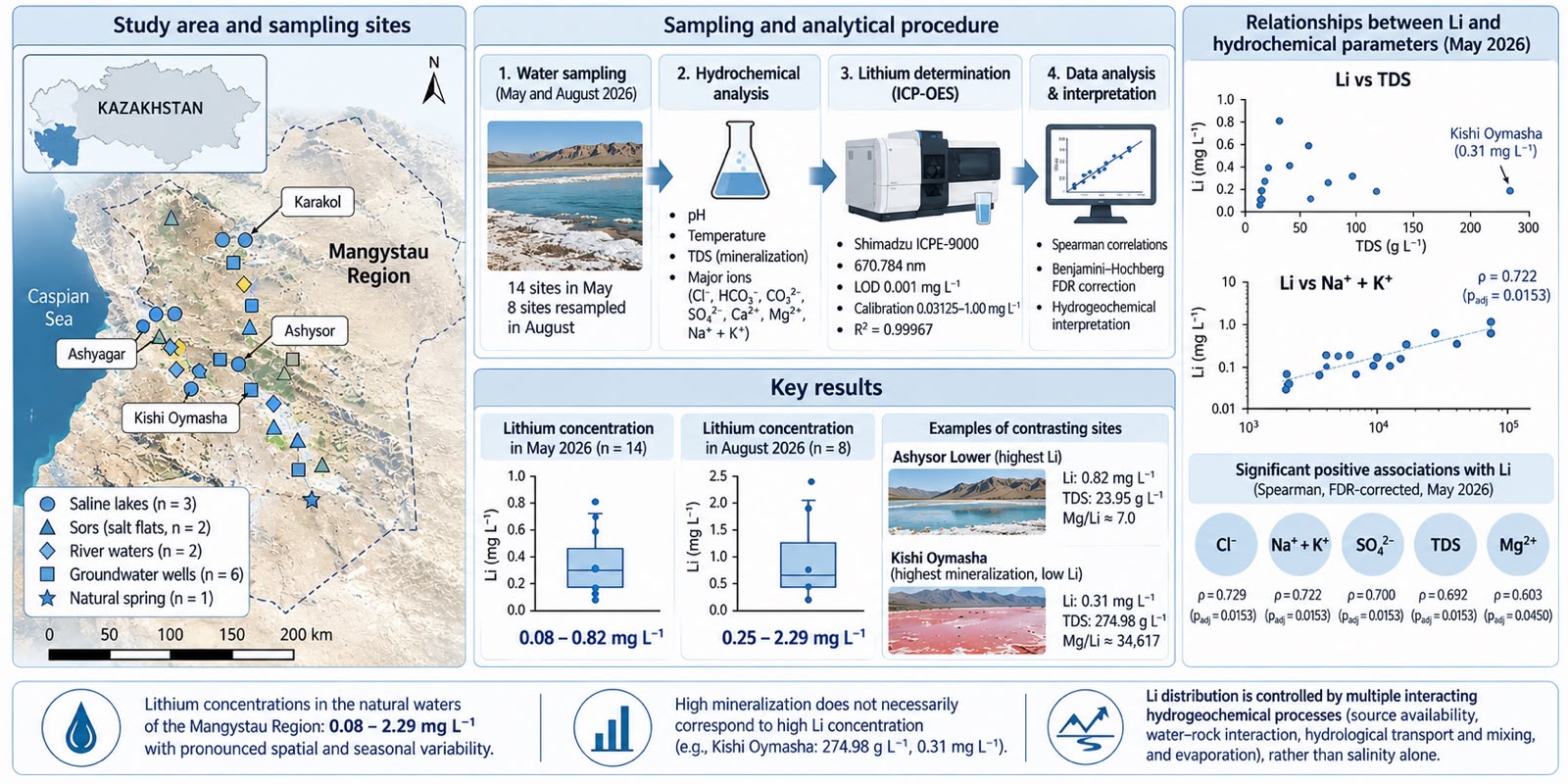
Lithium (Li) occurrence in natural waters is controlled by interacting hydrogeochemi-cal processes, yet these controls remain poorly constrained in the Mangystau Region of western Kazakhstan outside deep formation and oilfield brines. This study evaluated Li distribution and its principal hydrochemical controls in contrasting surface- and groundwater systems. Two sampling campaigns were conducted in May and August 2026 at 14 sites, including saline lakes, sors, river waters, groundwater wells, and a natural spring; eight sites were resampled in August. Physicochemical parameters and major ions were determined using standardized hydrochemical methods, while Li, Na, and K were quantified by ICP-OES. Relationships were assessed using Spearman rank correlations with Benjamini–Hochberg false-discovery-rate correction. Li concentra-tions ranged from 0.08–0.82 mg L⁻¹ in May and 0.25–2.29 mg L⁻¹ in August, increasing at seven of eight repeatedly sampled sites. Kishi Oymasha had the highest calculated mineralization (274.98 g L⁻¹) but only 0.31 mg L⁻¹ Li. Significant positive associations remained between Li and Cl⁻, Na⁺ + K⁺, SO₄²⁻, TDS, and Mg²⁺. Overall, Li distribution reflects combined effects of source availability, water–rock interaction, hydrological transport and mixing, and evaporation rather than salinity alone.
Keywords:
lithium
; hydrogeochemistry
; natural waters
; groundwater
; saline lakes
; geological and structural map
; tectonic framework
Copyright: This open access article is published under a Creative Commons CC BY 4.0 license, which permit the free download, distribution, and reuse, provided that the author and preprint are cited in any reuse.