
Submitted:
06 October 2026
Posted:
09 October 2026
You are already at the latest version
Abstract
This article examines the development of muralism on the island of Tenerife between 1850 and 1950, focusing on its main manifestations, artists, iconographic characteristics, techniques, and conservation conditions. The study analyses the transition of religious painting from the nineteenth century, when it was primarily devotional in character, to the gradual incorporation of mural painting into civic and institutional spaces during the first half of the twentieth century. Through the study of representative works, the contributions of artists such as Néstor Martín-Fernández de la Torre, Mariano de Cossío, and José Aguiar are assessed, while the technical transition from dry painting on lime-based mortars to techniques such as encaustic painting and marouflage is documented. The material characteristics of the artworks and the influence of Tenerife's climatic conditions on their deterioration and conservation processes are also considered. In conclusion, the study highlights the close relationship between muralism, architecture, and territorial identity, emphasizing the urgent need to develop preventive conservation strategies adapted to the microclimatic conditions of the buildings.
Keywords:
mural painting
; tenerife
; canary islands
; preventive conservation
; painting techniques
; cultural herit-age
; art history
; nineteenth and twentieth centuries
1. Introduction
Mural painting constitutes one of the artistic manifestations most closely linked to inhabited space and the construction of collective identity. Its decorative dimension possesses political, social, and cultural representational capacities, with the potential to transform the urban landscape and human perceptions (Perdomo, 2022). In the case of Tenerife, and more broadly within the surrounding island contexts, artistic processes followed different rhythms from those of their contemporaries in the Iberian Peninsula; rhythms shaped by the political and cultural transformations, Atlantic isolation, and material conditions that affected the Canary Islands during the nineteenth and twentieth centuries. An example of this is the end of the Spanish Civil War, which brought about a revitalisation of muralism as an instrument of public representation, both propagandistic and regionalist in nature. As a result, currents originating in Mexican muralism, influences from European Symbolism, and decorative avant-garde movements reached the Canary Islands, finding a receptive and distinctive environment among Canary artists during the first half of the twentieth century. This combined influence, both Hispanic and transatlantic, endowed muralism in Tenerife with its own identity, constructed around the tension between the universal and the insular, between learned monumentality and the landscape as a subject.
Therefore, this article aims to catalogue and analyse the most representative mural ensembles from the period between 1850 and 1950 on the island of Tenerife, paying particular attention to the duality that runs throughout their production: that which separates and, at the same time, connects sacred and secular spaces. While during the nineteenth century mural painting was confined almost exclusively to the interiors of churches and chapels, with a clearly defined pedagogical and devotional function, the beginning of the twentieth century brought an expansion into theatres, casinos, institutional headquarters, and university buildings, where painting ceased to be a subordinate ornament and became a visual statement in its own right. Studying this transition involves not only describing iconographies and attributing authorship, but also understanding the material and historical conditions that made each ensemble possible, as well as those that, over time, have determined its current condition, itself influenced by the island’s climate.
The island’s climatic conditions (the Atlantic humidity of elevated urban areas, salt-laden air in port environments, and the diversity of microclimates within only a few kilometers) together with the combined use of local and imported materials and techniques, currently determine the conservation condition of these works to an extent that has not always been sufficiently acknowledged. This conservation condition reflects an iconographic and stylistic transition shaped by historical and material change: the shift from lime mortar and the dry-painting technique characteristic of the nineteenth century towards encaustic painting and marouflage, the system of canvases adhered to the wall that characterises the major mural works of the first half of the twentieth century.
Although the study focuses on the period 1850–1950, the ensemble by José Aguiar in the Cabildo Insular de Tenerife is exceptionally included, as it was initiated within the artistic context of the 1940s and 1950s and completed in 1960, due to its relevance to understanding the evolution of muralism in Tenerife.
2. Materials and Methods
The following research was structured into three consecutive methodological phases: delimitation of the study corpus, fieldwork, and bibliographic-documentary analysis.
First, a process of survey, identification, and cataloguing of the mural paintings preserved on the island of Tenerife was carried out. Based on the initial analysis of distinctive ensembles associated with the Catholic Church, specifically the Church of San Pedro de Güímar, the research was subsequently expanded to the island-wide context of Tenerife, applying chronological and typological criteria to delimit the study sample to works produced between 1850 and 1950.
Second, systematic fieldwork was conducted, consisting of on-site inspection and photographic documentation of the previously identified ensembles. The representative sample encompasses examples located in different municipalities across the island, particularly Santa Cruz de Tenerife and San Cristóbal de La Laguna, prioritising those works with an adequate degree of integrity and accessibility for visual analysis.
Finally, a specific historiographical and technical analysis was conducted for each selected case. This phase combined a review of specialised bibliographic literature, consultation of documentary and institutional sources, and formal examination of the artworks. This procedure made it possible to systematise data concerning authorship, stylistic attribution, technical execution, material characterisation, architectural context, and conservation condition of the murals under study.
3. Results
Based on the application of the methodological framework structured around the three phases described—delimitation of the corpus, in situ documentation, and documentary research—the present study has made it possible to systematise the catalogue of nineteenth- and early twentieth-century mural painting on the island of Tenerife. The data obtained reflect not only the geographical distribution of the works included in the sample, but also the formal patterns, attributed authorship, and diversity of supports and techniques employed in their execution.
As a general synthesis, Table 1 summarises the corpus analysed in the study, linking each mural work to its architectural location, chronological framework, authorship or school, painting technique, and current conservation condition:
To further explore the academic and historiographical implications of these findings, the results are structured into three complementary thematic sections:
3.1. The Mural Landscape in Tenerife: Typologies and Artists
3.1.1. Religious Muralism: Function, Iconography and Renewal
During the nineteenth century, most of the mural manifestations preserved in Tenerife were located in religious buildings. In these spaces, painting fulfilled a clearly defined pedagogical and doctrinal function: to make visible, in an immediate and accessible manner, a set of truths and symbols that the faithful were expected to recognise without the need for scholarly mediation. The compositions were generally simple in their spatial arrangement, with isolated figures or small groups, clearly defined contours, palettes dominated by soft tones, and a smooth pictorial surface, executed directly onto lime-based plaster using a secco painting, tempera, or oil on dry plaster techniques, which were considerably more common in the archipelago than traditional fresco painting (Hernández Perera, 1984).
A particularly illustrative example of this tradition is the ensemble of the Chapel of San Pedro de Arriba, in Güímar (Figure 1). Built in 1794 and declared an Asset of Cultural Interest (Bien de Interés Cultural), with the category of Monument, in 2006 (Gobierno de Canarias, 2006a), the chapel preserves a series of mural paintings produced between 1890 and 1895, initially attributed to Gumersindo Robayna Lazo. However, during the restoration carried out between 2009 and 2010, the discovery of the artist’s signature among the ornamental motifs made it possible to confirm the authorship of Ubaldo Bordanova Moreno, a finding that illustrates the importance of technical interventions for advancing historical knowledge of these works (Rodriguez Delgado, 2017).
These paintings were executed over a preparation consisting of lime mortars and fine plaster layers, using a dry technique fully consistent with the practices of Canary Islands religious mural decoration during the period. From a formal perspective, they display a two-dimensional surface with uniform brushwork and recognisable figuration: the Theological Virtues, the arms of Saint Peter, the sword of Saint Paul, and various symbols of the Passion of Christ are arranged within painted ornamental frames featuring garlands, vegetal scrolls, and trompe-l’œil architectural elements (Rodriguez Delgado, 2022). The figures neither interact nor generate a narrative; rather, they are isolated representations designed for direct visual reading and devotional contemplation (Réau, 1996; Hall, 2003).
In the twentieth century, this approach underwent a transformation, as can be seen in the work of Mariano de Cossío for the Parish Church of Santo Domingo de Guzmán in San Cristóbal de La Laguna (Figure 2). The paintings, executed in 1948, cover a substantial portion of the interior walls of the church and represent a qualitative shift in relation to nineteenth-century ensembles: greater narrative complexity, interacting figures, spatial depth, more dynamic compositions, and a palette of warm tones, ochres, and golds that lends the scenes a monumental warmth (Jáudenes Ruiz, 1999). The subjects represented include the Apotheosis of Saint Dominic of Guzmán, the Presentation of the Rosary, and various episodes relating to the Virgin of Candelaria. However, what makes the ensemble a major visual historical document is the presence of portraits of contemporary figures from Lagunero society integrated into the sacred scenes. This combination of portraiture and religious representation is not an anomaly, but rather a practice with deep roots in Hispanic devotional painting, which Cossío revived here while giving it a distinctly documentary dimension (Romeu Palazuelos, 1986). Technically, the work was executed using a combination of tempera and encaustic painting, representing a significant development compared with the dry tempera technique of the previous century and, as will be discussed below, a decisive factor in terms of material stability.
3.1.2. Civil and Institutional Muralism: Space, Representation and Identity
At the beginning of the twentieth century, the construction of new representative buildings—such as theatres, casinos, island institutional headquarters, and university assembly halls—was promoted in response to the growing bourgeois character of a sector of Tenerife’s society, which demanded decorative programmes consistent with their intended functions. Iconography consequently underwent a transformation: alongside religious scenes, representations began to include allegories of the island’s landscape, agricultural and maritime labour, technological progress, and the arts. In many cases, the aim was to construct a visual conception of Canarianness, fixing in monumental images an identity that the cultural regionalism of the period was simultaneously developing through literature, music, and architecture.
The Teatro Leal in La Laguna, built between 1912 and 1915, constitutes one of the earliest significant examples of this new function of painting within civil spaces devoted to leisure and culture. Its interior decorative paintings, produced between 1920 and 1930, are distributed across ceilings, boxes, cornices, and the upper areas of the auditorium, featuring ornamental motifs, seascapes, allegorical scenes, and references to music, dance, and the performing arts (Romeu Palazuelos, 1986). Technically, the paintings were executed using dry techniques (Guedes, 2018), probably with tempera and oil on plaster, creating a smooth, two-dimensional surface that integrates seamlessly with the building’s eclectic architecture with Modernist influences. The roof of this historic building contains an oil painting on adhered canvas (marouflage), executed by Manuel López Ruiz in 1915. The painting in the Teatro Leal was not intended to function as an autonomous work: its purpose was to reinforce the theatrical and ornamental character of the space, create an atmosphere consistent with the cultural function of the theatre, and reproduce, through a bourgeois decorative idiom, a visual imaginary that had already moved away from the religious sphere.
The case of the Real Casino de Tenerife represents a more decisive development. The present building, inaugurated in 1935 and designed by the architect Miguel Martín-Fernández de la Torre, was conceived from the outset as a unified space in which architecture, decorative arts, and painting would form part of a single aesthetic programme (Gobierno de Canarias, 2006b). The murals commissioned from Néstor Martín-Fernández de la Torre for the main hall, known as Alegoría de La Tierra (Figure 3) and Alegoría del Mar (Figure 4), represent, in this sense, the fullest expression of an aspiration towards the synthesis of art and architecture that late Modernism had established as a programme. Although commonly referred to as murals, Alegoría de La Tierra and Alegoría del Mar are, strictly speaking, large oil paintings on canvas subsequently attached to the walls using the marouflage technique (Gobierno de Canarias, 2013), a process with significant technical and conservation implications. The monumental compositions depict the agricultural world and maritime universe of the Canary Islands through stylised figures, solemn anatomies, and an intense palette of greens, blues, and ochres. Rather than depicting genre scenes, the works present idealised allegories of insular identity, constructed through the Symbolist sensibility that Néstor had developed during his long period in Europe (Castro Borrego & Allen Hernández, 2010)). The Friso Isleño (Figure 5), which runs along the upper sections of several rooms in the building, completes the programme with a continuous decorative sequence of figures, landscapes, flowers, fruits, and elements associated with rural and maritime life, constituting a more directly mural synthesis than the large canvases in the main hall (Rivero Pérez, 2020).
The cycle of institutional muralism reaches its greatest complexity with the work of José Aguiar in the Noble Hall of the Cabildo Insular de Tenerife. Although the ensemble was completed in 1960, its conception and Aguiar’s artistic style were fully developed during the 1940s and 1950s, allowing it to be considered as the mature stage of the period examined here. The work occupies approximately 200 square metres distributed across three of the hall’s main walls: the southern wall is devoted to the mythical and historical origins of the Canary Islands, the western wall to rural and agricultural scenes, and the eastern wall to the maritime and fishing world (Gobierno de Canarias, 2011). The scale of the figures, compositional density, and chromatic intensity construct an idealised vision of the history, landscape, and traditional activities of the archipelago, transforming the Noble Hall into one of the most symbolically charged spaces within twentieth-century Canarian artistic heritage.
3.1.3. Great Masters: Profiles of the Key Figures
The period is defined through three key artists, each embodying a different approach to the relationship between painting, space, and territory. Néstor Martín-Fernández de la Torre, a native of Gran Canaria, was a major synthesiser of the European Symbolist and decorative heritage with insular sensibility. His work at the Casino de Tenerife is inseparable from his broader project of visually defining Canarian identity, a project that oscillated between the aestheticised exaltation of the landscape and the desire to create a distinctive iconography for the Atlantic (Castro Borrego & Allen Hernández, 2010). Mariano de Cossío contributed a more directly narrative and monumental dimension: trained in Madrid and Europe, his work at Santo Domingo and at the Paraninfo of the University of La Laguna combines the influence of muralism with academic classicism and Baroque illusionism, producing ensembles in which the architectural space is expanded and imbued with allegorical content (De la Rosa Vilar et al., 2004). José Aguiar, born in Spanish Havana, takes the lessons of American muralism to their ultimate expression: his figures are powerful and monumental, his compositions deliberately epic, and his palette rich and dense.
3.2. Materiality and Technique
3.2.1. Supports and Preparation
The analysis of the cases studied reveals a technical evolution consistent with the stylistic and iconographic transformations described above. During the nineteenth century, the predominant support was a masonry wall rendered with lime-based mortars, onto which the pictorial layers were applied once the plaster had dried. This system, which in the Canary Islands frequently incorporated locally sourced volcanic stone, behaves very differently from mainland Spanish or Italian walls in terms of porosity and hygroscopic capacity, imposing technical constraints that artists of the period did not always fully master (Campos Domínguez, 2010). An example of this can be found in the restoration works carried out on the churches of El Salvador and Nuestra Señora de Las Nieves (La Palma) (Ventura, 2007), both of which feature lime-based supports; a type of rendering that tends to allow moisture to permeate through capillary action from the ground. In both cases, oil paints were used, a material which, when applied to these renders, favours moisture retention and can consequently contribute to the deterioration of the painting (Miranda, 1921).
The combination of secco techniques on lime-based supports, so common in nineteenth-century Canarian religious mural painting, constitutes one of the main factors contributing to the conservation pathologies currently observed in ensembles such as that of the Chapel of San Pedro de Arriba.
In response to moisture-related conservation problems, the marouflage technique became increasingly widespread during the twentieth century. This technique consists of painting on a canvas independently of the wall and subsequently attaching it to the architectural surface using adhesives. It originated in fifteenth-century Venice as a solution to the problem of moisture infiltration through walls and the resulting deterioration of mural paintings (Iancu, 2024). The use of this technique transformed the relationship between the architectural support, pictorial surface, and conservation of the artwork. Néstor used this technique for La Tierra and El Mar at the Casino de Tenerife, while Aguiar systematically employed it in the Cabildo Insular. It allowed artists to work under controlled studio conditions, with complete compositional freedom and without the drying-time constraints associated with techniques applied directly to walls. However, it also introduced new vulnerabilities: the adhesion between the canvas and the wall depends on the stability of the adhesive used, and any differential movement between the mural support and the canvas (caused by variations in temperature or humidity) can generate air pockets, detachment, or deformations that are difficult to reverse.
3.2.2. Palette, Binders and Painting Techniques
The dry technique predominant during the nineteenth century involved the use of protein-based or aqueous binders (glue tempera, egg tempera, and, in some cases, highly diluted oil) that bound the pigments without creating the mineralised layer characteristic of fresco painting. Under certain conditions, these preparations are more sensitive to moisture and environmental fluctuations than the mineralised pictorial layers characteristic of fresco. The pigments used during this period were predominantly traditional materials (natural earth pigments, lime and lead whites, and some mineral blues), with the progressive incorporation of industrial pigments as the century advanced.
Encaustic painting, employed by Cossío at Santo Domingo and by Aguiar at the Cabildo, represents a substantially different technical approach. By using beeswax as a binder, encaustic painting provides the pictorial surface with greater resistance to moisture and a material richness distinct from that of tempera (González González, 2000). The palette gains intensity and depth, while the surface acquires a distinctive tactile quality. However, encaustic painting presents its own conservation challenges in a warm and humid climate such as that of the Canary Islands: the wax may soften, accumulate dust and dirt that can be difficult to treat, and sudden thermal changes can make the surface particularly vulnerable.
As for Néstor’s La Tierra and El Mar, their nature as oil paintings on canvas places them within a well-established technical tradition. However, their condition as works attached to the wall (and not originally conceived as easel paintings) means that their behaviour differs from that of a conventional painting. The canvas responds differently from when it is mounted on a stretcher, the accumulation of stresses is different, and the adhesives used in the marouflage constitute a specific point of vulnerability that conservation treatments must take into consideration.
3.2.3. Environmental Conditions: The Atlantic Climate as a Determining Variable
Tenerife does not have a single climate, but rather several climatic conditions overlapping within a relatively short geographical distance and determined by altitude, orientation, and proximity to the sea. This climatic diversity, one of the most distinctive characteristics of the island’s territory, becomes a major factor in the conservation of its cultural heritage. La Laguna, located at more than 550 m above sea level and frequently enveloped in mist and clouds, experiences very high relative humidity levels and cooler temperatures than the coast. Santa Cruz, by contrast, is a coastal city characterised by higher temperatures, greater solar exposure, and a constant presence of sea salt carried inland from the Atlantic (Santana Pérez, 2013).
These differences directly affect the deterioration mechanisms affecting mural ensembles. In the case of Cossío’s murals at Santo Domingo (located in a La Laguna building with thick volcanic ashlar walls and a history of problems associated with rising damp) the high relative humidity of the surrounding environment favours the growth of microorganisms on dry-painted pictorial layers, the formation of salt efflorescence, and the progressive loss of adhesion between the pictorial strata and their support. In Santa Cruz, by contrast, the presence of marine salts may promote crystallisation and the expansion of pores within the wall, potentially generating pressures that ultimately cause the rendering and the pictorial layers applied over it to fragment. Néstor’s works at the Casino and Aguiar’s works at the Cabildo are exposed to this second type of risk, which, in the case of adhered canvases, is combined with the specific vulnerability of the adhesives to the temperature and humidity fluctuations characteristic of the coastal climate.
3.3. Conservation Condition
3.3.1. Current Condition: General Assessment
The deterioration processes affecting the mural ensembles from this period are, in general terms, those that would be expected from the combination of secco techniques applied over lime or cement-based renders and an Atlantic climate characterised by high relative humidity. Salt efflorescence (whitish deposits produced by the crystallisation of soluble salts on the pictorial surface) is one of the most widespread problems, particularly in buildings in La Laguna. Detachment of pictorial layers, favoured by the poor adhesion between dry-painted strata and lime-based supports, affects, to varying degrees, all of the nineteenth-century ensembles (Mora, Mora and Philippot, 1984).
In canvases adhered to the wall, such as Néstor’s La Tierra and El Mar and Aguiar’s murals in the Cabildo, the main deterioration phenomena include the formation of air pockets between the canvas and the wall, oxidation and ageing of the adhesives, and deformations caused by differential stresses between the architectural support and the canvas fabric. In both cases, changes in use and modifications introduced into the buildings over time (such as climate-control systems, the opening of new apertures, and changes in lighting) have altered the original environmental conditions and, in some cases, accelerated deterioration processes (Venegas García and Barrainkua Legido, 2021).
3.3.2. Recent Interventions and Reference Cases
The restoration carried out at the Chapel of San Pedro de Arriba between 2009 and 2010 constitutes one of the best-documented episodes of intervention on nineteenth-century religious mural painting in Tenerife (Campos Domínguez, 2010). In addition to stabilising the pictorial layers and consolidating strata at risk of detachment, the intervention led to the discovery of Bordanova’s signature, highlighting the methodological importance of rigorous restoration processes as a tool for historical research. The case demonstrates that comprehensive documentation prior to any intervention (including stratigraphic analysis, mortar studies, and identification of original techniques) is as important as the material treatment itself.
The designation of Aguiar’s murals as Assets of Cultural Interest in 2011 (Gobierno de Canarias, 2011), and Néstor’s murals in 2013 (Gobierno de Canarias, 2013), has established a legal framework for their protection which, nevertheless, does not in itself resolve preventive conservation issues. Legal protection is necessary but not sufficient: these works also require continuous environmental monitoring protocols, regular assessment of the condition of the adhesives in the case of adhered canvases, and preventive treatments adapted to the specific conditions of each microclimate.
4. Discussion
The results show that the evolution of muralism in Tenerife between 1850 and 1950 was not solely stylistic, but also material. The transition from dry painting on lime mortar to techniques such as encaustic painting and marouflage modified the relationship between painting, support, and environment and, consequently, the factors affecting their conservation. This transition can be interpreted within preventive conservation models, which have evolved from the control of environmental parameters towards the identification and management of specific risks (Waller and Michalski, 2005). In this regard, technique does not eliminate vulnerability, but rather modifies its nature. This interpretation should be considered in light of the limited size of the sample and the fact that the study does not incorporate its own environmental monitoring.
4.1. Technical Transition and Support Vulnerability: From Dry Painting on Lime to Marouflage
Murals executed using dry techniques on lime mortar are vulnerable primarily due to the behaviour of their support. Moisture can promote loss of cohesion and alterations in the adhesion of the pictorial layers (Mora, Mora and Philippot, 1984). Therefore, in these ensembles, preventive control should focus particularly on humidity conditions and the possible pathways through which moisture may enter the artwork.
Encaustic painting introduces wax as a binder, reducing the direct sensitivity of the pictorial layer to water. However, this does not imply absolute stability, as organic materials remain vulnerable to thermal and environmental conditions (Michalski, 2002).
Marouflage, on the other hand, introduces an intermediate space between the wall and the artwork, the canvas, meaning that variations in temperature and humidity can produce different responses in the two supports and generate stresses within the bond, favouring deformation or loss of adhesion (Mecklenburg and Tumosa, 1991). Thus, the technical evolution identified in the results can be understood as a redistribution of risk: dry painting on lime is particularly vulnerable to moisture, whereas marouflage introduces a dependency on the stability of the adhesive.
This approach is consistent with the risk-management framework proposed by Waller and Michalski in 2005, according to which preventive measures should be adapted to the specific agents and mechanisms of deterioration affecting each cultural heritage object.

Table 2.
Technique, vulnerability and prevention.
| Technique | Vulnerable component | Relevant deterioration agents | Potential mechanism | Preventive priority |
|---|---|---|---|---|
| Secco painting | ||||
| Render and pictorial layers | Moisture and salts | Moisture transport, crystallisation, and loss of adhesion | Control of the building’s hygrothermal behaviour | |
| Encaustic | Waxy pictorial layer | Temperature, humidity, and dirt | Modification of physical properties and ageing | Monitoring of thermal and environmental conditions |
| Marouflage | Canvas, adhesive, and wall–canvas interface | Temperature and RH fluctuations | Differential movement, deformation, and loss of adhesion | Environmental monitoring and inspection of the interface |
4.2. Physicochemical Behaviour According to the Island’s Microclimates
The environmental differences between the buildings studied make it impossible to consider Tenerife as a homogeneous climatic context. Altitude, orientation, and proximity to the sea generate differentiated humidity and temperature conditions (Santana Pérez, 2013). This variability becomes particularly significant when considered in relation to the different techniques and supports identified.
In La Laguna, conditions of high humidity may favour the persistence of moisture within porous materials and, consequently, processes such as biological growth, salt mobilisation, and loss of adhesion of the pictorial layers. In Santa Cruz, proximity to the marine environment additionally introduces the presence of salts, whose dissolution, transport, and crystallisation depend on humidity conditions and their fluctuations (Charola, 2000). Therefore, salt-related deterioration cannot be explained solely by the presence of salts, but rather by their interaction with water and with the characteristics of the support.
This difference demonstrates the need to interpret deterioration agents at a microclimatic scale. The same agent may produce different deterioration mechanisms depending on the technique, the building, and the specific environmental conditions. Furthermore, subsequent modifications to the buildings, such as the installation of climate-control systems or changes in ventilation and lighting, may alter the original conservation conditions.
4.3. Critical Evaluation of the Applied Criteria
The cases analysed reveal an evolution in intervention and documentation criteria. The restoration of the Chapel of San Pedro de Arriba (2009–2010), in addition to stabilising the pictorial layers, made it possible to locate Bordanova’s signature, demonstrating the value of technical research as a tool for historical knowledge. Prior documentation, the study of materials, and the identification of original techniques therefore constitute fundamental elements for establishing appropriate interventions, in accordance with the principles for the conservation of mural paintings established by ICOMOS (2003).
From the perspective of preventive conservation, the designation of a heritage asset as an Asset of Cultural Interest (BIC) constitutes a necessary protective measure, but it does not replace monitoring its conservation condition or controlling risk factors. The ensembles classified in this research as “Unrestored” should likewise not necessarily be considered free from risk: the absence of intervention does not imply the absence of deterioration processes. A preventive approach requires these processes to be identified and monitoring measures to be established before they necessitate more extensive interventions (IPCE, 2011).
For murals executed on lime-based mortars, these measures should focus particularly on the control of moisture and salts, whereas works employing marouflage require periodic assessment of the adhesive. Establishing a systematic record of conservation condition would make it possible to create a baseline for future assessments. Heritage conservation cannot be approached through a single technical or environmental criterion.
The transition from dry painting to encaustic painting and marouflage also entails a transformation of the works’ risk profiles. Consequently, preventive strategies must be adapted to the materiality of each work and to the specific microclimatic conditions of the building in which it is preserved.
5. Conclusions
The survey of the mural ensembles in Tenerife dating from 1850 to 1950 makes it possible to establish the island’s relevance as an active centre of Spanish muralism during the mid-twentieth century.
The presence of artists of the calibre of Néstor Martín-Fernández de la Torre, Mariano de Cossío, and José Aguiar, together with the exceptional concentration of monumental ensembles in such diverse settings as a small rural chapel, a city theatre, a bourgeois casino, and the representative hall of the Cabildo, constitute a heritage of outstanding value that deserves systematic and rigorous attention.
Beyond the aesthetic and historical value of these works, however, their technical study has an instrumental dimension that this article has sought to emphasise: understanding how they were materially constructed, which techniques and materials were employed in each case, and how each work responds to the climatic conditions of the environment in which it is preserved is essential for developing long-term conservation strategies. The transition from nineteenth-century dry tempera painting to the encaustic and marouflage techniques of the twentieth century is not merely a technical detail; it is the axis around which the principal vulnerabilities of Tenerife’s mural heritage revolve and, consequently, the starting point from which future conservation efforts should be structured.
Although Tenerife is fortunate to possess works of exceptional quality and visual coherence, it is equally important to assume the responsibility of preserving them with the same ambition with which they were conceived.
Furthermore, maintenance interventions should focus on controlling rising damp, which is responsible for a significant proportion of salt efflorescence, and on the periodic assessment of the adhesives used in the canvases at the Casino and the Cabildo, whose aging can be anticipated over the coming decades. It would also be necessary to develop a systematic catalogue of the conservation condition of all the ensembles from the period, providing a baseline against which the evolution of deterioration phenomena over time can be assessed. The training of conservators specialised in Atlantic mural techniques, with specific knowledge of Canarian lime mortars, encaustic painting, and marouflage, constitutes a structural need that the island’s academic and cultural institutions should address as a matter of urgency.
References
- Perdomo Mendoza, E. Visión crítica de Gran Canaria a través del arte del siglo XX [Trabajo de Fin de Máster, Universidad de La Laguna]. Repositorio Institucional de la Universidad de La Laguna. 2022. Available online: http://riull.ull.es/xmlui/handle/915/31563.
- Hernández Perera, J.; March, Fundación Juan. Arte. En Canarias. Tierras de España, 1.a ed.; Fundación Juan March y Noguer, 1984. [Google Scholar]
- Gobierno de Canarias. Decreto 21/2006, de 21 de febrero, por el que se declara Bien de Interés Cultural, con categoría de Monumento, la Capilla de San Pedro de Arriba. Boletín Oficial de Canarias, 2006a.
- Rodríguez Delgado, O. La capilla de San Pedro Arriba en Güímar (1794-2017). Recuperado de: El Blog de Octavio Rodríguez Delgado. 2017. Available online: https://blog.octaviordelgado.es/la-capilla-de-san-pedro-arriba-en-guimar-1794-2017/.
- Rodríguez Delgado, O. La capilla de San Pedro Arriba en Güímar (1794). Recuperado de: El Blog de Octavio Rodríguez Delgado. 2022. Available online: https://blog.octaviordelgado.es/wp-content/uploads/2022/06/Articulo-CAPILLA-DE-SAN-PEDRO-ARRIBA-GUIMAR-1.pdf.
- Réau, L. Iconografía del arte cristiano: Iconografía de la Biblia: Antiguo Testamento. Volumen 1.; Ediciones del Serbal, 1996. [Google Scholar]
- Hall, J. Diccionario de temas y símbolos artísticos; Alianza Editorial: Madrid, 2003. [Google Scholar]
- Jáudenes Ruiz de Atauri, Í. Estudio científico de la pintura mural al fresco de Mariano de Cossío. Aportaciones al conocimiento de los murales del siglo XX en Canarias [Tesis doctoral, Universidad de La Laguna]. Repositorio Institucional de la Universidad de La Laguna. 1999. Available online: http://riull.ull.es/xmlui/handle/915/9597.
- Romeu Palazuelos, E. Retratos en el mural que pintó Mariano de Cossío para la Iglesia de Santo Domingo de la ciudad de San Cristóbal de La Laguna. Anuario de Estudios Atlánticos 1986, 1(32), 555–574. [Google Scholar]
- Guedes, E. R. En la bruma de la memoria, los primeros cines de La Laguna. In Los patrimonios de La Laguna: Volumen 1; Instituto de Estudios Canarios, 2018; pp. 283–314. [Google Scholar]
- Gobierno de Canarias. Decreto 59/2006, de 16 de mayo, por el que se declara Bien de Interés Cultural, con categoría de Monumento, el Casino de Santa Cruz de Tenerife. Boletín Oficial de Canarias, 2006b.
- Gobierno de Canarias. Decreto 49/2013, de 2 de mayo, por el que se declaran Bien de Interés Cultural, con categoría de Bien Mueble, los murales de Néstor Martín-Fernández de la Torre ubicados en el Casino de Santa Cruz de Tenerife. Boletín Oficial de Canarias, 2013.
- Castro Borrego, F., & Allen Hernández, J. (2010). Historia cultural del arte en Canarias. Vol. 7. La modernidad y las vanguardias en Canarias 1900-1939. Consejería de Educación, Formación Profesional, Actividad Física y Deportes.
- Pérez, A. R. La representación de naturalezas muertas en la pintura mural canaria del siglo XX. In XXIII Coloquio de Historia Canario-Americana; Cabildo Insular de Gran Canaria, 2020; p. 57. [Google Scholar]
- Gobierno de Canarias. Decreto 309/2011, de 4 de noviembre, por el que se declara Bien de Interés Cultural, con categoría de Bien Mueble, los Murales de José Aguiar ubicados en el Salón Noble del Cabildo Insular de Tenerife. Boletín Oficial de Canarias, 2011.
- De la Rosa Vilar, D.; Acosta Rodríguez, S.; Tudela Noguera, M. Á.; Álvarez, E. Mariano de Cossío: Pintura mural del techo del Paraninfo. Conservación-restauración; Departamento de Pintura y Escultura, Universidad de La Laguna: Santa Cruz de Tenerife, 2004. [Google Scholar]
- Campos Domínguez, Elisa; Güímar. Informe de restauración de las pinturas murales y el artesonado de la Capilla de San Pedro de Arriba [Informe inédito; Archivo Histórico Diocesano de La Laguna, 2010. [Google Scholar]
- Ventura, F. D. La restauración del templo de El Salvador por Bordanova (1895-1896. Revista de Estudios Generales de la Isla de la Palma 2007, (3), 279–302. Available online: http://www.palmensis.com/estudios-generales/pdf/tres/ARTE/0324-FACUNDO.pdf.
- Miranda, C. A. De morteros y aplicación de pinturas al óleo. Anales del Instituto de Ingenieros de Chile (No. 2). 1921. [Google Scholar]
- Iancu, S. M. (2024). Estudio histórico, técnico-conservativo y propuesta de conservación futura, de un lienzo marouflage con iconografía del Padre Eterno, perteneciente a la parroquia de San Esteban Protomártir de Valencia. [Trabajo de fin de grado, Universitat Politécnica de Valencia] Repositorio institucional UPV. https://riunet.upv.es/entities/publication/d9de2bb0-95d9-442a-9d51-e16869e858aa.
- González González, J. (2000). Pintura a la cera: encáustica y derivados en frío. Universidad de Sevilla, Secretariado de Recursos Audiovisuales y Nuevas Tecnologías eBooks, 1. https://dialnet.unirioja.es/servlet/articulo?codigo=6501188.
- Santana Pérez L., M. (2013). ANÁLISIS DE LAS HUMEDADES RELATIVAS DEL AIRE EN TENERIFE. En AgroCabildo. https://www.agrocabildo.org/publica/analisisclimatico/HUMEDADTENERIFE2.pdf.
- Mora, P.; Mora, L.; y Philippot, P. Conservation of wall paintings; Butterworths, 1984. [Google Scholar]
- Venegas García, C.; Barrainkua Legido, A. Conservación y restauración de pintura mural. In Síntesis; 2021. [Google Scholar]
- Waller, R.; y Michalski, S. A paradigm shift for preventive conservation, and a software tool to facilitate the transition. ICOM Committee for Conservation, 14th Triennial Meeting, The Hague; ICOM-CC. (ICOM-CC Publicaciones En Línea, 2005; pp. 733–738. [Google Scholar]
- Michalski, S. Double the life for each five-degree drop, more than double the life for each halving of relative humidity. ICOM Committee for Conservation, 13th Triennial Meeting, Rio de Janeiro; ICOM-CC. (ICOM-CC Publicaciones En Línea, 2002; pp. 66–72. [Google Scholar]
- Mecklenburg, M. F.; y Tumosa, C. S. Mechanical Behavior of Paintings Subjected to Changes in Temperature and Relative Humidity. In Art in Transit: Studies in the Transport of Paintings; Mecklenburg, M. F., Ed.; National Gallery of Art: Washington, D.C., 1991; pp. 173–216. [Google Scholar]
- Charola, A. E. Salts in the deterioration of porous materials: An overview. Journal of the American Institute for Conservation (CoOL). 2000, 39(3), 327–343. [Google Scholar] [CrossRef]
- ICOMOS (2003). Principles for the Preservation and Conservation-Restoration of Wall Paintings. Adopted at the 14th General Assembly, Victoria Falls. (ICOMOS).
- IPCE. Plan Nacional de Conservación Preventiva; Instituto del Patrimonio Cultural de España, Ministerio de Cultura. (Cultura), 2011. [Google Scholar]
Figure 1.
Chapel of San Pedro de Arriba, in Güímar (Self-authored). Images authorized by the Bishopric of Tenerife.
Figure 1.
Chapel of San Pedro de Arriba, in Güímar (Self-authored). Images authorized by the Bishopric of Tenerife.
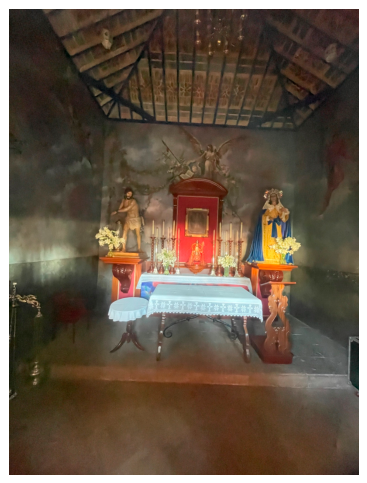
Figure 2.
Church of Santo Domingo de Guzmán in San Cristóbal de La Laguna (Self-authored). Images authorized by the Bishopric of Tenerife.
Figure 2.
Church of Santo Domingo de Guzmán in San Cristóbal de La Laguna (Self-authored). Images authorized by the Bishopric of Tenerife.
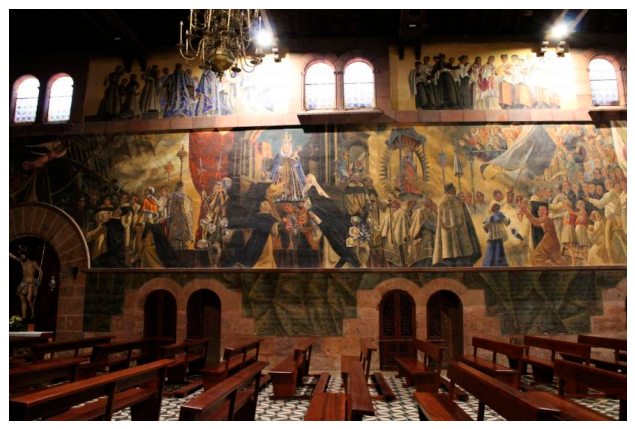
Figure 3.
Alegoría de la tierra, by Néstor Martín-Fernández de la Torre. Source: Real Casino de Tenerife (n.d.), reproduced with permission.
Figure 3.
Alegoría de la tierra, by Néstor Martín-Fernández de la Torre. Source: Real Casino de Tenerife (n.d.), reproduced with permission.
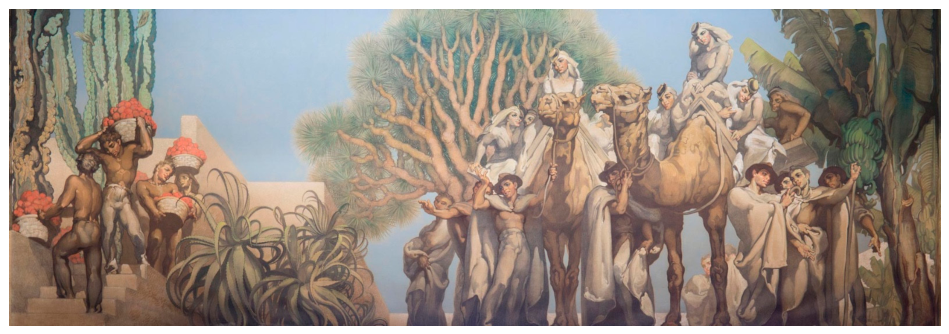
Figure 4.
Alegoría del mar, by Néstor Martín-Fernández de la Torre. Source: Real Casino de Tenerife (n.d.), reproduced with permission.
Figure 4.
Alegoría del mar, by Néstor Martín-Fernández de la Torre. Source: Real Casino de Tenerife (n.d.), reproduced with permission.
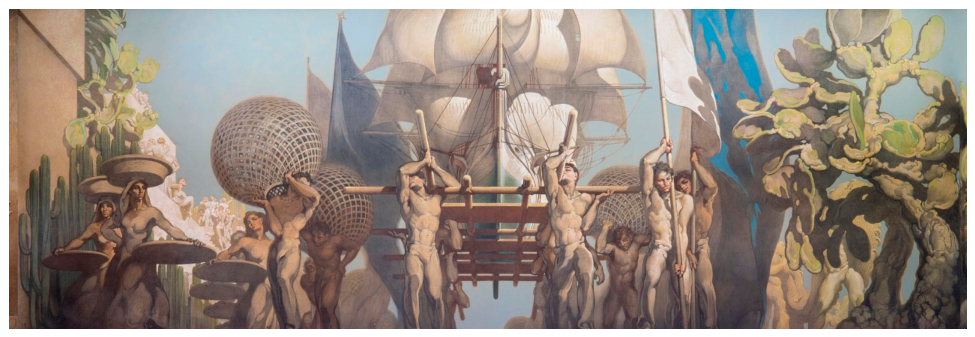
Figure 5.
Friso Isleño, by José Aguiar de la Torre. Source: Real Casino de Tenerife (n.d.), reproduced with permission.
Figure 5.
Friso Isleño, by José Aguiar de la Torre. Source: Real Casino de Tenerife (n.d.), reproduced with permission.
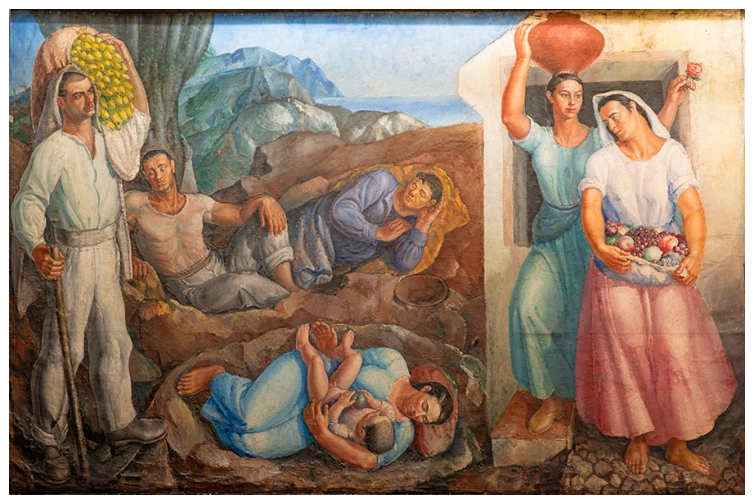
Table 1.
Mural Paintings in Tenerife, 1850-1950.
| Building | Municipality | Ensemble-Chronology | Attribution | Technique-Support | Conservation condition |
|---|---|---|---|---|---|
| Capilla de San Pedro de Arriba | |||||
| Güímar | Virtudes teologales, 1829–1898 | Ubaldo Bordanova |
Secco painting |
Restored in 2010 | |
| Real Casino de Tenerife | Santa Cruz de Tenerife | Alegoría de la tierra, 1932–1935 | Néstor Martín-Fernández de la Torre | Oil on canvas | Unrestored |
| Real Casino de Tenerife | Santa Cruz de Tenerife | Alegoría del mar, 1932–1935 | Néstor Martín-Fernández de la Torre | Oil on canvas | Unrestored |
| Real Casino de Tenerife | Santa Cruz de Tenerife | Friso Isleño, 1941 | José Aguiar | Encaustic on canvas | Restored in 1978 |
| Parroquia de Santo Domingo de Guzmán | San Cristóbal de La Laguna | 1948 | Mariano de Cossío | Fresco painting |
Unrestored |
| Teatro Leal | San Cristóbal de La Laguna | Techo, 1915–1930 | Manuel López Ruiz | Oil on canvas | Restored in 2001–2008 |
| Cabildo insular de Tenerife | Santa Cruz de Tenerife | Murales del salón noble, 1951–1960 | José Aguiar García | Encaustic on canvas | Unrestored |
Disclaimer/Publisher’s Note: The statements, opinions and data contained in all publications are solely those of the individual author(s) and contributor(s) and not of MDPI and/or the editor(s). MDPI and/or the editor(s) disclaim responsibility for any injury to people or property resulting from any ideas, methods, instructions or products referred to in the content. |
© 2026 by the authors. Licensee MDPI, Basel, Switzerland. This article is an open access article distributed under the terms and conditions of the Creative Commons Attribution (CC BY) license (http://creativecommons.org/licenses/by/4.0/).
Copyright: This open access article is published under a Creative Commons CC BY 4.0 license, which permit the free download, distribution, and reuse, provided that the author and preprint are cited in any reuse.