

Submitted:
08 October 2026
Posted:
09 October 2026
You are already at the latest version
Abstract
Background/Objectives: Bitewing (BW) radiographs are essential for detecting proximal caries but may cause discomfort and anxiety in children. Virtual reality (VR) distraction reduces procedural pain in several dental interventions, but its use during dental radiography has not been investigated. This study evaluated the effect of VR distraction on objective and subjective discomfort and pain during BW imaging in children aged 4–12 years. Methods: In this parallel-group randomized controlled clinical trial at King Abdulaziz University Dental Hospital, Jeddah, Saudi Arabia (ClinicalTrials.gov NCT07376941), 74 cooperative children were randomized 1:1 to VR distraction (n = 37) or no distraction (n = 37). Sessions were video recorded, and two calibrated examiners scored objective pain behavior with a modified Face, Legs, Activity, Cry, and Consolability (FLACC) scale (Face item excluded because the headset obscured facial expressions), the primary outcome. Immediately afterwards, children rated pain with the Arabic Wong–Baker FACES Pain Rating Scale and satisfaction on a 10-point Likert scale (secondary outcomes). Results: Groups were comparable at baseline. A modified FLACC score of zero was more frequent in the VR group (83.8% vs. 67.6%), but the difference was not significant (p = 0.267). More children in the VR group self-reported zero pain (91.9% vs. 70.3%; p = 0.044). Maximum satisfaction did not differ significantly (89.2% vs. 83.8%; p = 0.368). No adverse events were reported. Conclusions: VR distraction did not significantly reduce examiner-rated pain behavior, the primary outcome. The significant difference in self-reported pain, a secondary outcome without adjustment for multiplicity, should be regarded as exploratory. Adequately powered multicenter trials with blinded outcome assessment are needed.
Keywords:
virtual reality
; immersive technologies
; digital health
; distraction
; pediatric dentistry
; dental radi-ography
; procedural pain
; FLACC
1. Introduction
Bitewing (BW) radiographs are among the most valuable diagnostic tools for detecting and monitoring proximal carious lesions and feature high accuracy and sensitivity [1,2]. Despite the procedure’s importance and brevity, pediatric patients may experience discomfort, pain, and anxiety associated with intraoral radiographic imaging, which may negatively influence their willingness to cooperate and can shape their attitude toward future dental visits [3]. Previous investigations have found that most children experience low levels of discomfort during BW imaging [3,4], with half of the children (50%) reporting that the process is painless, but approximately 1.7% reported significant pain [4].
Virtual reality (VR) can be used to create an immersive computer-generated environment that engages multiple sensory channels to redirect a patient’s attention away from a clinical setting [5]. Unlike pharmacological approaches, VR operates through attentional distraction and modifies pain perception by competing for limited conscious attentional resources rather than altering underlying physiological pain pathways. This mechanism is theoretically well suited to procedural pain in dentistry, where psychological anticipation and anxiety frequently amplify the subjective experience of pain. Numerous randomized controlled clinical trials (RCTs) have demonstrated that VR distraction reduces discomfort, pain, and anxiety during various pediatric dental procedures, including local anesthesia administration, pulpotomy, and prophylaxis [6,7,8,9,10,11,12].
However, to our knowledge, no study has evaluated VR distraction during dental radiographic image acquisition with children. BW imaging presents a distinct procedural context as it is brief, minimally invasive, and involves placing an intraoral sensor with a film holder, which may trigger a gag reflex or cause mild oral discomfort. Given the known effects of VR and behavioral challenges of pediatric imaging, there is a clinical rationale to investigate whether VR can meaningfully improve this experience. Therefore, we conducted an RCT to evaluate the impact of VR distraction on objective and subjective discomfort and pain during BW radiographs in children aged 4 to 12 years. The hypothesis was that VR distraction would reduce both objective and subjective pain outcomes.
2. Materials and Methods
2.1. Study Design and Ethics
This parallel-group RCT was conducted at the Radiology Department of King Abdulaziz University Dental Hospital (KAUDH), Jeddah, Saudi Arabia. Ethical approval was granted by the Research Ethics Committee of the Faculty of Dentistry at King Abdulaziz University (Approval No. 32-03-25, dated 15 April 2025). The trial was prospectively registered at ClinicalTrials.gov (NCT07376941) and reported in accordance with the Consolidated Standards of Reporting Trials (CONSORT) 2025 guideline [13]. The full trial protocol, including the statistical analysis plan, is provided in the Supplementary Materials (File S1).
Before enrolment began, the planned sample size was increased from 60 to 74 participants (37 per group) after a formal a priori power calculation, and the VR headset was changed from the LG 360 to the Meta Oculus Quest 2 because the LG 360 was no longer commercially available (File S1). All radiographs related to this study were taken as part of routine clinical care, and no additional radiographic exposures were performed for purposes of this research. Patients and the public were not involved in the design, conduct, reporting, or dissemination plans of this research. One protocol change was implemented after enrollment commenced: the Face subscale of the Face, Legs, Activity, Cry, and Consolability (FLACC) scale was removed in light of observations that the VR headset obstructed the assessment of facial expressions, which resulted in a modified score range of 0–8. This modification was applied consistently for all enrolled participants. Two secondary outcomes listed in the trial registration were subsequently removed from the study: Frankl’s behavior rating scale during the radiograph procedure and procedure chair time. The reason was that the FLACC behavioral assessment made the Frankl scale redundant, and chair time was found to be non-discriminatory given the brief and uniform nature of the procedure.
2.2. Participants
Cooperative children aged 4–12 years who were referred to the radiology department for two BW radiographs were eligible for inclusion. Cooperation was judged at the time of the study visit, on the day of data collection (Frankl Behavior Rating Scale: cooperative or definitely cooperative), irrespective of the child’s behavior at previous dental visits. Children with a history of epilepsy, a diagnosed anxiety disorder, or a need for repeat BW radiographs were excluded. Signed written informed consent was obtained from the fathers of all participants before enrolment. Verbal assent was obtained from children aged 7 years and older. The study’s purpose, procedures, potential risks, and benefits were explained to both the participating children and their parents or legal guardians by trained dental interns.
2.3. Baseline Assessment
The ages, genders, histories of dental treatment, histories of intraoral radiographs, and behaviors during previous dental treatment of participating children were recorded based on electronic dental records (R4 system). Behavior was assessed using Frankl’s Behavior Rating Scale [14]. Prior ownership of a VR device and VR experience were also documented.
2.4. Randomization and Allocation Concealment
A computer-generated randomization sequence with a 1:1 allocation ratio was prepared and maintained by a radiology assistant who was not involved in data collection to ensure allocation concealment. Neither the participating children nor the radiologist performing the imaging were blinded to the group allocation, given the nature of the intervention. Participants were enrolled sequentially and allocated according to the concealed sequence. The study statistician was blinded to the group assignment throughout the analysis. The two examiners who scored the FLACC videos (S.B. and H.S.) were not formally blinded to group allocation; because the VR headset was visible in the recordings, allocation could not be concealed from them during scoring, which represents a potential source of assessment bias for the primary outcome.
2.5. Intervention and Image Acquisition Parameters
Before imaging, all children selected a preferred video from a list of popular cartoon shows. In the VR group, children wore an Oculus Quest 2 VR headset (Reality Labs, Meta Platforms Inc., Menlo Park, CA, USA), which was connected to a mobile phone, and the chosen video was played simultaneously through a headset and accompanying headphones. In the control group, BW radiographs were taken without a distraction device.
All radiographs were obtained by the same trained radiologist (F.A.A.) in the Radiology Department clinics in accordance with the “As Low As Reasonably Achievable” (ALARA) principles and KAUDH guidelines. The intraoral X-ray machines were configured to pediatric parameters of 65–70 kVp and 7 mA, and a highly reduced exposure time in the range of 0.05 to 0.064 s was used to minimize the radiation dose and motion artifacts. Radiation exposure was further limited using rectangular collimation.
Image acquisition was performed using flexible photostimulable phosphor (PSP) digital plates (Gendex Dental Systems, Hatfield, PA, USA). The plate size was strictly customized according to the child’s age, mixed dentition, and anatomical tolerance. PSP plates of size 0 or size 1 were used for younger children (ages 4 to 8 years) to capture a single horizontal BW on each side while targeting the interproximal region between the primary molars. For older children (ages 9 to 12 years) with sufficient oral volume, a size 2 was used.
Each PSP plate was enclosed in a single-use protective barrier sleeve for infection control. The plates were positioned using a standardized pediatric XCP Rinn film holder system with an aiming ring to ensure precise perpendicular alignment of the X-ray beam and prevent horizontal overlap or cone-cutting. Following exposure, the plates were immediately placed in a light-tight container and transferred to a digital scanner program to read and process the latent images before automatically erasing the plates for subsequent use. The “Tell-Show-Do” behavior-management technique was applied with all participating children, and all sessions were recorded with a high-resolution camera positioned to capture the face and whole body (Figure 1).
2.6. Outcome Measures
The primary outcome was objective behavioral pain according to the FLACC scale [15] with modifications. Due to the VR headset’s coverage of the upper face, the Face subscale was not assessable in the VR group, so the FLACC scale was modified to include only the remaining four subscales (Legs, Activity, Cry, Consolability). The modified score ranged from 0 to 8 (instead of 0 to 10). Two trained calibrated examiners (S.B. and H.S.) independently reviewed all recorded videos. Evaluator training and calibration were conducted for S.B. and H.S. using videos of 20 randomly selected children receiving dental treatment.
The secondary outcomes were self-reported subjective discomfort, pain, and satisfaction. Discomfort and pain were measured using the validated Arabic version of the Wong–Baker FACES Pain Rating Scale [16], which was administered immediately post-radiographic imaging. Children’s satisfaction was also assessed immediately after radiographic imaging using a 10-point Likert scale (0 = not satisfied at all; 10 = very satisfied). Adverse events were monitored non-systematically and recorded if observed spontaneously during the imaging procedure.
2.7. Sample Size and Statistical Analysis
A sample size of 37 participants per group (total n = 74) was estimated to have 80% power to detect a clinically meaningful score difference of 1.0 unit between groups on either the modified FLACC or Wong–Baker FACES Pain Rating Scale at a significance level of 0.05, assuming a common standard deviation of 1.5. Categorical variables were compared between groups using the chi-squared test or Fisher’s exact test as appropriate. Statistical significance was defined as p < 0.05, and all statistical analyses were conducted using SPSS software (version 26.0; IBM Corp., Armonk, NY, USA). The trial was powered to detect a difference on the primary outcome only; comparisons on secondary outcomes were not adjusted for multiplicity and should therefore be considered exploratory. For the primary outcome (FLACC score of 0 vs. >0) and the secondary self-reported pain outcome (FACES score of 0 vs. >0), risk ratios and risk differences with 95% confidence intervals (Wald method) were additionally calculated from the reported group counts to supplement the categorical comparisons. No participants were lost to follow-up, so no imputation of missing data was required.
3. Results
3.1. Participant Characteristics
A total of 74 children were enrolled and randomized, of which 37 were allocated to the VR group, and 37 were allocated to the control group. Recruitment took place between February 2026 and April 2026. All enrolled participants completed the study, and none were excluded after randomization (Figure 2). The baseline characteristics of the children are presented in Table 1. No statistically significant differences were found between the groups in any baseline characteristic, which confirmed success of randomization and comparability between groups.
Most participants in both groups had a history of previous dental treatment (78.4% in the VR group vs. 81.1% in the control group) and were reported as cooperative during prior dental visits (83.8% vs. 73.0%, respectively). Prior experience with intraoral radiographs was reported by 59.5% of the VR group and 67.6% of the control group. Ownership of a VR device and prior VR experience were uncommon in both groups (2.7% and 16.2% vs. 2.7% and 21.6%, respectively).
3.2. Pain and Satisfaction Outcomes
Table 2 and Figure 3 show the comparison results of objective and subjective discomfort and pain and satisfaction outcomes between groups. For the primary outcome, a higher proportion of the VR group had a modified FLACC score of 0 (83.8%) than the control group (67.6%), but this difference did not reach statistical significance (p = 0.267; risk ratio 1.24, 95% CI 0.95–1.62; risk difference 16.2%, 95% CI −3.0% to 35.4%). In contrast, self-reported discomfort and pain measured using the Wong–Baker FACES Pain Rating Scale, a secondary outcome, differed significantly between groups (p = 0.044; risk ratio 1.31, 95% CI 1.04–1.65; risk difference 21.6%, 95% CI 4.5% to 38.8%). The majority of the VR group (91.9%) reported a score of zero, indicating no discomfort or pain, compared with 70.3% in the control group. Fewer children in the VR group reported a score greater than 2 (5.4% vs. 10.8% in the control group). Satisfaction with the experience was high in both groups: 89.2% of the VR group and 83.8% of the control group reported maximum satisfaction (score of 10), with no statistically significant difference between groups (p = 0.368). No adverse events were reported in either group during the study.
4. Discussion
4.1. Principal Findings
To our knowledge, this RCT is the first investigation of VR distraction during BW imaging in a pediatric population. For the trial’s primary outcome, objective behavioral pain assessed using the modified FLACC scale, VR distraction did not produce a statistically significant difference between groups, although the proportion of children with a FLACC score of zero was numerically higher in the VR group (83.8%) than in the control group (67.6%; p = 0.267). This null result indicates that, on the basis of trained examiners’ ratings, VR distraction was not shown to produce a measurable change in overt pain behavior during BW imaging.
In a secondary, self-reported analysis, children in the VR group reported significantly less pain on the Wong–Baker FACES scale than children in the control group (p = 0.044). This finding is consistent with the attentional distraction theory of pain modulation, which posits that engaging cognitive resources with an immersive stimulus limits the attentional capacity available for pain processing [17], and it aligns with prior RCTs demonstrating VR-mediated reductions in self-reported discomfort and pain during more invasive dental procedures, including local anesthesia, pulpotomy, and prophylaxis [6,7,8,9,10,11,12]. However, because this was a secondary outcome for which the trial was not powered, and comparisons across outcomes were not adjusted for multiplicity, this result should be interpreted as exploratory and hypothesis-generating rather than as confirmatory evidence of a treatment effect. BW imaging is inherently brief and minimally invasive, and prior studies show that most children find the procedure painless and with minimal discomfort [3,4]. Such a low baseline level of pain leaves little room for an objective behavioral difference and may partly explain why the null primary (objective) finding was not matched by the positive secondary (self-reported) finding. Recent VR studies have mostly evaluated more invasive or longer dental procedures, including those requiring local anesthesia [11,12], so their findings may not transfer directly to brief, minimally invasive BW imaging.
4.2. Factors That May Have Influenced the Findings
The modification of the FLACC scale in the study was necessitated by the use of the VR headset. The Oculus Quest 2 headset physically covered the upper portion of each child’s face, which resulted in the Face subscale of the instrument not being properly assessable in the VR group. Therefore, the subscale was excluded, and a modified FLACC score was calculated using the remaining subscales. A number of cofactors may have masked the true magnitude of the VR benefit, and careful consideration is required when interpreting the results. Foremost is the potential influence of the Hawthorne effect, which is a well-documented tendency for individuals to modify their behavior in response to the awareness of being observed [18].
In dentistry, camera-related behavioral reactivity has been specifically documented in young children during dental procedures [19]. In the current study, it was observed that the participating children were aware that they were being recorded throughout the procedure due to the visible camera, especially in the control group. This likely induced more controlled cooperative behavior, thereby reducing the objective discomfort and pain scores and attenuating the group difference. This influence was unavoidable given the video-based FLACC assessment methodology, but future studies may seek to minimize this bias through concealed or less obtrusive recording setups.
Another confounding factor is VR-induced excitement. Some children in the VR group exhibited increased body movement and vocalization attributable to engagement with the VR content rather than to procedural discomfort, pain, or anxiety. Therefore, head movements attributable to viewing the VR video were excluded from the FLACC scoring to differentiate discomfort- and pain-related distress from excitability-related distress. When the VR headset is worn, the children are deprived of visual contact with their surroundings, which may lead to fear of the unknown rather than a response to actual procedural discomfort or pain. Therefore, before the headset was positioned and the visual field was occluded, all children received structured verbal assurance and a full “Tell-Show-Do” explanation, which included what the sensor placement would feel like and what sounds or sensations to expect throughout image acquisition.
4.3. Infection Control and Clinical Implementation
The use of shared VR headsets in a pediatric clinical setting raises important infection-control implications. The potential for transmission of head lice via the headset’s foam facial padding emerged as a clinically significant concern during the imaging procedure. In addition, the manufacturer’s guidelines for the Oculus Quest 2 advise against alcohol-based disinfection of porous foam components, which would be an issue for standard clinical workflows [20]. These considerations necessitate the development of standardized evidence-based infection-control protocols for shared VR equipment in dental settings, including routine use of disposable face covers, regular screening for parasitic infestations in headsets, and clear inter-patient decontamination procedures.
4.4. Limitations and Future Directions
Several limitations should be considered when interpreting these findings. First, the FLACC examiners were not blinded to group allocation because the VR headset was visible in the video recordings, which further limits interpretation of the primary outcome. Second, the trial was powered for the primary outcome only, and secondary-outcome comparisons were not adjusted for multiplicity. Third, the FLACC scale had to be modified (score range 0–8) because the headset obscured the Face item. Finally, the single-center design and predominantly cooperative sample (children with a diagnosed anxiety disorder were excluded) may limit the generalizability of these findings to children with uncooperative behavior or higher dental anxiety. Adequately powered multicenter trials, ideally with self-reported pain as a primary outcome and blinded outcome assessment where feasible, are needed to determine whether VR distraction provides a meaningful clinical benefit during dental radiographic imaging in children, including in more challenging radiographic contexts or in higher-anxiety pediatric populations.
5. Conclusions
In this RCT, VR distraction did not produce a statistically significant difference in the primary outcome of objective, examiner-rated pain behavior during BW radiography in children. Children randomized to VR reported significantly less self-reported pain, a secondary outcome; given the absence of a primary-outcome effect and the lack of adjustment for multiple secondary comparisons, this finding should be regarded as exploratory and hypothesis-generating rather than confirmatory. The high and comparable satisfaction scores in both groups confirm that BW imaging is generally well tolerated in cooperative children, and the numerically higher satisfaction in the VR group may merit further study. Larger multicenter trials with blinded assessment are needed to confirm whether VR distraction meaningfully reduces pain and discomfort during dental imaging in children.
Supplementary Materials
The following supporting information can be downloaded at the website of this paper posted on Preprints.org.
Author Contributions
Conceptualization, H.S., S.M.B. and O.F.; methodology, H.S., S.M.B., D.M.A., R.H., R.B., S.A., R.A., F.A.A. and O.F.; formal analysis, O.F.; investigation, H.S., S.M.B. and F.A.A. (data collection and radiographic image acquisition); resources, H.S.; data curation, H.S., S.M.B., D.M.A., R.H., R.B., S.A., R.A. and F.A.A.; writing—original draft preparation, H.S., R.H., R.B., S.A. and R.A.; writing—review and editing, H.S., S.M.B., D.M.A., R.H., R.B., S.A., R.A. and O.F.; supervision, H.S., S.M.B. and D.M.A.; funding acquisition, S.M.B. All authors have read and agreed to the published version of the manuscript.
Funding
This research was funded by the Deanship of Scientific Research (DSR) at King Abdulaziz University, Jeddah, Saudi Arabia, under grant No. (IPP: 109-165-2026).
Institutional Review Board Statement
The study was conducted at King Abdulaziz University Dental Hospital, Jeddah, Saudi Arabia, and was approved by the Research Ethics Committee of the Faculty of Dentistry, King Abdulaziz University (Approval No. 32-03-25, 15 April 2025). The trial was prospectively registered at ClinicalTrials.gov (NCT07376941). The study was conducted in accordance with the Declaration of Helsinki and applicable institutional regulations.
Informed Consent Statement
Signed written informed consent was obtained from the fathers of all children who participated in the study, and verbal assent was obtained from children aged 7 years and older. The study’s purpose, procedures, potential risks, and benefits were explained to the children and their fathers before enrolment.
Data Availability Statement
The datasets generated and analyzed during this study contain information from pediatric participants and cannot be publicly shared due to ethical and privacy restrictions imposed by the Research Ethics Committee of King Abdulaziz University. De-identified data are available from the corresponding author upon reasonable request and subject to approval by the Research Ethics Committee and applicable institutional data-sharing regulations.
Acknowledgments
The authors thank the staff of the Radiology Department at King Abdulaziz University Dental Hospital for their support during data collection, as well as the dental interns who assisted with participant recruitment and consent. The authors also extend their appreciation to the children who participated in this study, as well as their families. The authors gratefully acknowledge the Deanship of Scientific Research (DSR) at King Abdulaziz University, Jeddah, Saudi Arabia, for funding this project under grant No. (IPP: 109-165-2026) and for providing technical support.
Use of Generative AI
During the preparation of this manuscript, the authors used Claude (Anthropic) for language and editorial assistance. The authors reviewed and approved all AI-assisted content and take full responsibility for the final manuscript.
Conflicts of Interest
The authors declare no conflicts of interest.
Abbreviations
The following abbreviations are used in this manuscript:
ALARA, as low as reasonably achievable; BW, bitewing; CI, confidence interval; CONSORT, Consolidated Standards of Reporting Trials; FLACC, Face, Legs, Activity, Cry, and Consolability; KAUDH, King Abdulaziz University Dental Hospital; PSP, photostimulable phosphor; RCT, randomized controlled clinical trial; VR, virtual reality.
References
- Schwendicke, F.; Tzschoppe, M.; Paris, S. Radiographic caries detection: A systematic review and meta-analysis. J. Dent. 2015, 43, 924–933. [Google Scholar] [CrossRef]
- Abdelaziz, M.; Krejci, I.; Perneger, T.; Feilzer, A.; Vazquez, L. Near infrared transillumination compared with radiography to detect and monitor proximal caries: A clinical retrospective study. J. Dent. 2018, 70, 40–45. [Google Scholar] [CrossRef]
- Novaes, T.F.; Matos, R.; Raggio, D.P.; Braga, M.M.; Mendes, F.M. Children’s discomfort in assessments using different methods for approximal caries detection. Braz. Oral Res. 2012, 26, 93–99. [Google Scholar] [CrossRef]
- Felemban, O.M.; Khan, J.A.; Alamoudi, N.M.; El-Ashiry, E.A.; Bagher, S.M. Perception of pain with bitewing, DIAGNOcam, and teeth separation amongst children. Int. Dent. J. 2024, 74, 631–637. [Google Scholar] [CrossRef]
- Padilha, D.X.B.; Veiga, N.J.; Mello-Moura, A.C.V.; Nunes Correia, P. Virtual reality and behaviour management in paediatric dentistry: A systematic review. BMC Oral Health 2023, 23, 995. [Google Scholar] [CrossRef]
- Bagher, S.M.; Felemban, O.M.; Alandijani, A.A.; Tashkandi, M.M.; Bhadila, G.; Bagher, A.M. The effect of virtual reality distraction on anxiety level during dental treatment among anxious pediatric patients: A randomized clinical trial. J. Clin. Pediatr. Dent. 2023, 47, 63–71. [Google Scholar] [CrossRef]
- Niharika, P.; Reddy, N.V.; Srujana, P.; Srikanth, K.; Daneswari, V.; Geetha, K.S. Effects of distraction using virtual reality technology on pain perception and anxiety levels in children during pulp therapy of primary molars. J. Indian Soc. Pedod. Prev. Dent. 2018, 36, 364–369. [Google Scholar] [CrossRef]
- Shetty, V.; Suresh, L.R.; Hegde, A.M. Effect of virtual reality distraction on pain and anxiety during dental treatment in 5 to 8 year old children. J. Clin. Pediatr. Dent. 2019, 43, 97–102. [Google Scholar] [CrossRef]
- Pande, P.; Rana, V.; Srivastava, N.; Kaushik, N. Effectiveness of different behavior guidance techniques in managing children with negative behavior in a dental setting: A randomized control study. J. Indian Soc. Pedod. Prev. Dent. 2020, 38, 259–265. [Google Scholar] [CrossRef]
- Rao, D.G.; Havale, R.; Nagaraj, M.; Karobari, N.M.; Latha, A.M.; Tharay, N.; et al. Assessment of efficacy of virtual reality distraction in reducing pain perception and anxiety in children aged 6–10 years: A behavioral interventional study. Int. J. Clin. Pediatr. Dent. 2019, 12, 510–513. [Google Scholar] [CrossRef]
- Hamdy, S.F.; Farag, M.S.M.S.; Helmy, Y.S.; Abo-Elsoud, A.A. Enhancing pediatric dental care: The influence of virtual reality. Eur. J. Dent. 2024, 18, 1030–1039. [Google Scholar] [CrossRef]
- Alshatrat, S.M.; Sabarini, J.M.; Hammouri, H.M.; Alsaleh, M.M.; Al-Bakri, I.A.; Tabnjh, A.K. Effect of immersive virtual reality on pain in different dental procedures in children: A randomized controlled clinical trial. Front. Oral Health 2025, 6, 1539018. [Google Scholar] [CrossRef]
- Hopewell, S.; Chan, A.-W.; Collins, G.S.; Hróbjartsson, A.; Moher, D.; Schulz, K.F.; et al. CONSORT 2025 statement: Updated guideline for reporting randomised trials. PLoS Med. 2025, 22, e1004587. [Google Scholar] [CrossRef]
- Frankl, S.N.; Shiere, F.R.; Fogels, H.R. Should the parent remain with the child in the dental operatory? J. Dent. Child. 1962, 29, 150–163. [Google Scholar]
- Merkel, S.I.; Voepel-Lewis, T.; Shayevitz, J.R.; Malviya, S. The FLACC: A behavioral scale for scoring postoperative pain in young children. Pediatr. Nurs. 1997, 23, 293–297. [Google Scholar]
- Baker, C.M.; Wong, D.L. QUEST: A process of pain assessment in children. Orthop. Nurs. 1987, 6, 11–21. [Google Scholar]
- Asefi Rad, A.; Wippert, P.-M. Insights into pain distraction and the impact of pain catastrophizing on pain perception during different types of distraction tasks. Front. Pain Res. 2024, 5, 1266974. [Google Scholar] [CrossRef]
- McCambridge, J.; Witton, J.; Elbourne, D.R. Systematic review of the Hawthorne effect: New concepts are needed to study research participation effects. J. Clin. Epidemiol. 2014, 67, 267–277. [Google Scholar] [CrossRef]
- Zhou, Y.; Forbes, G.M.; Humphris, G.M. Camera-related behaviours of female dental nurses and nursery school children during fluoride varnish application interactions in nursery school settings. Int. J. Paediatr. Dent. 2010, 20, 374–381. [Google Scholar] [CrossRef]
- Roberts, S.C.; Havill, N.L.; Flores, R.M.; Hendrix, C.A., II; Williams, M.J.; Feinn, R.S.; et al. Disinfection of virtual reality devices in health care settings: In vitro assessment and survey study. J. Med. Internet Res. 2022, 24, e42332. [Google Scholar] [CrossRef]
Figure 1.
Clinical setup during BW radiographic image acquisition. (a) A participant allocated to the VR group with a VR headset during the radiographic procedure. (b) A participant allocated to the control group who underwent the same procedure without VR distraction.
Figure 1.
Clinical setup during BW radiographic image acquisition. (a) A participant allocated to the VR group with a VR headset during the radiographic procedure. (b) A participant allocated to the control group who underwent the same procedure without VR distraction.
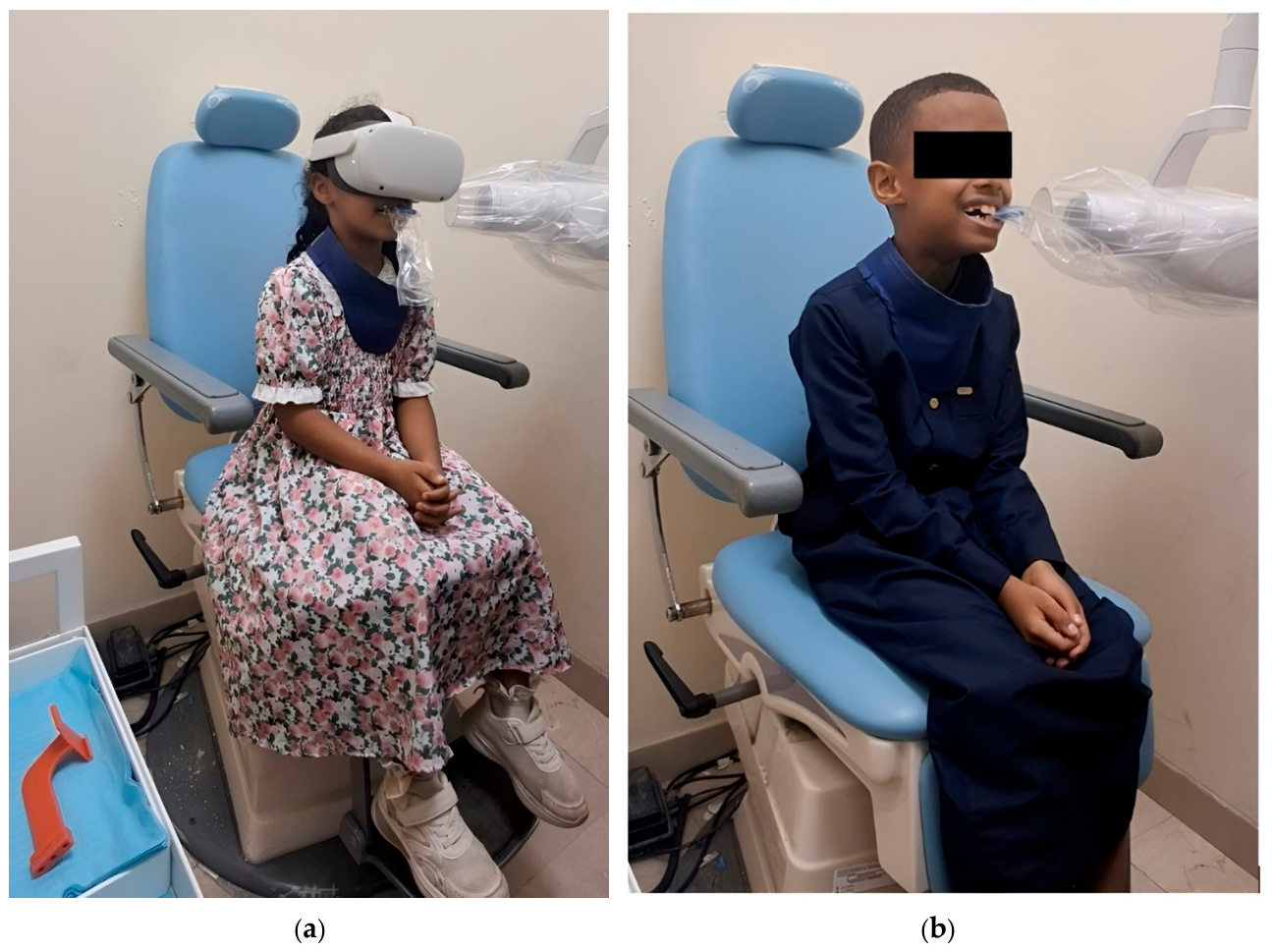
Figure 2.
CONSORT flow diagram illustrating participant enrolment, randomization, allocation, follow-up, and analysis.
Figure 2.
CONSORT flow diagram illustrating participant enrolment, randomization, allocation, follow-up, and analysis.
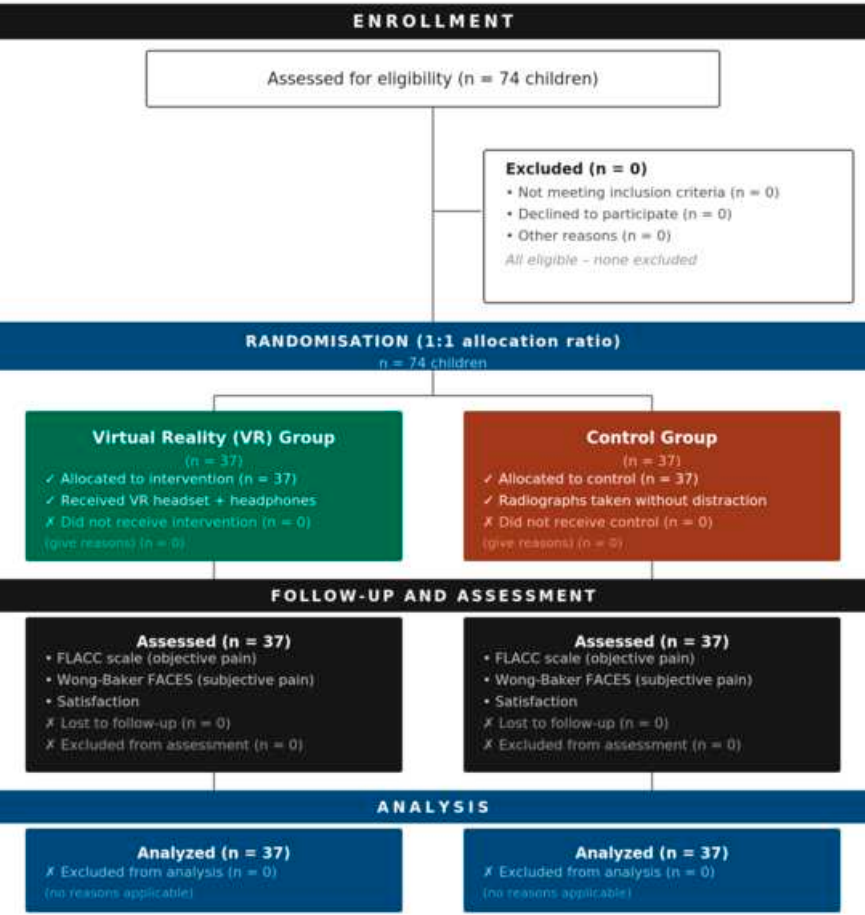
Figure 3.
Distribution of pain and satisfaction outcomes in the VR and control groups (n = 37 per group). (a) Modified FLACC score (primary outcome); (b) Wong–Baker FACES Pain Rating Scale score; (c) satisfaction with the procedure. Bars show the percentage of participants in each score category; labels give the number (percentage) of participants.
Figure 3.
Distribution of pain and satisfaction outcomes in the VR and control groups (n = 37 per group). (a) Modified FLACC score (primary outcome); (b) Wong–Baker FACES Pain Rating Scale score; (c) satisfaction with the procedure. Bars show the percentage of participants in each score category; labels give the number (percentage) of participants.
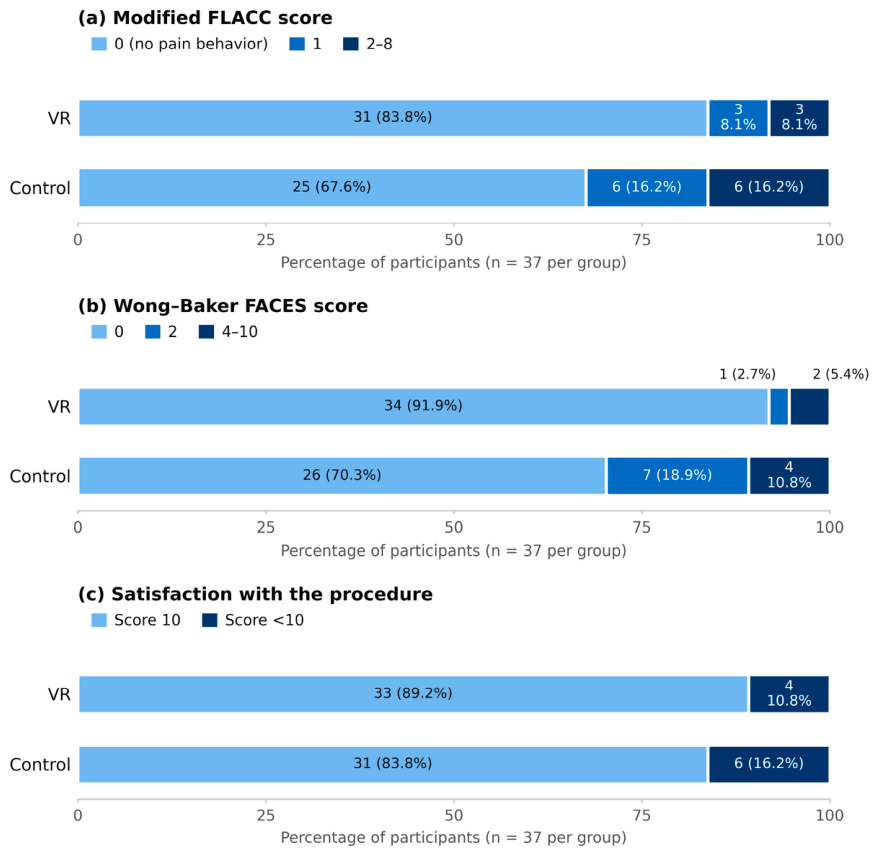

Table 1.
Baseline characteristics of study participants (N = 74).
| Variable | Category | VR Group N = 37, n (%) |
Control Group N = 37, n (%) |
p-Value |
|---|---|---|---|---|
| Age (years) | 4–7 | 16 (43.2) | 18 (48.6) | 0.641 |
| 8–12 | 21 (56.8) | 19 (51.4) | ||
| Gender | Male | 23 (62.2) | 23 (62.2) | 1.00 |
| Female | 14 (37.8) | 14 (37.8) | ||
| Previous dental treatment | Yes | 29 (78.4) | 30 (81.1) | 0.772 |
| Behavior during previous treatment * | Uncooperative | 6 (16.2) | 10 (27.0) | 0.259 |
| Cooperative | 31 (83.8) | 27 (73.0) | ||
| Previous intraoral radiographs | Yes | 22 (59.5) | 25 (67.6) | 0.469 |
| No | 15 (40.5) | 12 (32.4) | ||
| Behavior during previous radiograph (parent-reported) | Uncooperative | 5 (13.5) | 1 (2.7) | 0.123 |
| Cooperative | 17 (45.9) | 24 (64.9) | ||
| Don’t remember | 15 (40.5) | 12 (32.4) | ||
| VR device ownership | Yes | 1 (2.7) | 1 (2.7) | 0.753 |
| No | 36 (97.3) | 36 (97.3) | ||
| Previous VR experience | Yes | 6 (16.2) | 8 (21.6) | 0.553 |
| No | 31 (83.8) | 29 (78.4) |
* Behavior at previous visits was recorded from the R4 dental electronic system for description only; eligibility required cooperative behavior at the study visit. Chi-squared test/Fisher’s exact test. VR, virtual reality.
Table 2.
Comparison of objective and subjective discomfort, pain, and satisfaction between groups (N = 74).
Table 2.
Comparison of objective and subjective discomfort, pain, and satisfaction between groups (N = 74).
| Outcome Measure | Score | VR Group N = 37, n (%) |
Control Group N = 37, n (%) |
p-Value |
|---|---|---|---|---|
| Modified FLACC scale | 0 | 31 (83.8) | 25 (67.6) | 0.267 |
| 1 | 3 (8.1) | 6 (16.2) | ||
| 2–8 | 3 (8.1) | 6 (16.2) | ||
| Wong–Baker FACES Pain Rating Scale | 0 | 34 (91.9) | 26 (70.3) | 0.044 * |
| 2 | 1 (2.7) | 7 (18.9) | ||
| 4, 6, 8, or 10 | 2 (5.4) | 4 (10.8) | ||
| Satisfaction | <10 | 4 (10.8) | 6 (16.2) | 0.368 |
| 10 | 33 (89.2) | 31 (83.8) |
Statistically significant (p* < 0.05); secondary outcome, not adjusted for multiplicity. Chi-squared test/Fisher’s exact test. Risk ratios and risk differences (with 95% CIs, Wald method) for the score-of-0 category vs. all other scores are reported in the text. FLACC, Face, Legs, Activity, Cry, and Consolability; VR, virtual reality.
Disclaimer/Publisher’s Note: The statements, opinions and data contained in all publications are solely those of the individual author(s) and contributor(s) and not of MDPI and/or the editor(s). MDPI and/or the editor(s) disclaim responsibility for any injury to people or property resulting from any ideas, methods, instructions or products referred to in the content. |
© 2026 by the authors. Licensee MDPI, Basel, Switzerland. This article is an open access article distributed under the terms and conditions of the Creative Commons Attribution (CC BY) license (http://creativecommons.org/licenses/by/4.0/).
Copyright: This open access article is published under a Creative Commons CC BY 4.0 license, which permit the free download, distribution, and reuse, provided that the author and preprint are cited in any reuse.