

Submitted:
07 October 2026
Posted:
09 October 2026
You are already at the latest version
Abstract
Enterprises expose thousands of data entities as machine-readable metadata through APIs such as SAP Graph and Microsoft Graph, while adopting AI agents that act on the same data. Yet architecture repositories, process-governance workflows, and agent platforms each build their own view of the enterprise, and none is anchored in a formally validated specification. This paper asks how formally validated metadata can be turned into governed transformation capabilities that support autonomous enterprise operation. Following Design Science Research, we contribute (i) a repositioning of the Moregraph platform as a semantic integration layer; (ii) a validation gate that restates published Conceptual Graph and Formal Concept Analysis (CGFCA) results as re-checkable invariants; (iii) a target-parametric Metadata-to-Governance Transformation (MGT) with explicit commit conditions; and (iv) an integrated architecture connecting one validated source to architecture (SAP LeanIX), process (SAP Signavio), and agent (SAP AI Core) governance, mapped onto the BTM Tripod’s People, Process, and Application pillars of Business Transformation Management. We separate what is formally validated, what is demonstrated in a working prototype (LeanIX), and what is proposed (Signavio, AI Core), and set out an evaluation strategy. The central claim is bounded: explicit semantic and policy constraints derived from validated metadata can limit or prevent human- or agent-initiated changes from producing unauthorised or inconsistent enterprise outcomes.
Keywords:
enterprise systems engineering
; digital transformation
; enterprise architecture
; metadata governance
; conceptual graphs
; formal concept analysis
; SAP LeanIX
; SAP Signavio
; AI agent governance
; business transformation management
; design science research
1. Introduction
Digital transformation is widely understood as a process in which digital technologies trigger strategic responses that change how an organisation creates value, and which must in turn be managed through structural and organisational change [1]. Enterprise Architecture (EA) has long been positioned as the discipline that keeps such change aligned with business strategy [2,3,4,5]. For organisations running large SAP or Microsoft estates, the raw material for this alignment is increasingly available in machine-readable form: SAP Graph and Microsoft Graph publish thousands of data entities and their relationships as OData metadata [6,7,8]. The difficulty is no longer access to metadata but turning it into governed enterprise change.
Three developments make this difficulty more pressing. First, vendors are consolidating architecture, process, and lifecycle tooling into integrated toolchains (for SAP, the combination of SAP LeanIX, SAP Signavio, and SAP Cloud ALM [9]), each of which maintains its own model of the enterprise. Second, clean-core programmes ask organisations to keep processes, extensions, data, integration, and operations within governed boundaries [10,11], which presupposes that the organisation can trace what those boundaries are. Third, enterprises are deploying Large Language Model (LLM)-based agents that act on business data [12,13]. Such agents can generate fluent but unfounded outputs [14], and risk-management frameworks and regulation now expect organisations to maintain oversight and accountability over AI-initiated actions [15,16,17]. In each case, a downstream system needs a trustworthy statement of what the enterprise’s metadata means and which changes to it are permissible.
Our previous work produced two ingredients for such a statement. Moregraph ingests OData metadata, visualises it, and records its own conceptual specification as a Conceptual Graph (CG) [18,19]; applying the CG and Formal Concept Analysis (CGFCA) algorithm [20,21] to that specification yields formally checkable structural properties [22]. A Metadata-to-Governance Transformation (MGT) then maps OData entity types to Data Object records in SAP LeanIX [23]. Separately, our work on Business Transformation Management (BTM) introduced the BTM Tripod of People, Process, and Application resting on a shared Data foundation [24]. What has been missing is the integration: an account of how validated metadata flows, under explicit governance, into the several systems through which an enterprise actually transforms.
This paper addresses that gap through the following research question:
RQ. How can formally validated metadata be transformed into governed, enterprise-scale digital transformation capabilities that support autonomous enterprise execution?
We answer it with a design artefact developed through Design Science Research (DSR) [25,26]. The contributions are:
- 1.
- A repositioning of Moregraph as a semantic integration layer with six enterprise roles (acquiring, validating, and governing metadata; supporting architecture repositories and transformation tooling; and enabling governed autonomous execution), each tagged with its current implementation status (Section 4).
- 2.
- A validation gate that restates previously published CGFCA results as invariants over a formal context, so that they can be re-checked whenever the specification changes, rather than read once from a lattice diagram (Section 5).
- 3.
- A target-parametric MGT that generalises the earlier LeanIX-specific mapping to any governance target, with explicit commit conditions (Section 6).
- 4.
In line with guidance that DSR contributions should be positioned by their maturity [27], we separate four kinds of evidence throughout: architectural proposal, worked demonstration, formal validation, and empirical validation. The paper does not claim deterministic runtime guarantees, elimination of hallucination, or achievement of a particular maturity level. Its central claim is bounded: explicit semantic and policy constraints derived from validated metadata can reduce, limit, or prevent inappropriate actions from producing unauthorised or inconsistent enterprise outcomes. Table 6 (Section 9) records the evidence status of every component.
1.0.0.1. Relationship to prior publications.
This paper belongs to a research programme with three complementary layers, summarised in Table 1. The CONCEPTS papers are the authoritative sources for Moregraph’s conceptual specification and its CGFCA analysis [18,22] and for the LeanIX-specific MGT [23]; the MOVE 2026 paper is the authoritative source for the BTM Tripod, the Active Enterprise Conceptual Graph (AECG), and BTM maturity levels [24]. This paper does not reproduce their formal contexts, lattices, case-study results, or AECG formalisation; it cites and summarises only what is needed for it to be read on its own. Its own contribution is integration: the validation gate, the target-parametric MGT, the multi-target architecture, and the evaluation strategy.
The remainder of the paper is organised as follows. Section 2 introduces the background, and Section 3 the research method. Section 4 to Section 8 present the artefact. Section 9 discusses evidence, limitations, and evaluation; Section 10 reviews related work; and Section 11 concludes.
2. Background
2.1. Enterprise Architecture, Governance, and Transformation
EA frameworks decompose an enterprise into business, application, data, and technology concerns and provide viewpoints for reasoning about change [4,5,28,29]; ArchiMate provides a standard modelling language for these concerns, including data objects [30]. From a systems-engineering standpoint, governing an enterprise system across its life cycle requires traceable technical and management processes [31]. BTM methodologies treat transformation as a managed programme spanning strategy, people, processes, and technology [32]. Business Process Management supplies the complementary discipline of modelling, executing, and controlling processes [33]. Technical debt, originally a software metaphor [34], is now used more broadly for design shortcuts that constrain future change [35]; SAP’s clean-core strategy applies a similar logic to ERP landscapes across five dimensions: processes, extensibility, data, integration, and operations [10,11].
2.2. Metadata Sources and Governance Targets
OData is an OASIS standard for REST-based data services whose service documents describe entity types, properties, and navigation properties [8,36]. SAP Graph and Microsoft Graph expose large API estates in this form [6,7]. On the governance side, this paper considers three targets from the SAP portfolio as exemplars:
- SAP Signavio Process Governance, a web-based workflow modelling and execution solution that tracks the tasks and actions to be performed for each case [39];
- SAP AI Core, a service of SAP Business Technology Platform (BTP) that manages the execution and operation of AI assets, including generative-AI capabilities, in a standardised and scalable way [40].
SAP positions LeanIX, Signavio, and Cloud ALM as an integrated toolchain for transformation programmes [9]. Beneath these, SAP Business Data Cloud is presented as a unified, governed data foundation, with the SAP Knowledge Graph providing a business-friendly model of data for Joule agents [13,41]. Knowledge graphs more generally are graph-structured representations of entities and relations used to integrate and reason over heterogeneous data [42].
2.3. Conceptual Structures
Conceptual Graphs are a logic-based knowledge representation of concept and relation nodes with first-order semantics [43,44,45,46], serialisable in the Conceptual Graph Interchange Format (CGIF) of ISO/IEC 24707 Common Logic [47]. Formal Concept Analysis (FCA) derives concept lattices from a formal context of objects, attributes, and an incidence relation [48,49,50]. CGFCA maps a CG’s relational triples to a formal context in which an object (concept) is incident with an attribute (triple) if the concept is transitively reachable from that triple, making the CG’s pathway structure available to FCA [20,21]. CGs have previously been used to generate layered enterprise architectures [51].
2.4. AI Agents and Their Governance
LLM-based autonomous agents combine a language model with planning, memory, and tool use to act on external systems [12]. Because LLM outputs can be unfaithful to their sources [14], governance frameworks emphasise mapping, measuring, and managing AI risks [15], organisational AI management systems [16], and, for high-risk systems in the European Union, effective human oversight [17]. Neurosymbolic approaches argue for combining neural models with explicit symbolic knowledge to improve reliability and interpretability [52]. These sources motivate the governance design in Section 7; they do not by themselves establish its effectiveness, which remains to be evaluated (Section 9.4).
3. Research Method
We follow the Design Science Research Methodology (DSRM) of Peffers et al. [26], which structures DSR [25] into six activities. Table 2 maps each activity to this paper. The research entry point is design- and development-centred: artefacts already existed (Moregraph, CGFCA, and the LeanIX MGT prototype), and the problem addressed here is their integration into an enterprise-scale governance architecture.
From the problem analysis we derive five design objectives:
- O1
- Single validated source. Downstream governance targets should consume one formally validated statement of the enterprise’s metadata rather than each deriving its own.
- O2
- Re-checkable validation. Structural properties established for the specification should be re-checkable automatically whenever the specification changes.
- O3
- Target independence. The transformation from metadata to governed artefacts should be defined once and instantiated per governance target.
- O4
- Traceable, bounded change. Every governed artefact should be traceable to its metadata source, and changes should be committed only when explicit policy conditions hold.
- O5
- Human accountability. Where policy requires, a named human decision should precede commitment, including for changes initiated by AI agents.
For evaluation we adopt the Framework for Evaluation in Design Science (FEDS) [53]. Because the principal risks of this artefact are technical (whether mappings are faithful and whether policy gates intercept non-conforming changes), we follow a Technical Risk and Efficacy strategy: formative, artificial evaluation first, followed by naturalistic evaluation in an organisational setting. This paper reports the formative stage and specifies the subsequent stages (Section 9.4).
4. Moregraph as a Metadata-Driven Enterprise Platform
Moregraph is a Next.js web application backed by PostgreSQL via the Prisma object-relational mapper [18]. Its OData Parser accepts EDMX service documents, detects OData V2 or V4, and extracts entity types together with typed navigation properties in four categories: containment, external reference, internal navigation, and referential constraint. Parsed metadata is persisted in a Graph Store, rendered by a force-directed Visualiser grouped by service, and analysed by a browser-based CGFCA Tool that accepts CGIF, CSV, or draw.io XML and emits Burmeister .cxt contexts and pathway listings [18,22]. Earlier work connected SAP Graph metadata to the open-source Essential Project EA tool [19], and more recent work to SAP LeanIX [23].
Previous publications presented Moregraph primarily as a metadata-analysis platform. Here we reposition it as a semantic integration layer: the component through which metadata enters the governance landscape and from which each governance target draws its view. Table 3 lists the six roles this implies and the status of each. The status column matters: this repositioning is an architectural claim about where Moregraph sits, and only some of the roles are realised in software today.
5. Formal Validation Foundations
5.1. Summary of the Validated Specification
Moregraph’s specification is a CG of thirteen concepts and seventeen relational triples, authored in CharGer and exported to CGIF [18]. Its concepts include [Application: Moregraph], Technical Debt, Solution Architecture, its Business, Application, and Data Architecture constituents, Metadata, the Business Data Graph and its SAP Graph and Microsoft Graph implementations, Clean Core, the reference solution architecture at api.sap.com, and Enterprise Architecture. Applying CGFCA produces a formal context; the full context, the seven pathways from Moregraph to Enterprise Architecture, and the resulting concept lattice are reported in [22] and not repeated here. For the purposes of this paper, the relevant results are the structural properties that analysis established.
5.2. From One-Off Results to a Validation Gate
In the earlier work these properties were read from the context and the lattice [22]. An integration layer needs them in a form that can be re-evaluated automatically when the specification changes, for example, when a new governance target or metadata source is added to the CG (objective O2). We therefore restate them as predicates over the CGFCA context. Let C be the CG specification and its CGFCA context, where G is the set of concepts, M the set of triples , and holds if concept g is reachable from triple m through the transitive relational closure [21]. Using the standard FCA derivation operators [49], and , the invariants are:
- V1
- Unique input. Exactly one concept has (it is reachable from no triple).
- V2
- Unique output. Exactly one concept has (it is reachable from every triple).
- V3
- Mandatory mediation. is the source of exactly one triple , whose target is in turn the source of exactly one triple , and .
- V4
- Acyclicity. For every triple , .
- V5
- Reference traceability. For a designated reference concept and the unique triple targeting it, .
For the published Moregraph specification, is [Application: Moregraph], is Enterprise Architecture, and are Moregraph addresses Technical Debt and Technical Debt as-a-part-of Solution Architecture, and is the SAP reference solution architecture reached by Clean Core drawing-on. These instantiations restate the findings of [22]: a unique input and output, seven pathways all mediated by Technical Debt and Solution Architecture, no cyclic dependencies, and Clean Core traceability to the SAP reference architecture. Let . Each predicate needs only row and column scans of the context, so costs once the context is built, which is the same bound as the CGFCA context construction itself [22].
Table 4 records why each invariant matters for governance. The key point is that governance targets downstream do not have to trust Moregraph’s visualisation; they can rely on having held when the metadata was released to them.
The predicates are formal statements of specification properties. They validate the conceptual model that governs Moregraph’s behaviour; they do not, by themselves, guarantee properties of runtime transactions in target systems. That distinction is maintained in the rest of the paper.
6. Metadata-to-Governance Transformation
The MGT was introduced as a mapping from OData entity types in Moregraph to Data Object records in an EA platform, demonstrated with SAP LeanIX [23]. To serve several governance targets (objective O3) we generalise it here to a target-parametric form and make its commit conditions explicit (objective O4).
6.1. Definitions
Metadata graph. Parsed metadata is a structure , where E is the set of entity types, the navigation properties, assigns each navigation property one of the four categories recognised by the OData Parser (Section 4), and is the set of (name, type) pairs of the properties of .
Governance target. A governance target is a tuple , where is the set of artefact types the target manages, a schema assigning each artefact type its fields, a finite set of policy predicates over artefacts, and the delivery channel.
Transformation. For an entity type and its navigation neighbourhood , the transformation is
where a is an artefact of some type in populated according to the schema, and is a provenance record identifying the metadata source.
Commit condition. An artefact is committed to target only if
where holds if an equivalent artefact already exists in the target and is a named human decision when the delivery channel or a policy requires one, and true otherwise.
6.2. Required Properties
From objectives O1 to O5 we derive five properties that every instance of should satisfy:
- P1
- Provenance: every committed artefact carries , linking it back to its OData source.
- P2
- Structural fidelity: property names and types in are preserved in a.
- P3
- Non-duplication: no artefact is committed while holds.
- P4
- Policy conformance: no artefact is committed unless every holds.
- P5
- Human checkpoint: where required, is an explicit, attributable human decision.
6.3. The LeanIX Instance (Implemented Prototype)
For SAP LeanIX, contains the Data Object Fact Sheet type [37], and two delivery channels exist [23]. On the api channel, Moregraph authenticates with the OAuth2 client-credentials grant, creates a Data Object Fact Sheet populated with the entity’s property names and types, and attaches a reference document linking the Fact Sheet to its SAP Graph source; a read path retrieves existing Fact Sheets by type. On the bulk channel, Moregraph exports an entity and its navigation neighbourhood as a spreadsheet in LeanIX’s bulk-import column layout, which an architect reviews and uploads manually. Assessed against P1 to P5, the prototype realises P1 (the reference document) and P2 for property structure, but not for instance values. It supports P3 only partially, because duplicate lookup is available but not enforced before creation. It does not yet implement P4, and it realises P5 on the bulk channel only, through manual review before upload. We report these gaps explicitly because they define the difference between the implemented prototype and the architecture proposed below.
6.4. Proposed Instances for Process and Agent Governance
The same definition can be instantiated for the other two targets. These instances are architectural proposals; they have not been implemented.
Process governance (SAP Signavio Process Governance). Here is a change-request case, , and is the completion of the case’s approval task. A proposed change to governed metadata (for example, a new extension on a clean-core entity) becomes a case whose fields carry a and , so that approval is tracked per case, as the product is designed to do [39]. can encode clean-core constraints, for instance that extensions are decoupled from the core [10,11].
Agent governance (SAP AI Core). Here is a machine-readable scope descriptor: the entity types, properties, and navigation paths an agent may reference, the operations permitted on each, and the policies that apply. It is delivered on the api channel to agent workloads executed on SAP AI Core [40], for example as retrieval context or as tool definitions, which are the standard mechanisms through which LLM-based agents consume external knowledge and act on systems [12]. Because the descriptor is derived from metadata for which held, an agent’s view of the enterprise is bounded by the validated specification rather than inferred from free text.
7. Integrated Transformation Architecture
Figure 1 assembles the components into an integrated transformation architecture with eight stages. Solid borders mark implemented components and dashed borders mark proposed ones.
Stages 1 to 2 (acquisition and modelling) are the existing Moregraph capabilities described in Section 4. Stage 3 (validation) evaluates whenever the specification or the set of connected sources changes. The CGFCA computation exists; wiring its output into an automated pass/fail gate is proposed. Stage 4 (transformation) applies with its commit condition. Stages 5 to 7 (governance) are the three target instances of Section 6. They are deliberately separate: architecture, process, and agent governance have different owners and different artefacts, but they share one validated source (objective O1). Stage 8 (execution) is the operational outcome: changes to the enterprise, whether proposed by architects or by agents, are committed only through a governance target, so each committed change carries provenance and has satisfied that target’s policies.
Two design decisions deserve explanation. First, validation precedes transformation, not the reverse: a failed invariant blocks all targets at once, which avoids the situation in which one repository accepts metadata that another rejects. Second, the agent-governance target does not grant agents write access to enterprise systems. It bounds what they can reference and propose, and it routes proposals that require approval to process governance (the horizontal arrow in Figure 1). This ensures that human oversight [15,17] is exercised through an existing, tracked workflow rather than an ad hoc channel.
The architecture also clarifies how Moregraph relates to SAP’s own data foundation. SAP Business Data Cloud and the SAP Knowledge Graph provide harmonised business data and a business-friendly model of it for AI agents [13,41]. Moregraph does not replace them. Its role is narrower and complementary: to supply a formally validated specification of how metadata relates to architectural concerns such as Technical Debt, Solution Architecture, and Clean Core, and to condition governance actions on that specification. Integrating Moregraph with these services is part of future work.
8. Supporting the BTM Tripod and the Autonomous Enterprise
8.1. Support for the Tripod Pillars
The BTM Tripod, introduced in [24], organises transformation into People, Process, and Application pillars resting on a shared Data foundation. We do not restate its formalisation or maturity levels here. Instead, Table 5 shows which part of the integrated architecture supports each pillar, and what the validated metadata contributes.
8.2. Design Walkthrough: An Agent-Initiated Change
To demonstrate how the stages interact, we trace an illustrative scenario through the architecture. This is a design walkthrough, not an executed case study; it shows what the architecture prescribes, not measured behaviour.
An agent running on SAP AI Core, assisting a sales-operations team, proposes adding a custom field to a business-partner entity exposed through SAP Graph.
- 1.
- Scope check (stage 7). The agent’s scope descriptor lists the business-partner entity type and marks structural extension as permitted only by proposal. The agent can therefore reference the entity correctly, but it cannot apply the change itself.
- 2.
- Policy evaluation (stage 4). The proposal is expressed as an artefact a with provenance . The applicable clean-core policy requires extensions to be decoupled from the core [10], and the approval policy marks structural changes as requiring human approval.
- 3.
- Process governance (stage 6). Because is required, a change-request case is opened in SAP Signavio Process Governance. The responsible architect sees the proposal, its source entity, and the policy outcome.
- 4.
- Architecture governance (stage 5). On approval, the corresponding Data Object Fact Sheet in SAP LeanIX is updated through , retaining the link to its SAP Graph source (P1). On rejection, nothing is committed.
Under this design, an inappropriate agent proposal is stopped at step 1 (out of scope), step 2 (policy violation), or step 3 (human rejection) before it produces an inconsistent or unauthorised enterprise outcome. This is the bounded governance claim stated in Section 1. Whether the gates intercept such proposals reliably in practice is an empirical question for the evaluation in Section 9.4.
9. Discussion
9.1. Answer to the Research Question and Evidence Status
The RQ asked how formally validated metadata can be turned into governed, enterprise-scale transformation capabilities that support autonomous enterprise execution. Our answer is architectural. Metadata should pass through a single validation gate whose invariants are formal statements over a CGFCA context. It should then be transformed by a target-parametric MGT whose commit condition combines validation, policy, non-duplication, and human approval. Architecture, process, and agent governance should each consume the result as separate targets that share one source. Table 6 states, for each part of that answer, what kind of evidence currently supports it.

Table 6.
Evidence status of the paper’s components.
| Component | Evidence type | Status and source |
|---|---|---|
| CG specification and CGFCA results | Formal validation | Published [18,22] |
| Invariants V1 to V5 as predicates | Formal definition | This paper; instantiation restates [22] |
| Automated validation gate | Architectural proposal | Not yet implemented |
| Target-parametric MGT and P1 to P5 | Formal definition | This paper |
| LeanIX MGT instance | Worked demonstration | Prototype [23]; P1, P2 (structure) met; P3 partial; P4 not met; P5 bulk channel only |
| Signavio and AI Core instances | Architectural proposal | Not yet implemented |
| Integrated architecture (Figure 1) | Architectural proposal | This paper |
| Agent-initiated change walkthrough | Design walkthrough | Illustrative; not executed |
| Correctness, scalability, efficiency, interception rate | Empirical validation | Future work (Section 9.4) |
9.2. Implications for Enterprise Systems Engineering
Treating metadata validation as a gate in front of several governance systems changes where consistency is enforced. In integrated toolchains, architecture, process, and lifecycle tools are commonly synchronised with one another [9]. The architecture proposed here adds a validated source upstream of that synchronisation, so that disagreements between tools can be traced to a change in the specification rather than to drift between tools. For AI agents, it shifts part of the governance burden from inspecting model outputs to constraining model inputs and actions with explicit structures, in line with neurosymbolic arguments for combining learned and symbolic knowledge [52]. It does not remove the need to evaluate the agents themselves [15].
9.3. Limitations
Several limitations bound the contribution. (i) The validated specification is small (thirteen concepts); the invariants are cheap to check, but whether the specification remains analysable and meaningful as it grows to cover more targets and sources is untested. (ii) The invariants validate the specification, not runtime transactions in target systems. (iii) Only the LeanIX instance is implemented, and it transfers property structure rather than instance values; it also depends on the target workspace providing a technical user for API access, which is subject to the vendor’s licensing arrangements. (iv) The Signavio and AI Core instances, and the automated gate, are designs. (v) The exemplar targets are all from one vendor portfolio; the definitions are vendor-neutral, but their instantiation for other EA, BPM, or agent platforms has not been demonstrated. (vi) Product capabilities are described from vendor documentation [37,39,40], which can change between releases.
9.4. Evaluation Strategy
Following the FEDS Technical Risk and Efficacy strategy [53], we plan three evaluation episodes:
- 1.
- Artificial, formative: gate and mapping correctness. Implement the automated gate and test it against deliberately perturbed specifications (for example, an added second input concept, a cycle, or a pathway bypassing Technical Debt), measuring whether each violation of V1 to V5 is detected. For the LeanIX instance, measure field-level fidelity of committed Fact Sheets against source OData metadata across multiple SAP Graph namespaces.
- 2.
- Artificial, summative: interception and throughput. Implement the Signavio and AI Core instances and submit a seeded set of conforming and non-conforming change proposals, including agent-generated ones. Measure the proportion of non-conforming proposals intercepted at each gate, false-rejection rates, and entities processed per unit time.
- 3.
- Naturalistic, summative: organisational use. Deploy the pipeline with enterprise architects in an operational setting. Compare effort, error rates, and traceability against the organisation’s existing manual population and approval workflows.
10. Related Work
Conceptual structures for EA. Andrews and Polovina provided the mapping from CG triples to FCA formal contexts on which CGFCA rests [20,21]. It is distinct from Wille’s Concept Graphs, a diagrammatic reasoning system grounded directly in FCA [54]. Rudolph and Stumme constructed lattices from CG projection graphs [55], and Priss and Old modelled semantic aspects of CGs with FCA [56]; FCA’s broader role in knowledge organisation is surveyed by Priss [57]. Baxter et al. used conceptual structures to generate layered enterprise architectures [51]. Our own prior work applied CGFCA to Moregraph’s specification [22]. The present paper differs in using those results operationally, as invariants checked before governance actions, rather than as an end in themselves.
Metadata-driven EA tooling. Model-driven EA with ArchiMate is advocated by Lankhorst [4,30]. Commercial repositories such as SAP LeanIX provide governed Fact Sheet models [37] that must still be populated, a gap addressed for single targets by our earlier integrations with Essential Project [19] and SAP LeanIX [23]. The present paper generalises from one target to several and makes commit conditions explicit.
Enterprise knowledge foundations. Knowledge graphs are an established means of integrating heterogeneous enterprise data [42]. SAP’s Business Data Cloud and Knowledge Graph apply this idea to provide business context to AI agents [13,41]. Moregraph complements rather than competes with such foundations: its contribution is a formally validated specification of architectural relationships and the governance conditions derived from it.
Transformation management and agent governance. BTM methodologies [32] and our BTM Tripod [24] address the organisational side of transformation; the Tripod work also proposes an active conceptual-graph formalisation of the pillars. Surveys of LLM-based agents [12] and of hallucination [14], together with governance frameworks [15,16,17], define the problem of governing agents but leave open how enterprise-specific semantic constraints should be supplied to them. The scope descriptors and routing rules proposed here are one concrete answer, to be evaluated.
11. Conclusions
This paper addressed how formally validated metadata can be turned into governed, enterprise-scale transformation capabilities that support autonomous enterprise operation. Building on published foundations, namely Moregraph and its CGFCA-validated specification, the LeanIX-specific MGT, and the BTM Tripod, we contributed an integration layer. It comprises a repositioning of Moregraph as a semantic integration layer; a validation gate that states prior CGFCA results as re-checkable invariants; a target-parametric MGT with explicit commit conditions; and an integrated architecture that connects one validated source to architecture, process, and agent governance, mapped onto the People, Process, Application, and Data elements of the BTM Tripod. We have kept apart what is formally validated, what is demonstrated in a working prototype, and what is proposed. The bounded claim the architecture supports is that explicit semantic and policy constraints derived from validated metadata can limit or prevent inappropriate actions, whether human- or agent-initiated, from producing unauthorised or inconsistent enterprise outcomes. Testing that claim empirically, through the evaluation strategy set out above, is the next step.
Author Contributions
Conceptualization, M.S. and S.P.; methodology, M.S., S.P. and R.F.; software, M.S.; validation, M.S., S.P. and R.F.; formal analysis, M.S. and S.P.; writing (original draft preparation), M.S.; writing (review and editing), M.S., S.P. and R.F.; supervision, S.P. All authors have read and agreed to the published version of the manuscript.
Funding
This research received no external funding.
Data Availability Statement
No new datasets were generated or analysed in this study.
Acknowledgments
The authors thank Chirag Baxi at the E-Com Group for the initial Tripod BTM model that we have elaborated upon in this paper.
Conflicts of Interest
The authors declare no conflicts of interest.
Abbreviations
The following abbreviations are used in this manuscript:
| AECG | Active Enterprise Conceptual Graph |
| BTM | Business Transformation Management |
| BTP | SAP Business Technology Platform |
| CG | Conceptual Graph |
| CGFCA | Conceptual Graphs and Formal Concept Analysis |
| CGIF | Conceptual Graph Interchange Format |
| DSR | Design Science Research |
| DSRM | Design Science Research Methodology |
| EA | Enterprise Architecture |
| FCA | Formal Concept Analysis |
| FEDS | Framework for Evaluation in Design Science |
| LLM | Large Language Model |
| MGT | Metadata-to-Governance Transformation |
| OData | Open Data Protocol |
References
- Vial, G. Understanding Digital Transformation: A Review and a Research Agenda. J. Strateg. Inf. Syst. 2019, 28, 118–144. [Google Scholar] [CrossRef]
- Henderson, J.C.; Venkatraman, N. Strategic Alignment: Leveraging Information Technology for Transforming Organizations. IBM Syst. J. 1993, 32, 4–16. [Google Scholar] [CrossRef]
- Ross, J.W.; Weill, P.; Robertson, D.C. Enterprise Architecture as Strategy: Creating a Foundation for Business Execution; Harvard Business School Press: Boston, MA, 2006. [Google Scholar]
- Lankhorst, M. Enterprise Architecture at Work: Modelling, Communication and Analysis, 4th ed.; Springer: Berlin, Heidelberg, 2017. [Google Scholar]
- The Open Group. The TOGAF Standard, 10th Edition; The Open Group, 2022; Available online: https://www.opengroup.org/togaf.
- SAP, S.E. SAP Graph: A Unified API for SAP Data. Technical report, Available at api.sap.com. SAP SE, 2024. [Google Scholar]
- Microsoft Corporation. Microsoft Graph REST API v1.0 Reference. Technical report; Microsoft Corporation, 2024; Available online: https://learn.microsoft.com/en-us/graph/api/overview.
- OASIS. OData Version 4.01. Part 1: Protocol. In OASIS Open; Technical report; OASIS Standard, 2020. [Google Scholar]
- SAP, S.E. What Is the Integrated Toolchain? SAP SE, 2026. Available online: https://www.sap.com/products/erp/rise/what-is-sap-integrated-toolchain.html (accessed on 23 September 2026).
- SAP, S.E. RISE with SAP: ERP Clean Core Strategy. SAP SE. 2025. Available online: https://www.sap.com/products/erp/rise/methodology/clean-core.html (accessed on 23 September 2026).
- SAP, S.E. The Clean Core White-Paper Series Is Now Complete—Your Foundation for the Autonomous Enterprise. SAP Community, Technology Blog Posts by SAP, 2026. Available online: https://community.sap.com/t5/technology-blog-posts-by-sap/the-clean-core-white-paper-series-is-now-complete-your-foundation-for-the/ba-p/14481019 (accessed on 23 September 2026).
- Wang, L.; Ma, C.; Feng, X.; Zhang, Z.; Yang, H.; Zhang, J.; Chen, Z.; Tang, J.; Chen, X.; Lin, Y.; et al. A Survey on Large Language Model Based Autonomous Agents. Front. Comput. Sci. 2024, 18, 186345. [Google Scholar] [CrossRef]
- SAP, S.E. SAP Unveils the Autonomous Enterprise. SAP News Center. 2026. Available online: https://news.sap.com/2026/05/sap-sapphire-sap-unveils-autonomous-enterprise/ (accessed on 23 September 2026).
- Ji, Z.; Lee, N.; Frieske, R.; Yu, T.; Su, D.; Xu, Y.; Ishii, E.; Bang, Y.J.; Madotto, A.; Fung, P. Survey of Hallucination in Natural Language Generation. ACM Comput. Surv. 2023, 55, 248:1–248:38. [Google Scholar] [CrossRef]
- National Institute of Standards and Technology. Artificial Intelligence Risk Management Framework (AI RMF 1.0); Technical Report NIST AI 100-1; U.S. Department of Commerce: Gaithersburg, MD, 2023. [Google Scholar] [CrossRef]
- ISO/IEC. ISO/IEC 42001:2023; Information Technology—Artificial Intelligence—Management System. Technical report; International Organization for Standardization, 2023.
- European Parliament and Council of the European Union. Regulation (EU) 2024/1689 Laying Down Harmonised Rules on Artificial Intelligence (Artificial Intelligence Act). Off. J. Eur. Union 2024, L series. Available online: http://data.europa.eu/eli/reg/2024/1689/oj.
- Polovina, S.; Fallon, R.; Saleem, M. Moregraph: Metadata-Driven Enterprise Architecture Using Conceptual Structures. In Proceedings of the Conceptual Knowledge Structures: Second International Joint Conference, CONCEPTS 2025, Cluj-Napoca, Romania, September 8–12, 2025, Proceedings, Cham, 2025; Lecture Notes in Computer Science. Vol. 15941, pp. 91–106. [Google Scholar] [CrossRef]
- Saleem, M.; Polovina, S. Towards Metadata-Driven Enterprise Architecture by Integrating SAP Graph and Essential Project. In Proceedings of the Proceedings of MOVE2024: The Second International Measuring Ontologies for Value Enhancement Workshop. CEUR-WS.org CEUR Workshop Proceedings, 2025. [Google Scholar]
- Andrews, S.; Polovina, S. A Mapping from Conceptual Graphs to Formal Concept Analysis. In Proceedings of the Conceptual Structures for Discovering Knowledge, The 19th International Conference on Conceptual Structures, ICCS 2011; Derby, UK, Andrews, S., Polovina, S., Hill, R., Akhgar, B., Eds.; Heidelberg, 2011; pp. 63–76. [Google Scholar]
- Andrews, S.; Polovina, S. Exploring, Reasoning with and Validating Directed Graphs by Applying Formal Concept Analysis to Conceptual Graphs. In Proceedings of the Graph Structures for Knowledge Representation and Reasoning, 5th International Workshop, GKR 2017; Melbourne, VIC, Australia, August 21, 2017, Revised Selected Papers, Croitoru, M., Marquis, P., Rudolph, S., Stapleton, G., Eds.; Lecture Notes in Artificial Intelligence; Springer, 2018; pp. 10775 pp. 3–28. [Google Scholar]
- Saleem, M.; Polovina, S.; Fallon, R. Exploring Metadata in Enterprise Architecture by Applying Conceptual Graphs—Formal Concept Analysis (CGFCA) to Moregraph. In Proceedings of the Conceptual Knowledge Structures: Third International Joint Conference, CONCEPTS 2026; Montpellier, France, August 31–September 4, 2026, Proceedings, Croitoru, M., Stumme, G., López-Rodríguez, D., Eds.; Lecture Notes in Computer Science; Cham, 2026; Vol. 16811, pp. 362–372. [Google Scholar] [CrossRef]
- Saleem, M.; Polovina, S.; Fallon, R. Advancing Metadata-Driven Enterprise Architecture Management Tools Using Conceptual Structures. In Proceedings of the Conceptual Knowledge Structures: Third International Joint Conference, CONCEPTS 2026; Montpellier, France, August 31–September 4, 2026, Proceedings, Croitoru, M., Stumme, G., López-Rodríguez, D., Eds.; Lecture Notes in Computer Science; Cham, 2026; Vol. 16811, pp. 329–339. [Google Scholar] [CrossRef]
- Polovina, S.; Saleem, M.; Saleem, W.; Fallon, R. Harnessing People, Process, and Applications for Level 5 Business Transformation Management. In Proceedings of the MOVE2026: Measuring Ontologies for Value Enhancement Workshop, Workshop paper; extended version in preparation for the post-proceedings; Henley Business School, University of Reading, UK, 16–18 September 2026, 2026. [Google Scholar]
- Hevner, A.R.; March, S.T.; Park, J.; Ram, S. Design Science in Information Systems Research. MIS Q. 2004, 28, 75–105. [Google Scholar] [CrossRef]
- Peffers, K.; Tuunanen, T.; Rothenberger, M.A.; Chatterjee, S. A Design Science Research Methodology for Information Systems Research. J. Manag. Inf. Syst. 2007, 24, 45–77. [Google Scholar] [CrossRef]
- Gregor, S.; Hevner, A.R. Positioning and Presenting Design Science Research for Maximum Impact. MIS Q. 2013, 37, 337–355. [Google Scholar] [CrossRef]
- Zachman, J.A. A Framework for Information Systems Architecture. IBM Syst. J. 1987, 26, 276–292. [Google Scholar] [CrossRef]
- Sowa, J.F.; Zachman, J.A. Extending and formalizing the framework for information systems architecture. IBM Syst. J. 1992, 31, 590–616. [Google Scholar] [CrossRef]
- The Open Group. ArchiMate 3.2 Specification; The Open Group, 2023; Available online: https://pubs.opengroup.org/architecture/archimate32-doc/.
- ISO/IEC/IEEE. ISO/IEC/IEEE 15288:2023; Systems and Software Engineering—System Life Cycle Processes. Technical report; International Organization for Standardization, 2023.
- Uhl, A.; Gollenia, L.A. (Eds.) A Handbook of Business Transformation Management Methodology; Gower: Farnham, 2012. [Google Scholar]
- Dumas, M.; La Rosa, M.; Mendling, J.; Reijers, H.A. Fundamentals of Business Process Management, 2nd ed.; Springer: Berlin, Heidelberg, 2018. [Google Scholar] [CrossRef]
- Cunningham, W. The WyCash Portfolio Management System. In Proceedings of the Addendum to the Proceedings on Object-Oriented Programming Systems, Languages, and Applications (OOPSLA ’92), 1992; ACM; pp. 29–30. [Google Scholar] [CrossRef]
- Kruchten, P.; Nord, R.L.; Ozkaya, I. Technical Debt: From Metaphor to Theory and Practice. IEEE Softw. 2012, 29, 18–21. [Google Scholar] [CrossRef]
- OASIS. Open Data Protocol (OData) Version 2.0. Technical report, OASIS Open; OASIS Standard, 2014. [Google Scholar]
- SAP, S.E. Fact Sheets—SAP LeanIX Enterprise Architecture Management Documentation. SAP Help Portal. 2026. Available online: https://help.sap.com/docs/leanix/ea/fact-sheets (accessed on 23 September 2026).
- SAP, S.E. AI Capabilities in SAP LeanIX. Bright. Webcast 2024. [Google Scholar] [CrossRef]
- SAP, S.E. SAP Signavio Process Governance User Guide. SAP Help Portal. 2026. Available online: https://help.sap.com/docs/signavio-process-governance/user-guide/intro (accessed on 23 September 2026).
- SAP, S.E. What Is SAP AI Core?—SAP AI Core Service Guide. SAP Help Portal. 2026. Available online: https://help.sap.com/docs/sap-ai-core/sap-ai-core-service-guide/what-is-sap-ai-core (accessed on 23 September 2026).
- SAP, S.E. SAP Debuts Business Data Cloud with Databricks to Turbocharge Business AI. SAP News Center. 2025. Available online: https://news.sap.com/2025/02/sap-business-data-cloud-databricks-turbocharge-business-ai/ (accessed on 23 September 2026).
- Hogan, A.; Blomqvist, E.; Cochez, M.; d’Amato, C.; de Melo, G.; Gutierrez, C.; Kirrane, S.; Labra Gayo, J.E.; Navigli, R.; Neumaier, S.; et al. Knowledge Graphs. ACM Comput. Surv. 2021, 54, 71:1–71:37. [Google Scholar] [CrossRef]
- Sowa, J.F. Conceptual Structures: Information Processing in Mind and Machine; Addison-Wesley: Reading, MA, 1984. [Google Scholar]
- Sowa, J.F. Knowledge Representation: Logical, Philosophical, and Computational Foundations; Brooks Cole: Pacific Grove, CA, 2000. [Google Scholar]
- Sowa, J.F. Conceptual Graphs for Representing Conceptual Structures. In Conceptual Structures in Practice;Num Pages; Chapman and Hall/CRC, 2009; p. 36. [Google Scholar]
- Polovina, S. An Introduction to Conceptual Graphs. In Proceedings of the Conceptual Structures: Knowledge Architectures for Smart Applications; Priss, U., Polovina, S., Hill, R., Eds.; Berlin, Heidelberg, 2007; pp. 1–14. [Google Scholar]
- ISO/IEC. ISO/IEC 24707:2018; Information Technology—Common Logic (CL): A Framework for a Family of Logic-Based Languages. Technical report; International Organization for Standardization, 2018.
- Wille, R. Restructuring Lattice Theory: An Approach Based on Hierarchies of Concepts. In Ordered Sets; Rival, I., Ed.; Reidel: Dordrecht, 1982; pp. 445–470. [Google Scholar]
- Ganter, B.; Wille, R. Formal Concept Analysis: Mathematical Foundations; Springer: Berlin, Heidelberg, 1999. [Google Scholar]
- Wille, R. Formal Concept Analysis as Mathematical Theory of Concepts and Concept Hierarchies. In Formal Concept Analysis: Foundations and Applications; Lecture Notes in Computer Science; Springer: Berlin, Heidelberg, Lecture Notes in Computer Science; 2005; Vol. 3626, pp. 1–33. [Google Scholar]
- Baxter, M.; Polovina, S.; Laurier, W.; von Rosing, M. Generating Layered Enterprise Architectures with Conceptual Structures. In Proceedings of the Graph-Based Representation and Reasoning: 26th International Conference on Conceptual Structures; ICCS 2021, Virtual Event, September 20–22, 2021, Proceedings, Braun, T., Gehrke, M., Hanika, T., Hernandez, N., Eds.; Lecture Notes in Computer Science; Cham, 2021; Vol. 12879, pp. 34–47. [Google Scholar] [CrossRef]
- d’Avila Garcez, A.; Lamb, L.C. Neurosymbolic AI: The 3rd Wave. Artif. Intell. Rev. 2023, 56, 12387–12406. [Google Scholar] [CrossRef]
- Venable, J.; Pries-Heje, J.; Baskerville, R. FEDS: A Framework for Evaluation in Design Science Research. Eur. J. Inf. Syst. 2016, 25, 77–89. [Google Scholar] [CrossRef]
- Wille, R. Conceptual Graphs and Formal Concept Analysis. In Proceedings of the Conceptual Structures: Fulfilling Peirce’s Dream: Fifth International Conference on Conceptual Structures, ICCS 1997, Berlin, Heidelberg, 1997; Lecture Notes in Computer Science. Vol. 1257, pp. 290–303. [Google Scholar]
- Rudolph, S.; Stumme, G. Constructing Lattices from Conceptual Graphs. In Proceedings of the Conceptual Structures at Work: 12th International Conference on Conceptual Structures, ICCS 2004, Berlin, Heidelberg, 2004; Lecture Notes in Computer Science. Vol. 3127, pp. 139–155. [Google Scholar]
- Priss, U.; Old, L.J. Modelling Semantic Aspects of Conceptual Graphs with FCA. In Proceedings of the Conceptual Structures: Leveraging Semantic Technologies, 17th International Conference on Conceptual Structures, ICCS 2009, 2009; Springer Lecture Notes in Artificial Intelligence. ; Vol. 5662, pp. 193–206. [Google Scholar]
- Priss, U. Formal Concept Analysis in Information Science. Annu. Rev. Inf. Sci. Technol. 2006, 40, 521–543. [Google Scholar] [CrossRef]
Figure 1.
Integrated transformation architecture. Solid borders: implemented (stage 5 as a prototype); dashed borders: proposed. The arrow from agent to process governance indicates that agent-initiated changes are routed to a process-governance case when policy requires human approval.
Figure 1.
Integrated transformation architecture. Solid borders: implemented (stage 5 as a prototype); dashed borders: proposed. The arrow from agent to process governance indicates that agent-initiated changes are routed to a process-governance case when policy requires human approval.
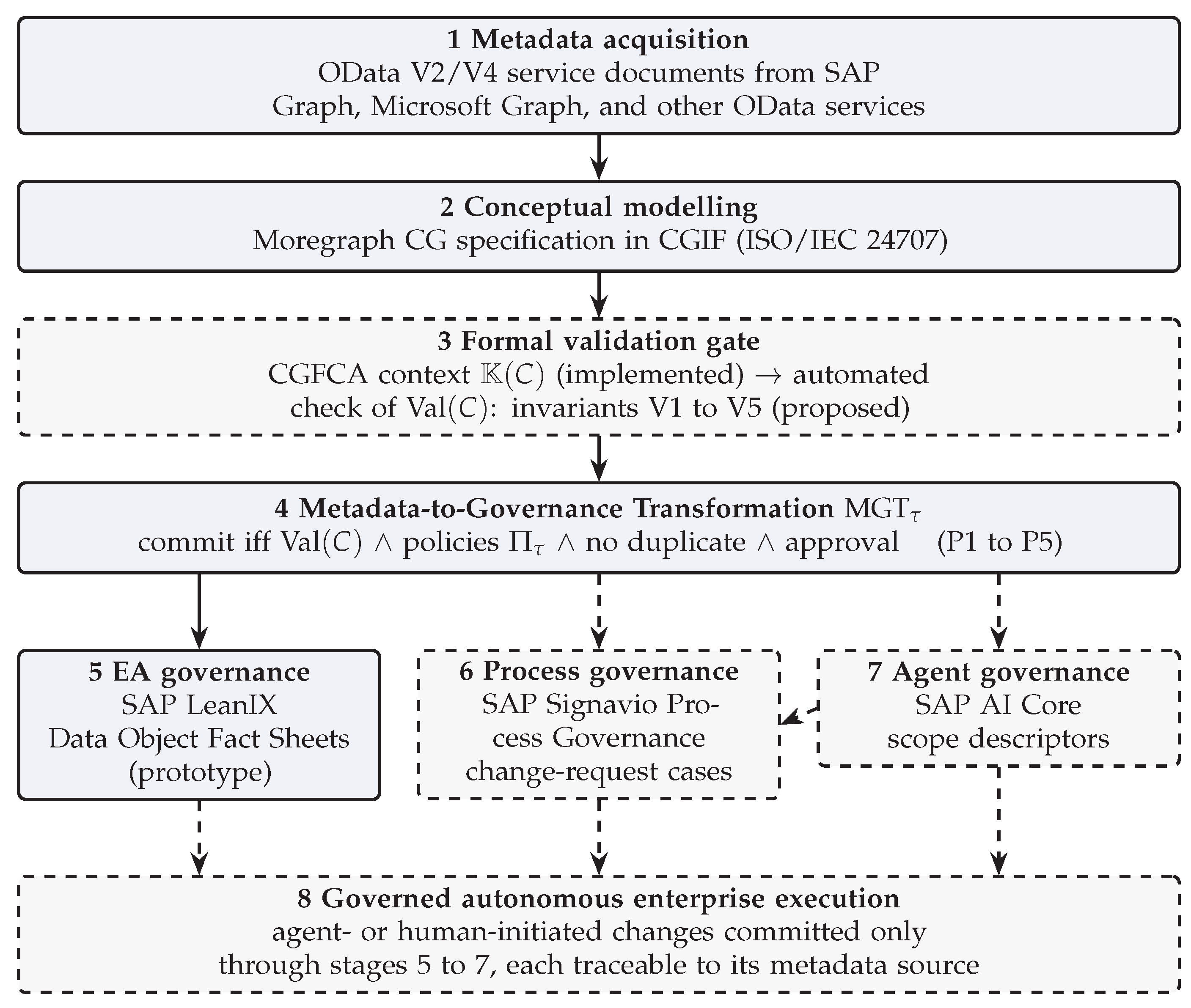
Table 1.
Differentiation of contributions across the research programme.
| Publication | Layer | Authoritative contribution |
|---|---|---|
| Moregraph, CONCEPTS 2025 [18] | Foundation | Moregraph platform; CG specification of metadata-driven EA |
| CGFCA to Moregraph, CONCEPTS 2026 [22] | Validation | Formal context, pathway analysis and concept lattice of the Moregraph CG |
| MGT, CONCEPTS 2026 [23] | Validation | LeanIX-specific MGT, its design principles and case study |
| BTM Tripod, MOVE 2026 [24] | Transformation | BTM Tripod, AECG, Clean Core pillar mapping, BTM maturity levels |
| This paper | Integration | Validation gate; target-parametric MGT; multi-target governance architecture; Tripod support mapping; evaluation strategy |
Table 2.
DSRM activities [26] and their realisation in this paper.
Table 2.
DSRM activities [26] and their realisation in this paper.
| Activity | Realisation | Section |
|---|---|---|
| Problem identification | Metadata, architecture, process, and agent governance are not anchored in a shared, validated specification | Section 1, Section 2 |
| Objectives of a solution | Design objectives O1 to O5 (below) | Section 3 |
| Design and development | Repositioned Moregraph; validation gate; target-parametric MGT; integrated architecture | Section 4 to Section 7 |
| Demonstration | Implemented LeanIX pathway; design walkthrough of an agent-initiated change | Section 6, Section 8 |
| Evaluation | Formal validation of invariants (from prior work); evaluation strategy for the remaining components | Section 5, Section 9 |
| Communication | This article | All |
Table 3.
Enterprise roles of Moregraph as a semantic integration layer.
| Role | Realisation | Status |
|---|---|---|
| Acquire metadata | OData V2/V4 parsing of SAP Graph, Microsoft Graph, and generic OData services | Implemented [18] |
| Validate metadata | CG specification analysed by CGFCA; invariants re-checked by the validation gate (Section 5) | CGFCA implemented [22]; automated gate proposed |
| Govern metadata | Commit conditions of the target-parametric MGT (Section 6) | Partially implemented |
| Support architecture repositories | MGT instance for SAP LeanIX Data Object Fact Sheets | Prototype [23] |
| Support transformation tooling | MGT instance for SAP Signavio Process Governance | Proposed |
| Enable governed autonomous execution | MGT instance supplying validated context and policy to agents on SAP AI Core | Proposed |
Table 4.
Validation-gate invariants and their governance significance.
| Invariant | Governance significance |
|---|---|
| V1 Unique input | There is exactly one entry point through which metadata enters the specification; an additional input signals an unintended, ungoverned source. |
| V2 Unique output | Every triple ultimately supports Enterprise Architecture; a triple not reaching the output indicates specification content with no architectural purpose. |
| V3 Mediation | All metadata reaches EA only through Technical Debt and Solution Architecture, so technical-debt control cannot be bypassed by a new pathway. |
| V4 Acyclicity | No concept depends on itself, so governance decisions can be ordered along pathways without circularity. |
| V5 Reference traceability | Clean Core compliance remains traceable to the SAP reference architecture. |
Table 5.
How the integrated architecture supports the BTM Tripod [24].
Table 5.
How the integrated architecture supports the BTM Tripod [24].
| Pillar | Governance concern | Architecture stage | Contribution of validated metadata |
|---|---|---|---|
| People | Accountability; supervision of AI | 7 Agent governance; P5 human checkpoint | Scope descriptors bound what agents may reference; approvals are attributable decisions |
| Process | Orchestration; compliance | 6 Process governance | Changes become tracked cases carrying provenance; clean-core policies in |
| Application | Architecture governance; technical-debt control | 5 EA governance; V3 mediation | Data Object Fact Sheets traceable to OData sources; no pathway to EA bypasses Technical Debt |
| Data | Semantic foundation | Stages 1 to 4 (acquisition to transformation) | One validated specification () shared by all targets |
Disclaimer/Publisher’s Note: The statements, opinions and data contained in all publications are solely those of the individual author(s) and contributor(s) and not of MDPI and/or the editor(s). MDPI and/or the editor(s) disclaim responsibility for any injury to people or property resulting from any ideas, methods, instructions or products referred to in the content. |
© 2026 by the authors. Licensee MDPI, Basel, Switzerland. This article is an open access article distributed under the terms and conditions of the Creative Commons Attribution (CC BY) license (http://creativecommons.org/licenses/by/4.0/).
Copyright: This open access article is published under a Creative Commons CC BY 4.0 license, which permit the free download, distribution, and reuse, provided that the author and preprint are cited in any reuse.