

Submitted:
06 October 2026
Posted:
09 October 2026
You are already at the latest version
Abstract
Malaria remains a major global public health challenge, with a substantial burden of morbidity and mortality concentrated in sub-Saharan Africa and other tropical and subtropical regions. The complex transmission process involving Plasmodium parasites, Anopheles mosquito vectors, and human hosts makes mathematical modeling an important tool for understanding transmission dynamics and evaluating control strategies. This review provides a comprehensive synthesis of mathematical modeling approaches for malaria transmission and control, including deterministic compartmental models, stochastic models, optimal control frameworks, spatial models, and cost-effectiveness analyses. Particular attention is given to major intervention strategies, including vector control, vaccination, antimalarial treatment, and other integrated control approaches. The review also examines the effects of seasonality, climate variability, drug and insecticide resistance, spatial heterogeneity, and human movement on malaria transmission and intervention outcomes. A bibliography-based keyword frequency analysis and word-cloud visualization are used to identify dominant research themes, followed by a comparative assessment of modeling approaches and intervention strategies. The findings highlight the importance of integrating multiple interventions with context-specific epidemiological and environmental conditions. Overall, mathematical models provide valuable support for optimizing malaria control strategies and addressing important challenges toward malaria elimination.
Keywords:
malaria control
; mathematical modeling
; optimal control
; vector control
; vaccination
; cost-effectiveness analysis
1. Introduction
Malaria is a major vector-borne disease caused by parasites of the genus Plasmodium and transmitted predominantly through the bites of infected female Anopheles mosquitoes [1,2]. Despite sustained global efforts to control and eliminate the disease, malaria continues to impose a substantial public health burden. According to the World Health Organization (WHO), an estimated 249 million malaria cases and 608,000 deaths occurred worldwide in 2022, with approximately four out of five malaria deaths in the WHO African Region occurring among children under five years of age [2,3]. The complexity of malaria transmission arises from interactions among multiple Plasmodium species, diverse mosquito vectors, and environmental, climatic, demographic, and socioeconomic factors [1,4]. These interacting factors complicate the design and implementation of effective control strategies, while the emergence of insecticide resistance in mosquito vectors and antimalarial drug resistance in parasites increasingly threatens the effectiveness of established interventions [5,6]. Consequently, understanding the heterogeneous and dynamic nature of malaria transmission is essential for developing effective and sustainable strategies for disease control and eventual elimination.
Literature of Disease Dynamics
Mathematical modeling has become indispensable for understanding the transmission dynamics of infectious diseases, evaluating intervention strategies, and guiding public health decisions. This review organizes the literature into thematic subsections, highlighting contributions to deterministic and stochastic modeling, optimal control, cost-effectiveness analysis, and applications to specific pathogens.
Several studies focus on the COVID-19 pandemic, using compartmental models (SEIR, SEIQR, etc.) to simulate transmission dynamics, evaluate non-pharmaceutical interventions, and forecast outcomes. Kamrujjaman et al. [7] analyzed the spatio-temporal spread of COVID-19 in Bangladesh and globally. Mahmud et al. [8] assessed vaccine efficacy and control measures in California and the USA. Kamrujjaman et al. [9] studied the effect of lockdown and isolation in Bangladesh. Hassan et al. [10] provided forecasts for Texas, USA. Saha et al. [11] modeled COVID-19 transmission with saturated treatment using Spain as a case study. Kamrujjaman et al. [12] examined the Rohingya refugee camp context. Khondaker et al. [13] analyzed physical distancing and treatment. Kamrujjaman et al. [14] mapped the mathematical growth of COVID-19. These studies consistently highlight the importance of early interventions, testing, and vaccination.
Influenza A (H1N1) is another major focus. Mohammad & Kamrujjaman [15] developed a stochastic differential equation (SDE) model with continuous-time Markov chains. Mohammad et al. [16] performed bifurcation analysis with treatment and vaccination. Kamrujjaman & Mohammad [17] modeled H1N1 transmission across Mexico, Italy, and South Africa. Kazi Mehedi Mohammad et al. [15] used Lévy-driven SDE and branching processes for influenza control. Akhi et al. [18] studied state-by-state influenza outbreaks in California. These works emphasize seasonal variability, stochastic extinction, and the role of control measures.
Recent stochastic epidemic models have further incorporated environmental and demographic variability to capture uncertainty in disease transmission and outbreak progression [19,20]. Such approaches provide a framework for examining disease dynamics when transmission processes cannot be adequately represented by deterministic models alone.
Dengue is addressed through deterministic and stochastic models with real data from Bangladesh and other tropical regions. Mayeda et al. [21] assessed vaccination and insecticide strategies via optimal control. Khondaker et al. [22] performed cost-effectiveness analysis (ACER-ICER) for dengue control in Bangladesh. Mobin et al. [23] analyzed a data-driven vector-borne dengue transmission model for Bangladesh. Eme et al. [24] studied vaccination and combined optimal control measures. Akhi et al. [25] analyzed seasonal variability and stochastic branching processes for malaria outbreak probability. Akhi et al. [26] used continuous-time Markov chains and SDEs for malaria propagation. Islam et al. [27] developed a fuzzy cognitive map for malaria outbreak risk. These contributions underscore the importance of seasonality, environmental factors, and resource allocation.
Additional vector-borne disease models have considered the effects of spatial heterogeneity and population movement, which can substantially alter local transmission patterns and the geographical distribution of disease [28,29]. These studies demonstrate that incorporating spatial and mobility-related factors can provide a more realistic representation of disease transmission across heterogeneous populations.
High-mortality zoonotic diseases receive attention. Haque et al. [30] studied bifurcations and optimal control in Nipah virus epidemiology. Haque et al. [31] performed cost-effectiveness and optimal control for Marburg virus. Haque et al. [32] developed a modeling study of Marburg virus and risk factors. These papers emphasize the need for rapid response and limited-resource optimization. HIV/AIDS modeling focuses on intervention targets and gender differences. Rivu et al. [33] analyzed UNAIDS 90-90-90 and 95-95-95 targets in North America. Rivu et al. [34] compared stochastic and predictive models across genders. Ahmed et al. [34] studied optimal treatment strategies for acute HIV infection. These works highlight the importance of treatment coverage and cost-effectiveness.
Khondaker & Kamrujjaman [35] performed stochastic analysis of Mpox epidemiology with vaccination strategies and environmental persistence. This study is among the few applying stochastic differential equations to Mpox. Diphtheria is modeled using crisp and fuzzy approaches. Islam et al. [36] integrated crisp and fuzzy models for diphtheria dynamics. Akhi et al. [37] modeled a diphtheria outbreak in the Rohingya settlement in Bangladesh. These studies demonstrate the utility of fuzzy logic in handling uncertainty.
Cancer modeling appears in several papers. Kamrujjaman et al. [38] used Monte Carlo sampling and computational analysis for a three-component tumor radiotherapy model. Ira et al. [39] modeled tumor growth dynamics and optimal control. Alam et al. [40] analyzed the dynamics of ovarian tumor growth with treatment. Hossine et al. [41] reviewed tumor growth predictions. These studies apply ODEs and optimal control to oncology. Game-theoretic approaches are used to study vaccination decisions and social distancing. Alam et al. [42] assessed the tradeoff between voluntary and forced interventions using evolutionary game theory. Kulsum et al. [43] modeled early and delayed vaccination driven by imitation and aspiration. Ullah et al. [44] analyzed stay-at-home measures and vaccine shortages using conventional, heterogeneous, and fractional dynamics. These papers reveal the impact of human behavior on epidemic outcomes.
Several papers develop advanced stochastic methods. Akhi et al. [25] used seasonal variability and branching processes for malaria. Mohammad et al. [19] applied Wiener and Lévy processes to predict disease outbreaks. Kamrujjaman et al. [38] (Network Biology) – Monte Carlo sampling. These works demonstrate the importance of demographic stochasticity and environmental noise. Stochastic formulations are particularly useful for describing the probability of disease emergence and extinction when the number of infected individuals is small, where random fluctuations may have a substantial influence on epidemic trajectories [20,25].
Optimal control theory is applied across many diseases. Khondaker et al. [22] (Acta Tropica) performed cost-effectiveness analysis for dengue. Haque et al. [31] for Marburg. Eme et al. [24] for malaria. Rivu et al. [33] for HIV. The consistent use of incremental cost-effectiveness ratio (ICER) and average cost-effectiveness ratio (ACER) provides policy-relevant insights. For vector-borne diseases, optimal control frameworks have also been used to evaluate combinations of treatment, vaccination, and vector-control interventions, allowing mathematical models to compare alternative intervention strategies [45,46,47].
Several studies incorporate real data and machine learning. Mobin & Kamrujjaman [48] downscaled epidemiological time series for improved forecasting. Mobin et al. [23] used data-driven models for dengue. Islam et al. [27] applied fuzzy cognitive maps. These approaches enhance model realism and predictive accuracy. Recent data-driven approaches have also explored the use of computational and machine-learning techniques to represent spatial disease dynamics and improve prediction in heterogeneous environments [49].
Beyond disease modeling, the research addresses broader public health issues. Kamrujjaman et al. [50] studied the impact of COVID-19 on education in Bangladesh and its mitigation. Islam et al. [51] reviewed acquired immunity against infectious diseases. Hossain & Kamrujjaman [52] discussed mechanisms to fight antibiotic resistance.
In this context, mathematical modeling has emerged as an indispensable tool for understanding malaria transmission dynamics, evaluating intervention strategies, and guiding public health decisions. Historically, mathematical modeling has played a significant role in shaping responses to major infectious disease threats, including HIV/AIDS, tuberculosis, and malaria. The first mathematical models of malaria transmission, developed by Ross and Macdonald over a century ago, established the conceptual framework for understanding how vector and human populations interact to sustain transmission. Since then, models have been extended to incorporate malaria immunity, superinfection, heterogeneous biting, spatial dynamics, and climatic factors.
Subsequent malaria models have incorporated acquired immunity and superinfection to describe the complex interactions between repeated exposure, infection, and protection against clinical disease [53,54]. Spatially explicit models have further examined how heterogeneous transmission environments and human movement influence malaria persistence and the geographical spread of infection [28,29]. Environmental and climatic variables have also been incorporated into malaria models because temperature, precipitation, and other ecological conditions can influence vector abundance and transmission intensity [55,56,57,58].
Another important direction in malaria modelling concerns the development of intervention strategies. Mathematical models have been used to investigate vaccination, treatment, and vector-control measures, as well as combinations of these interventions, to determine their potential effects on malaria transmission [46,47,59,60]. More recent studies have considered the influence of insecticide resistance and changing intervention effectiveness, highlighting the need to account for evolutionary and operational challenges in malaria control [5,61,62,63,64].
Stochastic approaches provide another important direction for malaria research because seasonal variation, demographic fluctuations, and environmental uncertainty can affect outbreak probability and transmission trajectories [25,26]. Data-driven and forecasting approaches have also been developed to improve the representation of observed epidemiological patterns and to support malaria prediction and control planning [48,49].
This review aims to provide a comprehensive synthesis of the mathematical modeling approaches used to study malaria transmission and control, with a particular focus on studies published in the last decade. We examine the contributions of deterministic and stochastic models, optimal control theory, cost-effectiveness analysis, and data-driven approaches to understanding malaria dynamics and designing effective intervention strategies. We also present a comparative analysis of key intervention strategies and provide a forecasting summary for global malaria elimination efforts.
1.1. An Overview of the Adopted Methodology
To provide a systematic and quantitative overview of the research landscape in mathematical malaria modeling, a structured review methodology was adopted. The methodology involves the systematic selection of relevant malaria literature, followed by data extraction and organization to identify major research themes, mathematical modeling approaches, and intervention strategies. An overview of the adopted methodology is presented in Figure 1.
The analysis begins with the identification, screening, and selection of relevant literature on malaria and its mathematical modeling approaches. The selected studies are then systematically reviewed and organized based on their key characteristics, modeling frameworks, and intervention strategies. Keyword frequency analysis and word-cloud visualization are employed to identify frequently occurring terms and provide an initial representation of the dominant research areas within the reviewed literature.
Subsequently, the reviewed studies are analyzed according to the mathematical modeling approaches used to describe malaria transmission and control. Particular attention is given to different intervention strategies, including vector control, vaccination, treatment, and other control measures discussed in the literature. A comparative analysis is then conducted to highlight the characteristics, applications, and contributions of the different intervention strategies.
Finally, the findings from the reviewed literature are synthesized to identify important research gaps and potential directions for future research. This structured methodology provides a quantitative and qualitative overview of the existing mathematical malaria modeling literature and supports a comprehensive assessment of current modeling approaches and intervention strategies.
1.2. Keyword Frequency Analysis and Word Cloud
To provide a quantitative overview of the major research themes represented in the reviewed literature, a bibliography-based keyword frequency analysis was performed using the titles of the studies included in the bibliography. This approach follows the general use of frequency-based textual analysis and word-cloud visualization in review studies to provide an initial representation of dominant research themes [65,66]. Unlike an author-keyword analysis, in which keywords are extracted directly from individual publications, the present analysis treats the titles of the cited studies as the textual corpus. Accordingly, the resulting word cloud represents the thematic structure of the literature reviewed in this study based on terminology appearing in the reference titles. The analysis was conducted using the bibliography of the present review. A total of 106 bibliography entries were identified and used as the reference corpus. Each reference title was treated as an individual document, and the presence of selected epidemiological, mathematical, intervention-related, and methodological terms was examined across the complete corpus. This procedure provides a reproducible quantitative summary of the major research themes represented in the reviewed literature, including malaria transmission, mathematical modeling, vaccination, treatment, intervention and control strategies, resistance, stochastic processes, spatial dynamics, human movement, vector-related approaches, and cost-effectiveness [24,25,26,27,28,29,59].
Before calculating the frequencies, terminology was standardized to reduce inconsistencies arising from alternative forms of the same concept. In particular, “modeling” and “modelling” were treated as the same standardized term, while “vaccine,” “vaccines,” and “vaccination” were grouped under “vaccination.” Similarly, multi-word concepts such as “optimal control,” “malaria transmission,” “human movement,” and “cost-effectiveness” were retained as standardized thematic terms. This normalization reduces the possibility that minor differences in terminology artificially separate closely related research themes. For each reference title, the presence of a standardized term was counted at most once, irrespective of the number of times that term occurred within the title. Thus, the reported frequency represents the number of bibliography titles containing a particular term rather than the total number of textual occurrences. This document-frequency approach prevents longer titles from receiving greater weight and provides a consistent measure of how broadly a research theme is represented across the bibliography. The same principle was applied to both single-word and multi-word standardized terms. The analysis focused on terminology corresponding to the principal themes of the present review, including malaria, modeling, control, vaccination, transmission, optimal control, resistance, epidemiology, intervention, outbreak, stochastic approaches, treatment, cost-effectiveness, efficacy, spatial dynamics, human movement, vector-related approaches, and artemisinin. These themes reflect the principal mathematical and epidemiological dimensions addressed throughout the review, including malaria transmission dynamics, intervention optimization, vaccination and treatment, vector control, resistance, stochastic modeling, spatial heterogeneity, and public-health decision making [46,47,55,60,63,67,68,69,70,71,72].
Table 1 presents the twenty most frequently occurring standardized terms identified from the titles of the 106 bibliography entries. The results show that “malaria” is the most frequently represented term, occurring in 61 reference titles, followed by “control” (32), “vaccination” (22), “modeling” (21), and “transmission” (19). The prominence of these terms reflects the central emphasis of the reviewed literature on malaria disease dynamics, mathematical modeling, intervention and control strategies, vaccination, and transmission processes. Other frequently occurring themes include optimal control, epidemiology, malaria transmission, resistance, outbreaks, intervention, stochastic approaches, treatment, cost-effectiveness, vector-related processes, efficacy, spatial dynamics, artemisinin, infected populations, and human movement.
The frequency distribution in Table 1 was subsequently visualized using a word cloud, as shown in Figure 2. The size of each term is proportional to its frequency across the reference titles. Consequently, larger terms indicate themes that occur in a greater number of bibliography entries, whereas smaller terms indicate comparatively less frequent themes. The word cloud therefore provides an intuitive visual complement to the quantitative frequency distribution presented in Table 1.
It should be emphasized that the word cloud does not represent author-provided keywords extracted directly from the individual publications. Instead, it represents standardized thematic terms identified from the titles of the references included in the present bibliography. The visualization should therefore be interpreted as a title-based thematic representation of the reviewed literature rather than as a conventional bibliometric analysis based on author keywords. The frequency analysis captures both malaria-specific and broader methodological themes. The dominance of “malaria” reflects the disease-specific focus of the reviewed literature, while the high frequencies of “control,” “vaccination,” “modeling,” and “transmission” indicate the major methodological and intervention-oriented dimensions of the literature. The occurrence of “optimal control,” “epidemiology,” and “malaria transmission” further demonstrates the strong emphasis on mathematical and epidemiological approaches to understanding and controlling malaria dynamics. Other terms provide additional insight into the breadth of the reviewed research. “Resistance” reflects attention to drug and treatment-related challenges, whereas “outbreak,” “intervention,” “stochastic,” and “treatment” represent epidemiological, methodological, and public-health perspectives. Similarly, “cost-effectiveness” indicates the consideration of economic aspects of malaria interventions, while “vector,” “efficacy,” “spatial,” and “artemisinin” represent important biological, intervention-related, and geographical dimensions of malaria research. The presence of “human movement” further indicates the consideration of population mobility and spatial connectivity in malaria transmission dynamics [28,29,59,63,69,71].
The combination of malaria-specific and broader methodological terms highlights the interdisciplinary nature of mathematical malaria research. Mathematical modeling is used not only to describe malaria transmission dynamics but also to investigate intervention optimization, vaccination, treatment, drug resistance, vector-related processes, spatial heterogeneity, stochastic effects, environmental variability, and elimination strategies. Thus, the frequency distribution provides an overview of how mathematical, epidemiological, biological, and public-health perspectives are integrated within the reviewed literature. The resulting word-cloud analysis therefore provides a quantitative complement to the narrative synthesis developed in the subsequent sections. By deriving the thematic frequencies directly from the titles of the 106 bibliography entries, the analysis establishes a transparent connection between the reference corpus and the major themes discussed throughout the review. It also provides a reproducible basis for organizing the literature according to mathematical modeling approaches, intervention and control strategies, resistance, spatial and population-mobility factors, and malaria prevention and elimination objectives. Overall, the word-cloud analysis demonstrates that the reviewed literature is strongly centered on malaria, control, vaccination, modeling, and transmission, while also incorporating a diverse range of methodological and applied themes. The frequency-based representation therefore complements the detailed narrative discussion of mathematical models and intervention strategies presented in the following sections and provides an overall thematic snapshot of the current mathematical malaria modeling literature.
2. The Global Challenge of Malaria Control
Malaria control remains a major global public health challenge, shaped by the scale of the disease burden, its uneven geographic distribution, and persistent threats to existing interventions. This section outlines the current epidemiological situation and the principal obstacles hindering progress toward control and elimination, providing the empirical context for the modeling approaches discussed in Section 3.
2.1. Epidemiological Burden and Regional Distribution
Malaria remains a major global health challenge, although its burden is highly heterogeneous across geographical regions. In 2023, an estimated 263 million malaria cases and 597,000 deaths occurred globally, with the WHO African Region accounting for approximately 94% of cases and 95% of deaths [2]. The burden is concentrated particularly in sub-Saharan Africa, while substantial transmission also persists in South-East Asia, the Eastern Mediterranean, the Western Pacific, and the Americas [2,73,74]. Recent spatial modelling further demonstrates pronounced geographical variation in malaria prevalence, incidence, and mortality, emphasizing the importance of considering spatial heterogeneity when assessing transmission and control strategies [75].
Human malaria is caused by several Plasmodium species, with P. falciparum and P. vivax accounting for most infections globally [1,2]. P. falciparum is the predominant species in sub-Saharan Africa and is responsible for most malaria-related morbidity and mortality in the region, whereas P. vivax is geographically more widespread and predominates in many areas of Asia, the Western Pacific, and the Americas [1,2,76]. The epidemiology of malaria is further complicated by substantial heterogeneity in exposure and transmission intensity at household, community, and regional scales [75,77]. Such heterogeneity can arise from differences in vector ecology, environmental conditions, human behaviour, immunity, and access to interventions.
The biological characteristics of P. vivax introduce additional challenges for malaria elimination. Unlike P. falciparum, P. vivax can form dormant liver-stage parasites known as hypnozoites, which may reactivate after the initial infection and produce recurrent infections [76]. These persistent reservoirs, together with asymptomatic and low-density infections, can sustain transmission even when clinical malaria has been substantially reduced [78]. Consequently, the marked spatial, epidemiological, and biological heterogeneity of malaria should be considered when designing mathematical models and evaluating intervention strategies, particularly in settings where transmission intensity and parasite composition vary substantially.
2.2. Challenges to Malaria Control
Despite substantial progress in malaria prevention and treatment, achieving sustained control and eventual elimination remains difficult because transmission is influenced by interacting biological, environmental, behavioural, and socioeconomic factors. Five major challenges are particularly relevant to contemporary malaria control and mathematical modelling.
The widespread emergence of insecticide resistance in Anopheles mosquitoes threatens the effectiveness of major vector-control interventions, particularly insecticide-treated nets (ITNs) and indoor residual spraying (IRS). Pyrethroid resistance is especially concerning because pyrethroids have been extensively used in malaria vector control, while resistance to additional insecticide classes is also being detected in some vector populations [2,5,61]. The epidemiological consequences of resistance depend on the intensity and mechanisms of resistance, mosquito behaviour, insecticide exposure, and intervention coverage. Mathematical and simulation models are therefore increasingly used to quantify how resistance may alter intervention effectiveness and to evaluate alternative vector-control strategies, including next-generation ITNs, insecticide rotation, and combinations of interventions [2,62].
The emergence and geographic spread of antimalarial drug resistance pose a major threat to effective case management and malaria elimination. In particular, partial resistance to artemisinin and resistance to partner drugs can reduce the efficacy of artemisinin-based combination therapies (ACTs) and increase the risk of treatment failure [6,79]. Resistance evolution is driven by interactions among drug pressure, parasite genetics, treatment practices, transmission intensity, and the movement of resistant parasites between populations. Mathematical and individual-based models have consequently become important tools for investigating the evolutionary dynamics of resistance and assessing strategies such as multiple first-line therapies and triple artemisinin-based combination therapies [80,81,82]. Such modelling approaches can help evaluate long-term resistance trajectories that cannot be readily assessed through short-term clinical studies alone.
Malaria transmission exhibits substantial temporal variation because temperature, rainfall, and humidity influence mosquito abundance, survival, biting behaviour, parasite development, and the availability of breeding habitats [55,56]. Consequently, transmission intensity may increase sharply during favourable climatic periods and decline when environmental conditions become less suitable. Recent stochastic modelling has further shown that seasonal variation can alter the basic reproduction number and the probability of malaria outbreaks, with outbreak risk depending on both temporal conditions and the initial number of infected hosts or vectors [25,69]. Incorporating seasonally varying parameters into deterministic and stochastic models is therefore important for capturing realistic transmission dynamics and for identifying appropriate timing of surveillance and control interventions.
Human mobility can facilitate the spatial dissemination and reintroduction of malaria parasites, particularly when infected individuals move between areas with different levels of transmission [70,71]. This problem becomes increasingly important as transmission declines because imported infections may sustain transmission in low-incidence areas or threaten malaria-free status. Spatially explicit and metapopulation models have demonstrated that parasite importation and source–sink connectivity can substantially modify local transmission patterns and the impact of interventions [72]. Recent modelling work in the Chittagong Hill Tracts of Bangladesh similarly shows that areas with high transmission and strong connectivity to more populated regions can be important targets for elimination-oriented interventions [83]. Thus, malaria models that incorporate human movement can provide a more realistic representation of spatial transmission and help identify locations where intervention efforts may have broader regional effects.
Climate change presents an additional long-term challenge because changes in temperature, precipitation, humidity, and extreme weather can modify mosquito development, survival, geographic distribution, and the rate of parasite development within vectors [57,84]. These effects are nonlinear and geographically heterogeneous; climatic changes may increase transmission suitability in some regions while reducing it in others when environmental conditions move beyond the optimal range for vectors or parasites. Climate-driven mathematical models therefore provide an important framework for investigating potential changes in the spatial and temporal distribution of malaria transmission under alternative climate scenarios [55,58,69]. Integrating climatic variables with epidemiological, demographic, and intervention-related factors is consequently essential for developing adaptive malaria-control strategies under a changing climate.
Collectively, these challenges demonstrate that malaria transmission cannot be adequately characterized by considering a single biological or environmental mechanism in isolation. The interactions among insecticide and drug resistance, seasonal forcing, human mobility, and climatic variability create substantial spatial and temporal heterogeneity in transmission. Mathematical modelling provides a useful framework for integrating these factors, quantifying their individual and combined effects, and evaluating control strategies under heterogeneous epidemiological conditions.
3. Mathematical Modeling of Malaria Transmission
Mathematical models of malaria transmission offer a rigorous framework for integrating the biological, epidemiological, and environmental processes that govern parasite circulation between human hosts and Anopheles vectors. Over the past century, these models have developed from the classical Ross–Macdonald equations [85,86] into more sophisticated frameworks that account for immunity, age structure, spatial heterogeneity, seasonality, stochasticity, and economic considerations. This section synthesizes the principal modeling paradigms found in the malaria literature, namely deterministic compartmental models, stochastic formulations, optimal control frameworks, and cost-effectiveness analyses, and examines how each contributes to our understanding of transmission dynamics and the design of effective intervention strategies.
3.1. Deterministic Compartmental Models
The foundation of malaria modeling consists of models that divide human and mosquito populations into different epidemiological classes. The classic Ross–Macdonald model and its extensions form the basis of modern malaria models [25]. A typical malaria transmission model includes compartments such as Susceptible , Exposed/Latent , Infectious , and Recovered , which are often expanded to include treatment, immunity, and other relevant states. Malaria models also contain compartments comprising Susceptible , Exposed/Latent , and Infectious [26]. The dynamics are governed by a system of ordinary differential equations (ODEs) that describe the rates of movement between compartments. The basic reproduction number, , serves as a critical threshold parameter: if , the disease will die out; if , the disease will persist [24].
Recent advancements have extended these models to incorporate age structure, spatial heterogeneity, and immunity. Age-structured models capture how malaria risk depends on age and allow vaccination to be targeted at specific age groups. These models have been used to evaluate vaccination strategies that target specific ages while taking into account vaccine efficacy and waning immunity [27]. Studies have demonstrated that interventions targeting children under five years of age have a significantly greater positive effect on overall endemicity levels than similar measures targeting older individuals [59]. Models incorporating diffusion terms or meta population structures capture how transmission varies across space and how human movement influences malaria transmission [48]. The Ross–Macdonald framework has been extended to include human movement dynamics, with research showing that elimination efforts are most effective when they target areas with both high transmission intensity and strong connections to large and more populated regions [28]. Human mobility data are used to parameterize malaria models and assess how malaria-endemic areas are connected [29]. Extended models also include acquired immunity, which develops after repeated exposure and alters the probability of infection and the severity of disease [23]. Research has shown that the susceptibility and infectivity of human hosts primarily depend on age-related differences in acquired immunity, with people who have never acquired immunity being at significantly higher risk [53]. Mathematical models have been developed to show how immunity is gradually acquired through exposure and how this affects the age distribution of severe disease [54]. Seasonal variability significantly affects malaria transmission, and the probability of disease outbreaks is influenced by time and the initial number of infected individuals [25]. These modeling advancements have made deterministic models more realistic and have increased their ability to inform targeted malaria control strategies across diverse epidemiological settings [24,27].
3.2. Stochastic Models
While deterministic models provide valuable insights into average behavior, they do not capture the inherent randomness in disease transmission, particularly important when populations are small or when extinction events are possible. Stochastic models, including continuous-time Markov chains (CTMC) and stochastic differential equations (SDEs), have been applied to malaria transmission. Seasonal variability significantly impacts malaria transmission, and the probability of disease outbreaks is influenced by time and the initial number of infected individuals [25]. Branching process approaches have been used to calculate the probability of disease outbreaks and extinction [26].
3.3. Optimal Control Framework
Optimal control theory, particularly Pontryagin’s Maximum Principle (PMP), has been widely applied to identify the most effective and cost-efficient intervention strategies for malaria control [24,45]. In this framework, control variables represent intervention measures such as insecticide-treated net distribution, indoor residual spraying, antimalarial treatment, vaccination, and larviciding. The objective function typically aims to minimize the disease burden while accounting for the costs of interventions. The resulting system of nonlinear differential equations is solved numerically, often using fourth-order Runge–Kutta (RK4) methods [46]. A systematic review of mathematical models with optimal control strategies for malaria management from 2010 to 2024 found that the combined use of vaccination, personal protective equipment, and treatment is the best way to curb malaria incidence [24].
Several studies have demonstrated the effectiveness of optimal control in malaria modeling. For instance, [47] applied optimal control to a malaria model with two strains of the parasite and found that treatment and insecticide-treated nets are the most effective control measures. [46] incorporated both vaccination and treatment as control variables and showed that combining these interventions significantly reduces the infected human and mosquito populations. More recent work by [24] extended the optimal control framework to include multiple intervention strategies and confirmed that integrated approaches yield the greatest reduction in malaria incidence. Additionally, [22] performed a cost-effectiveness analysis using ACER and ICER metrics for dengue control in Bangladesh, providing a methodological template that has been adapted for malaria studies. Furthermore, [25] highlighted the role of seasonality in shaping optimal control outcomes, demonstrating that time-dependent control strategies outperform static ones in seasonal transmission settings. [48] emphasized the importance of data-driven approaches in parameterizing optimal control models, while [27] introduced fuzzy cognitive mapping to handle uncertainty in intervention planning. These findings collectively highlight the importance of optimal control theory in designing cost-effective and sustainable malaria intervention programs [22,24,25,27,45,46,47,48].
3.4. Cost-Effectiveness Analysis
Cost-effectiveness analysis (CEA) is essential for prioritizing interventions in resource-limited settings, particularly as malaria control budgets remain constrained and the disease continues to impose a substantial burden in endemic regions [22]. Two key metrics are commonly used: the Average Cost-Effectiveness Ratio (ACER), which represents the cost per unit of health outcome achieved, and the Incremental Cost-Effectiveness Ratio (ICER), which measures the additional cost per additional unit of health outcome gained when comparing two interventions [22,30]. Recent studies have shown that while combined intervention strategies often achieve the greatest reduction in infection rates, single interventions may be more cost-effective in resource-limited settings. For example, anti-malaria drugs alone may provide the most economical intervention strategy when resources are constrained [24].
A systematic review of cost-effectiveness evidence from 2018 to 2025 found that insecticide-treated nets and indoor residual spraying were highly cost-effective in sub-Saharan Africa, with costs per disability-adjusted life year (DALY) averted falling below national GDP thresholds [87]. Combined approaches enhanced effectiveness in high-resistance or high-burden settings. However, more complex strategies, such as tafenoquine with G6PD screening, showed higher ICERs due to additional operational costs and logistical challenges [87]. Ivermectin mass drug administration has also been evaluated as a supplementary vector control tool, with a base-case ICER of $905.23 per DALY averted in Kwale county, Kenya, which fell below the threshold of 0.5 × Kenya’s GDP per capita [88]. Similar findings have been reported for dengue control in Bangladesh, where vector control measures alone were more cost-effective than integrated approaches in certain low-resource settings [22]. Cost-effectiveness analyses have also been applied to Marburg virus and Nipah virus interventions, demonstrating the broader utility of ACER and ICER metrics in infectious disease modeling [30,31]. Furthermore, [33] applied cost-effectiveness analysis to HIV/AIDS intervention plans in North America, comparing the UNAIDS 90-90-90 and 95-95-95 targets, and found that treatment coverage expansion was the most cost-effective strategy. These studies collectively highlight the importance of context-specific cost-effectiveness analysis in guiding resource allocation for malaria and other infectious disease control programs [22,24,30,33,87,88].
3.5. Spatial Heterogeneity and Source–Sink Dynamics
Malaria transmission is spatially heterogeneous because vector abundance, environmental conditions, human population density, immunity, intervention coverage, and patterns of human mobility vary across geographical locations. Consequently, assuming spatially homogeneous transmission may overlook important differences in local transmission intensity. Mathematical models have therefore been extended to incorporate spatial structure through diffusion processes, metapopulation frameworks, and human-mobility networks [89,90]. These approaches provide a framework for describing differences in transmission between connected locations and for investigating the movement of infected individuals between areas with different transmission characteristics. A generic spatial representation of a malaria-related population or epidemiological state can be written schematically as
where denotes a population or epidemiological state at location x and time t, D is a spatial diffusion coefficient, and represents local demographic, epidemiological, and transmission processes. In malaria applications, spatial variation can also be incorporated through location-dependent transmission parameters, vector abundance, environmental conditions, population characteristics, and intervention coverage [89]. The diffusion formulation in Equation (1) is intended as a general schematic representation; metapopulation and network-based models can instead describe movement between discrete or interconnected geographical locations.
Figure 3 provides a conceptual representation of spatial heterogeneity and source–sink dynamics in malaria transmission. The high-transmission region is represented as a potential source region, whereas the lower-transmission region is represented as a potential sink region. Human mobility and spatial connectivity can transport infected individuals between these regions, thereby facilitating parasite importation into areas with lower local transmission. Mathematical metapopulation models have demonstrated that human movement can connect populations with substantially different transmission characteristics and can alter the persistence and distribution of infection across connected regions [89]. Empirical analyses have also shown that human mobility can generate identifiable routes of parasite importation between malaria-endemic locations [90].
The spatial structure shown in Figure 3 also illustrates the potential role of local diffusion and connectivity in shaping transmission patterns. In a heterogeneous landscape, movement between locations can modify the effective exposure experienced by individuals and can influence transmission in both high- and low-transmission settings. More detailed spatial models can therefore link multiple epidemiological subpopulations through movement rates, connectivity matrices, or spatially varying transmission parameters [89,90]. Such formulations are particularly relevant when neighbouring or otherwise connected populations experience substantially different levels of malaria transmission.
Human mobility is especially important in settings approaching elimination, where local transmission may be substantially reduced but imported infections can continue to influence transmission dynamics. Wesolowski et al. [90] demonstrated that human movement can contribute to parasite importation across geographical regions, while Prosper et al. [89] showed mathematically how movement between regions with different transmission characteristics can affect malaria persistence and control. These findings indicate that malaria transmission in a given location cannot always be interpreted independently of the epidemiological conditions and connectivity of surrounding populations.
Spatial heterogeneity is also important for evaluating malaria interventions. The effect of vector control, treatment, vaccination, and other interventions may depend on local transmission intensity, vector abundance, population characteristics, and intervention coverage. Consequently, spatially explicit models can be used to investigate how interventions applied in one location may influence transmission in connected locations through changes in local transmission and infection movement [89]. The combination of spatial heterogeneity and human mobility is therefore particularly relevant for identifying locations where intervention and surveillance efforts may have broader epidemiological consequences.
Overall, spatially structured models complement conventional compartmental approaches by explicitly representing geographical variation and movement between populations. Diffusion models, metapopulation frameworks, and human-mobility networks provide different mathematical approaches for representing these processes. Their integration with seasonal forcing, vector and drug resistance, climatic variability, and intervention dynamics can provide a more comprehensive representation of heterogeneous malaria transmission and may improve the evaluation of context-specific control and elimination strategies.
3.6. Seasonality and Climate-Driven Models
Malaria transmission exhibits substantial temporal variability because several biological processes involved in transmission are influenced by environmental conditions. Temperature, rainfall, and relative humidity can affect mosquito development, adult survival, biting activity, parasite development, and the availability of suitable aquatic breeding habitats. Consequently, malaria transmission may vary considerably across seasons and between different ecological settings [55,56]. Mathematical models that assume constant transmission parameters may therefore fail to capture important temporal variations in malaria transmission.
Seasonality can be incorporated into malaria transmission models by allowing one or more epidemiological or vector-related parameters to vary periodically with time. A commonly used mathematical approach is to represent seasonal variation using a periodic forcing function. In particular, sinusoidal forcing has been widely used in mathematical models of seasonal infectious disease transmission, including malaria models [91]. For example, a seasonally varying transmission rate can be represented schematically as
where denotes the mean transmission rate, represents the amplitude of seasonal variation, T denotes the period of the seasonal cycle, and represents the phase of the cycle. The periodic form in Eq. (2) is a mathematical representation of seasonal forcing rather than an assertion that malaria transmission follows an exactly sinusoidal pattern in nature. Indeed, Chitnis et al. [91] considered a periodically forced malaria model in which model parameters vary over a one-year cycle and noted that sinusoidal forcing has commonly been used to represent seasonality in malaria transmission models. Therefore, Eq. (2) is useful as a parsimonious representation of periodic variation, while more detailed models may employ empirical or climate-derived seasonal profiles.
Seasonal forcing and climate-driven modeling represent two related but distinct approaches to incorporating environmental variability. In a seasonal-forcing model, temporal variation is prescribed directly through a periodic function such as Eq. (2). In contrast, climate-driven models explicitly link epidemiological or vector-related parameters to environmental variables such as temperature, rainfall, and relative humidity. Weather-driven malaria models have demonstrated how environmental variables can be incorporated into mechanistic descriptions of parasite and vector dynamics [92]. Similarly, process-based climate models have been used to investigate the effects of temperature and rainfall on mosquito population dynamics, malaria invasion, persistence, and seasonal transmission [55].
Figure 4 provides a conceptual representation of the pathways through which climatic variability can influence malaria transmission. Temperature, rainfall, and relative humidity may affect different components of mosquito ecology and parasite development, which subsequently influence transmission intensity. The seasonal-forcing component shown in the figure corresponds to periodic variation that can be represented mathematically by functions such as Eq. (2). The figure is conceptual and does not represent an empirically fitted climate–malaria relationship.
Temperature is one of the most important environmental variables affecting malaria transmission. It can influence mosquito development, adult survival, biting behaviour, and the development of the malaria parasite within the mosquito. Importantly, these relationships are generally nonlinear rather than simply linear. Temperature-dependent models based on empirically derived thermal responses have shown that malaria transmission potential increases over a favourable temperature range and decreases outside this range [58]. Thus, representing temperature effects using a simple linear relationship may not adequately describe the biological responses of malaria vectors and parasites to environmental variation.
Rainfall also plays an important role in malaria transmission by influencing the availability and persistence of aquatic breeding habitats for Anopheles mosquitoes. Its effect on transmission, however, need not be instantaneous or linear. The relationship between rainfall and mosquito abundance may depend on the amount, duration, and temporal distribution of precipitation, as well as local environmental conditions. Climate-driven malaria models have consequently incorporated rainfall together with temperature and other environmental variables to represent temporal variation in vector populations and transmission more realistically [55,92].
A general climate-driven malaria model can be written schematically as
where denotes the epidemiological and vector state variables, represents temperature, denotes rainfall, and represents relative humidity. The function describes the resulting epidemiological and vector dynamics. Equation (3) is intended as a general schematic representation of climate-sensitive transmission models rather than as the exact model equation of a particular study. In climate-driven models, environmental variables can influence specific biological processes, such as mosquito development, mosquito survival, biting rate, parasite development, or vector abundance. Such process-based formulations have been used to examine the effects of weather and climate variability on malaria transmission [55,92].
Several mathematical modeling studies have incorporated environmental variables to investigate seasonal and interannual variation in malaria transmission. Hoshen and Morse [92] developed a weather-driven malaria model in which weather-dependent processes within the mosquito were linked to malaria parasite dynamics. Their framework illustrates how climate data can be incorporated to account for spatial, seasonal, and interannual variation in malaria transmission. Similarly, Parham and Michael [55] discussed process-based mathematical approaches for representing the effects of weather and climate change on malaria transmission, including the effects of temperature and rainfall on mosquito population dynamics. These studies demonstrate that climate-driven models can extend conventional transmission models by linking environmental forcing to biologically meaningful processes.
Seasonality is also important when evaluating malaria control and elimination strategies. Because transmission intensity can vary substantially throughout the year, the timing of an intervention may influence its population-level effect. Chitnis et al. [91], for example, incorporated periodic environmental variation into a malaria model and considered its implications for intervention timing. Seasonality can therefore be incorporated into models evaluating vector control, treatment, chemoprevention, and vaccination strategies. Such models can be used to investigate how intervention timing and coverage interact with temporal changes in local transmission conditions.
Climate change introduces an additional temporal and spatial dimension to malaria modeling. Changes in temperature and precipitation may modify the geographical suitability and seasonal patterns of malaria transmission. However, the magnitude and direction of these effects depend on local vector ecology, environmental conditions, population characteristics, and existing malaria control measures. Process-based modeling studies have demonstrated that rainfall and temperature can jointly influence mosquito population dynamics, malaria persistence, and seasonal transmission [55]. Consequently, projections of future malaria risk should account for both environmental forcing and the biological mechanisms through which climatic variables affect vectors and parasites.
An important distinction between periodic seasonal models and climate-driven models is therefore the source of temporal variation. In a periodic model, seasonality is prescribed through a mathematical function such as Eq. (2). In a climate-driven model, temporal variation arises from observed or projected environmental conditions and their effects on specific biological processes. The former approach provides a relatively simple and analytically tractable representation of seasonality, whereas the latter can provide greater biological interpretation when suitable climate and epidemiological data are available. These approaches are not mutually exclusive; a model may combine periodic forcing with explicit environmental drivers depending on the objectives, data availability, and spatial and temporal scales of the analysis.
Overall, incorporating seasonality and climate-dependent processes extends conventional malaria transmission models by allowing transmission dynamics to vary over time in response to periodic or environmental forcing. The integration of seasonal forcing, nonlinear temperature and rainfall responses, and spatial heterogeneity can provide a more realistic representation of malaria transmission across different ecological settings. Such integrated models are particularly useful for investigating temporal variation in transmission, evaluating the timing of interventions, and assessing potential changes in malaria risk under changing climatic conditions.
4. Intervention Strategies and Modeling Insights
Vector control remains the cornerstone of malaria prevention, with insecticide-treated nets (ITNs), indoor residual spraying (IRS), and larviciding as the primary tools [63,67]. Mathematical models have been used to compare the effectiveness of different types of ITNs. Attractive ITNs consistently reduce malaria transmission potential more effectively than inert or deterrent ITNs, even in the presence of resistant vector phenotypes [64]. Modeling has also shown that the impact of ITNs depends on human usage rates and the degree of insecticide resistance [93]. Recent modeling studies suggest that next-generation ITNs (NGM-ITNs) are superior to pyrethroid-only ITNs for both transmission control and insecticide resistance management, and that national malaria control programs should prioritize the transition to NGM-ITNs to optimize both malaria transmission control and resistance management [64]. IRS is highly effective when coverage is high and when vectors are susceptible to the insecticides used [67]. However, resistance and operational challenges limit its applicability in some settings [63].
Larviciding targets mosquito larvae before they become adults, reducing vector populations at the source [93,94]. Cost-effectiveness analyses have identified larviciding, habitat modification, and the Sterile Insect Technique (SIT) as among the most cost-effective vector control approaches [93]. A recent simulation study in rural south-eastern Tanzania found that ITNs alone are insufficient to achieve optimal vector control, and that adding larviciding to existing ITN interventions reduced the entomological inoculation rate (EIR) by 22-fold compared to a 9-fold reduction with ITNs alone [94]. Another modeling study predicted that larval source management (LSM) alongside ITNs could reduce malaria prevalence in children by 48–72% in Kenya, with high heterogeneity between villages indicating that relative or absolute reductions in mosquito adult density cannot be simply extrapolated to other regions [93]. A systematic review of mathematical models with optimal control strategies for malaria management from 2010 to 2024 found that combined vector control strategies are consistently more effective than single interventions [87].
Emerging vector control approaches include genetic biocontrol and Wolbachia-based strategies. Genetic technologies, including gene drive systems, offer the potential to suppress vector populations or render them incapable of transmitting parasites [49]. A simulation-based deep learning framework for spatially explicit malaria modeling of CRISPR suppression gene drive mosquitoes found that current gene drives are likely sufficient to significantly reduce the prevalence of malaria in a target population, and that the parameter space of malaria eradication is significantly larger than that for mosquito eradication [49]. Wolbachia bacteria can be introduced into mosquito populations to reduce their capacity to transmit pathogens [95]. Mathematical models incorporating Wolbachia transmission in mosquitoes and malaria transmission with dynamical immunity have shown that malaria prevalence can be reduced when Wolbachia infection of mosquitoes is considered, though the feasibility of Wolbachia control may be impeded by the presence of naturally occurring endosymbionts such as Asaia [95]. A compartmental model including Wolbachia-carrying Anopheles mosquitoes has demonstrated that Wolbachia can be an effective tool for malaria control, particularly in regions with limited public health resources [96]. Attractive targeted sugar bait (ATSB) is another emerging vector control tool that exploits the sugar-feeding behaviour of mosquitoes. A transmission dynamics model combined with field data from Mali projected that widespread use of ATSB could substantially reduce malaria burden alone or in combination with standard malaria control, though epidemiological impact is likely to vary substantially in different areas [97].
4.1. Vaccination
The approval of the RTS,S/AS01 and R21/Matrix-M vaccines represents a major milestone in malaria control. These pre-erythrocytic vaccines (PEVs) target the sporozoite stage of the parasite, preventing infection of liver cells [98]. Mathematical models have emphasized the importance of vaccine efficacy, waning immunity, and their role in determining the population-level impact of vaccination. Improved pre-erythrocytic malaria vaccines targeting childhood burden have the potential to significantly reduce malaria morbidity and mortality in children [98]. A modelling study using an individual-based model of malaria transmission found that deploying a vaccine with 90% initial efficacy against infection, with a six to 12-month half-life duration of protection, co-administered with a blood-stage drug and followed by yearly boosters, results in 60–80% yearly incidence reduction in children, consistent with seasonal RTS,S and R21 trials [98]. Halting vaccination after five years leads to sustained protection of at least a 35% incidence reduction in children less than six years in settings where PfPR2-10 is below 30% [98]. The initial protection of RTS,S immediately following three doses is estimated as providing an efficacy against infection of 65% when immunizing infants aged 6–12 weeks old and 91% when immunizing children aged 5–17 months old at first vaccination, with protection decaying relatively rapidly with an approximately exponential decay [99]. Anti-circumsporozoite antibody titres wane according to a biphasic exponential distribution, with the half-life of the short-lived component being 45 days and that of the long-lived component being 591 days in participants aged 5–17 months [100]. Waning anti-circumsporozoite antibody titres predict the duration of efficacy against clinical malaria across different age categories and transmission intensities, and efficacy wanes more rapidly at higher transmission intensity [100].
Age-structured vaccination strategies, with doses administered starting around 9 months and a booster dose given one year later, have been modeled to assess their impact on transmission and burden. Models have shown that improving vaccine-induced immunity significantly reduces [101]. A study presenting an age-structured mathematical model for malaria vaccination that captures human and mosquito host interactions found that the malaria-free equilibrium is locally and globally asymptotically stable when the effective reproduction number [101]. Another two-group malaria model structured by age with vaccination of individuals aged below 5 years old demonstrated that the disease-free equilibrium is globally asymptotically stable when the disease-induced death rate in both human groups is zero [102]. Seasonal use case modelling has shown that seasonally targeting RTS,S resulted in greater absolute reductions in malaria cases and deaths compared with an age-based strategy, averting an additional 14,000–47,000 cases per 100,000 children aged 5 years and younger over 15 years, dependent on seasonality and transmission intensity [103]. A modelling study of R21/Matrix-M found that catch-up campaigns in moderate-to-high transmission settings targeting younger children averted the most uncomplicated cases per 1000 additional doses, while in low transmission settings the impact was similar across age groups [104]. An extra booster 5 years post-primary series averted 835 clinical cases per 1000 additional doses in a 45% PfPR2-10 perennial setting versus 247 clinical cases per 1000 doses with routine vaccination in a 5% PfPR2-10 perennial setting [104].
Age-structured mathematical models have assessed the combined effects of vaccine and non-vaccine interventions on malaria transmission and burden. These models demonstrate that vaccination is most effective when integrated with other control measures [24]. A mathematical model for malaria disease dynamics with vaccination and infected immigrants found that in the absence of an influx of infected immigrants, it is possible to achieve a malaria-free society when more children get vaccinated, and the analysis of the optimal control model showed that the combined use of vaccination, personal protective equipment, and treatment is the best way to curb malaria incidence [105]. A modelling study incorporating the dominant vectors Anopheles funestus and Anopheles arabiensis demonstrated that adding immunization (40% coverage) to ITNs (80% coverage), along with effective treatment (80% coverage), can reduce the proportion of infectious individuals to below 20% and achieve , even under high resistance intensities [63]. Counterintuitively, mathematical models have revealed that the frailty of malaria immunity will potentially cause both synergistic and antagonistic interactions between vaccination and the use of bednets, with strong synergy between pre-erythrocytic vaccines and treated bednets that may facilitate elimination, while the combination of blood-stage vaccines with treated bednets can lead to increased morbidity [106]. A model incorporating naturally acquired immunity found that control programs should place less effort in vaccination as the level of naturally acquired immunity in a population, and as disease prevalence, increases [60]. An imperfect malaria vaccine could have negative or positive impact depending on whether a certain threshold is less than unity, with numerical simulations showing that such a vaccine with modest efficacy and coverage rate can lead to effective disease control if the reproduction threshold of the disease is reasonably small [68]. These findings collectively highlight that vaccination is most effective when integrated with other control measures and tailored to local transmission settings and population immunity profiles [24,63,105,106].
4.2. Antimalarial Treatment and Chemoprevention
Antimalarial drugs are critical for controlling malaria, but the emergence of drug resistance poses a significant challenge to global eradication efforts [24]. Prompt and effective treatment of confirmed malaria cases reduces morbidity and mortality and contributes to transmission reduction; however, treatment alone is unlikely to eliminate malaria in high-transmission settings, where asymptomatic and submicroscopic infections sustain continuous transmission . Mathematical models have been developed to evaluate treatment strategies under varying resistance scenarios. A compartmental model incorporating asymptomatic, paucisymptomatic, and clinical infection states found that when mutation rates are relatively low, the optimal strategy combines antimalarial drugs with MDA, with a gradual decrease in drug use over time, whereas at higher mutation rates, broader deployment of MDA while reducing reliance on antimalarials minimizes resistance risk.
Mass Drug Administration (MDA) involves treating entire populations regardless of symptoms to reduce the parasite reservoir. Models have explored strategies to minimize resistance prevalence and improve malaria control, particularly through combining MDA with other interventions. A recent study incorporating optimal control strategies found that strategic intervention is critical in mitigating drug resistance, with numerical simulations reinforcing the importance of time-dependent control measures for treatment and MDA [24]. However, MDA also carries risks of accelerating resistance. A modelling study of sulfadoxine-pyrimethamine (SP) chemoprevention found that at 45% coverage, the dhps A581G resistance mutation increased from 11% to 20.6% with three cycles and to 27.8% with five cycles, with coverage level explaining 58% of the variation in resistance spread. Another study using a stochastic individual-based model found that MDA can reduce malaria prevalence by up to 70% in low-transmission settings, but the emergence of drug-resistant parasites remains a major concern, particularly when MDA is implemented without adequate surveillance. A systematic review of MDA for malaria control concluded that while MDA can rapidly reduce transmission, its effectiveness is highly context-dependent, with the greatest impact observed in low-transmission settings and when combined with vector control measures.
Seasonal Malaria Chemoprevention (SMC) involves administering antimalarial drugs to children during peak transmission seasons. Models incorporating seasonal forcing have shown that SMC can be highly effective in settings with strong seasonal transmission. An individual-based modelling study using OpenMalaria evaluated the combination of SMC with novel therapeutics, including multi-stage vaccines and long-acting injectables, and found that combining a multi-stage therapeutic (with both pre-liver and blood-stage activity) with SMC led to greater reductions in cumulative severe cases throughout childhood than single-stage therapeutics. The study also found that in settings where SP’s duration of protection is shortened by resistance, children experience longer periods of vulnerability between SMC rounds, increasing both the absolute and relative benefit of an additional intervention. Mathematical models have been used to assess the trade-offs between the immediate public health benefits of high chemoprevention coverage and the long-term risk of accelerating drug resistance, highlighting the need for careful policy planning and ongoing molecular surveillance . A modelling study in Burkina Faso found that SMC with SP plus amodiaquine remained highly cost-effective even under moderate resistance levels, with an incremental cost-effectiveness ratio of $15 per disability-adjusted life year averted.
4.3. Integrated Intervention Strategies
A consistent finding across mathematical modeling studies is that combined intervention strategies are more effective than single interventions. Integrated approaches that simultaneously target the parasite, the vector, and the human host can achieve synergistic effects.
For example, a climate-based malaria transmission model with seasonal optimal control evaluated seven intervention strategies combining bed nets, treatment, and insecticide spraying. The single-control strategy with bed nets was the least expensive, but the combined strategy reduced infections by 96.98%.
5. Comparative Analysis of Intervention Strategies
Table 2 presents a comparative analysis of key malaria intervention strategies based on mathematical modeling studies.
6. Data-Driven Approaches and Machine Learning
Recent advances in computational methods have enabled the integration of real-world data with mathematical models, enhancing predictive accuracy and policy relevance [48]. Downscaling epidemiological time series data has been shown to improve forecasting accuracy, and algorithmic approaches to downscaling have been developed to enhance the utility of coarse-grained surveillance data [48]. Machine learning methods have been applied to identify risk factors, predict outbreaks, and optimize resource allocation. Fuzzy cognitive maps, for example, have been used to anticipate the risk of malaria outbreaks [27]. The integration of climate data with transmission models has improved the understanding of seasonal and inter-annual variability in malaria transmission. These data-driven approaches have been further strengthened by optimal control and cost-effectiveness analyses, which provide policy-relevant insights for resource allocation [22,24]. Recent studies have also demonstrated the utility of stochastic and branching process models in capturing outbreak probabilities and extinction dynamics, complementing data-driven forecasting efforts [25,26]. Additionally, fuzzy and crisp modeling approaches have been integrated to handle uncertainty in disease dynamics, offering robust frameworks for prediction under data scarcity [36]. The combination of machine learning, climate data integration, and mathematical modeling represents a promising direction for improving malaria forecasting and control policy [22,24,25,27,48].
7. Forecasting Summary for Malaria Elimination
Based on the synthesis of mathematical modeling studies, we present a forecasting summary for global malaria control and elimination efforts.
7.1. Short-Term Forecast (2025-2030)
Insecticide and drug resistance will continue to threaten existing control tools [63,64]. Mathematical modeling has demonstrated that higher insecticide-treated net (ITN) coverage provides greater malaria vector control than lower coverage, even in the presence of resistance evolution, and that next-generation mixture ITNs (NGM-ITNs) consistently outperform pyrethroid-only ITNs for both transmission control and resistance management [64]. At high resistance levels exceeding 75%, however, the effective reproduction number may remain above unity irrespective of the type or combination of vector control interventions, underscoring the need for integrated approaches that include immunization and effective case management [63]. The continued deployment of RTS,S/AS01 and R21/Matrix-M vaccines in endemic countries will contribute to burden reduction, particularly in children. Modeling studies indicate that deploying a vaccine with 90% initial efficacy against infection, with a six to 12-month half-life duration of protection, co-administered with a blood-stage drug and followed by yearly boosters, results in 60–80% yearly incidence reduction, consistent with seasonal RTS,S and R21 trials [98]. Catch-up campaigns in moderate-to-high transmission settings targeting younger children averted the most uncomplicated cases per 1000 additional doses, while an extra booster 5 years post-primary series averted 835 clinical cases per 1000 additional doses in a 45% PfPR2-10 perennial setting [104]. Seasonal fluctuations in transmission will continue to drive outbreak risk, with the probability of outbreaks influenced by time and the initial number of infected individuals [25]. Combined intervention strategies that simultaneously deploy multiple control measures will achieve the greatest impact, as demonstrated by modeling studies showing that adding immunization (40% coverage) to ITNs (80% coverage), along with effective treatment (80% coverage), can reduce the proportion of infectious individuals to below 20% and achieve , even under high resistance intensities [63]. Integrated vector management approaches incorporating larviciding as a supplementary intervention have been shown to reduce malaria prevalence in children by 48–72% in field-validated modeling studies, though high heterogeneity between villages indicates that relative or absolute reductions in mosquito adult density cannot be simply extrapolated to other regions [93].
7.2. Medium-Term Forecast (2030-2040)
Genetic biocontrol and Wolbachia-based strategies may become available for field deployment, offering new approaches to vector control. A simulation-based deep learning framework for spatially explicit malaria modeling of CRISPR suppression gene drive mosquitoes found that current gene drives are likely sufficient to significantly reduce the prevalence of malaria in a target population, and that the parameter space of malaria eradication is significantly larger than that for mosquito eradication [49]. Mathematical models incorporating Wolbachia transmission in mosquitoes and malaria transmission with dynamical immunity have shown that malaria prevalence can be reduced when Wolbachia infection of mosquitoes is considered, though the feasibility of Wolbachia control may be impeded by the presence of naturally occurring endosymbionts such as Asaia [95]. A compartmental model including Wolbachia-carrying Anopheles mosquitoes has demonstrated that Wolbachia can be an effective tool for malaria control, particularly in regions with limited public health resources [96]. Attractive targeted sugar bait (ATSB) is another emerging vector control tool that exploits the sugar-feeding behaviour of mosquitoes, and a transmission dynamics model combined with field data from Mali projected that widespread use of ATSB could substantially reduce malaria burden alone or in combination with standard malaria control, though epidemiological impact is likely to vary substantially in different areas [97].
Some countries with low transmission will achieve elimination, while high-burden countries will continue to face significant challenges. Modeling studies have shown that in low-transmission settings, elimination feasibility is enhanced when interventions target areas with both high transmission intensity and strong connections to larger, more populated regions, and that human mobility data can be used to parameterize these models and assess connectivity between malaria-endemic areas [28,29]. The continued development of new tools, including vaccines, genetic biocontrol technologies, and novel antimalarial drugs, offers hope for accelerating progress, but sustained political commitment, adequate funding, and strong health systems will be equally important [24,87]. Changing climatic conditions may expand the geographic range of malaria vectors, requiring adaptive control strategies. Mathematical modeling of climate change and malaria transmission dynamics has become increasingly important for predicting future disease burdens and planning adaptive control strategies, with research showing that seasonal variability significantly impacts malaria transmission and the probability of disease outbreaks is influenced by time and the initial number of infected individuals [25]. The integration of climate data with transmission models has improved the understanding of seasonal and inter-annual variability in malaria transmission, and continued research is needed to understand how climate change will affect malaria transmission and to plan adaptive control strategies [27,48].
7.3. Long-Term Forecast (2040-2050)
Global malaria elimination is technically feasible but will require sustained political commitment, adequate funding, and continued innovation. Mathematical models have consistently shown that combined intervention strategies targeting multiple aspects of the transmission cycle are more effective than single interventions, and that integrated approaches can achieve synergistic effects [24,63]. Cost-effectiveness analyses have demonstrated that while combined strategies often achieve the greatest reduction in infection rates, single interventions may be more cost-effective in resource-limited settings, highlighting the need for context-specific resource allocation [22,87]. The continued development of new tools, including vaccines, genetic biocontrol technologies, and novel antimalarial drugs, offers hope for accelerating progress, but sustained political commitment and strong health systems will be equally important [24,98].
Effective surveillance systems and rapid response capabilities will be essential to prevent re-introduction in eliminated areas. Mathematical models have shown that human mobility can reintroduce malaria into areas where transmission has been reduced or eliminated, and that elimination efforts are most effective when they target areas with both high transmission and strong connections to larger, more populated regions [28,29]. Data-driven approaches, including downscaling of epidemiological time series and machine learning methods, have improved forecasting accuracy and can enhance surveillance systems [27,48]. Fuzzy cognitive mapping has been used to anticipate the risk of malaria outbreaks, providing a robust framework for prediction under data scarcity [27].
Antimalarial drug resistance and insecticide resistance will require ongoing management and the development of new tools. Mathematical models have been instrumental in understanding the factors that drive resistance evolution and in designing strategies to slow its spread [64]. A modeling study of sulfadoxine-pyrimethamine chemoprevention found that at 45% coverage, the dhps A581G resistance mutation increased from 11% to 20.6% with three cycles and to 27.8% with five cycles, with coverage level explaining 58% of the variation in resistance spread. Another study using a stochastic individual-based model found that MDA can reduce malaria prevalence by up to 70% in low-transmission settings, but the emergence of drug-resistant parasites remains a major concern. These findings underscore the importance of continued resistance monitoring and the development of new antimalarial drugs and vector control tools [64].
8. Discussion
This review has synthesized the extensive literature on mathematical modeling of malaria transmission and control, revealing several key findings. Mathematical models have become indispensable for understanding malaria transmission dynamics and designing effective control strategies, with the classic Ross–Macdonald framework and its extensions forming the basis for most contemporary malaria models [24,25]. Combined intervention strategies that simultaneously target multiple aspects of the transmission cycle are consistently more effective than single interventions, as demonstrated by modeling studies showing that adding immunization to ITNs along with effective treatment can reduce the proportion of infectious individuals to below 20% and achieve , even under high resistance intensities [24,63]. Seasonal variability significantly impacts malaria transmission, and the probability of disease outbreaks is influenced by time and the initial number of infected individuals [25,26]. Cost-effectiveness analysis is essential for prioritizing interventions in resource-limited settings, with different strategies being optimal in different contexts [22,24,87]. For example, anti-malaria drugs alone may provide the most economical intervention strategy when resources are constrained, while combined approaches are more effective in high-resistance or high-burden settings. Emerging approaches such as genetic biocontrol, Wolbachia-based strategies, and new vaccines offer promise for future control efforts, with simulation-based deep learning frameworks suggesting that current gene drives are likely sufficient to significantly reduce malaria prevalence, and mathematical models demonstrating that Wolbachia can be an effective tool for malaria control, particularly in regions with limited public health resources [49,96,98]. These findings collectively underscore the importance of integrated, context-specific, and data-driven approaches to malaria control and elimination [24,27,48].
8.1. Limitations and Gaps
Despite the significant progress, several limitations and gaps remain. Many malaria-endemic countries lack the high-quality surveillance data needed for accurate modeling and forecasting, which limits the reliability of model predictions and their utility for policy guidance [48,87]. Many models are not validated against independent data, further constraining their credibility and policy relevance [24,48]. Mathematical models often assume perfect implementation of interventions, which is rarely achieved in practice due to logistical, financial, and operational barriers [24,63]. The impact of human behavior on intervention effectiveness is often under-modeled, despite evidence that treatment-seeking behavior, bed net usage, and mobility patterns significantly influence transmission dynamics and control outcomes [28,29]. While spatial models exist, many studies still use homogeneous mixing assumptions that fail to capture the heterogeneous nature of malaria transmission across different ecological and epidemiological settings [28,48]. These limitations highlight the need for improved data collection systems, increased emphasis on model validation, more explicit incorporation of human behavior, and greater use of spatially explicit modeling frameworks [24,48,87].
8.2. Recommendations for Future Research
Based on this review, we recommend several priorities for future research. Enhanced surveillance systems are needed to provide the data required for accurate modeling and forecasting, particularly in malaria-endemic countries where high-quality data remain scarce [48,87]. Increased emphasis on validating models against independent data would enhance their credibility and policy relevance, as many current models lack external validation [24,48]. Models should more explicitly incorporate human behavior, including treatment-seeking, bed net usage, and mobility patterns, since these factors significantly influence transmission dynamics and intervention effectiveness [28,29]. Continued research is needed to understand how climate change will affect malaria transmission and to plan adaptive control strategies, as changing climatic conditions are altering the geographic distribution of malaria vectors and the seasonality of transmission [25,48]. Further development of models that capture the evolution and spread of insecticide and drug resistance is essential, given that resistance threatens the effectiveness of existing control tools [64]. Finally, models should be linked more closely with implementation science to understand the barriers to effective intervention delivery, as mathematical models often assume perfect implementation of interventions, which is rarely achieved in practice [24,63]. These priorities collectively aim to improve the realism, reliability, and policy relevance of mathematical models for malaria control and elimination [24,48,87].
9. Conclusion
The evidence synthesized in this review demonstrates that understanding and controlling malaria requires an integrated modeling perspective that connects transmission dynamics, intervention strategies, environmental variability, population movement, and economic considerations. The reviewed literature encompasses deterministic and stochastic models, optimal control, cost-effectiveness analysis, spatial heterogeneity and human mobility, seasonality and climate-driven transmission, resistance, and data-driven approaches, highlighting the increasing scope of mathematical methods in malaria research. A major finding of this review is that no single intervention is sufficient for effective and sustainable malaria control. Vector-control measures, vaccination, antimalarial treatment, chemoprevention, and emerging approaches such as genetic and biological vector control can provide substantial benefits, but their effectiveness depends on local transmission intensity, vector ecology, intervention coverage, resistance, and available resources. Mathematical models support integrated and context-specific intervention strategies, while optimal control and cost-effectiveness analyses help identify appropriate intervention combinations, timing, and resource allocation.
The review further emphasizes the importance of incorporating spatial heterogeneity, human mobility, seasonal variation, temperature, rainfall, humidity, and climate change into malaria models. These factors can substantially influence transmission intensity, intervention effectiveness, and parasite importation, particularly in areas approaching elimination. Future models should therefore move beyond simplified homogeneous assumptions and better integrate environmental, epidemiological, behavioural, and mobility-related processes. Despite considerable progress, important challenges remain, including limited surveillance data, insufficient independent model validation, idealized assumptions about intervention implementation, and inadequate representation of human behaviour and spatial heterogeneity. Future research should strengthen the integration of high-quality surveillance data with mathematical and data-driven models while explicitly accounting for uncertainty, intervention feasibility, resistance evolution, climate variability, and implementation constraints. Ultimately, continued collaboration among mathematicians, epidemiologists, entomologists, data scientists, health professionals, and policymakers will be essential for translating mathematical insights into effective, affordable, and sustainable strategies for malaria control and eventual elimination.
None.
Author Contributions
Md. Mashih Ibn Yasin Adan: conceptualization, methodology, software, analysis, writing–original draft. Md. Saiful Islam: investigation, analysis, writing–review and editing. Md. Abadur Rahman: methodology, investigation, writing–review and editing. Md. Sabab Zulfiker: software, validation, visualization. Md. Kamrujjaman: conceptualization, methodology, supervision, writing–review and editing.
Data Availability Statement
The data analyzed in this review were derived from the scientific literature included in the reference list of the present study. The bibliography-based keyword frequency analysis and word-cloud visualization were performed using the titles of the 106 references included in the review. The processed bibliography and supporting analysis materials are publicly available at: https://github.com/Md-Adan/Malaria-Paper.git.
Acknowledgments
The authors would like to acknowledge the contributions of the many researchers whose work has advanced the field of malaria modeling and control. We are grateful to the mathematical modeling community for their continued efforts to improve our understanding of infectious disease dynamics and to inform evidence-based policy.
Conflicts of Interest
The authors declare no conflicts of interest.
References
- Phillips, M. A.; Burrows, J. N.; Manyando, C.; van Huijsduijnen, R. H.; Van Voorhis, W. C.; Wells, T. N. C. Malaria. Nat. Rev. Dis. Primers 2017, 3, 17050. [Google Scholar] [CrossRef] [PubMed]
- World Health Organization. World malaria report 2024: Addressing inequity in the global malaria response; World Health Organization: Geneva, 2024; Available online: https://www.who.int/publications/i/item/9789240104440.
- World Health Organization. World Malaria Report 2023; World Health Organization: Geneva, 2023; Available online: https://www.who.int/publications-detail-redirect/9789240086173.
- White, N. J.; Pukrittayakamee, S.; Hien, T. T.; Faiz, M. A.; Mokuolu, O. A.; Dondorp, A. M. Malaria. The Lancet 2014, 383(9918), 723–735. [Google Scholar] [CrossRef] [PubMed]
- Hemingway, J.; Shretta, R.; Wells, T. N. C.; Bell, D.; Djimde, A. A.; Ranson, H.; Bousema, T. Averting a malaria disaster: Will insecticide resistance derail malaria control? The Lancet 2016, 387(10029), 1785–1788. [Google Scholar] [CrossRef] [PubMed]
- Rosenthal, P. J.; Asua, V.; Conrad, M. D. Emergence, transmission dynamics and mechanisms of artemisinin partial resistance in malaria parasites in Africa. Nat. Rev. Microbiol. 2024, 22, 373–384. [Google Scholar] [CrossRef] [PubMed]
- Kamrujjaman, M.; Mahmud, M. S.; Islam, M. S. Dynamics of a diffusive vaccination model with therapeutic impact and non-linear incidence in epidemiology. J. Biol. Dyn. 2021, 15 (Suppl. 1), S105–S133. [Google Scholar] [CrossRef] [PubMed]
- Mahmud, M. S.; Kamrujjaman, M.; Adan, M. M. I. Y.; Hossain, M. A.; Rahman, M. M.; Islam, M. S.; Mohebujjaman, M.; Molla, M. M. Vaccine efficacy and SARS-CoV-2 control in California and U.S. during the session 2020–2026: A modeling study. Infect. Dis. Model. 2022, 7(1), 62–81. [Google Scholar] [CrossRef] [PubMed]
- Kamrujjaman, M.; Jubyrea, J.; Islam, M. S. Data analysis and mathematical model: Control measures and prediction to prevent COVID-19 outbreak. Arab. J. Med. Sci. 2020, 3(2), 5–9. [Google Scholar] [CrossRef]
- Hassan, M. N.; Mahmud, M. S.; Nipa, K. F.; Kamrujjaman, M. Mathematical modeling and COVID-19 forecast in Texas, USA: A prediction model analysis and the probability of disease outbreak. Disaster Med. Public Health Prep. 2021, 17, e19. [Google Scholar] [CrossRef] [PubMed]
- Saha, P.; Ghosh, J. K.; Kamrujjaman, M.; Ghosh, U. Transmission dynamics of COVID-19 with saturated treatment: A case study of Spain. Braz. J. Phys. 2023, 53, 105. [Google Scholar] [CrossRef]
- Kamrujjaman, M.; Mahmud, M. S.; Ahmed, S.; Qayum, M. O.; Alam, M. M.; Hassan, M. N.; Islam, M. R.; Nipa, K. F.; Bulut, U. SARS-CoV-2 and Rohingya refugee camp, Bangladesh: Uncertainty and how the government took over the situation. Biology 2021, 10(2), 124. [Google Scholar] [CrossRef] [PubMed]
- Khondaker, F.; Kamrujjaman, M.; Islam, M. S. Optimal control analysis of COVID-19 transmission model with physical distance and treatment. Adv. Biol. Res. 2022, 3(1), 65–76. [Google Scholar] [CrossRef]
- Kamrujjaman, M.; Mahmud, M. S.; Islam, S. Coronavirus outbreak and the mathematical growth map of COVID-19. Annu. Res. Rev. Biol. 2020, 35(1), 72–78. [Google Scholar] [CrossRef]
- Mohammad, K. M.; Khan, T.; Kamrujjaman, M. Stochastic control of influenza spread: A Lévy-driven SDE and branching process approach. Infect. Dis. Model. 2026, 11(3), 969–1008. [Google Scholar] [CrossRef] [PubMed]
- Mohammad, K. M.; Akhi, A. A.; Kamrujjaman, M. Bifurcation analysis of an influenza A (H1N1) model with treatment and vaccination. PLoS ONE 2025, 20(1), e0315280. [Google Scholar] [CrossRef] [PubMed]
- Kamrujjaman, M.; Mohammad, K. M. Modeling influenza transmission and control: Epidemic theory insights across Mexico, Italy, and South Africa. Theory Biosci. 2025, 144(3–4), 261–290. [Google Scholar] [CrossRef] [PubMed]
- Akhi, A. A.; Diba, R. A.; Anwar, M. A.; Akash, T. M.; Kamrujjaman, M. State-by-state influenza outbreaks and oversee: A Markov chain study of California and North Carolina, USA. PLoS Glob. Public Health 2025, 5(9), e0005135. [Google Scholar] [CrossRef] [PubMed]
- Mohammad, K. M.; Kamrujjaman, M. Stochastic differential equations to model influenza transmission with continuous and discrete-time Markov chains. Alex. Eng. J. 2025, 110, 329–345. [Google Scholar] [CrossRef]
- Mohammad, K. M.; Tisha, M. S.; Kamrujjaman, M. Wiener and Lévy processes to prevent disease outbreaks: Predictable vs stochastic analysis. Partial Differ. Equ. Appl. Math. 2024, 10, 100712. [Google Scholar] [CrossRef]
- Mayeda, K.; Lima, S. A.; Ullah, A.; Kamrujjaman, M. Can dengue be controlled? Assessing vaccination and insecticide strategies with optimal control. Alex. Eng. J. 2026, 134, 508–525. [Google Scholar] [CrossRef]
- Khondaker, F.; Kamrujjaman, M.; Islam, M. S. Cost-effectiveness of dengue control strategies in Bangladesh: An optimal control and ACER-ICER analysis. Acta Trop. 2025, 264, 107587. [Google Scholar] [CrossRef] [PubMed]
- Mobin, M. A.; Kamrujjaman, M.; Molla, M. M.; Chen, S. Analysis of a data driven vector-borne dengue transmission model for a tropical environment in Bangladesh. Int. J. Differ. Equ. 2024, 2024, 2959770. [Google Scholar] [CrossRef]
- Eme, K. A.; Kamrujjaman, M.; Alam, M.; Ali, M. A. Vaccination and combined optimal control measures for malaria prevention and spread mitigation. Math. Biosci. Eng. 2025, 22(8), 2039–2071. [Google Scholar] [CrossRef] [PubMed]
- Akhi, A. A.; Mohammad, K. M.; Kamrujjaman, M. Seasonal variability and stochastic branching process in malaria outbreak probability. Acta Trop. 2024, 257, 107311. [Google Scholar] [CrossRef] [PubMed]
- Akhi, A. A.; Kamrujjaman, M.; Nipa, K. F.; Khan, T. A continuous-time Markov chain and stochastic differential equations approach for modeling malaria propagation. Healthc. Anal. 2023, 4, 100239. [Google Scholar] [CrossRef]
- Islam, S.; Kamrujjaman, M.; Islam, M. S. Edsh effects on RMO: Development of a fuzzy cognitive map for anticipating the risk of malaria outbreak. Discov. Public Health 2025, 22, 617. [Google Scholar] [CrossRef]
- Prosper, O.; Ruktanonchai, N.; Martcheva, M. Assessing the role of spatial heterogeneity and human movement in malaria dynamics and control. J. Theor. Biol. 2012, 303, 1–14. [Google Scholar] [CrossRef] [PubMed]
- Wesolowski, A.; Eagle, N.; Tatem, A. J.; Smith, D. L.; Noor, A. M.; Snow, R. W.; Buckee, C. O. Quantifying the impact of human mobility on malaria. Science 2012, 338(6104), 267–270. [Google Scholar] [CrossRef] [PubMed]
- Haque, Z.; Adan, M. M. I. Y.; Kamrujjaman, M. Cost-Effectiveness and Optimal Control Strategies for Managing Marburg Virus Infections. J. Indones. Math. Soc. 2026, 32(1), 1–31. [Google Scholar] [CrossRef]
- Haque, Z.; Adan, M. M. I. Y.; Zulfiker, M. S.; Khondaker, F.; Kamrujjaman, M. Bifurcations and Optimal Control in Nipah Virus Epidemiology. PLoS ONE 2026, 21(3), e0342764. [Google Scholar] [CrossRef] [PubMed]
- Haque, Z.; Kamrujjaman, M.; Alam, M. S.; Biswas, M. H. A. Marburg virus and risk factor among infected population: A modeling study. Malays. J. Math. Sci. 2024, 18(1), 141–165. [Google Scholar] [CrossRef]
- Rivu, N. N. K.; Kamrujjaman, M.; Iqbal, A. HIV/AIDS suppression in North America: Intervention plans and cost-effectiveness of UNAIDS 90-90-90 and 95-95-95 targets. Commun. Nonlinear Sci. Numer. Simul. 2026, 152(Part B), 109246. [Google Scholar] [CrossRef]
- Rivu, N. N. K.; Kamrujjaman, M.; Ahmed, S. Comparative analysis of stochastic and predictable models in the HIV epidemic across genders. Int. J. Biomath. 2025. [Google Scholar] [CrossRef]
- Khondaker, F.; Kamrujjaman, M. Stochastic analysis of Mpox epidemiology with vaccination strategies and environmental persistence. Sci. Rep. 2025, 15, 44369. [Google Scholar] [CrossRef] [PubMed]
- Islam, S.; Islam, M. S.; Kamrujjaman, M. Integrating crisp and fuzzy models for diphtheria dynamics. Frankl. Open 2026, 15, 100613. [Google Scholar] [CrossRef]
- Akhi, A. A.; Tasnim, F.; Akter, S.; Kamrujjaman, M. A mathematical model of a diphtheria outbreak in Rohingya settlement in Bangladesh. J. Mahani Math. Res. 2023, 12(2), 547–563. [Google Scholar] [CrossRef]
- Kamrujjaman, M.; Akter, S. I.; Akhi, A. A.; Ahmed, S.; Mobin, M. A. Monte Carlo sampling and computational analysis of a three-component tumor radiotherapy mathematical model. Netw. Biol. 2023, 13(4), 213–229. Available online: http://www.iaees.org/publications/journals/nb/articles/2023-13(4)/Monte-Carlo-sampling-and-computational-analysis.pdf.
- Ira, J. I.; Islam, M. S.; Misra, J. C.; Kamrujjaman, M. Mathematical modelling of the dynamics of tumor growth and its optimal control. Int. J. Ground Sediment Water 2020, 11, 659–679. [Google Scholar] [CrossRef]
- Alam, M. S.; Kamrujjaman, M.; Islam, M. S. Parameter sensitivity and qualitative analysis of dynamics of ovarian tumor growth model with treatment strategy. J. Appl. Math. Phys. 2020, 8(6), 941–955. [Google Scholar] [CrossRef]
- Hossine, Z.; Megla, A. A.; Kamrujjaman, M. A short review and the prediction of tumor growth based on numerical analysis. Adv. Res. 2019, 19(1), 1–10. [Google Scholar] [CrossRef]
- Alam, M.; Jamila, S.; Kamrujjaman, M.; Tanimoto, J. Assessing the tradeoff between voluntary and forced interventions to control the emergence of recurring pandemics—An evolutionary game-theoretic modeling. J. Appl. Math. Phys. 2025, 13(3), 990–1028. [Google Scholar] [CrossRef]
- Kulsum, U.; Alam, M.; Kamrujjaman, M. Modeling and investigating the dilemma of early and delayed vaccination driven by the dynamics of imitation and aspiration. Chaos Solitons Fractals 2024, 178, 114364. [Google Scholar] [CrossRef]
- Ullah, M. S.; Kamrujjaman, M.; Kabir, K. M. A. Understanding the relationship between stay-at-home measures and vaccine shortages: A conventional, heterogeneous, and fractional dynamic approach. J. Health Popul. Nutr. 2024, 43, 32. [Google Scholar] [CrossRef] [PubMed]
- Blayneh, K. W.; Cao, Y.; Kwon, H.-D. Optimal control of vector-borne diseases: Treatment and prevention. Discret. Contin. Dyn. Syst.-B 2009, 11(3), 587–611. [Google Scholar] [CrossRef]
- Okosun, K. O.; Rachid, O.; Marcus, N. Optimal control strategies and cost-effectiveness analysis of a malaria disease transmission model that includes treatment and vaccination with waning immunity. BioSystems 2013, 111(2), 83–101. [Google Scholar] [CrossRef] [PubMed]
- Agusto, F. B.; Marcus, N.; Okosun, K. O. Application of optimal control to the epidemiology of malaria. Electron. J. Differ. Equ. 2012, 2012(81), 1–22. Available online: https://ejde.math.txstate.edu/.
- Al Mobin, M.; Kamrujjaman, M. Downscaling epidemiological time series data for improving forecasting accuracy: An algorithmic approach. PLoS ONE 2023, 18(12), e0295803. [Google Scholar] [CrossRef] [PubMed]
- Allegretti, Y. H.; Sun, W.; Champer, J. A simulation-based deep learning framework for spatially explicit malaria modeling of CRISPR suppression gene drive mosquitoes. iScience 2026, 29(4), 115221. [Google Scholar] [CrossRef] [PubMed]
- Kamrujjaman, M.; Sinje, S. S.; Nandi, T. R.; Islam, F.; Rahman, M. A.; Akhi, A. A.; Tasnim, F.; Alam, M. S. The impact of the COVID-19 pandemic on education in Bangladesh and its mitigation. Bull. Biomath. 2024, 2(1), 57–84. [Google Scholar] [CrossRef]
- Islam, M. S.; Chaudhuri, I.; Mobin, M. A.; Islam, M.; Mahmud, M. S.; Uddin, M. K.; Kabir, K. M. A.; Kamrujjaman, M. The perspective of acquired immunity to combat against infectious diseases: An overview. Health 2021, 13, 1020–1044. [Google Scholar] [CrossRef]
- Hossain, A.; Kamrujjaman, M. Mechanisms and Possible Strategies to Fight Against the Antibiotic Resistance. Asian Sci. Bull. 2023, 1(1), 31–46. [Google Scholar] [CrossRef]
- Doolan, D. L.; Dobaño, C.; Baird, J. K. Acquired immunity to malaria. Clin. Microbiol. Rev. 2009, 22(1), 13–36. [Google Scholar] [CrossRef] [PubMed]
- Filipe, J. A. N.; Riley, E. M.; Drakeley, C. J.; Sutherland, C. J.; Ghani, A. C. Determination of the processes driving the acquisition of immunity to malaria using a mathematical transmission model. PLoS Comput. Biol. 2007, 3(12), e255. [Google Scholar] [CrossRef] [PubMed]
- Parham, P. E.; Michael, E. Modeling the effects of weather and climate change on malaria transmission. Environ. Health Perspect. 2010, 118(5), 620–626. [Google Scholar] [CrossRef] [PubMed]
- Martens, P.; Kovats, R. S.; Nijhof, S.; de Vries, P.; Livermore, M. T. J.; Bradley, D. J.; McMichael, A. J. Climate change and future populations at risk of malaria. Glob. Environ. Change 1999, 9 (Suppl. 1), S89–S107. [Google Scholar] [CrossRef]
- Caminade, C.; Kovats, S.; Rocklöv, J.; Tompkins, A. M.; Morse, A. P.; Colón-González, F. J.; Stenlund, H.; Martens, P.; Lloyd, S. J. Impact of climate change on global malaria distribution. Proc. Natl. Acad. Sci. 2014, 111(9), 3286–3291. [Google Scholar] [CrossRef] [PubMed]
- Mordecai, E. A.; Paaijmans, K. P.; Johnson, L. R.; Balzer, C.; Ben-Horin, T.; de Moor, E.; McNally, A.; Pawar, S.; Ryan, S. J.; Smith, T. C.; Lafferty, K. D. Optimal temperature for malaria transmission is dramatically lower than previously predicted. Ecol. Lett. 2013, 16(1), 22–30. [Google Scholar] [CrossRef] [PubMed]
- Smith, T.; Killeen, G. F.; Maire, N.; Ross, A.; Molineaux, L.; Tediosi, F.; Hutton, G.; Utzinger, J.; Dietz, K.; Tanner, M. Mathematical modeling of the impact of malaria vaccines on the clinical epidemiology and natural history of Plasmodium falciparum malaria: Overview. Am. J. Trop. Med. Hyg. 2006, 75((2) Suppl, 1–10. [Google Scholar] [CrossRef] [PubMed]
- Prosper, O.; Ruktanonchai, N.; Martcheva, M. Optimal vaccination and bednet maintenance for the control of malaria in a region with naturally acquired immunity. J. Theor. Biol. 2014, 353, 142–156. [Google Scholar] [CrossRef] [PubMed]
- Ranson, H.; Lissenden, N. Insecticide resistance in African Anopheles mosquitoes: A worsening situation that needs urgent action to maintain malaria control. Trends Parasitol. 2016, 32(3), 187–196. [Google Scholar] [CrossRef] [PubMed]
- Churcher, T. S.; Lissenden, N.; Griffin, J. T.; Worrall, E.; Ranson, H. The impact of pyrethroid resistance on the efficacy and effectiveness of bednets for malaria control in Africa. eLife 2016, 5, e16090. [Google Scholar] [CrossRef] [PubMed]
- Hamenyimana, E. G.; Mayengo, M. M.; Mlacha, Y. P.; Ngowo, H. S.; Okumu, F. O.; Selvaraj, P. Modelling the impact of different intervention packages for malaria control under varying intensities of pyrethroid resistance. Malar. J. 2025, 24(1), 411. [Google Scholar] [CrossRef] [PubMed]
- Hobbs, N. P.; Kim, S.; Masserey, T.; Chitnis, N. Impact of insecticide resistance evolution on malaria vector control. PLoS Comput. Biol. 2026, 22(8), e1014612. [Google Scholar] [CrossRef] [PubMed]
- Zulfiker, M. S.; Kabir, N.; Biswas, A. A.; Zulfiker, S.; Uddin, M. S. Analyzing the public sentiment on COVID-19 vaccination in social media: Bangladesh context. Array 2022, 15, 100204. [Google Scholar] [CrossRef] [PubMed]
- Biswas, A. A. A comprehensive review of explainable AI for disease diagnosis. Array 2024, 22, 100345. [Google Scholar] [CrossRef]
- Chitnis, N.; Hardy, D.; Gnaegi, G.; Boutsika, K.; Maire, N.; Steketee, R.; Schapira, A.; Smith, T. Modeling the effects of vector control interventions in reducing malaria transmission, morbidity and mortality. Malar. J. 2010, 9 (Suppl 2), O7. [Google Scholar] [CrossRef]
- Teboh-Ewungkem, M. I.; Podder, C. N.; Gumel, A. B. Mathematical study of the role of gametocytes and an imperfect vaccine on malaria transmission dynamics. Bull. Math. Biol. 2010, 72(1), 63–93. [Google Scholar] [CrossRef] [PubMed]
- Traoré, B.; Koutou, O.; Sangaré, B. A global mathematical model of malaria transmission dynamics with structured mosquito population and temperature variations. Nonlinear Anal. Real. World Appl. 2020, 52, 103081. [Google Scholar] [CrossRef]
- Sorichetta, A.; Bird, T. J.; Ruktanonchai, N. W.; zu Erbach-Schoenberg, E.; Pezzulo, C.; Tejedor, N.; Waldock, I. C.; Sadler, J. D.; Garcia, A. J.; Sedda, L.; Tatem, A. J. Mapping internal connectivity through human migration in malaria endemic countries. Sci. Data 2016, 3, 160066. [Google Scholar] [CrossRef] [PubMed]
- Marshall, J. M.; Wu, S. L.; Sanchez, C.; Kiware, H. M.; Ndhlovu, S. S.; Ouédraogo, M.; Touré, A. L.; Sturrock, M. B.; Ghani, H. J.; Ferguson, A. C.; N. M. Mathematical models of human mobility of relevance to malaria transmission in Africa. Sci. Rep. 2018, 8, 7713. [Google Scholar] [CrossRef] [PubMed]
- Reiner, R. C.; Le Menach, A.; Kunene, S.; Ntshalintshali, N.; Hsiang, M. S.; Perkins, T. A.; Greenhouse, B.; Tatem, A. J.; Cohen, J. M.; Smith, D. L. Mapping residual transmission for malaria elimination. eLife 2015, 4, e09520. [Google Scholar] [CrossRef] [PubMed]
- Guerra, C. A.; Snow, R. W.; Hay, S. I. Defining the global spatial limits of malaria transmission in 2005. Adv. Parasitol. 2006, 62, 157–179. [Google Scholar] [CrossRef] [PubMed]
- Dalrymple, U.; Mappin, B.; Gething, P. W. Malaria mapping: understanding the global endemicity of Plasmodium falciparum and Plasmodium vivax malaria. BMC Med. 2015, 13, 140. [Google Scholar] [CrossRef] [PubMed]
- Stresman, G.; Bousema, T.; Cook, J. Malaria hotspots: Is there epidemiological evidence for fine-scale spatial targeting of interventions? Trends Parasitol. 2019, 35(10), 822–834. [Google Scholar] [CrossRef] [PubMed]
- Howes, R. E.; Battle, K. E.; Mendis, K. N.; Smith, D. L.; Cibulskis, R. E.; Baird, J. K.; Hay, S. I. Global epidemiology of Plasmodium vivax. Am. J. Trop. Med. Hyg. 2016, 95((6) Suppl, 15–34. [Google Scholar] [CrossRef] [PubMed]
- Gething, P. W.; Patil, A. P.; Smith, D. L.; Guerra, C. A.; Elyazar, I. R. F.; Johnston, G. L.; Tatem, A. J.; Hay, S. I. A new world malaria map: Plasmodium falciparum endemicity in 2010. Malar. J. 2011, 10, 378. [Google Scholar] [CrossRef] [PubMed]
- Bousema, T.; Okell, L.; Felger, I.; Drakeley, C. Asymptomatic malaria infections: detectability, transmissibility and public health relevance. Nat. Rev. Microbiol. 2014, 12, 833–840. [Google Scholar] [CrossRef] [PubMed]
- Duffey, M.; Shafer, R. W.; Timm, J.; Burrows, J. N.; Cockett, M.; Fotouhi, N.; Leroy, D. Combating antimicrobial resistance in malaria, HIV and tuberculosis. Nat. Rev. Drug Discov. 2024, 23, 461–479. [Google Scholar] [CrossRef] [PubMed]
- Nguyen, T. D.; Olliaro, P.; Dondorp, A. M.; Baird, J. K.; Lam, H. M.; Farrar, J.; Thwaites, G. E.; White, N. J.; Boni, M. F. Optimum population-level use of artemisinin combination therapies: a modelling study. Lancet Glob. Health 2015, 3(12), e758–e766. [Google Scholar] [CrossRef] [PubMed]
- Zupko, R. J.; Nguyen, T. D.; Ngabonziza, J. C. S.; et al. Modeling policy interventions for slowing the spread of artemisinin-resistant pfkelch R561H mutations in Rwanda. Nat. Med. 2023, 29(11), 2775–2784. [Google Scholar] [CrossRef] [PubMed]
- Nguyen, T. D.; Gao, B.; Amaratunga, C.; Dhorda, M.; Tran, T. N.-A.; White, N. J.; Dondorp, A. M.; Boni, M. F.; Aguas, R. Preventing antimalarial drug resistance with triple artemisinin-based combination therapies. Nat. Commun. 2023, 14, 4568. [Google Scholar] [CrossRef] [PubMed]
- Mahmud, A. S.; Chang, M.-C.; Citron, D. T.; Engo-Monsen, K.; Abu Sayeed, A.; Ibna Zaman, S.; Uddin, D.; Rahman, M. M.; Rahaman, M.; Islam, M. N.; Maude, R. J.; Buckee, C. O.; Chang, H.-H. Identifying malaria elimination strategies in the presence of human movement in Bangladesh. Commun. Med. 2025, 5, 461. [Google Scholar] [CrossRef] [PubMed]
- De Souza, W. M.; Weaver, S. C. Effects of climate change and human activities on vector-borne diseases. Nat. Rev. Microbiol. 2024, 22, 476–491. [Google Scholar] [CrossRef] [PubMed]
- Ross, R. The Prevention of Malaria. In LONDON JOHN MURRAY, ALBEMARLE STREET, W; 1911; Available online: https://archive.org/details/b21351508.
- Macdonald, G. The Epidemiology and Control of Malaria; Oxford University Press: London, 1957; Available online: https://archive.org/details/in.ernet.dli.2015.549644.
- Firdaus, M. H.; Ho Imran, D. S.; Puteh, S. E. W.; Zhueng, T. J.; Hamid, M. H. A.; Idris, Z. M. D.; Manaf, M. R. A. Strategic resource allocation for malaria elimination in endemic settings: A systematic review of cost-effectiveness evidence. Front. Public Health 2026, 13, 1718225. [Google Scholar] [CrossRef] [PubMed]
- Xie, K.; Otuko, R.; Marathe, A.; Sanz Gutierrez, A.; Kariuki, M.; Musyoka, L.; Yaa, E.; Mbarak, J.; Omondi, I.; Kasiwa, L.; Rabinovich, R.; Maia, M.; Chaccour, C.; Deng, X.; Rist, C. Cost and cost-effectiveness of ivermectin mass drug administration for malaria control in Kwale county, Kenya: A modelling analysis of a cluster-randomised trial. Lancet Glob. Health 2026, 14(3), e435–e443. [Google Scholar] [CrossRef] [PubMed]
- Prosper, O.; Ruktanonchai, N.; Martcheva, M. Assessing the role of spatial heterogeneity and human movement in malaria dynamics and control. J. Theor. Biol. 2012, 303, 1–14. [Google Scholar] [CrossRef] [PubMed]
- Wesolowski, A.; Eagle, N.; Tatem, A. J.; Smith, D. L.; Noor, A. M.; Snow, R. W.; Buckee, C. O. Quantifying the impact of human mobility on malaria. Science 2012, 338(6104), 267–270. [Google Scholar] [CrossRef] [PubMed]
- Chitnis, N.; Hardy, D.; Smith, T. A periodically-forced mathematical model for the seasonal dynamics of malaria in mosquitoes. Bull. Math. Biol. 2012, 74, 1098–1124. Available online: https://link.springer.com/article/10.1007/s11538-011-9710-0. [CrossRef] [PubMed]
- Hoshen, M. B.; Morse, A. P. A weather-driven model of malaria transmission. Malar. J. 2004, 3, 32. Available online: https://link.springer.com/article/10.1186/1475-2875-3-32. [CrossRef] [PubMed]
- Sherrard-Smith, E.; Fillinger, U.; Tia, J.-P. B.; Winskill, P.; Koudou, B. G.; Tchicaya, E. S. F.; Sanou, A.; Okumu, F.; Opiyo, M.; Majambere, S. Heterogeneous impacts for malaria control from larviciding across villages and considerations for monitoring and evaluation. PLoS Pathog. 2025, 21(7), e1013287. [Google Scholar] [CrossRef] [PubMed]
- Shirima, G. S.; Fairbanks, E. L.; Gavana, T.; Kiwelu, G.; Nambunga, I.; Mlacha, Y. P.; Mirau, S.; Chaki, P.; Chitnis, N.; Kiware, S. Modelling the impact of larviciding as a supplementary malaria vector control intervention in rural south-eastern Tanzania: A district-level simulation study. PLoS ONE 2026, 21(5), e0337662. [Google Scholar] [CrossRef] [PubMed]
- Qu, Z.; Childs, L. M. Assessing the impact of the Wolbachia-based control of malaria. Math. Biosci. 2025, 387, 109466. [Google Scholar] [CrossRef] [PubMed]
- Jain, H.; Sinha, A. Modeling the efficacy of Wolbachia in malaria control with limited public health resources. Nonlinear Anal. Real. World Appl. 2025, 84, 104325. [Google Scholar] [CrossRef]
- Moghaddas, N. R.; Traore, M. M.; Müller, G. C.; et al. Exploring the epidemiological impact of attractive targeted sugar bait against malaria in combination with standard malaria control. Curr. Res. Parasitol. Vector-Borne Dis. 2025, 7, 100247. [Google Scholar] [CrossRef] [PubMed]
- Malinga, J.; Braunack-Mayer, L.; Masserey, T.; Cavelan, A.; Chandramohan, D.; Dicko, A.; Ouédraogo, J.-B.; Kelly, S. L.; Le Rutte, E. A.; Nekkab, N.; Penny, M. A. Performance characteristics and potential public health impact of improved pre-erythrocytic malaria vaccines targeting childhood burden. PLoS Glob. Public Health 2025, 5(8), e0004549. [Google Scholar] [CrossRef] [PubMed]
- Penny, M. A.; Pemberton-Ross, P.; Smith, T. A. The time-course of protection of the RTS,S vaccine against malaria infections and clinical disease. Malar. J. 2015, 14, 437. [Google Scholar] [CrossRef] [PubMed]
- White, M. T.; et al. Immunogenicity of the RTS,S/AS01 malaria vaccine and implications for duration of vaccine efficacy: secondary analysis of data from a phase 3 randomised controlled trial. Lancet Infect. Dis. 2015, 15(12), 1450–1458. [Google Scholar] [CrossRef] [PubMed]
- Haringo, A. T.; et al. Age-structured vaccination strategies in mathematical modeling of malaria transmission. Curr. Res. Parasitol. Vector-Borne Dis. 2025, 8, 100328. [Google Scholar] [CrossRef] [PubMed]
- Tchoumi, S. Y.; Chukwu, C. W.; Diagne, M. L.; Rwezaura, H.; Juga, M. L.; Tchuenche, J. M. Optimal control of a two-group malaria transmission model with vaccination. Netw. Model. Anal. Health Inform. Bioinform. 2023, 12(1), 7. [Google Scholar] [CrossRef] [PubMed]
- Thompson, H. A.; Hogan, A. B.; Walker, P. T. G.; Winskill, P.; Zongo, I.; Sagara, I.; Tinto, H.; Ouedraogo, J.-B.; Dicko, A.; Chandramohan, D.; Greenwood, B.; Cairns, M.; Ghani, A. C. Seasonal use case for the RTS,S/AS01 malaria vaccine: a mathematical modelling study. Lancet Glob. Health 2022, 10(12), e1782–e1792. [Google Scholar] [CrossRef] [PubMed]
- McCain, K.; Topazian, H. M.; Challenger, J. D.; Okell, L.; Winskill, P.; Ghani, A. C. Public health impact of catch-up vaccination or additional booster doses with pre-erythrocytic malaria vaccine R21/Matrix-M: a modelling study. BMC Med. 2026, 24, 286. [Google Scholar] [CrossRef] [PubMed]
- Duve, P.; Charles, S.; Munyakazi, J.; Lühken, R.; Witbooi, P. A mathematical model for malaria disease dynamics with vaccination and infected immigrants. Math. Biosci. Eng. 2024, 21(1), 1082–1109. [Google Scholar] [CrossRef] [PubMed]
- Artzy-Randrup, Y.; Dobson, A. P.; Pascual, M. Synergistic and antagonistic interactions between bednets and vaccines in the control of malaria. Proc. Natl. Acad. Sci. 2015, 112(10), 3014–3019. [Google Scholar] [CrossRef] [PubMed]
Figure 1.
Overview of the adopted methodology for the comprehensive review of mathematical models and intervention strategies for malaria control.
Figure 1.
Overview of the adopted methodology for the comprehensive review of mathematical models and intervention strategies for malaria control.

Figure 2.
Word cloud illustrating the major research themes identified from the titles of the 106 bibliography entries included in the present review. The size of each term is proportional to the number of reference titles containing the corresponding standardized term.
Figure 2.
Word cloud illustrating the major research themes identified from the titles of the 106 bibliography entries included in the present review. The size of each term is proportional to the number of reference titles containing the corresponding standardized term.
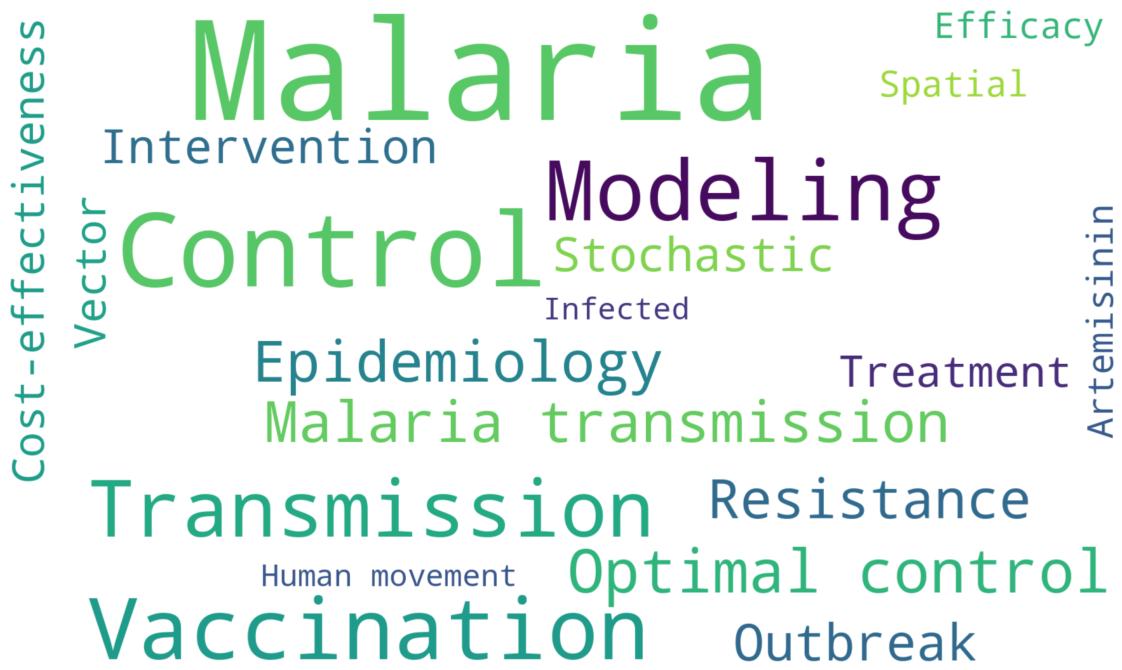
Figure 3.
Conceptual representation of spatial heterogeneity and source–sink dynamics in malaria transmission. A high-transmission source region is connected to a lower-transmission sink region through human mobility and spatial connectivity. Movement of infected individuals may facilitate parasite importation into connected locations, while local diffusion, vector control, and treatment can modify transmission intensity. The transmission profile shown is schematic and is intended to illustrate spatial variation rather than represent empirical data.
Figure 3.
Conceptual representation of spatial heterogeneity and source–sink dynamics in malaria transmission. A high-transmission source region is connected to a lower-transmission sink region through human mobility and spatial connectivity. Movement of infected individuals may facilitate parasite importation into connected locations, while local diffusion, vector control, and treatment can modify transmission intensity. The transmission profile shown is schematic and is intended to illustrate spatial variation rather than represent empirical data.
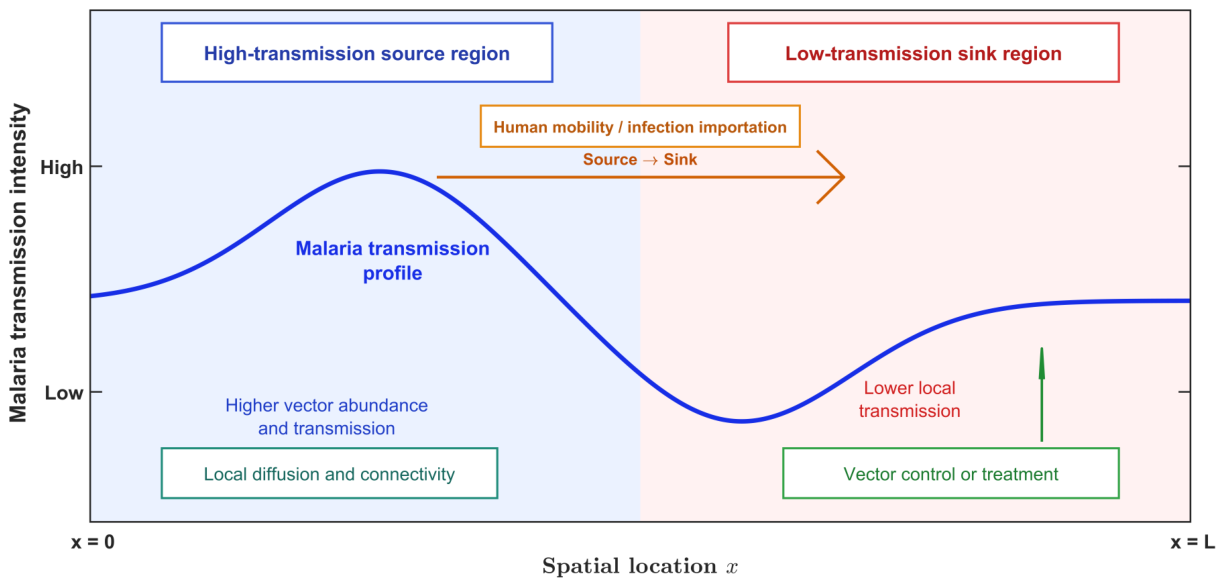
Figure 4.
Conceptual framework illustrating the influence of climatic and seasonal variability on malaria transmission dynamics. Temperature, rainfall, and relative humidity can affect mosquito abundance, survival, development, and biting activity, as well as parasite development within the mosquito. These processes may subsequently influence the time-dependent transmission rate and human infection burden. Seasonal forcing represents periodic variation in transmission, whereas long-term climate change may modify the magnitude and timing of seasonal transmission patterns.
Figure 4.
Conceptual framework illustrating the influence of climatic and seasonal variability on malaria transmission dynamics. Temperature, rainfall, and relative humidity can affect mosquito abundance, survival, development, and biting activity, as well as parasite development within the mosquito. These processes may subsequently influence the time-dependent transmission rate and human infection burden. Seasonal forcing represents periodic variation in transmission, whereas long-term climate change may modify the magnitude and timing of seasonal transmission patterns.
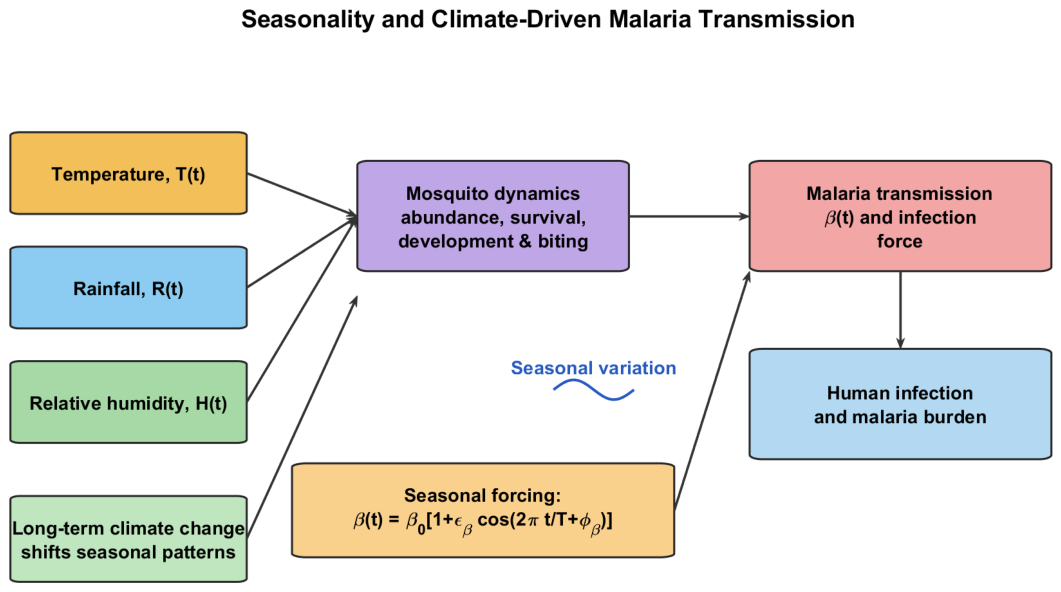

Table 1.
Twenty most frequent standardized terms identified from the titles of the 106 bibliography entries, together with the references whose titles contain the corresponding terms.
Table 1.
Twenty most frequent standardized terms identified from the titles of the 106 bibliography entries, together with the references whose titles contain the corresponding terms.
| Rank | Standardized Term | Frequency | Supporting References |
|---|---|---|---|
| 1 | Malaria | 61 |
[1,2,3,4,5,6,24,25,26,27,28,29,46,47] [49,53,54,55,56,57,58,59,60,62,63,64] [67,68,69,70,71,72,73,74,75,77,78,79] [83,85,86,87,88,89,90,91,92,93,94,95] [96,97,98,99,100,101,102,103,104,105,106] |
| 2 | Control | 32 |
[5,8,9,13,15,17,21,22,24,28,30,31] [39,42,45,46,47,60,62,63,64,67,86,88] [89,93,94,95,96,97,102,106] |
| 3 | Vaccination | 22 |
[7,8,16,21,24,35,43,44,46,59,60,65] [68,98,99,100,101,102,103,104,105,106] |
| 4 | Modeling | 21 |
[8,10,17,26,32,39,42,43,49,55,59] [63,67,80,81,88,94,96,101,103,104] |
| 5 | Transmission | 19 |
[6,11,13,17,19,23,46,54,55,58,67] [68,69,71,72,73,92,101,102] |
| 6 | Optimal control | 11 |
[13,21,22,24,30,31,39,45,46,47,102] |
| 7 | Epidemiology | 10 |
[7,31,35,47,48,59,75,76,86,97] |
| 8 | Malaria transmission | 10 |
[55,58,67,68,69,71,73,92,101,102] |
| 9 | Resistance | 9 |
[5,6,52,61,62,63,64,79,82] |
| 10 | Outbreak | 8 |
[9,10,14,18,20,25,27,37] |
| 11 | Intervention | 7 |
[33,42,63,67,75,81,94] |
| 12 | Stochastic | 7 |
[15,19,20,25,26,34,35] |
| 13 | Treatment | 6 |
[11,13,16,40,45,46] |
| 14 | Cost-effectiveness | 6 |
[22,30,33,46,87,88] |
| 15 | Vector | 6 |
[23,45,64,67,84,94] |
| 16 | Efficacy | 4 |
[8,62,96,100] |
| 17 | Spatial | 4 | [28,73,75,89] |
| 18 | Artemisinin | 4 | [6,80,81,82] |
| 19 | Infected | 3 | [32,105] |
| 20 | Human movement | 3 | [28,83,89] |
Table 2.
Comparative Analysis of Malaria Intervention Strategies
| Intervention | Mechanism | Effectiveness | Cost-Effectiveness | Key Challenges | Modeling Insights |
|---|---|---|---|---|---|
| Insecticide-Treated Nets (ITNs) | Physical barrier + insecticide | High when usage is high | Moderate-High | Insecticide resistance, behavioral resistance | Attractive ITNs are most effective |
| Indoor Residual Spraying (IRS) | Vector mortality | High with high coverage | Moderate | Insecticide resistance, operational costs | Effectiveness depends on vector susceptibility |
| Larviciding | Vector population reduction | Moderate-High | High (in some settings) | Environmental concerns, logistical challenges | Cost-effective in suitable settings |
| RTS,S/AS01 Vaccine | Pre-erythrocytic immunity | Moderate (∼30–40%) | Moderate-High | Waning immunity, multiple doses needed | Combined with other interventions is optimal |
| R21/Matrix-M Vaccine | Pre-erythrocytic immunity | Higher than RTS,S | Moderate-High | New vaccine, long-term efficacy unknown | Promising for childhood burden reduction |
| Antimalarial Treatment | Parasite clearance | High | High | Drug resistance, access to care | Combined with vector control is optimal |
| Mass Drug Administration (MDA) | Parasite reservoir reduction | Moderate-High | Variable | Drug resistance, logistical challenges | Effective in low-transmission settings |
| Genetic Biocontrol | Vector population modification | Potential High | Unknown | Regulatory, ethical challenges | Promising but early-stage |
| Wolbachia-based Control | Vector competence reduction | Potential High | Unknown | Technical challenges, field deployment | Emerging approach |
Disclaimer/Publisher’s Note: The statements, opinions and data contained in all publications are solely those of the individual author(s) and contributor(s) and not of MDPI and/or the editor(s). MDPI and/or the editor(s) disclaim responsibility for any injury to people or property resulting from any ideas, methods, instructions or products referred to in the content. |
© 2026 by the authors. Licensee MDPI, Basel, Switzerland. This article is an open access article distributed under the terms and conditions of the Creative Commons Attribution (CC BY) license (http://creativecommons.org/licenses/by/4.0/).
Copyright: This open access article is published under a Creative Commons CC BY 4.0 license, which permit the free download, distribution, and reuse, provided that the author and preprint are cited in any reuse.