

Submitted:
06 October 2026
Posted:
09 October 2026
You are already at the latest version
Abstract
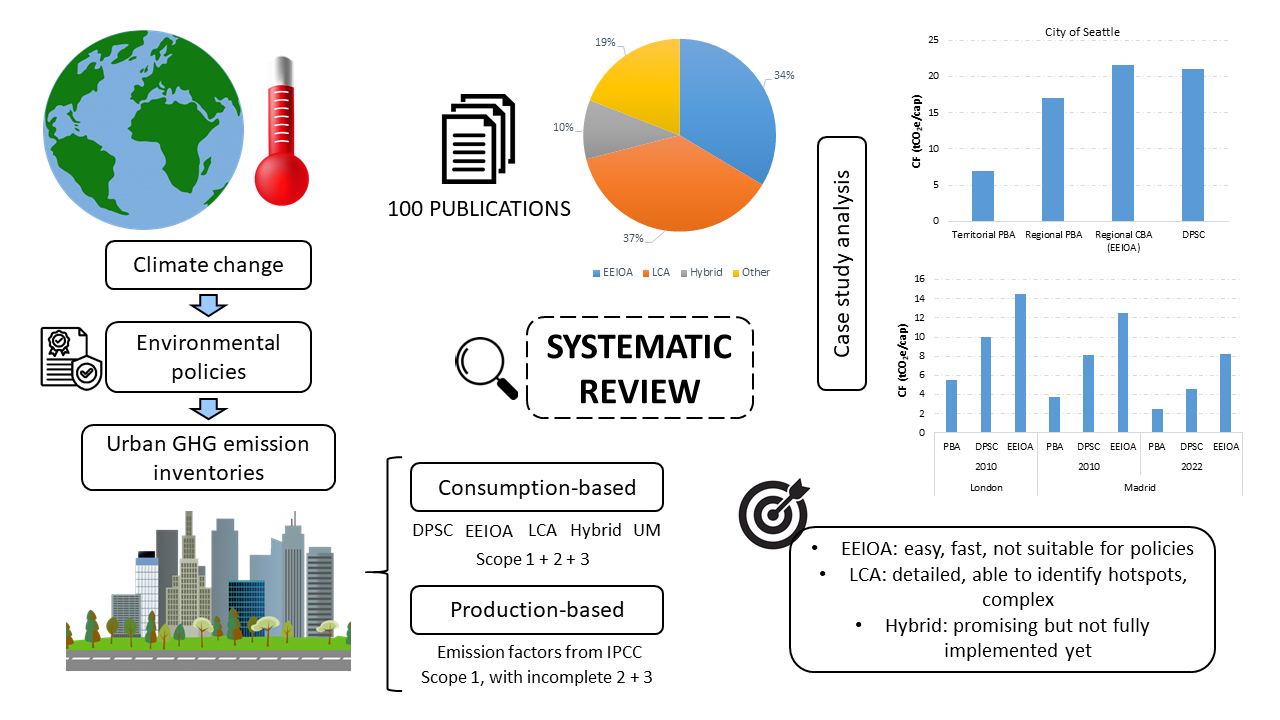
As cities emerge as the primary drivers of global consumption-based emissions, the need for greenhouse gas (GHG) accounting methods that model multisectoral urban interactions has become paramount. In this context, consumption-based (CB) urban GHG emission inventories have arisen as a useful tool for political decision-makers. This systematic literature review was carried out across three databases, covering al-most 20 years of publications strictly related to the elaboration of CB GHG emission inventories, reaching a total of 100 publications. More than a third of the articles ex-plored Life-Cycle Assessment (LCA), 34% used Environmentally-Extended In-put-Output Analysis (EEIOA), with only 10% delving into hybrid methodologies. A case study comparison was performed for cities that applied different methodologies, in terms of carbon footprint. The strengths and weaknesses of each framework were also assessed. The results showed that both EEIOA and LCA were useful to model complex carbon flows and accounted for the majority of emissions associated to urban activity. EEIOA excelled for its operational simplicity and speed in the calculation of carbon footprint when input-output matrices are available, but it was not as suitable for policy-making. LCA required a larger volume of information and its processing was more time-consuming, but it was also capable of identifying hotspots. Hybrid approaches obtained carbon footprint results similar to those of EEIOA or LCA, while covering certain weaknesses of these standalone methodologies.
Keywords:
climate change
; consumption-based emissions
; urban emission inventories
; input-output analysis
; life-cycle assessment
Copyright: This open access article is published under a Creative Commons CC BY 4.0 license, which permit the free download, distribution, and reuse, provided that the author and preprint are cited in any reuse.