

Submitted:
04 October 2026
Posted:
09 October 2026
You are already at the latest version
Abstract
Relator spaces provide a relational framework in which neighborhoods, interiors, closures, convergence and several topological properties can be generated directly from a family of binary relations. Independently, neutrosophic set theory extends classical and fuzzy descriptions by associating with every point three membership degrees representing truth, indeterminacy and falsity. In this paper we combine these two frameworks and develop a systematic theory of neutrosophic relator spaces. We define neutrosophic relator interiors and closures componentwise from a relator, and introduce neutrosophic open and closed sets, neutrosophic neighborhoods, induced neutrosophic topologies, continuity, separation properties, compactness and connectedness. Several basic algebraic and order properties of these operators are established. We show that the construction reduces to the corresponding theory of relator spaces when the three neutrosophic components are crisp, and to ordinary neutrosophic topological spaces when the relator is induced by a topology. Several examples are given, including finite relator spaces, symmetric relators, preorder relators and a crisp neutrosophic relator space. The resulting framework provides a common language for relational generalizations of neutrosophic topology and suggests further investigations involving convergence, quasiuniformity, bitopological structures and generalized separation axioms.
Keywords:
neutrosophic set
; neutrosophic topology
; relator space
; relator
; neutrosophic interior
; neutrosophic closure
; neutrosophic continuity
; neutrosophic compactness
; neutrosophic connectedness
MSC: 54A05; 54E15; 54C08; 54D10; 54D30; 03E72
1. Introduction
The study of generalized topological structures has developed along several different directions. One important direction replaces a single topology by more general systems of neighborhoods, relations or convergences. Relator spaces belong to this relational approach. A relator is a nonempty family of binary relations on a set, and many topological notions can be generated from such a family [5,6,9]. In particular, interiors, closures, convergence and several continuity properties can be formulated directly in terms of relations.
A different direction is represented by neutrosophic set theory. Smarandache introduced neutrosophic sets as a framework allowing truth, indeterminacy and falsity to be represented independently [1]. Neutrosophic topological structures were subsequently developed in several directions; see, for example, Salama and Alblowi [2] and Salama and Smarandache [3]. These theories generalize classical topological notions by replacing ordinary characteristic functions with neutrosophic membership information.
The purpose of this paper is to combine these two approaches. More precisely, let
be a relator space, where is a nonempty family of binary relations on X . For a neutrosophic set
we define three relational operators
and combine them into a neutrosophic relator interior
The corresponding closure operator is defined dually.
The basic philosophy is that the relational structure should determine the local behavior of the three neutrosophic components simultaneously. This is analogous to the role played by relators in the general theory of generalized uniform and topological structures [5,6]. At the same time, the componentwise treatment is compatible with the usual constructions in neutrosophic topology [2,3].
The paper is organized as follows. Section 2 recalls the required background on relator spaces and neutrosophic sets. Section 3 introduces neutrosophic relator interiors and closures. Section 4 investigates open and closed neutrosophic sets. Section 5 studies the induced neutrosophic topology. Section 6 considers continuity and mappings. Section 7 introduces separation properties, while Section 8 and Section 9 study compactness and connectedness. Section 10 discusses special cases and examples. Finally, Section 11 presents several directions for further research.
2. Preliminaries
2.1. Relator Spaces
We first recall the relational framework.
Definition 1.
Let X be a nonempty set. A relator on X is a nonempty family of binary relations on X. The pair
is called a relator space.
This notion was systematically developed by Száz as a common framework for various generalized structures; in particular, relators can be used to generate topological and uniform-type notions [5,6].
For and , put
Thus is the R -neighborhood of x .
For a subset , one standard relational closure operator is given by
where
The corresponding interior can be expressed by complementation:
These constructions are part of the general theory of relator spaces [5,9].
Definition 2.
A relator on X is called reflexive if
where
Definition 3.
A relator is called symmetric if
2.2. Neutrosophic Sets
We use the following standard form of a neutrosophic set.
Definition 4.
Let X be a nonempty set. A neutrosophic set A in X is a triple
where
For , the numbers
are called respectively the truth-membership, indeterminacy-membership and falsity-membership degrees of x with respect to A.
The three components are treated independently. This is one of the central ideas of neutrosophic set theory [1].
We write
if
for every .
The neutrosophic empty and universal sets are
meaning
and
3. Neutrosophic Relator Interior and Closure
We now introduce the principal construction of the paper.
Let be a relator space and let
be a neutrosophic set on X .
For a relation , define the relational truth operator by
and the relational falsity and indeterminacy operators by
and
These formulas express the idea that a point x has a high truth degree relative to a neighborhood if all points in that neighborhood have high truth degree, whereas uncertainty and falsity are propagated by upper bounds.
Definition 5.
Let be a relator space and let
be a neutrosophic set. The neutrosophic relator interior of A is
where
and
The use of a supremum over relations expresses the possibility of choosing a sufficiently small relational neighborhood.
Definition 6.
The neutrosophic relator closure of A is
where
and
The definitions are designed so that interior and closure are dual under neutrosophic complementation.
Proposition 1.
For every neutrosophic set A,
and
provided that is reflexive.
Proof.
Suppose that is reflexive. Then for every and every . Hence
and therefore
For the other two components,
and hence
This is exactly
The closure assertion follows by applying the preceding argument to and using the definition of . □
Proposition 2.
For all neutrosophic sets A and B,
and
Proof.
The result follows immediately from the monotonicity of infima and suprema and the definition of the neutrosophic ordering. □
Proposition 3.
For every neutrosophic set A,
whenever the relator generates a topological relator.
4. Neutrosophic Open and Closed Sets
Definition 7.
A neutrosophic set A in is called neutrosophic -open if
It is called neutrosophic -closed if
We denote the family of all neutrosophic -open sets by
and the family of all neutrosophic -closed sets by
Theorem 1.
Assume that is a topological relator. Then
is a neutrosophic topology on X.
Proof.
The neutrosophic empty and universal sets are fixed by the interior operator. Hence
The finite-intersection property follows from the fact that an interior operator is contractive and monotone. Likewise, arbitrary unions of fixed points of an interior operator are fixed points whenever the operator is a topological interior operator. Thus
satisfies the axioms of a neutrosophic topology. □
This construction parallels the usual passage from relational structures to topological structures. Relator spaces were specifically developed to provide a framework in which topological notions can be derived from relations [5,9].
Corollary 1.
If is induced by an ordinary topology τ, then
is a neutrosophic topological space associated with τ.
5. Neutrosophic Neighborhoods
Definition 8.
Let . A neutrosophic set N is called a neutrosophic -neighborhood of x if there exists a neutrosophic -open set G such that
Because a neutrosophic set is not merely an ordinary subset, membership in the preceding definition is understood through its truth component:
Definition 9.
A neutrosophic set A is said to be locally -truth-open at xif
Similarly, A is locally -indeterminacy-closed at x if
and locally -falsity-closed at x if
These componentwise notions are useful when one does not require all three neutrosophic components to have identical local behavior.
6. Basic Properties
We next collect several properties that follow directly from the definitions.
Theorem 2
(Monotonicity). Let be neutrosophic sets on X. If
then
and
Proof.
For every ,
for all y . Hence
Taking the supremum over gives
The indeterminacy and falsity inequalities follow from
together with the reversal produced by the infimum. The closure result then follows by complementation. □
Theorem 3
(Idempotence under topologicality). Suppose that is a topological relator. Then
and
Proof.
Each component is an ordinary interior or closure operator generated by the corresponding relational neighborhoods. Since a topological relator produces an idempotent interior operator, the three componentwise equalities follow. The closure equality follows by duality. □
Theorem 4
(Duality). For every neutrosophic set A,
and
Proof.
This follows directly from the definitions of neutrosophic complement, interior and closure. □
7. Neutrosophic Continuity
Let
be neutrosophic relator spaces.
Definition 10.
A mapping
is called neutrosophically continuous if for every neutrosophic -open set B in Y,
is a neutrosophic -open set in X.
For a neutrosophic set
on Y , define its inverse image by
Proposition 4.
If is neutrosophically continuous, then for every neutrosophic set B,
contains
in the corresponding neutrosophic order.
Proof.
This is the closure formulation of continuity. It follows from continuity applied to complements and the duality between interior and closure. □
Definition 11.
A bijection
is called a neutrosophic relator homeomorphism if both f and are neutrosophically continuous.
8. Separation Properties
The relational structure permits natural neutrosophic versions of separation axioms.
Definition 12.
A neutrosophic relator space is called neutrosophically if for any distinct points there exists a neutrosophic -open set U such that
or
Definition 13.
A neutrosophic relator space is called neutrosophically if for every pair there exist neutrosophic open sets such that
and
Definition 14.
A neutrosophic relator space is called neutrosophically Hausdorff if for every pair there exist neutrosophic open sets satisfying
and
The last condition expresses neutrosophic disjointness in terms of the truth components.
Proposition 5.
Every neutrosophically Hausdorff relator space is neutrosophically .
Proof.
If , choose neutrosophic open sets U and V separating x and y . The neutrosophic disjointness condition prevents the truth degree of y in U and the truth degree of x in V from being simultaneously positive. Restricting the corresponding neighborhoods gives the required separation. □
9. Neutrosophic Compactness
Definition 15.
Let be a neutrosophic relator space. A family
of neutrosophic open sets is called a neutrosophic open cover of a neutrosophic set A if
Definition 16.
A neutrosophic set A is called neutrosophically compact if every neutrosophic open cover of A has a finite subcover.
Theorem 5.
If A is neutrosophically compact and
is neutrosophically continuous, then is neutrosophically compact.
Proof.
Let be a neutrosophic open cover of . By continuity,
is a neutrosophic open cover of A . Compactness gives
Applying f yields
Thus is neutrosophically compact. □
Remark 4.
The definition is deliberately formulated through the induced neutrosophic topology. This makes it compatible with the ordinary definition of compactness when the neutrosophic structure is crisp.
10. Neutrosophic Connectedness
Definition 17.
A neutrosophic relator space is called neutrosophically disconnected if there exist nonzero neutrosophic open sets such that
and
Otherwise, X is called neutrosophically connected.
Thus connectedness means that the space cannot be decomposed into two nontrivial neutrosophically disjoint open parts.
Proposition 6.
The continuous image of a neutrosophically connected space is neutrosophically connected.
Proof.
Suppose that were disconnected. Then the inverse images of the two separating neutrosophic open sets would give a separation of X , contradicting connectedness. □
11. Special Relators
11.1. The Discrete Relator
Let
Then
Consequently,
and
Hence:
Proposition 7.
For the discrete relator,
for every neutrosophic set A.
Thus every neutrosophic set is neutrosophically open.
11.2. The Indiscrete Relator
Let
and
Then
for every .
Therefore
while
and
Thus the interior is constant across X .
Example 1.
Let
and define
and
For the indiscrete relator,
and
for every . Hence
12. Crisp Neutrosophic Relator Spaces
A particularly important special case occurs when all membership values are crisp.
Definition 18.
A neutrosophic set
is called crisp if
In the standard crisp representation of a classical subset , one may use
Theorem 6.
Let and associate with A the crisp neutrosophic set
If is a reflexive relator, then the truth component of the neutrosophic relator interior satisfies
Similarly,
Proof.
For every ,
The infimum is equal to 1 precisely when
Consequently,
exactly when x has a relational neighborhood contained in A . This is precisely the definition of relational interior. The closure assertion follows by duality. □
This theorem shows that the present theory is genuinely compatible with the classical relational theory rather than being an unrelated extension.
13. A Finite Example
Example 2
(A finite neutrosophic relator space). Let
and let
where
Consider the neutrosophic set
defined by
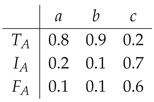
For the truth component,
while
and
For the indeterminacy component,
and
Likewise,
Thus
In this particular example A is already -open.
14. Relations with Classical and Neutrosophic Topology
The construction has two important limiting cases.
First, if all neutrosophic components are crisp, the truth component recovers the corresponding relational interior and closure, as shown above.
Second, if the relator is generated by a topology , the neutrosophic relator topology agrees with the corresponding neutrosophic topology generated from .
This gives the following conceptual diagram:
The horizontal arrows add the three-valued neutrosophic structure, whereas the vertical arrows replace a general relational structure by a topological one.
15. Further Structural Properties
We record several consequences of the framework.
Proposition 8.
Let and be relators on X with
Then, for every neutrosophic set A,
in the neutrosophic order.
Proof.
For the truth component,
The corresponding inequalities for indeterminacy and falsity follow from the reversed ordering of these components. □
Proposition 9.
Suppose that is symmetric. Then the corresponding relational neighborhood system has a natural duality between forward and backward neighborhoods.
Proof.
If is symmetric, then for every ,
Thus forward and backward relational neighborhoods are represented inside the same relator. This is the relational analogue of the symmetry phenomena that occur in generalized uniform spaces [7]. □
Remark 5.
Symmetric relators are especially suitable for studying neutrosophic analogs of uniformity, proximity and quasi-metric structures.
16. Conclusions
We have introduced a relational framework for neutrosophic topology by combining relator spaces with neutrosophic sets. The principal operators are the neutrosophic relator interior and closure, which are defined componentwise from the relational neighborhoods.
The framework recovers classical relational topology in the crisp case and connects naturally with neutrosophic topological spaces when the relator is topological. We have established basic monotonicity, duality and idempotence results under appropriate assumptions and introduced neutrosophic versions of openness, closedness, continuity, separation, compactness and connectedness.
References
- F. Smarandache, Neutrosophy: Neutrosophic Probability, Set, and Logic , American Research Press, Rehoboth, NM, 1998.
- Comput. Sci. Eng. 2012, 2(7), 129–132. [CrossRef]
- A. A. Salama and F. Smarandache, Neutrosophic crisp set theory, Neutrosophic Sets and Systems 5 (2014), 26–35.
- J. C. Kelly, Bitopological spaces, Proceedings of the London Mathematical Society (3) 13 (1963), 71–89. [CrossRef]
- Á. Száz, Basic tools and mild continuities in relator spaces, Acta Mathematica Hungarica 50 (1987), 177–201. [CrossRef]
- Á. Száz, Directed, topological and transitive relators, Publicationes Mathematicae Debrecen 35 (1988), 179–196.
- Á. Száz, Inverse and symmetric relators, Acta Mathematica Hungarica 60 (1992), 157–176. [CrossRef]
- Á. Száz, An extension of Kelley’s closed relation theorem to relator spaces, Filomat 14 (2000), 49–71.
- Cs. Rakaczki and Á. Száz, Semicontinuity and closedness properties of relations in relator spaces, Mathematica 45 (2003), 73–92.
- M. Salih and Á. Száz, Generalizations of some ordinary and extreme connectedness properties of topological spaces to relator spaces, Electronic Research Archive 28 (2020), 471–548. [CrossRef]
Disclaimer/Publisher’s Note: The statements, opinions and data contained in all publications are solely those of the individual author(s) and contributor(s) and not of MDPI and/or the editor(s). MDPI and/or the editor(s) disclaim responsibility for any injury to people or property resulting from any ideas, methods, instructions or products referred to in the content. |
© 2026 by the authors. Licensee MDPI, Basel, Switzerland. This article is an open access article distributed under the terms and conditions of the Creative Commons Attribution (CC BY) license (http://creativecommons.org/licenses/by/4.0/).
Copyright: This open access article is published under a Creative Commons CC BY 4.0 license, which permit the free download, distribution, and reuse, provided that the author and preprint are cited in any reuse.