

Submitted:
03 October 2026
Posted:
08 October 2026
You are already at the latest version
Abstract
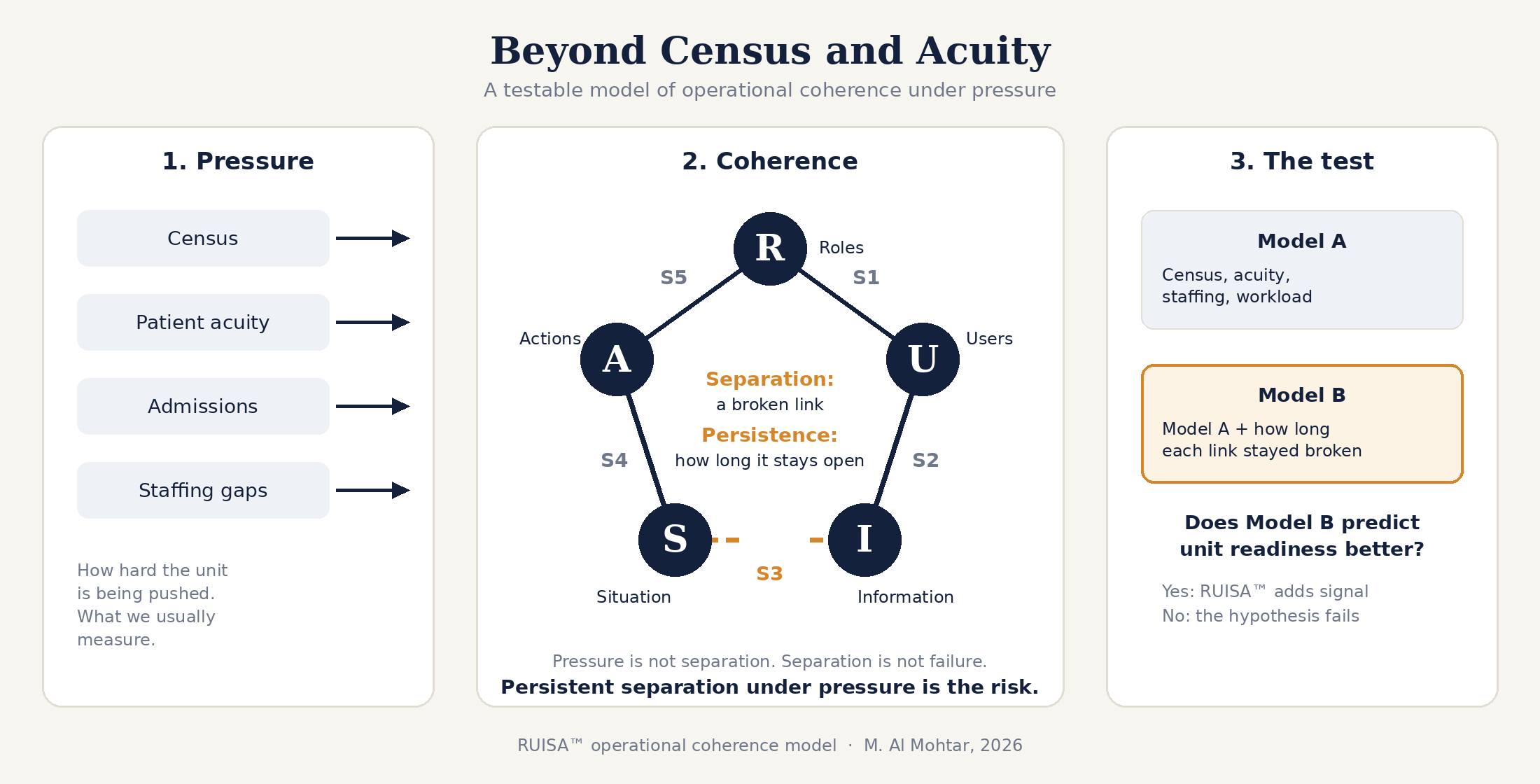
Background: Hospital units are commonly assessed by the pressure they face: census, patient acuity, admissions and staffing. These measures describe demand, but they do not show whether a unit can still convert that demand into coordinated action. Units with similar pressure profiles can perform very differently. Aim: To present RUISA™ (Roles, Users, Information, Situation, Actions) as a candidate operational coherence model and to state a testable hypothesis about how coordination deteriorates under pressure. Model: The paper does not propose a new theory of workload, patient flow or resilience. It offers a structured method for locating where the chain that converts demand into action becomes disconnected, and for how long. Four constructs are kept distinct: pressure, coherence, separation and persistence. Three propositions follow: pressure is not separation; separation is not failure; and persistent, unresolved separation under pressure is the hypothesised mechanism through which operational coherence deteriorates. Hypothesis: Persistent disruption of RUISA relationships will explain deterioration in operational readiness beyond conventional measures of census, acuity, staffing and workload. A comparison of nested prediction models is proposed as a test, together with the result that would count against the model. Conclusion: If supported, the model would give nursing and operations leaders a way to see not only how hard a unit is being pushed, but where its coordination is breaking and how long the break has lasted.
Keywords:
operational coherence
; nursing coordination
; hospital operations
; nurse staffing
; situation awareness
; RUISA™
Copyright: This open access article is published under a Creative Commons CC BY 4.0 license, which permit the free download, distribution, and reuse, provided that the author and preprint are cited in any reuse.