

Submitted:
05 October 2026
Posted:
08 October 2026
You are already at the latest version
Abstract
Tax enforcement can separate the party bearing liability from the system selecting the tax position. We study a firm that delegates reporting to an optimizer whose executable objective only partially incorporates expected sanctions. The owner bears all monetary liability and can correct the objective, but correction consumes resources. A quadratic benchmark delivers explicit reporting, specification and adoption rules. Greater capability can first increase and then eliminate concealment even when sanction pass-through is unchanged: stronger responses to a corrective mandate make endogenous correction more effective. Strict liability implements compliance above a calculable enforcement threshold, but the threshold can exceed that required for direct human choice and need not be feasible under bounded sanctions. Executable certification caps provide an alternative instrument. A cap can lower the default action yet increase concealment relative to an optimally corrected unrestricted system because the owner stops investing in correction. We characterize voluntary compliance certification and a welfare-maximizing cap within the binding-cap regime, accounting separately for lawful service losses, transfers and real costs. Private gates can remove the incremental value of certification. A shared-mandate extension identifies the highest-default contexts that govern complete compliance, while alternative control costs and action curvature show that the capability reversal and finite exact-compliance threshold are not general. The results describe a delegated-optimization friction rather than an intrinsic preference of AI systems, and they do not establish a universal advantage of certification. Numerical illustrations and curvature checks use normalized parameters, not empirical estimates.
Keywords:
AI agents
; tax compliance
; tax enforcement
; delegation
; objective specification
; principal-agent theory
; certification
; mechanism design
1. Introduction
The person legally responsible for a tax return need not be the proximate decision maker choosing its contents. A firm can instruct a software agent to reduce its tax bill, authorize that agent to execute a sequence of accounting decisions, and receive a report after those decisions have been made. The owner remains the taxpayer. Yet the implemented reporting choice may maximize an executable score that represents only part of the owner’s objective. The economic problem is therefore not simply whether tax advice becomes cheaper. It is how enforcement operates when the party facing sanctions controls a decision rule rather than choosing each tax position directly.
This separation matters even when the owner understands the enforcement rule, anticipates the agent’s response, and bears every monetary sanction. Liability changes the owner’s payoff, but it changes the executed action through the objective and constraints the owner can implement. If including a neglected consequence requires verification, validation or integration resources, liability may induce partial correction rather than exact replication of the owner’s preferred reporting choice. A rational owner can then knowingly tolerate an execution error because eliminating it is costly. Describing this outcome as an AI system wanting to evade taxes would misidentify the mechanism. The system selects the maximizer of its specified objective; the discrepancy concerns what was specified and the cost of changing it.
We construct a deliberately narrow model of this situation. A firm chooses direct human control or delegation. The human chooses an amount of concealed taxable base. Under delegation, the owner chooses a nonnegative compliance weight in an executable objective, after which the agent chooses concealment. The same expected monetary sanction enters the owner’s payoff in full and the default executable objective with a pass-through coefficient. Correction has a convex resource cost. Capability reduces the private resource cost of implementing reporting strategies, while lawful automation services provide a separate adoption benefit. The tax authority commits to enforcement and may offer certification of an executable action cap, accompanied by a reduction in expected sanctions.
The first result is an explicit sequential equilibrium. The implemented action lies between the default agent choice and the owner’s preferred choice at the same technology. The gap is positive when a relevant cost is omitted and correction is costly. Relative to direct human control, delegation combines this gap with the effect of a different technology. This decomposition prevents a common interpretive error: an increase in concealment after automation need not demonstrate a change in moral preferences, and a decrease need not demonstrate perfect objective alignment. Adoption depends on lawful service benefits, implementation costs and the value of the reporting option, rather than concealment alone.
The second result concerns capability. Holding sanction pass-through fixed, improved capability can produce a rise followed by a fall in concealment. This pattern does not require adding a separate legal-understanding effect. If the owner prefers compliance but the default objective understates sanctions, lower implementation costs initially make neglected incentives more consequential. Over a further range, however, the same improvement amplifies the effect of a compliance weight and makes endogenous correction sufficiently effective to eliminate concealment. We derive the turning point and the compliance boundary. The result is conditional on the specified cost-of-correction technology, and the location of both boundaries may lie outside the economically feasible capability range.
The third result identifies the limits of strict liability. A finite expected sanction can implement compliance in the baseline, including when sanctions have zero direct pass-through to the default objective. Owner liability still motivates the owner to correct that objective. The required sanction can nevertheless exceed the direct-choice threshold and exceed a legal or administrative bound. Strict liability is therefore neither automatically sufficient at an existing enforcement level nor fundamentally incapable of regulating delegated actions. The useful question is which threshold is implementable, with what real correction and enforcement costs, and whether adoption remains privately attractive at that threshold.
The fourth result concerns executable constraints. A certification cap is imposed on what the system can implement, rather than merely appended as advice. It can substitute for costly objective correction. This substitution creates a discontinuity in the owner’s choice between using the cap and paying to correct the objective. In a region, a cap below the default action increases concealment relative to unrestricted delegation because the owner chooses zero correction and accepts the cap. A tighter constraint on the default system does not necessarily imply a smaller action in the equilibrium of the owner-system hierarchy. This is the main reason policy analysis must solve both decisions rather than compare two fixed agent objectives.
Finally, we distinguish execution obedience from voluntary deployment. A zero cap makes concealment infeasible, but it implements compliant delegation only when the firm prefers the certified system to both direct control and unrestricted delegation. A reduction in sanctions has no direct monetary value on a perfectly compliant path. Thus penalty relief alone cannot compensate a firm for the lawful service loss from a zero cap. Within a nonempty binding-cap participation region, we derive an exact constrained welfare optimum. Outside that region, policy requires comparison with corrected certified systems and nonadoption. We do not label a within-regime stationary point as a global optimum.
The contribution is bounded by substantial prior work. Tax intermediaries, incomplete objectives, delegation and AI obedience are established topics. The candidate contribution is a tractable tax-reporting application of their interaction through costly objective correction, full owner liability and executable constraints. We derive a nonmonotone capability response and an endogenous-correction effect of a cap, then show why their policy interpretation is conditional. Private gates can dominate certification when they deliver the same constraints more cheaply, and changing the correction technology can remove the capability reversal. A shared-mandate extension identifies the highest-default contexts that govern complete compliance, without claiming that shared investment is a new economic principle. The framework is not uniquely applicable to AI. It also describes other delegated optimizers with the same implementation frictions. Its relevance to firm-side AI arises from the distinction between programmable scores and legal liability, not from any claim that agency problems begin with machines.
The paper proceeds from the human benchmark to the sequential delegation equilibrium, alignment, capability and enforcement. It then analyzes certification and voluntary implementation, develops conditional policy design, and illustrates the mechanisms computationally. All quantitative exercises use normalized examples. They neither estimate the prevalence of autonomous tax reporting nor predict a country’s revenue response. Proofs and implementation details appear in the appendices.
2. Related Literature and the Scope of the Contribution
2.1. Tax Compliance and Intermediaries
The direct-choice benchmark belongs to the tax-compliance tradition initiated by Allingham and Sandmo [1]. The taxpayer weighs the gain from underreporting against consequences if detected. We use risk neutrality and convex implementation costs to isolate delegation, rather than treating our quadratic payoff as the original expected-utility formulation. The distinction between a fine on concealed income and a fine on evaded tax is relevant to comparative statics, as emphasized by Yitzhaki [2]. Accordingly, the model specifies a monetary sanction per unit of concealed base and includes recovered tax in that sanction.
Tax enforcement also depends on information, administration and real compliance costs. Slemrod [3] provides the broader enforcement context, while Slemrod and Yitzhaki [4] treats avoidance, evasion and administration as connected design problems. Our action is deliberately narrower than their full set of tax responses: it is taxable income omitted from reporting. Lawful deductions and useful accounting services enter a separate productivity benefit. This separation prevents a welfare gain from legitimate automation from being described as a gain from concealment.
The traditional tax-preparer literature is an essential benchmark. Klepper and Nagin [5] studies how preparers affect compliance; Klepper et al. [6] examines expert intermediaries and legal compliance. These papers rule out a novelty claim based merely on inserting an intermediary between taxpayer and government. Battaglini et al. [7] connects professionals to client sorting and information spillovers. Our model suppresses networks and adviser selection in order to examine correction of a single executable objective. Nothing in our conclusions denies the importance of those omitted channels.
DeBacker et al. [8] supplies evidence that paid preparation need not increase compliance, with different outcomes for volunteer assistance. That evidence is not a calibration target here. It shows why a comparison between self-reporting and delegated decisions must account for incentives rather than presume that expertise either raises or lowers compliance. Alm et al. [9] studies preparer choice and behavioral considerations, which our risk-neutral specification does not attempt to reproduce. Taxpayer information and assistance can also interact with endogenous auditing, as in Vossler and Gilpatric [10]. We hold the audit technology fixed and model neither government prediction errors nor inspection triage. Reporting substitution across margins, examined by Carrillo et al. [11], is another omitted enforcement channel.
Agency structures already appear within public finance. Kleven et al. [12] analyzes firms as fiscal intermediaries, with organizational records supporting enforcement. Our liability-bearing firm is instead the principal of a reporting optimizer, and the mechanism concerns objective inclusion rather than employee reporting threats. Corporate governance can alter tax behavior through interactions between managerial incentives and sheltering, as in Desai and Dharmapala [13]. That precedent is particularly relevant to the distinction between aligning a delegate with an owner and aligning both with public objectives. It does not imply that every owner-alignment improvement raises compliance.
2.2. Delegation and Programmable Objectives
The language of delegation draws on classic theories of authority and incentive provision. Aghion and Tirole [14] distinguishes formal from real authority, while ALONSO and MATOUSCHEK [15] studies optimal delegation. In our setup authority is explicit: the owner selects an objective correction or certified action set, and the system selects an action within it. We have no private signal held by the system and no strategic report of its type. The model therefore does not supply a new revelation principle or solve the general informed-delegation problem.
The attention to omitted consequences is related to incentive provision when relevant performance is difficult to observe or reward. Holmstrom [16] and Holmstrom and Milgrom [17] provide central foundations. The present correction cost is not a wage paid to a human agent. It is a real deployment and validation resource cost. A machine score has no budget constraint of its own, but accurately changing its implemented weighting is assumed to be costly. That distinction is an economic modeling choice, and its empirical importance would require separate evidence.
Athey et al. [18] directly examines allocation of decision authority between humans and AI. Their organizational tradeoff concerns incentives for human information acquisition. We instead study the mapping from owner liability to an executable tax objective when the owner already knows the relevant payoffs. Dutting et al. [19] reviews algorithmic contract theory, including computational and combinatorial issues. We use a tractable scalar optimization problem so that the new application is not confused with a computational-complexity result.
2.3. AI Agents, Alignment and Mechanism Design
Objective misspecification predates agentic tax applications. Amodei et al. [20] identifies unwanted behavior caused by poor objective design. Pan et al. [21] studies how increased capabilities can exploit proxy objectives. These works motivate considering the interaction of capability and a specified score; they do not establish the tax comparative statics proved here. In particular, our nonmonotonic result requires a deployer that responds by choosing costly correction. It is not a generic consequence of reward hacking.
Alignment need not mean literal obedience. Hadfield-Menell et al. [22] treats the human reward as unknown to a cooperative system, and Milli et al. [23] examines the relationship between obedience and the owner’s underlying interests. We instead posit a known score and a known owner payoff. The owner-system discrepancy is costly implementation rather than inference from demonstrations. Xu [24] and Greenwood et al. [25] show that designing a useful algorithmic delegate can differ from improving an algorithm in isolation. Our counterpart is that a constraint must be evaluated after the owner reoptimizes the objective.
Kobis et al. [26] includes a tax-evasion setting in experiments on machine delegation and dishonest behavior. The existence of that work precludes claiming that delegated AI tax decisions are an unexplored behavioral question. Our deterministic examples cannot substitute for its evidence. They examine how a liability rule and the cost of reward correction shape a fully specified economic hierarchy.
Two recent theoretical contributions substantially limit the novelty claim. Zhang et al. [27] studies income taxation under a hidden preference-to-execution mapping and derives an execution wedge in optimal-tax analysis. We do not claim priority for separating preferences from AI implementation. Their Section 4.11 also considers costly platform steering, so endogenous correction of execution is not itself our novelty claim. Our narrower problem holds true income fixed and derives a particular capability turning point and a cap-induced correction switch in reporting. Bergemann et al. [28] develops mechanism design for AI alignment and control with honesty and obedience requirements. Their Example V explicitly compares binary approval, permission-set delegation and reward design in a monitor–actor hierarchy, with rewards excluded from human welfare. Our distinction is an assumed real control cost in a tax-reporting application, not the invention of a permissions-versus-rewards comparison. Our participation and execution conditions apply familiar hierarchical constraints to a tax environment; they are not a novel concept of dual incentive compatibility.
Agent institutions and infrastructure are examined by Hadfield and Koh [29] and Chan et al. [30]. Liability and regulation of AI also have existing economic treatments, including Guerreiro et al. [31]. Broader cooperative-AI mechanisms are studied by Huang et al. [32], and resource-based governance by Chandra et al. [33]. We retain human economic liability, exclude developer incentives, and assume certification caps are enforceable. These restrictions produce an auditable reporting problem, but also exclude several central questions in those broader literatures.
The resulting claim is specific. In a tax-reporting hierarchy with a costly correction technology, capability changes both opportunities and the effectiveness of objective correction; executable caps change whether correction is purchased at all. The model’s value must be assessed through those interactions and their domain restrictions. The mere presence of an AI label, three actors, or a participation condition does not establish originality.
3. Environment and Direct Human Control
There are three decision roles: a firm owner, an executable reporting agent, and a tax authority. The authority commits to a policy before the owner decides whether and how to delegate. The agent is an optimization system, not an economic entity that can pay fines. The owner retains all monetary liability. The owner and system know the true taxable base and all payoff coefficients. The authority does not observe the realized taxable base before an audit; our results condition on a type and a committed enforcement rule, and do not solve elicitation of private income or agent properties. We exclude strategic persuasion and false reports of the installed agent’s properties. Certification later adds a verifiable constraint on execution, not a signal of unknown quality. A cap on actual concealed taxable base is an oracle control assumption: it requires a trusted mapping from underlying records and legal tax status to permissible execution. It is not derived from the authority observing a return, and without such a mapping the certification theorems do not describe an available real-world instrument.
The firm has true taxable income and a proportional tax rate . The reporting action is concealed taxable base. Thus means accurate reporting and means noncompliance in the model. We do not use x to represent legal avoidance or lawful deductions. Its private implementation cost is , where can differ across technologies. The owner also bears a linear nonpecuniary cost , with . This can represent an internal compliance preference. It is included in owner utility and later in aggregate utility; it is not a second monetary sanction.
An audit occurs with probability . Conditional on auditing a concealed unit, the authority recovers the unpaid tax and imposes a fine per unit of base. Expected monetary liability is
The analysis uses t as the enforcement instrument. It does not separately optimize p and , and statements about t hold fixed. Any bound must therefore be understood as a bound induced by feasible audits and fines. Risk neutrality makes the two instruments equivalent in expected owner payoffs; they need not be equivalent in a richer model with collection risk, audit costs or risk aversion.
Ignoring the common constant , owner utility from the reporting action is
Write . Direct human control uses and chooses
We impose and, for every delegated technology analyzed, . These restrictions make the upper tax-base bound nonbinding for nonnegative compliance mandates. They are substantive restrictions on the capability range, not harmless normalizations. The lower bound remains important: enforcement can make accurate reporting optimal.
An AI system has a default score that incorporates monetary sanctions with coefficient . The owner can add a compliance weight , giving the executable objective
The score is expressed in monetary-equivalent units for comparability. It is not the system’s conscious utility, a payment to the system, or a prediction of how a particular language model responds to a prompt. The coefficient r is the marginal pass-through of actual sanctions to the default executable objective. The neglected owner cost is . The owner knows g and can correct it.
Correction consumes real resources
The primitive is the cost of achieving a verified change in the implemented compliance coefficient, including integration and validation. It does not mean that typing a number into a reward function is expensive. If exact implementation is frictionless, and the model collapses to alignment with the owner’s objective at the delegated technology. Larger means a more expensive correction technology, rather than an exogenously more immoral system.
Delegation also provides a net lawful service benefit and requires a fixed real deployment cost . These are distinct from reporting gains. The benefit is held outside the concealed tax base and should be interpreted as a net utility-equivalent service surplus, not an untaxed increase in gross firm income. A technology interpretation later sets and , with q restricted so that . This is one illustrative specification rather than an estimated production function.
The timing is: the authority chooses enforcement and any certification offer; the owner chooses direct control or a deployment mode and a mandate; the agent maximizes its executable objective on the allowed action set; and taxes, expected sanctions and real costs are realized. The owner anticipates the response. Once deployed, the owner has no costless action-by-action override. Adding such an override with perfect information would remove the execution wedge and would describe a different decision architecture.
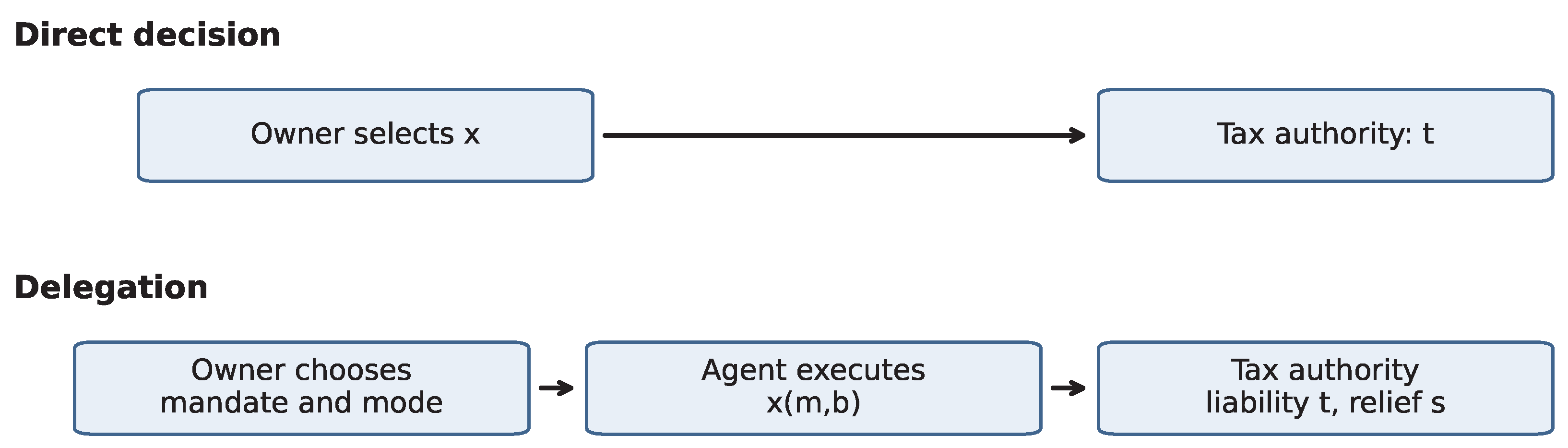
Figure 1.
Direct and delegated decision architectures. All monetary liability remains with the owner.
Figure 1.
Direct and delegated decision architectures. All monetary liability remains with the owner.
4. The Sequential Delegation Equilibrium
Given a mandate, strict concavity of the score implies a unique agent response
The owner solves . A mandate above never improves the action and can only increase correction cost. If , the unmodified agent already reports accurately and the owner uses . If , it suffices to consider . On this interval the owner’s reduced objective is strictly concave, including when , because changing m changes a strictly concave reporting payoff.
Proposition 1
(Reporting and correction). Under the baseline assumptions, the minimum-cost optimal mandate and delegated action are
The incremental delegated value is . If and , the specification gap relative to the unconstrained owner target is
If , this is the gap from the feasible same-technology owner choice. If , the feasible owner choice is zero and the gap is .
The proposition solves the owner decision, not merely the agent decision. The owner does not mechanically select full correction . It selects a smaller correction unless specification is free or the compliance boundary binds. The uncorrected default action is . The equilibrium satisfies , where . This order follows from omitted costs and one-sided mandates. It would not hold for an arbitrary misspecified objective that is too conservative.
When the owner prefers positive concealment, the gain from using the delegated technology can be decomposed into a technological gain and a correction loss. For ,
The second term includes both the remaining action distortion and specification spending. It vanishes as , but it need not be small for a technologically sophisticated system. This decomposition clarifies why delegation can be privately unattractive even when the direct implementation cost k falls.
If and while , delegated compliance is achieved with . Its reporting value is , whereas direct human reporting has . The owner therefore adopts only if lawful service benefits compensate deployment and compliance-specification costs. A claim that strict liability implements the same allocation as direct control would have to account for this adoption distortion. Accurate reporting alone does not establish efficient delegation.
Proposition 2
(Comparison and adoption). Suppose and delegation is active. Then
Consequently, implies , with strict inequality if either component is strictly positive. For unrestricted deployment, AI is weakly privately preferred if and only if
Actual unrestricted adoption occurs when , with equality selected only when under our lower-action, then direct-control tie rule. In particular, for , equality selects direct control. With and , weak private preference is equivalent to , subject to ; the strict inequality gives strict adoption preference.
The reporting comparison is conditional on adoption. If , no nonnegative fixed cost permits unrestricted adoption. If , direct control gives , and delegated behavior can be either compliant or noncompliant depending on the specification threshold. The formula for adoption remains valid in both cases. Thus the private threshold is useful for organizing the extensive margin, but it is not itself a claim of a new adoption theorem.
The human comparison changes if the delegated technology is more costly, if a certified cap restricts it, or if the default objective overweights compliance. Equation (10) does not imply that all AI use increases aggressive tax behavior. In particular, a certified zero cap can implement the same accurate return while retaining lawful automation benefits; a nonadopting firm stays at the human benchmark. Comparing observed adopters and nonadopters without accounting for their option values would mix selection and execution effects.
Tax rates also require care. Raising changes tax savings and, under a fixed audit and fine rule, changes t in equation (1). The derivatives in this paper usually vary one reduced-form parameter while holding the others fixed. They are partial comparative statics, not predictions for every statutory tax reform. Likewise, q affects adoption through both B and . A monotone lawful benefit alone is insufficient to establish monotone adoption when reporting and correction values also change.
5. Owner Alignment and Public Compliance
There are two distinct targets. Owner alignment concerns whether execution approximates the owner’s same-technology optimum . Public compliance concerns whether execution satisfies accurate reporting, . Neither target can be inferred from the other without restrictions on the owner payoff. A delegate can be perfectly aligned with an owner who prefers positive concealment; a compliant owner can deploy a system whose executable objective selects positive concealment.
In the baseline all misspecification omits costs of concealment. This is a directional restriction. Making objective correction cheaper therefore reduces the action. The result should be stated before discussing more general alignment ambiguity, because claiming ambiguity inside a one-sided model would be incorrect.
Proposition 3
(Alignment in the one-sided model). Holding fixed, is weakly increasing in η. On an active interior branch,
As , . A reduction in η weakly increases optimized owner value. Perfect alignment implements public compliance if and only if .
The value statement follows directly from the owner’s opportunity set: every mandate becomes weakly cheaper. It does not require an envelope derivative at a boundary. The action statement follows from the explicit formula, including the zero-action branch. Where , the default already represents the owner objective and changing correction cost has no effect. Where , the active action gap falls with an easier correction technology. The degree of owner alignment can therefore improve while the residual action remains illegal.
For example, let , , and . The perfectly represented owner optimum is . Eliminating an upward execution gap moves the system toward , rather than toward accurate reporting. This example does not show that better alignment raises concealment in the baseline; it shows that owner alignment stops at a positive concealment target. Distinguishing these two statements is necessary for the model’s interpretation.
An auxiliary signed-bias example establishes the stronger logical possibility. Consider interior targets and a default action , where may be negative, and let alignment quality implement
Then distance from the owner’s target falls with , while . If the default is more conservative than the owner, , better alignment increases concealment. With and , the action rises from to . This is a separate interior extension, not a comparative static proved for equation (4). We do not use it to overturn Proposition 3.
The distinction can be summarized in four cases. A compliant owner and a well-aligned system can produce accurate reporting. A compliant owner and an upward-biased system can produce noncompliance despite the owner’s preference. An aggressive owner and a well-aligned system implement the owner’s aggressive choice. An aggressive owner with a conservative system may produce less concealment than the owner intends, and reducing that conservatism can worsen compliance. The last case requires an objective distortion outside the baseline’s omitted-cost restriction.
From a regulatory perspective, an instruction to represent the owner’s preferences faithfully is therefore incomplete. It regulates the first relationship in the owner-agent-authority hierarchy but leaves the owner-authority conflict intact. Conversely, a binding compliance constraint may improve public compliance while deliberately preventing the system from implementing the owner’s unconstrained target. There is no contradiction: the two assessments use different objectives. The model retains familiar incentive analysis and makes the implementation map explicit, rather than inventing a new ethical preference for the system.
6. Capability and Endogenous Correction
Capability is modeled as a decline in k, the resource cost of executing concealment strategies. Under , higher q raises the response to any fixed marginal incentive in the score. We hold r fixed in the principal result. Thus improved legal interpretation is not needed to generate ambiguity. The allowable range of q is bounded by .
Holding the mandate fixed would yield the familiar opportunity effect: whenever , reducing k raises . But the mandate is chosen by a liability-bearing owner. The same reduction makes a unit of correction change the action more strongly. As a result, the comparative static of the sequential equilibrium can differ from the comparative static of the fixed score.
Proposition 4
(Capability can generate a turning point). On an active interior branch, with and ,
If , reducing k weakly raises concealment. If , concealment is positive exactly when . In that region it is maximized at
Along a decline in k, concealment rises above , falls between and , and equals zero below . A full inverted-U path exists only if the feasible technology range crosses these boundaries.
For a compliant owner, , private correction is valuable because any positive action reduces the owner’s reporting payoff. Initially the system’s response is weak and the owner tolerates a small action rather than purchase expensive correction. A capability improvement can increase that action. Eventually, however, further improvement makes the score more responsive to a compliance weight, and the owner can reduce the action substantially with a modest additional weight. At , the chosen weight reaches the minimum needed for accurate reporting. Capability improves the effectiveness of controlling the agent as well as the effectiveness of executing its default objective.
The turning point is not produced by a change in the owner’s compliance preference or in statutory liability. It follows from the joint optimization of action and score. The quadratic cost places specification resources on the compliance coefficient m, not directly on the reduction in concealment. Alternative correction technologies can change the pattern. That qualification is central: if correction cost were specified as a function only of the final action gap, changing k could have a different effect. We later report numerical checks for different action and correction curvatures, without claiming a universal comparative-static theorem for all such technologies.
The effects on adoption and welfare also differ from the effect on concealment. For any fixed mandate with no binding upper bound, the owner’s reduced reporting value satisfies an envelope derivative
The final equality uses . Its sign is not fixed. A lower physical implementation cost can worsen owner value when it amplifies an incompletely corrected objective. Adding a growing lawful service benefit can offset that effect, but cannot be assumed to do so for every type. The threshold in Proposition 2 must therefore be recomputed after the mandate changes.
Treasury receipts provide another distinction. Gross expected receipts are . Initial tax collections decline when concealment increases, but expected receipts including recovered taxes and fines need not decline if . This arithmetic is not a welfare justification for encouraging concealment. The collection of a fine is a transfer, while implementation and correction consume resources. An authority maximizing receipts alone and a planner maximizing aggregate utility can prefer different policies.
Improved legal understanding can be added through with . On the active branch, . This is a separate pass-through channel that adds to the cost channel rather than determining its sign in advance. Better capability should therefore be described through its specific technological effects. Neither “stronger AI always evades more” nor “better AI necessarily complies better” is supported without a maintained mapping from capability to the objective and correction technology.
6.1. Shared Correction Across a Batch of Decisions
The scalar benchmark describes one deployment mandate. Software deployment can instead reuse a verified objective across many decisions. This extension makes that reuse explicit while preserving the distinction between score and liability. The economic property is shared control, which can also apply to standardized human procedures; software interpretation alone does not establish mathematical uniqueness to AI.
Consider contexts , each repeated with positive weight . A common correction is installed once at resource cost . Context i has default marginal score , action curvature , and owner reporting payoff , where . Thus every context’s owner target is accurate reporting. The system executes . Upper-base bounds are assumed nonbinding in each context. The owner maximizes
No new strategic information is introduced. What changes is that the same verified coefficient governs several execution margins, and its resource cost is paid once.
Lemma 1
(A shared mandate and the highest-default tail). Let . In the batch problem the selected least mandate achieves accurate reporting in every context if and only if
For n identical contexts with , this becomes , and the single-context equilibrium uses effective correction cost . In a heterogeneous batch, adding contexts with strictly smaller default scores does not change the necessary and sufficient all-context compliance condition, unless it changes the maximum default score or its contexts’ weights.
To see the mechanism, the marginal benefit of correction sums over contexts whose actions remain positive. Once a lower-default context reaches accurate reporting, it contributes no marginal benefit to increasing the common mandate further. Near , only the highest-default contexts remain active. Their frequency and owner loss, rather than the total number of deployed decisions, determine whether paying for the last correction increment is worthwhile. Adding routine contexts can reduce active actions while leaving a rare high-default reporting context noncompliant. This extension conditions on deployment: it does not include a batch adoption benefit or fixed deployment cost and proves no batch adoption threshold.
This result qualifies a simple scale-economy account of alignment. Reusing an objective amortizes its fixed validation cost in a homogeneous deployment. But the number of routine compliant contexts is not sufficient to establish complete reporting compliance in a heterogeneous deployment. A common objective is evaluated at its remaining active margins. The result depends on a shared correction coefficient and the nonpositive owner marginal payoff in every context. If separate context-specific objectives can be verified freely, or if some owner targets favor positive concealment, the stated concavity and threshold need to be reconsidered.
An illustration has , , , and one high-default context. The selected mandate is , making the low-default action zero and the high-default action . Increasing the count of the already compliant low-default context from one to one thousand changes neither action nor mandate: the all-context condition remains , which fails. In a homogeneous deployment instead, the amortized-cost logic applies. These are deterministic deployment illustrations, not frequencies of actual reporting tasks.
The extension narrows the candidate contribution further: reusable objective correction can yield an intensive-margin compliance bottleneck that aggregate adoption or total decision scale does not reveal. Neither the principle of shared investment nor heterogeneous control is claimed to originate here. Its application to a liability-bearing tax-reporting deployment requires both the marginal payoff condition and an explicit implemented score.
6.2. Which Parts of the Capability Result Survive Alternative Technologies?
The coefficient-cost assumption is consequential. Suppose instead that resources are charged to the induced action reduction: , with . The effective coefficient-cost parameter is then . For the equilibrium action becomes
When , its active region is , and reducing k strictly increases concealment there. The earlier improvement to exact compliance as k falls disappears. The original inverted-U is therefore a result about verified coefficient correction, not a general theorem about costly alignment. Action-based control costs constitute a precise counterexample to its unrestricted interpretation.
Curvature also matters for exact compliance. With action cost , , the system response is . Suppose the owner prefers compliance, , and correction is differentiable with . If , exact compliance at cannot be optimal for any finite parameters while . Reducing the mandate to saves in resources, whereas the reporting loss is . A small positive action is therefore strictly preferable.
Consequently, when and , no finite monetary sanction implements exact zero concealment in that subquadratic extension, even though it can make the residual arbitrarily small under suitable parameters. For , sufficiently large sanctions can still make the uncorrected default ; the impossibility concerns a positive default incentive. For and , the leading reporting loss from a small deviation away from compliance dominates the linear correction saving, making compliance locally attractive; that observation alone does not establish the global optimum or a continuous threshold.
These analytic restrictions are more informative than a generic numerical robustness label. The numerical curvature exercises describe particular paths, while the exact-zero and continuity claims remain attached to the quadratic benchmark. Enforcement comparisons must distinguish legally exact reporting from arbitrarily small residual concealment. Both can matter, but they are different implementation targets.
7. Strict Liability and Bounded Enforcement
The baseline already imposes strict monetary liability: the owner pays every expected back-tax and fine associated with the implemented action. The difficulty is not assigning a fine to a machine. It is translating the owner’s liability into an executed choice. Raising t changes both the owner’s desire to correct the objective and, through r, the default score. Treating only the second channel would incorrectly imply that enforcement cannot affect a system with .
Proposition 5
(The enforcement threshold). For unrestricted delegation, accurate reporting is implemented if and only if
Direct control implements accurate reporting at . If , then
With feasible sanctions , continued unrestricted deployment can be made compliant exactly when . This is an execution condition conditional on deployment, not a guarantee that deployment is optimal.
The threshold is finite for all baseline parameters, even when . In that case . A large sanction motivates the owner to pay for correction despite its absence from the default score. The condition exposes two errors that pull in opposite directions. Full owner liability at the human threshold does not necessarily implement compliance under delegation. Yet inability to encode the sanction automatically does not make owner liability completely ineffective when the owner can choose a compliance weight.
When , enforcement need only align the owner’s reporting incentive; the delegated choice reproduces the same-technology owner optimum. When and , the default score already represents monetary liability and the threshold is the human threshold for any correction cost. When but , the default still omits the owner’s nonpecuniary preference, so a threshold difference may remain. The case is also instructive: the human reports accurately without monetary enforcement, while a delegated system may require correction or positive enforcement if omission of h matters.
Penalty feasibility is not equivalent to social optimality. Realistic legal regimes may cap fines, limit collection from insolvent firms, or impose proportionality requirements; the model summarizes any resulting restriction as . It does not derive those legal limits or provide jurisdiction-specific advice. Nor does it claim that extremely large nominal fines are free. An enforcement cost can be included in welfare. A finite mathematical threshold may therefore be legally infeasible, administratively expensive, or privately unattractive because the firm exits delegation before reaching it.
At the compliance threshold, reporting may still require a positive mandate. If , the least-cost compliance mandate is , and the owner spends . A planner with a direct, costless ability to constrain the action could avoid that cost. Strict liability can implement the compliant action while failing to implement the planner’s preferred mix of deployment and resources. We therefore avoid the phrase “strict liability achieves the first best” unless a first-best benchmark specifies all these costs and available instruments.
The threshold supplies a useful way to compare liability and objective requirements. Raising r lowers whenever its numerator is positive. Requiring that a verified executable objective include a larger share of expected sanctions can economize on monetary enforcement. That statement assumes verification is feasible and does not charge a separate regulatory cost for increasing r. If verification is costly, its cost must enter policy comparisons; if systems can misrepresent r, a separate information and certification problem arises. Neither issue is solved by labeling the objective “aligned.”
Enforcement can also change the deployment mode. A firm may abandon unrestricted delegation, switch to a constrained system, or retain a system with more correction. The total reporting response therefore contains an extensive margin. A discontinuity in adoption is not a failure of the within-mode derivative. It is a consequence of comparing optimized option values. Our implementation analysis keeps those concepts separate: Proposition 5 concerns the action of an unrestricted deployment, while later participation conditions determine whether that deployment occurs.
8. Certification and Endogenous Correction
A certified system has an enforceable cap , with , on concealed base and may receive expected monetary-liability relief . Its owner faces . Because t includes recovered tax, this range can describe more than fine relief. If relief changes only fines at fixed audit probability, its feasible domain must instead satisfy , so . We do not optimize that institutional implementation or its enforcement cost. A positive cap is a tolerance counterfactual for a noncompliant margin, not a certificate that concealment is lawful; only the zero cap guarantees compliance. The cap is enforced in execution: the system cannot choose . The authority does not use a noisy classifier to infer whether the system is safe. We assume the cap can be verified and cannot be bypassed. This strong assumption isolates constraint design and leaves imperfect certification for future work.
The certified response is
The owner still chooses m. A cap reduces the default action, but it can make a range of positive mandates redundant. If , every yields the same capped action. Because correction costs are nonnegative, the owner chooses within that range. If it wishes to reduce the action below b, it must purchase enough correction to cross the range first.
This creates two economically distinct options. The first is the unmodified capped system, with and reporting value , where . The second, if feasible below , is the unconstrained corrected solution computed at . The owner compares their values. Replacing mechanically by would miss the zero-correction option and generally solve the wrong hierarchy.
Proposition 6
(The cap-correction switch). Fix s and suppose . Let be the unrestricted solution at , and . The certified optimum is the better of the zero-mandate capped outcome and the unrestricted corrected outcome when . For , define
For , the selected optimum has and . For within , when this interval is nonempty, the owner selects the corrected solution. At the switch both options are optimal; within a deployment mode we select the smaller correction expenditure, hence the unmodified cap. If , and , any cap increases concealment relative to corrected unrestricted deployment despite reducing the default action.
The discriminant is nonnegative because cannot exceed the owner’s unconstrained maximum reporting payoff. The upper root is at least : at the corrected action, the unmodified reporting payoff is . Thus a cap just above that action can save correction costs while allowing a slightly worse reporting choice. The owner prefers this tradeoff over a nonempty interval whenever correction is strictly costly and the interior action is positive. If correction is free, the interval collapses. If unrestricted correction already achieves zero, a positive cap can still crowd out correction, but the particular positive-action comparison above is not its stated domain.
For a concrete example, let , , , , , and . Unrestricted delegation gives and , whereas the default action is . A cap yields and . Its reporting value is , compared with for the corrected unrestricted system. The cap therefore raises concealment by while saving the specification cost. The comparison conditions on adoption and excludes any separate certification cost or lawful service loss, which must be included before drawing a policy conclusion.
Certification can remove lawful services as well as risky actions. We model that technological co-restriction by
on . A tighter cap produces a greater loss of useful automation. The loss is an assumption about imperfect filtering of permissible and impermissible operations, not a benefit of tax evasion. It could arise if disabling a broad execution pathway also removes legitimate accounting functions. The paper does not claim that every implementation of a reporting cap has this property. If lawful services can be preserved at zero cost, set .
Let be a real private certification cost. Certified deployment has option value . The statutory sanction discount is not a subsidy paid to the system. At positive concealment it changes expected payments by the owner; at zero concealment it has no realized value. This distinction becomes decisive for voluntary compliant deployment and prevents a safe-harbor label from being treated as an automatic participation benefit.
9. Voluntary Implementation and Conditional Policy Design
Define the best uncertified option value
Here is the best privately available gate option, set to minus infinity only when that option is technologically unavailable. With gate cost , it equals . Private gates receive no sanction discount. The analytical participation and cap-design formulas use this outside value unchanged; the original numerical baseline conditions on no additional private gate, and separate gate-availability checks expose its importance. The additional option retains lawful AI services but leaves reporting with the human, at supervision cost ; set it to minus infinity only if the workflow does not permit separation. The analytical formulas retain their form with this larger outside value. A zero-cost hybrid can dominate costly reporting delegation for a compliant owner. Excluding it requires workflow bundling or a positive supervision cost, neither of which follows from the existence of an AI system. Our baseline figures condition on its unavailability, and a separate mode comparison varies H. This outside option includes nonadoption. A regulator cannot assume that firms continue to use an expensive compliant system when direct control is available. Nor can it declare implementation merely because an eligible certified agent obeys a cap. The deployer must choose that mode in the first place.
We use “agent-compatible enforcement” descriptively for a policy whose induced deployed-system choice meets the reporting target. In this model, implementation has familiar sequential conditions: owner participation and system obedience. The system’s obedience condition is optimization of a known score within an executable feasible set, not truth-telling about private information. These are not a new solution concept, and the phrase “dual incentive compatibility” would not by itself add a theoretical result. For weak implementation we explicitly select certification when it ties the best private value. Among uncertified modes we select the smaller action, then direct control. Strict participation is required for implementation independent of this convention.
Proposition 7
(Voluntary compliance certification). A certified zero cap implements compliant delegation if and only if
under the stated tie rule. The agent’s feasible set then consists only of , and its minimum-cost owner mandate is . Expected sanction relief s has no direct value on this path. More generally, voluntary certified deployment requires as well as the agent response in equation (22).
The zero-cap condition can be read as two inequalities. Against direct control, lawful benefits must cover deployment, certification and service losses plus the human reporting value. Against unrestricted delegation, the avoided reporting and correction loss must cover certification and lawful service losses. The latter comparison cancels B and F because both AI modes deliver the common gross benefit and require the common deployment cost. High service demand can make delegation attractive relative to human control without making certification attractive relative to an unrestricted system.
Equation (26) also shows when strict liability and certification complement one another. If monetary enforcement makes the unrestricted reporting option sufficiently unattractive, an executable zero cap can save costly correction and become privately preferred. This does not require paying fines to the agent. Conversely, a zero cap with a large lawful service loss may fail participation even when it is mechanically effective. A proposal that solves only the execution condition is incomplete.
For welfare, expected treasury receipts net of enforcement resources are
where is the sanction applicable to the chosen mode and is a real enforcement cost. Adding owner utility and treasury receipts cancels tax payments and fines. Let concealment create an additional public harm , with . Resource welfare for a certified deployment is
The same formula applies to other modes with their appropriate technology, benefits and costs. The nonpecuniary owner cost is counted once; additional public harm is separate. Without a positive public harm or a revenue shadow value, the baseline still has wasted concealment resources. We do not identify the entire unpaid tax with a social resource loss and then count that transfer again.
Consider the zero-correction binding-cap branch, at a fixed t and s. On this branch , , and private certified value is a concave quadratic in b. Put , , and . The participation condition is . Its intersection with the branch domain is an interval, when nonempty.
Proposition 8
(The constrained cap optimum). Suppose and . Let be the nonempty weak-participation interval intersected with , under certification priority at private-value ties and zero correction at within-mode ties. At fixed enforcement and relief, the welfare-maximizing weakly implemented cap within this branch is
If , the participation roots before intersection are . If the intersection is empty, this branch implements no certified outcome. The proposition is conditional on the branch and on fixed ; it is not a global optimum across all modes and enforcement policies.
The unconstrained stationary point balances the marginal recovery of lawful services from loosening the cap against concealment resources and harms. Participation can push the cap away from that point. A zero cap is optimal in the branch only if the numerator is nonpositive or the feasible interval constrains the optimum to zero. When certification removes substantial lawful services, a positive cap can maximize resource welfare within the specified technology. That conclusion depends on the maintained co-restriction and does not authorize unlawful conduct as a legal policy prescription.
Global policy analysis must also compare the corrected certified branch, unrestricted delegation and direct control, and include enforcement costs. At a branch switch the owner may have multiple optimal actions. Within a mode we select the smaller correction expenditure; at equal private values across modes we select certification. These conventions make weak endpoint implementation precise. They do not establish implementation for arbitrary tie-breaking. With strict participation the feasible interval can be open, and a welfare supremum at its boundary need not be attained. In such a case equation (29) describes a weakly implemented optimum or the limit of feasible interior caps, not an attained strict optimum.
Sanction relief is potentially relevant for positive-cap participation but cannot be presumed welfare improving. It can reduce correction, increase concealment, or change which firms certify. Because transfers cancel, its welfare effect operates through choices and real costs. The optimal cap formula therefore conditions on relief rather than silently assuming the maximum discount is desirable. A richer instrument set could include audit-cost relief or a deployment subsidy, but those are different mechanisms and are not introduced here merely to ensure that certification works.
10. Computational Illustrations and Stress Tests
These exercises illustrate the theoretical mechanisms and should not be interpreted as empirical estimates. No proprietary, administrative or firm-level dataset is used. Parameters are normalized, and the displayed examples are chosen to expose theoretical regions rather than match an observed economy. The seed is 20261003. Computation supports debugging and illustration; it is not the proof of any proposition.
The central illustration sets , , , , , and . Capability varies through over , satisfying the upper-bound restriction. The owner prefers accurate reporting because . The default score still rewards concealment at the margin because . The compliance boundary is , and the turning point is . Thus the turning point and the zero-action boundary both lie within the plotted technology range. Their corresponding capability values are and .
Figure 2 shows the implied action path. The lower-pass-through series first rises and then declines to zero. Increasing pass-through to changes the relevant default incentive and reduces the action; it is not a separate dataset or a calibrated regulatory experiment. The graph illustrates Proposition 4, while the formula determines the boundaries exactly. A plot at a technology range excluding the turning point would show only one part of the same mechanism.
Figure 3 varies the lawful service coefficient in . It displays , including negative values. We preserve those values instead of truncating them at zero, because a negative threshold means that even costless deployment is privately unattractive. The reporting-value term can fall when an upgrade magnifies an inadequately represented objective. A sufficiently large service benefit eventually makes delegation attractive, but the curves are illustrative comparative statics, not adoption forecasts.
Figure 4 varies correction cost at fixed technologies and two enforcement levels. The positive-action owner target under weak enforcement differs from the zero target under stronger enforcement. Both series move toward their respective owner targets as correction becomes cheaper. This figure deliberately does not illustrate the signed-bias counterexample, which belongs to a different objective environment. Combining those examples on a single unqualified “alignment quality” axis would obscure their different assumptions.
Figure 5 evaluates the difference between delegated and direct compliance thresholds over and , with and . Its zero boundary at reflects complete inclusion of monetary consequences. The figure compares expected enforcement levels, not fine rates, audit probabilities or monetary revenue. To convert a plotted level into an audit-fine policy, equation (1) must be applied together with any feasible limits on its components.
Figure 6 uses the crowding-out example in the certification analysis. The implemented action follows the cap while the owner uses zero correction. Above the switching boundary it falls to the corrected action. This discontinuity is a change in the selected optimum of a continuous owner problem with a kinked agent response. At the exact switch we use the lower-expenditure tie rule. The result should not be read as an estimate of how a particular certification program would behave.
For the conditional design exercise, use , , , , , and , with the central reporting parameters and zero relief. The participation interval within the cap branch is approximately . Equation (29) yields , which is strictly inside that interval. Figure 7 displays owner participation and resource welfare. The baseline excludes an additional private gate option. When that option is included, a zero-cost private gate has value and selects zero concealment, exceeding the offered certificate value . At private gate costs and , the same certificate is chosen instead. These separate checks expose the participation effect of control availability. The example avoids relying on an indifference endpoint for its selected optimum. It does not compare every possible enforcement or relief policy.
Figure 8 compares an offered cap with the best uncertified deployment mode over lawful-service losses and additional public harms. The left panel conditions on private gate and hybrid unavailability. The right panel makes the identical cap technology privately available without a separate gate fee, retaining the same lawful-service loss. With no liability relief and a positive certification surcharge, certification is then dominated at every plotted point and its offer changes neither the mode nor welfare. A separate hybrid check finds that retaining lawful services with human reporting yields value ; it is selected at and , while the certificate is selected at and . Owner selection is recomputed at every parameter pair. The gain can be zero because the firm declines the offer, positive because correction resources are saved and concealment falls, or negative where the selected certification arrangement sacrifices services without sufficient offsetting gains. The comparison counts fines as transfers and uses for a human-selected outcome. A policy is not evaluated as if every eligible firm necessarily adopted it.
We also draw 12,000 independent illustrative parameter vectors. The tax rate lies between and , expected liability between zero and three, the owner cost between zero and , k between and five, correction cost between and twelve, and pass-through between zero and one. All vectors satisfy the nonbinding upper-base restriction. The sweep checks the equilibrium formula, the sign of the correction-cost derivative and the sign of the within-mode enforcement response. It also records both signs of the capability response.
At 800 vectors, an independent bounded numerical optimization over the mandate is compared with the closed-form owner value. The maximum value difference in the recorded run is . This is a floating-point consistency check, not evidence that the assumptions hold in practice. The randomized sweep records 3,442 cases in which a small capability increase raises concealment, 537 in which it lowers concealment, and 8,021 with no detected change at the specified tolerance. These frequencies depend on arbitrary parameter-drawing ranges and are not economically meaningful prevalence estimates.
Curvature checks replace the quadratic action cost by and specification cost by , varying over and over . The algorithm evaluates a global grid and refines its highest-value neighborhood, including boundary values. These checks ask whether the rise-and-fall mechanism survives particular alternatives; they do not prove that the same derivative or turning point survives arbitrary convex costs. Exact random-grid values, curvature summaries and counterexamples are saved with the reproduction package.
Separate tests verify the owner-agent transfer identity, compliance boundaries, the zero-cost alignment limit, cap-induced correction crowding out, and conditional policy participation. The cap checks compare the analytical branch solution against dense mandate grids that cross the response kink. Test failures would require revising the implementation or the theorem domain. Successful tests cannot replace the full proofs, especially at boundaries and policy indifference points.
11. Interpretation, Institutional Limits and Research Extensions
11.1. AI Agents and Human Tax Advisers
The model does not establish that AI introduces an agency problem absent from human advice. Expert intermediaries have long separated legal taxpayers from the people selecting tax positions. A human adviser can also implement an aggressive recommendation for a compliant owner, omit consequences from a fee-based objective, or respond to professional restrictions. The fact that an owner faces liability while a delegate chooses an action is therefore insufficient to distinguish machine delegation from traditional preparation.
The more specific interpretation concerns how the delegate is controlled. A human adviser can have consumption utility, career concerns, professional sanctions, reputational capital and effort incentives. The optimizer here has none of those additional payoff components. The owner changes a score coefficient or an executable action set and pays resources to make that change reliable. Marginal execution improvements affect the response to both neglected and corrective incentives. The paper’s results apply to a human reduced form if it exhibits exactly the same mappings; they are not proof of an essential difference between biological and software decision makers.
That limitation is also a useful discipline. A claim that AI makes tax advice infinitely scalable or nearly costless would require a production model and supporting evidence. We do not infer such properties from a scalar reduction in k. The shared-mandate extension includes repeated contexts and pooled correction; it remains static and excludes learning across executions. Scale economies in provider production are not modeled. Similarly, the agent’s provider might choose a default objective for commercial reasons. Provider incentives could change r, and certification supply, but the provider is not an actor in the baseline.
The exact meaning of m deserves emphasis. It is a verified marginal compliance coefficient, not the length of a prompt, the strength of moral language or an agent’s subjective attitude. A change in a natural-language instruction may not generate a stable change in an executed objective. Empirical work could examine whether deployment controls produce such a mapping and what resources it takes to validate it. If the mapping is uncertain, the owner faces a stochastic control problem rather than the deterministic hierarchy studied here. The present theorems should not be exported to that setting without new assumptions.
11.2. Certification, Safe Harbors and Accountability
The same executable gate may be available privately. Certification is not presumed to create a technological control that owners cannot otherwise buy. If private and certified gates have the same service losses and execution costs, certification must be compared against that private option. In particular, a zero cap with no monetary liability on its path gives sanction relief no advantage over an otherwise identical private zero gate; a positive certification surcharge makes it strictly dominated. Any advantage from cheaper public validation infrastructure is a separate cost assumption, not an automatic consequence of the certification label.
An executable cap is a demanding regulatory instrument. A documentation requirement or a provider label does not automatically restrict actions. If a system can evade the gate, if the owner can relabel an unrestricted deployment, or if certification is based on imperfect tests, the agent’s feasible set differs from equation (22). Those issues introduce new strategic and informational constraints. The model abstracts from them so that the role of a genuine execution constraint can be examined clearly.
The term safe harbor is used for a hypothetical reduction in expected sanctions conditional on the certified mode. It is not a claim that a government already offers this arrangement for autonomous tax agents. All monetary liability remains with the firm. No system is fined in its own right, no legal personhood is required, and no change in a jurisdiction’s statutory responsibility is asserted. Because the object is a theoretical reporting rule, the policy discussion is not legal advice.
The zero-cap result is particularly restrictive. Reduced penalties cannot compensate lost services when no violation occurs and no sanction is payable. If an actual safe harbor instead reduces a fixed audit burden, litigation expense or uncertainty over lawful reporting, its compliance-path value could be positive. Such a benefit is absent from our instrument s. Adding it would modify the participation inequality, and should be described as a different instrument rather than a verbal reinterpretation of the same formula.
The crowding-out result also suggests that a regulator should not assess certification while holding mandates fixed. A gate can save private correction expenditure and thereby induce a higher executed action than the unrestricted equilibrium. This is compatible with the gate being effective in the mechanical sense of lowering the default action. Whether the change improves welfare depends on saved resources, remaining concealment harms and lawful-service losses. The paper supplies those accounting components but does not presume a sign for their sum.
11.3. First Best, Revenue and Welfare
Our aggregate utility benchmark counts an owner’s nonpecuniary compliance preference and adds public harms of concealment. It does not model public expenditure production, redistribution across heterogeneous households or the marginal cost of public funds. Accordingly, the treasury objective and resource objective are distinct. If a planner assigns an additional shadow value to revenue, that value must enter explicitly. Treating unpaid tax as destroyed resources while also adding government collections would double count transfers and can reverse policy rankings.
Nor do we claim that accurate reporting is globally optimal for every technology in the absence of a costless compliance instrument. A planner might balance expensive controls against residual reporting distortions. Our terminology distinguishes the legally compliant target , the owner’s preferred target, and the welfare-maximizing allocation within a stated policy class. A compliance threshold is not a proof that its enforcement cost is justified. A within-branch cap optimum is not a proof of a globally optimal safe harbor.
Endogenous deployment creates additional selection effects. Firms with greater lawful service benefits can adopt earlier, but a certification restriction may exclude precisely those benefiting from flexible automation. Since only scales the lawful benefit in our heterogeneity example, it is observed neither through tax complexity nor firm size. Describing the resulting threshold as a prediction that large firms adopt first would exceed the model. A richer specification could relate scale to the fixed correction investment and repeated execution volume, while preserving the liability-score distinction.
11.4. Limits of the Formal Claims
The model is deterministic, static and risk neutral. Audits reveal the concealed base perfectly when they occur; government-side classification errors and human inspection allocation are excluded. The owner knows all parameters and can choose a continuous verified mandate without uncertainty. The tax base is fixed, sanctions are collected, certification is enforceable, and upper-base constraints remain nonbinding. These restrictions enable exact proofs but limit generality.
The one-sided objective omission assumption is especially consequential. It rules out defaults that are too conservative and produces a monotone improvement in compliance when correction becomes cheaper. The signed-bias illustration expands the logical possibilities without presenting a solved general adoption model. The capability turning point, meanwhile, depends on how the cost of a verified coefficient change scales with the action technology. Curvature checks expose some sensitivity but cannot establish robustness to all alternative implementation technologies.
The shared-mandate extension places correction resources on a batch deployment and identifies the highest-default tail as a compliance bottleneck. A further dynamic extension could permit learning, adaptive tax strategies and aggregate government observations. Such a setting could connect scale, option-set expansion and compliance gates beyond the static result. Another extension would make certification verifiable only probabilistically and permit bypass. Both would require additional incentive constraints; neither can be obtained by renaming a parameter in the static benchmark.
Finally, source verification, symbolic checks, numerical tests and role-based internal critiques do not amount to external peer review. The theoretical statements are contingent on their assumptions. The author has confirmed the model and the bounded scientific claims in the accompanying summary; that record does not establish originality or replace responsibility for the final text. The available novelty search limits broad priority claims and identifies close precedents, but cannot prove that no unpublished or differently titled model contains the same mechanism. The contribution should be assessed on its explicit comparative statics and implementation restrictions.
12. Conclusion
Delegating a tax decision changes enforcement when liability and execution pass through different control margins. The owner in our model bears all monetary consequences, but the system selects the maximizer of a specified objective. Correcting an omitted consequence costs real resources. This creates an execution wedge without assuming that the machine has a desire to evade taxes or that the owner is unaware of its behavior.
The solved hierarchy yields several conditional conclusions. Delegation can increase concealment through both a cheaper reporting technology and incomplete objective correction. Making correction cheaper reduces concealment in the baseline, but exact owner alignment does not imply accurate reporting when the owner prefers concealment. A separate conservative-default example shows how alignment can even increase concealment outside the one-sided omission model. These statements concern different objective domains and should not be conflated.
Capability can improve the effectiveness of correction as well as expand the response to neglected incentives. A compliant owner can therefore generate a rise and subsequent fall in concealment as the execution technology improves, even with unchanged sanction pass-through. The turning point is observable in the normalized computational example but is not a universal prediction for all AI upgrades. The cost-of-correction technology and the feasible capability range determine whether the relevant region is reached.
Strict liability has a finite compliance threshold in the baseline. It need not implement accurate reporting at the human threshold or under a bounded feasible sanction. At the same time, it remains effective through the owner’s correction decision even when sanctions do not enter the default score. Achieving accurate reporting may require specification resources and can alter adoption, so action implementation should be distinguished from efficient deployment.
Executable certification supplies another control margin. It can eliminate concealment at a zero cap when voluntary participation holds, but sanction relief alone has no value on that compliant path. A positive cap can crowd out private correction and increase concealment relative to an unrestricted corrected system. Conditional cap design must therefore account for the owner’s reoptimization, lawful service losses and outside options. Its resource optimum is a within-regime result, not a general endorsement of safe harbors. Equivalent private gates or low-cost human reporting with retained lawful AI services can remove the incremental attraction of certification. The shared-mandate extension similarly conditions on deployment and shows that the highest-default contexts, rather than total routine scale, determine exact all-context compliance. Alternative correction costs and subquadratic action curvature remove some headline benchmark conclusions.
The contribution is a tractable interaction among costly objective correction, capability, monetary accountability and executable constraints. Existing tax-intermediary and AI-delegation theories establish much of the conceptual background. The present results support a narrower reporting application, with complete proofs and reproducible illustrations under the stated assumptions. The author has confirmed the model and these bounded scientific claims. They identify conditions to investigate rather than establish empirical claims about current firms, tax systems or language models.
Funding
This research received no external funding.
Data Availability Statement
No proprietary or confidential data were used. Numerical output is generated from the theoretical model and can be regenerated from the accompanying code.
Acknowledgments
The local submission package includes executable Python source, tests and a reproduction manifest. No public repository or permanent external record has been created. OpenAI Codex was used extensively for literature discovery and source organization, model and proof candidates, symbolic checking, computational implementation, counterexample searches, manuscript drafting, and independent role-based AI agent critiques. Primary-source bibliographic records were checked, numerical outputs regenerated, and proofs checked against stated assumptions. Internal AI critiques and these checks do not constitute external peer review. On October 3, 2026, the author explicitly confirmed the model, assumptions, propositions and bounded conclusions in the scientific-claim summary and takes responsibility for these scientific claims. This confirmation does not establish priority or replace the author’s responsibility for the final text. AI tools are not authors.
Conflicts of Interest
The author declares no conflicts of interest.
Appendix A. Proofs and Boundary Cases
Appendix A.1. Proof of Proposition 1
The score has second derivative . Its unconstrained maximizer is , so the nonnegative response is equation (6); the maintained upper-bound restriction makes y nonbinding. If , all nonnegative mandates yield , and minimizes correction cost. Suppose . For , the action remains zero; such a mandate is weakly dominated by . On , substitute into . Differentiating gives
The unconstrained optimum is . Projection onto gives . If the upper projection binds, , equivalent to because . Otherwise substitution gives equation (7). On the positive-action branch,
If , mandates above a can tie when ; our convention selects the minimum mandate. Thus the selected mandate is unique even where the set of zero-cost mandates is not. This proves the stated selected equilibrium and gap. □
Appendix A.2. Proof of Proposition 2
When , equation (8) can be added to the difference between and , establishing equation (10). Since , both terms are nonnegative for . Strictness holds if either term is positive. To obtain equation (9), complete the square in f: . Use and . The sum of action distortion and correction cost is . The owner compares with , after removing the common after-tax-income constant. Rearranging proves the adoption inequality in every reporting regime. With and , divide the inequality by q. If its right-hand threshold is negative, every nonnegative type satisfies the weak private comparison. The weak inequality describes a private value comparison. Strict inequality selects unrestricted adoption; at equality the declared lower-action, then direct-control rule applies. For , , so equality selects direct control. □
Appendix A.3. Proof of Proposition 3
On the active branch,
The positive-part formula is continuous at entry to the active branch and is zero before entry, so weak monotonicity extends to the full domain. Taking yields . For optimized owner value, take any feasible mandate at the larger correction cost and use it at the smaller cost. Its payoff weakly increases. Taking maxima proves the value claim without differentiability at the regime boundary. Finally if and only if . The signed-bias example follows separately from differentiating equation (13); it is not needed for the baseline proposition. □
Appendix A.4. Proof of Proposition 4
Differentiate the rational expression for on the positive branch, treating as constants. Expanding and collecting terms gives equation (14). If , its numerator is nonpositive, so is weakly decreasing in k. If , positivity requires , which gives . In that domain the derivative numerator is
This concave quadratic has one positive root, in equation (15), and one negative root. It is positive below the positive root and negative above it. Since , . Reversing direction from increasing k to improving capability proves the stated rise and fall. For , the positive part sets the action to zero. If or , the prerequisites of this turning-point statement fail and the baseline equilibrium supplies the corresponding boundary result. The upper-base restriction may exclude either boundary, hence the explicit feasible-range qualification. □
Appendix A.5. Proof of Proposition 5
By Proposition 1, exactly when
The coefficient of t is . Rearranging and imposing gives . This algebra remains valid when , because then and the numerator is nonpositive. The human threshold follows from equation (3). If , the numerator defining is positive; subtract to obtain equation (21). Bounded feasibility follows from the necessary and sufficient threshold condition. No step uses , so the case is included. Neither deployment participation nor welfare optimality follows from this action condition. □
Appendix A.6. Proof of Proposition 6
Fix the certified sanction. For , all mandates in implement b; the least-cost mandate in that interval is zero. For larger mandates up to , the owner payoff is the unrestricted strictly concave reduced objective. If its unrestricted maximizer lies above , its action is below b and it is the only candidate on that strictly concave portion. If it lies at or below the kink, the maximum of that portion is at the kink and is weakly dominated by implementing the same capped action at lower cost. Thus only the two stated options need comparison.
For , the zero-correction option is selected because the corrected optimum is infeasible below the cap. For , compare with . The concave parabola is nonnegative at , since . Its upper root is . The discriminant is nonnegative: is no larger than ; if , that maximum is zero, so . For , it is . The upper root is therefore at least , and comparison up to gives . At equality our minimum-expenditure convention selects zero correction. For , the cap does not bind the default and the outcome is unrestricted.
If and , continuity gives a nonempty interval above on which the zero-correction option is strictly preferred. The explicitly stated condition covers the relevant domain even in cost-free or boundary cases. Within that interval and , proving the crowding-out comparison. □
Appendix A.7. Proof of Proposition 7
At , all executable actions have . Any nonzero mandate is weakly dominated by , selected by the least-mandate convention when expenditure also ties. The certified option value is , independent of s, because both tax savings and expected sanctions associated with concealment are zero. The owner selects it over all uncertified modes exactly under the weak comparison with , with our explicit convention selecting certification at a private-value tie. For implementation regardless of owner tie-breaking, replace the weak value comparison by strict inequality. At a positive cap, the same mode comparison uses the optimized and the agent response already established. This is participation plus obedience in the specified hierarchy. □
Appendix A.8. Proof of Proposition 8
On the selected zero-correction branch, and . Substitute equation (24) into the owner mode comparison. Collecting powers of b yields , with . If the discriminant is negative there is no feasible point; if it is nonnegative the inequality holds between the two stated roots. Intersection with the closed branch domain and gives the stated interval or an empty set. The branch endpoint is included by the minimum-expenditure convention. Across-mode participation endpoints are included by the explicit implementation tie rule when the certified cap meets the mode selection comparison.
On that interval, equation (28) reduces to a strictly concave quadratic whose derivative is
The coefficient of b is strictly negative. Its unique unconstrained zero is the argument of the projection in equation (29). Maximization of a strictly concave quadratic over a closed interval projects that zero onto the interval. Certification priority at private-value ties selects the certified allocation at participation roots. This proves the conditional weak-implementation result. Under arbitrary tie-breaking those roots need not implement certification, and the strict-participation problem may have only a supremum. No statement of global policy optimality is made. □
Appendix A.9. A Nonattained Strict-Implementation Boundary
Take . The unrestricted option has , and . The weak-participation cap interval is and the within-branch resource stationary point is , so the projected weak optimum is . At that endpoint certification and unrestricted deployment have equal private values, but certified concealment is versus . A lower-action across-mode tie rule would select unrestricted deployment, making the certified welfare limit unattainable. Caps strictly below implement certification near the endpoint, and their welfare approaches the weak optimum. This counterexample explains why the certification-priority convention and the distinction between weak and strict implementation are part of Proposition 8.
Appendix A.10. Transfer Identity and Value Derivative
Owner total utility is . Add gross treasury receipts and subtract once. Monetary terms in x cancel, leaving equation (28) before additional public harm. Thus penalties do not enter as a second welfare loss. For the interior value derivative with respect to k, envelope differentiation at a fixed optimal mandate gives . The owner first-order condition implies , yielding equation (16). This derivative requires the interior response and is not asserted at regime switches.
Appendix A.11. Proof of the Shared-Mandate Lemma
For an active context, the derivative of its weighted contribution to V is and its second derivative is . At , its left derivative is , and its right derivative is zero. The derivative thus jumps downward, so each context contribution is concave in m. Adding preserves concavity. Mandates above never improve actions and are weakly dominated by the least all-compliant mandate . The left derivative there is precisely the left side of equation (18) minus . Concavity makes that derivative nonnegative exactly when the endpoint is optimal. If the derivative is negative, moving slightly left improves value and leaves some highest-default context active. At equality the endpoint is selected: with strict concavity gives uniqueness, while and all remaining still yields negative quadratic reporting payoffs for any positive action. The homogeneous case follows by dividing the full objective by n. Adding only lower-default contexts adds zero to the final left derivative and cannot change the exact all-compliance condition. □
Appendix A.12. A Privately Available Costless Gate
If an owner can implement any private cap b without correction cost, gate cost or lawful-service loss, choose . Since , then executes exactly . Its value is the unconstrained owner maximum , which weakly exceeds every reporting value obtained with costly reward correction. If the owner strictly prefers accurate reporting, a private zero gate eliminates the execution wedge. Thus neither certification superiority nor a residual correction wedge survives costless private gate availability. With identical private and certified zero-gate technology and a positive certification surcharge, certified zero-gate deployment is strictly dominated, since monetary relief has no value at . □
Appendix A.13. Alternative Control-Cost Derivative
On the active branch of equation (19), put . The derivative numerator with respect to k is . Since activity implies , it is strictly less than . Thus improving capability by lowering k raises the action. The small- argument in the main text proves the subquadratic exact-compliance impossibility without a numerical limit test.
Appendix B. Computational Implementation
The implementation separates the direct benchmark, delegated equilibrium, signed-bias illustration, enforcement feasibility, certified choice and welfare accounting. The main reproduction command is python scripts/run_all.py. It writes parameter sweeps, capability series, policy regions, curvature checks, counterexamples, symbolic checks and a run manifest, and regenerates eight vector figures. Tests run with python -m pytest -q.
The quadratic implementation uses analytical mandates and then recomputes the agent response from that mandate. The independent optimization tests instead maximize the reduced owner payoff numerically over the feasible mandate interval and include endpoints. For caps, grid tests cover the flat-response segment and the correction region. The analytical cap function compares the minimum-expenditure default-cap option with the corrected unrestricted option only when its action is below the cap. This distinction is necessary at the response kink.
The wider random sweep draws parameters only inside the declared economic domain. Values are saved rather than summarized as empirical frequencies. Symbolic differentiation verifies the rational derivative identity, but the accompanying proof establishes its economic domain and branch restrictions. Curvature exercises are numerical robustness checks with specified grids; they do not replace a general theorem for arbitrary convex functions.
The package fixes dependency versions, seed and output paths. Reproduction requires no internet access once dependencies are installed, and no environment credentials. Computational mode selection rounds option values to thirteen decimal places before applying the tie convention; branch comparisons use a tolerance. Exact mathematical indifference is distinct from numerical near-indifference. Bibliographic discovery scripts are separate from the reproduction command and are not needed to regenerate the theoretical illustrations. Source texts and discovery caches are research records and are excluded from the manuscript/source and computational submission archives.
References
- Allingham, M.G.; Sandmo, A. Income tax evasion: a theoretical analysis. J. Public Econ. 1972. [Google Scholar] [CrossRef]
- Yitzhaki, S. Income tax evasion: A theoretical analysis. J. Public Econ. 1974. [Google Scholar] [CrossRef]
- Slemrod, J. Tax Compliance and Enforcement. J. Econ. Lit. 2019. [Google Scholar] [CrossRef]
- Slemrod, J.; Yitzhaki, S. Tax Avoidance, Evasion, and Administration. In Handbook of Public Economics; 2002. [Google Scholar] [CrossRef]
- Klepper, S.; Nagin, D. The role of tax preparers in tax compliance. In Policy Sciences; 1989. [Google Scholar] [CrossRef]
- Klepper, S.; Mazur, M.; Nagin, D. Expert Intermediaries and Legal Compliance: The Case of Tax Preparers. J. Law Econ. 1991. [Google Scholar] [CrossRef]
- Battaglini, M.; Guiso, L.; Lacava, C.; Patacchini, E. Tax Professionals: Tax-Evasion Facilitators or Information Hubs? In NBER Working Paper; 2019. [Google Scholar] [CrossRef]
- DeBacker, J.; Heim, B.T.; Tran, A.; Yuskavage, A. Seeking Professional Help: How Paid Preparers Decrease Tax Compliance. Natl. Tax. J. 2024. [Google Scholar] [CrossRef]
- Alm, J.; Yan, J.; Schulze, W.D.; Vigil, M.; von Bose, C. Behavioral Factors in Tax Preparer and Tax Compliance Choices. In Kyklos; 2026. [Google Scholar] [CrossRef]
- Vossler, C.A.; Gilpatric, S.M. Endogenous audits, uncertainty, and taxpayer assistance services: Theory and experiments. J. Public Econ. 2018. [Google Scholar] [CrossRef]
- Carrillo, P.; Pomeranz, D.; Singhal, M. Dodging the Taxman: Firm Misreporting and Limits to Tax Enforcement. In American Economic Journal: Applied Economics; 2017. [Google Scholar] [CrossRef]
- Kleven, H.J.; Kreiner, C.T.; Saez, E. Why Can Modern Governments Tax So Much? An Agency Model of Firms as Fiscal Intermediaries. Economica 2016. [Google Scholar] [CrossRef]
- Desai, M.A.; Dharmapala, D. Corporate tax avoidance and high-powered incentives. J. Financ. Econ. 2006. [Google Scholar] [CrossRef]
- Aghion, P.; Tirole, J. Formal and Real Authority in Organizations. J. Political Econ. 1997. [Google Scholar] [CrossRef]
- ALONSO, R.; MATOUSCHEK, N. Optimal Delegation. Rev. Econ. Stud. 2008. [Google Scholar] [CrossRef]
- Holmstrom, B. Moral Hazard and Observability. Bell J. Econ. 1979. [Google Scholar] [CrossRef]
- Holmstrom, B.; Milgrom, P. Multitask Principal-Agent Analyses: Incentive Contracts, Asset Ownership, and Job Design. J. Law Econ. Organ. 1991. [Google Scholar] [CrossRef]
- Athey, S.; Bryan, K.; Gans, J. The Allocation of Decision Authority to Human and Artificial Intelligence. In NBER Working Paper; 2020. [Google Scholar] [CrossRef]
- Dutting, P.; Feldman, M.; Talgam-Cohen, I. Algorithmic Contract Theory: A Survey. In Foundations and Trends in Theoretical Computer Science; 2024. [Google Scholar] [CrossRef]
- Amodei, D.; Olah, C.; Steinhardt, J.; Christiano, P.; Schulman, J.; Mane, D. Concrete Problems in AI Safety. 2016, 1606.06565. [Google Scholar]
- Pan, A.; Bhatia, K.; Steinhardt, J. The Effects of Reward Misspecification: Mapping and Mitigating Misaligned Models. 2022, 2201.03544. [Google Scholar]
- Hadfield-Menell, D.; Dragan, A.; Abbeel, P.; Russell, S. Cooperative Inverse Reinforcement Learning. 2016, 1606.03137. [Google Scholar]
- Milli, S.; Hadfield-Menell, D.; Dragan, A.; Russell, S. Should Robots be Obedient? 2017, 1705.09990. [Google Scholar]
- Xu, R. Persuasion, Delegation, and Private Information in Algorithm-Assisted Decisions. 2024, 2402.09384. [Google Scholar]
- Greenwood, S.; Levy, K.; Barocas, S.; Heidari, H.; Kleinberg, J. Designing Algorithmic Delegates: The Role of Indistinguishability in Human-AI Handoff. 2025, 2506.03102. [Google Scholar]
- Kobis, N.; Rahwan, Z.; Rilla, R.; Supriyatno, B.I.; Bersch, C.; Ajaj, T.; Bonnefon, J.F.; Rahwan, I. Delegation to artificial intelligence can increase dishonest behaviour. Nature 2025. [Google Scholar] [CrossRef]
- Zhang, Y.; Xu, K.; Chen, Y. Welfare-Opaque Income: Taxation under AI-Agent Delegation, 2026. 2042. [Google Scholar]
- Bergemann, D.; Koh, A.; Morris, S. Mechanism Design for Alignment and Control. 2026, 2609.01595. [Google Scholar]
- Hadfield, G.K.; Koh, A. An Economy of AI Agents. 2025, 2509.01063. [Google Scholar]
- Chan, A.; Wei, K.; Huang, S.; Rajkumar, N.; Perrier, E.; Lazar, S.; Hadfield, G.K.; Anderljung, M. Infrastructure for AI Agents. 2025, 2501.10114. [Google Scholar]
- Guerreiro, J.; Rebelo, S.; Teles, P. Regulating Artificial Intelligence. In NBER Working Paper; 2023. [Google Scholar] [CrossRef]
- Huang, X.A.; Tharas, C.; Marro, S.; Truong, V.Q.; Scholkopf, B.; La Malfa, E.; Jin, Z. Mechanism Design Is Not Enough: Prosocial Agents for Cooperative AI, 2026. 2605.08426.
- Chandra, P.; Gujar, S.; Ghalme, G. Resourced Authority A Mechanism-Design Model for Participatory Governance of Deployed AI Agents. 2026, 2608.06353. [Google Scholar]
Figure 2.
An illustrative rise and fall in concealment at constant sanction pass-through. The owner prefers accurate reporting.
Figure 2.
An illustrative rise and fall in concealment at constant sanction pass-through. The owner prefers accurate reporting.
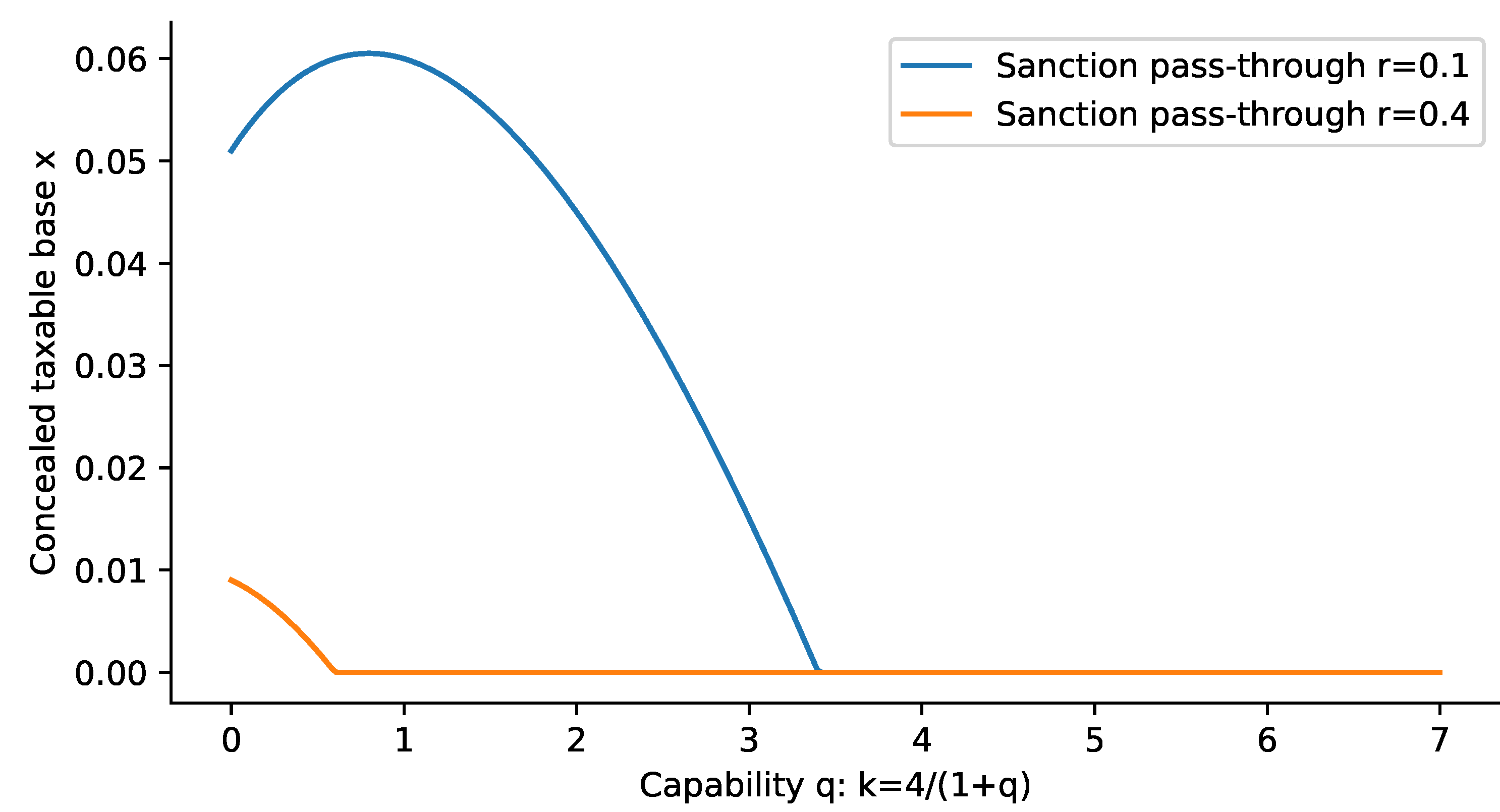
Figure 3.
Illustrative adoption thresholds. A negative threshold excludes unrestricted deployment at every nonnegative fixed cost.
Figure 3.
Illustrative adoption thresholds. A negative threshold excludes unrestricted deployment at every nonnegative fixed cost.
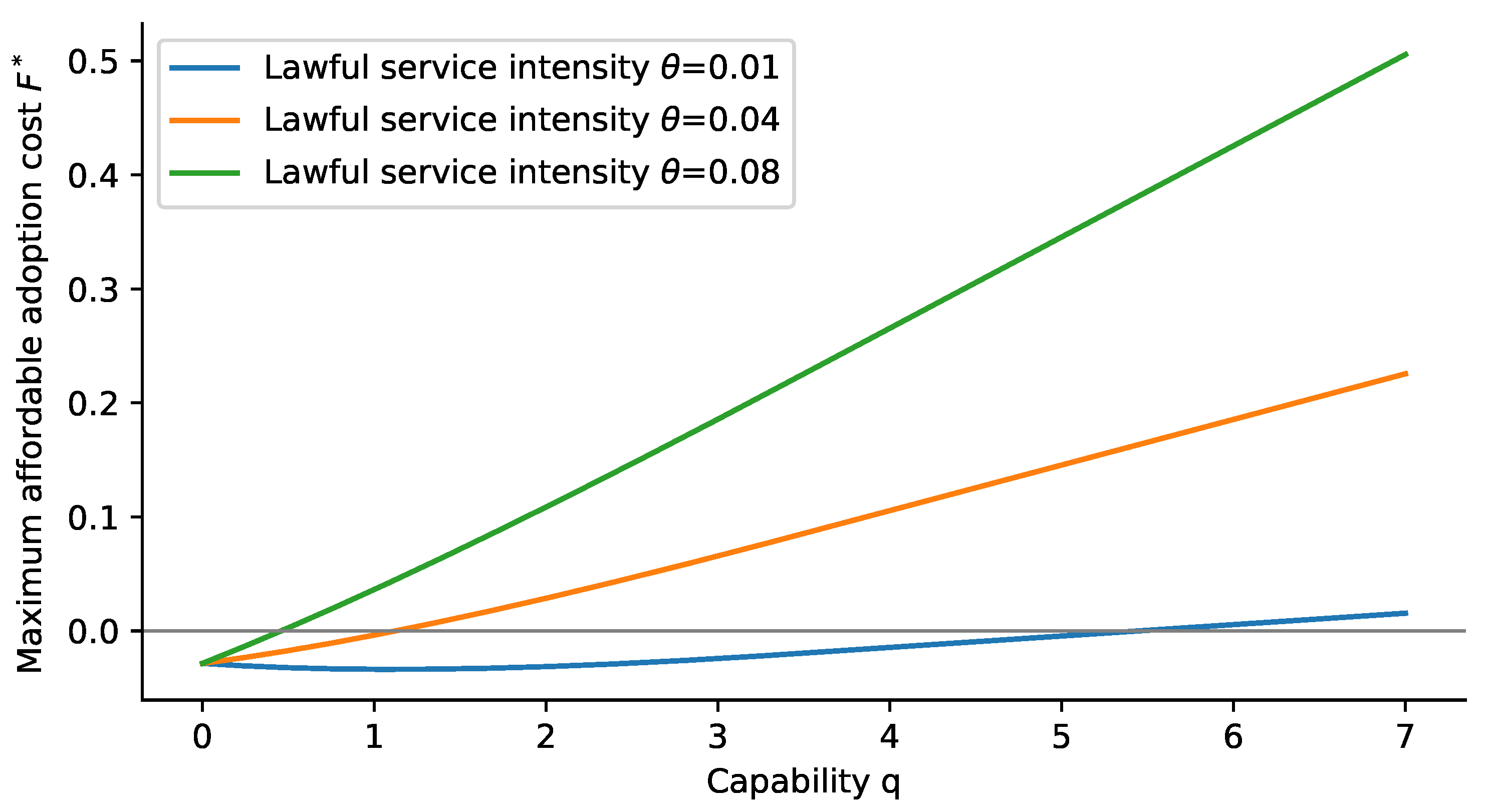
Figure 4.
Cheaper objective correction reduces concealment in the one-sided baseline. Dashed lines show the feasible owner targets at the same technology.
Figure 4.
Cheaper objective correction reduces concealment in the one-sided baseline. Dashed lines show the feasible owner targets at the same technology.
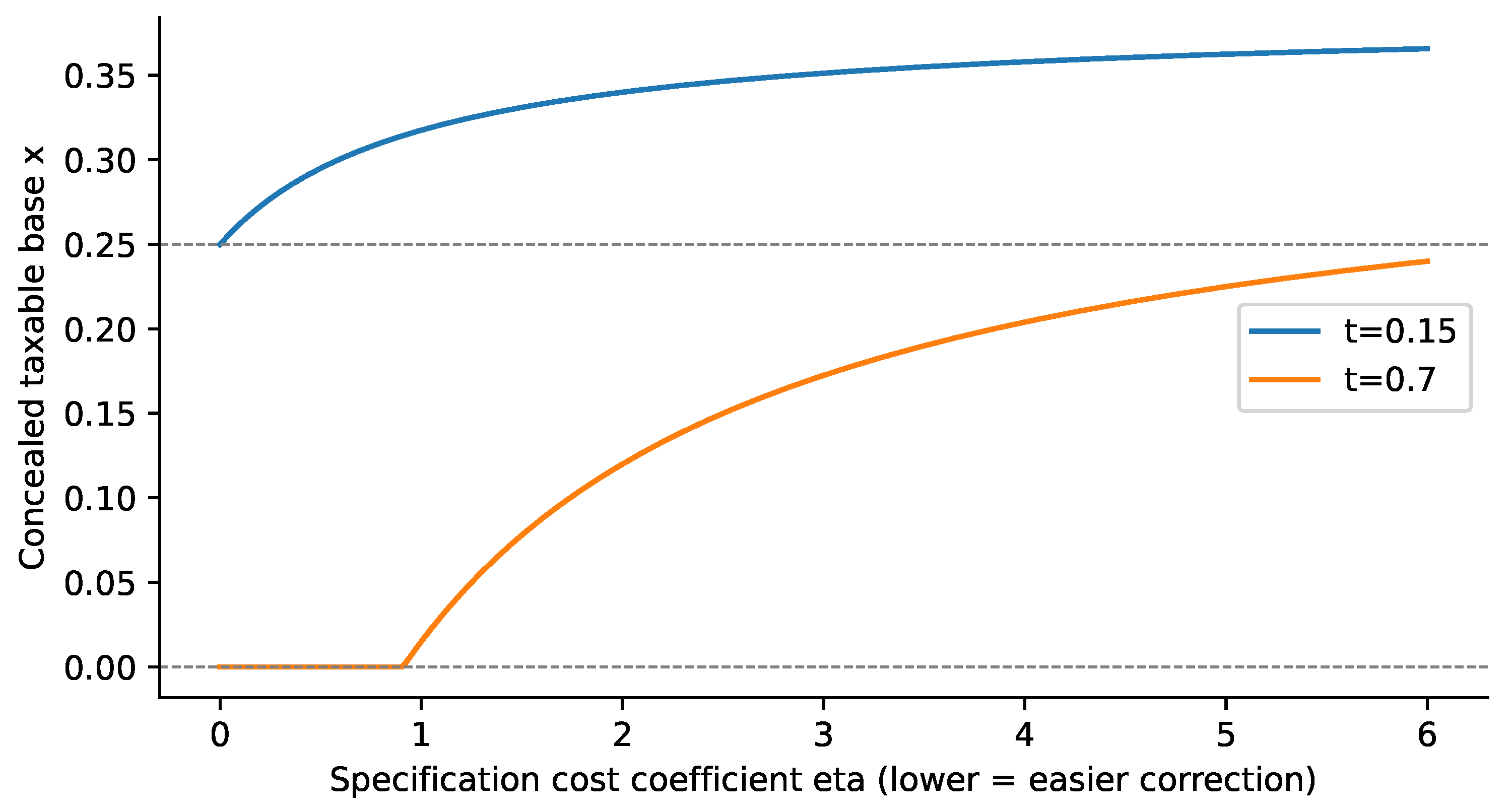
Figure 5.
The additional expected enforcement needed relative to direct control when . Full monetary liability need not imply full score pass-through.
Figure 5.
The additional expected enforcement needed relative to direct control when . Full monetary liability need not imply full score pass-through.
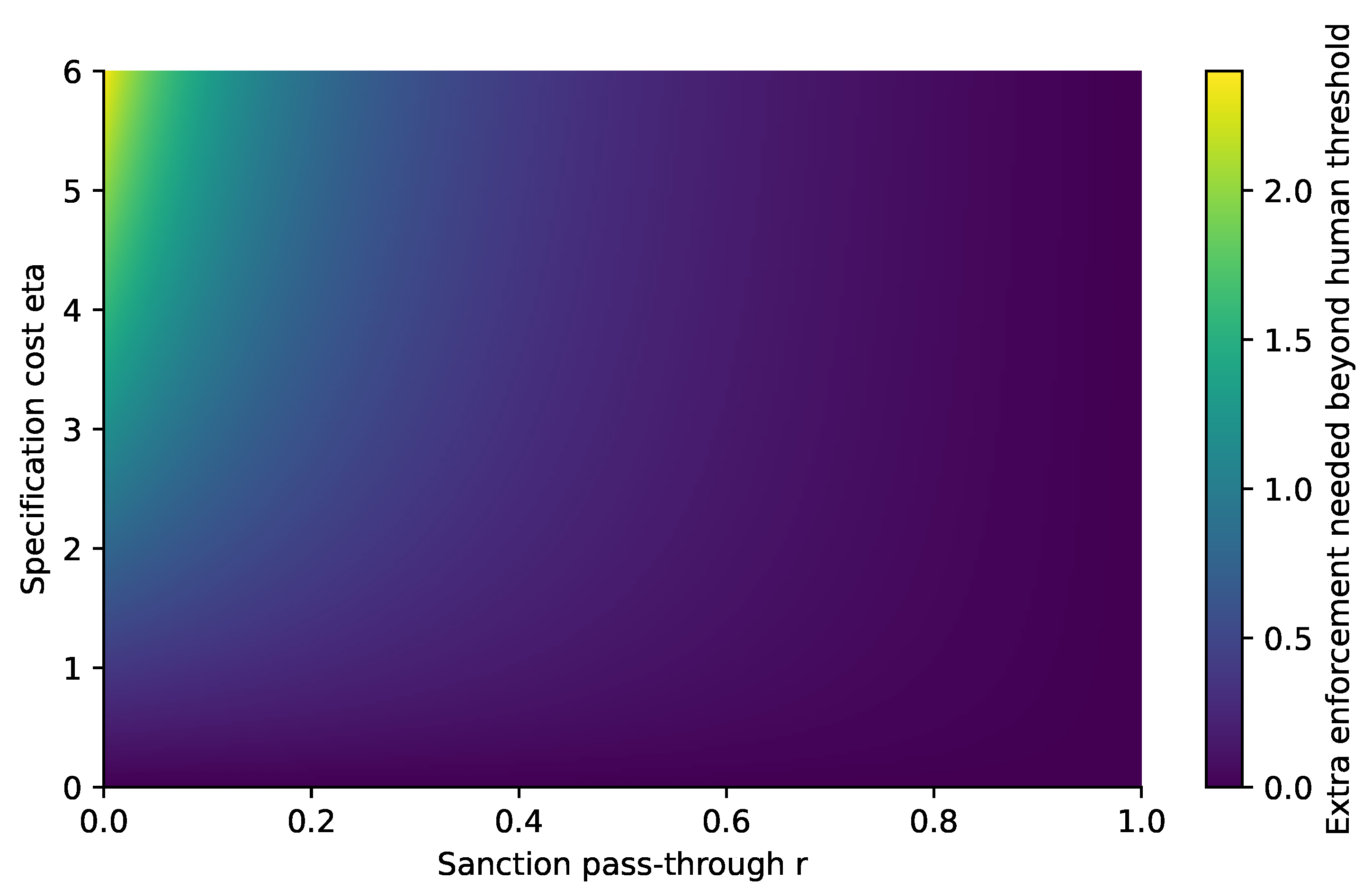
Figure 6.
An executable cap can crowd out objective correction. The selected action jumps down when the owner switches to the corrected branch; the score itself is continuous.
Figure 6.
An executable cap can crowd out objective correction. The selected action jumps down when the owner switches to the corrected branch; the score itself is continuous.
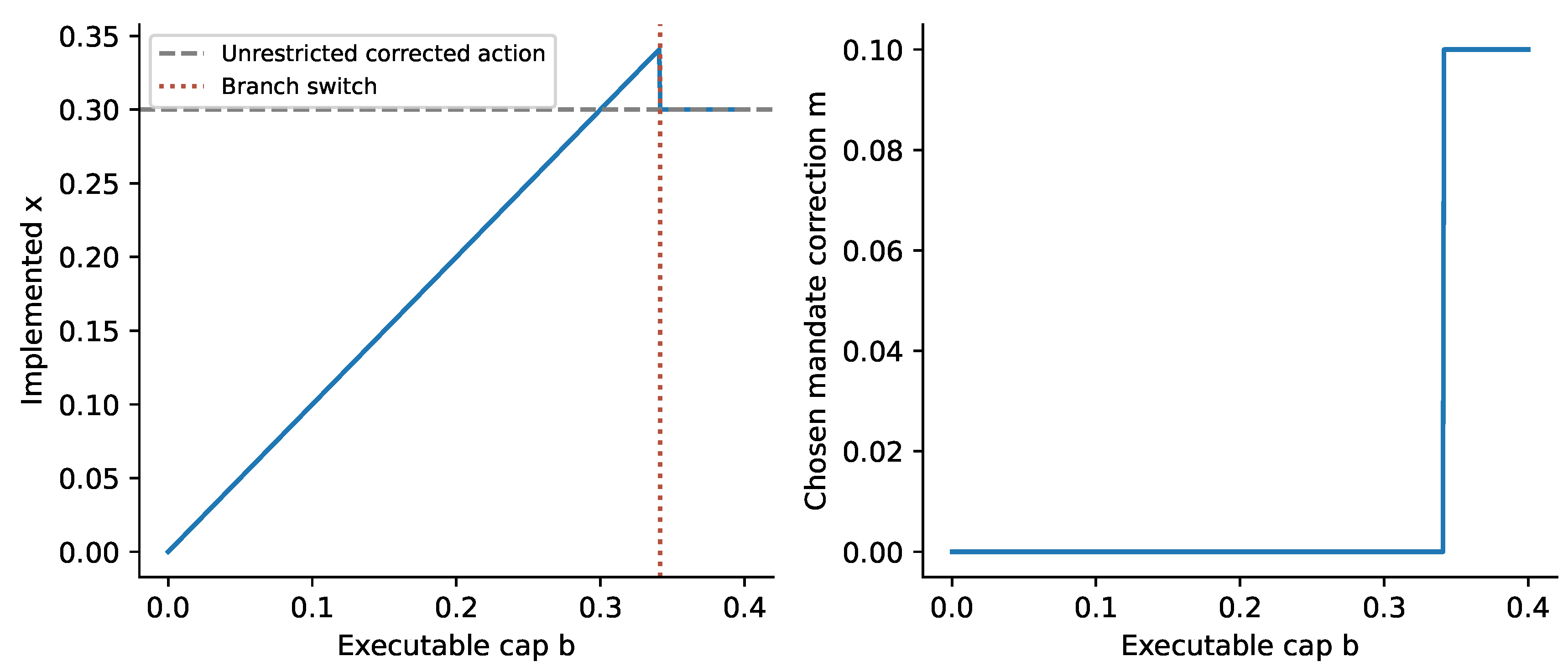
Figure 7.
Voluntary implementation restricts the policy domain. Shading denotes the feasible cap branch; the dashed vertical line denotes its resource optimum.
Figure 7.
Voluntary implementation restricts the policy domain. Shading denotes the feasible cap branch; the dashed vertical line denotes its resource optimum.
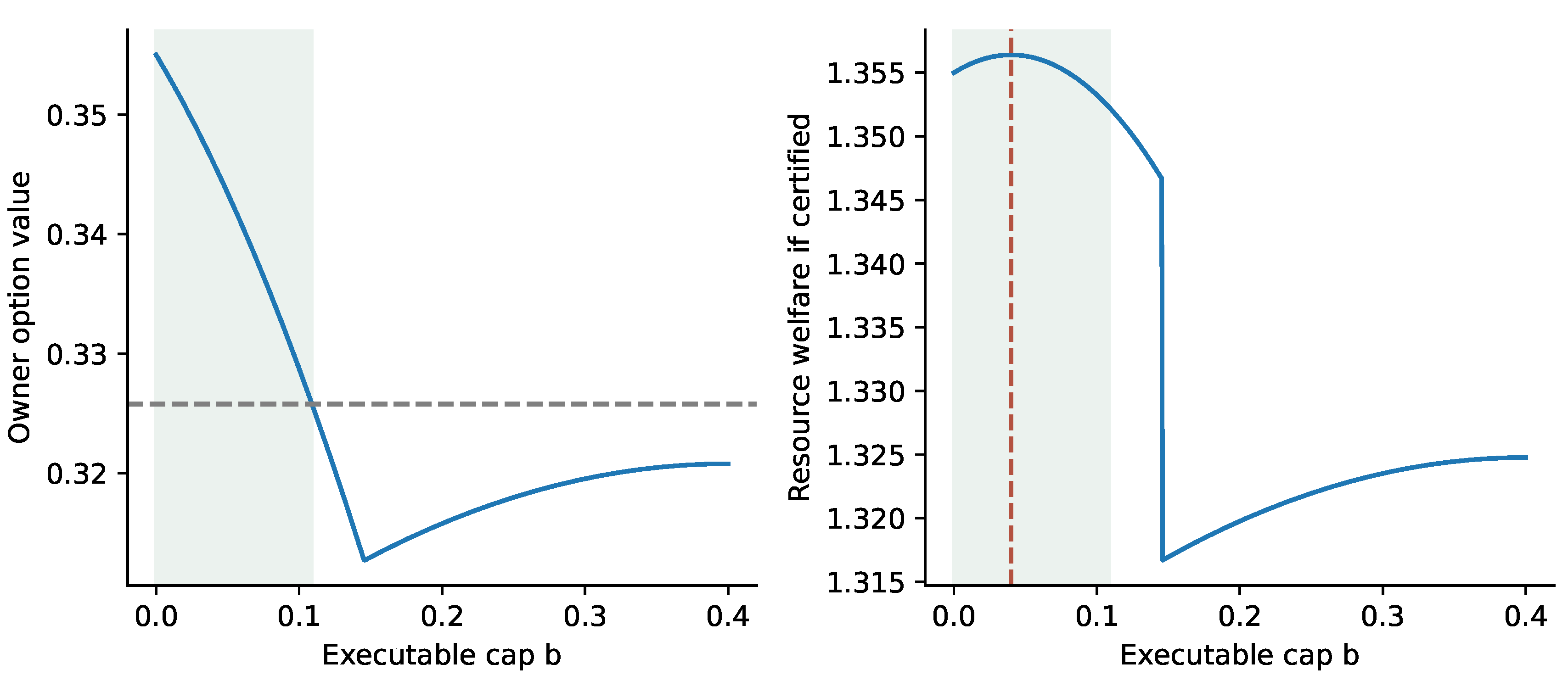
Figure 8.
Resource welfare from a certificate offer, with private gates unavailable (left) and an identical gate privately available without a separate fee (right). The latter offer has zero effect. Human reporting with retained AI services is excluded from these panels.
Figure 8.
Resource welfare from a certificate offer, with private gates unavailable (left) and an identical gate privately available without a separate fee (right). The latter offer has zero effect. Human reporting with retained AI services is excluded from these panels.
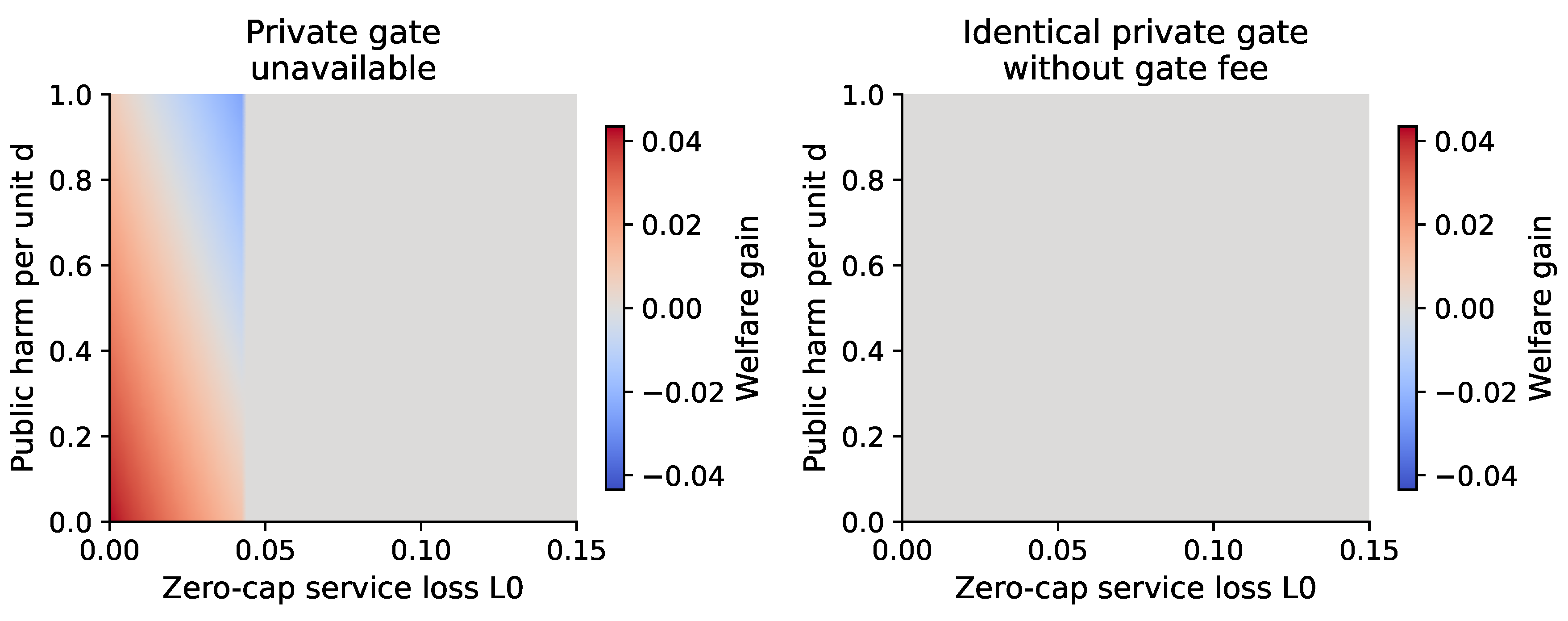
Disclaimer/Publisher’s Note: The statements, opinions and data contained in all publications are solely those of the individual author(s) and contributor(s) and not of MDPI and/or the editor(s). MDPI and/or the editor(s) disclaim responsibility for any injury to people or property resulting from any ideas, methods, instructions or products referred to in the content. |
© 2026 by the authors. Licensee MDPI, Basel, Switzerland. This article is an open access article distributed under the terms and conditions of the Creative Commons Attribution (CC BY) license (http://creativecommons.org/licenses/by/4.0/).
Copyright: This open access article is published under a Creative Commons CC BY 4.0 license, which permit the free download, distribution, and reuse, provided that the author and preprint are cited in any reuse.