

Submitted:
05 October 2026
Posted:
08 October 2026
You are already at the latest version
Abstract
Historical digital personas are a promising means of interactive and personalized access to cultural heritage; however, their practical deployment requires simultaneous control over factual accuracy, source provenance, persona consistency, and multimodal response latency. This paper proposes an evidence-grounded multimodal AI framework for historical digital personas that combines controlled canonical interactions with open-ended retrieval-augmented generation. The architecture implements a cascaded query processing strategy: high-confidence queries are routed to source-linked canonical FAQ responses and pre-generated multimedia objects, whereas open-ended queries are handled via hybrid full-text retrieval, cross-encoder reranking, an Evidence Gate, evidence-constrained generation, persona-oriented post-generation validation, speech synthesis, and lip synchronization. The framework is implemented and experimentally evaluated using the digital persona of Taras Shevchenko based on a Ukrainian-language cultural heritage knowledge base containing 543 evidence-oriented retrieval chunks, 50 canonical FAQ intents, and 500 natural language question variants. BGE-M3 hybrid retrieval achieved a Recall@1 of 36.46% and a Recall@10 of 77.71%, outperforming classical BM25 and compact dense retrieval baselines. Chunk-level cross-encoder reranking increased Recall@10 to 87.92% and nDCG@10 to 0.6151. In a strict Leave-One-Variant-Out evaluation, the conservative FAQ cascade reached a coverage of 87.4% and a correctness of 95.19% among accepted matches. The Evidence Gate correctly rejected 96% of unsupported queries while retaining 88% of evidence-supported queries, achieving a Balanced Accuracy of 92%. Canonical multimedia caching reduced median processing time from approximately 143.94 s for complete dynamic multimedia executions to approximately 2.08 ms for processing-layer access to prepared canonical media under the evaluated warm-cache configuration. The obtained results demonstrate that the robust construction of historical digital personas requires a functional separation of high-confidence canonical interactions and open-ended evidence-grounded generation, as well as a coordinated yet functionally decoupled operation of retrieval, provenance, persona control, and multimedia delivery.
Keywords:
cultural heritage
; historical digital personas
; multimodal artificial intelligence
; retrieval-augmented generation
; evidence grounding
; hybrid retrieval
; provenance
; persona consistency
; selective generation
; multimedia caching
1. Introduction
The digitalization of cultural heritage is increasingly transcending the boundaries of digitizing museum collections, creating 3D models, and developing virtual exhibitions. Modern artificial intelligence technologies enable the creation of interactive digital representations of historical figures, capable of maintaining natural language interaction with visitors, explaining historical events, and presenting cultural and historical knowledge in a personalized form. Virtual humans and embodied conversational agents are already being utilized as museum guides, information intermediaries, and tools for contextual storytelling [1,2]. In such systems, the digital character ceases to be solely a visual element of the exhibition and acquires the function of an interactive interface between the user and the digital representation of cultural heritage.
The development of large language models (LLMs) has significantly expanded the capabilities of these systems. Unlike classical rule-based or intent-based museum chatbots, modern generative models are capable of maintaining open-ended dialogue, adapting the response format to user queries, and working within a broad thematic context. Experimental museum applications of ChatGPT and other LLMs confirm the potential of natural-language interfaces for personalized access to cultural content [3]. However, the application of generative models in the cultural and historical domain presents a fundamental challenge: the linguistic naturalness of a response does not guarantee its historical accuracy. A generative model may form a convincing statement that is not supported by source materials or that combines factually similar but historically distinct events.
One of the main approaches to reducing this reliance on LLM parametric knowledge is retrieval-augmented generation (RAG). In a RAG architecture, the generative model receives external context generated by searching a controlled knowledge base [4]. This allows for the functional separation of factual information storage from its natural-language realization and enables the updating of the external information foundation without retraining the generative model. At the same time, the presence of a retrieval component does not by itself guarantee trustworthy generation: it is necessary to control the relevance of the retrieved evidence, the link between generated statements and sources, and the system’s behavior in the absence of sufficient information. The concept of “Attributable to Identified Sources,” in particular, defines the verifiability of generated claims against a specific external source as a distinct property of reliable generation [5].
For the digital reconstruction of a historical figure, this problem is more complex than in a traditional question-answering system. A digital persona must not only convey correct facts but also present them in a form compatible with the reconstructed persona. Research on role-playing LLMs demonstrates the possibility of modeling specific characters using their profiles, life experiences, and other character-specific attributes [6]. However, factual correctness and persona consistency are not identical characteristics. A response may be supported by a historical source but remain incorrect as an utterance of the digital persona due to an improper communicative perspective, inconsistency with biographical context, or the use of information that cannot be correctly attributed to the historical figure themselves. Therefore, for a historical digital persona, it is necessary to separately control both evidence grounding and persona consistency.
A separate architectural challenge is the computational complexity of multimodal interaction. A fully-fledged digital persona must support not only text dialogue, but also speech input, speech synthesis, and audiovisual presentation of the response. Modern ASR models, such as Whisper, provide robust multilingual speech recognition [7], whereas audio-driven talking-face models allow for synchronizing speech with the facial movements of a digital persona [8]. However, combining ASR, retrieval, reranking, LLM generation, TTS, and lip synchronization into a sequential online pipeline can create significant end-to-end latency. Even if an individual talking-head component demonstrates high model-level throughput, this does not imply low latency for the complete conversational system, as audio preparation, video generation, and other stages remain computationally expensive.
Modern latency-aware LLM architectures partially solve this problem through caching repeated computational states, knowledge representations, or pre-computed textual responses [9,10,11,12,13,14]. In particular, Prompt Cache demonstrates the ability to reuse already computed attention states to reduce time-to-first-token [9]. However, for a museum digital persona, the repeatedly occurring object is potentially not just the text response. A significant portion of typical visitor queries concerns a limited set of biographical facts, meaning that various natural language formulations can be mapped to a single canonical intent and a corresponding pre-generated multimedia object. This creates the possibility of shifting not only LLM inference, but also TTS and lip-sync generation from online interaction to offline preparation.
Thus, the core problem lies not in the absence of individual technologies for creating a digital historical persona, but in the need for their coordinated integration. Existing solutions separately develop virtual humans, museum conversational agents, retrieval-augmented generation, persona-conditioned LLMs, speech technologies, talking-head generation, and inference caching. However, cultural and historical applications require an architecture that simultaneously ensures: (i) controlled provenance of factual content; (ii) explicit linkage of the response to retrieved evidence and provenance; (iii) consistency of the utterance with a defined historical persona; (iv) support for open-ended natural-language interaction; and (v) acceptable computational cost of the multimodal response.
The aim of this study is to develop and experimentally evaluate an evidence-grounded multimodal AI framework for constructing digital personas of historical figures, in which retrieval, generation, persona control, and multimedia representation function as interconnected yet methodologically decoupled layers. The proposed approach implements cascaded user query processing: high-confidence interactions are routed to a controlled canonical FAQ layer with pre-prepared multimedia responses, whereas open-ended queries are passed to full-text evidence-grounded RAG. In the dynamic path, relevant context is formed via hybrid retrieval and cross-encoder reranking, after which the Evidence Gate controls its sufficiency for generation, and the generated response undergoes grounding and persona validation prior to execution of TTS and lip synchronization.
The practical implementation and experimental study of the framework were carried out using the digital persona of Taras Shevchenko as a case study. This case is used as the initial implementation of the general architecture rather than as a limitation of its applicability to a single historical figure. The informational foundation of the prototype includes a full-text evidence-oriented knowledge base and a controlled canonical FAQ layer with a set of natural language question variants. Such a structure makes it possible to separately investigate the quality of full-text retrieval, the generalization of the FAQ router to unseen paraphrasings, and the impact of multimedia caching on computational latency.
The main contributions of this work are as follows:
- A cascaded evidence-grounded multimodal AI framework for digital historical personae is proposed, functionally separating high-confidence canonical interactions and open-ended evidence-grounded queries.
- A hybrid evidence retrieval pipeline is developed, combining semantic, sparse, and lexical signals with subsequent cross-encoder reranking, where generation is permitted only after verifying the sufficiency of the source context via an Evidence Gate.
- A canonical FAQ representation is proposed, in which multiple natural language formulations are mapped to a limited set of controlled intents and responses, simultaneously supporting conservative FAQ routing and reducing the factual response space.
- Evidence-constrained generation, provenance, and persona validation are integrated, ensuring that source grounding and consistency with the historical digital persona are controlled as separate response properties.
- Canonical multimedia caching is proposed, where not only text responses but also associated audio and lip-synchronized video assets are pre-generated for recurring FAQ interactions, allowing the system to bypass the repetition of the most resource-intensive multimedia stages.
The experimental study, accordingly, focuses on four research questions: comparing retrieval representations and hybrid search for retrieving historical evidence (RQ1); determining the contribution of different levels of reranking (RQ2); evaluating the FAQ-router’s ability to generalize unknown natural-language paraphrases under strict Leave-One-Variant-Out conditions (RQ3); and measuring the impact of canonical multimedia caching on processing latency compared to a full dynamic RAG–LLM–TTS–lip-sync pipeline (RQ4). ASR, TTS, and lip-sync models are treated here as implementation components rather than as subjects of separate comparative testing.
The rest of the paper is organized as follows. Section 2 presents an analysis of existing approaches to digital heritage, conversational AI, evidence retrieval, reliable generation, character modeling, multimodal avatars, and latency-aware architectures, and identifies research gaps. Section 3 describes the iterative process of developing architectural solutions. Section 4 formalizes the final evidence-based multimodal architecture. Chapter 5 characterizes the knowledge base and the canonical set of frequently asked questions (FAQs). Chapter 6 defines the experimental protocol and research questions, while Chapter 7 presents the results of the quantitative evaluation. Chapter 8 presents an integrated museum prototype, followed by a discussion of the results, limitations, and directions for further development.
2. Related Work and Existing Approaches
2.1. Digital Heritage and Historical Digital Personae
Digital representation of cultural heritage has gradually evolved from the spatial reconstruction of archaeological objects, monuments, and museum environments to interactive systems in which digital characters act as mediators of historical and cultural information. Early approaches utilized avatars predominantly as a component of the virtual representation of the past and a means for interpreting the reconstructed environment [15]. Further development of virtual humans expanded this concept to embodied agents, for which, alongside appearance, animation, behavioral modeling, and the mode of user interaction are critical [16].
In the museum context, virtual humans began to be utilized as interactive guides and conversational interfaces. Duguleană et al. [1] combined natural language voice interaction with an animated 3D avatar and lip synchronization. Another direction has focused on enhancing visual and behavioral realism through motion capture, facial animation, retargeting, and integration into VR/AR environments [17]. A systematic review by Sylaiou and Fidas [2] confirms the general trend of transitioning from user avatars to autonomous virtual agents performing the functions of guides, companions, and cultural mediators.
Digital characters are also employed for contextual storytelling and the representation of intangible heritage. AR-based approaches allow animated characters to be linked to physical or reconstructed cultural environments [18], while research on behavioral realism highlights the importance of consistency in a character’s movements and behavior for shaping a convincing user experience [19]. Newer AI-powered avatar technologies further expand the possibilities of reconstructing figures from the past, while simultaneously increasing the risks of misrepresentation, cultural insensitivity, and over-reliance on the synthetic image [20].
Thus, works [1,2,15,16,17,18,19,20] demonstrate a transition from digital reconstruction to interactive AI-enabled personae. However, their primary focus remains on visual fidelity, embodiment, storytelling, immersion, and visitor engagement. Source-level grounding of generated utterances, explicit provenance traceability, and control over the consistency between historical facts and the behavior of the reconstructed persona are predominantly not central components of such systems.
2.2. Conversational AI and RAG in Cultural Heritage
Conversational AI for cultural heritage has also undergone a transition from closed-domain assistants to LLM- and RAG-based systems. Early solutions utilized predefined intents, keywords, entity recognition, and structured cultural repositories. For instance, conversational access to Europeana was implemented through keyword- and entity-based query interpretation [21], whereas museum chatbot systems could combine controlled Q&A with an embodied docent or a reenacted historical figure [22]. The advantage of such approaches is a high degree of control over the response space; however, their capabilities for open-ended interaction remain limited.
The advent of LLMs has significantly expanded the linguistic flexibility of museum conversational systems. The use of ChatGPT-4 as a museum guide demonstrated the potential for personalized natural-language interaction, but simultaneously highlighted the necessity of domain validation due to the risk of factual inaccuracies [3]. RAG has emerged as one of the primary mechanisms for reducing this reliance on LLM parametric knowledge. Cultural-heritage chatbots with an external knowledge base have utilized retrieval to enhance factual precision and contextual relevance [23], while LLM-based cultural guides have begun combining curated content with free-text conversational exploration [24].
Particularly relevant are systems focused on the reconstruction of specific historical figures. Research on a chatbot simulating Luigi Einaudi demonstrated a conflict between conversational naturalness, historical authenticity, and factual accuracy, emphasizing the need for grounding and guardrails [25]. Subsequent museum-oriented RAG applications utilize curated domain collections for voice-based or free-form interaction [26], local institutional knowledge resources with curator-controlled content [27], and more structured plan-retrieve-generate architectures with knowledge graphs and auditable retrieval plans [28]. Similar LLM-based agents are also integrated into augmented-reality cultural tours, where alongside usability and immersion, issues of accuracy, provenance, and cultural data governance remain critical [29].
Thus, works [3,21,22,23,24,25,26,27,28,29] demonstrate a transition from closed-domain FAQ systems to more flexible LLM/RAG architectures. This creates a fundamental trade-off: controlled FAQs ensure predictability but have limited coverage, whereas generative systems support open-ended interaction yet require external grounding. This establishes the prerequisites for architectures in which high-confidence canonical interactions and dynamic evidence-grounded RAG are viewed not as alternatives, but as mutually complementary processing paths.
2.3. Evidence Retrieval, Grounding, and Provenance
The quality of evidence-grounded generation directly depends on the retrieval component’s ability to find passages that genuinely contain the required information. Classical sparse approaches, notably BM25, maintain high sensitivity to lexical overlap and therefore remain useful for entity-centric queries [30]. Dense neural retrieval has expanded this paradigm through semantic vector representations of queries and passages [31]; however, subsequent work has shown that sparse and dense representations are complementary: hybrid methods can combine semantic matching with the precision of lexical retrieval [32]. This is especially important for entity-centric tasks, where dense retrievers can be less stable for rare or specific entities [33].
Further development of universal embeddings is represented by the E5 family [34] and multilingual E5 [35], which focus on transferability across retrieval tasks and languages. BGE-M3 extends this logic through the simultaneous support of dense, sparse, and multi-vector representations and the handling of texts with varying granularity [36]. Research on multilingual QA also confirms the feasibility of combining dense retrieval with sparse/entity signals [37]. Following first-stage retrieval, additional ranking refinement can be performed by cross-encoder models, which jointly evaluate query-passage pairs and establish a typical two-stage retrieve-rerank pipeline [38]. Retrieval granularity remains an individual design parameter, as overly large fragments contain extraneous context, whereas excessive splitting may cause a loss of informational integrity [39].
However, relevant retrieval alone does not yet guarantee trustworthy generation. RAG combines a parametric generative model with an external non-parametric knowledge base, establishing a foundation for knowledge-grounded generation [4]. Subsequent research has shifted focus from the mere use of retrieval to the verifiability of generated claims. The concept of “Attributable to Identified Sources” formalizes the requirement that a statement must be verifiable against a specifically identified source [5].
Furthermore, ensuring system reliability requires advanced classification and structured evidence processing frameworks, which provide a dependable basis for managing complex domain information and filtering data before generation [40].
Modern approaches develop various mechanisms for attribution and post-generation verification. RARR performs external support retrieval and correction of unsupported content [41], whereas ALCE systematizes the evaluation of correctness and citation quality in systems combining retrieval, generation, and citations [42]. Self-RAG introduces adaptive retrieval and self-reflection [43], while Corrective RAG involves separate evaluation of retrieved evidence quality and corrective actions in cases of insufficient relevance [44]. Fine-grained attribution is explored via source-first generation [45], model-internal attribution [46], and interleaved reference-claim generation [47]. A distinct requirement for trustworthy QA is controlled abstention: the model must be capable of withholding a factual response if sufficient evidence is absent [48].
Thus, works [4,5,30,31,32,33,34,35,36,37,38,39,40,41,42,43,44,45,46,47,48] demonstrate that trustworthy evidence retrieval requires a combination of semantic and lexical signals, reranking, granularity control, source attribution, and mechanisms to handle insufficient evidence. For historical QA, this is particularly important, as a stylistically plausible response from a digital persona can be mistakenly perceived as historically accurate. Therefore, retrieval quality, provenance, and the decision regarding the admissibility of generation must be treated as interconnected components of a single evidence-grounded pipeline.
2.4. Persona-Constrained Historical Character Simulation
Unlike traditional QA, a digital historical persona must ensure not only factual correctness but also the consistency of the response with the identity and communicative perspective of a specific character. One of the early approaches to persona-conditioned dialogue is Persona-Chat, where an explicit persona profile is used to generate more specific and consistent responses [49].
In modern LLM-based systems, persona modeling has expanded to the replication of specific characters. Character-LLM utilizes profiles, experiences, and character-specific information for trainable role-playing agents, including historical figures [6]. RoleLLM further distinguishes between role-specific knowledge, speaking style, and role-conditioned instruction following [50]. At the same time, CharacterEval [51] and InCharacter [52] demonstrate that character fidelity is a multidimensional property and cannot be evaluated solely by factual correctness or semantic similarity. Newer approaches, such as ThinkPersona, transition to structured representations of life trajectories, values, relationships, and events through persona graphs [53].
Taken together, works [6,49,50,51,52,53] show that persona consistency and factual grounding are interconnected yet distinct characteristics. A statement may be supported by a historical source but remain inconsistent with the reconstructed persona due to an improper speech perspective, mode of presentation, or mismatch with the character’s life context. Therefore, for a historical digital persona, it is advisable to separate evidence validation, which determines the permissible factual content, from persona validation, which controls the form in which this content is presented.
2.5. Multimodal Avatars and Latency-Aware Response Generation
A multimodal digital persona involves the integration of automatic speech recognition, text processing, speech synthesis, and audio-driven facial animation. For ASR, an important milestone in development was Whisper, which demonstrated robust multilingual speech recognition and zero-shot transfer across various speech tasks [7]. In TTS systems, reduced inference latency and improved naturalness are ensured by non-autoregressive and end-to-end architectures, notably FastSpeech 2 [54] and VITS [55].
Audio-driven facial animation has evolved from specialized lip synchronization to more comprehensive talking-head generation. Wav2Lip focuses on precise alignment of target speech with lip movements [56], whereas SadTalker additionally models head pose and facial expressions [57]. MuseTalk utilizes latent-space inpainting to enhance visual fidelity and lip synchronization efficiency [8]. Concurrently, end-to-end audiovisual dialogue models are being explored that directly transform audiovisual input into an audiovisual response [58]. However, for evidence-grounded systems, a modular architecture has a fundamental advantage: retrieval, grounding, and persona validation can be completed at the text level prior to the generation of synthetic audio/video output.
The integration of such components makes latency a systemic characteristic. Modern LLM-serving approaches reduce redundant computations through various caching types. Prompt Cache reuses attention states for recurring prompt segments [9], while RAGCache extends this idea to intermediate states of retrieved knowledge [10]. Semantic caching enables the reuse of pre-computed responses for semantically similar queries [11]. CacheBlend [12] and TurboRAG [13] optimize the reuse of knowledge/KV representations in retrieval-augmented inference, whereas learning-based semantic caching treats cache selection as a distinct optimization problem accounting for semantic mismatch [14].
Thus, works [7,8,9,10,11,12,13,14,54,55,56,57,58] cover both multimodal response generation technologies and inference cost-reduction mechanisms. However, most caching architectures reuse prompt states, knowledge representations, or textual responses. For a digital historical persona, a different level of reuse is appropriate: if multiple natural-language queries reliably map to a single canonical intent, the reusable object can encompass the full set of text-audio-video assets. This makes it possible to bypass the repetition of not only LLM inference, but also TTS and talking-head generation for typical museum interactions.
2.6. Research Gaps and Positioning of the Proposed Framework
The conducted review shows that the necessary technological components of digital historical personae are already being actively researched, yet predominantly as separate directions. Virtual humans and museum agents focus on embodiment, storytelling, and visitor engagement [1,2,15,16,17,18,19,20]; conversational systems and RAG expand access to cultural knowledge [3,21,22,23,24,25,26,27,28,29]; retrieval research develops hybrid search, reranking, and grounding [4,5,30,31,32,33,34,35,36,37,38,39,40,41,42,43,44,45,46,47,48]; role-playing architectures focus on persona fidelity [6,49,50,51,52,53]; and multimodal AI and caching address audiovisual interaction and computational efficiency [7,8,9,10,11,12,13,14,54,55,56,57,58].
Based on this, four interconnected research gaps can be identified.
First, an integration gap persists: evidence retrieval, persona control, provenance, and multimedia delivery are rarely treated as interdependent layers of a unified digital historical persona architecture.
Second, an evidence-persona gap exists. Trustworthy RAG ensures grounding and attribution [4,5,40,41,42,43,44,45,46,47,48], while role-playing systems focus on character consistency [6,49,50,51,52,53]; however, historical reconstruction requires controlling both properties simultaneously.
Third, the FAQ-RAG routing gap remains insufficiently explored. Closed-domain systems ensure predictability, whereas open-ended RAG offers broader semantic coverage [3,21,22,23,24,25,26,27,28,29]; nevertheless, their cascaded combination makes it possible to separate high-confidence repeated interactions from queries that require dynamic evidence retrieval.
Fourth, a multimedia latency gap exists. ASR, TTS, and talking-head models are predominantly evaluated at the level of individual components [7,8,54,55,56,57,58], whereas caching architectures focus primarily on textual or internal model representations [9,10,11,12,13,14]. For a museum digital persona, the reuse of fully completed multimedia responses for typical canonical interactions is crucial.
A generalized comparison of the most relevant existing systems is presented in Table 1. Characteristics directly related to the purpose of this work were used for the comparison: cultural-heritage orientation, use of external knowledge/RAG, evidence provenance, persona consistency, multimodal representation, FAQ-RAG cascade, and multimedia caching. The designation “Partial” indicates that the respective aspect is partially implemented or considered indirectly; “—” means that such functionality is not claimed as a core component of the corresponding work.
As seen in Table 1, individual elements of the proposed approach are already present in prior work, yet their comprehensive integration remains limited. In this work, a digital historical persona is treated as an evidence-grounded multimodal AI framework, in which canonical FAQ routing and dynamic RAG serve as two interconnected interaction paths, while retrieval, the Evidence Gate, provenance, persona validation, and multimedia delivery form a sequential, controlled pipeline. Additionally, canonical multimedia caching shifts the reuse of results from the text or internal model state level to the level of the fully completed multimedia response. These provisions determine the logic for the subsequent iterative formulation of the architecture in Section 3 and its formal description in Section 4.
.3. Iterative Design and Justification of Architectural Solutions
The development of the proposed framework was carried out following an iterative approach, wherein the system architecture was sequentially refined based on qualitative error analysis, intermediate testing of retrieval components, and the analysis of computational constraints within the multimodal pipeline. This approach was driven by the specific requirements of the digital personification of a historical figure, which necessitates simultaneously ensuring the factual grounding of the response, persona consistency, naturalness of the dialogue, multimodal presentation, and acceptable interaction latency.
At the initial stage, the system was conceptualized as a sequential retrieval-augmented generation pipeline, in which every user query passed through retrieval, text response generation, speech synthesis, and lip synchronization.
q → (q) → (q,E) → TTS → LipSync,
Where q is the user query; (q) is the relevant context retrieval procedure; E is the set of selected evidence fragments; and (q,E) is the response generation based on the query and retrieved evidence.
The practical implementation of the initial scheme defined two main directions for architectural optimization. First, executing the full generative and multimedia pipeline for every query created a substantial computational load. Second, short, repetitive museum questions and open-ended information requests addressed to the full historical corpus demonstrated different requirements for retrieval mechanisms. As a result, the architecture was sequentially transformed from a monolithic RAG pipeline into a cascaded system in which typical high-confidence queries are processed via an optimized path, whereas open-ended queries are forwarded to full-text evidence-grounded retrieval. The general evolution of the proposed architecture during the iterative design process is illustrated in Figure 1.
3.1. Transition to Evidence-First Knowledge Representation
The first fundamental architectural decision was the separation of the generative model’s parametric knowledge from the factual foundation of the digital persona. In the proposed approach, the LLM is not considered the primary source of historical information. The factual content of the response must be determined by an external knowledge base, for which information about the source, structural context, and provenance is preserved for each element.
During the preparation of the knowledge representation, it became evident that the mere existence of a text corpus is insufficient for evidence-grounded generation. A retrieval unit must simultaneously be compact enough to localize a specific fact and substantive enough to preserve local historical context. This provided the rationale for using evidence-oriented segmentation instead of arbitrary text splitting without regard to the source structure.
For each retrieval object, structural attributes were stored, including the source page title, section, document identifier, chunk identifier, and source URL. This organization made it possible to use the exact same informational foundation for both full-text retrieval and the subsequent display of evidence provenance in the user interface. The quantitative characteristics of the corpus, cleaning rules, and segmentation parameters are detailed separately in Section 5. The process of forming and structuring the knowledge base is illustrated in Figure 2.
3.2. Functional Specialization and Hybrid Evidence Retrieval
Initial iterations used a single compact multilingual embedding model for various retrieval tasks. While computationally attractive, practical testing demonstrated that retrieval over a small controlled FAQ space and retrieval over a larger historical knowledge base have different requirements.
For FAQ routing, the primary task is recognizing semantically equivalent formulations within a relatively small controlled space. For full-text retrieval, conversely, it is necessary to distinguish between thematically close historical fragments in which individual names, events, dates, geographic names, and titles of works can be factually critical.
RFAQ = MiniLM
RKB = BGE − M3
The compact multilingual MiniLM was retained as a component of the FAQ semantic routing, whereas for knowledge-base retrieval, it was decided to evaluate more powerful multilingual embedding models. At the exploratory model selection stage, multilingual E5, BGE-M3, and other embedding configurations were considered. This preliminary comparison was used solely for the engineering formation of the candidate architecture; an independent quantitative comparison of the models on the evaluation set of natural-language museum queries is presented in Section 6 and Section 7.
Further error analysis showed that dense semantic similarity does not always rank historical fragments with sufficient precision. This was particularly evident for entity-centric queries, where relevance is largely determined by the exact match of proper names, toponyms, titles of works, or events. Therefore, the hypothesis was formulated that full-text retrieval should be supplemented with sparse and lexical signals.
Shybrid = wd ⋅ Sdense + ws ⋅ Ssparse + wl ⋅ Slex
Shybrid = 0.62 ⋅ Sdense + 0.18 ⋅ Ssparse + 0.20 ⋅ Slex
In the prototype, a fixed engineering-tuned hybrid configuration with weights of 0.62 for the dense component, 0.18 for the sparse component, and 0.20 for the direct lexical/entity component was used. These values were formulated on the basis of qualitative error analysis during prototyping and were not optimized on the final RQ1 evaluation set. The lexical component also accounted for structural fields, including page_title and section_title, which made it possible to reinforce fragments whose structural context directly matched the historical entity mentioned in the query.
To assess the robustness of this engineering choice, an additional post-review weight-sensitivity analysis was performed without replacing the originally reported configuration. The three fusion weights were systematically varied under the constraint that they summed to one, while the 0.62/0.18/0.20 configuration was retained as the fixed reference operating point. The sensitivity analysis was therefore used to assess parameter dependence rather than to perform post-hoc optimization of the production configuration.
3.3. Verification of Multi-Level Reranking
The next stage involved investigating whether the initial retrieval score alone is sufficient for directly constructing the context for the generative model. Practical analysis demonstrated that several thematically close fragments can simultaneously appear among the top-ranked chunks, differing in factually important details.
C30 = Top30(Shybrid(q, di))
To test this assumption, cross-encoder reranking was added to the initial retrieval. The initial retriever formed a high-recall candidate pool of 30 fragments, after which the cross-encoder directly evaluated query-chunk pairs. In a separate intermediate iteration, an additional decomposition of the selected chunks into sentences with sentence-level reranking was also tested. This configuration was considered an experimental hypothesis and is not included in this section as part of the final architecture. Its effectiveness was tested separately in an ablation experiment, the results of which are presented in Section 7. The multi-level ranking scheme investigated during the iterative formation of the evidence-selection pipeline is shown in Figure 3.
3.4. Canonical FAQ Representation and Controlled Routing
One of the most significant changes during the development process was the rethinking of the FAQ structure. The initial version involved the semi-automated creation of a large number of independent question-answer pairs. To reduce the risk of hallucination, evidence-first validation was used, whereby the generated response had to be supported by a specific source fragment.
Qualitative analysis of the initial FAQ representation showed that evidence consistency should be complemented by semantic and persona-oriented control. This made it possible to account for the correspondence between the question and answer types, the differentiation of semantically close historical events, temporal perspective, and the consistency of the formulation with the persona. Based on this, the FAQ representation was transitioned to a canonical intent structure, formalizing the distinct levels of verification as expressed in Equation (7):
Evidence consistency ≠ Semantic correctness ≠ Persona correctness
As a result, a canonical intent representation was adopted. Instead of a multitude of independent answers, a limited set of canonical semantic intents was formed, each corresponding to a single controlled response, while natural-language variability is represented by a set of alternative formulations for the exact same intent.
50 canonical intents × 10 question variants = 500 natural − language questions
Canonical representation made it possible to separate the variability of user language from the factual response space and became the foundation for both FAQ routing and canonical multimedia caching. The detailed composition of the FAQ dataset, thematic distribution, provenance attributes, and quality control results are presented in Section 5. The structure of the dataset formation using the canonical intent representation is shown in Figure 4.
After the formation of the canonical FAQ, it was established that semantic embeddings should not be the sole routing mechanism. For already known formulations, normalized exact matching is the most reliable and cheapest approach. For morphologically and lexically close queries, word-level and character-level representations are effective, whereas semantic embeddings remain useful for freer paraphrases.
SFAQ = 0.30 ⋅ Sword + 0.55 ⋅ Schar + 0.15 ⋅ Stoken
search_texti = questioni⊕keywordsi
As with full-text hybrid retrieval, these weights represent an engineering configuration formulated during the qualitative refinement of the prototype rather than the result of optimization on the final evaluation set. The character-level representation plays a special role in this configuration because it preserves similarity between morphologically related Ukrainian forms even in the absence of a complete token match. Together, these formed the Exact → Lexical → Semantic → Full-text RAG cascade.
A separate class of FAQ errors was related not to insufficient semantic similarity, but to the logical incompatibility of the question and the answer. For example, two queries may concern the same historical event, but one requires a date while the other requires a location. High semantic similarity in such a case should not automatically imply a correct FAQ match.
T(q) ∈ {date,place,person,count,yes/no,other}
Match(q,f) = Similarity(q,f)∧Compatible(T(q),T(f))
The guard is used asymmetrically: a generic question is not blocked simply because a canonical FAQ has a more specific type, but two explicitly defined and incompatible question types cannot be automatically matched. Thus, the FAQ decision depends not only on lexical or semantic proximity, but also on the correspondence of the expected information type.
Additional robustness analysis showed that semantic or lexical similarity can remain high even for structurally similar queries that should not activate the canonical FAQ. The most characteristic cases were questions about other historical figures, such as queries like “When was Ivan Franko born?”, which are close in lexical structure to the canonical intent “When and where were you born?”, as well as anachronistic queries containing concepts that arose after the life of the reconstructed historical person. Therefore, question-type compatibility was supplemented with lightweight historical compatibility control, which includes a foreign-person subject guard and a temporal/anachronism guard. An FAQ candidate is accepted automatically only when no explicit entity or temporal incompatibility is detected. If the query contains a foreign-person subject or an explicitly anachronistic/posthumous concept incompatible with the reconstructed persona, the prepared FAQ response is not returned and the query is instead forwarded to dynamic RAG. This mechanism does not alter similarity scores or routing thresholds, but applies an interpretable logical compatibility check before a canonical response can be returned.
3.5. Evidence-Constrained Generation and Persona Validation
During practical prototyping, it was observed that replacing the generative model alone does not eliminate errors caused by irrelevant or insufficient evidence. Since a systematic comparative evaluation of LLMs was not part of the experimental protocol of this work, the selection of a specific generative model is not considered an independent experimental result. Instead, an architectural decision was made to restrict the LLM’s function to natural-language realization based on the retrieved evidence.
where A is the response; E is the selected evidence-context; and P represents persona constraints. Thus, retrieval determines which statements can be formed, while the LLM determines their natural language presentation.
𝒜 = (q,E,),
Numbers) ⊆ Numbers(E)
Additionally, post-generation validation was introduced. For numerical claims, a grounding constraint is applied, whereas persona validation controls the use of the first person, the absence of an unjustified shift to third-person narration, and the emergence of unsupported factual claims. In the event of constraint violations, a controlled repair procedure is permitted; if a valid result cannot be obtained, preference is given to a neutral refusal.
3.6. Multimedia Response Optimization and Component Selection
The integration of TTS and lip synchronization demonstrated that the most resource-intensive part of the interaction pipeline is the generation of the multimedia output, rather than just retrieval or LLM generation. At the same time, the canonical FAQ representation means that a significant number of distinct natural-language queries correspond to a limited set of controlled answers.
where qi is the natural-language variant; cj is the canonical intent; and aj is the controlled response. As a result, typical FAQ interactions can utilize pre-prepared multimedia responses, whereas open-ended questions retain the dynamic RAG path.
qi → cj → aj → (audioj,videoj)
Response(q) = CachedMedia(cj) if FAQ hit; otherwise DynamicRAG(q)
Thus, caching was introduced not merely as a technical optimization, but as a distinct architectural decision directly tied to the canonical representation of FAQs. The quantitative impact of this solution on latency is evaluated separately in RQ4.
Unlike retrieval and FAQ-routing, the ASR, TTS, and lip-synchronization components were not subjects of systematic comparative benchmarking within the scope of the current work. Their selection was based on engineering criteria: the availability of out-of-the-box implementations, Ukrainian language support, the feasibility of local or near-local execution, no requirement for additional model training, compatibility with the available GPU environment, and ease of integration into a unified pipeline.
Within this study, Whisper, Piper, and MuseTalk 1.5 are used as reproducible implementation components of the integrated multimodal pipeline. Their selection was driven by engineering criteria of compatibility, availability of pre-trained models, Ukrainian language support, and execution capability within the chosen computational environment. Comparative benchmarking of individual ASR, TTS, and talking-head architectures falls outside RQ1-RQ4 and may be considered an independent direction for the future development of the system’s multimedia layer.
The completed iterations transformed (Table 2) the initial sequential RAG pipeline into a cascaded architecture that functionally separates high-confidence canonical interactions and open-ended evidence-grounded queries. The main outcomes of this process include the separation of FAQ and full-text retrieval, the introduction of hybrid semantic-lexical evidence retrieval, the verification of cross-encoder and more granular reranking, the transition to a canonical FAQ representation, the formation of the Exact-Lexical-Semantic FAQ cascade, question-type compatibility control, evidence-constrained generation, persona validation, and canonical multimedia caching.
A summary of the main architectural decisions, their initial configurations, the motivation for subsequent refinement, and their experimental or engineering justification is presented in Table 2.
As can be seen from Table 2, the formation of the final architecture occurred through the functional specialization of individual components rather than the sequential complication of a single universal pipeline. Retrieval, FAQ routing, generation, and multimedia delivery were refined according to different requirements for accuracy, controllability, and computational efficiency, which shaped the final cascaded structure of the framework.
Each of these components addresses a specific class of problems identified during prototype refinement. At the same time, Section 3 describes the logic of their emergence, while the formal structure of the final framework is presented in Section 4, dataset characteristics in Section 5, the evaluation protocol in Section 6, and quantitative results in Section 7.
4. Proposed Evidence-Grounded Multimodal AI Framework
The proposed framework is designed to build interactive digital personas of historical figures capable of supporting natural language interaction with the user, generating factually grounded responses, and presenting them in a multimedia format. Unlike approaches where a large language model directly generates a response based on parametric knowledge, in the proposed architecture the generative component functions only after receiving an external evidential context. Thus, the factual foundation of the response is formed at the retrieval level, while the LLM is used primarily to convert the selected evidence fragments into a natural language utterance consistent with the image of the digital historical figure. Such a principle corresponds to the general concept of the project, in which the core of digital reconstruction is RAG on a controlled local knowledge base with provenance support and managed generation.
The architecture is organized according to a cascaded principle. Instead of executing the full RAG-LLM-TTS-lip-sync pipeline for every user request, the system sequentially applies several retrieval mechanisms with varying computational complexity. If a query can be unambiguously mapped to a pre-formed controlled FAQ entry, a prepared multimedia response is returned to the user without re-executing generative procedures. Only in the absence of a reliable FAQ match is full-text evidence-grounded RAG activated. Such an organization ensures the functional combination of two requirements: low latency for typical museum queries and the ability to answer questions that go beyond the pre-formed FAQ set. The overall architecture is shown in Figure 5.
4.1. Input Processing and Cascade FAQ Routing
The framework supports two methods of user request formulation: text input and voice input. In the case of text interaction, the query is directly transmitted to the routing module. For the voice mode, the audio signal is preliminarily converted to text using the ASR component, after which further processing is carried out using the same procedure.
Let xraw denote the raw user input. The textual representation of the query q is formed depending on the input modality:
Further system logic does not depend on the method of request acquisition, which ensures a unified retrieval mechanism for both text and voice interfaces.
Before searching, query normalization is performed, which involves casing normalization, unification of apostrophes and punctuation marks, normalization of hyphenated constructions, and removal of irrelevant symbols. The normalized form is primarily used for exact routing, while the original formulation is preserved for semantic and lexical retrieval.
The first level of the proposed framework is formed by the controlled FAQ-router. Its task is to determine whether the user query can be reliably mapped to one of the pre-formed canonical intents.
Unlike a single-level semantic search procedure, the FAQ-router consists of three consecutive levels:
Exact matching → Lexical retrieval → Semantic retrieval.
At the first level, the normalized query is matched against the exact map. If a unique canonical identifier exists for the normalized formulation, the corresponding FAQ entry is accepted without additional semantic search.
Formally:
c*= ExactLookup(N(q)),if a unambiguous mapping exists.
Here N(q) is the normalization function, and c* is the identifier of the found canonical intent.
If an exact match is absent, the lexical layer is activated. Its function is to identify close formulations based on lexical, morphological, and terminological features. It utilizes word-level and character-level TF-IDF representations, token overlap, and domain keywords associated with each FAQ entry.
The character-level representation is of particular importance for Ukrainian-language queries because it makes it possible to account for morphologically related forms without requiring their complete lexical match.
If the lexical similarity does not reach the established confidence threshold, the query is passed to semantic FAQ retrieval. At this level, the query and the natural-language variants of the FAQs are represented in a shared embedding space, after which the closest canonical intent is determined.
Thus, the FAQ-router implements the principle of progressively increasing complexity:
Exact → Lexical → Semantic.
This allows avoiding embedding inference in cases where a reliable response can be determined deterministically or using lighter lexical methods.
Additionally, at the lexical and semantic routing stages, a question-type compatibility constraint is used. For queries that unambiguously require a date, place, person, or quantitative characteristic, a candidate with an incompatible response type is rejected even with a high similarity score. Thus, the FAQ decision is determined not only by semantic similarity, but also by the logical correspondence of the question type. In the final configuration, this constraint is extended to historical compatibility control.
Before accepting a lexical or semantic FAQ candidate, the system additionally checks whether the query contains an explicit foreign-person subject and whether it unambiguously relates to anachronistic or posthumous concepts. Queries that fail this control do not return a prepared canonical response even with a sufficient similarity score, but are instead forwarded to full-text evidence retrieval. Thus, FAQ acceptance is determined by a combination of similarity-based and rule-based compatibility conditions.
4.2. Full-Text Evidence Retrieval and Reranking
If none of the FAQ levels provides a sufficiently reliable match, the query is forwarded to the full-text RAG pipeline.
The search space consists of a prepared knowledge base of 543 evidence-oriented chunks, for which text, structural context, and provenance metadata are stored.
At the first stage, BGE-M3-based hybrid retrieval is used. For each fragment, a combined relevance score is formed, which takes into account dense semantic similarity, sparse retrieval signal, and lexical/entity correspondence.
The general function can be represented as:
Shybrid(q,di)= wd · Sdense(q,di)+ ws · Ssparse(q,di)+ wl · Slex(q,di).
As a result of the initial retrieval, a set is formed:
C30= Top30{Shybrid(q,di)}.
Thus, at the first stage, the objective is to maximize the probability of including relevant evidence in the candidate set, rather than immediately determining the final context for generation.
The next level uses bge-reranker-v2-m3. Unlike embedding retrieval, the reranker directly evaluates the relationship between the query and each candidate. Based on the re-ranking results, a reduced set is formed:
C₁₀ = Top10{Rerank(q,di) |di ∈ C₃₀}.
After cross-encoder reranking, an ordered set of the most relevant chunks is formed. According to the results of the ablation experiment, additional chunk decomposition into individual sentences is not used in the final configuration, as it led to a degradation of retrieval metrics. Therefore, the evidence-context is formed directly from the top portion of the reranked chunk list.
where E(q) is the final set of evidence chunks selected from the cross-encoder reranking results for subsequent Evidence Gate verification and response generation.
E(q) = Topk(C10), k ≤10.
Thus, the complete retrieval cascade looks as follows:
543 chunks → BGE − M3 hybrid retrieval → Top − 30 → bge − reranker − v2 − m3 → Top − 10 reranked chunks → Evidence Gate.
Thus, the final retrieval pipeline combines high-recall candidate generation using BGE-M3 hybrid retrieval with more precise cross-encoder reranking. This configuration preserves the contextual integrity of the retrieval chunks while simultaneously improving the placement of relevant evidence at the top of the ranking. The experimental justification for this decision is presented in Section 7.
4.3. Evidence Gate, Controlled Generation, and Persona Validation
Before passing the selected context to the generative model, an Evidence Gate is applied. Its task is to prevent the formulation of a confident response in situations where retrieval has not identified sufficiently relevant source material.
Let E(q) be the selected set of evidence, and SE(q) be the integral evaluation of evidence sufficiency. Generation is allowed only under the condition:
where τE is the established evidence sufficiency threshold. Thus, the absence of a convincing source context is interpreted not as a need to “fill the gap” with the LLM’s parametric knowledge, but as a basis for a restricted or controlled response.
SE(q) ≥ τE,
This mechanism is of fundamental importance for the cultural and historical domain, since the plausibility of a generated statement cannot be considered equivalent to its historical authenticity.
After passing through the Evidence Gate, the formed context is transmitted to the generative model. The generator’s input consists of the user query, the selected evidence fragments, and a set of persona constraints.
Formally:
where A is the generated response; G is the generative model; E(q) is the selected evidence context; and P represents the persona rules.
A = G(q, E(q), P),
A fundamental feature is the restriction of the LLM’s functional role. The model must not independently reconstruct a historical fact or supplement the answer with information absent from the selected source fragments. Its task is to linguistically reformulate the evidence in accordance with the context of the question and persona requirements.
This approach separates two functional levels:
- Retrieval determines what can be asserted;
- The LLM determines how this assertion will be formulated.
This exact separation forms the basis of evidence-grounded generation.
Since the system models a dialogue with a digital persona of a historical figure, factual correctness alone is not sufficient. The response must also correspond to the defined communicative perspective.
Therefore, the generated utterance undergoes persona validation. It checks, in particular, the use of the first person, the absence of an unjustified shift to the third person, and the absence of facts not supported by the retrieval context.
For numerical statements, an additional grounding constraint is introduced:
Numbers(A) ⊆ Numbers(E(q)).
This means that dates, years, quantitative characteristics, and other numerical values in the response must originate from the evidence context.
Thus, the final acceptance of the response can be represented as:
Valid(A) = Grounded(A,E) ∧ PersonaConsistent(A,P).
If one of the conditions is violated, a limited response correction procedure is executed. If re-validation is also unsuccessful, the system must provide a controlled neutral response instead of a potentially unreliable statement. Such a mechanism aligns with the principle adopted in the prototype, according to which the generative model does not replace retrieval and is not used as an autonomous historical source.
4.4. Multimodal Response and Canonical Caching
After text validation, the response is transmitted to the multimedia level. For a dynamically generated RAG response, the text is converted into an audio signal using TTS, after which the audio is used as input for the lip-synchronization component.
The sequence looks as follows:
A → TTS(A) → Audio → MuseTalk(Audio, Avatar) → Video.
As a result, the user receives not just a text response, but a synchronized audiovisual utterance of the digital persona.
At the same time, executing TTS and lip-sync for every request is computationally expensive. Therefore, an alternative cached path is applied for controlled FAQs.
For 50 canonical intents, controlled text responses and corresponding multimedia files are pre-formed. At the same time, 500 natural language question variants do not require 500 different videos, as they map to 50 canonical identifiers. The current set thus contains 50 controlled responses, 50 audio files, and 50 video files.
Let C = {c1, …, cm} — be the set of canonical intents. For each cj ∈ C, a multimedia response Mj is pre-generated: translations:
Mj = {Aj, Audioj, Videoj}
Then the response issuance function is defined as:
Response(q) = CachedMedia(cj),iftheFAQ−
router has reliably determined cj;
Response(q) = DynamicRAG(q), otherwise.
In the first case, the LLM, TTS, and MuseTalk are not executed in real time. After routing is completed, the system directly returns the pre-prepared MP4. In the second case, the full retrieval-generation-multimedia pipeline is executed.
Thus, canonical multimedia caching reduces the duplication of multimedia objects and simultaneously implements a latency-aware strategy for the most typical user requests.
4.5. Overall Framework Algorithm
Taking the described components into account, the complete request processing algorithm can be represented by the following sequence (Figure 5).
First, the text representation of the query is formed. After that, cascaded FAQ routing is performed. If the exact, lexical, or semantic layer detects a reliable canonical match, the system returns the corresponding cached multimedia response. If FAQ routing fails to provide sufficient confidence, full-text retrieval is activated: BGE-M3 forms a set of candidates, after which bge-reranker-v2-m3 re-ranks the top-ranked chunks. The most relevant chunks are passed to the Evidence Gate, which determines the sufficiency of the source context for subsequent generation. After passing the Evidence Gate, the LLM generates a response in accordance with the persona constraints. The generated text undergoes grounding and persona validation, after which speech synthesis and lip-sync are performed.
Formally, the general function can be represented as:
F(q) = CachedFAQ(q), if FAQConfidence(q) ≥ τ_FAQ;
F(q) = Multimedia(Validate(G(q,E(q),P))), otherwise.
Thus, the proposed framework implements an evidence-first cascade, in which each subsequent level is engaged only when the previous one is insufficient. This simultaneously ensures the control of factual content, compliance with the digital persona of a historical figure, and a reduction in computational costs for repetitive museum scenarios.
5. Dataset and Knowledge Base
For the experimental implementation of the proposed framework, a specialized information base was formed, consisting of two interconnected levels: a full-text knowledge base for evidence-grounded retrieval and a controlled FAQ set for the rapid routing of typical user queries. This division corresponds to the cascaded architecture of the system: the full-text corpus provides the capability to generate responses to arbitrary information queries, while the FAQ level is used for the fast and deterministic processing of repetitive museum scenarios.
A fundamental requirement during the formation of both components was maintaining the connection between the information object and the source from which it originates. Therefore, alongside the textual representation, structural attributes, fragment identifiers, source URLs, licensing details, and evidence excerpts were stored. This made it possible to use the same provenance layer for both full-text RAG and controlled FAQs.
5.1. Historical Knowledge Corpus
The initial corpus was formed for the digital reconstruction of Taras Shevchenko as the first experimental implementation of the proposed framework. During the data collection stage, 57 thematically related pages were processed. The data retrieval procedure completed without download errors: all 57 selected pages were successfully parsed.
The initial structured representation contained 623 records, of which 332 corresponded to sections of Ukrainian-language Wikipedia pages and 291 to structured Wikidata statements. The total volume of the initial dataset amounted to 573,089 characters, or approximately 143,266 tokens. During the formation of the primary corpus, 40 exact duplicates were also identified and removed.
For full-text retrieval, a separate cleaned version of the corpus was formed. After selecting thematically relevant Wikipedia content, it covered 42 unique pages. A total of 277 cleaned text records with a combined volume of 503,806 characters and 74,207 words were passed to the segmentation stage. At the same time, the structural organization of the sources was preserved, making it possible to map a fragment to a specific page and its thematic section.
Further evidence-oriented segmentation formed 543 retrieval chunks spanning 263 structural sections of 42 source pages. The total word count in the chunk representation was 88,106. The increase in this metric compared to the cleaned continuous corpus is due to the use of overlapping segmentation, where part of the context is repeated between adjacent fragments.
The average length of a single retrieval chunk was 162.3 words, with a median of 196 words. The minimum length was 36 words, and the maximum was 220 words. The first and third quartiles were 106 and 213 words, respectively. This distribution indicates that the vast majority of retrieval units remain compact enough to localize individual facts while simultaneously containing the context necessary to interpret a historical event or biographical statement.
All 543 chunks included in the current retrieval base originate from Ukrainian-language Wikipedia sources and carry the CC BY-SA 4.0 license attribute. Structured Wikidata records are stored at the source corpus level, but were not included in the current 543-fragment embedding collection. This allows for a clear distinction between the raw multi-source corpus and the actual knowledge base used in the current retrieval experiment.
The main quantitative characteristics of the information base are presented in Table 3.
5.2. Building the Canonical FAQ
A controlled FAQ level was formed as a separate component of the dataset. Its purpose was not to maximize the number of independent question-answer pairs, but to represent a limited set of semantic intents that can be formulated by users in various ways.
As a result of domain structuring, 50 canonical intents were formed. Each canonical intent corresponds to a single controlled response describing a specific aspect of the historical figure’s biography, creative work, artistic activity, exile, social views, or cultural heritage.
The generated intents cover 27 thematic categories and 50 distinct thematic topics. The most heavily represented categories are Literature (6 canonical intents), Art (4), Exile (4), Biography (3), Kobzar (3), Ukraine (3), and the Aral Expedition (3). The remaining thematic areas are represented by one or two canonical intents each.
For additional control over the logical structure, each canonical intent was assigned a question type. A total of nine types were used. Among the 50 canonical questions, 27 belong to the general other type, 5 to reason, 4 each to date, person, and count, 3 to place, and the identity, object, and yes/no types are represented by one canonical intent each.
The text of the controlled response was deliberately limited in length, as the response is intended not only for text display but also for speech synthesis and digital character animation. The average response length is 36.4 words, with a median of 37 words; the shortest response contains 25 words, and the longest contains 47 words. Thus, the canonical responses are informative enough to convey a fact without creating overly long audiovisual utterances.
5.3. Formation of Natural Language Question Variants
To model the natural variability of museum dialogue, each of the 50 canonical intents was represented by ten alternative formulations. As a result, the following were formed:
50 canonical intents × 10 question variants = 500 natural − language questions.
Unlike building 500 independent Q&A pairs, all ten formulations of a single group map to the same canonical_id and, accordingly, to a single controlled response. Such a structure makes it possible to increase the linguistic coverage of the system without a proportional increase in the number of factual responses.
All 50 canonical intents contain exactly 10 question variants each. Thus, the distribution of variants among intents is balanced and does not create an advantage for individual thematic classes in terms of the number of training or search formulations.
The average length of a natural language question is 9.17 words, with a median of 9 words. The length varies from 2 to 16 words, which ensures the representation of both short direct questions, such as “Who are you?”, and more extended conversational formulations.
Alongside the original question text, an expanded search_text field is stored, which combines the natural language formulation with controlled domain keywords. This representation is used as an additional retrieval-oriented signal for lexical and semantic FAQ routing.
384-dimensional embedding representations were generated for all 500 search records using sentence-transformers/paraphrase-multilingual-MiniLM-L12-v2. Thus, the FAQ semantic index has a dimensionality of:
500 × 384.
This embedding collection is used solely for rapid routing within the FAQ space and is functionally separated from the BGE-M3 representations of the full-text knowledge base.
5.4. Evidence and Provenance
Each canonical FAQ record was linked to a source context used to generate or verify the controlled response. The provenance structure contains the fields source_page, source_section, source_doc_id, source_chunk_id or a set of source_chunk_ids, source_url, source_license, and evidence_excerpt.
For all 50 canonical intents—100% of the dataset—the following are present:
title of the source page;
name of the structural section;
source URL;
license attribute;
textual evidence excerpt.
The FAQ set utilizes six unique source pages and 35 unique “page-section” combinations. The largest share of canonical answers—43 out of 50, or 86%—is related to the thematic sections of the main biographical page “Taras Shevchenko”. Three additional entries are based on materials about “Kobzar”, while individual intents use specialized pages dedicated to “Zapovit”, the Aral Description Expedition, the Karatau Expedition, and Taras Shevchenko’s self-portraits.
At the canonical FAQ level, 40 unique retrieval chunks were used. All 40 identified chunk IDs are present in the 543-fragment knowledge base, meaning no references to missing or inconsistent retrieval objects were found for explicitly defined chunk-level links.
For retrieval-oriented evaluation, 48 canonical intents were used, for which an unambiguous explicit mapping to source_chunk_id/source_chunk_ids existed at the time of benchmark formation. This corresponds to 480 out of 500 natural-language variants. Document-level provenance, including source page, section, URL, license, and evidence excerpt, was preserved for all 50 canonical intents.
Thus, the retrieval benchmark uses a subset of records with unambiguous chunk-level gold mapping, while the full FAQ layer covers all 50 canonical intents.
Consequently, provenance is complete at the source document level for all records, while chunk-level provenance in the current version is 96%. For the museum release version, the elimination of these two inconsistencies is planned to ensure a complete, unambiguous mapping:question → canonical intent → controlled answer → evidence chunk → source.
5.5. Dataset Quality Control
Quality control of the FAQ dataset was carried out at several levels: structural, lexical, semantic, evidence-oriented, and persona-oriented.
At the first level, the uniqueness of the question variants was verified. All 500 initial questions are unique. After applying the same normalization procedure used during exact routing, 500 unique normalized strings were also obtained. Consequently, the exact question map contains 500 unambiguous keys, and the number of normalization collisions is zero:
Nraw = 500, Nnormalized = 500, Ncollisions = 0
This result is of practical importance, as the exact router can utilize all 500 variants without ambiguous mapping of different questions to a single normalized key.
Additionally, a structural check of the semantic consistency of the formed paraphrase groups was performed. For this purpose, the embedding of each question variant was temporarily excluded from its respective canonical group, after which the centroid of the remaining nine variants was calculated. The resulting representation was compared with the centroids of all 50 canonical groups using cosine similarity.
According to this leave-one-variant-out procedure, the correct canonical intent ranked first for 491 out of 500 questions, which corresponds to 98.2% Top-1, and fell within the top three for 499 out of 500 questions, or 99.8% Top-3. The average cosine similarity between a variant and the leave-one-out centroid of its own group was 0.940, with a median of 0.966. The average difference between the similarity to the correct centroid and the best centroid of another intent was 0.242.
This analysis is not regarded as an independent evaluation of FAQ retrieval accuracy, since the question variants were formed within predefined canonical groups, and the embedding representation also includes retrieval-oriented keywords. At the same time, it serves as a useful internal indicator of semantic compactness and allows for the identification of potentially ambiguous formulations. In particular, for 9 out of 500 questions (1.8%), the nearest foreign centroid had a higher similarity than the centroid of the corresponding canonical group. Such cases constitute a separate set for further manual review.
Persona consistency control was performed at the canonical answers level. For all 50 entries, the persona field is defined as “Taras Shevchenko, first person”. Automatic text checks showed the presence of at least one first-person marker in 50 out of 50 answers, i.e., in 100% of canonical responses.
Furthermore, all 50 canonical records have quality_status = valid_curated and grounding_status = curated_evidence. This means that all entries have passed the current structural and evidence-oriented verification procedure. All 50 canonical records have undergone structural, evidence-oriented, and persona-oriented control, holding the statuses valid_curated and curated_evidence. Such a procedure provides a controlled information base for the experimental prototype. At the next stage of museum deployment, this workflow can be supplemented with institution-specific curatorial review involving historians and museum specialists.
The results of the comprehensive quality check of the FAQ dataset regarding structure, semantics, and source grounding are summarized in Table 4.
Thus, the generated dataset provides two complementary levels of information representation: a 543-fragment full-text knowledge base for dynamic evidence retrieval and a compact FAQ level with 50 canonical intents and 500 natural language formulations. Structural verification confirmed the absence of exact-normalization collisions, high internal semantic consistency of paraphrase groups, and complete document-level provenance. The conducted quality-control analysis additionally allowed for the identification of a small subset of semantically close question variants, which confirms the feasibility of using conservative FAQ routing and a question-type compatibility guard in the final architecture.
6. Experimental Setup
The experimental study was aimed at quantitatively evaluating three key properties of the proposed framework: the search accuracy of historically relevant evidence fragments, the ability of the FAQ router to generalize natural language paraphrases, and the impact of canonical multimedia caching on the response generation time for multimedia outputs. The contribution of re-ranking to the quality of evidence retrieval was investigated separately.
The experiments were performed using the digital persona implementation of Taras Shevchenko; however, the evaluated mechanisms—dense and hybrid retrieval, cross-encoder reranking, canonical FAQ routing, and multimedia caching—are independent of the specific historical figure and can be applied to other knowledge packs formed under the same scheme.
The experimental information base included 543 retrieval-oriented chunks, 50 canonical FAQ intents, and 500 natural language question variants, with 10 formulations for each canonical intent. For 48 out of 50 canonical intents, an explicit source_chunk_id/source_chunk_ids was specified at the time of the experiment. Consequently, the evidence-retrieval benchmark for RQ1 and RQ2 included 480 questions, representing 96% of the full FAQ500 dataset. Two canonical intents (TSH-C024 and TSH-C029) were excluded from the retrieval benchmark due to the lack of an unambiguous chunk-level gold identifier. All 500 questions were used in the FAQ-routing experiment, as the gold target was defined by the canonical identifier rather than the source chunk.
6.1. Research Questions and Evaluation Sets
RQ1. How accurately do various text representation models and retrieval configurations identify relevant evidence fragments for natural language museum queries?
RQ2. To what extent does re-ranking improve evidence retrieval compared to using embedding/hybrid retrieval without additional reranking?
RQ3. How effectively do lexical and semantic FAQ-routing methods generalize unseen formulations of canonical intents, and how reliably does the final cascade reject negative and out-of-FAQ queries?
RQ4. To what extent does canonical multimedia caching reduce the preparation time of a multimedia response compared to a full dynamic RAG-LLM-TTS-lip-sync pipeline?
The structure of the experimental study, including evaluation objects and core metrics, is presented in Table 5.
Thus, the retrieval-oriented experiment for RQ1 and RQ2 was performed on 480 gold-supported questions for each corresponding configuration, whereas FAQ generalization was evaluated on 500 independent leave-one-variant-out trials.
Four related but functionally separated evaluation sets were used for different research questions. The first set—the evidence retrieval benchmark—was formed from natural-language question variants for which an explicit gold mapping to one or more source_chunk_ids existed. The total number of such questions was 480. For each test query, the retrieval model was given access to the full collection of 543 chunks and had to rank them by relevance.
where Gᵢ is the set of retrieval chunks containing evidence for the corresponding canonical intent.
Gᵢ = {dᵢ₁, dᵢ₂, …, dᵢₘ}
The second set was used for FAQ-routing and included all 500 natural-language variants corresponding to the 50 canonical intents. For this experiment, the gold label was defined by the canonical_id value.
The third evaluation subset was used for latency profiling. Thirty queries were randomly selected from canonical records that simultaneously had gold source mapping and prepared audio/video assets. A fixed random seed of 42 was used to ensure the reproducibility of the procedure. The fourth set was used for the FAQ-router’s robustness evaluation and included 100 negative and out-of-FAQ queries. The set was structured into four types: 25 in-domain questions outside the predefined FAQ space, 25 questions about other historical persons, 20 anachronistic/posthumous questions, and 30 general out-of-domain queries. For each query, the correct routing outcome was considered to be a refusal of the prepared FAQ response and the forwarding of the query to the dynamic RAG.
The core metrics were the False FAQ Activation Rate and the correct rejection rate, calculated both overall and separately for each type of negative query. The quantitative parameters of the generated test datasets are presented in Table 6.
6.2. Retrieval Models and Reranking Protocol
For RQ1, five first-stage retrieval configurations were compared. BM25 was additionally used as a classical sparse retrieval baseline. Unlike neural embedding representations, BM25 forms a ranking based on term frequency, inverse document frequency, and document length normalization, so its inclusion makes it possible to separately evaluate the effectiveness of traditional lexical retrieval for entity-sensitive historical queries. The exact same tokenized text representation was used for all 543 retrieval chunks; the BM25 parameters were set to k1 = 1.5 and b = 0.75. The model was evaluated on the same 480 gold-supported natural-language questions and using the same Recall@K, MRR@10, and nDCG@10 metrics as the neural retrieval configurations.
sentence-transformers/paraphrase-multilingual-MiniLM-L12-v2 was used as a lightweight baseline. This model is also utilized in the system as an FAQ semantic encoder, so its inclusion in the full-corpus benchmark allows verifying whether a compact embedding model is sufficient for both retrieval tasks.
The second baseline was intfloat/multilingual-e5-base. An asymmetric encoding strategy was applied for E5: queries were submitted with the prefix query:, and knowledge chunks with the prefix passage:. The third configuration used BGE-M3 dense representations. The fourth corresponded to the actual full-text retriever of the proposed system, combining dense, sparse, and lexical/entity signals.
Shybrid = 0.62 ⋅ Sdense + 0.18 ⋅ Ssparse + 0.20 ⋅ Slex
For all dense configurations, cosine-equivalent ranking of normalized embeddings was applied.
To quantify sampling uncertainty while preserving the dependence among paraphrases of the same canonical intent, an additional post-review clustered-bootstrap analysis was conducted. Canonical intents, rather than individual question variants, were treated as the resampling units, so that all paraphrases associated with a sampled intent remained within the same bootstrap replicate. A total of 5,000 bootstrap replicates were used to derive 95% confidence intervals and paired differences between configurations evaluated on the same queries.
A separate post-review sensitivity analysis evaluated the stability of the hybrid fusion weights. A systematic grid of 55 weight configurations was examined under the constraint that the dense, sparse, and lexical weights summed to one. The original 0.62/0.18/0.20 configuration was retained as the reference setting. In addition, three pre-specified perturbations increased the sparse weight from 0.18 to 0.23, 0.28, and 0.33 while holding the lexical weight fixed at 0.20 and correspondingly reducing the dense contribution. These analyses were conducted to characterize sensitivity and were not used to replace the originally reported RQ1 configuration.
For RQ1, configurations R0–R4 were evaluated as independent retrievers. Configuration R5 was used in RQ2 to determine the effect of re-ranking. The retrieval model configurations used for RQ1 are presented in Table 7.
RQ2 was implemented as a sequential ablation experiment. The starting configuration was the BGE-M3 hybrid retriever. For each of the 480 test questions, it formed a candidate set of the most relevant chunks. At the next stage, the candidates were re-ranked using the BAAI/bge-reranker-v2-m3 cross-encoder.
BGE-M3 hybrid — without additional reranking;
BGE-M3 hybrid + chunk-level reranking;
BGE-M3 hybrid + chunk-level + sentence-level reranking.
The initial candidate pool comprised up to 30 chunks per query. After cross-encoder reranking, up to 10 top-ranked chunks were analyzed. In the final configuration, the text of the selected chunks was additionally segmented into sentences, after which a set of up to 5 evidence fragments was formed.
543 → Top30 → Top10 → Top5
All three configurations were evaluated against the same gold chunk identifiers, which made it possible to determine whether additional re-ranking improves the actual placement of the correct evidence.
To investigate the observed degradation associated with isolated-sentence reranking, an additional post-review diagnostic configuration was evaluated on the same 480-query benchmark. Instead of independently reranking isolated sentences, this configuration preserved local context using overlapping windows containing two to three adjacent sentences. The contextual-window configuration was compared with both isolated-sentence reranking and direct chunk-level reranking using the same gold chunk identifiers. This experiment was treated as a diagnostic analysis of retrieval granularity and did not replace the original RQ2 ablation reported in Table 10.
6.3. FAQ-Routing Configurations and Leave-One-Variant-Out Protocol
For RQ3, five actual routing approaches and an exact-matching baseline were compared. Exact only was used as a deterministic baseline. In the strict leave-one-variant-out setup, the test question was excluded from the searchable set, meaning exact retrieval by definition had no opportunity to find an identical string.
Word TF-IDF utilized word n-grams of orders 1–2. Character TF-IDF employed char_wb n-grams of lengths 3–5 characters. Semantic FAQ retrieval was implemented using paraphrase-multilingual-MiniLM-L12-v2.
SFAQ = 0.30 · Sword + 0.55 · Schar + 0.15 · Stoken
Lexical → MiniLM
In the final cascaded configuration, semantic retrieval was activated only when the lexical layer did not meet the specified confidence conditions. Additionally, a question-type compatibility guard was applied for the types date, place, person, and count.
In addition to question-type compatibility, a historical compatibility control is applied in the final cascade, which checks for a foreign-person subject and explicitly anachronistic/posthumous concepts before accepting a lexical or semantic FAQ match.
Standalone retrieval methods always formed a ranking, whereas the final cascade had the option not to accept an FAQ match and forward the query to RAG. Therefore, for the cascade, along with accuracy, coverage was necessarily evaluated. The list of tested FAQ routing methods is presented in Table 8.
To avoid trivial overlap between the test question and the searchable FAQ, a strict Leave-One-Variant-Out (LOO) protocol was applied. For each canonical intent c_j, ten natural-language variants were formed.
Qj = qj1,qj2,…,qj10
At each iteration, one variant q_jk was completely excluded from the searchable set. After that, the test question was used as a query, and the system had to determine the correct canonical identifier based on the other nine paraphrases of the same intent and the variants of other intents. The procedure was repeated for all 50 × 10 = 500 question variants, meaning 500 independent LOO trials were performed.
For Word TF-IDF and Char TF-IDF, the vectorizer was re-fitted at each iteration without the held-out question. For MiniLM, the test question was also not used as an indexed candidate; its embedding was compared only with the embeddings of the remaining 499 searchable variants. The evaluation protocol for assessing the FAQ router’s ability to generalize paraphrases is demonstrated in Figure 6.
6.4. Evaluation Metrics
For RQ1 and RQ2, the primary group of metrics consisted of Recall@K, Mean Reciprocal Rank (MRR), and normalized Discounted Cumulative Gain (nDCG).
where RᵢK is the set of top-K retrieved chunks for query i, Gi is the gold evidence set, and N = 480. The metrics were calculated for K ∈ {1, 3, 5, 10}.
nDCG@10 = DCG@10 / IDCG@10
Recall@K characterized evidence coverage, MRR measured the system’s ability to place the first correct fragment at the top of the ranking, and nDCG evaluated the overall quality of ordering relevant evidence objects.
Coverage = Naccepted/Ntotal
Precisionaccepted = Ncorrect_accepted/Naccepted
For RQ3, Top-1 Accuracy, Top-3 Accuracy, and MRR were used. For the final cascade, Acceptance/Coverage was additionally determined, since the cascade router can deliberately reject an insufficiently reliable FAQ candidate and forward the query to the RAG. To correctly interpret conservative routing, the results section also utilizes the accuracy among accepted FAQ matches.
Additionally, a diagnostic development set of 100 negative and out-of-FAQ queries was used to evaluate erroneous activation of prepared FAQ responses. The set comprised 25 in-domain questions outside the predefined FAQ inventory, 25 questions about other historical persons, 20 anachronistic/posthumous questions, and 30 general out-of-domain questions. The primary metrics were the False FAQ Activation Rate (FAQ-FAR) and the correct rejection rate. Wilson 95% confidence intervals were additionally calculated for the false activation proportions.
Because the negative set had previously informed error analysis and architectural refinement, the final post-review negative-routing audit is treated as a diagnostic development-set analysis rather than as an independent held-out evaluation. Moreover, this audit evaluates the revised serving configuration and is reported separately from the original strict Leave-One-Variant-Out experiment of Table 11.
6.5. Evidence Gate Evaluation
Separately from the main research questions, a quantitative validation of the Evidence Gate mechanism was conducted to determine whether the retrieved evidence is sufficient to trigger dynamic generation. For this purpose, a balanced evaluation set of 200 queries was used: 100 answerable questions from the gold-supported historical benchmark and 100 queries for which the compiled knowledge base did not contain sufficient thematic evidence.
For each query, after BGE-M3 hybrid retrieval and chunk-level cross-encoder reranking, an integral gate score was calculated based on dense retrieval, direct lexical correspondence, and reranker evidence signals. A threshold value of τ = 1.0 was used as a predefined conservative configuration in the current prototype. This threshold is not considered universally optimal and may require calibration for other knowledge bases and deployment scenarios.
The efficiency of the mechanism was evaluated using the Answerable Acceptance Rate, Correct Abstention Rate, False Acceptance Rate, False Rejection Rate, and Balanced Accuracy. The Answerable Acceptance Rate characterizes the proportion of source-supported questions for which the system permitted generation. The Correct Abstention Rate determines the proportion of unsupported queries for which generation was correctly blocked. The False Acceptance Rate, accordingly, characterizes the risk of triggering generation under insufficient evidence.
The threshold used in this experiment should be interpreted as a dataset- and retriever-specific operating point rather than as a universal constant. For transfer to another historical figure or collection, the Evidence Gate should be calibrated on a labeled development set containing both evidence-supported and unsupported queries, with the selected operating point subsequently frozen before evaluation on an independent held-out set. Accordingly, the present study evaluates the predefined conservative operating configuration rather than claiming a universally optimal numerical threshold.
6.6. Latency Evaluation and Computational Environment
RQ4 evaluated the practical effect of canonical multimedia caching. In the cached configuration, the canonical question went through FAQ lookup, after which the system returned a pre-prepared MP4 file. In the dynamic configuration, the FAQ cache was intentionally bypassed, and the exact same question was forced to go through the full pipeline.
q → Retrieval → Reranking → LLM → TTS → MuseTalk → MP4
Thirty canonical questions were used for latency profiling. For each dynamic execution, new WAV and MP4 files were created so that the existing cache could not artificially reduce the TTS or lip-sync time. Retrieval, chunk reranking, grounded LLM, TTS, MuseTalk, and total processing time were evaluated. For diagnostic completeness, the timing of the sentence-level reranking stage present in the latency-profiling implementation was also recorded; however, in accordance with RQ2, this stage is not part of the recommended final retrieval architecture.
Mean, Median, P95, Min, Max
When interpreting this metric, T is defined as the processing latency from the text query to media readiness, rather than the total user-perceived response time. File transmission over the network, browser UI rendering, and actual video playback duration were not included in the measurements.
The experiments were performed in a cloud research environment on Kaggle using an NVIDIA Tesla T4 GPU (compute capability 7.5). For lip synchronization, MuseTalk 1.5 was used with an inference batch size of 2, a face-detection batch size of 2, bbox_shift = 5, and an output video frame rate of 25 fps. Speech synthesis was performed using the Piper voice uk_UA-mykyta-high.
Prior to the latency experiment, a one-time model loading and MuseTalk avatar cache preparation were executed. These operations were treated as deployment or startup costs and were not included in the per-query latency. Following preparation, all measurements were performed in a warm steady-state mode. ASR was also excluded from RQ4, as the latency experiment used textual canonical questions as input.
6.7. Reproducibility
To minimize the impact of random sampling in the latency experiment, a fixed random seed of 42 was used. The evaluation pipeline automatically saved gold retrieval questions, reranking predictions, FAQ LOO results, individual latency measurements, and aggregated statistics into CSV/JSON artifacts.
To support the reproducibility of the experimental implementation, an executable notebook featuring the integrated pipeline and core prototype components has been published openly on Kaggle: https://www.kaggle.com/code/xrustya/optymisacia-avatar/notebook. The notebook includes the implementation of cascaded FAQ routing, full-text retrieval, re-ranking, grounded response generation, and the multimedia response pipeline, and can be used to replicate and further extend the prototype.
7. Results of the Experimental Study
The experimental evaluation aimed to test the four research questions formulated in Section 6. The analysis covered the quality of full-text evidence retrieval, the impact of re-ranking, the ability of the FAQ router to generalize natural language paraphrases, and the effect of canonical multimedia caching on system latency.
The main results demonstrate a clear dependence of retrieval performance on the functional role of the evaluated model. The compact MiniLM configuration produced substantially lower full-corpus retrieval point estimates than the BGE-M3 configurations, while the addition of lexical/sparse signals further improved the original hybrid retrieval results. Cross-encoder reranking improved evidence coverage at deeper top-K cutoffs, although additional sentence-level reranking in the original ablation degraded the reported metrics. For FAQ routing, character-level and hybrid lexical representations produced the strongest standalone results, while the cascaded configuration provided higher reliability among automatically accepted answers at the expense of reduced coverage. Statistical uncertainty and paired post-review analyses are reported below where the corresponding configurations were reproducibly recovered.
7.1. Comparison of Evidence Retrieval Models: RQ1
To answer RQ1, the classical BM25 baseline, MiniLM, multilingual E5-base, BGE-M3 dense, and BGE-M3 hybrid were compared. The results are presented in Table 9.
A graphical comparison of the Recall@K metrics for the investigated models is presented in Figure 7.
The addition of the classical BM25 baseline allows for a clearer interpretation of the contribution of neural and hybrid representations. BM25 achieved Recall@1 = 15.00%, Recall@5 = 33.54%, and Recall@10 = 45.00%, with MRR@10 = 0.2290 and nDCG@10 = 0.2807. Thus, traditional sparse lexical retrieval produced substantially higher point estimates than the compact MiniLM configuration, which provided a Recall@1 of only 1.04% and Recall@10 = 10.21%. At the same time, BM25 lagged behind multilingual E5-base at larger values of K and produced lower point estimates than the BGE-M3 configurations.
Compared to BM25, BGE-M3 hybrid increased Recall@1 from 15.00% to 36.46% (an increase of 21.46 percentage points) and Recall@10 from 45.00% to 77.71% (an increase of 32.71 percentage points). MRR@10 increased from 0.2290 to 0.4912, and nDCG@10 rose from 0.2807 to 0.5597. Consequently, the results confirm that lexical matching remains a useful signal for historical retrieval, but maximum effectiveness is achieved when it is integrated with semantic and sparse representations within the BGE-M3 hybrid configuration.
The quantitative results (see Table 9) demonstrate a clear advantage of BGE-M3 over more compact embedding models. MiniLM secured a Recall@1 of only 1.04% and Recall@10 of 10.21%, indicating that this model is unsuitable as a general-purpose retriever for the compiled historical corpus. Multilingual E5-base improved the result substantially—reaching 16.25% for Recall@1 and 54.17% for Recall@10—yet it still lagged behind both BGE-M3 configurations.
BGE-M3 dense achieved Recall@1 = 32.71%, Recall@5 = 63.75%, and Recall@10 = 77.50%. Incorporating sparse and lexical signals into the hybrid configuration boosted Recall@1 to 36.46%, Recall@3 to 58.33%, and Recall@5 to 66.04%. In absolute terms, the gains compared to BGE-M3 dense were 3.75, 4.38, and 2.29 percentage points, respectively.
The relative improvement of BGE-M3 hybrid over the dense configuration was approximately 11.5% for Recall@1, 8.1% for Recall@3, and 6.1% for MRR@10. The nDCG@10 value also increased from 0.5372 to 0.5597. Particularly telling is the gap between BGE-M3 hybrid and multilingual E5-base: Recall@1 for the hybrid configuration was roughly 2.24 times higher.
Therefore, RQ1 confirms the appropriateness of using BGE-M3 hybrid as the primary full-text retriever. Comparison with the classical BM25 baseline further shows that the advantage of the hybrid architecture is not limited to lexical matching alone: the integration of semantic, sparse, and lexical signals delivers substantially better evidence ranking both in top positions and across the Top-10 candidate set.
As seen in Figure 7, the classical BM25 baseline provides a competitive result compared to multilingual E5-base at the early Recall@1 position, but the BGE-M3 configurations demonstrate significantly higher retrieval effectiveness for all values of K. The best results among first-stage retrievers were obtained for BGE-M3 hybrid.
A post-review clustered-bootstrap analysis was additionally conducted to quantify uncertainty while accounting for the dependence among paraphrases of the same canonical intent. The repeated evaluation reproduced the original BGE-M3 hybrid result within the predefined reproducibility tolerance (Recall@1 = 36.25% in the repeated analysis compared with 36.46% in Table 9). For the reproducibly recovered comparison with multilingual E5-base, BGE-M3 hybrid increased Recall@1 by 20.00 percentage points (95% CI: 10.63–30.00; bootstrap p < 0.001) and Recall@10 by 23.54 percentage points (95% CI: 11.67–34.79; p < 0.001). Corresponding paired improvements were observed for MRR@10 (Δ = 0.2169, 95% CI: 0.1290–0.3039; p < 0.001) and nDCG@10 (Δ = 0.2221, 95% CI: 0.1336–0.3064; p < 0.001).
The hybrid-weight sensitivity analysis further showed that increasing the sparse contribution did not improve early retrieval accuracy. Relative to the reference 0.62/0.18/0.20 configuration, increasing the sparse weight to 0.28 reduced Recall@1 by 1.88 percentage points (95% CI: −3.75 to −0.42; p = 0.010), while increasing it to 0.33 reduced Recall@1 by 3.13 percentage points (95% CI: −5.63 to −1.04; p < 0.001). The entity-sensitive subset likewise provided no evidence that increasing the sparse contribution improved Recall@1.
Some more dense-dominant configurations produced higher descriptive Recall@1 values in the exploratory grid, with a maximum of 42.29% at 0.75/0.10/0.15. Because these configurations were examined on the same RQ1 benchmark, they were not adopted post hoc as new production weights. Instead, this finding indicates that weight selection should be conducted on a separate development set before the resulting configuration is evaluated on an independent held-out benchmark.
7.2. Impact of Re-Ranking on Evidence Retrieval Quality: RQ2
RQ2 evaluated the contribution of additional re-ranking stages after BGE-M3 hybrid retrieval. The results of the ablation experiment are presented in Table 10.

Table 10.
Results of the ablation experiment for evidence reranking.
| Configuration | Recall@1, % | Recall@3, % | Recall@5, % | Recall@10, % | MRR@10 | nDCG@10 |
|---|---|---|---|---|---|---|
| BGE-M3 hybrid | 36.46 | 58.33 | 66.04 | 77.71 | 0.4912 | 0.5597 |
| BGE-M3 hybrid + chunk reranker | 35.62 | 63.33 | 80.62 | 87.92 | 0.5302 | 0.6151 |
| BGE-M3 hybrid + chunk + sentence reranking | 30.83 | 44.38 | 49.58 | 49.58 | 0.3802 | 0.4092 |
As illustrated in Figure 8, the impact of re-ranking levels on evidence retrieval effectiveness is clearly visible.
The addition of bge-reranker-v2-m3 at the chunk level did not increase Recall@1: this metric decreased slightly from 36.46% to 35.63%, a drop of 0.83 percentage points. At the same time, a pronounced improvement was observed for larger values of K. Recall@3 increased from 58.33% to 63.33%, Recall@5 from 66.04% to 80.63%, and Recall@10 from 77.71% to 87.92%.
The largest absolute gain was achieved for Recall@5 at 14.58 percentage points, which corresponds to an approximate relative improvement of 22.1%. MRR@10 increased from 0.4912 to 0.5302, and nDCG@10 rose from 0.5597 to 0.6151. Consequently, the cross-encoder reranker does not necessarily move the correct chunk directly to the first position, but increases its probability of appearing within the upper portion of the candidate set.
Conversely, additional sentence-level re-ranking showed the opposite effect. Recall@5 dropped from 80.63% after chunk re-ranking down to 49.58%, Recall@10 fell from 87.92% to 49.58%, MRR@10 decreased from 0.5302 to 0.3802, and nDCG@10 dropped from 0.6151 to 0.4092. This outcome indicates that excessive decomposition of already retrieved historical context into individual sentences can lead to the loss of semantically necessary local context.
Therefore, the answer to RQ2 is differentiated. In the original ablation, chunk-level cross-encoder reranking improved the reported deeper-cutoff retrieval metrics, whereas isolated sentence-level reranking provided no additional benefit and substantially degraded several ranking measures. The post-review paired clustered-bootstrap analysis confirmed statistically supported improvements for Recall@5 (Δ = +14.58 percentage points, 95% CI: 5.83–23.75; p = 0.0008) and Recall@10 (Δ = +10.21 percentage points, 95% CI: 4.58–16.88; p < 0.001). In contrast, the confidence intervals for Recall@1, Recall@3, MRR@10, and nDCG@10 included zero. The final evidence-retrieval configuration therefore remains BGE-M3 hybrid → Top-30 → bge-reranker-v2-m3 → top-ranked chunks without mandatory sentence-level reranking.
To further examine the sentence-level degradation, a separate post-review diagnostic analysis compared isolated-sentence reranking with overlapping contextual windows containing two to three adjacent sentences. Within this diagnostic implementation, contextual expansion increased Recall@1 from 30.42% to 38.33% (Δ = +7.92 percentage points, 95% CI: 2.50–14.38; p = 0.0032) and Recall@3 from 55.21% to 60.21% (Δ = +5.00 percentage points, 95% CI: 0.42–10.42; p = 0.0272). MRR@10 increased by 0.0585 (95% CI: 0.0235–0.1004; p = 0.0016), and nDCG@10 increased by 0.0464 (95% CI: 0.0176–0.0774; p = 0.0012).
Contextual expansion therefore mitigated part of the degradation associated with isolated-sentence reranking. However, it did not consistently outperform direct chunk-level reranking: Recall@5 remained lower for contextual windows (73.33% versus 80.63%; Δ = −7.29 percentage points, 95% CI: −13.54 to −1.46; p = 0.0144), while Recall@10 was identical at 87.92%. Because this contextual-window experiment was implemented as a post-review diagnostic analysis, it is reported separately and does not replace the original sentence-level ablation values in Table 10.
7.3. FAQ Routing Generalization and Robustness: RQ3
To evaluate the FAQ router’s ability to generalize unseen formulations, a strict Leave-One-Variant-Out protocol was used. Each of the 500 questions was sequentially excluded from the searchable set, after which the corresponding canonical intent had to be determined based on the remaining paraphrases. The results are presented in Table 11.
Table 11.
Results of Leave-One-Variant-Out evaluation of FAQ-routing.
| Method | Top-1, % | Top-3, % | MRR | Coverage, % | Accuracy of accepted queries, % |
|---|---|---|---|---|---|
| Exact only (strict LOO) | 0.0 | 0.0 | 0.0000 | 0.0 | — |
| Word TF-IDF | 81.8 | 88.2 | 0.8612 | 100.0 | 81.80 |
| Char TF-IDF | 89.2 | 96.2 | 0.9300 | 100.0 | 89.20 |
| MiniLM semantic | 78.8 | 88.4 | 0.8446 | 100.0 | 78.80 |
| Lexical hybrid | 89.4 | 94.0 | 0.9261 | 100.0 | 89.40 |
| Final cascade (Lexical→MiniLM) | 83.2 | 85.4 | 0.8452 | 87.4 | 95.19 |
The comparative accuracy and coverage metrics for the FAQ routing methods are presented in Figure 9.
The zero result for Exact only is an expected consequence of the strict LOO protocol: the test string was directly excluded from the searchable set, making an exact string match impossible by definition. This baseline confirms that the evaluation specifically targets generalization over paraphrases rather than the rote reproduction of known formulations.
Among standalone routing methods, the highest Top-1 result was achieved by the lexical hybrid approach at 89.4%. A very close result was obtained for Char TF-IDF at 89.2%, which additionally yielded the best Top-3 Accuracy (96.2%) and MRR (0.9300). Word TF-IDF reached a Top-1 of 81.8%, while MiniLM semantic achieved 78.8%. Consequently, character-level representation outperformed MiniLM by 10.4 percentage points in Top-1 Accuracy.
This result is particularly significant for a Ukrainian-language museum interface. The high effectiveness of character n-grams aligns with the morphological variability of the Ukrainian language: case inflections of proper nouns, historical locations, works of art, and other entities can substantially alter token-level representations while preserving significant character-level overlap.
The final cascade requires separate interpretation. Its overall Top-1 Accuracy was 83.2%, with a Coverage of 87.4%. Out of 500 test questions, the cascade accepted 437 FAQ matches, of which 416 were correct. Thus, the accuracy among automatically accepted FAQ matches reached 95.19%. This demonstrates that the final cascade operates at a more conservative set point, trading a portion of coverage for higher reliability in automatically accepted responses.
Therefore, the answer to RQ3 depends on the optimization criterion. If the goal is maximum Top-1 coverage without rejections, the lexical hybrid method proves optimal at 89.4%. If the priority is reliability of automatically accepted FAQ responses, the final cascade delivers approximately 95.2% correctness among accepted matches.
In addition to the original Leave-One-Variant-Out experiment, a separate post-review diagnostic robustness audit was conducted on 100 negative and out-of-FAQ queries using the revised serving configuration. This audit is reported separately because the serving implementation was refined after the original RQ3 experiment and the resulting negative-routing metrics should not be conflated with the Lexical→MiniLM LOO results of Table 11.
The diagnostic set comprised 25 in-domain questions outside the predefined FAQ inventory, 25 questions about other historical persons, 20 anachronistic/posthumous questions, and 30 general out-of-domain questions. In the final post-review serving audit, 3 of the 100 queries activated a prepared FAQ response, corresponding to an FAQ-FAR of 3.0% and a correct rejection rate of 97.0%. The Wilson 95% confidence interval for the overall FAQ-FAR was 1.03–8.45%.
All three false activations occurred in the in-domain/outside-FAQ category (3/25; FAR = 12.0%; 95% CI: 4.17–29.96%). No false FAQ activations were observed for questions about other historical persons (0/25), anachronistic/posthumous questions (0/20), or general out-of-domain questions (0/30). The remaining errors therefore represent semantic boundary cases within the historical domain rather than failures of foreign-person or temporal compatibility control.
Because this same negative set had informed earlier error analysis and architectural refinement, the 3.0% FAQ-FAR is interpreted as diagnostic development-stage evidence rather than as an unbiased estimate of generalization to unseen historical collections.
Table 12.
Post-review diagnostic negative-routing audit of the revised serving configuration.
| Category | N | False FAQ activations | FAQ-FAR, % | Correct rejection, % | 95% CI for FAQ-FAR |
|---|---|---|---|---|---|
| In-domain outside FAQ | 25 | 3 | 12.0 | 88.0 | 4.17–29.96 |
| Other historical person | 25 | 0 | 0.0 | 100.0 | 0.00–13.32 |
| Anachronistic/posthumous | 20 | 0 | 0.0 | 100.0 | 0.00–16.11 |
| Out-of-domain | 30 | 0 | 0.0 | 100.0 | 0.00–11.35 |
| Overall | 100 | 3 | 3.0 | 97.0 | 1.03–8.45 |
7.4. Evidence Gate Validation
A separate evaluation of the Evidence Gate was performed on a balanced benchmark consisting of 100 answerable and 100 unsupported queries. For the production-oriented configuration with threshold τ = 1.0, the system correctly permitted generation for 88 out of 100 answerable questions and correctly blocked generation for 96 out of 100 unsupported queries.
Consequently, the Answerable Acceptance Rate was 88.0%, the Correct Abstention Rate was 96.0%, the False Acceptance Rate was 4.0%, and the False Rejection Rate was 12.0%. The Balanced Accuracy equaled 92.0%. The resulting operating point demonstrates conservative evidence-first behavior: the configuration favors abstention when retrieved evidence is insufficient while retaining generation for the majority of evidence-supported queries.
Table 13.
Evidence Gate performance for answerable and unsupported queries.
| Metric | Result, % |
|---|---|
| Answerable Acceptance Rate | 88.0 |
| Correct Abstention Rate | 96.0 |
| False Acceptance Rate | 4.0 |
| False Rejection Rate | 12.0 |
| Balanced Accuracy | 92.0 |
The reported values characterize the predefined operating point evaluated in this study rather than a universally transferable threshold. Evidence-score distributions may change with corpus composition, retriever behavior, source density, and the prevalence of unsupported queries. Consequently, deployment on another historical collection should include threshold calibration on a labeled development set followed by evaluation of the frozen configuration on an independent held-out benchmark.
Therefore, the quantitative evaluation confirms that the Evidence Gate performs more than just a formal architectural function; it provides a practically measurable mechanism for selective generation. Under the current configuration, 96% of unsupported queries were not forwarded to the generative model, while 88% of evidence-supported questions retained the capability for dynamic answer generation.
7.5. Multimedia Latency and Canonical Caching: RQ4
RQ4 evaluated the difference between returning a pre-formed canonical multimedia response and executing the full dynamic pipeline. For the cached path, latency was measured across 30 canonical queries. Component-level statistics for the dynamic path were calculated for 19 complete executions that reached the full multimedia generation stage. This separation allows for independently characterizing direct access to prepared media and the computational profile of the full dynamic pipeline. The summary values are presented in Table 14.
For the cached path, 30 measurements were performed. For component-level profiling of the dynamic path, 19 complete multimedia executions from the initial 30 latency trials were used. Only these executions had a complete set of timing measurements for retrieval, generation, TTS, and MuseTalk, and were therefore included in the aggregated dynamic path statistics. Consequently, the presented latency values characterize the processing time conditional on a complete dynamic multimedia execution and should not be interpreted as an estimate of the overall system success rate. These successful executions were used for the aggregated component-level latency analysis.
The dynamic pipeline had a median processing latency of 143.94 s and a p95 of 199.55 s. The maximum recorded time was 205.59 s. In contrast, the cached FAQ path had a median of only 0.00208 s (approximately 2.1 ms) and a p95 of about 2.5 ms.
Thus, caching changed the order of magnitude of processing latency—from approximately 144 s for a complete dynamic multimedia execution down to millisecond processing-layer access for prepared canonical media. For practical interpretation, it is more correct to characterize this effect as a reduction in media response preparation time from approximately 144 s down to 2.1 ms. This metric refers to the time until media readiness and does not include network MP4 transmission, interface rendering, or actual playback time.
The latency distribution among individual components shows that the primary bottleneck is neither retrieval nor the LLM. Median retrieval was 1.364 s, chunk reranking 0.642 s, sentence reranking 0.426 s, and LLM generation 0.518 s. In contrast, TTS required a median of 12.096 s, and MuseTalk 126.962 s.
Relative to the median total dynamic latency, MuseTalk accounted for approximately 88.2% of the total time, and TTS another 8.4%. Together, these two multimedia components made up about 96.6% of the total median latency. Consequently, merely optimizing retrieval or replacing the LLM with a faster model could not eliminate the main bottleneck.
In the conducted experiment, the Evidence Gate operated in a conservative evidence-first configuration: full multimedia generation was initiated only after meeting the established sufficiency criterion for the retrieved evidence. This policy aligns with the system’s architectural principle that source-grounding takes priority over unconditional answer generation. In deployment-oriented configurations, the threshold can be adapted depending on the required balance between answer coverage and the strictness of evidence control.
Therefore, RQ4 confirms the fundamental rationale for canonical multimedia caching: for typical FAQ questions, the expensive TTS and MuseTalk steps can be executed offline once, while during interaction the system simply routes to the corresponding pre-built media asset.
The distribution of execution times for the main system components in both dynamic and cached modes is presented in Figure 10.
Quantitative analysis (Table 15) allows us to formulate generalized answers to the posed research questions.
The obtained results confirm the viability of a cascaded rather than monolithic approach to multimodal digital personification. The best method for one tier of the system is not automatically optimal for another: MiniLM, which is insufficient for full-text retrieval, can function as a lightweight semantic fallback within a small FAQ space; character-level retrieval proves particularly strong for short natural-language museum queries; and BGE-M3 alongside a cross-encoder reranker are appropriate for more complex evidence retrieval.
Together, the results of RQ1–RQ4 confirm the main architectural hypothesis of the study: for a historical digital persona, it is effective to separate high-confidence canonical interactions from open-ended evidence-grounded interactions, utilizing lightweight routing and pre-formed multimedia responses for the first group, and hybrid retrieval, cross-encoder reranking, and controlled generation for the second.
8. Prototype Implementation and Interactive Museum Interface
To verify the practical integration of the proposed evidence-grounded multimodal framework, a functional prototype of a digital reconstruction of the historical figure Taras Shevchenko was implemented. The prototype combines a user interface, cascaded FAQ routing, full-text RAG, text response generation, speech synthesis, lip synchronization, subtitle display, and provenance information into a single interactive environment. Unlike the experiments in RQ1–RQ4, where components were evaluated quantitatively, this section characterizes the functional integration of the system at the level of the implemented museum-oriented prototype. The visualization of interface solutions and functional elements of the implemented prototype is presented in Figure 11.
The user interface is designed in accordance with a museum interaction scenario in which the visitor interacts with a digital persona rather than directly with the technical modules of retrieval or the generative model. The system supports text and voice query input, text response display, subtitles, synthesized speech, an audiovisual response from the digital persona, and a separate evidence provenance block. This representation corresponds to the general concept of the project, focused on a museum terminal featuring ASR–RAG–TTS–lip-sync, a local knowledge base, controlled generation, and explicit source attribution.
At the top level of the interface, an explicit warning is displayed stating that the presented individual is a digital reconstruction, and that the voice and video are synthesized using artificial intelligence rather than being authentic recordings of the historical figure. Such labeling is essential for the responsible use of generative AI in the cultural and historical domain, as it distinguishes the reconstructed digital image from documentary audiovisual sources.
8.1. Multimodal User Interaction and Digital Persona Presentation
The interface supports two main query input channels: text and voice. In text mode, the question is passed directly to the routing pipeline, whereas in voice mode, the audio signal is first converted to text by the ASR component. After that, both types of queries are processed by a unified cascade logic for search and response generation.
q = qtext or q = ASR(qaudio)
This organizational approach allows for functionally separating the modality input from the retrieval architecture. Consequently, changing the input method does not require duplicating FAQs, the embedding index, or the knowledge base.
The demonstration interface also implements a toggle for Ukrainian and English modes. At the same time, the evidence layer remains tied to the original Ukrainian-language sources, which is explicitly labeled as “Evidence (original Ukrainian sources)”. English-mode in the current work is considered exclusively as a prototype interface feature; systematic evaluation of translation or the quality of English-language interaction was not part of RQ1–RQ4 and is therefore not interpreted as a separate experimental contribution.
In the English interaction mode, the user query is translated into Ukrainian before retrieval against the Ukrainian-language evidence base. Evidence retrieval and grounded response construction therefore remain anchored to the original Ukrainian sources, after which the grounded response can be translated into English for presentation. The final translation stage was not independently evaluated for factual consistency; consequently, no quantitative claim regarding cross-lingual factual equivalence is made in this study.
The central element of the prototype is the audiovisual representation of the digital historical figure. For the experimental implementation, a frontal-position reconstructed image of Taras Shevchenko against a neutral background was used. This composition minimizes visual artifacts and ensures a clear display of the facial region required for lip-sync.
For the dynamic RAG path, after the text response is generated and validated, speech synthesis is performed, and the resulting audio is used as input for MuseTalk. For canonical FAQs, the system can bypass computationally expensive online stages and directly play back the prepared multimedia asset. Figure 11b,c show an example of the generated audiovisual response and the corresponding full-body media output.
The text of the generated response is duplicated in a separate subtitle component with high visual contrast. This arrangement allows for simultaneously presenting the content of the utterance in text and audio forms, reducing the dependency of response perception on a single channel. In the prototype, the subtitle panel is synchronized with the audiovisual playback of the digital persona.
A separate audio component provides playback of the synthesized utterance independently of the video. In the provided demonstration example, the duration of the audio response is about 16 s. This value is used solely to characterize a specific prototype example and is not a statistical estimate of TTS latency or response duration across the system.
8.2. Evidence and Provenance Visualization
A fundamentally important feature of the implemented prototype is the separate presentation of evidence provenance alongside the persona-oriented response. The interface displays a structured table of retrieved evidence containing the evidence ID, source identifier, page title, section title, source sentence or snippet, evidence score, and source URL. Thus, the text response can be correlated with a specific fragment of the knowledge base and the primary source.
Source Evidence → Controlled Answer → Persona Presentation
Such a separation is important for the museum scenario because the persona layer alters the format of information presentation, but it must not alter its evidentiary basis. Figure 11d shows an example of an evidence table for an identification question, where the retrieved source fragment supports the generated response regarding the identity and activities of Taras Shevchenko.
8.3. Integration of Cached and Dynamic Response Paths
The prototype implements a cascade logic in which the cheapest routing mechanisms are executed before full-text RAG. In the demonstration version, the sequence includes Instant/Exact FAQ, keyword-based FAQ routing, semantic FAQ retrieval, BGE-M3 retrieval, cross-encoder reranking, grounded generation, TTS, and MuseTalk. Following the results of the ablation experiment from Section 7, sentence-level reranking is not considered a mandatory element of the final retrieval architecture.
q → FAQRouter → canonicalid → PreparedMP4
q → BGE − M3 → Reranker → Evidence → LLM → TTS → MuseTalk
From the user’s perspective, both execution paths result in the same type of multimodal response from the digital persona. However, from the computational architecture standpoint, they differ fundamentally. The cached path utilizes a pre-built media object, whereas the dynamic path performs retrieval, generation, TTS, and lip-sync in real time.
In the provided example, the query “hello, who are you?” (“привіт, ти хтo?”) was routed to prepared FAQ media. The interface displayed a service metric: “Instant FAQ → prepared MP4: 0.471 s”. This value characterizes one specific interface-level run and does not replace the formal latency benchmark from RQ4, where cached and dynamic paths were evaluated statistically across a series of queries.
8.4. Functional Prototype Implementation
The implemented integrated prototype confirmed the feasibility of combining knowledge retrieval, controlled generation, persona presentation, evidence visualization, and multimedia rendering into a single interactive application layer. The main functional components of the prototype are summarized in Table 16.
The implemented integrated prototype confirms the functional operability of the full processing pipeline and demonstrates the practical transition from a retrieval-oriented architecture to an interactive digital museum persona. Importantly, the final audiovisual interface preserves access to the evidence layer: provenance can be presented directly alongside the response, which enhances the transparency of museum communication.
The next stage of prototype development involves deployment-oriented evaluation in a museum environment, specifically investigating usability, visitor acceptance, perceived naturalness, and the performance of the voice interface under real acoustic conditions. Such evaluation extends the current technical validation and does not alter the functional architecture of the proposed system.
The software implementation of the integrated prototype is available as anexecutable Kaggle notebook: https://www.kaggle.com/code/xrustya/optymisacia-avatar/notebook
9. Discussion
The obtained results confirm that building an interactive digital persona of a historical figure is not a standalone text generation or talking-head animation task, but a comprehensive challenge where the quality of interaction is determined by the coordinated operation of retrieval, grounding, persona control, and multimedia delivery. The experiments showed that different mechanisms are effective for different tiers of this architecture: lightweight representations are sufficient for a controlled FAQ space, yet significantly lag behind more powerful retrieval models when searching a full-text knowledge base; cross-encoder reranking improves the placement of relevant evidence in top-K, but excessive granularity reduction can degrade retrieval; conservative FAQ routing reduces coverage while increasing the reliability of automatically accepted answers; and finally, the primary computational bottleneck of the full multimodal pipeline is not the LLM, but the generation of the audiovisual response.
Together, these results support the core architectural idea of the work: the functional separation of high-confidence canonical interactions and open-ended evidence-grounded interactions. This division makes it possible to avoid applying an equally complex generative pipeline to all user queries while simultaneously preventing the system from being restricted to a predefined set of FAQs.
9.1. Evaluation of Full-Text Evidence Retrieval and Reranking Granularity
The results of RQ1 showed a significant difference between retrieval models depending on the complexity of the search space. MiniLM, which is used as a lightweight semantic component in the FAQ router, demonstrated a Recall@1 of only 1.04% and a Recall@10 of 10.21% when searching among 543 knowledge chunks. At the same time, BGE-M3 dense achieved 32.71% Recall@1 and 77.50% Recall@10, while the hybrid configuration achieved 36.46% and 77.71%, respectively. Thus, a model suitable for semantic matching in a small controlled FAQ space is not automatically suitable for full-text evidence retrieval.
This result aligns with previous studies showing that dense retrieval provides semantic generalization, but may lack sensitivity to exact entities and lexical cues [31,32,33]. For a historical corpus, this property is crucial because queries are often distinguished precisely by names, geographical locations, titles of works, dates, or events. Therefore, the gain of BGE-M3 hybrid compared to the dense configuration can be interpreted as confirmation of the effectiveness of combining semantic and lexical/sparse signals, rather than the superiority of a single universal representation mechanism.
At the same time, the difference between BGE-M3 dense and hybrid depends on the ranking position. The greatest effect is observed at early positions: Recall@1 increased from 32.71% to 36.46%, whereas Recall@10 changed only from 77.50% to 77.71%. This means that hybrid signals primarily contribute to better early ordering of the candidate set rather than a radical increase in the total number of retrieved evidence objects. For downstream generation, this is important because the LLM typically receives a limited number of top fragments rather than the entire candidate collection.
Thus, the results of RQ1 support task-specific retrieval design: FAQ routing and full-text evidence search should be regarded as distinct retrieval tasks with different requirements for model capacity, lexical sensitivity, and computational cost. This justifies the functional separation of the MiniLM-based FAQ semantic fallback and the BGE-M3-based full-corpus retrieval in the proposed architecture.
The post-review uncertainty analysis strengthens this conclusion for the configurations that were reproducibly recovered. BGE-M3 hybrid showed statistically supported gains over multilingual E5-base, whereas the additional fusion-weight analysis demonstrated that the exact dense/sparse/lexical balance remains dataset-dependent. In particular, increasing the sparse contribution did not improve Recall@1 in the present benchmark, while some more dense-dominant configurations produced higher descriptive values. This indicates that the architectural conclusion concerns the usefulness of complementary semantic and lexical signals rather than the universality of a single fixed weight vector.
RQ2 showed that re-ranking can significantly alter the quality of evidence selection, though its effect depends on the level of granularity. Adding bge-reranker-v2-m3 to BGE-M3 hybrid practically did not improve Recall@1 and even numerically decreased it from 36.46% to 35.63%. At the same time, Recall@5 increased from 66.04% to 80.63%, Recall@10 from 77.71% to 87.92%, and nDCG@10 from 0.5597 to 0.6151.
This result indicates that the primary role of the cross-encoder reranker in the studied configuration is not guaranteed movement of the correct chunk to the first position, but the improvement of the structure of the top portion of the ranking. For evidence-grounded generation, this is practically significant: the correct fragment needs to enter the limited context window even if it does not occupy rank 1.
The opposite result was obtained for sentence-level reranking. After additional chunk decomposition, Recall@5 dropped to 49.58% and nDCG@10 to 0.4092. Such behavior shows that increasing the granularity of evidence selection does not necessarily improve precision. For historical texts, an individual sentence may contain a key name or date while losing the causal, chronological, or biographical context required for the correct interpretation of a statement.
This result complements previous work viewing retrieval granularity as a distinct design parameter [39]. In the context of a digital historical persona, it gains additional significance: evidence must be not only locally relevant but also sufficiently contextually integral to support safe natural-language reformulation.
Ablation analysis showed that chunk-level representation provides a better balance between relevance and contextual integrity, which is why additional sentence-level decomposition was not included in the final retrieval architecture. This confirms the expediency of experimental selection of the granularity level instead of automatic complication of the retrieval pipeline. Such a result is methodologically useful: it demonstrates that a more complex multi-tier retrieval pipeline is not necessarily better, and the addition of each new processing stage must be justified by separate evaluation.
The post-review contextual-window diagnostic provides additional evidence for this interpretation. Preserving two to three adjacent sentences substantially improved several ranking metrics relative to isolated-sentence reranking, indicating that loss of local causal, chronological, and biographical context is one contributor to the original degradation. Nevertheless, contextual windows did not consistently outperform direct chunk-level reranking. The evidence therefore supports retaining chunks as the primary evidence unit while treating contextual expansion as an optional refinement rather than a mandatory additional stage.
9.2. Controlled FAQ Routing and Domain-Specific Compatibility
The results of RQ3 revealed a different pattern: in the controlled FAQ space, lexical representations proved more competitive than semantic embeddings. Lexical hybrid achieved Top-1 = 89.4% and Char TF-IDF 89.2%, whereas MiniLM semantic provided 78.8%. At the same time, Char TF-IDF obtained the highest Top-3 value at 96.2%.
The advantage of character-level representations is logical for the morphologically variable Ukrainian language. Names, geographical locations, and other historical entities can appear in various case forms, and character n-grams preserve a significant portion of lexical correspondence even when exact token overlap decreases. At the same time, the difference between lexical hybrid (89.4%) and Char TF-IDF (89.2%) is very small and within the conducted experiment should be treated merely as a numerical difference rather than proof of a statistically significant advantage of the hybrid configuration.
The final cascade was optimized for high-confidence FAQ acceptance rather than for unconditional assignment of every query. It automatically accepted 437 out of 500 queries, of which 416 were matched to the correct canonical intent, ensuring 95.19% correctness among accepted matches at a coverage of 87.4%. Thus, the cascade implements a conservative operating point where insufficient-confidence cases are forwarded to dynamic RAG instead of being subjected to forced FAQ assignment.
For a museum deployment, this trade-off is fundamental. A false FAQ hit can be more dangerous than a fallback to RAG, because in such a case the system returns a pre-built multimedia response without re-conducting evidence retrieval. Therefore, maximizing unconditional Top-1 accuracy is not necessarily the optimal operational objective. For high-confidence routing, the balance between coverage and precision among accepted matches is more relevant.
This result also explains the role of the canonical FAQ representation. The FAQ layer does not replace full-text RAG and does not claim to cover all possible museum queries. Its function lies in the fast and controlled processing of a limited set of frequent interactions for which the system has a high level of confidence. All uncertain cases must be passed on to dynamic evidence retrieval.
A separate post-review negative-routing audit complements the original strict Leave-One-Variant-Out evaluation by examining a different property of the system: its ability not to activate a prepared response for a query outside the applicable canonical intent. In the revised serving configuration, 97 of 100 diagnostic negative queries were correctly rejected by the FAQ layer, corresponding to a 3.0% FAQ-FAR. All three remaining false activations occurred for in-domain questions outside the predefined FAQ inventory, whereas no false activations were observed for other-person, anachronistic/posthumous, or general out-of-domain queries. This pattern suggests that the residual difficulty lies primarily in semantic boundary separation within the same historical domain. Because the negative set was also used during development, these results should be interpreted as diagnostic evidence rather than as an independent estimate of generalization.
9.3. Latency Bottleneck Analysis and Canonical Multimedia Caching
The most pronounced engineering result was obtained for RQ4. The median processing latency of the dynamic path was 143.94 s, whereas a cached FAQ response required approximately 0.00208 s to media readiness. Formally, this corresponds to a reduction in median processing latency of approximately 99.9986%.
However, more important than the absolute percentage is the distribution of time across components. Median retrieval stood at 1.364 s, chunk reranking at 0.642 s, and LLM generation at only 0.518 s. In contrast, Piper TTS required 12.096 s, and MuseTalk 126.962 s. Thus, TTS and lip-sync together accounted for approximately 96.6% of the median dynamic processing time.
This result shifts the typical interpretation of latency in LLM-based applications. In a text-based RAG system, primary optimization targets might be retrieval, prompt processing, or generation. For a multimodal digital persona, replacing the LLM with a slightly faster model does not eliminate the main bottleneck if audio and full lip-synchronized video must be synthesized afterward.
From this perspective, canonical multimedia caching is not merely a standard response cache. In existing latency-aware architectures, prompt states, KV representations, retrieved knowledge, or textual responses are cached [9,10,11,12,13,14]. In the proposed approach, the reusable unit is formed at the level of:
canonical intent → controlled text → prepared audio → prepared video.
Thus, a cache hit bypasses multiple expensive online stages simultaneously. The results of RQ4 confirm that this specific property provides the greatest practical latency reduction.
The storage implications of canonical multimedia caching were additionally estimated using the media objects produced in the RQ4 experiment. Across the 19 complete dynamic multimedia executions, the median combined WAV+MP4 size was approximately 1.866 MiB per canonical response. Under a simple full-cache assumption, this corresponds to approximately 1.82 GiB for 1,000 canonical intents and 18.22 GiB for 10,000 intents. Thus, complete multimedia caching remains practical at moderate scale but becomes increasingly storage-intensive for very large intent inventories. A tiered caching policy is therefore preferable for large deployments, with complete text-audio-video objects retained for high-frequency canonical interactions while lower-frequency requests use partial or dynamic generation.
Component-level statistics of the dynamic path were calculated for complete multimedia executions, whereas cached-path measurements characterize direct access to prepared canonical media; the corresponding sample sizes are explicitly given in Table 11.
The conservative configuration of the Evidence Gate additionally demonstrates the ability to manage the strictness of evidence-first generation. For different deployment scenarios, this parameter can be adapted to the required balance between coverage and source-grounding requirements.
9.4. Disentangling Factual Grounding, Evidence Gate, and Persona Consistency
One of the conceptual results of the study is the separation of factual grounding and persona consistency. Related work shows that trustworthy RAG predominantly focuses on retrieval, attribution, citation, and abstention [4,5,40,41,42,43,44,45,46,47,48], whereas role-playing research investigates persona knowledge, character fidelity, and behavioral consistency [6,49,50,51,52,53]. For a digital historical persona, these two sets of requirements intersect but are not equivalent.
For instance, a source fragment may correctly confirm a fact about an event that occurred after the historical figure’s death. Such a fact might be acceptable in traditional historical QA, but phrasing it from the first-person perspective of the digital persona can create a temporal or persona inconsistency. Similarly, a factual statement might be correct yet formulated in the third person or as if the character has access to modern evaluations of their own historical role.
Therefore, the proposed architecture employs a sequential logic: retrieval determines the permissible factual space; the Evidence Gate determines whether this evidence is sufficient for generation; the LLM performs natural-language realization; and persona validation verifies the result’s compliance with the specified communicative perspective. Such a separation is also important from an explainability standpoint, as it enables the localization of different types of errors: retrieval failure, insufficient evidence, unsupported generation, or persona inconsistency.
Quantitative evaluation of the Evidence Gate confirmed the validity of this separation. Under a conservative production configuration, the gate achieved 96.0% correct abstention on unsupported queries with a False Acceptance Rate of only 4.0%, while maintaining an 88.0% acceptance rate for evidence-supported questions. Balanced Accuracy reached 92.0%. This demonstrates that evidence sufficiency control can function as an independent selective-generation layer between retrieval and the LLM, mitigating the risk of relying on parametric model knowledge when external historical evidence is insufficient.
The Evidence Gate results demonstrate the practical value of selective generation in the evaluated setting, but the numerical threshold should not be interpreted as transferable across historical collections. Corpus size, document heterogeneity, retriever behavior, and the prevalence of unsupported queries can substantially alter the evidence-score distribution. Future deployments should therefore calibrate the gate on a collection-specific development set and evaluate the frozen operating point on an independent held-out benchmark.
In the current implementation, the persona validator acts as a lightweight and interpretable post-generation safeguard. It controls first-person perspective, numeric grounding, and specific types of unsupported factual claims. This mechanism should be viewed as a structural persona-oriented safeguard rather than a full quantitative evaluation of historical persona fidelity; a separate human-expert evaluation of persona consistency remains a direction for future work.
9.5. Architectural Portability, Cultural Governance, and Transferability
The conducted research also shows that a digital historical persona should be viewed not as a talking-head interface on top of a general LLM, but as a knowledge-mediated cultural interface. In this formulation, the anthropomorphic representation is merely the final presentation layer, whereas the reliability of the system is formed earlier—at the level of knowledge representation, retrieval, provenance, and generation constraints.
This has practical implications for museum and cultural-educational applications. First, the knowledge base must be an independent and manageable component of the system so that a museum or other cultural institution can control the evidentiary basis of the digital persona. Second, it is advisable to provide the user not only with the generated utterance but also with the ability to view its evidence provenance. The implemented prototype demonstrates this capability through a separate evidence view alongside the persona-oriented response.
Third, the architectural separation of FAQ and RAG makes it possible to combine curatorial control with open-ended interaction. The most typical questions can have pre-prepared answers and multimedia assets, whereas less predictable queries are handled dynamically provided there is sufficient evidence. This can be especially useful for museum terminals, where a significant portion of interaction patterns repeats and computational resources are limited.
Fourth, the synthetic nature of the digital persona must be explicitly indicated. The more convincing the audiovisual reconstruction becomes, the more important it is to separate the historical source from the AI-generated presentation. Therefore, the implemented interface includes an explicit notice stating that the voice and video are artificially generated and do not constitute an authentic recording of the historical figure. This aligns with the misrepresentation risks noted in research on AI-enabled cultural reconstruction [20].
Although the experimental implementation was built for the digital persona of Taras Shevchenko, most of the architectural components are independent of a specific historical figure. The knowledge base, canonical FAQs, provenance records, and multimedia assets serve as persona-specific data layers, whereas FAQ routing, hybrid retrieval, reranking, the Evidence Gate, controlled generation, and caching constitute a reusable processing architecture.
Transferring the framework to another historical figure would require forming a new knowledge pack, defining canonical intents, preparing evidence-linked responses, and creating a corresponding audiovisual representation. At the same time, the processing cascade itself can remain unchanged. Thus, the Taras Shevchenko case should be treated as a first implementation case rather than a domain boundary of the proposed approach.
However, the generalizability of quantitative parameters should not be automatically transferred to other collections. In particular, the weights of hybrid retrieval, FAQ confidence thresholds, chunk size, and the Evidence Gate threshold depend on the structure of the corpus, the type of sources, and the nature of user queries. Therefore, the proposed framework is portable at the architectural level, but individual hyperparameters will require calibration for each new historical persona.
Together, RQ1–RQ4 show that an effective digital historical persona requires not a single universal AI component, but a cascade of specialized mechanisms. BGE-M3 hybrid and chunk-level cross-encoder reranking proved appropriate for full-text evidence retrieval; character-level and hybrid lexical representations—for short FAQ paraphrases; a conservative cascade—for high-confidence FAQ acceptance; and canonical multimedia caching—for eliminating the primary end-to-end latency bottleneck.
The comparison made it possible to determine a functionally specialized configuration for each tier of the system. MiniLM was retained as a lightweight semantic component for the FAQ router, whereas BGE-M3 hybrid was chosen for full-corpus evidence retrieval. Ablation analysis justified the use of chunk-level cross-encoder reranking without additional sentence-level decomposition, and a conservative Evidence Gate implements an evidence-first policy for dynamic generation. Thus, the final architecture was formed through the experimental selection of components according to their functional roles.
Consequently, the primary result of the work is not merely an isolated improvement in retrieval or caching performance, but the demonstration of an architectural principle whereby historical evidence, persona constraints, and multimedia delivery must be controlled at different tiers of a single pipeline. This approach makes it possible to combine the openness of natural-language interaction with the controllability of cultural-historical content and creates a foundation for the further development of evidence-grounded digital personae in museum, educational, and other cultural-heritage applications.
10. Limitations and Future Work
First, the experimental retrieval knowledge base is formed primarily from Ukrainian-language Wikipedia materials. Such a corpus supports reproducibility and controlled provenance but differs substantially from heterogeneous museum catalogues, archival descriptions, primary historical documents, and academic monographs. Wikipedia provides comparatively standardized terminology and structural regularity, whereas museum and archival collections may contain archaic phrasing, inconsistent naming, incomplete metadata, fragmented descriptions, and institution-specific terminology. Consequently, the retrieval results obtained in the present study may be more favorable than those obtained on heterogeneous expert-curated museum collections and should not be assumed to transfer directly to such settings. Independent replication on museum, archival, and scholarly source collections is therefore required to establish external validity.
Second, the FAQ robustness analysis includes a diagnostic development set that informed both error analysis and subsequent architectural refinement. The 3.0% FAQ-FAR observed in the final post-review serving audit should therefore be interpreted as development-stage evidence rather than as an independent estimate of generalization. The original Leave-One-Variant-Out experiment and the post-review negative-routing audit evaluate different properties of the system and are reported separately. Subsequent work should include externally constructed held-out negative benchmarks for new collections and historical personae.
Third, the multimodal components—ASR, TTS, and lip synchronization—were considered in this work as engineering components of the integrated prototype rather than as objects of a separate model-level benchmark. The primary focus was placed on the end-to-end architecture and the impact of canonical multimedia caching on latency. Further research may include a separate comparison of alternative ASR, TTS, and talking-head models in terms of quality, naturalness, synchronization, and computational cost.
Fourth, the evidence-retrieval benchmark was formed based on natural-language variants of controlled canonical intents associated with the same knowledge pack. Such a design ensures unambiguous gold evidence mappings and the reproducibility of RQ1–RQ2, but it does not represent an independent benchmark of real museum visitors’ queries. Further validation should include externally formulated or user-generated questions that were not used during the creation of the canonical FAQ.
Fifth, the present study does not include a formal human-subject evaluation of perceived historical authenticity, engagement, trust, or educational utility. Informal domain consultations informed aspects of prototype development, but they were not conducted or analyzed as a structured expert or visitor study and are therefore not treated as empirical validation. A subsequent evaluation should include historians, museum professionals, and visitors and should separately assess factual trust, perceived persona authenticity, stylistic appropriateness, engagement, and educational value.
Overall, these limitations do not alter the main conclusions of the work, but rather outline logical directions for its scaling: expanding the source base, deepening robustness evaluation, conducting separate research on multimodal components, and testing the generalizability of the framework on other historical figures.
10.1. Scalability Analysis to Multi-Entity and Large-Scale Museum Collections
The empirical experiments in this study were conducted on a single-person knowledge base containing 543 retrieval chunks derived from 42 source pages. Therefore, the present work does not empirically establish retrieval accuracy or latency for museum-scale multi-person collections.
At larger scales, the architecture could be extended through persona- or entity-level routing, approximate-nearest-neighbor indexing, index partitioning, and hierarchical retrieval. Methods such as HNSW or IVF-based indexing represent prospective implementation options rather than experimentally validated components of the current study. Direct scalability experiments with thousands to tens of thousands of chunks and multiple historical personae remain necessary.
Multimedia caching introduces a separate scaling dimension. Based on the 19 complete multimedia executions in RQ4, the median combined WAV+MP4 object size was approximately 1.866 MiB per canonical response. A full multimedia cache would therefore require approximately 1.82 GiB for 1,000 canonical intents and 18.22 GiB for 10,000 intents. Such linear storage growth motivates a tiered caching policy in which complete multimedia objects are retained for frequently accessed canonical interactions, whereas lower-frequency requests rely on partial or dynamically generated responses.
Thus, the framework is architecturally extensible to larger collections, but neither retrieval complexity nor multimedia storage requirements should be assumed to remain unchanged with scale. Both properties require dedicated empirical evaluation in future multi-person museum deployments.
11. Conclusions
In this work, an evidence-grounded multimodal AI framework is proposed and experimentally investigated for building digital personae of historical figures. It combines a controlled FAQ tier, retrieval-augmented generation, evidence sufficiency verification, persona validation, and multimedia generation. Unlike approaches where a digital persona is viewed primarily as a talking-head interface or an LLM-based chatbot, the proposed architecture divides the interaction process into two functional paths: a fast canonical FAQ path for high-confidence repeated queries and a dynamic RAG path for open-ended questions.
Retrieval experiments showed that the choice of representation must correspond to the nature of the search space. Among the original first-stage configurations, BGE-M3 hybrid achieved Recall@1 = 36.46% and Recall@10 = 77.71%. A post-review clustered-bootstrap analysis additionally confirmed statistically supported gains over multilingual E5-base for the reproducibly recovered comparison. Chunk-level cross-encoder reranking produced statistically supported improvements at deeper retrieval cutoffs: Recall@5 increased by 14.58 percentage points (95% CI: 5.83–23.75; p = 0.0008), while Recall@10 increased by 10.21 percentage points (95% CI: 4.58–16.88; p < 0.001). The corresponding differences in Recall@1, Recall@3, MRR@10, and nDCG@10 were not statistically supported by the clustered-bootstrap intervals. An additional diagnostic analysis showed that contextual windows mitigate part of the degradation associated with isolated-sentence reranking, although direct chunk-level reranking remained the most consistent final configuration.
An additional classical BM25 baseline achieved Recall@1 = 15.00% and Recall@10 = 45.00%, whereas the original BGE-M3 hybrid configuration achieved 36.46% and 77.71%, respectively. These point estimates support the use of complementary semantic, sparse, and lexical evidence signals in the evaluated corpus, while the exact magnitude of the advantage remains dependent on the retrieval implementation and corpus characteristics.
For the canonical FAQ layer, 50 controlled intents were formed with ten natural-language variants each, totaling 500 queries. Strict Leave-One-Variant-Out evaluation showed that lexical representations are particularly effective for this task: Lexical Hybrid achieved a Top-1 accuracy of 89.4%, and Char TF-IDF reached 89.2%. The final conservative cascade provided 87.4% coverage, with 416 out of 437 automatically accepted matches being correct, which corresponds to 95.19% correctness among accepted FAQ matches. This result confirms the appropriateness of using the FAQ layer not as a replacement for RAG, but as a high-confidence routing mechanism with a fallback to evidence retrieval for uncertain cases.
In a separate post-review diagnostic audit of the revised serving configuration, 3 of 100 negative and out-of-FAQ queries activated a prepared FAQ response, corresponding to a 3.0% FAQ-FAR and a 97.0% correct rejection rate. All remaining false activations occurred within the in-domain/outside-FAQ category, whereas no false activations were observed for other-person, anachronistic/posthumous, or general out-of-domain queries. Because this audit used a diagnostic development set, independent held-out negative evaluation remains necessary before generalizing these robustness estimates.
A separate quantitative validation of the Evidence Gate demonstrated that under the conservative production configuration, the system correctly blocked generation for 96.0% of unsupported queries with a False Acceptance Rate of 4.0% while maintaining 88.0% acceptance for evidence-supported questions. Balanced Accuracy reached 92.0%. Thus, evidence sufficiency control provides a practical selective-generation mechanism between retrieval and the LLM, supporting the core principle of the framework whereby the absence of sufficient external evidence should lead to abstention rather than the uncontrolled use of the generative model’s parametric knowledge.
A distinct result is the evaluation of the end-to-end latency of the multimodal pipeline. The median processing time of the dynamic RAG–LLM–TTS–lip-sync path was approximately 143.94 s, with the primary contribution coming from TTS and, especially, MuseTalk-based video generation. For a pre-prepared canonical multimedia response, the median access time was approximately 0.00208 s. Consequently, the results showed that for repetitive museum interaction scenarios, the greatest effect is achieved by caching not just the text or internal model states, but the complete text–audio–video response object.
At a conceptual level, the study confirmed the feasibility of separating evidence grounding and persona consistency. Retrieved evidence defines the permissible factual space of the response, the Evidence Gate controls the sufficiency of source support, and persona validation additionally verifies the compliance of the generated utterance with the historical figure’s communicative perspective. Such multi-tier control is especially important for cultural-heritage applications, where an anthropomorphic presentation format can increase user trust in the generated content.
The practical implementation of the framework was carried out using the digital persona of Taras Shevchenko as an example. The developed prototype confirmed the feasibility of integrating voice input, canonical FAQ retrieval, evidence-grounded RAG, source provenance, text-to-speech, and lip-synchronized video into a single conversational interface. At the same time, Taras Shevchenko is treated as the first implementation case, whereas the core processing architecture is independent of a specific historical figure and can be adapted to other cultural collections by replacing the knowledge base, canonical FAQs, persona constraints, and multimedia assets.
Consequently, the primary contribution of the work is not an individual retrieval or avatar-generation model, but a cascaded architecture integrating factual evidence, persona-aware generation, and latency-aware multimedia delivery. The obtained results show that such decomposition simultaneously supports open-ended interaction, the controllability of historical content, and nearly instantaneous playback of typical responses. This establishes a foundation for the further scaling of evidence-grounded digital personae in museum, educational, and other digital cultural-heritage systems.
Author Contributions
Conceptualization, K.L.-H.; methodology, K.L.-H.; software, K.L.-H. and K.Y.; validation, K.L.-H. and K.Y.; formal analysis, K.L.-H.; investigation, K.L.-H. and K.Y.; resources, K.L.-H.; data curation, K.Y.; writing—original draft preparation, K.L.-H.; writing—review and editing, K.L.-H. and K.Y.; visualization, K.Y.; supervision, K.L.-H.; project administration, K.L.-H. All authors have read and agreed to the published version of the manuscript.
Funding
This research received no external funding.
Institutional Review Board Statement
Not applicable. The study did not involve human participants or animals. The experimental evaluation was based on computational experiments, digital cultural-heritage data, and evaluation of the implemented software prototype.
Informed Consent Statement
Not applicable.
Acknowledgments
During the preparation of this manuscript, the authors used OpenAI ChatGPT for language editing, structural refinement, and preparation of selected graphical materials. The authors reviewed and edited all AI-assisted outputs and take full responsibility for the content of this publication.
Data Availability Statement
The executable implementation and experimental notebook are publicly available at Kaggle: https://www.kaggle.com/code/xrustya/optymisacia-avatar/notebook. The source materials used to construct the historical knowledge base were obtained from publicly accessible Wikipedia and Wikidata resources, with source provenance retained in the corresponding dataset records.
Conflicts of Interest
The authors declare no conflicts of interest.
References
- Duguleană, M.; Briciu, V.-A.; Duduman, I.-A.; Machidon, O.M. A virtual assistant for natural interactions in museums. Sustainability 2020, 12, 6958. [Google Scholar] [CrossRef]
- Sylaiou, S.; Fidas, C. Virtual humans in museums and cultural heritage sites. Appl. Sci. 2022, 12, 9913. [Google Scholar] [CrossRef]
- Trichopoulos, G.; Konstantakis, M.; Caridakis, G.; Katifori, A.; Koukouli, M. Crafting a museum guide using ChatGPT4. Big Data Cogn. Comput. 2023, 7, 148. [Google Scholar] [CrossRef]
- Lewis, P.; Perez, E.; Piktus, A.; Petroni, F.; Karpukhin, V.; Goyal, N.; Küttler, H.; Lewis, M.; Yih, W.-t.; Rocktäschel, T.; et al. Retrieval-augmented generation for knowledge-intensive NLP tasks. In Advances in Neural Information Processing Systems; Larochelle, H., Ranzato, M., Hadsell, R., Balcan, M.F., Lin, H., Eds.; Curran Associates, Inc.: Red Hook, NY, USA, 2020; Volume 33, pp. 9459–9474. [Google Scholar]
- Rashkin, H.; Nikolaev, V.; Lamm, M.; Aroyo, L.; Collins, M.; Das, D.; Petrov, S.; Tomar, G.S.; Turc, I.; Reitter, D. Measuring attribution in natural language generation models. Comput. Linguist. 2023, 49, 777–840. [Google Scholar] [CrossRef]
- Shao, Y.; Li, L.; Dai, J.; Qiu, X. Character-LLM: A trainable agent for role-playing. In Proceedings of the 2023 Conference on Empirical Methods in Natural Language Processing, Singapore, 6–10 December 2023; Association for Computational Linguistics: Stroudsburg, PA, USA, 2023; pp. 13153–13187. [Google Scholar] [CrossRef]
- Radford, A.; Kim, J.W.; Xu, T.; Brockman, G.; McLeavey, C.; Sutskever, I. Robust speech recognition via large-scale weak supervision. In Proceedings of the 40th International Conference on Machine Learning (ICML), Honolulu, HI, USA, 23–29 July 2023; Proceedings of Machine Learning Research: PMLR, 2023; Volume 202, pp. 28492–28518. [Google Scholar]
- Zhang, Y.; Liu, M.; Chen, Z.; Wu, B.; Zeng, Y.; Zhan, C.; He, Y.; Huang, J.; Zhou, W. MuseTalk: Real-time high quality lip synchronization with latent space inpainting. arXiv 2024, arXiv:2410.10122. [Google Scholar] [CrossRef]
- Gim, I.; Chen, G.; Lee, S.-s.; Sarda, N.; Khandelwal, A.; Zhong, L. Prompt Cache: Modular attention reuse for low-latency inference. Proc. Mach. Learn. Syst. 2024, 6, 452–468. [Google Scholar]
- Jin, C.; Zhang, Z.; Jiang, X.; Liu, F.; Liu, S.; Liu, X.; Jin, X. RAGCache: Efficient knowledge caching for retrieval-augmented generation. ACM Trans. Comput. Syst. 2026, 44, 1–27. [Google Scholar] [CrossRef]
- Gill, W.; Elidrisi, M.; Kalapatapu, P.; Ahmed, A.; Anwar, A.; Gulzar, M.A. MeanCache: User-centric semantic caching for LLM web services. In Proceedings of the 2025 IEEE International Parallel and Distributed Processing Symposium (IPDPS), Milan, Italy, 26–30 May 2025; IEEE: Piscataway, NJ, USA; 2025, pp. 1298–1310. [Google Scholar] [CrossRef]
- Yao, J.; Li, H.; Liu, Y.; Ray, S.; Cheng, Y.; Zhang, Q.; Du, K.; Lu, S.; Jiang, J. CacheBlend: Fast large language model serving for RAG with cached knowledge fusion. In Proceedings of the Twentieth European Conference on Computer Systems (EuroSys ’25), Rotterdam, The Netherlands, 30 March–3 April 2025; ACM: New York, NY, USA; 2025, pp. 94–109. [Google Scholar] [CrossRef]
- Lu, S.; Wang, H.; Rong, Y.; Chen, Z.; Tang, Y. TurboRAG: Accelerating retrieval-augmented generation with precomputed KV caches for chunked text. In Proceedings of the 2025 Conference on Empirical Methods in Natural Language Processing, Suzhou, China, 5–9 November 2025; Association for Computational Linguistics: Stroudsburg, PA, USA; 2025, pp. 6588–6601. [Google Scholar] [CrossRef]
- Liu, X.; Atalar, B.; Dai, X.; Zuo, J.; Wang, S.; Lui, J.C.S.; Chen, W.; Joe-Wong, C. Semantic caching for low-cost LLM serving: From offline learning to online adaptation. In Proceedings of the IEEE INFOCOM 2026 — IEEE Conference on Computer Communications, New York, NY, USA, 11–14 May 2026; IEEE: Piscataway, NJ, USA, 2026; pp. 1–10. [Google Scholar] [CrossRef]
- Morgan, C.L. (Re)Building Çatalhöyük: Changing virtual reality in archaeology. Archaeologies 2009, 5, 468–487. [Google Scholar] [CrossRef]
- Carrozzino, M.; Galdieri, R.; Machidon, O.M.; Bergamasco, M. Do virtual humans dream of digital sheep? IEEE Comput. Graph. Appl. 2020, 40, 71–83. [Google Scholar] [CrossRef]
- Karuzaki, E.; Partarakis, N.; Patsiouras, N.; Zidianakis, E.; Katzourakis, A.; Pattakos, A.; Kaplanidi, D.; Baka, E.; Cadi, N.; Magnenat-Thalmann, N.; et al. Realistic virtual humans for cultural heritage applications. Heritage 2021, 4, 4148–4171. [Google Scholar] [CrossRef]
- Galani, S.; Vosinakis, S. An augmented reality approach for communicating intangible and architectural heritage through digital characters and scale models. Pers. Ubiquitous Comput. 2024, 28, 471–490. [Google Scholar] [CrossRef]
- Makled, E.; Gerhardt, C.; Schwandt, T.; Weidner, F.; Broll, W. Evaluating behavioral realism in AR and VR: A comparison of single-point IK and full-body motion capture virtual humans. Vis. Comput. 2025, 41, 11721–11733. [Google Scholar] [CrossRef]
- Wilkinson, C.M.; Roughley, M.; Liu, C.Y.J.; Shrimpton, S.; Davidson, C.; Dickinson, T. The affordances of AI-powered, deepfake, avatar creator systems in archaeological facial depiction and the related changes in the cultural heritage sector. Appl. Sci. 2026, 16, 1023. [Google Scholar] [CrossRef]
- Machidon, O.M.; Tavcar, A. Exploring European cultural heritage using conversational agents. In VR Technologies in Cultural Heritage; Duguleană, M., Carrozzino, M., Gams, M., Tanea, I., Eds.; Springer: Cham, Switzerland, 2019; Volume 904, pp. 184–194. [Google Scholar] [CrossRef]
- Noh, Y.-G.; Hong, J.-H. Designing reenacted chatbots to enhance museum experience. Appl. Sci. 2021, 11, 7420. [Google Scholar] [CrossRef]
- Chang, C.-C.; Chang, H.-P.; Lee, H.-S. Leveraging retrieval-augmented generation for culturally inclusive Hakka chatbots: Design insights and user perceptions. In Proceedings of the 2024 IEEE International Conference on Recent Advances in Systems Science and Engineering (RASSE), Taichung, Taiwan, 29 October–1 November 2024; IEEE: Piscataway, NJ, USA; 2024, pp. 1–6. [Google Scholar] [CrossRef]
- Geninatti Cossatin, A.; Mauro, N.; Ferrero, F.; Ardissono, L. Tell me more: Integrating LLMs in a cultural heritage website for advanced information exploration support. Inf. Technol. Tour. 2025, 27, 385–416. [Google Scholar] [CrossRef]
- Natale, S.; Surace, B.; Mensa, E.; Befera, L. ChatGPT for cultural heritage and the customization of generative AI: A talkthrough analysis of the Luigi Einaudi chatbot. New Media Soc. 2025. Advance online publication. [Google Scholar] [CrossRef]
- Kucia, F.J.; Wróblewska, A.; Grabek, B.; Trochimiak, S.D. How to make museums more interactive? Case study of Artistic Chatbot. In Proceedings of the 34th ACM International Conference on Information and Knowledge Management (CIKM ’25), Melbourne, VIC, Australia, 20–24 October 2025; ACM: New York, NY, USA, 2025. [Google Scholar] [CrossRef]
- Scharnhorst, A.; Yang, H.; Touber, J.; Ferguson, K.; Mayr, P.; Tykhonov, V. Co-creation of AI technology, empowering curators of cultural heritage information and guarding research commons. In Understanding Science with Large Language Models? Potentials for the History, Philosophy, and Sociology of Science; Simons, A., Wüthrich, A., Zichert, M., Graßhoff, G., Eds.; Transcript Verlag: Bielefeld, Germany, 2026; pp. 383–412. [Google Scholar] [CrossRef]
- Barla, N.S.; de Berardinis, J. Competency questions as executable plans: A controlled RAG architecture for cultural heritage storytelling. In The Semantic Web; Lecture Notes in Computer Science; Springer: Cham, Switzerland, 2026; Volume 16549, pp. 476–499. [Google Scholar] [CrossRef]
- Loretti, A.; Bernasconi, V.; Cascarano, P.; Troffei, A.; Lai, M.; Vitale, L.; Bortolotti, A.; Marfia, G. Investigating the role of conversational agents in augmented cultural heritage tours. J. Big Data 2026, 13, 84. [Google Scholar] [CrossRef]
- Robertson, S.; Zaragoza, H. The probabilistic relevance framework: BM25 and beyond. Found. Trends Inf. Retr. 2009, 3, 333–389. [Google Scholar] [CrossRef]
- Qu, Y.; Ding, Y.; Liu, J.; Liu, K.; Ren, R.; Zhao, W.X.; Dong, D.; Wu, H.; Wang, H. RocketQA: An optimized training approach to dense passage retrieval for open-domain question answering. In Proceedings of the 2021 Conference of the North American Chapter of the Association for Computational Linguistics: Human Language Technologies (NAACL-HLT), Online, 6–11 June 2021; Association for Computational Linguistics: Stroudsburg, PA, USA, 2021; pp. 5835–5847. [Google Scholar] [CrossRef]
- Luan, Y.; Eisenstein, J.; Toutanova, K.; Collins, M. Sparse, dense, and attentional representations for text retrieval. Trans. Assoc. Comput. Linguist. 2021, 9, 329–345. [Google Scholar] [CrossRef]
- Shao, Y.; Li, L.; Dai, J.; Qiu, X. Character-LLM: A trainable agent for role-playing. In Proceedings of the 2023 Conference on Empirical Methods in Natural Language Processing, Singapore, 6–10 December 2023; Association for Computational Linguistics: Stroudsburg, PA, USA, 2023; pp. 13153–13187. [CrossRef]
- Wang, L.; Yang, N.; Huang, X.; Jiao, B.; Yang, L.; Jiang, D.; Majumder, R.; Wei, F. Text embeddings by weakly-supervised contrastive pre-training. arXiv 2022, arXiv:2212.03533. [Google Scholar] [CrossRef]
- Wang, L.; Yang, N.; Huang, X.; Yang, L.; Majumder, R.; Wei, F. Multilingual E5 text embeddings: A technical report. arXiv 2024, arXiv:2402.05672. [Google Scholar] [CrossRef]
- Chen, J.; Xiao, S.; Zhang, P.; Luo, K.; Lian, D.; Liu, Z. M3-Embedding: Multi-linguality, multi-functionality, multi-granularity text embeddings through self-knowledge distillation. In Findings of the Association for Computational Linguistics: ACL 2024; Association for Computational Linguistics: Bangkok, Thailand; Stroudsburg, PA, USA, 11–16 August 2024; pp. 2318–2335. [Google Scholar] [CrossRef]
- Tu, Z.; Padmanabhan, S.J. MIA 2022 shared task submission: Leveraging entity representations, dense-sparse hybrids, and Fusion-in-Decoder for cross-lingual question answering. In Proceedings of the Workshop on Multilingual Information Access (MIA), Gyeongju, Republic of Korea, 27 October 2022; Association for Computational Linguistics: Stroudsburg, PA, USA, 2022; pp. 100–107. [Google Scholar] [CrossRef]
- Nogueira, R.; Cho, K. Passage re-ranking with BERT. arXiv 2019, arXiv:1901.04085. [Google Scholar]
- Wang, Z.; Ng, P.; Ma, X.; Nallapati, R.; Xiang, B. Multi-passage BERT: A globally normalized BERT model for open-domain question answering. In Proceedings of the 2019 Conference on Empirical Methods in Natural Language Processing and the 9th International Joint Conference on Natural Language Processing (EMNLP-IJCNLP), Hong Kong, China, 3–7 November 2019; Association for Computational Linguistics: Stroudsburg, PA, USA, 2019; pp. 5878–5882. [Google Scholar] [CrossRef]
- Lipianina-Honcharenko, K.; Wolff, C.; Sachenko, A. A.; Kit, I.; Zahorodnia, D. Intelligent Method for Classifying the Level of Anthropogenic Disasters. Big Data Cogn. Comput. 2023, 7(3), 157. [Google Scholar] [CrossRef]
- Gao, L.; Dai, Z.; Pasupat, P.; Chen, A.; Chaganty, A.T.; Fan, Y.; Zhao, V.; Lao, N.; Lee, H.; Juan, D.-C.; et al. RARR: Researching and revising what language models say, using language models. In Proceedings of the 61st Annual Meeting of the Association for Computational Linguistics (Volume 1: Long Papers), Toronto, ON, Canada, 9–14 July 2023; Association for Computational Linguistics: Stroudsburg, PA, USA; 2023, pp. 16477–16508. [Google Scholar] [CrossRef]
- Gao, T.; Yen, H.; Yu, J.; Chen, D. Enabling large language models to generate text with citations. In Proceedings of the 2023 Conference on Empirical Methods in Natural Language Processing, Singapore, 6–10 December 2023; Association for Computational Linguistics: Stroudsburg, PA, USA, 2023; pp. 6465–6488. [Google Scholar] [CrossRef]
- Asai, A.; Wu, Z.; Wang, Y.; Sil, A.; Hajishirzi, H. Self-RAG: Learning to retrieve, generate, and critique through self-reflection. In Proceedings of the International Conference on Learning Representations (ICLR), Vienna, Austria, 7–11 May 2024. [Google Scholar]
- Yan, S.-Q.; Gu, J.-C.; Zhu, Y.; Ling, Z.-H. Corrective retrieval augmented generation. arXiv 2024, arXiv:2401.15884. [Google Scholar] [CrossRef]
- Slobodkin, A.; Hirsch, E.; Cattan, A.; Schuster, T.; Dagan, I. Attribute first, then generate: Locally-attributable grounded text generation. In Proceedings of the 62nd Annual Meeting of the Association for Computational Linguistics (Volume 1: Long Papers), Bangkok, Thailand, 11–16 August 2024; Association for Computational Linguistics: Stroudsburg, PA, USA; 2024, pp. 3309–3344. [Google Scholar] [CrossRef]
- Qi, J.; Sarti, G.; Fernández, R.; Bisazza, A. Model internals-based answer attribution for trustworthy retrieval-augmented generation. In Proceedings of the 2024 Conference on Empirical Methods in Natural Language Processing, Miami, FL, USA, 12–16 November 2024; Association for Computational Linguistics: Stroudsburg, PA, USA; 2024, pp. 6037–6053. [Google Scholar] [CrossRef]
- Xia, S.; Wang, X.; Liang, j.; Zhang, Y.; Zhou, W.; Deng, J.; Yu, F.; Xiao, Y. Ground every sentence: Improving retrieval-augmented LLMs with interleaved reference-claim generation. In Findings of the Association for Computational Linguistics: NAACL 2025, Albuquerque, NM, USA, 27 April–2 May 2025; Association for Computational Linguistics: Stroudsburg, PA, USA, 2025; pp. 969–988. [CrossRef]
- Madhusudhan, N.; Madhusudhan, S.T.; Yadav, V.; Hashemi, M. Do LLMs know when to NOT answer? Investigating abstention abilities of large language models. In Proceedings of the 31st International Conference on Computational Linguistics (COLING), Abu Dhabi, UAE, 19–24 January 2025; Association for Computational Linguistics: Stroudsburg, PA, USA, 2025; pp. 9329–9345. [Google Scholar]
- Zhang, S.; Dinan, E.; Urbanek, J.; Szlam, A.; Kiela, D.; Weston, J. Personalizing dialogue agents: I have a dog, do you have pets too? In Proceedings of the 56th Annual Meeting of the Association for Computational Linguistics (Volume 1: Long Papers), Melbourne, VIC, Australia, 15–20 July 2018; Association for Computational Linguistics: Stroudsburg, PA, USA, 2018; pp. 2204–2213. [CrossRef]
- Wang, N.; Peng, Z.Y.; Que, H.; Liu, J.; Zhou, W.; Wu, Y.; Guo, H.; Gan, R.; Ni, Z.; Yang, J.; et al. RoleLLM: Benchmarking, eliciting, and enhancing role-playing abilities of large language models. In Findings of the Association for Computational Linguistics: ACL 2024, Bangkok, Thailand, 11–16 August 2024; Association for Computational Linguistics: Stroudsburg, PA, USA, 2024; pp. 14743–14777. [CrossRef]
- Tu, Q.; Fan, S.; Tian, Z.; Shen, T.; Shang, S.; Gao, X.; Yan, R. CharacterEval: A Chinese benchmark for role-playing conversational agent evaluation. In Proceedings of the 62nd Annual Meeting of the Association for Computational Linguistics (Volume 1: Long Papers), Bangkok, Thailand, 11–16 August 2024; Association for Computational Linguistics: Stroudsburg, PA, USA; 2024, pp. 11836–11850. [Google Scholar] [CrossRef]
- Wang, X.; Xiao, Y.; Huang, J.-t.; Yuan, S.; Xu, R.; Guo, H.; Tu, Q.; Fei, Y.; Leng, Z.; Wang, W.; et al. InCharacter: Evaluating personality fidelity in role-playing agents through psychological interviews. In Proceedings of the 62nd Annual Meeting of the Association for Computational Linguistics (Volume 1: Long Papers), Bangkok, Thailand, 11–16 August 2024; Association for Computational Linguistics: Stroudsburg, PA, USA; 2024, pp. 1840–1873. [Google Scholar] [CrossRef]
- Cai, Y.; Chen, P.; Li, J.; Guo, J.; Li, Z.; Yang, C.; Sun, L. ThinkPersona: Thinking with persona graphs for faithful individualized role-playing. In Proceedings of the 64th Annual Meeting of the Association for Computational Linguistics (Volume 1: Long Papers), Vienna, Austria, 2–7 August 2026; Association for Computational Linguistics: Stroudsburg, PA, USA; 2026, pp. 9905–9927. [Google Scholar] [CrossRef]
- Ren, Y.; Hu, C.; Tan, X.; Qin, T.; Zhao, S.; Zhao, Z.; Liu, T.-Y. FastSpeech 2: Fast and high-quality end-to-end text to speech. International Conference on Learning Representations (ICLR), Virtual, 1–5 May 2021. [Google Scholar]
- Kim, J.; Kong, J.; Son, J. Conditional variational autoencoder with adversarial learning for end-to-end text-to-speech. In Proceedings of the 38th International Conference on Machine Learning (ICML), Virtual, 18–24 July 2021; Proceedings of Machine Learning Research: PMLR, 2021; Volume 139, pp. 5530–5540. [Google Scholar]
- Prajwal, K.R.; Mukhopadhyay, R.; Namboodiri, V.P.; Jawahar, C.V. A lip sync expert is all you need for speech to lip generation in the wild. In Proceedings of the 28th ACM International Conference on Multimedia, Seattle, WA, USA, 12–16 October 2020; ACM: New York, NY, USA, 2020; pp. 484–492. [Google Scholar] [CrossRef]
- Zhang, W.; Cun, X.; Wang, X.; Zhang, Y.; Shen, X.; Guo, Y.; Shan, Y.; Wang, F. SadTalker: Learning realistic 3D motion coefficients for stylized audio-driven single image talking face animation. In Proceedings of the IEEE/CVF Conference on Computer Vision and Pattern Recognition (CVPR), Vancouver, BC, Canada, 18–22 June 2023; IEEE: Piscataway, NJ, USA, 2023; pp. 8652–8661. [Google Scholar] [CrossRef]
- Park, S.J.; Kim, C.W.; Rha, H.; Kim, M.; Hong, J.; Yeo, J.H.; Ro, Y.M. Let’s go real talk: Spoken dialogue model for face-to-face conversation. In Proceedings of the 62nd Annual Meeting of the Association for Computational Linguistics (Volume 1: Long Papers), Bangkok, Thailand, 11–16 August 2024; Association for Computational Linguistics: Stroudsburg, PA, USA; 2024, pp. 16334–16348. [Google Scholar] [CrossRef]
Figure 1.
Evolution of the proposed evidence-grounded multimodal framework during the iterative design process.
Figure 1.
Evolution of the proposed evidence-grounded multimodal framework during the iterative design process.
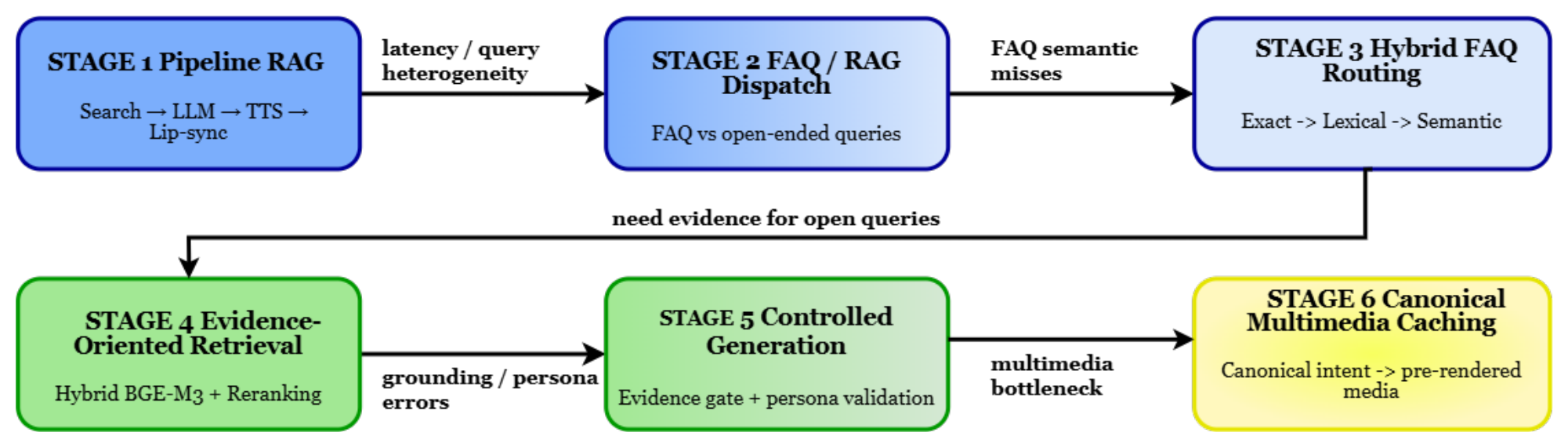
Figure 2.
Formation of the provenance-aware knowledge base and the relationship between sources, retrieval units, evidence, and FAQs.
Figure 2.
Formation of the provenance-aware knowledge base and the relationship between sources, retrieval units, evidence, and FAQs.
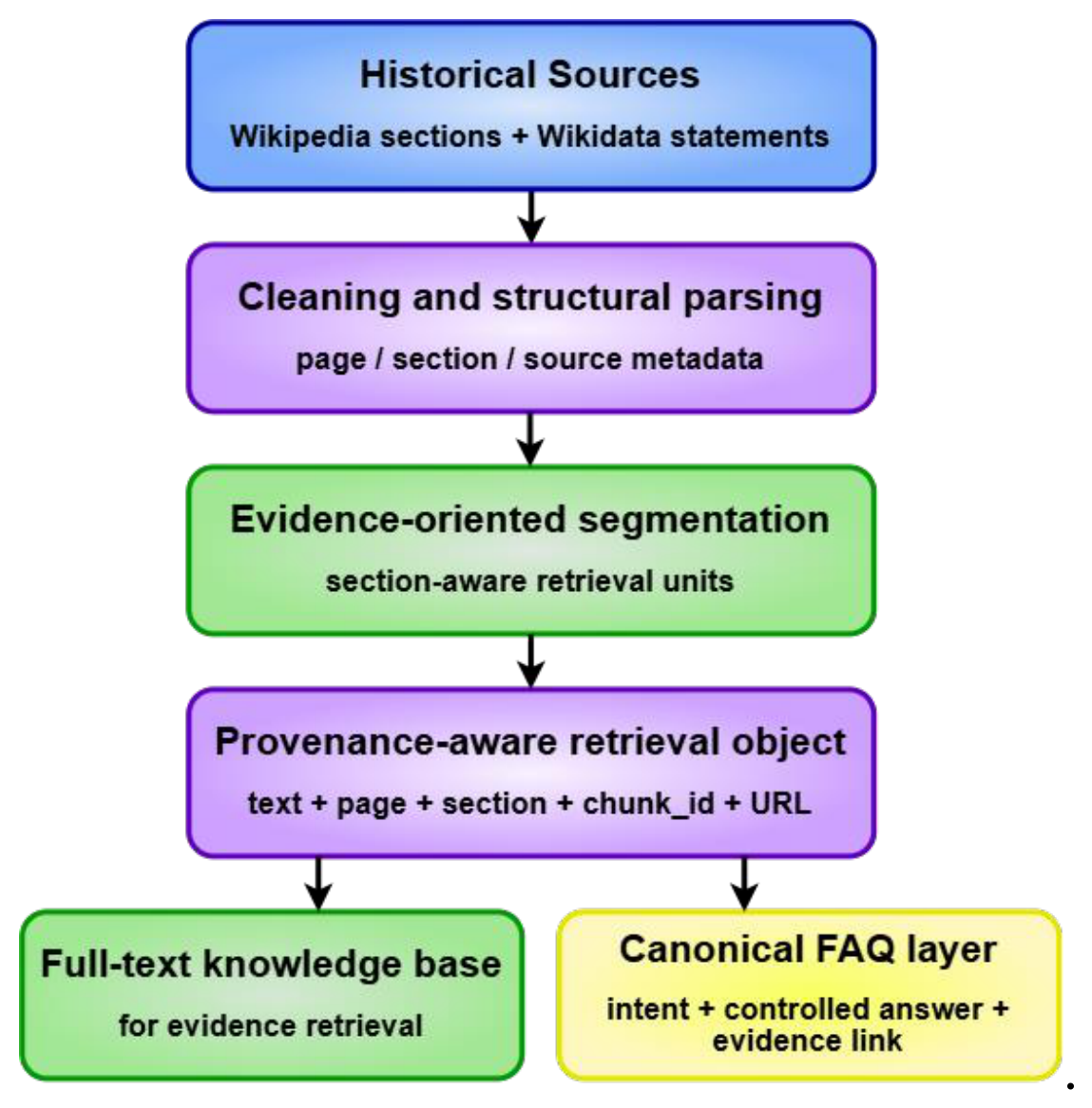
Figure 3.
Experimentally investigated levels of retrieval and reranking during the iterative formation of the evidence-selection pipeline.
Figure 3.
Experimentally investigated levels of retrieval and reranking during the iterative formation of the evidence-selection pipeline.

Figure 4.
Canonical intent representation for the controlled FAQ dataset.
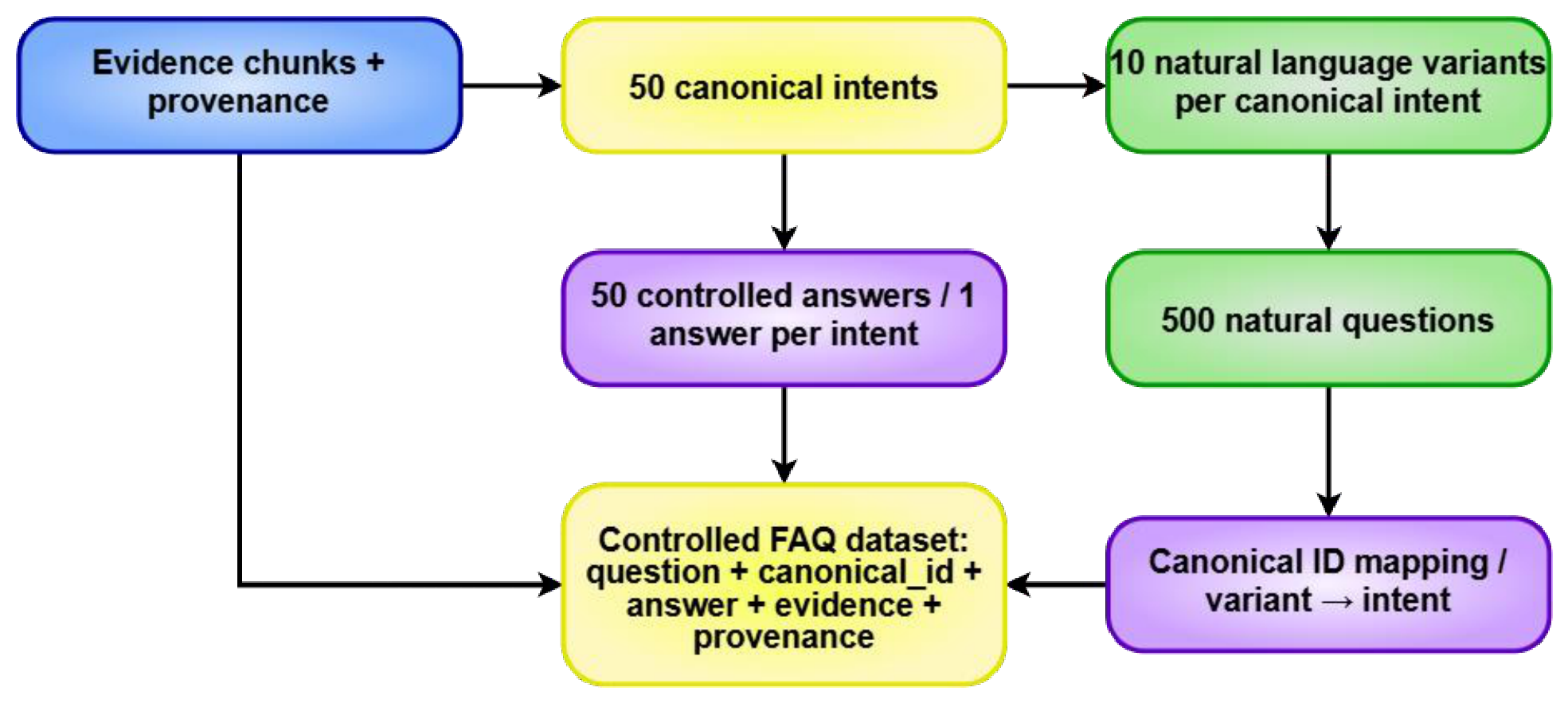
Figure 5.
Final cascaded architecture of user request processing in the proposed evidence-grounded multimodal AI framework.
Figure 5.
Final cascaded architecture of user request processing in the proposed evidence-grounded multimodal AI framework.
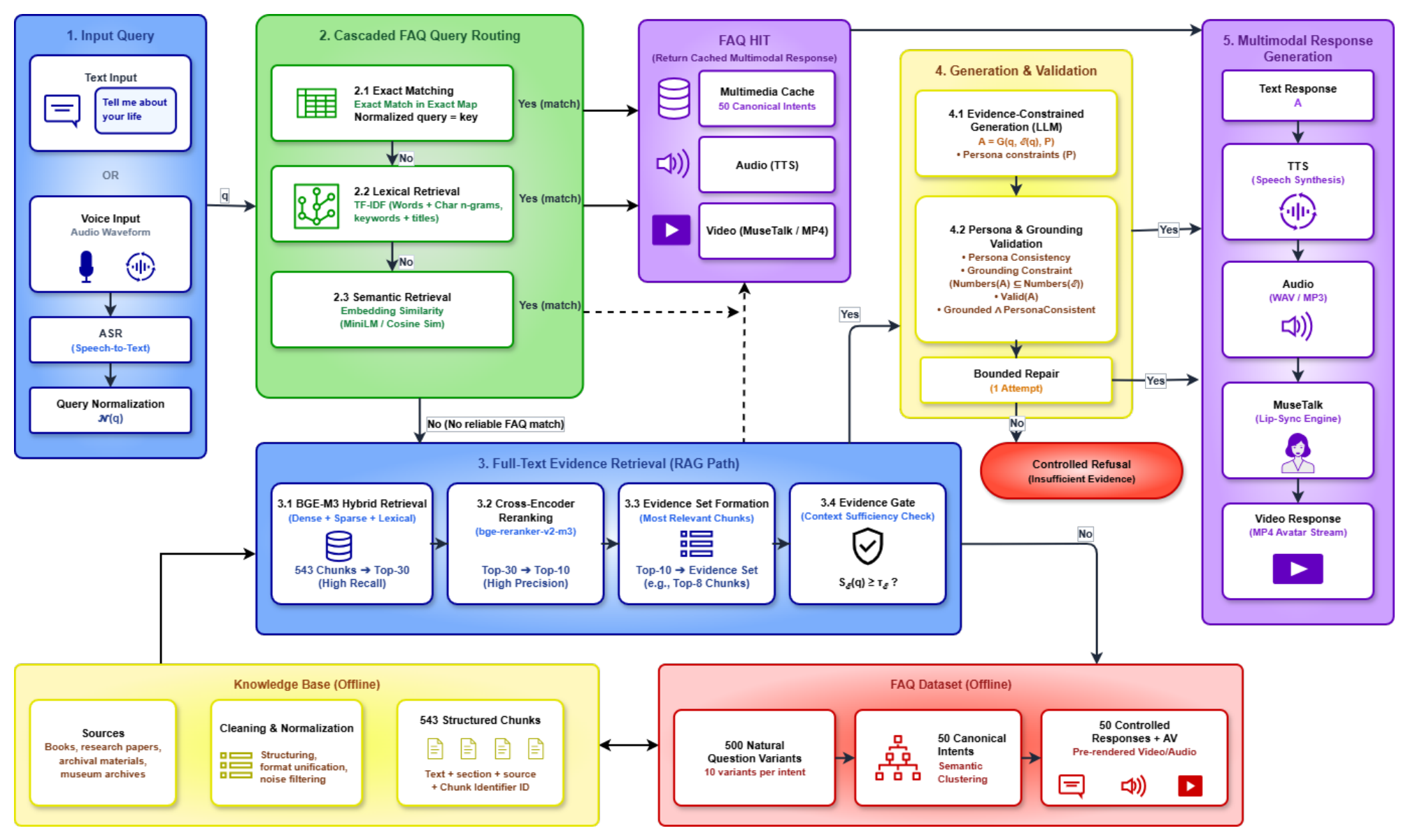
Figure 6.
Protocol for strict Leave-One-Variant-Out evaluation of the FAQ router’s ability to generalize natural language paraphrases.
Figure 6.
Protocol for strict Leave-One-Variant-Out evaluation of the FAQ router’s ability to generalize natural language paraphrases.
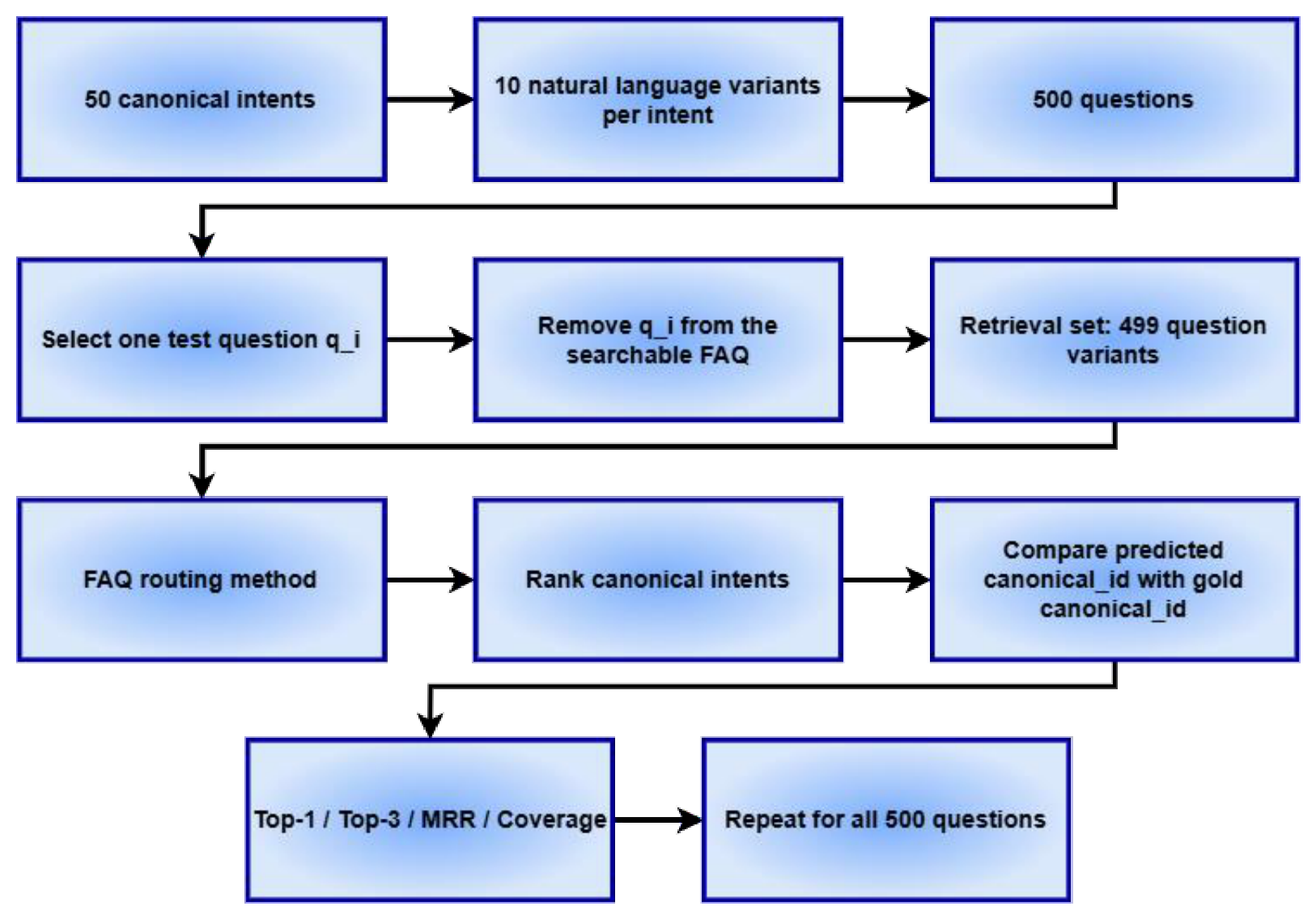
Figure 7.
Comparison of Recall@K for classical sparse, dense, and hybrid retrieval configurations.
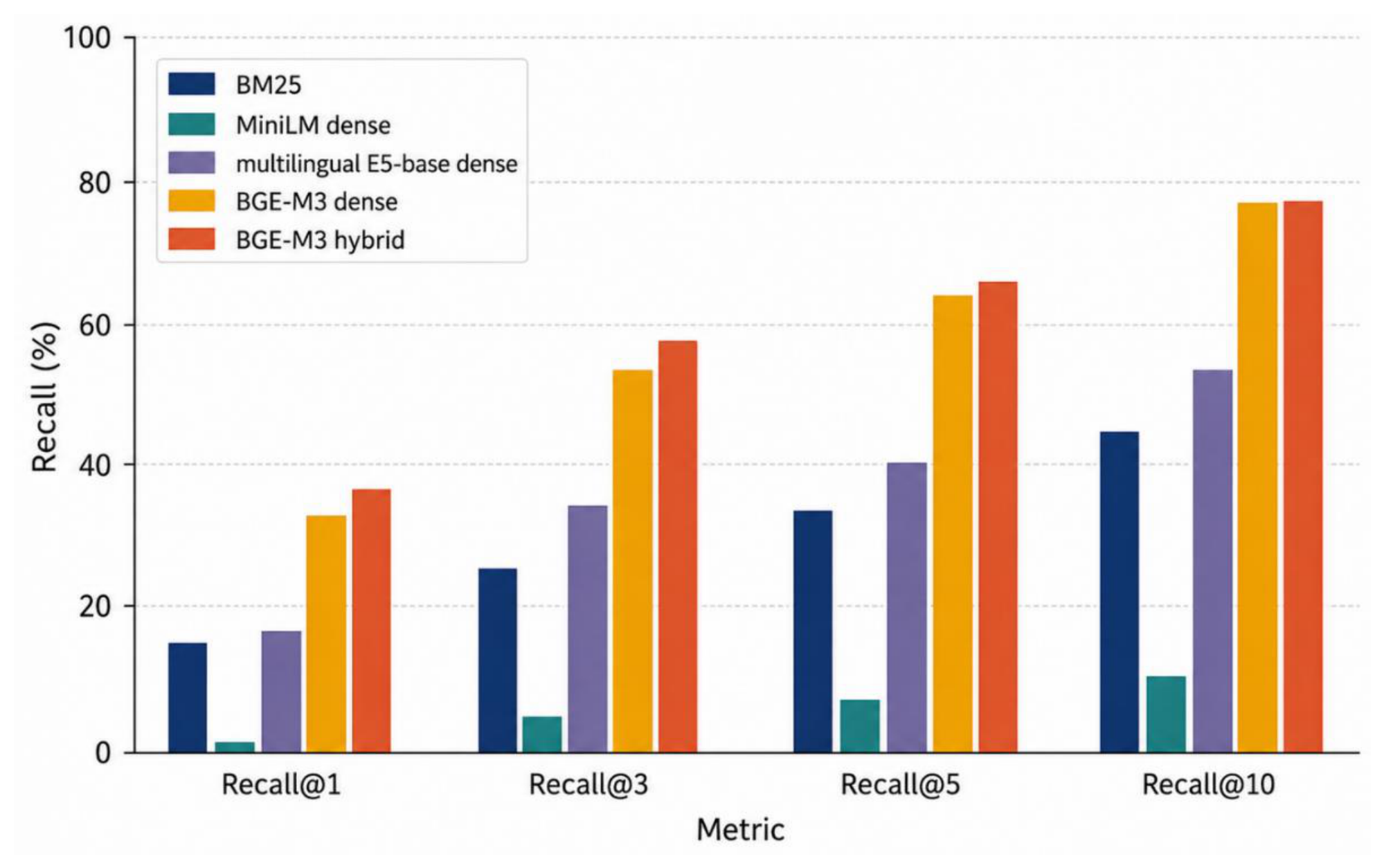
Figure 8.
Impact of chunk-level and sentence-level reranking on Recall@K for full-text evidence retrieval.
Figure 8.
Impact of chunk-level and sentence-level reranking on Recall@K for full-text evidence retrieval.
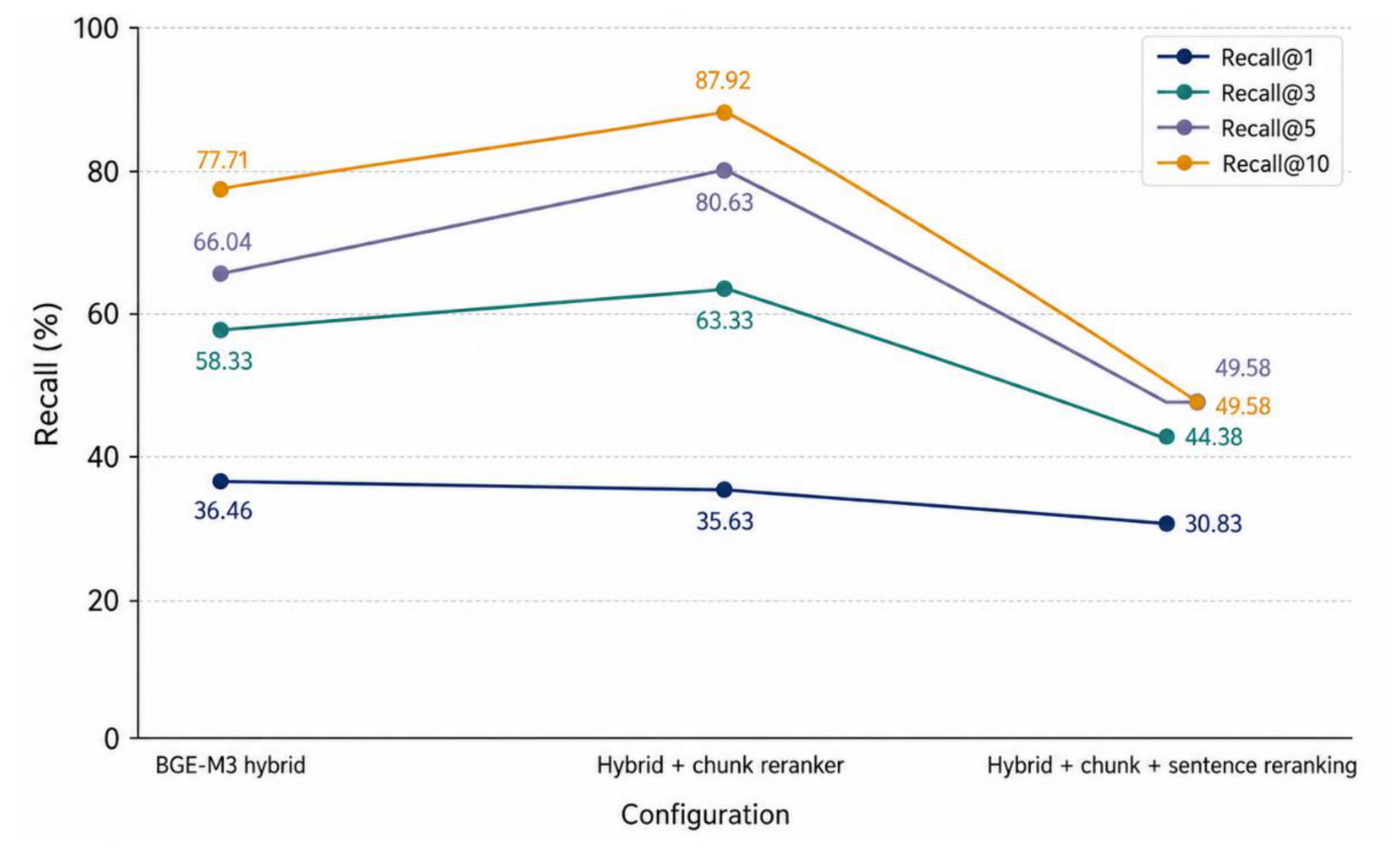
Figure 9.
Comparison of Top-1, Top-3, and coverage for different FAQ-routing configurations in the strict Leave-One-Variant-Out experiment.
Figure 9.
Comparison of Top-1, Top-3, and coverage for different FAQ-routing configurations in the strict Leave-One-Variant-Out experiment.
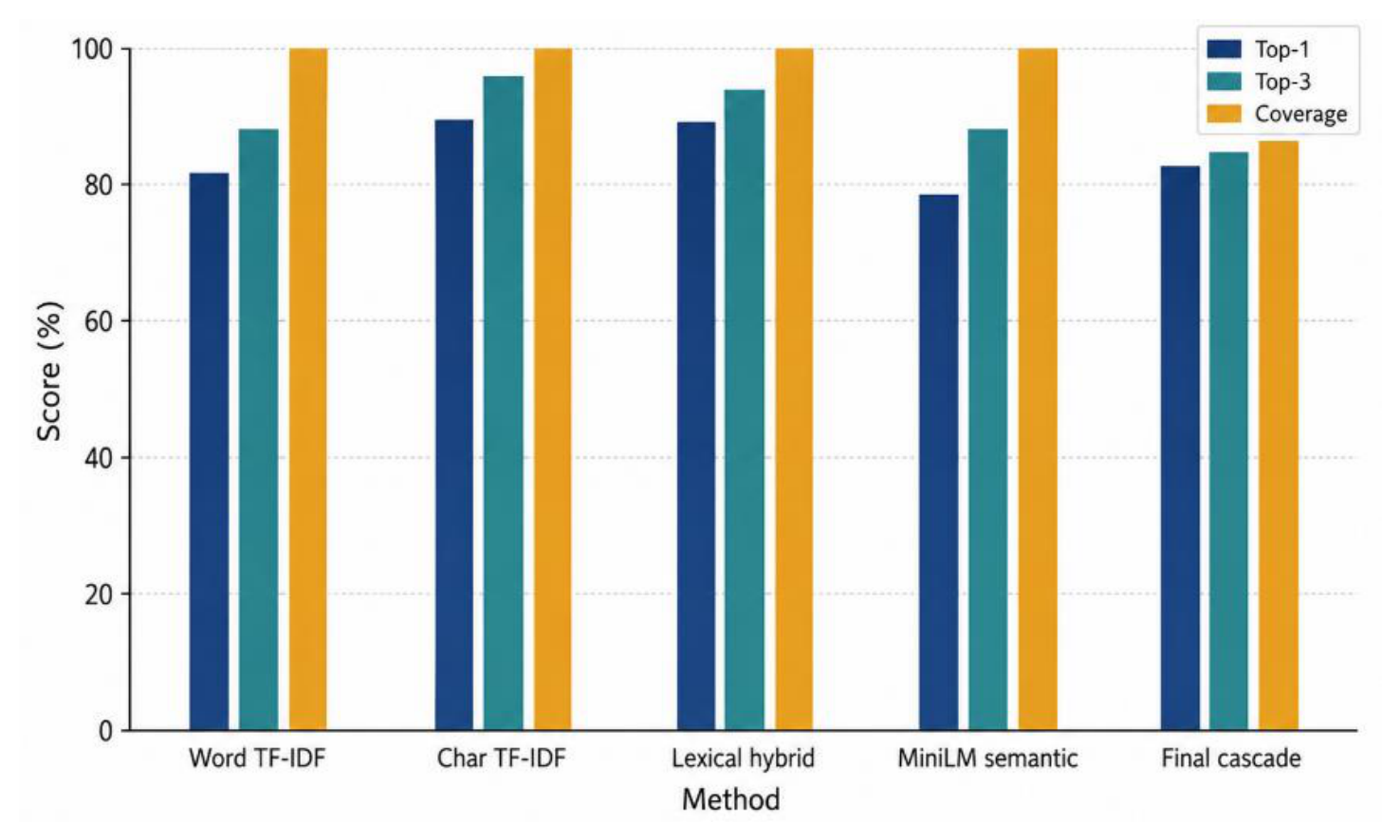
Figure 10.
Median latency of individual dynamic pipeline components and cached FAQ path (logarithmic scale).
Figure 10.
Median latency of individual dynamic pipeline components and cached FAQ path (logarithmic scale).
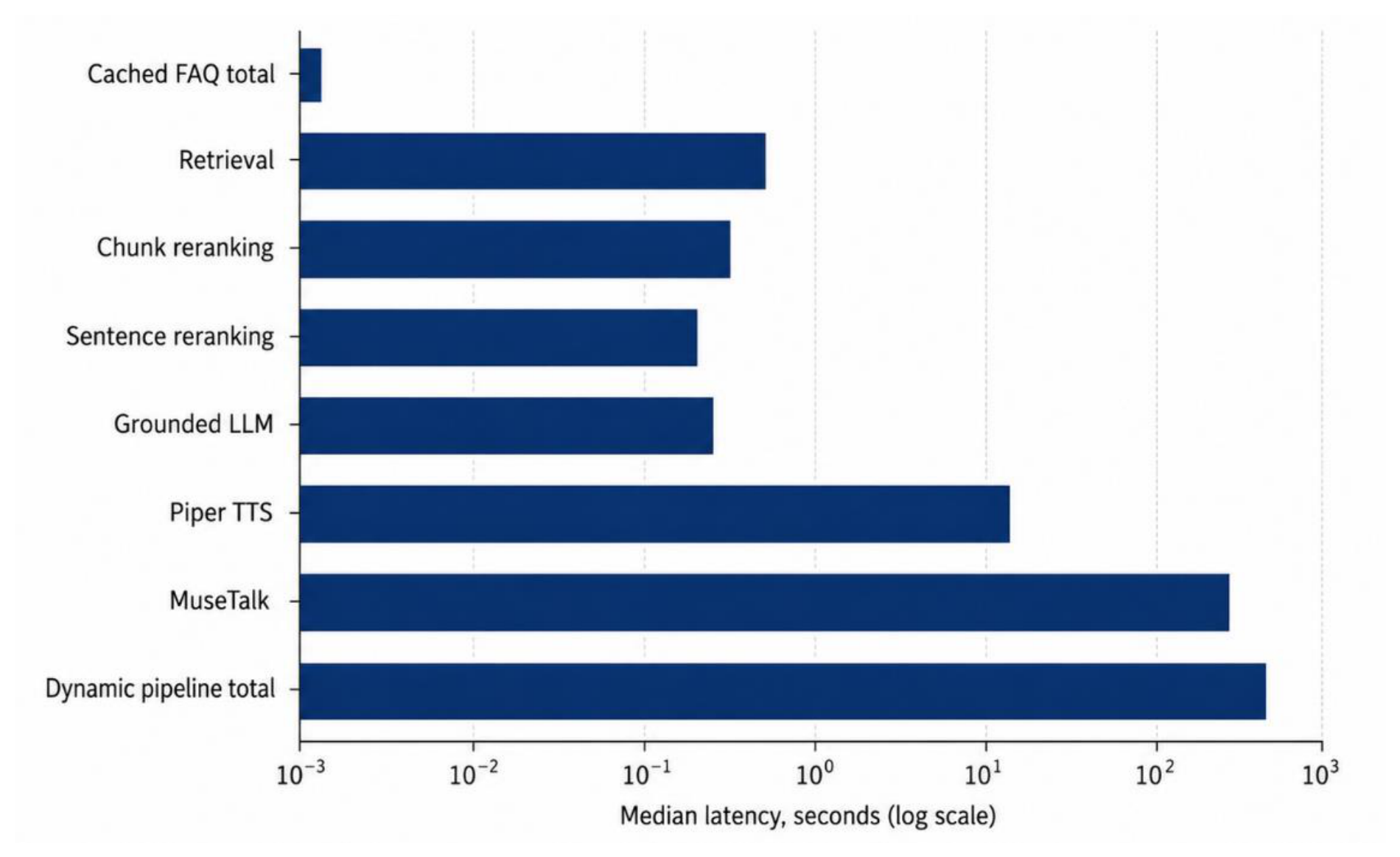
Figure 11.
Implementation of the interactive digital persona prototype for Taras Shevchenko: (a) initial museum-oriented interface; (b) response to a canonical identity question with synchronized digital persona and subtitles; (c) generated full-body lip-synchronized digital persona video; (d) evidence provenance table and textual response; (e) synchronized subtitle and audio presentation; (f) language selection and text/voice question interface.
Figure 11.
Implementation of the interactive digital persona prototype for Taras Shevchenko: (a) initial museum-oriented interface; (b) response to a canonical identity question with synchronized digital persona and subtitles; (c) generated full-body lip-synchronized digital persona video; (d) evidence provenance table and textual response; (e) synchronized subtitle and audio presentation; (f) language selection and text/voice question interface.
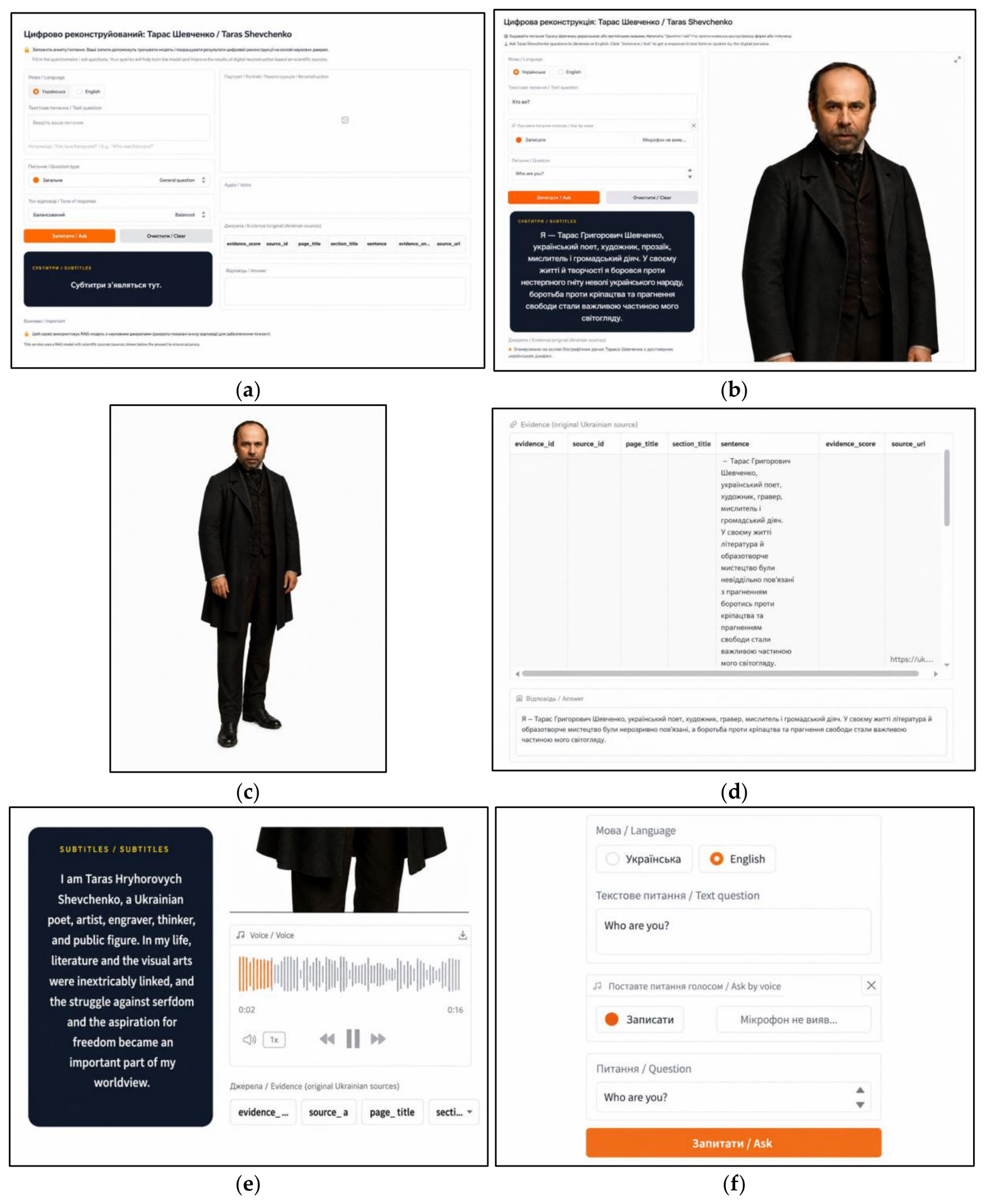
Table 1.
Comparative analysis of related approaches and the proposed evidence-grounded multimodal framework.
Table 1.
Comparative analysis of related approaches and the proposed evidence-grounded multimodal framework.
| Study | Cultural heritage | RAG/external knowledge | Evidence provenance | Persona consistency | Multimodal avatar | FAQ–RAG cascade | Multimedia caching |
|---|---|---|---|---|---|---|---|
| Duguleană et al. [1] | ✓ | — | — | — | ✓ | — | — |
| Trichopoulos et al. [3] | ✓ | — | — | — | — | — | — |
| Character-LLM [6] | — | Partial | — | ✓ | — | — | — |
| Noh & Hong [22] | ✓ | Partial | — | ✓ | ✓ | — | — |
| Chang et al. [23] | ✓ | ✓ | Partial | — | — | — | — |
| Geninatti Cossatin et al. [24] | ✓ | Partial | — | — | — | — | — |
| Natale et al. [25] | ✓ | Partial | Partial | ✓ | — | — | — |
| Kucia et al. [26] | ✓ | ✓ | Partial | — | — | — | — |
| Barla & de Berardinis [28] | ✓ | ✓ | ✓ | — | — | — | — |
| Proposed framework | ✓ | ✓ | ✓ | ✓ | ✓ | ✓ | ✓ |
Notation: ✓ — explicitly implemented or addressed as a core component; Partial — partially implemented or indirectly addressed; — — not reported or not considered as a component of the study.
Table 2.
Evolution of key architectural decisions during iterative framework development.
| Component | Initial approach | Motivation for refinement | Candidate/final decision | Basis |
|---|---|---|---|---|
| FAQ retrieval | Semantic MiniLM | Need for stronger lexical and morphological sensitivity in short Ukrainian queries | Exact + lexical + semantic cascade | Qualitative analysis + RQ3 |
| Full-text retrieval | Compact dense embeddings | Need for stronger full-corpus evidence retrieval and entity-sensitive matching | BGE-M3-based hybrid retrieval | Exploratory analysis + RQ1 |
| Evidence ranking | Retriever similarity only | Need for finer discrimination among semantically close evidence chunks | Cross-encoder reranking | RQ2 |
| Sentence-level refinement | Chunk decomposition into sentences | Need to verify whether finer evidence granularity improves retrieval quality | Evaluated as ablation; chunk-level representation retained in final framework | RQ2 |
| FAQ representation | Independent generated Q&A pairs | Need for controlled semantic consistency, reduced redundancy, and stable persona-oriented responses | Canonical intents + controlled natural-language variants | Qualitative validation |
| Question-type control | Similarity-based matching only | Need to distinguish semantically close queries requesting different information types | Rule-based question-type compatibility guard | Qualitative analysis |
| Generation | Direct LLM response | Need to align generated content with retrieved evidence and persona constraints | Evidence-constrained generation + post-generation validation | Architectural requirements + qualitative analysis |
| Multimedia output | Dynamic TTS + lip-sync for every query | Opportunity to reduce repeated multimedia computation for frequent interactions | Canonical multimedia caching | RQ4 |
| ASR / TTS / lip-sync | Available pretrained models | Need for a reproducible, Ukrainian-compatible multimodal implementation stack | Whisper / Piper / MuseTalk as engineering components | Implementation requirements |
| Question-type and historical compatibility control | Similarity-based matching only | Need to distinguish semantically similar queries with incompatible answer types, foreign-person subjects, or posthumous concepts | Rule-based question-type + entity + temporal compatibility guard | Qualitative error analysis + RQ3 robustness evaluation |
Table 3.
Main characteristics of the historical corpus and the retrieval-ready knowledge base.
| Characteristic | Value |
|---|---|
| Processed thematic pages | 57 |
| Wikipedia sections in initial corpus | 332 |
| Wikidata statements | 291 |
| Initial structured records | 623 |
| Exact duplicates removed | 40 |
| Initial corpus volume | 573,089 characters |
| Approximate volume | 143,266 tokens |
| Pages in retrieval-ready corpus | 42 |
| Cleaned Wikipedia records | 277 |
| Structural sections in chunk collection | 263 |
| Retrieval chunks | 543 |
| Total word count in chunks | 88,106 |
| Average chunk length | 162.3 words |
| Median chunk length | 196 words |
| Length range | 36–220 words |
Table 4.
Results of structural, semantic, evidence-, and persona-oriented control of the FAQ dataset.
Table 4.
Results of structural, semantic, evidence-, and persona-oriented control of the FAQ dataset.
| Control Metric | Result |
|---|---|
| Canonical intents | 50 |
| Natural-language variants | 500 |
| Variants per intent | 10 |
| Unique raw questions | 500/500 (100%) |
| Unique normalized questions | 500/500 (100%) |
| Exact normalization collisions | 0 |
| FAQ embeddings | 500 × 384 |
| Semantic cohesion, LOO Top-1 | 491/500 (98,2%) |
| Semantic cohesion, LOO Top-3 | 499/500 (99,8%) |
| Average within-intent cosine similarity | 0,940 |
| Canonical answers with first-person markers | 50/50 (100%) |
| Canonical records with evidence excerpt | 50/50 (100%) |
| Records with page/section/URL provenance | 50/50 (100%) |
| Explicit chunk-level provenance | 48/50 (96%) |
| quality_status = valid_curated | 50/50 |
| grounding_status = curated_evidence | 50/50 |
Table 5.
Structure of the Experimental Study.
| RQ | Evaluation Object | Number of Tests | Search Space | Core Metrics |
| RQ1 | Retrieval models | 480 questions | 543 chunks | Recall@1/3/5/10, MRR@10, nDCG@10 |
| RQ2 | Reranking configurations | 480 questions | 543 → Top-30 candidates | Recall@K, MRR@10, nDCG@10 |
| RQ3 | FAQ routing and robustness | 500 LOO trials + 100 negative queries | 499 searchable variants у LOO; FAQ50 cascade для negative benchmark | Top-1, Top-3, MRR, Coverage, correctness among accepted, False FAQ Activation Rate, rejection rate |
| RQ4 | Multimedia latency | 30 queries | cached та dynamic paths | mean, median, p95, min, max |
Table 6.
Quantitative characteristics of the evaluation sets.
| Characteristic | Evidence retrieval | FAQ LOO | Latency |
|---|---|---|---|
| Knowledge chunks | 543 | — | 543 |
| Canonical intents | 48 із gold chunk | 50 | subset із eligible intents |
| Natural-language questions | 480 | 500 | 30 |
| Variants на canonical intent | 10 | 10 | 1 canonical question |
| Gold target | source_chunk_id(s) | canonical_id | cached/dynamic response |
| Share FAQ500 | 96% | 100% | 30 canonical questions |
Table 7.
Retrieval configurations for RQ1.
| Notation | Configuration | Representation Type | Additional lexical signal |
|---|---|---|---|
| R0 | BM25 | Sparse lexical | Так |
| R1 | MiniLM | Dense | Ні |
| R2 | multilingual E5-base | Dense | Ні |
| R3 | BGE-M3 | Dense | Ні |
| R4 | BGE-M3 hybrid | Dense + sparse + lexical | Так |
| R5 | BGE-M3 hybrid + bge-reranker-v2-m3 | Hybrid + cross-encoder | Так |
Table 8.
Configurations of FAQ Routing.
| Method | Representation | Uses paraphrases | Confidence rejection |
|---|---|---|---|
| Exact only | Normalized string | No | No |
| Word TF-IDF | Word 1–2 grams | Yes | No |
| Char TF-IDF | Character 3–5 grams | Yes | No |
| MiniLM | Dense semantic embeddings | Yes | No |
| Lexical hybrid | Word + char + token overlap | Yes | No |
| Final cascade | Lexical hybrid → MiniLM + question-type + historical compatibility guard | Yes | Yes |
Table 9.
Results of the comparison of full-text evidence retrieval models.
| Model | Recall@1, % | Recall@3, % | Recall@5, % | Recall@10, % | MRR@10 | nDCG@10 |
|---|---|---|---|---|---|---|
| BM25 | 15.00 | 25.21 | 33.54 | 45.00 | 0.2290 | 0.2807 |
| MiniLM dense | 1.04 | 4.58 | 7.08 | 10.21 | 0.0356 | 0.0512 |
| multilingual E5-base dense | 16.25 | 34.17 | 40.42 | 54.17 | 0.2731 | 0.3368 |
| BGE-M3 dense | 32.71 | 53.96 | 63.75 | 77.50 | 0.4629 | 0.5372 |
| BGE-M3 hybrid | 36.46 | 58.33 | 66.04 | 77.71 | 0.4912 | 0.5597 |
Table 14.
Execution time of cached and dynamic multimedia paths.
| Component | N | Mean, s | Median, s | P95, s | Min, s | Max, s |
|---|---|---|---|---|---|---|
| Retrieval | 19 | 1.009 | 1.364 | 1.618 | 0.270 | 1.651 |
| Chunk reranking | 19 | 0.638 | 0.642 | 0.668 | 0.609 | 0.669 |
| Sentence reranking* | 19 | 0.449 | 0.426 | 0.561 | 0.330 | 0.698 |
| Grounded LLM | 19 | 0.532 | 0.518 | 0.697 | 0.401 | 0.715 |
| Piper TTS | 19 | 13.200 | 12.096 | 18.763 | 7.932 | 18.987 |
| MuseTalk | 19 | 129.488 | 126.962 | 177.144 | 94.177 | 181.697 |
| Dynamic pipeline total | 19 | 147.162 | 143.941 | 199.546 | 106.652 | 205.588 |
| Cached FAQ MP4 total | 30 | 0.00227 | 0.00208 | 0.00250 | 0.00157 | 0.00783 |
Table 15.
Summary of Main Experimental Results.
| RQ / validation | Main Result | Quantitative Confirmation | Architectural Conclusion |
|---|---|---|---|
| RQ1 | BGE-M3 hybrid outperforms other full-text retrievers | Recall@1 = 36,46%; Recall@10 = 77,71%; MRR = 0,4912 | Use BGE-M3 hybrid for knowledge-base retrieval |
| RQ2 | Chunk reranking improves top-K retrieval | Recall@5: 66,04% → 80,63%; Recall@10: 77,71% → 87,92% | Retain bge-reranker-v2-m3 after initial retrieval |
| RQ2 | Sentence reranking degrades results | Recall@5: 80,63% → 49,58%; nDCG: 0,6151 → 0,4092 | Remove from the main final architecture |
| RQ3 | Lexical methods best generalize FAQ paraphrases | Hybrid Top-1 = 89,4%; Char TF-IDF Top-3 = 96,2% | Character-level lexical signal is key for FAQ |
| RQ3 | Conservative cascade increases the reliability of accepted matches | Coverage = 87,4%; correctness among accepted = 95.19% | Forward uncertain matches to RAG |
| RQ3 | Revised serving configuration conservatively rejects negative and out-of-FAQ queries | FAQ-FAR = 3.0%; correct rejection = 97.0%; 0 false activations for other-person, anachronistic/posthumous, and general out-of-domain queries | Use semantic routing together with entity-, temporal-, and question-type compatibility safeguards; validate on independent held-out negatives before deployment |
| RQ4 | Cached multimedia path eliminates the primary latency bottleneck | Median: 143,94 s → 0,00208 s | Use pre-built MP4s for canonical FAQs |
| RQ4 | MuseTalk dominates dynamic latency | Median = 126,96 s | Do not use real-time lip-sync for repetitive FAQs |
| Evidence Gate validation | Conservative gate effectively separates supported and unsupported queries | Acceptance = 88.0%; correct abstention = 96.0%; FAR = 4.0%; Balanced Accuracy = 92.0% | Launch dynamic generation only after evidence sufficiency control |
Table 16.
Functional components of the implemented prototype.
| Component | Implemented function | User-facing output |
|---|---|---|
| Text/voice input | Text entry and ASR-based voice query acquisition | Normalized user question |
| FAQ cascade | Exact, lexical and semantic routing to canonical intents | Prepared canonical response |
| Dynamic RAG | BGE-M3 retrieval and cross-encoder reranking | Evidence set for grounded generation |
| Grounded generation | Evidence-constrained natural-language realization | Textual persona response |
| TTS | Synthesis of Ukrainian speech | Audio response |
| Lip-sync | MuseTalk-based synchronization of the reconstructed portrait | Video response |
| Subtitles | Text duplication of the generated response | Readable synchronized captions |
| Evidence view | Display of source metadata and retrieved fragments | Transparent provenance and source URL |
Disclaimer/Publisher’s Note: The statements, opinions and data contained in all publications are solely those of the individual author(s) and contributor(s) and not of MDPI and/or the editor(s). MDPI and/or the editor(s) disclaim responsibility for any injury to people or property resulting from any ideas, methods, instructions or products referred to in the content. |
© 2026 by the authors. Licensee MDPI, Basel, Switzerland. This article is an open access article distributed under the terms and conditions of the Creative Commons Attribution (CC BY) license.
Copyright: This open access article is published under a Creative Commons CC BY 4.0 license, which permit the free download, distribution, and reuse, provided that the author and preprint are cited in any reuse.