

Submitted:
05 October 2026
Posted:
08 October 2026
You are already at the latest version
Abstract
Acute stress can change metabolism, immune activity, redox regulation, microcirculation, nutrient distribution, tissue repair, and the interaction among these systems. These changes raise the possibility that the functional availability or requirement for selected nutrients differs temporarily from that during physiological maintenance. Acute Stress Orthomolecular Nutrition (ASON) is proposed as a systems-medicine hypothesis and research framework for investigating this possibility across infection, including COVID-19; surgery, including dental procedures; trauma and burns; ischemic cardiovascular and cerebrovascular injury; intense physical exertion and recovery; and, more provisionally, acute neuroendocrine or psychological stress.The framework distinguishes altered circulating concentration, altered turnover or loss, functional nutrient limitation, and clinical benefit from intervention. None establishes the next automatically. ASON further treats nutrient physiology as one component of a changing biological terrain in which metabolic state, inflammatory burden, redox signaling, microcirculation, organ function, baseline nutritional status, environmental exposures, and repair capacity may interact. Selected perioperative nutritional strategies provide clinical precedents, but uncertainty in systematic reviews and null or harmful results in critical illness impose substantial boundaries. ASON neither predicts uniformly increased requirements nor supports universal high-dose supplementation. Nutrient effects must be evaluated according to baseline status, stressor, disease severity, organ function, formulation, dose, route, timing, and duration.This narrative framework proposes serial systems-level physiological measurements followed by prespecified, adequately controlled intervention studies with patient-centered outcomes and adverse-event monitoring. Its incremental value would depend on demonstrating reproducible stress-related changes, identifying functionally relevant limitations, and, separately, showing that targeted interventions improve outcomes safely. Acute psychological stress remains a hypothesis-generating extension without an established acute nutrient-treatment indication.
Keywords:
acute stress
; orthomolecular nutrition
; systems medicine
; nutrient requirements
; clinical nutrition
; perioperative nutrition
; redox regulation
; micronutrients
; precision nutrition
1. Introduction
Dietary reference values guide nutritional planning for healthy populations. They account for differences such as age, sex, and life stage; they are neither an immutable prescription for every illness nor evidence that higher intakes improve disease outcomes. Clinical nutrition already addresses substantial changes in energy and protein metabolism during surgery, critical illness, and burns [1,2,3]. The assessment of micronutrients likewise requires attention to inflammation, analytical limitations, losses, intake, and toxicity [4,5]. ASON asks whether this existing context-dependent approach can be developed into a testable account of transient, nutrient-specific functional requirements during acute stress.
The author previously described a Nutrient Demand Principle and a systemic account of surgical healing [6,7]. These OMNS articles establish the conceptual lineage of the present proposal; they do not supply independent clinical validation. ASON narrows the proposition to selected nutrients and defined stressors. It allows increased, unchanged, or reduced requirements, distinguishes availability from intake, and permits the possibility that correcting a biochemical abnormality produces no benefit or causes harm.
Here, orthomolecular denotes the study of nutrients and other substances normally present in, or required by, human physiology in relation to biological context. It does not confer safety on pharmacological exposures. Essential nutrients, conditionally essential substrates, and nutrients used for drug-like effects should remain distinct categories.
The central hypothesis is that acute stress can transiently alter the functional availability, utilization, loss, requirement, or appropriate delivery of selected nutrients relative to physiological maintenance in the same organism. Whether a resulting limitation exists, and whether intervention improves a defined outcome, are separate empirical questions.
ASON is also interpreted through a systems-medicine perspective. Acute illness or injury does not perturb a single pathway in isolation; it changes a dynamic biological terrain shaped by interacting metabolic, nutritional, inflammatory, redox, vascular, organ-function, environmental, and repair variables. In the I-OM systems-medicine model, nutrient status is therefore considered alongside upstream and interacting drivers rather than as an isolated explanatory variable. This perspective is used to generate testable hypotheses, not to override established evidence or imply that every relevant system is abnormal in every patient.
ASON has substantial overlap with established clinical nutrition, precision nutrition, immunonutrition, and pharmaconutrition. Its proposed novelty lies in emphasizing the temporal stress trajectory—baseline, acute response, repair, and recovery—and testing whether nutrient-related physiology and intervention effects change across that trajectory and in relation to the wider biological terrain. It does not claim discovery of a previously unrecognized general principle of nutrition.
2. Evidence Approach and Interpretation
This article is a narrative hypothesis paper, not a systematic review or a clinical guideline. Sources were selected to examine established nutritional care, mechanistic plausibility, clinical precedents, contrary evidence, and safety across the stated domains. Citation metadata and source-to-claim correspondence were checked against PubMed, DOI registry records, original publisher material, society guidelines, and official safety documents, with a targeted update through 4 October 2026. This process does not constitute an exhaustive systematic search and does not exclude publication bias. No original dataset, pooled effect estimate, or new formal GRADE assessment is presented.
The hierarchy used for interpretation is explicit. Randomized clinical trials address the effect of the tested intervention in the enrolled population. Systematic reviews are interpreted according to their eligibility criteria, risk of bias, heterogeneity, and certainty rather than being presumed superior solely because they pool studies. Guidelines provide clinical context and recommendations with their own grading systems. Human observational studies can identify associations but remain susceptible to reverse causation and confounding. Mechanistic, animal, and cellular observations justify questions and measurements but do not establish human efficacy. The author’s conceptual publications supply provenance, not treatment-effect evidence.
Clinical conclusions therefore remain attached to the actual comparator, nutrient formulation, route, timing, severity, and outcomes studied. Findings for a multicomponent formula cannot isolate the contribution of one component. Repeated meta-analyses may contain overlapping trials and should not be counted as independent replications. Negative results must not be dismissed by invoking untested synergy, a hypothetical subgroup, or a different dosing schedule. Such explanations require prospective evaluation.
The systems-medicine interpretation follows the same evidence hierarchy. Multisystem coherence can motivate measurement and model building, but the presence of interacting pathways does not itself establish a causal root driver or prove that modifying an upstream variable improves outcomes. Where the manuscript uses an I-OM interpretation, it should be read as an organizing hypothesis unless direct clinical evidence is cited.
3. Dynamic Nutrient Physiology
Four phenomena must be separated: (1) a change in circulating concentration; (2) a change in turnover, distribution, or loss; (3) a functional limitation attributable to nutrient availability; and (4) improvement in a clinically relevant outcome after intervention.
Inflammation can change carrier proteins and tissue distribution; fluid treatment can cause dilution; renal function can modify clearance; reduced intake, malabsorption, and exudative losses can change balance. A low measured concentration can therefore be a marker of illness without proving that the administered nutrient is limiting [2,3,4].
Requirements should be defined in relation to an objective and exposure. Maintaining enzymatic function, preventing deficiency, restoring a depleted pool, and producing a pharmacological effect are different objectives. An optimal exposure is not necessarily a single plasma concentration or intake, and the safer or more useful objective may differ by disease stage.
Oral and intravenous vitamin C, for example, produce substantially different exposures in human pharmacokinetic studies; results from one route cannot be transferred numerically to another [8]. This pharmacokinetic distinction itself proves neither acute-stress benefit nor an indication for intravenous treatment.
The history of conditionally essential substrates illustrates the distinction. Glutamine and arginine have attracted physiological and therapeutic interest, and the concept of pharmaconutrition emphasizes their possible drug-like use [9]. Recommendations in older reviews must be read historically: subsequent large trials of glutamine in critical illness and burns failed to confirm anticipated benefits and identified important risks [10,11]. ASON must accommodate those results rather than treat conditional essentiality as a treatment mandate.
From a systems perspective, the same measured nutrient state can have different functional implications depending on substrate availability, organ perfusion, inflammation, oxidative and reductive signaling, endocrine state, renal or hepatic clearance, medication exposure, and repair demand. ASON therefore favors longitudinal, context-rich measurements over isolated thresholds whenever feasible.
4. Biological Basis and Limits
4.1. Metabolism and Immune Activity
Surgery, infection, major trauma, and burns can alter substrate mobilization, insulin sensitivity, protein turnover, and inflammatory signaling [1,2,3]. Immune responses and tissue reconstruction depend on adequate substrates and cofactors. Nevertheless, a rise in metabolic activity does not mean that every nutrient becomes limiting or that whole-body requirements rise uniformly. Organ dysfunction, reduced activity, and changing phases of illness can produce opposing effects. Adequacy of total nutrition, absorption, and delivery must be considered before attributing a limitation to a specific micronutrient.
4.2. Redox Regulation and Adaptation
Reactive oxygen species participate in signaling, host defense, and adaptation as well as injury. Nutritional interventions aimed at redox biology should therefore be evaluated for restoration of function rather than simply reduction of an oxidation marker. During endurance training, vitamin C and E supplementation attenuated selected cellular markers of adaptation without clearly reducing improvements in the performance tests measured [12]. This is evidence against assuming that suppression of redox signals is invariably helpful; it does not establish that all antioxidant intake impairs exercise performance.
4.3. Microcirculation and Tissue Repair
Wound repair involves hemostasis, inflammatory regulation, angiogenesis, matrix synthesis, and remodeling. Adequate oxygen delivery and perfusion are relevant alongside nutritional status [13]. A nutrient-dependent biochemical reaction does not demonstrate that additional nutrient is the dominant constraint on healing. Infection, tissue oxygenation, glycemic control, smoking, mechanical stability, and surgical factors may remain limiting despite adequate nutrient exposure. In this framework, microcirculation is an interacting physiological variable and an investigational measurement, not a promised outcome of supplementation.
4.4. Redistribution and Losses
Burns provide a particularly clear example of catabolism, tissue destruction, and external nutrient losses [2,14]. Other stress states can change distribution, renal elimination, or intestinal absorption. Serial concentrations interpreted together with intake, inflammation, fluid balance, and organ function are more informative than an isolated measurement [4]. Even a demonstrated increase in loss does not determine the optimal replacement strategy independently of clearance, total exposure, and clinical outcomes.
A 2026 pharmacokinetic sub-study of LOVIT linked vitamin C exposure to renal filtration and illness severity. Greater exposure among nonsurvivors was not independently associated with mortality in the multivariable analysis [15]. This supports studying disposition and organ function; it does not establish increased requirements or a causal toxicity mechanism.
4.5. Systems Interactions and Biological Reserve
ASON treats nutrient physiology as one layer of a broader response network. Baseline metabolic health, nutritional reserve, tissue perfusion, inflammatory burden, redox state, medication exposure, environmental or toxicant burden where relevant, and organ reserve can plausibly modify the response to an acute stressor. These interacting factors should be measured when they are biologically and clinically justified, but they should not be assumed to be causal merely because they fit a systems model. The research task is to identify which variables add predictive value beyond established clinical risk factors and whether modifying any of them improves patient-centered outcomes.
5. Clinical Precedents and Contrary Evidence
5.1. Surgery and Perioperative Immunonutrition
The 2025 ESPEN surgery guideline integrates nutritional risk assessment and therapy with early feeding, metabolic control, and recovery [1]. Its recommendation 19 supports preoperative or perioperative immunonutrition containing arginine, omega-3 fatty acids, and nucleotides for major tumor surgery. This is a population-specific recommendation, not an endorsement of an ASON formula for every operation or dental procedure.
Early randomized studies reported favorable outcomes in selected gastrointestinal and cardiac surgical populations [16,17,18]. Their limitations include small samples, historical care pathways, differing nutrient delivery, and, in some instances, surrogate primary outcomes or per-protocol analysis.
In SONVI, 264 patients undergoing colorectal resection in an enhanced recovery program received an enriched formula or a standard supplement for seven days before and five days after surgery. Infectious complications were lower with immunonutrition, whereas median hospital stay was five days in both groups [19]. The result concerns the tested formula and care pathway; it cannot establish an isolated nutrient requirement or a benefit in unrelated surgery.
An umbrella review reported fewer infectious complications but substantial heterogeneity and unresolved questions concerning timing and contemporary enhanced recovery practice [20]. The 2024 Cochrane review found low-certainty evidence for immune-enhancing preoperative nutrition: its infectious-complication estimate, RR 0.74 (95% CI 0.53-1.04), was compatible with benefit and with no effect [21]. A sensitivity analysis in malnourished or weight-losing participants suggested benefit from standard oral supplements, which cannot be generalized to all patients. Positive trials, recommendations, and uncertain pooled estimates must all remain visible. These precedents support studying context and timing; they do not validate the broader ASON hypothesis.
5.2. Trauma and Burns
Established nutritional management of major trauma and severe burns recognizes altered metabolism and the need to avoid underfeeding [2,3,14]. It does not establish a common acute-stress micronutrient protocol. In RE-ENERGIZE, 1,209 patients with severe burns were randomized and 1,200 were analyzed. Enteral glutamine at 0.5 g/kg/day, begun within 72 hours of admission, did not shorten time to discharge alive: median 40 versus 38 days, subdistribution hazard ratio 0.91 (95% CI 0.80-1.04) [11]. Six-month mortality did not differ significantly. The trial refutes benefit for that strategy in that population; it does not show that adequate nutritional support is unnecessary.
5.3. Critical Illness and Sepsis
Favorable evidence also requires attention to methodological limits. A 2026 meta-analysis of fourteen intravenous vitamin C trials involving 1,958 patients reported lower 28-day mortality, RR 0.70 (95% CI 0.53-0.93), with low certainty. The signal was driven mainly by smaller single-center studies and was not confirmed in multicenter trials [22]. Exploratory dose, duration, and severity subgroups cannot establish an optimal regimen. Pooled adverse-event reporting does not erase the specific composite harm finding in LOVIT.
In REDOXS, 1,223 ventilated adults with multiorgan failure received early glutamine, antioxidants, both, or placebo in a factorial trial. Glutamine was associated with higher in-hospital and six-month mortality. The 28-day mortality result was a nonsignificant trend under the trial’s prespecified statistical threshold; it should not be described as a statistically significant primary-endpoint harm finding. Antioxidants did not improve the measured clinical outcomes [10].
CITRIS-ALI illustrates why an apparently favorable secondary result requires caution. Among 167 patients with sepsis and acute respiratory distress syndrome, intravenous vitamin C at 50 mg/kg every six hours for 96 hours did not improve the prespecified organ-failure and biomarker outcomes. Lower 28-day mortality was observed as a secondary outcome without adjustment for multiple comparisons [23]. It was a signal requiring confirmation, not a positive primary-endpoint trial.
LOVIT subsequently randomized 872 adults with sepsis receiving vasopressors to the same nominal vitamin C regimen or placebo. Death or persistent organ dysfunction at day 28 occurred in 44.5% versus 38.5% of the primary analysis populations, RR 1.21 (95% CI 1.04-1.40) [24]. The composite harm finding is stronger than a claim based on mortality alone, whose confidence interval included no difference. The 2021 Surviving Sepsis Campaign already suggested against intravenous vitamin C for sepsis or septic shock [25]; its publication preceded LOVIT and must not be represented as a consequence of that trial.
VIOLET supplies a further boundary: a single early enteral dose of 540,000 IU vitamin D3 did not improve 90-day mortality in critically ill adults with confirmed deficiency [26]. These trials demonstrate that low concentrations, physiological plausibility, and higher achieved exposure do not establish that an acute pharmacological intervention will improve outcomes. Their studied regimens are descriptions of evidence, not recommendations.
The 2025 C-EASIE trial directly tested early administration in eight emergency departments: intravenous vitamin C 1.5 g every six hours for four days, initiated within six hours of admission. Among 292 analyzed participants, the average post-baseline SOFA score did not improve significantly, ratio 0.91 (95% CI 0.77-1.08) [27]. Reported subgroup signals remain hypothesis-generating. Early timing therefore cannot be presumed to rescue an unselected intervention; a specific timing hypothesis still requires an appropriate trial.
6. Evidence Across the ASON Domains
Table 1 distinguishes evidence that stress changes physiology from evidence supporting nutrient intervention. Descriptions are qualitative, not formal certainty grades. The domains are preserved as research questions even where direct intervention evidence is limited.
7. Domain-Specific Research Questions
7.1. Acute Infection, Including COVID-19
Infection can alter immune activity, intake, distribution, and metabolic demand. Associations between low nutrient concentrations and severe illness can also arise from reverse causation. Two harmonized randomized trials enrolling critically ill and noncritically ill hospitalized patients with COVID-19 found a low probability that intravenous vitamin C improved organ-support-free days and hospital survival [32]. Recruitment stopped after prespecified futility and harm triggers were met. Their findings weigh against that regimen in those populations. They neither validate a universal infection supplement protocol nor settle every nutrient, route, or outpatient indication. Future studies should distinguish documented baseline deficiency from inflammation-related concentration changes and prespecify timing and organ-function strata.
7.2. Surgery, Including Dental Procedures
Elective surgery permits baseline assessment before a predictable stressor. The specific ASON question is whether surgery produces temporary functional nutrient limitations beyond pre-existing malnutrition and whether addressing them adds benefit to contemporary care. Dental extraction, periodontal surgery, grafting, and implant placement offer measurable tissue-repair outcomes, but evidence from major cancer surgery cannot be imported as a dental recommendation.
A 2024 review included seven human vitamin D studies involving 1,462 participants and 4,450 implants [28]. Its mixture of observational, genetic, and supplementation evidence is insufficient to establish a causal threshold or a universal supplementation strategy. Smoking, periodontal disease, metabolic health, and study design complicate interpretation. Dental research should measure wound healing, infection, pain, implant stability, and longer-term integration with patient-level analysis that accounts for multiple implants. It should avoid selecting biochemical targets after outcomes are known.
A 2026 scoping review expanded the dental evidence to 27 studies of mixed design, with both favorable and null findings and continued need for standardized trials [29]. A small 2025 randomized study involving 24 immediate implants reported improved local healing, stability, and radiographic measures after topical calcitriol gel [30]. Calcitriol is an active vitamin D metabolite; the source’s description of it as vitamin D3 should not imply equivalence to systemic cholecalciferol. Local formulation, small sample size, surrogate outcomes, and six-month follow-up limit extrapolation to systemic nutrient requirements or broad dental care.
7.3. Trauma and Burns
Trauma severity, burn surface area, resuscitation, feeding tolerance, and external losses create distinct contexts [2,3,14]. ASON studies should document these variables and differentiate nutrient replacement for a demonstrable loss from pharmacological supplementation. RE-ENERGIZE remains a direct boundary against presuming that a metabolically plausible glutamine intervention benefits severe burns [11]. Routine nutritional care should not be withheld to create an experimental comparator.
A 2026 trauma review found favorable signals for intravenous vitamin C across three randomized and three cohort studies, but heterogeneity prevented meta-analysis and certainty remained limited [31]. This provides a research rationale, not evidence for routine use, and cannot establish benefit in severe burns or override regimen-specific sepsis findings.
7.4. Ischemic Cardiovascular and Cerebrovascular Stress
Myocardial infarction and ischemic stroke involve energy failure and cellular injury; reperfusion can add oxidative and inflammatory injury [33]. This mechanistic literature supports inclusion as a translational research domain. It does not establish an ASON treatment for myocardial infarction or stroke. Any proposed adjunct must be evaluated within established emergency care, account for dysphagia and aspiration risk where relevant, and preserve timely reperfusion and other indicated therapies. Improvement in a redox marker cannot substitute for neurological function, cardiovascular outcomes, or survival.
7.5. Intense Physical Stress and Recovery
Sports nutrition already adapts food, fluid, and nutrient delivery to training, competition, and recovery [34]. Intense exercise is useful for studying dynamic physiology but differs from uncontrolled tissue injury: adaptation is often an intended outcome. In the 54-participant Paulsen trial, daily vitamin C 1,000 mg and vitamin E 235 mg during eleven weeks of training attenuated selected cellular responses, while measured performance improved in both groups [12]. Recovery and long-term adaptation should therefore be assessed separately. Findings from healthy training participants cannot establish a treatment for traumatic injury or critical illness.
7.6. Acute Neuroendocrine and Psychological Stress
A meta-analysis of 171 Trier Social Stress Test studies involving 8,452 healthy adults documented substantial autonomic and hypothalamic-pituitary-adrenal responses [35]. It measured stress responses, not nutrient depletion or supplementation efficacy. Acute psychological stress therefore remains a preliminary extension. No acute high-dose nutrient indication for panic, anxiety, or psychiatric emergencies follows from that evidence. Research would first need to establish a reproducible nutrient-related functional change, separate it from sleep, food intake, and chronic illness, and test an intervention safely.
8. The Stress Window and Dose Timing
The framework organizes investigation across baseline, stress onset, acute response, repair, and recovery. These phases overlap and differ by stressor; they are not validated dosing intervals. Figure 1 depicts alternative hypothetical trajectories rather than a measured requirement curve. ASON permits unchanged or reduced functional requirements as well as transient increases.
Maintenance provision, correction of established deficiency, replacement of losses, and pharmacological administration should be analyzed separately. Baseline adequacy, total intake from all sources, formulation, bioavailability, achieved exposure, and renal or hepatic clearance can modify both benefit and harm [4,8,36,37,38,39,40]. Exceeding a healthy-population upper intake level requires its own medical rationale and monitoring; it is neither justified by the word stress nor a direct extrapolation from a trial dose.
Table 2 shows how dose and timing remain attached to the studied population. It does not identify an optimal ASON regimen. Timing hypotheses should be tested prospectively, and continued exposure should be reassessed when the acute state resolves.
9. Relation to Existing Nutritional Concepts and I-OM Systems Medicine
ASON overlaps with clinical nutrition, conditionally essential nutrients, immunonutrition, pharmaconutrition, and precision nutrition [1,2,3,4,9]. Its organizing question concerns transient functional availability and requirements across a defined stress trajectory. It does not specify a universal nutrient, formulation, concentration, or dose. If established clinical-nutrition concepts explain a finding equally well, ASON should not claim additional explanatory value without testing it.
Within the I-OM systems-medicine perspective, acute nutrient physiology is interpreted as part of a dynamic biological terrain rather than as an isolated nutritional problem. Potentially relevant upstream or interacting drivers include baseline diet and nutrient status, metabolic health, inflammatory burden, redox regulation, microcirculation and oxygen delivery, mitochondrial and energy function, toxic or environmental exposures where clinically relevant, sleep and behavioral factors, medication effects, and tissue repair capacity. The relative importance of these drivers is expected to vary by person, stressor, and phase of illness. A systems model is useful only if it improves measurement, prediction, stratification, or intervention design beyond conventional approaches.
This framing also imposes a discipline: a broad systems explanation should not become an unfalsifiable explanation for every outcome. Variables should be prioritized according to biological plausibility, independent evidence, measurability, and incremental predictive value. Where a proposed root driver cannot be shown to precede, predict, or modify a relevant outcome, it should remain a hypothesis rather than a presumed cause.
10. Testable Predictions and Falsification
1. Selected stressors will produce reproducible temporal changes in nutrient turnover, distribution, loss, or validated functional measures beyond analytical variability and dilution.
2. The direction and magnitude of change will differ among nutrients; uniformly increased requirements are not predicted.
3. Different stressors will produce partially distinct nutrient-response patterns after adjustment for major confounders.
4. Prespecified measures of stress magnitude will relate to selected physiological changes when baseline status and organ function are accounted for.
5. Baseline nutritional status and selected systems-level modifiers will alter some responses to stress and, separately, some responses to intervention.
6. Timing will modify the effect of selected interventions at comparable total exposure; this requires a design capable of distinguishing timing from dose.
7. Some dose-response relationships will be nonlinear, with adverse effects possible at excessive exposure.
8. Interventions addressing a demonstrated functional limitation will outperform unselected supplementation in some defined settings.
9. Continued pharmacological exposure after recovery will not necessarily retain a favorable benefit-risk profile.
10. A prespecified biomarker- or systems-guided strategy may improve patient-centered outcomes relative to an appropriate standard-care strategy, but must be tested against it.
The physiological component of ASON would be weakened if nutrient-specific changes cannot be reproduced or are fully explained by nonspecific illness and measurement effects. A particular therapeutic prediction would be weakened or refuted if an adequately powered, appropriately designed intervention failed to improve its prespecified outcome or caused harm. Failure of one regimen does not logically refute every physiological observation, but it restricts that regimen’s proposed use. Repeated negative intervention results would weaken the clinical utility of the broader framework. Post hoc rescue arguments do not constitute validation.
11. Research Agenda
11.1. Map Trajectories Before Selecting Targets
Predictable models such as elective surgery permit repeated measurements before exposure and during recovery. Studies should record intake, supplements, fluid balance, inflammatory markers, organ function, relevant carrier proteins, external losses, and analytical handling. Stable-isotope turnover measurements or validated functional assays may be more informative than plasma concentrations alone. Exploratory metabolomics and redox measures require prespecified methods and independent validation before being used as treatment triggers.
11.2. Define Populations and Plausible Effect Modifiers
Candidate modifiers include documented malnutrition or deficiency, muscle reserve, stress severity, metabolic health, renal or hepatic impairment, inflammatory burden, medication use, tissue perfusion, and other systems-level factors justified by the specific hypothesis. Stratification and treatment-interaction hypotheses should be defined in advance. Small subgroup findings should not support a clinical protocol until replicated. Context may help explain heterogeneity, but it cannot retrospectively transform an overall negative trial into evidence of efficacy.
11.3. Test Interventions Against Appropriate Care
Randomized studies should compare an investigational strategy with contemporary standard nutritional and disease-specific care. Clinically indicated deficiency correction must not be withheld. Designs should match energy and protein where feasible, document cointerventions and formulation, and separate replacement from pharmacological dosing. Prespecified patient-centered outcomes, adequate sample size, missing-data plans, correction for multiple comparisons, and competing-risk methods where appropriate are essential. Monitoring should include nutrient-specific toxicity, organ function, and predefined stopping rules.
11.4. Use Dental Surgery as a Feasible Model
Dental procedures may offer practical serial sampling and reproducible healing endpoints while retaining strict research ethics and clinical equipoise. An observational mapping phase should precede selection of an experimental dosing algorithm. Later trials could test whether a demonstrable limitation predicts response while controlling for smoking, periodontal status, diabetes, surgical technique, and implant characteristics. Procedural feasibility alone does not justify immediate high-dose treatment.
11.5. Develop Systems-Level Phenotyping Without Creating an Unfalsifiable Model
A systems-medicine extension of ASON could prospectively map a limited, prespecified set of upstream and interacting variables—for example nutritional status, metabolic control, inflammatory burden, redox-related measures, tissue perfusion, organ function, and relevant exposures—and test whether the combined model improves prediction over established clinical variables. Dimension reduction, external validation, and transparent model performance are essential. Systems complexity should be reduced to testable variables rather than invoked as an explanation after outcomes are known.
Figure 2.
ASON research sequence. Acute stress may be followed by measurable nutrient-related physiological change, but altered physiology, functional limitation, treatment responsiveness, and clinical benefit are separate propositions. A result at one stage does not prove the next. Measurement validity and safety assessment apply throughout the sequence.

12. Safety, Contraindications, and Interactions
Acute stress does not remove toxicity or interaction risks. Safety assessment must consider age, pregnancy or lactation, renal and hepatic function, absorption, total intake, electrolyte disturbances, relevant inherited disorders, and medications. Pharmacological research in children, pregnant participants, or patients with organ failure requires population-specific justification; efficacy and safety cannot be imported from other adults. The boundaries below identify risks and safeguards rather than prescribe an exhaustive clinical protocol.
Intravenous ascorbate requires particular attention to oxalate nephropathy or stones, renal impairment, hemolysis risk in glucose-6-phosphate dehydrogenase deficiency, and interference with redox-based laboratory assays, including some glucose measurements [36]. A high-dose study should include appropriate G6PD assessment, renal monitoring, and glucose methods validated for the exposure. The ASCOR label describes short-term treatment of scurvy when oral administration is unsuitable; it does not authorize high-dose treatment of sepsis or other ASON domains. Hemolysis risk is a warning requiring appropriate exclusions or precautions, not evidence of a benefit-risk balance for an experimental dose.
Vitamin D excess can cause hypercalcemia, hypercalciuria, and renal injury. Calcium exposure, renal function, thiazide use, and disorders affecting vitamin D metabolism require consideration [37]. A proposed laboratory target or bolus regimen must be validated for its objective; observational dental associations and correction of deficiency do not justify arbitrary higher targets. Magnesium can accumulate with renal impairment and can interfere with absorption of selected antibiotics and bisphosphonates [38]. Zinc excess over time can impair copper status and interacts with quinolone or tetracycline antibiotics and penicillamine [39]. Vitamin K intake changes can alter warfarin and related vitamin K antagonist effects; that interaction should not be generalized to every anticoagulant [40].
Trace elements and fat-soluble vitamins can cause toxicity, while acute inflammatory changes can make individual concentrations difficult to interpret [4,5]. Iron-related decisions must distinguish true deficiency from inflammation-related sequestration and account for overload and disease context. Refeeding risk requires appropriate assessment of severely malnourished patients and clinical management of thiamine and electrolyte needs [3,4]. Formula allergy, intolerance, route-related complications, and cumulative exposures should also be captured. Glutamine in multiorgan failure and intravenous vitamin C in vasopressor-dependent sepsis have specific negative or harm evidence that a generalized framework must not override [10,24].
Nutritional strategies must remain adjunctive to established emergency, antimicrobial, surgical, cardiovascular, neurological, psychiatric, trauma, burn, and critical-care treatment. ASON is not a treatment guideline for those conditions. Uncontrolled implementation, delayed reperfusion or infection management, and self-directed pharmacological supplementation are not supported by this framework.
13. Limitations
The evidence spans heterogeneous populations, stressors, nutrients, and objectives. This targeted narrative approach is susceptible to selection bias and does not provide systematic certainty ratings or comprehensive treatment recommendations. Many mechanistic relationships are nonspecific to nutrient limitation. Nutritional status can be both a cause and a consequence of disease, and concentrations, functional availability, and intake are not interchangeable.
Clinical precedents often concern macronutrients, complete formulas, or malnourished patients; they do not establish additional micronutrient requirements in nutritionally adequate individuals. Some studies predate current care and use small samples, surrogate outcomes, or unequal nutrient delivery. Timing, formulation, adherence, and cointerventions complicate comparisons. No biomarker algorithm, universal threshold, or optimal dose has been validated for ASON. The dental, myocardial infarction, stroke, and psychological extensions are particularly limited as intervention frameworks.
The systems-medicine perspective introduces its own risk of overinterpretation. Broad biological networks can make almost any outcome appear explainable after the fact. For ASON to add scientific value, candidate systems variables and root drivers must be prespecified, measured reproducibly, and shown to add predictive or therapeutic value beyond established clinical factors. Complexity is not evidence.
The term orthomolecular has been used both for physiological nutrition and for advocacy of high doses. The narrower definition used here does not remove the need for controlled efficacy and safety evidence. Nor does allowing multiple mechanisms or context-dependent responses make the framework immune to falsification. Its clinical usefulness remains an open question requiring prospective validation beyond established nutritional practice.
14. Conclusions
Acute stress can alter nutrient-related physiology within a broader, dynamically changing biological terrain. ASON proposes investigating whether selected changes create transient functional limitations and whether a defined intervention can address them safely. The framework preserves infection, surgery including dentistry, trauma and burns, ischemic cardiovascular and cerebrovascular injury, and physical exertion and recovery as research domains; psychological stress remains a preliminary extension.
Positive perioperative studies provide precedents, while uncertain review findings and null or harmful critical-care trials constrain clinical inference. ASON does not predict that every nutrient requirement rises or that high-dose supplementation improves outcomes. An I-OM systems-medicine interpretation adds the hypothesis that nutrient-related responses may depend on interacting metabolic, inflammatory, redox, microcirculatory, organ-function, environmental, and repair variables, but those interactions must themselves be measured and tested rather than assumed.
The next scientific task is therefore not to prescribe a universal acute-stress regimen, but to measure reproducible trajectories, identify functional limitations independently of circulating concentrations, determine which systems variables add predictive value, and test prespecified strategies against appropriate care. Physiological plausibility, systems coherence, and therapeutic efficacy must remain separate conclusions.
Author Contributions
Richard Z. Cheng: Conceptualization; methodology; literature evaluation; writing—original draft; writing—review and editing. The author reviewed and approved the final manuscript and accepts responsibility for its content.
Funding
This research received no external funding.
Conflicts of interest
Richard Z. Cheng is associated with I-OM.ai and develops educational and research programs related to orthomolecular medicine, systems medicine, nutrition, and healthy aging. Concepts discussed in this manuscript may subsequently be incorporated into I-OM.ai educational or research activities. He is Editor-in-Chief of the Orthomolecular Medicine News Service, which published the earlier conceptual articles cited in this manuscript. No external commercial sponsor funded this work. The author declares no other competing financial or nonfinancial interests relevant to this manuscript.
Ethics, consent, and data availability: This conceptual, literature-based article reports no original human or animal research, individual patient information, or newly generated dataset. Research ethics approval and participant consent are therefore not applicable to the work described. The literature supporting the manuscript is identified in the reference list; no participant-level data were generated or analyzed.
Use of generative artificial intelligence: OpenAI ChatGPT and Codex were used to assist with manuscript organization, drafting and revision, language editing, literature and metadata checking, source mapping, and document preparation. The author independently reviewed the manuscript, verified the cited sources and interpretations, approved the final text, and assumes full responsibility for its content and conclusions. AI tools were not authors and did not independently determine the scientific conclusions.
Clinical scope statement: ASON is a scientific hypothesis and research framework. It does not establish a clinical protocol or replace evidence-based acute care. Trial doses described in this manuscript identify interventions evaluated in published studies and are not prescribing instructions.
References
- Weimann A, Bezmarevic M, Braga M, et al. ESPEN guideline on clinical nutrition in surgery—Update 2025. Clin Nutr. 2025;53:222-261. [CrossRef]
- Rousseau AF, Losser MR, Ichai C, et al. ESPEN endorsed recommendations: nutritional therapy in major burns. Clin Nutr. 2013;32(4):497-502. [CrossRef]
- Singer P, Blaser AR, Berger MM, et al. ESPEN practical and partially revised guideline: Clinical nutrition in the intensive care unit. Clin Nutr. 2023;42(9):1671-1689. [CrossRef]
- Berger MM, Shenkin A, Schweinlin A, et al. ESPEN micronutrient guideline. Clin Nutr. 2022;41(6):1357-1424. [CrossRef]
- Berger MM, Shenkin A, Schweinlin A, et al. Corrigendum to “ESPEN micronutrient guideline” [Clin Nutr 41 (2022) 1357-1424/YCLNU5151]. Clin Nutr. 2024;43(4):1024. [CrossRef]
- Cheng RZ. The Nutrient Demand Principle of Disease: Why illness and aging increase the physiological requirement for optimal nutrition. Orthomolecular Medicine News Service. 2026;22(13). Published 15 March 2026. https://orthomolecular.org/resources/omns/v22n13.shtml. Accessed 4 October 2026.
- Cheng RZ. Surgery Is Systemic: Why Nutrient Status, Redox Balance, and Microcirculation May Determine Healing Outcomes as Much as Surgical Technique. Orthomolecular Medicine News Service. 2026;22(12). Published 12 March 2026. https://orthomolecular.org/resources/omns/v22n12.shtml. Accessed 4 October 2026.
- Padayatty SJ, Sun H, Wang Y, et al. Vitamin C pharmacokinetics: implications for oral and intravenous use. Ann Intern Med. 2004;140(7):533-537. [CrossRef]
- Jones NE, Heyland DK. Pharmaconutrition: a new emerging paradigm. Curr Opin Gastroenterol. 2008;24(2):215-222. [CrossRef]
- Heyland D, Muscedere J, Wischmeyer PE, et al. A randomized trial of glutamine and antioxidants in critically ill patients. N Engl J Med. 2013;368(16):1489-1497. [CrossRef]
- Heyland DK, Wibbenmeyer L, Pollack J, et al. A Randomized Trial of Enteral Glutamine for Treatment of Burn Injuries. N Engl J Med. 2022;387(11):1001-1010. [CrossRef]
- Paulsen G, Cumming KT, Holden G, et al. Vitamin C and E supplementation hampers cellular adaptation to endurance training in humans: a double-blind, randomised, controlled trial. J Physiol. 2014;592(8):1887-1901. [CrossRef]
- Sen CK. Wound healing essentials: let there be oxygen. Wound Repair Regen. 2009;17(1):1-18. [CrossRef]
- Rousseau AF, Pantet O, Heyland DK. Nutrition after severe burn injury. Curr Opin Clin Nutr Metab Care. 2023;26(2):99-104. [CrossRef]
- Kanji S, Hernández-Mitre MP, Blain H, et al. Population Pharmacokinetics of Intravenous Vitamin C in Adults with Sepsis: A Sub-study of the LOVIT Trial. Clin Pharmacokinet. 2026;65(8):1205-1216. [CrossRef]
- Daly JM, Lieberman MD, Goldfine J, et al. Enteral nutrition with supplemental arginine, RNA, and omega-3 fatty acids in patients after operation: immunologic, metabolic, and clinical outcome. Surgery. 1992;112(1):56-67.
- Tepaske R, Velthuis H, Oudemans-van Straaten HM, et al. Effect of preoperative oral immune-enhancing nutritional supplement on patients at high risk of infection after cardiac surgery: a randomised placebo-controlled trial. Lancet. 2001;358(9283):696-701. [CrossRef]
- Braga M, Gianotti L, Vignali A, et al. Preoperative oral arginine and n-3 fatty acid supplementation improves the immunometabolic host response and outcome after colorectal resection for cancer. Surgery. 2002;132(5):805-814. [CrossRef]
- Moya P, Soriano-Irigaray L, Ramirez JM, et al. Perioperative Standard Oral Nutrition Supplements Versus Immunonutrition in Patients Undergoing Colorectal Resection in an Enhanced Recovery (ERAS) Protocol: A Multicenter Randomized Clinical Trial (SONVI Study). Medicine (Baltimore). 2016;95(21):e3704. [CrossRef]
- Slim K, Badon F, Vacheron CH, et al. Umbrella review of the efficacy of perioperative immunonutrition in visceral surgery. Clin Nutr ESPEN. 2022;48:99-108. [CrossRef]
- Sowerbutts AM, Burden S, Sremanakova J, et al. Preoperative nutrition therapy in people undergoing gastrointestinal surgery. Cochrane Database Syst Rev. 2024;4(4):CD008879. [CrossRef]
- Cai B, Xiao Q, Xia Y, et al. Intravenous vitamin C as micronutrient therapy in patients with sepsis or septic shock: an updated systematic review and meta-analysis of randomized controlled trials. Front Nutr. 2026;13:1905726. [CrossRef]
- Fowler AA 3rd, Truwit JD, Hite RD, et al. Effect of Vitamin C Infusion on Organ Failure and Biomarkers of Inflammation and Vascular Injury in Patients With Sepsis and Severe Acute Respiratory Failure: The CITRIS-ALI Randomized Clinical Trial. JAMA. 2019;322(13):1261-1270. [CrossRef]
- Lamontagne F, Masse MH, Menard J, et al. Intravenous Vitamin C in Adults with Sepsis in the Intensive Care Unit. N Engl J Med. 2022;386(25):2387-2398. [CrossRef]
- Evans L, Rhodes A, Alhazzani W, et al. Surviving sepsis campaign: international guidelines for management of sepsis and septic shock 2021. Intensive Care Med. 2021;47(11):1181-1247. [CrossRef]
- National Heart, Lung, and Blood Institute PETAL Clinical Trials Network, Ginde AA, Brower RG, et al. Early High-Dose Vitamin D3 for Critically Ill, Vitamin D-Deficient Patients. N Engl J Med. 2019;381(26):2529-2540. [CrossRef]
- Vandervelden S, Cortens B, Fieuws S, et al. Early administration of vitamin C in patients with sepsis or septic shock in emergency departments: a multicenter, double-blind, randomized controlled trial: the C-EASIE trial. Crit Care. 2025;29(1):160. [CrossRef]
- Buzatu BLR, Buzatu R, Luca MM. Impact of Vitamin D on Osseointegration in Dental Implants: A Systematic Review of Human Studies. Nutrients. 2024;16(2):209. [CrossRef]
- Sodnom-Ish B, Kühl S, Herber V, et al. The effect of dietary factors and nutrients on osseointegration, dental implant success and survival: a scoping review. Int J Implant Dent. 2026;12(1):23. [CrossRef]
- Ayyad BM, Hamed MS, Elrody A, et al. Clinical and radiographic evaluation of topical vitamin D application on immediate dental implants: a randomized clinical trial. BMC Oral Health. 2025;25(1):1114. [CrossRef]
- Patel NC, Coombs C, Bage T, et al. A systematic review on the role of high-dose vitamin C in trauma patients. BMJ Mil Health. 2026:military-2026-003285. [CrossRef]
- LOVIT-COVID Investigators, on behalf of the Canadian Critical Care Trials Group, and the REMAP-CAP Investigators, Adhikari NKJ, Hashmi M, et al. Intravenous Vitamin C for Patients Hospitalized With COVID-19: Two Harmonized Randomized Clinical Trials. JAMA. 2023;330(18):1745-1759. [CrossRef]
- Kalogeris T, Baines CP, Krenz M, et al. Cell biology of ischemia/reperfusion injury. Int Rev Cell Mol Biol. 2012;298:229-317. [CrossRef]
- Thomas DT, Erdman KA, Burke LM. American College of Sports Medicine Joint Position Statement. Nutrition and Athletic Performance. Med Sci Sports Exerc. 2016;48(3):543-568. [CrossRef]
- Gu H, Lei Y, Yao Y, et al. Physiological and psychological responses to acute stress: A meta-analysis of the 171 studies of Trier Social Stress Test including 8452 healthy adults. Psychoneuroendocrinology. 2025;180:107566. [CrossRef]
- McGuff Pharmaceuticals, Inc. ASCOR (ascorbic acid) injection: prescribing information. Revised July 2022. DailyMed, US National Library of Medicine. https://dailymed.nlm.nih.gov/dailymed/drugInfo.cfm?setid=388aad52-fc01-4784-9791-1dbc80c69306. Accessed 4 October 2026.
- National Institutes of Health, Office of Dietary Supplements. Vitamin D: Fact Sheet for Health Professionals. https://ods.od.nih.gov/factsheets/VitaminD-HealthProfessional/. Accessed 4 October 2026.
- National Institutes of Health, Office of Dietary Supplements. Magnesium: Fact Sheet for Health Professionals. https://ods.od.nih.gov/factsheets/Magnesium-HealthProfessional/. Accessed 4 October 2026.
- National Institutes of Health, Office of Dietary Supplements. Zinc: Fact Sheet for Health Professionals. https://ods.od.nih.gov/factsheets/Zinc-HealthProfessional/. Accessed 4 October 2026.
- National Institutes of Health, Office of Dietary Supplements. Vitamin K: Fact Sheet for Health Professionals. https://ods.od.nih.gov/factsheets/VitaminK-HealthProfessional/. Accessed 4 October 2026.
Figure 1.
Alternative hypothetical nutrient trajectories across acute stress. Curves are qualitative illustrations, not measured data or established quantitative requirements. Direction, magnitude, and duration require nutrient- and stressor-specific investigation.
Figure 1.
Alternative hypothetical nutrient trajectories across acute stress. Curves are qualitative illustrations, not measured data or established quantitative requirements. Direction, magnitude, and duration require nutrient- and stressor-specific investigation.
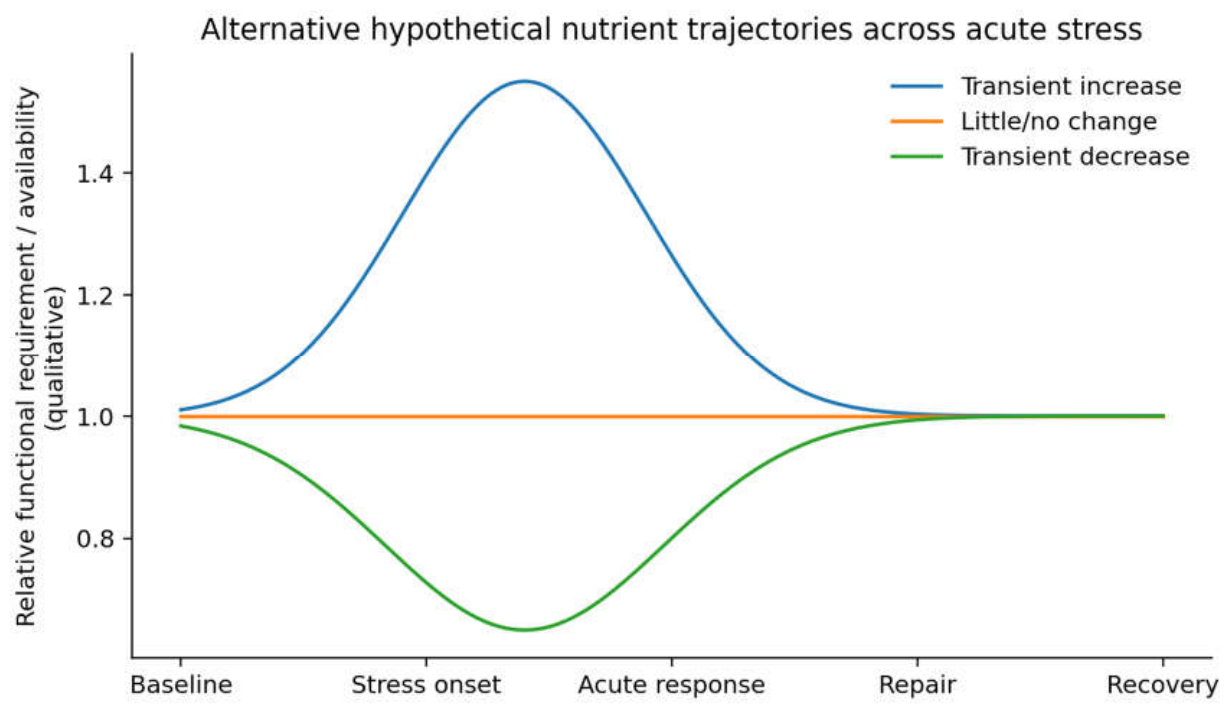

Table 1.
Evidence across acute stress domains. Qualitative descriptors are not formal certainty grades.
Table 1.
Evidence across acute stress domains. Qualitative descriptors are not formal certainty grades.
| Domain | Physiology | Intervention evidence | ASON interpretation |
| Major surgery | Established changes in metabolism and clinical nutritional risk [1]. | Selected formula trials are positive; Cochrane estimates remain uncertain [19,20,21]. | Clinical precedent with population and comparator limits. |
| Dental surgery | Tissue-repair rationale; direct functional nutrient studies remain limited [13,28]. | Mixed vitamin D evidence and a small local calcitriol trial [28,29,30]. | Translational hypothesis, not an established systemic protocol. |
| Trauma and burns | Marked catabolism and, for burns, external losses [2,3,14]. | Glutamine null in severe burns; trauma vitamin C signals have limited certainty [11,31]. | Preserve nutritional support; distinguish nutrient, formulation, and population. |
| Infection and COVID-19 | Illness-related metabolism and concentration changes [4]. | Low-certainty pooled vitamin C benefit; multicenter null/harm findings [22,24,27,32]. | Biological domain with substantial therapeutic caution. |
| MI and ischemic stroke | Energy failure and reperfusion injury have mechanistic support [33]. | No validated ASON regimen is established by this evidence. | Research adjunct only; preserve emergency care. |
| Intense exertion and recovery | Sports nutrition addresses dynamic exposure and recovery [34]. | C/E training study altered cellular markers without clear performance impairment [12]. | Separate recovery, adaptation, and injury. |
| Psychological and neuroendocrine stress | Autonomic and endocrine responses are established [35]. | The cited stress meta-analysis tests no nutrient intervention [35]. | Preliminary extension; no acute dosing indication. |
Table 2.
Selected intervention regimens and outcomes. Doses shown describe published study exposures and are not prescribing recommendations.
Table 2.
Selected intervention regimens and outcomes. Doses shown describe published study exposures and are not prescribing recommendations.
| Study | Population | Dose, route, and timing | Finding and boundary |
| SONVI [19] | Colorectal resection in ERAS; 264 randomized. | Multicomponent formula versus standard supplement; 7 days before and 5 days after surgery. | Fewer infections; hospital stay unchanged. Effect cannot be assigned to one nutrient. |
| RE-ENERGIZE [11] | Severe burns; 1,209 randomized, 1,200 analyzed. | Enteral glutamine 0.5 g/kg/day, within 72 h of admission; until specified recovery/discharge or 3-month limit. | No faster discharge alive; no significant 6-month mortality difference. |
| REDOXS [10] | Ventilated adults with multiorgan failure; 1,223 randomized. | Early IV plus enteral glutamine and/or antioxidants, begun within 24 h of ICU admission. Numeric glutamine dose is not reproduced because a published dosage erratum applies. | No clinical benefit; glutamine increased in-hospital and 6-month mortality. Primary 28-day trend did not meet the trial threshold. |
| CITRIS-ALI [23] | Sepsis with ARDS; 167 randomized. | IV vitamin C 50 mg/kg every 6 h for 96 h versus placebo. | Primary outcomes null; secondary mortality signal was not multiplicity-adjusted. |
| LOVIT [24] | Sepsis on vasopressors; 872 randomized. | IV vitamin C 50 mg/kg every 6 h for up to 96 h versus placebo. | Higher 28-day death/persistent-organ-dysfunction composite. Mortality alone was inconclusive. |
| C-EASIE [27] | Sepsis/septic shock in 8 emergency departments; 300 recruited, 292 analyzed. | IV vitamin C 1.5 g every 6 h for 4 days, started within 6 h of admission. | Primary post-baseline SOFA endpoint null. Early timing did not establish overall benefit. |
| Harmonized COVID trials [32] | Hospitalized adults, with and without critical illness; 2,613 randomized. | IV vitamin C 50 mg/kg every 6 h for 96 h; placebo or no-vitamin-C control by trial. | Low probability of benefit; stopped for futility/harm triggers. No inference to all routes or all infections. |
| VIOLET [26] | Critically ill adults; 1,078 with laboratory-confirmed deficiency in primary analysis. | Single enteral vitamin D3 dose 540,000 IU, early after ICU-admission decision. | No advantage for 90-day mortality; pharmacological bolus is not a universal repletion strategy. |
| Paulsen [12] | Healthy young training participants; 54 randomized. | Vitamin C 1,000 mg/day plus vitamin E 235 mg/day for 11 weeks. | Selected cellular adaptation attenuated; measured performance gains did not clearly differ. |
Disclaimer/Publisher’s Note: The statements, opinions and data contained in all publications are solely those of the individual author(s) and contributor(s) and not of MDPI and/or the editor(s). MDPI and/or the editor(s) disclaim responsibility for any injury to people or property resulting from any ideas, methods, instructions or products referred to in the content. |
© 2026 by the authors. Licensee MDPI, Basel, Switzerland. This article is an open access article distributed under the terms and conditions of the Creative Commons Attribution (CC BY) license (http://creativecommons.org/licenses/by/4.0/).
Copyright: This open access article is published under a Creative Commons CC BY 4.0 license, which permit the free download, distribution, and reuse, provided that the author and preprint are cited in any reuse.