

Submitted:
05 October 2026
Posted:
08 October 2026
You are already at the latest version
Abstract
Formalizing the transition from qualitative, phenomenological neuropsychological observations to quantitative clinical data structures remains a critical bottleneck in computational neuroscience. Existing methods either rely on scalar psychometric screening tools (e.g., MoCA, MMSE) that obscure the modular and network-level topography of cognitive deficits, or utilize stochastic large language models (LLMs) prone to diagnostic hallucination and predicate drift. This paper presents a deterministic expert core architecture that bridges network neuroscience and clinical practice by formalizing A.R. Luria’s theory of systemic-dynamic localization of higher mental functions into a production-rule predicate processor. The system converts an input 10-dimensional integer vector of multi-domain cognitive error scores [0-5] into standardized syndromic profiles using multi-level nested dictionary traversals and automated mapping onto the WHO International Classification of Functioning, Disability and Health (ICF) taxonomy (b, d, and e codes). To ensure morphosyntactic invariance across language localizations, an isolated regular expression inflection module handles gender agreement tags post-traversal. The computational runtime maintains strict algorithmic transparency, enforces cross-domain data integrity filters, and implements a deterministic interrupt for vector singularities, eliminating probabilistic inference and ensuring auditable, reproducible clinical decision-support reporting.
Keywords:
deterministic expert core
; directed acyclic graph (DAG)
; predicate processor
; software architecture
; systemic-dynamic localization
; neuropsychological modeling
; automated ICF coding
; clinical decision-support system (CDSS)
1. Introduction
Formalizing the transition from primary phenomenological symptoms to standardized syndromic models of cognitive deficit remains poorly reproducible in computational neuroscience. Linear screening scales such as the MoCA and MMSE exhibit ceiling effects and rely on aggregate scalar indices that obscure the topographic heterogeneity and modular architecture of cognitive deficits. Applying stochastic generative large language models (LLMs) to clinical reporting risks fabricated data and drift of diagnostic predicates, which conflicts with the requirements of evidence-based medicine.
Network neuroscience describes cognition as the interaction of large-scale brain networks, including the frontoparietal control network (FPCN), the default mode network (DMN), and the dorsal attention network (DAN), whose dynamic interactions change with age and task demands (Avelar-Pereira et al., 2017). Quantitative estimates of network properties also depend on the parcellation atlas applied (Deschwanden et al., 2024). A multi-dimensional topological evaluation of these networks is therefore required to formalize cognitive deficits in focal lesions (acute ischemia, hemorrhage, cortico-subcortical neoplasms), diffuse damage (sequelae of open and closed traumatic brain injury, axonal disconnection), and systemic neurodegenerative processes.
To address the psychometric reductionism of linear scales and the instability of probabilistic models, this paper presents the translation of A. R. Luria's Theory of Systemic-Dynamic Localization of Higher Mental Functions (SDLHMF) into a deterministic software architecture (Mikadze et al., 2019). Luria's syndromic analysis evaluates the qualitative structure of the neurodynamic execution of process-oriented cognitive tasks, which permits identification of the pathophysiological mechanisms underlying disintegration of both local analyzer systems and large-scale associative cerebral networks. Theory-based qualitative assessment remains in clinical use in contexts such as epilepsy surgery (Patrikelis et al., 2023) and underlies the PASS model operationalized in the Das-Naglieri Cognitive Assessment System (McCrea, 2009). Qualitative neuropsychological evaluation has also been applied to cognitive disorders in children after COVID-19 (Troitskaya et al., 2022).
The deterministic expert core (predicate processor) formalizes the transition from primary discrete symptoms to topographically verified syndromes through production rules. This provides algorithmic transparency, invariance, and data reproducibility, which regulatory compliance requires.
The architecture builds on prior validation of neurocognitive profiling scales and patterns of functional-structural dissociation, with acute vascular cohorts as the primary verification model:
- Preprint 1: Algorithmic Multi-Domain Syndromic Profiling in Cerebrovascular Disease: A Deterministic Approach to Post-Stroke Neurocognitive Deficit Mapping (Erzin, 2026 a);
- Preprint 2: Functional-Structural Dissociation in Acute Stroke: Multi-Layered Lurian Syndromic Analysis and Network Hub Disruption (Erzin, 2026 b).
This technical note describes the architecture of a deterministic expert core that implements algorithmic analysis within Luria's paradigm of functional systems, automated syndromic profiling, and verification of phenomenological data integrity.
2. System Architecture Manual
The expert system is organized as a deterministic directed acyclic graph (DAG) of sequential conditional predicates and cascading transformations of hierarchical data structures. The computational core contains no probabilistic approximation or stochastic generation. It executes fixed inference trajectories, with controlled contextual variability confined to the synthesized textual impressions. The framework maps the input code vector invariantly onto a structured syndromic description with automated classification coding across four independent processing levels (Figure 1).
Level 1: Input Vector Parsing and Integrity Verification
At the primary level, the system ingests and parses an incoming alphanumeric code string (code_str) and decomposes it into two independent components:
- Categorical clinical state key (raw_typ): a discrete string identifier defining the baseline nosological and psychopathological profile of the patient (normal variation, organic brain lesion, or endogenous spectrum disorder). During parsing, the system strips linguistic markers of biological sex from the key to ensure invariant linguistic localization across platforms.
-
Deficit index array (s_raw): a 10-dimensional vector of integers on the interval [0-5], in which each position corresponds to a quantified error severity score within one functional domain. The computational core operates on the following independent measurement axes:
- − Selective attention and neurodynamic rate;
- − Modality-specific visual gnosis;
- − Spatial and quasi-spatial gnosis;
- − Kinetic praxis (dynamic organization of movements);
- − Kinesthetic praxis (afferent feedback control);
- − Constructive and visuospatial praxis;
- − Programming of calculation operations;
- − Speech functions (comprehension and production);
- − Memory and mnestic processes (encoding and retrieval);
- − Executive control and conceptual reasoning;
- − +Written language impairment scale (agraphia, facultative axis);
- − +Reading impairment scale (alexia, facultative axis).
Data integrity control and contradiction interception. Because structural validity of the input determines the validity of every downstream inference, the system treats input verification as an explicit stage. The same reasoning underlies the use of DAGs to make assumed dependencies among variables explicit (Dekkers et al., 2024). Before the data reach the logic processor, the system verifies array length. If fewer than 10 axes are passed (or fewer than 12 when the facultative written language scales are included), the vector is zero-padded to the target dimension, which precludes IndexError exceptions.
The algorithm then cross-validates the categorical key against the metric vector to detect latent contradictions. If the input declares a normal or compensated profile, but the maximum penalty on any single axis satisfies >= 3 or the aggregate deficit across all axes satisfies >= 10, the system suppresses the initial key. The vector shifts to the organic computing level, and the baseline clinical status (calc_lvl) is calculated by a non-linear weighted shift formula:
calc_lvl = max(1, min(5, round(max_score * 0.6 + avg_active * 0.4)))
where max_score denotes the peak score of the registered defect and avg_active denotes the arithmetic mean of strictly positive penalty indices. The function constrains the resulting level to the interval [1, 5]. This keeps the expert assessment invariant and prevents true focal pathology from being omitted because of manual data entry errors. Explicit specification of such structural dependencies is also the principal means by which DAGs reduce confounding in applied health research (Tennant et al., 2021).
A separate integrity case is an empty set of active features (the input vector singularity criterion), which arises when the user deactivates all evaluated domains. A dedicated logical interrupt is required to distinguish clinical normality from complete inaccessibility of the cognitive domain. Without this filter, the resulting zero vector of penalty indices would be interpreted as optimal functional preservation and would produce a false impression of clinical normality.
To prevent this error, the system flags the input vector singularity criterion during integrity verification, halts standard execution, terminates predicate traversal, and outputs an unconditional expert conclusion:
"CLINICAL SYNTHESIS & IMPRESSION: Due to the patient's current neurological/somatic status (depression of consciousness, lack of productive contact), a full-scale standardized neurocognitive evaluation is precluded. Clinical context and MSE parameters indicate profound disintegration of mental activity, preventing valid verification of functional deficits via syndromic analysis."
This mechanism separates preserved cognitive status from infeasibility of evaluation and thereby maintains the validity of the output data.
Level 2: Contextual Preset Gating and Domain Mapping
The second level performs non-linear contextual enrichment of the deficit vector and filters out non-specific neurodynamic slowing. Instead of scanning isolated scalar values without constraint, the computational core routes qualitative clinical presets through a fixed lookup table, p_map.
Qualitative phenomenological syndromes (specific forms of aphasia, apraxia, agnosia, agraphia, and alexia) are mapped to anatomical-functional dimensions. Such syndromes include conduction aphasia in left-hemisphere glioma (Buklina et al., 2021) and semantic aphasia, whose functional neuroanatomy was characterized in a case series of ten new patients (Dragoy et al., 2017). Agraphias are rerouted to the written language domain (index 10) and alexias to the reading domain (index 11). This adds specific syndromic structure to baseline symptoms without expanding the dimensionality of the feature space.
The system also incorporates macro-scale network pathogenetic presets (ndyn, msa, ccas, retic) directly into the results preamble, bypassing linear iteration. These presets characterize the integrity of white matter tracts and structural hubs of large-scale brain networks, a level of description supported by evidence that presurgical structural connectivity predicts postsurgical cognitive impairment in glioma (Smolders et al., 2025). Network-level targets are likewise used in individualized neuromodulation, where single-session iTBS modulates functional networks and neural activation (Fan et al., 2026).
Level 3: Production-Rule Predicate Inference Core
The third level is a deterministic logic processor based on hierarchical IF-THEN production rules and predicates. Its sequential conditional structure corresponds to the acyclic graph formulations used in graph-based models of brain functional connectivity (Huang et al., 2022). The system first calculates the local extrema of the deficit profile (the primary peak extraction algorithm). The mean penalty score is computed as avg_s. A domain is designated a primary peak and core cognitive deficit only if both of the following conditions hold: the domain score satisfies >= 3.0, and the score equals or exceeds the mean level shifted by a constant offset of 0.8 (avg_s + 0.8). If the mean score satisfies >= 3.5, local peak identification is suppressed and the profile is classified as generalized systemic collapse.
Inference predicates and cascading triggers follow Luria's paradigm of functional units and compute cross-domain interactions and an integrated deficit profile (Mikadze et al., 2019; McCrea, 2009).
- Functional Unit I (energy regulation subsystem). The control predicate trig1 fires when Unit I pathogenetic presets co-occur with an organic categorical key, or when the attention deficit exceeds 2.0 (or 1.8 in the presence of concurrent memory or language deficits). The computational core executes cross-domain modulation of report severity: when severe depression is confirmed by the Geriatric Depression Scale (GDS > 9), or when peak attentional impairment is detected, the system forces generation of text reflecting heightened severity. This modulation is consistent with evidence that depressive pathology is associated with altered function of the frontoparietal and default mode networks (Wu et al., 2024).
- Functional Unit II (information reception, processing, and storage subsystem). The control predicate trig2 fires when gnosis/praxis presets are detected, or when a deficit threshold of 2.0 is exceeded in any posterior cortical domain (visual, spatial, or somatosensory gnosis; afferent praxis; reading; writing). Spatial deficits of this unit, such as visual neglect, are the subject of Luria-derived rehabilitation approaches (Stepanov et al., 2025). The auditory-verbal memory vector (s_mem) is isolated from the calculation of the Unit II cortical peak (b2_max). If memory impairment occurs in isolation while the gnostic scales remain intact, the memory score is excluded from the cortical collapse metric. The Unit II textual matrix is emitted into the final report only when a genuine operational cortical defect is verified (b2_max > 1), which prevents false topological inferences arising from secondary retrieval failures.
- Functional Unit III (programming, regulation, and verification subsystem). The control predicate trig3 fires when regulatory presets (r-reg, l-reg, apr-dyn, v-frontal, striar) or apathy/adynamia tags are detected, or when the score for executive thinking or dynamic praxis satisfies >= 2.0. The peak deficit score is computed as b3_max. The executive domain is evaluated alongside behavioral dyscontrol, a construct used to differentiate frontotemporal dementia from Alzheimer disease (Alsemari & Malloy, 2021). Its network correlates include cognitive flexibility, which is associated with resting-state network connectivity (Thomas et al., 2023), and cognitive control, which depends on subject-specific frontoparietal networks (Dengler et al., 2024).
Level 4: Multilingual Lexical Aggregation and Dynamic RegEx Inflection
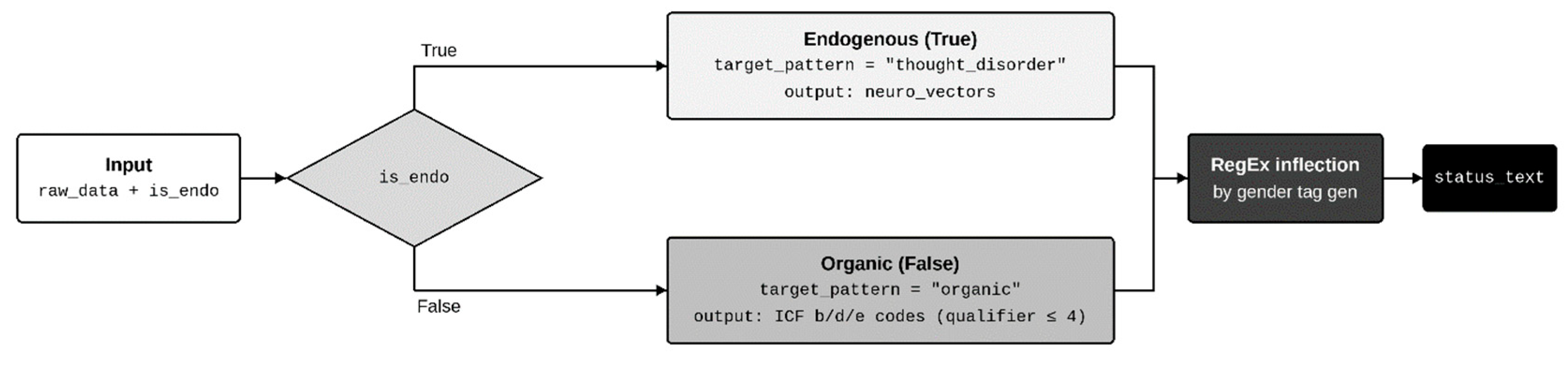
The fourth level performs the final deterministic synthesis of the clinical report from the stabilized array of activated predicates. Instead of a stochastic text generator, the system implements an isolated cascading dictionary traversal across nested dictionaries in a hierarchical library. Symbolic strings are retrieved according to the language localization flag (lang = ru, en, es, pt), and the fragments are concatenated with delimiter strings. To eliminate stylistic errors and ensure grammatical agreement, the synthesized descriptor array is passed to the isolated linguistic runtime of the apply_gender function (Figure 2). In addition to regular expression-based morphosyntactic transformations adapted to the target language (such as inflected agreement of predicate stems in Russian), this module acts as an invariant selective filter for output patterns.
When an endogenous cognitive profile is activated (through the categorical key thought_disorder or target clinical spectrum tags), the algorithm alters the dictionary traversal. The system converts descriptions of the memory, speech, and thought domains into an endogenous modality and maps the input code vector onto neurotransmitter pathways (neuro_vectors) in the final summary. The module characterizes decompensation within mesocortical and mesolimbic dopaminergic pathways and functional dysconnection between operational and motivational cortical nodes. This characterization is consistent with reported altered functional connectivity of cognitive brain networks during working memory tasks in schizophrenia (Godwin et al., 2017) and with the involvement of default mode connectivity and working memory in schizophrenia spectrum disorders (Grot et al., 2026).
This two-component post-processing mechanism preserves the invariance of the DAG expert logic and produces standardized phenotypic descriptors across heterogeneous clinical states.
3. ICF Mapping and Rehabilitation Gating
Automated Mapping of Syndromic Profiles to Hierarchical International Classification of Functioning, Disability and Health (ICF) Codes
To ensure standardization and cross-platform interoperability, the computational core maps the penalty indices of the 10-dimensional vector onto codes of the World Health Organization (WHO) International Classification of Functioning, Disability and Health (ICF). Automated ICF coding has been evaluated with language models applied to rehabilitation notes in low-resource languages (Roitero et al., 2023) and with an artificial intelligence-enhanced mobile application in a randomized controlled trial (Kurban et al., 2025). Automated assignment of classification codes from medical text has also been demonstrated for the International Classification of Diseases (Zhuang et al., 2025). In contrast to these probabilistic approaches, the present system assigns codes by fixed threshold rules. Code generation is threshold-gated: a code is generated only when the deficit magnitude in the corresponding domain strictly exceeds 1 point. The ICF severity qualifier is computed with a saturation function that clamps peak penalty scores at a maximum of 4 (complete impairment), which keeps outputs within WHO normative coding boundaries. Codes are distributed across three independent axes:
-
Body Functions (b-codes). Metric penalties from the core and facultative axes project onto mental function categories:
- −
- Attention maps to b140;
- −
- Visual gnosis maps to b1560;
- −
- Spatial gnosis maps to b1561;
- −
- Kinetic and kinesthetic praxis map to b176;
- −
- Calculation operations map to b172;
- −
- Executive control and thinking map to b164;
- −
- Speech functions map to b167 (agraphia is routed to b16711 [written language] and alexia to b16701 [expression of language through reading]);
- −
- Memory maps to b144.
- Activities and Participation (d-codes). In accordance with the WHO biopsychosocial framework, the system does not assume a linear causal relation between brain tissue damage and social maladaptation. Functional limitation profiles in purposeful communication (d310–d349), complex task execution (d175), and self-care are evaluated as directed covariations coupled to the primary focal cortical defect.
-
Environmental Factors (e-codes). At the final stage, the algorithm matches intervention modules to the preserved cognitive resources identified by the analysis. When pronounced deficits are detected (penalty score >= 3), the system selects environmental support as follows:
- −
- For critical deficiency of Functional Unit I regulatory systems, the algorithm assigns code e250 (specialized environmental design) and formulates recommendations to reduce exogenous stimulation and to limit intensive cognitive training in order to prevent exhaustion.
- −
- For structural disruption of Functional Unit II modular systems, the system assigns code e115 (assistive products and technology for navigation) and instantiates cross-modal compensatory strategies, specifically the substitution of visual tracking for deficient kinesthetic feedback. Technology-assisted rehabilitation, such as robotic-assisted gait training with a lower extremity exoskeleton in stroke patients, represents the assistive-product category to which this code belongs (Wiśniowska-Szurlej et al., 2023).
- −
- For decompensation of Functional Unit III executive systems, the algorithm assigns code e310 (immediate family and social support) and generates recommendations for external cognitive scaffolding, step-by-step action planning, and external behavioral cueing to compensate for disrupted internal programming.
Conclusions
The NeuroDraft architecture implements deterministic, reproducible synthesis of qualitative clinical data. Translating Luria's syndromic analysis into conditional predicates and directed acyclic graphs (DAGs) eliminates the risk of stochastic hallucination inherent to large language models (LLMs). The embedded module apply_gender serves as an invariant morphosyntactic and context processor: it performs regular-expression-based syntactic smoothing during post-processing and selects between endogenous and organic output patterns. The computational core alone computes syndromic structures, penalty indices, WHO qualifiers, and the mapping of code vectors onto large-scale cerebral dopaminergic pathways.
From the standpoint of systems analysis and software boundaries, the framework functions as a deterministic clinical decision-support system (CDSS) for automated structured reporting. The absence of probabilistic inference in the computational core places the platform outside the category of autonomous diagnostic classifiers and ensures that every stage of graph traversal is transparent and auditable. The independence of the predicate logic from language localization, together with the automated mapping of deficit profiles onto International Classification of Functioning (ICF) codes, standardizes the output metrics and facilitates structured health data exchange.
References
- Alsemari, A.; Malloy, P. F. The Behavioral Dyscontrol Scale in the differential diagnosis of behavioral variant of frontotemporal dementia and Alzheimer disease. Clin. Neuropsychol. 2021, 35(3), 633–642. [Google Scholar] [CrossRef]
- Avelar-Pereira, B.; Bäckman, L.; Wåhlin, A.; Nyberg, L.; Salami, A. Age-related differences in dynamic interactions among default mode, frontoparietal control, and dorsal attention networks during resting-state and interference resolution. Front. Aging Neurosci. 9 2017, 152. [Google Scholar] [CrossRef]
- Buklina, S. B.; Zhukov, V. Y.; Goryainov, S. A.; Batalov, A. I.; Afandiev, R. M.; Maryashev, S. A.; Vologdina, Y. O.; Bykanov, A. E. Conduction aphasia in patients with glioma in the left hemisphere. Zhurnal Vopr. Neirokhirurgii Im. N. N. Burdenko 2021, 85(4), 29–40. [Google Scholar] [CrossRef]
- Dekkers, O. M.; Laugesen, K.; Groenwold, R. H. H. Directed acyclic graphs in clinical research. Eur. J. Endocrinol. 2024, 190(4), E5–E7. [Google Scholar] [CrossRef]
- Dengler, J.; Deck, B. L.; Stoll, H.; Fernandez-Nunez, G.; Kelkar, A. S.; Rich, R. R.; Erickson, B. A.; Erani, F.; Faseyitan, O.; Hamilton, H. H.; Medaglia, J. D. Enhancing cognitive control with transcranial magnetic stimulation in subject-specific frontoparietal networks. Cortex 172 2024, 141–158. [Google Scholar] [CrossRef]
- Deschwanden, P. F.; Piñeiro, A. L.; Hotz, I.; Malagurski, B.; Mérillat, S.; Jäncke, L. Influence of atlas-choice on age and time effects in large-scale brain networks in the context of healthy aging. Imaging Neurosci. 2 2024, imag_a_00127. [Google Scholar] [CrossRef]
- Dragoy, O.; Akinina, Y.; Dronkers, N. Toward a functional neuroanatomy of semantic aphasia: A history and ten new cases. Cortex 97 2017, 164–182. [Google Scholar] [CrossRef]
- Erzin, A. I. Algorithmic multi-domain syndromic profiling in cerebrovascular disease: A deterministic approach to post-stroke neurocognitive deficit mapping [Preprint]. medRxiv 2026. [Google Scholar] [CrossRef]
- Erzin, A. I. Functional-Structural Dissociation in Acute Stroke: Multi-Layered Lurian Syndromic Analysis and Network Hub Disruption [Preprint]. In Research Square; 2026. [Google Scholar] [CrossRef]
- Fan, S.; Zhang, J.; Wu, J.; Zang, Y.; Yue, J.; Zhang, X.; Guan, Q.; Luo, Y.; Zhang, J.; Zhang, H. Individualized single-session iTBS modulates functional networks and neural activation to predict cognitive gain. NeuroImage 334 2026, 121968. [Google Scholar] [CrossRef]
- Godwin, D.; Ji, A.; Kandala, S.; Mamah, D. Functional connectivity of cognitive brain networks in schizophrenia during a working memory task. Front. Psychiatry 8 2017, 294. [Google Scholar] [CrossRef]
- Grot, S.; De Benedictis, L.; Bougeard, A.; Albouy, P.; Stip, E.; Potvin, S.; Orban, P. Effect of personalized dorsolateral prefrontal cortex neuromodulation on default mode connectivity and working memory in schizophrenia spectrum disorders. Psychiatry Res. Neuroimaging 356 2026, 112093. [Google Scholar] [CrossRef]
- Huang, S. G.; Xia, J.; Xu, L.; Qiu, A. Spatio-temporal directed acyclic graph learning with attention mechanisms on brain functional time series and connectivity. Med. Image Anal. 77 2022, 102370. [Google Scholar] [CrossRef]
- Kurban, Z.; Khassenov, D.; Burkitbaev, Z.; Bulekbayeva, S.; Chinaliyev, A.; Bakhtiyar, S.; Saparbayev, S.; Sultanaliyev, T.; Zhunissova, U.; Slivkina, N.; Titskaya, E.; Arias, L.; Aldakuatova, D.; Yessenbayeva, G. Artificial intelligence-enhanced mapping of the International Classification of Functioning, Disability and Health via a mobile app: A randomized controlled trial. Front. Public Health 13 2025, 1590401. [Google Scholar] [CrossRef]
- McCrea, S. M. A review and empirical study of the composite scales of the Das-Naglieri Cognitive Assessment System. Psychol. Res. Behav. Manag. 2 2009, 59–79. [Google Scholar] [CrossRef]
- Mikadze, Y. V.; Ardila, A.; Akhutina, T. V. A. R. Luria's approach to neuropsychological assessment and rehabilitation. Arch. Clin. Neuropsychol. 2019, 34(6), 795–802. [Google Scholar] [CrossRef]
- Patrikelis, P.; Messinis, L.; Kimiskidis, V.; Gatzonis, S. Neuropsychology of epilepsy surgery and theory-based practice: An opinion review. Arq. De Neuro-Psiquiatr. 2023, 81(9), 835–843. [Google Scholar] [CrossRef]
- Roitero, B.; Martinuzzi, A.; Armellin, M. T.; Paparella, G.; Maniero, A.; Della Mea, V. Automated ICF coding of rehabilitation notes for low-resource languages via continual training of language models. Stud. Health Technol. Inform. 302 2023, 763–767. [Google Scholar] [CrossRef]
- Smolders, L.; De Baene, W.; Gehring, K.; van der Hofstad, R.; Florack, L.; Rutten, G. J. Presurgical structural connectivity predicts postsurgical cognitive impairment in glioma patients. Brain Commun. 2025, 7(5), fcaf346. [Google Scholar] [CrossRef]
- Stepanov, G.; Terentiy, D.; Propustina, V.; Skvortsov, A.; Kovyazina, M.; Varako, N.; Bukinich, A.; Vasyura, E. Neurorehabilitation of visual neglect: A narrative review of approaches from A. R. Luria to modern clinical protocols. Consort. Psychiatr. 2025, 6(4), 71–81. [Google Scholar] [CrossRef]
- Tennant, P. W. G.; Murray, E. J.; Arnold, K. F.; Berrie, L.; Fox, M. P.; Gadd, S. C.; Harrison, W. J.; Keeble, C.; Ranker, L. R.; Textor, J.; Tomova, G. D.; Gilthorpe, M. S.; Ellison, G. T. H. Use of directed acyclic graphs (DAGs) to identify confounders in applied health research: Review and recommendations. Int. J. Epidemiol. 2021, 50(2), 620–632. [Google Scholar] [CrossRef]
- Thomas, A. S.; Ryan, S. K.; Gilman, J. Resting state network connectivity is associated with cognitive flexibility performance in youth in the Adolescent Brain Cognitive Development Study. Neuropsychol. 191 2023, 108708. [Google Scholar] [CrossRef]
- Troitskaya, L. A.; Plotnikova, I. A.; Avakyan, G. G.; Erokhina, V. A.; Badalyan, O. L.; Muraveva, A. V.; Zelentsova, V. L.; Khodko, O. K.; Safarova, S. T.; Shirokova, E. I.; Rusina, E. A.; Sanina, N. P.; Terentev, K. V.; Rachin, A. P. Neuropsychological evaluation of cognitive disorders in children after COVID-19. Eur. J. Transl. Myol. 2022, 32(3), 10685. [Google Scholar] [CrossRef]
- Wiśniowska-Szurlej, A.; Wołoszyn, N.; Brożonowicz, J.; Ciąpała, G.; Pietryka, K.; Grzegorczyk, J.; Leszczak, J.; Ćwirlej-Sozańska, A.; Sozański, B.; Korczowski, B. Enhanced rehabilitation outcomes of robotic-assisted gait training with EksoNR lower extremity exoskeleton in 19 stroke patients. Med. Sci. Monit. 29 2023, e940511. [Google Scholar] [CrossRef]
- Wu, Y.; Zhang, H.; Shen, Q.; Jiang, X.; Yuan, X.; Li, M.; Chen, M.; Zhou, J.; Cui, J. Exploring the neurocognitive correlates of suicidal ideation in major depressive disorder: The role of frontoparietal and default mode networks. J. Psychiatr. Res. 177 2024, 211–218. [Google Scholar] [CrossRef]
- Zhuang, Y.; Zhang, J.; Li, X.; Liu, C.; Yu, Y.; Dong, W.; He, K. Autonomous International Classification of Diseases coding using pretrained language models and advanced prompt learning techniques: Evaluation of an automated analysis system using medical text. JMIR Med. Inform. 13 2025, e63020. [Google Scholar] [CrossRef]
Figure 1.
Data processing graph and logical architecture of the NeuroDraft deterministic predicate processor.
Figure 1.
Data processing graph and logical architecture of the NeuroDraft deterministic predicate processor.
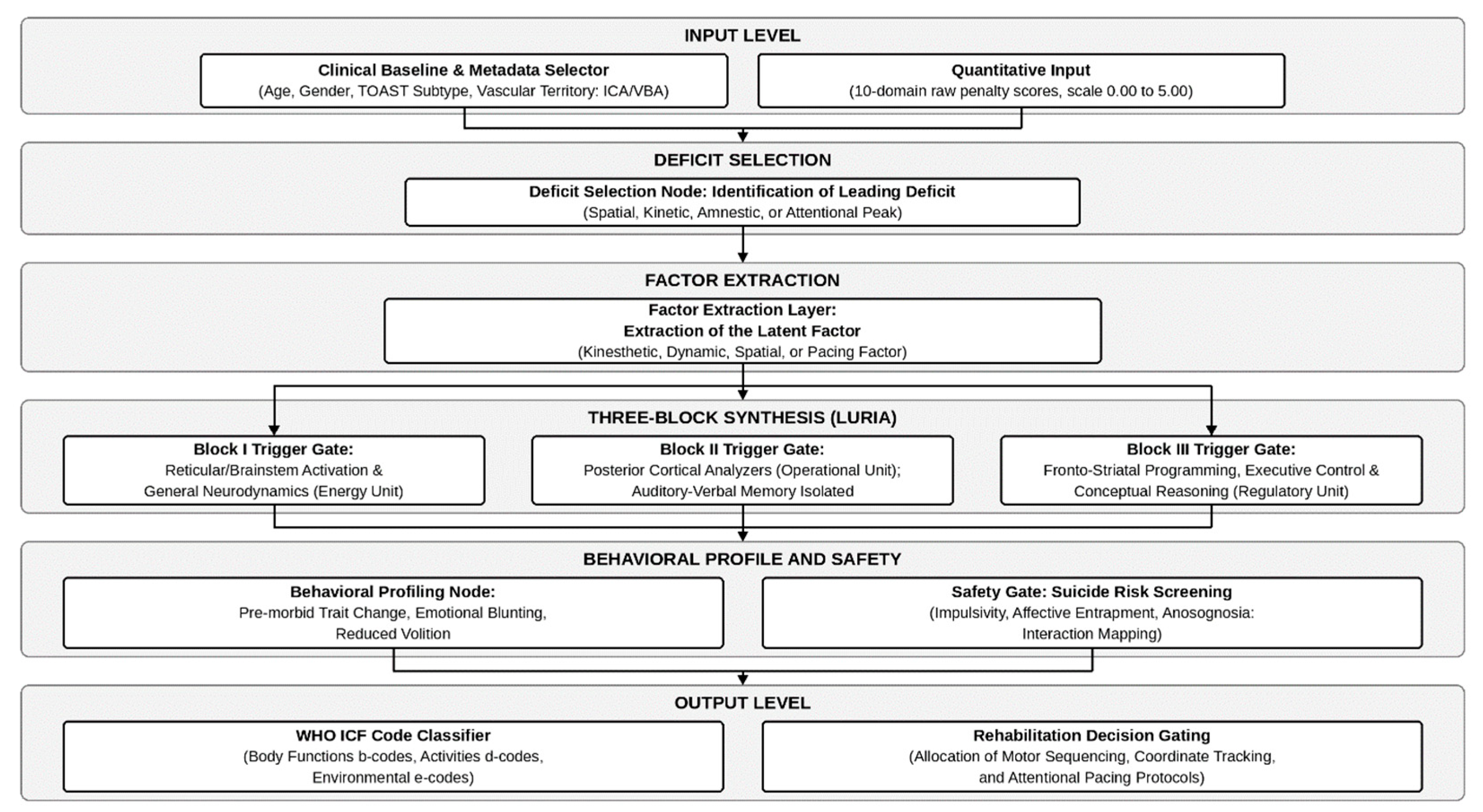
Figure 2.
Control flow and selective routing of the apply_gender post-processing module based on the is_endo categorical flag.
Figure 2.
Control flow and selective routing of the apply_gender post-processing module based on the is_endo categorical flag.
Disclaimer/Publisher’s Note: The statements, opinions and data contained in all publications are solely those of the individual author(s) and contributor(s) and not of MDPI and/or the editor(s). MDPI and/or the editor(s) disclaim responsibility for any injury to people or property resulting from any ideas, methods, instructions or products referred to in the content. |
© 2026 by the authors. Licensee MDPI, Basel, Switzerland. This article is an open access article distributed under the terms and conditions of the Creative Commons Attribution (CC BY) license (http://creativecommons.org/licenses/by/4.0/).
Copyright: This open access article is published under a Creative Commons CC BY 4.0 license, which permit the free download, distribution, and reuse, provided that the author and preprint are cited in any reuse.