

Submitted:
04 October 2026
Posted:
07 October 2026
You are already at the latest version
Abstract
Explanation methods for natural language processing (NLP) come from two literatures that rarely meet: feature attribution and probing for task models, and the interpretability of large language models (LLMs), from chain-of-thought reasoning to sparse autoencoder features and circuit tracing. We place both in a unified taxonomy with four dimensions: scope (local vs. global), mechanism (how the explanation is computed), model access (model-agnostic vs. model-specific), and output form (importance scores, rules, examples, counterfactuals, rationale spans, concepts, natural language). Faithfulness and plausibility come apart, and the erasure tests built for extracted rationales do not apply to a chain of thought, which is an output rather than part of the input, so chains of thought need intervention tests of their own. The access a deployment allows settles which mechanisms are usable before scope or audience matter; our practical decision frameworks start from that question and are traced through three worked deployments. In our synthesis of LLM-era interpretability, a lineage table shows that most current techniques rebuild or extend older ideas under new constraints of scale and access, while two problems are new: keeping reasoning traces monitorable under training pressure, and testing whether models can introspect. Faithfulness metrics disagree with one another, and sparse autoencoders do not yet beat simple baselines on standardized benchmarks, so evaluations should name the tests they ran instead of reporting one score. We also survey applications across healthcare, legal and financial services, social science research, content moderation, and education, and close with six open problems.
Keywords:
explainability
; interpretability
; faithfulness
; large language models
; chain-of-thought
; mechanistic interpretability
1. Introduction
Large language models (LLMs) now draft clinical documentation, review legal and financial documents, and moderate content at platform scale, where an incorrect or biased output can affect a diagnosis, a credit decision, or a person’s ability to take part in online discourse. Regulators have begun to respond. The EU AI Act (Regulation (EU) 2024/1689) is now in force and is phasing in its obligations, several of which bear directly on transparency and human oversight [80]; Section 7 sets out the staging and the amendments that have since revised it.
People use explanations to make decisions with a model’s help [138] and to calibrate how far they trust it [120], and developers use them to find bugs and data artifacts [102]. For an LLM, an explanation can take two forms: an attribution of the output to parts of the input, or the reasoning the model writes before it answers.
1.1. Two Literatures
Explanation methods for NLP grew up in two literatures with their own vocabularies and, to a large extent, their own venues. Saphra and Wiegreffe [220] trace how a separate mechanistic-interpretability community formed alongside the established NLP one; we take the divide as given and ask what translates across it. The first literature explains task models such as fine-tuned classifiers with feature attribution [214,234], probing classifiers [32,112], and extractive rationales [143]. Its evaluation methodology assumes that an explanation is a subset of the input: ERASER scores a rationale by erasing it and measuring how the prediction changes [68]. The second literature studies LLMs, from the faithfulness of chain-of-thought reasoning [142,243] to sparse autoencoder features and circuit tracing [8,45], and much of it appears first in industry reports that are not peer-reviewed. Most surveys sit on one side of the divide. Those that cross it do so as a technical primer [85], by training paradigm [279], or by stakeholder [48], and none works out which faithfulness tests carry across (Section 1.5). A reader who wants to compare a SHAP attribution with a chain of thought, or to know whether ERASER-style tests apply to the latter, therefore has to translate between them. This survey asks four questions. Can one taxonomy place both literatures? Which faithfulness tests carry over to an explanation the model writes itself? Given the access a deployment allows, which methods remain usable? How much of the LLM-era toolbox is new?
1.2. Scope and Contributions
We restrict the survey to NLP, where inputs are sequences of discrete tokens whose meaning depends on context, and we cover methods from other modalities only where they were later imported into NLP (Section 1.3). We make three contributions:
- 1.
- A unified taxonomy: We organize explanation methods for NLP along four dimensions: scope (local vs. global), mechanism (how the explanation is computed), model access (model-agnostic vs. model-specific), and output form (importance scores, rules, examples, counterfactuals, rationale spans, concepts, natural language). The taxonomy places classical attribution methods such as LIME [214] and SHAP [153], attention and representation analysis, and current LLM-oriented techniques in a single framework (Section 3).
- 2.
- Practical decision frameworks: We turn the taxonomy into a decision tree for method selection that starts from model access and then considers scope and audience, with an access table for LLMs and reasoning models, task-specific recommendations for classification, sequence labeling, question answering, and generation, guidance on evaluation protocols and tooling, and three worked examples that trace the framework end to end on concrete deployments (Section 6).
- 3.
- LLM-era interpretability: We set twelve LLM-era techniques against their closest classical counterparts in a lineage table that records what changed between the two and whether each technique rebuilds an older idea, extends it, or has no counterpart (Table 6, Section 4.7). Around the table we synthesize the evidence on chain-of-thought (CoT) faithfulness in reasoning models, self-explanation and introspection, and mechanistic interpretability from sparse autoencoders to circuit tracing (Section 4).
Main findings:
- 1.
- Faithfulness and plausibility come apart, and the erasure tests do not transfer to a chain of thought. Comprehensiveness and sufficiency [68] erase part of the input, and they carry over only where a self-explanation cites input words that can be redacted [162]. A chain of thought is an output, so the intervention moves to the trace itself, truncating it or inserting a mistake into it [142], and asks whether the stated reasoning drives the answer rather than which input tokens do. Chains of thought can rationalize an answer driven by a cue they never mention [54,243], and whether such omissions count as unfaithfulness or as incompleteness is itself disputed [276]. Zhao et al. [279] note that erasure metrics cannot be applied directly to natural language explanations; we separate the cases where erasure still applies from those where it does not, and build both into a minimum evaluation protocol (Section 6.3).
- 2.
- Access settles which mechanisms are usable before scope or audience matter. With open weights every mechanism is available. An API that returns log-probabilities or embeddings supports perturbation and surrogate attribution over those outputs, and a text-only API leaves perturbations that read only the predicted label, such as Anchors [215], and prompting. Reasoning traces narrow the options further: the OpenAI and Anthropic APIs return at most a summary of the trace (Section 2), while an open-weight model makes the trace available for intervention tests. The decision framework therefore starts from access (Figure 2 and Table 10), and the three worked deployments show where access is the binding constraint and where, at platform scale, throughput is (Section 6).
- 3.
- Most LLM-era techniques rebuild or extend older ideas. Of the twelve techniques in the lineage table (Table 6), ten have a classical counterpart: five rebuild an older idea and five extend one. Activation patching applies the intervention of causal mediation analysis [172,252], a lineage that Mueller et al. [189] trace in detail; Faithful CoT [156] repeats the faithful-by-construction design of select-then-predict rationales [143]; and the dispute over chain-of-thought as explanation [24,243,276] has the structure of the attention debate [36,121,261]. Two problems have no classical counterpart: whether a reasoning trace stays monitorable under optimization pressure [21,134], and whether a model has introspective access to its own states [39,149]. Both problems rest partly on industry reports that were not peer-reviewed [21,149], and peer-reviewed work has since qualified each: training only against a monitor of the output can still obfuscate the trace [70], and evidence that models detect tampering with their internal states may reflect generic anomaly detection [229].
- 4.
- Faithfulness metrics disagree, and dictionary features do not yet beat simple baselines. Faithfulness metrics rank methods inconsistently [51], and tests advertised as measuring chain-of-thought faithfulness may measure only output-level self-consistency [202]. On standardized benchmarks (Section 4.4), sparse-autoencoder methods are matched or beaten by linear probes for concept detection [123] and by prompting or finetuning for steering [267], even when features are selected by their effect on the output [10], and sparse autoencoders trained on randomly initialized transformers can earn automated interpretability scores similar to those from trained transformers [109]. Both halves warn against the same shortcut, treating one proxy (a single faithfulness metric, or a feature that looks interpretable) as evidence for the property it stands in for. An evaluation should therefore name the tests it ran and combine at least two that fail in different ways (Section 5).
- 5.
- Explanations raise acceptance of model outputs more reliably than they raise decision quality. In a controlled comparison across several tasks, explanations made people more likely to accept the model’s recommendation, correct or not, without improving team accuracy over showing model confidence alone [22]. The pattern holds for LLM explanations, which raise reliance on incorrect answers as well as correct ones [129] and, when longer, raise users’ confidence without making the answers more accurate [233]. The target is warranted trust, which lets users anticipate when the model is right and when it is wrong [120], so extrinsic evaluation should measure the decisions people make with an explanation (Section 5).
Section 8.1 turns these findings into six open problems.
1.3. Survey Scope and Methodology
This survey is a structured narrative review. Because narrative reviews involve judgment about what to include, we describe our selection process here so that readers can assess its coverage and its limitations.
Corpus construction: We seeded the corpus with prior surveys of XAI and explainable NLP [25,64,101,157,161,279] together with foundational method and evaluation papers [68,118,121,153,214,234]. We then expanded the seed set with searches that crossed three keyword families: explainability terms (explainab*, interpretab*, faithful*), NLP terms (NLP, language model, LLM), and the names of specific methods and constructs (for example attention, saliency, SHAP, probing, chain-of-thought, sparse autoencoder). Searches were run over the ACL Anthology, Semantic Scholar, and the arXiv cs.CL and cs.LG listings. Finally, we performed bidirectional citation snowballing, following both the references of included papers and the later papers citing them, until additional rounds stopped surfacing work that met the inclusion criteria below. The last search was run in September 2026.
Time window: We cover foundational work from roughly 2015 onward, the period in which the shift to deep neural architectures made opacity an acute problem for NLP, and we cite earlier classics where they are needed for context. Coverage of LLM-era interpretability extends through September 2026. The reference list holds 282 works: 182 papers in conference or workshop proceedings, 36 journal articles, one book, and 63 preprints, technical reports, legal texts, software releases and documentation pages; 82 of the 282 date from 2025 or 2026.
Inclusion criteria: A work was included if it fell into at least one of four categories: (i) explanation methods applicable to text and NLP models; (ii) evaluation of explanation quality, including faithfulness, plausibility, and human utility; (iii) applications of NLP with explicit explainability requirements; or (iv) LLM interpretability, including widely cited industry technical reports. We admit this last form of gray literature deliberately: a substantial share of current mechanistic interpretability research first appears, and sometimes only appears, in industry reports, and excluding it would misrepresent the state of the field. Wherever we rely on such reports, we flag that they are not peer-reviewed.
Exclusion criteria: We exclude vision-only XAI work, except for foundational methods that were later imported into NLP, such as layer-wise relevance propagation [20]. We also exclude fairness and bias research that lacks an explicit explanation component, since fairness is a large field in its own right with dedicated surveys.
Coverage claim: We prioritize influential and representative work and do not claim the exhaustive coverage of a PRISMA-style systematic review. Where the literature is too large to cover fully, for instance on probing or attention analysis, we select representative works and point to specialized surveys. How generative AI tools were used in this work, including for literature retrieval, is stated at the end of the article.
1.4. Paper Organization
Section 2, Section 3, Section 4, Section 5 and Section 6 give background, the taxonomy, the LLM-era synthesis with the lineage table, evaluation, and the decision frameworks. Section 7 covers the application domains (healthcare, legal and financial services, social science research, content moderation, and education), Section 8 the six open problems, Section 9 the limitations of this survey, and Section 10 concludes.
1.5. Related Surveys
Several surveys address explainability in machine learning broadly and in NLP specifically. Table 1 compares the most closely related ones with the present survey along the dimensions that structure this paper. Several earlier surveys already classify methods along named dimensions or give evaluation a dedicated treatment, and two mechanistic reviews give explicit procedures for choosing a method. What sets this survey apart is a selection procedure that spans both literatures and is keyed to the access a deployment allows, together with an analysis of which faithfulness tests carry over to explanations the model writes itself.
General XAI surveys: The general surveys in Table 1 classify methods by the problem they solve [101], by complexity, scope and dependence on the model [3], or within a taxonomy oriented toward responsible AI [25]. They give little attention to the discrete, sequential nature of text or to methods specific to language models.
NLP-specific surveys: Early surveys covered explainability and post-hoc methods for neural NLP [64,161]. Lyu et al. [157] then organize the field around faithfulness, asking whether explanations reflect the model’s actual reasoning, and offer the most thorough treatment of faithfulness evaluation among existing surveys. Their property table already scores five method families on time, model accessibility, scope, unit of explanation, and form of explanation, and Madsen et al. [161] cross the form an explanation takes with the information a method needs, so scope, model access, and output form are not new as dimensions. What our taxonomy adds is the extension of these axes to LLM-era methods, with prompting as a mechanism and sparse-autoencoder and circuit methods placed alongside classical attribution (Section 3).
LLM-era surveys: These fall into two groups. Breadth surveys of LLM explainability classify techniques by training paradigm and scope [279], or by local and global analysis together with uses such as model editing [155], and a position paper argues that LLMs shift interpretability from individual predictions toward dataset-level and capability-level understanding [228]. Mechanistic reviews organize inner-interpretability methods by network component [212], by causal nature, learning phase, locality and comprehensiveness from an AI-safety perspective [34], by research task [209], or by the causal mediator a method intervenes on and the search over mediators [189]; Ferrando et al. [85] give a technical primer on decoder-only transformers that runs from input attribution and probing to sparse autoencoders, and Shu et al. [225] cover sparse autoencoders alone. Two of the mechanistic reviews already tell a researcher which method to use. Rai et al. [209] give step-by-step workflows that map a type of study to techniques, and Mueller et al. [189] say which mediators and search methods suit which research goal. Both procedures start from a research question and assume access to the model’s internals; ours starts from the access a deployment allows and also covers perturbation, surrogate and prompting methods. On evaluation, Zhao et al. [279] observe that erasure metrics such as comprehensiveness and sufficiency cannot be applied directly to natural language explanations, the point our first finding develops. Calderon and Reichart [48] come closest to our framing. They classify interpretability paradigms by properties that overlap with our dimensions, among them scope, model access, and how insights are presented, and they use an LLM to annotate thousands of retrieved papers, finding that natural language explanations have spread quickly to fields outside NLP while explanations of internal model components are rarely used there. Their organizing question is which stakeholders each paradigm serves; ours is which faithfulness tests apply to a given explanation and which methods remain usable under the access a deployment allows.
Relation to our prior work: This survey is a companion to our earlier survey of explainable NLP across application domains [178] (preprint arXiv:2502.00837, currently under journal review). That work is organized by application domain and the requirements each imposes. The present survey is organized by method, and it treats evaluation and LLM-era interpretability in greater technical depth, with coverage through September 2026. The two also differ in method: the earlier survey follows a systematic bibliometric review pipeline, whereas this one is a structured narrative synthesis, and the two share no text, tables, or figures. Where the domain discussion in Section 7 overlaps with the earlier survey, we summarize and refer readers there.
2. Background
This section fixes terms and the two distinctions from general XAI, scope and model access, that the taxonomy in Section 3 extends, and then traces what an explanation attaches to as NLP models changed.
2.1. Terms and Classic Distinctions
An explanation is faithful to the extent that it accurately represents the reasoning process behind a model’s prediction, and plausible to the extent that people find it convincing [118]. The two can come apart: a model trained on human-written explanations can produce plausible ones with no guarantee that they are faithful [118], and much of this survey concerns that gap. The term interpretability has no settled meaning: the literature offers diverse motivations for it and many notions of what makes a model interpretable [152]. We use it interchangeably with explainability.
Explanations also differ in when they are produced relative to training [25]. A directly interpretable model, such as a linear model or a small decision tree, needs no separate explanation: the computation is the explanation, so it is faithful by construction. Post-hoc methods are applied after training and can treat the model as a black box, for instance by attributing a prediction to input features [153] or by fitting a simpler surrogate model [26,236]. Rudin [219] argues that high-stakes decisions should use an interpretable model in place of a post-hoc explanation of a black box, since on structured data carefully designed interpretable models often rival black-box accuracy. NLP has a counterpart: a select-then-predict model whose classifier sees only the rationale its extractor selected came close to a full-text model on several classification tasks while reading 10–30% of the input [122]. Our taxonomy has no separate timing dimension; direct interpretability appears there as the intrinsic value of the mechanism dimension (Table 2).
Explanation methods are commonly classified by scope and by model access [3]. A local explanation accounts for one prediction (“Why did the model make this specific prediction?”) and a global explanation for the model’s behavior across inputs (“How does the model generally work?”); local explanations can be aggregated into a global picture [154]. Model-agnostic methods such as LIME [214] and KernelSHAP [153] need only query access to the model, while model-specific methods use its internals, as DeepLIFT [224] and Layer-wise Relevance Propagation (LRP) [20] do for neural networks and attention visualization does for transformers. In deployment, access comes in three levels: open weights expose gradients and activations, some APIs return log-probabilities or embeddings along with the generated text, and a text-only API returns the output alone (Section 6). Section 3 keeps scope and model access and adds two dimensions, the mechanism by which an explanation is computed and the output form it takes.
2.2. From Linear Classifiers to Reasoning Models
Each shift in NLP architecture changed what an explanation most naturally attaches to. Linear classifiers over engineered features [114,278] could be read through their feature weights. Distributed representations, from word embeddings [174] and recurrent networks [75] to pre-trained transformers [67,250], took that reading away, and explanation moved in two directions: outward to the input tokens, which attribution scores weight and rationales select, and inward to the hidden states, which probing classifiers and later dictionary features decode. Attention weights seemed to offer a shortcut between the two, but reading them as importance scores remains contested (Section 4.6). LLMs, which learn new tasks from examples in the prompt [46], added a fourth unit: text the model writes about its own answer. None of these units displaced the earlier ones, and the output forms of Section 3 cover all four.
Reasoning models such as o1 [198] and DeepSeek-R1 [65], trained with large-scale reinforcement learning to write long chains of thought before answering, make the trace an obvious interface for interpretation, but whether anyone outside the developer can read it depends on the deployment. Open-weight reasoning models such as DeepSeek-R1 and gpt-oss return the full trace [199]. The OpenAI, Anthropic and Google APIs return at most a summary of the reasoning, in one case written by a separate model, and unless asked for the summary some return only the answer [9,98,200]. Whether a trace reflects the computation that produced the answer is the question Section 4 takes up, and the tests that intervene on the trace (Section 5.2) need the raw trace.
3. A Unified Taxonomy of Explainable NLP
This section presents a unified taxonomy of explanation methods for NLP, organized along four dimensions: scope, mechanism, model access, and output form. Figure 1 places the methods on the first two.
3.1. Taxonomy Framework
We classify explanation methods along four dimensions. The first dimension is scope, distinguishing between local explanations for single predictions and global explanations that characterize model-wide behavior. The second dimension is mechanism, which describes how the explanation is computed and takes seven values. Perturbation methods query the model with modified inputs (through occlusion, erasure, sampling-based feature removal, or counterfactual search) and read importance off the resulting output changes. Gradient/propagation methods backpropagate signals from the output through the model’s weights, as in vanilla gradients, Integrated Gradients, or Layer-wise Relevance Propagation. Surrogate methods fit an interpretable proxy model, either locally around one prediction (as in LIME) or globally via distillation. Internal inspection methods read internal states such as attention weights, hidden representations, probe outputs, or learned dictionary features without modifying the model. Intervention methods ablate or patch model components and measure the behavioral consequences, as in head pruning, layer ablation, and activation patching. Prompting-based methods elicit an explanation from the model itself in natural language, as in chain-of-thought prompting and self-explanation. Finally, intrinsic methods build the explanation into the model itself, so that the forward computation produces it, as in select-then-predict rationale architectures, concept bottleneck models, and weight-sparse transformers. The third dimension is model access, separating model-agnostic methods that work with any model from model-specific methods designed for particular architectures. The fourth dimension is output form, categorizing methods by whether they produce importance scores, rules, examples, counterfactuals, rationale spans, concepts, or natural language. Rationale spans differ from importance scores in being a hard selection: a subset of the input is designated as the evidence and the rest is discarded, where an importance score weights every token.
The dimensions are not independent. Gradient/propagation, internal inspection and intervention need weights or activations and are model-specific, as are most intrinsic methods, which need a model trained for the purpose (Faithful CoT, built by prompting, is the exception). Perturbation, surrogate and prompting need only queries, and SHAP is agnostic or specific depending on the estimator [153]. Access is thus largely implied by mechanism, which is why the decision frameworks of Section 6 ask about it first. Query access comes in grades: an API that returns scores or token log-probabilities lets a perturbation method measure a change in probability, and one that returns labels only, a change in label.
Table 2 classifies prominent explanation methods by scope and mechanism. Most methods occupy a single cell, although some span categories: SHAP values can be aggregated from local to global scope, and activation patching supports both single-prediction and model-wide analyses.
3.2. Local Explanation Methods
Attribution by perturbation, gradient/propagation and surrogate. These mechanisms all score input tokens and differ mainly in how they realize a token’s absence. Occlusion deletes or masks the token [145]; LIME fits a linear surrogate to predictions on copies of the input with words masked [214]; SHAP averages a token’s effect over coalitions of the other tokens, and its common KernelSHAP estimator is itself a weighted linear surrogate fitted to such samples [153]. Integrated Gradients [234] and DeepLIFT [224] measure change against a baseline input or reference activations. Integrated Gradients accumulates gradients along the path from the baseline, so a token keeps its credit where the output has flattened, and its attributions sum to the output difference between input and baseline. Vanilla gradients [227] and SmoothGrad [230] use no reference and measure local sensitivity, and LRP redistributes the output backward under a conservation rule [16,20]. Methods that define absence differently need not agree. On an LSTM news classifier six attribution methods disagreed on every metric tested, and data scientists often resolved such disagreements with ad hoc heuristics [136]. For moderately rich model classes, neural networks among them, complete and linear methods such as Integrated Gradients and SHAP can provably fail to beat random guessing at inferring model behavior [38]. Deletion and masking also create inputs unlike the training data (Section 5).
Attribution for generation. For a generative model the target comes first: one next-token probability, the difference between a token and a named alternative, or a whole generated statement. Contrastive targets verify grammatical phenomena better than plain attribution and help people simulate the model’s contrastive decisions [273]. Classical mechanisms have been rebuilt for this setting. AttnLRP extends relevance propagation to attention layers and attributes LLaMa 2 and Mixtral 8x7b outputs at about the cost of one backward pass [2]. ContextCite fits a sparse linear surrogate to context ablations and so attributes a generated statement to the sources the model relied on [57], which matters because a cited source can support a statement without having been used [256].
Perturbation with discrete outputs. An anchor is a set of words that keeps the prediction fixed with high precision under the method’s perturbation distribution, chosen for coverage, the probability that it applies to a sample from that distribution; in a user study, anchors let people predict the model on unseen instances with higher precision than linear explanations did [215]. A counterfactual is a minimal edit that changes the prediction [270], the contrastive form human explanations take [176]. MiCE searches for minimal, fluent edits guided by the model’s gradients and is model-specific [218], while Polyjuice needs only queries to the explained model [263]. Generation is now often delegated to an LLM prompted to change one concept while holding the others fixed [92], the device Matton et al. [168] use to test self-explanations (Section 5.2). An LLM asked for a counterfactual of its own prediction often writes one on which its prediction does not change as claimed [66]. Human-authored counterfactuals also serve as training data that reduces reliance on spurious cues [127].
Attribution to training data. Influence functions estimate the effect of removing one training example without retraining. The derivation assumes a convex loss, though Koh and Liang [130] found the approximation informative where that theory breaks down. Scaling to models of up to 52 billion parameters with an EK-FAC approximation, Grosse et al. [99] note that for neural networks the estimates match poorly the counterfactual that motivated them, and treat them as approximating a more local quantity, the proximal Bregman response function. Representer points [272] are a cheaper alternative.
Internal inspection and intervention. Whether raw attention weights track importance is disputed [121,261]; context-mixing measures such as ALTI [84], which account for value vectors and the residual stream, are the better default (Section 4.6), and value zeroing makes the question an intervention by ablating a token’s value vector [185]. Other local readings decode each layer’s hidden state into the vocabulary [33], treat feed-forward layers as key-value memories [94], or track hidden units and gates in recurrent networks [124]. Prompting-based explanations are local by nature and are treated in Section 4.1 and Section 4.2.
Intrinsic. Select-then-predict architectures choose a short subset of the input and classify from it alone, so the selected tokens are the only evidence the classifier sees [143]. Differentiable relaxations later replaced the reinforcement-learning selector and allow control over rationale length [27], and a fully discrete two-stage pipeline retains competitive accuracy [122]. Concept bottleneck models predict human-specified concepts as an intermediate layer and the label from those alone, so a concept can be intervened on at test time [131]. In both designs the guarantee covers only the second stage. The selector or concept predictor is itself unexplained, and a selector can encode the predicted label in which tokens it selects, a Trojan explanation that the usual definition of faithfulness does not rule out [119], so its rationales still need the checks of Section 5. Weight-sparse transformers instead train most weights to zero so that the circuit for a task can be pruned out and read, trading capability for interpretability [90].
3.3. Global Explanation Methods
Several global methods aggregate local ones. Local attributions can be combined into a picture of global structure [154], but the aggregate inherits the disagreement among the methods it is built from, and corpus-level attention statistics describe what heads attend to [56] without measuring importance.
Surrogate. Model distillation trains an interpretable student, such as a decision tree or rule set, to mimic the black-box teacher [26,236]. It explains the teacher only as far as the two agree, so that fidelity has to be measured [141].
Concepts. Concept methods differ in who names the concept and whether its use is tested. TCAV defines a concept by examples a researcher chooses and measures a prediction’s directional sensitivity to it [128]. A probe defines it by an annotated label set and tests only whether it can be decoded [32,112]. A concept bottleneck trains it as a supervised layer, so intervening on it changes the prediction [131]. Sparse autoencoders learn a dictionary without labels, which removes the researcher’s choice but leaves naming to post hoc description (Section 4.4). For detection, supervised baselines still match or beat SAE features [123,267].
Probing. Probe accuracy conflates what a representation encodes with what the probe can learn, which control tasks calibrate against a random-label baseline [111]. Results are most informative as a profile across depth, as when the stages of the classical NLP pipeline emerge in rough order across the layers of BERT [217,238]. Amnesic probing adds a test of use: it removes a property from the representation and measures the change in predictions, and finds that probe accuracy does not track how much the task relies on the property [72]. Belinkov [31] reviews these critiques.
Intervention. These methods remove or replace a component and observe the effect, from head pruning [173,253] and causal mediation analysis [252] to activation patching [172,277] and circuit discovery [60,257] (Section 4.3). Their evidence is causal for the component intervened on. Attribution graphs are a partial exception: they are computed on a replacement model built from cross-layer transcoders, whose mechanisms need not match the original’s [8] (Section 4.4).
One gap recurs across these families: finding information in a component does not show that the model uses it there. Probes decode properties, such as phrase boundaries in BERT’s last layer, that its word predictions do not use from that layer [72]; where causal tracing localizes a fact gives no insight into which layer is best to edit [108]; the knowledge-neuron account of factual recall [63] is at best an oversimplification [194]; and very different attention distributions can yield the same prediction [121]. Intervention closes the gap only for the component it acts on.
3.4. What Each Mechanism Can Establish
Table 3 compares the seven mechanisms on access, cost, the claim each supports, and a documented failure. Perturbation, gradient/propagation and surrogate methods establish how the output responds to the input. Internal inspection establishes what a representation contains and intervention that a component matters; only these two support claims about the model’s internal states, and both need activations. A prompted explanation is a self-report whose relation to the computation must be tested separately (Section 5.2), and intrinsic methods pay a training run for an explanation that is part of the computation. Because the failures differ from row to row, tests drawn from two rows can check each other, the reasoning behind the minimum of two tests that fail in different ways (Section 6.3).
3.5. Summary of Methods
Table 4 places key methods, classical and LLM-era, along all four dimensions, with a practical note on each.
Output form decides which faithfulness test applies at all (Table 5). Erasure presupposes an explanation that picks out part of the input, as importance scores, rationale spans and anchors do; examples, concepts and natural-language text each need a test of their own, which is why the erasure tests do not transfer to a chain of thought (Section 5.2).
4. LLM-Era Interpretability
Large language models present interpretability challenges and opportunities that differ from earlier neural paradigms. Their scale and, for many, their API-only availability close off methods that presuppose gradients or activations, while their fluency opens a route no earlier model offered: the model can be asked to explain itself in language.
This section follows that split. Section 4.1 and Section 4.2 cover what the model says about its own reasoning, through chain-of-thought and self-explanation, and what is known about whether those accounts are faithful. Section 4.3 and Section 4.4 cover what can be read off the weights and activations, from circuits and superposition through sparse dictionary learning and circuit tracing, and Section 4.5 checks the first kind of evidence against the second. Section 4.6 asks whether the attention-explanation debate, conducted on encoders, carries over to LLMs, and Section 4.7 sets each technique against its classical counterpart. In the taxonomy of Section 3, the first group is prompting-based. The second spans internal inspection, intervention, surrogate replacement models and intrinsically sparse architectures, all of which need weights or activations, so the access a deployment allows usually decides which group is available at all.
4.1. Chain-of-Thought Prompting
Chain-of-thought (CoT) prompting has a model write intermediate steps before its answer [132,259]. The trace is at once an explanation and part of the computation, so its faithfulness is the question of whether the answer depends on the trace in the way the text says. Reasoning models trained with reinforcement learning to write long traces [65,198] made the trace the default interface, though not always a visible one. Whoever runs an open-weight model such as DeepSeek-R1 sees every token of its trace. OpenAI’s o1 instead shows ChatGPT users a summary written by a separate summarizer model, and the external evaluator Apollo Research worked without its hidden trace [198]. A summary is itself a generated account of the trace, and the tests that truncate or edit a trace (Section 5.2) need one that can be edited and fed back, so behind such an interface trace-level faithfulness tests are out of reach. Access thus decides which faithfulness tests are possible, as it decides which explanation methods are (Section 6).
Measured CoT faithfulness is not a fixed property of chain of thought. It moves with the test, the training regime, the scale of the model and the token budget. Early evidence came from planted cues: when the few-shot answers in a prompt were reordered so that the correct option was always the same letter, models followed the bias and wrote explanations that justified the biased answer without mentioning the reordering [243]. On tests of this kind, reasoning models reveal a hint they used in at least 1% of cases for most settings, but often in fewer than 20%, and outcome-based reinforcement learning raises the rate at first and then plateaus [54]. Reasoning training still helps: for one such cue, DeepSeek-R1 describes the cue’s influence 59% of the time against 7% for the non-reasoning DeepSeek model, in a workshop paper [55]. Without any planted cue, asking a model whether X is bigger than Y and then whether Y is bigger than X exposes implicit post-hoc rationalization at rates of up to 13% for production models, 0.37% for DeepSeek-R1 and 0.04% for Claude 3.7 Sonnet with thinking [11]. On soft-reasoning tasks, models distilled from a reasoning model often revise their initial answer as the trace unfolds, while instruction-tuned and RL-trained reasoning models do so far less often; the instruction-tuned models’ traces often justify an answer already reached, and the reasoning models show mixed dynamics [144]. Scale cuts the other way: in the intervention tests of Section 5.2, larger and more capable models produce less faithful reasoning on most tasks [142]. When the token budget is raised, hint verbalization reaches 90% in some settings, which suggests that much apparent unfaithfulness comes from tight token limits [276].
Part of the disagreement is over what the tests measure. A planted-cue test asks whether the trace mentions a cause of the answer, and not whether that cause acts through the trace. Zaman and Srivastava [276] argue that the first criterion confuses unfaithfulness with the incompleteness of any linear account of a distributed computation. In some models more than half of the chains it flags are judged faithful by other metrics, and causal mediation analysis shows that hints the trace never names can still change the prediction through it. Resampling studies agree: a hint that affects the answer without being mentioned exerts a subtle, cumulative influence on the trace that persists even after the hint is removed [158]. A trace can therefore carry an influence while leaving it unstated, and so read as a complete account when it is not. Faithful CoT closes the gap for tasks that can be written as a program: the model translates the query into a symbolic chain that a deterministic solver executes, so the chain fixes the answer [156].
Monitorability, whether a reader of the trace can catch misbehavior, is a different property from faithfulness. The evidence so far turns on two conditions, whether the task needs the trace [54,76] and whether training optimizes against a monitor that reads it [21,100]. All four studies come from frontier laboratories, and only the monitorability evaluation suite [100] has been peer-reviewed; Problem 4 (Section 8.1) treats the evidence in full.
Analysis of the trace itself has begun to borrow from attribution. Thought anchors are found by resampling each sentence of a trace and measuring how the distribution of final answers shifts, which is occlusion moved from input tokens to generated sentences; the sentences with outsized influence are mostly planning and uncertainty management [42]. A model defines a distribution over traces, which self-consistency decoding already exploits by sampling several [258]. A single trace therefore supports few causal claims (Section 5.2). All of these tests assume that the reasoning is in the text. Models can be trained to reason in continuous latent states that are never decoded into words [106], and transformers given dense supervision can use meaningless filler tokens in place of a chain of thought to solve two hard algorithmic tasks they cannot solve without intermediate tokens [206]. Where reasoning moves into such channels, the trace stops being evidence of how the answer was reached.
4.2. Self-Explanation and Introspection
A model can also be asked after the fact why it answered as it did. Such self-explanations may be post-hoc rationalizations [271], and a preprint finds that they can read as convincing while diverging from the features that drive the prediction [5]. The tests that carry over from erasure feed the explanation back to the model. Madsen et al. [162] redact the words a self-explanation calls important, or apply the counterfactual it proposes, and find that faithfulness depends on the explanation type, the model and the task. Self-generated counterfactuals fail in a more basic way: models sometimes cannot produce one, and when they do, their prediction on it often disagrees with their own counterfactual reasoning [66]. Self-critique has the same limit. Models improve their code by explaining it and reading its execution results [52], but without such an external signal they often fail to correct their reasoning and can revise correct answers into wrong ones [115]. In both cases the evidence supports trusting the model’s account of itself only where something outside the model checks it.
Whether models have privileged access to their own states is now tested directly, and the answer depends on the design. Positive results come from setups that train or perturb the model. Models finetuned to predict properties of their own behavior outperform a stronger model trained on the same behavior, though only on simple tasks [39], and models finetuned on examples of a policy that are never described as such can state the policy [35]. When concepts are injected into its activations, Claude Opus 4.1 reports the injected thought on about 20% of trials at the best layer and strength, according to an industry report [149]. A peer-reviewed follow-up on open-weight models finds that detection holds across prompts and dialogue formats, at moderate rates with no false positives, traces it to a circuit that emerges in post-training, and finds the capacity under-elicited: ablating refusal directions in Gemma 3 27B raises detection from 10.8% to 63.8%, while false positives rise from 0% to 7.3% [159]. Designs with a stricter control find no evidence of privileged access. Across 21 open models, prompted grammaticality judgments and word predictions track a model’s own string probabilities no better than the prompted responses of a model with nearly identical knowledge do [232]. Singh et al. [229] require that an introspection test not be solvable from the input and that it separate second-order from first-order accounts. On that standard, input-only classifiers match a model’s predictions of labels derived from its own hidden states, and models cannot reliably tell an intervention on their states from a manipulation of their input. Both accounts of the injection result thus place it in a detector of anomalous internal states: Macar et al. [159] call that detector mechanistically nontrivial, and Singh et al. [229] call it generic anomaly detection. For linguistic work, the consequence is that a model’s prompted judgments should not be conflated with the generalizations its string probabilities show [232].
4.3. Mechanistic Interpretability
Mechanistic interpretability aims to understand models at the level of individual components, including neurons, attention heads, and circuits. The label is used loosely in current work, having broadened from its original sense of reverse-engineering algorithms out of weights into a general banner for internal analysis; readers comparing claims across papers should check which sense is intended [220].
The circuits agenda [196] takes features and the weighted connections between them as the unit of analysis. In transformer language models its best-known results are induction heads, which implement a match-and-copy pattern and for which there is preliminary evidence that they underlie most in-context learning [73,197], and hand-analyzed circuits in GPT-2 small for indirect object identification (IOI) [257] and numerical greater-than comparison [103]. ACDC automates the search by pruning a computational graph to the subgraph responsible for a behavior [60], and Boundless Distributed Alignment Search works top-down, aligning the representations of the instruction-tuned Alpaca model with the variables of an interpretable causal model [265]. The causal machinery predates the circuits vocabulary: causal mediation analysis was already measuring how much specific neurons and heads mediate gender bias [252].
A circuit claim is validated much as a rationale is. Wang et al. [257] require a circuit to be faithful (on its own it performs the task about as well as the full model), complete (it and the full model stay similar when any subset of its components is knocked out) and minimal. Faithfulness and completeness are the counterparts of sufficiency and comprehensiveness, moved from input tokens to model components, and the IOI circuit shows why both are needed: it recovers 87% of the full model’s logit difference, yet a greedy search found knockout sets under which circuit and model diverge by as much as 87% of the original logit difference. Three failure modes recur across circuit studies. The choice of corruption and metric can decide the result [277], which is the out-of-distribution problem of erasure moved inside the model. Overlap with a reference circuit does not establish faithfulness, since two discovery methods can both overlap heavily with a circuit found by intervention and still differ in faithfulness [104]. Nor need the explanation be unique: on small networks where every candidate can be enumerated, several circuits reproduce the same behavior and one circuit admits several interpretations [171], the circuit-level form of the finding that different attention distributions can yield the same prediction [121]. Knowledge localization shows a related gap. Causal tracing locates some factual associations in transformer weights where they can be edited [172], and their recall can be followed from subject representations to the answer [95], but where tracing localizes a fact does not reliably predict where editing it succeeds [108]. Section 5.3 discusses how such internal explanations can be evaluated.
A central obstacle for this agenda is superposition: models may represent more features than they have dimensions, with features sharing neurons through approximately orthogonal directions, so that one neuron responds to several unrelated features [74].
A parallel line of work asks what the residual stream represents. Sequence models trained on board games develop representations of board state that can be read out and causally edited [146], truth-like directions can be recovered from hidden states without supervision [47], and many high-level concepts are encoded as linear directions [203]. Such directions can also be acted on. Adding a contrastively derived vector at inference time steers behavior along a concept [216], function vectors carry a compact task representation across contexts [241], representation engineering reads and steers concepts in population-level activations [282], and a single direction mediates refusal across chat models, so that ablating it suppresses refusals and adding it induces them on harmless prompts [12]. Removing a concept by projecting out a direction is an older idea: debiasing identified a gender direction in word embeddings and removed it [43], and iterative nullspace projection repeatedly trains a linear classifier for a property and projects the representations onto its null space [213]. Two caveats limit the linear picture. The objective behind unsupervised truth directions is satisfied by arbitrary features, so such methods tend to find whatever feature is most prominent [82], a result reported in a preprint, and some features are irreducibly multi-dimensional, such as the circular representations of days and months used in modular arithmetic [77].
Language models can also write the descriptions. Bills et al. [37], in an industry report, had GPT-4 describe what individual neurons of GPT-2 XL respond to, at a scale hand inspection cannot reach. A score for such a description measures how plausible the label is. Tested both observationally and by intervention, even the most confident of those descriptions had high error rates and little or no causal efficacy [116], and the same kind of automated score applied to dictionary features fails a random-model baseline (Section 4.4).
4.4. Sparse Autoencoders and Circuit Tracing
Sparse autoencoders (SAEs) address superposition by rewriting each activation vector as a sparse combination of features from a learned, overcomplete dictionary. The method was first shown on the MLP of a one-layer transformer [45] and, by Huben et al. [117],1 on the residual stream of Pythia models, where its features scored as more interpretable under automated scoring than PCA or ICA directions. It was then scaled to millions of features from Claude 3 Sonnet [237] and, with k-sparse (TopK) autoencoders, to a 16-million-latent dictionary on GPT-4 activations [89]. JumpReLU SAEs improve reconstruction at a given sparsity [210], the Gemma Scope release made hundreds of them public for the Gemma 2 models [147], and crosscoders learn one dictionary across layers or across models [150]. Several of these results appeared as industry reports without peer review [45,150,237].
Whether a dictionary feature explains the model is the faithfulness-plausibility question again. An automated interpretability score measures how plausible a feature’s label is, while reconstruction of the model’s behavior, stability across training runs and comparison with a random-model baseline test whether the decomposition belongs to the model. The two kinds of evidence come apart. SAEs trained on randomly initialized transformers often reach automated-interpretability and reconstruction scores similar to those of SAEs trained on the real models [109], and SAEs that differ only in their random seed share only 30% of their features in a 131K-latent dictionary on a Llama 3 8B layer, with TopK SAEs more seed-dependent than ReLU ones [204]. Paulo and Belrose [204] therefore read an SAE as one useful decomposition of activation space among several.
Where a supervised baseline exists, dictionary features have not beaten it. SAE-based probes do not consistently outperform probes on the raw activations under data scarcity, class imbalance, label noise or covariate shift [123]. On AxBench, prompting and then finetuning lead for steering and representation-based methods such as difference-in-means lead for concept detection, with SAEs competitive on neither [267], and SAEBench finds that gains on proxy metrics do not reliably carry over to practical tasks [125]. Choosing features by their effect on the output, instead of by the inputs that activate them, improves SAE steering two- to threefold and makes it competitive with the representation-based methods, though prompting still scores about twice as high on the same benchmark [10]. Where no labels exist the case is stronger but thinner. Sparse feature circuits let a human ablate the features judged irrelevant to a task and so improve a classifier’s generalization [165]. In a blind auditing game, three of four teams found an objective deliberately trained into a model, using SAEs alongside behavioral attacks and training-data analysis [166]. When the game was rerun with automated auditing agents, SAEs trained on generic data did not reliably improve win rates in any configuration, while a natural-language autoencoder that maps activations to text raised them, both for agents without training-data access and for agents with full access [88]; both reports come from one industry laboratory. Benchmarking now reaches beyond SAEs to circuit and causal-variable localization [188]. On this evidence, dictionaries currently generate hypotheses about a model and do not yet measure it; Problem 5 (Section 8.1) asks on which tasks that could change.
Dictionary features become explanations of behavior when they are connected into computations. Transcoders replace an MLP layer with a sparse approximation of its input-output function [71], sparse feature circuits connect SAE features into causal graphs for a behavior [165], and attribution graphs built on cross-layer transcoders trace the steps by which a model produces one output [8]. Applied to Claude 3.5 Haiku, attribution graphs exposed mechanisms for multi-step reasoning, planning ahead in poetry, multilingual processing, hallucination and refusal [151]. In the terms of Section 3, an attribution graph explains a surrogate: a replacement model trained to mimic the MLPs, read by linear attribution and checked by intervention. Its faithfulness is therefore a fidelity question of the kind LIME raises, and its error nodes measure the part of each MLP output the replacement leaves unexplained. Its authors list the limits. Attention patterns are taken as given, so the graphs do not show why information moves between positions; the replacement may use different mechanisms from the model; and the graphs gave satisfying insight on about a quarter of the prompts tried [8,151]. Both are industry reports, and an open-source library for building such graphs on open-weight models has been tested on models of up to 14B parameters [105]. The neuron basis is a baseline here as well: MLP neurons turn out to be as sparse a basis as SAE features, and gradient-based tracing on neurons finds a circuit of about a hundred neurons that controls subject-verb agreement [14].
4.5. Checking What a Model Says Against What It Computes
The two halves of this section meet where a self-report can be checked against the computation, and only methods with access to internals can make that check. Their verdicts so far are mixed. Asked how it added 36 and 59, Claude 3.5 Haiku described the carry algorithm taught in school, while its attribution graph showed a low-precision pathway estimating the sum running in parallel with one computing the ones digit [151]. Given a hint to a problem it could not compute, the model worked backwards from the suggested answer to the intermediate value that would produce it and tailored its written steps to match; on a problem it could compute, the graph confirmed the computation the trace described [151]. The causal mediation result of Section 4.1 shows hints acting through a trace that never names them; unlearning the content of a reasoning step from the parameters often changes the prediction [244], a test described in Section 5.2; and concept injection shows some self-reports tracking an internal state (Section 4.2). A trace or a self-report is thus a claim about the computation that internal methods can test, and the test requires weights, which most deployments of frontier models do not give.
4.6. The Attention-Explanation Debate
The debate over attention as explanation was conducted on encoders and recurrent models. Against attention, alternative attention distributions can yield identical predictions [121], attention may not agree with gradient-based importance [223], and models can be trained to push attention away from impermissible tokens while still relying on them, so that attention looks clean while the prediction is not [208]. On the other side, attention can be a valid explanation under appropriate conditions [261], and constrained attention can be made more faithful [184]. Bibal et al. [36] bring together the research areas involved, which seldom cite one another, and set out the terms of the debate, including the distinction between faithful and plausible explanations. The question for LLMs is whether these conclusions survive in deep decoders with many heads.
Some encoder findings carry over. In BERT, many heads attend to easily described positional or syntactic targets and much of the attention mass falls on delimiter tokens that carry little task content [56]. Decoder LLMs show the same pattern as attention sinks, strong attention to the initial tokens even when they carry no meaning; evicting those tokens from a sliding-window cache makes generation on long texts fail [268]. The responses take more of the computation into account. Rollout and flow trace attention across layers [1], and ALTI [84] and value zeroing [185] measure how much context actually mixes into a representation, correcting for the residual stream and the value transformation; on encoder models both score as more faithful than the gradient-based or attention-based scores they were compared with. For decoder LLMs, AttnLRP propagates relevance through the attention layers of models such as LLaMA 2 and Mixtral and reports higher faithfulness than the attribution methods it was compared with [2], and information-flow routes extract the important paths through Llama 2 from a single forward pass, without the prompt templates that activation patching needs [83]. Single heads can still carry an identifiable function. Retrieval heads, fewer than 5% of the heads in the long-context models studied, fetch information from the context, and pruning them makes retrieval fail while pruning other heads at random does not [264]. Whether context-mixing scores also improve on raw attention in decoder LLMs, measured against importance established by intervention, is part of Problem 3 (Section 8.1).
4.7. What Is New and What Is Rebuilt
Many techniques in this section have an ancestor in interpretability work that predates LLMs, much of it covered in Section 3. Table 6 pairs each LLM-era technique or question with its closest classical counterpart and records what changed between the two: the access the method needs, the scale it runs at, the object it intervenes on or decodes, or the form of its output. Every work cited in the counterpart column was published in 2020 or earlier.
Ten of the twelve rows have a classical counterpart. Five rebuild a classical idea and five extend one, which is the sense in which we say that most LLM-era techniques rebuild or extend older ideas under new constraints of scale and access. For activation patching the Rebuilt verdict is shared by two recent syntheses, one that organizes mechanistic interpretability by the causal mediator a method intervenes on [189] and one that restates patching, mediation analysis, circuit analysis and sparse autoencoders in the single language of causal abstraction [93]. Two patterns run across rows. Faithful CoT makes the move of select-then-predict models, routing the answer through an explanation that determines it, and the two designs share a limit: the guarantee covers the second stage only, so neither explains why the selector picked those tokens or why the model wrote that program. The dispute over chain-of-thought as explanation has the structure of the attention debate. In both, a quantity that practitioners read as an explanation is shown to diverge from what drives the prediction, and the reply questions the criterion behind that finding (Section 4.1 and Section 4.6).
The counterparts matter because their failure modes and tests carry over. A saliency map that barely changes when the model’s weights are randomized cannot explain the trained model [4], and the same control shows SAEs on random transformers often scoring like SAEs on trained ones [109]. Remove-and-retrain answered the distribution shift of erasure by retraining without the removed features [113], and unlearning a reasoning step from the parameters likewise changes the model and not only its input, since a step erased from the trace alone can still be recovered from the parameters [244]. Causal mediation analysis [252] now runs through the trace and finds hints acting through it unnamed [276]. The finding that different attention distributions yield the same prediction [121] returns as the non-identifiability of circuits [171]. Control tasks asked whether a probe’s accuracy reflected the representation or the probe [111], and baseline probes on raw activations ask the same of SAE probes [123]. Influence estimates proved a poor match to retraining in deep networks [29], so the LLM-scale estimator is validated against a local proximal objective, a comparison run only on models of up to 810M parameters, and how well that objective captures what retraining would show is left open [99].
The two new rows each have a near precursor, and the difference is what makes them new. In the nearest precursor for monitorability, deceptive attention was itself the training objective [208]. In a reasoning model the trace can be part of the computation, so a model that needs its trace can hide it only with substantial help [76], and obfuscation arises as a side effect of optimizing too hard against a safety monitor [21]. Models trained on human-written explanations learn to produce explanations that resemble them [49]; introspection asks instead whether a model’s report draws on its own states beyond what another model can predict, one trained on the same behavior for Binder et al. [39] and one with nearly identical internal knowledge for Song et al. [232]. Neither question has a classical test literature, and monitorability returns as an open problem in Section 8.1.
5. Evaluation Frameworks
Explanations are hard to evaluate because there is rarely a ground truth for what the “correct” explanation of a prediction should be, and because interpretability itself bundles several distinct desiderata that call for different measurements [152]. A useful organizing distinction is due to Doshi-Velez and Kim [69]: evaluations can be functionally grounded (proxy metrics with no humans), human-grounded (simplified tasks with lay users), or application-grounded (real tasks with domain experts), with cost and validity rising in that order. Three results organize what follows. Every faithfulness test carries a confound of its own, so the method that looks best depends on the test chosen, for input attributions, chains of thought and circuits alike. The erasure tests built for extracted rationales reach a generated explanation only by changing what they erase. Explanations also raise acceptance of model outputs more reliably than they raise the quality of the decisions people make with them.
5.1. Intrinsic Evaluation
5.1.1. Faithfulness
Faithfulness measures how accurately an explanation reflects the model’s actual reasoning process [118,119]. An explanation is faithful if it changes when the model’s reasoning changes. Erasure tests ask whether the highlighted input drives the prediction. Surrogate fidelity, used for explanations such as LIME’s, asks only how often an interpretable surrogate agrees with the model’s predictions in the region being explained [141]; agreement on outputs does not show that the surrogate’s features are the ones the model uses.
The most widely used faithfulness metrics for extractive rationales are the erasure-based measures of the ERASER benchmark [68]. Let denote the probability that model m assigns to its originally predicted class j for input , and let be the rationale, that is, the highlighted portion of the input. Comprehensiveness asks whether the rationale captures all of the evidence the model relied on, by measuring how much the predicted-class probability drops when the rationale is removed from the input:
where is the input with the rationale tokens deleted; higher is more faithful. Sufficiency asks the converse question of whether the rationale alone is adequate to support the prediction:
where is the predicted-class probability when the model is given only the rationale; lower is better. Both metrics are signed differences of probabilities, computed for the class the model originally predicted, which need not be the gold label. Because a single rationale threshold yields only a point estimate, ERASER also defines an aggregate “Area Over the Perturbation Curve” (AOPC) variant that averages Equation 1 over bins of the top 1%, 5%, 10%, 20%, and 50% of tokens ranked by importance score:
where denotes the tokens up to and including bin k; AOPC sufficiency is defined analogously from Equation 2 [68].
5.1.2. Limitations of Faithfulness Metrics
Erasure-based metrics share a structural weakness: deleting tokens produces inputs unlike anything the model encountered during training, so a drop in confidence may reflect the out-of-distribution character of the corrupted input as much as the importance of the removed tokens. ERASER’s metrics accept this confound in exchange for scoring the deployed model cheaply. Two remedies remove it, each at a price. ROAR (RemOve And Retrain) retrains the model on inputs from which the allegedly important features have been removed; on image classifiers it found many popular saliency methods no better than a random assignment of importance [113]. Its NLP adaptation, Recursive ROAR, masks and retrains recursively [160]. Both score a retrained model in place of the deployed one. Fine-tuning the model so that masked inputs stay in distribution makes erasure measurable without retraining, but only for the fine-tuned model [163]. Sanity checks, also from image classification, answer a different question. A saliency map that barely changes when the model’s weights or its training labels are randomized cannot be explaining the trained model, and two widely used methods, Guided Backpropagation and Guided GradCAM, fail this test [4]; such checks rule methods out without ranking the ones that pass.
Which method looks most faithful depends on the test, and studies that share no method agree on this. Against a list of diagnostic properties, gradient-based methods led on most properties across three text classification tasks and three architectures, but perturbation methods best predicted the model’s confidence and no single method led on rationale consistency [17]. Recursive ROAR finds the faithfulness of importance measures to be both model-dependent and task-dependent [160]. Chan et al. [51] start from the observation that faithfulness metrics prefer different interpretations and find sufficiency and comprehensiveness the most diagnostic of the metrics they compare, and among the cheapest to compute. Human judgment does not settle the question either: in an early comparison for text classification, crowdsourced judgments of local explanations correlated only moderately with word-deletion measures [193]. None of these comparisons included a decoder-only LLM: the models were linear classifiers, small feedforward, convolutional or recurrent networks, and BERT-style encoders. The same dependence recurs for internal explanations (Section 5.3) and for the free-text tests of Section 5.2, where a study that scores faithfulness metrics against known answers finds their diagnostic power varying across tasks and models [275].
The recurring answer to the missing ground truth has been to construct one. Hybrid documents, built by concatenating fragments of documents with known labels, give a reference that holds on average: a method scores a hit when its most relevant word falls in a fragment whose label matches the prediction [207]. Later designs plant the answer in the model, through partially synthetic training data with planted shortcuts, on which some of the most popular salience configurations give poor results even for the simplest shortcut [28], or through model editing, which yields faithful and unfaithful pairs of natural-language explanations [275]. Each design checks a method only on the kind of mechanism it plants, which is why Problem 2 in Section 8.1 asks for a suite of them. We therefore follow Lyu et al. [157] in treating faithfulness as a graded property probed by several complementary tests. A method that passes independent tests warrants more confidence than one validated against a single metric, so an evaluation should name each test it ran and report its result separately.
5.1.3. Additional Quality Criteria
The remaining criteria divide by the relation they test. Soundness, which requires every part of an explanation to be true of the system, and completeness, which requires it to cover the system’s relevant behavior [137], relate the explanation to the model, as faithfulness does; so does generalizability, whether an explanation holds beyond the explained instance [231]. Plausibility, how convincing an explanation is to people [118], usually measured against human rationales such as those of e-SNLI [49] and CoS-E [211], and comprehensibility, for which the number of features, rule complexity and explanation length serve as proxies [140], relate it to a person. Only the first group can be checked without people, and only the second is visible to the people who use the explanation, which is one reason plausibility is the easier property to obtain. The two groups need not agree: in a diagnostic study of saliency methods, models whose explanations scored high on faithfulness did not necessarily score high on agreement with human rationales [17], and Section 5.4.1 reports the same gap for LLM explanations.
5.2. Evaluating Free-Text and LLM Explanations
The metrics above presuppose extractive rationales, that is, subsets of input tokens. Explanations generated by LLMs, whether CoT reasoning traces produced before the answer or self-explanations offered after it, are free-form text. Such an explanation is generated by the model, so there is no input span to delete, and erasure survives only by changing its target. A chain of thought is part of the context on which the answer is conditioned, so truncating or corrupting it tests whether the answer depends on the stated reasoning; Table 6 records this move as an extension of erasure. For a post-hoc self-explanation, erasure applies only where the explanation names input words that can be redacted [162]. The remaining tests intervene on the prompt, the input or the parameters and check whether the explanation tracks the change. Table 7 groups the tests by what they intervene on.
Taken together, the tests show that faithfulness of a free-text explanation is a property of a model on a task. Models condition on their chain of thought strongly for some tasks and barely for others, and larger, more capable models produce less faithful reasoning on most tasks studied [142]. Self-consistency checks on post-hoc self-explanations reach the same verdict from a different design, with faithfulness depending on explanation type, model and task [162]. How a trace is edited also matters. On decision-making tasks, off-policy edits to a chain had small and unstable effects compared with resampling the continuation from the model itself [158]. This bears on the adding-mistakes test, since an inserted error is text the model did not write.
The tests also disagree on what counts as unfaithful. The biasing-feature test counts a chain unfaithful when a cue planted in the prompt changes the answer and the chain never mentions it [243]. Zaman and Srivastava [276] reply that this confuses unfaithfulness with incompleteness, and both their mediation analysis and a resampling study [158] find unmentioned hints still acting through the chain (Section 4.1). Omitting a cue therefore does not show that the chain played no part in the answer, and Parcalabescu and Frank [202] argue that most tests in this family measure self-consistency at the output level. Label-rationale association is a cheaper and weaker check: on the two measures Wiegreffe et al. [262] introduce, robustness equivalence and feature-importance agreement, jointly trained T5 models that predict and rationalize satisfy both on commonsense question answering and natural language inference, while pipelines that are faithful for extractive rationales do not extend as reliably to these tasks. Association is required for faithfulness and does not establish it.
Monitorability is scored differently from faithfulness. The quantity is how often a monitor reading the trace catches misbehavior known to have occurred, such as a reward-hacking exploit [21], or detects that a planted cue influenced the answer, a design adapted from hint-verbalization tests of faithfulness [54,243]; one evaluation suite separates such intervention designs from process and outcome-property designs [100]. Section 4.1 and Problem 4 in Section 8.1 discuss the results.
The use of an LLM as a judge of explanation quality needs its own check. Such judges show position and verbosity effects and may favor their own answers [280], and they are swayed by the arguments they read, as people are [201]. Their agreement with people has now been measured for explanation quality. On ACORN, a dataset of commonsense explanations rated aspect by aspect, LLM ratings correlated with the human majority unevenly across quality aspects, and an additional human rater improved agreement more than an added LLM did in every case [44]. LLM-judged scores are therefore best reported together with the behavioral tests above and a human-rated subsample. In moral-alignment evaluation, EvalMORAAL adds a model-as-judge peer-review stage that flags conflicting judgments, most of which a majority vote among the judging models resolves, leaving the rest as candidates for human validation [183].
5.3. Evaluating Internal Explanations
A mechanistic explanation claims that a component, feature or circuit carries out part of the computation. Causal abstraction gives the criterion: a network is explained by a high-level algorithm if there is a map between the two under which interventions on one match interventions on the other, and the theory formalizes how far a partial match counts as graded faithfulness [93]. The criterion needs constraints to mean anything. If the map may be arbitrarily non-linear, then under reasonable assumptions any network can be mapped to any algorithm, and alignment maps reach perfect interchange-intervention accuracy on indirect object identification even in randomly initialized language models [235]. In many settings, random models expose the proxy metrics of sparse autoencoders as well [109] (Section 4.4). The scores also move with the experimenter’s choices. Circuit-faithfulness measures are highly sensitive to the ablation methodology [175], and activation-patching conclusions to the corruption scheme and metric [277], which is the internal counterpart of the out-of-distribution confound in erasure.
Benchmarks with a known answer are the response. MIB finds attribution and mask-optimization methods best at circuit localization, and for causal-variable localization finds supervised distributed alignment search best and SAE features no better than neurons [188]; an auditing game supplies a hidden objective planted by training as the answer to recover [166]. Together with the probing and steering comparisons of Section 4.4 [123,267], every comparison reviewed here that sets dictionary features against simpler methods finds them matched or beaten, and Problem 5 in Section 8.1 asks where that could change. Each failure above has a matching control, and an internal explanation is best reported with all four: a randomized-model baseline, a stated constraint on the alignment map, the ablation scheme used, and the strongest simple baseline.
5.4. Extrinsic Evaluation
Extrinsic evaluation asks what an explanation does for the people who use it. Miller [176] synthesizes the social-science literature and finds that human explanations are contrastive, selective and social, and among the output forms of Section 3, counterfactuals answer the contrastive question most directly. Studies of human-AI decision making differ widely in task, assistance and outcome measure, and a review of the empirical literature calls for common frameworks so that their results can build on one another [139]. The outcome that matters is the accuracy of the decisions people make with an explanation. In deception detection, explanations alone improved human accuracy slightly, while showing the model’s predicted label improved it far more [138]. A stricter criterion is complementary team performance, in which the human-AI team outperforms both the human and the model working alone [22].
5.4.1. Trust and Decision Support
The target is warranted trust, which lets users anticipate when the model is right and when it is wrong [120]. Table 8 collects user studies that measure reliance or decision accuracy with and without explanations, and most point the same way: explanations raise acceptance of the model’s output whether or not it is correct. Bansal et al. [22] found that explanations made people more likely to accept the AI’s recommendation regardless of its correctness, without adding to the complementary gains that AI assistance itself produced. LLM-era studies repeat the result with free-text explanations in question answering and fact-checking [129,226], and the form of the text does part of the work. Longer explanations raised users’ confidence without making the answers more accurate [233], and in hate-speech moderation fluent natural-language explanations drew more over-reliance than feature-based ones [242]. LLM-written arguments for or against an answer also moved people’s plausibility judgments in the direction argued [201].
Where explanations made reliance more appropriate or decisions better, they gave the user a way to check the model. Sources, and explanations that contained inconsistencies, lowered reliance on incorrect answers [129]; showing the case for and against a claim reduced over-reliance in fact-checking [226]; and physicians, who are better placed to check a diagnosis, stayed resilient when the model erred, while lay users gained when it was right and lost when it erred [269]. The pattern fits the argument of Fok and Weld [87] that explanations help only to the extent that they let the decision maker verify the prediction, and that most tasks do not allow easy verification. In one study, three interventions aimed at reliance itself reduced over-reliance without generally improving appropriate reliance [41], and showing two explanation types together increased over-reliance [23]. The outcome that separates the two effects is reliance split by whether the model was right, which Problem 6 in Section 8.1 asks future studies to report.
Simulatability, whether users can predict model behavior after studying explanations, is a second behavioral outcome. In the first tests to isolate the effect of explanations on it, clear gains appeared for very few combinations of method and data domain, and users’ ratings of an explanation did not predict how much it helped them [107]. The LLM-era version asks whether an explanation lets a reader infer the model’s answers on counterfactual inputs; for GPT-3.5 and GPT-4 this precision was low and did not correlate with how plausible the explanation was judged [53].
5.5. Benchmarks and Datasets
A survey of the datasets available for explainable NLP, covering roughly sixty-five resources and the design decisions behind their collection, is a useful starting point for choosing among them and for understanding the annotation artifacts each introduces [260]. The ERASER benchmark [68] remains the standard resource for evaluating extractive rationales, unifying seven datasets with human rationale annotations under the common metrics of Equations 1–3. e-SNLI [49] and CoS-E [211] add crowd-written free-text explanations for natural language inference and commonsense question answering and are widely used to train and evaluate models that generate explanations; ERASER includes extractive versions of both. Domain datasets for hate speech and fact verification, among them HateXplain [167], FEVER [240] and LIAR-PLUS [7], are discussed with their applications in Section 7. Table 9 records what each resource can test. Agreement with human annotations measures plausibility, so the faithfulness of free-text and CoT explanations rests on the intervention tests of Section 5.2, and the benchmarks for internal explanations replace annotations with a mechanism or concept that a method must recover (Section 5.3).
6. Practical Guidelines
This section turns the taxonomy into practical decision frameworks for choosing and deploying an explanation method. The frameworks start from model access, because the access a deployment allows settles which mechanisms are usable before scope or audience matter, and three worked deployments test them. Where a recommendation rests on a published comparison we cite it, where it rests on our judgment we say so, and Table 11 marks each task accordingly.
6.1. Method Selection Decision Framework
6.1.1. Key Decision Factors
Figure 2 gives the decision tree. Three of the taxonomy’s four dimensions (Section 3) enter it as inputs: the access the deployment allows, the scope required, and, through the audience, the output form. The fourth, mechanism, is what the procedure returns. Deployment access is graded by what the deployment exposes, which differs from whether a method is model-agnostic, and Table 10 distinguishes three levels. Open weights make every mechanism family usable, from Integrated Gradients [234] and context-mixing measures such as ALTI [84] to patching model components. An API that returns output scores (class probabilities, log-probabilities or embeddings) supports perturbation and surrogate methods such as SHAP [153] and LIME [214], scored on those values; one that returns only labels or text leaves label-flip perturbation, Anchors [215], counterfactuals and prompting. For reasoning models a further question cuts across these levels: whether the trace comes back raw and editable, as open-weight models allow, or as a summary or not at all, as on the OpenAI and Anthropic APIs [9,200]. The faithfulness tests a deployment can run follow from the same exposure. The mapping follows from what each method and test takes as input; it does not rank the methods.
Scope then narrows the choice within those access constraints. Local methods such as LIME, Integrated Gradients, or a counterfactual edit explain a single prediction; aggregated SHAP values, probing classifiers, and distillation into an interpretable surrogate characterize overall behavior. Many deployments need both, local explanations for contested decisions and global summaries for audits.
Different audiences need different output forms. Human explanations are contrastive [176], which favors a counterfactual or a highlighted span for end users. Fluent prose is the riskier form for non-experts [242,269], and showing two explanation types together raised over-reliance [23] (Section 5.4.1). Explanations of model internals are rarely used outside NLP [48], so layer-wise context-mixing maps and other views of internals suit practitioners and auditors more than domain users. Regulators need the documented methodology that the reporting standards of Section 6.3 produce (Section 7). Whether a form serves its audience has to be measured, because users’ own ratings of an explanation do not predict how well it helps them simulate the model [107].
6.1.2. Decision Framework for LLM-Era Systems
For systems built on large language models, additional branches extend the framework, and the first question remains access. When a model is reachable only through an API, as is typical for frontier model families such as GPT, Claude, and Gemini, perturbation and surrogate attribution over the API’s outputs supplies the evidence. For generated text the attribution needs a scalar target: the log-probability of the original output given the perturbed input where the API returns it, or a similarity score between perturbed and original outputs where it returns text only [186]. Chain-of-thought and self-explanation are added on top as a presentation layer. Passing the tests of Section 5.2 that intervene on the trace rules out a trace the answer ignores; whether it shows the trace to be faithful is disputed (Problem 1, Section 8.1), so a trace that passes is reported together with the tests it passed. With open weights every mechanism is available, and the binding constraint becomes compute, as in the sexism-detection example below.
A second branch concerns reasoning models such as o1 [198] and DeepSeek-R1 [65], which are trained with reinforcement learning to reason at length before answering. Whether the trace can be tested at all depends on what the deployment returns (Table 10). Where it can, the evidence reviewed in Section 4.1 counsels caution, since reasoning models often leave unmentioned a hint they used [54] and post-hoc rationalization occurs even without a planted bias [11]. Three studies bear on a second question for this branch, whether the task needs multi-step computation. How much the answer depends on the chain varies by task [142] (Section 5.2). Chen et al. [54] suggest that in settings like theirs, where the task does not require the chain, monitoring it at test time is unlikely to catch rare, catastrophic behaviors reliably. When a task does require it, models evaded a monitor only with substantial help [76] (Problem 4, Section 8.1). We therefore give a trace more weight on a task that needs it, such as a multi-step calculation, than on a one-pass judgment such as scoring a credit application from structured features. This weighting is our reading of the three studies; none tests it directly.
The final branch sets how much testing the stakes require. Every deployment runs the two-test minimum of Section 6.3 where its access allows. For a chain of thought, the two cheapest interventions, early answering and adding mistakes [142], share what we read as a weakness: both feed the model a trace it would not have produced, and such off-policy edits gave unstable effects in decision-making tasks [158] (Section 5.2). The second test therefore comes from outside the trace, a biasing feature planted in the prompt [243] or a concept-level counterfactual on the input [168]. In high-stakes settings we also check the trace against an attribution computed over the inputs, as in the credit example below. A prompting-based explanation that has passed no faithfulness test is presented as the model’s own account of its answer.
6.1.3. Three Worked Examples
The three walkthroughs below record the decisions the framework forces and the evaluation each decision implies. They are illustrative and none is a benchmarked comparison of methods; each falls in a different row of Table 10.
Clinical coding assistant, API-only access. A hospital assigns ICD codes to discharge summaries using a commercial LLM reached through an API. Access is the binding constraint, leaving perturbation, surrogate, and prompting (Table 10). The audience is clinicians who must verify each assigned code against the note, which argues for highlighted evidence spans as the output form. The framework therefore lands on SHAP or LIME computed over sentence-level units of the note, presenting the top-ranked sentences as the justification for each code; any prompted natural-language rationale is a presentation layer over that attribution. Where the API returns token log-probabilities, the attribution is computed over the probability the model assigns to the code, and where it returns labels only, label-flip perturbation or Anchors [215] work from the assigned code alone. Sentence-level attribution needs many API calls for each assigned code, so it is computed for the codes a clinician queries, the same split by need that the next example makes by appeal. Evaluation combines comprehensiveness and sufficiency over the highlighted sentences (with labels only, whether removing or isolating those sentences changes the assigned code) with an application-grounded clinician study measuring whether verification time falls without a rise in accepted miscodes. Where the model can be trained in house, a per-label attention architecture such as CAML [190] yields highlighted spans with no query cost. Its authors’ evaluation by a physician found those spans meaningful, which is evidence of plausibility; the attention is internal inspection and has to pass the same comprehensiveness and sufficiency checks (Section 4.6 and Section 5) before it replaces the attribution.
Sexism detection at platform scale, full access. A platform fine-tunes an open-weight encoder and needs per-decision explanations for appeals as well as periodic global audits. Full access opens every mechanism, but throughput closes most of them again, since billions of items make per-item Shapley estimation infeasible. The workable split is by scope. Locally, plain gradient attribution over tokens runs inline at the cost of one backward pass, and SHAP, which Mohammadi et al. [177] used to surface the terms behind each sexism score, is reserved for items that enter the appeals queue. The split is our design. Gradient-based explanations performed best on most properties across tasks and architectures in the diagnostic comparison of Atanasova et al. [17], which justifies trying the cheap method first, and the faithfulness tests below decide whether it stays. Globally, probing classifiers and aggregated attribution run offline to test whether the model has come to rely on dialect or identity terms as proxies. Evaluation pairs plausibility against the word-level rationales of HateXplain [167], which cover English posts only, with two faithfulness tests of the inline attribution that fail in different ways: comprehensiveness and sufficiency on a sample of items, and a Recursive ROAR check [160].
Credit adverse-action notices, open-weight reasoning model. A lender runs an open-weight reasoning model such as DeepSeek-R1 [65] on its own servers to decide applications from structured features, and must state the specific principal reasons for each adverse decision under Regulation B (Section 7). Open weights make the trace available for testing, whereas the OpenAI and Anthropic APIs return a summary of the reasoning or nothing [9,200]. The principal reasons come from a model-agnostic attribution over the application features. The trace is then tested against that attribution with concept-level counterfactuals [168], varying income, debt ratio and each protected attribute in turn and checking whether the trace cites the features whose change flips the decision. Early answering and adding mistakes [142] test whether the decision depends on the trace at all. We expect that it largely does not. A decision over a dozen structured features needs no multi-step reasoning, the kind of setting in which Chen et al. [54] suggest trace monitoring is unlikely to catch rare failures reliably, and Emmons et al. [76] single out bias auditing as an application where post-hoc rationalization in the trace is an important failure mode. The notice therefore rests on the attribution, and the trace serves as an internal audit record. The attribution method, its hyperparameters and the tests run are logged so that the notice can be reconstructed at audit.
6.2. Task-Specific Recommendations
Table 11 lists starting-point methods, evaluation focus, and metrics by NLP task. Its last column gives the basis for each row: the studies that compared methods or tests for that task, or our judgment where no comparison has been run. Text classification is the only task with several comparative studies behind it.
6.2.1. Text Classification
For document and sentence classification, begin with gradient-based attribution such as Integrated Gradients [234] where the weights are available, and with LIME or SHAP where the model can only be queried. Where a view of how context flows through the model is wanted, a context-mixing measure such as ALTI [84] or value zeroing [185] is a better choice than raw attention weights (Section 4.6). Anchors adds rule-based explanations that practitioners can read and check directly. The comparative evidence behind this order is mixed. Gradient-based explanations performed best across tasks and architectures on most of the diagnostic properties of Atanasova et al. [17], yet ALTI outperformed gradient methods on comprehensiveness and sufficiency for three sentiment datasets and subject-verb agreement [84], and Recursive ROAR found the faithfulness of importance measures to depend on both model and task [160]. Which method ranks first thus depends on the test and the model, so the starting point is chosen for cost and the protocol of Section 6.3 decides whether it stays. An attribution validated in distribution is retested under domain shift, since it may not hold on data unlike the training set.
6.2.2. Sequence Labeling Tasks
For token-level tasks such as named entity recognition, attribution is computed per labeled position and evaluated per entity span with the erasure tests of Section 5. Probing locates the layers at which entity information emerges [238]; transition weights are informative only for taggers that keep a CRF layer.
6.2.3. Question Answering
For extractive question answering, where models select answer spans from context, a context-mixing measure such as ALTI [84], or attention rollout [1] where only attention weights are exposed, traces how information from the question and context reaches the answer tokens, evidence sentence extraction with confidence scores gives justifications that users can verify, and counterfactual edits to the context show what information the model relies on. For generative question answering with LLMs, chain-of-thought prompting elicits a reasoning trace, which is reported together with the intervention tests of Section 5.2 it passed. Self-consistency across multiple reasoning paths indicates how reliable an answer is, and source attribution is treated as in the next subsection.
6.2.4. Text Generation Tasks
For summarization, translation, and open-ended generation, source attribution links each generated span to the input passages that support it, which shows whether the output is grounded in the source. In translation, word alignment between source and target gives a word-level view of the same link. The attribution needs checking in its turn. Even the best models tested on the ALCE benchmark lacked complete citation support about half of the time on ELI5 [91]. A cited passage that does support a statement need not be the one the model relied on: in one experiment up to 57% of citations lacked that faithfulness [256]. Where the model is reachable only through an API, perturbation attribution over the source, scored by text similarity when no log-probabilities are returned, gave more faithful explanations for summarization than the model’s self-explanations [186]. A chain of thought or self-explanation is tested with the interventions of Section 5.2. Where weights are available, patching the component an attribution points to [277] serves as an intervention check on that attribution. Whether sparse-autoencoder features repay their cost for a given task is open: on standardized benchmarks they have not beaten simpler baselines for concept detection or steering [123,267] (Problem 5, Section 8.1).
6.3. Evaluation Protocol Recommendations
6.3.1. Evaluation and Reporting Standards
We recommend the following minimum protocol for any explainability deployment. Faithfulness metrics disagree with one another [51], and how well a metric separates faithful from unfaithful free-text explanations varies across tasks and models [275], so faithfulness is checked with at least two tests that fail in different ways. Erasure tests such as comprehensiveness and sufficiency [68] can mistake the effect of an out-of-distribution input for the importance of the removed tokens; retraining [113,160] and in-distribution masking [163] avoid that confound at the price of retraining or fine-tuning (Section 5). Pairing an erasure test with one of the other two is a sensible default. For an API-only deployment such as the clinical example only erasure remains, so the minimum cannot be met; the report says so and states the out-of-distribution confound alongside the result. For an explanation the model writes in natural language the tests become interventions, on the reasoning trace for a chain of thought and on the words a self-explanation cites (Section 5.2). When the two tests disagree, the explanation counts as unvalidated for that deployment: the report gives both results, and users see the explanation only with that status. Stability under small input perturbations is a robustness property and is reported separately from faithfulness. Where human rationales exist, plausibility is measured on its own, by token-level F1 against the annotations and by Intersection-over-Union (IoU) for span-level explanations. For user-facing applications, the primary human-evaluation outcome is the quality of the decisions people make with the explanation, because explanations have raised acceptance of model outputs without raising team accuracy [22]. The strict version of that outcome, a team that outperforms both the human and the model working alone, is a demanding target. A meta-analysis of 106 experiments found human-AI combinations on average worse than the better of human or model alone (Hedges’ ), with losses on decision tasks and gains mainly where the human alone outperformed the model [248]. A study should therefore report which of the two is stronger alone before interpreting the team result. Comprehensibility ratings and trust calibration are secondary measures.
Reports should document the dataset and its size, the model architecture and training details that may affect explanation quality, and the explanation method’s hyperparameters, such as the baseline input for Integrated Gradients or the number of perturbation samples for LIME and KernelSHAP. Each faithfulness test is named and its result given with a confidence interval or significance test; a single combined faithfulness score would hide the disagreements described above (Section 5). Reports also give the computational cost in time and memory and describe failure cases.
6.4. Tools and Libraries
Table 12 lists open-source libraries that implement the methods discussed in this survey, with the latest release of each as a rough guide to whether it is maintained. The ferret library implements the erasure tests of the protocol above as built-in metrics, and Captum implements infidelity and sensitivity measures.
The LLM era has produced a further layer of tooling aimed at models with billions of parameters. For open-weight models, TransformerLens [191] loads GPT-style architectures with standardized internal components and lets researchers cache, edit, and patch any activation during a forward pass, and has become common infrastructure for activation patching. NNsight offers a complementary interface built on deferred execution graphs, and together with the NDIF service it makes the internals of models too large to host locally accessible for the same interventions [86]; pyvene expresses such interventions, static or trainable, as configurations that can be shared [266]. Neuronpedia [148] hosts feature dashboards, automated feature descriptions, steering, and circuit tracing through a web interface and API. Automated interpretation, in which a language model describes what a neuron or feature responds to [37], has become a reusable resource, as have public releases of trained dictionaries, which spare practitioners the cost of training them: Gemma Scope for Gemma 2 [147], and Gemma Scope 2, an industry release that covers every layer of the Gemma 3 models from 270M to 27B parameters with sparse autoencoders and transcoders and adds, for the 270M and 1B models, the cross-layer transcoders that attribution graphs use [170]. SAELens trains and loads such autoencoders [40], and the circuit-tracer library builds attribution graphs [8]; its authors tested it on open-weight models of up to 14B parameters [105]. For API-served LLMs, perturbation attribution over generated text needs only query access, by scoring each perturbed output against the original [186]; explanations the model writes itself inherit the caveats of Section 5.2.
6.5. Computational Cost
At scale, cost decides which methods run where, and the costs differ by orders of magnitude. Plain gradient attribution needs one backward pass. Integrated Gradients needs one per interpolation step, and its authors found 20 to 300 steps enough to approximate the integral [234]. Perturbation methods need one model call per sample: the reference LIME implementation defaults to 5,000 perturbed texts [214], and KernelSHAP in the SHAP library defaults to coalitions for M features [153]. Per-item perturbation is therefore expensive at high volume or when an API bills each call, which is why the clinical and sexism-detection examples reserve it for queried or appealed items. Retraining tests retrain the model once per masking ratio, and trace interventions regenerate the answer once per cut point or edit. Global explanations can be computed offline, so that one thorough analysis replaces repeated ones. Where latency is tight, a select-then-predict model whose rationale is faithful by construction [122] avoids post-hoc attribution at serving time.
7. Applications
Our companion domain-organized survey [178] examines the deployment contexts of explainable NLP in depth. Here each of the five domains is kept brief and read through four questions: who acts on the explanation, what model access is typical, where the requirement for an explanation comes from, and what evidence shows that explanations help. Table 13 in Section 7.6 sets the answers side by side.
7.1. Healthcare NLP
In the United States, clinical decision support software falls outside the definition of a medical device only if, among other criteria, it enables a clinician “to independently review the basis” for its recommendations (Criterion 4, section 520(o)(1)(E)(iii) of the FD&C Act). The FDA’s January 2026 guidance holds that software for critical, time-sensitive decisions does not meet the criterion, because the clinician is unlikely to have time for that review, and grounds this reading in automation bias [247]. Read as a test of verifiability, the criterion is met only if the basis shown is the basis the software used, which is a faithfulness condition. CAML offers clinicians a checkable output form: its per-label attention highlights the snippets of a clinical note that justify each assigned ICD code [190]. Those highlights are evidence of plausibility until they pass erasure tests (Section 4.6 and Section 5). Ghassemi et al. [97] argue further that current explanation methods are unlikely to give assurance about the prediction for an individual patient, and they call for rigorous internal and external validation of the models.
A chain of thought in which an LLM states its diagnostic reasoning is the model’s own account and needs the trace tests of Section 5.2 before a clinician treats it as the basis (Problem 1, Section 8.1). The clearest user evidence is from image diagnosis: in dermatology, physicians given LLM-written explanations were not misled when the model erred, while lay users were [269] (Section 5.4.1). What transfers to clinical NLP is that the reader’s expertise influenced whether the explanation supported review or replaced it.
For literature review and evidence synthesis the explanation is a citation, with the limits set out in Section 7.6. Device regulation asks mainly for documentation. Building on its 2021 action plan [245], the FDA issued draft guidance on AI-enabled device software functions in January 2025 that recommends total-product-lifecycle documentation covering transparency, bias evaluation and post-market performance monitoring [246]; as of October 2026 it is still a draft.
7.2. Legal and Financial NLP
In legal research the person acting on an explanation is trained to check it against a source: a cited case either supports the proposition or does not. Chalkidis et al. [50] released a dataset of European Court of Human Rights cases annotated with paragraph-level rationales, and found that some constraints proposed for word-level rationales (sparsity, continuity, comprehensiveness) do not help at the paragraph level, while others must be reformulated for the multi-label task. Deployed tools explain through citations instead. In a preregistered evaluation, commercial retrieval-augmented legal research tools hallucinated on 17–33% of queries, where a response counted as hallucinated if it was incorrect or misgrounded, that is, if it asserted that a source supports a statement it does not support [164]. Since a correct citation need not be the one the answer relied on [256], even a well-grounded citation is only evidence of plausibility (Section 7.6).
In credit the duty to explain is statutory. Under the Equal Credit Opportunity Act and Regulation B (12 C.F.R. § 1002.9(b)(2)), a creditor must disclose the specific principal reasons for an adverse action. CFPB Circular 2022-03 stated that this duty is not excused when decisions rely on complex or opaque models; the CFPB withdrew the circular, with other Bureau guidance, effective May 2025 (90 Fed. Reg. 20084), but the statutory and regulatory requirement remains in force [61]. Creditworthiness assessment is also a high-risk use under Annex III of the EU AI Act [80]. The applicant who receives the reasons cannot check them against the model, so the reasons have to be faithful on their own account, the case the credit worked example of Section 6 traces. None of the works reviewed tests whether the reasons lenders state, or the attributions they derive them from, match the operative ones.
7.3. Social Science Research
In social science research the person acting on an explanation is the researcher, who wants to know whether an automated coding measures the intended construct; no statute requires the explanation. Across 25 computational social science benchmarks, zero-shot LLMs did not beat the best fine-tuned models at classification but reached fair agreement with human annotators, and on free-form coding tasks their explanations often exceeded the quality of crowdworkers’ reference explanations [281]. That is a plausibility result. A preprint that replicates 37 annotation tasks from 21 published social science studies, testing 2,361 hypotheses with 18 LLMs, finds that configuration choices such as the model and the prompt lead to incorrect conclusions for about 31% of hypotheses with state-of-the-art LLMs, even under standard research practice [30]. In sexism annotation, annotator demographics explained about 8% of label variance against the dominant effect of the text, persona prompting often did not improve LLM agreement with human judgments and sometimes lowered it, and attribution showed predictions resting on content tokens related to sexism, not on correlates of demographics [182]. Comparisons of model outputs with international survey data show that LLMs often compress cross-cultural variation in moral attitudes and align poorly with survey patterns [181], so agreement on aggregate scores can hide the absence of the variation a social scientist wants to measure.
Read together, these results put the main threat to validity in sensitivity to configuration more than in opacity: an explanation serves as a measurement check only when it holds across prompts and models. Explanation can also generate hypotheses. HypotheSAEs trains a sparse autoencoder on text embeddings, keeps the features that predict an outcome, and has an LLM describe each one, which yielded findings on partisan differences in Congressional speeches and on drivers of engagement with online headlines [187].
7.4. Content Moderation
Moderation explanations have two readers: the moderator who reviews a flag and the user whose content is restricted. For the user, the EU Digital Services Act requires a hosting service to give a statement of reasons that includes the facts and circumstances relied on and, where applicable, the use made of automated means in detecting the content or deciding on it (Article 17) [79]. Practice falls short of the form. In a sample of 131 million statements of reasons submitted to the DSA Transparency Database in November 2023, several large platforms filled the free-text fields with one or two standard sentences [126].
7.4.1. Hate Speech and Toxicity Detection
HateXplain [167] is the only moderation resource in Table 9 with word-level rationales, and its authors report that classifiers with high accuracy can still score poorly on plausibility and faithfulness. For sexism detection, a pipeline that combines several BERT variants with a CNN uses SHAP values to identify the terms that contribute most to each prediction and combines them with the model’s predictions into graded sexism scores [177]. User evidence favors this kind of output for moderators, for whom fluent natural-language explanations increased over-reliance while feature-based ones encouraged scrutiny [242] (Section 5.4.1). Attributions can also guide evasion. Replacing the tokens that SHAP and LIME rank highest significantly reduced a single classifier’s ability to detect machine-generated text, although an ensemble detector kept strong performance across languages and domains [179]; a platform that showed its attributions to the users it moderates could hand them the same map.
7.4.2. Misinformation Detection
In fact-checking the explanation is the evidence. FEVER [240] and LIAR-PLUS [7] supply sentence-level evidence and justification paragraphs (Table 9, where FEVER is covered through ERASER). Kotonya and Toni [135] survey explanation generation for automated fact-checking and identify desirable properties for its explanations, and Atanasova et al. [18] show that training veracity prediction jointly with explanation generation improves the verdicts and, by human judgment of coverage and overall quality though not by ROUGE, the explanations. In LLM-based systems the evidence arrives as inline citations from retrieval-augmented generation, and benchmarks that score citation precision and recall alongside answer correctness find that fluent, well-cited answers often cite passages that do not support the sentence they are attached to [91], a problem Section 7.6 follows across domains.
7.5. Education and Learning
The EU AI Act lists AI systems that determine admission to education or evaluate learning outcomes as high-risk under Annex III [80], and their obligations now apply from 2 December 2027 (Section 7.6.1). The explanation a learner needs is feedback tied to a rubric, which in the terms of the taxonomy combines rationale spans with natural language. Among the works reviewed there is no explanation-annotated educational benchmark and no test of whether such feedback is faithful to the scoring model, so recommendations for this domain rest on the general framework of Section 6.
7.6. Cross-Domain Considerations
Where the law asks for reasons or for a reviewable basis, as for adverse credit actions, statements of reasons under the DSA, the basis of a clinical recommendation and the logic of an automated decision under the GDPR (Section 7.6.1), it asks for the reasons actually used, so an unfaithful explanation is a legal exposure as well as a scientific one; the credit worked example of Section 6 traces such a case. Where the person acting can check the output against a source, as a clinician checks a code against the note or a lawyer checks a cited case, a citation becomes a testable explanation. Its precision can be scored [91], deployed legal tools fail at measurable rates [164], and in an experiment on LLM question answering, showing sources lowered reliance on incorrect answers [129] (Section 5). A correct citation still does not show use: in a test on a RAG model, up to 57% of citations lacked faithfulness, meaning that the model had not relied on the cited document [256].
Where the person cannot check, as with a credit applicant, a moderated user or a learner, the explanation carries the weight alone. The two user studies in the table, in dermatology [269] and hate speech moderation [242], both find that the reader’s expertise or the explanation’s form shapes how people rely on the model, in line with the fifth main finding (Section 1). Social science research and education have no worked example and the thinnest evidence. Conversational assistants and business analytics, covered for CRM and churn prediction in the companion survey [178], inherit the citation problem of retrieval-augmented generation.
7.6.1. Regulatory Landscape
The EU AI Act (Regulation (EU) 2024/1689) [80] entered into force on 1 August 2024 and applies in stages: prohibitions since 2 February 2025, obligations for general-purpose AI models since 2 August 2025, and most other provisions since 2 August 2026, among them the Article 50 duties to disclose that a person is interacting with an AI system and to mark synthetic content, which require disclosure but no explanation. Generative systems already on the market before that date have until 2 December 2026 to meet the marking duty [81]. The Digital Omnibus on AI, Regulation (EU) 2026/1744, published on 24 July 2026 and in force since 27 July 2026, postponed the obligations for high-risk systems to 2 December 2027 for the stand-alone uses listed in Annex III, among them creditworthiness assessment and education, and to 2 August 2028 for AI in products covered by Annex I, among them medical devices [81]. Article 86 of the Act gives a person significantly and adversely affected by a decision based on an Annex III high-risk system the right to “clear and meaningful explanations of the role of the AI system in the decision-making procedure and the main elements of the decision taken” [80]. Whether the GDPR [78] contains a right to explanation was long debated [222,254]. In Dun & Bradstreet Austria the Court of Justice of the EU held that Article 15(1)(h) gives a “genuine right to an explanation” of the “procedure and principles actually applied”, that neither communicating an algorithm nor describing every step of the decision satisfies it, that complexity does not relieve the controller of the duty, and that telling the person how far a change in their data would have changed the result may suffice [62]. The first holding comes close to a faithfulness requirement, the second suggests that handing over a raw reasoning trace would not count as an explanation, and the last matches the counterfactual output form of the taxonomy (Section 3). In the United States, Colorado repealed and reenacted its 2024 AI statute [58] as SB 26-189, signed on 14 May 2026. For consequential decisions made from 1 January 2027, in areas that include lending, health care and education, a deployer whose automated system materially influenced a decision with an adverse outcome must give the consumer, within 30 days, a plain-language description of the decision and of the role the system played in it [59]. The duty is to describe the system’s role, not to state its reasons.
8. Challenges and Future Directions
This section states six open problems, each with the evidence that it is still open and the test or result that would count as progress. Shorter notes on research directions and on responsible deployment follow.
8.1. Open Problems
1. A faithfulness criterion for free-text explanations. Comprehensiveness and sufficiency score an explanation by erasing it from the input, but a chain of thought or a self-explanation is an output of the model, so there is no input span to erase. The substitutes reviewed in Section 5.2 intervene on the trace [142], on the parameters that produced it [244], or on the prompt, by planting a biasing feature and checking whether the explanation mentions it [243]; others compare the concepts that change a prediction with those the explanation cites [168], or ask whether a rationale is associated with the label at all [262]. Each test presupposes a different causal property, and several of these presuppositions are disputed: the biasing-feature criterion may confuse unfaithfulness with incompleteness [276], edits to a trace are off-policy and give unstable effects in decision tasks [158], and many of the tests may measure only output-level self-consistency [202]. Progress would be a criterion stating which causal property of the model a free-text explanation must match, scored on testbeds that plant the property by training as well as by model editing [275], and that extend to reasoning models.
2. Ground truth for faithfulness metrics. What a trained model relied on for a given input is not observed, so faithfulness metrics are validated against other proxies, and Section 5 shows that the proxies disagree. Retraining [113] and in-distribution fine-tuning [163] remove the out-of-distribution confound of erasure without supplying the missing reference, sanity checks [4] rule methods out without ranking the ones that pass, and LLM judges bring position and verbosity biases of their own, and may favor their own answers [280]. A reference can be built where the mechanism is planted. An auditing game in which a hidden objective is trained into a model gives auditors a known answer [166], weight-sparse transformers yield circuits small enough to check by hand [90], MIB scores circuit and causal-variable localization on shared models and tasks [188], and Causal Diagnosticity plants faithful and unfaithful free-text explanations by model editing [275]. Planted references still need randomly initialized controls, on which both automated-interpretability scores and unconstrained causal-abstraction maps can look as good as on trained models [109,235] (Section 5.3). Progress would be a suite of models with planted mechanisms and randomly initialized controls, on which each faithfulness metric, and each LLM judge, is ranked by agreement with the planted answer, not by agreement with other metrics.
3. Attention-style explanations in deep, many-headed models.Section 4.6 sets out the evidence on both sides of the attention-explanation debate [36,121,261]. Three questions remain open. Wiegreffe and Pinter [261] proposed tests of when attention can serve as an explanation in recurrent models, but no checkable criterion has been established for many-headed transformers, so practice still oscillates between using attention uncritically and discarding it outright. How attention should be combined with gradient-based attribution, with rollout across layers [1], and with the context-mixing measures that partly supersede it [84,185] is also unsettled. The debate was also conducted on single-task encoders with a handful of heads, so its conclusions need not hold for decoder LLMs. There, attention concentrates on the initial tokens whatever their content [268], the decoder counterpart of the delimiter-token finding of Section 4.6, and attention-aware relevance propagation reports more faithful attributions than competing methods on LLaMA 2 and Mixtral [2]. We found no study, however, that compares raw attention, rollout and context-mixing scores against importance established by intervention across the depth of current LLMs. That comparison is the most tractable of the three questions, and it would show which attention-derived view, if any, survives at scale.
4. Keeping reasoning traces monitorable through training. Reasoning models such as o1 [198] and DeepSeek-R1 [65] write long chains of thought before answering, and for whoever can read the trace (the OpenAI and Anthropic APIs return at most a summary; Section 2) it is the main window on their behavior. Where Problem 1 asks whether one explanation is faithful, this problem asks whether a property of the trace survives training, and classical attribution had no analogue: a saliency map is computed by the analyst, while a trace is generated by the model and shaped by whatever training rewards. The evidence divides by the pressure applied. Training against a monitor that reads the trace, beyond a low-pressure regime, teaches the model to hide its intent while it keeps reward hacking [21]. Penalizing specific strings in the trace teaches models an encoding that generalizes to held-out strings of the same class [169], and even training against a monitor that sees only the output can make traces look safe [70]. Without such pressure the picture is better. An evaluation suite finds most frontier models fairly but not perfectly monitorable, and finds that RL optimization did not materially reduce monitorability in the two frontier training runs it tracked [100]. Reasoning models control what their traces contain far less well than what their outputs contain [274], and when the misbehavior requires multi-step reasoning, models evade a monitor only with substantial help such as human-written strategies [76]. Monitoring stays imperfect where the trace is not needed for the task: traces often omit hints the model used [54], and misleading rationalizations in the trace can lower a monitor’s detection of obvious sabotage, while a hybrid monitor that scores reasoning and actions separately beats both [13]. Other training choices matter too, with GRPO yielding more faithful chains than DPO in larger models [180], and a cross-laboratory position paper asks developers to weigh monitorability in training decisions [134]. Because the frontier-scale measurements come from the developers’ own laboratories [21,54,100], progress would be a monitorability metric of this kind tracked across the checkpoints of an open-weight reasoning model under each kind of pressure (monitor reward, process supervision, output supervision), with a planted exploit as the fixed target.
5. When dictionary features beat simple baselines. Sparse autoencoders and the methods built on them (Section 4.4) offer a basis of interpretable features, and the open question is on which tasks that basis buys something a simpler method does not. On the benchmarks reviewed there, simpler baselines match or beat SAE-based methods for probing [123] and for steering and concept detection [267]; selecting features by their effect on the output makes SAE steering competitive with the representation-based methods, though prompting still scores higher [10]. All of these tasks act on a concept someone has already named. Peng et al. [205] argue that SAEs are especially promising for the other kind of task, discovering concepts nobody thought to label, which a probe cannot do without labels. Open-ended auditing is such a task, and the evidence there is mixed (Section 4.4): SAEs were one of several techniques that led human teams to a hidden objective [166], but did not reliably help automated auditing agents in a report outside peer review, where natural-language autoencoders helped under some data-access conditions [88]. For circuit tracing a simple baseline is the neuron basis itself, which is as sparse as an SAE basis and yields a circuit for subject-verb agreement, a behavior earlier traced with dictionary features [14]. Any claimed advantage also needs two controls, an SAE trained on a randomly initialized transformer [109] and one trained with a different random seed [204]. Progress would be a named class of discovery tasks, evaluated on held-out instances with both controls, on which dictionary features beat the strongest simple baseline given the same supervision.
6. Explanations that improve decisions, not only trust. Across the pre-LLM [22] and LLM-era [23,129,242] user studies of Section 5.4.1, explanations raised acceptance of the model’s output, correct or not, more reliably than they raised the accuracy of the decisions people made. The exceptions to this pattern have two sources. As Bansal et al. [22] observe of earlier studies, gains came where the AI alone outperformed both the human and the team [138], so that more acceptance meant more correct answers. In image-based diagnosis, physicians stayed resilient to model errors [269], which fits the argument of Fok and Weld [87] that an explanation helps only insofar as it lets the person verify the AI’s answer; in a maze task whether explanations reduced over-reliance depended on the cost of doing the task and of checking the explanation [249]. LLMs may widen the gap, since a fluent free-text rationale reads as plausible whether or not it is faithful (Problem 1) and sways people’s plausibility judgments [201]. The target is warranted trust [120], and in one comparison of three interventions on LLM advice, reducing over-reliance did not generally make reliance appropriate [41]. Progress would be studies that compare an explanation condition against a confidence-only baseline, report team accuracy separately on the instances where the model is wrong, state how costly verification was for the participants, and treat complementary performance, a team that beats both the human and the model working alone, as the target result.
8.2. Research Directions
Mechanistic interpretability is moving in two directions. One automates the hand analysis behind early circuit results, from circuit discovery [60] to LLM-written descriptions of units (Section 4.3), and the same analysis can follow a model through training, as when progress measures derived from a reverse-engineered algorithm tracked grokking in a small transformer [192], the kind of checkpoint tracking Problem 4 asks for. The other changes the model and leaves the analysis as it is: transformers trained with mostly zero weights yield circuits for simple tasks that can be pruned out and read [90], though keeping such models interpretable beyond tens of millions of nonzero parameters is unsolved.
For reasoning, the firmest guarantee comes from constraining the format. Faithful CoT has the model write a symbolic chain that a deterministic solver executes, so the trace determines the answer [156]. Free-form traces carry no such guarantee, and they are the subject of Problems 1 and 4. Conversational explanation, where a user asks follow-up questions about an answer, inherits Problem 1 at every turn and adds consistency across turns. Multimodal models add to each problem the question of which modality an answer drew on.
8.3. Responsible Deployment
The regulation that bears on explanation is set out in Section 7. Several of its duties ask for the reasons that actually produced a decision: the Court of Justice of the EU reads the GDPR right of access as a right to an explanation of “the procedure and principles actually applied” [62], and US creditors must state the specific principal reasons for an adverse credit action (Section 7). The faithfulness tests of Problems 1 and 2 can therefore serve as compliance evidence as well as research instruments. Hendrycks et al. [110] place interpretability among the defenses against deceptive alignment and unexpected harmful behavior in their overview of catastrophic AI risks, a defense that depends on Problems 4 and 5.
9. Limitations
Three limitations qualify the conclusions of this survey. First, on selection: this is a structured narrative synthesis (Section 1.3), without the reproducible coverage of a PRISMA-style review. Relevant contributions may be missing, and the corpus carries the biases of its construction, skewing toward English-language work at major venues, so explainability research on other languages, at regional venues, and in unpublished industry practice is underrepresented. Coverage is also uneven across application domains. Section 7 keeps each domain brief. Social science research and education have no worked example in Section 6, and the evidence that explanations help their users is thinner there than in healthcare or content moderation. Several of the social-science and moderation examples also come from our own studies.
Second, regarding currency, parts of the surveyed literature are moving quickly, and mechanistic interpretability is moving fastest of all. Several results we discuss are industry technical reports that have not undergone peer review, including the sparse-autoencoder, circuit-tracing, introspection and natural-language-autoencoder findings from the Transformer Circuits series [45,88,149,151] and the system-card and alignment analyses of reasoning-trace faithfulness [54,198]. We flag these as non-peer-reviewed where they are discussed. Some now have peer-reviewed follow-ups: circuit tracing is available as an open library tested on models of up to 14B parameters [105], and the detection of injected concepts has been traced to a two-stage circuit in open-weight models [159]. Our statements about specific model families, available tooling, and the regulatory picture describe the state of affairs in October 2026 and will age faster than the survey’s conceptual framework.
Third, the decision frameworks of Section 6 are a reasoned synthesis, not an empirical ranking. For most pairs of methods the head-to-head comparison under a shared protocol that would settle an ordering has not been run, and Section 5 shows that the faithfulness metrics disagree with one another and that the benchmarks able to adjudicate them are only now appearing. We expose the reasoning at each decision point and trace it end to end on three deployments, so that a reader can see which recommendations rest on published results and which on our judgment, and can revise them as the benchmarks arrive.
Ethics Statement
This survey analyzes previously published research and public technical reports; it involves no human subjects, no personal data, and no new data collection. We note a dual-use concern: techniques that expose or steer model internals can also enable manipulation and the gaming of oversight; for example, optimizing against chain-of-thought monitors can teach models to obfuscate their reasoning rather than correct their behavior [21]. Finally, deploying explanations that sound convincing but are unfaithful can create unwarranted trust in high-stakes settings, so faithfulness validation should precede deployment.
10. Conclusions
10.1. Summary of Contributions
We have made three main contributions:
1. Unified Taxonomy: We presented a framework that locates any explanation method along four dimensions: scope (local vs. global), mechanism (how the explanation is computed), model access (model-agnostic vs. model-specific), and output form (importance scores, rules, examples, counterfactuals, rationale spans, concepts, natural language). Its seven mechanism values are perturbation, gradient/propagation, surrogate, internal inspection, intervention, prompting-based, and intrinsic, the last covering models designed to be interpretable. Classical attribution, attention-based analysis, and the current LLM toolbox all sit inside this one frame.
2. Practical Decision Frameworks: Section 6 turns the taxonomy into method choices. Its decision tree branches on model access first and on scope and audience after (Figure 2), and an access table extends it to LLMs and reasoning models (Table 10). Task-specific recommendations cover classification, sequence labeling, question answering, and generation, and the evaluation protocol comes with an overview of available tooling. Three worked examples trace the framework end to end on an API-only clinical deployment, a full-access moderation system, and a reasoning model under a legal duty to state reasons.
3. LLM-Era Interpretability: Section 4 brings the interpretability literature of the current model generation into the same frame: reasoning traces and what is known about their faithfulness and their monitorability, self-explanation and the open question of introspective access, dictionary learning and the circuit tracing built on top of it, and the long-running dispute over attention. The lineage table (Table 6) sets each technique against its closest classical counterpart. Ten of its twelve rows rebuild or extend an older idea; the chain-of-thought faithfulness tests, for instance, carry erasure over from the input to the reasoning trace. Only the monitorability of reasoning traces and introspective access have no classical counterpart.
10.2. Findings and Recommendations
Applied to the literature, the frame supports five findings. Table 14 sets out, for each, the main supporting evidence, the settings it comes from, the work that qualifies it, and where the evidence is thin.
- 1.
- Faithfulness and plausibility come apart, and the erasure tests do not transfer to a chain of thought. Chains of thought and self-explanations can rationalize answers driven by cues they never mention, and people find such text persuasive. Testing them means intervening on the trace, on the parameters that produced it, or on the prompt and input (Section 5.2), with plausibility reported as a separate quantity.
- 2.
- Access settles which mechanisms are usable before scope or audience matter. Behind an API, gradient/propagation, internal inspection and intervention are out of reach, so the decision framework asks about access first and selects by scope and audience among what remains (Section 6).
- 3.
- Most LLM-era techniques rebuild or extend older ideas. For the ten rows of Table 6 with a classical counterpart, the counterpart’s failure modes and tests carry over. The two without one, the monitorability of reasoning traces under optimization pressure and introspective access, have no inherited methods, and monitorability has to be measured through training (Problem 4 in Section 8.1).
- 4.
- Faithfulness metrics disagree, and dictionary features do not yet beat simple baselines. A single score therefore says little. An evaluation should name the tests it ran and on which model, and run at least two that fail in different ways, such as an erasure-based score checked against a retraining-based one (Section 5).
- 5.
- Explanations raise acceptance of model outputs more reliably than they raise decision quality. Extrinsic evaluation should measure the decisions people make with an explanation, report accuracy separately on the instances where the model is wrong, and state how costly it was for people to verify the model’s answer.
10.3. Looking Forward
For researchers, Section 8.1 states six open problems, from a faithfulness criterion for free-text explanations to explanations that improve decisions and not only trust. Reasoning models make the first and the fourth of these pressing: their chains of thought can omit the very cues that drive their answers [54], so neither the faithfulness of a trace nor its value to a monitor can be assumed.
For practitioners in healthcare, legal and financial services, social science research, content moderation, and education, the output form should match the audience that will act on the explanation (Table 13), and the user studies behind Finding 5 suggest that an explanation helps most when it lets that audience check the model’s answer. Where the law requires reasons, as for automated decisions under the GDPR [62] and for adverse credit decisions, the stated reasons have to be the ones actually applied, so the faithfulness tests of Section 5 can serve as compliance evidence (Section 6 and Section 7).
10.4. Final Remarks
Explainable NLP now spans two literatures that grew up apart, one built around attributing predictions to inputs and one around reverse-engineering computations from weights. Placing them in a single frame is what lets a practitioner see that the choice between them is usually made for them by access, and lets a researcher see which LLM-era techniques carry an older idea forward and which problems, such as keeping a reasoning trace monitorable, arrived with the models themselves (Table 6).
Author Contributions
Both authors contributed to the conception and structure of the survey, the literature search and screening, the design of the taxonomy and the decision frameworks, and the writing and revision of the manuscript. Both authors read and approved the final manuscript.
Funding
The authors did not receive support from any organization for the submitted work.
Ethics Approval
Not applicable. This article is a survey of the published literature and reports no studies involving human participants or animals.
Informed Consent Statement
Not applicable.
Data Availability Statement
No datasets were generated or analysed; every work discussed is identified in the reference list. The figures and the code that generates them, a machine-readable copy of the taxonomy, and the full bibliography are available at https://github.com/mohammadi-hadi/xnlp-llm-survey, archived on Zenodo (DOI: 10.5281/zenodo.21899962).
Use of Generative Artificial Intelligence
Generative AI tools were used for literature retrieval, reference formatting and checking, consistency checks across sections, and drafting and revising text under the authors’ direction. The authors checked every statement against the cited sources and every reference against an authoritative record (ACL Anthology, Crossref, DBLP, OpenReview or the publisher), and take full responsibility for the content. Versions: This preprint (October 2026) is a substantially revised and extended version of earlier preprints of this survey archived on Zenodo (all versions: DOI 10.5281/zenodo.18521289), the first of which appeared as “Explainable NLP: A Comprehensive Survey and Practical Guidelines for Interpretable Text Models” (DOI: 10.5281/zenodo.18521290). This version adds 88 references, 52 of them from 2025 or 2026; a comparison of explanation mechanisms; tables on chain-of-thought faithfulness tests, studies of user reliance, model access levels and application domains; and a table of the evidence behind each main finding. It also corrects several descriptions of cited work. It has not been published in a journal or conference proceedings.
Conflicts of Interest
The authors declare no conflicts of interest.
References
- Abnar, S.; Zuidema, W. Quantifying attention flow in transformers. In Proceedings of the 58th Annual Meeting of the Association for Computational Linguistics, 2020; Association for Computational Linguistics; pp. 4190–4197. [Google Scholar] [CrossRef]
- Achtibat, R.; Vakilzadeh Hatefi, S.M.; Dreyer, M.; Jain, A.; Wiegand, T.; Lapuschkin, S.; Samek, W. AttnLRP: Attention-aware layer-wise relevance propagation for transformers. Proc. 41st Int. Conf. Mach. Learn. 2024, 235, ages 135–168. Available online: https://proceedings.mlr.press/v235/achtibat24a.html.
- Adadi, A.; Berrada, M. Peeking inside the black-box: A survey on explainable artificial intelligence (XAI). IEEE Access 2018, 6, 52138–52160. [Google Scholar] [CrossRef]
- Adebayo, J.; Gilmer, J.; Muelly, M.; Goodfellow, I.; Hardt, M.; Kim, B. Sanity checks for saliency maps. In Advances in Neural Information Processing Systems; Curran Associates, Inc: Red Hook, NY, USA, 2018; Volume 31. [Google Scholar]
- Agarwal, C.; Tanneru, S.H.; Lakkaraju, H. Faithfulness vs. plausibility: On the (un)reliability of explanations from large language models. 2024. Available online: https://arxiv.org/abs/2402.04614.
- Alammar, J. Ecco: An open source library for the explainability of transformer language models. In Proceedings of the 59th Annual Meeting of the Association for Computational Linguistics and the 11th International Joint Conference on Natural Language Processing: System Demonstrations; Association for Computational Linguistics, 2021; pp. 249–257. Available online: https://aclanthology.org/2021.acl-demo.30/. [CrossRef]
- Alhindi, T.; Petridis, S.; Muresan, S. Where is your evidence: Improving fact-checking by justification modeling. In Proceedings of the First Workshop on Fact Extraction and VERification (FEVER), Brussels, Belgium, November 2018; pp. 85–90. Available online: https://aclanthology.org/W18-5513/. [CrossRef]
- Ameisen, E.; Lindsey, J.; Pearce, A.; Gurnee, W.; Turner, N.L.; Chen, B.; Citro, C.; Abrahams, D.; Carter, S.; Hosmer, B.; et al. Circuit tracing: Revealing computational graphs in language models. Transformer Circuits Thread. 2025. Available online: https://transformer-circuits.pub/2025/attribution-graphs/methods.html.
- Anthropic. Thinking. Claude Platform documentation. 2026. Available online: https://platform.claude.com/docs/en/build-with-claude/thinking.
- Arad, D.; Mueller, A.; Belinkov, Y. SAEs are good for steering – if you select the right features. In Proceedings of the 2025 Conference on Empirical Methods in Natural Language Processing; Christodoulopoulos, C., Chakraborty, T., Rose, C., Peng, V., Eds.; Association for Computational Linguistics, 2025; pp. 10241–10259. Available online: https://aclanthology.org/2025.emnlp-main.519/. [CrossRef]
- Arcuschin, I.; Janiak, J.; Krzyzanowski, R.; Rajamanoharan, S.; Nanda, N.; Conmy, A. Chain-of-thought reasoning in the wild is not always faithful. In Proceedings of the 43rd International Conference on Machine Learning. PMLR, 2026; Available online: https://arxiv.org/abs/2503.08679.
- Arditi, A.; Obeso, O.; Syed, A.; Paleka, D.; Panickssery, N.; Gurnee, W.; Nanda, N. Refusal in language models is mediated by a single direction. In Advances in Neural Information Processing Systems; Curran Associates, Inc.: Red Hook, NY, USA, 2024; Volume 37, pp. 136037–136083. [Google Scholar] [CrossRef]
- Arnav, B.; Bernabeu-Perez, P.; Helm-Burger, N.; Kostolansky, T.; Whittingham, H.; Phuong, M. CoT red-handed: Stress testing chain-of-thought monitoring. Proceedings of Thirty-ninth Annual Conference on Neural Information Processing Systems, 2025; Available online: https://openreview.net/forum?id=oHB4Ee77uG.
- Arora, A.; Wu, Z.; Steinhardt, J.; Schwettmann, S. Language model circuits are sparse in the neuron basis. In Proceedings of the 43rd International Conference on Machine Learning. PMLR, 2026; Available online: https://openreview.net/forum?id=OrviwFWcN4.
- Arora, S.; Li, Y.; Liang, Y.; Ma, T.; Risteski, A. Linear algebraic structure of word senses, with applications to polysemy. Trans. Assoc. Comput. Linguist. 2018, 6, 483–495. [Google Scholar] [CrossRef]
- Arras, L.; Montavon, G.; Müller, K.-R.; Samek, W. Explaining recurrent neural network predictions in sentiment analysis. In Proceedings of the 8th Workshop on Computational Approaches to Subjectivity, Sentiment and Social Media Analysis, Copenhagen, Denmark, 2017; pp. 159–168. [Google Scholar] [CrossRef]
- Atanasova, P.; Simonsen, J.G.; Lioma, C.; Augenstein, I. A diagnostic study of explainability techniques for text classification. In Proceedings of the 2020 Conference on Empirical Methods in Natural Language Processing (EMNLP); Webber, B., Cohn, T., He, Y., Liu, Y., Eds.; Association for Computational Linguistics, 2020a; pp. 3256–3274. Available online: https://aclanthology.org/2020.emnlp-main.263/. [CrossRef]
- Atanasova, P.; Simonsen, J.G.; Lioma, C.; Augenstein, I. Generating fact checking explanations. In Proceedings of the 58th Annual Meeting of the Association for Computational Linguistics, Online, b July 2020; pp. 7352–7364. Available online: https://aclanthology.org/2020.acl-main.656/. [CrossRef]
- Attanasio, G.; Pastor, E.; Di Bonaventura, C.; Nozza, D. Ferret: A framework for benchmarking explainers on transformers. In Proceedings of the 17th Conference of the European Chapter of the Association for Computational Linguistics: System Demonstrations; Croce, D., Soldaini, L., Eds.; Association for Computational Linguistics, 2023; pp. 256–266. Available online: https://aclanthology.org/2023.eacl-demo.29/. [CrossRef]
- Bach, S.; Binder, A.; Montavon, G.; Klauschen, F.; Müller, K.-R.; Samek, W. On pixel-wise explanations for non-linear classifier decisions by layer-wise relevance propagation. PLoS ONE 2015, 10, e0130140. [Google Scholar] [CrossRef] [PubMed]
- Baker, B.; Huizinga, J.; Gao, L.; Dou, Z.; Guan, M.Y.; Madry, A.; Zaremba, W.; Pachocki, J.; Farhi, D. Monitoring reasoning models for misbehavior and the risks of promoting obfuscation. 2025. Available online: https://arxiv.org/abs/2503.11926.
- Bansal, G.; Wu, T.; Zhou, J.; Fok, R.; Nushi, B.; Kamar, E.; Tulio Ribeiro, M.; Weld, D. Does the whole exceed its parts? the effect of AI explanations on complementary team performance. In Proceedings of the 2021 CHI Conference on Human Factors in Computing Systems, New York, NY, USA, 2021. [Google Scholar] [CrossRef]
- Bao, C.; Baumler, C.; Daumé, H., III; Carpuat, M. Who’s the author? how explanations impact user reliance in AI-assisted authorship attribution. In Findings of the Association for Computational Linguistics: EMNLP 2025; Association for Computational Linguistics: Suzhou, China, 2025; pp. 25312–25330. [Google Scholar] [CrossRef]
- Barez, F.; Wu, T.-Y.; Arcuschin, I.; Lan, M.; Wang, V.; Siegel, N.; Collignon, N.; Neo, C.; Lee, I.; Paren, A.; et al. Chain-of-thought Is Not Explainability. Oxford Martin AI Governance Initiative, University of Oxford, 2025. Available online: https://aigi.ox.ac.uk/publications/chain-of-thought-is-not-explainability.
- Barredo Arrieta, A.; Díaz-Rodríguez, N.; Del Ser, J.; Bennetot, A.; Tabik, S.; Barbado, A.; García, S.; Gil-López, S.; Molina, D.; Benjamins, R.; et al. Explainable artificial intelligence (XAI): Concepts, taxonomies, opportunities and challenges toward responsible AI. Inf. Fusion 2020, 58, 82–115. [Google Scholar] [CrossRef]
- Bastani, O.; Kim, C.; Bastani, H. Interpretability via model extraction, 2017. Available online: https://arxiv.org/abs/1706.09773.
- Bastings, J.; Aziz, W.; Titov, I. Interpretable neural predictions with differentiable binary variables. In Proceedings of the 57th Annual Meeting of the Association for Computational Linguistics, Florence, Italy, 2019; pp. 2963–2977. [Google Scholar] [CrossRef]
- Bastings, J.; Ebert, S.; Zablotskaia, P.; Sandholm, A.; Filippova, K. “will you find these shortcuts?” A protocol for evaluating the faithfulness of input salience methods for text classification. In Proceedings of the 2022 Conference on Empirical Methods in Natural Language Processing; Goldberg, Y., Kozareva, Z., Zhang, Y., Eds.; Association for Computational Linguistics, 2022; pp. 976–991. Available online: https://aclanthology.org/2022.emnlp-main.64/. [CrossRef]
- Basu, S.; Pope, P.; Feizi, S. Influence functions in deep learning are fragile. In Proceedings of the The Ninth International Conference on Learning Representations, 2021; OpenReview.net. Available online: https://openreview.net/forum?id=xHKVVHGDOEk.
- Baumann, J.; Röttger, P.; Urman, A.; Wendsjö, A.; Plaza-del Arco, F.M.; Gruber, J.B.; Hovy, D. Large language model hacking: Quantifying the hidden risks of using LLMs for text annotation. 2025. Available online: https://arxiv.org/abs/2509.08825.
- Belinkov, Y. Probing classifiers: Promises, shortcomings, and advances. Comput. Linguist. 2022, 48, 207–219. Available online: https://aclanthology.org/2022.cl-1.7/. [CrossRef]
- Belinkov, Y.; Màrquez, L.; Sajjad, H.; Durrani, N.; Dalvi, F.; Glass, J. Evaluating layers of representation in neural machine translation on part-of-speech and semantic tagging tasks. In Proceedings of the Eighth International Joint Conference on Natural Language Processing, Taipei, Taiwan, 2017; Volume 1, pp. 1–10. Available online: https://aclanthology.org/I17-1001/.
- Belrose, N.; Ostrovsky, I.; McKinney, L.; Furman, Z.; Smith, L.; Halawi, D.; Biderman, S.; Steinhardt, J. Eliciting latent predictions from transformers with the tuned lens. 2023. Available online: https://arxiv.org/abs/2303.08112.
- Bereska, L.; Gavves, E. Mechanistic interpretability for AI safety – a review. Transactions on Machine Learning Research. 2024. Available online: https://openreview.net/forum?id=ePUVetPKu6.
- Betley, J.; Bao, X.; Soto, M.; Sztyber-Betley, A.; Chua, J.; Evans, O. Tell me about yourself: LLMs are aware of their learned behaviors. Proceedings of Thirteenth International Conference on Learning Representations, Singapore, 2025; Available online: https://openreview.net/forum?id=IjQ2Jtemzy.
- Bibal, A.; Cardon, R.; Alfter, D.; Wilkens, R.; Wang, X.; François, T.; Watrin, P. Is attention explanation? An introduction to the debate. In Proceedings of the 60th Annual Meeting of the Association for Computational Linguistics, Dublin, Ireland, May 2022; Volume 1, pp. 3889–3900. [Google Scholar] [CrossRef]
- Bills, S.; Cammarata, N.; Mossing, D.; Tillman, H.; Gao, L.; Goh, G.; Sutskever, I.; Leike, J.; Wu, J.; Saunders, W. Language models can explain neurons in language models. OpenAI. 2023. Available online: https://openaipublic.blob.core.windows.net/neuron-explainer/paper/index.html.
- Bilodeau, B.; Jaques, N.; Wei Koh, P.; Kim, B. Impossibility theorems for feature attribution. Proc. Natl. Acad. Sci. 2024, 121, e2304406120. [Google Scholar] [CrossRef] [PubMed]
- Binder, F.J.; Chua, J.; Korbak, T.; Sleight, H.; Hughes, J.; Long, R.; Perez, E.; Turpin, M.; Evans, O. Looking inward: Language models can learn about themselves by introspection. Proceedings of Thirteenth International Conference on Learning Representations, Singapore, 2025; Available online: https://openreview.net/forum?id=eb5pkwIB5i.
- Bloom, J.; Tigges, C.; Duong, A.; Chanin, D. SAELens Open-source library for training and analysing sparse autoencoders; citation as given in the repository README. 2024. Available online: https://github.com/decoderesearch/SAELens.
- Bo, J.Y.; Wan, S.; Anderson, A. To rely or not to rely? evaluating interventions for appropriate reliance on large language models. In Proceedings of the 2025 CHI Conference on Human Factors in Computing Systems, New York, NY, USA, 2025; pp. 1–23. [Google Scholar] [CrossRef]
- Bogdan, P.C.; Macar, U.; Nanda, N.; Conmy, A. Thought anchors: Which LLM reasoning steps matter? 2025. Available online: https://arxiv.org/abs/2506.19143.
- Bolukbasi, T.; Chang, K.-W.; Zou, J.; Saligrama, V.; Kalai, A.T. Man is to computer programmer as woman is to homemaker? debiasing word embeddings. In Advances in Neural Information Processing Systems; Curran Associates, Inc., 2016; Volume 29, Available online: https://papers.nips.cc/paper_files/paper/2016/hash/a486cd07e4ac3d270571622f4f316ec5-Abstract.html.
- Brassard, A.; Heinzerling, B.; Kudo, K.; Sakaguchi, K.; Inui, K. ACORN: Aspect-wise commonsense reasoning explanation evaluation. In Proceedings of the First Conference on Language Modeling, 2024; OpenReview.net. Available online: https://openreview.net/forum?id=2oHnsM9M9D.
- Bricken, T.; Templeton, A.; Batson, J.; Chen, B.; Jermyn, A.; Conerly, T.; Turner, N.; Anil, C.; Denison, C.; Askell, A.; et al. Towards monosemanticity: Decomposing language models with dictionary learning. Transformer Circuits Thread. 2023. Available online: https://transformer-circuits.pub/2023/monosemantic-features/index.html.
- Brown, T.; Mann, B.; Ryder, N.; Subbiah, M.; Kaplan, J.D.; Dhariwal, P.; Neelakantan, A.; Shyam, P.; Sastry, G.; Askell, A.; et al. Language models are few-shot learners. In Advances in Neural Information Processing Systems; Curran Associates, Inc.: Red Hook, NY, USA, 2020; Volume 33, pp. 1877–1901. Available online: https://proceedings.neurips.cc/paper/2020/hash/1457c0d6bfcb4967418bfb8ac142f64a-Abstract.html.
- Burns, C.; Ye, H.; Klein, D.; Steinhardt, J. Discovering latent knowledge in language models without supervision. Proceedings of Eleventh International Conference on Learning Representations, Kigali, Rwanda, 2023. OpenReview.net. [Google Scholar]
- Calderon, N.; Reichart, R. On behalf of the stakeholders: Trends in NLP model interpretability in the era of LLMs. In Proceedings of the 2025 Conference of the Nations of the Americas Chapter of the Association for Computational Linguistics: Human Language Technologies, Albuquerque, New Mexico, April 2025; Volume 1, pp. 656–693. [Google Scholar] [CrossRef]
- Camburu, O.-M.; Rocktäschel, T.; Lukasiewicz, T.; Blunsom, P. E-SNLI: Natural language inference with natural language explanations. In Advances in Neural Information Processing Systems; Curran Associates, Inc: Red Hook, NY, USA, 2018; Volume 31. [Google Scholar]
- Chalkidis, I.; Fergadiotis, M.; Tsarapatsanis, D.; Aletras, N.; Androutsopoulos, I.; Malakasiotis, P. Paragraph-level rationale extraction through regularization: A case study on European court of human rights cases. In Proceedings of the 2021 Conference of the North American Chapter of the Association for Computational Linguistics: Human Language Technologies, Online, 2021; pp. 226–241. Available online: https://aclanthology.org/2021.naacl-main.22/. [CrossRef]
- Chan, C.S.; Kong, H.; Guanqing, L. A comparative study of faithfulness metrics for model interpretability methods. In Proceedings of the 60th Annual Meeting of the Association for Computational Linguistics; Muresan, S., Nakov, P., Villavicencio, A., Eds.; Association for Computational Linguistics, 2022; Volume 1, pp. 5029–5038. Available online: https://aclanthology.org/2022.acl-long.345/. [CrossRef]
- Chen, X.; Lin, M.; Schärli, N.; Zhou, D. Teaching large language models to self-debug. Proceedings of Twelfth International Conference on Learning Representations, Vienna, Austria, 2024; Available online: https://openreview.net/forum?id=KuPixIqPiq.
- Chen, Y.; Zhong, R.; Ri, N.; Zhao, C.; He, H.; Steinhardt, J.; Yu, Z.; McKeown, K. Do models explain themselves? Counterfactual simulatability of natural language explanations. Proc. 41st Int. Conf. Mach. Learn. 2024, 235, ages 7880–7904. Available online: https://proceedings.mlr.press/v235/chen24bl.html.
- Chen, Y.; Benton, J.; Radhakrishnan, A.; Uesato, J.; Denison, C.; Schulman, J.; Somani, A.; Hase, P.; Wagner, M.; Roger, F.; et al. Reasoning Models Don’t Always Say What They Think. Anthropic Alignment Science report. 2025. Available online: https://arxiv.org/abs/2505.05410.
- Chua, J.; Evans, O. Are DeepSeek R1 and other reasoning models more faithful? In Proceedings of the ICLR 2025 Workshop on Foundation Models in the Wild, 2025; Available online: https://arxiv.org/abs/2501.08156.
- Clark, K.; Khandelwal, U.; Levy, O.; Manning, C.D. What does BERT look at? an analysis of BERT’s attention. In Proceedings of the 2019 ACL Workshop BlackboxNLP: Analyzing and Interpreting Neural Networks for NLP, Florence, Italy, 2019; pp. 276–286. [Google Scholar] [CrossRef]
- Cohen-Wang, B.; Shah, H.; Georgiev, K.; Madry, A. ContextCite: Attributing model generation to context. In Advances in Neural Information Processing Systems; Curran Associates, Inc., 2024; Volume 37, pp. 95764–95807. Available online: https://proceedings.neurips.cc/paper_files/paper/2024/hash/adbea136219b64db96a9941e4249a857-Abstract-Conference.html. [CrossRef]
- Colorado General Assembly. Senate Bill 24-205: Consumer Protections for Artificial Intelligence https://leg.colorado.gov/bills/sb24-205. Signed May 17, 2024. Effective date delayed from February 1, 2026 to June 30, 2026 by SB 25B-004 (Aug. 2025); repealed and reenacted as a narrower automated decision-making technology (ADMT) framework by SB 26-189 (signed May 14, 2026; effective January 1, 2027). In Proceedings of the Colorado General Assembly, May 2024; Available online: https://leg.colorado.gov/bills/sb24-205.
- Colorado General Assembly. Senate Bill 26-189: Automated Decision-Making Technology. Colorado General Assembly. May 2026. Available online: https://leg.colorado.gov/bills/SB26-189.
- Conmy, A.; Mavor-Parker, A.N.; Lynch, A.; Heimersheim, S.; Garriga-Alonso, A. Towards automated circuit discovery for mechanistic interpretability. In Advances in Neural Information Processing Systems; Curran Associates, Inc: Red Hook, NY, USA, 2023; Volume 36. [Google Scholar]
- Consumer Financial Protection Bureau. Issued May 26, 2022; published at 87 FR 35864; Consumer Financial Protection Bureau. 2022. Available online: https://www.consumerfinance.gov/compliance/circulars/circular-2022-03-adverse-action-notification-requirements-in-connection-with-credit-decisions-based-on-complex-algorithms/.
- Court of Justice of the European Union. Judgment of the Court (first Chamber) of 27 February 2025, CK V Magistrat Der Stadt Wien (Dun & Bradstreet Austria GmbH), Case C-203/22, 2025. ECLI:EU:C; p. 2025:117. Available online: https://eur-lex.europa.eu/legal-content/EN/TXT/?uri=CELEX:62022CJ0203.
- Dai, D.; Dong, L.; Hao, Y.; Sui, Z.; Chang, B.; Wei, F. Knowledge neurons in pretrained transformers. In Proceedings of the 60th Annual Meeting of the Association for Computational Linguistics, Dublin, Ireland, May 2022; Volume 1, pp. 8493–8502. Available online: https://aclanthology.org/2022.acl-long.581/. [CrossRef]
- Danilevsky, M.; Qian, K.; Aharonov, R.; Katsis, Y.; Kawas, B.; Sen, P. A survey of the state of explainable AI for natural language processing. In Proceedings of the 1st Conference of the Asia-Pacific Chapter of the Association for Computational Linguistics and the 10th International Joint Conference on Natural Language Processing, Suzhou, China, 2020; pp. 447–459. Available online: https://aclanthology.org/2020.aacl-main.46/. [CrossRef]
- DeepSeek-AI; Guo, D.; Yang, D.; Zhang, H.; Song, J.; Wang, P.; et al. DeepSeek-R1 incentivizes reasoning in LLMs through reinforcement learning. Nature, Peer-reviewed version of; 2025, arXiv:2501.12948645, 633–638. [Google Scholar] [CrossRef] [PubMed]
- Dehghanighobadi, Z.; Fischer, A.; Zafar, M.B. Can LLMs explain themselves counterfactually? In Proceedings of the 2025 Conference on Empirical Methods in Natural Language Processing, Suzhou, China, 2025; pp. 7787–7815. Available online: https://aclanthology.org/2025.emnlp-main.396/. [CrossRef]
- Devlin, J.; Chang, M.-W.; Lee, K.; Toutanova, K. BERT: Pre-training of deep bidirectional transformers for language understanding. In Proceedings of the 2019 Conference of the North American Chapter of the Association for Computational Linguistics: Human Language Technologies, Minneapolis, Minnesota, 2019; Volume 1, pp. 4171–4186. Available online: https://aclanthology.org/N19-1423/. [CrossRef]
- DeYoung, J.; Jain, S.; Fatema Rajani, N.; Lehman, E.; Xiong, C.; Socher, R.; Wallace, B.C. ERASER: A benchmark to evaluate rationalized NLP models. In Proceedings of the 58th Annual Meeting of the Association for Computational Linguistics, Online, 2020; pp. 4443–4458. [Google Scholar] [CrossRef]
- Doshi-Velez, F.; Kim, B. Towards a rigorous science of interpretable machine learning, 2017. Available online: https://arxiv.org/abs/1702.08608.
- Drori, J.; Marks, L.; Woodworth, B.; Cloud, A.; Turner, A.M. Output supervision can obfuscate the chain of thought. Proceedings of Fourteenth International Conference on Learning Representations, Rio de Janeiro, Brazil, 2026; Available online: https://openreview.net/forum?id=JTX0iqxBjk.
- Dunefsky, J.; Chlenski, P.; Nanda, N. Transcoders find interpretable LLM feature circuits. In Proceedings of the Advances in Neural Information Processing Systems, Red Hook, NY, USA, 2024; Volume 37, pp. 24375–24410. Available online: https://proceedings.neurips.cc/paper_files/paper/2024/hash/2b8f4db0464cc5b6e9d5e6bea4b9f308-Abstract-Conference.html. [CrossRef]
- Elazar, Y.; Ravfogel, S.; Jacovi, A.; Goldberg, Y. Amnesic probing: Behavioral explanation with amnesic counterfactuals. Trans. Assoc. Comput. Linguist. 2021, 9, 160–175. Available online: https://aclanthology.org/2021.tacl-1.10/. [CrossRef]
- Elhage, N.; Nanda, N.; Olsson, C.; Henighan, T.; Joseph, N.; Mann, B.; Askell, A.; Bai, Y.; Chen, A.; Conerly, T.; et al. A mathematical framework for transformer circuits, 2021. Transformer Circuits Thread. Available online: https://transformer-circuits.pub/2021/framework/index.html.
- Elhage, N.; Hume, T.; Olsson, C.; Schiefer, N.; Henighan, T.; Kravec, S.; Hatfield-Dodds, Z.; Lasenby, R.; Drain, D.; Chen, C.; et al. Toy models of superposition. Transformer Circuits Thread. 2022. Available online: https://transformer-circuits.pub/2022/toy_model/index.html.
- Elman, J.L. Finding structure in time. Cogn. Sci. 1990, 14, 179–211. [Google Scholar] [CrossRef]
- Emmons, S.; Jenner, E.; Elson, D.K.; Saurous, R.A.; Rajamanoharan, S.; Chen, H.; Shafkat, I.; Shah, R. When chain of thought is necessary, language models struggle to evade monitors. 2025. Available online: https://arxiv.org/abs/2507.05246.
- Engels, J.; Michaud, E.J.; Liao, I.; Gurnee, W.; Tegmark, M. Not all language model features are one-dimensionally linear. Proceedings of Thirteenth International Conference on Learning Representations, Singapore, 2025; Available online: https://openreview.net/forum?id=d63a4AM4hb.
- European Parliament and Council of the European Union. Regulation (EU) 2016/679 of the European Parliament and of the Council of 27 April 2016 on the protection of natural persons with regard to the processing of personal data and on the free movement of such data (General Data Protection Regulation). Off. J. Eur. Union OJ L 119 2016, 4.5.2016, 1–88. Available online: https://eur-lex.europa.eu/eli/reg/2016/679/oj.
- European Parliament and Council of the European Union. Regulation (EU) 2022/2065 of the European Parliament and of the Council of 19 October 2022 on a single market for digital services and amending Directive 2000/31/EC (Digital Services Act). Off. J. Eur. Union OJ L 2022, 277, 1–102. Available online: https://eur-lex.europa.eu/eli/reg/2022/2065/oj.
- European Parliament and Council of the European Union. Regulation (EU) 2024/1689 of the European Parliament and of the Council of 13 June 2024 laying down harmonised rules on artificial intelligence (Artificial Intelligence Act) 2024/1689, 12.7. Official Journal of the European Union, OJ L. 2024. Available online: https://eur-lex.europa.eu/eli/reg/2024/1689/oj.
- European Parliament and Council of the European Union. Regulation (EU) 2026/1744 of the European Parliament and of the Council of 8 July 2026 amending Regulations (EU) 2024/1689, (EU) 2018/1139 and (EU) 2023/1230 as regards the simplification of the implementation of harmonised rules on artificial intelligence (Digital Omnibus on AI). Official Journal of the European Union, OJ L, 2026/1744, 24.7.2026, 2026. 27 July 2026. Available online: https://eur-lex.europa.eu/eli/reg/2026/1744/oj.
- Farquhar, S.; Varma, V.; Kenton, Z.; Gasteiger, J.; Mikulik, V.; Shah, R. Challenges with unsupervised LLM knowledge discovery, 2023. Available online: https://arxiv.org/abs/2312.10029.
- Ferrando, J.; Voita, E. Information flow routes: Automatically interpreting language models at scale. In Proceedings of the 2024 Conference on Empirical Methods in Natural Language Processing; Al-Onaizan, Y., Bansal, M., Chen, Y.-N., Eds.; Association for Computational Linguistics, 2024; pp. 17432–17445. Available online: https://aclanthology.org/2024.emnlp-main.965/. [CrossRef]
- Ferrando, J.; Gállego, G.I.; Costa-jussà, M.R. Measuring the mixing of contextual information in the transformer. In Proceedings of the 2022 Conference on Empirical Methods in Natural Language Processing, Abu Dhabi, United Arab Emirates, 2022; pp. 8698–8714. Available online: https://aclanthology.org/2022.emnlp-main.595/. [CrossRef]
- Ferrando, J.; Sarti, G.; Bisazza, A.; Costa-jussà, M.R. A primer on the inner workings of transformer-based language models. 2024. Available online: https://arxiv.org/abs/2405.00208.
- Fiotto-Kaufman, J.; Loftus, A.R.; Todd, E.; Brinkmann, J.; Pal, K.; Troitskii, D.; Ripa, M.; Belfki, A.; et al. NNsight and NDIF: Democratizing access to open-weight foundation model internals. Proceedings of Thirteenth International Conference on Learning Representations, Singapore, 2025; Available online: https://openreview.net/forum?id=MxbEiFRf39.
- Fok, R.; Weld, D.S. In search of verifiability: Explanations rarely enable complementary performance in AI-advised decision making. AI Mag. 2024, 45, 317–332. [Google Scholar] [CrossRef]
- Fraser-Taliente, K.; Kantamneni, S.; Ong, E.; Mossing, D.; Lu, C.; Bogdan, P.C.; Ameisen, E.; Chen, J.; Kishylau, D.; Pearce, A.; et al. Natural language autoencoders produce unsupervised explanations of LLM activations. In Transformer Circuits Thread; Anthropic, 2026; Available online: https://transformer-circuits.pub/2026/nla/index.html.
- Gao, L.; Dupré la Tour, T.; Tillman, H.; Goh, G.; Troll, R.; Radford, A.; Sutskever, I.; Leike, J.; Wu, J. Scaling and evaluating sparse autoencoders. Proceedings of Thirteenth International Conference on Learning Representations, Singapore, 2025; Available online: https://openreview.net/forum?id=tcsZt9ZNKD.
- Gao, L.; Rajaram, A.; Coxon, J.; Govande, S.V.; Baker, B.; Mossing, D. Weight-sparse transformers have interpretable circuits. In Proceedings of the 43rd International Conference on Machine Learning. PMLR, 2026; Available online: https://arxiv.org/abs/2511.13653.
- Gao, T.; Yen, H.; Yu, J.; Chen, D. Enabling large language models to generate text with citations. In Proceedings of the 2023 Conference on Empirical Methods in Natural Language Processing, Singapore, 2023; pp. 6465–6488. Available online: https://aclanthology.org/2023.emnlp-main.398/. [CrossRef]
- Gat, Y.; Calderon, N.; Feder, A.; Chapanin, A.; Sharma, A.; Reichart, R. Faithful explanations of black-box NLP models using LLM-generated counterfactuals. Proceedings of Twelfth International Conference on Learning Representations, 2024; Available online: https://openreview.net/forum?id=UMfcdRIotC.
- Geiger, A.; Ibeling, D.; Zur, A.; Chaudhary, M.; Chauhan, S.; Huang, J.; Arora, A.; Wu, Z.; Goodman, N.; Potts, C.; et al. Causal abstraction: A theoretical foundation for mechanistic interpretability. J. Mach. Learn. Res. 2025, 26, 1–64. Available online: http://jmlr.org/papers/v26/23-0058.html.
- Geva, M.; Schuster, R.; Berant, J.; Levy, O. Transformer feed-forward layers are key-value memories. In Proceedings of the 2021 Conference on Empirical Methods in Natural Language Processing, Online and Punta Cana, Dominican Republic, November 2021; pp. 5484–5495. Available online: https://aclanthology.org/2021.emnlp-main.446/. [CrossRef]
- Geva, M.; Bastings, J.; Filippova, K.; Globerson, A. Dissecting recall of factual associations in auto-regressive language models. In Proceedings of the 2023 Conference on Empirical Methods in Natural Language Processing, Singapore, December 2023; pp. 12216–12235. Available online: https://aclanthology.org/2023.emnlp-main.751/. [CrossRef]
- Ghandeharioun, A.; Caciularu, A.; Pearce, A.; Dixon, L.; Geva, M. Patchscopes: A unifying framework for inspecting hidden representations of language models. In Proceedings of the 41st International Conference on Machine Learning, Vienna, Austria, 2024; Volume 235, pp. 15466–15490. Available online: https://proceedings.mlr.press/v235/ghandeharioun24a.html.
- Ghassemi, M.; Oakden-Rayner, L.; Beam, A.L. The false hope of current approaches to explainable artificial intelligence in health care. Lancet Digit. Health 2021, 3, e745–e750. [Google Scholar] [CrossRef] [PubMed]
- Google. Gemini thinking. Gemini API documentation, Google AI for Developers. 2026. Available online: https://ai.google.dev/gemini-api/docs/thinking.
- Grosse, R.; Bae, J.; Anil, C.; Elhage, N.; Tamkin, A.; Tajdini, A.; Steiner, B.; Li, D.; Durmus, E.; Perez, E.; et al. Studying large language model generalization with influence functions, 2023. Available online: https://arxiv.org/abs/2308.03296.
- Guan, M.Y.; Wang, M.; Carroll, M.; Dou, Z.; Wei, A.Y.; Williams, M.; Arnav, B.; Huizinga, J.; Kivlichan, I.D.; Glaese, A.; et al. Monitoring monitorability. In Proceedings of the 43rd International Conference on Machine Learning. PMLR, 2026; Available online: https://openreview.net/forum?id=b82fgbMVpz.
- Guidotti, R.; Monreale, A.; Ruggieri, S.; Turini, F.; Giannotti, F.; Pedreschi, D. A survey of methods for explaining black box models. ACM Comput. Surv. 2018, 51, 93:1–93:42. [Google Scholar] [CrossRef]
- Han, X.; Wallace, B.C.; Tsvetkov, Y. Explaining black box predictions and unveiling data artifacts through influence functions. In Proceedings of the 58th Annual Meeting of the Association for Computational Linguistics, Online, 2020; pp. 5553–5563. [Google Scholar] [CrossRef]
- Hanna, M.; Liu, O.; Variengien, A. How does GPT-2 compute greater-than? interpreting mathematical abilities in a pre-trained language model. In Advances in Neural Information Processing Systems; Curran Associates, Inc: Red Hook, NY, USA, 2023; Volume 36. [Google Scholar]
- Hanna, M.; Pezzelle, S.; Belinkov, Y. Have faith in faithfulness: Going beyond circuit overlap when finding model mechanisms. In Proceedings of the First Conference on Language Modeling, 2024; OpenReview.net. Available online: https://openreview.net/forum?id=TZ0CCGDcuT.
- Hanna, M.; Piotrowski, M.; Lindsey, J.; Ameisen, E. Circuit-tracer: A new library for finding feature circuits. In Proceedings of the 8th BlackboxNLP Workshop: Analyzing and Interpreting Neural Networks for NLP; Belinkov, Y., Mueller, A., Kim, N., Mohebbi, H., Chen, H., Arad, D., Sarti, G., Eds.; Association for Computational Linguistics, 2025; pp. 239–249. Available online: https://aclanthology.org/2025.blackboxnlp-1.14/. [CrossRef]
- Hao, S.; Sukhbaatar, S.; Su, D.; Li, X.; Hu, Z.; Weston, J.; Tian, Y. Training large language models to reason in a continuous latent space. In Proceedings of the Second Conference on Language Modeling, 2025; OpenReview.net. Available online: https://openreview.net/forum?id=Itxz7S4Ip3.
- Hase, P.; Bansal, M. Evaluating explainable AI: Which algorithmic explanations help users predict model behavior? In Proceedings of the 58th Annual Meeting of the Association for Computational Linguistics, Online, 2020; pp. 5540–5552. [Google Scholar] [CrossRef]
- Hase, P.; Bansal, M.; Kim, B.; Ghandeharioun, A. Does localization inform editing? Surprising differences in causality-based localization vs. knowledge editing in language models. In Advances in Neural Information Processing Systems; Curran Associates, Inc.: Red Hook, NY, USA, 2023; Available online: https://proceedings.neurips.cc/paper_files/paper/2023/hash/3927bbdcf0e8d1fa8aa23c26f358a281-Abstract-Conference.html.
- Heap, T.; Lawson, T.; Farnik, L.; Aitchison, L. Automated interpretability metrics do not distinguish trained and random transformers. Proceedings of Fourteenth International Conference on Learning Representations, Rio de Janeiro, Brazil, 2026; Available online: https://openreview.net/forum?id=USyGD0eUod.
- Hendrycks, D.; Mazeika, M.; Woodside, T. An overview of catastrophic AI risks, 2023. Available online: https://arxiv.org/abs/2306.12001.
- Hewitt, J.; Liang, P. Designing and interpreting probes with control tasks. In Proceedings of the 2019 Conference on Empirical Methods in Natural Language Processing and the 9th International Joint Conference on Natural Language Processing (EMNLP-IJCNLP), Hong Kong, China, 2019; pp. 2733–2743. [Google Scholar] [CrossRef]
- Hewitt, J.; Manning, C.D. A structural probe for finding syntax in word representations. In Proceedings of the 2019 Conference of the North American Chapter of the Association for Computational Linguistics: Human Language Technologies, Minneapolis, Minnesota, 2019; Volume 1, pp. 4129–4138. [Google Scholar] [CrossRef]
- Hooker, S.; Erhan, D.; Kindermans, P.-J.; Kim, B. A benchmark for interpretability methods in deep neural networks. In Advances in Neural Information Processing Systems; Curran Associates, Inc., 2019; Available online: https://proceedings.neurips.cc/paper_files/paper/2019/hash/fe4b8556000d0f0cae99daa5c5c5a410-Abstract.html.
- Hosmer, D.W., Jr.; Lemeshow, S.; Sturdivant, R.X. Applied logistic regression. In Wiley Series in Probability and Statistics, 3 edition; John Wiley & Sons: Hoboken, NJ, 2013; ISBN 978-0-470-58247-3. [Google Scholar] [CrossRef]
- Huang, J.; Chen, X.; Mishra, S.; Zheng, H.S.; Yu, A.W.; Song, X.; Zhou, D. Large language models cannot self-correct reasoning yet. Proceedings of Twelfth International Conference on Learning Representations, Vienna, Austria, 2024; Available online: https://openreview.net/forum?id=IkmD3fKBPQ.
- Huang, J.; Geiger, A.; D’Oosterlinck, K.; Wu, Z.; Potts, C. Rigorously assessing natural language explanations of neurons. In Proceedings of the 6th BlackboxNLP Workshop: Analyzing and Interpreting Neural Networks for NLP; Belinkov, Y., Hao, S., Jumelet, J., Kim, N., McCarthy, A., Mohebbi, H., Eds.; Association for Computational Linguistics: Singapore, 2023; pp. 317–331. Available online: https://aclanthology.org/2023.blackboxnlp-1.24/. [CrossRef]
- Huben, R.; Cunningham, H.; Smith, L.R.; Ewart, A.; Sharkey, L. Sparse autoencoders find highly interpretable features in language models. Proceedings of Twelfth International Conference on Learning Representations, Vienna, Austria, 2024; Available online: https://openreview.net/forum?id=F76bwRSLeK.
- Jacovi, A.; Goldberg, Y. Towards faithfully interpretable NLP systems: How should we define and evaluate faithfulness? In Proceedings of the 58th Annual Meeting of the Association for Computational Linguistics, Online, 2020; pp. 4198–4205. [Google Scholar] [CrossRef]
- Jacovi, A.; Goldberg, Y. Aligning faithful interpretations with their social attribution. Trans. Assoc. Comput. Linguist. 2021, 9, 294–310. [Google Scholar] [CrossRef]
- Jacovi, A.; Marasović, A.; Miller, T.; Goldberg, Y. Formalizing trust in artificial intelligence: Prerequisites, causes and goals of human trust in AI. In Proceedings of the 2021 ACM Conference on Fairness, Accountability, and Transparency, New York, NY, USA, 2021; pp. 624–635. [Google Scholar] [CrossRef]
- Jain, S.; Wallace, B.C. Attention is not explanation. In Proceedings of the 2019 Conference of the North American Chapter of the Association for Computational Linguistics: Human Language Technologies, Minneapolis, Minnesota, 2019; Volume 1, pp. 3543–3556. [Google Scholar] [CrossRef]
- Jain, S.; Wiegreffe, S.; Pinter, Y.; Wallace, B.C. Learning to faithfully rationalize by construction. In Proceedings of the 58th Annual Meeting of the Association for Computational Linguistics, Online, 2020; pp. 4459–4473. [Google Scholar] [CrossRef]
- Kantamneni, S.; Engels, J.; Rajamanoharan, S.; Tegmark, M.; Nanda, N. Are sparse autoencoders useful? a case study in sparse probing. In Proceedings of the 42nd International Conference on Machine Learning, Vancouver, Canada, 2025; Volume 267, pp. 29018–29049. Available online: https://proceedings.mlr.press/v267/kantamneni25a.html.
- Karpathy, A.; Johnson, J.; Fei-Fei, L. Visualizing and understanding recurrent networks, 2015. Available online: https://arxiv.org/abs/1506.02078.
- Karvonen, A.; Rager, C.; Lin, J.; Tigges, C.; Bloom, J.I.; Chanin, D.; Lau, Y.-T.; Farrell, E.; McDougall, C.; Ayonrinde, K.; et al. SAEBench: A comprehensive benchmark for sparse autoencoders in language model interpretability. In Proceedings of the 42nd International Conference on Machine Learning, Vancouver, Canada, 2025; Volume 267, pp. 29223–29264. Available online: https://proceedings.mlr.press/v267/karvonen25a.html.
- Kaushal, R.; Van De Kerkhof, J.; Goanta, C.; Spanakis, G.; Iamnitchi, A. Automated transparency: A legal and empirical analysis of the Digital Services Act transparency database. In Proceedings of the 2024 ACM Conference on Fairness, Accountability, and Transparency (FAccT ’24), Rio de Janeiro, Brazil, 2024; pp. 1121–1132. [Google Scholar] [CrossRef]
- Kaushik, D.; Hovy, E.; Lipton, Z.C. Learning the difference that makes a difference with counterfactually-augmented data. In Proceedings of the International Conference on Learning Representations, Virtual, 2020. OpenReview.net. [Google Scholar]
- Kim, B.; Wattenberg, M.; Gilmer, J.; Cai, C.; Wexler, J.; Viegas, F.; Sayres, R. Interpretability beyond feature attribution: Quantitative testing with concept activation vectors (TCAV). In Proceedings of the 35th International Conference on Machine Learning, Stockholm, Sweden, 2018; Volume 80, pp. 2673–2682. [Google Scholar]
- Kim, S.S.Y.; Vaughan, J.W.; Liao, Q.V.; Lombrozo, T.; Russakovsky, O. Fostering appropriate reliance on large language models: The role of explanations, sources, and inconsistencies. In Proceedings of the 2025 CHI Conference on Human Factors in Computing Systems, New York, NY, USA, 2025; pp. 1–19. [Google Scholar] [CrossRef]
- Koh, P.W.; Liang, P. Understanding black-box predictions via influence functions. In Proceedings of the 34th International Conference on Machine Learning, Sydney, NSW, Australia, 2017; Volume 70, pp. 1885–1894. [Google Scholar]
- Koh, P.W.; Nguyen, T.; Tang, Y.S.; Mussmann, S.; Pierson, E.; Kim, B.; Liang, P. Concept bottleneck models. In Proceedings of the 37th International Conference on Machine Learning, Virtual, 2020; Volume 119, pp. 5338–5348. [Google Scholar]
- Kojima, T.; Gu, S.S.; Reid, M.; Matsuo, Y.; Iwasawa, Y. Large language models are zero-shot reasoners. In Advances in Neural Information Processing Systems; Curran Associates, Inc: Red Hook, NY, USA, 2022; Volume 35, pp. 22199–22213. [Google Scholar]
- Kokhlikyan, N.; Miglani, V.; Martin, M.; Wang, E.; Alsallakh, B.; Reynolds, J.; Melnikov, A.; Kliushkina, N.; Araya, C.; Yan, S.; et al. Captum: A unified and generic model interpretability library for PyTorch, 2020. Available online: https://arxiv.org/abs/2009.07896.
- Korbak, T.; Balesni, M.; Barnes, E.; Bengio, Y.; Benton, J.; Bloom, J.; Chen, M.; Cooney, A.; et al. Chain of thought monitorability: A new and fragile opportunity for AI safety. 2025. Available online: https://arxiv.org/abs/2507.11473.
- Kotonya, N.; Toni, F. Explainable automated fact-checking: A survey. In Proceedings of the 28th International Conference on Computational Linguistics, Barcelona, Spain (Online), December 2020; pp. 5430–5443. Available online: https://aclanthology.org/2020.coling-main.474/. [CrossRef]
- Krishna, S.; Han, T.; Gu, A.; Wu, S.; Jabbari, S.; Lakkaraju, H. The disagreement problem in explainable machine learning: A practitioner’s perspective. Transactions on Machine Learning Research. 2024. Available online: https://openreview.net/forum?id=jESY2WTZCe.
- Kulesza, T.; Stumpf, S.; Burnett, M.; Yang, S.; Kwan, I.; Wong, W.-K. Too much, too little, or just right? Ways explanations impact end users’ mental models. In Proceedings of the 2013 IEEE Symposium on Visual Languages and Human Centric Computing, San Jose, CA, USA, 2013; pp. 3–10. [Google Scholar] [CrossRef]
- Lai, V.; Tan, C. On human predictions with explanations and predictions of machine learning models: A case study on deception detection. In Proceedings of the Conference on Fairness, Accountability, and Transparency, New York, NY, USA, 2019; pp. 29–38. [Google Scholar] [CrossRef]
- Lai, V.; Chen, C.; Smith-Renner, A.; Liao, Q.V.; Tan, C. Towards a science of human-AI decision making: An overview of design space in empirical human-subject studies. In Proceedings of the 2023 ACM Conference on Fairness, Accountability, and Transparency, 2023; pp. 1369–1385. [Google Scholar] [CrossRef]
- Lakkaraju, H.; Bach, S.H.; Leskovec, J. Interpretable decision sets: A joint framework for description and prediction. In Proceedings of the 22nd ACM SIGKDD International Conference on Knowledge Discovery and Data Mining, New York, NY, USA, 2016; pp. 1675–1684. [Google Scholar] [CrossRef] [PubMed]
- Lakkaraju, H.; Kamar, E.; Caruana, R.; Leskovec, J. Faithful and customizable explanations of black box models. In Proceedings of the 2019 AAAI/ACM Conference on AI, Ethics, and Society, New York, NY, USA, 2019; pp. 131–138. [Google Scholar] [CrossRef]
- Lanham, T.; Chen, A.; Radhakrishnan, A.; Steiner, B.; Denison, C.; Hernandez, D.; Li, D.; Durmus, E.; Hubinger, E.; Kernion, J.; et al. Measuring faithfulness in chain-of-thought reasoning, 2023. Available online: https://arxiv.org/abs/2307.13702.
- Lei, T.; Barzilay, R.; Jaakkola, T. Rationalizing neural predictions. In Proceedings of the 2016 Conference on Empirical Methods in Natural Language Processing, Austin, Texas, 2016; pp. 107–117. [Google Scholar] [CrossRef]
- Lewis-Lim, S.; Tan, X.; Zhao, Z.; Aletras, N. Analysing chain of thought dynamics: Active guidance or unfaithful post-hoc rationalisation? In Proceedings of the 2025 Conference on Empirical Methods in Natural Language Processing; Christodoulopoulos, C., Chakraborty, T., Rose, C., Peng, V., Eds.; Association for Computational Linguistics, 2025; pp. 29838–29853. Available online: https://aclanthology.org/2025.emnlp-main.1516/. [CrossRef]
- Li, J.; Monroe, W.; Jurafsky, D. Understanding neural networks through representation erasure, 2016. Available online: https://arxiv.org/abs/1612.08220.
- Li, K.; Hopkins, A.K.; Bau, D.; Viégas, F.; Pfister, H.; Wattenberg, M. Emergent world representations: Exploring a sequence model trained on a synthetic task. Proceedings of Eleventh International Conference on Learning Representations, Kigali, Rwanda, 2023. OpenReview.net. [Google Scholar]
- Lieberum, T.; Rajamanoharan, S.; Conmy, A.; Smith, L.; Sonnerat, N.; Varma, V.; Kramar, J.; Dragan, A.; Shah, R.; Nanda, N. Gemma Scope: Open sparse autoencoders everywhere all at once on Gemma 2. In Proceedings of the 7th BlackboxNLP Workshop: Analyzing and Interpreting Neural Networks for NLP; Belinkov, Y., Kim, N., Jumelet, J., Mohebbi, H., Mueller, A., Chen, H., Eds.; Association for Computational Linguistics, 2024; pp. 278–300. Available online: https://aclanthology.org/2024.blackboxnlp-1.19/. [CrossRef]
- Lin, J. Neuronpedia: Interactive reference and tooling for analyzing neural networks. 2023. Available online: https://www.neuronpedia.org.
- Lindsey, J. Emergent introspective awareness in large language models. Transformer Circuits Thread. 2025. Available online: https://transformer-circuits.pub/2025/introspection/index.html.
- Lindsey, J.; Templeton, A.; Marcus, J.; Conerly, T.; Batson, J.; Olah, C. Sparse crosscoders for cross-layer features and model diffing. Transformer Circuits Thread. 2024. Available online: https://transformer-circuits.pub/2024/crosscoders/index.html.
- Lindsey, J.; Gurnee, W.; Ameisen, E.; Chen, B.; Pearce, A.; Turner, N.L.; Citro, C.; Abrahams, D.; Carter, S.; Hosmer, B.; et al. On the biology of a large language model. Transformer Circuits Thread. 2025. Available online: https://transformer-circuits.pub/2025/attribution-graphs/biology.html.
- Lipton, Z.C. The mythos of model interpretability. Queue 2018, 16, 31–57. [Google Scholar] [CrossRef]
- Lundberg, S.M.; Lee, S.-I. A unified approach to interpreting model predictions. In Advances in Neural Information Processing Systems; Curran Associates, Inc: Red Hook, NY, USA, 2017; Volume 30. [Google Scholar]
- Lundberg, S.M.; Erion, G.; Chen, H.; DeGrave, A.; Prutkin, J.M.; Nair, B.; Katz, R.; Himmelfarb, J.; Bansal, N.; Lee, S.-I. From local explanations to global understanding with explainable AI for trees. Nat. Mach. Intell. 2020, 2, 56–67. [Google Scholar] [CrossRef] [PubMed]
- Luo, H.; Specia, L. From understanding to utilization: A survey on explainability for large language models. 2024. Available online: https://arxiv.org/abs/2401.12874.
- Lyu, Q.; Havaldar, S.; Stein, A.; Zhang, L.; Rao, D.; Wong, E.; Apidianaki, M.; Callison-Burch, C. Faithful chain-of-thought reasoning. In Proceedings of the 13th International Joint Conference on Natural Language Processing and the 3rd Conference of the Asia-Pacific Chapter of the Association for Computational Linguistics, Nusa Dua, Bali, November 2023; Volume 1, pp. 305–329. [Google Scholar] [CrossRef]
- Lyu, Q.; Apidianaki, M.; Callison-Burch, C. Towards faithful model explanation in NLP: A survey. Comput. Linguist. 2024, 50, 657–723. Available online: https://aclanthology.org/2024.cl-2.6/. [CrossRef]
- Macar, U.; Bogdan, P.C.; Rajamanoharan, S.; Nanda, N. Thought branches: Interpreting LLM reasoning requires resampling. Proceedings of Fourteenth International Conference on Learning Representations, Rio de Janeiro, Brazil, a 2026; Available online: https://openreview.net/forum?id=bVsAuIOvJ5.
- Macar, U.; Yang, L.; Wang, Z.; Wallich, P.; Ameisen, E.; Lindsey, J. Mechanisms of introspective awareness. In Proceedings of the 43rd International Conference on Machine Learning. PMLR, b 2026; Available online: https://openreview.net/forum?id=BwR6sSDWw7.
- Madsen, A.; Meade, N.; Adlakha, V.; Reddy, S. Evaluating the faithfulness of importance measures in NLP by recursively masking allegedly important tokens and retraining. In Findings of the Association for Computational Linguistics: EMNLP 2022; Goldberg, Y., Kozareva, Z., Zhang, Y., Eds.; Association for Computational Linguistics: Abu Dhabi, United Arab Emirates, 2022a; pp. 1731–1751. Available online: https://aclanthology.org/2022.findings-emnlp.125/. [CrossRef]
- Madsen, A.; Reddy, S.; Chandar, S. Post-hoc interpretability for neural NLP: A survey. ACM Comput. Surv. 2022, 55, 155:1–155:42. [Google Scholar] [CrossRef]
- Madsen, A.; Chandar, S.; Reddy, S. Are self-explanations from large language models faithful? In Findings of the Association for Computational Linguistics: ACL 2024, Pages 295–337; Ku, L.-W., Martins, A., Srikumar, V., Eds.; Association for Computational Linguistics: Bangkok, Thailand, 2024a; Available online: https://aclanthology.org/2024.findings-acl.19/. [CrossRef]
- Madsen, A.; Reddy, S.; Chandar, S. Faithfulness measurable masked language models. In Proceedings of the 41st International Conference on Machine Learning, Vienna, Austria, b 2024; Volume 235, pp. 34161–34202. Available online: https://proceedings.mlr.press/v235/madsen24a.html.
- Magesh, V.; Surani, F.; Dahl, M.; Suzgun, M.; Manning, C.D.; Ho, D.E. Hallucination-free? Assessing the reliability of leading AI legal research tools. J. Empir. Leg. Stud. 2025, 22, 216–242. [Google Scholar] [CrossRef]
- Marks, S.; Rager, C.; Michaud, E.J.; Belinkov, Y.; Bau, D.; Mueller, A. Sparse feature circuits: Discovering and editing interpretable causal graphs in language models. Proceedings of Thirteenth International Conference on Learning Representations, Singapore, a 2025; Available online: https://openreview.net/forum?id=I4e82CIDxv.
- Marks, S.; Treutlein, J.; Bricken, T.; Lindsey, J.; Marcus, J.; Mishra-Sharma, S.; Ziegler, D.; Ameisen, E.; Batson, J.; et al. Auditing Language Models for Hidden Objectives. Anthropic. 2025b. Available online: https://arxiv.org/abs/2503.10965.
- Mathew, B.; Saha, P.; Muhie Yimam, S.; Biemann, C.; Goyal, P.; Mukherjee, A. HateXplain: A benchmark dataset for explainable hate speech detection. In Proceedings of the AAAI Conference on Artificial Intelligence; AAAI Press, 2021; Volume 35, pp. 14867–14875. Available online: https://ojs.aaai.org/index.php/AAAI/article/view/17745. [CrossRef]
- Matton, K.; Osazuwa Ness, R.; Guttag, J.; Kıcıman, E. Walk the talk? measuring the faithfulness of large language model explanations. Proceedings of Thirteenth International Conference on Learning Representations, Singapore, 2025; Available online: https://openreview.net/forum?id=4ub9gpx9xw.
- McCarthy, R.; Skaf, J.; Ibanez-Lissen, L.; Georgiev, V.; Watts, C.; Whittingham, H.; Gonzalez-Manzano, L.; Tice, C.; Young, E.J.; Radmard, P.; et al. Large language models can learn and generalize steganographic chain-of-thought under process supervision. Proceedings of Thirty-ninth Annual Conference on Neural Information Processing Systems, 2025; Available online: https://openreview.net/forum?id=2g5cJqX15Y.
- McDougall, C.; Conmy, A.; Kramár, J.; Lieberum, T.; Rajamanoharan, S.; Nanda, N. Gemma Scope 2: Technical paper. Technical report, Google DeepMind. 2025. Available online: https://storage.googleapis.com/deepmind-media/DeepMind.com/Blog/gemma-scope-2-helping-the-ai-safety-community-deepen-understanding-of-complex-language-model-behavior/Gemma_Scope_2_Technical_Paper.pdf.
- Méloux, M.; Maniu, S.; Portet, F.; Peyrard, M. Everything, everywhere, all at once: Is mechanistic interpretability identifiable? Proceedings of Thirteenth International Conference on Learning Representations, Singapore, 2025; Available online: https://openreview.net/forum?id=5IWJBStfU7.
- Meng, K.; Bau, D.; Andonian, A.; Belinkov, Y. Locating and editing factual associations in GPT. In Advances in Neural Information Processing Systems; Curran Associates, Inc: Red Hook, NY, USA, 2022; Volume 35, pp. 17359–17372. [Google Scholar]
- Michel, P.; Levy, O.; Neubig, G. Are sixteen heads really better than one? In Proceedings of the Advances in Neural Information Processing Systems Red Hook, NY, USA, 2019; Volume 32. Available online: https://proceedings.neurips.cc/paper_files/paper/2019/hash/2c601ad9d2ff9bc8b282670cdd54f69f-Abstract.html.
- Mikolov, T.; Sutskever, I.; Chen, K.; Corrado, G.S.; Dean, J. Distributed representations of words and phrases and their compositionality. In Advances in Neural Information Processing Systems; Curran Associates, Inc: Red Hook, NY, USA, 2013; Volume 26. [Google Scholar]
- Miller, J.; Chughtai, B.; Saunders, W. Transformer circuit faithfulness metrics are not robust. In Proceedings of the First Conference on Language Modeling OpenReview.net, 2024; Available online: https://openreview.net/forum?id=zSf8PJyQb2.
- Miller, T. Explanation in artificial intelligence: Insights from the social sciences. Artif. Intell. 2019, 267, 1–38. [Google Scholar] [CrossRef]
- Mohammadi, H.; Giachanou, A.; Bagheri, A. A transparent pipeline for identifying sexism in social media: Combining explainability with model prediction. Appl. Sci. 2024, 14, 8620. Available online: https://www.mdpi.com/2076-3417/14/19/8620. [CrossRef]
- Mohammadi, H.; Bagheri, A.; Giachanou, A.; Oberski, D.L. Explainability in practice: A survey of explainable NLP across various domains. 2025. Available online: https://arxiv.org/abs/2502.00837.
- Mohammadi, H.; Giachanou, A.; Oberski, D.L.; Bagheri, A. Explainability-based token replacement on LLM-generated text. 2025. Available online: https://arxiv.org/abs/2506.04050.
- Mohammadi, H.; Kozák, T.; Giachanou, A. Evaluating GRPO and DPO for faithful chain-of-thought reasoning in LLMs. 2025. Available online: https://arxiv.org/abs/2512.22631.
- Mohammadi, H.; Meijer, Y.F.S.S.; Papadopoulou, E.; Bagheri, A. Do large language models understand morality across cultures? In Proceedings of the 2nd LUHME Workshop, Bologna, Italy, d 2025; pp. 30–39. Available online: https://aclanthology.org/2025.luhme-1.3/.
- Mohammadi, H.; Shahedi, T.; Mosteiro, P.; Poesio, M.; Bagheri, A.; Giachanou, A. Assessing the reliability of LLMs annotations in the context of demographic bias and model explanation. In Proceedings of the 6th Workshop on Gender Bias in Natural Language Processing (GeBNLP), Vienna, Austria, e 2025; pp. 92–104. Available online: https://aclanthology.org/2025.gebnlp-1.9/. [CrossRef]
- Mohammadi, H.; Giachanou, A.; Bagheri, R.A. EvalMORAAL: Interpretable chain-of-thought and LLM-as-judge evaluation for moral alignment in large language models. In Proceedings of the 15th Joint Conference on Lexical and Computational Semantics (*SEM 2026), San Diego, California, United States, 2026; pp. 497–515. Available online: https://aclanthology.org/2026.starsem-conference.34/. [CrossRef]
- Mohankumar, A.K.; Nema, P.; Narasimhan, S.; Khapra, M.M.; Srinivasan, B.V.; Ravindran, B. Towards transparent and explainable attention models. In Proceedings of the 58th Annual Meeting of the Association for Computational Linguistics, Online, 2020; Online; pp. 4206–4216. [Google Scholar] [CrossRef]
- Mohebbi, H.; Zuidema, W.; Chrupała, G.; Alishahi, A. Quantifying context mixing in transformers. In Proceedings of the 17th Conference of the European Chapter of the Association for Computational Linguistics, Dubrovnik, Croatia, 2023; pp. 3378–3400. Available online: https://aclanthology.org/2023.eacl-main.245/. [CrossRef]
- Paes, L.M.; Wei, D.; Do, H.J.; Strobelt, H.; Luss, R.; Dhurandhar, A.; Nagireddy, M.; Ramamurthy, K.N.; Sattigeri, P.; Geyer, W.; et al. Multi-level explanations for generative language models. In Proceedings of the 63rd Annual Meeting of the Association for Computational Linguistics;Association for Computational Linguistics; Che, W., Nabende, J., Shutova, E., Pilehvar, M.T., Eds.; 2025; Volume 1, pp. 32291–32317. Available online: https://aclanthology.org/2025.acl-long.1553/. [CrossRef]
- Movva, R.; Peng, K.; Garg, N.; Kleinberg, J.; Pierson, E. Sparse autoencoders for hypothesis generation. In Proceedings of the 42nd International Conference on Machine Learning, Vancouver, Canada, 2025; Volume 267, pp. 44997–45023. Available online: https://proceedings.mlr.press/v267/movva25a.html.
- Mueller, A.; Geiger, A.; Wiegreffe, S.; Arad, D.; Arcuschin, I.; Belfki, A.; Chan, Y.S.; Fiotto-Kaufman, J.; Haklay, T.; Hanna, M.; et al. MIB: A mechanistic interpretability benchmark. In Proceedings of the 42nd International Conference on Machine Learning, Vancouver, Canada, 2025; Volume 267, pp. 45069–45108. Available online: https://proceedings.mlr.press/v267/mueller25a.html.
- Mueller, A.; Brinkmann, J.; Li, M.; Marks, S.; Pal, K.; Prakash, N.; Rager, C.; Sankaranarayanan, A.; Sen Sharma, A.; Sun, J.; et al. The quest for the right mediator: Surveying mechanistic interpretability for NLP through the lens of causal mediation analysis. Comput. Linguist. 2026, 52, 331–378. Available online: https://aclanthology.org/2026.cl-1.10/. [CrossRef]
- Mullenbach, J.; Wiegreffe, S.; Duke, J.; Sun, J.; Eisenstein, J. Explainable prediction of medical codes from clinical text. In Proceedings of the 2018 Conference of the North American Chapter of the Association for Computational Linguistics: Human Language Technologies, New Orleans, Louisiana, June 2018; Volume 1, pp. 1101–1111. Available online: https://aclanthology.org/N18-1100/. [CrossRef]
- Nanda, N.; Bloom, J. TransformerLens Open-source library for mechanistic interpretability of GPT-style language models. 2022. Available online: https://github.com/TransformerLensOrg/TransformerLens.
- Nanda, N.; Chan, L.; Lieberum, T.; Smith, J.; Steinhardt, J. Progress measures for grokking via mechanistic interpretability. Proceedings of Eleventh International Conference on Learning Representations, Kigali, Rwanda, 2023; Available online: https://openreview.net/forum?id=9XFSbDPmdW.
- Nguyen, D. Comparing automatic and human evaluation of local explanations for text classification. In Proceedings of the 2018 Conference of the North American Chapter of the Association for Computational Linguistics: Human Language Technologies, New Orleans, Louisiana, 2018; Volume 1, pp. 1069–1078. [Google Scholar] [CrossRef]
- Niu, J.; Liu, A.; Zhu, Z.; Penn, G. What does the knowledge neuron thesis have to do with knowledge? Proceedings of Twelfth International Conference on Learning Representations, 2024; Available online: https://openreview.net/forum?id=2HJRwwbV3G.
- Nori, H.; Jenkins, S.; Koch, P.; Caruana, R. InterpretML: A unified framework for machine learning interpretability. 2019. Available online: https://arxiv.org/abs/1909.09223.
- Olah, C.; Cammarata, N.; Schubert, L.; Goh, G.; Petrov, M.; Carter, S. Zoom in: An introduction to circuits. Distill 2020, 5. Available online: https://distill.pub/2020/circuits/zoom-in. [CrossRef]
- Olsson, C.; Elhage, N.; Nanda, N.; Joseph, N.; DasSarma, N.; Henighan, T.; Mann, B.; Askell, A.; Bai, Y.; Chen, A.; et al. In-context learning and induction heads. Transformer Circuits Thread. 2022. Available online: https://transformer-circuits.pub/2022/in-context-learning-and-induction-heads/index.html.
- OpenAI. OpenAI o1 system card. 2024. Available online: https://arxiv.org/abs/2412.16720.
- OpenAI. Gpt-oss-120b & gpt-oss-20b model card. 2025. Available online: https://arxiv.org/abs/2508.10925.
- OpenAI. Reasoning models. OpenAI API documentation. 2026. Available online: https://developers.openai.com/api/docs/guides/reasoning.
- Palta, S.; Rankel, P.A.; Wiegreffe, S.; Rudinger, R. Arguments that alter minds: LLM rationales sway human (and LLM) notions of plausibility. In Proceedings of the 64th Annual Meeting of the Association for Computational Linguistics, San Diego, California, United States, 2026; Volume 1, pp. 13132–13152. [Google Scholar] [CrossRef]
- Parcalabescu, L.; Frank, A. On measuring faithfulness or self-consistency of natural language explanations. In Proceedings of the 62nd Annual Meeting of the Association for Computational Linguistics; Ku, L.-W., Martins, A., Srikumar, V., Eds.; Association for Computational Linguistics, 2024; Volume 1, pp. 6048–6089. Available online: https://aclanthology.org/2024.acl-long.329/. [CrossRef]
- Park, K.; Choe, Y.J.; Veitch, V. The linear representation hypothesis and the geometry of large language models. In Proceedings of the 41st International Conference on Machine Learning, Vienna, Austria, 2024; Volume 235, pp. 39643–39666. [Google Scholar]
- Paulo, G.; Belrose, N. Sparse autoencoders trained on the same data learn different features. Proceedings of Fourteenth International Conference on Learning Representations, Rio de Janeiro, Brazil, 2026; Available online: https://openreview.net/forum?id=EjInprGpk9.
- Peng, K.; Movva, R.; Kleinberg, J.; Pierson, E.; Garg, N. Position: Use sparse autoencoders to discover unknowns. In Proceedings of the 43rd International Conference on Machine Learning. PMLR, 2026; Available online: https://openreview.net/forum?id=x1Px74tbvs.
- Pfau, J.; Merrill, W.; Bowman, S.R. Let’s think dot by dot: Hidden computation in transformer language models. In Proceedings of the First Conference on Language Modeling. OpenReview.net, 2024; Available online: https://openreview.net/forum?id=NikbrdtYvG.
- Poerner, N.; Schütze, H.; Roth, B. Evaluating neural network explanation methods using hybrid documents and morphosyntactic agreement. In Proceedings of the 56th Annual Meeting of the Association for Computational Linguistics, Melbourne, Australia, 2018; Volume 1, pp. 340–350. [Google Scholar] [CrossRef]
- Pruthi, D.; Gupta, M.; Dhingra, B.; Neubig, G.; Lipton, Z.C. Learning to deceive with attention-based explanations. In Proceedings of the 58th Annual Meeting of the Association for Computational Linguistics, Online, 2020; pp. 4782–4793. Available online: https://aclanthology.org/2020.acl-main.432/. [CrossRef]
- Rai, D.; Zhou, Y.; Feng, S.; Saparov, A.; Yao, Z. A practical review of mechanistic interpretability for transformer-based language models, 2024. In Proceedings of the To Appear in ACM Transactions on Intelligent Systems and Technology; Available online: https://arxiv.org/abs/2407.02646.
- Rajamanoharan, S.; Lieberum, T.; Sonnerat, N.; Conmy, A.; Varma, V.; Kramár, J.; Nanda, N. Jumping ahead: Improving reconstruction fidelity with JumpReLU sparse autoencoders. 2024. Available online: https://arxiv.org/abs/2407.14435.
- Fatema Rajani, N.; McCann, B.; Xiong, C.; Socher, R. Explain yourself! Leveraging language models for commonsense reasoning. In Proceedings of the 57th Annual Meeting of the Association for Computational Linguistics, Florence, Italy, 2019; pp. 4932–4942. [Google Scholar] [CrossRef]
- Räuker, T.; Ho, A.; Casper, S.; Hadfield-Menell, D. Toward transparent AI: A survey on interpreting the inner structures of deep neural networks. In Proceedings of the 2023 IEEE Conference on Secure and Trustworthy Machine Learning (SaTML), Raleigh, NC, USA, 2023; pp. 464–483. [Google Scholar] [CrossRef]
- Ravfogel, S.; Elazar, Y.; Gonen, H.; Twiton, M.; Goldberg, Y. Null it out: Guarding protected attributes by iterative nullspace projection. In Proceedings of the 58th Annual Meeting of the Association for Computational Linguistics, Online, July 2020; pp. 7237–7256. Available online: https://aclanthology.org/2020.acl-main.647/. [CrossRef]
- Ribeiro, M.T.; Singh, S.; Guestrin, C. “Why should I trust you?”: Explaining the predictions of any classifier. In Proceedings of the 22nd ACM SIGKDD International Conference on Knowledge Discovery and Data Mining, New York, NY, USA, 2016; pp. 1135–1144. [Google Scholar] [CrossRef]
- Ribeiro, M.T.; Singh, S.; Guestrin, C. Anchors: High-precision model-agnostic explanations. In Proceedings of the AAAI Conference on Artificial Intelligence, New Orleans, Louisiana, USA, 2018; Volume 32, pp. 1527–1535. [Google Scholar] [CrossRef]
- Rimsky, N.; Gabrieli, N.; Schulz, J.; Tong, M.; Hubinger, E.; Turner, A. Steering Llama 2 via contrastive activation addition. In Proceedings of the 62nd Annual Meeting of the Association for Computational Linguistics, Bangkok, Thailand, 2024; Volume 1, pp. 15504–15522. [Google Scholar] [CrossRef]
- Rogers, A.; Kovaleva, O.; Rumshisky, A. A primer in BERTology: What we know about how BERT works. Trans. Assoc. Comput. Linguist. 2020, 8, 842–866. [Google Scholar] [CrossRef]
- Ross, A.; Marasović, A.; Peters, M.E. Explaining NLP models via minimal contrastive editing (MiCE). Findings of the Association for Computational Linguistics: ACL-IJCNLP 2021. Online. 2021, pp. 3840–3852. [CrossRef]
- Rudin, C. Stop explaining black box machine learning models for high stakes decisions and use interpretable models instead. Nat. Mach. Intell. 2019, 1, 206–215. [Google Scholar] [CrossRef] [PubMed]
- Saphra, N.; Wiegreffe, S. Mechanistic? In Proceedings of the 7th BlackboxNLP Workshop: Analyzing and Interpreting Neural Networks for NLP, Miami, Florida, USA, 2024; pp. 480–498. [Google Scholar] [CrossRef]
- Sarti, G.; Feldhus, N.; Sickert, L.; van der Wal, O. Inseq: An interpretability toolkit for sequence generation models. In Proceedings of the 61st Annual Meeting of the Association for Computational Linguistics; Bollegala, D., Huang, R., Ritter, A., Eds.; Association for Computational Linguistics, 2023; Volume 3, pp. 421–435. Available online: https://aclanthology.org/2023.acl-demo.40/. [CrossRef]
- Selbst, A.D.; Powles, J. Meaningful information and the right to explanation. Int. Data Priv. Law 2017, 7, 233–242. [Google Scholar] [CrossRef]
- Serrano, S.; Smith, N.A. Is attention interpretable? In Proceedings of the 57th Annual Meeting of the Association for Computational Linguistics, Florence, Italy, 2019; pp. 2931–2951. [Google Scholar] [CrossRef]
- Shrikumar, A.; Greenside, P.; Kundaje, A. Learning important features through propagating activation differences. In Proceedings of the 34th International Conference on Machine Learning, Sydney, NSW, Australia, 2017; Volume 70, pp. 3145–3153. [Google Scholar]
- Shu, D.; Wu, X.; Zhao, H.; Rai, D.; Yao, Z.; Liu, N.; Du, M. A survey on sparse autoencoders: Interpreting the internal mechanisms of large language models. Findings of the Association for Computational Linguistics: EMNLP 2025. 2025, pp. 1690–1712. Available online: https://aclanthology.org/2025.findings-emnlp.89/. [CrossRef]
- Si, C.; Goyal, N.; Wu, T.; Zhao, C.; Feng, S.; Daumé, H., III; Boyd-Graber, J. Large language models help humans verify truthfulness – except when they are convincingly wrong. In Proceedings of the 2024 Conference of the North American Chapter of the Association for Computational Linguistics: Human Language Technologies;Association for Computational Linguistics; Duh, K., Gomez, H., Bethard, S., Eds.; 2024; Volume 1, pp. 1459–1474. Available online: https://aclanthology.org/2024.naacl-long.81/. [CrossRef]
- Simonyan, K.; Vedaldi, A.; Zisserman, A. Deep inside convolutional networks: Visualising image classification models and saliency maps. 2013. Available online: https://arxiv.org/abs/1312.6034.
- Singh, C.; Inala, J.P.; Galley, M.; Caruana, R.; Gao, J. Rethinking interpretability in the era of large language models, 2024. Available online: https://arxiv.org/abs/2402.01761.
- Singh, S.; Linzen, T.; Ravfogel, S. Can LLMs introspect? A reality check. In Proceedings of the Third Conference on Language Modeling. OpenReview.net, 2026; Available online: https://openreview.net/forum?id=B3o9SKlGX5.
- Smilkov, D.; Thorat, N.; Kim, B.; Viégas, F.; Wattenberg, M. SmoothGrad: Removing noise by adding noise. 2017. Available online: https://arxiv.org/abs/1706.03825.
- Sokol, K.; Flach, P. Explainability fact sheets: A framework for systematic assessment of explainable approaches. In Proceedings of the 2020 Conference on Fairness, Accountability, and Transparency, New York, NY, USA, 2020; pp. 56–67. [Google Scholar] [CrossRef]
- Song, S.; Hu, J.; Mahowald, K. Language models fail to introspect about their knowledge of language. In Proceedings of the Second Conference on Language Modeling, 2025; OpenReview.net. Available online: https://openreview.net/forum?id=AivRDOFi5H.
- Steyvers, M.; Tejeda, H.; Kumar, A.; Belem, C.; Karny, S.; Hu, X.; Mayer, L.W.; Smyth, P. What large language models know and what people think they know. Nat. Mach. Intell. 2025, 7, 221–231. [Google Scholar] [CrossRef]
- Sundararajan, M.; Taly, A.; Yan, Q. Axiomatic attribution for deep networks. In Proceedings of the 34th International Conference on Machine Learning, Sydney, NSW, Australia, 2017; Volume 70, pp. 3319–3328. [Google Scholar]
- Sutter, D.; Minder, J.; Hofmann, T.; Pimentel, T. The non-linear representation dilemma: Is causal abstraction enough for mechanistic interpretability? In Advances in Neural Information Processing Systems; Neural Information Processing Systems Foundation, Inc., 2025; Volume 38, pp. 166009–166057. Available online: https://openreview.net/forum?id=ZYXTLo7kCi. [CrossRef]
- Tan, S.; Caruana, R.; Hooker, G.; Lou, Y. Distill-and-compare: Auditing black-box models using transparent model distillation. In Proceedings of the 2018 AAAI/ACM Conference on AI, Ethics, and Society, New York, NY, USA, 2018; pp. 303–310. [Google Scholar] [CrossRef]
- Templeton, A.; Conerly, T.; Marcus, J.; Lindsey, J.; Bricken, T.; Chen, B.; Pearce, A.; Citro, C.; Ameisen, E.; Jones, A.; et al. Scaling monosemanticity: Extracting interpretable features from Claude 3 Sonnet. Transformer Circuits Thread. 2024. Available online: https://transformer-circuits.pub/2024/scaling-monosemanticity/index.html.
- Tenney, I.; Das, D.; Pavlick, E. BERT rediscovers the classical NLP pipeline. In Proceedings of the 57th Annual Meeting of the Association for Computational Linguistics, Florence, Italy, 2019; pp. 4593–4601. [Google Scholar] [CrossRef]
- Tenney, I.; Wexler, J.; Bastings, J.; Bolukbasi, T.; Coenen, A.; Gehrmann, S.; Jiang, E.; Pushkarna, M.; Radebaugh, C.; Reif, E.; et al. The Language Interpretability Tool: Extensible, interactive visualizations and analysis for NLP models. In Proceedings of the 2020 Conference on Empirical Methods in Natural Language Processing: System Demonstrations; Online, Ed.; Association for Computational Linguistics, 2020; pp. 107–118. Available online: https://aclanthology.org/2020.emnlp-demos.15/. [CrossRef]
- Thorne, J.; Vlachos, A.; Christodoulopoulos, C.; Mittal, A. FEVER: A large-scale dataset for fact extraction and VERification. In Proceedings of the 2018 Conference of the North American Chapter of the Association for Computational Linguistics: Human Language Technologies, New Orleans, Louisiana, 2018; Volume 1, pp. 809–819. Available online: https://aclanthology.org/N18-1074/. [CrossRef]
- Todd, E.; Li, M.L.; Sharma, A.S.; Mueller, A.; Wallace, B.C.; Bau, D. Function vectors in large language models. Proceedings of Twelfth International Conference on Learning Representations, Vienna, Austria, 2024; Available online: https://openreview.net/forum?id=AwyxtyMwaG.
- Tuo, B.; Miller, T.; Demartini, G. Easy to read, easy to trust: How processing fluency in LLM explanations drives over-reliance in hate speech moderation. In Proceedings of the 2026 ACM Conference on Human-AI Complementarity and Alignment, New York, NY, USA, 2026; pp. 62–72. [Google Scholar] [CrossRef]
- Turpin, M.; Michael, J.; Perez, E.; Bowman, S.R. Language models don’t always say what they think: Unfaithful explanations in chain-of-thought prompting. In Advances in Neural Information Processing Systems; Curran Associates, Inc: Red Hook, NY, USA, 2023; Volume 36. [Google Scholar]
- Tutek, M.; Chaleshtori, F.H.; Marasovic, A.; Belinkov, Y. Measuring chain of thought faithfulness by unlearning reasoning steps. In Proceedings of the 2025 Conference on Empirical Methods in Natural Language Processing; Christodoulopoulos, C., Chakraborty, T., Rose, C., Peng, V., Eds.; Association for Computational Linguistics, 2025; pp. 9935–9960. Available online: https://aclanthology.org/2025.emnlp-main.504/. [CrossRef]
- U.S. Food and Drug Administration. Artificial intelligence/machine learning (AI/ML)-based software as a medical device (SaMD) action plan. U.S. Food and Drug Administration. 2021. Available online: https://www.fda.gov/medical-devices/software-medical-device-samd/artificial-intelligence-software-medical-device.
- U.S. Food and Drug Administration. Draft Guidance for Industry and Food and Drug Administration Staff, Docket No. FDA-2024-D-4488; Artificial intelligence-enabled device software functions: Lifecycle management and marketing submission recommendations. notice of availability: 90 FR, Jan. 7, 2025, 2025. Available online: https://www.fda.gov/regulatory-information/search-fda-guidance-documents/artificial-intelligence-enabled-device-software-functions-lifecycle-management-and-marketing.
- U.S. Food and Drug Administration. Clinical decision support software. Guidance for Industry and Food and Drug Administration Staff, Docket No. FDA-2017-D-6569. January 2026. Available online: https://www.fda.gov/regulatory-information/search-fda-guidance-documents/clinical-decision-support-software.
- Vaccaro, M.; Almaatouq, A.; Malone, T. When combinations of humans and AI are useful: A systematic review and meta-analysis. Nat. Hum. Behav. 2024, 8, 2293–2303. [Google Scholar] [CrossRef] [PubMed]
- Vasconcelos, H.; Jörke, M.; Grunde-McLaughlin, M.; Gerstenberg, T.; Bernstein, M.S.; Krishna, R. Explanations can reduce overreliance on AI systems during decision-making. Proc. ACM Hum.-Comput. Interact. 2023, 7, 1–38. [Google Scholar] [CrossRef]
- Vaswani, A.; Shazeer, N.; Parmar, N.; Uszkoreit, J.; Jones, L.; Gomez, A.N.; Kaiser, U.; Polosukhin, I. Attention is all you need. In Advances in Neural Information Processing Systems; Curran Associates, Inc: Red Hook, NY, USA, 2017; Volume 30. [Google Scholar]
- Vig, J. A multiscale visualization of attention in the Transformer model. In Proceedings of the 57th Annual Meeting of the Association for Computational Linguistics: System Demonstrations, Florence, Italy, July 2019; pp. 37–42. Available online: https://aclanthology.org/P19-3007/. [CrossRef]
- Vig, J.; Gehrmann, S.; Belinkov, Y.; Qian, S.; Nevo, D.; Singer, Y.; Shieber, S. Investigating gender bias in language models using causal mediation analysis. In Advances in Neural Information Processing Systems; Curran Associates, Inc: Red Hook, NY, USA, 2020; Volume 33, pp. 12388–12401. [Google Scholar]
- Voita, E.; Talbot, D.; Moiseev, F.; Sennrich, R.; Titov, I. Analyzing multi-head self-attention: Specialized heads do the heavy lifting, the rest can be pruned. In Proceedings of the 57th Annual Meeting of the Association for Computational Linguistics, Florence, Italy, July 2019; pp. 5797–5808. Available online: https://aclanthology.org/P19-1580/. [CrossRef]
- Wachter, S.; Mittelstadt, B.; Floridi, L. Why a right to explanation of automated decision-making does not exist in the General Data Protection Regulation. Int. Data Priv. Law 2017, 7, 76–99. [Google Scholar] [CrossRef]
- Wallace, E.; Tuyls, J.; Wang, J.; Subramanian, S.; Gardner, M.; Singh, S. AllenNLP interpret: A framework for explaining predictions of NLP models. In Proceedings of the 2019 Conference on Empirical Methods in Natural Language Processing and the 9th International Joint Conference on Natural Language Processing (EMNLP-IJCNLP): System Demonstrations, Hong Kong, China, November 2019; pp. 7–12. Available online: https://aclanthology.org/D19-3002/. [CrossRef]
- Wallat, J.; Heuss, M.; de Rijke, M.; Anand, A. Correctness is not faithfulness in retrieval augmented generation attributions. In Proceedings of the 2025 International ACM SIGIR Conference on Innovative Concepts and Theories in Information Retrieval (ICTIR), Padua, Italy, 2025; pp. 22–32. [Google Scholar] [CrossRef]
- Wang, K.R.; Variengien, A.; Conmy, A.; Shlegeris, B.; Steinhardt, J. Interpretability in the wild: A circuit for indirect object identification in GPT-2 small. Proceedings of Eleventh International Conference on Learning Representations, Kigali, Rwanda, a 2023. OpenReview.net. [Google Scholar]
- Wang, X.; Wei, J.; Schuurmans, D.; Le, Q.; Chi, E.; Narang, S.; Chowdhery, A.; Zhou, D. Self-consistency improves chain of thought reasoning in language models. Proceedings of Eleventh International Conference on Learning Representations, Kigali, Rwanda, b 2023. OpenReview.net. [Google Scholar]
- Wei, J.; Wang, X.; Schuurmans, D.; Bosma, M.; Ichter, B.; Xia, F.; Chi, E.; Le, Q.V.; Zhou, D. Chain-of-thought prompting elicits reasoning in large language models. In Advances in Neural Information Processing Systems; Curran Associates, Inc: Red Hook, NY, USA, 2022; Volume 35, pp. 24824–24837. [Google Scholar]
- Wiegreffe, S.; Marasović, A. Teach me to explain: A review of datasets for explainable natural language processing. In Advances in Neural Information Processing Systems Track on Datasets and Benchmarks; Curran Associates, Inc: Red Hook, NY, USA, 2021; Volume 1. [Google Scholar]
- Wiegreffe, S.; Pinter, Y. Attention is not not explanation. In Proceedings of the 2019 Conference on Empirical Methods in Natural Language Processing and the 9th International Joint Conference on Natural Language Processing (EMNLP-IJCNLP), Hong Kong, China, 2019; pp. 11–20. [Google Scholar] [CrossRef]
- Wiegreffe, S.; Marasović, A.; Smith, N.A. Measuring association between labels and free-text rationales. In Proceedings of the 2021 Conference on Empirical Methods in Natural Language Processing, Online and Punta Cana, Dominican Republic, 2021; pp. 10266–10284. [Google Scholar] [CrossRef]
- Wu, T.; Ribeiro, M.T.; Heer, J.; Weld, D. Polyjuice: Generating counterfactuals for explaining, evaluating, and improving models. In Proceedings of the 59th Annual Meeting of the Association for Computational Linguistics and the 11th International Joint Conference on Natural Language Processing; Online, Ed.; Association for Computational Linguistics, 2021; Volume 1, pp. 6707–6723. Available online: https://aclanthology.org/2021.acl-long.523/. [CrossRef]
- Wu, W.; Wang, Y.; Xiao, G.; Peng, H.; Fu, Y. Retrieval head mechanistically explains long-context factuality. Proceedings of Thirteenth International Conference on Learning Representations, Singapore, a 2025; Available online: https://openreview.net/forum?id=EytBpUGB1Z.
- Wu, Z.; Geiger, A.; Icard, T.; Potts, C.; Goodman, N. Interpretability at scale: Identifying causal mechanisms in Alpaca. In Advances in Neural Information Processing Systems; Curran Associates, Inc: Red Hook, NY, USA, 2023; Volume 36. [Google Scholar]
- Wu, Z.; Geiger, A.; Arora, A.; Huang, J.; Wang, Z.; Goodman, N.D.; Manning, C.D.; Potts, C. Pyvene: A library for understanding and improving PyTorch models via interventions. In Proceedings of the 2024 Conference of the North American Chapter of the Association for Computational Linguistics: Human Language Technologies;Association for Computational Linguistics; Chang, K.-W., Lee, A., Rajani, N., Eds.; 2024; Volume 3, pp. 158–165. Available online: https://aclanthology.org/2024.naacl-demo.16/. [CrossRef]
- Wu, Z.; Arora, A.; Geiger, A.; Wang, Z.; Huang, J.; Jurafsky, D.; Manning, C.D.; Potts, C. AxBench: Steering LLMs? even simple baselines outperform sparse autoencoders. In Proceedings of the 42nd International Conference on Machine Learning, Vancouver, Canada, b 2025; Volume 267, pp. 67035–67080. Available online: https://proceedings.mlr.press/v267/wu25a.html.
- Xiao, G.; Tian, Y.; Chen, B.; Han, S.; Lewis, M. Efficient streaming language models with attention sinks. Proceedings of Twelfth International Conference on Learning Representations, Vienna, Austria, 2024; Available online: https://openreview.net/forum?id=NG7sS51zVF.
- Xu, X.O.; Hu, H.; Zhang, H.; Wang, W.K.; Wang, R.; Soenksen, L.R.; Badri, O.; Jafry, S.; Burger, E.; Nwandu, L.; et al. Divergent impacts of explainable AI for dermatological diagnosis on clinicians versus lay people. Nat. Med. 2026, 32, 3000–3009. [Google Scholar] [CrossRef] [PubMed]
- Yang, L.; Kenny, E.; Ng, T.L.J.; Yang, Y.; Smyth, B.; Dong, R. Generating plausible counterfactual explanations for deep transformers in financial text classification. In Proceedings of the 28th International Conference on Computational Linguistics, Barcelona, Spain (Online), 2020; pp. 6150–6160. [Google Scholar] [CrossRef]
- Ye, X.; Durrett, G. The unreliability of explanations in few-shot prompting for textual reasoning. In Advances in Neural Information Processing Systems; Curran Associates, Inc: Red Hook, NY, USA, 2022; Volume 35, pp. 30378–30392. [Google Scholar]
- Yeh, C.-K.; Kim, J.; Yen, I.E.-H.; Ravikumar, P.K. Representer point selection for explaining deep neural networks. In Advances in Neural Information Processing Systems; Curran Associates, Inc: Red Hook, NY, USA, 2018; Volume 31. [Google Scholar]
- Yin, K.; Neubig, G. Interpreting language models with contrastive explanations. In Proceedings of the 2022 Conference on Empirical Methods in Natural Language Processing, Abu Dhabi, United Arab Emirates, 2022; pp. 184–198. Available online: https://aclanthology.org/2022.emnlp-main.14/. [CrossRef]
- Chen Yueh-Han, Robert McCarthy, Bruce W. Lee, He He, Micah Carroll, and Tomek Korbak. Reasoning models struggle to control their chains of thought. In Proceedings of the 43rd International Conference on Machine Learning. PMLR, 2026; Available online: https://openreview.net/forum?id=3el4fMYQU6.
- Zaman, K.; Srivastava, S. A causal lens for evaluating faithfulness metrics. In Proceedings of the 2025 Conference on Empirical Methods in Natural Language Processing, Suzhou, China, 2025; pp. 29425–29449. Available online: https://aclanthology.org/2025.emnlp-main.1496/. [CrossRef]
- Zaman, K.; Srivastava, S. Is chain-of-thought really not explainability? Chain-of-Thought can be faithful without hint verbalization. In Proceedings of the 64th Annual Meeting of the Association for Computational Linguistics, San Diego, California, United States, 2026; Volume 1, pp. 48008–48030. [Google Scholar] [CrossRef]
- Zhang, F.; Nanda, N. Towards best practices of activation patching in language models: Metrics and methods. Proceedings of Twelfth International Conference on Learning Representations, Vienna, Austria, 2024. OpenReview.net. [Google Scholar]
- Zhang, T.; Oles, F.J. Text categorization based on regularized linear classification methods. Inf. Retr. 2001, 4, 5–31. [Google Scholar] [CrossRef]
- Zhao, H.; Chen, H.; Yang, F.; Liu, N.; Deng, H.; Cai, H.; Wang, S.; Yin, D.; Du, M. Explainability for large language models: A survey. ACM Trans. Intell. Syst. Technol. 2024, 15, 1–38. [Google Scholar] [CrossRef]
- Zheng, L.; Chiang, W.-L.; Sheng, Y.; Zhuang, S.; Wu, Z.; Zhuang, Y.; Lin, Z.; Li, Z.; Li, D.; Xing, E.; et al. Judging LLM-as-a-judge with MT-Bench and Chatbot Arena. In Advances in Neural Information Processing Systems;Datasets and Benchmarks Track.; Curran Associates, Inc.: Red Hook, NY, USA, 2023; Volume 36, pp. 46595–46623. Available online: https://proceedings.neurips.cc/paper_files/paper/2023/hash/91f18a1287b398d378ef22505bf41832-Abstract-Datasets_and_Benchmarks.html.
- Ziems, C.; Held, W.; Shaikh, O.; Chen, J.; Zhang, Z.; Yang, D. Can large language models transform computational social science? Comput. Linguist. 2024, 50, 237–291. Available online: https://aclanthology.org/2024.cl-1.8/. [CrossRef]
- Zou, A.; Phan, L.; Chen, S.; Campbell, J.; Guo, P.; Ren, R.; Pan, A.; Yin, X.; Mazeika, M.; Dombrowski, A.-K.; et al. Representation engineering: A top-down approach to AI transparency, 2023. Available online: https://arxiv.org/abs/2310.01405.
| 1 | This work is widely cited as “Cunningham et al.”; we follow the author order printed on the published ICLR version, which lists Huben first. |
Figure 1.
The taxonomy as a grid of mechanism (rows) by scope (columns), listing the methods of Table 2. Crosshatched frames mark LLM-era techniques (Section 4), which fall into the same cells as classical ones. Table 4 adds model access and output form.
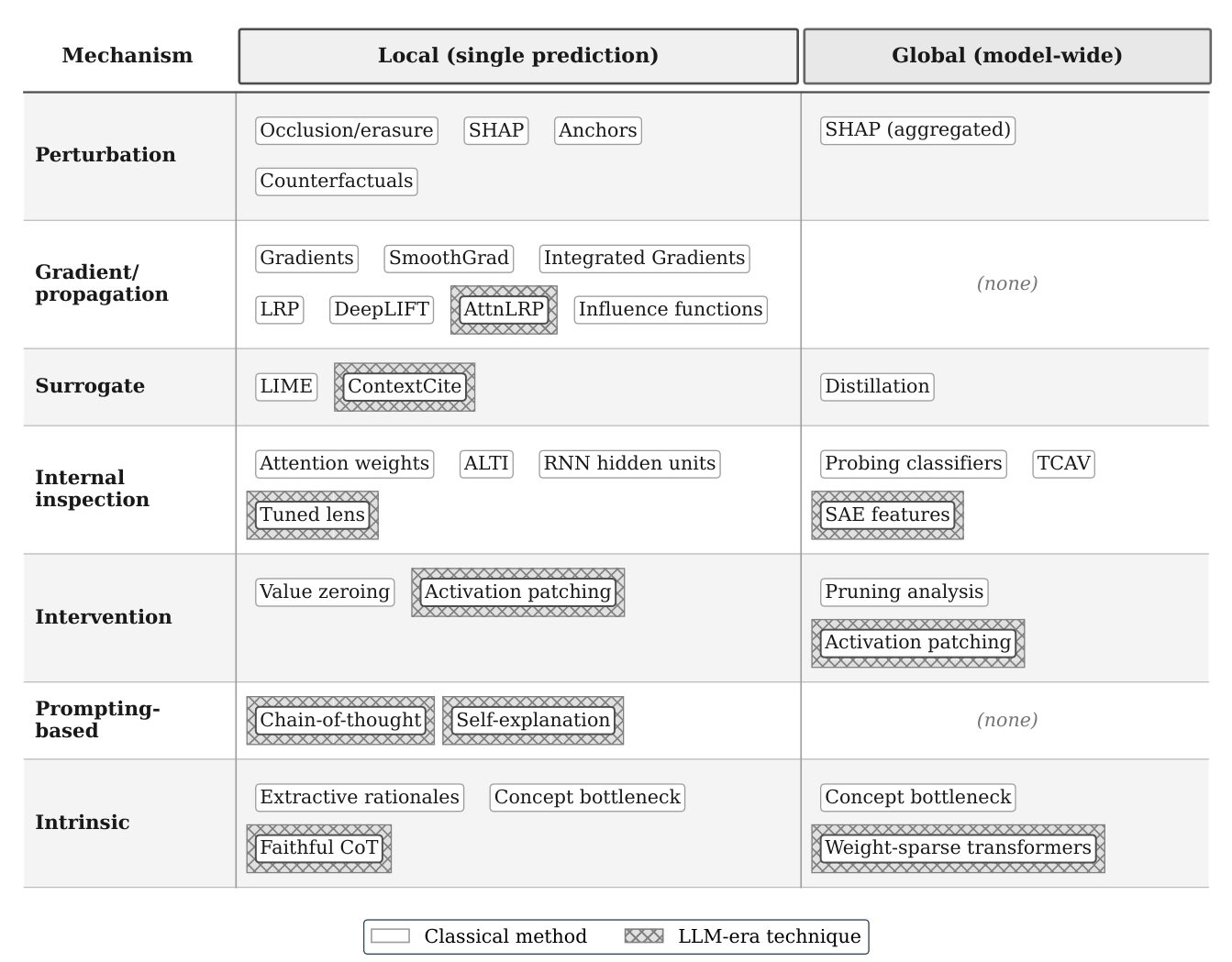
Figure 2.
Decision tree for selecting an explanation method. Model access is asked first. With full access, scope decides next; behind an API, whether the model is an LLM. The lower panel maps audiences to explanation styles. “API Only” corresponds to an API that returns output scores, and “Black-box” to one that returns labels or text only; Table 10 refines both branches for LLMs and reasoning models.
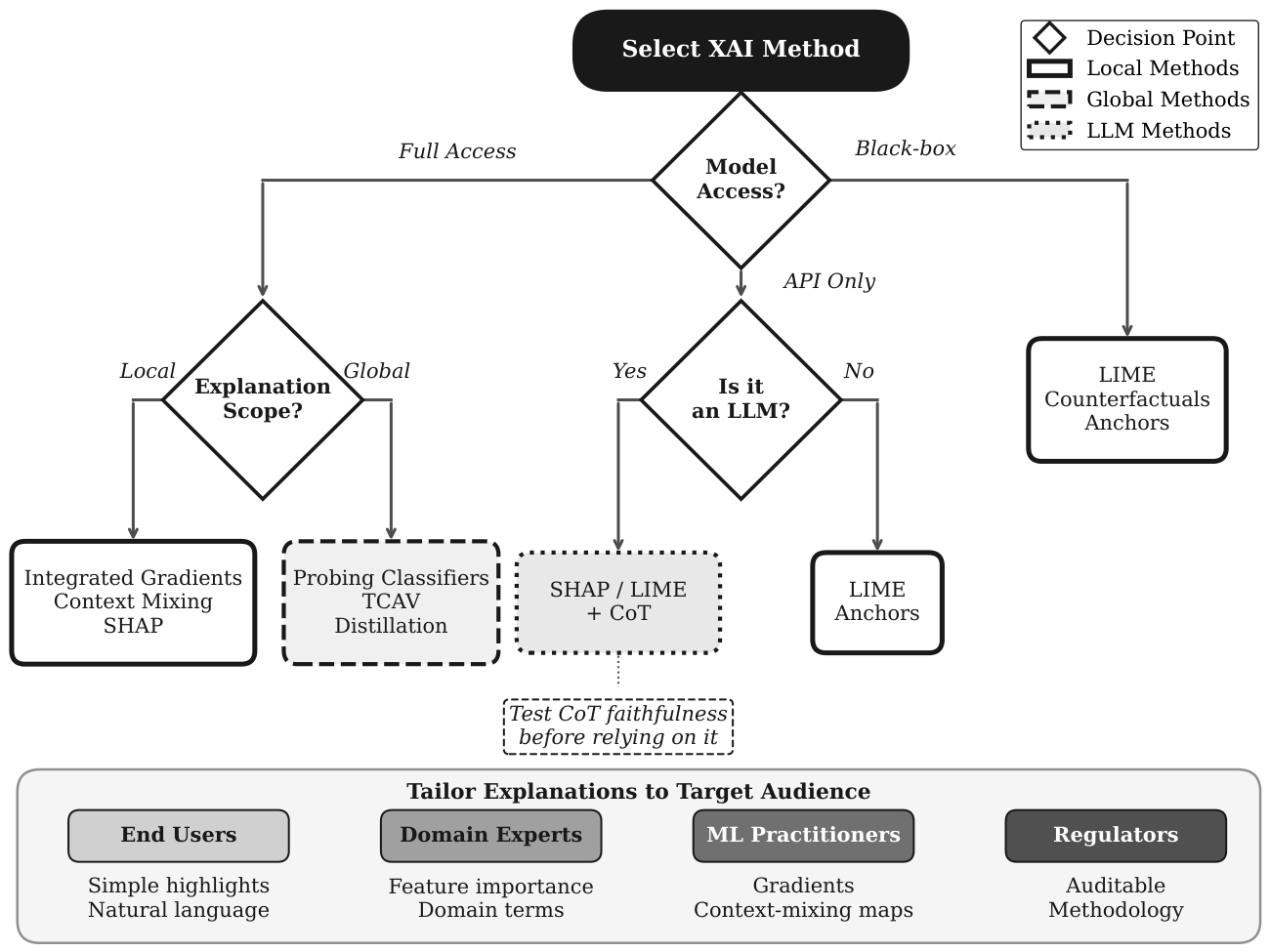

Table 1.
Comparison of this survey with related surveys of explainability, on our reading of each. Taxonomy: ✓ = methods classified along named dimensions, ∼ = organizing categories only. Eval.: ✓ = a dedicated treatment of explanation-quality metrics and their limitations, ∼ = passing mention. Guidance: ✓ = an explicit method-selection procedure, ∼ = general advice on choosing or combining methods. LLM-era: ✓ = dedicated coverage of work since 2022 on CoT faithfulness or mechanistic interpretability, ∼ = passing mention. Domains: ✓ = per-domain sections, ∼ = examples or brief per-domain summaries. In every column, – = not covered. Our own Domains rating is deliberately limited: Section 7 keeps each domain brief and defers per-domain depth to our companion survey.
| Survey | Year | Scope | Taxonomy | Eval. | Guidance | LLM-era | Domains |
|---|---|---|---|---|---|---|---|
| Adadi and Berrada [3] | 2018 | General | ✓ | ✓ | – | – | ∼ |
| Guidotti et al. [101] | 2018 | General | ✓ | ∼ | – | – | ∼ |
| Barredo Arrieta et al. [25] | 2020 | General | ✓ | ∼ | ∼ | – | ∼ |
| Danilevsky et al. [64] | 2020 | NLP | ✓ | ✓ | – | – | – |
| Madsen et al. [161] | 2022 | NLP | ✓ | ✓ | ∼ | – | – |
| Räuker et al. [212] | 2023 | General | ✓ | ∼ | – | ∼ | – |
| Zhao et al. [279] | 2024 | LLM | ✓ | ✓ | – | ✓ | ∼ |
| Luo and Specia [155] | 2024 | LLM | ∼ | ∼ | – | ✓ | – |
| Lyu et al. [157] | 2024 | NLP | ✓ | ✓ | ∼ | ∼ | – |
| Singh et al. [228] | 2024 | LLM | ∼ | ∼ | – | ✓ | – |
| Bereska and Gavves [34] | 2024 | General | ✓ | ∼ | ∼ | ✓ | – |
| Ferrando et al. [85] | 2024 | LLM | ∼ | ∼ | – | ✓ | – |
| Rai et al. [209] | 2024 | LLM | ∼ | ✓ | ✓ | ✓ | – |
| Calderon and Reichart [48] | 2025 | NLP | ✓ | ∼ | ∼ | ∼ | ∼ |
| Shu et al. [225] | 2025 | LLM | ∼ | ✓ | – | ✓ | – |
| Mohammadi et al. [178] | 2025 | NLP | ∼ | ✓ | ∼ | ∼ | ✓ |
| Mueller et al. [189] | 2026 | NLP | ✓ | ✓ | ✓ | ✓ | – |
| This survey | 2026 | NLP+LLM | ✓ | ✓ | ✓ | ✓ | ∼ |
Table 2.
Classification of explanation methods by scope and mechanism, in the mechanism order of Section 3.1. * LLM-era technique (Section 4).
Table 2.
Classification of explanation methods by scope and mechanism, in the mechanism order of Section 3.1. * LLM-era technique (Section 4).
| Method | Local | Global | Mechanism |
|---|---|---|---|
| Occlusion/erasure [145] | ✓ | Perturbation | |
| SHAP [153] | ✓ | ✓ | Perturbation |
| Anchors [215] | ✓ | Perturbation | |
| Counterfactual generation [92,263,270] | ✓ | Perturbation | |
| Vanilla gradients, SmoothGrad [227,230] | ✓ | Gradient/propagation | |
| Integrated Gradients [234] | ✓ | Gradient/propagation | |
| LRP, DeepLIFT [20,224] | ✓ | Gradient/propagation | |
| AttnLRP * [2] | ✓ | Gradient/propagation | |
| Influence functions [99,130] | ✓ | Gradient/propagation | |
| LIME [214] | ✓ | Surrogate | |
| ContextCite * [57] | ✓ | Surrogate | |
| Model distillation [26,236] | ✓ | Surrogate | |
| Attention weights [121,261] | ✓ | Internal inspection | |
| Context mixing: ALTI [84] | ✓ | Internal inspection | |
| Hidden units and gates (RNN) [124] | ✓ | Internal inspection | |
| Tuned lens * [33] | ✓ | Internal inspection | |
| Probing classifiers [32] | ✓ | Internal inspection | |
| Concept activation (TCAV) [128] | ✓ | Internal inspection | |
| Sparse autoencoder features * [45,117] | ✓ | Internal inspection | |
| Value zeroing [185] | ✓ | Intervention | |
| Pruning analysis [173,253] | ✓ | Intervention | |
| Activation patching / causal tracing * [172] | ✓ | ✓ | Intervention |
| Chain-of-thought prompting * [259] | ✓ | Prompting-based | |
| Self-explanation * [162] | ✓ | Prompting-based | |
| Extractive rationales [122,143] | ✓ | Intrinsic | |
| Concept bottleneck models [131] | ✓ | ✓ | Intrinsic |
| Faithful CoT * [156] | ✓ | Intrinsic | |
| Weight-sparse transformers * [90] | ✓ | Intrinsic |
Table 3.
What each mechanism can establish. Access is the minimum a method in the row needs; cost is per explanation. Section 5 describes the tests that detect each failure.
Table 3.
What each mechanism can establish. Access is the minimum a method in the row needs; cost is per explanation. Section 5 describes the tests that detect each failure.
| Mechanism | Minimum access | Cost | What it can establish | Characteristic failure |
|---|---|---|---|---|
| Perturbation | Queries; labels suffice, scores sharpen | Many forward passes | Effect of an input change on the output | Perturbed inputs leave the training distribution [113]; methods disagree [136] |
| Gradient/ propagation | Gradients | One backward pass, or one per path step | Local sensitivity, or relevance relative to a baseline | Maps can barely change when the weights are randomized [4] |
| Surrogate | Queries | Many forward passes and a fit | Behavior of a proxy where it agrees with the model | The proxy is what gets explained; fidelity must be measured [141] |
| Internal inspection | Activations | One forward pass; a probe or dictionary trained once | What a representation contains | Probe accuracy can reflect the probe [111]; decodable need not mean used [72]; attention need not track importance [121] |
| Intervention | Activations, with write access | One forward pass per intervention | Causal effect of a component | Localization need not predict where editing works [108]; results depend on corruption and metric [277] |
| Prompting-based | Text in and out | One generation | The model’s report of its reasons | The stated reasoning can omit the cue that drove the answer [243] |
| Intrinsic | Training the model (Faithful CoT: text and a solver) | A training run | The computation after the bottleneck | The selector can encode the label in what it selects [119] |
Table 4.
Prominent explanation methods along all four taxonomy dimensions, with a practical note on each. “Varies” indicates that the property depends on the estimator or variant used; “Inspection” and “Prompting” abbreviate internal inspection and prompting-based.
Table 4.
Prominent explanation methods along all four taxonomy dimensions, with a practical note on each. “Varies” indicates that the property depends on the estimator or variant used; “Inspection” and “Prompting” abbreviate internal inspection and prompting-based.
| Method | Scope | Mechanism | Access | Output | Notes |
|---|---|---|---|---|---|
| LIME | Local | Surrogate | Agnostic | Importance | Many forward passes; report fidelity |
| SHAP | Local/ Global | Perturbation | Varies | Importance | Exact values need all feature subsets |
| Integrated Gradients | Local | Gradient/ propagation | Specific | Importance | One backward pass per path step |
| LRP | Local | Gradient/ propagation | Specific | Importance | One backward pass; propagation rules per layer type |
| Attention | Local | Inspection | Specific | Importance | Prefer context mixing (Section 4.6) |
| Anchors | Local | Perturbation | Agnostic | Rules | Reports precision and coverage |
| Counterfactual edits | Local | Perturbation | Varies | Counterfactuals | MiCE needs gradients; others only queries |
| Extractive rationales | Local | Intrinsic | Specific | Rationale spans | Faithful by construction for the predictor; needs retraining |
| Influence Functions | Local | Gradient/ propagation | Specific | Examples | Approximates leave-one-out retraining |
| Activation patching | Local/ Global | Intervention | Specific | Importance | Causal effect per component; needs activation access |
| CoT Prompting | Local | Prompting | Agnostic | Natural language | Needs only text access; faithfulness varies |
| SAE features | Global | Inspection | Specific | Concepts | Requires activations; scales to LLMs |
| Concept bottleneck | Local/ Global | Intrinsic | Specific | Concepts | Needs concept labels |
Table 5.
Output form and the faithfulness tests it admits. Erasure applies only where the explanation picks out part of the input.
Table 5.
Output form and the faithfulness tests it admits. Erasure applies only where the explanation picks out part of the input.
| Output form | Example methods | Tests that apply |
|---|---|---|
| Importance scores | LIME, SHAP, gradients, LRP, activation patching | Erasure: comprehensiveness, sufficiency, AOPC [68]; erasure with retraining [113]; weight randomization [4] |
| Rationale spans | Select-then-predict, extractive rationales | Comprehensiveness and sufficiency, the case erasure was built for [68] |
| Rules | Anchors | Precision and coverage under the perturbation distribution [215] |
| Examples | Influence functions, representer points | Agreement with leave-one-out retraining [130], or with the proximal Bregman response function, validated on models of up to 810M parameters [99] |
| Counterfactuals | MiCE, Polyjuice, LLM-generated edits | Whether the edit flips the label, minimality, fluency [218]; for self-generated edits, re-querying the model [66] |
| Concepts | TCAV, concept bottleneck, SAE features | Intervening on the concept [131]; detection and steering against supervised baselines [267] |
| Natural language | CoT, self-explanation | Interventions on the trace [142]; biasing features [243]; counterfactual self-consistency [162] |
Table 6.
LLM-era techniques and questions set against their closest classical counterparts. The verdicts are our judgment. Rebuilt: the classical idea applied again, with the changes that LLM scale or access force, to answer the same question. Extended: the classical idea with a change of object or scale large enough that it answers a different question. New: no classical counterpart.
| LLM-era technique or question | Classical counterpart | What changed | Verdict |
|---|---|---|---|
| Activation patching [172,277] | Causal mediation analysis [252] | Same activation swap at arbitrary sites; the corruption scheme and metric now shape the result, as distribution shift confounds erasure | Rebuilt |
| Faithful CoT [156] | Select-then-predict rationales [143] | A solver executes a generated symbolic chain in place of a selected input subset; built by prompting | Rebuilt |
| CoT tests: early answering, adding mistakes, unlearning steps [142,244] | Erasure: comprehensiveness, sufficiency; remove and retrain [68,113] | Perturbs the generated trace, or the parameters that hold a step, since the explanation is an output | Extended |
| CoT-as-explanation dispute [54,243] | Attention debate [121,261] | A trace read as reasoning is contested; the reply again disputes the test [276] | Rebuilt |
| SAE features [45,117] | TCAV, probing classifiers [32,128] | Overcomplete dictionary learned without labels, up to millions of features, instead of named concepts | Extended |
| Tuned lens, Patchscopes [33,96] | Probing classifiers [32] | Decodes each layer into the vocabulary, or has the model put a patched state into words; no labels | Extended |
| LLM-scale influence functions [99] | Influence functions [130] | EK-FAC approximation at tens of billions of parameters; traces a generation to pretraining sequences | Rebuilt |
| Automated neuron description [37] | Inspecting units by hand [124] | A language model writes each neuron’s description, at a scale hand inspection cannot reach | Rebuilt |
| Weight-sparse transformers [90] | Inherently interpretable models [219] | Interpretability built into a transformer’s circuits: most weights held at zero, pruned to the circuit for a task | Extended |
| CoT monitorability [21,100,134] | None | Training against a monitor that reads the trace can teach obfuscation as a side effect, where deceptive attention was the training goal [208] | New |
| Introspective access [39,149,232] | None | Whether a model’s reports about its own states draw on privileged access, beyond what another model can predict | New |
| Superposition [74] | Word senses superposed in embeddings [15]; polysemantic neurons [196] | From word vectors to the neurons of every layer; toy models make explicit when a network stores more features than dimensions | Extended |
Table 7.
Faithfulness tests for chains of thought and self-explanations, grouped by what they intervene on. The first row extends erasure to the trace (Table 6).
Table 7.
Faithfulness tests for chains of thought and self-explanations, grouped by what they intervene on. The first row extends erasure to the trace (Table 6).
| Test | Intervenes on | Main finding | Limit or critique |
|---|---|---|---|
| Early answering, adding mistakes [142] | Trace: truncate it, or insert an error | Reliance on the CoT varies widely across tasks; larger models less faithful on most tasks | Off-policy edits gave small, unstable effects in decision tasks [158] |
| Paraphrasing, filler tokens [142] | Trace: reword it, or replace it with filler | CoT gains not explained by added compute alone or by information in the phrasing | Filler tokens the most diagnostic metric on a planted testbed [275] |
| Resampling [42,158] | Trace: resample the continuation after a sentence | Planning and uncertainty-management sentences steer the rest; some stated reasons have little causal effect | Needs repeated sampling from the model |
| Unlearning reasoning steps [244] | Parameters: erase the information in one step | Unlearning key steps often changes the prediction | Needs open weights |
| Biasing features [54,243] | Prompt: plant a cue, e.g. answers always (A) | Chains rationalize the cued answer without naming the cue | Omission conflated with incompleteness [276] |
| Paired questions [11] | Input: ask a comparison both ways round | Contradictory answers argued without a planted bias; rarer in frontier and thinking models | Applies where a question has a mirror image |
| Concept counterfactuals [168] | Input: an auxiliary LLM rewrites concepts | Explanations can hide social-bias influence and misstate which evidence mattered | Depends on the auxiliary LLM’s rewrites |
| Redaction, counterfactual, attribution self-consistency [162] | Input words the explanation cites | Faithfulness depends on explanation type, model and task | Argued to measure self-consistency [202] |
| Counterfactual simulatability [53] | Inputs the explanation makes predictions about | Low precision, uncorrelated with plausibility | Checks agreement with outputs only |
| Label-rationale association [262] | Input: compare how label and rationale respond | Joint T5 models pass both measures | Necessary condition only |
Table 8.
User studies of explanations and reliance, ordered by year. Accuracy is the accuracy of the human decision; reliance covers how often people follow the model and how far they trust its answers. A dash marks an outcome the study does not report as a main result.
Table 8.
User studies of explanations and reliance, ordered by year. Accuracy is the accuracy of the human decision; reliance covers how often people follow the model and how far they trust its answers. A dash marks an outcome the study does not report as a main result.
| Study | Task and users | Explanation | Effect on accuracy | Effect on reliance |
|---|---|---|---|---|
| Lai and Tan [138] | Deception detection | Model explanations, with or without predicted labels | Explanations alone: slight gain; predicted labels: large gain | – |
| Hase and Bansal [107] | Simulation tests on text and tabular data | LIME, Anchor, decision boundary, prototypes, composite | Clear simulatability gains in very few cases; users’ ratings did not predict them | – |
| Bansal et al. [22] | Decision tasks with an AI about as accurate as people | AI explanations of its recommendation | No gain beyond AI assistance alone | More acceptance of the recommendation, correct or not |
| Si et al. [226] | Claim verification; crowdworkers | LLM explanation; contrastive (both sides) | Similar to search engines, and faster | Over-reliance on wrong explanations; contrastive form reduced it |
| Steyvers et al. [233] | Multiple-choice and short-answer questions | Default LLM explanations of varied length; confidence-matched text | – | Users overestimated the model’s accuracy; longer explanations raised confidence without better answers; confidence-matched text narrowed the gap |
| Kim et al. [129] | Objective question answering with an LLM | Explanations, sources, inconsistencies | – | More reliance on correct and incorrect answers; sources and inconsistencies reduced it on incorrect ones |
| Bo et al. [41] | Logical reasoning, numerical estimation | Reliance interventions on LLM advice | – | Less over-reliance; appropriate reliance generally not improved |
| Bao et al. [23] | Authorship identification | LLM style rewrites, feature rationales, or both | No overall gain | Rewrites: appropriate reliance; both types: more over-reliance |
| Tuo et al. [242] | Hate-speech detection; human moderators | LLM natural-language vs. feature-based | Unchanged by explanation form | Fluent text raised over-reliance; features prompted scrutiny |
| Xu et al. [269] | Skin-condition diagnosis; lay people and physicians | Multimodal LLM explanations among XAI aids | Physicians not misled when the AI erred; lay users gained when it was right and lost when it erred | Automation bias in lay users |
| Palta et al. [201] | Plausibility of commonsense answers; humans and LLMs | LLM-written arguments for or against an answer | – | Ratings moved in the direction argued |
Table 9.
Benchmarks for evaluating explanations in NLP and what each can test. Plausibility needs human annotations; faithfulness and localization need an intervention on the model or a known mechanism.
Table 9.
Benchmarks for evaluating explanations in NLP and what each can test. Plausibility needs human annotations; faithfulness and localization need an intervention on the model or a known mechanism.
| Resource | Task | Annotation or reference | What it can test |
|---|---|---|---|
| ERASER [68] | Seven tasks incl. sentiment, QA, NLI, fact verification | Extractive human rationales in a unified format | Plausibility against rationales; erasure faithfulness (Eqs. 1–3) |
| e-SNLI, CoS-E [49,211] | NLI; commonsense QA | Crowd-written free-text explanations | Plausibility of generated explanations |
| HateXplain [167] | Hate speech detection | Word-level rationales, target community | Plausibility; erasure faithfulness |
| LIAR-PLUS [7] | Political fact-checking | PolitiFact justification paragraphs | Plausibility of generated justifications |
| SAEBench [125] | Sparse autoencoders on LM activations | Metrics spanning interpretability, disentanglement and unlearning | Whether gains on proxy metrics carry over to practical use |
| AxBench [267] | Concept detection and steering | Shared concepts; prompting, finetuning and representation baselines | Representation-based methods against simple baselines |
| MIB [188] | Shared tasks and LMs | Circuit-localization and causal-variable-localization tracks | Whether a method recovers the causal pathway or variable |
Note: The ERASER suite comprises Movie Reviews, BoolQ, Evidence Inference, FEVER, MultiRC, CoS-E, and e-SNLI, each converted to a unified extractive-rationale format so that comprehensiveness, sufficiency, and agreement with human rationales can be computed uniformly.
Table 10.
What a deployment exposes decides which mechanisms are usable and which faithfulness tests can be run. The last two rows add the reasoning-trace question: the first to the open-weights row, the second to the API rows. The last column names the worked example that falls in each row.
Table 10.
What a deployment exposes decides which mechanisms are usable and which faithfulness tests can be run. The last two rows add the reasoning-trace question: the first to the open-weights row, the second to the API rows. The last column names the worked example that falls in each row.
| Deployment exposes | Usable mechanisms | Faithfulness tests that can be run | Worked example |
|---|---|---|---|
| Weights and activations (open weights) | All seven; intrinsic needs retraining | Erasure [68]; retraining [113,160]; in-distribution masking [163]; activation patching [277] | Sexism detection |
| Output scores: class probabilities, log-probabilities, embeddings (API) | Perturbation, surrogate, prompting | Erasure scored on the predicted-class probability or the answer’s log-probability | Clinical coding |
| Labels or generated text only (API) | Perturbation scored on label change, Anchors, counterfactuals, prompting | Erasure scored as label change; redaction of the words a self-explanation cites [162]; concept counterfactuals estimated from sampled answers [168] | Clinical coding (labels only) |
| Raw, editable reasoning trace (open-weight reasoning model) | Adds the trace as an object of intervention | Early answering, adding mistakes, filler tokens [142]; resampling from a cut point [158] | Credit notices |
| Summarized or hidden trace (OpenAI, Anthropic APIs) | No intervention on the trace | Input-side tests only: answer shift under a planted biasing feature [243], concept counterfactuals [168]; the summary itself cannot be tested | None |
Table 11.
Task-specific recommendations: starting-point methods, the evaluation properties that matter most for each task, the metrics to report, and the basis for the row. Rows marked Judgment have no comparative study behind them and should be adapted per deployment using Figure 2 and Table 10.
| Task | Starting methods | Evaluation focus | Key metrics | Basis |
|---|---|---|---|---|
| Text classification | Integrated Gradients, LIME, SHAP, Anchors, ALTI, counterfactuals | Faithfulness from two or more tests, then plausibility | Comprehensiveness, sufficiency, ROAR; rationale F1 for plausibility | Gradient methods best on diagnostic properties [17]; ALTI above gradients on erasure tests [84]; rankings depend on model and task [160]; comprehensiveness and sufficiency the most diagnostic [51] |
| Named entity recognition | Token-level gradient attribution, probing | Faithfulness per entity span | Comprehensiveness and sufficiency per span; probing accuracy by layer [238] | Judgment |
| Question answering | Context mixing (ALTI), attention rollout, evidence extraction | Faithfulness first, then plausibility | Sufficiency, comprehensiveness, rationale precision and recall | Judgment; ALTI and rollout were evaluated on classification and agreement tasks [1,84] |
| Text generation | Chain-of-thought, source attribution | Trace faithfulness; support from cited sources | Trace interventions [142]; citation precision and recall [91] | No method comparison; evidence that both need testing [91,142,256] |
| Machine translation | Context mixing, word-level attribution, attention alignment | Agreement with source words | Alignment error rate against gold word alignments | Judgment |
| Summarization | Extractive rationales, perturbation attribution over source sentences | Influence of source sentences on the summary | Area under the perturbation curve [186] | Perturbation attribution more faithful than self-explanation on summarization [186] |
Table 12.
Open-source tools and libraries for explaining NLP models; capability descriptions follow each tool’s own documentation. General-purpose libraries such as SHAP and InterpretML are included because they are widely applied to text classifiers. “Latest release” is the newest stable release on the Python Package Index as of 4 October 2026.
| Tool | Methods | Notes | Latest release | Citation |
|---|---|---|---|---|
| Captum | Gradient- and perturbation-based attribution (e.g., Integrated Gradients, DeepLIFT, occlusion, LIME, KernelSHAP) | PyTorch-native; feature, neuron, and layer attribution; infidelity and sensitivity metrics; visualization | 0.9.0, Apr. 2026 | [133] |
| SHAP | Shapley-value attribution (KernelSHAP, TreeSHAP) | Model-agnostic unified interface; fast exact variants for tree ensembles | 0.52.0, May 2026 | [153] |
| InterpretML | Glass-box models (EBM) and black-box explainers (LIME, SHAP) | Microsoft library with a scikit-learn-style API; general-purpose, not NLP-specific | 0.7.8, Mar. 2026 | [195] |
| LIT (Language Interpretability Tool) | Salience maps, attention visualization, counterfactual editing, data-slice analysis | Google’s framework-agnostic browser workbench for interactive error analysis of NLP models | 1.3.1, Dec. 2024 | [239] |
| Inseq | Gradient (e.g., Integrated Gradients, DeepLIFT), attention, and perturbation attribution (occlusion, LIME, value zeroing) for each generated token | Decoder-only and encoder-decoder Transformers; contrastive attribution | 0.7.1, Mar. 2026 | [221] |
| ferret | Gradient, Integrated Gradients, LIME, SHAP for Hugging Face Transformer classifiers | Built-in faithfulness metrics (comprehensiveness, sufficiency, correlation with leave-one-out) and plausibility metrics (IOU, token F1, AUPRC) | 0.4.2, Jan. 2024 | [19] |
| BertViz | Attention visualization only (head, model, and neuron views) | Interactive views of raw Transformer attention patterns; computes no attribution scores | 1.4.1, Jun. 2025 | [251] |
Note: Two earlier tools are no longer maintained. Ecco [6], for saliency and hidden-state analysis of GPT-style models, has had no release since 0.1.2 (January 2022). AllenNLP Interpret [255] depends on AllenNLP, whose repository is archived (last commit November 2022). LIME’s reference implementation has had no release since 0.2.0.1 (June 2020); Captum includes its own LIME implementation, while the LIME explainers of InterpretML and ferret wrap the reference one.
Table 13.
The five application domains compared, using only works cited in this survey. “Worked example” refers to the walkthroughs in Section 6. “None reviewed” means that none of the works reviewed addresses the cell.
Table 13.
The five application domains compared, using only works cited in this survey. “Worked example” refers to the walkthroughs in Section 6. “None reviewed” means that none of the works reviewed addresses the cell.
| Domain | Who acts on the explanation | Typical model access | Source of the requirement | Methods reported | Evidence that explanations help | Main gap |
|---|---|---|---|---|---|---|
| Healthcare | Clinician checking a code or recommendation against the record; lay users | API-only (worked example); full if trained in house | FDA Criterion 4 [247]; device documentation [246] | Per-label attention [190]; LLM-written text [269] | Mixed: physicians resilient, lay users misled when the model erred; image task [269] | No test that the shown basis is the one used; validation proposed instead [97] |
| Legal and financial | Lawyer checking cited authority; credit applicant, who cannot check | Closed RAG products [164]; reasoning model (worked example) | Regulation B reasons [61]; GDPR Art. 15(1)(h) [62]; AI Act Annex III; Colorado SB 26-189 [59] | Paragraph rationales [50]; citations [164] | None reviewed | Hallucination on 17–33% of queries [164]; citation faithfulness rarely measured [256] |
| Social science | Researcher validating a measurement | Varies; LLMs used as annotators | Scientific validity; no statutory duty | LLM-written explanations [281]; token attribution [182]; SAE hypotheses [187] | Plausibility only: often better than crowd references [281] | Conclusions shift with configuration [30]; no worked example |
| Content moderation | Moderator reviewing a flag; user who appeals | Full for fine-tuned encoders (worked example) | DSA Art. 17 statements of reasons [79] | SHAP term scores [177]; word-level rationales [167]; evidence retrieval [240] | Form left accuracy unchanged; fluent text raised over-reliance [242] | Boilerplate statements [126]; attributions can guide evasion [179] |
| Education | Learner; teacher | None reviewed | AI Act Annex III, from December 2027 [81]; Colorado SB 26-189 | None reviewed | None reviewed | No explanation-annotated benchmark; no worked example |
Table 14.
Evidence for the five findings, with the settings reported by the cited studies and where the evidence is limited or rests on our own analysis.
Table 14.
Evidence for the five findings, with the settings reported by the cited studies and where the evidence is limited or rests on our own analysis.
| Finding | Main supporting evidence | Settings and models | Qualifying or contrary evidence | Where evidence is thin |
|---|---|---|---|---|
| 1. Faithfulness and plausibility come apart, and the erasure tests do not transfer to a chain of thought | CoTs omit biasing cues that steer the answer [243]; reasoning models often fail to verbalize hints they use [54]; rationalization occurs without planted cues [11]; erasure carries over only where a self-explanation names redactable input words [162,279]; RAG citations can be correct yet unused [256]; LLM rationales sway human plausibility ratings [201] | GPT-3.5, Claude 1.0 (13 BIG-Bench Hard tasks); Claude 3.7 Sonnet, DeepSeek R1 (MMLU, GPQA, six hint types); Llama 2, Mistral, Falcon 40B; commonsense multiple choice | Many CoTs flagged by the hint test pass other metrics, and verbalization rises with token budget [276]; unlearning key steps often changes the answer [244]; distilled reasoning models revise their answer during the CoT far more often than instruction-tuned and RL-trained ones [144]; T5 joint models show label–rationale association [262] | No agreed criterion; one planted-answer testbed, by model editing on four tasks [275]; mostly multiple-choice QA; a key hint-verbalization study is a developer report [54] |
| 2. Access settles which mechanisms are usable before scope or audience matter | What each mechanism needs (Table 3): gradients need weights [234], probing and patching need activations [32,172], perturbation and surrogates need only queries [153,214] | Our mapping of method requirements; three illustrative deployments | Open SAE suites [147] and circuit tooling tested up to 14B parameters [105] bring internal methods to open-weight models; at platform scale compute binds before access | A structural argument: no study compares explanation quality across access levels for one model and task; worked examples not benchmarked |
| 3. Most LLM-era techniques rebuild or extend older ideas | Ten of twelve rows of Table 6 have a counterpart from 2020 or earlier; patching, mediation, SAEs and steering share one causal-abstraction formalism [93] and read as causal mediation analysis [189] | Twelve techniques selected by us | Attention trained to hide reliance on tokens still used [208] partly anticipates the monitorability row; introspection results split between positive [39,159] and deflationary [229,232]; both New verdicts kept | Verdicts are our judgment, not independently rated; the New rows rest on 2024–2026 work, much of it from developers |
| 4. Faithfulness metrics disagree, and dictionary features do not yet beat simple baselines | Faithfulness metrics show conflicting preferences [51], and the diagnosticity of free-text faithfulness metrics varies by task and model [275]; CoT tests may measure only self-consistency [202]; SAEs trail baselines for probing [123], steering and detection [267] | Text classifiers; 11 open LLMs, 5 tasks; Gemma-2 2B and 9B; over 200 SAEs of eight architectures [125] | Sufficiency and comprehensiveness were most diagnostic [51]; output-score feature selection makes SAE steering competitive with representation-based methods, though prompting still scores about twice as high [10]; SAEs may pay off for discovery [166,187,205] | Few model families; no held-out discovery benchmark; SAEs on random models often score similarly [109]; features vary with seed [204]; SAEs did not help one automated audit (not peer-reviewed) [88] |
| 5. Explanations raise acceptance of model outputs more reliably than they raise decision quality | Acceptance rose whether or not the AI was right, with no added team gain [22]; LLM explanations raised reliance on wrong answers [129], fluent ones more than feature-based ones [242]; longer explanations raised confidence, not accuracy [233]; no explanation type improved accuracy [23] | Three tasks, AI as accurate as users; objective QA (); hate-speech moderation; authorship () | In earlier studies, as Bansal et al. [22] note, gains came where the AI beat human and team [138]; physicians stayed resilient to AI errors [269]; sources cut reliance on wrong answers [129]; cheap verification helps [87,249] | Mostly lay users on short tasks; few domain experts with deployed NLP systems; the clinical study is image-based; outcome measures differ |
Disclaimer/Publisher’s Note: The statements, opinions and data contained in all publications are solely those of the individual author(s) and contributor(s) and not of MDPI and/or the editor(s). MDPI and/or the editor(s) disclaim responsibility for any injury to people or property resulting from any ideas, methods, instructions or products referred to in the content. |
© 2026 by the authors. Licensee MDPI, Basel, Switzerland. This article is an open access article distributed under the terms and conditions of the Creative Commons Attribution (CC BY) license (http://creativecommons.org/licenses/by/4.0/).
Copyright: This open access article is published under a Creative Commons CC BY 4.0 license, which permit the free download, distribution, and reuse, provided that the author and preprint are cited in any reuse.