
Submitted:
05 October 2026
Posted:
07 October 2026
You are already at the latest version
Abstract
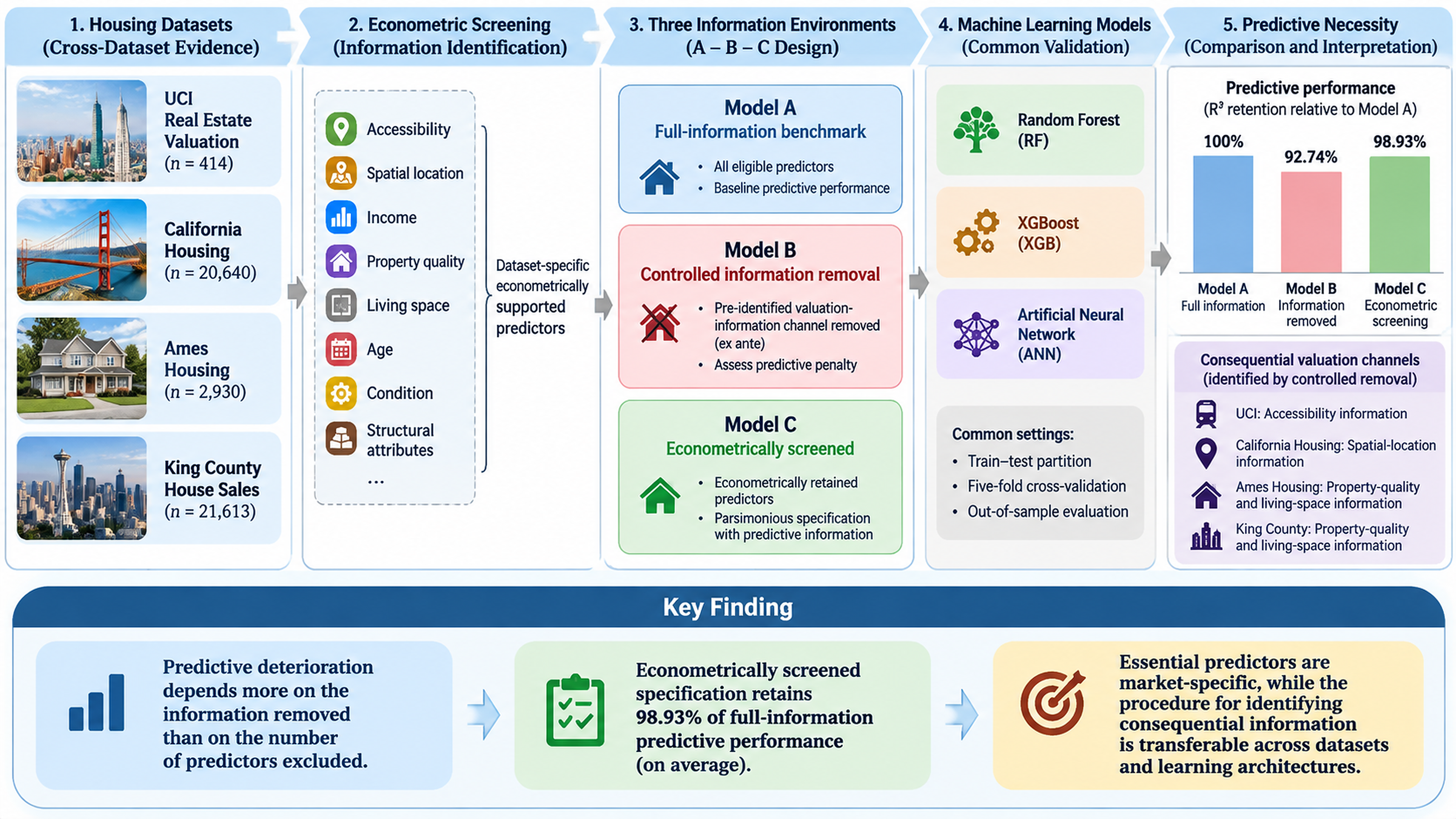
Machine-learning performance depends not only on algorithm selection but also on whether the predictor set preserves information essential for reliable prediction. This study develops an econometric-guided cross-dataset predictor-necessity framework that distinguishes predictor importance from predictive necessity through controlled infor-mation removal. Three information environments are compared: a full-information benchmark, an ex ante information-removal specification, and an econometrically screened specification. Random Forest, XGBoost, and artificial neural networks are evalu-ated under common out-of-sample validation conditions across four public housing da-tasets. Econometric screening retained dataset-specific combinations of accessibility, spa-tial location, income, age, quality, living space, condition, and related structural attributes. Controlled removal identified accessibility information in UCI Real Estate Valuation, spa-tial-location information in California Housing, and property-quality and living-space information in Ames Housing and King County as consequential valuation channels. Across twelve dataset-algorithm combinations, the econometrically screened specification retained an average of 98.93% of full-information predictive R², whereas the controlled in-formation-removal specification retained 92.74%. Predictive deterioration therefore de-pended more on the substantive information removed than on the number of predictors excluded. The findings demonstrate that essential predictors are market-specific, whereas the procedure for identifying consequential information is transferable across datasets and learning architectures.
Keywords:
essential predictors
; machine learning
; econometric screening
; predictive penalty
; information loss
; feature selection
; housing markets
; cross-dataset validation
1. Introduction
The increasing availability of large-scale property data and advances in computational methods have substantially transformed housing-market analysis. Classical hedonic theory conceptualizes property value as the outcome of a bundle of observable characteristics, while subsequent empirical research has demonstrated that the composition and relative influence of these characteristics can vary substantially across markets and property types [22,23]. More recently, machine-learning (ML) methods have expanded the analytical capacity of real-estate valuation by capturing nonlinear relationships, complex interactions, and heterogeneous effects that are difficult to represent within conventional parametric specifications [13,14,15,16,20,25]. Systematic evidence further indicates that ML has become an important component of contemporary real-estate analytics, with applications ranging from housing-price prediction and automated valuation to interpretable market analysis [15,16,17].
Much of this development has naturally emphasized predictive performance. Random Forest, boosting algorithms, artificial neural networks, and related approaches have been increasingly employed to improve housing-price prediction and compare alternative learning architectures [12,13,14,15,20]. At the same time, the literature demonstrates that predictive capability depends not only on algorithmic choice but also on the information supplied to the learning process. Contemporary valuation models draw on heterogeneous information sources, including property-level structural characteristics, socioeconomic indicators, macroeconomic conditions, spatial attributes, and market variables [1,11,21]. Location and accessibility are particularly prominent examples, with GIS-based, transport-accessibility, and other location-sensitive information contributing materially to housing-price modelling [18,19]. Algorithmic sophistication and predictor information should therefore be regarded as distinct but interacting determinants of predictive performance.
This distinction becomes important because real-estate datasets typically contain multiple, partially overlapping dimensions of valuation information. Structural characteristics, dwelling quality, age, usable living space, accessibility, neighbourhood attributes, spatial location, income-related factors, and broader market conditions may all contribute to price formation, but they need not provide equal or independent predictive information. Expanding the predictor set may expose a learning algorithm to additional signal, yet it can also introduce redundancy, multicollinearity, weakly incremental variables, and dataset-specific noise. Conversely, reducing dimensionality may simplify model specification without materially affecting prediction when the removed information is recoverable from retained predictors; but the same reduction can be consequential when it suppresses an information channel that the remaining variables cannot reconstruct. The methodological issue is therefore not simply how many predictors should be retained, but which information must remain available for reliable prediction.
Econometric and ML approaches offer complementary perspectives on this problem. Econometric analysis provides interpretable evidence concerning conditional associations, coefficient magnitude and direction, statistical significance, and multicollinearity, whereas ML provides flexible predictive structures capable of exploiting nonlinearities, interactions, and heterogeneous relationships. Methodological research has emphasized that econometrics and ML need not be treated as competing paradigms and can instead contribute different forms of evidence when inference, prediction, and model interpretation are combined within a common analytical design [6,24]. This complementarity is particularly relevant in real-estate research, where explainable ML methods have increasingly been used to reveal how individual property and market characteristics contribute to fitted predictions [16,17].
Recent hybrid approaches have extended this integration by combining econometric modelling, nonlinear machine learning, and explainable artificial intelligence within unified valuation architectures, demonstrating that predictive performance, economic interpretation, and model transparency can be considered jointly across heterogeneous real-estate environments [26]. Such developments represent an important progression beyond purely algorithm-centred valuation. However, they primarily address how available information is modelled, interpreted, or attributed once it has entered the predictive system. They do not, by themselves, establish whether a particular predictor-or the broader valuation-information channel represented by that predictor-is necessary for maintaining predictive capability when the information is no longer available.
The present study addresses a different methodological question. Rather than asking only how available predictors contribute to fitted predictions, it investigates whether the information represented by those predictors is necessary for maintaining out-of-sample predictive performance when that information is deliberately withheld. Feature importance and predictive necessity are not equivalent. Attribution methods characterize how a fitted model distributes predictive contribution across the information available to it, while econometric significance describes conditional association under a specified model. Neither criterion alone establishes whether the corresponding information can be removed without a material predictive cost. A highly ranked predictor may be replaceable by correlated or substitutable information, whereas a predictor with modest individual importance may become consequential when the broader information channel it represents is unavailable. Correlation, redundancy, substitution, and nonlinear interaction therefore make the identification of important predictors conceptually distinct from the identification of necessary information.
Despite the rapid expansion of ML applications in real-estate analysis, much of the literature remains focused on improving predictive accuracy, comparing algorithms, developing forecasting architectures, or explaining fitted predictions [12,13,14,15,16,17,20,25]. These contributions have substantially advanced automated valuation and housing-market prediction, but they leave a less developed question: does information associated with a statistically relevant or algorithmically important predictor remain necessary once the remaining predictor structure is allowed to compensate for its absence? Answering this question requires a counterfactual evaluation of information availability rather than an importance ranking alone.
A related gap concerns the role of econometrics in hybrid econometric-ML research. When an unchanged predictor set is passed to both econometric and ML models, econometrics functions largely as a parallel benchmark. A more substantive integration is possible when econometric analysis operates upstream of ML by characterizing conditional relevance, multicollinearity, structural dependence, and the empirical support for theoretically meaningful valuation-information channels. ML can then evaluate whether alternative information environments remain sufficient for out-of-sample prediction. Although methodological research has emphasized the complementary roles of prediction and econometric reasoning [6,24], this sequential use of econometric evidence to structure subsequent ML information experiments remains comparatively underdeveloped in real-estate prediction.
This perspective also exposes an important distinction between dimensional reduction and information reduction. A smaller predictor set need not be informationally deficient when the removed variables are weakly incremental, redundant, or recoverable from retained predictors. Conversely, removing only a few variables may cause substantial deterioration when they jointly encode a consequential valuation mechanism. Existing real-estate ML studies demonstrate that strong predictive performance can be obtained from different combinations of structural, spatial, socioeconomic, and market variables [11,12,13,14,15,16,17,18,19,20,21], but predictor reduction and deliberate removal of coherent valuation information are rarely formulated as separate empirical experiments. Controlled information removal provides a direct means of addressing this distinction by measuring what happens to out-of-sample performance when a pre-identified information channel is no longer available to the learner.
A further challenge concerns external validity. Evidence on predictor relevance is commonly derived from individual markets, datasets, or learning architectures [18,19,20,21,25], making it difficult to distinguish general methodological patterns from dataset-specific information structures. A predictor that is consequential in one market need not be universally necessary because valuation mechanisms, predictor availability, substitution possibilities, and market conditions differ across data environments. The relevant objective is therefore not necessarily to establish a universal ranking of housing predictors, but to develop a transferable identification procedure capable of determining which information is consequential within a given valuation environment. Cross-dataset and cross-algorithm evaluation provides a means of testing whether such a procedure remains informative despite heterogeneity in markets, samples, predictor structures, and learning architectures.
To address these gaps, this study develops an econometric-guided cross-dataset predictor-necessity framework comprising three predefined information environments. Model A provides the full eligible information benchmark. Model B implements an ex ante controlled information-removal experiment in which a theoretically interpretable valuation-information channel, supported by training-sample econometric evidence, is deliberately withheld before inspection of subsequent ML performance. Model C is constructed independently through predefined econometric screening based primarily on statistical significance and multicollinearity diagnostics, with coherent treatment of deterministic structural dependencies. Models B and C therefore represent different forms of information reduction: the former tests the consequences of suppressing information expected to matter economically, whereas the latter tests whether econometric screening can reduce the available information set while preserving predictive capability.
Random Forest, XGBoost, and artificial neural networks are evaluated under common validation conditions using R², RMSE, MAE, and MAPE together with five-fold cross-validation. Econometrics and ML consequently perform complementary rather than competing functions: econometric analysis characterizes the structure and conditional support of valuation information before predictive comparison, while out-of-sample ML evaluation measures the consequences of changing the information supplied to the learner. This sequencing also prevents Model B and Model C from being constructed retrospectively according to observed test-set performance.
The framework is evaluated using four independently accessible housing datasets-UCI Real Estate Valuation, California Housing, Ames Housing, and King County House Sales-which differ substantially in sample size, predictor dimensionality, geographic setting, and information composition. Their heterogeneity permits accessibility and local amenities, explicit spatial location, property quality, living-space capacity, and related valuation mechanisms to be examined within a common experimental logic. Importantly, the study does not claim that these channels constitute a universal set of essential housing attributes. Instead, it tests whether dataset-specific consequential information can be identified through a reproducible ex ante procedure and subsequently validated through the predictive consequences of its absence.
Accordingly, the principal contribution of this study is methodological. The methodological novelty lies in distinguishing predictor importance and econometric relevance from predictive necessity through the ex ante controlled removal of theoretically interpretable valuation-information channels, followed by cross-dataset and cross-algorithm out-of-sample validation. Rather than treating feature reduction solely as an optimization problem, the proposed framework integrates theoretical identification, training-sample econometric evidence, controlled information removal, independent econometric screening, and out-of-sample machine-learning validation to determine whether the removal of economically meaningful information produces a reproducible predictive penalty. In this way, the study distinguishes predictor reduction from substantive information loss and shifts the analytical focus from identifying which predictors appear important to determining which valuation information must be retained for reliable prediction. Predictive necessity is therefore treated not as an intrinsic or causal property of an individual variable, but as an empirically testable property of information within a specified valuation environment..
2. Literature Review and Related Work
Real-estate valuation research has progressively evolved from econometric models grounded in hedonic price theory toward increasingly flexible machine-learning and hybrid analytical frameworks. The hedonic tradition conceptualizes property value as the combined outcome of multiple structural, locational, environmental, and market attributes [22,23]. This perspective remains fundamental because it establishes that observed property prices reflect heterogeneous bundles of information rather than a single dominant characteristic. However, conventional parametric specifications generally require predefined functional relationships and may have limited capacity to represent nonlinear interactions, threshold effects, and complex dependencies among valuation determinants.
The growing availability of property-level data has consequently encouraged extensive application of machine-learning methods to real-estate prediction. Comparative studies have evaluated Random Forest, boosting methods, neural networks, and related algorithms with the principal objective of improving predictive accuracy [12,13,14,15,20,25]. Chou et al. [13], for example, compared alternative ML models for preliminary real-estate price forecasting, while Deaconu et al. [14] examined the predictive performance of real-estate valuation models. Lee [20] demonstrated how neural-network performance can be enhanced through richer representations of property information. More broadly, the systematic evidence reviewed by Tekouabou et al. [15] confirms that ML has become an established methodological component of urban real-estate prediction. Collectively, this literature demonstrates the predictive advantages of nonlinear learning but remains primarily concerned with how accurately a given information set can be modelled, rather than with determining which parts of that information set are necessary for maintaining predictive performance. The manuscript's reference base explicitly includes these representative prediction studies.
A parallel research stream has shifted attention from predictive accuracy toward model interpretation. Interpretable ML and explainable artificial intelligence make it possible to examine how individual predictors contribute to fitted model outcomes. Lorenz et al. [16] applied interpretable ML to real-estate market analysis, while Bachmann [17] investigated model mechanics in the residential rental market. SHAP and related attribution approaches provide a general framework for allocating model predictions across available features [4]. These methods represent an important advance because they make nonlinear predictive systems more transparent. Nevertheless, feature attribution and predictive necessity answer different questions. An importance measure describes how a fitted model uses information while that information is available; it does not establish whether the same information can be removed without material loss of predictive capability. Correlated or substitutable predictors may receive substantial importance even when their information can partly be reconstructed from other variables. Conversely, the removal of a coherent information channel may reveal a predictive dependency that is not evident from individual importance rankings.
The composition of the information supplied to real-estate models is itself heterogeneous. Recent studies increasingly combine micro-level property characteristics with socioeconomic, macroeconomic, and market information. Schmid [11], for example, develops a two-stage housing-price-index approach based on linked micro-, socio-, and macroeconomic data, illustrating the value of integrating information operating at different levels of the housing market. Location-related information constitutes another important research stream. GIS and transport-accessibility analysis demonstrates that geographic position and accessibility can materially influence housing-price formation [18], while location-based services have been incorporated into ML-based assessment of residential attractiveness [19]. These studies establish the substantive importance of heterogeneous valuation information, but generally evaluate that information through association, prediction, or attribution rather than through a controlled experiment in which the corresponding information channel is deliberately made unavailable.
A further methodological development concerns the integration of econometric reasoning with machine learning. Econometrics provides interpretable evidence concerning conditional associations, coefficient direction and magnitude, statistical significance, and multicollinearity, whereas ML provides flexible nonlinear approximation and strong out-of-sample predictive capacity. Rather than treating these paradigms as substitutes, methodological research increasingly emphasizes their complementarity [6,24]. The recent generalized explainable hybrid econometric-ML framework [26] extends this logic to real-estate valuation by integrating econometric modelling, nonlinear ML, and explainable AI within a common architecture. The progression is important: econometric evidence can support economic interpretation, ML can capture nonlinear predictive relationships, and explainability methods can characterize how the fitted model uses available predictors. The present manuscript nevertheless addresses a subsequent methodological question that remains unresolved by this integration: does the information identified as relevant or important remain necessary when it is deliberately withheld from the predictive system?
This distinction exposes a broader limitation of conventional feature-selection and feature-importance approaches. Statistical significance, multicollinearity diagnostics, embedded ML selection, and post-estimation importance measures provide useful but conceptually different information. Statistical significance concerns conditional association; VIF characterizes linear informational overlap; and ML importance describes the contribution or use of available features. None of these quantities alone constitutes a counterfactual test of information necessity. The relevant experiment requires changing the information environment and observing whether the remaining predictor structure can compensate for the information that has been removed. This is particularly important in real estate because several observable predictors may encode related underlying mechanisms, such as property quality, usable living space, accessibility, neighbourhood conditions, or geographic location.
The literature also reveals an external-validity limitation. Many real-estate ML studies evaluate a single market, dataset, or learning architecture. Consequently, a predictor identified as highly important in one empirical setting may reflect local market structure, predictor availability, sample composition, or algorithm-specific behaviour rather than a universally essential valuation characteristic. The appropriate methodological objective is therefore not necessarily to identify a universal ranking of individual predictors. A more transferable objective is to determine whether valuation-information channels can be identified ex ante and whether their predictive necessity can subsequently be tested across heterogeneous datasets and learning architectures.
Table 1 synthesizes these methodological developments and positions the proposed framework relative to representative strands of the existing literature. The comparison is deliberately organized around the analytical role assigned to predictors rather than around predictive accuracy alone. It distinguishes studies emphasizing econometric interpretation, ML prediction, explainability, heterogeneous or spatial information, and hybrid integration from the present framework, which adds an explicit counterfactual test of predictive necessity. The table therefore clarifies the progression from identifying determinants, to improving prediction, to explaining fitted predictions, and finally to testing whether theoretically interpretable valuation information can be removed without materially weakening out-of-sample performance.
The comparison in Table 1 shows that existing research provides strong foundations for hedonic interpretation, nonlinear prediction, multi-source and spatial information integration, comparative model evaluation, and explainable machine learning. Hybrid approaches have further demonstrated that econometric reasoning, nonlinear ML prediction, and model interpretation can be integrated within a unified valuation architecture. However, these methodological advances predominantly evaluate predictors while the corresponding information remains available to the model. A distinct question therefore remains insufficiently examined: whether theoretically meaningful valuation information is predictively necessary, rather than merely statistically relevant or algorithmically important. The present study addresses this gap by combining ex ante theoretical identification, training-sample econometric evidence, controlled information removal, independent econometric screening, and out-of-sample validation across four heterogeneous housing datasets and three learning architectures. Predictive necessity is consequently evaluated through the measurable consequence of information absence rather than through importance rankings alone.
3. Methodology
The proposed cross-dataset predictor-necessity framework is designed to identify information that is consequential for machine-learning valuation by distinguishing predictor reduction from valuation-information loss. This distinction is fundamental because reducing the number of predictors does not necessarily produce a proportional loss of predictive information. Variables may be redundant, weakly incremental, or alternative representations of the same underlying valuation mechanism. Conversely, removing only a small number of predictors may materially impair prediction when those variables encode an economically important source of valuation information.
The conceptual motivation can be illustrated by the income-capitalization relationship commonly used for income-producing real estate,
where V denotes property value, NOI is net operating income, and CR is the capitalization rate. This relationship illustrates that valuation information is not homogeneous: some variables represent direct value-generating mechanisms, whereas others capture complementary structural, spatial, accessibility, or market information. Although the public housing datasets examined here do not generally contain NOI and capitalization-rate variables, the same information-based principle remains applicable. Economically meaningful valuation mechanisms may instead be represented by observable channels such as accessibility, spatial location, property quality, usable living space, and related characteristics that condition market utility and price formation.
To identify such channels without reference to subsequent ML outcomes, the study applies an ex ante valuation-information identification rule before predictive comparison. A predictor or coherent predictor block is eligible to represent a Model B information channel when three conditions are satisfied. First, the information must have a theoretically interpretable relationship with property value. Second, the corresponding predictor or predictors must receive econometric support in the training data, assessed primarily through statistical significance and the magnitude of standardized effects. Third, variables representing the same underlying valuation mechanism or exhibiting structural dependence are treated coherently rather than as independent removal candidates. Econometric evidence therefore supports the identification of Model B information channels but does not mechanically select them. This distinction prevents Model B from being constructed retrospectively according to which predictor happens to generate the largest ML performance deterioration.
All econometric analysis precedes ML evaluation and is conducted exclusively on the training sample. Coefficient estimates and standardized effects characterize conditional relevance, while variance inflation factors assess multicollinearity and informational overlap. Statistical significance is evaluated at the 5% level, with VIF < 10 used as the primary multicollinearity criterion. The independent test observations remain isolated from econometric screening, information-channel identification, and model construction so that subsequent predictive comparisons constitute genuine out-of-sample experiments.
Three distinct information environments are constructed. Model A contains the full eligible predictor set after exclusion of identifiers, target-derived variables, and non-informative fields and therefore establishes the full-information predictive benchmark. Model B represents a controlled information-loss experiment in which a pre-identified, theoretically interpretable and econometrically supported valuation-information channel is deliberately withheld. Depending on the information structure of the dataset, this channel may represent accessibility, explicit spatial location, property quality, usable living space, or a coherent combination of related characteristics. Model B is therefore not a feature-optimization procedure; it creates a counterfactual information environment in which an economically meaningful valuation signal is unavailable to the learner.
Formally, let the full eligible predictor set be
and let the existing notation denote the pre-identified valuation-information block. Model B is then defined as
The resulting change in out-of-sample performance measures the predictive cost associated with withholding that information.
Model C addresses a different question. Rather than deliberately suppressing an economically meaningful valuation channel, it constructs an econometrically screened information environment. Predictors are retained primarily when they satisfy the predefined conditions pj<0.05 and VIFj<10, subject to coherent treatment where deterministic or near-deterministic structural relationships make mechanical predictor-by-predictor screening inappropriate. Its predictor set is represented as
where XA denotes the full eligible predictor set and XC contains the predictors retained under the predefined econometric criteria. Model C therefore evaluates whether an econometrically defensible information set can preserve the predictive capability of the full-information benchmark. Predictor retention in Model C is not itself interpreted as evidence of predictive necessity.
The resulting A-B-C architecture consequently separates three analytical states: full eligible information (Model A), deliberate removal of a theoretically meaningful valuation-information channel (Model B), and econometrically screened information (Model C). Models B and C should therefore not be interpreted as competing feature-selection algorithms. Model B asks what happens when information expected to matter economically is deliberately unavailable; Model C asks what happens when information is reduced according to predefined econometric evidence. Their relative out-of-sample penalties provide the empirical basis for distinguishing routine predictor reduction from consequential valuation-information loss.
RF, XGB, and ANN are estimated independently under each information environment. Using three structurally different learners reduces dependence on the internal architecture of any single algorithm and allows the consequences of information removal to be examined across ensemble averaging, sequential gradient boosting, and nonlinear neural approximation. Within each dataset, all A-B-C specifications use identical train-test partitions. Performance is evaluated using R², RMSE, MAE, and MAPE and is further assessed through five-fold cross-validation.
The primary quantities of interest are the predictive penalty and predictive retention relative to Model A. For R²,
and predictive retention is defined as
For error-based measures,
Positive penalties indicate deterioration relative to the full-information benchmark, whereas negative values indicate marginal improvement on the corresponding evaluation sample. The principal methodological test is therefore not whether Model C invariably outperforms Model A. Instead, the framework evaluates whether the predictive loss produced by deliberate removal of a theoretically meaningful information channel is systematically greater than the loss associated with econometric screening:
When this relationship persists across datasets and learning architectures, it provides evidence that the controlled removal has suppressed information that cannot be adequately reconstructed from the remaining predictors. Model C, by contrast, can be considered predictively successful when it preserves most of the information available to Model A after independently specified econometric screening. Importantly, this comparison concerns information preservation rather than predictor count alone; a reduced specification is not assumed to be preferable simply because it is more parsimonious.
Under this framework, statistical significance alone does not define an essential predictor. Econometric evidence identifies and characterizes theoretically plausible valuation-information channels, while controlled removal tests whether the predictive system can compensate for the absence of such information. The resulting out-of-sample predictive penalty therefore provides empirical evidence of predictive necessity. Predictor necessity is consequently treated as a property of the information environment rather than merely as an algorithm-specific importance ranking.
The framework is applied to four independently accessible public housing datasets-UCI Real Estate Valuation, California Housing, Ames Housing, and King County House Sales-whose heterogeneous predictor structures allow different valuation-information channels to be examined under a common methodological rule. The cross-dataset design further tests whether the distinction between deliberate removal of theoretically meaningful information and econometrically guided screening persists across market environments, sample sizes, predictor structures, and learning architectures.
Table 2 operationalizes this design by defining the three information environments used in the empirical analysis for each dataset. Model A identifies the full eligible predictor set; Model B records the ex ante removal of the dataset-specific valuation-information channel; and Model C reports the predictor set obtained independently through the predefined econometric screening criteria. The purpose of Table 2 is therefore not to report predictive outcomes, but to establish transparently what information is available to each competing specification before RF, XGB, and ANN performance is evaluated. By fixing these information environments prior to predictive comparison, Table 2 provides the empirical bridge between the conceptual framework and the subsequent experiments and makes clear that the reduced specifications were not selected retrospectively from test-set performance.
Table 2 demonstrates that econometric screening produces dataset-specific predictor structures rather than a universal reduced feature set. Model C retains accessibility and location-related information in UCI, income and explicit spatial information in California Housing, a broad combination of structural, quality, age, and size attributes in Ames Housing, and structural, amenity, condition, temporal, and geospatial information in King County. By contrast, Model B deliberately suppresses a pre-identified valuation-information channel. The comparison therefore evaluates not how many predictors are removed, but whether the removed information is consequential for out-of-sample prediction.
Computational environment. All computational analyses were performed in Python 3.12.3. Data processing and numerical operations were conducted using pandas 3.0.2 and NumPy 2.4.4. Econometric estimation and associated statistical diagnostics, including OLS estimation and multicollinearity assessment, were implemented using statsmodels 0.15.0. Data preprocessing, train–test splitting, cross-validation, Random Forest, and artificial neural network modelling were implemented using scikit-learn 1.8.0, while gradient-boosting models were estimated using XGBoost 3.4.1. SHAP 0.52.0 was available for model-interpretation procedures, and Matplotlib 3.10.8 was used for graphical output. The computational environment, random-state controls, and principal algorithm-specific settings were maintained consistently across the A–B–C experiments to support computational reproducibility.
3.1. Implementation and Validation Protocol
To ensure reproducibility and prevent predictor selection from being influenced by subsequent machine-learning performance, the empirical analysis followed a predefined sequential protocol. Data preparation, econometric assessment, construction of the three information environments, machine-learning estimation, and out-of-sample evaluation were separated explicitly. The objective was therefore not to identify reduced predictor sets retrospectively from predictive results, but to evaluate the predictive consequences of information structures established before those results were observed.
For each dataset, identifier fields, target-derived variables, and predictors capable of introducing direct information leakage were excluded before model construction. The remaining eligible variables formed the full-information specification, Model A. Dataset-specific preprocessing, including missing-value treatment and transformations or scaling required by the corresponding algorithms, was performed using training information only.
The econometric stage preceded all RF, XGB, and ANN comparisons. Predictor-level conditional relevance and multicollinearity were evaluated on the training sample using standardized coefficients, statistical significance, and variance inflation factors. Model C was constructed using the predefined primary criteria of p < 0.05 and VIF < 10, with deterministic or structurally dependent predictors treated coherently rather than mechanically as independent candidates. This stage also provided econometric evidence supporting the theoretically interpretable valuation-information channels considered for Model B. Model B was constructed independently of subsequent ML performance and was not intended as an alternative feature-selection algorithm. The removed predictor or coherent predictor block was required to represent a recognizable valuation mechanism, to have econometric support in the training data, and, where multiple variables encoded the same underlying mechanism, to be treated jointly so that substantial portions of the same information channel were not inadvertently retained. Model B therefore represents an ex ante controlled information-removal experiment, whereas Model C represents an econometrically screened information environment. The two specifications answer different empirical questions: Model B evaluates the predictive consequences of deliberately withholding theoretically meaningful valuation information, while Model C evaluates whether formal econometric screening can reduce the information set without materially compromising predictive capability.
Figure 1 summarizes this analytical sequence from the full eligible information environment through econometric assessment and construction of Models A, B, and C to independent ML evaluation. Econometric analysis and machine learning are therefore integrated sequentially rather than treated as competing approaches: econometric evidence characterizes conditional relevance, redundancy, and the empirical support for theoretically meaningful information channels, while subsequent ML estimation evaluates the predictive consequences of retaining, deliberately suppressing, or econometrically screening that information.
After the A-B-C specifications had been fixed, RF, XGB, and ANN models were estimated under common validation conditions within each dataset. Observations were divided into an 80% training sample and a 20% independent hold-out sample using random_state = 42, with identical partitions maintained across the competing information environments. Five-fold cross-validation using common folds within each dataset provided an additional robustness assessment. Predictive performance was evaluated using R², RMSE, MAE, and MAPE. Model A served as the dataset- and algorithm-specific full-information benchmark, while Models B and C were evaluated through the predictive changes resulting from their respective information reductions.
The ANN implementation was standardized across all datasets using a two-hidden-layer architecture with 32 and 16 neurons, ReLU activation, Adam optimization, L2 regularization (alpha = 0.01), and early stopping. Inputs and targets were standardized using training information only, with target predictions subsequently transformed back to their original scale. Early stopping used an internal validation fraction drawn exclusively from the training sample and therefore did not expose the independent hold-out observations during model development. The same ANN architecture and optimization settings were maintained across Models A, B, and C so that observed performance differences reflected changes in available information rather than changes in neural-network specification.
Implementation settings, validation rules, preprocessing controls, and computational reproducibility details are reported in Supplementary Table S1. The ex ante theoretical rationale and coherent information blocks used to construct Model B are summarized in Supplementary Table S2, while Supplementary Table S3 provides the predictor-level econometric audit trail supporting both Model B and Model C. In combination, these tables distinguish computational implementation from theoretical information identification and formal econometric screening, thereby making the complete A-B-C construction independently traceable.
Reproducibility and Robustness Control
The analytical protocol was applied consistently across all four datasets and three machine-learning algorithms. Models A, B, and C were evaluated using identical hold-out partitions within each dataset, complemented by five-fold cross-validation and multiple performance metrics. All preprocessing, econometric screening, and ex ante Model B information-identification decisions were based exclusively on training information and were completed before inspection of the corresponding hold-out predictive penalties. This separation ensures that the three specifications represent predefined information environments rather than predictor sets retrospectively selected according to machine-learning performance.
Model implementation settings

| Algorithm | Main implementation settings |
| RF | n_estimators = 500; max_depth = 8; min_samples_leaf = 2; max_features = 0.8; random_state = 42; n_jobs = -1 |
| XGB | n_estimators = 400; learning_rate = 0.03; max_depth = 3; subsample = 0.85; colsample_bytree = 0.85; reg_alpha = 0.05; reg_lambda = 1.0; objective = 'reg:squarederror'; random_state = 42; n_jobs = 2 |
| ANN | hidden_layer_sizes = (32, 16); activation = 'relu'; solver = 'adam'; alpha = 0.01; learning_rate_init = 0.001; batch_size = 256; max_iter = 2000; early_stopping = True; validation_fraction = 0.10; n_iter_no_change = 30; tol = 1×10⁻⁴; input scaling = StandardScaler; target scaling = StandardScaler through TransformedTargetRegressor; random_state = 42 |
Note: The same algorithm-specific settings were maintained across Models A, B, and C within each dataset. ANN input and target scaling were estimated from training information only, and early stopping used an internal validation subset drawn exclusively from the training sample; the independent hold-out test observations were therefore not used for optimization or stopping decisions. Dataset-specific A-B-C predictor compositions are reported in Table 2.
Supplementary Table S2 documents the theoretical provenance and coherent block structure of the valuation-information channels deliberately removed in Model B. Supplementary Table S3 complements this conceptual justification by providing the predictor-level econometric audit trail underlying the A-B-C construction. Specifically, it reports the standardized coefficients, statistical significance, and variance inflation factors used to characterize each predictor, together with its corresponding Model B and Model C status and the rationale for retention or removal. In this way, Supplementary Table S3 provides empirical verification of the dataset-specific predictor compositions reported in Table 2: it shows that the Model B information channels were supported by training-sample econometric evidence before subsequent ML performance was inspected, while independently documenting the application of the predefined Model C screening criteria. The table therefore makes transparent why particular predictors were retained or removed, distinguishes theoretically guided information removal from formal econometric screening, and provides a reproducible predictor-level audit trail linking the methodological rules to the final A-B-C specifications used in the predictive experiments.
Accordingly, the contribution of the proposed framework is not another feature-selection procedure, but a structured approach for identifying valuation information whose absence produces a measurable out-of-sample predictive consequence, thereby providing an empirical basis for assessing predictive necessity.
4. Results
The empirical results reveal a consistent distinction between reducing predictor dimensionality and removing economically meaningful valuation information. Across the four housing datasets, predictive performance depended substantially more on the information represented by the excluded predictors than on the number of predictors retained. This pattern persisted across Random Forest (RF), XGBoost (XGB), and artificial neural network (ANN) models, despite substantial differences in dataset size, market context, predictor structure, and learning architecture.
Model A provides the full-information benchmark, whereas Models B and C represent two fundamentally different information-reduction mechanisms. Model B deliberately removes an ex ante, theoretically interpretable valuation-information channel before inspection of subsequent ML performance. Model C instead applies the predefined econometric screening criteria to the training data. The predictor-level econometric evidence underlying these decisions is reported in Supplementary Table S3, thereby separating the construction of the reduced specifications from their subsequent predictive evaluation.
Table 3 shows that the predictive consequences of Model B are substantially larger than those of Model C. Across the four datasets, Model B retained an average of 92.74% of the full-information R², whereas Model C retained 98.93%. The corresponding mean R² penalties were 0.0587 and 0.0088, respectively. Thus, the average R² penalty generated by deliberate information removal was approximately 6.7 times that associated with econometric screening. This contrast provides the central empirical evidence that statistical reducibility and predictive necessity are not equivalent.
The dataset-specific results clarify the economic meaning of this distinction. In UCI Real Estate, Model B removes distance to the nearest MRT station and the number of convenience stores, thereby suppressing the accessibility and local-amenity channel. Mean R² retention falls to 91.36%, whereas Model C, which excludes only Longitude because of insufficient conditional statistical support, retains 98.07%. The larger Model B penalty indicates that accessibility information remains consequential even when other structural and geographic predictors are available.
California Housing provides the strongest evidence of spatial-information necessity. The ex ante removal of Latitude and Longitude reduces mean R² retention to 88.18%, the lowest Model B retention among the four datasets. By contrast, the corrected Model C excludes only Population, which fails the predefined significance criterion in the training sample, while retaining the seven remaining predictors, including both spatial coordinates. This specification preserves 99.77% of the Model A benchmark. The contrast is particularly informative because the substantial loss under Model B cannot be attributed simply to dimensionality reduction: it arises from suppressing an economically consequential spatial-location channel.
Ames Housing exhibits a different but complementary pattern. Model B deliberately removes Overall Quality and Gr Liv Area, representing property-quality and usable-living-space information, and retains 97.59% of the Model A R². Corrected Model C instead excludes Full Bath and TotRms AbvGrd, both of which fail the predefined conditional-significance criterion, while retaining the economically stronger quality and living-space predictors. Model C achieves a mean test R² of 0.9020, compared with 0.8988 for Model A, corresponding to an R² retention of 100.36%. This marginal difference should not be interpreted as evidence that reduced models are systematically superior; rather, it indicates practical predictive equivalence and shows that removal of conditionally weak information need not impose an out-of-sample cost.
King County further separates theoretical information removal from econometric restructuring. Model B suppresses Grade together with the current living-space block comprising sqft_living, sqft_above, and sqft_basement, reducing mean R² retention to 93.84%. Corrected Model C treats the deterministic relationship among the three living-area variables coherently and excludes that structurally collinear block while retaining Grade and Floors, yielding a 14-predictor specification. Despite the structural reduction, Model C retains 97.53% of Model A performance. The result is especially informative because Grade remains strongly supported econometrically; its deliberate removal in Model B therefore represents loss of substantive valuation information rather than routine feature screening.
Taken together, these results establish a consistent hierarchy:
in terms of retained predictive information. The hierarchy does not imply that Model C is universally preferable to Model A, nor that every excluded predictor is economically irrelevant. Rather, it shows that the predefined econometric screening procedure generally removes information that is either conditionally weak or structurally redundant, whereas Model B deliberately removes information channels whose contribution cannot be fully reconstructed from the remaining predictor structure.
Model A ≈ Model C > Model B
Figure 2 provides a visual counterpart to the aggregate evidence in Table 3. Model C remains close to the full-information benchmark across the four datasets, whereas Model B exhibits larger deviations whenever the deliberately withheld information channel carries substantial valuation content. The separation is most pronounced for spatial location in California Housing and accessibility in UCI, while the Ames and King County results demonstrate the importance of property-quality and living-space information. The consistency of this pattern across RF, XGB, and ANN indicates that the observed penalties are not attributable to a single learning architecture but instead reflect differences in the information supplied to the models.
The cross-dataset comparison is important because the four datasets differ markedly in sample size, predictor dimensionality, geographic context, and housing-market structure. What generalizes is therefore not a universal list of essential predictors. Instead, the transferable element is the identification procedure: a theoretically recognizable information channel becomes empirically consequential when its ex ante removal produces a reproducible deterioration in out-of-sample performance that cannot be adequately compensated for by the remaining information.
This interpretation also distinguishes the proposed framework from conventional feature-selection exercises. Statistical significance identifies conditional relationships within an econometric specification, while ML importance measures characterize how a fitted predictive model uses available information. Neither quantity alone establishes predictive necessity. Controlled information removal adds the missing counterfactual dimension by asking whether predictive capability deteriorates when a theoretically meaningful information source is no longer available.
Accordingly, the principal empirical contribution is not that fewer predictors necessarily improve prediction, but that predictor importance, econometric relevance, and predictive necessity represent distinct analytical concepts. Model C demonstrates that econometric screening can substantially preserve the information content of the full specification, retaining 98.93% of Model A's mean predictive R² across the four datasets. Model B, by contrast, retains 92.74%, demonstrating that deliberate removal of economically meaningful valuation channels produces materially larger predictive consequences. The robustness of this relationship across heterogeneous datasets and learning architectures supports the use of controlled information removal as a transferable procedure for identifying consequential valuation information.
5. Discussion
The central implication of the findings is that predictor dimensionality and valuation-information content are not equivalent. Across four heterogeneous housing datasets and three learning architectures, econometric screening preserved performance close to the full-information benchmark, whereas deliberate removal of an ex ante valuation-information channel produced substantially larger predictive deterioration. The distinction shifts attention away from the conventional question of whether more or fewer predictors improve machine-learning accuracy and toward a more fundamental issue: which information must remain available for reliable valuation prediction.
The contrast between Models B and C is central to this interpretation. Model C applies predefined econometric criteria to identify predictors with limited conditional contribution or problematic information redundancy, while Model B performs a different experiment: it deliberately withholds a theoretically recognizable valuation mechanism before subsequent RF, XGB, and ANN performance is inspected. Supplementary Table S3 documents this distinction at predictor level by reporting the econometric evidence supporting both the ex ante Model B information channels and the formal Model C screening decisions. Consequently, the subsequent predictive penalties can be interpreted as outcomes of pre-specified information structures rather than retrospective feature selection motivated by ML performance.
The aggregate evidence strongly supports this distinction. Model C retained 98.93% of the full-information predictive R² across the four datasets, whereas Model B retained 92.74%. Corresponding mean R² penalties were 0.0088 and 0.0587, respectively. Thus, deliberate removal of theoretically meaningful valuation information generated an average R² penalty approximately 6.7 times larger than econometric screening. The relevant implication is not that screening necessarily improves prediction, but that much of the information removed through econometric screening can be weakly incremental, redundant, or recoverable from the retained predictor structure. By contrast, suppression of a coherent valuation-information channel can remove information that the remaining predictors cannot adequately reconstruct.
This interpretation clarifies the role of econometrics within the proposed framework. Econometrics and machine learning are not treated as competing estimators whose value is determined solely by comparative predictive accuracy. Instead, econometric analysis operates upstream of ML by providing theoretically interpretable evidence concerning conditional relevance, multicollinearity, redundancy, and information structure. ML then evaluates whether the resulting information environment remains predictively sufficient under nonlinear estimation. This complementary division of labour is consistent with the broader rationale of hybrid modelling, in which different analytical paradigms contribute distinct forms of information rather than serving exclusively as substitutes [6].
The role of Model B is correspondingly different from conventional feature selection. Its objective is neither dimensionality minimization nor identification of a statistically optimal subset. The removed predictor or coherent predictor block represents a theoretically grounded valuation mechanism with econometric support in the training data. Statistical evidence therefore supports the economic interpretation of the removed information but does not mechanically determine the Model B specification. The resulting out-of-sample deterioration measures the extent to which the remaining information can compensate for the deliberately unavailable channel. Model B should therefore be interpreted as a controlled information-loss counterfactual, rather than as an alternative variable-selection algorithm.
The dataset-specific evidence illustrates why this distinction matters. In UCI Real Estate, accessibility and local-amenity information represented by distance to MRT and convenience-store availability is consequential. In California Housing, explicit spatial position produces the strongest Model B penalty, while econometric screening excludes only Population and preserves almost all full-information performance. Ames Housing identifies property quality and usable living space as consequential information, whereas the exclusion of conditionally weak Full Bath and TotRms AbvGrd under Model C produces no meaningful predictive loss. King County provides a complementary structural case: Model B removes Grade together with the current living-space channel, whereas Model C coherently removes the deterministically dependent sqft_living, sqft_above, and sqft_basement block while retaining Grade and Floors. The smaller Model C penalty therefore arises from a fundamentally different information structure, not merely from using fewer predictors.
These results do not support a universal hierarchy of individual housing predictors. Housing markets need not capitalize accessibility, income, spatial position, property quality, condition, amenities, and living space in identical ways. What generalizes across the four datasets is instead the identification mechanism. A theoretically interpretable predictor or information block becomes empirically consequential when its ex ante removal generates an out-of-sample penalty that cannot be adequately recovered from the remaining information. Essentiality is therefore conditional on both market context and the surrounding information environment rather than being an intrinsic property of a variable considered in isolation.
This distinction also separates predictor importance from predictive necessity. Model-interpretation methods such as SHAP quantify how a fitted model uses the information available to it [4]. Such attribution is valuable for understanding model behaviour, but high importance does not establish indispensability. Correlated predictors may substitute for one another, nonlinear interactions may redistribute apparent importance, and rankings can vary across algorithms. Controlled information removal addresses a different counterfactual question: what happens to predictive performance when a specified information source is unavailable? Predictor necessity is therefore evaluated through the consequence of absence, rather than solely through the magnitude of use.
Accordingly, predictor essentiality within the proposed framework emerges from a sequential body of evidence: theoretical relevance establishes why an information channel may matter economically; econometric diagnostics evaluate its conditional empirical structure; controlled removal alters its availability independently of subsequent ML outcomes; out-of-sample testing measures the resulting predictive cost; and cross-algorithm comparison assesses whether that cost persists under different nonlinear learning architectures. Essentiality is therefore not inferred from any single coefficient, p-value, VIF statistic, SHAP ranking, or ML performance measure.
The corrected Model C results reinforce an important boundary of this interpretation. Econometric screening should not be expected to systematically outperform the full-information Model A. Ames Housing marginally exceeds the Model A benchmark after screening, but this small hold-out difference is more appropriately interpreted as practical predictive equivalence than as evidence that reduced models are inherently superior. Additional predictors may legitimately contain small incremental signals even when their conditional econometric contribution is weak. The relevant criterion is therefore not whether Model C maximizes predictive accuracy, but how much predictive information is preserved after an independently specified econometric screening procedure.
This distinction has practical implications for data acquisition and automated valuation systems. Real-estate datasets are frequently heterogeneous, incomplete, expensive to maintain, or inconsistent across jurisdictions. Requiring every available predictor may impose unnecessary collection and harmonization costs, whereas losing a consequential information channel may materially compromise valuation reliability. The proposed framework provides a mechanism for distinguishing these situations. Variables whose removal produces little out-of-sample deterioration may warrant lower acquisition priority, while information channels associated with reproducible predictive penalties should receive greater attention in data design, quality control, and model deployment.
At the same time, statistical significance should not be interpreted as a universally optimal ML feature-selection rule. Linear econometric specifications may not fully represent nonlinearities, interactions, threshold effects, or substitution among correlated predictors. This limitation is precisely why Model C screening is followed by out-of-sample RF, XGB, and ANN evaluation rather than treated as the final criterion of predictor necessity. The machine-learning stage therefore acts as an empirical safeguard against equating conditional econometric relevance with predictive indispensability.
The cross-algorithm consistency is important in this respect. RF, XGB, and ANN represent substantially different nonlinear learning architectures, yet the broader A-B-C relationship persists. This reduces the likelihood that the observed information-loss penalties are artifacts of a particular learner and supports their interpretation as consequences of the information supplied to the predictive system. The framework therefore combines the structural interpretability of econometrics with the flexible nonlinear representation and out-of-sample validation capabilities of machine learning.
Several boundaries nevertheless remain. The four public datasets differ in target definition, predictor dimensionality, sample size, geographic setting, and information richness. These differences strengthen the cross-dataset robustness assessment but preclude direct comparison of raw coefficients or absolute prediction errors across markets. Model B is also constrained by the information available within each dataset. The findings therefore identify consequential information conditional on the observed information environment, rather than proving that a particular predictor is intrinsically essential in every valuation system. This qualification is particularly relevant to Ames Housing, where the analysis uses a predefined 15-predictor numerical valuation panel extracted from a substantially richer original dataset. The original Discussion already recognized this boundary, and it should be retained.
Across the four heterogeneous housing datasets, the controlled information-removal experiments identify two recurring families of consequential valuation information: property-specific information, particularly quality and usable living-space capacity, and location-related information, represented by explicit spatial position, transport accessibility, and local amenities. These findings do not establish a universal ranking of individual predictors; rather, they indicate that the predictive necessity of specific variables is dataset-dependent, while broader valuation-information channels may recur across heterogeneous housing markets. The cross-dataset evidence therefore suggests that generalizability may reside more strongly at the level of valuation-information channels than at the level of individual predictor names.
Future research should extend the framework to richer commercial and income-producing real-estate datasets containing direct financial valuation variables, transaction-liquidity measures, macroeconomic conditions, and more detailed spatial information. In such settings, income-based mechanisms-including net operating income and capitalization rates-could be subjected to the same ex ante controlled-removal logic alongside structural, accessibility, spatial, and market information. Such extensions would test whether the distinction between econometric relevance and predictive necessity persists when valuation information is more directly connected to income-generation mechanisms.
Overall, the evidence supports a shift from asking which algorithm predicts best toward asking which information an algorithm must retain to predict reliably. Econometric screening preserved nearly all of the information available to the full ML specification, whereas deliberate removal of theoretically grounded valuation-information channels produced substantially larger predictive costs. Predictor importance, econometric relevance, and predictive necessity should therefore be treated as related but distinct concepts. The methodological contribution of the framework lies in connecting them through an ex ante, reproducible sequence of theoretical identification, econometric diagnosis, controlled information removal, and out-of-sample machine-learning validation.
6. Conclusions
This study addressed a central question in machine-learning model specification for real estate valuation: which information must be retained for reliable prediction? Rather than defining predictor essentiality solely through statistical significance or algorithm-specific importance rankings, the study developed an econometric-guided cross-dataset predictor-necessity framework in which theoretical interpretation, econometric evidence, controlled information removal, and out-of-sample machine-learning validation are integrated within a common analytical design. The framework was evaluated across four heterogeneous public housing datasets using Random Forest, XGBoost, and artificial neural networks.
The findings demonstrate a consistent distinction between predictor reduction and consequential information loss. Across the four datasets, the econometrically screened Model C retained, on average, 98.93% of the predictive R² achieved by the full-information Model A, whereas Model B, which deliberately withheld an ex ante, theoretically interpretable and econometrically supported valuation-information channel, retained 92.74%. The corresponding predictive deterioration was therefore substantially greater under controlled information removal than under econometric screening. This evidence indicates that predictive performance depends less on the number of predictors removed than on the valuation information represented by those predictors.
The cross-dataset analysis further shows that predictive necessity is information- and context-dependent rather than universal. Accessibility and local amenities were consequential in the UCI dataset, explicit spatial location was particularly important in California Housing, and property-quality and living-space information played prominent roles in Ames and King County. At the same time, the corrected Model C specifications demonstrate that predictors with limited conditional contribution or structurally redundant information can be removed with little or, in some cases, no measurable loss of predictive capability. These findings should not be interpreted as establishing a universal ranking of housing predictors; instead, they show that different markets and datasets may encode essential valuation information through different observable channels.
The principal methodological contribution is therefore the distinction between predictor importance, econometric relevance, and predictive necessity. Statistical significance describes conditional econometric evidence, while algorithm-specific importance measures characterize how a fitted model uses the information available to it. Neither alone establishes that the information is necessary for prediction. Within the proposed framework, predictive necessity is supported when a theoretically grounded and econometrically supported information channel, identified before inspection of subsequent ML performance, produces a reproducible out-of-sample penalty when deliberately removed. Essentiality is thus evaluated through the predictive consequence of information absence, rather than solely through the observed importance of information when present.
This framework also assigns econometrics a more active role in machine-learning valuation. Econometric analysis is used upstream to characterize conditional relevance, multicollinearity, structural dependence, and the empirical support for theoretically meaningful information channels; machine learning subsequently tests whether the resulting information environments remain predictively sufficient under nonlinear estimation. Model B and Model C consequently serve different purposes: the former provides a controlled information-loss counterfactual, whereas the latter evaluates the predictive sufficiency of an econometrically screened specification.
The framework remains conditional on the information available in each dataset and should therefore not be interpreted as proving intrinsic or causal essentiality of individual predictors. Future research should extend the approach to richer commercial and income-producing real estate datasets containing direct financial valuation variables, macroeconomic conditions, transaction and liquidity measures, and more detailed spatial information. In particular, datasets containing net operating income and capitalization rates would permit direct testing of income-based valuation mechanisms within the same ex ante controlled-removal design. Such extensions would help determine whether the distinction between econometric relevance and predictive necessity persists across broader property sectors and more complex valuation environments.
Supplementary Materials
The following supporting information can be downloaded at the website of this paper posted on Preprints.org, Supplementary Table S1, Implementation, Validation, and Reproducibility Protocol for the A–B–C Experiments; Supplementary Table S2, Ex Ante Identification and Justification of the Valuation-Information Blocks Removed in Model B; and Supplementary Table S3, Econometric Evidence Supporting Ex Ante Information Removal in Model B and Predictor Screening in Model C.
Author Contributions
Conceptualization, I.G.A.; methodology, I.G.A.; formal analysis, I.G.A.; investigation, I.G.A. and A.A.; data curation, A.A.; visualization, A.A.; validation, I.G.A.; writing—original draft preparation, A.A.; writing—review and editing,A.A. and I.G.A.; supervision, A.A. and I.G.A.; project administration, A.A. All authors have read and agreed to the published version of the manuscript.
Funding
This research received no external funding.
Data Availability Statement
All datasets analysed in this study are publicly available from their respective repositories or source platforms. The UCI Real Estate Valuation dataset is available from the UCI Machine Learning Repository: https://archive.ics.uci.edu/dataset/477/real+estate+valuation+data+set (accessed on 30 August 2026). The California Housing dataset is publicly accessible through the fetch_california_housing dataset loader provided by scikit-learn: https://www.kaggle.com/datasets/camnugent/california-housing-prices (accessed on 30 August 2026). The Ames Housing dataset is available through the data resources accompanying De Cock (2011), Ames, Iowa: Alternative to the Boston Housing Data as an End of Semester Regression Project: https://www.kaggle.com/datasets/shashanknecrothapa/ames-housing-dataset (accessed on 30 August 2026). The King County House Sales dataset is publicly available through Kaggle as: House Sales in King County, USA (accessed on 30 August 2026). No proprietary or confidential data were used in the study. The dataset-specific predictor compositions and econometric screening decisions required to reproduce the A-B-C information environments are additionally documented in Table 2 and Supplementary Table S2 and Table S3.
Acknowledgments
The authors would like to thank their colleagues for constructive discussions and technical support during the preparation of this study. During the preparation of this manuscript, the authors used ChatGPT (OpenAI) to assist with English-language refinement, academic style, terminology consistency, and the presentation of figures. The tool was not used to generate research data, determine the methodological design, perform the reported statistical or machine-learning analyses, or independently interpret the findings or formulate the scientific conclusions. The authors take full responsibility for the accuracy, originality, integrity, and final content of the manuscript.
Conflicts of Interest
The authors declare no conflicts of interest.
Abbreviations
The following abbreviations are used in this manuscript:
| ANN | Artificial Neural Network |
| CV | Cross-Validation |
| MAE | Mean Absolute Error |
| MAPE | Mean Absolute Percentage Error |
| ML | Machine Learning |
| MRT | Mass Rapid Transit |
| OLS | Ordinary Least Squares |
| PP | Predictive Penalty |
| RF | Random Forest |
| RMSE | Root Mean Squared Error |
| SHAP | SHapley Additive exPlanations |
| VIF | Variance Inflation Factor |
| XGB | XGBoost (Extreme Gradient Boosting) |
References
- Gafarbayli, K.; Hashimova, A.; Aliyev, I.G. Market Dynamics and Determinants of Commercial Real Estate Performance: Evidence from an Emerging Economy. Economies 2026, 14(8), 310. [Google Scholar] [CrossRef]
- Latif, S.; Aslam, F.; Ferreira, P.; Iqbal, S. Integrating Macroeconomic and Technical Indicators into Forecasting the Stock Market: A Data-Driven Approach. Economies 2025, 13(1), 6. [Google Scholar] [CrossRef]
- Sonkavde, G.; et al. Forecasting Stock Market Prices Using Machine Learning and Deep Learning Models: A Systematic Review, Performance Analysis and Discussion of Implications. Int. J. Financ. Stud. 2023, 11(3), 94. [Google Scholar] [CrossRef]
- Lundberg, S.M.; Lee, S.I. A Unified Approach to Interpreting Model Predictions. Adv. Neural Inf. Process. Syst. 2017, 30, 4765–4774. [Google Scholar]
- Jerez, T.; Kristjanpoller, W. Effects of the Validation Set on Stock Returns Forecasting. Expert Syst. With Appl. 2020, 150, 113271. [Google Scholar] [CrossRef]
- Hajirahimi, Z.; Khashei, M. Hybrid Structures in Time Series Modeling and Forecasting: A Review. Eng. Appl. Artif. Intell. 2019, 86, 83–106. [Google Scholar] [CrossRef]
- Campisi, G.; Muzzioli, S.; De Baets, B. A Comparison of Machine Learning Methods for Predicting the Direction of the US Stock Market on the Basis of Volatility Indices. Int. J. Forecast. 2023, 40, 869–880. [Google Scholar] [CrossRef]
- Salles, R.; Pacitti, E.; Bezerra, E.; Porto, F.; Ogasawara, E. TSPred: A Framework for Nonstationary Time Series Prediction. Neurocomputing 2022, 467, 197–202. [Google Scholar] [CrossRef]
- Zhou, F. Cross-validation Research Based on RBF-SVR Model for Stock Index Prediction. Data Sci. Financ. Econ. 2021, 1(1), 1–20. [Google Scholar] [CrossRef]
- Hamed, M.M.; Ali, H.; Abdelal, Q. Forecasting Annual Electric Power Consumption Using a Random Parameters Model with Heterogeneity in Means and Variances. Energy 2022, 255, 124510. [Google Scholar] [CrossRef]
- Schmid, J. Predicting a Housing Price Index: A Two-Stage Machine Learning Approach Using Linked Micro-, Socio- and Macroeconomic Data from Frankfurt am Main. Real. Estate 2026, 3(3), 8. [Google Scholar] [CrossRef]
- Jin, B.; Xu, X. Predictions of Residential Property Price Indices for China via Machine Learning Models. Qual. Quant. 2025, 59, 1481–1513. 10. [Google Scholar] [CrossRef]
- Chou, J.-S.; Fleshman, D.-B.; Truong, D.-N. Comparison of Machine Learning Models to Provide Preliminary Forecasts of Real Estate Prices. J. Hous. Built Environ. 2022, 37, 2079–2114. [Google Scholar] [CrossRef]
- Deaconu, A.; Buiga, A.; Tothăzan, H. Real Estate Valuation Models Performance in Price Prediction. Int. J. Strateg. Prop. Manag. 2022, 26, 86–105. [Google Scholar] [CrossRef]
- Tekouabou, S.C.K.; Gherghina, Ş.C.; Kameni, E.D.; Filali, Y.; Idrissi Gartoumi, K. AI-Based on Machine Learning Methods for Urban Real Estate Prediction: A Systematic Survey. Arch. Comput. Methods Eng. 2024, 31, 1079–1095. [Google Scholar] [CrossRef]
- Lorenz, F.; Willwersch, J.; Cajias, M.; Fuerst, F. Interpretable Machine Learning for Real Estate Market Analysis. Real. Estate Econ. 2023, 51, 1178–1208. [Google Scholar] [CrossRef]
- Bachmann, S. Interpretable Machine Learning for the German Residential Rental Market-Shedding Light into Model Mechanics. Aestimum 2025, 86, 25–46. [Google Scholar] [CrossRef]
- Xue, C.; Ju, Y.; Li, S.; Zhou, Q.; Liu, Q. Research on Accurate House Price Analysis by Using GIS Technology and Transport Accessibility: A Case Study of Xi’an, China. Symmetry 2020, 12, 1329. [Google Scholar] [CrossRef]
- Elariane, S.A. Location Based Services APIs for Measuring the Attractiveness of Long-Term Rental Apartment Location Using Machine Learning Model. Cities 2022, 122, 103588. [Google Scholar] [CrossRef]
- Lee, C. Enhancing the Performance of a Neural Network with Entity Embeddings: An Application to Real Estate Valuation. J. Hous. Built Environ. 2022, 37, 1057–1072. [Google Scholar] [CrossRef]
- Grybauskas, A.; Pilinkienė, V.; Stundžienė, A. Predictive Analytics Using Big Data for the Real Estate Market during the COVID-19 Pandemic. J. Big Data 2021, 8, 105. [Google Scholar] [CrossRef]
- Sirmans, S.; Macpherson, D.; Zietz, E. The Composition of Hedonic Pricing Models. J. Real. Estate Lit. 2005, 13, 1–44. [Google Scholar] [CrossRef]
- Rosen, S. Hedonic Prices and Implicit Markets: Product Differentiation in Pure Competition. J. Political Econ. 1974, 82, 34–55. [Google Scholar] [CrossRef]
- Mullainathan, S.; Spiess, J. Machine Learning: An Applied Econometric Approach. J. Econ. Perspect. 2017, 31, 87–106. [Google Scholar] [CrossRef]
- Kim, C.D.; Bedorf, N. Predicting Housing Sale Prices in Germany by Application of Machine Learning Models and Methods of Data Exploration. KNoP 2024, 71, 107–122. [Google Scholar] [CrossRef]
- Mammadrzayeva, F.; Jafarov, N.; Aliyev, I.G. Beyond Prediction: A Generalized Explainable Hybrid Econometric-Machine Learning Framework for Real Estate Valuation. In Real Estate; 2026; volume. [Google Scholar] [CrossRef]
Figure 1.
Econometric-guided A-B-C framework for identifying consequential valuation information in machine-learning models.
Figure 1.
Econometric-guided A-B-C framework for identifying consequential valuation information in machine-learning models.
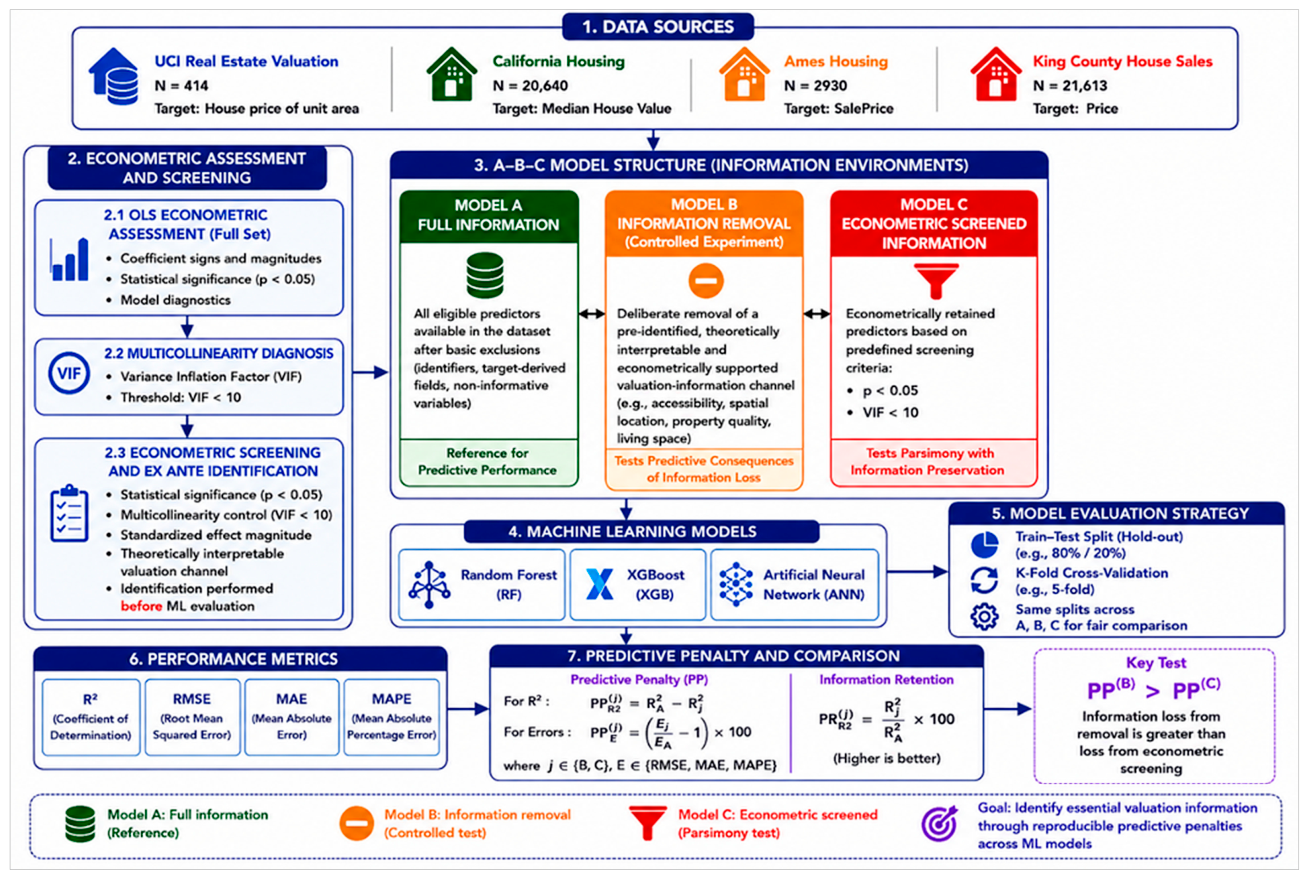
Figure 2.
Cross-dataset predictive performance under full-information, ex ante information-removal, and econometrically screened specifications.
Figure 2.
Cross-dataset predictive performance under full-information, ex ante information-removal, and econometrically screened specifications.
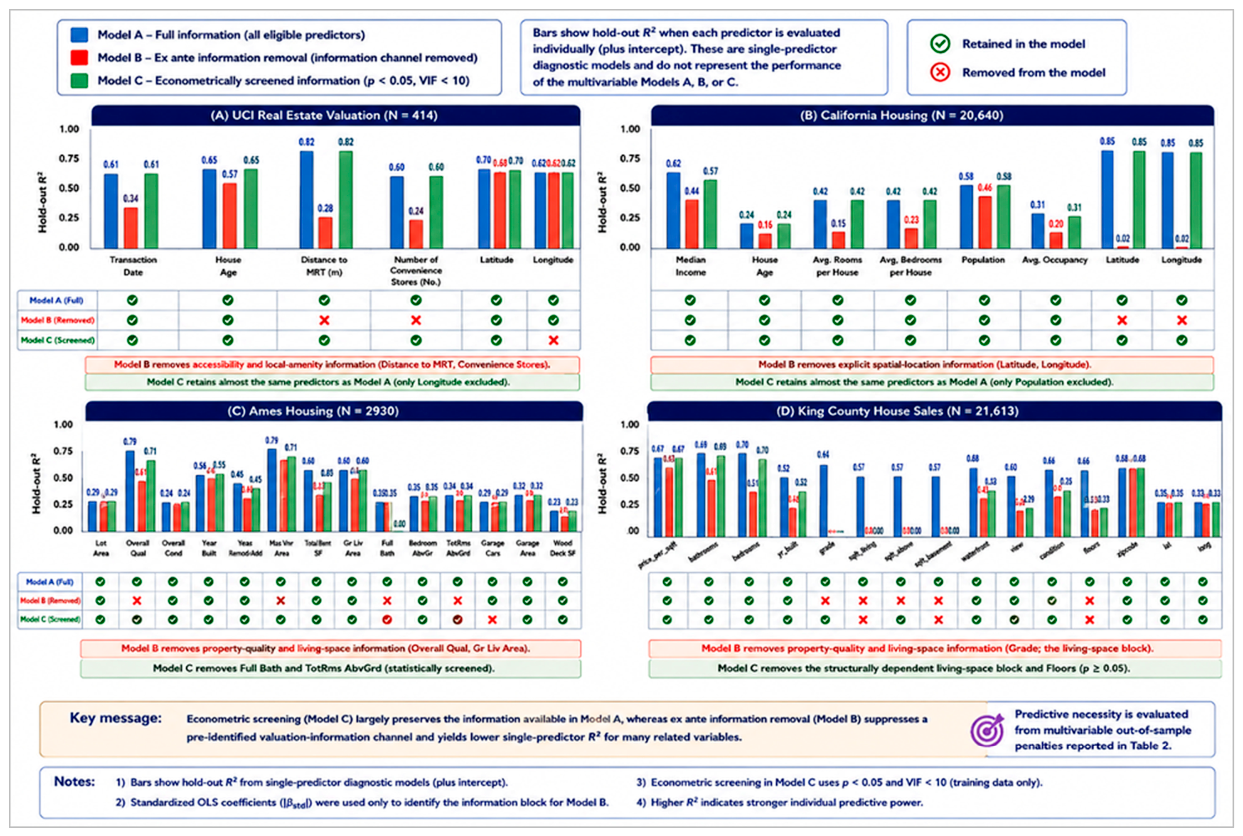
Table 1.
Comparative analysis of representative real-estate valuation studies and the proposed econometric-guided predictor-necessity framework.
Table 1.
Comparative analysis of representative real-estate valuation studies and the proposed econometric-guided predictor-necessity framework.
| Study | Main analytical orientation | Econometric evidence | ML prediction | Explainability / predictor interpretation | Controlled information removal | Cross-dataset / cross-model validation | Principal methodological role |
| Rosen [23] | Hedonic pricing theory | Yes | No | Economic interpretation | No | No | Establishes the theoretical basis for valuing heterogeneous property attributes |
| Sirmans et al. [22] | Hedonic model composition | Yes | No | Economic interpretation | No | Cross-study synthesis | Shows that hedonic predictor composition varies across empirical contexts |
| Schmid [11] | Multi-source housing-price prediction | Limited / auxiliary | Yes | Yes | No | Multi-information design | Integrates micro-, socioeconomic-, and macro-level information within a two-stage ML framework |
| Jin and Xu [12] | Residential property price-index prediction | No | Yes | Limited | No | Multiple ML models | Compares ML approaches for residential property-price-index forecasting |
| Chou et al. [13] | Real-estate price forecasting | No | Yes | Limited | No | Multiple ML models | Compares alternative ML models for preliminary real-estate price prediction |
| Deaconu et al. [14] | Valuation-model performance | Yes / comparative | Yes | Limited | No | Multiple valuation models | Evaluates the predictive performance of alternative real-estate valuation models |
| Tekouabou et al. [15] | Systematic review of AI/ML real-estate prediction | No | Yes | Reviewed | No | Literature-level | Synthesizes ML methods, applications, and challenges in urban real-estate prediction |
| Lorenz et al. [16] | Interpretable ML for real-estate markets | No | Yes | Yes | No | Model / market specific | Uses interpretable ML to explain predictor contributions in real-estate analysis |
| Bachmann [17] | Interpretable ML in residential rental markets | No | Yes | Yes | No | Model / market specific | Examines model mechanics and predictor effects in residential rental valuation |
| Xue et al. [18] | GIS and transport-accessibility valuation | Limited / auxiliary | Yes | Domain interpretation | No | Context specific | Demonstrates the valuation relevance of spatial and accessibility information |
| Elariane [19] | Location-based services and ML | Limited / auxiliary | Yes | Domain interpretation | No | Context specific | Uses location-based information to evaluate residential attractiveness through ML |
| Lee [20] | Neural-network real-estate valuation | No | Yes | Limited | No | Model specific | Improves real-estate valuation using neural networks with entity embeddings |
| Grybauskas et al. [21] | Big-data predictive analytics in real estate | No | Yes | Limited | No | Market / temporal context | Demonstrates predictive analytics under changing market conditions |
| Mammadrzayeva et al. [26] | Hybrid econometric-ML-XAI valuation | Yes | Yes | Yes | Partial sensitivity analysis | Cross-sector / cross-model | Integrates econometric modelling, nonlinear ML, and explainability within a unified valuation framework |
| Present study | Econometric-guided predictor necessity | Yes | Yes | Information-channel interpretation | Yes -ex ante controlled removal | Yes -four datasets; RF, XGB, ANN | Tests whether theoretically meaningful valuation information is predictively necessary through the consequence of its absence |
Note: The table compares methodological orientation rather than predictive performance. “Controlled information removal” refers to an explicitly predefined experiment in which a theoretically interpretable valuation-information channel is withheld before subsequent ML performance is inspected. “Limited / auxiliary” indicates that econometric or interpretive evidence is used in a supporting rather than central methodological role. The present study additionally separates ex ante information removal (Model B) from independent econometric screening (Model C).
Table 2.
Dataset-specific construction of the full-information, ex ante information-removal, and econometrically screened specifications.
Table 2.
Dataset-specific construction of the full-information, ex ante information-removal, and econometrically screened specifications.
| Dataset | Target | Model A: Full eligible information | Model B: Ex ante information removal | Corrected Model C: Econometrically screened information |
| UCI Real Estate Valuation | House price of unit area | 6 predictors: Transaction Date; House Age; Distance to nearest MRT station; Number of Convenience Stores; Latitude; Longitude | 4 predictors. Removed ex ante: Distance to nearest MRT station + Number of Convenience Stores, representing the accessibility/local-amenity information channel | 5 predictors: Transaction Date; House Age; Distance to nearest MRT station; Number of Convenience Stores; Latitude. Excluded: Longitude because of insufficient conditional statistical support (p=0.599; VIF=2.74) |
| California Housing | Median House Value | 8 predictors: Median Income; House Age; Average Rooms; Average Bedrooms; Population; Average Occupancy; Latitude; Longitude | 6 predictors. Removed ex ante: Latitude + Longitude, representing the explicit spatial-location information channel | 7 predictors: Median Income; House Age; Average Rooms; Average Bedrooms; Average Occupancy; Latitude; Longitude. Excluded: Population because of insufficient conditional statistical support (p=0.699; VIF=1.13) |
| Ames Housing | SalePrice | 15 predictors: Lot Area; Overall Qual; Overall Cond; Year Built; Year Remod/Add; Mas Vnr Area; Total Bsmt SF; Gr Liv Area; Full Bath; Bedroom AbvGr; TotRms AbvGrd; Fireplaces; Garage Cars; Garage Area; Wood Deck SF | 13 predictors. Removed ex ante: Overall Qual + Gr Liv Area, representing the property-quality/usable-living-space information channel | 13 predictors: Lot Area; Overall Qual; Overall Cond; Year Built; Year Remod/Add; Mas Vnr Area; Total Bsmt SF; Gr Liv Area; Bedroom AbvGr; Fireplaces; Garage Cars; Garage Area; Wood Deck SF. Excluded: Full Bath (p=0.199) and TotRms AbvGrd (p=0.938) because of insufficient conditional statistical support |
| King County House Sales | Price | 17 predictors: Bedrooms; Bathrooms; sqft_living; sqft_lot; Floors; Waterfront; View; Condition; Grade; sqft_above; sqft_basement; yr_built; yr_renovated; Latitude; Longitude; sqft_living15; sqft_lot15 | 13 predictors. Removed ex ante: Grade + sqft_living + sqft_above + sqft_basement, representing the property-quality/current-living-space information channel | 14 predictors: Bedrooms; Bathrooms; sqft_lot; Floors; Waterfront; View; Condition; Grade; yr_built; yr_renovated; Latitude; Longitude; sqft_living15; sqft_lot15. Excluded: sqft_living, sqft_above and sqft_basement because of exact structural collinearity |
Note: Model A contains the full eligible predictor set and serves as the full-information predictive benchmark. Model B represents an ex ante controlled information-removal experiment in which a theoretically interpretable and econometrically supported valuation-information channel was deliberately removed before inspection of subsequent RF, XGB, or ANN performance. Model C was constructed independently through econometric screening conducted on the training data, based primarily on statistical significance (p < 0.05) and multicollinearity diagnostics (VIF < 10), with coherent treatment of deterministic structural dependencies where required. Accordingly, Models B and C represent distinct information-reduction experiments: Model B tests the predictive consequences of deliberately withholding a theoretically meaningful valuation-information channel, whereas Model C tests whether an econometrically screened information set can preserve the predictive capability of Model A. Detailed predictor-level econometric evidence supporting both specifications is reported in Supplementary Table S3.
Table 3.
Cross-dataset predictive consequences of ex ante information removal and econometric screening relative to the full-information specification.
Table 3.
Cross-dataset predictive consequences of ex ante information removal and econometric screening relative to the full-information specification.
| Dataset | Mean Test R² Model A | Mean Test R² Model B | Mean Test R² Model C | A→B R² Penalty | A→B R² Retained (%) | A→C R² Penalty | A→C R² Retained (%) |
| UCI Real Estate | 0.8067 | 0.7370 | 0.7911 | 0.0697 | 91.36 | 0.0156 | 98.07 |
| California Housing | 0.7718 | 0.6806 | 0.7700 | 0.0912 | 88.18 | 0.0018 | 99.77 |
| Ames Housing | 0.8988 | 0.8772 | 0.9020 | 0.0216 | 97.59 | −0.0032 | 100.36 |
| King County | 0.8479 | 0.7957 | 0.8269 | 0.0523 | 93.84 | 0.0210 | 97.53 |
| Mean across datasets | 0.8313 | 0.7726 | 0.8225 | 0.0587 | 92.74 | 0.0088 | 98.93 |
Note: Values are averaged across RF, XGB, and ANN within each dataset. R² penalty is calculated as the difference between the mean test R² of Model A and that of the reduced specification, whereas R² retained expresses the corresponding reduced-model R² as a percentage of the Model A benchmark. A negative penalty indicates marginally higher hold-out performance rather than systematic superiority. Model B was defined ex ante through controlled removal of a theoretically interpretable valuation-information channel, whereas Model C was constructed independently through econometric screening of the training data.
Disclaimer/Publisher’s Note: The statements, opinions and data contained in all publications are solely those of the individual author(s) and contributor(s) and not of MDPI and/or the editor(s). MDPI and/or the editor(s) disclaim responsibility for any injury to people or property resulting from any ideas, methods, instructions or products referred to in the content. |
© 2026 by the authors. Licensee MDPI, Basel, Switzerland. This article is an open access article distributed under the terms and conditions of the Creative Commons Attribution (CC BY) license.
Copyright: This open access article is published under a Creative Commons CC BY 4.0 license, which permit the free download, distribution, and reuse, provided that the author and preprint are cited in any reuse.