

Submitted:
05 October 2026
Posted:
07 October 2026
You are already at the latest version
Abstract
Climate change is recognized as one of the key systemic threats to sustainable development, and business engagement in the climate agenda is a prerequisite for achieving the UN Sustainable Development Goals. Given that the Russian Federation experiences climate shifts at a rate exceeding the worldwide mean, coupled with the nascent state of its carbon market regulations, understanding the mechanisms by which small and medium-sized enterprises (SMEs) – with their limited resources and exemption from mandatory regulatory pressure – develop readiness for environmental, and primarily climate-related, action takes on particular significance. Drawing on a qualita-tive abductive research design utilizing the Gioia methodology, this study analyzes ten in-depth semi-structured interviews with owners of Russian SMEs from various industries. Verification was conducted through data triangulation (company websites, media publications, corporate reports) and independent coding. Two distinct trajectories of intention formation were identified: a pragmatic (defensive) trajectory and a value-based (creative) trajectory. A hierarchy of signal extraction and the role of the institutional vacuum as a boundary condition were established. The factors shaping companies' intentions to participate in climate initiatives were verified. Pro-environmental intentions in Russian SMEs are formed not as an automatic reac-tion to external stimuli, but as the result of multi-level cognitive processing in which the owner's personalized initiation interacts with network support, while the institutional vacuum functions simultaneously as both a barrier and a filter.
Keywords:
pro-environmental intentions
; small and medium-sized enterprises
; climate signals
; sensemaking theory
; Gioia methodology
; sustainable development
; SMEs
1. Introduction
Global warming poses a fundamental systemic risk to long-term human sustainability. Its far-reaching consequences—ranging from elevated temperatures and altered meteorological cycles to more frequent extreme weather events—disrupt critical economic domains like energy, agriculture, and infrastructure.
To counteract climate change, the global community has established a multi-tiered climate regulation system, anchored by the United Nations Framework Convention on Climate Change (1992), the Kyoto Protocol (1997), and the Paris Agreement (2015). The climate agenda is integrated into the UN Sustainable Development Goals (SDGs), which establish specific indicators that businesses help achieve.
Business has become a key player in combating climate change, integrating climate strategies into its operations through investments in low-carbon technologies, participation in carbon markets, and the implementation of climate projects. Corporate behavior regarding the climate agenda is shaped by a complex set of interrelated factors that can be categorized into two groups [1]:
Incentives: regulatory pressure [2,3], economic benefits [3,4], reputational advantages [5,6], and the personal convictions of management [7];
Barriers: financial constraints [8,9], short-term managerial orientation [6], information asymmetry [8,10], bureaucratic complexities [2,10], psychological factors, and business resistance [8,11].
However, merely listing incentives and barriers fails to reveal the mechanisms of their interaction or explain how climate signals are translated into managerial decisions. Existing research predominantly focuses on the large corporate sector [1], where environmental responsibility is formalized through specialized departments, public reporting, and internal carbon pricing mechanisms [4,6,12,13]. Small and medium-sized enterprises (SMEs) remain underexplored and are most often examined merely in the context of general barriers and constraints.
Yet, the environmental responsibility of large corporations and SMEs differs fundamentally. In SMEs, it rarely manifests through formal strategies; instead, it exists in the form of informal practices, operational decisions, and managerial choices that depend heavily on the personal beliefs and values of the owner-manager. The decision-making process in SMEs is highly personalized, rendering the cognitive attitudes of the leader the dominant mechanism for intention formation.
The climate agenda is of particular relevance for Russia. First, climate change within Russian territory is progressing significantly faster than the global average, posing substantial potential damage to both the population and the economy [14]. Second, Russia is actively shaping its domestic climate policy: the Strategy for Socio-Economic Development of the Russian Federation with Low Greenhouse Gas Emissions until 2050 envisions a 30% reduction in emissions by 2030 and the achievement of carbon neutrality by 2060; the Sakhalin Experiment is piloting carbon regulation mechanisms; and a network of carbon polygons is being deployed. Third, Russian companies face growing external pressure from the EU Carbon Border Adjustment Mechanism (CBAM, effective 2026) and the CORSIA system for international aviation, which create direct financial incentives for decarbonization.
The Russian institutional context—characterized by weak regulatory pressure on SMEs, a lack of developed “green” financing instruments, and uncertainty regarding the international recognition of carbon units [15,16]—amplifies the role of the cognitive level. This renders institutional incentives insufficient for integrating SMEs into the climate agenda. Under these conditions, external signals must be noticed, interpreted, and made sense of by the owner-manager before they can be translated into actionable intentions.
The aim of this study is to investigate the mechanisms underlying the formation of pro-environmental intentions in Russian SMEs through qualitative empirical research.
R1: How do owners of Russian SMEs notice, interpret, and translate climate signals into pro-environmental intentions, and what boundary conditions explain the variability of this process?
2. Literature Review and Theoretical Framework
2.1. Conceptual Model
To establish the theoretical foundation of this study, a systematic review of theoretical and empirical literature (covering the period 2017–2025) was conducted to examine business engagement in climate projects and initiatives, as well as their attitudes, roles, and actions within the context of climate change economics [1]. Based on the findings, a conceptual model of corporate participation in climate initiatives was developed (Figure 1). The model comprises three blocks: (1) antecedent factors, categorized into external, internal, and cognitive; (2) climate initiatives, classified as adaptive, mitigative, and compensatory; and (3) outcomes, encompassing economic, environmental, and socio-reputational indicators.
The model demonstrates that antecedent factors shape a company’s potential for participation in climate initiatives; this potential is then transformed into specific forms of climate action, which in turn lead to the generation of measurable outcomes.
The present study focuses on the stage of pro-environmental intention formation—an intermediate construct between antecedents (signals) and actual actions (initiatives). At the same time, the model allows for the verification of antecedent factors and initiatives within the context of Russian SMEs, as well as the documentation of observed implementation outcomes.
2.2. Pro-Environmental Intentions
Pro-environmental intentions represent the conscious readiness of an organization or its management to take actions aimed at protecting the environment, minimizing negative environmental impacts, and supporting environmental sustainability. It is a multidimensional construct encompassing values, perception of the external environment, self-identity, and planning [19]. Pro-environmental intentions are operationalized through various categories: “green” commitments [20,21], commitment to environmental sustainability [21], corporate sustainability motivations [22], and firm pro-environmental behavior [19].
The specific nature of SMEs determines the unique characteristics of pro-environmental intentions: personalization (intentions exist in the form of the owner’s personal beliefs), resource constraints, weak regulatory pressure, and the dominant role of cognitive factors. In SMEs, there is a pronounced intention-behavior gap, where the declared readiness for environmental actions is not realized due to a lack of operational resources or institutional uncertainty [9,23]. This specificity underscores the need to shift the research focus toward cognitive-behavioral decision-making mechanisms. Under conditions of weak regulatory pressure, it is the subjective interpretation of climate signals, altruistic motives, and entrepreneurial alertness that become the dominant drivers of intention formation [19].
2.3. Theoretical Framework
The theoretical foundation of the study is grounded in Karl Weick’s sensemaking theory, which posits that organizational reality is not objectively given but is constructed by individuals through the process of interpreting events, communication, and joint action. Sensemaking is the process through which an ambiguous flow of experience is transformed into a comprehensible situation that can be understood and acted upon. Weick (1995) identifies seven key properties of sensemaking: (1) grounded in identity—interpretation depends on how the entrepreneur defines themselves and their organization; (2) retrospective—the meaning of events becomes clear in hindsight; (3) enactment of the environment—people actively construct their environment through their actions and interpretations; (4) social—interpretations are formed in dialogue with the team, partners, and family; (5) ongoing—sensemaking never ceases; (6) focused on extracted cues—specific signals are isolated from an infinite flow of information; and (7) driven by plausibility rather than accuracy—under conditions of uncertainty, people seek a sufficiently plausible explanation to enable action [24].
This approach is particularly relevant for studying SMEs, as the owners of such enterprises operate under conditions of high uncertainty and limited resources, relying on subjective interpretations of external signals. In the context of the Russian institutional environment, where regulatory pressure on SMEs is minimal and access to “green” financing is limited, it is the owner’s cognitive mechanisms that act as the primary filter determining whether a climate signal will be noticed, interpreted, and transformed into an intention to act.
3. Materials and Methods
3.1. Research Context and Sample Characteristics
To uncover the process of pro-environmental intention formation as a sensemaking process, a qualitative abductive design was adopted, grounded in the Gioia methodology [25]. This choice was justified on several grounds. First, the research question begins with “how,” which makes a qualitative approach most relevant [26,27]. Second, sensemaking theory presupposes the study of subjective interpretations, which requires access to participants’ narratives. Third, the Gioia methodology ensures a rigorous transition from empirical data to theoretical conclusions through three levels of coding [25].
The study employs a purposive theoretical sampling strategy, in which companies were selected not on the basis of representativeness but on their potential to provide relevant data for the research. The inclusion criteria were as follows: the status of a small or medium-sized enterprise (SME) in accordance with Russian legislation; the presence of voluntary climate or environmental initiatives; and the participation of the owner or top manager in the decision-making process.
Additionally, a typology of companies was developed during the research, encompassing three categories of engagement with the climate agenda:
- • Category 1 (“Declaring” firms): Organizations that openly advocate for ecological responsibility, maintain verifiable sustainability documentation, and actively embed green practices into their core developmental strategies.
- • Category 2 (“Non-declaring” firms): Entities that adopt eco-friendly operational tweaks mainly to cut expenses (e.g., energy or waste reduction) without explicitly framing these actions as environmental initiatives.
- • Category 3 (“Eco-centric” business models): Enterprises where sustainability is the foundational value proposition, making ecological practices an inseparable part of their primary operations (such as organic manufacturing or waste recycling) rather than an add-on project.
This typology enabled the structuring of data at the initial stage of analysis and facilitated the identification of differences in pro-environmental intentions across company groups.
3.2. Data Collection
Semi-structured in-depth interviews were employed as the primary method of data collection [28]. Data collection was conducted between April and July 2026. Interviews were carried out both face-to-face and online (via the Yandex Telemost platform) and lasted between 60 and 90 minutes. All interviews were audio-recorded with the respondents’ consent and subsequently transcribed verbatim. A total of 10 semi-structured in-depth interviews were conducted with owners and top managers of Russian SMEs. Company size ranged from 7 to 200 employees, corresponding to the categories of small and medium-sized enterprises. The sample covered diverse industries, including hospitality (2), packaging manufacturing (1), food production (1), environmental consulting (1), forestry and logging (2), event services (1), energy engineering (1), and B2B sales (1).
Ethical standards were observed throughout the research process. All interviews were conducted with the respondents’ informed consent. Participants were briefed on the research objectives, the intended use of the data, and their right to decline to answer any question without providing a reason. All personal data (names, company names) were anonymized using ordinal codes (Respondent 1, Respondent 2, etc.), and all collected data are reported exclusively in aggregated form.
The interview guide was developed based on the study’s theoretical framework and comprised the following thematic blocks: immersion in the context; perception of climate signals from the external environment; perception of climate opportunities; strategic reorientation; strategic orientation; and the formation of pro-environmental intentions. During the interviews, we adhered to the principle of the “knowledgeable agent” [25], treating respondents as experts in their own experience.
For data triangulation, supplementary sources of information were utilized, including company websites, public reports, and news and media publications related to the companies’ environmental and climate initiatives. Based on the data gathered from open sources, profiles were prepared for each company and its owner, which provided a preliminary understanding of the company’s activities and positioning within the environmental agenda. This facilitated the refinement of interview questions and enabled the verification of information obtained during the interviews by cross-checking declared positions against factual data.
3.3. Data Analysis
Data analysis was conducted in accordance with the Gioia methodology [25], which entails a systematic transition from empirical data to theoretical inferences, achieved through a three-stage analytical process. In the first stage, first-order codes were identified using the respondents’ own terms (1st-Order Concepts). Each text fragment containing information regarding the perception of signals, their interpretation, decision-making processes, and influencing factors was assigned a code in the respondent’s own language. In the second stage, the codes were grouped into theoretical themes (2nd-Order Themes). At this stage, the initial codes, clustered based on semantic similarity, were consolidated into theoretical themes. Subsequently, in the third stage, the identified themes were aggregated into conceptual categories (Aggregate Dimensions).
A key element of the data analysis is the visual representation of the findings in the form of a data structure that demonstrates the linkages between first- and second-order codes and aggregate dimensions. This structure allows for tracing the progression from empirical data to theoretical conclusions, which is a crucial component for demonstrating the rigor of qualitative research [29].
To ensure the trustworthiness of the research findings [30], the following approaches were employed:
- • Data triangulation, which involved the use of multiple data sources;
- • Reflexivity, which entailed regular discussions of the obtained data and their interpretation within the research team;
- • An audit trail, which consisted of comprehensive and transparent documentation, wherein all research materials were preserved—including company profiles, interview recordings and transcripts, and codes of all orders—allowing the analytical process to be reconstructed and reproduced;
- • An independent coder, where coding was conducted involving an external researcher to verify consistency and minimize subjective bias.
4. Results
The data analysis was conducted in two sequential stages. In the first stage, a narrative analysis of the interviews was performed, aimed at capturing the primary layer of meanings forming in the consciousness of SME owners when encountering climate and environmental signals. In the second stage, three-level coding in accordance with the Gioia methodology was conducted, enabling the transition from narratives to theoretical generalizations.
4.1. Narrative Analysis
Appendix A presents the most representative narrative excerpts from the interviews. Due to the limited volume of the article, an abridged version of the data is provided.
The narrative analysis demonstrated high heterogeneity in the data. Some respondents describe the climate agenda through the language of operational costs and regulatory constraints; others—through the language of personal values and identity; and still others—through the language of competitive opportunities and market niches. At the same time, none of the respondents describe environmental initiatives as a direct and automatic reaction to external institutional pressure. All interviews contain a common pattern: between the external signal and the readiness to act, there is always an intermediate stage of subjective interpretation, the content and logic of which differ substantially across owners. This observation raises the question of how exactly this intermediate stage is structured and which mechanisms determine the variability of trajectories from signal to intention.
The presented narratives capture what respondents say but do not reveal the transformation process itself: which signals are noticed first, through which filters they pass, how they are transformed into specific intentions, and which boundary conditions determine the variability of this process. To answer these questions, three-level coding in accordance with the Gioia methodology was conducted, ensuring a rigorous and reproducible transition from respondent narratives to theoretical generalizations.
4.2. Coding in Accordance with the Gioia Methodology
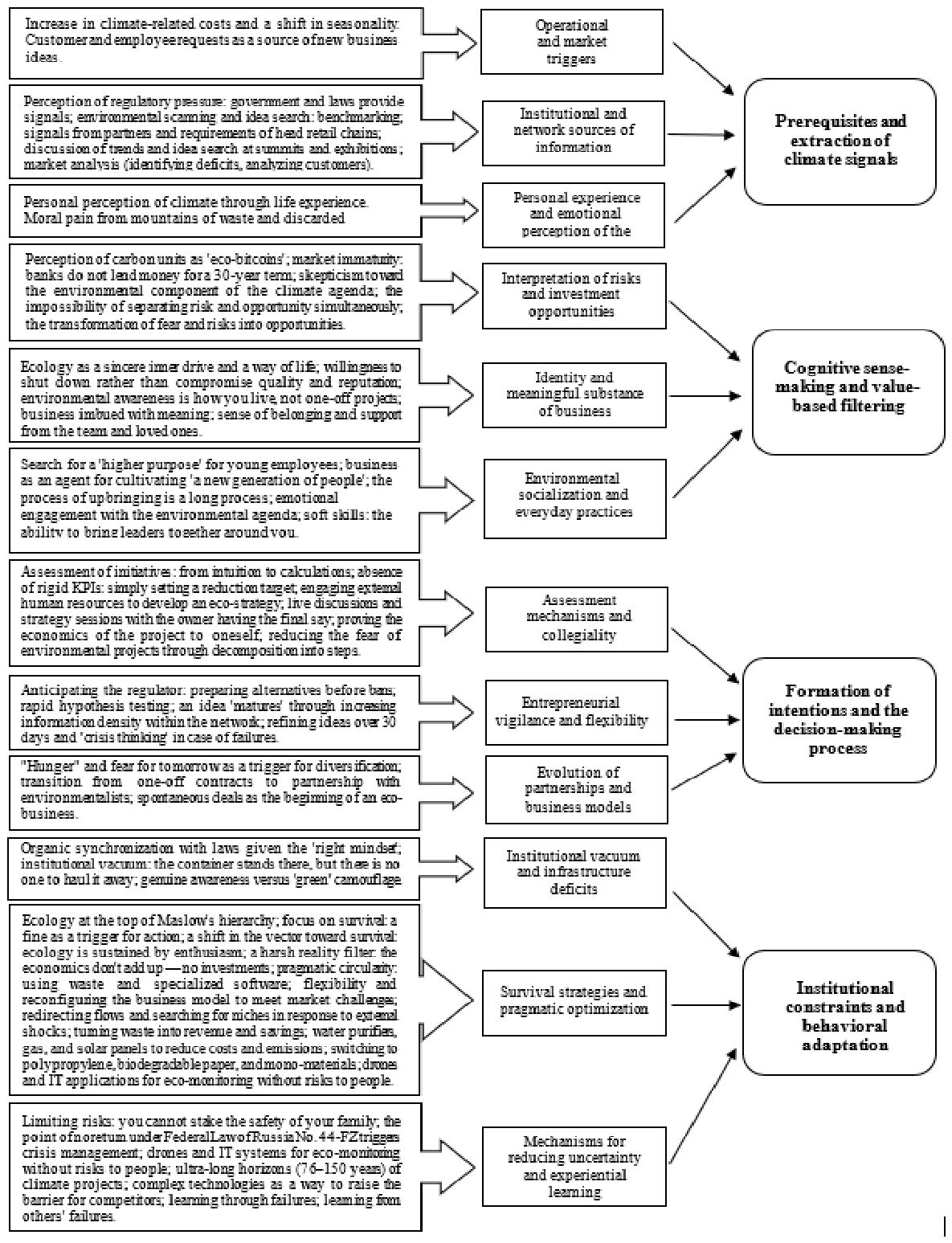
The analysis of 10 semi-structured in-depth interviews with owners of Russian SMEs yielded 44 first-order codes, which were grouped into 12 second-order themes and 4 aggregate dimensions. The data structure, presented in Figure 2, demonstrates the progression from respondent narratives to theoretical generalizations in accordance with the Gioia methodology [25].
The four identified aggregate dimensions—(1) prerequisites and extraction of climate signals, (2) cognitive sensemaking and value-based filtration, (3) intention formation and the decision-making process, and (4) institutional constraints and behavioural adaptation—describe the sequential stages of transforming climate signals into pro-environmental intentions. Each of these is discussed in detail below.
1. Prerequisites and extraction of climate signals. The first aggregate dimension describes the input conditions: which signals owners of Russian SMEs notice and from which sources they extract them. This dimension comprises three second-order themes.
Operational and market triggers. The data demonstrate that a crucial stage in extracting climate signals from the environment is the assessment of their operational impacts. These impacts include rising costs for air conditioning and energy consumption, shifts in seasonal demand, and changing consumer preferences. Respondents perceive climate change not through abstract data on global warming, but through the specific operational metrics of their businesses.
Requests from clients and employees also serve as a source of new signals. Unexpected inquiries from clients lead to the development of new services, while shifts in employee behaviour (such as refusing single-use plastic bags and adopting reusable tote bags) signal a change in values.
Institutional and network sources of information. Owners utilise a multiplex structure of channels for extracting primary signals. Regulatory signals (laws, prohibition lists, environmental levies) are perceived as the most significant for the manufacturing and packaging sectors. However, for a subset of respondents, the key source of signals is not the state, but rather monopoly partners, international parent networks, and industry summits. Discussions of trends at industry events, benchmarking (including international), and the analysis of market deficits complement this picture. Several respondents highlighted the role of informal information channels, such as contacts within regulatory bodies, professional networks, and word-of-mouth.
Personal experience and emotional perception of the environment. For some respondents, the extraction of climate signals begins not with external sources, but with personal experience (e.g., memories of snowier winters, observations of changing weather patterns, and emotional reactions to the wasteful use of resources). This theme aligns with Weick’s sensemaking theory, where the retrospective nature of sensemaking is evident in the way the meaning of climate change is constructed by comparing current experiences with the past.
2. Cognitive sensemaking and value filtration. The second aggregate dimension reveals the mechanisms for interpreting the extracted signals and comprises three second-order themes.
Interpretation of risks and investment opportunities. The data reveal a dominance of the economic frame in the interpretation of climate signals. Respondents consistently translate the climate agenda into the language of economics. Climate projects are perceived as a form of long-term investment, carbon units as an analogue of financial assets, and the climate agenda itself is interpreted primarily as an economic and political process of market redistribution. Respondents note the immaturity of the climate market: banks are unwilling to finance projects with a horizon of 30 years or more, and genuine environmental actions are often implemented without public fanfare.
A fundamental finding is the identified pattern of duality in climate signals. The same climate signal is interpreted simultaneously as both a risk and an opportunity. Respondents do not separate these categories but perceive them as inextricably linked. Fear and risks are transformed into opportunities through entrepreneurial alertness.
Identity and meaning-making in business. For a subset of respondents, environmental orientation is not a reaction to external stimuli but an extension of personal identity. Ecology is perceived as a lifestyle, a sincere inner impulse unrelated to market trends. Several respondents demonstrate a willingness to bear additional costs for environmental goals, which contradicts rational economic logic. Product quality and inner integrity serve as absolute values for which respondents are willing to close their business rather than compromise their principles. Business is perceived as a tool for imbuing life with meaning, rather than merely a source of profit. The search for a “higher purpose” for young employees serves as an additional motivator for environmental initiatives.
Environmental socialization and everyday practices. Pro-environmental intentions are not limited to formal projects but manifest in everyday practices and socialization processes. Respondents describe their business as an agent for nurturing a “new generation of people,” and environmental awareness as a daily practice rather than a series of one-off projects. The process of raising consciousness is characterized as long and arduous, aimed at the next generation. The emotional engagement of employees (e.g., showing video materials that evoke an emotional response) serves as a tool for transmitting environmental values within the organization.
3. Intention formation and the decision-making process. The third aggregate dimension describes the mechanisms through which sensemade signals are transformed into specific intentions to act and comprises three second-order themes.
Evaluation mechanisms and collegiality. The decision-making process in SMEs is predominantly collegial. Respondents describe lively discussions, strategy sessions, and regular working meetings where initiatives are debated. However, the final decision is typically made by the owner, who assumes responsibility. The process of evaluating initiatives moves from intuition to rational calculation; that is, the initial decision is made intuitively and then subjected to economic verification. Several respondents describe the practice of “proving the project’s economics to oneself,” which involves a mental presentation of the project to an internal investor.
Notably, there is an absence of formalized environmental KPIs. Respondents set reduction goals without specific quantitative targets, reflecting the informal nature of pro-environmental intentions in SMEs. Reducing the fear associated with environmental projects is achieved through task decomposition, breaking them down to make them less daunting. Attracting external resources (students, universities) acts as a catalyst for strategy formalization. Flexibility and business model transformation in response to market challenges, reorientation of flows, and niche-seeking in response to external shocks complement the picture of adaptive strategies.
Entrepreneurial alertness and flexibility. The data demonstrate a high speed of decision-making in SMEs. Initial actions to test a hypothesis are undertaken within 30 days, and ideas are worked out in a short timeframe. Respondents describe the practice of preempting regulatory changes, which involves preparing alternatives before bans come into effect. An idea “matures” through an increase in information density within the network: respondents and their partners think about a problem simultaneously, and at a certain point, a transition to action occurs. Flexibility and business model restructuring in response to market challenges, reorientation of flows, and niche-seeking in response to external shocks complement the picture of adaptive strategies.
Evolution of partnerships and business models. Intention formation often occurs not in isolation, but through interaction with partners. Respondents describe the transition from one-off contracts to long-term partnerships, spontaneous deals as the beginning of a new business, and “hunger” as a driver of diversification. Fear for the future and the inability to guarantee stability act as triggers for forming a model with multiple sources of income.
4. Institutional constraints and behavioural adaptation. The fourth aggregate dimension describes the boundary conditions of the process and comprises three second-order themes.
Institutional vacuum and infrastructure deficits. Institutional deficits serve as a key barrier to the realization of pro-environmental intentions. Respondents describe the absence of certified waste disposal operators, bureaucratic complexities under which initiatives “perish,” and the lack of waste segregation infrastructure. The geographical scale of the country exacerbates infrastructure deficits. Several respondents note that regulatory oversight is insufficient, which devalues businesses’ primary efforts.
For some respondents, the institutional vacuum manifests itself in a shift of focus toward survival. Environmental activities are sustained by enthusiasm alone, while economic instability leads to the abandonment of long-term planning. Several respondents note that the environmental agenda is located “at the top of the hierarchy of needs,” and when more pressing problems exist (tax payments, business survival), ecology simply “does not get reached.”
Survival strategies and pragmatic optimization. In conditions of institutional vacuum, pro-environmental intentions are realized predominantly through pragmatic optimization. Small and medium-sized enterprises implement internal circularity (reuse of packaging, waste compression, use of waste as fuel), adopt energy-saving technologies, and transition to recyclable materials. Economic efficiency serves as the primary filter: if investments do not yield returns, respondents refuse to proceed with implementation. Technological innovations (drones, IT systems for environmental monitoring, hybrid power stations) serve as instruments for realizing pro-environmental intentions, enabling simultaneous reduction of both costs and environmental footprint.
Mechanisms of uncertainty reduction and experiential learning. Respondents reduce uncertainty through risk limitation (refusal of high-risk projects that threaten family security), rapid hypothesis testing, and task decomposition. The point of no return (contract signing, inability to withdraw) serves as a driver of adaptation and triggers crisis management. The ultra-long horizons of climate projects (76–150 years) contrast with the short-term planning horizon of business, creating a fundamental contradiction.
Learning through failure and from others’ mistakes serves as a key mechanism of uncertainty reduction. Respondents described “panic” during initial setbacks but perceived them as a necessary condition for learning. Failure is perceived not as a reason to quit, but as a prerequisite for learning. Learning from the mistakes of others (analyzing the failures of large corporations) complements personal experience. Complex technologies are perceived as a means of raising barriers for competitors, which links environmental initiatives to competitive strategy.
Additionally, the analysis of empirical data revealed two distinct trajectories of pro-environmental intention formation. The data show that the same climate signal can be interpreted in fundamentally different ways depending on the dominant trajectory.
The pragmatic (defensive) trajectory is characterized by the interpretation of environmental issues as macroeconomic risks and regulatory pressures. The drivers include the fear of government regulation, demands from B2B partners, and the need for diversification. The mechanism for realization involves creating barriers to entry, preempting the regulator, and leveraging environmental initiatives as a competitive shield. This trajectory is characteristic of respondents from the manufacturing sector, environmental consulting, and forestry.
The value-based (creative) trajectory is characterized by the interpretation of environmental issues as an ethical imperative and an extension of personal identity. The drivers include personal empathy, moral disgust toward the wasteful use of resources, and love for the region. The mechanism for realization involves the conscious subsidization of unprofitable eco-practices through the core business. This trajectory is characteristic of respondents from the hospitality, food production, and event services sectors.
Thus, the three-level coding in accordance with the Gioia methodology enabled the systematization of narrative data from ten in-depth interviews and the identification of the structure of the pro-environmental intention formation process in Russian SMEs. The identified data structure demonstrates that the process of pro-environmental intention formation is not linear. At each stage, a signal may be filtered out, reinterpreted, or blocked, which explains the variability of SME responses to identical external stimuli.
5. Discussion
5.1. Summary of Findings and Verification of the Conceptual Model
The conceptual model developed in this study (Figure 1) was verified using qualitative data from Russian SMEs. The verification was conducted across three blocks of the model: antecedents, climate initiatives, and outcomes. The interview data confirm the presence of the three groups of antecedents identified in the model; however, they reveal a specific hierarchy of their significance for Russian SMEs. External factors, which act as the dominant driver in large business studies [4,7], move to the background in the context of Russian SMEs. Respondents note regulatory signals but perceive them not as a stimulus, but as a threat to the business model, generating reactive adaptation. These results align with the findings of Kouloukoui et al. (2019) [3], who showed that companies assess regulatory risks as more relevant than physical and market ones. Conversely, cognitive factors become dominant. The owner’s values and beliefs, entrepreneurial alertness, and personal identity act as the primary filter determining whether a signal will be noticed and interpreted. This result confirms and extends the theoretical proposition that under weak institutional pressure, subjective interpretation becomes the dominant mechanism [31,32]. Internal factors were also verifie [3,4d: financial resources act as the main decision-making filter (if investments do not yield returns, respondents refuse implementation), and corporate culture in SMEs is a direct reflection of the owner’s personal culture, blurring the boundary between individual and organizational levels. Formal strategic planning is largely absent; strategies exist as personal beliefs and intuitive decisions rather than formalized environmental KPIs.
Regarding climate initiatives, the data confirm the dominance of mitigating initiatives (energy efficiency, circular economy, transition to recyclable materials), which aligns with previous studies [3,4]. Adaptive initiatives manifest as operational adaptation to changing conditions (e.g., shifts in seasonality, increased air conditioning costs) but do not take the form of strategic adaptation typical of large businesses [33]. Compensatory initiatives (reforestation, carbon polygons) are recorded as a potential horizon but not as an implemented practice, due to the ultra-long horizons of climate projects (76–150 years), which are fundamentally incompatible with the short-term planning horizon of SMEs. Economic outcomes (reducing operating costs through circularity and energy efficiency) are verified most clearly. Environmental outcomes are recorded at the operational level (waste reduction, emission reductions). Socio-reputational outcomes manifest internally through team cohesion and attracting young employees via a “higher purpose,” whereas external reputational benefits do not act as a significant stimulus for Russian SMEs [4,5]. Thus, the conceptual model confirms its applicability to the context of Russian SMEs but requires contextual adaptation: cognitive factors take precedence among antecedents, mitigating initiatives dominate the mechanisms, and socio-reputational outcomes transform into internal organizational effects.
Furthermore, the three-level coding using the Gioia methodology revealed that the process of forming pro-environmental intentions in Russian SMEs is non-linear; at each stage, the signal can be filtered out, reinterpreted, or blocked. The process begins with the extraction of signals from multiple channels. Respondents perceive climate changes not through abstract data, but through specific operational metrics of their business. A stable hierarchy of signal extraction was discovered, where priority is determined not by objective significance, but by immediate impact on financial performance. At the cognitive sensemaking stage, signals pass through a filter determined by the owner’s identity, which dictates the trajectory of intention formation (value-based vs. pragmatic). A fundamental pattern of duality was identified: the same signal is interpreted simultaneously as a risk and an opportunity. The intention formation process is predominantly informal and iterative. Moreover, a pattern of prospective sensemaking was discovered, complementing retrospective sensemaking in conditions of regulatory unpredictability. Ultimately, the institutional vacuum acts simultaneously as a barrier blocking implementation and a filter that leaves only intentions supported by pragmatic benefits or deep personal values.
5.2. Theoretical Contributions
This study makes several contributions to the existing literature on pro-environmental behavior, sensemaking theory, and sustainable entrepreneurship in the context of small and medium-sized enterprises.
First, by providing robust empirical evidence on the mechanisms underlying the formation of pro-environmental intentions in Russian SMEs, this paper contributes to the existing literature on corporate environmental behavior. Based on the work of Shen & Zhang (2024) [19], Celso de Matos et al. (2024) [23], and Ab Albakoush and Kiraz (2025) [22], this study extends the understanding of pro-environmental intentions beyond large corporations, where environmental responsibility is formalized through specialized departments, public reporting, and internal carbon pricing mechanisms [12,13]. The findings reveal that in SMEs, pro-environmental intentions exist predominantly in the form of the owner’s personal beliefs and informal operational decisions rather than formalized strategies. This contrasts with the study by Hampton et al. (2023) [9], who examined barriers faced by SMEs in climate projects, but did not uncover the cognitive mechanisms through which these barriers are interpreted and overcome. The present study fills this gap by demonstrating that climate signals do not automatically translate into pro-environmental intentions; rather, they pass through a multi-level filter of cognitive sensemaking and value-based interpretation before forming actionable intentions.
Second, this paper identifies and theorizes two distinct trajectories of pro-environmental intention formation—the pragmatic (defensive) and the value-based (creative) trajectories—thereby contributing to the understanding of heterogeneity in SME responses to identical external stimuli. The pragmatic trajectory, characterized by the interpretation of environmental issues as macroeconomic risks and regulatory pressures, aligns with the findings of Zhu et al. (2022) [2] and Kouloukoui et al. (2019) [3] regarding regulatory pressure as a dominant stimulus for corporate environmental action. However, this study extends these findings by showing that in the context of Russian SMEs, regulatory pressure generates not proactive climate strategies but reactive adaptation and the creation of competitive barriers. The value-based trajectory, characterized by environmental responsibility as an ethical imperative and an extension of personal identity, resonates with the Value-Belief-Norm theory proposed by Stern (2000) [34] and the findings of Patzelt and Shepherd (2011) [35] regarding altruistic motives in environmental opportunity recognition. This study extends their work by demonstrating that in SMEs, the value-based trajectory can compensate for the absence of economic incentives through the mechanism of self-subsidizing unprofitable eco-practices from the core business. Importantly, these trajectories are not mutually exclusive; some owners demonstrate elements of both simultaneously, which extends the understanding of pro-environmental intentions as a multidimensional construct [19].
Third, this paper contributes to the understanding of boundary conditions shaping pro-environmental behavior by conceptualizing the institutional vacuum as simultaneously a barrier and a filter. Previous studies have examined institutional pressures as drivers of environmental behavior [2] or barriers to its implementation [9]. However, few studies have examined how the absence of institutional infrastructure shapes the very process of intention formation. This study reveals that the institutional vacuum—manifested in the absence of certified waste disposal operators, the lack of waste segregation infrastructure, bureaucratic complexities, and the geographical scale of the country—does not merely block the realization of already-formed intentions but actively filters which intentions can form in the first place. Only intentions supported by either pragmatic economic benefit or deep personal values survive this filter. This finding extends the institutional theory perspective on corporate environmental behavior [36,37] by demonstrating that in contexts of institutional void, the cognitive mechanisms of the owner become the dominant driver of environmental action, compensating for the absence of formal institutional support structures.
Fourth, this study extends Weick’s sensemaking theory [24] by applying it to the specific context of climate signal interpretation in resource-constrained SMEs. The findings reveal that sensemaking in SMEs is not merely individual but distributed: the owner initiates the intention, but the network—comprising the team, partners, clients, and professional communities—supports, refines, and subsidizes its implementation. This extends the social dimension of sensemaking theory by demonstrating that in SMEs, an intention is born individually but survives collectively. Furthermore, the study reveals a stable hierarchy in the extraction of climate signals (operational → regulatory → network → market → personal experience), which extends the “focused on extracted cues” property of sensemaking theory by showing that the hierarchy is determined not by the objective significance of the signal but by its immediate impact on financial performance. The identification of entrepreneurial alertness as the mechanism through which fear and uncertainty are transformed into sources of innovation and competitive advantage extends the understanding of the “enactment of the environment” property in the specific context of climate change.
Fifth, the study contributes to the literature on the intention-behavior gap in environmental behavior [20,23]. While previous studies have documented the existence of this gap in organizational contexts, this study reveals the specific mechanisms through which SMEs compensate for it: pragmatic optimization (implementing eco-practices only where they reduce costs) and value-based perseverance (pursuing eco-initiatives contrary to economic logic by self-subsidizing them through the core business). This extends the understanding of how the gap between declarative readiness and actual implementation is managed in resource-constrained environments.
5.3. Practical Implications
The findings of this study have several practical implications for policymakers, SME owners and managers, and business support organizations.
First, for regulatory bodies and policymakers seeking to achieve carbon neutrality through the engagement of SMEs in climate projects and initiatives, the results suggest that the most effective incentives are not direct financial subsidies but rather the reduction of institutional uncertainty and the creation of predictable infrastructure. The institutional vacuum identified in this study—manifested in the absence of unified standards, accessible verification mechanisms, and clear procedures for interaction with regulators—constitutes the primary barrier to SME engagement. Specific policy recommendations include: (1) the unification of requirements for climate projects; (2) the simplification of verification and certification procedures; (3) the development of public registries of “green” suppliers; and (4) the creation of accessible mechanisms for carbon unit registration. These measures would reduce transaction costs and allow SMEs to perceive long-term rules of the game, thereby lowering the perceived risk of environmental investments. This aligns with the findings of the present study, where respondents identified bureaucratic complexity and infrastructure deficits as the primary obstacles to implementing pro-environmental intentions.
Second, for SME owners and managers, the results suggest that the formation of pro-environmental intentions can begin with pragmatic optimization—implementing eco-practices that simultaneously reduce operational costs (energy efficiency, waste reduction, logistics optimization). The study demonstrates that such practices can serve as a “point of entry” into the climate agenda and, in the presence of a value-based filter, can evolve into substantive environmental initiatives. SME owners should recognize that their current informal practices (reuse of packaging, waste compression, use of waste as fuel) may be “repackaged” as climate initiatives with additional benefits, including access to preferential financing, reputational advantages, and participation in the supply chains of large corporations. Furthermore, the study highlights the importance of leveraging network support: engaging team members, partners, and professional communities in the development and implementation of environmental strategies can significantly reduce perceived risk and increase the likelihood of successful implementation.
Third, for business support organizations, industry associations, and business education providers, the results suggest that programs aimed at developing “climate sensitivity”—the ability to recognize environmental signals and interpret them as potential business opportunities rather than solely as regulatory burdens—would be particularly effective. The study demonstrates that SME owners who exhibit high entrepreneurial alertness and proactive market search are more likely to perceive climate signals as business opportunities. Business education programs should therefore include modules on climate signal recognition, interpretation, and transformation into actionable strategies, with emphasis on case studies of entrepreneurs who have successfully implemented climate initiatives. Additionally, given that decision-making in SMEs often has a collegial character and depends on the support of key employees, business education should be addressed not only to owners but also to their teams.
Fourth, for companies already declaring environmental initiatives, the study suggests that their practical experience of interacting with regulators and markets can be systematized and transmitted to regulators for the adjustment of support measures. Such companies can serve as a “bridge” between regulators and the broader business community, sharing insights about bureaucratic obstacles and proposing practical solutions. For companies with an “eco-business by model” (whose core business model is inherently ecological), the study suggests the need for tools to verify and monetize their environmental practices (e.g., through carbon units, green certificates, or participation in compensatory reforestation programs), as their current initiatives often remain undeclared and unaccounted for in economic models despite having a real climate effect.
5.4. Limitations and Future Research Directions
This study has several limitations that should be acknowledged. The sample of 10 interviews does not allow for statistical generalizability. The qualitative design enables deep exploration of cognitive mechanisms, the findings should be validated through quantitative research on larger samples. The study focuses on the formation of pro-environmental intentions and does not extend to the analysis of their implementation. The transition from intention to action is mediated by other factors (organizational routines, resource allocation, coordination mechanisms) that fall outside the cognitive-value paradigm of this research. The data were collected through self-reported interviews, which may be subject to social desirability bias.
Future research could address these limitations through several directions. Quantitative verification of the identified trajectories on expanded samples would strengthen the generalizability of the findings. Longitudinal studies could track the dynamics of intention formation and their evolution into action over time. Comparative analyses across different Russian regions (and potentially across countries with similar institutional voids) would help identify context-specific versus universal patterns. Studies examining the mechanisms of transition from intention to action would complement the present findings by addressing the full cycle of pro-environmental behavior. Additionally, research exploring the role of digital technologies in facilitating pro-environmental intention formation in SMEs would be timely, given the increasing digitalization of business processes and the potential of digital tools to reduce information asymmetry and transaction costs associated with environmental initiatives.
6. Conclusions
This study was aimed at investigating the mechanisms underlying the formation of pro-environmental intentions in Russian SMEs. The central research question was formulated as follows: How do owners of Russian SMEs notice, interpret, and transform climate signals into pro-environmental intentions, and what boundary conditions explain the variability of this process?
Drawing on a qualitative abductive design utilizing the Gioia methodology, ten in-depth semi-structured interviews with owners of Russian SMEs across various industries were analyzed. The results allow us to affirm that the research question has been answered.
First, it was established that climate signals do not automatically translate into pro-environmental intentions. A multi-level filter stands between the signal and the intention, encompassing cognitive sensemaking (translating the signal into the language of economics or values), value-based filtration (the alignment of the signal with the owner’s identity), and behavioral assessment (economic feasibility and perceived control). The process of intention formation is predominantly informal in nature: strategies exist in the form of the owner’s personal beliefs, and decisions are made intuitively with subsequent economic verification.
Second, two distinct trajectories of intention formation were identified: the pragmatic (defensive) trajectory, in which environmental issues are interpreted as macroeconomic risks and regulatory pressures, and the value-based (creative) trajectory, in which environmental responsibility serves as an ethical imperative and an extension of personal identity. These trajectories are not mutually exclusive; however, the dominant logic is typically defined by one of them.
Third, it was established that pro-environmental intentions in SMEs are distributed in nature. They are formed not in isolation within the owner’s consciousness, but through interaction with the team, partners, clients, and professional networks. Subjective norms in Russian SMEs are shaped by the immediate professional environment rather than by society at large.
Fourth, the institutional vacuum serves as a key boundary condition determining the variability of the process. Under identical external conditions, some owners form pro-environmental intentions, while others reject them in favor of survival. Infrastructure deficits block the realization of even fully formed intentions, and the gap between declaration and action is offset by two strategies—pragmatic optimization and value-based perseverance.
Fifth, the dual nature of climate signals was discovered. The same signal is interpreted simultaneously as both a risk and an opportunity. Entrepreneurial alertness enables the transformation of fear and uncertainty into sources of innovation and competitive advantage.
Author Contributions
Conceptualization, O.Y.; methodology, O.Y; formal analysis, O.Y.; investigation, O.Y.; data curation, O.N. and E.T.; writing—original draft preparation, O.Y.; writing—review and editing, O.Y.; Visualization, O.Y.; supervision, O.N. and E.T.
Funding
The work was carried out with the support of the State Assignment of the Ministry of Education and Science of Russia in the field of scientific activity under project No. FZNS-2026-0020 “Assessment of the Resource Potential of Coastal Marine Ecosystems”.
Institutional Review Board Statement
Ethical standards were observed throughout the research process. All interviews were conducted with the respondents’ informed consent. Participants were briefed on the research objectives, the intended use of the data, and their right to decline to answer any question without providing a reason. All personal data (names, company names) were anonymised using ordinal codes (Respondent 1, Respondent 2, etc.), and all collected data are reported exclusively in aggregated form.
Informed Consent Statement
Informed consent was obtained from all subjects involved in the study.
Data Availability Statement
The datasets analyzed during the current study are available from the corresponding author upon reasonable request.
Conflicts of Interest
The authors declare no conflicts of interest.
Abbreviations
The following abbreviations are used in this manuscript:
| SMEs | Small and medium-sized enterprises |
Appendix A

Table A1.
Narrative Excerpts (Quotes) from Interviews with Owners of Russian SMEs.
| 1st-order concepts | Narrative Excerpts |
| Increase in climate-related costs and a shift in seasonality |
“Climate change means changing air conditioning costs [...] any temperature fluctuations take a toll on the building’s condition” (Respondent 5); “Demand peaks are shifting [...] the winter lull ended much earlier due to a warm spring” (Respondent 7). |
| Personal perception of climate through life experience |
“I remember snowier winters in my childhood... the snow keeps getting less and less... sometimes it’s even above freezing in December” (Respondent 6); “The climate has changed significantly... winter used to be a proper winter, now it’s completely different for us” (Respondent 1). |
| Perception of regulatory pressure: government and laws provide signals |
“The legislation has changed, and it gives you a clear, unambiguous, absolutely understandable signal: get on with it” (Respondent 3). “My personal market, well, that is, my company’s market, is governed by the state and legislative changes, first and foremost” (Respondent 9). |
| Environmental scanning and idea search: benchmarking |
“We brazenly and shamelessly spy on others to see how similar enterprises are developing...” (Respondent 7); “We watched St. Petersburg hotels closely... just stared in open-mouthed admiration” (Respondent 5). |
| Signals from partners and requirements of parent networks | “Sustainability plans came from outside, but not from the state regulator, rather from international business standards” (Respondent 6). |
| Discussion of trends and idea search at summits and exhibitions |
“We get together in Moscow with other manufacturers and discuss the changes” (Respondent 7); “Exhibitions in China... there it’s more of a product-related issue, in terms of product range development” (Respondent 7). |
| Market analysis (identifying deficits, analyzing customers) |
“We analyze a multitude of signals coming from outside... first and foremost, we look at who is coming to visit us” (Respondent 6); “There are moments when you see that a certain market exists in this segment, and... it doesn’t exist in our region. Or you can break into it because only three colleagues are doing it... you can offer something better and more” (Respondent 4). |
| Customer and employee requests as a source of new business ideas |
“Sometimes clients come to us with unexpected questions, which then grow into either a new service, a new product, or even a completely new business” (Respondent 4); “The next block that is crucial for insights is our relationship with our clients. We simply go and ask: what needs exist, what is currently unmet?” (Respondent 7). |
| Assessment of initiatives: from intuition to calculations |
“All the standard tools involve market analysis, and it usually starts with formulating the requests... we calculate the risks and see how well it will go” (Respondent 8); “We assess how it will affect the bottom line... not just in the present moment, but over the course of several years” (Respondent 7). |
| Market immaturity: banks do not lend money for a 30-year horizon | “The global climate market is not yet mature. Neither Gazprombank nor Sberbank will fund it; they say, ‘Guys, 2036, the issuance of the first carbon units. We don’t have planning horizons that long’“ (Respondent 3). |
| Anticipating the regulator: preparing alternatives before bans | “Even back then, the state’s trend was clear... that the government would gradually introduce prohibitive barriers to the use of plastic. When plastic was banned at Lake Baikal, we adapted in time with corn-based alternatives” (Respondent 7). |
| Skepticism toward the environmental component of the climate agenda | “If we skip the beautiful rhetoric... I believe there is very little ecology and a whole lot of economics in it” (Respondent 4). |
| A shift in the vector toward survival: ecology is sustained by enthusiasm | “The focus has shifted to survival... environmental activities are literally sustained by enthusiasm alone” (Respondent 5). |
| “Hunger” and fear for tomorrow as a trigger for diversification | “What was the ultimate trigger? Hunger, the inability to guarantee tomorrow, forces you to build a model with multiple sources of income” (Respondent 3). |
| Ecology as a sincere inner drive and a way of life |
“It’s a way of life, and in production, we oriented ourselves exactly around how we live... we don’t follow any trends; it’s rather a sincere, inner drive” (Respondent 2); “You see, even some things that come at the expense of the environmental or economic components... we still do them because... it feels right, it aligns with our values, it feels close to us” (Respondent 5). |
| Search for a ‘higher purpose’ for young employees | “It is important for young people to work in a company that gives them something more than just a workplace... some kind of higher purpose” (Respondent 5). |
| Moral pain from mountains of waste and discarded resources |
“Just throwing it away [the oilseed meal], well, it’s terrible. In terms of the sheer amount of waste it creates” (Respondent 2); “It hurts to see resources being thrown away... it’s unpleasant that the business generates such a large amount of small waste” (Respondent 5). |
| Willingness to shut down rather than compromise quality and reputation | “We would rather close down than compromise product quality and lose our authority and our inner integrity as people” (Respondent 2). |
| Limiting risks: you cannot stake the safety of your family | “You must never jeopardize yourself, your safety, or your family’s financial security. I wouldn’t advise taking high-risk, unjustified gambles” (Respondent 3). |
| Business as an agent for cultivating ‘a new generation of people’ |
“We are deliberately trying to nurture a new generation, a new breed of people, so to speak” (Respondent 6); “It is important to me that the environmental direction develops... that it becomes the corporate culture of the city” (Respondent 1). |
| Gap between words and deeds: seeking eco-friendly options but buying cheap plastic | “There is a trend in what the buyer is looking for. But there is no trend in what the buyer actually purchases... Everyone wants eco-friendly packaging, but when they find out the price difference, they choose plastic” (Respondent 7). |
| The impossibility of separating: it is simultaneously both a risk and an opportunity | “First and foremost as an opportunity [regarding climate change], and then as a risk. Right away, well, they are inextricably linked... we would never consider it solely as an opportunity or solely as a risk” (Respondent 9). |
| Ultra-long horizons (76–150 years) of climate projects | “The Sakhalin agreement is for 76 years... you have to live to be at least 120 just to see the project through to completion” (Respondent 3). |
| Absence of rigid KPIs: simply setting a reduction target | “We don’t set goals to reduce energy consumption by a specific percentage... we simply set a goal to reduce it” (Respondent 6). |
| Rapid hypothesis testing |
“It doesn’t stay in our heads for long... we take the first steps to test the hypothesis within 30 days at most. And then we see: is it worth digging deeper or not?” (Respondent 7); “Most often, it’s a very short period... within a month. We immediately work out whether implementation is feasible. If it is, we get to work” (Respondent 6). |
| Redirecting flows and searching for niches in response to external shocks |
“When people had fewer opportunities to vacation abroad, the flow of tourists was redirected... we need to analyze that experience and meet their expectations here. That’s an opportunity for us” (Respondent 6); “Hunger... the inability to guarantee tomorrow forces you to build a model with multiple sources of income” (Respondent 3). |
| Emotional engagement with the environmental agenda | “We showed a video of sea turtles with straws sticking out of them... it brought people to tears. We managed to convey the value of this decision” (Respondent 5). |
| Business imbued with meaning | “An opportunity is when a business is filled with meaning, rather than just providing a place to sleep. If guests request an eco-agenda, we must support it as a response” (Respondent 5). |
| Transforming fear and risks into opportunities |
“Don’t be afraid... there will always be risks. You just have to look at how you can get extra benefits from a potential risk and turn it into new opportunities” (Respondent 7); “It was important for me, as an individual entrepreneur, to go through this journey and show my employees that it’s something we need to go through, that it’s difficult in places, scary in places, and involves financial risks, but it’s growth” (Respondent 1). |
| Live discussions and strategy sessions with the owner having the final say |
“Department heads would get together and discuss initiatives in the format of a lively discussion” (Respondent 5); “Most often we use strategy sessions... I’d gather guys from different departments with different work experience” (Respondent 7); “An idea comes up, we discuss it... I make all the final decisions, but that’s so I can take the responsibility on myself” (Respondent 3). |
| Learning through failures |
“When you’re going through your first contract, you still make a lot of mistakes” (Respondent 1); “If you don’t try, you definitely won’t succeed. With a 100% probability” (Respondent 4). |
| Learning from others’ failures | “Corporation A bet on this... and they lost. And that’s also part of business. Actually, as a non-professional businessman, I learn from them. How not to do things” (Respondent 4). |
| Genuine awareness versus ‘green’ camouflage | “Just give me the paperwork so they’ll back off... or, guys, please do it right for me, the way it should be done, so I can just work. And I consider this approach to be the most correct and conscious one” (Respondent 4). |
| Sense of belonging and support from the team and loved ones |
“When we did all this and got the certificate, we had this reaction: ‘Wow, great, we did it!’ The team felt the satisfaction of having done it with their own hands... a sense of involvement in doing a great, good deed” (Respondent 6); “My team supported me, my family supported me, and there’s this inner core that says I can do it, and I will” (Respondent 1). |
| Reducing the fear of environmental projects through decomposition into steps | “At first, everything seems huge, scary, and maybe even expensive. But when you start breaking it down into stages, steps, and individual tasks... by the middle, you can already breathe a little easier” (Respondent 6). |
| Transition from one-off contracts to partnership with environmentalists | “We need to move from one-off contracts to partnerships... the environmentalist guys should be the first to tell me about this, to help and advise on how to navigate it” (Respondent 4). |
| Turning waste into revenue and savings |
“All the nut meal goes into protein production...” (Respondent 2); “We started using our own waste as fuel for our own drying machines...” (Respondent 9). |
| Water purifiers, gas, and solar panels to reduce costs and emissions | “We installed water dispensers... we don’t have bottled water in the rooms anymore. There’s just a carafe... we achieved colossal savings on purchasing and waste disposal” (Respondent 6). |
| Switching to polypropylene, biodegradable paper, and monomaterials |
“We’re entering a project with a partner for polypropylene cups... they are 100% recyclable, unlike paper ones that have a lamination layer” (Respondent 7); “We switched to organic paper for microgreens... abandoning plastic packaging in favor of biodegradable alternatives” (Respondent 2). |
| Drones and IT applications for eco-monitoring without risks to people |
“We bought drones and mastered grass seeding using UAVs... without health risks, without crazy fuel costs” (Respondent 3); “We found some guys... developed a system that will display environmental status information in the management company’s app” (Respondent 4). |
References
- Yaryga, O.O. Business Attitude Towards Climate Projects: A Review of Empirical Studies. Izv. Far East. Fed. Univ. Econ. Manag. 2025, 2, 33–59. [Google Scholar]
- Zhu, B.; Xu, C.; Wang, P.; Zhang, L. How Does Internal Carbon Pricing Affect Corporate Environmental Performance? J. Bus. Res. 2022, 145, 65–77. [Google Scholar] [CrossRef]
- Kouloukoui, D.; Marinho, M.; Gomes, S.; Kiperstok, A.; Torres, E.A.; Torres, F.A. Corporate Climate Risk Management and the Implementation of Climate Projects by the World’s Largest Emitters. J. Clean. Prod. 2019, 238, 117935. [Google Scholar] [CrossRef]
- Shrestha, D. The Impacts of Climate Change on Businesses. Crossing Bord. Int. J. Interdiscip. Stud. 2014, 2, 93–112. [Google Scholar] [CrossRef]
- Henke, L.; Knoth, K.; Sandberg, E. Climate Change Adaptation in Norwegian Businesses—Awareness, Integration and Barriers. Clim. Risk Manag. 2024, 45, 100647. [Google Scholar] [CrossRef]
- Littlewood, D.; Decelis, R.; Hillenbrand, C.; Holt, D. Examining the Drivers and Outcomes of Corporate Commitment to Climate Change Action in European High Emitting Industry. Bus. Strategy Environ. 2018, 27, 1437–1449. [Google Scholar] [CrossRef]
- Barbedo, M.; Rita, P.; Ramos, R. CEOs’ and Directors’ Perspective Towards Environmental Sustainability and Climate Change. J. Clean. Prod. 2025, 496, 145143. [Google Scholar] [CrossRef]
- Liyanaarachchi, G.; Gamage, T.C.; Viglia, G.; Charton-Vachet, F. Overcoming Reactance to Climate Change: The Business-Ecology Nexus. J. Bus. Res. 2025, 190, 115229. [Google Scholar] [CrossRef]
- Hampton, S.; Blundel, R.; Eadson, W.; Northall, P.; Sugar, K. Crisis and Opportunity: Transforming Climate Governance for SMEs. Glob. Environ. Change 2023, 82, 102707. [Google Scholar] [CrossRef]
- Hu, C.; Pan, W.; Wen, L.; Pan, W. Can Climate Literacy Decrease the Gap Between Pro-Environmental Intention and Behaviour? J. Environ. Manag. 2025, 373, 123929. [Google Scholar] [CrossRef]
- Huang, S.; Wang, X.; Xue, Y.; Zhang, X. CEOs’ Climate Risk Perception Bias and Corporate Debt Structure. J. Int. Money Financ. 2025, 151, 103254. [Google Scholar] [CrossRef]
- Pakhomova, N.V.; Richter, K.K.; Vetrova, M.A. Global Climate Challenges, Structural Shifts in the Economy and the Development of Proactive Business Strategies for Achieving Carbon Neutrality. Vestn. St. Petersburg Univ. Econ. 2022, 38, 331–364. [Google Scholar] [CrossRef]
- Lvova, N.A. Managing Corporate Financial Sustainability Using a Sustainable Business Growth Model. Vestn. North Cauc. Fed. Univ. 2024, 6, 171–179. [Google Scholar] [CrossRef]
- Stepanov, I.A.; Makarov, I.A.; Muzychenko, E.E.; Galimova, K.Z. Global Initiatives to Prevent “Carbon Leakage”: Risks and Opportunities for Russia. Vestn. Mosk. Univ. Ser. 6. Econ. 2023, 3, 239–260. [Google Scholar] [CrossRef]
- Kuzminykh, Y.V. Problems of Financing Climate Projects in the Russian Federation in Current Conditions. Scientific Notes of the St. Petersburg Named After V.B. Bobkov Branch of the Russian Customs Academy 2020, 1, 67–72. [Google Scholar]
- Krupina, N.N. On the Issue of Climate Projects. Theory Pract. World Sci. 2024, 6, 22–26. [Google Scholar]
- Bingler, J.A.; Kraus, M.; Leippold, M.; Webersinke, N. How Cheap Talk in Climate Disclosures Relates to Climate Initiatives, Corporate Emissions, and Reputation Risk. J. Bank. Financ. 2024, 164, 107191. [Google Scholar] [CrossRef]
- Ntawuruhunga, D.; Ngowi, E.E.; Mangi, H.O.; Salanga, R.J.; Leonard, K.L. Farmers’ Knowledge, Attitude, and Motivation for Adoption of Climate-Smart Agroforestry in Two Contrasting Agroecosystems of Rwanda. Trees For. People 2025, 19, 100766. [Google Scholar] [CrossRef]
- Shen, J.; Zhang, H. Individuals’ Social Identity and Pro-Environmental Behaviors: Cross-Cultural Evidence from 48 Regions. Sustainability 2024, 16, 11299. [Google Scholar] [CrossRef]
- Chen, Y.; Du, M.; Xie, Y.; Wang, J. Veiled by a Green Image: Corporate Carbon Commitments and Employee Lawsuits. Financ. Res. Lett. 2026, 88, 109336. [Google Scholar] [CrossRef]
- Zhang, J.; Shao, X.; Sun, T. How Does Environmental Sustainability Commitment Affect Corporate Environmental Performance: A Chain Mediation Model. Sustainability 2025, 17, 3461. [Google Scholar] [CrossRef]
- Ab Albakoush, I.A.; Kiraz, A. Investigating the Impact of Corporate Environmental Sustainability Motivations on Environmental Management Practices. Sustainability 2025, 17, 7436. [Google Scholar] [CrossRef]
- de Matos, C.A.; Luppi, L.; Veiga, R.T. Assessing the Intention-Behavior Gap in the Pro-Environmental Behavior Context: A Longitudinal Study About Water Conservation. J. Clean. Prod. 2026, 524, 146499. [Google Scholar] [CrossRef]
- Weick, K.E. Sensemaking in Organizations; Sage Publications: Thousand Oaks, CA, USA, 1995; ISBN 0-8039-7177-X. [Google Scholar]
- Gioia, D.A.; Corley, K.G.; Hamilton, A.L. Seeking Qualitative Rigor in Inductive Research: Notes on the Gioia Methodology. Organ. Res. Methods 2013, 16, 15–31. [Google Scholar]
- Eisenhardt, K.M. Building Theories from Case Study Research. Acad. Manag. Rev. 1989, 14, 532–550. [Google Scholar] [CrossRef]
- Yin, R.K. Case Study Research: Design and Methods, 3rd ed.; Sage: Thousand Oaks, CA, USA, 2003. [Google Scholar]
- Rubin, H.J.; Rubin, I.S. Qualitative Interviewing: The Art of Hearing Data, 2nd ed.; Sage: Thousand Oaks, CA, USA, 2005. [Google Scholar]
- Pratt, M.G. Fitting Oval Pegs into Round Holes: Tensions in Evaluating and Publishing Qualitative Research in Top-Tier North American Journals. Organ. Res. Methods 2008, 11, 481–509. [Google Scholar]
- Lincoln, Y.S.; Guba, E.G. Naturalistic Inquiry; Sage: Beverly Hills, CA, USA, 1985. [Google Scholar]
- Emami, A.; Yoruk, E.; Jones, P. The Interplay Between Market Need Urgency, Entrepreneurial Push and Pull Insights and Opportunity Confidence in the Course of New Venture Creation in the Developing Country Context. J. Bus. Res. 2023, 163, 113882. [Google Scholar] [CrossRef]
- Wade, B.; Meath, C.; Griffiths, A. Capabilities for Circularity: Overcoming Challenges to Turn Waste into a Resource. Bus. Strategy Environ. 2022, 31, 2658–2681. [Google Scholar] [CrossRef]
- Macchion, L.; Moretto, A.; Caniato, F.; Caridi, M.; Danese, P.; Spina, G.; Vinelli, A. Improving Innovation Performance through Environmental Practices in the Fashion Industry: The Moderating Effect of Internationalisation and the Influence of Collaboration. Prod. Plan. Control 2017, 28(3), 190–201. [Google Scholar] [CrossRef]
- Stern, P.C. New Environmental Theories: Toward a Coherent Theory of Environmentally Significant Behavior. J. Soc. Issues 2000, 56, 407–424. [Google Scholar] [CrossRef]
- Patzelt, H.; Shepherd, D.A. Recognizing Opportunities for Sustainable Development. Entrep. Theory Pract. 2011, 35, 631–652. [Google Scholar] [CrossRef]
- Suchman, M.C. Managing Legitimacy: Strategic and Institutional Approaches. Acad. Manag. Rev. 1995, 20, 571–610. [Google Scholar] [CrossRef]
- Hoffman, A.J. Institutional Evolution and Change: Environmentalism and the U.S. Chemical Industry. Acad. Manag. J. 1999, 42, 351–371. [Google Scholar] [CrossRef]
Figure 1.
Conceptual model of company participation in climate initiatives. Source: compiled based on [2,3,4,6,7,8,9,17,18].
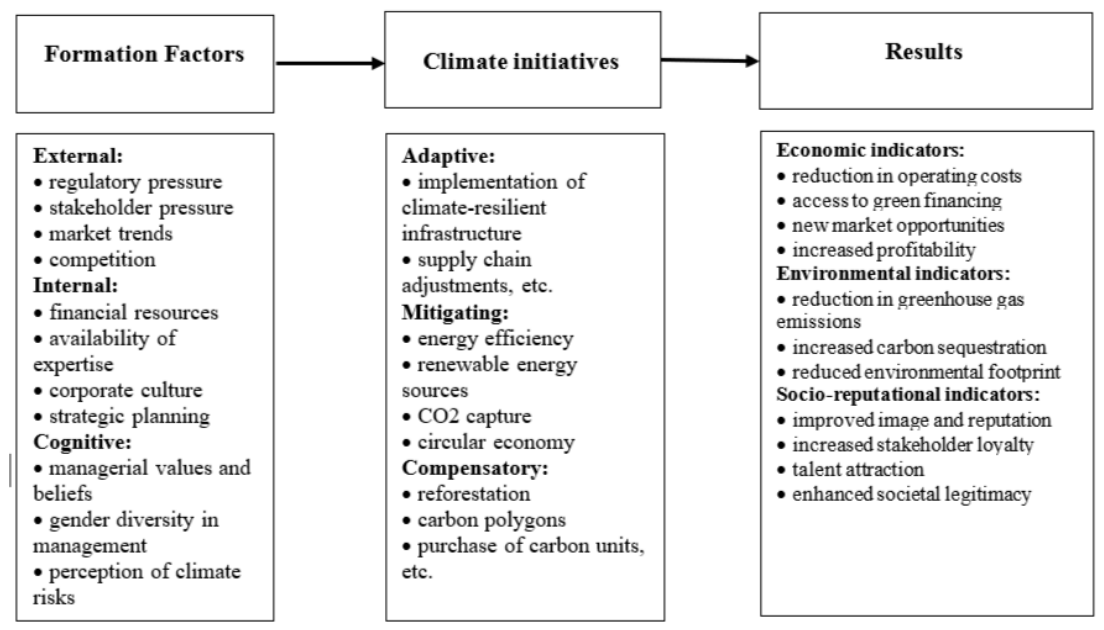
Figure 2.
Data Structure (Gioia Methodology). Source: compiled by the author.
Disclaimer/Publisher’s Note: The statements, opinions and data contained in all publications are solely those of the individual author(s) and contributor(s) and not of MDPI and/or the editor(s). MDPI and/or the editor(s) disclaim responsibility for any injury to people or property resulting from any ideas, methods, instructions or products referred to in the content. |
© 2026 by the authors. Licensee MDPI, Basel, Switzerland. This article is an open access article distributed under the terms and conditions of the Creative Commons Attribution (CC BY) license.
Copyright: This open access article is published under a Creative Commons CC BY 4.0 license, which permit the free download, distribution, and reuse, provided that the author and preprint are cited in any reuse.