

Submitted:
04 October 2026
Posted:
07 October 2026
You are already at the latest version
Abstract
Sodium-ion batteries are emerging as a complementary electrochemical energy-storage technology to lithium-ion batteries, particularly for stationary, grid-scale, and other cost-sensitive applications. However, assessing the practical relevance of newly developed sodium-ion materials remains challenging because early-stage electrochemical evaluation is still dominated by Na-metal half-cells. These configurations are indispensable for establishing reversible capacity within defined voltage windows, redox behavior, kinetic characteristics, structural evolution, initial Coulombic efficiency, and electrode-specific interfacial processes, but they do not reproduce the finite sodium inventory, electrode balancing, realistic loading, shared electrolyte environment, or coupled ageing that govern practical full cells. This review develops a translational framework for evaluating sodium-ion battery materials across successive levels of experimental realism. It first defines the appropriate role of half-cell testing and then examines the transition toward realistic composite electrodes and balanced full cells, with particular emphasis on mass loading, areal capacity, electrode density, N/P ratio, sodium-inventory management, electrolyte amount, full-cell energy, Coulombic efficiency, impedance evolution, and reproducibility. Interfacial chemistry is considered in terms of the transition from electrode-specific SEI/CEI formation to chemically coupled full-cell behavior, including interelectrode cross-talk, transition-metal migration, electrolyte-derived species, gas evolution, and their consequences for sodium loss and impedance growth. Operando and in situ characterization are discussed according to an architecture–mechanism–diagnostic framework in which X-ray methods, vibrational spectroscopies, imaging and microscopy, impedance analysis, and multimodal approaches are matched to the degradation processes they are intended to resolve under increasingly representative cell conditions. Finally, a staged validation pathway is proposed, progressing from material-level half-cell characterization to realistic electrode validation, balanced full-cell testing, operando diagnosis, and prototype-level assessment. By distinguishing what each experimental stage can establish and which questions require more representative architectures, this review provides a framework for assessing whether favorable material-level performance can be translated into practical sodium-ion battery operation.
Keywords:
sodium-ion batteries
; half-cell testing
; full-cell validation
; electrode balancing
; sodium inventory
; electrode–electrolyte interphases
; interelectrode cross-talk
; operando characterization
1. Introduction
Sodium-ion batteries (SIBs) are emerging as a complementary electrochemical energy-storage technology to lithium-ion batteries, particularly for stationary storage, grid applications, and other cost-sensitive sectors where resource availability, supply-chain resilience, and manufacturability are important considerations [1,2,3,4,5]. Considerable progress has been achieved in hard-carbon anodes, layered oxides, polyanionic cathodes, Prussian blue analogs, electrolyte formulations, and interfacial engineering [1,6,7]. Nevertheless, assessing whether a newly developed material is genuinely relevant to practical sodium-ion cells remains difficult because early-stage electrochemical evaluation is still dominated by half-cell configurations against metallic sodium [6,7].
Half-cells are indispensable during materials development. Their primary role is to isolate the electrochemical response of the working electrode and establish fundamental descriptors such as reversible capacity within a defined voltage window, redox behavior, polarization, reaction reversibility, transport characteristics, charge-transfer kinetics, phase evolution, and early degradation signatures. This is particularly important when newly synthesized materials are available only in limited quantities and their intrinsic electrochemical behavior must be established before larger-scale electrode processing is justified. More generally, distinguishing material-, electrode-, and cell-level performance is essential to avoid inappropriate extrapolation of laboratory metrics to application-level battery behavior [8,9,10]. The limitation of half-cell testing therefore lies not in the information it provides, but in extending conclusions beyond the questions that this configuration is designed to answer.
The transition toward practical relevance begins when the research question shifts from how a material stores Na to whether it can operate efficiently as one electrode of a finite, balanced sodium-ion cell. A Na-metal counter electrode provides a sodium reservoir and electrochemical boundary condition fundamentally different from those of a practical rocking-chair cell. Consequently, conventional Na-metal half-cells cannot by themselves establish the effects of finite sodium inventory, irreversible first-cycle losses, cathode–anode capacity matching, realistic electrode loading, electrolyte limitation, or coupled ageing [8,9,10,11,12]. These constraints are particularly important for hard-carbon-based SIBs, where first-cycle sodium consumption can substantially reduce the cyclable sodium available in a full cell and directly penalize usable capacity and energy density [6,13,14,15].
A useful distinction is therefore required between material testing, electrode testing, and cell testing. At the material level, low-loading half-cells remain appropriate for establishing intrinsic electrochemical properties and determining whether a candidate chemistry merits further development. The next stage requires realistic composite electrodes, where processability, formulation, mass loading, thickness, porosity, density, and transport limitations become relevant. Balanced full cells then provide the appropriate platform for assessing finite sodium inventory, cathode–anode matching, practical voltage and energy output, electrolyte sufficiency, impedance growth, and long-term coupled ageing [8,9,11,12]. This staged progression avoids both dismissing half-cell measurements that provide essential materials information and treating favorable half-cell data as evidence of practical-cell viability.
The distinction becomes particularly important for interfacial chemistry. SEI and CEI formation can be investigated effectively in half-cells, and carefully designed model cells remain valuable for isolating interfacial reactions and determining their chemical origin [16]. Practical full cells, however, introduce a finite sodium inventory, a shared electrolyte, and interelectrode coupling. Reaction products generated at one electrode may migrate through the electrolyte and modify the opposite interface, while continued electrolyte consumption, transition-metal migration, gas evolution, and coupled SEI/CEI ageing become whole-cell processes [17]. The relevant question is therefore not whether interfaces can be studied in half-cells, but which interfacial processes change when the electrochemical boundary conditions shift from a sodium-metal reservoir to a paired, finite-inventory cell.
This change in architecture also provides the rationale for operando and in situ characterization. Half-cell operando experiments remain highly informative for resolving material-specific redox reactions, phase transitions, structural evolution, and selected interfacial processes [16]. At the full-cell level, the additional challenge is to determine how these local processes interact with electrode balancing, finite sodium inventory, transport gradients, reaction heterogeneity, and simultaneous ageing of both electrodes. Structural, spectroscopic, imaging, and electrochemical methods performed under operating conditions can therefore provide information that endpoint measurements alone cannot recover, particularly when degradation is dynamic or spatially heterogeneous [16,18]. Operando measurements become most relevant when they are designed to identify which mechanisms emerge, change in importance, or become coupled as the experiment progresses from a model electrode toward a realistic sodium-ion cell.
Evidence from more representative SIB architectures reinforces this need. Characterization of a commercial 1.2 Ah sodium-ion cell has shown that balancing, electrolyte behavior, impedance evolution, gas-related phenomena, and safety-device activation can become relevant at the complete-cell level [19]. Likewise, model-based analysis demonstrates that electrode thickness, particle dimensions, porosity, active-material fraction, and electrolyte transport can strongly influence reaction uniformity and usable capacity as current density increases [11]. Practical validation therefore introduces interacting variables that are not captured by simply scaling up a favorable half-cell result.
This review adopts a translational framework for evaluating how evidence should evolve as sodium-ion materials progress toward practical validation. It first defines the appropriate role and limitations of Na-metal half-cells and then examines the transition toward realistic composite electrodes and balanced full cells, with emphasis on sodium inventory, electrode balancing, loading, areal capacity, density, electrolyte amount, and cell-level performance metrics. Interfacial chemistry is considered specifically in terms of the differences between isolated electrode measurements and paired full-cell operation, with particular attention to cross-talk. Operando and in situ methods are discussed according to the degradation processes they can resolve under increasingly representative cell conditions. The resulting validation pathway: material screening → realistic electrode fabrication → balanced full-cell evaluation → operando diagnosis → prototype-level validation, provides a framework for distinguishing what each experimental stage can establish and where further evidence is required before practical relevance can be claimed. This progression is summarized schematically in Figure 1, which illustrates how the experimental questions, relevant metrics, and unresolved constraints evolve from material-level half-cell characterization toward increasingly representative sodium-ion cell architectures.
2. From Material Screening to Practical Electrode Validation
The progression from a newly synthesized sodium-storage material to a practical sodium-ion cell is best understood as a sequence of validation levels rather than as a direct transition from synthesis to full-cell testing. Each experimental configuration addresses a different set of questions. Half-cells provide controlled access to the intrinsic electrochemical response of a candidate material; realistic composite electrodes introduce processing, loading, porosity, density, and transport constraints; and balanced full cells determine whether both electrodes remain compatible under finite sodium inventory, shared electrolyte conditions, and coupled ageing [8,9,10,12].
This distinction is particularly important in sodium-ion batteries because several parameters that appear secondary during isolated electrode testing become decisive during translation. Hard-carbon anodes, for example, may exhibit attractive reversible sodium-storage behavior in Na-metal half-cells while still presenting practical limitations associated with initial Coulombic efficiency, sodium-inventory loss, and full-cell balancing [6,7]. A rigorous validation strategy must therefore preserve the mechanistic value of half-cell measurements while progressively introducing the architectural and electrochemical constraints that govern realistic electrodes and cells.
2.1. What Half-Cells Can Reliably Establish
Half-cell testing remains the appropriate starting point for the electrochemical assessment of newly developed sodium-ion electrode materials. Pairing the material of interest with metallic sodium allows the response of the working electrode to be examined without the additional variables introduced by a second insertion electrode. This configuration is particularly useful during early-stage materials development, when the objective is to establish intrinsic sodium-storage behavior before electrode-scale optimization or full-cell balancing is attempted [6,7].
A primary outcome of half-cell testing is the reversible capacity of the working electrode within a clearly defined voltage window. Capacity should be interpreted together with voltage limits, current density or C-rate, electrode loading, and cycle number, because these parameters determine the fraction of electrochemically accessible capacity that is reached under the selected conditions [9,10]. Half-cell capacity is therefore a material-level descriptor rather than a direct predictor of full-cell energy density.
Half-cells are equally valuable for resolving voltage profiles and redox behavior. Galvanostatic charge–discharge curves, cyclic voltammetry, and differential-capacity analysis can identify characteristic redox potentials, voltage plateaus or sloping regions, hysteresis, and changes in reaction reversibility. These features help establish whether sodium storage proceeds through solid-solution behavior, phase transitions, adsorption-dominated processes, intercalation, alloying, or conversion reactions [6,7]. Such information is essential for defining a meaningful operating window and for selecting an appropriate counter electrode for subsequent full-cell development.
Kinetic information can also be obtained effectively when electrode geometry and test conditions are appropriately controlled. Rate-capability measurements, electrochemical impedance spectroscopy, intermittent titration methods, and related techniques provide insight into charge-transfer resistance, apparent Na+ transport limitations, and diffusion-related behavior. Low-loading electrodes are particularly useful at this stage because they reduce through-thickness transport gradients and help separate intrinsic material response from limitations imposed by practical electrode architecture [9,12].
Half-cell configurations also facilitate mechanistic characterization. Operando or in situ diffraction, spectroscopy, microscopy, and impedance measurements can identify phase evolution, lattice changes, local bonding variations, and early interfacial reactions during sodiation and desodiation. For hard carbon, half-cell studies have been central to the development of models involving adsorption, interlayer insertion, and pore-filling contributions to sodium storage [6]. These mechanistic insights remain valid even when later electrode- or cell-level testing introduces additional constraints.
Initial Coulombic efficiency is another important electrode-level descriptor obtained from half-cells. First-cycle irreversible loss reflects processes such as SEI formation, electrolyte reduction, sodium trapping, and other non-reversible reactions. This parameter is especially relevant for hard carbon, where initial sodium consumption can be substantial [6,7]. Half-cell measurements quantify the magnitude of this irreversible demand, whereas its practical consequence must subsequently be evaluated in a full cell with finite sodium inventory.
Interfacial studies are similarly informative at this level. Half-cells can resolve SEI or CEI formation, electrolyte-additive decomposition, interfacial resistance, and electrode-specific surface reactions, particularly when electrochemical analysis is combined with operando or post-mortem characterization. Their limitation is not an inability to probe interfacial chemistry, but the absence of the coupled environment created when two insertion electrodes share the same electrolyte and finite sodium inventory.
Half-cell testing therefore provides the material-level evidence required to determine whether a candidate electrode warrants progression toward realistic electrode architectures. Its predictive scope is strongest for intrinsic electrochemical behavior and electrode-specific mechanisms, whereas parameters governed by loading, electrode architecture, finite sodium inventory, electrode balancing, and interelectrode coupling require subsequent validation stages [9,10,12].
2.2. What Changes at the Electrode Level
Once a candidate material has demonstrated meaningful sodium-storage behavior in a half-cell, the next validation step is its incorporation into a realistic composite electrode. At this stage, the dominant variables shift from intrinsic material properties toward processing, transport, mechanical integrity, and electrode architecture. The electrochemical response of the active material is therefore evaluated together with the binder, conductive network, current collector, porosity, thickness, density, and processing conditions that define the functional electrode [8,9,12].
Electrode processability becomes a central consideration. Slurry preparation, binder chemistry, conductive-additive dispersion, coating, drying, and calendering determine whether the electrode develops adequate electronic connectivity, ionic accessibility, adhesion, and mechanical stability. Agglomeration, phase segregation, cracking, poor adhesion, or unstable rheology can degrade performance independently of the intrinsic electrochemical properties of the active material [8,12].
Mass loading is one of the first parameters to expose this transition. Low-loading electrodes minimize through-thickness transport limitations and are therefore useful for material-level characterization, but practical electrodes require higher active-material loading per unit area. Increasing loading generally increases electrode thickness, ionic transport distance, and sensitivity to pore connectivity and electrolyte penetration [8,9]. As a result, a material that exhibits high utilization at low loading may show increased polarization and reduced accessible capacity when incorporated into a thicker electrode.
Areal capacity provides a more meaningful electrode-level descriptor than gravimetric capacity alone because it relates the amount of charge delivered to electrode area. Two electrodes with similar specific capacity can therefore differ substantially in practical relevance if their loadings are different. Reporting specific capacity together with mass loading and areal capacity is necessary to distinguish intrinsic material utilization from electrode-level productivity [9,10].
Electrode thickness, porosity, and density further determine whether increased loading translates into useful performance. Greater density can improve volumetric energy density and reduce inactive volume, but excessive compaction can restrict electrolyte infiltration, increase tortuosity, and intensify concentration gradients. Similarly, thick electrodes may become transport-limited even when the active material exhibits favorable intrinsic kinetics [8]. The relevant objective is therefore an architecture that balances ionic transport, electronic connectivity, mechanical stability, and volumetric efficiency.
These trade-offs are particularly relevant for sodium-ion electrodes such as hard carbon, where surface area, porosity, and densification influence both transport and irreversible sodium consumption. High surface area may improve apparent kinetics while increasing electrolyte decomposition and sodium loss, whereas excessive densification can restrict access to active storage sites and magnify transport limitations [6,7]. Electrode architecture therefore modifies not only rate performance but also the practical consequences of interfacial chemistry.
The fractions of binder and conductive additive must also be considered. High inactive-material contents can improve mechanical integrity or electronic percolation in laboratory electrodes, but they reduce both gravimetric and volumetric energy density. Electrode-level validation therefore requires a formulation that maintains sufficient conductivity and cohesion without relying on excessive inactive fractions [8].
A realistic electrode should consequently be evaluated using a set of coupled descriptors rather than a single capacity value. Relevant parameters include active-material mass loading, areal capacity, thickness, density or porosity, active-material fraction, binder and conductive-additive content, current collector, electrolyte amount, and calendering conditions [8,9,10,12]. Their combined reporting is necessary to determine whether favorable material-level behavior is retained under an architecture approaching practical relevance.
Electrode-level validation also helps distinguish intrinsic material limitations from architecture-induced limitations. Performance that remains poor in thin, low-loading electrodes is more likely to reflect material chemistry or reaction kinetics, whereas deterioration that emerges primarily with increasing loading or thickness may indicate limitations in ionic transport, electronic connectivity, wetting, pore structure, or electrode mechanics. This distinction is important because material redesign and electrode engineering address fundamentally different failure modes.
The transition to full-cell testing becomes meaningful only after reversible sodium storage, acceptable polarization, and cycling stability are retained under a reproducible electrode architecture with representative loading, areal capacity, density, and inactive-material fraction. At that point, the unresolved questions shift from electrode functionality to cathode–anode compatibility, finite sodium inventory, balancing, shared electrolyte stability, and coupled full-cell ageing.
2.3. What Only Full Cells Can Establish
Full-cell testing becomes necessary when the objective shifts from characterizing an individual electrode to evaluating whether two electrodes can operate together as a finite electrochemical system. Unlike Na-metal half-cells, practical sodium-ion full cells contain no excess sodium reservoir capable of compensating indefinitely for irreversible losses. The positive and negative electrodes are therefore mutually constrained by their accessible capacities, voltage profiles, kinetics, first-cycle inefficiencies, and interfacial stability [8,9,10,12].
One of the principal quantities that can only be assessed meaningfully at the full-cell level is sodium-inventory utilization. In a Na-metal half-cell, irreversible sodium consumption at the working electrode can be quantified without immediately limiting subsequent cycling because metallic sodium continuously supplies Na+. In a practical full cell, however, Na+ consumed during SEI formation, electrolyte decomposition, sodium trapping, or other parasitic reactions is removed from the finite inventory initially supplied by the cathode. This effect is particularly important for hard-carbon anodes, where initial Coulombic efficiency and continued interfacial sodium consumption directly influence usable full-cell capacity and energy [6,7].
Electrode balancing is consequently a cell-level design variable. The capacities and voltage profiles of the positive and negative electrodes must be matched so that neither electrode is driven toward an unfavorable stoichiometric or potential range during operation. The N/P ratio provides a practical descriptor of this balance, but its significance also depends on irreversible losses, kinetic mismatch, and the selected voltage window [8].
Full-cell voltage and energy output likewise cannot be inferred from the capacity of either electrode alone. Cell voltage is determined by the instantaneous potential difference between cathode and anode, whereas usable energy depends on the integral of that voltage over the accessible full-cell capacity [9,10]. High material-level capacity therefore does not necessarily translate into high full-cell energy when irreversible losses, polarization, or unfavorable electrode matching limit the accessible operating range.
The shared electrolyte introduces another level of coupling. Both electrodes draw from the same finite electrolyte inventory, and decomposition occurring at either interface progressively modifies the chemical environment of the complete cell. Under practical electrolyte conditions, parasitic reactions can affect wetting, transport, interphase stability, and gas generation throughout the cell. These effects cannot be reconstructed fully from isolated electrode/electrolyte half-cell measurements.
Interelectrode cross-talk is a particularly important consequence of this shared environment. Soluble species generated at one electrode can migrate through the electrolyte and alter the opposite interphase, while transition-metal dissolution, electrolyte-derived intermediates, and gas-forming reactions can generate degradation pathways that involve both electrodes simultaneously [17]. The SEI and CEI therefore evolve as chemically coupled interphases rather than as independent films.
This coupling also complicates the interpretation of impedance and ageing. In a full cell, measured impedance contains contributions from both electrodes, electrolyte transport, separator resistance, and electronic or mechanical contacts. Capacity fade may similarly arise from sodium-inventory loss, loss of active material, increasing resistance, electrode imbalance, or combinations of these mechanisms. Full-cell testing establishes the integrated operational consequence of these processes, whereas additional diagnostic methods are required to resolve their individual origins.
Long-term compatibility is therefore a full-cell property. Two electrodes that cycle stably against sodium metal may still degrade when paired because their rates of sodium consumption, impedance growth, structural evolution, and electrolyte reactivity are not necessarily matched [12,19]. Practical validation must therefore determine whether both electrodes remain within compatible electrochemical and interfacial conditions throughout ageing.
Full-cell testing thus provides the appropriate platform for establishing finite sodium utilization, electrode balance, full-cell voltage and energy, shared-electrolyte stability, cross-talk, integrated impedance growth, and coupled ageing. These quantities complement rather than replace material- and electrode-level measurements, completing the transition from intrinsic electrochemical characterization to cell-level validation.
3. Practical Full-Cell Design and Performance Metrics
Once a candidate material has passed material- and electrode-level validation, practical assessment requires a balanced full-cell architecture and a corresponding shift in performance metrics. At this stage, specific capacity of an isolated electrode is no longer sufficient to describe battery performance. Usable capacity and energy emerge from the interaction between cathode and anode capacities, their voltage profiles, irreversible sodium losses, electrode loading and density, electrolyte availability, and the kinetic constraints imposed by the complete cell architecture [8,9,10,11,12].
These variables are strongly coupled. Increasing electrode loading may improve projected cell energy while simultaneously increasing transport polarization; modifying the N/P ratio changes the accessible stoichiometric range of both electrodes; reducing electrolyte excess improves gravimetric and volumetric efficiency but increases sensitivity to parasitic consumption; and improving initial Coulombic efficiency preserves sodium that would otherwise be permanently removed from the cyclable inventory [6,7,12]. Practical validation therefore requires both appropriate full-cell design and metrics capable of distinguishing material-level performance from the behavior of the complete electrochemical system.
For sodium-ion batteries, finite sodium inventory makes this transition especially important. Once the cell operates in rocking-chair configuration, irreversible sodium consumption can no longer be compensated by an excess alkali-metal reservoir. Full-cell design must therefore balance reversible electrode capacities, irreversible losses, electrolyte conditions, and operating voltage while preserving sufficient cyclable sodium throughout ageing. The following subsections address the parameters most directly associated with this transition: electrode balancing and sodium inventory, realistic loading and electrode architecture, electrolyte amount, and full-cell performance metrics.
3.1. Electrode Balancing and Sodium Inventory
Electrode balancing is a defining parameter of sodium-ion full-cell design because the positive and negative electrodes cannot be optimized independently once they operate within a finite sodium inventory. Usable cell capacity depends on their relative reversible capacities, voltage profiles, irreversible losses, and kinetic response. Inadequate balancing can shift either electrode toward an unfavorable state of charge, reduce accessible capacity, increase polarization, or accelerate degradation [12].
The negative-to-positive capacity ratio (N/P ratio) is commonly used to describe this balance. It should be calculated from the electrochemically accessible capacities of both electrodes within the voltage windows relevant to full-cell operation rather than from theoretical capacities alone. The N/P ratio therefore determines not only nominal capacity matching but also the extent to which each electrode approaches its limiting potential during charge and discharge.
Irreversible sodium consumption complicates this balance. Hard-carbon anodes can exhibit significant first-cycle losses associated with SEI formation, sodium trapping, and other irreversible processes [6,7]. In a Na-metal half-cell, these losses are quantified through initial Coulombic efficiency while the sodium-metal reservoir continues to supply Na+. In a full cell, the same irreversible charge is drawn from the finite sodium inventory initially provided by the cathode. Initial Coulombic efficiency therefore becomes part of the balancing problem rather than merely an electrode-level descriptor.
The practical sodium inventory can be viewed as the sodium initially available from the positive electrode, together with any additional sodium introduced through presodiation or sacrificial strategies, minus the amount irreversibly consumed during formation and subsequent ageing. If these losses are sufficiently large, a full cell can become sodium-inventory limited even when both electrodes retain substantial intrinsic capacity. High reversible capacity in a hard-carbon half-cell is therefore insufficient if it is accompanied by poor initial Coulombic efficiency [6,7].
Balancing must also account for the voltage profiles of both electrodes. Full-cell voltage is the instantaneous difference between cathode and anode potentials, and changes in electrode stoichiometry can therefore affect both accessible capacity and average discharge voltage [9,10]. An N/P ratio that maximizes nominal capacity may not maximize usable energy if it drives one electrode toward a region associated with strong polarization, accelerated parasitic reactions, or incomplete utilization. The appropriate balance is consequently chemistry- and operating-window dependent rather than defined by a universal N/P target.
Kinetic mismatch introduces a further constraint. Even when electrodes are well balanced at low rate, differences in transport or charge-transfer kinetics can generate dynamic imbalance as current density increases. One electrode may reach its voltage limit before its nominal capacity is fully utilized, reducing accessible full-cell energy. Model-based analyses of sodium-ion cells show that particle size, electrode thickness, porosity, and electrolyte transport can influence reaction-zone uniformity and usable capacity under increasing current demand [11]. Electrode balancing must therefore be considered together with electrode architecture and operating rate.
Formation protocols influence the same balance because the first cycles determine a substantial fraction of the irreversible sodium consumption associated with interphase formation. Formation current, voltage limits, temperature, and rest periods can therefore affect the sodium inventory available after formation [8,10]. Full-cell balancing should consequently be evaluated using capacities and electrode states representative of actual operating conditions rather than relying exclusively on theoretical or single-point half-cell values.
Presodiation can compensate partially for initial sodium losses, but its effectiveness depends on the amount of sodium introduced and on its compatibility with cathode capacity, electrode potential limits, and the intended full-cell operating window. Excessive compensation can shift the negative electrode toward unfavorable states, whereas insufficient compensation leaves the cell sodium limited. Presodiation should therefore be evaluated through its effect on usable full-cell capacity, energy, and long-term inventory stability rather than on first-cycle efficiency alone.
Electrode balancing in sodium-ion batteries is thus a coupled problem involving reversible capacity, irreversible sodium demand, electrode potential profiles, kinetics, formation history, and sodium-compensation strategies. Meaningful reporting should specify the basis used to calculate electrode capacities, active-material loadings, N/P ratio, initial Coulombic efficiencies, voltage limits, formation protocol, and any presodiation or sacrificial-sodium strategy employed [8,10]. Without this information, comparison among nominally similar full cells remains difficult.
3.2. Mass Loading, Areal Capacity, and Electrode Density
Mass loading, areal capacity, electrode thickness, porosity, and density determine whether favorable material-level performance can be translated into a practically relevant sodium-ion electrode. These parameters are closely related but not interchangeable. Mass loading defines the amount of active material per unit area, areal capacity reflects the corresponding charge delivered per unit electrode area, and electrode density determines how efficiently that active material is packed within a given volume [8,9].
Low-loading electrodes are valuable for intrinsic electrochemical characterization because they minimize concentration gradients and through-thickness transport limitations. Their practical relevance is limited, however, by the large relative contribution of current collectors, separator, electrolyte, and other inactive components when performance is projected to the cell level [9]. Increasing mass loading reduces this inactive-material penalty but simultaneously increases electrode thickness, Na+ transport distance, and sensitivity to pore connectivity and electrolyte accessibility.
Areal capacity provides an essential link between gravimetric capacity and electrode-level performance. Two electrodes with comparable specific capacity can deliver substantially different charge per unit area if their loadings differ. Specific capacity should therefore be reported together with mass loading and areal capacity, particularly when practical relevance is claimed [8,9]. High gravimetric capacity obtained at very low loading may have limited cell-level significance if it cannot be retained as areal capacity increases.
The transition to higher areal capacity is constrained by transport. Increasing loading generally increases electrode thickness, which promotes electrolyte concentration gradients, nonuniform reaction fronts, and incomplete utilization at higher current density. Under these conditions, rate-dependent capacity loss may originate from through-thickness transport limitations rather than from intrinsically slow active-material kinetics [11,20]. Sodium-ion cell modeling has shown that electrode thickness, particle size, porosity, and electrolyte transport jointly influence reaction uniformity and accessible capacity as current demand increases [11].
Electrode density introduces a complementary trade-off. Calendering and densification can reduce pore volume, improve particle–particle contact, and increase volumetric energy density. Excessive compaction, however, can restrict electrolyte infiltration, increase tortuosity, and intensify concentration polarization [8]. The appropriate density is therefore defined by the balance between volumetric efficiency and preservation of sufficient ionic transport through the porous electrode.
The coupled influence of these electrode-level parameters on cell-level performance is illustrated in Figure 2. As shown by Heubner et al. [9], changes in electrode thickness, porosity, and active-material fraction affect not only the amount of electrochemically active material incorporated into the cell, but also volumetric energy density, transport-limited rate capability, and the relative contribution of inactive components. These relationships illustrate why electrode optimization cannot be based on a single parameter and why improvements in material-level capacity do not necessarily translate directly into improved cell-level performance.
This balance is particularly relevant for sodium-ion batteries because electrode architecture can influence both reversible utilization and irreversible sodium consumption. In hard-carbon electrodes, for example, high surface area may favor electrolyte decomposition and increase first-cycle sodium loss, whereas excessive densification can restrict pore accessibility and reduce utilization of sodium-storage sites [6,7]. Electrode density and porosity should consequently be interpreted together with initial Coulombic efficiency, loading, and areal capacity rather than as isolated structural descriptors.
Experimental work on high-loading electrodes also illustrates the importance of formulation and architecture. Surace et al. [21] showed, in high-areal-capacity NMC811 electrodes, that rate performance depended strongly on binder chemistry, current-collector surface, and electrode formulation despite use of the same active material. Although this study concerns lithium-ion cathodes, it provides a relevant electrode-engineering example of how high loading exposes limitations in conductive-network continuity, interfacial contact, and transport that may remain hidden in thin laboratory electrodes.
Similarly, Dunne et al. [20] demonstrated that increasing electrode thickness can improve specific energy while reducing high-rate capacity because of transport limitations, and that structured electrode architectures can partially recover rate performance by improving mass-transfer pathways. These results reinforce the need to distinguish active-material limitations from electrode-design limitations when performance deteriorates at increased loading.
For sodium-ion full-cell studies, meaningful reporting should therefore include active-material mass loading, areal capacity, electrode thickness, density or porosity, active-material fraction, binder and conductive-additive content, and the current density or C-rate used during testing [8,9,12]. These parameters provide the minimum context required to assess whether electrochemical performance has been retained under an architecture approaching practical relevance.
Mass loading, areal capacity, and electrode density should thus be treated as coupled design variables rather than independent descriptors. Practical electrode optimization requires increasing active-material utilization per unit area and volume without introducing transport, wetting, or polarization penalties that offset the expected gain in cell-level energy.
3.3. Electrolyte Amount and Cell Architecture
Electrolyte amount is a central full-cell design parameter because the electrolyte must simultaneously provide ionic conduction, ensure wetting of porous electrodes and separator, sustain interfacial transport, and accommodate parasitic consumption during formation and ageing. In laboratory half-cells, electrolyte is frequently used in substantial excess to minimize wetting and transport limitations. This is appropriate for materials characterization, but it weakens the relevance of the resulting data for practical cells, where electrolyte contributes directly to inactive mass and volume and where depletion or redistribution can become performance-limiting [8].
Reducing electrolyte content can improve projected gravimetric and volumetric energy density, but it also decreases the chemical and transport reserve of the cell. Under leaner conditions, solvent and salt consumed during SEI or CEI formation represent a larger fraction of the total inventory, while local loss of wetting can no longer be compensated by excess liquid. Parasitic reactions that appear minor in electrolyte-rich laboratory cells may therefore have a substantially greater impact under practical full-cell conditions.
Electrolyte amount is closely coupled to electrode architecture. Thicker and denser electrodes require sufficient penetration of electrolyte through increasingly tortuous porous networks, and incomplete infiltration can generate nonuniform ionic conductivity and reaction rates. Increasing electrode loading while reducing electrolyte excess therefore imposes simultaneous constraints on transport distance and liquid availability. Model-based analysis of sodium-ion cells shows that electrolyte transport properties, electrode thickness, particle dimensions, and porosity jointly determine reaction-zone uniformity and usable capacity as current density increases [11].
Electrolyte quantity should consequently be interpreted together with electrode loading, thickness, porosity, and cell geometry. An electrolyte amount sufficient for a thin porous electrode may become inadequate after densification or increased loading, whereas excessive electrolyte can conceal deficiencies in pore connectivity, wetting, or transport [8,11]. For this reason, absolute electrolyte volume alone provides limited information unless normalized or reported together with the relevant electrode and cell dimensions.
Electrolyte composition and handling add another experimental boundary condition. Hashimov and Hofmann [22] showed that sodium-ion electrolyte degradation can depend on salt chemistry, additives, storage temperature, container material, and exposure to sodium metal even before electrochemical cycling. These factors can alter electrolyte composition before cell assembly and thereby influence formation behavior, interphase chemistry, and reproducibility.
Cell format further modifies the consequences of electrolyte limitation. Coin cells are valuable for controlled screening, but their small electrode area, relatively high electrolyte excess, rigid confinement, and simplified pressure environment differ substantially from larger stacked, pouch, or cylindrical formats [12]. As geometric scale increases, wetting uniformity, pressure distribution, electrolyte redistribution, and gas accumulation become increasingly relevant to transport and ageing.
Evidence from commercial sodium-ion cells illustrates this scale dependence. Laufen et al. [19] characterized a commercial 1.2 Ah 18650 sodium-ion cell using electrochemical, impedance, electrolyte, structural, and non-destructive analyses. Their results showed that electrolyte decomposition and gas evolution can influence cell-level behavior, including activation of internal safety mechanisms. These phenomena depend not only on electrolyte chemistry but also on finite electrolyte inventory, cell geometry, internal pressure, and simultaneous operation of both electrodes.
Gas evolution further illustrates the coupling between electrolyte chemistry and cell architecture. Decomposition-generated gases can modify internal pressure, electrode–separator contact, local wetting, and transport. In pouch cells, gas accumulation may promote swelling, whereas in cylindrical or rigid formats it can interact with mechanical confinement and safety devices. Gas generation is therefore not only a chemical degradation product but also a potential source of mechanical and transport heterogeneity.
Formation protocols are likewise coupled to electrolyte inventory. Initial cycling determines much of the first-stage electrolyte consumption associated with SEI and CEI formation, and its practical consequence depends on both the available liquid volume and cyclable sodium inventory. Formation current, voltage limits, temperature, and rest periods can therefore influence how efficiently the finite electrolyte inventory is utilized.
For practical sodium-ion full-cell studies, electrolyte composition and amount should be reported together with electrode area or loading, separator, cell format, formation procedure, and relevant storage or handling conditions [8,12,22]. Where possible, electrolyte quantity should be normalized in a manner that permits comparison across different cell geometries and loadings.
The practical objective is therefore not to minimize electrolyte content indiscriminately, but to identify an inventory that preserves wetting, ionic transport, and interfacial stability without imposing an excessive inactive-mass penalty. Electrolyte amount and cell architecture should be treated as coupled design variables because reductions in liquid inventory can improve projected energy density while simultaneously increasing sensitivity to transport heterogeneity, electrolyte depletion, gas evolution, and ageing.
3.4. Full-Cell Performance Metrics and Reporting Requirements
The practical relevance of a sodium-ion full cell cannot be established by a single performance metric. Once both electrodes are coupled, evaluation must account not only for stored charge but also for operating voltage, irreversible sodium loss, electrode loading, electrolyte conditions, impedance evolution, and cycling history. Specific capacity remains useful, but its interpretation at the full-cell level requires clear normalization and correlation with areal capacity, energy output, Coulombic efficiency, rate capability, cell format, and test conditions [8,9,10,12].
Specific capacity is particularly sensitive to the choice of denominator. Capacity normalized to the mass of one active electrode is appropriate for materials comparison, but it does not represent the capacity of the complete cell. Full-cell studies should therefore state explicitly whether capacity is normalized to the cathode active material, anode active material, total active material, electrode pair, or another defined basis [9,10].
Energy metrics require even greater care. Full-cell energy is determined by integrating cell voltage over delivered capacity rather than by combining a nominal voltage with the capacity of a single electrode [10]. Reported gravimetric or volumetric energy densities should specify the mass or volume basis used and whether inactive components such as current collectors, separator, electrolyte, casing, and tabs are included [9,10].
Areal capacity provides an important link between material utilization and electrode productivity, but it should not be interpreted independently of mass loading, electrode thickness, density or porosity, active-material fraction, and electrolyte amount [8,9,12]. High areal capacity achieved under excessive electrolyte conditions, very low density, or unusually high inactive-material fractions may still have limited relevance to practical cell design.
Coulombic efficiency is especially important in sodium-ion full cells because irreversible losses accumulate against a finite sodium inventory. Initial Coulombic efficiency quantifies first-cycle sodium consumption associated with interphase formation, sodium trapping, and related parasitic reactions, whereas subsequent cycling efficiency reflects continued loss of cyclable sodium during operation. Both should be interpreted together with capacity retention and voltage-profile evolution rather than as isolated indicators.
Impedance growth provides complementary information because capacity fade and resistance increase do not necessarily evolve in parallel. A cell may retain substantial low-rate capacity while progressively losing power capability through interphase growth, charge-transfer resistance, contact degradation, or electrolyte-transport limitations. Conversely, sodium-inventory depletion can reduce capacity with comparatively modest impedance change. Tracking impedance as a function of cycle number and state of charge can therefore help distinguish inventory-related losses from kinetic degradation.
Rate capability should likewise be reported under conditions that preserve the practical meaning of the experiment. Thin electrodes and electrolyte-rich cells can exhibit favorable high-rate performance because transport limitations are minimized [9,12]. Current density or C-rate should therefore be accompanied by electrode loading, areal capacity, temperature, voltage window, electrolyte amount, and cell format so that rate performance can be interpreted in the correct architectural context.
Long-term cycling requires similar contextual information. Cycle number alone does not define cycle life because degradation depends on current rate, depth of discharge, voltage limits, temperature, rest periods, formation history, and calendar time [10]. Capacity retention should therefore be reported together with the electrochemical protocol and sufficient information to reconstruct the severity and duration of the ageing conditions.
Reproducibility also becomes increasingly important as validation progresses toward full cells. Cell-to-cell variability may reflect sensitivity to electrode loading, alignment, pressure, wetting, formation, or assembly tolerances rather than intrinsic chemistry. Reporting the number of replicate cells, statistical dispersion, and criteria for excluding failed cells provides a more reliable assessment of whether the observed performance is representative [12].
For studies claiming practical relevance, the experimental boundary conditions should therefore be reported explicitly. At minimum, this includes electrode composition, active-material loading, areal capacity, thickness, density or porosity, N/P ratio, voltage window, electrolyte composition and amount, separator, cell format, formation protocol, test temperature, current or C-rate definition, Coulombic efficiency, capacity retention, impedance evolution where measured, and the normalization basis used for capacity and energy calculations [8,9,10,12].
The objective of this reporting framework is not to impose a universal performance target across sodium-ion chemistries, but to ensure that cell-level metrics are interpretable and comparable. Practical relevance is established most convincingly when capacity, energy, efficiency, impedance, and cycling stability are reported together with the architectural and experimental parameters that determine their meaning.
4. Interfacial Chemistry Beyond Half-Cells
Interfacial chemistry is one of the areas in which the distinction between half-cell and full-cell validation becomes most consequential. Half-cells remain fully capable of resolving SEI or CEI formation, electrolyte decomposition, additive effects, interfacial impedance, and electrode-specific structural or mechanical changes. Their limitation lies not in the ability to probe interfaces, but in the fact that each electrode is examined against metallic sodium rather than within the chemically coupled environment of a sodium-ion full cell. In practical cells, both electrodes share a finite sodium inventory and a common electrolyte, while soluble or volatile reaction products generated at one interface can influence the opposite electrode. Interfacial ageing therefore becomes a cell-level process rather than the simple sum of two independently characterized interfaces [16,17].
The discussion below focuses on the differences that emerge under paired full-cell conditions, with particular emphasis on finite sodium consumption, electrolyte-mediated cross-talk, transition-metal migration, coupled SEI/CEI evolution, gas-generating reactions, and their consequences for impedance and long-term cell stability.
4.1. What Changes from Na-Metal Half-Cells to Sodium-Ion Full Cells
The SEI and CEI originate primarily from electrolyte reduction and oxidation, respectively, and their formation can be investigated effectively in half-cell configurations. Such measurements remain essential for determining decomposition potentials, interphase composition, passivation behavior, charge-transfer resistance, and the influence of additives or electrode chemistry [16,23,24]. The distinction is therefore not between informative and non-informative configurations, but between electrode-specific interfacial behavior and chemically coupled full-cell behavior.
The diversity of electrode chemistries involved in sodium-ion full cells further complicates interphase behavior. As summarized in Figure 3, different classes of anode and cathode materials develop distinct solid-electrolyte and cathode-electrolyte interphases, whose composition and stability depend on both electrode chemistry and electrolyte environment. This material dependence provides the basis for understanding why interfacial behavior established for an isolated electrode cannot necessarily be transferred directly to a paired full-cell configuration [17].
The first fundamental difference is sodium availability. In a half-cell, metallic sodium compensates for irreversible consumption at the working electrode, allowing SEI formation, electrolyte reduction, or sodium trapping to be quantified without immediately exhausting the available inventory. In a sodium-ion full cell, the same irreversible reactions consume part of the finite sodium initially supplied by the positive electrode. Continued interphase growth can therefore produce a direct capacity penalty even when both active materials retain substantial intrinsic electrochemical activity [6,23,25].
A second difference is the shared electrolyte. In a full cell, the chemical environment at either electrode is influenced not only by local decomposition reactions but also by species generated at the opposite electrode. Soluble electrolyte-derived products, transition-metal species, salt-decomposition intermediates, and other mobile compounds can migrate through the separator and participate in reactions at the counter electrode [16,17]. This coupling is absent, or substantially altered, when either electrode is examined separately against metallic sodium.
Metallic sodium itself also changes the experimental boundary condition because of its high reactivity toward conventional sodium-ion electrolytes. The electrolyte surrounding a working electrode in a Na-metal half-cell is therefore not necessarily chemically equivalent to that present in a paired sodium-ion full cell. This distinction is especially important when evaluating solvents or additives, because apparent interfacial effects may partly reflect reactions occurring at the sodium counter electrode [26,27,28].
Interphase evolution is further influenced by electrode balancing. In a half-cell, the working-electrode potential is controlled relative to Na/Na+ and can be explored over a deliberately selected range. In a full cell, the potential reached by either electrode depends on balancing, sodium inventory, polarization, and the instantaneous potential of the counter electrode. Changes in N/P ratio, capacity loss, or kinetic mismatch can therefore shift the operating window during ageing and expose either interface to increasingly reductive or oxidative conditions.
This effect is particularly relevant for hard-carbon anodes. Their first-cycle irreversible loss is commonly associated with SEI formation, sodium trapping, and related processes [6,25]. Half-cell measurements quantify these losses and help establish their origin, but only full-cell testing determines whether the resulting sodium demand is compatible with the cathode inventory and whether continued interphase repair produces progressive inventory depletion during cycling.
Cathode-side behavior introduces an analogous coupling. CEI formation and electrolyte oxidation can be characterized in cathode/Na half-cells, but in a full cell their consequences extend beyond local cathode impedance. Oxidative decomposition products can enter the shared electrolyte, transition metals may dissolve from unstable surfaces, and gas-generating reactions can modify both chemical and mechanical conditions throughout the cell [16,24,29].
Additive behavior illustrates the same principle. A compound selected to promote a favorable SEI at the negative electrode may also undergo oxidation at the positive electrode, modify the CEI, or generate soluble products that subsequently reach the anode. Conversely, cathode-oriented additives can alter species available for reduction at the negative electrode. FEC, for example, is commonly discussed as an anode-side film-forming additive in SIBs but can also influence cathode-side CEI chemistry [28].
The transition from half-cell to full-cell interfacial analysis is therefore a shift from local interface characterization to coupled interphase chemistry. Half-cells remain appropriate for identifying electrode-specific reactions and establishing their mechanistic origin, whereas full cells are required to determine how those reactions interact when both electrodes share finite sodium and electrolyte inventories.
4.2. Electrode Cross-Talk and Coupled Interphase Evolution
Electrode cross-talk is one of the clearest mechanisms by which full-cell interfacial chemistry differs from behavior inferred from isolated half-cells. In a practical sodium-ion cell, the positive and negative electrodes are chemically coupled through a common electrolyte. Species generated at one interface can dissolve, diffuse, or migrate across the separator and participate in reactions at the opposite electrode. Interphase evolution therefore becomes a spatially and chemically coupled process [17].
Transition-metal dissolution provides a representative example. Surface reconstruction, oxygen instability, electrolyte oxidation, and structural degradation at transition-metal oxide cathodes can promote the release of metal species into the electrolyte. Once dissolved, these species may migrate to the negative electrode, where they can modify SEI composition, catalyze further electrolyte reduction, increase interfacial resistance, and accelerate loss of cyclable sodium [30,31,32]. A cathode-localized degradation process can therefore become a whole-cell failure pathway.
This distinction is important because transition-metal dissolution measured in a cathode/Na half-cell establishes cathode-side instability but does not fully determine its consequences at a practical anode. In a full cell, the relevant sequence includes metal release, transport through the electrolyte, deposition or reaction at the opposite electrode, modification of interphase chemistry, and the resulting impact on sodium inventory or impedance.
Layered sodium transition-metal oxides are particularly relevant in this context because phase transitions, surface reconstruction, cracking, and oxygen-related instability can increase reactivity toward the electrolyte [33,34]. The resulting degradation may therefore affect the full cell through both local cathode damage and the generation of mobile species capable of altering the hard-carbon interface.
Cross-talk is not restricted to transition metals. Electrolyte decomposition products generated at one electrode may remain soluble and subsequently participate in reactions at the other. Oxidative species formed at the cathode can undergo reduction at the anode, whereas reduction products generated at the anode can alter electrolyte composition and influence cathode-side reactions. Salt-decomposition products, soluble organic fragments, and other reactive intermediates can thus connect the chemical histories of the SEI and CEI [16,17].
This coupling can generate feedback between both interfaces. Cathode-derived species that destabilize the anode SEI may promote additional SEI repair, consuming further sodium and electrolyte. Changes in electrolyte composition can then alter cathode-side reactions, potentially accelerating CEI growth or surface degradation. Interphase ageing may therefore become self-reinforcing even when the initial instability originates predominantly at one electrode.
Gas evolution introduces an additional coupled pathway. Gas-generating reactions can originate from oxidative or reductive electrolyte decomposition and can modify wetting, pressure, electrode contact, and separator compression. Their consequences therefore depend strongly on cell architecture and cannot be considered solely as local interfacial chemistry.
The magnitude of cross-talk is also influenced by electrolyte inventory. In electrolyte-rich laboratory cells, soluble degradation products can be diluted within a relatively large liquid reservoir. Under leaner conditions, the same quantity of reaction product produces a larger change in electrolyte composition and may reach the opposite electrode at a higher effective concentration. Cross-talk therefore becomes increasingly relevant as electrolyte excess is reduced toward practical values.
Electrode balancing can further modify cross-talk by shifting the potential ranges experienced by both electrodes. Sodium-inventory loss, capacity imbalance, or kinetic mismatch may drive one electrode toward a more reactive potential region, increasing electrolyte decomposition and generating additional mobile species. This creates a feedback between balancing, interfacial chemistry, and degradation.
The temporal character of cross-talk is equally important. Transition-metal release, electrolyte decomposition, interphase repair, and gas evolution do not necessarily occur at constant rates but may depend on state of charge, upper cutoff voltage, temperature, and ageing history. Operando studies of transition-metal dissolution have shown that metal release and shuttling can be strongly voltage-dependent and dynamically coupled to electrolyte stability [30]. These observations reinforce the need to treat cross-talk as an evolving rather than static degradation process.
Mechanistic identification is strongest when the full sequence source → transport → deposition or reaction → opposite-electrode consequence → cell-level performance loss can be demonstrated. Detecting cathode surface reconstruction alone is insufficient if the resulting soluble species are not tracked, just as identifying metal deposition at the anode is incomplete without establishing its effect on SEI chemistry, sodium loss, or impedance.
Electrode cross-talk therefore provides the mechanistic bridge between local interfacial chemistry and whole-cell ageing. In sodium-ion batteries, cathode-side degradation can accelerate anode-side sodium consumption and resistance growth, while changes at the anode can modify the shared electrolyte and influence cathode stability. The SEI and CEI should consequently be regarded as chemically coupled interphases whose evolution is mediated by a finite and progressively changing electrolyte environment.
4.3. Interfacial Consequences for Sodium Inventory, Impedance, and Ageing
The practical significance of interfacial chemistry lies in its effect on the finite resources and transport properties of the full cell. SEI and CEI formation, electrolyte decomposition, transition-metal migration, interphase repair, and gas-generating reactions ultimately become relevant because they consume cyclable sodium, increase impedance, alter electrolyte availability, and modify the electrochemical balance between both electrodes.
Loss of cyclable sodium is one of the most direct consequences of interfacial instability in sodium-ion batteries. Sodium consumed during initial SEI formation reduces the inventory available for subsequent cycling, while continued electrolyte reduction, interphase repair, sodium trapping, or cross-talk-driven reactions can progressively remove additional Na+ from reversible circulation [6,17,25]. In a full cell, this loss cannot be replenished by a metallic sodium reservoir and therefore shifts the accessible stoichiometric range of both electrodes.
Capacity fade associated with sodium-inventory loss does not necessarily imply substantial structural degradation of either active material. Both electrodes may retain significant intrinsic capacity while the cell loses access to part of that capacity because insufficient cyclable sodium remains available. Distinguishing inventory loss from loss of active material is therefore essential when identifying whether degradation should be mitigated through interphase control, sodium compensation, electrolyte formulation, or electrode redesign.
Interfacial ageing also contributes directly to impedance growth. Repeated SEI or CEI formation increases the thickness and complexity of ion-conducting interphases, while deposition of cross-talk species can modify charge-transfer pathways. Transition-metal species reaching the anode may further alter SEI chemistry and promote additional electrolyte reduction [30,31,32], whereas cathode-side surface reconstruction and CEI growth can similarly increase polarization [33,34].
Impedance rise can reduce usable full-cell energy before pronounced low-rate capacity loss becomes evident. Increasing polarization causes the cell to reach its voltage limits earlier under load, rendering part of the nominal capacity inaccessible at practical current densities. This creates an important distinction between retained low-rate capacity and retained power capability.
Because the impedance of a two-electrode full cell contains contributions from both electrodes, electrolyte transport, separator resistance, and electronic or mechanical contacts, assigning resistance growth to a single interface is not straightforward. Half-cell measurements can isolate electrode-specific processes more effectively, whereas full-cell measurements reveal the integrated electrochemical consequence. Correlation with complementary structural, spectroscopic, or spatially resolved diagnostics is therefore required for mechanistic assignment.
Interfacial degradation can also alter electrode balancing during ageing. Preferential sodium consumption or asymmetric impedance growth shifts the effective operating range of the electrodes and may expose one of them to increasingly unfavorable potentials. Such drift can promote further electrolyte decomposition or structural instability, creating feedback between sodium-inventory loss, polarization, and accelerated ageing.
Electrolyte depletion introduces another coupled mechanism. Interphase-forming reactions consume solvent, salt, additives, and sodium. Under practical electrolyte inventories, cumulative decomposition can modify electrolyte composition, reduce local wetting, and increase transport limitations. Interfacial degradation therefore affects not only surface chemistry but also the availability and functionality of the shared liquid phase.
Gas evolution can amplify these effects by modifying pressure, electrode–separator contact, and electrolyte distribution. Depending on cell format, gas accumulation may induce swelling, contact loss, or local transport heterogeneity, thereby increasing impedance and further accelerating interfacial degradation.
These processes are therefore strongly interconnected. Sodium-inventory loss can shift electrode potentials; shifted potentials can increase parasitic reactions; parasitic reactions consume electrolyte and thicken interphases; and impedance growth increases polarization and reaction heterogeneity. Full-cell ageing can consequently emerge from coupled feedback mechanisms rather than from a single isolated failure pathway.
For practical sodium-ion validation, interfacial stability should therefore be assessed through measurable cell-level consequences, including Coulombic efficiency, capacity retention, voltage-profile evolution, impedance growth, gas evolution, sodium-inventory changes, and evidence of species migration between electrodes. Considered together, these observables can help distinguish active-material degradation from inventory loss, interfacial resistance growth, electrolyte depletion, or cross-talk-driven ageing.
Interfacial chemistry becomes practically meaningful only when linked to full-cell function. A stable interphase is one that minimizes irreversible sodium consumption, preserves electrolyte transport, limits resistance growth and detrimental cross-talk, and allows both electrodes to remain within compatible operating windows throughout ageing. This cell-level perspective provides the basis for the operando and in situ approaches discussed in the following section.
5. Operando Validation of Practical Sodium-Ion Cells
The progression from half-cell screening to practical sodium-ion full cells changes not only the electrochemical boundary conditions of the experiment but also the questions that characterization must address. At the material level, operando measurements can isolate phase transitions, redox processes, structural changes, and selected interfacial reactions of a single electrode. In a practical full cell, however, degradation emerges from the simultaneous evolution of two electrodes operating with finite sodium and electrolyte inventories, realistic loading, transport gradients, and interelectrode cross-talk [16,18,35,36].
Many of these processes are dynamic and path-dependent. Interphase growth, electrolyte redistribution, structural heterogeneity, impedance rise, gas evolution, local contact loss, and sodium-inventory depletion can vary with state of charge, current density, temperature, electrode architecture, and ageing history [16,35,37]. Post-mortem analysis remains essential for detailed chemical and structural characterization, but it may miss transient states or alter reactive interfaces during cell disassembly and sample transfer [16,18].
Operando and in situ methods are therefore most informative when they are selected to resolve a specific full-cell mechanism. X-ray-based techniques can track structural and redox heterogeneity; vibrational spectroscopies can probe electrolyte and interphase chemistry; imaging and microscopy can reveal spatially localized reactions, cracking, swelling, or gas accumulation; and impedance-based methods quantify the functional consequences of transport and interfacial changes [37,38,39,40,41,42,43].
The discussion below is organized according to the degradation question to be resolved rather than as a catalogue of analytical techniques. A central experimental constraint is that increased electrochemical realism often reduces analytical accessibility: realistic electrode thickness, loading, electrolyte content, pressure, and geometry can complicate optical, X-ray, or spatially resolved measurements. Operando validation therefore requires a deliberate balance between diagnostic access and representative cell conditions.
5.1. Why Cell Architecture Determines the Diagnostic Strategy
Cell architecture determines both which degradation processes can develop and how they can be observed. A low-loading Na-metal half-cell, a balanced coin-type full cell, and a high-loading pouch or cylindrical sodium-ion cell may contain similar active materials but impose different sodium inventories, transport distances, electrolyte conditions, pressure environments, and interfacial interactions. An operando experiment is therefore informative only when its architecture preserves the boundary conditions relevant to the mechanism under investigation.
This distinction is particularly important when translating material-level observations. A phase transition identified in a thin half-cell establishes the intrinsic structural response of the active material within a defined potential range, but it does not determine whether the same transformation occurs uniformly in a thick electrode or remains fully accessible under increased polarization. Higher loading and thickness can generate concentration gradients and nonuniform reaction fronts, making structural evolution spatially heterogeneous [35,37]. X-ray diffraction, total scattering, or X-ray absorption spectroscopy become especially useful when the question is whether bulk phase evolution, local disorder, or redox-state changes remain homogeneous under more realistic conditions [39,40,41].
The emergence of spatially nonuniform reaction zones under increasing transport demand is illustrated in Figure 4. Barati et al. [11] showed, using a sodium-ion cell model, that the spatial extent of the electrochemically active reaction zone depends strongly on cell design and discharge rate. As current demand increases, the reaction can become progressively localized within only part of the electrode thickness, whereas an optimized architecture maintains a broader active region. This behavior illustrates why structural or electrochemical responses established under low-loading conditions cannot necessarily be assumed to remain spatially homogeneous in more demanding electrode architectures.
Electrolyte amount introduces a similar architecture-dependent constraint. In electrolyte-rich cells, decomposition products may be strongly diluted and wetting may remain sufficient despite continued parasitic reactions. Under leaner conditions, the same reactions can produce local depletion, changes in solvent or salt composition, and stronger transport gradients. Raman and infrared methods are therefore most relevant when the objective is to relate electrolyte composition, solvation changes, or interphase-derived species to operating state rather than simply identify decomposition products after cycling [37,42].
Interelectrode cross-talk imposes an additional requirement. Half-cells can isolate SEI or CEI formation at a single electrode, but they cannot fully reproduce the simultaneous generation, migration, and reaction of species between two insertion electrodes sharing the same electrolyte. When the objective is to establish the temporal relationship between cathode-side reactions, anode-side interphase evolution, electrolyte changes, and impedance growth, a full-cell environment becomes necessary.
Spatially resolved methods become increasingly important as geometric scale and electrode thickness increase. Local differences in ionic transport, wetting, pressure, temperature, or contact can create heterogeneous reaction zones that are not captured by spatially averaged measurements [35]. Imaging and microscopy are therefore particularly useful when the relevant question concerns where degradation begins, how reaction fronts propagate, or whether cracking, delamination, swelling, or gas accumulation localize performance loss.
EIS provides complementary information by quantifying the functional consequences of these structural and chemical changes. Changes in interfacial resistance, charge-transfer kinetics, electrolyte transport, or contact resistance can be followed dynamically [38,43]. In full cells, however, the measured response contains overlapping contributions from both electrodes and other cell components, so impedance data are most informative when correlated with structural, spectroscopic, imaging, or thermal evidence [38,43,44].
The design of the operando cell itself can introduce artefacts. Modifications intended to improve X-ray transmission, optical access, or spatial resolution may alter electrode loading, pressure, electrolyte inventory, or current distribution. Analytical sophistication therefore does not automatically imply greater practical relevance. The extent to which the diagnostic cell reproduces the electrochemical boundary conditions of the target architecture should be reported explicitly and considered during interpretation.
Operando validation should consequently be based on architecture–mechanism–diagnostic matching. A low-loading half-cell may be entirely appropriate for establishing intrinsic phase evolution; realistic electrodes are required to determine whether transport-driven gradients develop with increased loading; and balanced full cells become necessary when the target mechanism involves cross-talk, sodium-inventory loss, gas evolution, or coupled impedance growth. The appropriate configuration depends on the mechanism to be resolved and on the conditions under which that mechanism becomes physically meaningful.
This architecture–mechanism–diagnostic relationship is summarized in Table 1. Rather than assigning individual techniques to fixed validation levels, the framework identifies the experimental architecture most appropriate to the mechanism under investigation, the information that can be obtained, and the principal limitations that should be considered when translating operando or in situ observations toward practical sodium-ion cells.
5.2. Structural and Redox Heterogeneity: X-ray-Based Methods
X-ray-based operando methods are particularly valuable for determining whether the structural and redox behavior established during material-level testing is retained under realistic electrode and full-cell conditions. Their main contribution is not simply phase identification, but the ability to follow how crystallographic evolution, local coordination, oxidation state, and reaction heterogeneity change with loading, current density, state of charge, and ageing [39,40,41,45,46].
Operando X-ray diffraction (XRD) provides direct access to long-range structural evolution during cycling. In sodium-ion electrode materials undergoing phase transitions, solid-solution reactions, lattice breathing, or phase coexistence, XRD can establish when these transformations occur and whether they remain reversible [39,40]. At the material-screening stage, this information defines intrinsic sodiation and desodiation mechanisms; under higher loading or full-cell conditions, the relevant question becomes whether the same transformation remains uniformly accessible across the electrode.
This distinction is important because a reversible phase transition observed in a thin Na-metal half-cell does not necessarily imply homogeneous structural utilization in a practical electrode. Increasing thickness and areal capacity can generate Na+ concentration gradients and nonuniform reaction fronts, leading to delayed transformation, incomplete desodiation, or coexistence of regions at different states of charge [39,40]. Operando diffraction can therefore reveal transport-driven heterogeneity that may remain hidden in conventional end-of-cycle measurements.
Conventional diffraction is primarily sensitive to long-range crystalline order. Structural degradation may, however, begin through local disorder, strain accumulation, nanoscale rearrangement, or partial amorphization before a distinct crystalline phase emerges. Total X-ray scattering and pair distribution function (PDF) analysis extend structural sensitivity to short-range correlations and disordered environments [40], complementing operando XRD when local structural evolution precedes measurable bulk transformation.
X-ray absorption spectroscopy (XAS) provides element-specific information on electronic structure and local coordination. Operando XAS can follow changes in transition-metal oxidation state, coordination environment, and redox compensation during charge and discharge [41,45,46]. This is especially useful when electrochemical capacity cannot be assigned unambiguously to a single redox center or when structural disorder limits the interpretability of diffraction data.
Combining diffraction and XAS is particularly informative for sodium-ion cathodes. XRD resolves host-lattice evolution, whereas XAS identifies which elements participate in charge compensation and whether local coordination changes reversibly. Disagreement between these observables can itself be diagnostic: bulk crystallographic reversibility does not necessarily exclude persistent local coordination changes or surface-related redox instability [40,41,45].
Full-cell measurements introduce an additional interpretive constraint. In a half-cell, structural or redox changes can be correlated directly with the working-electrode potential versus Na/Na+. In a two-electrode full cell, terminal voltage reflects the potential difference between both electrodes, and ageing or imbalance can shift the individual electrode potentials even when the external voltage window remains unchanged. Operando X-ray data obtained in full cells should therefore be interpreted together with electrode balancing, voltage-profile evolution, and, where possible, independent information on electrode state.
This becomes particularly relevant when structural evolution is used to diagnose sodium-inventory loss or kinetic imbalance. If one electrode becomes progressively underutilized because of inventory depletion or increasing polarization, its phase fractions, lattice parameters, or oxidation states may no longer return to the same values at nominally equivalent full-cell voltages. XRD or XAS can therefore provide indirect evidence that the operating range of an electrode is drifting during ageing.
Experimental design remains critical. Windows, beam path, electrode thickness, absorption, pressure, electrolyte content, and current distribution can affect both data quality and electrochemical behavior. Modifications introduced to improve X-ray access may therefore move the experiment away from practical conditions [40,46]. The degree of architectural modification should be reported explicitly and justified against the mechanism being investigated.
For practical sodium-ion validation, the strongest use of X-ray methods is comparative and mechanistic. Half-cell measurements establish intrinsic structural and redox behavior; realistic electrodes test whether that behavior remains homogeneous as loading and thickness increase; and full-cell measurements determine whether electrode coupling, finite sodium inventory, and ageing shift or spatially redistribute the expected transformations. XRD, total scattering, and XAS therefore provide complementary evidence for assessing whether material-level structural advantages survive translation to practical cell conditions.
5.3. Interphase Chemistry and Electrolyte Evolution: Vibrational Spectroscopies
Vibrational spectroscopies provide access to chemical information that is complementary to X-ray-based methods. Raman and infrared techniques are particularly sensitive to molecular bonding, electrolyte-derived species, ion solvation, surface functional groups, and local structural distortions that may generate little or no crystallographic signature. They are therefore especially useful for following electrolyte decomposition, SEI/CEI formation, changes in solvation environment, and interfacial reactions under electrochemical control [37,42,48].
Operando Raman spectroscopy can monitor both active-material and electrolyte-related signatures during cycling. Changes in vibrational bands can provide information on structural ordering, solvent coordination, salt decomposition, and the appearance or disappearance of reaction products. In a translational context, the relevant question is not merely whether a spectral feature changes during sodiation or desodiation, but whether the associated chemistry remains reversible and representative when loading, electrolyte amount, and cell architecture approach practical conditions [42].
Infrared spectroscopy provides complementary sensitivity because many electrolyte solvents, salt-derived products, and interfacial functional groups contain strongly IR-active polar bonds. In situ or operando IR methods can therefore follow electrolyte decomposition, changes in ion coordination, and the formation of organic or inorganic interphase components [37]. Raman and infrared spectroscopy are consequently best regarded as complementary rather than interchangeable techniques, with their relative usefulness determined by the species and process of interest.
Their relevance increases in full-cell environments because the same electrolyte is simultaneously exposed to reductive and oxidative conditions at opposite electrodes. Reaction products generated at one interface can alter the composition of the shared electrolyte and subsequently influence reactions at the other. Operando vibrational spectroscopy can therefore help establish whether electrolyte-derived species appear preferentially at particular states of charge and whether their evolution correlates with Coulombic inefficiency, impedance growth, or other signatures of cross-talk.
This capability is particularly useful when degradation involves soluble or transient intermediates. Cathode-side oxidation products may undergo subsequent reduction at the anode, while continued SEI repair can progressively alter solvent or salt composition and modify the chemical environment experienced by the cathode. Time-resolved vibrational measurements can contribute to reconstructing these sequences by following the appearance, persistence, and disappearance of electrolyte- and interphase-derived species during operation.
Spatially resolved measurements can add context when chemical changes are not uniform across the electrode. Variations in local state of charge, wetting, current density, or interfacial chemistry can produce position-dependent spectral responses, particularly in high-loading or transport-limited electrodes [42]. However, the interpretation of such heterogeneity benefits from correlation with dedicated imaging or microscopy approaches, discussed in the following section.
The main experimental limitation is that vibrational measurements often require specialized cell geometries, transparent windows, controlled optical paths, or reduced material thickness. Raman spectroscopy can additionally be affected by fluorescence, local laser heating, limited penetration depth, and spectral overlap, whereas infrared measurements may be constrained by strong absorption from solvents, separators, or cell components [37,42]. Modifications introduced to improve optical access may therefore alter wetting, pressure, electrolyte amount, or current distribution.
For this reason, simplified optical half-cells remain appropriate when the objective is to identify the origin of an interfacial reaction or assign a specific spectral feature. More representative full-cell configurations become necessary when the objective is to determine how electrolyte decomposition, interphase evolution, or cross-talk proceeds under finite sodium and electrolyte inventories.
For practical sodium-ion validation, the principal contribution of vibrational spectroscopy is its ability to connect chemical identity with electrochemical state. Raman and infrared methods can reveal how electrolyte solvation, decomposition products, and SEI/CEI-related species evolve during operation, complementing X-ray methods that primarily resolve structural and redox evolution.
5.4. Spatial Heterogeneity, Gas, and Mechanical Evolution: Imaging and Microscopy
Many degradation processes in sodium-ion batteries are spatially heterogeneous. Local differences in state of charge, ionic transport, wetting, pressure, temperature, particle contact, or current distribution can generate reaction zones that evolve differently within the same electrode or cell. Spatially resolved imaging and microscopy therefore complement diffraction, spectroscopy, and impedance measurements by revealing where degradation initiates and how it propagates [35,47,49,50].
Imaging methods are particularly valuable for identifying nonuniform reaction fronts in thick or high-loading electrodes. Transport limitations can produce gradients through electrode thickness or across the electrode area, causing different regions to operate at different effective states of charge. Such heterogeneity may remain hidden in electrochemical data averaged over the complete cell and can also be difficult to distinguish from intrinsic kinetic limitations without spatially resolved evidence.
X-ray imaging and tomography can provide three-dimensional information on electrode morphology, porosity, cracking, particle rearrangement, and changes in internal structure during cycling [35,47]. These methods are especially useful when degradation involves progressive loss of electronic or ionic connectivity rather than a uniform change in active-material chemistry. Repeated or operando imaging can additionally reveal whether structural damage develops reversibly, accumulates gradually, or localizes near specific regions of the electrode.
Microscopy provides complementary information at smaller length scales. Optical, electron, and related microscopies can reveal particle cracking, surface reconstruction, binder failure, delamination, and changes in electrode–separator contact. Their practical value is greatest when structural observations are linked to electrochemical state or to corresponding spectroscopic and impedance signatures rather than interpreted as isolated post-mortem features [47,49].
Mechanical evolution becomes increasingly important as electrode thickness and cell format increase. Repeated sodiation and desodiation can generate local strain, particle displacement, interfacial debonding, and electrode-thickness changes. Even when the active material remains electrochemically reversible, accumulated mechanical damage can interrupt electronic pathways or alter pore structure, thereby increasing polarization and reducing accessible capacity.
Gas evolution represents another spatially dependent degradation pathway. Electrolyte decomposition at either electrode can generate gases that redistribute within the cell and modify local pressure, wetting, and contact. In pouch cells, gas accumulation may produce swelling or localized loss of stack pressure, whereas in rigid cylindrical or coin-type formats the same gas generation can interact with mechanical confinement and internal safety components [19]. Imaging methods can therefore provide information that chemical analysis alone cannot capture by locating gas accumulation and its mechanical consequences.
The relevance of gas depends not only on the amount generated but also on where and when it accumulates. Local gas pockets can displace electrolyte, increase ionic resistance, and create nonuniform current distribution even when the total gas volume remains comparatively small. Correlating imaging with electrochemical or spectroscopic measurements can help distinguish gas as a secondary marker of decomposition from gas as an active contributor to transport and contact degradation.
Spatially resolved methods are also useful for studying interfacial heterogeneity. SEI or CEI composition and thickness may vary across an electrode because of local differences in current density, electrolyte access, or reaction history. Similarly, cross-talk species may deposit preferentially in regions experiencing particular potential or transport conditions. Although chemical identification generally requires complementary spectroscopy or surface analysis, imaging can determine whether these processes are uniformly distributed or spatially localized.
Operando microscopy and imaging nevertheless involve significant experimental trade-offs. Windows, reduced electrode dimensions, modified pressure conditions, altered electrolyte volume, or specialized cell holders may change the very gradients and mechanical constraints being investigated. In addition, high spatial resolution often reduces field of view and may therefore capture local features that are not representative of the complete electrode. Interpretation should consequently distinguish between local mechanistic observation and cell-scale prevalence.
The strongest diagnostic value arises from combining spatial information with chemical and electrochemical measurements. Imaging can identify where cracking, gas accumulation, delamination, or reaction heterogeneity develops, whereas spectroscopy, diffraction, or impedance can establish the corresponding chemical, structural, or transport consequence. Such multimodal correlation is particularly important in practical cells, where several degradation processes may evolve simultaneously.
For practical sodium-ion validation, imaging and microscopy are therefore most useful when the failure mechanism is inherently spatial or mechanical. Their role is not simply to provide visual confirmation of degradation, but to determine whether heterogeneity, gas generation, cracking, contact loss, or morphological evolution contributes directly to loss of capacity, increased impedance, or accelerated ageing under realistic cell conditions.
5.5. Impedance Growth and Multimodal Diagnosis
Electrochemical impedance spectroscopy provides a sensitive measure of how interfacial, transport, and contact-related resistances evolve during sodium-ion cell ageing. Its main value in practical validation is not simply the detection of resistance growth, but the ability to relate that growth to changes in power capability, polarization, and accessible capacity under operating conditions [38,43].
In full cells, however, the impedance response is intrinsically composite. Contributions from the positive and negative electrodes, electrolyte transport, separator resistance, current collectors, interphase growth, charge-transfer kinetics, and mechanical contacts can overlap within similar frequency ranges. As a result, changes in the measured spectrum cannot generally be assigned unambiguously to a single degradation process without additional information [38,43].
This limitation becomes more important as the cell architecture becomes more realistic. Increasing electrode thickness, reducing electrolyte excess, or introducing stronger mechanical confinement can alter ionic transport, wetting, current distribution, and contact resistance simultaneously. A rise in full-cell impedance may therefore reflect interphase growth, electrolyte depletion, transport heterogeneity, electrode imbalance, mechanical degradation, or combinations of these effects.
Impedance evolution should consequently be interpreted together with state of charge, temperature, cycle history, and cell architecture. Spectra recorded at different states of charge may change substantially even in the absence of irreversible degradation because electrode kinetics and interphase properties are potential dependent. Ageing comparisons are therefore most meaningful when measurement conditions are controlled and reproducible.
Equivalent-circuit analysis can provide useful phenomenological parameters, but circuit elements are not inherently unique mechanistic assignments. Different physical processes can produce similar spectral features, while fitting quality alone does not establish the chemical or structural origin of a resistance contribution [38,43]. Physically constrained interpretation is therefore preferable to assigning each fitted element to a specific interface without independent evidence.
Distribution-of-relaxation-times analysis and related approaches can help separate partially overlapping processes without imposing a single predefined equivalent circuit [51,52]. These methods can improve temporal resolution of evolving impedance features, but they do not eliminate the need for mechanistic validation. A relaxation process that changes during ageing still requires correlation with structural, chemical, spatial, or thermal evidence before its physical origin can be established.
The strongest use of impedance is therefore multimodal. Operando or periodically resolved EIS can identify when resistance changes occur, whereas diffraction, spectroscopy, imaging, gas analysis, or post-mortem characterization can determine what structural or chemical process accompanies those changes [38,43,44,51,52]. For example, increasing interfacial resistance correlated with persistent SEI/CEI growth, transition-metal deposition, electrolyte depletion, or local contact loss provides substantially stronger evidence than either observation alone.
A representative framework for this strategy has recently been proposed by Li et al. [18], who illustrated how complementary operando probes can provide multiscale access to buried battery interfaces (Figure 5). X-ray, neutron, optical, electron, scanning-probe, and magnetic-resonance techniques provide distinct penetration depths, spatial resolutions, and contrast mechanisms, enabling structural, chemical, mechanical, and interfacial evolution to be correlated across length scales. Although the framework is not specific to sodium-ion batteries, its methodological principle is directly applicable to practical sodium-ion full-cell diagnosis, where coupled degradation processes cannot generally be resolved unambiguously using a single technique.
Multimodal diagnosis is particularly valuable when capacity fade and impedance growth do not evolve in parallel. Sodium-inventory loss can reduce capacity with limited resistance increase, whereas interphase thickening or contact degradation may strongly impair power capability while low-rate capacity remains comparatively high. Combining Coulombic efficiency, voltage-profile evolution, impedance, and complementary structural or chemical diagnostics therefore helps distinguish inventory loss from kinetic or mechanical degradation.
The same principle applies to cross-talk. If cathode-side degradation products are detected at the anode while impedance increases, stronger mechanistic inference requires establishing temporal consistency between species generation, migration, interphase modification, and the observed electrochemical penalty. Multimodal approaches are particularly well suited to reconstructing this sequence because no single technique can resolve all stages of the process.
The practical value of operando diagnosis therefore lies in correlation rather than analytical complexity. A highly sophisticated measurement provides limited translational insight if it is performed in a strongly modified cell or cannot be connected to a specific performance loss. Conversely, a simpler combination of electrochemical, structural, and chemical measurements can provide strong mechanistic evidence when performed under representative conditions.
For practical sodium-ion cells, impedance should therefore be treated as an integrated functional indicator of ageing rather than as a self-sufficient mechanistic probe. Its diagnostic power is greatest when changes in resistance are correlated with independently observed evolution in sodium inventory, interphase chemistry, electrode structure, electrolyte state, gas generation, or mechanical integrity.
6. Staged Validation Framework for Practical Sodium-Ion Batteries
The translation of a sodium-ion electrode material toward practical-cell relevance can be organized as a staged validation process in which each experimental level addresses a distinct set of questions. Progression should occur only when the previous stage has established the information required to justify additional architectural complexity. This approach preserves the mechanistic value of half-cell measurements while preventing material-level metrics from being interpreted as evidence of practical full-cell performance.
The framework considered here comprises four stages: material-level validation, realistic electrode validation, balanced full-cell validation, and operando/prototype-level validation. Each stage establishes specific electrochemical or mechanistic evidence while leaving other questions unresolved. The purpose of the framework is therefore not to replace conventional characterization, but to define the experimental boundary beyond which additional claims require a more representative configuration.
6.1. Stage I — Material-Level Validation
Material-level validation constitutes the first experimental gate and is appropriately based primarily on half-cell testing. At this stage, the objective is to establish whether a candidate material exhibits electrochemical properties that justify progression toward electrode-level development. The principal descriptors include reversible sodium-storage capacity within a defined voltage window, voltage and redox behavior, initial Coulombic efficiency and subsequent cycling efficiency, rate response, charge-transfer characteristics, apparent Na+ transport limitations, and the structural or chemical transformations associated with sodiation and desodiation [6,7].
Low-loading electrodes are particularly appropriate at this stage because they minimize through-thickness concentration gradients and reduce the influence of electrode-scale architectural limitations. Under these conditions, the electrochemical response of the active material can be evaluated with greater sensitivity to intrinsic capacity, voltage profile, polarization, charge-transfer resistance, and solid-state transport behavior. This is especially important during early materials development, when newly synthesized compounds may be available only in limited quantities and their fundamental electrochemical viability must be established before larger-scale electrode processing is justified.
The minimum electrochemical evidence at this level should include reproducible reversible capacity within clearly specified voltage limits, initial Coulombic efficiency and subsequent cycling efficiency, rate-dependent behavior, and sufficient cycling to identify early instability. Voltage profiles, cyclic voltammetry, differential-capacity analysis, impedance measurements, and intermittent titration methods can provide complementary information on redox processes, polarization, charge-transfer behavior, and apparent Na+ transport kinetics. These measurements define whether the material possesses a sufficiently robust and interpretable electrochemical response to merit further development.
Where the sodium-storage mechanism remains uncertain, complementary structural or spectroscopic characterization should establish the origin of the observed electrochemical response. Operando or in situ diffraction, spectroscopy, microscopy, and related techniques can determine whether sodiation and desodiation involve solid-solution behavior, phase transformations, adsorption, intercalation, alloying, conversion, local coordination changes, or other relevant processes. Half-cell configurations remain particularly valuable for this purpose because the response of a single working electrode can generally be interpreted more directly than in a coupled full cell.
Initial Coulombic efficiency requires particular attention for sodium-ion negative electrodes. First-cycle irreversible sodium consumption associated with SEI formation, electrolyte decomposition, sodium trapping, or related processes can be quantified effectively in half-cells [6,7]. At Stage I, this measurement establishes the irreversible sodium demand of the electrode. Its consequence for finite sodium inventory, however, remains a full-cell question and should not be inferred from the half-cell result alone.
Electrode-specific interfacial chemistry can also be investigated meaningfully at this stage. Half-cells are suitable for identifying SEI or CEI formation, additive decomposition, interfacial resistance, and early surface reactions under controlled electrochemical conditions. These measurements establish the local origin and evolution of interfacial processes, whereas interelectrode cross-talk and coupled SEI/CEI ageing remain outside the scope of Stage I validation.
Progression to Stage II is justified when the material exhibits reproducible reversible sodium storage, a well-defined operating voltage window, acceptable polarization and cycling stability, and sufficiently characterized kinetic and mechanistic behavior. Stage I therefore establishes material-level electrochemical viability. It does not establish whether the same performance will be retained at practical mass loading, areal capacity, electrode thickness, density, inactive-material fraction, or processing conditions, nor does it validate cathode–anode compatibility, finite sodium inventory, full-cell energy, electrolyte sufficiency, or interelectrode cross-talk [8,9,10].
6.2. Stage II — Electrode-Level Validation
Electrode-level validation constitutes the second experimental gate and determines whether the electrochemical behavior established at Stage I is retained after incorporation into a realistic composite electrode. At this stage, the emphasis shifts from intrinsic material response toward the combined effects of electrode formulation, mass loading, areal capacity, thickness, porosity, density, inactive-material fraction, current collector, and processing conditions [8,9,12].
The central question is whether increasing architectural realism introduces limitations that were not evident in low-loading material-level tests. Higher mass loading and areal capacity increase electrode thickness and transport distance, while densification and changes in porosity modify ionic accessibility, tortuosity, electrolyte penetration, and electronic connectivity. A material that performs well in a thin laboratory electrode may therefore exhibit increasing polarization, incomplete utilization, or reduced rate capability once incorporated into a thicker and more practically relevant architecture [11,12].
Electrode processing should also be assessed at this stage because slurry formulation, binder chemistry, conductive-additive distribution, coating, drying, and calendering can determine whether the composite electrode develops sufficient mechanical integrity and electronic percolation. Poor dispersion, cracking, delamination, weak adhesion, or excessive inactive-material content can limit performance independently of the intrinsic electrochemical properties of the active material [8,12].
Mass loading and areal capacity provide key quantitative criteria for progression. Specific capacity should remain reproducible as loading increases, while areal capacity should rise without disproportionate growth in polarization or loss of active-material utilization. Electrode thickness, density, and porosity should be reported together because increased loading is only practically useful when the resulting architecture preserves sufficient ionic transport and does not rely on unrealistically low density or excessive electrolyte excess.
Rate-dependent behavior is particularly informative at Stage II. If performance deteriorates only when loading or thickness increases, the dominant limitation is more likely to arise from transport, wetting, pore connectivity, electronic conduction, or mechanical architecture than from intrinsic active-material kinetics. Conversely, poor behavior that persists even in thin, low-loading electrodes is more consistent with a material-level limitation. Stage II therefore provides the experimental basis for distinguishing material redesign from electrode-engineering requirements.
For sodium-ion electrodes, electrode architecture can also modify irreversible sodium demand. Surface area, porosity, binder chemistry, and processing conditions can influence electrolyte decomposition and interphase formation, while densification may alter access to electrochemically active sites. Initial Coulombic efficiency and subsequent cycling efficiency should therefore be re-evaluated under the more representative electrode configuration rather than assumed to remain unchanged from Stage I.
Progression to Stage III is justified when the electrode retains reproducible reversible capacity, acceptable polarization and rate performance, and stable cycling under representative loading, areal capacity, density, porosity, and inactive-material fraction. At this point, the electrode has passed from material-level feasibility to electrode-level functional viability.
Stage II does not, however, establish whether two electrodes can operate compatibly within a finite sodium inventory and shared electrolyte. Cathode–anode balancing, N/P ratio, full-cell voltage and energy, sodium-inventory utilization, electrolyte sufficiency, interelectrode cross-talk, and coupled ageing therefore remain unresolved until balanced full-cell testing is performed [8,9,11,12].
6.3. Stage III — Balanced Full-Cell Validation
Balanced full-cell validation constitutes the third experimental gate and determines whether the positive and negative electrodes can operate together as a finite electrochemical system. At this stage, the relevant constraints are no longer limited to the properties of either electrode individually, but include cathode–anode capacity matching, sodium inventory, irreversible losses, full-cell voltage, electrolyte availability, formation conditions, and the coupled evolution of both interfaces [8,9,10,11,12].
Electrode balancing should be based on the electrochemically accessible capacities of the positive and negative electrodes within their relevant operating windows. The N/P ratio provides a practical descriptor of this balance, but its interpretation must also account for first-cycle irreversible losses, voltage-profile overlap, kinetic mismatch, and the possibility that ageing shifts the effective operating range of either electrode. A nominally balanced cell can therefore become dynamically imbalanced during cycling.
Finite sodium inventory is a defining criterion at this stage. Sodium consumed during initial interphase formation, trapping, electrolyte decomposition, or subsequent parasitic reactions is removed from the cyclable inventory and can directly reduce usable full-cell capacity and energy. Initial Coulombic efficiency and subsequent cycling efficiency should therefore be interpreted in terms of their cumulative effect on sodium availability rather than as isolated electrode metrics.
Stage III should also establish whether the selected electrode pair delivers reproducible full-cell voltage and energy under representative loading and electrolyte conditions. Capacity should be reported together with the normalization basis used, while energy should be derived from the measured voltage–capacity response. Areal capacity, electrode loading, N/P ratio, electrolyte amount, voltage window, formation protocol, current density or C-rate, and cell format should be specified so that the reported performance can be interpreted in its architectural context [8,9,10,12].
The shared electrolyte introduces an additional validation requirement. Both electrodes operate within the same finite liquid inventory, and decomposition at either interface can modify electrolyte composition, wetting, transport, and interphase chemistry throughout the cell. Under these conditions, interelectrode cross-talk, transition-metal migration, soluble decomposition products, and gas-generating reactions can emerge as coupled degradation pathways that are not fully captured by isolated half-cell measurements [17].
Impedance evolution and long-term cycling should therefore be evaluated together with capacity retention and Coulombic efficiency. An increase in full-cell resistance may reflect interphase growth, electrolyte transport limitations, contact degradation, or coupled ageing, while capacity loss may result from sodium-inventory depletion even when substantial intrinsic electrode capacity remains. Stage III establishes the integrated electrochemical consequence of these processes, although additional diagnostics are often required for unambiguous mechanistic attribution.
Reproducibility becomes particularly important at this level because full-cell performance is sensitive to variations in loading, electrode alignment, wetting, pressure, formation, and assembly. Replicate cells and appropriate reporting of cell-to-cell dispersion are therefore necessary to determine whether the observed behavior reflects a robust electrode pairing rather than an isolated result [8].
Progression to Stage IV is justified when the balanced full cell exhibits reproducible capacity and energy, acceptable initial Coulombic efficiency and subsequent cycling efficiency, stable voltage behavior, controlled impedance growth, and sufficient retention under representative loading and electrolyte conditions. Stage III therefore establishes coupled full-cell electrochemical viability.
What remains unresolved is the mechanistic origin and spatial or temporal development of degradation. Full-cell cycling alone cannot determine unambiguously whether performance loss arises predominantly from sodium-inventory depletion, structural heterogeneity, interphase growth, cross-talk, electrolyte depletion, gas evolution, or mechanical degradation. These questions require the operando and in situ diagnostic approaches introduced at Stage IV.
6.4. Stage IV — Operando Diagnosis and Prototype-Level Validation
Stage IV represents the transition from demonstrating electrochemical viability to identifying the mechanisms that control degradation under increasingly representative cell conditions. At this stage, operando and in situ methods are used to correlate structural, chemical, spatial, interfacial, and transport evolution with the performance losses observed during full-cell operation [35,37,38,39,40,41,42,43,44,45,46,47,48,49,50,51,52,53].
The diagnostic strategy should be selected according to the mechanism and architecture of interest. Half-cell operando measurements remain appropriate when the objective is to resolve intrinsic phase evolution, local redox processes, or electrode-specific interfacial reactions. More representative full-cell configurations become necessary when the target process depends on finite sodium inventory, shared electrolyte, electrode balancing, interelectrode cross-talk, gas evolution, or coupled impedance growth.
Structural and redox evolution can be followed using operando X-ray diffraction, total scattering, or X-ray absorption methods, whereas Raman and infrared spectroscopies provide complementary information on electrolyte decomposition, solvation changes, and interphase chemistry. Imaging and microscopy can resolve reaction heterogeneity, cracking, delamination, gas accumulation, swelling, or loss of electrode contact, while impedance measurements provide an integrated functional readout of interfacial and transport degradation [35,37,38,39,40,41,42,43,44,45,46,47,48,49,50,51,52,53].
The strongest mechanistic evidence is obtained when several observables are correlated rather than interpreted independently. Structural changes, interphase evolution, gas generation, impedance growth, and sodium-inventory loss may develop simultaneously, and no single technique can generally resolve the complete degradation pathway. Multimodal diagnosis can therefore help establish temporal and causal relationships between local degradation processes and the resulting loss of capacity, energy, or power capability.
As validation progresses toward prototype formats, cell architecture itself becomes part of the experiment. Larger electrode area, realistic loading, reduced electrolyte excess, stack pressure, internal geometry, heat transfer, and current distribution can introduce degradation pathways that are weak or absent in small laboratory cells. Pouch, cylindrical, or other larger-format configurations are therefore required when the mechanism under investigation depends on pressure, wetting, gas accumulation, thermal gradients, or geometry-dependent transport.
Evidence from commercial sodium-ion cells illustrates the importance of this transition. Characterization of a commercial 1.2 Ah 18650 sodium-ion cell has shown that electrolyte decomposition, impedance evolution, gas-related phenomena, and activation of internal safety mechanisms can become relevant at the complete-cell level [19]. Such behavior depends on finite electrolyte inventory, mechanical confinement, internal geometry, and simultaneous operation of both electrodes, and therefore cannot be reconstructed fully from simplified half-cell experiments.
Prototype-level validation should determine whether the mechanisms identified at smaller scale remain operative under representative loading, electrolyte amount, electrode area, current distribution, and mechanical conditions. Relevant metrics include reproducibility, capacity and energy retention, impedance evolution, gas behavior, thermal response, and the persistence of previously identified degradation pathways under the target architecture.
This stage also provides an important check on the operando methodology itself. Analytical access often requires windows, modified housings, reduced electrode thickness, altered pressure, or increased electrolyte volume, all of which can change the boundary conditions of the experiment. Mechanistic conclusions should therefore be interpreted in light of the extent to which the diagnostic cell reproduces the architecture and constraints of the prototype it is intended to represent.
Progression beyond Stage IV requires a further shift from research validation toward engineering and application-specific qualification. Laboratory-scale operando and prototype testing can establish mechanistic robustness and increasingly representative electrochemical performance, but they do not by themselves demonstrate manufacturability, application-level lifetime, safety certification, cost competitiveness, or field reliability. Stage IV therefore establishes mechanistically supported prototype-level viability. Its purpose is to determine whether the degradation processes identified during earlier validation stages remain consistent with performance under realistic architectural constraints and whether those processes can be linked quantitatively to capacity loss, impedance growth, gas evolution, thermal behavior, or other cell-level failure modes.
Table 2 summarizes the validation stages, the evidence required at each level, and the limits of the conclusions that can be drawn before progression to the subsequent stage.
7. Conclusions and Outlook
The practical assessment of sodium-ion battery materials requires a clear distinction between material-level, electrode-level, and full-cell validation. Na-metal half-cells remain indispensable for establishing reversible capacity within a defined voltage window, redox behavior, kinetic characteristics, structural evolution, initial Coulombic efficiency, and electrode-specific interfacial processes. Their limitation lies not in the scientific value of these measurements, but in extrapolating them to phenomena governed by finite sodium inventory, realistic electrode architecture, cathode–anode balancing, shared electrolyte conditions, and coupled ageing [8,9,10,12].
Translation toward practical relevance therefore requires a staged increase in experimental realism. Material-level evidence should be followed by validation in composite electrodes with representative mass loading, areal capacity, thickness, density, porosity, and inactive-material fraction. Balanced full-cell testing must then determine whether both electrodes remain compatible under finite sodium inventory, defined N/P ratio, controlled electrolyte amount, and representative formation conditions. At this level, full-cell voltage, energy output, Coulombic efficiency, impedance evolution, and capacity retention become the relevant measures of coupled electrochemical performance.
Interfacial chemistry is one of the principal reasons why this progression is necessary. SEI and CEI formation can be investigated effectively in half-cells, but practical full cells introduce a chemically coupled environment in which both electrodes share the same electrolyte and finite sodium inventory. Sodium consumption, electrolyte decomposition, transition-metal migration, soluble reaction products, gas evolution, and interelectrode cross-talk can therefore transform local interfacial reactions into whole-cell degradation pathways [17]. Interfacial stability should consequently be evaluated not only through local composition or resistance, but also through its impact on cyclable sodium, electrolyte functionality, opposite-electrode chemistry, impedance growth, and long-term cell balance.
Operando and in situ characterization provide the mechanistic link between cell architecture and degradation, but their value depends on appropriate architecture–mechanism–diagnostic matching. X-ray-based methods, vibrational spectroscopies, imaging and microscopy, impedance analysis, and multimodal workflows can resolve complementary aspects of structural evolution, interphase chemistry, reaction heterogeneity, gas generation, transport limitations, and resistance growth. Their translational relevance is greatest when the diagnostic configuration preserves the boundary conditions responsible for the mechanism being investigated and when the observed physicochemical changes can be correlated directly with capacity, energy, impedance, or failure onset.
The staged framework proposed in this review—material-level validation → electrode-level validation → balanced full-cell validation → operando diagnosis → prototype-level validation—provides a practical basis for distinguishing what has been demonstrated experimentally from what remains unresolved. Progression through these stages should be evidence-based rather than automatic: failure at a later stage may reflect intrinsic material chemistry, electrode architecture, sodium-inventory management, electrolyte availability, interfacial cross-talk, or cell-format effects, and the appropriate mitigation strategy depends on identifying the correct level at which the limitation emerges.
Future progress will therefore depend less on maximizing isolated performance metrics and more on improving the quality and comparability of translational evidence. Studies claiming practical relevance should report electrode loading, areal capacity, thickness, density or porosity, inactive-material fraction, N/P ratio, electrolyte amount, formation conditions, capacity and energy normalization, impedance evolution, cell format, and replicate-cell variability. Operando experiments should explicitly describe how diagnostic modifications affect loading, electrolyte inventory, pressure, geometry, and current distribution. Greater standardization in these areas would improve comparison across laboratories and reduce the risk of interpreting architecture-dependent performance as an intrinsic material property.
Ultimately, a promising sodium-ion material should not be defined solely by how effectively it stores sodium in an optimized half-cell, but by whether its electrochemical advantages survive progressively more demanding electrode and cell conditions. The central challenge is therefore translational: to preserve useful material properties while introducing the finite inventories, coupled interfaces, transport limitations, mechanical constraints, and ageing processes that determine the behavior of practical sodium-ion batteries. A validation strategy that integrates controlled half-cell characterization, realistic electrode engineering, balanced full-cell testing, mechanistically targeted operando diagnosis, and prototype-level assessment provides a more rigorous path toward identifying sodium-ion chemistries with genuine application potential.
Author Contributions
Conceptualization, F.M.; methodology, F.M., A.M.; formal analysis, F.M., A.M.; investigation, F.M., A.M.; resources, F.M., A.M.; writing—original draft preparation, F.M., A.M.; writing—review and editing, F.M., A.M.; supervision, F.M.; project administration, F.M.; funding acquisition, F.M. Both authors have read and agreed to the published version of the manuscript.
Funding
The authors gratefully acknowledge financial support from the NSF Center for the Advancement of Wearable Technologies (CAWT, Grant 1849243), the Consortium of Hybrid Resilient Energy Systems (CHRES, Grant DE-NA0003982).
Institutional Review Board Statement
Not applicable.
Informed Consent Statement
Not applicable.
Data Availability Statement
The data is contained in the article and is available from the authors on reasonable request.
Acknowledgments
During the preparation of this manuscript, the authors used AI tools to assist in preparing Figure 1 and Figure 3 and for language and grammatical editing. The authors have reviewed and edited the output and take full responsibility for the content of this publication. The authors gratefully acknowledge Raúl S. García, Dock García, and Dina Márquez, for their valuable assistance in organizing and updating the research databases, as well as for their support in coordinating the bibliography.
Conflicts of Interest
The authors declare no conflict of interest.
Abbreviations
The following abbreviations are used in this manuscript:
| CEI — Cathode electrolyte interphase |
| CT — Computed tomography |
| DRT — Distribution of relaxation times |
| EIS — Electrochemical impedance spectroscopy |
| IR — Infrared |
| N/P — Negative-to-positive capacity ratio |
| PDF — Pair distribution function |
| SEI — Solid electrolyte interphase |
| SIB — Sodium-ion battery |
| XAS — X-ray absorption spectroscopy |
| XRD — X-ray diffraction |
References
- Machín, A.; Márquez, F. Sodium-Ion Batteries: Advances, Challenges, and Roadmap to Commercialization. Batteries 2026, 12, 131. [Google Scholar] [CrossRef]
- Yao, A.; Benson, S.M.; Chueh, W.C. Critically Assessing Sodium-Ion Technology Roadmaps and Scenarios for Techno-Economic Competitiveness against Lithium-Ion Batteries. Nat. Energy 2025, 10, 404–416. [Google Scholar] [CrossRef]
- Zhao, L.; Zhang, T.; Li, W.; Li, T.; Zhang, L.; Zhang, X.; Wang, Z. Engineering of Sodium-Ion Batteries: Opportunities and Challenges. Engineering 2023, 24, 172–183. [Google Scholar] [CrossRef]
- Chayambuka, K.; Mulder, G.; Danilov, D.L.; Notten, P.H.L. From Li-Ion Batteries toward Na-Ion Chemistries: Challenges and Opportunities. Adv. Energy Mater. 2020, 10, 2001310. [Google Scholar] [CrossRef]
- Bača, P.; Libich, J.; Gazdošová, S.; Polkorab, J. Sodium-Ion Batteries: Applications and Properties. Batteries 2025, 11, 61. [Google Scholar] [CrossRef]
- Wu, C.; Yang, Y.; Zhang, Y.; Xu, H.; He, X.; Wu, X.; Chou, S. Hard Carbon for Sodium-Ion Batteries: Progress, Strategies and Future Perspective. Chem. Sci. 2024, 15, 6244–6268. [Google Scholar] [CrossRef] [PubMed]
- Wathoni, A.Z.; Madurani, K.A.; Lai, C.W.; Kurniawan, F. Comprehensive Review of Sodium-Ion Battery Materials: Advances and Performance Challenges. ChemPhysMater 2025, 4, 344–359. [Google Scholar] [CrossRef]
- Scurtu, R.-G.; Innocenti, A.; Scheck, V.; Maunz, M.; Waldmann, T.; Hölzle, M.; Hoffmann, A.; Axmann, P.; Wohlfahrt-Mehrens, M. From Small Batteries to Big Claims. Nat. Nanotechnol. 2025, 20, 970–976. [Google Scholar] [CrossRef] [PubMed]
- Heubner, C.; Voigt, K.; Marcinkowski, P.; Reuber, S.; Nikolowski, K.; Schneider, M.; Partsch, M.; Michaelis, A. From Active Materials to Battery Cells: A Straightforward Tool to Determine Performance Metrics and Support Developments at an Application-Relevant Level. Adv. Energy Mater. 2021, 11, 2102647. [Google Scholar] [CrossRef]
- Xu, K. Navigating the Minefield of Battery Literature. Commun. Mater. 2022, 3, 31. [Google Scholar] [CrossRef]
- Barati, S.; Dias, L.G.; Da Silva, J.L.F. Approaching Lithium-Ion-Level Performance in Sodium-Ion Batteries through Rational Reaction-Zone Design. J. Energy Storage 2026, 153, 120776. [Google Scholar] [CrossRef]
- Ghani, F.; An, K.; Lee, D. A Review on Design Parameters for the Full-Cell Lithium-Ion Batteries. Batteries 2024, 10, 340. [Google Scholar] [CrossRef]
- Jia, Q.; Li, Z.; Ruan, H.; Luo, D.; Wang, J.; Ding, Z.; Chen, L. A Review of Carbon Anode Materials for Sodium-Ion Batteries: Key Materials, Sodium-Storage Mechanisms, Applications, and Large-Scale Design Principles. Molecules 2024, 29, 4331. [Google Scholar] [CrossRef] [PubMed]
- Liu, L.; Tian, Y.; Abdussalam, A.; Gilani, M.R.H.S.; Zhang, W.; Xu, G. Hard Carbons as Anodes in Sodium-Ion Batteries: Sodium Storage Mechanism and Optimization Strategies. Molecules 2022, 27, 6516. [Google Scholar] [CrossRef] [PubMed]
- Tan, S.; Yang, H.; Zhang, Z.; Xu, X.; Xu, Y.; Zhou, J.; Zhou, X.; Pan, Z.; Rao, X.; Gu, Y.; et al. The Progress of Hard Carbon as an Anode Material in Sodium-Ion Batteries. Molecules 2023, 28, 3134. [Google Scholar] [CrossRef] [PubMed]
- Maibach, J.; Rizell, J.; Matic, A.; Mozhzhukhina, N. Toward Operando Characterization of Interphases in Batteries. ACS Mater. Lett. 2023, 5, 2431–2444. [Google Scholar] [CrossRef] [PubMed]
- Zhang, J.; Gai, J.; Song, K.; Chen, W. Advances in Electrode/Electrolyte Interphase for Sodium-Ion Batteries from Half Cells to Full Cells. Cell Rep. Phys. Sci. 2022, 3, 100868. [Google Scholar] [CrossRef]
- Li, Z.; Omirkhan, A.; Nicklin, C.; Ryan, M.P. Probing Buried Interfaces in Batteries: Toward Operando Visibility and Quantitative Diagnosis. Chem. Mater. 2026, 38, 2130–2141. [Google Scholar] [CrossRef] [PubMed]
- Laufen, H.; Klick, S.; Ditler, H.; Quade, K.L.; Mikitisin, A.; Blömeke, A.; Schütte, M.; Wasylowski, D.; Sonnet, M.; Henrich, L.; et al. Multi-Method Characterization of a Commercial 1.2 Ah Sodium-Ion Battery Cell Indicates Drop-in Potential. CR-PHYS-SC 2024, 5. [Google Scholar] [CrossRef]
- Dunne, R.N.; Solberg, S.B.B.; Amiri, M.N.; Ezeigwe, E.R.; Lamb, J.J.; Burheim, O. Quantifying Lithium-Ion Battery Rate Capacity, Electrode Structuring, and Transport Phenomena Using E-I Measurements. Batteries 2024, 10, 364. [Google Scholar] [CrossRef]
- Surace, Y.; Jahn, M.; Cupid, D.M. The Rate Capability Performance of High-Areal-Capacity Water-Based NMC811 Electrodes: The Role of Binders and Current Collectors. Batteries 2024, 10, 100. [Google Scholar] [CrossRef]
- Hashimov, M.; Hofmann, A. Deciphering Electrolyte Degradation in Sodium-Based Batteries: The Role of Conductive Salt Source, Additives, and Storage Condition. Batteries 2023, 9, 530. [Google Scholar] [CrossRef]
- Hao, M.; Weng, S.; Zhong, C.; Li, Y.; Wang, X. Structure and Evolution of Solid Electrolyte Interphase (SEI) at the Electrode-Electrolyte Interface. Mater. Today Energy 2025, 53, 101998. [Google Scholar] [CrossRef]
- Yao, Q.; Zheng, Z.; Mei, J.; Bai, J.; Sun, Z. Cathode-Electrolyte Interphase: Evolution, Identification and Modulation Strategies for High-Voltage Dual-Ion Batteries. Adv. Funct. Mater. 2026, 36, e21024. [Google Scholar] [CrossRef]
- Fitzpatrick, J.R.; Murdock, B.E.; Thakur, P.K.; Lee, T.; Fearn, S.; Naylor, A.J.; Biswas, D.; Tapia-Ruiz, N. An In-depth Study of the Solid Electrolyte Interphase Compositional Evolution in Sodium-Ion Batteries: Unravelling the Effects of a Na Metal Counter Electrode on the SEI. Adv. Sci. 2025, 12, e04717. [Google Scholar] [CrossRef] [PubMed]
- Yang, S.; Cheng, K.; Cao, Z. Status and Strategies of Electrolyte Engineering for Low-Temperature Sodium-Ion Batteries. J. Mater. Chem. A 2024, 12, 13059–13080. [Google Scholar] [CrossRef]
- Cheng, F.; Hu, J.; Zhang, W.; Guo, B.; Yu, P.; Sun, X.; Peng, J. Reviving Ether-Based Electrolytes for Sodium-Ion Batteries. Energy Environ. Sci. 2025, 18, 6874–6898. [Google Scholar] [CrossRef]
- Chen, Y.; Guo, J.; Liu, Y.; Zhang, W.; Chen, C.; Zhou, H.; Liao, Y.; Xing, L.; Li, W. Exploring the Genuine Effect of Fluoroethylene Carbonate on Cathode in Virtue of Sodium Vanadium Phosphate. J. Power Sources 2025, 655, 237938. [Google Scholar] [CrossRef]
- Zhang, J.; Ma, S.; Zhang, J.; Zhang, J.; Wang, X.; Wen, L.; Tang, G.; Hu, M.; Wang, E.; Chen, W. Critical Review on Cathode Electrolyte Interphase towards Stabilization for Sodium-Ion Batteries. Nano Energy 2024, 128, 109814. [Google Scholar] [CrossRef]
- Gajan, A.; Var, K.; Rajendiran, R.; Lemineur, J.-F.; Guiader, O.; Mortemard De Boisse, B.; Simon, B.; Demeaux, J.; Lucas, I.T. Dynamics of Transition Metal Dissolution and Cross-Contamination in Operating Lithium-Ion Batteries. J. Power Sources 2025, 630, 236031. [Google Scholar] [CrossRef]
- Zhan, C.; Wu, T.; Lu, J.; Amine, K. Dissolution, Migration, and Deposition of Transition Metal Ions in Li-Ion Batteries Exemplified by Mn-Based Cathodes – a Critical Review. Energy Environ. Sci. 2018, 11, 243–257. [Google Scholar] [CrossRef]
- Hestenes, J.C.; Sadowski, J.T.; May, R.; Marbella, L.E. Transition Metal Dissolution Mechanisms and Impacts on Electronic Conductivity in Composite LiNi0.5 Mn1.5 O4 Cathode Films. ACS Mater. Au 2023, 3, 88–101. [Google Scholar] [CrossRef] [PubMed]
- Ren, C.; Dong, Y.; Lei, Y. High-Voltage Cathode Materials for Sodium-Ion Batteries: Advances and Challenges. Small 2026, 22, 2501262. [Google Scholar] [CrossRef] [PubMed]
- Li, P.; Yuan, T.; Qiu, J.; Che, H.; Ma, Q.; Pang, Y.; Ma, Z.-F.; Zheng, S. A Comprehensive Review of Layered Transition Metal Oxide Cathodes for Sodium-Ion Batteries: The Latest Advancements and Future Perspectives. Mater. Sci. Eng. R Rep. 2025, 163, 100902. [Google Scholar] [CrossRef]
- Dorri, M.; M R, A.K.; Zaghib, K. In Operando and in Situ Characterization Tools for Advanced Rechargeable Batteries: Effects of Electrode Origin and Electrolyte. J. Power Sources 2025, 658, 238188. [Google Scholar] [CrossRef]
- Lu, H.; Nagarathinam, M.; Chen, Y.; Zhang, W.; Chen, X.; Chen, J.; Tao, J.; Li, J.; Lin, Y.; Kolosov, O.; et al. Recent Advances on Characterization Techniques for the Composition-Structure-Property Relationships of Solid Electrolyte Interphase. Small Methods 2025, 9, 2401786. [Google Scholar] [CrossRef] [PubMed]
- Amaral, M.M.; Real, C.G.; Yukuhiro, V.Y.; Doubek, G.; Fernandez, P.S.; Singh, G.; Zanin, H. In Situ and Operando Infrared Spectroscopy of Battery Systems: Progress and Opportunities. J. Energy Chem. 2023, 81, 472–491. [Google Scholar] [CrossRef]
- Klink, R.; Van Doorn, R.H.E.; Weber, A. Review—Electrochemical Impedance Spectroscopy for Lithium-Ion Batteries: Measurement and Analysis (for Automotive Applications). Curr. Opin. Electrochem. 2025, 54, 101768. [Google Scholar] [CrossRef]
- Zhu, W.; Wang, Y.; Liu, D.; Gariépy, V.; Gagnon, C.; Vijh, A.; Trudeau, M.L.; Zaghib, K. Application of Operando X-Ray Diffractometry in Various Aspects of the Investigations of Lithium/Sodium-Ion Batteries. Energies 2018, 11, 2963. [Google Scholar] [CrossRef]
- Skurtveit, A.; North, E.T.; Capel Berdiell, I.; Van Beek, W.; Wragg, D.S.; Koposov, A.Y. Operando X-Ray Diffraction and Total Scattering Characterization of Battery Materials: Not Just a Pretty Picture. Adv. Energy Mater. 2026, e06777. [Google Scholar] [CrossRef]
- Ghigna, P.; Quartarone, E. Operando X-Ray Absorption Spectroscopy on Battery Materials: A Review of Recent Developments. J. Phys. Energy 2021, 3, 032006. [Google Scholar] [CrossRef]
- Samajdar, R.N.; Zhou, Y.; Rodríguez, O.; Lazumi, J.; Vuriti, N.; Clark, T.; Winter, M.; Nowak, S.; Risse, S.; Gilmore, I.S.; et al. Designing Realistic Operando Raman Battery Experiments: Examining Measurement Validity and Spatial Inhomogeneities. Chem. Mater. 2026, 38, 782–790. [Google Scholar] [CrossRef]
- Zhang, Y.; Xu, J.; Xie, X.; Huang, Q.-A.; Cheng, S.; Xie, J. Measurement, Interpretation, and Application of Electrochemical Impedance Spectroscopy to Lithium-Ion Batteries. EES Batter. 2026, 2, 80–102. [Google Scholar] [CrossRef]
- Zhang, H.; Tu, W.; Wu, X.; Xue, J.; Tian, Y.; Chen, J.; Qi, Q.; Zou, Y.; Wang, J.; Tian, J.; et al. Multimodal Operando Characterization Platform for Monitoring Lithium-Ion Battery Pouch-Cell. J. Phys. Chem. Lett. 2025, 16, 12050–12060. [Google Scholar] [CrossRef] [PubMed]
- Fan, Y.; Wang, X.; Bo, G.; Xu, X.; See, K.W.; Johannessen, B.; Pang, W.K. Operando Synchrotron X-Ray Absorption Spectroscopy: A Key Tool for Cathode Material Studies in Next-Generation Batteries. Adv. Sci. 2025, 12, 2414480. [Google Scholar] [CrossRef] [PubMed]
- Praetz, S.; Johansen, M.; Kober, D.; Tesic, M.; Schlesiger, C.; Bomholdt Ravnsbæk, D.; Kanngießer, B. Operando Laboratory XAS on Battery Materials Using the DANOISE Cell in a von Hámos Spectrometer. J. Anal. At. Spectrom. 2025, 40, 2447–2461. [Google Scholar] [CrossRef]
- Borkiewicz, O.J.; Wiaderek, K.M.; Chupas, P.J.; Chapman, K.W. Best Practices for Operando Battery Experiments: Influences of X-Ray Experiment Design on Observed Electrochemical Reactivity. J. Phys. Chem. Lett. 2015, 6, 2081–2085. [Google Scholar] [CrossRef] [PubMed]
- Quarrell, M.J.; Samarakoon, T.; Neale, A.R.; Barker, O.J.; Botchway, S.W.; Hardwick, L.J. Operando Fluorescence Lifetime Imaging Microscopy during Li+ Intercalation into Graphitic Electrodes. Chem. Commun. 2025, 61, 16822–16825. [Google Scholar] [CrossRef] [PubMed]
- Saqib, M.; Mao, J.; Hao, R. In Situ Optical Imaging of Sub-Particle Heterogeneity at Electrochemical Interfaces in Batteries and (Photo)Electrocatalysis. Mater. Chem. Front. 2026, 10, 741–761. [Google Scholar] [CrossRef]
- Cho, B.-K.; Jung, S.-Y.; Park, S.-J.; Hyun, J.-H.; Yu, S.-H. In Situ / Operando Imaging Techniques for Next-Generation Battery Analysis. ACS Energy Lett. 2024, 9, 4068–4092. [Google Scholar] [CrossRef]
- Du, X.; Meng, J.; Xue, Z.; Amirat, Y.; Gao, F.; Benbouzid, M. Revolutionizing Battery Safety: Real-Time Insights with Dynamic Electrochemical Impedance Spectroscopy. ACS Energy Lett. 2025, 10, 2292–2304. [Google Scholar] [CrossRef]
- Drvarič Talian, S.; Kapun, G.; Moškon, J.; Dominko, R.; Gaberšček, M. Operando Impedance Spectroscopy with Combined Dynamic Measurements and Overvoltage Analysis in Lithium Metal Batteries. Nat. Commun. 2025, 16, 2030. [Google Scholar] [CrossRef] [PubMed]
- Xu, W.; Liu, L.; Li, M.; Hu, E.; Zhang, J.; Mao, Z.; Chen, Z. Comprehensive Review on Capacity Degradation Mechanisms and State-of-Health Estimation of Sodium-Ion Batteries. J. Energy Storage 2025, 132, 117725. [Google Scholar] [CrossRef]
- Yadav, P.; Shelke, V.; Patrike, A.; Shelke, M. Sodium-Based Batteries: Development, Commercialization Journey and New Emerging Chemistries. Oxf. Open Mater. Sci. 2023, 3, itac019. [Google Scholar] [CrossRef]
- Shelke, M.; Boyer, J.M.; Mirzapure, V.; Pol, V.G. Evaluating Sodium-Ion Pouch Cell Battery for Renewable Energy Storage under Extreme Conditions. Commun. Chem. 2025, 8, 315. [Google Scholar] [CrossRef] [PubMed]
Figure 1.
Staged validation pathway for translating sodium-ion battery materials from material-level characterization to practical-cell assessment. Half-cell testing establishes intrinsic electrochemical behavior and electrode-specific mechanisms; realistic electrode validation introduces processing, loading, and transport constraints; balanced full-cell testing evaluates finite sodium inventory, electrode matching, electrolyte availability, and coupled ageing; and operando and prototype-level validation links degradation mechanisms to performance under increasingly representative cell architectures. Experimental realism and cell-level coupling increase progressively across the validation pathway.
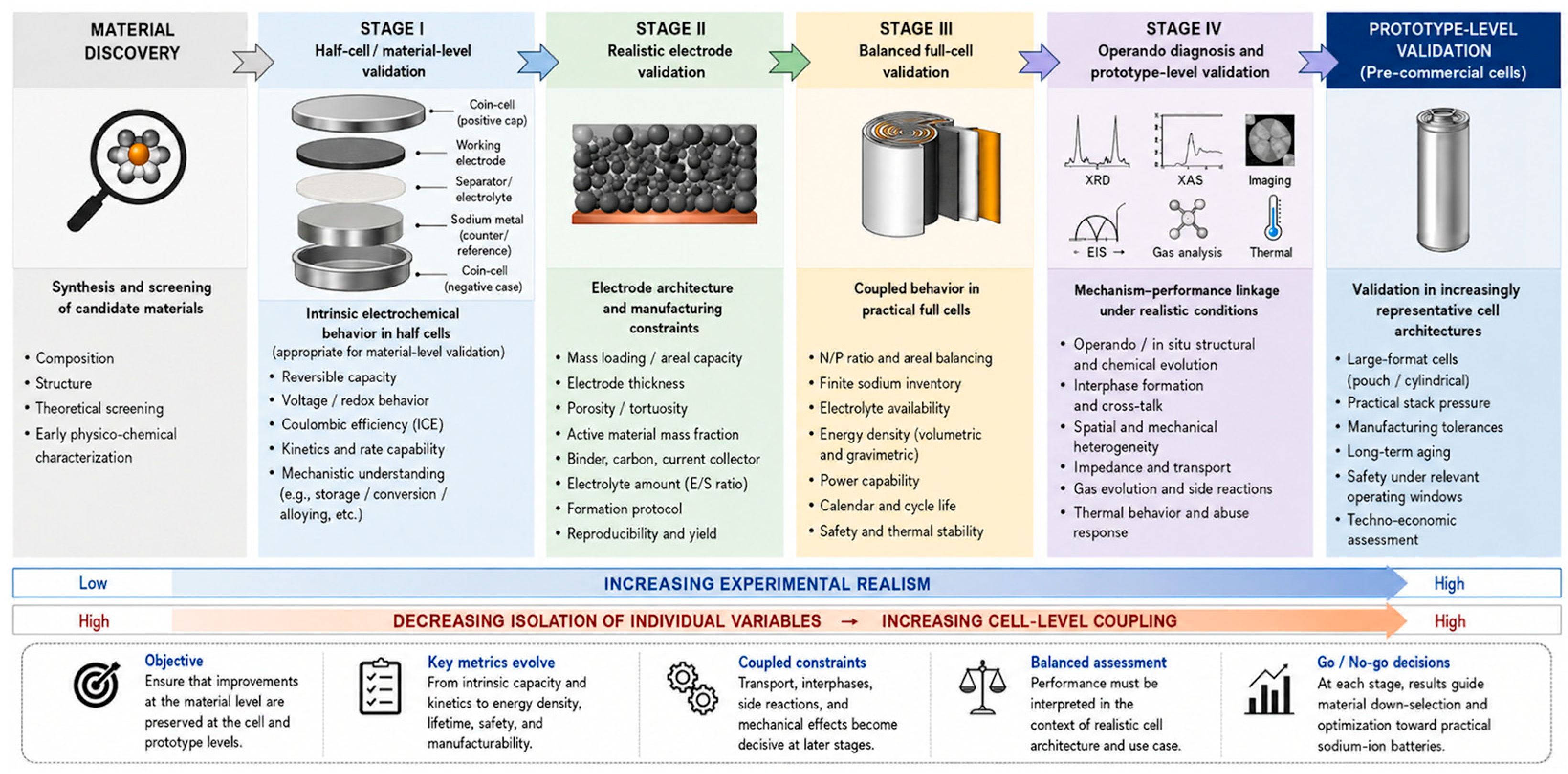
Figure 2.
General electrode-design trade-offs linking material- and cell-level performance metrics. Changes in cathode thickness, porosity, and active-material fraction affect nominal specific capacity, volumetric energy density, diffusion-limited rate capability, and the relative volumetric contribution of active and inactive cell components. Although originally developed in a lithium-ion cell context, these relationships provide a general electrode-engineering framework for interpreting the transition from material-level performance to practically relevant sodium-ion electrodes. Adapted from Heubner et al. [9].
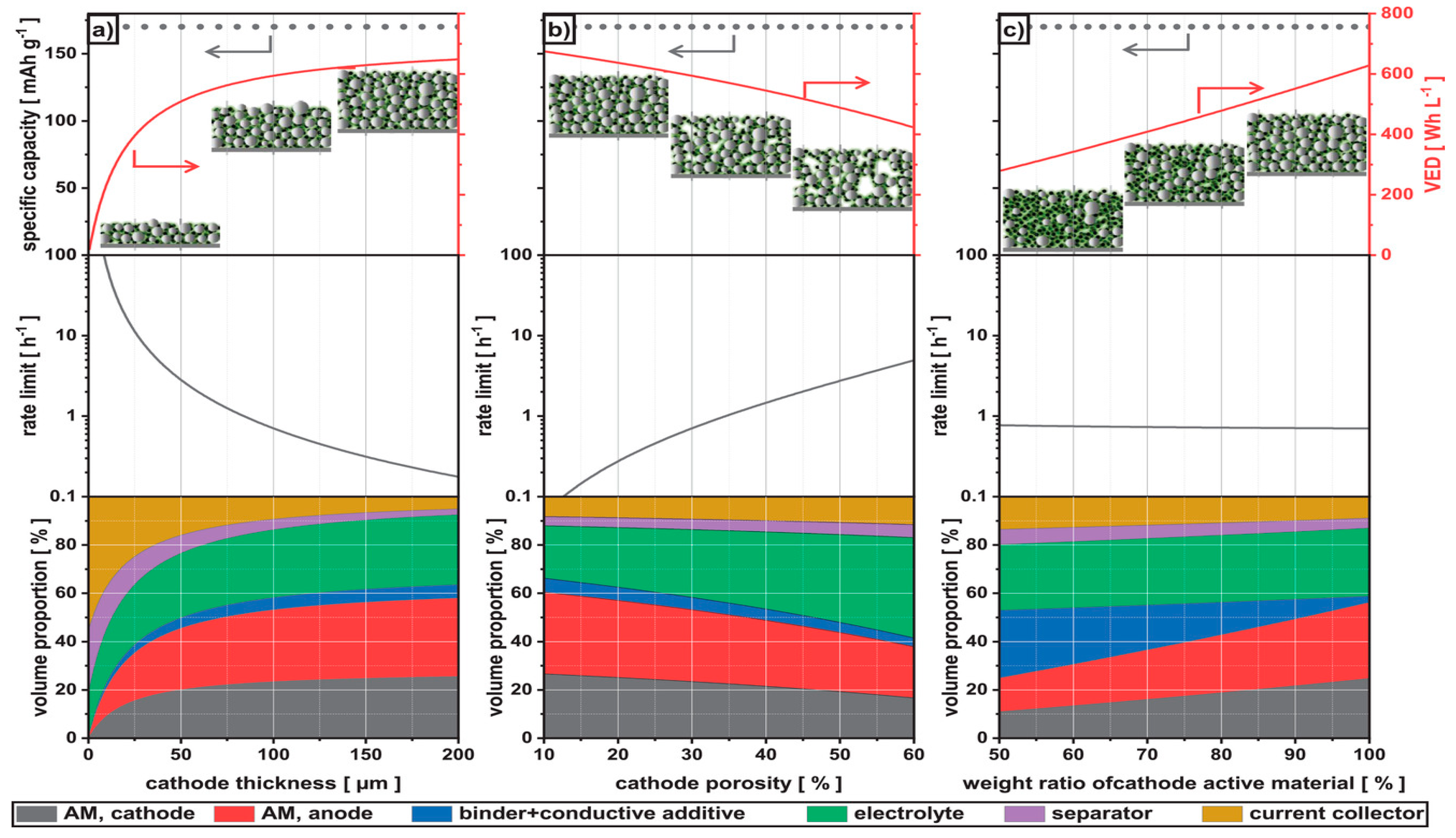
Figure 3.
Interphase investigation in sodium-ion full cells, illustrating representative anode and cathode material classes associated with solid-electrolyte and cathode-electrolyte interphases.
Figure 3.
Interphase investigation in sodium-ion full cells, illustrating representative anode and cathode material classes associated with solid-electrolyte and cathode-electrolyte interphases.
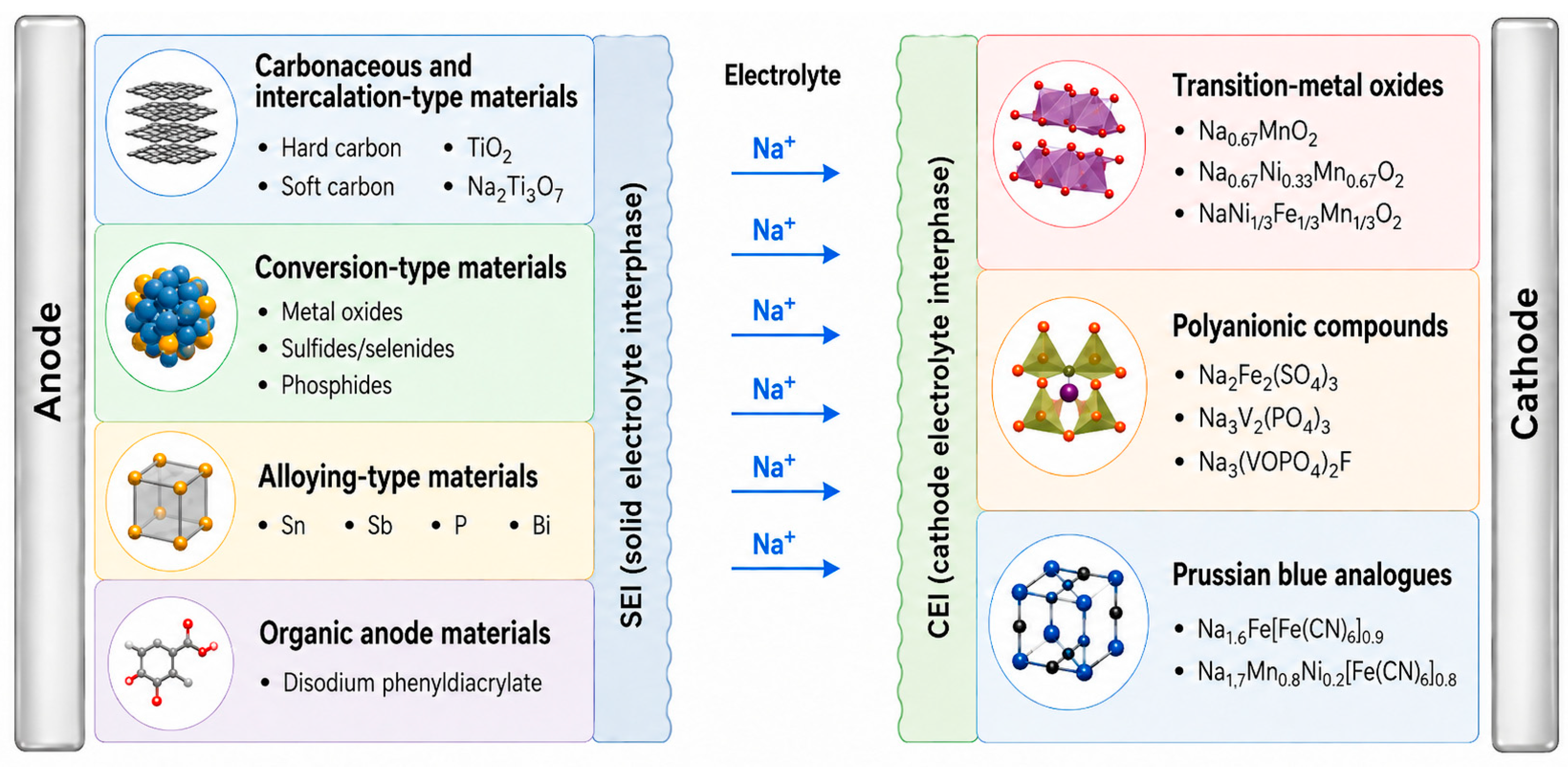
Figure 4.
Evolution of the reaction-zone distribution in initial and optimized sodium-ion cell designs at increasing discharge rates. The figure illustrates how transport limitations can progressively localize electrochemical activity within only part of the electrode thickness, whereas optimized electrode and cell parameters maintain a broader active reaction zone under higher current demand. Reproduced from Barati et al. [11].
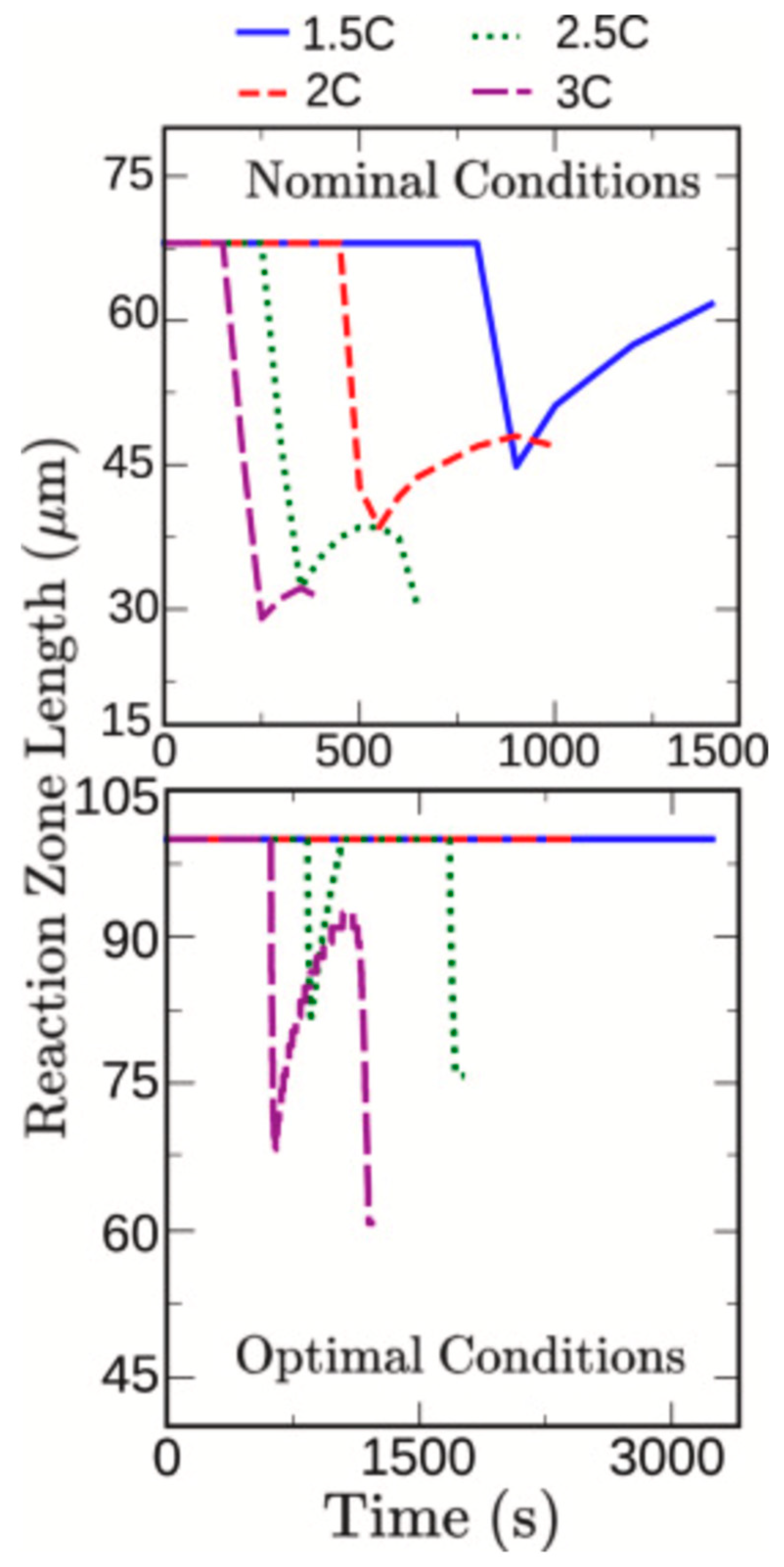
Figure 5.
Multimodal operando characterization of battery interfaces, illustrating the evolution from ex situ and in situ analysis to operando measurements and the complementary sensitivity of X-ray, neutron, optical, electron, scanning-probe, and magnetic-resonance techniques across multiple length scales. Adapted from Li et al. [18].
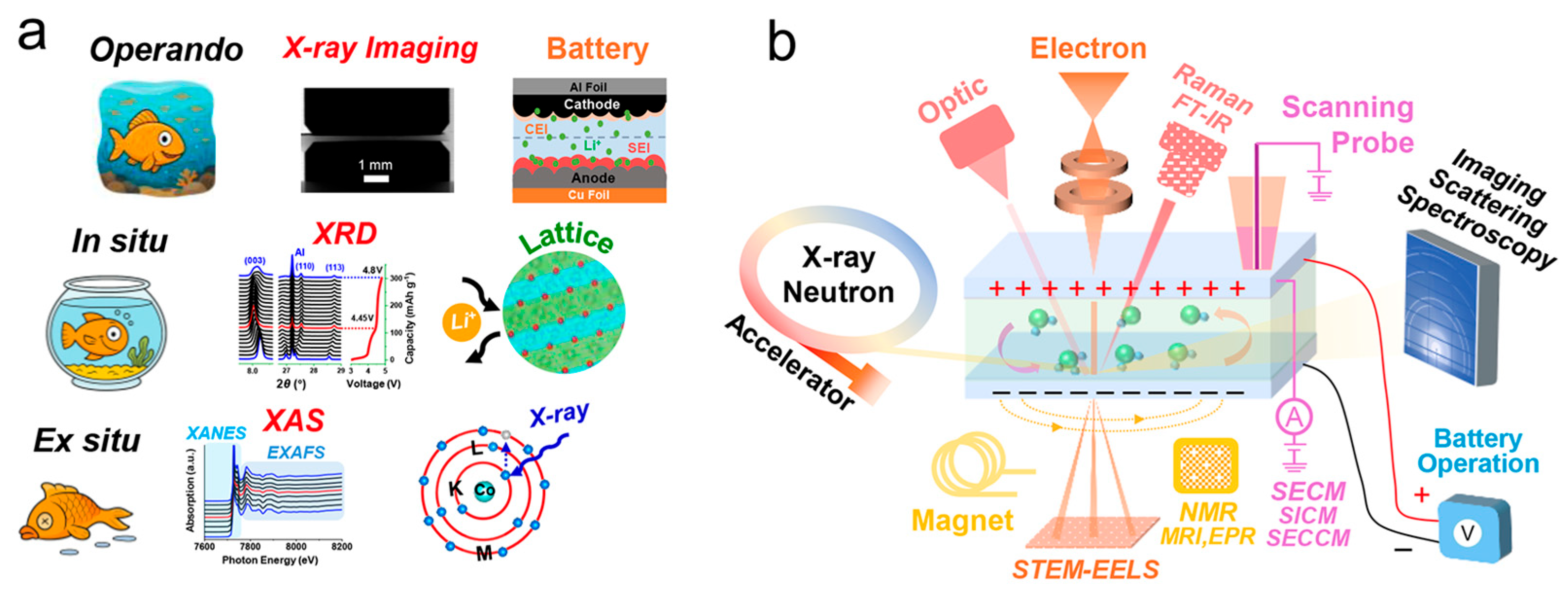

Table 1.
Architecture–mechanism–diagnostic framework for operando and in situ characterization of sodium-ion batteries.
Table 1.
Architecture–mechanism–diagnostic framework for operando and in situ characterization of sodium-ion batteries.
| Target process | Diagnostics | Preferred architecture | What it resolves | Main limitation | Refs. |
| Intrinsic phase/redox evolution | Operando XRD; total scattering/PDF; XAS | Low-loading Na-metal half-cell or model cell | Phase transitions, lattice/local-structure evolution, oxidation state, redox compensation | Does not reproduce practical transport gradients, finite Na inventory, or electrode coupling | [39,40,41,45,46] |
| Transport-driven heterogeneity | Spatial X-ray methods; CT/imaging; electrochemical analysis | High-loading electrode or balanced full cell | Reaction fronts, through-thickness gradients, nonuniform state of charge and utilization | Strongly dependent on loading, rate, porosity, electrolyte transport, and cell geometry | [11,35,37,47] |
| SEI/CEI evolution | Raman/IR; EIS; complementary surface analysis | Half-cell for isolation; full cell for coupled evolution | Electrolyte decomposition, solvation changes, interphase formation and evolution | Half-cells do not establish coupled SEI/CEI evolution or cross-talk | [16,17,37,42,48] |
| Interelectrode cross-talk | Time-resolved spectroscopy/chemical analysis; full-cell diagnostics | Balanced full cell | Species generation, migration, deposition/reaction, opposite-electrode effects | Detection alone does not establish causality; source-to-performance sequence must be demonstrated | [17,30,31,32] |
| Electrolyte evolution/depletion | Raman/IR; electrolyte analysis; electrochemistry | Full cell with representative electrolyte inventory | Solvation, decomposition products, progressive electrolyte changes | Optical access or excess electrolyte may alter relevant boundary conditions | [22,37,42,48] |
| Mechanical/morphological degradation | X-ray CT; imaging; microscopy; ultrasound | High-loading full cell or pouch/prototype | Cracking, delamination, particle rearrangement, contact loss, thickness changes | Local observations or modified cells may not represent whole-cell behavior | [35,44,47,49,50] |
| Gas evolution | Imaging/CT; gas analysis; pressure/thermal diagnostics | Full cell; pouch/cylindrical prototype | Gas onset/localization, swelling, pressure, wetting and contact effects | Strongly architecture dependent; usually requires complementary methods | [19,44,49,50] |
| Impedance/transport ageing | EIS; DRT | Half-cell for isolation; full cell for integrated response | Interfacial, charge-transfer, transport and contact resistance evolution | Full-cell spectra contain overlapping contributions; assignments are not unique | [38,43,51,52] |
| Coupled ageing | Multimodal operando workflows | Balanced full cell or prototype | Correlated structural, chemical, spatial, thermal, mechanical and electrochemical evolution | Greater diagnostic access may reduce cell realism; correlation alone does not prove causality | [19,38,43,44,51,52] |
Table 2.
Staged validation framework for translating sodium-ion battery materials from half-cell characterization to practical-cell assessment.
Table 2.
Staged validation framework for translating sodium-ion battery materials from half-cell characterization to practical-cell assessment.
| Validation stage | Primary objective | Key evidence/metrics | What can be established | What remains unvalidated | References |
| Stage I — Material-level validation | Establish intrinsic electrochemical viability of the candidate material under controlled conditions | Reversible capacity within a defined voltage window; voltage/redox behavior; initial Coulombic efficiency and subsequent cycling efficiency; rate response; polarization; charge-transfer behavior; apparent Na+ transport limitations; structural evolution; electrode-specific interfacial reactions | Intrinsic Na-storage capability; electrochemical operating window; early kinetic and mechanistic limitations; electrode-specific degradation processes | Practical areal capacity; electrode density and thickness effects; processing robustness; electrolyte sufficiency; cathode–anode compatibility; finite sodium inventory; full-cell energy; interelectrode cross-talk | [6,7,8,9,10] |
| Stage II — Electrode-level validation | Determine whether material-level performance is retained in a representative composite electrode | Active-material loading; areal capacity; thickness; density/porosity; active-material fraction; binder and conductive-additive content; current collector; processability; polarization; rate response; cycling reproducibility; initial and subsequent Coulombic efficiency | Functional viability under representative electrode architecture; sensitivity to loading, transport, wetting, electronic connectivity, and mechanical constraints | Cathode–anode balancing; N/P ratio; finite sodium inventory; full-cell voltage and energy; shared-electrolyte stability; interelectrode cross-talk; coupled ageing | [8,9,11,12] |
| Stage III — Balanced full-cell validation | Establish coupled electrochemical viability under finite sodium and electrolyte inventories | Cathode–anode matching; N/P ratio; initial Coulombic efficiency and subsequent cycling efficiency; sodium-inventory loss; voltage profile; full-cell capacity and energy; electrolyte amount; formation protocol; impedance evolution; cycling stability; replicate-cell variability | Usable full-cell capacity and energy; sodium-inventory utilization; electrode compatibility; integrated impedance growth; shared-electrolyte and coupled interfacial behavior | Unambiguous origin of degradation; spatial heterogeneity; dynamic cross-talk; local interphase evolution; gas distribution; mechanical failure; robustness in larger formats | [1,8,9,10,11,12,17,19,54] |
| Stage IV — Operando diagnosis and prototype-level validation | Link degradation mechanisms to performance under increasingly representative architectures | Operando/in situ X-ray, vibrational, imaging, microscopy, gas, impedance, and multimodal diagnostics; realistic loading and electrolyte amount; pouch/cylindrical or other prototype formats; energy retention; impedance growth; gas behavior; thermal response; reproducibility | Mechanistic correlation between structural, interfacial, transport, mechanical, and sodium-inventory changes and cell-level performance; persistence of degradation pathways under prototype-relevant conditions | Application-level lifetime; manufacturability; scale-up robustness; safety certification; cost competitiveness; field reliability | [8,19,35,37,38,39,40,41,42,43,44,45,46,47,48,49,50,51,52,53,55] |
Disclaimer/Publisher’s Note: The statements, opinions and data contained in all publications are solely those of the individual author(s) and contributor(s) and not of MDPI and/or the editor(s). MDPI and/or the editor(s) disclaim responsibility for any injury to people or property resulting from any ideas, methods, instructions or products referred to in the content. |
© 2026 by the authors. Licensee MDPI, Basel, Switzerland. This article is an open access article distributed under the terms and conditions of the Creative Commons Attribution (CC BY) license (http://creativecommons.org/licenses/by/4.0/).
Copyright: This open access article is published under a Creative Commons CC BY 4.0 license, which permit the free download, distribution, and reuse, provided that the author and preprint are cited in any reuse.