
Submitted:
03 October 2026
Posted:
07 October 2026
You are already at the latest version
Abstract
Behavioral and sensory research on food intake has long treated energy content as if it were a directly perceptible property of food. Organisms are said to “detect,” “evaluate,” or “compensate for” calories. This language imports an energy-centric ontology into a sensory system that has no access to energy as such. There are no receptors for the joule or the kilocalorie. Taste, smell, texture, oral processing, and gastric distension respond to molecular identity, physical mass, volume, and structure. Post-ingestive signals report molecular identity and concentration, not energy content. Energy is a derived quantity that can be associated with sensory patterns through learning, but it is not sensed directly. The present commentary argues that this category error – a derived property treated as a perceptible one – has shaped experimental design, interpretation, and vocabulary in the behavioral literature, and that restoring mass to primacy brings the psychology of appetite into register with the physics and physiology of mass balance.
Keywords:
calorie sensing
; mass balance
; sensory perception
; food intake
; satiety
; energy density
; category error
1. The Category Error
The behavioral and sensory literature on food intake is written in an energy-centric vocabulary. Organisms are described as “detecting calories,” “sensing energy,” “compensating for energy intake,” or “responding to caloric density.” These formulations treat energy content as if it were a property of food that the organism can perceive directly.
It is not. Energy is a derived physical quantity: the capacity to do work, measured in joules or kilocalories. It is not a substance, not a molecular feature, and not a stimulus that can interact with a receptor. There is no receptor for the joule, just as there is no receptor for the meter or the kilogram. The question “how does the organism sense calories?” is not a question about biology. It is a question about how a derived quantity has been reified in the language of a research tradition.
This is a category error in the strict sense introduced by Ryle [1]: a concept from one logical category (a derived physical quantity) has been treated as if it belonged to another (a perceptible stimulus). The error is not harmless. It shapes what counts as an explanation, what counts as a control, and what counts as a surprising result.
2. What the Senses Actually Report
The sensory and physiological systems that participate in food intake respond to a limited set of physical and chemical properties. None of them transduces energy.
Figure 1.
No calorie receptors. Sensory and physiological channels detect food properties, not energy content. Each channel transduces a specific physical or chemical property (molecular identity, mechanical features, volume/mass, or nutrient presence). The right-hand column is identical across all rows by design: energy content is never the stimulus. Energy can enter the control system only indirectly, through learning.
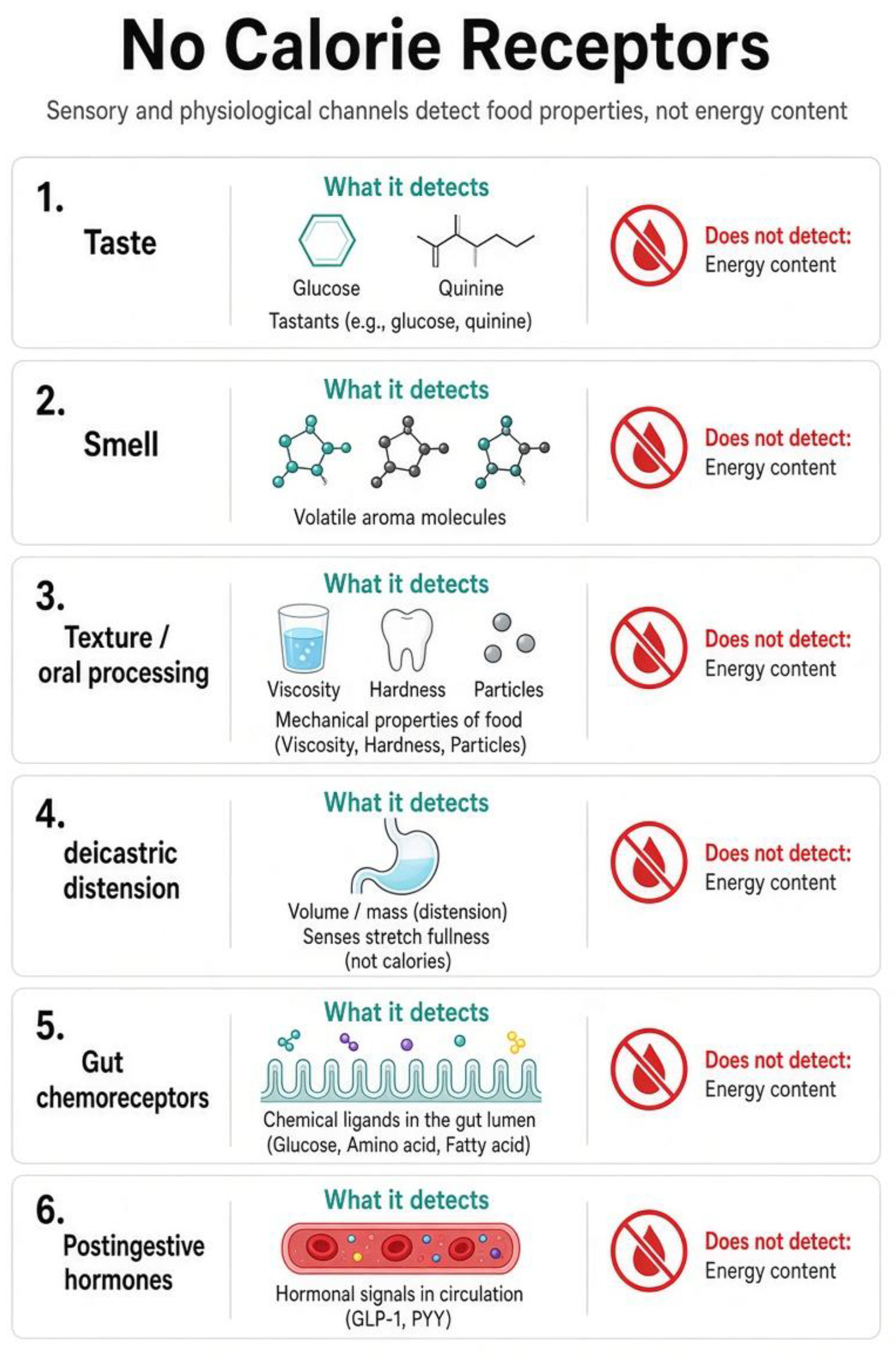
Taste and smell detect molecular identity. Texture and oral processing detect mechanical properties. Gastric distension detects volume and mass via stretch receptors. Gut chemoreceptors and post-ingestive hormones (GLP-1, PYY, FGF21) report the presence and concentration of specific molecular species [2,3]. In every case the primary input is a physical or chemical property of the food or of the gut contents. Energy content is absent.
A common objection is that post-ingestive hormones must be sensing energy because they rise after nutrient intake. They do not. They respond to specific ligands – glucose, amino acids, fatty acids – not to the energy those molecules contain. The correlation with energy is real but indirect and downstream.
An organism can learn that a particular sensory pattern predicts a particular post-ingestive consequence. It cannot sense energy directly. Learning creates a secondary association; the primary sensory currency remains mass, volume, and molecular identity.
3. Consequences of the Error
The category error has shaped the literature in four concrete ways.
3.1. Misdescribed Experimental Designs
Studies that match foods for energy while allowing mass, volume, and texture to vary are routinely interpreted as tests of “caloric” effects. If the organism cannot sense energy, these studies actually test mass, volume, texture, or learned associations. The interpretation outruns the design.
3.2. Misattributed Failures of Compensation
When precise energy compensation fails, the failure is often ascribed to “defective energy sensing.” If the system never sensed energy, there is nothing defective. The system is tracking mass and volume. The “failure” is a failure of an expectation that was never biologically grounded.
3.3. Reified Vocabulary
Terms such as “calorie-dense” and “calorie-dilute” quietly promote a derived property into the role of the primary controlled variable. They imply that the organism tracks energy when the data are fully consistent with tracking mass and its correlates.
3.4. Misplaced Research Questions
Questions of the form “how does the organism detect energy?” are ill-posed. The productive questions are: what properties does the organism actually detect, how are those properties linked to post-ingestive consequences, and how do learned associations shape intake?
4. Mass as the Primary Behavioral Currency
Once mass is restored to primacy, classic phenomena reorganize cleanly.
Portion-size effects. Larger portions produce greater intake [4]. Under an energy-centric reading this is puzzling. Under a mass-centric reading it is expected: larger portions deliver more mass and volume.
Sensory-specific satiety. Pleasantness declines for an eaten food while remaining high for a different food [5]. This tracks sensory pattern, not cumulative energy.
Satiating power of high-volume foods. Foods high in water or fiber produce greater satiety per unit energy [6,7]. This is anomalous if the organism tracks energy and expected if it tracks mass and volume.
Failure of energy-matched, mass-reduced foods. When energy is held constant but mass is reduced (by removing water or fiber), satiety falls. Again, this is predicted by mass primacy and surprising under energy primacy.
In each case the mass-centric account is simpler and aligns directly with the properties the senses actually detect.
5. Alignment with Physiological Mass Balance
The primacy of mass is not a new claim. It already follows from first principles at the physiological level. Mass balance is governed by the continuity equation: mass fluxes are the primary variables and energy is a derived property of the mass retained or lost [8,9]. The same principle applies at the behavioral level.
Extending mass primacy into the sensory and behavioral domain therefore yields a coherent framework across levels of analysis. Physiology and behavior are not separate theories; they are two applications of the same rule: mass is primary, energy is derived.
6. Predictions
If mass primacy is correct, four predictions follow.
Prediction 1. Mass-matched, energy-varied foods produce similar short-term satiety.
Foods matched for mass but differing in energy density should elicit comparable satiety responses in the short term.
Prediction 2. Energy-matched, mass-varied foods produce different satiety.
Foods matched for energy but differing in mass should produce different satiety, with the higher-mass version generating greater satiety.
Prediction 3. Learned associations modulate but do not replace mass effects.
Manipulations of taste–energy contingency should alter intake, yet the effect should sit on top of the mass signal rather than eliminate it.
Prediction 4. Individual differences in “caloric compensation” reflect differences in learned associations, not in energy-sensing capacity.
Variation in compensation accuracy should track learning history, not a hypothetical energy detector.
7. Conclusion
There are no calorie receptors. Continuing to write as though organisms detect energy perpetuates a category error that shapes experimental design, interpretation, and vocabulary in ways that outrun the evidence.
Restoring mass to primacy brings the psychology of appetite into register with the physics and physiology of mass balance. The resulting framework is simpler, more parsimonious, and consistent with what the sensory systems actually detect.
The organism does not sense energy. It senses mass, volume, and molecular identity, and it learns to associate these with post-ingestive consequences. That is the correct starting point for a science of food intake.
Note on Tone
The argument is conceptual. It does not deny that energy content influences intake or that learned associations between sensory properties and energy are real and important. It asserts only that energy is not sensed directly, and that the language of “calorie detection” obscures this fact.
Author Contributions
This is a single-authored paper.
Funding
This research did not receive any specific grant from funding agencies in the public, commercial, or not-for-profit sectors.
Institutional Review Board Statement
Not applicable.
Informed Consent Statement
Not applicable.
Data Availability Statement
All data generated or analyzed during this study are contained in the sources cited.
Acknowledgments
I thank colleagues for discussions on the distinction between primary sensory inputs and derived physical quantities.
Conflicts of Interest
The author declares no conflict of interest.
References
- Ryle, G. The Concept of Mind; Hutchinson: London, 1949. [Google Scholar]
- Gribble, F.M.; Reimann, F. Function and mechanisms of enteroendocrine cells and gut hormones in metabolism. Nat. Rev. Endocrinol. 2019, 15(4), 226–237. [Google Scholar] [CrossRef] [PubMed]
- Müller, T.D.; Finan, B.; Bloom, S.R.; et al. Glucagon-like peptide 1 (GLP-1). Mol. Metab. Epub. 2019, 30, 72–130. [Google Scholar] [CrossRef] [PubMed] [PubMed Central]
- Rolls, B.J.; Morris, E.L.; Roe, L.S. Portion size of food affects energy intake in normal-weight and overweight men and women. Am. J. Clin. Nutr. 2002, 76(6), 1207–13. [Google Scholar] [CrossRef] [PubMed]
- Rolls, B.J. Sensory-specific satiety. Nutr. Rev. 1986, 44(3), 93–101. [Google Scholar] [CrossRef] [PubMed]
- Rolls, B.J.; Bell, E.A.; Castellanos, V.H.; Chow, M.; Pelkman, C.L.; Thorwart, M.L. Energy density but not fat content of foods affected energy intake in lean and obese women. Am. J. Clin. Nutr. 1999, 69(5), 863–71. [Google Scholar] [CrossRef] [PubMed]
- Stubbs, R.J.; Whybrow, S. Energy density, diet composition and palatability: influences on overall food energy intake in humans. Physiol. Behav. 2004, 81(5), 755–64. [Google Scholar] [CrossRef] [PubMed]
- Manninen, A.H. Mass Balance over Energy Balance: Why Direct Mass Accounting Offers a More Precise and Mechanistically Faithful Framework for Human Body Weight Regulation. Preprints 2026, 2026040690. [Google Scholar] [CrossRef]
- Manninen, A.H. Implementing the Mass Balance Model (MBM) in Human Nutrition and Obesity Research: Protocols, Analytical Frameworks, and Translational Applications. Preprints 2026, 2026041641. [Google Scholar] [CrossRef]
Disclaimer/Publisher’s Note: The statements, opinions and data contained in all publications are solely those of the individual author(s) and contributor(s) and not of MDPI and/or the editor(s). MDPI and/or the editor(s) disclaim responsibility for any injury to people or property resulting from any ideas, methods, instructions or products referred to in the content. |
© 2026 by the authors. Licensee MDPI, Basel, Switzerland. This article is an open access article distributed under the terms and conditions of the Creative Commons Attribution (CC BY) license (http://creativecommons.org/licenses/by/4.0/).
Copyright: This open access article is published under a Creative Commons CC BY 4.0 license, which permit the free download, distribution, and reuse, provided that the author and preprint are cited in any reuse.