

Submitted:
03 October 2026
Posted:
07 October 2026
You are already at the latest version
Abstract
Stablecoins have rapidly developed into a significant form of digital currency, with market capitalisation surpassing \$300 billion by mid-2026 and transaction volumes exceeding those of Bitcoin and Ethereum. This paper analyses stablecoin use from a criminological perspective, treating stablecoins as a form of digital cash and using cash as the analytical baseline. Combining ecosystem-scale market measurements (Artemis Analytics) with institutional and regulatory analysis, it argues that stablecoins offer four criminogenic advantages for money laundering relative to cash: scale and velocity, programmable layering, borderless settlement, and pseudonymity. These features create a structural mismatch with prevailing AML/CFT compliance frameworks, which largely assume identifiable intermediaries and territorially bounded payment rails. The paper develops four policy implications, each grounded in the analytical properties identified, that specify the relevant regulated actor, the precise compliance obligation, the principal implementation trade-offs, and a path forward for regulatory design and future research, while recognising the investigative opportunities that public ledgers create relative to physical cash.
Keywords:
stablecoins
; anti-money laundering
; financial crime
; digital cash
; FATF travel rule
; MiCA
; GENIUS Act
; blockchain regulation
; DeFi
; cryptocurrency
1. Introduction
Stablecoins have undergone a fundamental transformation in their economic role. Designed initially as settlement instruments for cryptocurrency trading, they have since expanded into a broadly adopted layer of financial infrastructure. By mid-2026, over 250 stablecoins were in active circulation with a combined market capitalisation exceeding $300 billion [1], and Tether (USDT) and USD Coin (USDC) alone processed more than $10 trillion in on-chain transfer volume in 2025, exceeding the combined settlement activity of Bitcoin and Ethereum [2].
Stablecoins are now increasingly used for cross-border payments, institutional settlement, merchant payments, treasury management, and as the primary unit of account within decentralised finance (DeFi). The GENIUS Act, signed into United States law in July 2025 [3], the EU’s Markets in Crypto-Assets Regulation (MiCA, Regulation (EU) 2023/1114), whose stablecoin provisions applied from 30 June 2024 and whose transitional period for crypto-asset service providers ended on 1 July 2026 [4] together acknowledge at the legislative level that stablecoins have moved beyond cryptocurrency-specific concerns and into the mainstream of payments policy. The depth of institutional commitment is correspondingly broad: Visa, Mastercard, Stripe, PayPal, and BlackRock have each made material investments in stablecoin infrastructure, and on 30 June 2026 the Open Standard consortium backed by more than 140 founding organisations including Visa, Mastercard, BlackRock, BNY, Standard Chartered, Google, and Coinbase announced Open USD (OUSD), treating stablecoin infrastructure as collective financial plumbing rather than a single issuer’s product [5].
The FATF’s March 2026 Targeted Report on Stablecoins and Unhosted Wallets documents growing stablecoin use by sanctioned states, ransomware operators, and terrorist financing networks, and explicitly designates P2P transfers via unhosted wallets as a key structural vulnerability [6]. Quantitative estimates of illicit stablecoin activity should be interpreted with methodological care: identified illicit volume represents a lower bound subject to limitations from incomplete address attribution and uneven blockchain coverage, but the structural exposure is not in doubt.
Existing research on stablecoins and financial crime has developed along productive but largely distinct lines: AML/CFT compliance obligations for virtual asset service providers [1]; stablecoin governance, reserve transparency, and financial stability implications [7]; and the regulatory architecture emerging across major jurisdictions [3,4]. What remains comparatively underdeveloped is the more fundamental question:
Addressing that question requires an analytical framework that begins not with criminal incidents but with the payment instrument itself. Existing research primarily examines stablecoins as cryptocurrencies. This paper instead studies them as a payment instrument, using physical cash as the analytical baseline. This paper argues that stablecoins inherit the functional properties that historically made physical cash attractive for financial crime: price stability, bearer-like ownership in which possession of a private key confers control without institutional intermediation, rapid transferability, and limited dependence on regulated financial institutions. These properties are not incidental to stablecoin design; they are central to it. Crucially, however, the comparison is not one of mere equivalence. Blockchain technology amplifies these properties in ways that have no physical analogue: smart contracts automate in minutes the layering operations that once required weeks and networks of co-conspirators; cross-chain bridging fragments the investigative trail across ledgers no single authority can subpoena; and the scale of digital value transfer exemplified by the $1.46 billion Bybit exploit in 2025 [1] exceeds anything physically achievable with banknotes.
This paper makes four contributions.
- It introduces a criminological perspective for analysing stablecoins by treating them as a form of digital cash rather than simply another class of cryptocurrency.
- It presents real-time ecosystem-scale measurements of the global stablecoin market using Artemis Analytics, providing quantitative evidence of the institutional visibility gap across the stablecoin transaction lifecycle.
- It identifies where stablecoins replicate the financial-crime properties of physical cash, where blockchain technology amplifies them, and where it fundamentally changes the investigative landscape through a permanent public ledger.
- It translates these findings into practical policy implications for AML/CFT regulation, informed by current implementation evidence and emerging blockchain-native compliance mechanisms.
Taken together, these contributions motivate the paper’s central argument: compared with cash, stablecoins offer four criminogenic advantages for money launderingscale and velocity, programmable layering, borderless settlement, and pseudonymity. The analysis shows how these features sit uneasily within current AML/CFT compliance frameworks and develops four policy implications that (i) identify the relevant regulated actor, (ii) specify the compliance obligation, and (iii) surface the key implementation challenges and trade-offs.
2. Physical Cash and Financial Crime: The Policy Rationale
Over the past several decades, many governments have implemented policies aimed at reducing reliance on physical cash by encouraging electronic payments, expanding digital banking infrastructure, introducing reporting obligations, and imposing limits on large cash transactions. While these initiatives have been motivated by multiple economic and social objectives, including payment efficiency, tax compliance, and financial inclusion, a central policy objective has been to improve transparency within the financial system and reduce opportunities for financial crime.
Throughout this paper, the term criminogenic is used in the facilitative sense: it refers to properties that create conditions enabling or attracting criminal exploitation, not to properties that causally generate criminal activity. Stablecoins are not argued to cause crime; rather, their structural characteristics create opportunities that rational criminal actors are likely to exploit, in the same way that physical cash’s anonymity created opportunities that motivated decades of regulatory response.
2.1. The Criminogenic Properties of Cash
Physical currency possesses several intrinsic characteristics that make it particularly attractive for illicit financial activity.
2.1.1. Transactional Anonymity
The defining criminogenic property of physical cash is its high degree of transactional anonymity. Cash enables value to be exchanged directly between parties without automatically generating records identifying the sender, recipient, amount transferred, or purpose of the transaction [8]. Unlike electronic payment systems, the payment instrument itself contains no transaction history, identity information, or audit trail. Ownership changes solely through physical possession rather than through any centrally maintained record.
This characteristic significantly complicates financial investigations. Once cash leaves a regulated financial institution, subsequent transfers generally occur outside the visibility of regulatory authorities unless independent evidence such as surveillance, witness testimony, or forensic investigation is available. Consequently, authorities cannot easily reconstruct the movement of funds or establish beneficial ownership throughout successive transactions.
The absence of an inherent transaction record facilitates each stage of the money laundering process [9]. During the placement stage, criminal proceeds can enter the financial system through cash deposits, currency exchanges, or cash-intensive businesses. During layering, cash can be repeatedly transferred between individuals or transported across jurisdictions without creating reliable transactional records. Finally, during integration, illicit proceeds may re-enter the legitimate economy appearing disconnected from their criminal origin [10]. Beyond money laundering, transactional anonymity also facilitates tax evasion, corruption, bribery, organised crime, sanctions evasion, and terrorist financing by limiting the ability of authorities to observe and reconstruct financial flows [11,12].
2.1.2. Bearer-Instrument Characteristics
Cash functions as a classic bearer instrument. Legal ownership is determined by physical possession, and transfer occurs simply by handing the currency from one person to another without requiring the participation of any intermediary [8]. Unlike electronic payments, no financial institution is required to authorise, record, verify, or monitor the transaction. This bearer-instrument logic is fundamental to the regulatory challenges associated with cash. Since transactions occur directly between parties, there is no natural point at which regulatory controls, including customer identification, transaction monitoring, sanctions screening, or suspicious activity reporting can be applied. Consequently, many of the core mechanisms underpinning modern AML/CFT frameworks become ineffective once cash is circulating outside the regulated financial sector [9].
2.2. The Regulatory Response
Recognising these limitations, governments have progressively shifted AML/CFT strategies towards reducing the opportunities for anonymous cash transactions while increasing the traceability of financial activity. This approach includes customer identification requirements, Currency Transaction Reports (CTRs), Suspicious Activity Reports (SARs), cash transaction limits, enhanced due diligence, and reporting obligations imposed on banks and other regulated entities [9,13]. Collectively, these measures seek to create visibility at the point where anonymous physical currency interfaces with identifiable financial accounts. The underlying regulatory principle is straightforward: while cash itself cannot be made inherently traceable, its interaction with regulated financial institutions can generate sufficient information to support financial intelligence, criminal investigations, and regulatory oversight.
3. From Electronic Payments to Blockchain-Based Money
The proliferation of electronic payment systems over the past three decades addressed many of the financial crime risks associated with physical cash by introducing an indispensable third party into every transaction: the regulated financial intermediary. Unlike banknotes, which transfer value through physical delivery alone, electronic payments require the involvement of at least one institution that must identify its customers, record transactions, and respond to regulatory and law enforcement demands.
This intermediary-based architecture addressed many of the criminogenic properties associated with physical cash. Anonymous value transfer declined substantially, bearer-instrument characteristics gave way to account-based ownership, and regulatory authorities gained visibility through the institutions that process payments. Consequently, modern AML/CFT frameworks evolved around the assumption that financial transactions would pass through regulated intermediaries capable of enforcing compliance and providing financial intelligence when required.
This regulatory model proved highly effective for conventional electronic payment systems. However, it also established a fundamental assumption: that trusted intermediaries would remain central to the movement of digital value. The emergence of blockchain technology challenged this assumption by enabling peer-to-peer transfer of digital assets without requiring a central institution to validate, record, or authorise transactions [14,15,16].
3.1. Blockchain: Removing the Intermediary
Blockchain introduced a fundamentally different model of value transfer. Rather than routing payments through banks or payment service providers, blockchain enables participants to transfer digital value directly between one another across a distributed network, without requiring a central institution to authorise, process, or settle the transaction [14]. The intermediary that had become indispensable to electronic payment systems was, by design, removed.
Unlike conventional payment systems, blockchain maintains ownership and transaction history through a decentralised network rather than a single trusted institution. Transactions are validated collectively using a consensus mechanism and recorded on a shared ledger replicated across participating nodes. Ownership of digital assets is established through cryptographic key pairs instead of centrally managed customer accounts, allowing digital value to be transferred directly between participants without relying on a bank or payment processor [15]. This architecture created the technological foundation upon which cryptocurrencies, stablecoins, and decentralised financial services were subsequently developed.
Several characteristics of blockchain are particularly relevant to understanding its implications for financial crime and financial regulation.
3.1.1. Open Financial Infrastructure
Public blockchains operate as permissionless financial infrastructure upon which anyone can issue digital assets, deploy financial applications, and transfer value without obtaining approval from a central authority. Unlike conventional payment networks, where participation is controlled by regulated financial institutions, blockchain provides a globally accessible settlement layer that supports innovation independent of traditional banking infrastructure. Stablecoins are one of the most significant financial applications built upon this open infrastructure.
3.1.2. Pseudonymous Participation
Participants transact using cryptographic wallet addresses rather than verified identities. Although blockchain transactions are publicly visible, ownership is represented by pseudonymous addresses instead of named account holders. Unlike conventional electronic payments, customer identification is not an inherent property of the payment infrastructure but depends on external mechanisms such as regulated exchanges or blockchain analytics [17].
3.1.3. Absence of a Central Operator
Public blockchain networks have no single institution responsible for authorising, reversing, blocking, or monitoring transactions. Once transactions satisfy the network’s consensus rules, they are processed automatically without requiring the approval of any regulated intermediary. Consequently, regulators cannot compel the blockchain itself to implement Know-Your-Customer (KYC) requirements, freeze assets, or produce customer records in the manner expected of traditional financial institutions [16].
3.1.4. Borderless Settlement.
Blockchain enables digital assets to be transferred across jurisdictions within seconds without relying on correspondent banking networks or national payment infrastructure. The same transfer mechanism operates irrespective of the geographical location of the sender or recipient, allowing value to move globally through a common technological platform.
Collectively, these characteristics transformed blockchain from merely a distributed ledger into a global payment infrastructure. Unlike conventional electronic payment systems, regulatory oversight no longer depends on trusted intermediaries but instead relies on the properties of the underlying protocol and the services built upon it. This architectural shift created the foundation for stablecoins, which apply blockchain technology to create a digitally transferable representation of fiat currency that can function as a new form of digital cash.
3.2. Smart Contracts: Programmable Financial Logic
While blockchain provides the infrastructure for transferring digital assets, smart contracts provide the programmable logic that enables complex financial applications. Smart contracts are self-executing programs deployed on a blockchain that automatically execute predefined rules once specified conditions are met [18]. Once deployed, the contract executes according to its programmed logic without requiring human intervention, intermediary authorisation, or institutional approval.
The introduction of programmable financial logic fundamentally expanded the capabilities of blockchain beyond simple value transfer. Instead of merely sending digital assets between participants, blockchain could support decentralised exchanges, lending protocols, automated market makers, derivatives, token issuance, and many other financial applications operating without traditional financial intermediaries [19,20,21].
The combination of blockchain infrastructure and programmable smart contracts ultimately enabled the emergence of stablecoins. Unlike early cryptocurrencies, whose price volatility limited their usefulness for everyday transactions, stablecoins introduced a digitally transferable representation of fiat currency while retaining the decentralised, borderless, and programmable characteristics of blockchain. As a result, they increasingly perform many of the economic functions traditionally associated with physical cash while simultaneously introducing entirely new regulatory and financial crime challenges.
Figure 1 summarises the conceptual framework developed in this paper. Physical cash provides baseline payment properties; blockchain technology enhances them through programmability and global digital infrastructure; and stablecoins emerge as a payment instrument that combines both.
4. Stablecoins: Digital Fiat on a Decentralised Network
Stablecoins are cryptographic tokens engineered to maintain a stable value relative to a reference asset, most commonly the US dollar, while operating on blockchain infrastructure [7]. They were developed to overcome the price volatility that limited earlier cryptocurrencies as practical payment instruments. Whereas the value of cryptocurrencies such as Bitcoin may fluctuate by double-digit percentages within a single day, a dollar-pegged stablecoin is designed to preserve a consistent one-to-one value with its reference asset. This price stability enables stablecoins to function as a reliable medium of exchange rather than merely a speculative investment.
By combining the value stability of fiat currency with the programmability, global reach, and peer-to-peer transfer capabilities of blockchain networks, stablecoins increasingly perform many of the economic functions traditionally associated with cash. Users can hold, transfer, and settle value without relying on conventional banking infrastructure, making stablecoins functionally analogous to digital cash while retaining the unique characteristics of blockchain-based assets. As of mid-2026, over 250 stablecoins were in circulation with a combined market capitalisation exceeding $300 billion [1]. Tether (USDT) and USD Coin (USDC) alone processed more than $10 trillion in transfer volume in 2025, exceeding the combined on-chain settlement activity of Bitcoin and Ethereum [2].
Figure 2 illustrates how the stablecoin ecosystem has evolved since 2014. Early issuers such as Tether (USDT) [22] were crypto-native organisations seeking a stable settlement asset for digital asset trading. This was followed by a wave of issuers including Circle (USDC) [23], Paxos (USDP) [24], and MakerDAO (DAI) [25] that introduced greater regulatory oversight, improved reserve transparency, and decentralised collateral mechanisms. Since 2023, stablecoin issuance has increasingly attracted established payment providers and financial institutions, including PayPal (PYUSD) [26] and Ripple (RLUSD), alongside a coordinated response from traditional banking: in June 2026, JPMorgan Chase, Bank of America, Citigroup, Wells Fargo, and HSBC unveiled plans for a shared network of tokenised bank deposits operating on blockchain infrastructure, representing the most direct institutional challenge yet to crypto-native stablecoin issuers [27]. The collapse of TerraUSD (UST) [28] in 2022 marked a turning point for algorithmic models, prompting most jurisdictions to restrict uncollateralised issuance. Taken together, this trajectory reflects the transition of stablecoins from a cryptocurrency-specific instrument into a component of mainstream payment and settlement infrastructure.
This paper classifies stablecoins into four categories according to their collateral and peg mechanism: fiat-backed, commodity-backed, crypto-backed, and algorithmic. Table 1 summarises each category; the subsections below examine their characteristics and regulatory implications in turn.
4.0.1. Fiat-Collateralised Stablecoins
The dominant model: a central issuer holds fiat currency reserves or near-equivalent liquid assets such as government securities equal to or exceeding the value of tokens in circulation, and redeems tokens at par on demand [7]. USDT and USDC together account for the overwhelming majority of stablecoin market share. The issuer functions analogously to a narrow bank. Regulatory frameworks in the EU (MiCA), Singapore, Hong Kong, Japan, and the United States (GENIUS Act) primarily target this category, as it involves an identifiable legal entity [3,4].
4.0.2. Commodity-Backed Stablecoins
These tokens derive their value from physical assets, most commonly gold held in custody by the issuer. Each token represents ownership of a specified quantity of the underlying commodity, redeemable on demand. While they share the reserve-backed redemption structure of fiat-collateralised stablecoins, their value tracks commodity prices rather than fiat currency, limiting their utility as a payment instrument [29].
4.0.3. Crypto-Collateralised Stablecoins
Here the peg is maintained through overcollateralisation with other digital assets rather than fiat reserves. DAI, issued by the MakerDAO protocol, is the primary example: users lock cryptocurrency into a smart contract at a collateral ratio exceeding 150%, with positions automatically liquidated if the value falls below the required threshold. Because the system operates entirely through smart contracts with no central issuer, there is no legal entity to license, supervise, or sanction a regulatory gap that existing frameworks have not yet resolved [30].
4.0.4. Algorithmic Stablecoins
These attempt to maintain a peg through programmatic supply adjustments, minting tokens when the price rises above the peg and burning them when it falls below without holding collateral. The collapse of TerraUSD (UST) in May 2022, which lost its dollar peg entirely and erased approximately $40 billion in market value within days, demonstrated the fundamental fragility of this model and prompted most jurisdictions to prohibit or severely restrict algorithmic stablecoin issuance [4,28].
At the network level, stablecoin transfers follow the same cryptographic mechanism regardless of collateralisation model. A token holder signs a transaction with their private key; the transaction is broadcast, validated, and recorded permanently on the public ledger within seconds, with no bank or payment processor required to authorise it. For fiat-backed stablecoins, the issuer retains the ability to freeze addresses post-transfer; absent such intervention, no party can reverse a confirmed transaction [15].
5. Stablecoins as Functional Digital Cash
This section examines the financial crime implications of the stablecoin transaction pipeline, analysing how two core properties of physical cash cash-like bearer characteristics and transactional anonymity are reproduced in digital form by stablecoins operating on public blockchains. The analysis draws on original on-chain data queried from Artemis Analytics as of 20 July 2026, covering the global stablecoin ecosystem across all major blockchains; all figures represent a point-in-time snapshot or trailing twelve-month aggregate as of that date and may differ from figures obtained at other dates due to ongoing changes in market composition, address attribution, and chain coverage. The analysis employs a snapshot methodology, measuring the ecosystem at 20 July 2026 to characterise the structural flow of stablecoin activity through the pipeline. Absolute figures will differ at other measurement dates; the structural findings are presented as indicative of the pattern rather than as fixed market shares. Full dataset descriptions and limitations are documented in Appendix Section 8. Findings reported by Gopinath, Calder, Du and Stein [31] are used as independent corroboration where they overlap with our measurements.
Figure 3 maps the complete stablecoin transaction lifecycle from regulated issuance through the unregulated pipeline and back to fiat, identifying at each stage which financial crime property activates. Following Cornish’s crime-script framework [32], the pipeline identifies seven sequential stages, each corresponding to a specific enabling property: regulated issuance (Stage 1), exchange access (Stage 2), unhosted wallet custody (Stage 3), mixing and DEX activity (Stage 4), cross-chain movement (Stage 4b), off-ramp conversion (Stage 5), and fiat integration (Stage 6). Stages 1–2 and 5–6 represent regulated checkpoints where AML/CFT obligations currently apply; Stages 3–4b represent the unregulated script space where the transaction sequence currently proceeds without institutional interference. The two subsections that follow analyse the cash-like bearer characteristics and pseudonymity properties that operate within that gap, in the order they appear in the pipeline.
Before examining these properties, the concentration of the ecosystem justifies a scoping decision. As shown in Table 2, USDT ($185.2B) and USDC ($75.4B) together account for over 85% of the circulating supply among the twenty largest stablecoins as of 20 July 2026. This section therefore focuses on fiat-backed stablecoins on public blockchains, primarily USDT and USDC. Tokenised bank deposits, consortium models such as OUSD, and crypto-backed or algorithmic stablecoins are noted in Section 4 but lie outside this analysis; their distinct governance structures, particularly the freeze functions available to fiat-backed issuers are addressed below.
5.1. Replicating Bearer-Instrument Logic
The most direct parallel between physical cash and stablecoins operates at the level of ownership and transfer mechanics. In the cash model, whoever physically holds a banknote owns it; transfer requires only physical delivery, and no third party need consent, authorise, or record the transaction [8]. Stablecoins replicate this logic in cryptographic form. Ownership of a stablecoin balance is established by possession of the corresponding private key: whoever controls the key controls the funds, regardless of identity, jurisdiction, or amount involved [15]. Transfer requires only that the sender sign a transaction and broadcast it to the network. This corresponds to Stage 3 of the pipeline in Figure 3 the point at which value moves into an unhosted wallet and exits the regulatory perimeter without institutional record.
An important qualification applies to fiat-backed stablecoins specifically. Unlike physical banknotes, USDT and USDC tokens can be frozen at the contract level: Tether and Circle hold administrative keys permitting blacklisting of individual addresses at law enforcement request. Tether has publicly reported freezing over $2.5 billion in USDT across more than 1,900 addresses in response to law enforcement requests, and Circle has implemented equivalent controls under the USDC protocol [6]. This means fiat-backed stablecoins are not bearer instruments in the strict sense. Table 3 sets out the key differences across stablecoin types.
The freeze function represents a meaningful enforcement tool for fiat-backed models, and its existence distinguishes them from physical cash in one important respect: a central authority can intervene post-transfer in a way no banknote issuer can. However, it does not resolve the structural AML gap illustrated in Figure 3. The freeze function is reactive; it requires prior identification of a flagged address before it can take any action. The absence of mandatory monitoring at the point of transfer means that most stablecoin flows will not be identified until well after the fact, if at all. The function cannot reach value that has already transited mixing protocols or cross-chain bridges [30], and it depends entirely on issuers receiving timely, accurate intelligence from law enforcement across multiple jurisdictions.
The practical consequences for AML/CFT remain substantial even for freezable stablecoins. During a transfer between two unhosted wallets:
No mandatory regulated intermediary.
No native identity verification.
No built-in sanctions screening.
No built-in AML transaction monitoring.
No automatic regulatory reporting.
Consequently, the regulatory mechanisms that underpin cash-era AML/CFT customer due diligence, transaction monitoring, and reporting obligations have no natural point of application when value moves directly between unhosted wallets [33].
The scale of value circulating in this unhosted, bearer-equivalent zone is measured directly in our dataset. Figure 4 shows the distribution of the $310.8B global stablecoin supply across holder categories as of 20 July 2026. Self-custody wallets hold $181.1B (58.3% of total tracked supply). Centralised exchanges hold $75.0B (24.1%). The remainder sits in DeFi contracts, unlabelled smart contracts, and other applications ($54.7B, 17.6%). When narrowed to the self-custody versus exchange comparison, the ratio is 71% to 29%, consistent with the independent estimate reported by Gopinath, Calder, Du and Stein [31] for USDT and USDC specifically, confirming that the pattern holds across the broader ecosystem as of mid-2026.
FATF’s 2024 targeted update reports that unhosted wallets were associated with the preponderance of identified illicit stablecoin transfers in the reporting period [33]. Just as most cash-facilitated crime occurs outside the formal banking system, stablecoin- facilitated crime predominantly occurs outside the reach of institutional AML controls, a structural parallel that the holder distribution data makes quantitatively concrete.
5.2. Pseudonymity: Anonymity Reconstructed
The anonymity properties of stablecoins and physical cash differ in mechanism but converge in practical effect for investigators. Physical cash is intrinsically anonymous: the banknote carries no record of prior ownership, and transactions generate no data [11]. Stablecoin transactions, by contrast, are recorded permanently on a public ledger. Every transfer is visible, timestamped, and immutable. In this narrow sense, stablecoins appear more transparent than cash.
However, the ledger records addresses, not identities. A wallet address is an alphanumeric string with no inherent linkage to a legal name, jurisdiction, or institution. A single actor may control thousands of addresses simultaneously, and no registration requirement associates addresses with real-world persons absent voluntary disclosure or external intelligence [17]. This is the property of pseudonymity: transactions are public, but the identities behind them are not.
It is important to note that custody category does not directly measure anonymity. Self-custody addresses are often attributable through on-ramp history and address clustering heuristics; a weakly supervised offshore exchange may in practice offer greater anonymity than a self-custodied address with a visible on-chain history, because the omnibus account layer also breaks the on-chain graph.
Pseudonymity is not fixed
A range of techniques allows actors to actively reconstruct functional anonymity on top of the public ledger. Mixing protocols such as Tornado Cash pool deposits from multiple users and return equivalent amounts to different addresses, severing the on-chain link between sender and recipient [30]. Cross-chain bridges allow assets to move between different blockchain networks, breaking the continuous ledger trail that analytics tools depend upon. Decentralised exchanges enable asset swaps without identity verification, allowing USDT to become USDC, DAI, or Ether and back again with no institutional record. Chain-hopping, the sequential movement of funds across multiple blockchains, compounds each of these techniques. As shown in Figure 3, these techniques activate within the red unregulated zone at Stages 3–4b of the stablecoin transaction lifecycle.
Our data directly quantifies activity at the mixing protocol stage. Figure 5 shows monthly stablecoin transfer volume processed through Tornado Cash from July 2025 to July 2026. Aggregate volume over the trailing twelve months reached approximately $690M, with USDT accounting for 78.8% ($543.9M) and DAI and USDC each contributing approximately 10%. Transfer activity remained relatively low throughout the second half of 2025 before increasing sharply from January 2026, reaching a peak of approximately $168M in March 2026. Although $690M represents a small fraction of total stablecoin volume, it quantifies active use of a protocol designed to delink sender and recipient addresses on-chain. The enforcement trajectory of this protocol is itself instructive: OFAC sanctioned Tornado Cash in August 2022, yet it continued to operate throughout the sanctioned period because no legal entity controlled it. Following the Fifth Circuit’s ruling in Van Loon v. Department of the Treasury (see Section VI-C), OFAC removed Tornado Cash from the sanctions list in March 2025, and a federal court subsequently enjoined the agency from re-designating it on the same basis. The sharp rise in stablecoin volume through the protocol from January 2026 is consistent with renewed use following delisting, and the episode as a whole illustrates the limits of entity-based enforcement against immutable smart-contract infrastructure [34,35].
Figure 6 provides the cross-chain dimension. Organic stablecoin transfer volume by blockchain over the trailing twelve months reached approximately $57 trillion across all networks, with Base (44.0%, $25.2T), Ethereum (19.8%, $11.4T), and Tron (13.6%, $7.8T) accounting for the three largest shares. This trailing-twelve-month figure measures gross on-chain transfer volume across all tracked networks and, as defined in Appendix A, is an upper bound that includes automated market-maker routing and other DeFi protocol activity; it is therefore not directly comparable to the approximately $10 trillion in USDT and USDC transfer volume reported for calendar year 2025 [2], which reflects a narrower measure over a different period.
Cross-chain bridge activity represented only $226B 0.39% of total volume. While bridges feature in high-value laundering operations, including the $190M Nomad and $325M Wormhole exploits, they currently facilitate less than 0.4% of stablecoin transfers. The dominant compliance challenge lies in native on-chain flows, where 58.3% self-custody and $57T annual volume represent the primary exposure.
Figure 7 illustrates the structural consequence of this institutional visibility pattern. The axis measures institutional visibility, the proportion of supply subject to mandatory AML/CFT monitoring rather than anonymity in a strict technical sense. Traditional money stock data is drawn from Gopinath, Calder, Du and Stein [31]: in traditional dollar money ($36.1T), 53% of value sits at the highest-visibility end (US bank deposits subject to full KYC/AML), with foreign deposits and physical cash accounting for the remainder.
The stablecoin data is our own original measurement from Artemis Analytics (20 July 2026). Across the $310.8B global stablecoin supply, five holder categories are identified: self-custody wallets at 58.3% ($181B), centralised exchanges at 24.1% ($75B), other/unlabelled contracts at 8.8% ($27B), DeFi contracts at 6.2% ($19B), and other apps and issuers at 2.6% ($8B). Self-custody alone with no mandatory monitoring obligation is the single largest category. Together with DeFi and unlabelled contracts, 73.3% of supply falls outside mandatory institutional oversight. The dominant share of institutionally visible value has reversed direction compared with traditional money.
Taken together, these measurements quantify the institutional visibility gap that Figure 3 illustrates structurally. Of the $310.8B global stablecoin supply as of 20 July 2026, 58.3% ($181B) sits in self-custody wallets at Stage 3 outside mandatory KYC obligations. At Stage 4, approximately $690M transited Tornado Cash in the trailing twelve months to that date. At Stage 4b, cross-chain bridges accounted for $226B (0.39% of total volume) low by share but structurally significant because each hop breaks the continuous ledger trail that investigators depend upon. A substantial share of stablecoin value and transfer activity occurs outside the mandatory monitoring perimeter that AML/CFT frameworks depend upon. These figures reflect the ecosystem as measured on 20 July 2026; the structural pattern is expected to persist even as the absolute figures evolve with continued adoption.
6. Where Stablecoins Exceed the Cash Profile
The above section established the functional equivalence between stablecoins and physical cash. This section identifies where that equivalence ends. Stablecoins do not merely replicate cash’s criminogenic properties; along four dimensions scale and velocity, programmable layering, borderless settlement, and pseudonymity as an analytical asymmetry they amplify those properties in ways that have no physical equivalent. Along one further dimension the public ledger they provide a structural investigative advantage that cash entirely lacks. Table 4 summarises the mapping between these properties and the policy responses developed in Section 7.
6.1. Scale and Velocity
Physical cash is subject to the constraints of matter: it has weight, volume, and can only move as fast as the person or vehicle transporting it. The largest single cash seizure in history the Zhenli Ye Gon case in Mexico in 2007 recovered approximately $207 million in banknotes filling an entire house. A stablecoin transfer of equivalent value settles in seconds from a mobile device. The Lazarus Group’s 2022 exploitation of the Ronin Bridge resulted in the theft of approximately $625 million in cryptocurrency, subsequently laundered through stablecoins and mixing services [36]; a movement of value at that scale would have been physically impossible with banknotes. The 2025 Bybit hack, attributed to the same North Korean actor group, constituted the largest single virtual asset theft in history at $1.46 billion [1]. The difference between cash and stablecoins along this dimension is not one of degree but of kind: the physical constraints that impose a natural ceiling on cash-based crime do not apply to stablecoin transfers.
6.2. Programmable Layering
The layering stage of money laundering the movement of funds through multiple accounts and jurisdictions to obscure origin has historically been the most resource-intensive phase of the laundering process. With cash, it requires human intermediaries, correspondent accounts, shell companies, and manual transfers, each of which creates a potential investigative lead and imposes friction on the criminal [10]. Whereas, stablecoin on blockchain using Smart contracts substantially reduce this friction. A single deployed contract can automatically split incoming funds across hundreds of addresses, execute sequential DEX swaps, bridge assets across multiple blockchains, and re-emerge as a different asset class all within a single transaction sequence executing at machine speed and requiring no human involvement after initial deployment [30]. What once took weeks and a network of human co-conspirators can now be automated and completed in minutes. The investigative significance is not only that layering is faster, but that it no longer generates the human-mediated leads intermediaries, correspondent records, courier chains on which conventional AML investigations depend.
6.3. Borderless Settlement
Physical cash can cross borders, but it does so slowly and visibly. Bulk cash smuggling requires physical concealment, exposes couriers to interdiction, and is detectable at border crossings. These physical constraints have historically imposed meaningful friction on large-scale cross-border financial crime that AML/CFT frameworks were calibrated to exploit.
Stablecoin transfers substantially reduce this friction. A transfer between any two points on Earth settles within seconds, crosses no physical border, requires no customs declaration, and passes through no correspondent banking network subject to sanctions screening. The cross-chain bridge at Stage 4b in Figure 3 represents a high-severity, low-frequency amplification mechanism: rare in everyday stablecoin activity, but disproportionately present in large-scale laundering operations, where each hop moves value across entirely separate blockchain networks and breaks the continuous ledger trail on which analytics tools depend [15]. Where bulk cash smuggling requires a network of couriers, safe houses, and physical infrastructure, stablecoin-based cross-border value transfer requires only a wallet address and a network connection.
The consequences for sanctions enforcement are direct and empirically documented. FATF’s 2025 report found that stablecoin use by sanctioned states including the DPRK, Iran, and Russia continued to increase, with the value received by sanctioned entities surging 694% in 2025 [1]. FATF has separately documented that DPRK-linked actors, Iranian entities, and Russian-linked networks have used USDT specifically to circumvent the fiat system and evade sanctions [6]. These are not edge cases; they are a structural feature of an instrument that is jurisdictionally indifferent by design.
The borderless property also renders conventional entity-based enforcement tools ineffective in ways that have no cash equivalent. The Tornado Cash protocol illustrates this clearly. After OFAC sanctioned it in August 2022, the protocol continued functioning because no legal entity controlled it and no one could compel it to shut down. In Van Loon v. Department of the Treasury (2024), the Fifth Circuit held that immutable smart contracts are not “property” subject to sanctions under IEEPA; OFAC then removed Tornado Cash from the sanctions list in March 2025, and a federal court subsequently barred the agency from re-designating it on the same basis [34,35]. The enforcement model reached neither the running code while it was sanctioned nor, ultimately, the authority to sanction it at all. For AML/CFT frameworks that presuppose an identifiable, sanctionable intermediary, this is not a gap that can be closed by extending existing tools; it is a category the tools were not designed to reach.
6.4. Pseudonymity as an Analytical Asymmetry
Physical cash is fully anonymous: it generates no transaction record whatsoever. An investigator confronting a cash-based laundering chain must rely entirely on physical surveillance, informants, and institutional records produced by financial institutions through legal process. Stablecoin pseudonymity creates a structurally different investigative challenge. A transaction record exists and is permanent, but after passing through mixing protocols, DEX swaps, or chain-hopping the trail is severed at a point that is typically visible on-ledger but not resolvable from on-ledger data alone. The investigator observes activity on the ledger but cannot follow it. Establishing that a trail which appears to exist has in fact been broken is analytically resource-intensive in a way that the absence of any record is not: the permanent but fragmented record demands investigative investment to reach a dead end an outcome that physical cash avoids by generating no record in the first place. This combination of apparent transparency and practical opacity is a dimension along which stablecoins present an investigative challenge that physical cash, for all its anonymity, does not.
6.5. The Public Ledger as a Countervailing Property
The preceding four subsections identify dimensions along which stablecoins amplify cash’s criminogenic properties. One further dimension warrants separate treatment: the single respect in which stablecoins are unambiguously less problematic than physical cash.
Physical cash, once in circulation, leaves no trail. The banknote that changes hands in a drug transaction, a bribe, or a bulk cash smuggling operation is indistinguishable from any other note of the same denomination and generates no investigative record. Every stablecoin transaction, by contrast, is recorded permanently on a public ledger that is immutable and publicly queryable. Blockchain analytics firms among them Chainalysis and TRM Labs have developed clustering and heuristic techniques that can link pseudonymous addresses to real-world entities, trace fund flows through mixing protocols, and identify exchange accounts associated with illicit activity [17]. These capabilities have assisted in the recovery of hundreds of millions of dollars in stolen or laundered funds outcomes that would have been impossible in cash-based investigations, which depend entirely on informants, physical surveillance, and records produced by financial institutions through legal process.
This investigative asymmetry has a policy implication that distinguishes the stablecoin problem from the cash problem: the evidentiary foundation for effective enforcement already exists on the blockchain, conditional on regulators investing in the analytical capabilities required to exploit it. The public ledger is not merely a risk mitigant; it is a structural investigative asset that, properly leveraged, could render stablecoin-related financial crime more detectable than cash-related crime, not less. Whether existing regulatory frameworks are structured to realise that potential is the question to addresses.
7. Policy Implications
The analysis in Section 5 and Section 6 identifies a structural mismatch between the AML/CFT compliance architecture built around identifiable, regulated intermediaries and a payment instrument designed to operate without them. This section draws four policy implications and recommendation directly from that analysis. For each recommendation we identify the regulated actor, the precise obligation, and the principal implementation challenges and trade-offs; the mapping between properties and policy responses is summarised in Table 4. The intent is not to treat these recommendations as costless interventions, but to locate each at the specific point in the stablecoin transaction pipeline (Figure 3) where the analytical findings indicate that current controls do not reach.
7.1. Strengthen Regulation at On- and Off-Ramps
Analytical basis
The scale-and-velocity analysis in Section 6.1 establishes that stablecoin transfers operate at magnitudes and speeds that existing on/off-ramp controls were not calibrated to address. The stablecoin transaction pipeline in Figure 3 identifies two points at which regulated institutions currently interact with stablecoin flows: the on-ramp, where fiat converts to stablecoins through licensed exchanges or issuers, and the off-ramp, where stablecoins convert back to fiat. Between these endpoints, value circulates outside mandatory monitoring.
Obligation
Regulators should extend full customer due diligence and transaction-monitoring obligations to all licensed exchanges and payment processors regardless of jurisdiction, and apply consistent sanctions screening at every fiat-to-stablecoin and stablecoin-to-fiat conversion point. The GENIUS Act and MiCA already establish issuer-level obligations; the unaddressed gap is at the exchange and payment-processor level, where enforcement is uneven and jurisdictional inconsistency enables forum shopping [6].
Trade-off
The principal cost is displacement. Strengthening controls at compliant on/off-ramps may accelerate migration of high-risk activity to non-compliant venues in permissive jurisdictions the same dynamic long observed in cash regulation, where restrictions on one channel shift flows rather than eliminate them [8]. Effective implementation therefore requires parallel action on international minimum standards, coordinated through FATF’s mutual evaluation process rather than unilateral national action.
Path forward
Looking ahead, the effectiveness of on/off-ramp controls depends on whether minimum standards can be harmonised internationally before the gap between compliant and non-compliant venues widens further. The most productive direction for regulatory development is a FATF-coordinated baseline obligation that applies to all licensed CASPs regardless of jurisdiction, removing the forum- shopping incentive that currently allows high-risk activity to migrate toward permissive venues. A risk-based transaction monitoring framework, calibrated to the scale and velocity properties documented in Section 6.1, would allow institutions to focus compliance resources on the large-value and high-frequency transfers that represent the primary AML exposure rather than applying uniform scrutiny to all transactions.
7.2. Travel Rule Extension to Unhosted Wallets
Analytical basis
The pseudonymity-asymmetry analysis in Section 6.4 establishes that the critical gap is not merely that stablecoin identities are unknown, but that trails which appear traceable are analytically severed at the unhosted-wallet boundary. FATF’s March 2026 Targeted Report identifies peer-to-peer transfers via unhosted wallets as a key structural vulnerability [6]. Our data quantifies the scale: 58.3% of the $310.8 billion global stablecoin supply sits in self-custody wallets outside mandatory monitoring obligations.
Obligation and early evidence
The EU Transfer of Funds Regulation (Regulation (EU) 2023/1113), effective 30 December 2024, already implements unhosted-wallet verification requirements for transfers above 1,000 [4]. Because the obligation is now in force in a major jurisdiction, the productive research question has shifted from whether to adopt such a rule to what its early implementation reveals. EU-based exchanges are 55% more likely to prohibit self-hosted wallet transactions entirely rather than implement verification infrastructure [37], indicating that prescriptive verification requirements can reduce access for legitimate self-custody users without a proportionate AML/CFT benefit.
Trade-offs
Three structural challenges require explicit acknowledgement:
- The sunrise problem. When obligations apply in some jurisdictions but not others, regulated entities bear compliance costs that unregulated competitors avoid, creating incentives to route activity through permissive venues.
- Displacement to non-compliant venues. Extending Travel Rule obligations to unhosted wallets may accelerate migration of self-custody activity to peer-to-peer venues and non-compliant exchanges that sit outside the obligation entirely.
- Effects on legitimate self-custody. The majority of self-custody users are not engaged in illicit activity; HM Treasury concluded that there is insufficient evidence that unhosted wallets present a disproportionate illicit-finance risk [38]. Hardware-wallet holders, individual investors, developers, and privacy-conscious users face compliance costs disproportionate to demonstrated risk in compliant markets.
Path forward
Privacy-preserving compliance provides a technically viable alternative to identity-disclosure as the sole compliant model. ZKP compliance enables users to demonstrate satisfaction of KYC or sanctions requirements without revealing personal information [39], and Privacy Pools allow users to prove that funds are not associated with illicit sources without disclosing complete transaction history [6]. Regulatory frameworks should create explicit space for these mechanisms through technology-neutral, risk-based drafting and proportional thresholds rather than mandating identity-disclosure as the only compliant approach.
7.3. Mandate On-Chain Analytics at Licensed Institutions
Analytical basis
Two findings converge on this recommendation. The programmable-layering analysis in Section 6.2 establishes that automated laundering sequences leave on-chain traces that conventional transaction monitoring is not designed to detect. The public-ledger analysis in Section 6.5 establishes that the evidentiary foundation for detecting these traces already exists on-chain, but is not systematically exploited by regulated institutions.
Obligation
Mandating on-chain analytics integration as a component of AML/CFT compliance for licensed exchanges, payment processors, and stablecoin issuers with continuous screening against flagged-address databases maintained by financial intelligence units would convert the blockchain’s evidentiary record from a latent investigative asset into an operational compliance capability. The EBA’s Travel Rule Guidelines (EBA/GL/2024/11), applicable from 30 December 2024, already require technical capabilities for analysing blockchain data [4]; the outstanding gap is in consistent implementation and uniform cross-chain coverage, not in the absence of a legal obligation.
Trade-offs
Three implementation challenges require acknowledgement:
- Reliance on commercial analytics providers. On-chain analytics capacity is concentrated in a small number of private firms. A compliance mandate that does not address this concentration creates systemic dependence on commercial intelligence and potential conflicts of interest. Public investment in open-source blockchain analytics infrastructure would materially reduce this dependency.
- False positives and challenge mechanisms. Address-risk scoring is probabilistic and generates false positives that can result in legitimate transactions being blocked or accounts frozen. A self-custody address incorrectly scored as high-risk via graph heuristics several hops removed from illicit activity has limited recourse. Regulatory frameworks should require analytics providers to publish their classification methodology, maintain accessible dispute resolution, and clearly distinguish confirmed illicit addresses from probabilistic risk scores.
- Coverage gaps across chains. Our chain-volume data shows stablecoin activity spanning twelve major blockchains with distinct data architectures. Mandatory obligations should specify minimum coverage requirements across all networks on which an institution processes stablecoin transfers, rather than permitting compliance through Ethereum coverage alone.
Path forward
A substantive avenue for future development is the establishment of publicly funded, open-source blockchain analytics infrastructure, analogous to the shared financial intelligence platforms maintained by Egmont Group member FIUs for traditional finance. The underlying data is already public; what is missing is the sustained institutional investment to interpret it systematically at the scale that stablecoin adoption now demands.
7.4. Build Multi-Jurisdictional Analytical Cooperation
Analytical basis
The borderless-settlement analysis in Section 6.3 establishes that stablecoin laundering sequences routinely cross multiple jurisdictions and blockchain networks, and that entity-based enforcement tools fail when the underlying infrastructure has no identifiable operator. Our chain-volume data quantifies the scale of the resulting investigative challenge: approximately $57 trillion in stablecoin transfers flows across twelve major blockchain networks, each maintaining its own ledger in its own data format. A single laundering sequence may span several independent networks, requiring investigators to query, normalise, and cross-reference data across systems that share no common standard.
Obligation
An effective response requires two parallel developments. First, international standardisation of blockchain transaction data formats and address-attribution schemas, enabling investigative teams to cross-reference multi-chain transaction trails without requiring bilateral data-sharing agreements for each blockchain individually; the Financial Stability Board and FATF are the appropriate bodies to coordinate this work. Second, the development of joint investigative capacity analogous to existing joint financial intelligence units specifically equipped to trace cross-chain sequences and to engage with the legal questions raised by immutable smart-contract infrastructure (illustrated by the Van Loon litigation discussed in Section 6.3).
Trade-off
The principal trade-off is data sovereignty. Sharing blockchain transaction data across jurisdictions raises questions about intelligence-sharing scope, the privacy rights of individuals whose transactions are included in shared datasets, and the governance of jointly maintained address-attribution databases. These concerns are not unique to blockchain analytics they apply to all cross-border financial intelligence sharing but the public and permanent nature of the blockchain record makes both the data more extensive and the privacy implications more acute. Frameworks for multi-jurisdictional cooperation should therefore incorporate data-minimisation principles and purpose-limitation constraints consistent with applicable data protection law.
Taken together, the four recommendations target the four amplification dimensions identified in Section 6: on/off-ramp controls address scale and velocity at the fiat boundary; on-chain analytics addresses programmable layering by instrumenting the ledger evidence that layering leaves behind; multi-jurisdictional cooperation addresses borderless settlement; and Travel Rule extension, combined with privacy-preserving compliance, addresses pseudonymity as an analytical asymmetry. None of these recommendations is costless, and none is complete in isolation. Their combined intent is to close the structural mismatch between an AML/CFT architecture designed for regulated intermediaries and a payment instrument that operates without them using the one asset the instrument itself provides: a permanent, publicly queryable ledger.
8. Conclusions
This paper examined stablecoins through a criminological lens by treating physical cash as the analytical baseline. The analysis shows that stablecoins reproduce important cash-like properties, particularly bearer-style control and the ability to transfer value outside continuous institutional oversight. However, the comparison extends beyond functional equivalence. Stablecoins amplify the criminogenic characteristics of cash through scale and velocity, programmable layering, borderless settlement, and pseudonymity, while also introducing an important countervailing feature: a permanent and publicly queryable transaction record. These findings are consistent with the paper’s central argument that stablecoins combine cash-like financial autonomy with the reach and programmability of blockchain infrastructure.
The resulting regulatory challenge reflects a structural mismatch between AML/CFT frameworks built around identifiable intermediaries and a payment infrastructure capable of operating beyond them. The policy implications developed in this paper therefore focus on strengthening regulated entry and exit points, addressing unhosted-wallet risks proportionately, improving the use of on-chain analytics, and strengthening cross-jurisdictional cooperation. Importantly, regulation should also exploit the transparency provided by public blockchains rather than treating stablecoins simply as a digital equivalent of physical cash.
Stablecoins should therefore no longer be viewed merely as another category of cryptocurrency. They represent a form of digital cash operating on programmable, borderless public infrastructure. Understanding their transaction lifecycle as a crime script helps identify where conventional intermediary-based controls weaken and where blockchain-native approaches to AML/CFT are required.
Appendix A. Data and Methodology
The empirical analysis in Section 5 draws on four original datasets queried from Artemis Analytics, a blockchain data platform aggregating on-chain activity across major public blockchain networks. All queries were executed on 20 July 2026 and are reproducible through the Artemis Analytics API or dashboard interface using the parameters described below. This study employs a snapshot methodology: the holder distribution data reflect the state of the ecosystem on 20 July 2026, and the transfer volume data cover the trailing twelve months to that date. The objective is not to characterise a fixed state but to analyse the structural flow of stablecoin activity through the transaction pipeline at a representative point in time. The volume of tokens transiting individual stages self-custody wallets, mixing protocols, and cross-chain bridges will vary across measurement periods as adoption grows, market conditions change, and regulatory frameworks evolve. The structural pattern identified that the majority of supply and transfer activity occurs outside mandatory institutional monitoring is expected to be robust to these variations even as the absolute figures change. The datasets, observation periods, and key definitional choices are documented here to support independent replication.
Dataset 1: Stablecoin Supply by Holder Category
Source: Artemis Analytics, agg_daily_stablecoin_breakdown_with_labels dataset. Snapshot date: 20 July 2026. Chains included: All chains tracked by Artemis Analytics at the time of query, comprising the major public blockchain networks on which USDT and USDC are issued, including Ethereum, Tron, Solana, Base, BNB Smart Chain, Avalanche, Polygon, Arbitrum, Optimism, and additional chains. Scope: All stablecoins tracked by Artemis with non-zero circulating supply as of the snapshot date; total tracked supply $310.8B.
Holder categories are assigned by Artemis Analytics using address labelling derived from a combination of on-chain heuristics, off-chain intelligence, and publicly disclosed entity addresses. The five categories reported in this paper correspond to Artemis’s standard breakdown: (1) self-custody wallets, defined as addresses not associated with any identified centralised entity or smart contract; (2) centralised exchanges, comprising addresses attributed to licensed trading platforms; (3) DeFi contracts, comprising addresses identified as decentralised finance protocol smart contracts; (4) other/unlabelled contracts, comprising smart contract addresses not attributed to a specific protocol; and (5) other apps and issuers, comprising addresses associated with identified non-exchange applications and stablecoin issuers.
A material limitation of this classification is that the self-custody category is a residual: it comprises all addresses not positively attributed to a known entity or contract. This means addresses that are de facto controlled by institutional actors but have not been attributed through available intelligence are classified as self-custody, potentially overstating the unattributed share. The reported figure of 58.3% in self-custody should therefore be treated as an upper bound on the share of supply outside mandatory institutional monitoring rather than a precise measurement.
Dataset 2: Stablecoin Transfer Volume by Blockchain and Cross-Chain Bridges
Source: Artemis Analytics, organic stablecoin transfer volume by chain. Observation period: Trailing 12 months (T12M) to 20 July 2026. Chains included: All chains tracked by Artemis, with cross-chain bridge activity reported as a separate aggregate category. Definition of organic transfer volume: On-chain transfers of stablecoin tokens between addresses, excluding internal contract-to-contract movements arising from protocol mechanics where these can be identified by Artemis’s filtering methodology. Total tracked volume: approximately $57 trillion.
Cross-chain bridge volume is reported as a single aggregate across all bridge protocols tracked by Artemis, representing the value of stablecoin tokens crossing from one blockchain network to another via bridging contracts. The 0.39% share reported in this paper refers to cross-chain bridge volume as a proportion of total organic transfer volume across all chains.
A limitation is that the definition of organic transfer volume may vary across chains depending on the availability of internal transaction filtering. Where filtering is incomplete, volume figures may include some protocol-internal transfers, potentially overstating economically meaningful transfer activity on chains with high DeFi usage.
Dataset 3: Stablecoin Transfer Volume Through Tornado Cash
Source: Artemis Analytics, stablecoin transfer volume attributed to the Tornado Cash mixing protocol. Observation period: T12M to 20 July 2026. Definition: Stablecoin token transfers into or out of smart contract addresses identified as Tornado Cash protocol contracts, disaggregated by stablecoin token. Total volume: approximately $690M across all stablecoin assets.
Attribution of transactions to Tornado Cash is based on interaction with known Tornado Cash contract addresses on Ethereum. Tornado Cash deployments on other chains, if any, may not be fully captured in this dataset. The volume reported therefore represents a lower bound on total stablecoin mixing activity through Tornado Cash and does not include mixing activity through other protocols.
Dataset 4: Stablecoin Market Capitalisation by Token
Source: Artemis Analytics, stablecoin circulating supply by token across all supported blockchain networks. Snapshot date: 20 July 2026. Scope: Top 20 stablecoins by circulating supply. Used to establish market concentration (USDT and USDC account for approximately 85% of the top-20 supply) and to justify the analytical focus on fiat-backed stablecoins on public blockchains.
General Limitations
Several limitations apply across all datasets. First, Artemis Analytics’ chain coverage, while broad, may not include all blockchain networks on which stablecoins circulate; networks added to Artemis coverage after the query date are not reflected. Second, address attribution is based on best-available intelligence at the time of query; subsequent attribution updates may change the composition of holder categories. Third, all figures represent a snapshot or trailing-period aggregate as of 20 July 2026 and do not reflect subsequent market developments. Fourth, the identified illicit activity data cited elsewhere in this paper derives from Chainalysis and FATF sources with different coverage periods and methodologies; these are not directly comparable to the Artemis volume and holder data and are treated as separate evidence streams throughout.
References
- Financial Action Task Force. Best Practices: Travel Rule Supervision; Technical report; FATF/OECD: Paris, 2025. [Google Scholar]
- Pocher, N.; et al. StableAML: Machine Learning for Behavioral Wallet Detection in Stablecoin Anti-Money Laundering on Ethereum. arXiv 2025, arXiv:cs. [Google Scholar]
- United States Congress. Pub. L. No. 119-XX; Guiding and Establishing National Innovation for U.S. Stablecoins (GENIUS) Act, 2025. 18 July 2025.
- European Parliament and Council. Regulation (EU) 2023/1114 on Markets in Crypto-Assets (MiCA). Off. J. Eur. Union Technical report. 2023. [Google Scholar]
- Open Standard. Open USD: A New Stablecoin for Global Money Movement. Consortium Announcement, 2026. [Google Scholar]
- Financial Action Task Force. Targeted Report on Stablecoins and Unhosted Wallets: Peer-to-Peer Transactions. Technical report, 2026; FATF/OECD: Paris. [Google Scholar]
- Arner, D.W.; Barberis, J.N.; Buckley, R.P. The Rise of Stablecoins: Risks, Opportunities, and Regulation. J. Bank. Regul. 2020, 21, 195–208. [Google Scholar]
- Rogoff, K.S. The Curse of Cash; Princeton University Press: Princeton, NJ, 2016. [Google Scholar]
- Financial Action Task Force. International Standards on Combating Money Laundering and the Financing of Terrorism & Proliferation: The FATF Recommendations; FATF/OECD: Paris, 2012. [Google Scholar]
- Reuter, P.; Truman, E.M. Chasing Dirty Money: The Fight Against Money Laundering; Peterson Institute for International Economics: Washington, DC, 2004. [Google Scholar]
- Levi, M.; Soudijn, M. Cash, Crime and Anti-Money Laundering. In The Palgrave Handbook of Criminal and Terrorism Financing Law; King, C., Walker, C., Gurulé, J., Eds.; Palgrave Macmillan: Cham, 2018; pp. 29–58. [Google Scholar] [CrossRef]
- International Monetary Fund. IMF Strategy for Anti-Money Laundering and Combating the Financing of Terrorism: 2023 Review. In IMF Policy Paper; 2023. [Google Scholar]
- Unger, B.; van Waarden, F. How to Dodge Drowning in Data? Rule- and Risk-Based Anti-Money Laundering Policies Compared. Gov. An. Int. J. Policy Adm. Inst. 2009, 22, 411–436. [Google Scholar] [CrossRef]
- Nakamoto, S. Bitcoin: A Peer-to-Peer Electronic Cash System. 2008. Available online: https://bitcoin.org/bitcoin.pdf (accessed on 2025).
- Antonopoulos, A.M. Mastering Bitcoin: Programming the Open Blockchain, 2nd ed.; O’Reilly Media: Sebastopol, CA, 2017. [Google Scholar]
- Zetzsche, D.A.; Arner, D.W.; Buckley, R.P. Decentralized Finance. J. Financ. Regul. 2020, 6, 172–203. [Google Scholar] [CrossRef]
- Meiklejohn, S.; Pomarole, M.; Jordan, G.; Levchenko, K.; McCoy, D.; Voelker, G.M.; Savage, S. A Fistful of Bitcoins: Characterizing Payments Among Men with No Names. Proc. Proc. 13th ACM Internet Meas. Conf. 2013, IMC ’13, 127–140. [Google Scholar] [CrossRef]
- Szabo, N. Formalizing and Securing Relationships on Public Networks. 1997, 2. [Google Scholar] [CrossRef]
- Werner, S.M.; Perez, D.; Gudgeon, L.; Klages-Mundt, A.; Harz, D.; Knottenbelt, W.J. SoK: Decentralized Finance (DeFi). Proceedings of the Proceedings of the 4th ACM Conference on Advances in Financial Technologies. ACM 2022, AFT ’22, 30–46. [Google Scholar] [CrossRef]
- Xu, J.; Paruch, K.; Cousaert, S.; Feng, Y. SoK: Decentralized Exchanges (DEX) with Automated Market Maker (AMM) Protocols. ACM Comput. Surv. 2023, 55, 1–50. [Google Scholar] [CrossRef]
- Aquilina, M.; Frost, J.; Schrimpf, A. Decentralized Finance (DeFi): A Functional Approach. J. Financ. Regul. 2024, 10, 1–27. [Google Scholar] [CrossRef]
- Pierce, B.; Collins, R.; Sellars, C. Tether: Fiat Currency on the Bitcoin Blockchain. In Tether White Paper; 2014. [Google Scholar]
- Consortium, Centre. USD Coin (USDC): A Fully Reserved Stablecoin. In Circle / Centre White Paper; 2018. [Google Scholar]
- Paxos Trust Company. Paxos Standard (PAX): A Regulated, Collateralised Stablecoin. In Paxos White Paper; 2018. [Google Scholar]
- MakerDAO. The Dai Stablecoin System. MakerDAO White Pap. 2017.
- PayPal Holdings; Inc. PayPal Launches U.S. Dollar Stablecoin. Press Release. 2023. [Google Scholar]
- Bloomberg News. Wall Street Mounts Pushback on Trillion-Dollar Stablecoin Boom. Bloomberg 2026. [Google Scholar]
- Financial Stability Board. Global Regulatory Framework for Crypto-asset Activities; Technical report; Financial Stability Board, 2023. [Google Scholar]
- Bullmann, D.; Klemm, J.; Pinna, A. In Search for Stability in Crypto-Assets: Are Stablecoins the Solution? In ECB Occasional Paper Series; 2019. [Google Scholar]
- U.S. Department of the Treasury. Illicit Finance Risk Assessment of Decentralized Finance. Technical report; Office of Terrorist Financing and Financial Crimes, 2023. [Google Scholar]
- Gopinath, G.; Calder, J.; Du, W.; Stein, J.C. Stablecoins and Anonymous Money. Per Jacobsson Foundation Lecture, Bank for International Settlements Annual General Meeting, Basel, Switzerland, 2026. [Google Scholar]
- Cornish, D.B. The procedural analysis of offending and its relevance for situational prevention. Crime. Prev. Stud. 1994, 3, 151–196. [Google Scholar]
- Financial Action Task Force. Targeted Update on Implementation of the FATF Standards on Virtual Assets and Virtual Asset Service Providers. FATF/OECD, Technical report. Paris, 2024. [Google Scholar]
- United States Court of Appeals; Fifth Circuit. Van Loon v. Department of the Treasury Holding that immutable smart contracts do not constitute “property” for sanctions purposes. Fed. Report. 2024, No. 23-50669. [Google Scholar]
- U.S. Department of the Treasury; Office of Foreign Assets Control. Press Release SB-0057; Tornado Cash Delisting. 2025. Available online: https://home.treasury.gov/news/press-releases/sb0057.
- Chainalysis. 2025 Crypto Crime Report; Technical report; Chainalysis Inc., 2025. [Google Scholar]
- Notabene. State of Crypto Travel Rule Compliance: 2025 Annual Report. Technical report;Based on survey data from 91 VASPs and 10 regulatory bodies. Notabene, 2025. [Google Scholar]
- HM Treasury. Amendments to the Money Laundering, Terrorist Financing and Transfer of Funds (Information on the Payer) Regulations 2017 Statutory Instrument 2022: Response to the Consultation; Technical report; HM Treasury: London, 2022; Volume Chapter 6, p. paragraph 6.21. [Google Scholar]
- Duffie, D.; Olowookere, O.; Veneris, A. A Note on Privacy and Compliance for Stablecoins. IMF Finance and Development, 2025. [Google Scholar]
Figure 1.
Conceptual framework: how blockchain technology transforms the criminogenic properties of physical cash into the operational characteristics of stablecoins.
Figure 1.
Conceptual framework: how blockchain technology transforms the criminogenic properties of physical cash into the operational characteristics of stablecoins.
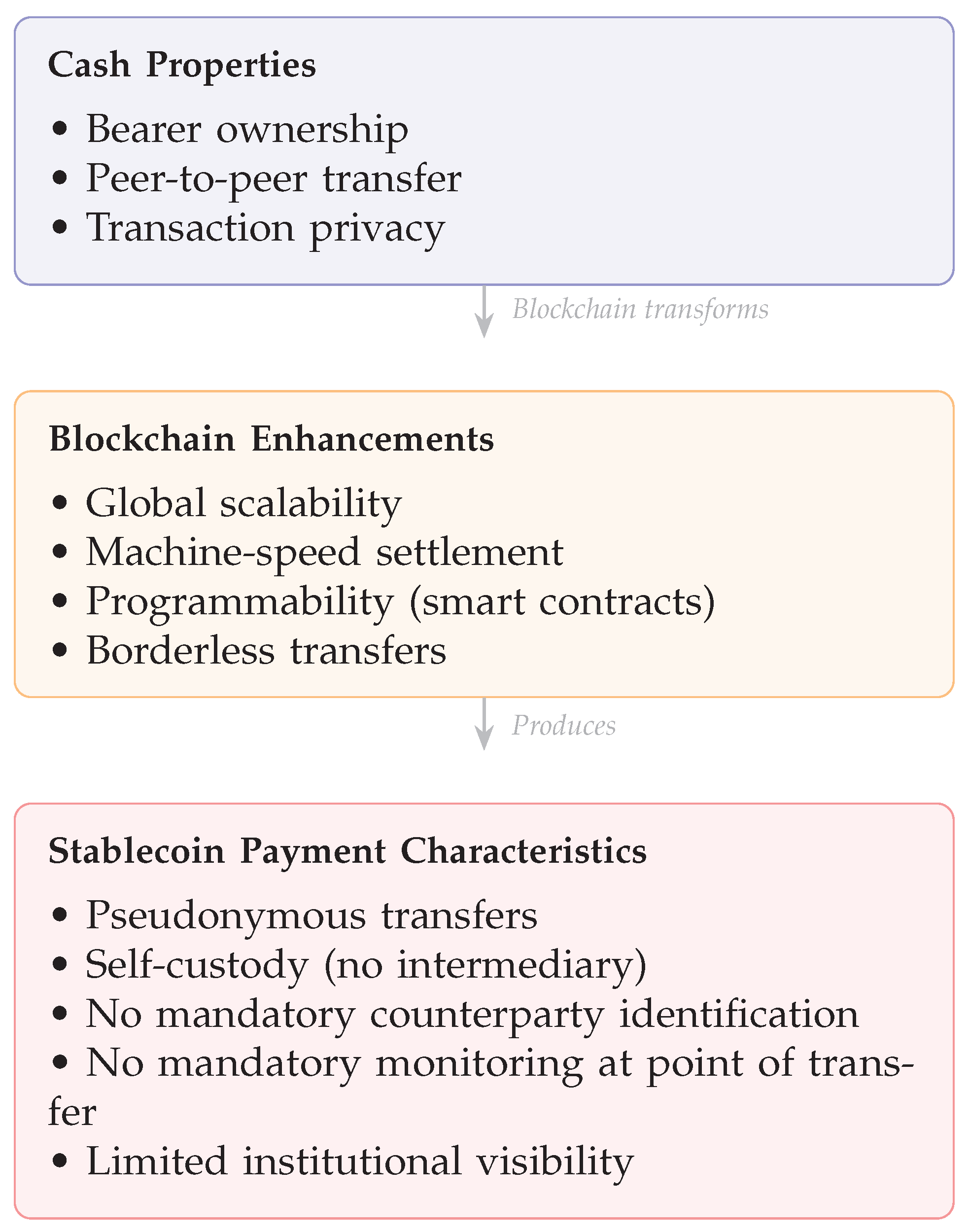
Figure 2.
Timeline of major stablecoin launches by collateral type, corresponding to the classification in Table 1. Colour coding: blue (fiat-backed), orange (commodity-backed), green (crypto-backed), red (algorithmic). The dashed marker at 2022 denotes the collapse of TerraUSD (UST), which erased approximately $40 billion in market value and prompted most jurisdictions to restrict algorithmic stablecoin issuance.
Figure 2.
Timeline of major stablecoin launches by collateral type, corresponding to the classification in Table 1. Colour coding: blue (fiat-backed), orange (commodity-backed), green (crypto-backed), red (algorithmic). The dashed marker at 2022 denotes the collapse of TerraUSD (UST), which erased approximately $40 billion in market value and prompted most jurisdictions to restrict algorithmic stablecoin issuance.
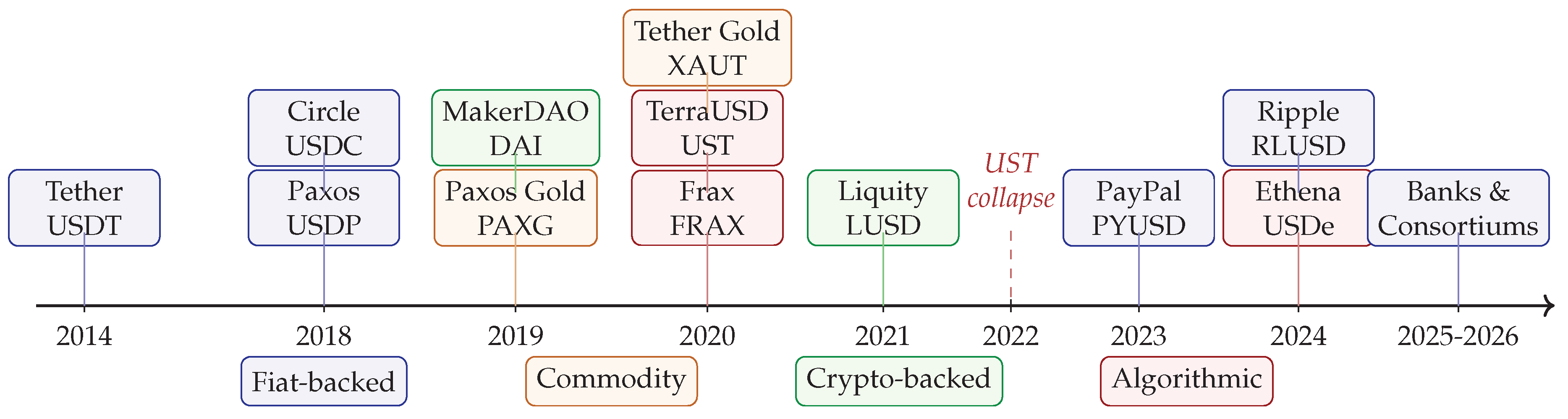
Figure 3.
Annotated stablecoin transaction pipeline. Green shading denotes regulated zones subject to AML/CFT obligations; red shading denotes the unregulated exploitation space (Stages 3–4b). The bottom row identifies the financial crime property activating at each stage. Stage 3 corresponds to the unhosted wallet. Stage 4 covers mixing and DEX activity. Stage 4b represents cross-chain bridge activity. Stages 1–2 and Stages 5–6 represent the regulated endpoints where KYC obligations apply but where the origin of funds may already be obscured.
Figure 3.
Annotated stablecoin transaction pipeline. Green shading denotes regulated zones subject to AML/CFT obligations; red shading denotes the unregulated exploitation space (Stages 3–4b). The bottom row identifies the financial crime property activating at each stage. Stage 3 corresponds to the unhosted wallet. Stage 4 covers mixing and DEX activity. Stage 4b represents cross-chain bridge activity. Stages 1–2 and Stages 5–6 represent the regulated endpoints where KYC obligations apply but where the origin of funds may already be obscured.
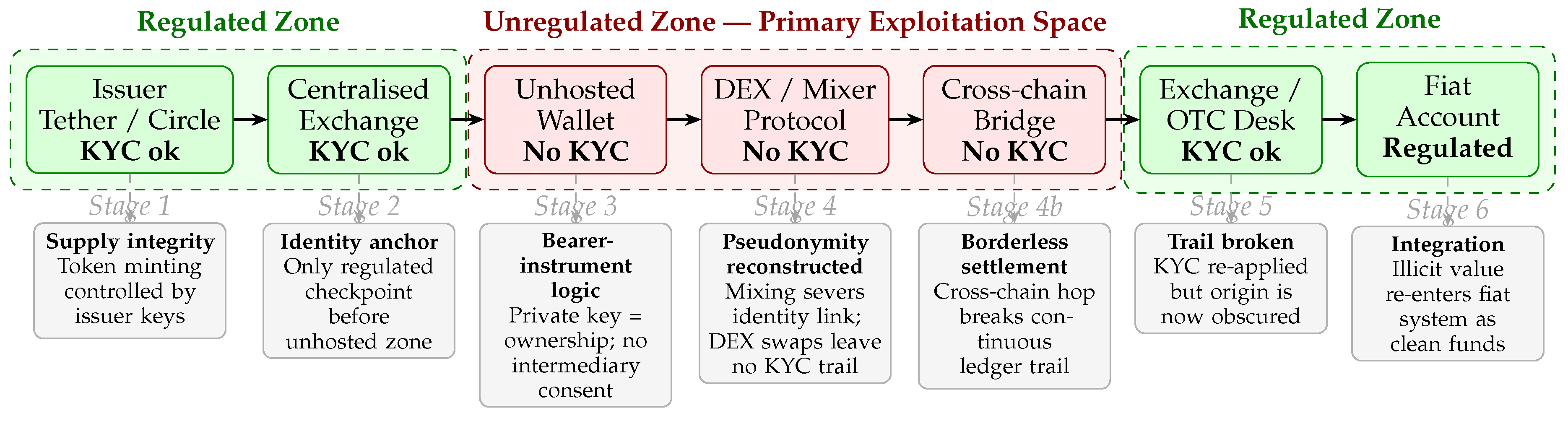
Figure 4.
Stablecoin supply distribution by holder category as of 20 July 2026, across all chains tracked by Artemis Analytics ($310.8B total). Self-custody wallets account for $181.1B (58.3%); centralised exchanges for $75.0B (24.1%); with the remainder in DeFi contracts, unlabelled smart contracts, and other applications (17.6%). When narrowed to the self-custody versus exchange comparison, the ratio is 71% to 29%, consistent with the independent estimate in Gopinath et al. [31]. The overwhelming majority of stablecoin value sits outside the mandatory KYC/AML perimeter at any given moment. Source: Artemis Analytics (20 July 2026, this study).
Figure 4.
Stablecoin supply distribution by holder category as of 20 July 2026, across all chains tracked by Artemis Analytics ($310.8B total). Self-custody wallets account for $181.1B (58.3%); centralised exchanges for $75.0B (24.1%); with the remainder in DeFi contracts, unlabelled smart contracts, and other applications (17.6%). When narrowed to the self-custody versus exchange comparison, the ratio is 71% to 29%, consistent with the independent estimate in Gopinath et al. [31]. The overwhelming majority of stablecoin value sits outside the mandatory KYC/AML perimeter at any given moment. Source: Artemis Analytics (20 July 2026, this study).
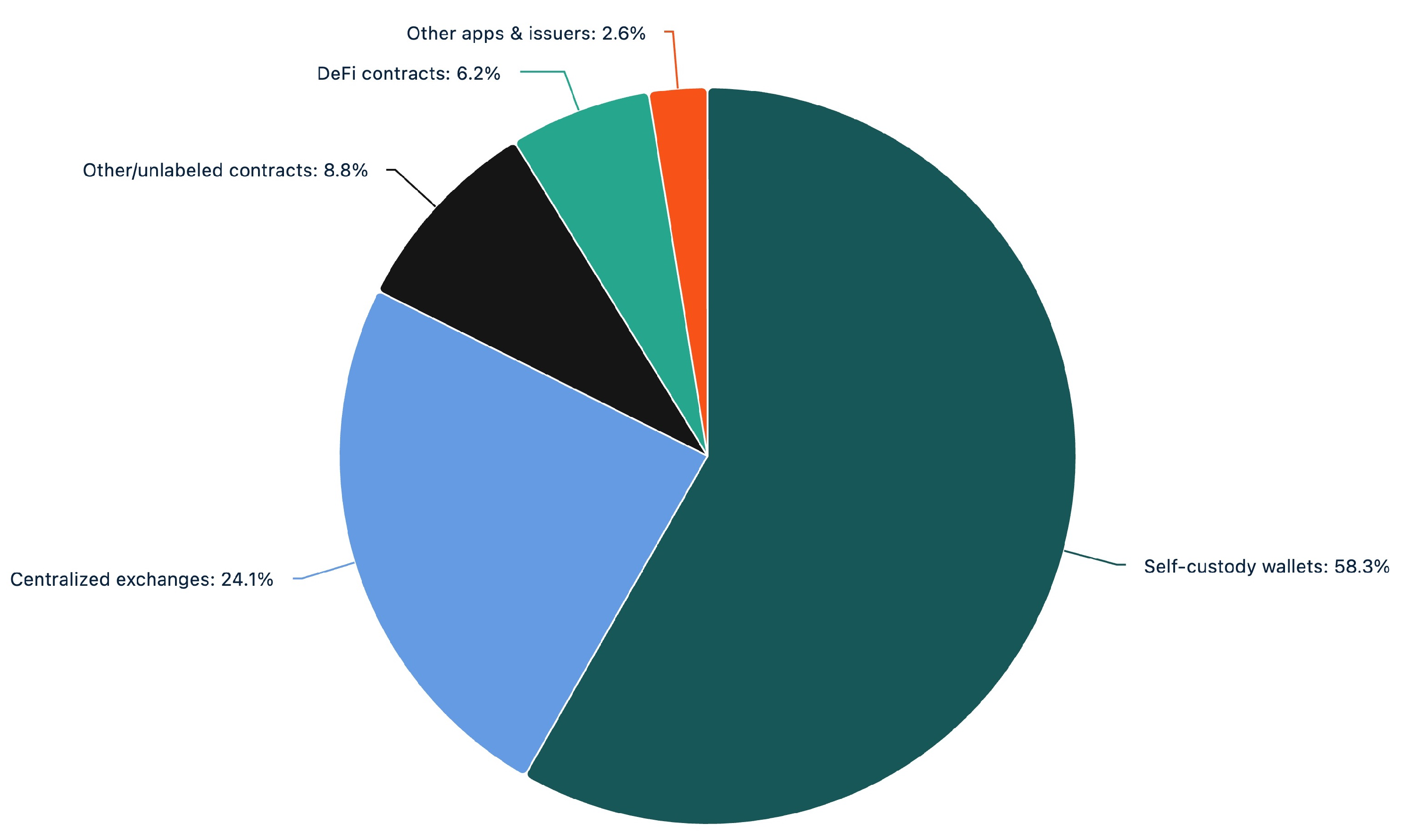
Figure 5.
Monthly stablecoin transfer volume processed through Tornado Cash, July 2025 to July 2026. Aggregate volume over the trailing 12 months reached approximately $690M (Artemis Analytics, this study). USDT accounted for 78.8% ($543.9M); DAI and USDC each contributed approximately 10%. Volume increased sharply from January 2026, peaking at approximately $168M in March 2026. This rise follows the March 2025 delisting of Tornado Cash from the OFAC sanctions list and is consistent with renewed use of the protocol; the episode illustrates the limits of entity-based enforcement against immutable smart-contract infrastructure (see Section V-B) [34,35]. Source: Artemis Analytics (this study).
Figure 5.
Monthly stablecoin transfer volume processed through Tornado Cash, July 2025 to July 2026. Aggregate volume over the trailing 12 months reached approximately $690M (Artemis Analytics, this study). USDT accounted for 78.8% ($543.9M); DAI and USDC each contributed approximately 10%. Volume increased sharply from January 2026, peaking at approximately $168M in March 2026. This rise follows the March 2025 delisting of Tornado Cash from the OFAC sanctions list and is consistent with renewed use of the protocol; the episode illustrates the limits of entity-based enforcement against immutable smart-contract infrastructure (see Section V-B) [34,35]. Source: Artemis Analytics (this study).
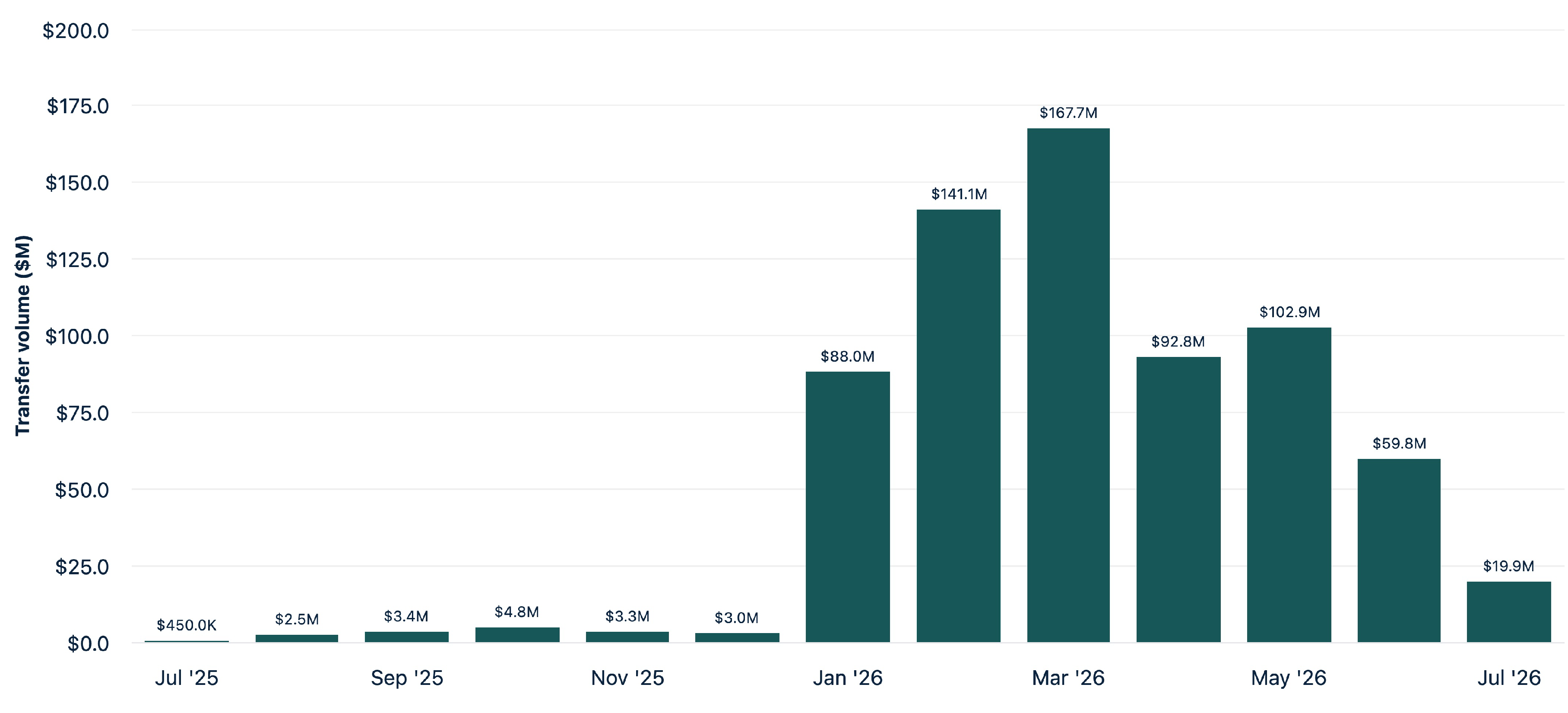
Figure 6.
Organic stablecoin transfer volume by blockchain network and cross-chain bridges, trailing 12 months to 20 July 2026 (Artemis Analytics, this study). Networks included: Base, Ethereum, Tron, Solana, BNB Smart Chain, Sui, Optimism, Avalanche, Arbitrum, Polygon, Aptos, and Plasma, with cross-chain bridge activity reported as a separate aggregate across all bridge protocols. Organic transfer volume is defined as on-chain stablecoin token transfers between addresses, excluding identifiable internal contract-to-contract movements; figures may include automated market maker routing and DeFi protocol activity and should be treated as an upper bound on economically meaningful peer-to-peer transfer volume rather than a precise measure. Cross-chain bridge activity represented $226B (0.39% of total volume). See Appendix A for full dataset definitions and limitations.
Figure 6.
Organic stablecoin transfer volume by blockchain network and cross-chain bridges, trailing 12 months to 20 July 2026 (Artemis Analytics, this study). Networks included: Base, Ethereum, Tron, Solana, BNB Smart Chain, Sui, Optimism, Avalanche, Arbitrum, Polygon, Aptos, and Plasma, with cross-chain bridge activity reported as a separate aggregate across all bridge protocols. Organic transfer volume is defined as on-chain stablecoin token transfers between addresses, excluding identifiable internal contract-to-contract movements; figures may include automated market maker routing and DeFi protocol activity and should be treated as an upper bound on economically meaningful peer-to-peer transfer volume rather than a precise measure. Cross-chain bridge activity represented $226B (0.39% of total volume). See Appendix A for full dataset definitions and limitations.
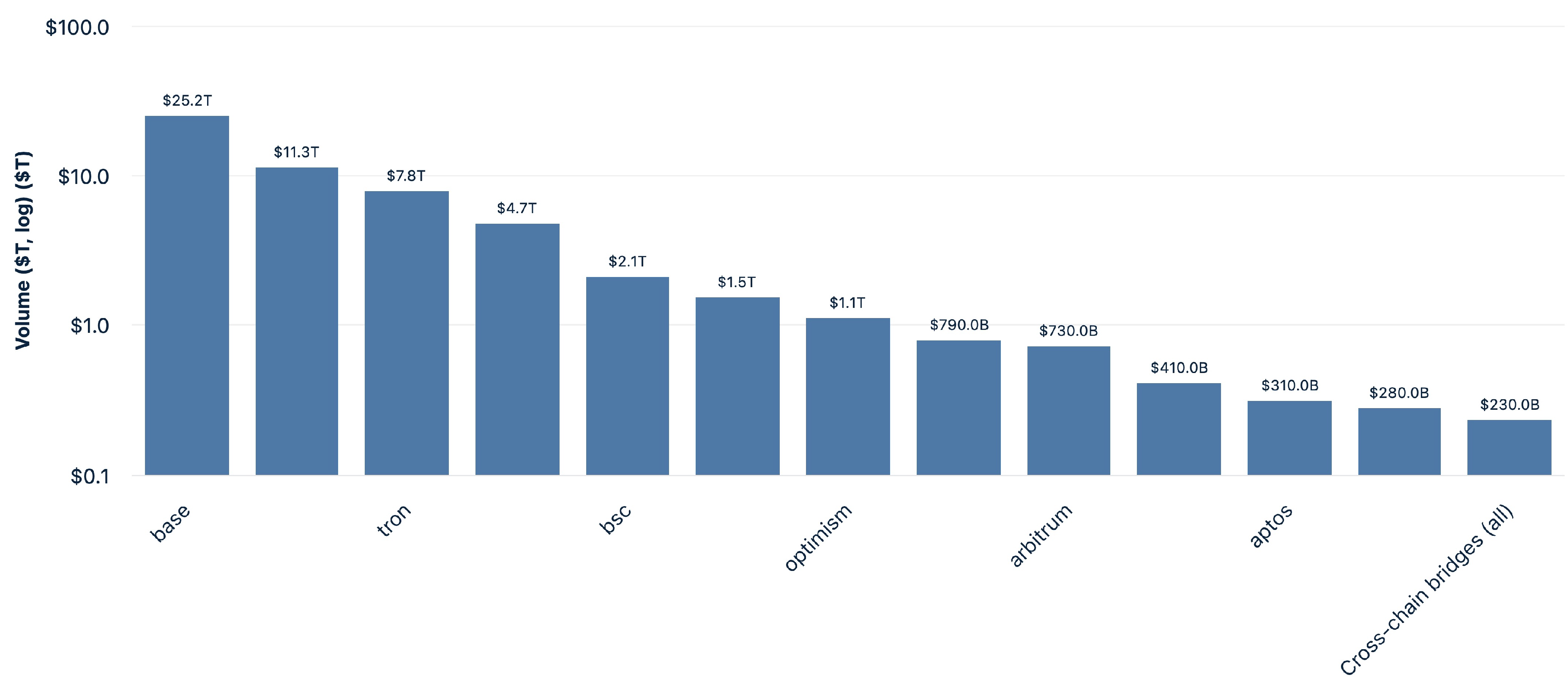
Figure 7.
Institutional visibility spectrum of traditional money versus stablecoins. The axis measures the proportion of supply subject to mandatory AML/CFT monitoring obligations; bar widths are proportional to share of total value. Stablecoin data reflect a point-in-time snapshot as of 20 July 2026; market composition and address attribution change continuously and figures obtained at a different date will differ. Source: Artemis Analytics (20 July 2026, this study); traditional money data from Gopinath et al. [31].
Figure 7.
Institutional visibility spectrum of traditional money versus stablecoins. The axis measures the proportion of supply subject to mandatory AML/CFT monitoring obligations; bar widths are proportional to share of total value. Stablecoin data reflect a point-in-time snapshot as of 20 July 2026; market composition and address attribution change continuously and figures obtained at a different date will differ. Source: Artemis Analytics (20 July 2026, this study); traditional money data from Gopinath et al. [31].
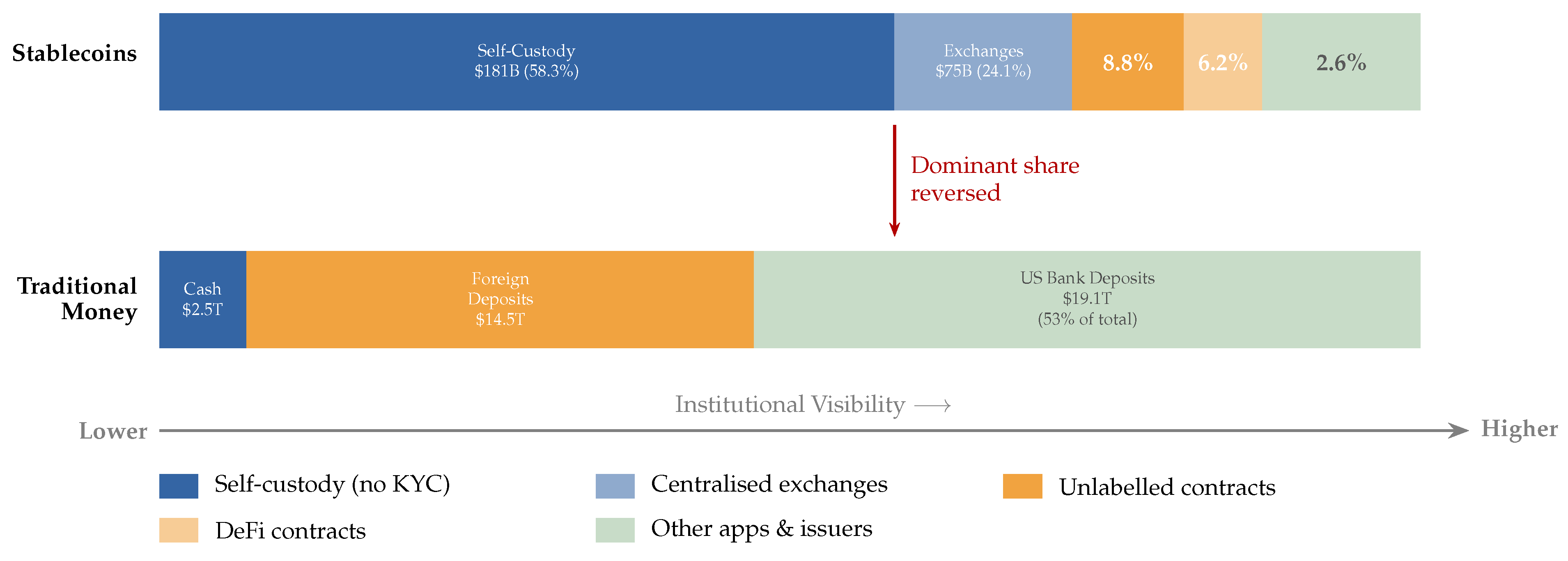

Table 1.
Classification of Stablecoins
| Type | Collateral / backing | Peg mechanism | Examples | Key characteristics |
|---|---|---|---|---|
| Fiat-backed | Cash, bank deposits, Treasury bills, and other highly liquid reserve assets held by a centralised issuer | Direct redemption at a fixed ratio (typically 1:1 with a fiat currency) | USDT, USDC, PYUSD | Centralised issuance; high liquidity; reserve-backed; dominant category by market capitalisation and transaction volume. |
| Commodity-backed | Physical commodities such as gold held in custody | Redeemable for a specified quantity of the underlying commodity | PAXG, XAUT | Provides on-chain exposure to commodity prices; value tracks the underlying asset rather than fiat currency. |
| Crypto-backed | Overcollateralised cryptocurrencies locked in smart contracts | Overcollateralisation and automated liquidation maintain the peg | DAI, LUSD | Decentralised issuance; transparent collateral management; requires excess collateral due to price volatility of underlying assets. |
| Algorithmic/ Synthetic | Financial strategies, derivatives, or partially collateralised assets | Algorithmic supply adjustment, arbitrage incentives, or hedging strategies | USDe, FRAX, (formerly UST) | No reserve backing; maintains peg through programmatic mechanisms; higher financial and operational risk. |
Table 2.
Major stablecoins by circulating supply across all supported blockchain networks (20 July 2026).
Table 2.
Major stablecoins by circulating supply across all supported blockchain networks (20 July 2026).
| Stablecoin | Supply ($B) | Stablecoin | Supply ($B) |
|---|---|---|---|
| USDT | 185.16 | USDY | 1.87 |
| USDC | 75.42 | RLUSD | 1.68 |
| USDS | 6.38 | BUIDL | 1.57 |
| USD1 | 4.21 | USDG | 1.54 |
| DAI | 3.89 | USDFALCON | 1.37 |
| USDe | 3.72 | USDD | 1.25 |
| USYC | 2.96 | USDGO | 1.00 |
| PYUSD | 2.82 | JTRSY | 0.87 |
| XAUt | 2.77 | BENJI | 0.82 |
| PAXG | 2.00 | GHO | 0.70 |
Table 3.
Bearer-instrument characteristics by stablecoin type.
| Type | Central issuer | Freeze function | Bearer instrument (strict) | Examples |
|---|---|---|---|---|
| Fiat-backed | Yes | Yes (issuer holds admin keys) | No | USDT, USDC |
| Commodity-backed | Yes | Yes (issuer holds admin keys) | No | PAXG, XAUT |
| Crypto-backed | No (protocol governed) | No (smart contract only) | Yes | DAI, LUSD |
| Algorithmic | No (protocol governed) | No (smart contract only) | Yes | USDe, FRAX |
Table 4.
Stablecoin properties that exceed the cash profile: analytical significance, policy response, and research direction.
Table 4.
Stablecoin properties that exceed the cash profile: analytical significance, policy response, and research direction.
| Property | Analytical significance | Policy response | Research direction |
|---|---|---|---|
| Scale & Velocity | Value transfer beyond physical constraints; no ceiling on single-transaction magnitude | Strengthen on/off-ramp controls; large-value transaction monitoring | Threshold calibration for AML-relevant transfer detection across networks |
| Programmable Layering | Automated money laundering at machine speed; removes human friction that creates investigative leads | Mandate on-chain analytics at licensed institutions | Automated layering pattern detection; graph-based anomaly identification across DEX and bridge activity |
| Borderless Settlement | Jurisdictional indifference; entity-based enforcement cannot reach immutable smart contract infrastructure | Multi-jurisdictional analytical cooperation | Cross-chain attribution standards; international blockchain intelligence sharing frameworks |
| Pseudonymity Asymmetry | Permanent but fragmented trail; analytically more demanding than the absence of a trail | Extend Travel Rule to unhosted wallets; on-chain analytics screening | ZKP-based compliance mechanisms; privacy-preserving AML verification without identity disclosure |
| Public Ledger | Structural investigative asset; every transaction permanently recorded and publicly queryable | Mandate on-chain analytics; invest in open-source analytics infrastructure | Public-sector blockchain intelligence platforms; open attribution databases for FIU use |
Disclaimer/Publisher’s Note: The statements, opinions and data contained in all publications are solely those of the individual author(s) and contributor(s) and not of MDPI and/or the editor(s). MDPI and/or the editor(s) disclaim responsibility for any injury to people or property resulting from any ideas, methods, instructions or products referred to in the content. |
© 2026 by the authors. Licensee MDPI, Basel, Switzerland. This article is an open access article distributed under the terms and conditions of the Creative Commons Attribution (CC BY) license (http://creativecommons.org/licenses/by/4.0/).
Copyright: This open access article is published under a Creative Commons CC BY 4.0 license, which permit the free download, distribution, and reuse, provided that the author and preprint are cited in any reuse.