

Submitted:
02 October 2026
Posted:
06 October 2026
You are already at the latest version
Abstract
Cross-border commuting by women in low and middle-income countries remains severely under-researched, legally unrecognised, and wrongly merged into international migration data. This paper applies a four-step distributive analysis of the law to examine the legal frictions of stop and delay experienced by women cross-border commuters at the South Africa–Zimbabwe border. Drawing on qualitative fieldwork conducted in March 2025 in Musina and Johannesburg, including interviews with women commuters and civil society professionals, a focus group, border observation, and systematic legal mapping, the analysis identifies the primary norms generating frictions of stop and delay; the second-level norms from other bodies of law that compound their effects; the actors and interests the legal architecture structures; and the resulting distribution of costs and benefits. The paper makes three contributions. Methodologically, it demonstrates that the distributive analysis of the law offers mobilities scholarship a framework capable of tracing how formally neutral legal norms generate unequal outcomes across diverse groups of actors. Empirically and from a feminist mobilities perspective, it disaggregates women cross-border commuters into two analytically distinct sub-groups: documented women traders and undocumented women without capital, showing that legal costs, physical danger, and exposure to violence accumulate heterogeneously even within this category, while the benefits of crossing, including trade income, healthcare access, and relief from domestic violence, are real and survival-level for both. Theoretically, it advances a constitutive account of law within the politics of mobility, arguing that informal crossings, extortion networks, and survival trade are not produced outside the law but within a field of constraints and opportunities that law itself organises. Zimbabwe’s Statutory Instrument 59 of 2026 is identified as a recent legal development that materially worsens the distributional position of documented women traders, ignoring the underlying conditions that make cross-border trade necessary.
Keywords:
trade
; cross-border commuters
; women
; distributive analysis
Introduction
There are 132 low and middle-income countries (LMICs) sharing a land border with at least one other country. Millions of people engage in formal and informal border crossings daily, many making routine trips for work or survival (International Organization for Migration, 2024). This phenomenon is expanding in both scale and political significance (Basch et al., 1993; Massey et al., 1998), yet migration data systems do not clearly distinguish international migration from temporary mobility such as cross-border commutes (CBC) and collect very limited statistics on the latter (United Nations Statistics Division, 2025).
The academic literature focuses largely on men’s CBC in Global North contexts (Bergantino & Madio, 2018; Mooses et al., 2020; Telve, 2019). CBC in LMICs, specially by women, remains severely under-researched, wrongfully mixed with international migration data, and unrecognised in law and in the gendered mobilities literature. Initial research suggests CBC are especially burdensome where stark wealth disparities exist between neighbouring countries, where displaced populations are concentrated, and where legal frameworks are not properly aligned across jurisdictions.
The South Africa–Zimbabwe border is a well-suited case for examining these dynamics. Zimbabwe has experienced decades of economic instability represented by hyperinflation exceeding 700% between 2007 and 2008, unemployment above 90%, and recurring food shortages (Hanke & Bostrom, 2017; Tawodzera et al., 2019), while South Africa provides economic opportunity despite its own inequalities, and constitutes the greater attractor of migrants in the Southern Africa region. This disparity drives a substantial and regular flow of commuters crossing to trade and work. There is only one formal crossing: the Beitbridge border post, and at least twenty-two unofficial crossings along the Limpopo River (Nare, 2020), creating a legal architecture that concentrates formal control while pushing many commuters towards informal, dangerous alternatives. Women cross-border commuters who travel this route, often to buy and resell goods, remain absent from research and policy. Their journeys are often classified into humanitarian migration narratives that do address their practical challenges.
This paper places the law at the centre of the analysis. Mobility scholarship has long recognised that movement is regulated through legal structures that distribute the capacity to move unevenly (Cresswell, 2010; Glick Schiller & Salazar, 2013). However, legal frameworks are often treated as background conditions rather than primary objects of exploration. A distributive analysis of the law addresses this gap: it examines not only which norms apply, but how their practical effects unevenly allocate power among different groups (Barrios Forero, 2023; Jaramillo Sierra & Alfonso Sierra, 2008). This is especially relevant at the South Africa–Zimbabwe border, where formally neutral immigration and customs laws generate costs that fall disproportionately on women without documentation, resources, or legal capacity. Thus, this paper responds to the New Mobilities Paradigm’s call for closer attention to the mechanisms through which kinetic hierarchies (or hierarchies among those who can move a lot and freely vs. those who do not) are produced (Sheller & Urry, 2006), and contributes a legal analysis to the growing literature on mobility governance in LMIC’s border contexts (Hochmüller & Idler, 2025; Mancinelli & Germann Molz, 2023).
The paper focuses on two categories of legal friction (Cresswell, 2014): frictions of stop, referring to norms limiting formal crossing, including designated port of entry requirements and passport obligations; and frictions of delay, related to norms generating bureaucratic interruptions during and after transit, including customs duties, goods restrictions, and mandatory police checkpoint unloading. The analysis proceeds in four steps: defining the primary legal norms analysed; identifying second-level norms that compound their effects; mapping the actors and interests involved; and assessing the resulting distribution of costs and benefits.
Literature Review
Mobility Frictions and the Law
Human social relations produce, reproduce, and transform mobility (Cresswell, 2010). Mobility is composed of at least six constituent parts: motive force, velocity, rhythm, route, experience, and friction, all of which are crucial to the politics of mobility. Frictions are social, cultural, material, physical, and legal forces that shape movement; they are not mere obstacles to overcome but omnipresent conditions of movement itself. As Cresswell argues, “friction [is] a force which works to slow or stop mobilities on the one hand and make the very fact of mobility possible on the other” (Cresswell, 2014:109).
The analytical distinction this paper draws between legal and non-legal frictions rests on a legal realist understanding of law. Legal realism considers how the law operates in practice, including judicial and administrative behaviour. From Holmes (1897) account of the law, from the perspective of the ‘bad man,’ as prediction of what courts will do in fact, to Llewellyn (1930) insistence on the gap between paper rules and real rules, this tradition foregrounds law in action beyond law on the books. A legal friction results from the combination of the text with enforcement patterns, official discretion, the economic incentives it creates, and the social arrangements that emerge when it is applied or not. This distinguishes legal frictions from infrastructural constraints, which arise from the material organization and uneven availability of infrastructures. Rodgers & O’Neill (2012) concept of infrastructural violence considers how such infrastructures can participate in the production of harm. Legal frictions are characterized by legally authorized consequences or constraints, including but not limited to fines, detention, seizure, exclusion, or denial of legally available benefits. This paper focuses on the credible, differentially deployed threat of those consequences that distributes costs and benefits across the actors.
This framing responds to a broader question: why centre law instead of using frameworks such as bordering (van Houtum & van Naerssen, 2002), mobility regimes (Glick Schiller & Salazar, 2013), or infrastructural violence (Rodgers & O’Neill, 2012)? Bordering scholarship illuminates how spatial divisions are constructed, but we consider it does not systematically account for who bears the costs when those borders are enforced. Mobility regimes describe regulatory systems that privilege certain movements, but we extend this concern by explicitly analysing cost allocation across actor groups. Infrastructural violence attends to material vulnerability but may ignore the specifically normative character of the constraints it describes. The distributive analysis of the law addresses each gap because it specifies what legal texts say and how they operate in practice; identifies second-order norms that compound their effects; maps the actor field those norms shape; and accounts systematically for the allocation of costs and benefits across that field (Barrios Forero, 2023; Jaramillo Sierra & Alfonso Sierra, 2008).
This paper adopts a constitutive account of law, arguing that legal norms structure the field within which other dynamics, economic, social, and violent, become possible, legible, and profitable. The paper argues that informal crossings, extortion networks, and survival trade are produced within a field of constraints and opportunities that the law organises. Mobility at the South Africa–Zimbabwe border unfolds in the shadow of the law since women cross-border commuters, their children, state officials, non-state actors, and members of civil society organizations end up negotiating risks, prices, and strategies within a legally structured environment that assigns differential costs to compliance and non-compliance. Cresswell’s (2010) politics of mobility, with its emphasis on differentiated movement, friction and regulation, finds a legal grounding here.
Some authors describe the relationship between states and people on the move as mutually constitutive (Mancinelli & Germann Molz, 2023). Building on the concept of governmobility (Bærenholdt, 2013), mobile individuals and mobility regimes mutually constitute each other through self-governance, moral conduct, and common economy. At porous borders where state policies are partially enforced, hybrid sovereignties emerge: state and non-state actors compete with and complement each other in the provision of governance functions, with no single entity exercising authority alone (Hochmüller & Idler, 2025). This paper applies that framework to the South Africa-Zimbabwe border. All actors therefore bargain and navigate in the face of legal frictions at these borderlands.
Cross-Border Commutes, Women and Gender
Crossing borders has mainly been understood through the lens of migration. There is, however, both a conceptual and empirical difference between temporary international mobilities and migration that has been blurred in policy and analytical frameworks. Migration implies a change of residence; temporary international mobility does not. The United Nations Statistics Division (2025) has recommended their formal conceptual separation. CBC fall under temporary international mobility including commuters who reside in one country but work or trade in another, making short-term and routine trips across the border. Legal frictions tied to sovereignty are therefore a significant and constitutive component of them.
There is a substantial gap between CBC in higher-income countries and in LMICs. CBC has been mostly studied in Europe and at the Mexico–US border, focusing on formal work by men and following qualitative approaches, with European studies comprising 88% of cases in the literature (Tsiopa et al., 2024). In higher-income countries, international agreements and connected infrastructure typically reduce barriers to movement. The European Union reported over 1.8 million cross-border workers in 2021–2022, facilitated by reduced passport controls, taxation agreements, and high transport connectivity (EGTC Summit Secretariat of the Greater Region, 2025; European Union, 2020; Nienaber & Pigeron-Piroth, 2017).
CBC in LMICs is characterised by economic hardship, humanitarian need, and governance failures that hinder flow. At Beitbridge, travellers face extended queues and waiting times while non-state actors offer faster alternatives in exchange for bribes (Fayad, 2011; Hill, 2024). Regional integration protocols in Southern Africa remain weakly implemented (United Nations Statistics Division, 2025). At the Venezuela–Colombia border, cross-border commuters contend with unregulated transport, sexual violence, inconsistent fares, and unwarranted document checks by both state and non-state actors (Espinel et al., 2020; Mendoza Niño, 2023; Mojica et al., 2020; Zulver & Idler, 2020). Cresswell’s (2010) kinetic hierarchies find clear expression in these contrasting contexts.
A notable gap in the CBC literature concerns gendered experience. European data show that men comprise up to 70% of cross-border commuters, concentrated in agriculture, construction, and mining (Bergantino & Madio, 2018). Meanwhile, women tend to engage less in CBC (Mooses et al., 2020). Tsiopa et al. (2024) note that women face additional legal and caregiving barriers, while men encounter occupational hazards and unpredictable border crossings. The gendered experience of CBC in LMICs, and specifically at the South Africa–Zimbabwe border, remains largely unexamined. Women’s commutes in this corridor are typically tied to the financial provision of families across the border while relying on temporary care arrangements for their children, a configuration that intersects with the legal frictions they face at the crossing.
Feminist mobilities scholarship counters frameworks that treat women’s mobility primarily through the lens of restriction and as the ones who stay when men commute. Hanson (2010) establishes that gender and mobility are mutually constitutive: mobility patterns shape gender identities, and gender identities shape mobility possibilities in ways that are spatially specific and historically situated. Uteng & Cresswell (2008) extend this by demonstrating that gendered mobilities reflect underlying inequalities in access to resources, safety, and political recognition, while also producing differentiated strategies women develop in response to constrained mobility environments. Silvey (2004) shows that women’s mobility is shaped by intersecting axes of class, marital status, age, and social position, such that two women facing the same legal barrier may navigate it through entirely different means depending on their economic capital and social networks. Mahler & Pessar (2001) concept of gendered geographies of power captures how agency operates within structures of constraint.
In this paper, this literature directs attention to how women cross-border commuters are not simply subjects acted upon by legal frictions but actors who navigate, negotiate, and at times subvert them, adopting aliases, building crossing networks, calibrating duty risks, timing crossings around police patrols, and developing shared knowledge of informal routes. What varies between women is not whether they exercise agency but what resources they bring to that exercise. Older women with established networks carry different risks than first-time crossers; women with financial capital can pay duties or use the formal crossing while those without cannot; married women face different obstacles than widowed or single women who are their household’s sole providers. These differences reveal that the distributional effects of legal frictions are heterogenous even within the category “women cross-border commuters.”
In synthesis, this paper advances a constitutive account of law within the politics of mobility. While Cresswell’s (2010, 2014) framework identifies frictions as central to the production of movement, this analysis specifies legal frictions as foundational: not merely interruptions to mobility, but mechanisms through which mobility itself is structured. The distributive analysis of the law provides the methodological architecture to trace these effects, examining how legal arrangements allocate costs and benefits across actors. These frameworks direct attention to the legal production of kinetic hierarchies in the South Africa–Zimbabwe corridor, and to how women cross-border commuters are positioned within them as those who bear a huge share of the costs that law generates, while continuing their commutes for the benefits those crossings, at great cost, provide.
Methodology
Case Study
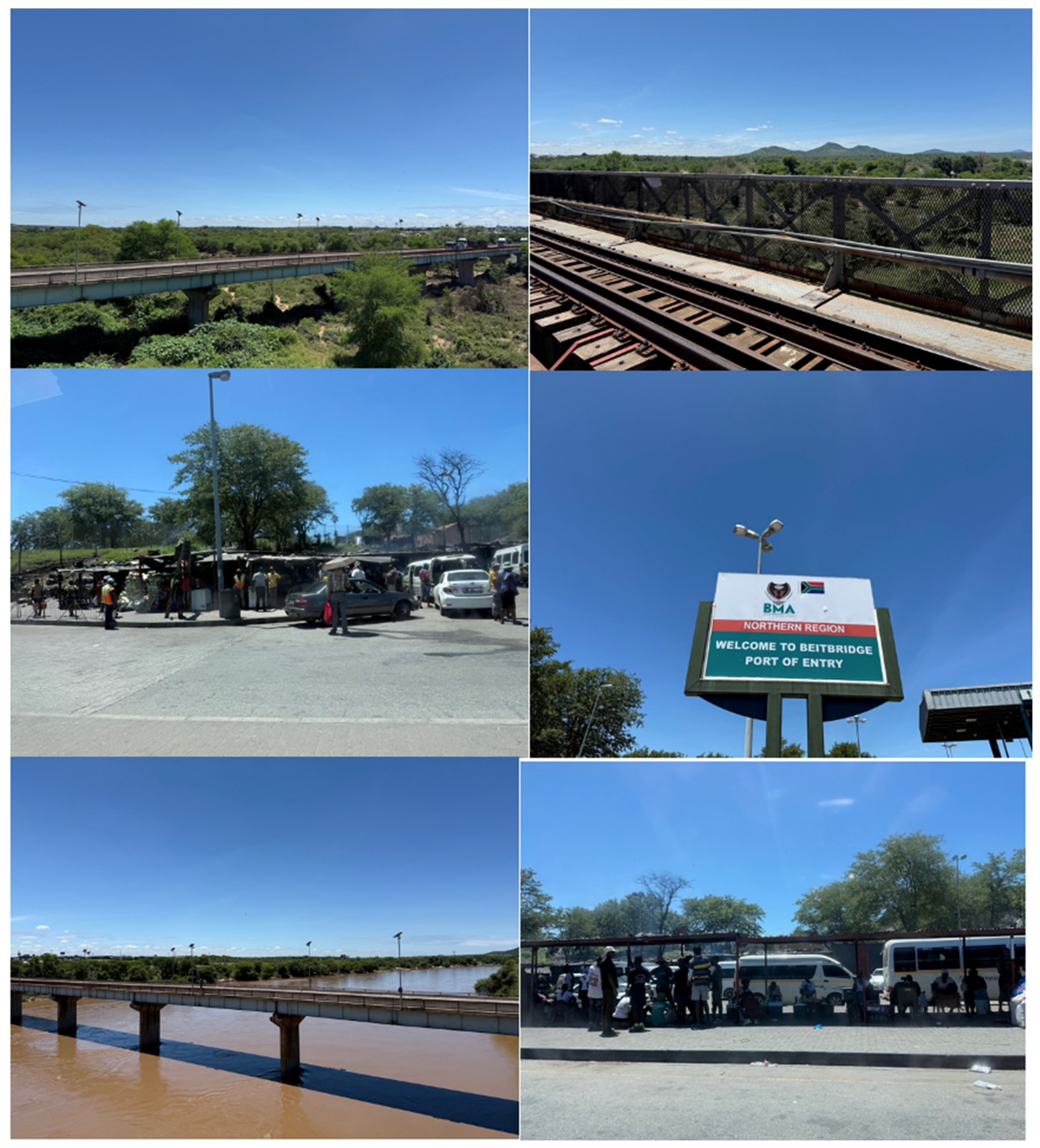
Musina was chosen as the site of the study for being located close to Beitbridge, the only formal border crossing between Zimbabwe and South Africa. The border extends approximately 225 kilometres, with the Limpopo River separating the two countries. Beitbridge Town sits one kilometre from the border post on the Zimbabwean side, in Matebeleland South province; Musina Town in South Africa’s Limpopo Province is approximately 13 kilometres from the post. The whole border is a bustling trade route witnessing significant informal trade and labour migration from sub-Saharan Africa (Fayad, 2011; Hill, 2024). Figure 1 below shows a collage of photos of this formal border crossing.
The socio-political context is marked by economic disproportion and migration pressure. Zimbabwe has faced severe economic challenges for decades, from the Fast Track Land Reform Programme in the early 2000s to hyperinflation exceeding 700% in 2007–2008, unemployment above 90%, and chronic food shortages exacerbated by recurring drought (Hanke & Bostrom, 2017; Tawodzera et al., 2019). These conditions have generated what Vanyoro (2023) calls survival migration, where economic hardship and political instability overlap to drive outward movement. South Africa has absorbed most Zimbabwean migrants, many travelling without documentation, creating precarious conditions on both sides of the border (Bayart, 2007; Vanyoro, 2023). Over time, Musina has become a hub of Zimbabwean migrant economic activity, extending to countries further north such as Zambia and Malawi, while South African authorities maintain enforcement through regular arrest, detention, and deportation of undocumented migrants (Chikanda, 2024; Vanyoro, 2023).
According to the 2022 census, Zimbabweans make up 1.01 millions of South Africa’s 2.4 million international migrants, representing 42% of that total Stats SA, 2023). South Africa recorded 2.18 million Zimbabwean arrivals in 2024, with 89% crossing by land (South African Government, 2025). The Beitbridge border post receives more than 13,000 travellers, over 400 buses, and 750 trucks daily (Private Infrastructure Development Group, 2025). There are at least 22 unofficial crossing points along the borderline, which increase in the dry season when the Limpopo can be crossed on foot (Nare, 2020); in April 2025 alone, 6,253 illegal crossings were detected. A United States Dollar (USD) 44 million expansion on the Zimbabwean side in 2020 reduced average crossing times from up to 12 hours to approximately three hours for non-commercial travellers (Private Infrastructure Development Group, 2025), though seasonal flooding creates high-risk conditions for anyone attempting informal crossings.
Data Collection
The study draws on qualitative fieldwork conducted in March 2025 in Musina and Johannesburg, following ethical approval.1 It had three components. The first was eight semi-structured, in-person interviews with women cross-border commuters, covering: basic demographic details; cross-border realities including residence conditions, family structure, and survival mechanisms; commuting experiences including frequency, transport, expenses, and challenges; and interaction with state and non-state actors, including risks, frictions, and strategies adopted. Interviews included time for participants to draw their commutes. This was followed by a focus group with four women in Musina addressing the same topics as the individual interviews.
The second component was six semi-structured interviews with professionals, including scholars, non-profit workers, and religious leaders. These focused on the approach of their organisations to cross-border realities; government intervention and its interaction with women commuters; and the role of violent and non-violent non-state actors. No State authority provided an interview. The third component was based on one observation at the Beitbridge border post examining crossing modes, transportation, group configurations, goods carried, and legal requirements in practice.
After fieldwork, a legal mapping exercise systematically identified and analysed immigration, customs, administrative, and international legal norms producing frictions for commuters, drawing on legal databases and official documentation. Synthesising fieldwork data and legal mapping enabled identification of gaps between written law and law in action.
In terms of positionality, one of the authors is a Colombian woman lawyer who has been working on gender and mobility for over a decade. The author has a vast experience conducting fieldwork, including in similar borderlands in Latin America. Part of her connections in South Africa, draw from her previous experience collaborating with a women’s rights non-profit in the country. This author experienced difficulties when approaching individuals because of her foreign accent and appearance, which was partly minimized by the fact that a Zimbabwean woman was her research assistant and accompanied her, translating and interacting when necessary. The other author is a Zimbabwean man who has lived in South Africa. He has personal experience and academic knowledge of cross-border realities and has contacts in the area. He came to the project after the fieldwork had already been conducted. However, this insider positioning facilitated contextual interpretation of places, routes, and informal social arrangements. At some time during this project, both authors were situated at a Global North Academic institution. This made the team alert to the associated risks such as the tendency to interpret participants’ accounts through foreign frameworks.
Study Participants
Women participants were randomly approached at the bus terminal and market in Musina, and through the Catholic Shelter for Women and Children, through professional networks. Professionals were identified through snowball sampling and contacted by phone or email. Each professional signed an informed consent form authorising participation and recording; for women participants, consent was oral and real names were replaced with aliases to protect anonymity. All participants were working adults.
The sample warrants open engagement with its limitations. The eight individual interviews and one focus group were conducted over a concentrated fieldwork period, which shapes the range of experiences represented. Women who had been deported, who were too afraid to speak, or who did not pass through Musina are absent from the data. However, women’s accounts are contextualised through six interviews with civil society professionals, including legal advisors, social workers, religious care providers, and Red Cross staff, who collectively hold institutional knowledge of hundreds of women’s experiences accumulated over years at this border. These professional accounts provide the structural depth that complement individual interviews, enabling pattern identification beyond individual trajectories.
Two further limitations are: First, the principal researcher arrived at this border as an outsider, foreign to its context, languages, and social geography. Her access was shaped by who was willing to speak to her and in what terms; women reachable through existing contacts and institutional gatekeepers are not necessarily representative of the wider population of women who cross the Limpopo every week (Bolt, 2015). Second, repeated attempts to secure interviews with South African government officials, including the Border Management Authority, the Department of Home Affairs, and local law enforcement, were unsuccessful. State actors are therefore represented in this paper through the accounts of those they govern rather than their own descriptions of their practices. These limitations were partly countered by the fact that the other author of the paper is Zimbabwean and studied in South Africa, with personal experience of this border’s dynamics through sustained engagement with its authorities and legal environment on a personal basis.
Method of Analysis: Distributive Analysis of the Law
The analysis follows a distributive analysis of the law, a methodology focused on the distributive effects of legal norms: the allocation of costs and benefits to different groups resulting from a legal issue (Jaramillo Sierra & Alfonso Sierra, 2008; Barrios Forero, 2023). Although the central focus is the law itself, “legal” here may refer to the substance of a positive legal, administrative, or judicial norm, or to the actual application of these laws. The analysis proceeds in four steps.
The first step defines the object of analysis. This can be approached by examining how knowledge-power is constructed through the legal text (Foucault, 1980), or by focusing on the normative text and examining the distributive effects generated by either compliance with or disregard for the norm (Shamir, 2010).
The second step analyses second-level norms: provisions found in other bodies of law that may not at first appear to impact the distribution but nonetheless compound the effects of primary norms (Mnookin & Kornhauser, 1979). These contrast with first-order norms, which bear an explicit relationship to the factual scenario that is being examined.
The third step identifies the actors and the interests at play. Since both first order and second-order norms empower certain subjects while weakening others, this step makes explicit that not all who gain, gain equally, and not all who lose, lose equally (Jaramillo Sierra & Alfonso Sierra, 2008). The distributive critique also examines how certain interests are imposed over others, and how this dynamic can empower the most unexpected actors (Barrios Forero, 2023).
The fourth step assesses the resulting distribution by calculating the allocation of costs and benefits. Following a Foucauldian approach, costs are understood as fluid and ever-changing rather than fixed or straightforward, and the analysis remains attentive to their shifting character across different actors and contexts (Barrios Forero, 2023)
Results and Discussion
Step 1: Defining the Object: Legal Frictions of Stop and Delay
The analysis focuses on legal norms that produce frictions of stop and delay at the South Africa–Zimbabwe border. Frictions of stop include the designation of a single formal crossing point and the requirement to hold a valid passport. Frictions of delay include customs duty obligations, product restrictions, and mandatory inspection. These are first-order norms with a direct and explicit relationship with the movement of women cross-border commuters.
Formal Crossing Points
Formal border crossings are instituted through bilateral agreements, domestic regulations, and physical infrastructure. Section 11(1) of Zimbabwe’s Immigration Act [Chapter 4:02] stipulates that entry is only permitted through designated ports of entry, with fines and imprisonment for violations. On the South African side, s 9(1) of the Immigration Act 13 of 2002 prohibits entry or departure other than at a port of entry, while s 9A empowers the Minister to designate such ports. There is a single formal crossing along the entire 225-kilometre Zimbabwe–South Africa border: the Beitbridge border post. This narrows the spatial possibility for legal crossing to a single channel. For women without documentation or the resources to use the formal post, this single-point structure generates a direct friction of stop, tethering them towards informal routes whose dangers are extensively documented in this study.
Passport Requirements
Section 25(5) [Chapter 4:02] of Zimbabwe’s Immigration Act and >Section 9(3)(a) and 9(4) of South Africa’s Immigration Act 13 of 2002 establish the valid passport as the primary legal requirement for formal crossing. In practice, passport possession is structurally out of reach for many Zimbabwean women. A member of Messina Legal Advice explained: “It’s an international requirement. A passport, however, is too expensive in Zimbabwe, hence they cross illegally.” The cost of a Zimbabwean passport is very high, from 150 to 250 USD. A focus group participant confirmed: “In Zimbabwe it’s difficult to get a passport. You need to have [like] USD 200, which is a lot of money” (Woman 4, focus group). The formal documentation requirement, while neutral in its text, functions as a structural barrier that disproportionately excludes women with limited financial resources.
Section 49(1)(a) of the Immigration Act 13 of 2002, as amended, makes unlawful entry, presence or departure an offence punishable by a fine or imprisonment not exceeding two years. Immigration detention and deportation are regulated separately under sections 32 and 34. Thus, an offence under Section 49 does not itself amount to a deportation order. In practice, however, undocumented women may experience the criminal and immigration consequences as interconnected, as reflected in participants’ pervasive fear of contact with state authorities, and systemic exclusion from protection. Sections 29 and 30(2) define “prohibited persons” and “undesirable persons,” -although providing formal remedies, the 10-day appeal deadline, high cost and administrative bottlenecks render the appeals practically inaccessible for individuals outside of South Africa. A member of Messina Legal Advice explained: “They don’t want to be in contact with the law, such as the police, because they are afraid that if they are illegal, they will be deported home. Another thing, when they are on the move, they change identity: today she’s known as Maria, but at home she’s Sara.” A member of the Catholic Shelter confirmed this effect: “We have had a number of these women who come here who have been robbed by these gumagumas. But they are afraid to go to the police because they are undocumented, and unfortunately that protects the perpetrators.” Thus, participants’ accounts suggest that fear of arrest, detention, or possible deportation can deter undocumented women from reporting robbery and violence, thereby reducing perpetrators’ practical exposure to law enforcement.
Another consequence of identity concealment was identified by a member of the Red Cross Society: “That is why most of the times you find unidentified bodies at the mortuary, because they have got different names but at home they are known by another name.” Identity concealment produced by the illegality of informal crossing generates permanent exclusion, since women who die during transit may be unidentifiable, denying their families legal recourse or dignified burial.
Legal Frictions of Delay: Random checks, Customs, Duty, and Product Restriction
Women cross-border commuters encounter significant frictions of delay arising from customs and excise obligations. Two overlapping instruments structure these frictions on the Zimbabwean side: the Customs and Excise Act (Chapter 23:02) and Statutory Instrument 59 of 2026 (SI 59).
Section 223A of the Customs and Excise Act authorises Zimbabwe Revenue Authority (ZIMRA) post-clearance audit and verification after goods have been released, including inspection at their destination. Separately, participants reported repeated searches of buses after leaving Beitbridge. Laura described: “On the Zimbabwean side it’s better for them to have one side that will clear everyone’s goods, like once-off, because when you leave the border sometimes you can find different groups stopping you, searching you and re-searching you. By the time you reach Harare you’ve probably been searched three or four times.” Whether each roadside inspection reported by participants was undertaken specifically under Section 223A could not be established from the interviews, evidence does establish is the cumulative experience of repeated customs enforcement after initial border clearance, which multiplies opportunities for both formal duty and informal coercive extraction.
Zimbabwe’s existing customs regime distinguishes personal imports from goods imported for resale or commercial purposes. The traveller’s rebate permits qualifying personal goods of up to USD 200 per calendar month but expressly excludes goods imported for resale or commercial purposes. SI 59 of 2026 adds a further regulatory layer by subjecting specified goods to an import-licensing regime, including a non-refundable USD 100 application fee and limited exemptions for specified quantities imported for personal use. Thus, goods for resale do not qualify for the traveller’s rebate and, where those goods require an import licensing, traders must comply with the applicable licensing requirements. This creates a huge legal friction for women whose livelihoods depend on small-scale recurrent trade. They must either misrepresent commercial goods as personal imports that may expose them to seizure, forfeiture, or prosecution under the applicable customs provisions; or declare their commercial purpose, paying for a license which places financial and administrative requirements on them. In 2025, before SI 59 came into force, Nhiko had already noted: “These days they say we must not buy anything from this side; if we buy anything we must pay duty, but the duty is too much… They say they want 40% and that’s just too much.” Her statement shows that the bargain was already constrained by customs duties before SI 59. Women could comply and absorb costs they experienced as excessive, alter their trade, or risk the consequences of non-compliance. SI 59 compounds the legal frictions by adding a further financial and administrative burden for regulated goods. For women cross-border commuters in this study, the law thus compounds the mobility frictions they experience and changes their bargaining strategies.
Step 2: Second-Level Norms
Second-level norms are provisions in other bodies of law that compound the effects of the first-level norms identified in Step 1. Three sets of second-level norms are operative at this border. First, Section 27(1)(a) of the South African Constitution guarantees everyone the right of access to health-care services, subject to progressive realisation within available resources, while s 27(3) provides that no one may be refused emergency medical treatment, which was then operationalised by the National Health Act 61 of 2003. This creates a significant pull factor. Laura explained: “Here in South Africa, if you get sick you can go to the hospital; they just charge you a minimum fee.” In practice, the exercise of this right is limited by documentation requirements at the implementation level that participants reported. A member of the Catholic Shelter reported: “Pregnant, HIV-positive people: it’s a big challenge for us because they come without transfer letters or a clinic card, hence the clinic refuses to attend to them or give them medication.” The health entitlement thus operates in two directions simultaneously, on the one hand, it creates the pull that makes crossing worthwhile, on the other hand, through its practical documental requirement it reinforces the exclusion that makes crossing so dangerous in the first place.
Second, Zimbabwe’s legal and regulatory history correlates to the economic conditions under which cross-border trade became the principal survival strategy for a large segment of the population. The Fast Track Land Reform Programme under the Land Acquisition Act [Chapter 20:10] is connected to the collapse agricultural output. Quasi-fiscal money creation under the Reserve Bank of Zimbabwe Act [Chapter 22:15] is partly accountable for hyperinflation. Price controls under subsequent statutory instruments contributed to moving goods from formal retail channels into parallel markets. The Indigenisation and Economic Empowerment Act 14 of 2007 helped to promote capital flight. Dollarization through Statutory Instrument 5 of 2009 introduced a new legal-economic asymmetry: goods priced in USD in Zimbabwe were available significantly more cheaply in South African rand across the border. Thus, while South Africans benefit from this exchange without no personal risks of crossing the borders, Zimbabweans bear all the legal risks in both countries. Laura confirmed: “It’s cheaper to buy in Musina and go resell in Zimbabwe.” Khalina identified the baseline reason for CBC: “Because of hunger.” For many participants, cross-border trade emerged not as an unconstrained livelihood choice but as a strategy adopted under severe economic constraint.
Third, Section 75 distinguishes between a right to basic state-funded education and further education, which the State must progressively make available and accessible. For participants seeking to finance their children’s university education, however, tuition and examination costs create substantial household expenditure. Nhiko explained: “I want my children to have degrees… That’s why I come to this place regularly, so that I can try by all means to generate money; because university is very expensive.” Recent SI 59 provision limits the trade that these conditions make necessary, adding a legal friction without addressing any of its underlying causes.
Step 3: Identifying the Actors and Interests at Play
Both first order and second-order legal norms empower certain actors while weakening others. Not all who gain, gain equally, and not all who lose, lose equally (Jaramillo Sierra & Alfonso Sierra, 2008).
South African Authorities
South African authorities including the Border Management Authority, immigration officers, and police have a legal mandate of safeguarding sovereignty and population control, which translates into arrests, deportations, and blocked entry. A member of Messina Legal Advice reported: “Recently in January 2024, the Border Management Authority was arresting a lot of illegal people who were crossing the border.” At the same time, the South African state benefits from an informal arrangement with civil society that allows it to maintain formal enforcement while offloading humanitarian responsibility. A member of the Catholic Shelter noted: “Even when they are arresting other people around here, they don’t come into the shelter; it’s like a sanctuary […]. They respect this place; they know that 85% of people here are undocumented.”
Zimbabwean Authorities
Zimbabwean state authorities pursue legal mandates in terms of sovereignty, revenue, and population control. The passport office generates income through passport fees, while ZIMRA administers customs duties and the traveller’s rebate. Separately, SI 59 of 2026 expands the import-control requirements administered through the Ministry of Industry and Commerce and the Secretary responsible for import licensing. These overlapping customs and licensing regimes increase the points at which women traders encounter state regulation. Zimbabwean police and soldiers formally enforce border norms but, according to participants, they also participate in informal extraction. Woman 4 of the focus group described the circuit: “We pay the gumagumas R500 to pass, then from that money they pay soldiers on the way, so they allow us to pass.” This account illustrates what Hochmüller and Idler (2025) describe as hybrid sovereignty, according to which state and non-state actors complement in governance, with soldiers operating as informal toll collectors connected to the gumaguma network.
Women Cross-Border Commuters
Women’s primary interest is family wellbeing and survival. Their motivation for crossing is not discretionary but existential. Laura explained: “Cross-border is my work because I’m always travelling every week. I come and buy my stuff in South Africa for resale in Zimbabwe.” Consistent with Silvey’s (2004) account of intersecting axes of constraint, the women in this study are a heterogeneous group. Their strategies vary with the resources they hold. Women who can afford the formal crossing use it; those who cannot calculate which informal routes and which gumagumas are comparatively safer. Women with some capital can absorb a partial duty payment; those without it must risk seizure or entrusting goods to gumagumas. These are not passive subjects of the legal architecture but active navigators of it. Their navigation is constrained, at every point, by the norms identified in Steps 1 and 2.
Non-State Violent Actors
The legal architecture helps create and sustain a market for gumaguma services by making formal crossing inaccessible to some travellers and penalising irregular crossing. Their primary interest is economic extraction combining guidance services with violence and extortion. A member of the Red Cross Society reported: “They pretend to want to help you cross the border irregularly, and they want certain money that you have to pay. If you don’t have it, they want to rape you.” Victims cannot report violence without risking their own penalty: “If you report them, you can’t find them, because they operate from the bush” (Messina Legal Advice). SI 59 legal regulation will likely expand the gumagumas’ market by increasing the cost and difficulty of formal compliance and pushing more women into informal crossings.
Civil Society, NGOs, and Faith Communities
Civil society actors such as the Red Cross Society, the Catholic Shelter for Women and Children, the Outreach Foundation, Messina Legal Advice and churches, provide critical services that the State does not. Their primary interest is humanitarian. A member of the Red Cross Society noted: “We provide services to people on the move […]. We have an App called the Red Safe App. It allows them to scan their documents before they leave.” Civil society absorbs the ongoing human costs of legal structures with exclusionary effects, while facing significant institutional obstruction. A church leader stated: “We have tried as a church to reach out to some NGOs and political figures, but it’s hard, you have to do a lot of work, the responses are slow.” As some study participants explained, financial aid has been further reduced by restrictions in United States foreign aid during the Trump administration, directly limiting services available to women cross-border commuters.
Step 4: Assessing the Distribution through Costs and Benefits
Step 4 calculates the allocation of costs and benefits across the actors identified in Step 3. Following a Foucauldian approach, costs are fluid and contextual (Barrios Forero, 2023); they do not accumulate equally but produce differentiated outcomes depending on each actor’s position within the kinetic hierarchy. Benefits, in this paper, are understood as any material, legal, institutional, or strategic advantage that an actor obtains, preserves, or is better positioned to capture because of the legal arrangement under examination. Benefits do not need to be intentionally conferred by law or formally recognised as legal entitlements. They may arise indirectly from the constraints, opportunities, or bargaining positions that legal norms create. Thus, what constitutes an advantage for one actor may be a cost imposed on another.
Women Cross-Border Commuters: A Differentiated Analysis
Feminist mobilities scholarship establishes that women facing the same legal barrier navigate it through different means depending on their economic capital, legal status, social networks, marital status, and experience (Mahler & Pessar, 2001; Silvey, 2004; Uteng & Cresswell, 2008). The distributional analysis confirms this: “women cross-border commuters” is not a homogeneous category, and the costs and benefits of the legal architecture fall unevenly within it.
We created two analytically distinguishable sub-groups based on empirically observed clusters from the data collected. What varies between them is what resources they bring to the agency they exercise, and thus, what costs they bear when the legal architecture tightens around them.
Group A refers to documented women traders. This group encompasses the regular cross-border traders in the study: women who hold documentation, use the formal Beitbridge crossing, and cross weekly or fortnightly to buy goods in South Africa for resale in Zimbabwe. They calibrate duty payments in advance, spread purchases across trips to manage declaration exposure, go in groups to protect themselves and divide transport costs, and time crossings to optimise the duty-free cycle. The experienced women respond to multi-point ZIMRA enforcement at the border and inland by distributing goods across bags and covering all with black plastic, travelling in groups, and pooling route intelligence. They hold passports. Their primary legal frictions are financial. First, they must pay applicable customs duties, which for some goods in participants’ accounts and ZIMRA examples reach 40%. Second, SI 59 creates a new burden in form of an Import Licence, tax clearance certification, and proof that acquired goods are unavailable domestically. This is structurally incompatible with the weekly trade cycle even for women who could otherwise afford to comply. For these women, the SI 59 is probably worsening a previously manageable friction of delay, narrowing the formal pathway through which they exercise their agency. The new avenue can lead them to pay gumagumas to cross products, risking their whole trade, their safety and spending additional money. Even before SI 59, Alice described that for a fellow trader: “A friend in the business was taken all the money and raped. Now she has no money to pay for a doctor, but she is sick. Thieves, gumaguma, did it.” The benefits that motivate this group are explicit and significant: trade income that finances children’s schooling and household food supply, and access to South African healthcare.
Group B refers to undocumented women with minimal financial capital, including first-time and sole-provider crossers. The data indicate that this group concentrates several of the most severe physical, legal and coercive costs. Unable to afford the passport fee, these women cross informally, and often adopt improvised strategies such as following others, observing at the crossing before committing, seeking guidance at the Catholic Shelter or bus terminal. They adopt strategies to move through enforcement encounters without triggering legal sanctions, such as changing their names and rely on gumagumas whose routes and reliability they cannot easily assess without the network knowledge that Group A women accumulate over years of regular crossing. For widowed and single women who are their household’s sole providers they face the legal frictions of stop without fallback if a crossing fails. The most acute expression of constraint is the coercive dynamic gumagumas impose on women who cannot pay crossing fees. Those unable to pay in cash face sexual exploitation with no practical legal recourse. The benefits Group B women derive from crossing are survival-level: food supply and minimal income, with healthcare and education remaining aspirational rather than consistently accessible.
Across both groups, four cost categories are consistently present, varying in intensity by sub-group. Physical safety costs fall disproportionately on Group B. Informal crossings in response to legal frictions of stop, expose women to drowning, wildlife, and criminal violence. A member of the Catholic Shelter described: “One lady said she crossed using the river with a rope, and two other ladies fell into the river.” The same source noted the additional mortal risk of the surrounding terrain: “There is a lot of crocodiles, elephants and lions”. Criminal violence compounds these dangers as told by participants above, illustrating how violence produces injury that cannot be treated because the victim cannot risk disclosing her undocumented status to health services.
Psychological costs are pervasive and systematically under documented. A member of the Catholic Shelter observed: “Very often they come here traumatised because they leave their children at home, by their circumstances back at home like gender-based violence, going through the river.” Likewise, this participant explained about a particular cross-border commuter: “She never reported the issue to us, but when she went to the clinic they realised she needed help psychologically.” Therefore, although undocumented status does not extinguish the constitutional entitlement to healthcare, participants reported that fear of detection and frontline documentation practices substantially inhibited its effective exercise.
Financial costs accumulate differently for both sub-groups. Group A women face duty at 40%, and under SI 59, the Import Licence requirement and possible seizure of unlicensed commercial goods. Even for documented traders with established routes, the consequences of miscalculating a declaration can be total. Tatenda described what happened to a fellow trader: “A friend of mine bought the goods. When she reached the border, she had half of the amount required by the government. So, they took everything and auctioned the goods. She is at home crying.” Despite their different economic roles, both groups share exposure to gumaguma predation. Group A women, the most common outcome is to lose trade goods if they decided to cross their goods informally to avoid paying duty. For Group B women, they can often losing wages and goods from the temporary work in occupations such as domestic labour, petty jobs and casual work. Where Group A women can absorb a bad crossing as a financial set back, Group B women it is a household survival crisis.
For analytical purposes, this paper distinguishes criminal liability from immigration consequences. Criminal liability arises from contraventions prosecuted under Section 49; detention and deportation operate through the separate immigration-control framework, principally Sections 32 and 34. The two may interact in practice, and participants may experience them as a single threat, but they should not be treated as legally identical.
Legal costs fall differently between the two groups. For Group A, the primary legal exposure is regulatory rather than existential. They could face the risk of prosecution for false declaration if commercial goods are classified as personal use to avoid the Import Licence requirement under SI 59. This new regulation has likely placed them in a position where formal compliance is structurally very difficult, and the alternative implies violating the law. For Group B, undocumented women, the legal costs are very different. Remaining in South Africa in contravention of the Immigration Act exposes them to criminal liability under Section 49(1)(a), which means that every encounter with state authorities they face the risk of arrest, and criminal proceedings, while immigration authorities may separately exercise powers of detention and deportation under the immigration framework, including Section 34. Laura confirmed the consequence: “If there is someone who doesn’t have the correct documentation, then you get arrested and taken in probably to court.” This legal exposure prevents them from reporting violence, accessing healthcare, or seeking help after robbery or assault. The same provision that makes their crossing illegal protects those who exploit them, because perpetrators of violence against them may enjoy a substantial practical reduction in the risk of detection and prosecution. For women in Group B, perceived immigration-enforcement risk can structure interactions with the state and discourage use of formal protection avenues.
Against these costs, the benefits women derive from crossing are substantial and must be stated explicitly, because they explain why women absorb extraordinary legal and physical risk. Earnings from resale trade or any type of survival job is the primary benefit for both groups since it can finance household food, children’s school fees, and in some cases capital accumulation. Healthcare access including emergency treatment and ongoing care more available and affordable in South Africa, which represents a second significant benefit for both groups. For women fleeing domestic violence or acute poverty, the crossing provides a degree of safety and autonomy unavailable at home. Considering that these are basic survival needs for these women, the data suggest that these legal costs do not necessarily stop mobility. Instead, participants bargain in the shadow of the law by absorbing them, altering strategies, or shifting toward riskier routes. The legal structure does not end informal mobility but pushes it into dangers and more exploitable forms.
Children
Children bear secondary costs concentrated in separation, inadequate care, and inherited precarity. Charmaine’s response to the question of who cares for her children during crossings: “They take care of themselves”, represents the condition of an undetermined number of children left without adult supervision. The benefit to children is contingent and deferred, since their mothers’ income finances education and food, but only if the crossing succeeds. They also risk losing their mothers for good, especially women crossing in very extreme and informal circumstances such as those in Group B. For children of women in Group A mostly, since SI 59 increases the costs of small-scale commercial importation, it may indirectly reduce household income available for education and food.
State Authorities
South African and Zimbabwean state authorities bear costs in the form of diminished institutional legitimacy, as explained by participants, the operational impossibility of full enforcement, and the fiscal and reputational burden of a humanitarian crisis they formally decline to address. The complicity of soldiers and police in the gumaguma system corrodes institutional legitimacy across both sides. As a representative of Messina Legal Advice stated, “They are all aware of the illegal crossings, but they don’t stop all these things happening. They have failed the people.”
State authorities also capture substantial and measurable benefits. ZIMRA generates customs revenue from the 40% duty: Laura confirmed, “Recently it’s been tough travelling through the borders because they are now charging for any single thing. Even a packet of sweets gets charged for duty.” SI 59 creates a new source of State revenue for the Ministry of Industry and Commerce through new Import Licence fees and seizure powers. State further charges passport fees. Where civil-society organisations provide shelter, legal assistance and humanitarian services that would otherwise require public or alternative provision, the state may receive an indirect fiscal or administrative benefit or saving. The South African state further benefits indirectly from the economic activity cross-border commuters sustain in Musina. This further reflects that CBCs are mutually constitutive and it further proves that wins and losses are not equally experienced even among the two countries.
Non-State Violent Actors
Gumagumas are among the clearest private beneficiaries identified in the qualitative data. The impossibility of formal crossing for undocumented women creates a captive market for their services, and the punishment of irregular crossing ensures that victims cannot report violence. Non-state violent actors benefit from: 1) Guidance fees for gumamgumas (approximately 500 South African Rands per crossing); 2) Thieves robbing loaded buses. As Nhiko explained: “There came four boys wearing masks. They entered the bus and asked for money and phones”; 3) Sexual extortion from women who cannot pay fees; and 4) Payment arrangements with soldiers that integrate them into the formal enforcement apparatus. SI 59 may expand their market by increasing the cost and complexity of formal compliance, driving more trade into informal channels that gumagumas control. In terms of distribution, this means that legal restrictions on mobility, implemented in the name of border control and customs revenue, generate the conditions for systematic private extraction from the most economically and legally vulnerable actors in the field.
Civil Society Actors
Civil society organisations absorb the cumulative human costs of legal structures designed to exclude, including the healthcare, shelter, trauma support, legal advice, and documentation services that the state fails to provide. The legal structure directly produces their operational costs. As such, identity concealment creates the false-name problem that makes tracing impossible. Likewise, institutional obstruction multiplies their costs. As explained by a member of the Catholic Shelter: “Sometimes it fails us, even when we go to hospitals, they fail us”. The Outreach Foundation confirmed that reporting is blocked by inter-institutional gatekeeping: “I once went with a report, and they denied it, claiming that they only accept reports from the Social Department.” As explained by some participants, their operational capacity has been further reduced by cuts to United States foreign aid during the current administration, directly limiting services available to women commuters. Against these costs, civil-society organisations gain institutional benefits such as resources that may support organisational capacity and enable fulfilment of humanitarian mandates.
Conclusions
This paper applied a four-step distributive analysis of the law to examine the legal frictions of stop and delay experienced by women cross-border commuters at the South Africa–Zimbabwe border. The central finding is that immigration, licencing and customs laws, neutral in their text, produce a system of cost allocation whose weight falls disproportionately on heterogeneous groups of women cross-border commuters, who are the principal economic providers of their households.
The analysis makes three contributions. In terms of methodology, by applying the distributive analysis of the law to a mobilities case study, the paper offers a framework that goes beyond what border scholarship and mobility regimes do. It specifies not only which legal norms apply, but how their enforcement patterns, discretionary application, and effects systematically allocate costs and benefits across different groups of actors.
The second contribution is empirical and feminist. By disaggregating “women cross-border commuters” into two analytically distinct sub-groups: documented women traders who cross regularly to buy and resell goods, and undocumented women without capital who cross to bring back whatever earnings they can secure, the paper shows how the distributional effects of legal frictions are heterogenous even within this category. Meanwhile, the benefits of crossing are crucial. For traders, income that finances children’s schooling, healthcare, and household food; for undocumented women, survival-level earnings, emergency healthcare and, for some, relief from domestic violence at home. These gains build family survival, which is precisely why legal deterrents do not work.
The third contribution is theoretical. Against the mobilities literature’s tendency to treat law as background context, this paper treats law as central. We consider that legal norms organise the conditions under which informal crossings, extortion networks, and survival trade and work become possible, legible, and profitable. The gumagumas become a fundamental feature of a legal structure that ends up limiting formal routes while creating ungoverned spaces where coercive extraction from legally invisible women is rational and practically unpunishable. Civil society absorb costs both states generate but do not address.
This paper has several limitations. Methodologically, it rests on a small sample which likely over-represents women with some connection to civil society or institutional networks and may not capture the most isolated or most vulnerable commuters. The fieldwork was conducted exclusively on the South African side, which limits direct observation of Zimbabwean enforcement dynamics and the experiences of women on the Zimbabwean part of their journeys. Repeated attempts to interview representatives of South African state authorities were unsuccessful. State actors are consequently represented in this paper through the accounts of those they govern rather than their own descriptions of their practices, which limits the paper’s capacity to examine institutional intent besides institutional effect. These gaps were partially countered by six interviews with civil society professionals holding accumulated institutional knowledge of hundreds of women’s cases, and by the co-author’s personal experience navigating this border as a Zimbabwean. Future research would benefit from larger samples on both sides of the border, longitudinal tracking of SI 59’s implementation on CBC, and comparative study across other LMIC border corridors where legal exclusion and survival migration intersect. For women who cross the Limpopo every week to pay school fees, access healthcare, and feed their families, these norms are the shadow under which they bargain for survival.
| 1 | University of Oxford Central University Research Ethics Committee (CUREC) gave ethical approval under reference SOGE C1A 24 114. Participants’ names were replaced with aliases; oral consent was obtained from women participants and written consent from professionals. |
References
- Bærenholdt, J. O. (2013). Governmobility: The powers of mobility. Mobilities, 8(1), 20–34. [CrossRef]
- Barrios Forero, V. (2023). Apuntes sobre el análisis distributivo en la teoría legal feminista [Undergraduate thesis, Universidad de los Andes]. Séneca: Repositorio Institucional de la Universidad de los Andes. handle.net.
- Basch, L., Glick Schiller, N., & Szanton Blanc, C. (1993). Nations unbound: Transnational projects, postcolonial predicaments and deterritorialized nation-states (1st ed.). Routledge. [CrossRef]
- Bayart, J. F. (2007). Global subjects: A political critique of globalization. Polity.Bergantino, A. S., & Madio, L. (2018). Intra- and inter-regional commuting: Assessing the role of wage differentials. SSRN Electronic Journal. [CrossRef]
- Bolt, M. (2015). Zimbabwe’s migrants and South Africa’s border farms: The roots of impermanence. Cambridge University Press.
- Chikanda, A. (2024). Informal Cross-Border Traders and Food Trade during the Global Pandemic in Zimbabwe. African Human Mobility Review, 10(3), 14–33. [CrossRef]
- Cresswell, T. (2010). Towards a politics of mobility. Environment and Planning D: Society and Space, 28(1), 17–31. [CrossRef]
- Cresswell, T. (2014). Friction. In P. Adey, D. Bissell, K. Hannam, P. Merriman, & M. Sheller (Eds.), The Routledge handbook of mobilities (pp. 192–205). Routledge. [CrossRef]
- EGTC Summit Secretariat of the Greater Region. (2025, January 8). The Greater Region at a Glance. Greater Region. https://www.granderegion.net/en/.
- Espinel, Z., Chaskel, R., Berg, R. C., Florez, H. J., Gaviria, S. L., Bernal, O., Berg, K., Muñoz, C., Larkin, M. G., & Shultz, J. M. (2020). Venezuelan migrants in Colombia: COVID-19 and mental health. The Lancet. Psychiatry, 7(8), 653. [CrossRef]
- European Union. (2020, August 24). Migration statistics | EUR-Lex. EUR-Lex Access to European Union Law. https://eur-lex.europa.eu/legal-content/EN/TXT/?uri=legissum%3Al14508.
- Fayad, S. (2011). “Beitbridge, where business is boss.” Sunday Times.
- Foucault, M. (1980). Power/knowledge: Selected interviews and other writings, 1972–1977 (C. Gordon, Ed.). Pantheon Books.
- Glick Schiller, N., & Salazar, N. B. (2013). Regimes of mobility across the globe. Journal of Ethnic and Migration Studies, 39(2), 183–200. [CrossRef]
- Hanke, S., & Bostrom, E. (2017). Zimbabwe Hyperinflates, Again: The 58th Episode of Hyperinflation in History. Studies in Applied Economics. https://ideas.repec.org/p/ris/jhisae/0090.html.
- Hanson, S. (2010). Gender and mobility: New approaches for informing sustainability. Gender, Place & Culture, 17(1), 5–23. [CrossRef]
- Hill, J. (2024, April 4). South Africa election 2024: ‘You see skeletons’—the deadly migrant crossing—BBC News. BBC. https://www.bbc.co.uk/news/world-africa-68680534.
- Hochmüller, M., & Idler, A. (2025). Porous borders and the emergence of hybrid sovereignties. Territory, Politics, Governance, 13(6), 847–866. [CrossRef]
- Holmes, O. W. (1897). The path of the law. Harvard Law Review, 10, 457–478.
- International Organization for Migration. (2024). Who Migrates Internationally and Where Do They Go? International | World Migration Report.
- IOM.https://www.iom.int/world-migration-report-2024.
- Jaramillo Sierra, I. C., & Alfonso Sierra, T. (2008). Mujeres, cortes y medios: la reforma judicial del aborto. Siglo del Hombre Editores.
- Kornhauser, L., & Mnookin, R. (1979). Bargaining in the shadow of the law: The case of divorce. The Yale Law Journal, 88(5), 950–997. [CrossRef]
- Llewellyn, K. N. (1930). A realistic jurisprudence: The next step. . Columbia Law Review, 30(4), 431–465.
- Mahler, S. J., & Pessar, P. R. (2001). Gendered geographies of power: Analyzing gender across transnational spaces. Identities, 7(4), 441–459. [CrossRef]
- Mancinelli, F., & Germann Molz, J. (2023). Moving with and against the state: Digital nomads and frictional mobility regimes. Mobilities, 19(2), 189–207. [CrossRef]
- Massey, D. S., Arango, J., Hugo, G., Kouaouci, A., Pellegrino, A., & Taylor, J. E. (1998). Worlds in motion: Understanding international migration at the end of the millennium. Clarendon Press; Oxford University Press.
- Mendoza Niño, J. (2023). La migración irregular y las vidas no deseadas en el conflicto armado colombiano. Iuris Dictio, (32), 18. [CrossRef]
- Mojica, E., Espinel Rubio, G. A., Leal, M., & Camargo, A. (2020). Dimensiones de la migración pendular colombo-venezolana.: Caso Cúcuta-San Antonio del Táchira (pp. 305–324). [CrossRef]
- Mooses, V., Silm, S., Tammaru, T., & Saluveer, E. (2020). An ethno-linguistic dimension in transnational activity space measured with mobile phone data. Humanities and Social Sciences Communications, 7, Article 140. Nare, T. (2020, December 23). Covid-19: Beitbridge’s 22 unofficial ports of entry give Zimbabwe headaches. CITE. https://cite.org.zw/covid-19-beitbridges-22-unofficial-ports-of-entry-give-zimbabwe-headaches. [CrossRef]
- Nienaber, B., & Pigeron-Piroth, I. (2017). Cross-border residential mobility of people working in Luxembourg: Development and impacts. https://orbilu.uni.lu/handle/10993/28040.
- Private Infrastructure Development Group. (2025, August 8). Facilitating cross-border trade and movement between Zimbabwe and South Africa—PIDG. Private Infrastructure Development Group. https://pidg.org/impact-story/facilitating-cross-border-trade-and-movement-between-zimbabwe-and-south-africa/.
- Rodgers, D., & O’Neill, B. (2012). Infrastructural violence: Introduction to the special issue. Ethnography, 13(4), 401–412. Shamir, H. (2010). The state of care: Rethinking the distributive effects of familial care policies in liberal welfare states. The American Journal of Comparative Law, 58(4), 953–986. [CrossRef]
- Sheller, M., & Urry, J. (2006). The New Mobilities Paradigm. Environment and Planning A, 38(2), 207–226. [CrossRef]
- Silvey, R. (2004). Power, difference and mobility: Feminist advances in migration studies. Progress in Human Geography, 28(4), 490–506. [CrossRef]
- South Africa. (1996). Constitution of the Republic of South Africa, 1996 (Act 108 of 1996). Government of South Africa. https://lawlibrary.org.za/akn/za/act/1996/constitution/eng@1996-12-1.
- South Africa. (2002). Immigration Act 13 of 2002 (as amended). Government of South Africa. https://lawlibrary.org.za/akn/za/act/2002/13/eng@2015-08-09.
- South African Government. (2025, February 3). Tourism on latest growth figures from Statistics South Africa. https://www.gov.za/news/media-statements/tourism-latest-growth-figures-statistics-south-africa-03-feb-2025.
- Statistics South Africa. (2023). Census 2022 statistical release (P0301.4). Statistics South Africa. https://census.statssa.gov.za/assets/documents/2022/P03014_Census_2022_Statistical_Release.pdfSouth Africa. (2003). National Health Act 61 of 2003. Government of South Africa. https://www.sahpra.org.za/document/national-health-act-2003-act-no-61-of-2003/.
- Tawodzera, G., & Chigumira, E. (2019). Household food poverty in Epworth, Zimbabwe (Consuming Urban Poverty Working Paper No. 8). Consuming Urban Poverty Project. https://consumingurbanpoverty.wordpress.com/wp-content/uploads/2019/02/cup-wp-8-epworthfoodpoverty-1.pdf.
- Telve, K. (2019). Family Involved or Left behind in Migration? A Family-Centred Perspective towards Estonia-Finland Cross-Border Commuting. Mobilities, 14(5), 715–729. [CrossRef]
- Tsiopa, A., Gerber, P., & Caruso, G. (2024). Framing the cross-border commuting literature: a systematic review and bibliographic analysis. Transport Reviews, 44(4), 889–911. [CrossRef]
- United Nations Statistics Division. (2025). Recommendations on statistics of international migration and temporary mobility (Background document for the 56th session of the United Nations Statistical Commission). United Nations. https://unstats.un.org/UNSDWebsite/statcom/session_56/documents/BG-3g-Migration-Recommendations_on_Statistics_of_International_Migration_and_Temporary_Mobility_v1.6-E.pdf.
- Uteng, T. P., & Cresswell, T. (2008). Gendered Mobilities (1st ed.). Routledge. [CrossRef]
- van Houtum, H., & van Naerssen, T. (2002). Bordering, ordering and othering. Tijdschrift voor Economische en Sociale Geografie, 93(2), 125–136. [CrossRef]
- Vanyoro, K. (2023). The Political Work of Migration Governance Binaries: Responses to Zimbabwean “Survival Migration” at the Zimbabwe–South Africa Border. Refugee Survey Quarterly, 42(3), 286–312. [CrossRef]
- Zimbabwe. (1979). Immigration Act [Chapter 4:02] (as amended). Government of Zimbabwe. https://www.zimimmigration.gov.zw/wp-content/uploads/2020/07/immigration-act.pdf.
- Zimbabwe. (1992). Land Acquisition Act [Chapter 20:10] (as amended). Government of Zimbabwe. https://faolex.fao.org/docs/pdf/zim2771.pdf.
- Zimbabwe. (1999). Reserve Bank of Zimbabwe Act [Chapter 22:15]. Government of Zimbabwe. https://zimlii.org/akn/zw/act/1999/5/eng.
- Zimbabwe. (2007). Indigenisation and Economic Empowerment Act 14 of 2007 [Chapter 14:33]. Government of Zimbabwe. https://www.law.co.zw/download/1914/.
- Zimbabwe. (2009). Finance (No. 2) Act 5 of 2009. Government of Zimbabwe.
- Zimbabwe. (2023). Customs and Excise Act [Chapter 23:02]. Ministry of Finance. https://www.zimra.co.zw/legislation/category/17-acts?download=3976:customs-and-excise-act-chapter-2302.
- Zimbabwe. (2026). Control of Goods (Import and Export) (Commerce) (Amendment) Regulations, 2026 (No. 15) (Statutory Instrument 59 of 2026). Government Printer. https://zimlii.org/akn/zw/act/si/2026/59/eng@2026-03-25.
- Zulver, J., & Idler, A. (2020). Gendering the border effect: the double impact of Colombian insecurity and the Venezuelan refugee crisis. Third World Quarterly, 41(7), 1122–1140. [CrossRef]
Figure 1.
Collage of photos taken during observation at Beitbridge, South African Side, February 27, 2025.
Figure 1.
Collage of photos taken during observation at Beitbridge, South African Side, February 27, 2025.
Disclaimer/Publisher’s Note: The statements, opinions and data contained in all publications are solely those of the individual author(s) and contributor(s) and not of MDPI and/or the editor(s). MDPI and/or the editor(s) disclaim responsibility for any injury to people or property resulting from any ideas, methods, instructions or products referred to in the content. |
© 2026 by the authors. Licensee MDPI, Basel, Switzerland. This article is an open access article distributed under the terms and conditions of the Creative Commons Attribution (CC BY) license (http://creativecommons.org/licenses/by/4.0/).
Copyright: This open access article is published under a Creative Commons CC BY 4.0 license, which permit the free download, distribution, and reuse, provided that the author and preprint are cited in any reuse.