

Submitted:
04 October 2026
Posted:
06 October 2026
You are already at the latest version
Abstract
Longevity clinics need more than predictions: they need to translate a person's measurements into reviewable biological states, trace the evidence, and decide what to reassess. We introduce the Virtual Longevity Clinic (VLC), a clinic-oriented AI-agent research prototype that makes this interpretive lens explicit as a versioned, auditable State Map—the state-representation layer of a biomedical world model. An observation mapper records how measurements enter the map, while the knowledge base that supplies evidence and the map's inference boundaries remain distinct layers alongside it. The architecture is designed to connect map-grounded findings to person-level option review and planned follow-up. In a targeted survey of research systems and public clinic-product materials, VLC is the first research prototype we identified in person-level longevity medicine to make the State Map explicit, versioned, and auditable and connect it to option review and planned follow-up. We evaluated one aging-hallmark module workflow in 11 prepared cases (10 de-identified public profiles and one synthetic). Across five reruns per case (55 total), the top-ranked module remained unchanged. In a separate option-list replay, 29/32 suggestions were traceable to supplied options. Single-model blinded judging did not favor deliberation over a no-peeking control (14/33 versus 17/33; two ties); deliberation used 2.2 times as many tokens. A five-role round averaged 8,916 tokens and 137 seconds; its token-equivalent list-price estimate was approximately RMB 0.01 under stated assumptions. These results demonstrate repeatable software behavior and partial option traceability—not clinical benefit, safety, or calibrated confidence. Map selection and cross-Map comparisons, clinician review, and real follow-up remain untested. A paired fixed-input State Map v1/v2 replay is the next direct test before prospective clinician-reviewed studies.
Keywords:
biomedical world models
; state-representation maps
; evidence traceability
; longevity medicine
; person-level decision support
; software testbed
; DNA methylation
; multi-agent systems
1. Introduction
1.1. Biomedical World Models and the Representation Problem
Person-level medicine depends not only on which observations are collected, but also on how those observations are represented as a state. A longevity clinic must decide which intervention to consider, explain that choice, specify what to measure next, and decide when to continue, modify, or stop—tasks that depend on scarce specialist time and costly measurements, and whose reasoning is rarely recorded in a form that can be checked before the outcome is known. Prediction models classify a current condition, estimate a future outcome, or estimate how an outcome may differ under an intervention; more accurate prediction does not automatically produce a better action, and the Cardiac Arrhythmia Suppression Trial remains a standing warning that treatment aimed at a surrogate marker can worsen outcomes [1]. The problem is sharpened when one person has several chronic conditions: single-disease guidelines may not fit the combined state, and many medical AI evaluations begin with a disease label already supplied [2]. Yet in most systems the state itself is treated as fixed preprocessing—measurements are converted into one feature space, and all downstream reasoning inherits that choice. Which representation describes a person determines which observations can be expressed, which abnormal themes can appear, and which candidate goals can even be formulated.
1.2. Why Map Utility May Depend on Task and Population
Representation utility may itself depend on the task. In companion module-panel benchmarking, different module panels performed best across disease categories, and the full 332-module atlas led in only 9 of 23 classes in an exploratory analysis [3]. Module-level profiles also retained recovery of known drug–disease relationships under noise where single-gene profiles lost it [4], and language models recovered approved therapies for 4/4 chronic diseases after disease names were removed before inference [2]. These benchmark results support task-specific evaluation of maps; they do not establish that every clinical population requires a different map, nor any patient-level map-assignment rule.
1.3. Person-Level Longevity Medicine as a Software Testbed
We therefore treat person-level longevity medicine as an initial software testbed for this representation problem. The aim is not to discover new anti-aging targets for researchers, but to let a clinic review how one person's measurements were interpreted, on what evidence, which conclusions remain uncertain, and what should be observed or retested next. The workflow maps measurements onto a selected, versioned map, organizes findings into reviewable themes, supports person–professional goal setting, records candidate plans, and prespecifies how follow-up measurements inform revision.
Decision-oriented AI systems organize work beyond a single prediction—agent organizations for therapeutic development [5], coordinated laboratory agents [6], biological research systems that represent state changes under intervention [7], typed decision tools [8], and planning architectures that rank candidate actions [9]. In the longevity domain specifically, autonomous agents now reanalyze population-scale molecular profiles to discover age-modifying interventions [10], the Longevity Claw platform integrates aging benchmarks and specialized models to prioritize therapeutic targets [11], and concept work has outlined AI health agents for continuous personal monitoring [12]. On the clinic-facing side, commercial products advertise evidence-based plans and AI assistants for longevity practices—Longevity AI [13], Longevitix [14], and LongevOS [15]. In the public materials we reviewed, we did not find a documented, versioned biomedical state representation linked to explicit observation-mapping rules and person-level follow-up; this describes the available documentation, not necessarily undisclosed internal capabilities, and product claims do not constitute independent clinical validation.
In a targeted survey of research systems and public clinic-product materials, VLC is the first research prototype we identified in person-level longevity medicine to make the State Map explicit, versioned, and auditable and connect it to option review and planned follow-up. This is a scoped novelty claim: the September 2026 survey covered preprint servers (arXiv, bioRxiv/medRxiv, Preprints.org), publisher indexes, public code repositories, and the public pages, documentation, and press releases of clinic-facing products, searched with combinations of terms including longevity clinic AI, clinical evidence, decision support, AI agent, biomedical world model, state representation, map versioning, follow-up, virtual clinic, medical multi-agent, intervention selection, and N-of-1 workflow; it was a targeted search, not an exhaustive one.
1.4. Contributions and Scope
We call the capability this workflow organizes selection intelligence: choosing, monitoring, and revising interventions for one person from a measured state, with the reasoning and evidence recorded; the companion position paper states the broader argument as “prediction is the means, selection is the end” [16]. This paper makes three contributions. First, it proposes the VLC architecture with state-representation maps (State Maps) as explicit, versioned, selectable components, together with the observation mapper, storyline, registry, and human-review duties around them. Second, it implements an aging-hallmark-centered, module-level software instance on frozen, hash-audited tools. Third, it evaluates that instance for repeat-run consistency, input sensitivity, option-list traceability, arbitration provenance, blinded preference against a no-peeking comparator (a control in which specialists write plans without seeing one another's proposals), and resource use. The study does not compare multiple State Maps, does not evaluate clinical utility, and includes no real intervention cycle; these are stated as next validation steps rather than present claims.
Figure 1 presents the proposed workflow—map selection, observation mapping, storyline organization, and human goal confirmation, feeding a recorded plan–exposure–retest–review cycle; clinic roles remain the workflow layer (Table 1). The architecture makes each step explicit, but the present study evaluates one path within it: a blood-methylation readout mapped to the module-level State Map, workflow and option-list operations, and selected software checks. The gene-level protein–protein-interaction (PPI) representation and the conditional dependency map are compatible map families, not selectable alternatives exercised in this instance; the map selector, cross-system mapping, storyline coupling, real intervention exposure, and a real follow-up cycle remain next validation steps. The results should therefore be read as evidence about software process properties within a map-pluggable architecture, not as clinical utility or patient benefit.
2. VLC Framework and Architecture
VLC organizes these requirements into five software components (Table 2): C1 holds the measured state; C2 provides maps; C3 constructs candidate options; C4 checks responses and applies a revision rule; and C5 runs roles and records software checks. Figure 1 places these components inside a broader evidence-centred episode. Three organizing logics work together: clinic workflow specifies who does what and when; shared goal setting specifies which outcomes matter to this person; and the evidence cycle specifies what the observations support. In the proposed design, the person and a qualified professional confirm each episode's objective and constraints. LLM roles may suggest objectives, measures, options, and trade-offs, but they do not set the person's priorities or make the final clinical decision. This shared-goal interaction was not tested in the present study.
Figure 1 presents this evidence cycle in detail. Versioned knowledge resources support State Map selection and observation mapping to a selected State Map. A storyline agent organizes State Map-native findings into reviewable themes; a goal and route layer presents options and trade-offs; the person and a qualified professional confirm goals and plans. Implementation, actual exposure, retesting, and evidence-graded review feed the next cycle. Arrows denote information flow and decision handoffs, not biological causation. Solid and dashed outlines distinguish capabilities evaluated in the current study from proposed or unevaluated components: the module-level view, the methylation-to-module mapping instance, plan construction, and synthetic retesting were exercised, while the gene-level protein–protein-interaction (PPI) view was not run in the v1 loop and the traditional-medicine map is a proposed extension (Figure 1).
2.1. Biomedical World Models, State Maps, and Observation Mapping
A biomedical world model is a computationally explicit account of biological states and their relationships, together with rules for grounding observations in that state space and evidence boundaries on interpretation. Within VLC, a state-representation map (State Map) is the world model's explicit representational layer. A State Map specifies: (i) state coordinates—the states, patterns, or modules that the system considers worth describing; (ii) concept relations among those coordinates and what the relations mean; (iii) observation-mapping norms—how symptoms, examination findings, laboratory measurements, imaging, questionnaires, and history project onto the coordinates; (iv) inference boundaries—which explanations or action hypotheses the map supports, at what evidence level; and (v) version and provenance—the map definition, mapping rules, knowledge sources, scope, and update date. A State Map and its observation mapper are related but distinct. The map declares the coordinates, the mapping norms, and the inference boundaries; the observation mapper is the operational component that applies those norms and projects recorded observations onto the coordinates. The knowledge base supplies domain knowledge and evidence but is distinct from the State Map. The State Map is the world model's representational layer, not by itself a validated predictive or causal model. The map's relations and evidence registry bound what those placements can support.
Multiple maps may coexist without being merged: the same person's observations can be organized by different maps into different state descriptions, themes, and candidate routes, and the architecture does not require one knowledge system to be translated into or reduced to another. Coexistence does not imply equal validation, direct comparability of scores, or conceptual equivalence of similar-sounding terms. Cross-map correspondences, when stated, carry an explicit type—terminology correspondence, expert mapping, statistical association, mechanistic hypothesis, or independently validated bridging—and where no reliable correspondence exists, the difference is retained and marked as unmapped rather than forced.
Four duties in this layer must be kept distinct. A knowledge and map registry maintains public maps, mapping rules, evidence, and versions, with institution-owned knowledge added as permission-scoped overlays rather than silent overrides. A map selector chooses which State Map or maps a round uses—possibly several in parallel, possibly none, with a request for further measurements—under selection rules fixed before analysis, reporting chosen and rejected maps with reasons, coverage, and losses. An observation-to-map mapper applies the map's declared norms and projects recorded observations onto the selected map's native coordinates, along a path that leads from every coordinate back to an observation and a rule; it does not invent values. A storyline agent organizes the mapped state into reviewable themes—candidate explanations carrying evidence levels, alternatives, and named unknowns—rather than diagnoses. In one sentence: the selector chooses the lens, the mapper projects observations onto it, the storyline interprets what the projection shows, and the registry keeps all three auditable. Goal-setting sits downstream of the storyline and remains with the person and qualified professionals (Section 2.3).
C1 records a person's measured molecular state in a form that all roles can read. Its unit of reasoning is the module rather than an individual gene. A module has a defined gene set, any specified member weights, and a version. The readout converts the member measurements into a module-level value; the current implementation uses an unweighted mean of absolute per-gene z-scores.
Companion studies provide the rationale for this representation: under Gaussian noise, module-level profiles retained recovery of known drug–disease relationships while single-gene profiles lost that recovery [4], and performance depended on the disease task, with the full 332-module library leading in only 9 of 23 classes in an exploratory analysis [3] (Section 1.2).
The input contract is a measured state, not a disease label. Labels may remain as annotations but are not used as keys in the computational path. In a companion benchmark, language models recovered approved therapies for 4/4 chronic diseases after disease names were removed before inference and restored only for scoring [2]. This small benchmark supports diagnosis-free option recovery in those tested tasks, not validated prescribing for an undiagnosed individual.
Every readout records three kinds of metadata. Provenance identifies the assay, reference cohort, and tool version. Version identifies the module release, such as the full 332-module universe or the 72-module aging subset. Uncertainty states the measurement's limits. In v1, module values summarize deviation of promoter methylation from a reference cohort; they do not directly measure organ function, diagnose a disease, or establish the direction of a therapeutic change.
C2 supplies two different kinds of information. The action map links interventions to modules: it contains 332 × 1,916 = 636,112 scored cells [3]. The dependency map records 798 conditional statistical relationships between aging hallmarks and organ-aging patterns [17]. The action map helps construct candidate options. The dependency map supplies context about related measured patterns. Neither map by itself proves that an intervention will benefit a particular person.
The maps are supported by companion studies (Section 2.4 states each study's public availability). The action-map benchmark reported recall@20 of 0.524 [3]. The dependency map showed agreement of relationship directions in 17/20 external cross-cohort tests [17]. Here, direction agreement concerns statistical relationships across cohorts; it is not evidence of causal transmission between modules or of independent-team replication.
The framework specifies three operations (Figure 2). Alignment ranks candidates by their match to the person's deviated modules [4]. Dependency filtering uses the conditional map to order or narrow candidates [17]. Engine evaluation compares alternative ranking engines for a stated task using benchmarks rather than assuming that they are interchangeable [2,18]. In the original v1 loop, the dependency-map tool ran; the protein–protein interaction engine did not.
A module-level state can be aligned to the action map and interpreted alongside the dependency map. Alignment, filtering, and benchmark-based engine selection have distinct roles. Arrows describe computational use of information, not causal biological effects. The original v1 loop used the dependency tool; the action-map option list was exercised in the later R3 replay, and the protein–protein interaction engine was not implemented in v1. The figure describes the framework, not a fully exercised end-to-end treatment selector. For example, a module's methylation deviation can identify candidate map entries; it does not establish inflammation, treatment direction, indication, or safety.
The dependency map has an important limit. In companion work, layer-label filtering made a protein–protein-interaction screening list 3.19- to 8.87-fold more compact and enriched, but the enrichment was not distinguishable from a target-count-matched null comparison (p = 0.18) [17]. We therefore treat this map as complementary layer information to test alongside other approaches, not as an independently proven enrichment factor.
A related knowledge base adds literature-derived information to human-data-derived relationships and already runs as a web service in our deployment environment. We call its person-specific subnetwork and narrative a storyline. The service is implemented, but its evidence integration, normalization, and connection to the framework's maps remain separate engineering tasks; coupling it to the selection loop is a design-stage capability, not an evaluated part of v1.
2.2. Map Versions and Selection
Module definitions can change without discarding their history. Different gene sets may implement the same module concept, but each realization must have its own registry version. Each State Map release therefore carries a version-ledger entry—identifier, version and content hash, sources, release date, state-structure definition, mapping-rule version, evidence boundaries, a change log, intended scope, and tested status—so that any interpretation can name the exact map realization it used. This makes the representation revisable while preserving the provenance of earlier plans and readouts.
These are logical roles, not separate models: one language model can serve several fixed roles, and deterministic tools perform the mapping computation wherever rules suffice. Table 2 separates what exists as a research asset, what ran in this study, and what is designed. Two map representations exist as assets—the gene-level protein–protein-interaction representation [4,18] and the 332-module atlas with its companion products [3,17]—and this instantiation exercises the module family. These two are different granularities of representation and organization rather than mutually exclusive world-views: the module atlas's proximity computations themselves rest on protein–protein-interaction networks, so the views are computationally related. The atlas itself includes TCM-derived syndrome-proxy gene sets [3]; these are biomedical-computed module panels, not a TCM-native State Map, and their presence does not make a traditional-medicine map available in this instantiation. An automatic selector, observation mapping beyond methylation modules, additional world-view maps (for example, a map from traditional Chinese medicine, which would require its own ontology, mapping rules, and independent validation), in-loop storyline coupling, and the goal co-planning agents are designed components with a stated evaluation plan (Section 5.5); none is claimed as implemented.
The tool layer is exposed through the Model Context Protocol (MCP) and pinned to specific versions. SHA-256 hashes check whether the assets match their frozen versions. Tool outputs retain source and version information. These measures support reproducibility and provenance; they do not validate the biological interpretation of the output.
2.3. Person-Level Workflow and Human Review
Selection intelligence has four requirements. Choose requires an explicit set of candidate interventions. Monitor requires measurements that can be compared with a prespecified expectation. Revise requires a rule, fixed before the result is seen, for continuing, modifying, or stopping. Auditable requires records of the source, version, uncertainty, and outcome of each step, including failures.
The intended cycle is MEASURE → INFER → PLAN → REVIEW RESPONSE. MEASURE loads the state. INFER reads it against the maps. PLAN records a candidate intervention choice. REVIEW RESPONSE writes follow-up measurements back into the record and evaluates whether the plan should change. This last stage was previously called ATTRIBUTE. We use REVIEW RESPONSE here because the implemented claim is deviation checking and revision, not identified causal attribution. Plans are stored as versioned data records rather than only as narrative recommendations.
These components correspond to the five checkpoints in the companion steerability framework [19]. C1 carries state representation (CP1) and intrinsic-capability quantification (CP2). C2 supplies intervention–response semantics (CP3). C3 and C4 address proposed state transitions (CP4). C5 and the revision rule in C4 provide quality-control feedback (CP5). This mapping specifies responsibilities; it does not mean that all five checkpoints have been validated inside VLC.
VLC is designed around a traceable person-specific evidence record, with clinic roles organizing work on that record. This is an organizational analogy: the prototype does not reproduce the full professional responsibilities of a clinic—in particular, its safety role performs wording-level checks, not pharmacist-level contraindication or interaction review. The intended architecture combines an API-accessed general-purpose LLM with versioned domain-specific knowledge and computation tools; in v1, five roles were sequential calls to GLM-4.5-Flash, while MCP tools returned structured measurements or map information. The companion maps are described in public preprints, so this is a controlled, versioned domain-knowledge layer rather than a private knowledge base. Table 1 summarizes the correspondence between clinic positions and software roles. What makes the framework multi-agent is the organization of distinct roles, shared state, orchestration, and recorded role outputs—not model count. Version 2.2 adds cross-visible proposals, revisions, and coordinator arbitration. Neither internal agent deliberation nor the proposed person–professional goal-setting layer substitutes for clinical shared decision-making. Figure 3 shows how the same evidence record could be presented in professional-facing and person-facing views.
The professional-facing view displays measurement sources, objective status, evidence levels, uncertainty, alternatives, and follow-up criteria. The person-facing view summarizes the same record in plain language and makes clear what remains unknown. Any example objective is hypothetical; no real person–professional goal-setting interaction or interface was evaluated. The views are not clinical recommendations or validated care plans, and any candidate actions they display are options for review, not prescriptions.
Box 1. The paper's working terms—VLC, role, selection intelligence, State Map, atlas, module, state record, action map, dependency map, gate, claim level, t0/t90, MCP, coverage, faithfulness, proposal provenance, and free tier / list-price equivalent—are defined in the glossary in Supplementary Note S1.
C3 turns the state and map information into a ranked set of candidate intervention modules or options. The intended input is a person-specific subnetwork: the deviated modules, connected organ-aging patterns, and associated interventions. The operator need not load the entire map for every case. References to a storyline in this design mean this restricted view; they do not imply that the literature-derived storyline service has been integrated into the tested loop.
Two engines remain available in the architecture. Engine A ranks candidates using proximity in a protein–protein interaction network [4]. Engine B uses conditional dependencies. Companion work found that the dependency map constrained where responses could be observed, but did not show an effect travelling from one module to another [18]. The engines are therefore not assumed to be substitutes. Their task-specific use must be decided by benchmarks [2,18], and Engine A was not implemented in the original v1 loop.
The option space is explicitly constructed rather than treated as an unrestricted language-model output. R3 measured this step by injecting a frozen, ranked list into the loop: 29/32 supplement suggestions were traceable to supplied list entries, and no names were fabricated outside the 1,916-intervention vocabulary (Section 4.3). This measures traceability under that constraint. It does not validate the clinical appropriateness of the entries or prove that unconstrained generation is equally traceable.
The architecture also includes a proposed method for a person who fits no single-disease frame. Reference-frame assembly would combine static module profiles into a coordinate system suited to that individual's state [20]. This mechanism remains at the design stage. Diagnosis-free recovery in four disease benchmarks [2] does not demonstrate that this individual frame-assembly mechanism already works.
C4 asks a practical follow-up question: does the measured response justify continuing, modifying, or stopping the recorded plan? It compares follow-up measurements with a prespecified expectation, checks deviations, and applies a revision rule. A stop branch is essential; a rule that only permits continuation would favor persistence regardless of the result. These procedures follow the discipline of prespecified N-of-1 evidence collection described in Good Healthspan Practice (GHP) [21].
Companion data show that intervention responses can contain reproducible patterns. An audit of 248 paired methylomes from eight public intervention cohorts found reproducible module-response orderings across random half-cohorts in 5/7 testable cohorts. An individual's paired response spectrum matched its own response template in 56% of cases, compared with a 14% random floor [22]. These are response-pattern results, not baseline forecasts of benefit. Under controlled comparisons in the same audit, baseline profiles did not predict who responded or by how much (r < 0.11) [22].
A second companion audit examined how well several response components could be separated in synthetic mixtures. Across 252,000 mixtures, the reported bandwidth was at most three concurrent components at moderate noise (K_max = 3), with a strict leave-self-out anchor of 0.922 [23]. This quantifies a limit under that audit's synthetic conditions. It does not establish causal identification in a real person receiving several interventions.
C4's claim is therefore narrow: deviation checking and rule-based revision. It does not identify a counterfactual treatment effect. It did not run inside the original v1 campaign, which contained no expected-versus-measured follow-up comparison. A later v2.1 replay tested whether baseline deviations indicated where improvement would occur and returned a null result against a regression-to-the-mean control (Section 5.5). A separate deterministic software test exercised t90 write-back—recording a simulated day-90 retest and applying the revision rule—and correctly selected continue, modify, or stop in 6/6 simulated scenarios (Section 4.5). Neither is a completed real intervention cycle.
C5 coordinates the roles and preserves the record of what they did. The framework separates organization from model count. Neighboring agent systems illustrate role-based organizations [5,6], but the precise implementation here is stated independently: v1 uses five sequential prompts to one language model. It is a role-based workflow, without autonomous tool selection or role-to-role negotiation.
Version 2.2 adds a different orchestration. A coordinator sets priority axes, a lead specialist, and constraints. Four specialists—exercise, nutrition, supplement, and safety—propose options and then revise them after seeing one another's proposals. The coordinator issues keep, modify, or reject verdicts and records the source proposal for each final action.
Across 33 runs, there were 132 specialist-level arbitration verdicts (11 cases × 3 reruns × 4 specialists). The coordinator modified or rejected 47/132 proposals (35.6%), and all 196 final actions carried proposal provenance. This records deliberation activity and action origin. It does not attribute an observed biological response to those actions or prove improved plan quality. The no-peeking comparison—same cases and inputs, except that specialists did not see one another's proposals—is reported in Section 4.4.
Three prespecified software gates check a positive-control probe, agreement between two scoring programs, and a synthetic blank (an input constructed to carry no target signal). All registrations were internal: each arm's criteria were frozen and recorded in the run ledger before that arm's runs, and no external registry was used; the frozen criteria, the run ledger, and a SHA-256 manifest of the frozen assets are retained for the planned versioned archival release (Data availability). G-1 required an ocular adverse-reaction term in the top 20 in three of three runs; it detected the term in only two and therefore failed. V1 gates label output and disclose failures but do not prevent release. Resource metering is also part of the record: Section 3.4 and Section 4.5 separate measured tokens, estimated list-price equivalence, and excluded costs.
2.4. Evaluation Boundaries
Each component is assessed on two questions that are independent of each other. The first question is narrow and concerns only this paper: did the component run in the workflow study reported here?
- -
- Designed: specified, but not implemented.
- -
- Instantiated: implemented, but not run for the stated capability.
- -
- Exercised: run on prepared inputs in this paper's workflow or control arms.
The second question asks where the supporting evidence for a component's underlying assets comes from. The maps, benchmarks, and audits used by VLC were not built in this paper: they come from earlier studies in this research program—companion studies [2,3,4,17,18,20,22,23]. This paper uses their frozen assets and cites their results where a claim depends on them; it does not re-derive or independently confirm those results. Their public availability differs and is tabulated below—released preprints with DOIs [3,4,17], studies awaiting public deposition [2,22,23], and manuscripts in preparation [18,20]. One companion result has additionally been replicated across external cohorts—the dependency map's direction agreement in 17/20 tests [17]; dataset replication is not replication by an independent research team.
The two questions answer different objections. A component can be exercised in this paper while resting on companion-study assets—the dependency-map tool ran in the v1 loop, and its map comes from a companion study [17]. A component can be evaluated in a companion study yet absent from this paper's loop—the PPI ranking engine [4]. And a component can remain designed—the map selector. Table 2 therefore states, for each component, what ran in this paper, what the companion studies contribute, and which claim the evidence supports.

Table 2.
Components, evidence, and participation in the original v1 loop.
| Component | Function | Evidence in this paper | Companion evidence | Evidence level and limit | Ran in original v1 loop? |
|---|---|---|---|---|---|
| C1: state record | Store module-level state; retain disease labels as annotations | Readout tool used in the workflow | Noise robustness [4]; disease-dependent panels and recall@20 = 0.524 [3] | Implemented and exercised; representation supported by companion studies | Yes, through readout |
| C2: State Maps | Action matrix, 332 × 1,916; dependency map, 798 edges | Dependency tool in v1; action-map list in R3 | Action-map ranking benchmark [3]; dependency directions agreeing in 17/20 external tests [17] | Companion-study support; direction replication concerns datasets, not causal links | Dependency half only |
| C3: selection operator | Align candidates, filter, and compare engines | 29/32 option-list suggestions traceable in R3 | Diagnosis-free recovery, 4/4 diseases [2]; alternative engine analysis [18]; frame design [20] | Partly exercised; engine interchangeability and frame assembly unproven | Partly |
| C4: response checking | Check deviations and apply continue/modify/stop rule | Synthetic write-back, 6/6; direction replay null | Response orderings, 5/7 cohorts; 56% versus 14% matching [22]; synthetic K_max = 3 [23] | Companion-data evidence and later synthetic software exercise; no real cycle | No |
| C5: execution and verdict | Run roles over frozen tools; record gates and arbitration | V1 gates; v2.2: 132 verdicts, 47 overridden, 196 actions with provenance | No separate validation claimed | Exercised as software; gates label but do not block; quality gain unproven | Yes, v1 execution and gates; v2.2 later |
| A1: knowledge & map registry | Maintain versioned maps, mapping rules, evidence, permissions | Asset registries exist (atlas, dependency matrix, reference manifest, SHA-256-audited) | Map assets documented in preprints [3,4,17] | Partially instantiated as frozen assets; institutional overlays not built | Assets frozen; registry service designed |
| A2: map selector | Choose this round's map(s) with reasons; may decline or request measurements | — | — | Designed; phased evaluation plan (Section 5.5) | No |
| A3: observation-to-map mapper | Project observations onto map coordinates with rule-level provenance | Methylation-to-module mapping ran (readout tool) | — | Narrow instance exercised; general multimodal mapping designed | One instance (methylation modules) |
| A4: storyline & goal co-planning | Organize abnormal themes; propose discussable goals with trade-offs | Storyline service exists as a separate web service; not coupled to the loop | RootMap three-level organization [17] | Designed; coupling and goal agents not evaluated | No |
Table 2 separates evidence from this workflow study from evidence in companion studies. The two State Maps are documented in public preprints with DOIs [3,17]; they are not yet peer-reviewed. Studies [2,22,23] are planned for public deposition before submission, so their reported methods and results cannot yet be independently checked through a public manuscript; additional references are submission-ready manuscripts, work in preparation, or a design document [16,18,20,24,25,26], with that status retained in the reference list rather than presented as published validation.
This distinction matters because parts of the framework depend on those studies. Companion results support representation choices, candidate-option construction, and response-analysis questions. They are not substitutes for evaluating those functions together inside a real person-level intervention cycle. The gene-level PPI representation [4] and the conditional dependency map [17] indicate directions for compatible map families at different scales; unless they are loaded and evaluated as selectable alternatives, they must not be described as current implementations.
3. Methods
This section distinguishes the original v1 campaign from later extension and control arms. The full architecture draws on larger companion datasets: 636,112 action-map cells, 798 dependency edges, 248 paired intervention methylomes, and 252,000 synthetic mixtures. Those scales are not the sample size of the VLC workflow evaluation. The workflow itself used 11 prepared cases and completed 211 case-level executions across the original campaign and later case-level arms. Repeat runs of the same cases are not independent individuals. Table 3 maps the research questions to the tests, metrics, and the conclusions each can support. The version ledger is provided in Supplementary Table S1.
3.1. Current Module-Level Implementation
V1 implements intake, testing, intervention planning, safety, and quality control as five sequential calls to glm-4.5-flash, with temperature 0 and thinking disabled. It uses two versioned MCP servers with SHA-256-audited assets. The framework distinguishes five version objects, each recorded per run: the State Map definition and version, the observation-mapper and rule version, the data and reference-cohort version, the language-model version, and the prompt and output-contract version. The available module universe has 332 modules; this readout release scores 72 aging-related modules. Input methylation measurements cover 18,116 genes standardized against a 209-person reference cohort. The dependency map contains 798 edges.
The tool `readout_module_spectrum` calculates each module score as the mean absolute per-gene z-score relative to the reference. Because the absolute value removes direction, the score measures deviation, not whether methylation is higher or lower overall. It does not measure organ function. The tool `query_dependency_map` returns conditional relationships, signs, and significance from the dependency map [17]. These tools implement C1 and the dependency half of C2 (Figure 4).
Eleven prepared inputs passed through hash-checked assets and two frozen MCP tools, followed by five sequential role calls and output rendering. Campaign-level gates tested the positive-control probe, scorer agreement, and synthetic blanks. These checks do not constitute a clinical clearance for an individual case. G-1 failed at 2/3 against a 3/3 rule; G-2 agreed on 44/44 reports; G-3 met its initial 3/3 rule. Gates label outputs but do not block them. The expert view and 90-day card are demonstrations only.
3.2. Prepared Cases and Evaluation Setup
The task set contains ten real, de-identified individuals from public Gene Expression Omnibus (GEO) data—two with major depressive disorder [27] and eight with rheumatoid arthritis [28]—plus one synthetic case with three target modules set to +2.5 standard deviations. The admission rule required the top module score to lie within [2.0, 10.0]. The upper limit was introduced after an Alzheimer's cohort [29] produced a top score near 47, interpreted as a possible cross-platform artifact; its date and change were recorded. That interpretation is not an experimentally isolated explanation of the high score.
Case selection substantially restricted the evaluation. In the screened depression series, 2/324 individuals passed the admission rule; the rheumatoid-arthritis queue contributed eight cases from a partial sequential scan, and no Alzheimer's-series case passed. These figures are case-supply yields under this readout and threshold, not diagnostic accuracy, disease prevalence, or representative population estimates. The depression series was also the source series for the healthy reference, so reference and case data are not fully independent (Section 5.5); the full admission statistics are provided in Supplementary Note S6.
The 72 scored modules are matched by name to the corresponding rows of the 332-module action map. Unscored modules are left unranked, not imputed. This identity mapping avoids treating unmeasured modules as if they had measured states, but it also limits the option-ranking input to the scored subset.
3.3. Repeatability, Sensitivity, Provenance, and Comparison Procedures
The campaign used three gates with criteria frozen before their runs and one prespecified human-readable review (Supplementary Table S2). A pass means that a software acceptance rule was met; it does not validate clinical performance.
Preference judging for the no-peeking comparison (Section 4.4) used a single language-model judge (glm-4.5-flash, the same model family as the workflow) with arm labels removed and plan order randomized within each of the 33 case-level pairs; ties were permitted. No human expert judged, so the preference counts are exploratory single-model evidence rather than independent expert review; the full judging protocol is provided in Supplementary Note S6.
The ablation compared four configurations using identical, hash-verified inputs: five roles, one call supplied with the same tool outputs, rules only, and four calls without quality control. Coverage measures the fraction of the ten tool-reported top modules named in a report. It does not measure action content, clinical benefit, or plan quality.
After v1, ten extension and control arms tested stability, deliberation, traceability, follow-up mechanics, and state dependence (Supplementary Table S3). Each arm's criteria were frozen before that arm's runs. This does not imply that all extensions were registered before the original v1 campaign. R1–R4 and R7–R10 used glm-4.5-flash; R5 used glm-4-flash; R6 used deterministic local code. Language-model runs used temperature 0. Per-arm assets, prompts, and freeze timestamps are recorded in the project registry.
3.4. Synthetic Revision Scenarios and Resource Measurement
Resource metering makes the computational cost of each workflow visible. A mean v1 five-role round used 8,916 tokens and 137 seconds; at the stated GLM-4.5 list prices and an assumed 70:30 input–output split, its list-price equivalent is approximately RMB 0.01 per round. This is an estimate at comparison rates, not a paid invoice, and the free-tier coding-plan subscription is a real cost outside it; the derivation and price assumptions are provided in Supplementary Note S6.
4. Results
4.1. State Representation and Repeatability
CASE-001 is one of the two depression-series cases admitted from 324 screened individuals. Intake loads the case record. Promoter methylation at 18,116 genes is standardized against the reference, and the 72-module readout returns the ten most deviated modules with their source and version information. The workflow reads their dependency-map neighbors and drafts illustrative intervention options. The intervention-planning role writes findings; the safety role checks wording; the quality-control role returns a structured report. No licensed professional participates, and no contraindication or interaction check is performed.
The round produces two views (Figure 5). The expert view pairs case-level measurements with campaign-level software-check status. The person-facing card gives three plain-language findings, options for review, and a proposed day-90 retest. Its amber marker is uncalibrated and is not a probability of clinical risk. Module names refer to methylation-deviation labels, not organ-function findings. The card is a demonstration, not a care plan.
CASE-001 has a top module score of 2.29, and the displayed top-six module scores range from 2.29 (A1_microbiota) to 1.87; the panel shows each value. (a) The expert view pairs case-level measurements with campaign-level software-check status. (b) The person-facing card gives three plain-language findings, options for review, and a proposed retest. The expert view separates these case measurements from campaign checks, including G-1 failure and the empty-action defect found by human review. The person view explains three module labels in ordinary language and shows illustrative options and a proposed day-90 retest. The sample-level cutoff of approximately 1.33 and uncalibrated amber marker do not establish clinical confidence. No contraindication, interaction, or indication checks were run. The diagram is an output demonstration; no person received these options. Redrawn for legibility without changing the displayed scores.
In R1, each of the eleven cases was rerun five times. The top-ranked finding module was unchanged in 55/55 runs. Mean module-set Jaccard similarity—the size of the overlap divided by the size of the union—was 0.75 within a case and 0.40 between cases. This suggests case-specific finding stability rather than identical lists for every case.
Three kinds of stability must remain separate. The tool readout is deterministic by construction. R1 measures stability of the language model's finding list: top rank was fully stable, while membership of the broader set was only moderately stable. Stability of the action list was not R1's endpoint, and arbitration verdicts varied in deliberation. R2 added 33 runs with the same top-ranked finding, giving the combined descriptive count of 88/88 across R1 and R2. These runs were not all under one orchestration.
R5 reran two cases five times each on glm-4-flash, a second free-tier model; top findings were unchanged and matched the primary model. This is a ten-run, two-case portability check, not broad cross-model validation (Supplementary Note S2).
4.2. Input Sensitivity and Interpretation
R9 substituted another case's methylation beta values while retaining the nominal case identity. Reports named a larger fraction of the donor's top-ten modules than of the nominal case's top ten: 0.500 versus 0.336. Both numbers use the coverage definition. This indicates use of the injected molecular state; it does not demonstrate calibrated personalization or correct treatment selection.
R10 used an all-zero beta input—a fixture defect, since zero betas represent extreme hypomethylation rather than the intended reference-mean state; we report the defect rather than treating it as a valid healthy blank (Supplementary Note S2). Its top score was 19.6 and the information gate (the top-score band rule of Section 3.2) flagged it in 3/3 seeds; reports were still generated, confirming that v1 gates label rather than block.
R4 used the 248 paired methylomes from the companion audit [22]. Baseline deviation direction did not indicate improvement beyond a regression-to-the-mean control (Section 5.5). This replay concerns baseline direction, not a direct test of action-map-guided treatment selection.
4.3. Traceability and Candidate Coverage
A prespecified, unblinded review by the author found a report that named all ten modules but left all ten action entries empty. Coverage did not detect the defect because it scores named findings, not action content. This demonstrates why a single metric cannot validate a complete workflow.
The output contract was repaired, and the five-role arm was rerun on all cases without changing the scoring criteria. Action entries became concrete, and coverage was 0.591. Because the other arms did not receive the same repair, the comparison retains the asymmetry described above.
Mean coverage was 0.591 for five roles, 0.500 for the single-call arm, 0.500 without QC, and 0.300 for rules only (Figure 6). Relative to the single call, the five-role difference was +9.1 percentage points, with a case-level bootstrap 95% confidence interval of 0 to +22.7 points. The prespecified superiority criterion was not met. The finding is failure to demonstrate superiority, not proof of equivalence or proof that multi-agent organization has no value. Scored faithfulness was 1.0 in every arm.
The run ledger contains 55 executions: 44 pre-repair runs and 11 post-repair five-role reruns that replaced the earlier files (one pre-repair parse failure was excluded under the rule). The scored comparison therefore combines 33 pre-repair reports from the other three arms with 11 post-repair five-role reports—an output-contract asymmetry that limits the comparison; the reruns are not independent confirmation. A unified-contract rerun of all arms is planned for v2.3.
Panels (a) and (b) report coverage and paired differences in percentage points; panels (c) and (d) report token use and latency. Circles mark real-data cases and the diamond marks the synthetic case. Coverage is the fraction of ten tool-reported modules named in the report. Panel (b) shows the case-level bootstrap 95% confidence interval and the prespecified +5-percentage-point threshold. The five-role versus single-call difference was +9.1 points (95% CI, 0 to +22.7); superiority was not established. The five-role arm used a mean of 8,916 tokens versus 1,140 for one call, about 7.8 times as many. Only the five-role arm used the repaired output contract. Rules used no LLM calls; their local execution time was not measured and should not be read as zero. Panels (a), (c), and (d) reproduce the source statistical plot without changing its points or reported values.
Coverage values elsewhere in the paper come from different configurations and run sets (Table 4). They must not be treated as one continuous performance series.
All listed language-model configurations used glm-4.5-flash. The metric is the same, but the arm, output contract, and run set differ.
R3 supplied a frozen ranked list of the top 20 interventions per case, aligned using the C2 action matrix, with an instruction to choose from that list. Across the eleven replay runs, the supplement role produced 32 suggestions. Of these, 29 were traceable to supplied entries: 26 by name and three by rank citation. No suggested name fell outside the full 1,916-intervention vocabulary. The remaining three were not on that case's supplied list; vocabulary membership is not the same as list compliance.
One case produced all three departures. Its list began with dimethyl sulfoxide and ranked opioids and chemotherapeutics above common anti-inflammatory drugs. The model accepted one entry, simvastatin, by rank citation, but substituted branched-chain amino acids, folate with B12, and alpha-lipoic acid for other entries—a recorded single-case departure from the constraint, not proof of a safety-aware refusal. Neither simvastatin nor the fallback options received an indication, contraindication, or interaction check, and their safety and appropriateness remain unvalidated.
The constraint also reduced report coverage: 0.64 versus 0.82 in the unconstrained post-v1 comparator, a difference of about 18 percentage points. These values use the same metric but should not be presented as inside the earlier v1 band, whose five-role value was 0.591. Deliberation and list constraint are different mechanisms tested in different run sets. Their results do not establish that one mechanism would rescue the other under a combined design.
4.4. Deliberation and Comparative Preference
R2 ran the coordinator-led workflow on eleven cases three times each (Figure 7). Of 132 specialist-level verdicts, 85 were keep and 47 were modify or reject. All 196 final actions carried their source-specialist provenance. Coverage was 0.803 (plan-level, same scorer as the no-peeking control; the post-v1 five-role report-caliber value of 0.591 is a different output contract and is not compared here). The top-ranked finding was unchanged in all 33 runs. The measured changes were therefore at the proposal and arbitration layer, not evidence that the underlying molecular measurement changed.
A coordinator specifies direction and constraints; four specialists propose, see the other proposals, and revise; (a) arbitration records keep, modify, or reject verdicts. (b) Across 33 runs there were 132 verdicts: 85 keep and 47 modify/reject (35.6%). All 196 final actions retained proposal provenance. In the separate no-peeking comparison, single-model, arm-blind, order-randomized judging preferred deliberation in 14/33 comparisons and the control in 17/33, with two ties. Deliberation used about 2.2 times the control's tokens and had higher coverage, 0.803 versus 0.561. Activity, restatement coverage, provenance, and judged plan quality are different endpoints. Aggregate counts alone do not prove beneficial negotiation or clinical efficacy.
R8 removed cross-visibility: specialists used the same inputs but did not see one another's proposals, and the coordinator arbitrated the original proposals directly. Under this arm-blind, order-randomized judging, the deliberation plan was preferred in 14/33 comparisons, the no-peeking plan in 17/33, with two ties. No quality advantage was demonstrated. This outcome should not be called formal equivalence, because no equivalence analysis is reported.
Deliberation used about 2.2 times the no-peeking control's tokens. It retained higher coverage, 0.803 versus 0.561, but coverage measures how completely the report restates the top modules. It is not an independent measure of plan quality or clinical benefit. An equal-budget no-peeking comparison with blind judging is therefore the next experiment.
4.5. Synthetic Revision Rules and Execution Footprint
G-1: positive control. A mechanism-only amiodarone probe had to name an ocular adverse reaction within its top 20 in all three runs, with rank spread no greater than 10. It detected the term in 2/3 runs, at ranks 20 and 16, and missed it once. The rank-20 result was exactly at the inclusion boundary. G-1 therefore failed its prespecified rule.
An exploratory ten-run retest detected the term in 9/10 runs at ranks 12–19. The combined descriptive count was 11/13, but combining the runs does not replace the original test or reverse its verdict. Even hypothetical success in 3/3 runs would provide a weak detection-probability bound: the Clopper–Pearson 95% lower bound would be about 0.29 for a two-sided interval, or 0.37 for a one-sided bound. These numbers illustrate the small-sample limitation; they are not confidence bounds for the observed 2/3 result.
The next rule will be designed around a target detection probability and confidence bound, then frozen before new testing. Candidate explanations for the current failure include model capability, prompting, and sampling variability; the free-versus-paid service tier was not isolated experimentally, and a stronger-model rerun remains a candidate validation step rather than a demonstrated remedy. No model tier should be assigned a pharmacovigilance-like responsibility without task-specific validation.
G-2: scorer agreement. Two independently written scoring programs agreed on all 44 reports on disk. This checks parsing and scoring consistency. It does not test the medical truth of the reports.
G-3: synthetic blank. Three prespecified blank seeds had top scores of 0.92–0.96, below the cutoff of 1.3299. The cutoff was the mean plus three standard deviations of scores from 1,000 resampled null inputs. The initial gate passed 3/3.
An exploratory 33-seed hardening set produced two scores above the original cutoff, at 1.36–1.37. Thus 31/33 were below the original threshold; the descriptive exceedance rate was 2/33, about 6%, in synthetic inputs. We emphasize this estimate rather than presenting the original 3/3 pass as strong validation. A candidate empirical 99th-percentile threshold of 1.44 placed all 33 below it. Because it was derived and checked post hoc, it requires independent validation, including real healthy individuals.
Development checks. The compliance lexicon had zero natural triggers; its natural sensitivity was therefore untested. After the campaign, a harness self-test injected four defects: an empty action list, a frozen-lexicon term, doubled module weights, and disagreement between scorers. All 4/4 triggered as intended, while a clean baseline passed with coverage and faithfulness of 1.0. This is a component test, not clinical validation. A single exploratory vitamin A probe placed hepatotoxicity at rank 7; it is a candidate for a future validation battery.
R6 exercised t90 write-back with deterministic local code on six simulated follow-up scenarios, selecting the expected continue, modify, or stop branch in 6/6—a synthetic software correctness check, not a real closed-loop intervention (Supplementary Note S2).
R7 used a scripted patient persona to exercise intake interviews: the mechanics ran, but information gain did not increase monotonically under the deterministic persona; an improved interview strategy remains a v2.3 design task (Supplementary Note S2).
Across all eleven v1 cases, a five-role round used a mean of 8,916 tokens and 137 seconds. The ranges were 7,218–13,273 tokens and 100–217 seconds. These are campaign means and ranges, not a separate latency estimate for CASE-001.
The single-call baseline used a mean of 1,140 tokens and 22 seconds per case. Five roles therefore required about 7.8 times the tokens and a mean of 137 seconds. A future paid-tier budget of RMB 30 and ten minutes per round is a design target, not a measurement. No real intervention was delivered. Follow-up write-back was later exercised on synthetic scenarios, not on a real treated person.
Supplementary Table S4 summarizes resource accounting and its scope. The 211 case-level executions and 202 retained metered records count different things. Eleven pre-repair v1 reports were overwritten by reruns, so their token counts are missing. This leaves 200 retained case-level records; adding two interviews gives 202 metered records. R6 deterministic scenarios and R4 paired-data analyses must not be counted as language-model case executions. The release ledger must show the per-arm reconciliation and any missing records.
Using the stated comparison rate, 1.82 million tokens corresponds to RMB 2.1112, rounded to RMB 2.1. The US-dollar value is the source manuscript's approximate conversion. These totals price only retained metered records. They are neither the cost of every execution nor the total cost of operating a clinic.
The accounting shows that language-model token cost was small in this software experiment. It suggests that future deployment economics may depend more on measurement, professional review, and outcome verification. Those costs were not evaluated here, so their relative contribution in a real clinic remains a hypothesis.
5. Discussion
5.1. What the Current Evaluation Establishes
Under the tested conditions, the software workflow was repeatable and traceable, but the evaluation did not establish a comparative decision-quality advantage or clinical utility. VLC makes the work surrounding an intervention choice explicit. It assigns roles, shares a measured state, constructs candidate options, versions plans, records software verdicts, and meters resource use. Its distinctive contribution is the organization of these functions into a person-level framework with visible evidence boundaries. In engineering terms, the framework works as a data bus for person-level medicine: one versioned record carries measurements, the selected maps and their versions, candidate options and their grounds, shared goals, and follow-up results, so that each step can be checked against the others; interventions, including anti-aging supplements, enter as entries aligned to module coordinates that the dependency map connects to aging hallmarks. Because every component attaches to the same record, the architecture is designed so that maps and engines can be mounted, compared, or replaced without rebuilding the loop; only one map path is exercised in this study, so cross-map mounting and comparison remain to be demonstrated. The arms and gates reported here constitute an evaluation harness for testing any map load. The contribution is not a demonstrated treatment effect or a claim that five roles produce better clinical plans than one call.
The experiments show why these distinctions matter. Findings were stable across repeated runs and changed when the molecular data were swapped. Options could be traced to an injected list, and deliberation left a measurable proposal history. Yet the five-role coverage comparison did not meet its superiority rule, blind judging did not show a deliberation-quality advantage, and the positive-control gate failed. These outcomes identify what the software can currently record and which responsibilities require further validation.
Negative results also guide the next tests. They do not prove the framework's broader thesis. The ablation motivates measuring organizational value directly rather than inferring it from model count. The no-peeking result motivates budget-matched comparisons. The baseline-direction null motivates testing measured revision rather than assuming that baseline deviations tell us where an individual will improve.
Taken together, the results support limited software-process claims: repeated outputs were stable within the prepared cases, selected suggestions could be traced to a supplied list, and arbitration decisions retained proposal provenance. They do not show that the selected options were clinically appropriate, that deliberation improved plan quality, or that the full map-to-follow-up loop works in practice. Those are separate claims and require independent and prospective evaluation.
5.2. Relation to Neighboring Systems
VLC has a different unit of analysis from neighboring agent systems—Virtual Biotech's therapeutic-development organization [5], Virtual Lab's coordinated laboratory agents [6], Quine's intervention-related state and experimental work [7], and Jev's typed decisions inside software calls [8]. These offer organizational or computational comparisons, not clinical-performance baselines. The longevity-domain systems from our survey—population-scale discovery [10], target prioritization [11], concept work [12], and clinic-facing products (Longevity AI [13], Longevitix [14], LongevOS [15])—are positioned against VLC in the matrix of Table 5; product entries describe public materials only.
VLC is organized around a single person's measured state and an intended 90-day revision cycle. That cycle has not been completed with real interventions. Only synthetic response write-back has run. Table 5 therefore distinguishes a reported experimental endpoint, a proposed workflow, and the evidence actually available for VLC.
5.3. Task-Specific Map Utility and the Companion Benchmark
Representation is not a neutral backdrop. Which State Map describes a person determines what becomes visible, comparable, and actionable: a deviation that is central in one coordinate system may be inexpressible in another, so the choice of map partly determines which abnormal themes and candidate goals can arise at all. Treating that choice as an explicit, recorded decision—rather than fixed preprocessing—is the architectural proposal of Section 2.1. Prior module-panel benchmarking suggests that representation utility may depend on the disease task: different panels performed best across disease categories, and the full atlas was not uniformly optimal [3]. This motivates task-specific evaluation of State Maps rather than an assumption that one representation is universally suitable. However, benchmark-level variation does not establish patient-level clinical map assignment.
The present study therefore evaluates one aging-hallmark-centered implementation; it does not identify the best map for any patient group.
The proposal has a specific shape. A knowledge system is operationalized as a versioned map that retains its native semantics; an observation mapper grounds real measurements in the map with rule-level provenance; and a storyline agent organizes the mapped state into reviewable themes with evidence levels, alternatives, and named unknowns. Selection intelligence, on this view, includes the choice of map, goal, and route—not only the ranking of interventions. Gene-level and module-level maps may differ in granularity while remaining computationally related rather than mutually exclusive. The specific cross-map risks—incommensurable metrics, mapping bias, map-selection bias chosen for agreeable results, spurious cross-map causal readings, and governance of institution-owned knowledge—and the corresponding safeguards are detailed in Supplementary Note S3.
5.4. Evaluation as Part of World-Model Development
What this paper provides is the architecture and software-level evidence for one map family. The map selector, cross-system mapping, in-loop storyline coupling, and real goal co-planning remain to be evaluated, in phases: offline map-selection benchmarks on held-out individuals with all candidate maps reported; mapper and storyline evaluation against expert rubrics; and only then real shared decision-making and closed-loop follow-up under appropriate consent, privacy, and professional oversight. A map from a knowledge system such as traditional Chinese medicine would be welcomed by this architecture only under those same conditions—an explicit ontology, observation-mapping rules, declared evidence sources, and independent validation—never as an unevaluated novelty claim. In this framing, evaluation becomes part of world-model construction, with test results feeding revisions of module definitions, map versions, and knowledge-base content (Supplementary Note S3). The present study proposes and partially implements this software test environment; it does not show that the system automatically evolves better world models.
5.5. Limitations and Next Comparative Map Study
Table 6 groups nine central boundaries. Some are implementation gaps, such as blocking gates and signed readouts. Others require new biological or clinical evidence and cannot be resolved by architecture alone.
Additional evaluation limits affect interpretation. The workflow has only eleven prepared cases, selected by a restrictive score band. Repeated executions do not increase the number of individuals. Human development review was single-author and unblinded. The ablation compares different output contracts, and the deliberation comparison did not match token budgets. Some companion evidence is not yet publicly available, and the resource ledger excludes specified work. External, independently run evaluations are needed to assess generalizability.
Three operations must be distinguished. Response prediction asks who will respond to an intervention and by how much. Option ranking asks which interventions align with a measured state under a given map. Measured revision asks what to do after follow-up shows what actually changed. Evidence for one operation does not establish the others.
The companion response audit did not support baseline response prediction under controlled comparisons (r < 0.11) [22]. Action-map recovery [3] and diagnosis-free option recovery in four diseases [2] provide evidence for specific ranking tasks, not for individual treatment benefit. Measured revision is the intended next capability: follow-up supplies new observations and the fixed rule evaluates the plan. This can operate without a calibrated response forecast, but it still requires valid measurements and does not automatically identify causality.
The 248-pair replay asked whether initial deviation indicated where improvement occurred. Overlap exceeded the cross-person regression-to-the-mean control by only 1.04-fold (subject-cluster bootstrap 95% CI 0.94–1.14; four cohorts above the control, four below), so the prespecified analysis did not support baseline-direction information beyond that control. The full replay detail—the cohort-cluster interval, method definitions, and reproducible-record pointer—is provided in Note S5. The null result motivates measuring actual follow-up rather than extrapolating from baseline direction; it does not prove that revision improves clinical outcomes or directly test action-map-guided treatment selection.
Other companion findings reinforce the need for careful transfer. In one audit, prior knowledge did not transfer to the individual level in any of 26 tested interventions [25]. The semaglutide toxicity example and language-model benchmark operated at the population level [26]; they do not validate individual safety review here.
A recent population health world-model preprint provides a complementary example: 502,166 individuals, 5,647 features, and simulation-based predictions for 1,010 diseases and mortality over twenty years, centered on prediction and trajectory simulation rather than individual intervention revision [30]. Population prediction and individual revision are separate research tasks; VLC proposes a workflow for the latter and has not yet produced the prospective evidence needed to validate it.
Six developments extend the framework: reference-frame assembly for individuals who do not fit one disease frame [20]; multi-omics interpretation beyond the current methylation-only state; federated deployment that keeps raw data within participating clinics; a first real t0/t90 cycle under ethics review and clinical supervision; blocking gates that prevent rather than label failed output; and coupling of the existing storyline service into the selection and reporting loop. Most are design-stage functions, and none is a result of the present campaign; their conditions and caveats are detailed in Supplementary Note S4.
Near-term evaluation should also repeat all ablation arms under a common output contract, compare deliberation with an equal-budget no-peeking control, improve intake strategy, and validate gates on independent test inputs.
The prototype suggests several uses that future studies can test. A clinic could use a shared, versioned record to make proposed intervention choices and revision rules easier to review. Specialist time might then concentrate on disputed or high-risk decisions. The present study has not measured workload reduction, adoption, or clinical outcomes.
GHP-informed software practices—prespecified checks, version-pinned tools, explicit failures, and per-workflow resource records—provide a candidate quality template. They do not constitute a regulatory approval, clinical standard, or complete safety system. A real deployment would need validated indication and interaction checks, qualified review, consent procedures, and appropriate oversight.
Low token-equivalent cost makes computational experiments inexpensive at the reported scale. It does not make a clinical visit cost one cent. Molecular assays, data preparation, software development, subscriptions, professional review, and outcome verification remain outside the reported per-round estimate. Future economic evaluation should measure these costs rather than infer savings from token price alone.
The proposed federated architecture could support multisite research and a versioned reference library, but privacy protection and cross-site calibration require separate evaluation. The most informative next stage is a direct multi-map comparison: select several disease tasks and target populations; fix shared tasks, endpoints, and clinical-relevance criteria in advance; hold inputs, model versions, and evaluation protocols constant while comparing multiple State Maps in parallel; measure the contributions of map content, observation mapper, and agent workflow separately; and evaluate state coverage, mapping consistency, candidate traceability, expert usability, safety, resource use, and follow-up change. The most direct test of versioning itself is a paired-version replay: fixed inputs, mapper, model, and prompts, run under State Map v1 and v2, with changes in state representation, themes, and options audited against the maps' change log; such experiments can begin at a scale that permits manual verification. Real-workflow clinical utility should be claimed only after appropriate external or prospective validation—no earlier stage should be called a clinical closed loop.
6. Conclusions
VLC makes the state-representation layer of a person-level biomedical world model explicit, versioned, and auditable. Its architecture is designed to map measured observations onto a selected State Map, make options and goals reviewable, record a plan with its grounds, and specify how later measurements would inform revision. Its defining architectural feature is a selectable, versioned State Map layer—designed to host world-model maps at different scales and from different knowledge systems, each retaining its own concepts, mapping rules, and evidence boundaries—so that the choice of representation itself becomes part of the auditable record. The current evaluation tests one software path through this architecture; it does not validate a complete predictive or causal world model, cross-Map selection, or clinical utility. In a targeted survey of research systems and public clinic-product materials, VLC is the first research prototype we identified in person-level longevity medicine to make the State Map explicit, versioned, and auditable and connect it to option review and planned follow-up; the claim is scoped to that survey rather than to an exhaustive search. In one sentence, VLC makes the evidence trail behind a person-level longevity decision visible—from measurement and biological representation to reviewable options and planned follow-up.
The module-level software instance demonstrates the process properties this architecture is built to record: within-case output stability (55/55 and 33/33 reruns), partial option-list traceability (29/32), arbitration with full proposal provenance (47/132 modified or rejected; 196/196 actions), and a token-equivalent list-price estimate of about RMB 0.01 per v1 round at the stated prices and input–output split—not a paid invoice or a full service cost. The study is equally explicit about what these numbers do not show: the five-role coverage comparison did not establish superiority, blind judging found no deliberation advantage, and the positive-control gate failed its 3/3 rule. No clinical benefit or patient safety claim is supported.
The expansion route runs through the architecture itself: load additional map families (gene-level PPI, formally encoded traditional-medicine maps), validate the map selector and observation mapper, couple the storyline and goal-setting layers into the loop, and then run a real t0/t90 cycle under prospective, ethically approved conditions with professional oversight. In this framing, the auditable selection process includes the choice of state representation—so that a later review can ask not only whether the chosen action worked, but whether the right lens was chosen.
Supplementary Materials
The following supporting information can be downloaded at the website of this paper posted on Preprints.org.
Funding
This research received no external funding.
Data Availability Statement
Currently, the public project page (https://github.com/DeepoMe/Virtual-Longevity-Clinic) provides the project description only. The timestamped ablation outputs, scores, verdicts, and gate records—gate and verdict outputs, the frozen gate criteria, the run ledger, and a SHA-256 manifest of the frozen assets—are packaged for the planned versioned archival release and are not yet publicly downloadable at the time of this preprint; large raw run directories are hash-listed in the manifest rather than stored in full. No repository DOI exists at the time of writing. The Supplementary Information accompanying this preprint contains the glossary (Note S1), the version, check, arm, and resource ledger tables (Tables S1–S4), extended narratives for the secondary arms (Note S2), extended discussion (Notes S3–S4), the full 248-pair replay detail (Note S5), and extended methods—admission statistics, judging protocol, and cost derivation (Note S6); its numbering and values match the main text. Individual-level inputs are de-identified public GEO samples: the GSE128235 healthy reference and depression-series cases, rheumatoid-arthritis cases from GSE42861, and the GSE153712 Alzheimer's series used only to set the information-gate upper bound. No GSE153712 individual was included in the eleven-case task set.
Conflicts of Interest
The author is the founder of DeepoMe Inc. DeepKang, the Virtual Longevity Intelligence Core (VLIC), and the Genyin Boshi (“RootCause Doctor”) multi-omics data-interpretation module are products under development by DeepoMe Inc. VLC is a research prototype. This paper evaluates its software, not those products or their clinical performance.
Code Availability
A project landing page and README are currently available at https://github.com/DeepoMe/Virtual-Longevity-Clinic. The complete executable code—the frozen MCP tool layer, SHA-256-audited assets, rendering and scoring scripts, and figure-generation code—together with time-stamped prespecification records and the run-ledger reconciliation, is planned for the same subsequent versioned archival release and is not included in the present preprint release; no repository DOI exists at the time of writing.
Ethics Statement
This study used de-identified, publicly available GEO data and collected no new human-participant measurements. Outputs from this prototype must not be provided to real participants or patients. Any prospective intervention study requires appropriate ethics review, consent, safety assessment, and clinical supervision.
References
- Echt, D.S.; Liebson, P.R.; Mitchell, L.B.; et al. Mortality and Morbidity in Patients Receiving Encainide, Flecainide, or Placebo: The Cardiac Arrhythmia Suppression Trial. New England Journal of Medicine 1991, 324, 781–788. [CrossRef]
- Xiong, J. Can Large Language Models Prescribe Without a Diagnosis? Deep Reasoning Recovers Approved Therapies in 4 Chronic Diseases. Manuscript v1, 2026.
- Xiong, J.; Xia, Q. Toward a Self-Learning AI Agent for Drug Repurposing: Building Human-Scale Representations for Virtual Patients. Preprints 2026, 202608.0998. [CrossRef]
- Xiong, J. SteeraMed: A Biomedical World Model for N-of-1 Intervention Reasoning across Chronic Diseases and Aging. Preprints 2026, 202605.1578. [CrossRef]
- Zhang, H.G.; Eckmann, P.; Miao, J.; Mahon, A.B.; Zou, J. The Virtual Biotech: A Multi-Agent AI Framework for Therapeutic Discovery and Development. Science 2026. [CrossRef]
- Swanson, K.; Wu, W.; et al. The Virtual Lab of AI Agents Designs New SARS-CoV-2 Nanobodies. Nature 2025. [CrossRef]
- Fusi, N.; Carlson, J.M. Introducing Quine: An AI Research System Designed for the Complexity of Biology. Microsoft Research Blog, 29 September 2026. https://www.microsoft.com/en-us/research/blog/introducing-quine-an-ai-research-system-designed-for-the-complexity-of-biology/ (accessed on 29 September 2026).
- TypeSafe AI. Introducing System One Models and Jev. 15 September 2026. https://typesafe.ai/blog/introducing-system-one-models-and-jev (accessed on 29 September 2026).
- LeCun, Y. A Path Towards Autonomous Machine Intelligence. OpenReview, 2022.
- Ying, K.; Tyshkovskiy, A.; Moldakozhayev, A.; et al. Autonomous AI Agents Discover Aging Interventions from Millions of Molecular Profiles. bioRxiv 2023, 2023.02.28.530532, version 3; PMC12667862. [CrossRef]
- Zhavoronkov, A.; Naumov, V.; et al. An Open Benchmark and Language Models for AI in Aging Biology. Cell 2026. [CrossRef]
- Swan, M.; Kido, T.; Roland, E.; dos Santos, R.P. AI Health Agents: Pathway2vec, ReflectE, Category Theory, and Longevity. Proc. AAAI Symp. Ser. 2024, 3, 426–433. [CrossRef]
- Longevity AI. The Clinical AI Platform for Preventive and Longevity Medicine. Available online: https://www.longevity-ai.com/ (accessed on 3 October 2026).
- Longevitix. Longevitix Launches Clinical Intelligence Platform for Preventive and Longevity Medicine. GlobeNewswire, 8 June 2026. Available online: https://www.globenewswire.com/news-release/2026/06/08/3308080/0/en/ (accessed on 3 October 2026).
- LongevAI. LongevOS: The Operating System for Longevity Clinics. Available online: https://longevos.ai/ (accessed on 3 October 2026).
- Xiong, J. World Models for Biomedicine: Prediction Is the Means, Selection Is the End. Manuscript, submission-ready, 2026.
- Xiong, J. RootMap: A Longevity Medicine Framework for Mapping Conditional Dependencies between Aging Hallmarks and Organ-Aging Patterns. Preprints 2026, 202609.2376. [CrossRef]
- Xiong, J. Sensors, Not Wires: Structure-Guided Intervention Response Prediction with a Dependency Map. In preparation, 2026.
- Xiong, J. World Models for Biomedicine: A Steerability Framework. Preprints 2026, 202605.0366. [CrossRef]
- Xiong, J. When Multimorbidity Fits No Disease Frame: On-the-Fly Reference-Frame Assembly from Molecular States. S0 design document, 2026.
- Xiong, J.; Zhang, J. When One Person Is the Trial: Toward Good Healthspan Practice (GHP), a Draft Good-Practice Guide for N-of-1 Evidence in Longevity Medicine. Preprints 2026, 202609.1682. [CrossRef]
- Xiong, J. What Can a Biomedical World Model Know about Intervention Response? An Eight-Cohort Virtual-Patient Audit. Manuscript, submission-ready, 2026.
- Xiong, J. When Can Multi-Intervention Effects Be Disentangled? A Decomposability Audit of the Human Methylome's Response to Interventions. Manuscript v0.2, 2026.
- Xiong, J. The Measure of Biological Compression. In preparation, 2026.
- Xiong, J. When Do Virtual Cells Reach Patients? The Cell-to-Patient Gate, Tested on 333 Paired Human Intervention Profiles. Manuscript, submission-ready, 2026.
- Xiong, J. From Rare Toxicity Signals to Trial Decisions: The Semaglutide Case and a Benchmark for Language-Model Agents. Manuscript v0.5, 2026.
- Wang, N.; Sun, J.; Pang, T.; et al. DNA Methylation Markers and Prediction Model for Depression and Their Contribution for Breast Cancer Risk. Frontiers in Molecular Neuroscience 2022, 15, 845212. [CrossRef]
- Liu, Y.; Aryee, M.J.; Padyukov, L.; et al. Epigenome-Wide Association Data Implicate DNA Methylation as an Intermediary of Genetic Risk in Rheumatoid Arthritis. Nature Biotechnology 2013, 31, 142–147. [CrossRef]
- NCBI Gene Expression Omnibus. GSE153712: Blood DNA Methylation in Alzheimer's Disease (Illumina MethylationEPIC; dataset of Nabais et al., 2021). https://www.ncbi.nlm.nih.gov/geo/query/acc.cgi?acc=GSE153712 (accessed on 28 September 2026).
- Wang, Z.; Zhang, O.; et al. A World Model Simulates the Latent Dynamics of Human Health. medRxiv preprint 2026, 2026.09.19.26363460 (version 2). [CrossRef]
Figure 1.
A map-pluggable, goal-centered multi-agent workflow for person-level evidence interpretation and intervention review.
Figure 1.
A map-pluggable, goal-centered multi-agent workflow for person-level evidence interpretation and intervention review.
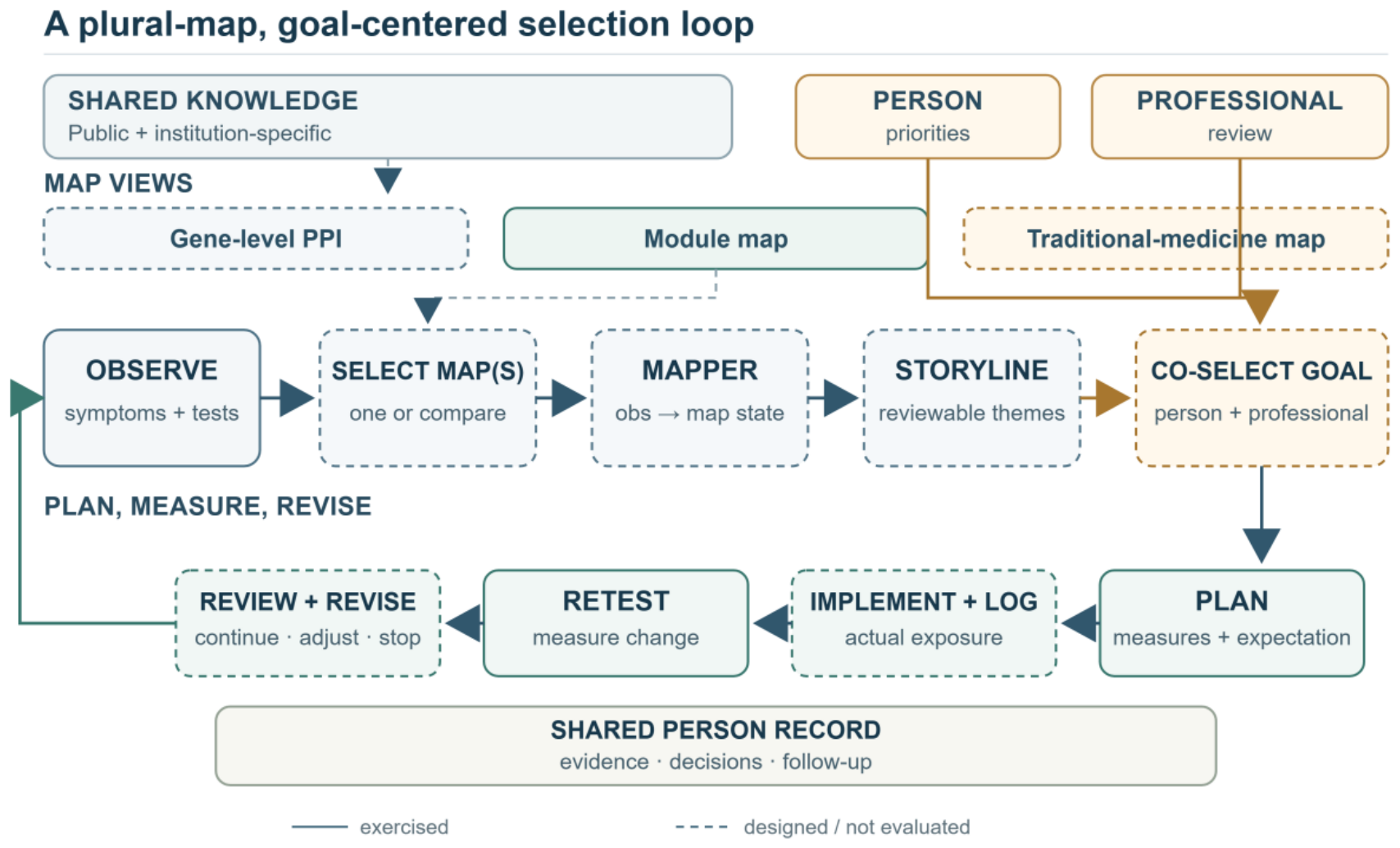
Figure 2.
How a measured state is used to construct candidate rankings.
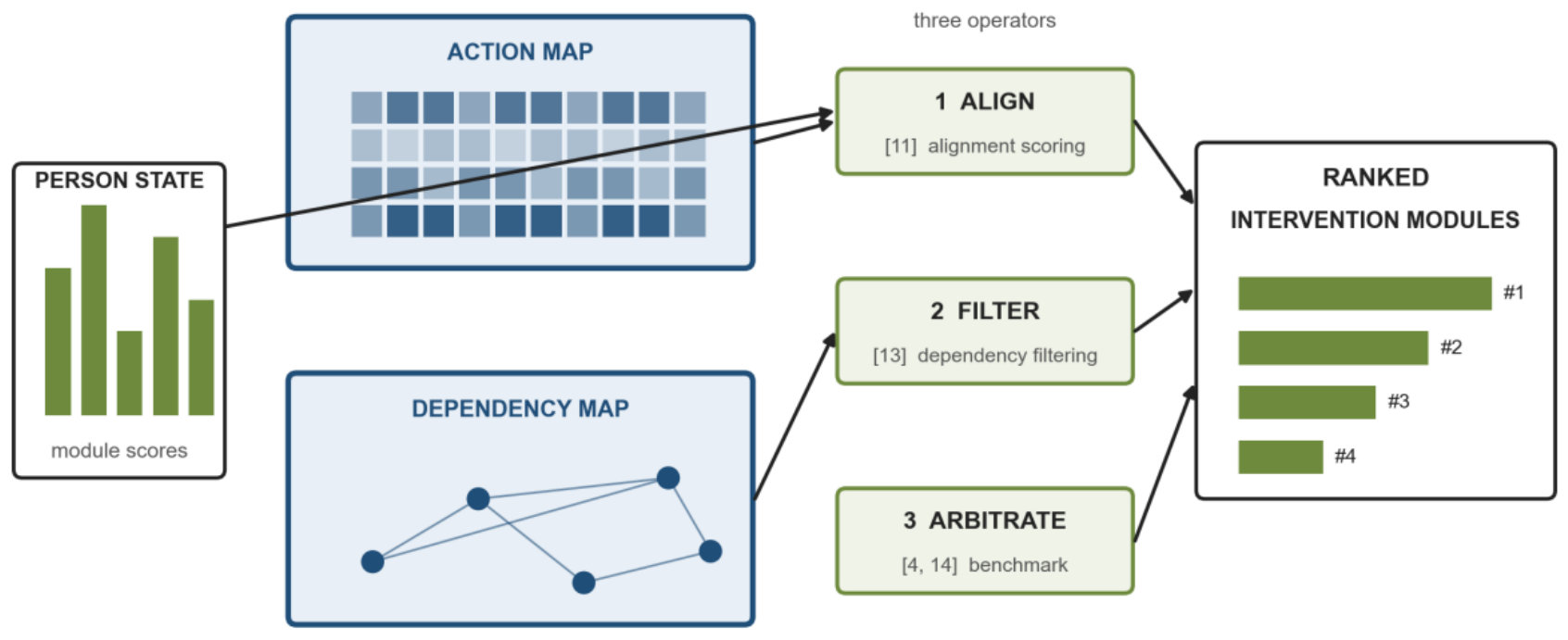
Figure 3.
Two views of one evidence record (conceptual design).
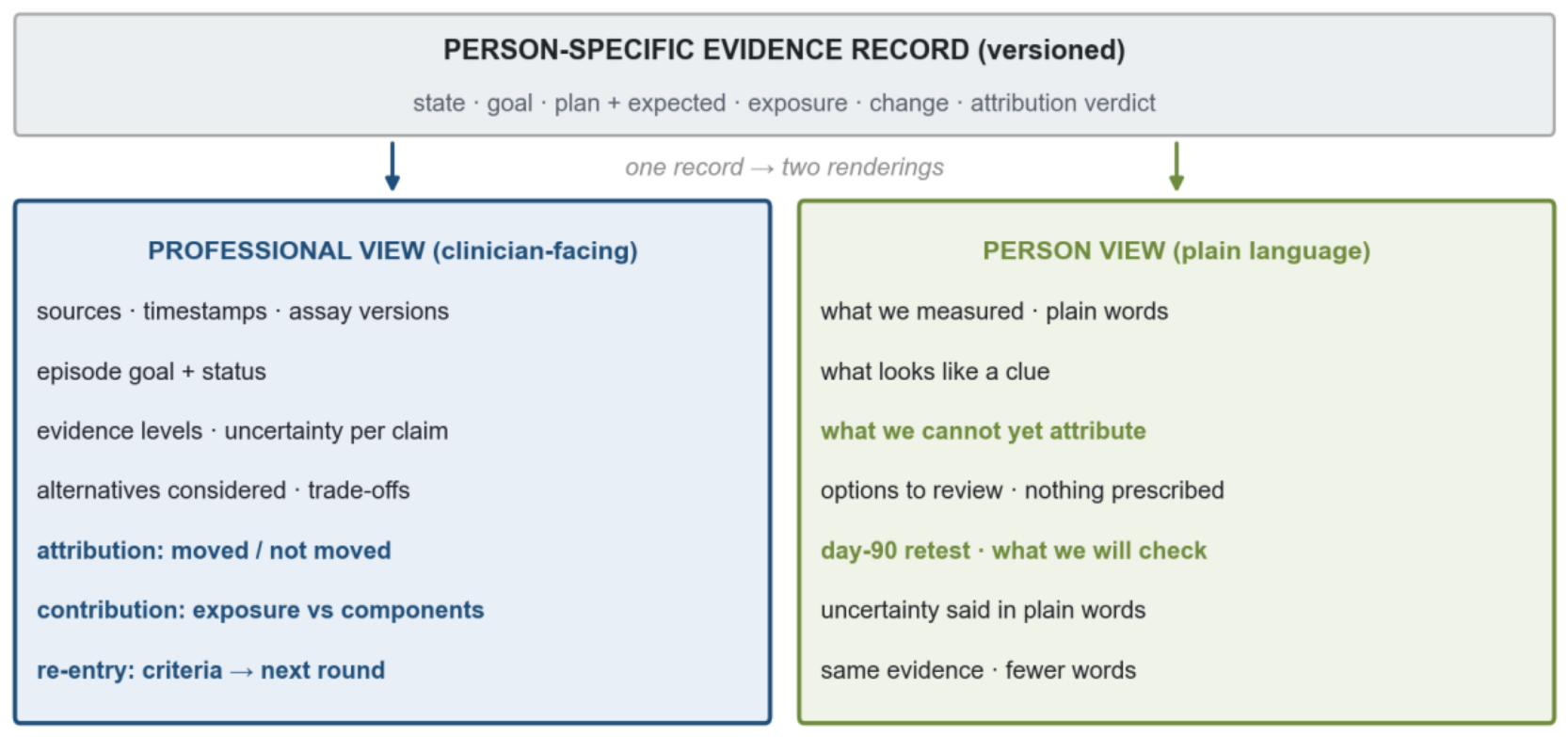
Figure 4.
What the original v1 pipeline executed.
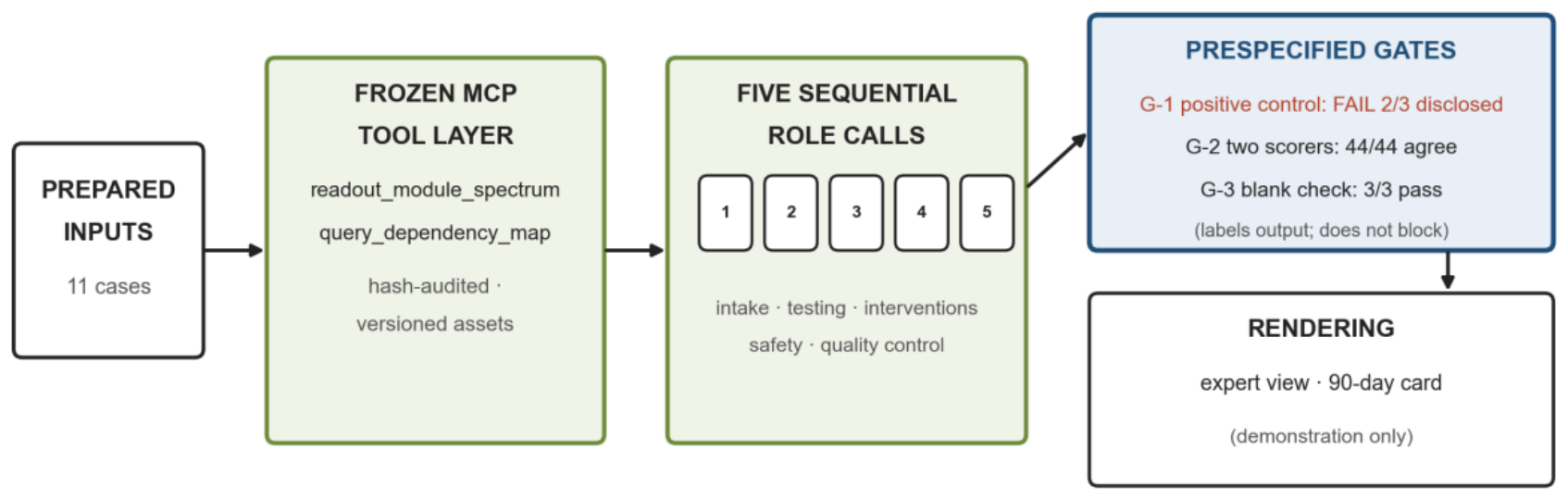
Figure 5.
Two demonstration views of the same round.
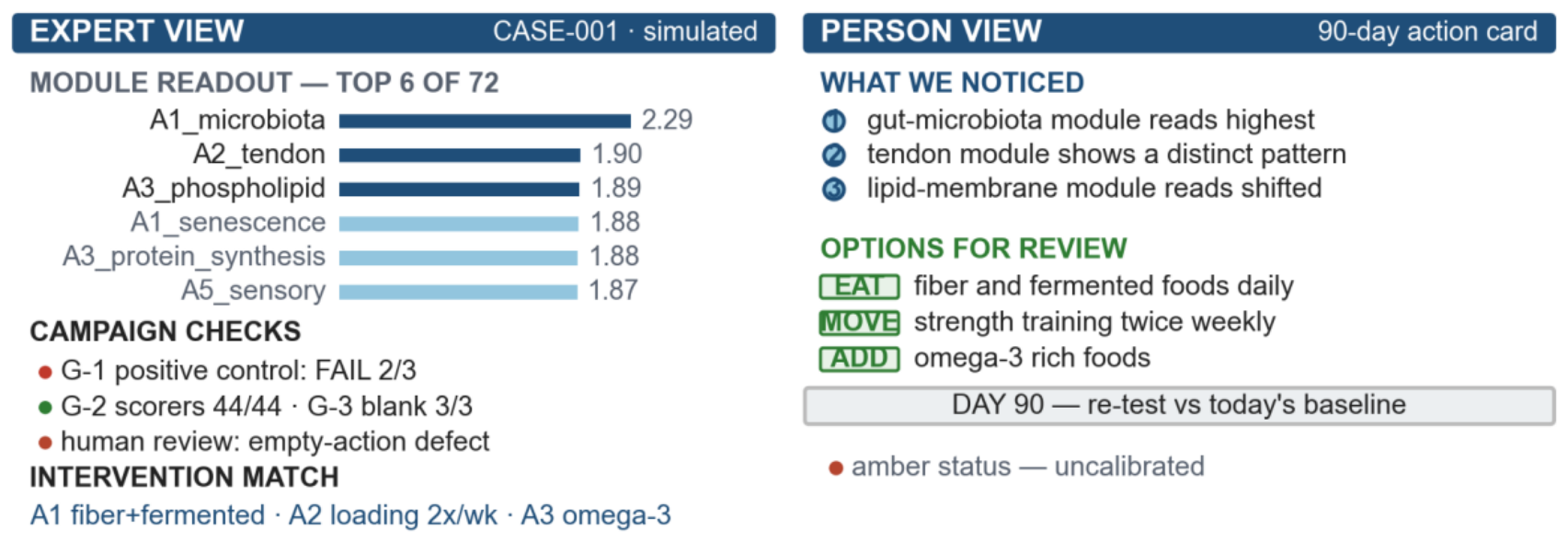
Figure 6.
Coverage and resource use across the four v1 configurations.
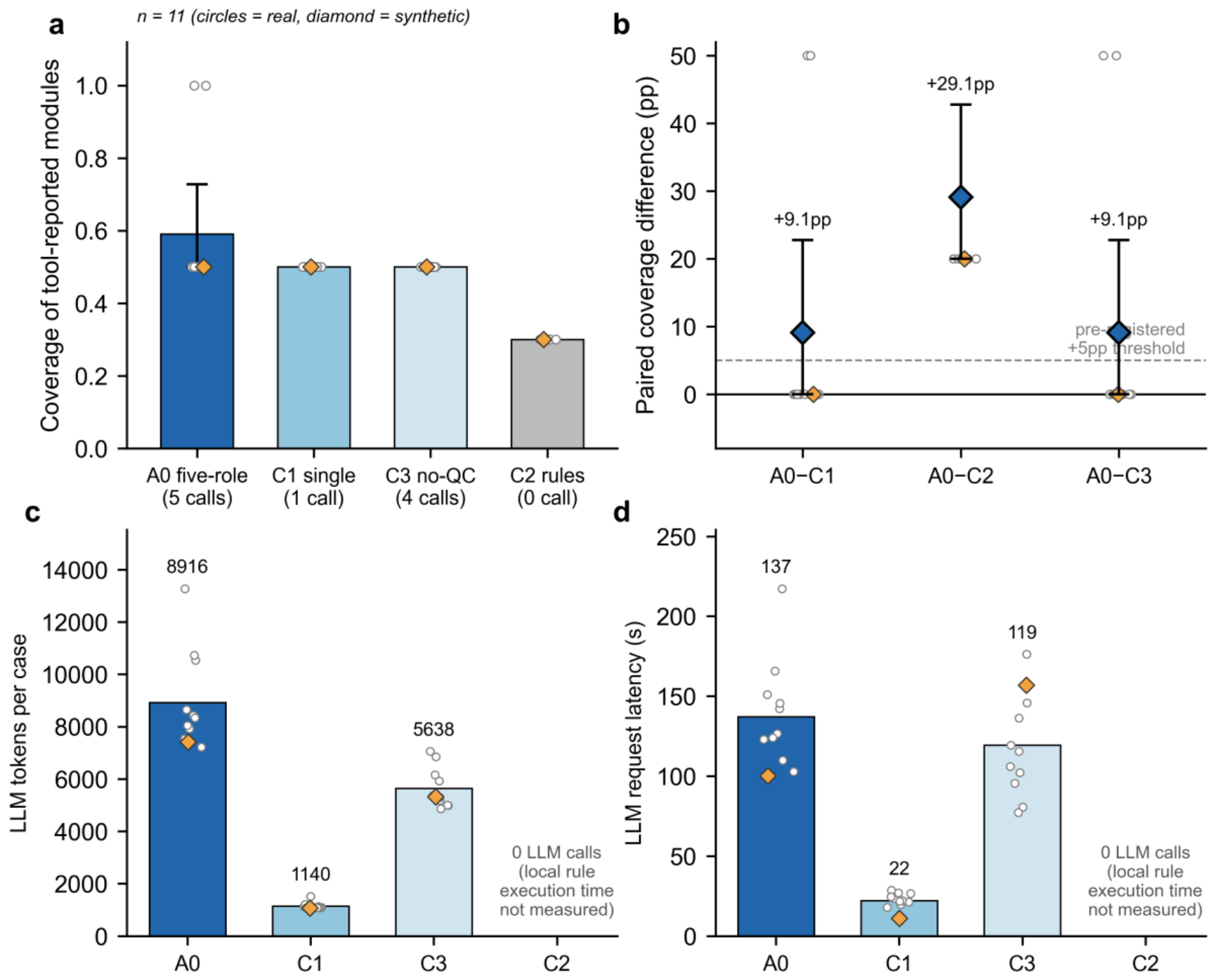
Figure 7.
What deliberation changed and what it did not establish.
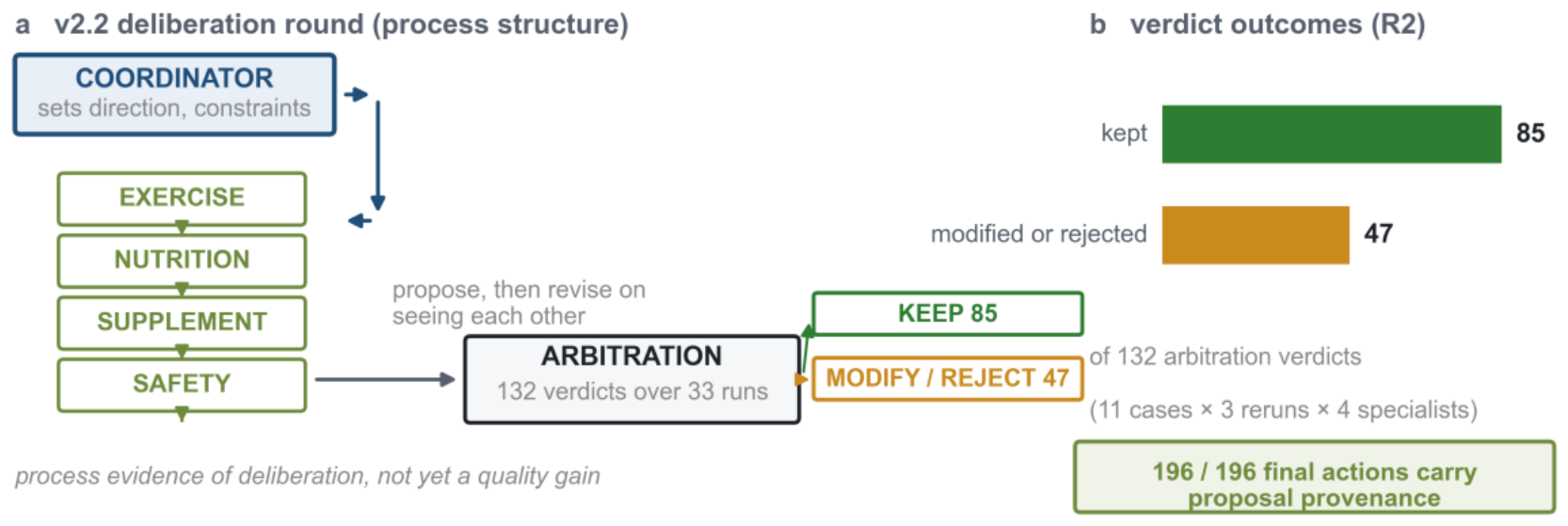
Table 1.
Clinic positions, VLC counterparts, and implementation status.
| Clinic position | VLC counterpart | Implementation status | Evidence |
|---|---|---|---|
| Intake / health manager | Intake role; scripted interview (R7) | Role ran; interview mechanics exercised; interview strategy remains a design item | Section 3.1 and Section 4.5 |
| Testing / laboratory interpretation | Testing role and C1 state record; 72-module readout | Readout ran; finding stability and state dependence tested | 55/55 (R1) and 33/33 (R2) reruns; R9 data-swap probe |
| Nutrition / exercise / supplement specialists | Intervention-planning role in v1 (covering diet, exercise, supplement, and retest actions); separate exercise, nutrition, and supplement roles in v2.2 | v1 role and v2.2 deliberation ran | 47/132 proposals modified or rejected; 196/196 actions with proposal provenance |
| Pharmacist / safety review | Safety role | wording-level checks ran; contraindication checks not implemented; no licensed professional involved | Section 4.1 and Section 5.5 |
| Quality-control office | QC role and C5 prespecified gates | Ran; gates label output but do not block release | G-1 failure disclosed; Section 4.5 |
| Lead physician / multidisciplinary-team chair | v2.2 coordinator | Sets direction and arbitrates proposals | 132 verdicts; Section 2.3 and Section 4.4 |
| Medical records and follow-up | Versioned plans and C4 t0/t90 write-back | No real follow-up cycle; later synthetic software test | Correct revision branches in 6/6 scenarios; Section 4.5 |
| Clinic procedures / quality standard | Good Healthspan Practice principles, prespecification, and version freezing | Software-level procedures used throughout | Section 2.3, Section 3.4 and Section 4.5 |
Table 3.
Research questions, tests, and the conclusions they support.
| Research question | Evaluation content | Supported conclusion | Not to be extrapolated |
|---|---|---|---|
| RQ1: Is mapping to a State Map repeatable and input-responsive? | Repeat-run consistency; data-swap sensitivity (R1, R5, R9, R10) | Output consistency and input response under the tested configuration | Biological truth, causal effects, or clinical validity |
| RQ2: Are candidate outputs traceable? | Provenance records, mapping chain, coverage (R3; arbitration provenance in R2) | Auditability of the workflow and coverage characteristics | Candidate suitability for patients, or efficacy |
| RQ3: Does collaboration improve judged quality? | Single-model blinded preference, arbitration changes, comparator results (R2, R8; ablation) | Whether a preference difference or opinion change was observed under these conditions | General multi-agent superiority over experts or other systems |
| RQ4: Do revision gates execute? | Synthetic write-back, rule thresholds (R6; gates G-1–G-3) | Whether software rules execute as specified in synthetic scenarios | A real follow-up loop or clinical benefit |
| RQ5: What does execution cost? | Tokens, time, cost estimates (metering; ablation) | Resource use of the tested configuration | Clinical operating cost or scalability |
Table 4.
Coverage values and their analysis sets.
| Coverage | Configuration / output contract | Run set |
|---|---|---|
| 0.591 | V1 five-role, post-repair | 11 reports |
| 0.500 | Single-call and no-QC, pre-repair | 11 reports per arm |
| 0.300 | Rules only | 11 reports |
| 0.82 | Post-v1 sequential pipeline, unconstrained | R3 comparator |
| 0.64 | Same pipeline under option-list constraint | R3 constrained replay |
| 0.803 versus 0.561 | Deliberation versus no-peeking | R2 versus R8; 33 runs each |
Table 5.
Positioning matrix: longevity-domain research agents, concept systems, clinic-facing products, and VLC.
Table 5.
Positioning matrix: longevity-domain research agents, concept systems, clinic-facing products, and VLC.
| Dimension | Research agents / concept | Clinic-facing products | VLC |
|---|---|---|---|
| Primary goal | Population discovery, target prioritization, concept design | Clinic workflow support, engagement, reporting | Person-level evidence translation and option review |
| Unit of analysis | Datasets, populations, or concepts | Clinic operations | One person's measured state (prepared cases) |
| World-model state representation | Not documented in public materials reviewed | Not documented in public materials reviewed | State Map as explicit design object |
| Map versioning and rule provenance | Not documented in public materials reviewed | Not documented in public materials reviewed | Versioned architecture; one path evaluated |
| Evidence sources and inference boundaries | Benchmarks or provider claims | Provider claims only | Design goal; partially implemented |
| Option review and follow-up | Not a person-level loop | Advertised; not independently validated | Planned pathway; no real clinical loop tested |
| Validation type | Benchmarks, preprints | Product self-description | Software-process evaluation on 11 prepared cases |
Table 6.
Nine boundaries that define the present claims.
| Type | Boundary |
|---|---|
| Evidence | C4 supports deviation checking and rule-based revision, not identified causal effects. The synthetic attribution bandwidth of K_max = 3 applies only under the stated audit conditions [23]. |
| Evidence | Engine A and Engine B are not proven interchangeable. The dependency map supplies complementary information, not independently demonstrated enrichment against the matched null [17,18]. |
| Evidence | Baseline-direction selection was not supported beyond regression to the mean in the 248-pair replay. This does not directly test action-map-guided selection. |
| Implementation | V1 evaluates prepared inputs. Gates label rather than block output; clinical utility and patient safety are not established. |
| Implementation | Diagnosis-free recovery was tested in four benchmark diseases [2]. Individual reference-frame assembly remains designed, not implemented [20]. |
| Implementation | Option-list traceability was bought at lower report coverage, and the list had no indication, contraindication, or interaction filtering. Safety-filtered selection remains future work. |
| Data | Module scores are unsigned, and action-map association does not establish therapeutic direction. Signed readouts are a planned v1.1 priority. |
| Data | Cross-dataset standardization carries batch risk. Depression-series admission, 2/324, is a supply yield under this rule, not a diagnostic or population rate. Admission-band sensitivity is untested. |
| Data / governance | Module-universe and subset versioning remain open governance tasks [24]. Every readout must retain its release. |
Disclaimer/Publisher’s Note: The statements, opinions and data contained in all publications are solely those of the individual author(s) and contributor(s) and not of MDPI and/or the editor(s). MDPI and/or the editor(s) disclaim responsibility for any injury to people or property resulting from any ideas, methods, instructions or products referred to in the content. |
© 2026 by the authors. Licensee MDPI, Basel, Switzerland. This article is an open access article distributed under the terms and conditions of the Creative Commons Attribution (CC BY) license (http://creativecommons.org/licenses/by/4.0/).
Copyright: This open access article is published under a Creative Commons CC BY 4.0 license, which permit the free download, distribution, and reuse, provided that the author and preprint are cited in any reuse.