
Submitted:
02 October 2026
Posted:
05 October 2026
You are already at the latest version
Abstract
Historical music dictionaries become digital heritage objects through a chain of editorial, technical, and interpretive transformations. A scan, an OCR file, a segmented entry, a keyword rule, and a plotted category count each preserve something from the historical source, but each also changes what can be found, compared, and cited. I examine that process through Lexicon C19 v3.2.1, a reproducible corpus of eight long nineteenth-century music, dance, biographical, and general reference traditions. The corpus contains 3,760 rule-selected records and a complete pool of 25,186 parsed candidates, with processed witnesses in English, French, German, Russian, and Portuguese; Russian and Portuguese are represented by fewer than 100 selected records. A provenance-first analysis combines source composition, selection yield, category profiles, OCR-surface regularity, exact headword overlap, a 200-record single-annotator audit, and a candidate-level rule-collision diagnostic. Three English-language processed witnesses supply 81.9% of selected records. Only 203 selected records, or 5.4%, match terms from more than one top-level category, which bounds the direct effect of rule precedence on top-level labels and shifts attention to larger asymmetries of sampling frame and ontology coverage. The audit estimates selected-candidate precision at 97.0%. Among real and relevant sampled rows, broad-category self-consistency is 89.7%. These figures are not historical prevalence. They show how sampling frame, translation, typography, OCR, segmentation, and classification rules construct the musical-heritage object available to computation. I argue for a critical computational musicology in which recoverability is modelled as evidence and distant reading organises source-specific close reading rather than replacing it.
Keywords:
digital heritage
; computational musicology
; historical OCR
; music dictionaries
; digital lexicography
; data criticism
; provenance
; distant reading
1. Introduction
Historical music dictionaries look unusually ready for computation. They are alphabetically organised, divided into entries, and filled with names, dates, places, instruments, genres, institutions, forms, and cross-references. Digitised copies seem to offer a pre-structured corpus before any code is written. Once their OCR has been segmented and their entries counted, comparison appears almost immediate: which source contains more dance, which gives more space to voice, which invokes sacred or national vocabularies, and which concepts recur across languages?
That apparent readiness is deceptive. A digitised dictionary is not simply a historical book in tabular form. It is a chain of representations: edition, scan, OCR or transcription, entry-boundary rule, text excerpt, normalisation, ontology, and analytical summary. Each link changes what can be recovered and counted. The problem becomes especially acute when a corpus combines unlike genres and digitisation modes. A specialist dictionary of dance will not have the same lexical density as a collaborative dictionary of music. A set of music articles manually structured on Wikisource will not have the same candidate denominator as full-volume OCR. An English translation of a German lexicon cannot be treated as direct evidence of German wording.
This article examines these transformations through Lexicon C19 v3.2.1, a multilingual computational corpus derived from eight nineteenth-century reference traditions [1]. The corpus contains 3,760 selected records and a complete pool of 25,186 parsed candidates. Its ordered keyword ontology assigns selected records to instruments, performance, voice, music concepts, dance, or sound. A companion Data Descriptor has been submitted to Data; the present article asks a different question. What do the distributions produced by this corpus reveal about the conditions under which historical music reference works become computational evidence?
The central argument is that recoverability is not external noise around a stable historical object. It is one of the forces that constructs the object available to analysis. Corpus composition, category profiles, confidence scores, and lexical overlap are shaped by editorial genre, processed witness, digitisation mode, and ontology. Quantitative analysis remains useful, but its strongest role is diagnostic and heuristic. It can reveal asymmetries, identify promising contrasts, and direct close reading. It cannot, without source-specific validation and historical argument, convert recovered counts into claims about nineteenth-century importance.
This intervention brings critical data studies into conversation with computational musicology and digital heritage. Music-information research has developed sophisticated methods for symbolic, audio, and metadata corpora, but historical reference texts pose a distinct problem. Their errors are not randomly distributed, their categories are editorially produced, and their units vary across works. The aim is not to reject distant reading. It is to make the transformations that enable it part of the musicological account.
2. Historical Music Dictionaries as Digital Heritage Infrastructures
The eight traditions in Lexicon C19 do not represent a single genre. Moore’s Complete Encyclopaedia of Music is an American music reference work with substantial biographical content [10]. Grove’s four-volume Dictionary of Music and Musicians is a collaborative scholarly project whose articles vary dramatically in length and authorship [11,12]. Riemann is represented not by German text from 1882 but by J. S. Shedlock’s English translation, fourth edition, 1908 [13]. Fétis’s Biographie universelle des musiciens is principally biographical, and the local collection is incomplete: main-series volume 1 is absent, while volumes 2–8 and Pougin’s first supplement are present [15]. Desrat’s Dictionnaire de la danse is a specialist practitioner’s dictionary in which technique, history, pedagogy, and polemic share entries [16]. Meyers and Brockhaus-Efron are general encyclopaedias represented by selected music articles [18,19]. Vieira’s Portuguese biographical dictionary produces only one selected record under the current extraction rules [20].
These distinctions matter before any result is calculated. A full dictionary and a curated article collection have different candidate denominators. A biographical dictionary may discuss performance inside personal entries without using headwords that match a performance ontology. A dance dictionary may place dance vocabulary in almost every entry. A translated lexicon carries the concepts and editorial interventions of more than one historical moment.
The processed texts are also unlike. Full-volume Internet Archive OCR preserves page noise, broken columns, running heads, and irregular spacing. Wikisource-derived article collections contain explicit headings and cleaner characters. A confidence heuristic based on surface regularity will therefore reward digitisation mode. That makes it useful for quality control, but risky if it is treated as a source’s intrinsic reliability.
Lexicographic comparison must consequently preserve at least four levels of provenance: the historical work, the processed edition or translation, the digital representation, and the extraction procedure. Lexicon C19 v3.2/v3.2.1 adds source_file, source_line_start, source_text_language, original_publication_year, and article_type to make those levels inspectable. The fields do not eliminate heterogeneity. They prevent it from disappearing behind a uniform CSV schema.
3. Materials and Methods
3.1. Corpus Layers
The analysis uses the frozen public v3.2.1 Zenodo release, which preserves the selected CSV and complete candidate pool published in v3.2 while adding a completed 200-record audit workbook and explicit code-licence file [1]. The selected table contains 3,760 rows and 27 fields. The complete candidate pool contains 25,186 JSON Lines records, including candidates assigned to GENERAL/OTHER. Both are generated deterministically from local public-domain inputs by scripts/build_dataset.py. The selected CSV has SHA-256 checksum a82a89cde3125edd5fa2009fcb2a4da6acc1c2509bed22c03eccb 67211054374; two consecutive builds from identical inputs produced the same selected-table and candidate-pool checksums.
Source-specific regular expressions segment candidate entries. An ordered multilingual keyword ontology then assigns each candidate a single category and subcategory or GENERAL/OTHER. Additional expressions derive semantic tags, geographic and historical references, etymological phrases, and cross-references. The confidence_score field is a bounded heuristic based on OCR surface features, not a calibrated probability.
A limited 200-record label-blinded single-annotator audit is available for the v3.2.1 release. It estimates selected-candidate precision and broad-category accuracy among sampled selected records, but the present article still treats labels and counts primarily as outputs of a known computational procedure. This choice narrows the claims and clarifies the object of study: the article analyses what the pipeline makes visible, not the full contents of the historical works.
3.2. Reproducible Analytical Notebook
The executed notebook 03_publication_analysis_executed.ipynb performs five families of analysis. First, it verifies structural integrity: expected row count and schema, unique identifiers, complete file and line provenance, controlled category vocabulary, and bounded confidence values. Second, it compares parsed candidates, selected records, selection rates, and corpus shares by source. Third, it calculates within-source category profiles and source shares within three retrieval domains: dance, voice, and instruments. Fourth, it compares confidence distributions and rule-derived semantic-tag profiles. Fifth, it measures exact lexical interoperability using Jaccard similarity between sets of normalised headwords.
The notebook exports twelve CSV tables and nine figure designs in PNG, SVG, and PDF. Its analysis manifest records dataset checksum, counts, missingness, generated files, and human-audit status. All figures carry the same interpretation rule: distributions are pipeline outputs, not direct measures of historical prevalence.
3.3. Analytical Cautions
Within-source percentages reduce the visual dominance of large sources but do not correct extraction recall or ontology bias. Selection rates use parsed candidates as denominators; they cannot observe printed entries missed by segmentation. Exact headword matching is intentionally conservative and is affected by language, inflection, translation, OCR, and editorial spelling. Confidence describes surface form, not content validity. The analysis is therefore comparative at the level of pipeline behaviour and descriptive of the released computational resource.
4. Results
4.1. Three Witnesses Dominate the Computational Corpus
Riemann/Shedlock supplies 1,295 selected records, Moore 1,053, and Grove 733. Together they account for 81.9% of the selected table. Desrat contributes 233, Meyers 214, Fétis/Pougin 141, Brockhaus-Efron 90, and Vieira one. This concentration has two consequences. Aggregate category totals primarily describe three English-language processed witnesses. They do not provide a multilingual average, even though the corpus includes five processed languages. The Riemann component is also an English translation published in 1908. An aggregate labelled simply as Riemann 1882 would conceal both translation and edition history.
The complete candidate pool intensifies the asymmetry. Riemann/Shedlock has 10,209 parsed candidates, Moore 7,187, Grove 3,892, and Fétis/Pougin 2,722. The remaining sources have fewer than 600 each. Corpus size is therefore partly a history of which sources were processed as full volumes and which entered as selected article collections.
4.2. Selection Rates Measure Sampling Frame as Much as Vocabulary
The share of parsed candidates assigned to a selected category ranges from 3.1% for Vieira and 5.2% for Fétis/Pougin to 55.6% for Brockhaus-Efron. Moore, Grove, and Riemann/Shedlock fall between 12.7% and 18.8%. Desrat and Meyers are near 46% and 45%.
It would be tempting to say that Brockhaus-Efron or Desrat is more concerned with performance than Fétis. The input structure makes that inference unsound. Brockhaus-Efron and Meyers are already music-article collections, Desrat is a specialist dance dictionary, and Fétis is a biographical series in which performance references may occur inside entries headed by names. The selection rate captures the interaction between genre, curation, headword structure, and ontology. It is a property of the data-generation system.
This is not merely a limitation. It provides evidence about computational accessibility. The pipeline more easily recovers categories when the source has explicit domain headwords or has already been curated to music articles. Biographical and noisy OCR sources require different retrieval strategies, such as passage-level indexing or named-entity and relation extraction.
4.3. Category Profiles Identify Source Centres, Not Historical Prevalence
Within-source profiles make the role of genre visible. Desrat’s selected records are 95.7% dance, while dance forms 6.5% of Meyers, 3.3% of Grove, 2.1% of Riemann/Shedlock, and less than 2% of Moore and Fétis/Pougin. Fétis/Pougin’s selected records are 44.0% voice, Grove’s are led by performance (32.7%) and instruments (30.3%), and Meyers has strong instrument (42.5%) and music-concept (29.9%) profiles.
Across the whole selected table, Desrat supplies 70.6% of all dance records. Riemann/Shedlock supplies 39.2% of instrument records and 37.1% of voice records; Moore supplies 24.3% of instruments and 34.4% of voice. These concentrations make the categories effective retrieval interfaces. A researcher investigating waltz genealogy should begin with Desrat but must then compare the long Grove and Riemann articles that a simple count underweights. A researcher investigating vocal terminology should recognise that the aggregate is largely an Anglo-American and translated-German computational profile.
The result changes the musicological question. Rather than asking which culture owned a category, one can ask how different reference genres made that category legible. Desrat’s dance entries encode steps, teaching, and practitioner authority. Grove often translates dance into metre, repertory, and compositional form. A category count locates this contrast; only source-specific reading can explain it.
4.4. Confidence Reveals Digitisation Mode
Median confidence is 1.000 for Meyers and 0.952 for Brockhaus-Efron. No selected record from either source falls below the project’s documented 0.4 low-confidence threshold. By contrast, median confidence is 0.333 for Grove, 0.362 for Desrat, 0.385 for Fétis/Pougin, 0.388 for Riemann/Shedlock, and 0.415 for Moore. Between 43.7% and 64.4% of selected records from those full-volume OCR sources fall below 0.4.
The clean scores for Meyers and Brockhaus-Efron do not demonstrate superior historical accuracy. They reflect structured transcription and article selection. Likewise, Grove’s lower score does not imply inferior scholarship. It signals the difficulty of its digital representation under the heuristic. Confidence becomes historically meaningful only when attached to witness provenance.
This distinction matters for machine-learning reuse. A model trained on the selected table could learn digitisation artefacts as source features. Random train-test splits would allow nearly identical source-specific noise patterns into both sets and overstate generalisation. Source-held-out evaluation is the more appropriate design for future classification experiments.
4.5. Exact Lexical Overlap Is Low and Linguistically Confounded
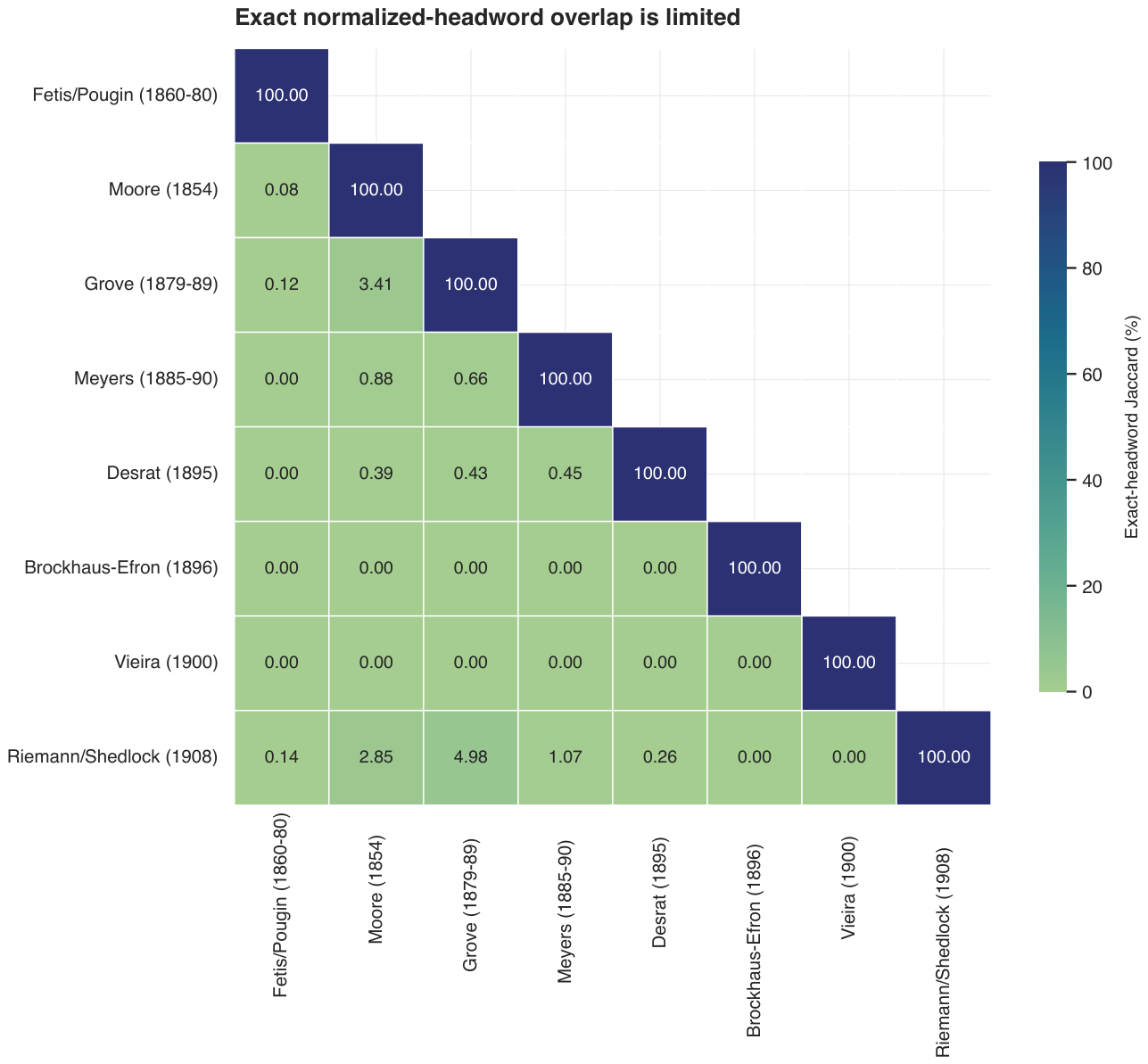
The largest pairwise Jaccard similarity between normalised-headword sets is 4.98% for Grove and Riemann/Shedlock. Moore–Grove overlap is 3.41%, Moore–Riemann/Shedlock 2.85%, and all other pairs are near or below 1.1%. Brockhaus-Efron and Vieira share no exact selected headwords with the other sources under this normalisation.
These low values do not prove conceptual isolation. Exact matching undercounts multilingual and morphological equivalence, while OCR may corrupt both headings and boundaries. Translation can increase overlap by presenting Riemann in English, but the translated vocabulary is itself an editorial mediation. The matrix is therefore an interoperability test: it quantifies how little can be aligned without a more explicit multilingual concept layer.
The corpus includes 27 curated multilingual concept alignments, but that number is too small for broad inference. A future extension could combine authority-controlled concepts, historical spelling variants, embeddings, and manual adjudication. Such work should preserve the original headword and distinguish lexical equivalence from looser conceptual relation.
5. Discussion
5.1. Recoverability as a Musicological Variable
The results demonstrate three forms of recoverability. Material recoverability concerns the scan, OCR, transcription, and completeness of the local witness. Structural recoverability concerns whether entries and headings can be segmented. Conceptual recoverability concerns whether a modern ontology recognises a passage and how it labels polysemous terms.
These layers interact. Desrat is conceptually easy for a dance-heavy ontology because the book is specialist and its vocabulary is explicit. Fétis is structurally and conceptually harder because biographical headings do not announce every performance topic discussed in the entry. Meyers and Brockhaus-Efron are materially clean but arrive through curated music-article collections. Riemann/Shedlock is abundant and lexically interoperable with English sources, yet that advantage is produced by translation.
Computational musicology often treats corpus construction as preparation for analysis. Here corpus construction is already an interpretation of musical knowledge. Deciding that opera maps to performance/theatrical, aria to voice/genre, or ballet to dance/theatrical creates a hierarchy for passages that may sustain several readings. Ordered single-label classification makes the hierarchy reproducible but not neutral.
5.2. From Distant Reading to Organised Close Reading
The strongest use of the current corpus is not a league table of historical concepts. It is an organised route into sources. Category profiles identify where a theme is computationally concentrated. Confidence scores identify where OCR inspection is most urgent. Exact overlap identifies terms that can be compared directly and where multilingual mediation is needed. Source and line provenance allow return to the processed text, while scan verification remains necessary for quotation.
This approach supports a recursive workflow. A pattern is detected at corpus scale; the relevant entries are read in their editorial and bibliographic context; the interpretation exposes limits in the category or segmentation rule; and the data model is revised or qualified. The goal is not to make close reading serve as anecdotal decoration for a chart. It is to let computational and historical criticism correct one another.
The Desrat–Grove contrast illustrates the method. Desrat’s dominance in selected dance records is predictable from genre, but the quantitative profile directs attention to a disciplinary asymmetry. In Desrat, dance knowledge is grounded in steps, bodily demonstration, teaching lineages, and polemics against non-specialist dictionaries. Grove contains serious dance articles but often reorganises dance as metre, form, chronology, and compositional repertory. The computational category establishes neither national ownership nor disciplinary absence. It identifies a difference in how lexicographic authority is distributed.
5.3. Implications for Digital Heritage and Benchmark Design
The corpus is not a gold-standard benchmark. Its labels are rule-derived and no page-level recall estimate is available. This does not prevent machine-learning experiments, but it changes their purpose. The selected table can support weak supervision, retrieval, error analysis, and the generation of annotation candidates. It should not be used to report human-equivalent classification accuracy without an independently labelled test set.
Future benchmark design should hold out entire sources, report performance by digitisation mode and language, and separate segmentation, relevance, and category errors. A later student internship will add blinded candidate annotations and page-level audits as a versioned validation layer. Keeping that layer separate will make improvement measurable and preserve the provenance of human decisions.
For digital heritage work more broadly, the case suggests that preservation cannot stop at scans or OCR. The conditions that make a heritage object searchable, segmentable, and classifiable also need to be preserved. A dataset that records its own recoverability is easier to reuse responsibly than one that presents heterogeneous witnesses as if they were born comparable.
5.4. Limitations
The corpus is imbalanced, partly incomplete, and based on a finite keyword ontology. Printed page values are empty. Definitions are capped at 800 characters, with 116 records reaching the cap. The Fétis collection lacks main-series volume 1, and Vieira is not quantitatively usable under the current extraction. The semantic and geographic fields are surface matches. Candidate denominators cannot measure entries missed by segmentation. Confidence is uncalibrated.
The chronology is also heterogeneous. The processed sources extend into 1908 even though the underlying project concerns nineteenth-century reference traditions. Riemann/Shedlock must be treated as an early-twentieth-century translation witness to a nineteenth-century work. This is not a reason to remove it, but it prevents a simple synchronic claim.
6. Conclusions
Historical music dictionaries do not become comparable merely because their records share columns. In Lexicon C19, three English-language processed witnesses dominate the selected corpus; specialist and curated sources have much higher selection yields; OCR-confidence scores largely separate structured transcription from full-volume OCR; and exact lexical overlap remains below 5%. Each result describes a computational transformation as much as a historical source.
A critical computational musicology should therefore treat recoverability as evidence. It should identify the processed witness, preserve sampling frame and provenance, separate rule-derived labels from human judgements, and use quantitative profiles to organise source-specific interpretation. Under those conditions, the computational lexicon becomes more than an index. It becomes a record of what digitisation allows musicology to see, and of what its methods are still likely to miss.
Author Contributions
Conceptualization, X.F.; methodology, X.F.; software, X.F.; validation, X.F.; formal analysis, X.F.; investigation, X.F.; resources, X.F.; data curation, X.F.; writing—original draft preparation, X.F.; writing—review and editing, X.F.; visualization, X.F.; project administration, X.F.; funding acquisition, X.F. The author has read and agreed to the published version of the manuscript.
Funding
This research was funded by ANR MELODY, grant number ANR-24-IAS1-0001.
Institutional Review Board Statement
Not applicable. The study did not involve humans or animals.
Informed Consent Statement
Not applicable. The dataset contains public-domain historical reference works and no human participants, living-person records, or personal data requiring consent.
Data Availability Statement
Lexicon C19 v3.2.1 is publicly available on Zenodo at https://doi.org/10.5281/zenodo.22207277 under concept DOI https://doi.org/10.5281/zenodo.21588976. The deposit contains the selected dataset, complete candidate pool, metadata, deterministic build code, clean and executed notebooks, derived tables, figures, release notes, checksum manifest, completed 200-record audit workbook, and LICENSE-CODE. Data, metadata, documentation, and analysis outputs are released under CC BY 4.0. Scripts and executable notebooks are released under the MIT License. Version 3.2 remains citable at https://doi.org/10.5281/zenodo.22194770, and version 3.1 remains citable at https://doi.org/10.5281/zenodo.21588977.
Acknowledgments
This work acknowledges support from ANR MELODY (ANR-24-IAS1-0001). It was developed within the musicological, digital-humanities, and computational research environments of IReMus, SCAI, and SAFIR. During preparation of this manuscript, the author used OpenAI Codex/ChatGPT and Claude to assist with language editing, proofreading, LaTeX formatting, and manuscript organization. These tools were not used as authors. The author reviewed, edited, verified, and takes full responsibility for all content, data, claims, and conclusions.
Conflicts of Interest
The author declares no conflict of interest. The funder had no role in the design of the corpus; in the collection, analysis, or interpretation of the data; in the writing of the manuscript; or in the decision to publish the results.
References
- Fresquet, X. Lexicon C19 Export Package v3.2.1: A Multilingual Dataset of Nineteenth-Century Music Performance Lexicography; Version 3.2.1; Zenodo: Geneva, Switzerland, 2026. [Google Scholar] [CrossRef]
- Ogilvie, S.; Safran, G. (Eds.) The Whole World in a Book: Dictionaries in the Nineteenth Century; Oxford University Press: Oxford, UK, 2020. [Google Scholar] [CrossRef]
- Considine, J. (Ed.) The Cambridge World History of Lexicography; Cambridge University Press: Cambridge, UK, 2019. [Google Scholar] [CrossRef]
- Haß, U. (Ed.) Große Lexika und Wörterbücher Europas: Europäische Enzyklopädien und Wörterbücher in historischen Porträts; De Gruyter: Berlin, Germany, 2012. [Google Scholar] [CrossRef]
- Wilkinson, M.D.; Dumontier, M.; Aalbersberg, I.J.; Appleton, G.; Axton, M.; Baak, A.; Blomberg, N.; Boiten, J.-W.; da Silva Santos, L.B.; Bourne, P.E.; et al. The FAIR Guiding Principles for Scientific Data Management and Stewardship. Sci. Data 2016, 3, 160018. [Google Scholar] [CrossRef]
- Bender, E.M.; Friedman, B. Data Statements for Natural Language Processing: Toward Mitigating System Bias and Enabling Better Science. Trans. Assoc. Comput. Linguist. 2018, 6, 587–604. [Google Scholar] [CrossRef]
- Piotrowski, M. Natural Language Processing for Historical Texts; Morgan & Claypool: San Rafael, CA, USA, 2012. [Google Scholar] [CrossRef]
- Moretti, F. Distant Reading; Verso: London, UK, 2013. [Google Scholar]
- Drucker, J. Humanities Approaches to Graphical Display. Digit. Humanit. Q. 2011, 5. [Google Scholar] [CrossRef]
- Moore, J.W. Complete Encyclopaedia of Music; Oliver Ditson: Boston, MA, USA, 1854. [Google Scholar]
- Grove, G. (Ed.) A Dictionary of Music and Musicians (A.D. 1450–1889); Macmillan: London, UK; p. 1879–1889; Volumes 1–4.
- Langley, L. Roots of a Tradition: The First Dictionary of Music and Musicians. In George Grove, Music and Victorian Culture; Musgrave, M., Ed.; Palgrave Macmillan: Basingstoke, UK, 2003; pp. 168–215. [Google Scholar]
- Riemann, H. Dictionary of Music. Original work published 1882, 4th ed.; Shedlock, J.S., Translator; Augener: London, UK, 1908. [Google Scholar]
- Rehding, A. Hugo Riemann and the Birth of Modern Musical Thought; Cambridge University Press: Cambridge, UK, 2003. [Google Scholar] [CrossRef]
- Fétis, F.-J. Biographie universelle des musiciens et bibliographie générale de la musique, 2nd ed.; Firmin-Didot: Paris, France; pp. 1860–1865.
- Desrat, G. Dictionnaire de la danse, historique, théorique, pratique et bibliographique; Librairies-Imprimeries Réunies: Paris, France, 1895. [Google Scholar]
- McKee, E.J. Decorum of the Minuet, Delirium of the Waltz: A Study of Dance-Music Relations in 3/4 Time; Indiana University Press: Bloomington, IN, USA, 2011. [Google Scholar]
- Meyers Konversations-Lexikon, 4th ed.; Bibliographisches Institut: Leipzig and Vienna; pp. 1885–1890.
- Brockhaus, F.A.; Efron, I.A. (Eds.) Brockhaus and Efron Encyclopedic Dictionary; Semenovskaya Tipolitografiya: St. Petersburg, Russian Empire; pp. 1890–1907.
- Vieira, E. Diccionario biographico de musicos portuguezes; Lambertini: Lisbon, Portugal, 1900. [Google Scholar]
Figure 1.
Corpus composition and rule-based selection yield. Parsed candidates and selected records are shown by processed witness, with the selected share of parsed candidates. Counts are diagnostic pipeline outputs rather than estimates of historical prevalence.
Figure 1.
Corpus composition and rule-based selection yield. Parsed candidates and selected records are shown by processed witness, with the selected share of parsed candidates. Counts are diagnostic pipeline outputs rather than estimates of historical prevalence.
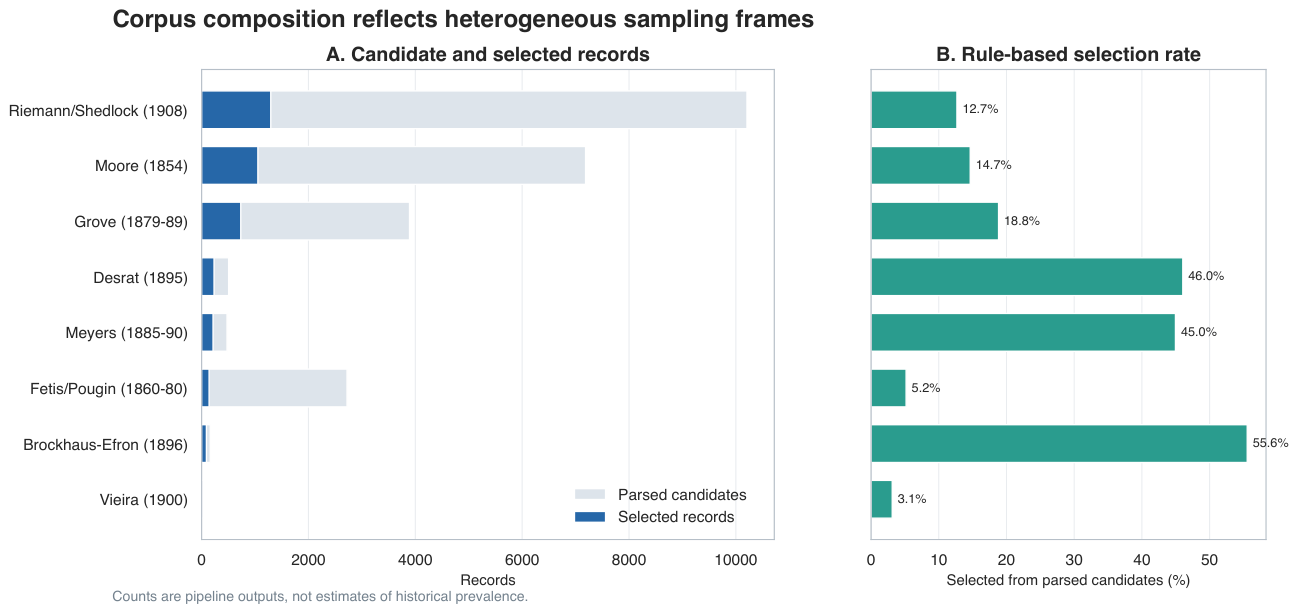
Figure 2.
Rule-based category profiles by source. Percentages are calculated within each processed witness. The plot is useful for locating contrasts but cannot by itself establish historical prevalence.
Figure 2.
Rule-based category profiles by source. Percentages are calculated within each processed witness. The plot is useful for locating contrasts but cannot by itself establish historical prevalence.
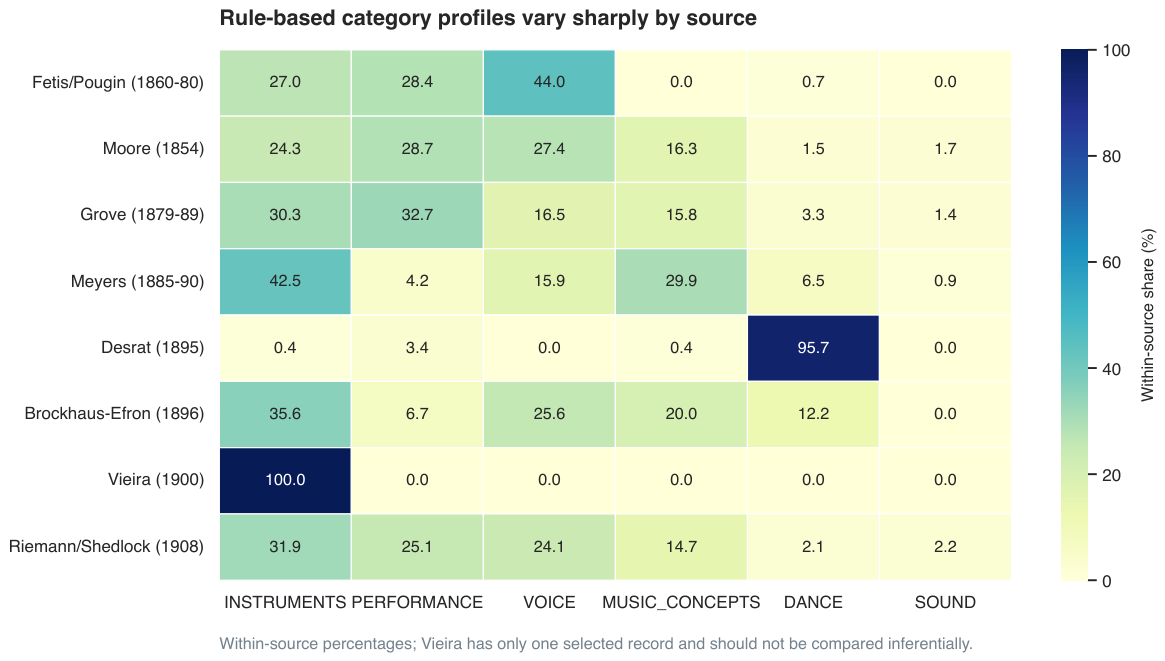
Figure 3.
OCR-surface confidence by processed witness. The heuristic mainly separates structured transcription and cleaner article collections from noisier full-volume OCR. It should not be interpreted as historical reliability.
Figure 3.
OCR-surface confidence by processed witness. The heuristic mainly separates structured transcription and cleaner article collections from noisier full-volume OCR. It should not be interpreted as historical reliability.
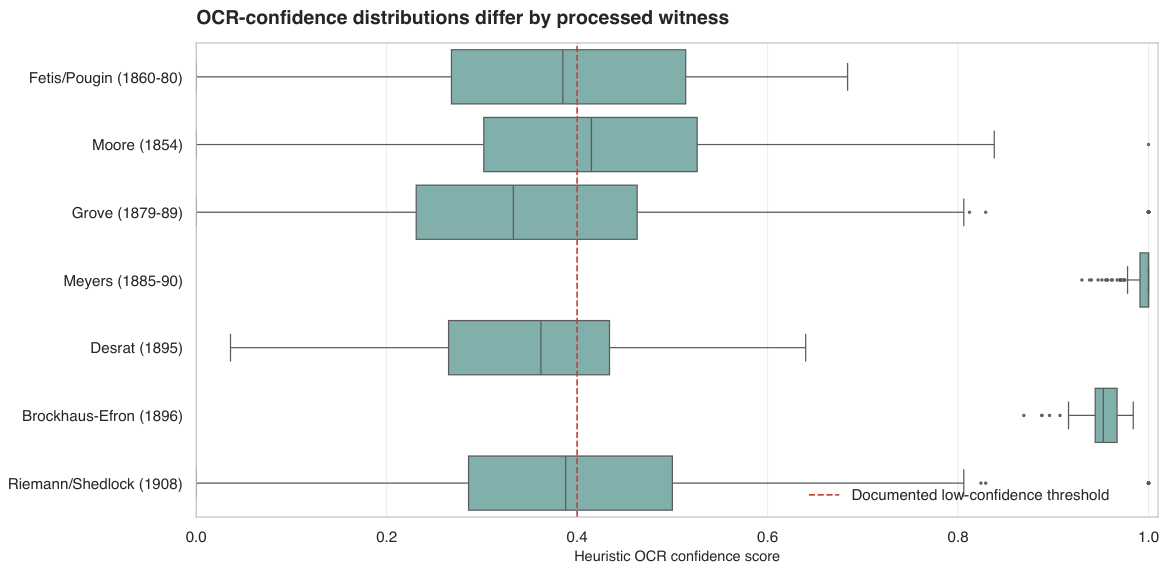
Figure 4.
Exact normalised-headword overlap between processed witnesses. Low overlap is an interoperability diagnostic rather than proof of conceptual isolation.
Figure 4.
Exact normalised-headword overlap between processed witnesses. Low overlap is an interoperability diagnostic rather than proof of conceptual isolation.
Disclaimer/Publisher’s Note: The statements, opinions and data contained in all publications are solely those of the individual author(s) and contributor(s) and not of MDPI and/or the editor(s). MDPI and/or the editor(s) disclaim responsibility for any injury to people or property resulting from any ideas, methods, instructions or products referred to in the content. |
© 2026 by the author. Licensee MDPI, Basel, Switzerland. This article is an open access article distributed under the terms and conditions of the Creative Commons Attribution (CC BY) license.
Copyright: This open access article is published under a Creative Commons CC BY 4.0 license, which permit the free download, distribution, and reuse, provided that the author and preprint are cited in any reuse.