
Submitted:
30 September 2026
Posted:
05 October 2026
You are already at the latest version
Abstract
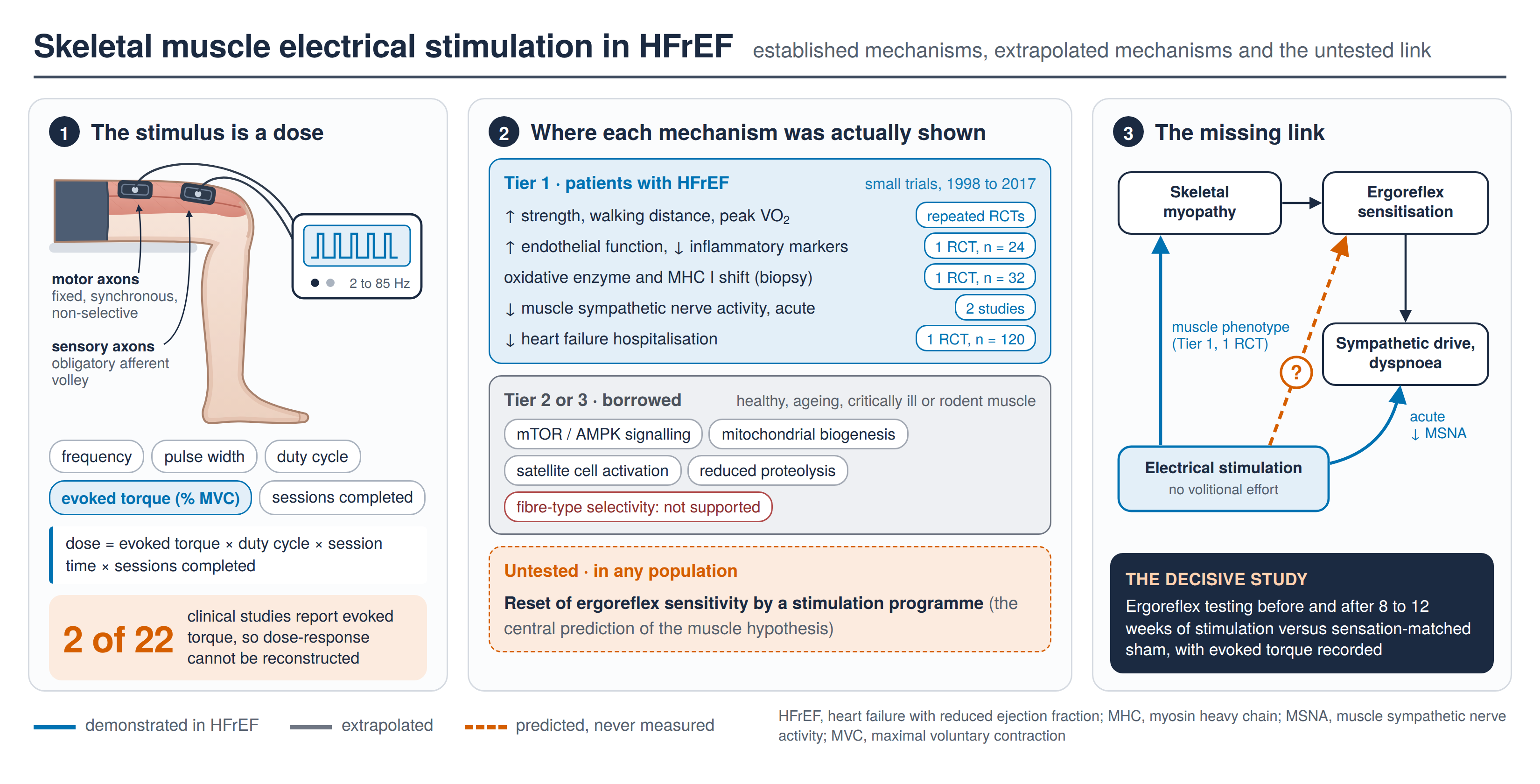
Skeletal muscle electrical stimulation, delivered as neuromuscular electrical stimulation (NMES) or functional electrical stimulation (FES), is one of very few interventions in heart failure that produces sustained contractile work in the periphery without volitional effort and, in low-frequency configurations, without a measurable rise in cardiac output. Its clinical evaluation now spans almost three decades and has produced consistent signals of improved muscle strength, walking distance and quality of life. The physiological rationale that underpins these observations has advanced much less. This review separates what has been demonstrated in human skeletal muscle in heart failure with reduced ejection fraction (HFrEF) from what has been extrapolated from healthy volunteers, chronic obstructive pulmonary disease, critical illness and ageing muscle. We frame stimulation within the muscle hypothesis of chronic heart failure, in which peripheral myopathy drives ergoreflex overactivity, sympathetic excitation and exertional symptoms, and we show that the decisive mechanistic question, whether a programme of stimulation attenuates ergoreflex sensitivity, has never been tested, although two sham-controlled microneurographic studies indicate that stimulation acutely lowers muscle sympathetic nerve activity. Three further gaps are identified: a single biopsy-controlled randomised dataset in advanced heart failure, absence of contemporary molecular phenotyping of anabolic and proteolytic signalling in stimulated HFrEF muscle, and drift of the recent evidence base towards decompensated, frail and older populations with mixed ejection fraction. Against the background of the 2026 European Society of Cardiology guidelines, which recommend exercise-based cardiac rehabilitation for all stable patients and mention electrical muscle stimulation only as an option for very weak patients, we propose a research agenda in which stimulation dose is reported as a biological variable and muscle afferent physiology becomes the primary mechanistic endpoint.
Keywords:
heart failure with reduced ejection fraction
; neuromuscular electrical stimulation
; functional electrical stimulation
; skeletal myopathy
; sarcopenia
; ergoreflex
; muscle sympathetic nerve activity
; cardiac rehabilitation
; whole-body electromyostimulation
Copyright: This open access article is published under a Creative Commons CC BY 4.0 license, which permit the free download, distribution, and reuse, provided that the author and preprint are cited in any reuse.