

Submitted:
30 September 2026
Posted:
05 October 2026
You are already at the latest version
Abstract
Introduction: Small and medium enterprises may struggle to adopt digital technologies that support Strategic Management Accounting (SMA), while weak accounting information can contribute to financing constraints. The supplied evidence suggests that digital accounting, performance measurement and strategic information systems can improve reporting usefulness, but implementation is conditioned by resources, skills, readiness and organisational support. Methods: The researcher-selected databases and information sources were Google Scholar, ERIC. The eligibility protocol restricted publication years to 2020–2026. The exact calendar date of search execution was not recorded in the verified identification provenance; this is distinct from the publication-year eligibility range. A Systematic Review searched Google Scholar and ERIC using the verified Boolean strategy, with publication eligibility restricted to 2020–2026. Results: The five analytical themes were: SME adoption is limited by resource, capability and change-readiness constraints; digital transformation requires strategic purpose and sociotechnical alignment; data-enabled SMA can improve the quality and usefulness of financial information; improved information may support funding access, but creditworthiness is only indirectly evidenced; and a practical framework should be staged, measurable and locally supportable. One study reported a negative association between digital accounting and financial performance, indicating that implementation quality matters. Discussion/Conclusion: The evidence supports a readiness-based, strategically aligned and incremental framework linking affordable digital accounting, data governance, employee capability, SMA practices, performance indicators and funding transparency. Transfer to Soweto remains provisional because the evidence is geographically heterogeneous, direct South African evidence is limited, direct lender assessments are thin, and the supplied.
Keywords:
Strategic Management Accounting
; digital transformation
; small and medium enterprises
; township economy
; South Africa
1. Introduction
Small and medium enterprises are expected to make strategic decisions with limited financial, human and technological resources. Strategic Management Accounting (SMA) can support planning, costing, performance measurement, control and risk identification, while digital accounting systems can improve the timeliness, accessibility and usability of financial information. The supplied literature nevertheless indicates that digital adoption is not a purely technical process. It depends on organisational readiness, management support, employee capability, data quality, trust and the perceived relationship between implementation costs and business benefits (Lutfi et al., 2022; Trenerry et al., 2021; Kallmuenzer et al., 2024).
The literature also links accounting information and financing conditions. Demanding financial statements and information asymmetry may restrict SMEs' ability to raise capital, whereas better accounting information and digital financial services may improve access to finance (Zayed et al., 2022; Liu et al., 2022; Nurohman et al., 2021). Digital accounting systems have been associated with timely and accurate reports, accessible financial data and improved decision-making (Lutfi et al., 2022). However, the evidence is not uniformly positive. One supplied study found a negative association between digital accounting and financial performance and attributed this possibility to improper or ineffective implementation (Hamzah et al., 2024).
The supplied literature further suggests that transformation should be connected to strategic purpose rather than technology acquisition alone. Framework-oriented studies emphasise defining transformation scope, aligning implementation with strategic goals, governing data, developing skills, building partnerships and using feedback to refine implementation (Correani et al., 2020; Machado et al., 2021; Rakić et al., 2021). Performance measurement systems and strategic accounting information are similarly presented as mechanisms for translating digital data into managerial action (Tambare et al., 2021; Dossou et al., 2022; Nasiri et al., 2020).
What remains insufficiently understood is how these relationships apply specifically to SMEs operating in Soweto. The supplied evidence is geographically heterogeneous and does not directly report findings from Soweto or South Africa as a focal setting. Direct evidence on SMA adoption among SMEs is also limited, with several studies addressing broader digital transformation, digital accounting, Industry 4.0 or performance management. Moreover, lender assessments and perceived creditworthiness are thinly evidenced. A systematic review was therefore needed to consolidate the available evidence, distinguish direct findings from transferable implications and identify framework elements requiring local validation.
2. Research Objectives
RO1: To identify and analyse the key barriers that hindered the adoption of digital technologies supporting SMA among SMEs in Soweto.
RO2: To examine how the use of digital SMA practices affected the quality of financial reporting and the perceived creditworthiness of Soweto-based SMEs.
RO3: To determine the essential digital-transformation elements that had to be incorporated into a practical framework aimed at improving SMA adoption and funding access among SMEs in Soweto.
3. Research Methods
3.1. Review Design
The selected review type was Systematic Review. Grant and Booth (2009) may be used to distinguish systematic review design from other review approaches; the present review used a documented search strategy, eligibility criteria, PRISMA selection record, critical appraisal and qualitative thematic synthesis. (Grant & Booth, 2009; Mfolo & Costa, 2024)
3.2. Search Strategy and Information Sources
The researcher-selected databases and information sources were Google Scholar, ERIC. The eligibility protocol restricted publication years to 2020–2026. The exact calendar date of search execution was not recorded in the verified identification provenance; this is distinct from the publication-year eligibility range.
3.3. Inclusion and Exclusion Criteria
Inclusion
- Studies focusing on Small and Medium Enterprises (SMEs) as the primary unit of analysis.
- Studies examining the integration or adoption of Strategic Management Accounting (SMA) principles.
- Studies investigating the role of digital transformation or digital technologies in business management processes.
- Studies proposing or evaluating frameworks, models, or criteria for SMA adoption.
- Studies addressing the relationship between SMA adoption and access to funding for SMEs.
- Studies set within the context of Soweto or comparable urban township business environments in South Africa.
- Peer-reviewed journal articles published between 2020 and 2026.
- Studies published in the English language.
Exclusion
- Studies focusing exclusively on large corporations or multinational enterprises rather than SMEs.
- Studies limited to traditional financial accounting or bookkeeping without a strategic management focus.
- Studies that do not address digital transformation or technological integration in accounting practices.
- Studies that focus solely on operational accounting without proposing or evaluating a framework or model.
- Studies that do not discuss or evaluate the impact of SMA on SME access to funding.
- Studies set in geographic contexts that are not comparable to the Soweto township business environment.
- Non-peer-reviewed literature, including white papers, conference proceedings, or book chapters.
- Studies published before 2020 or after 2026.
3.4. Screening and Study Selection
The PRISMA selection counts are persisted, but the decision rule used during title/abstract screening is not available in the verified audit payload. COSTAQDA therefore reports the recorded workflow counts without reconstructing an unverified screening procedure.
The persisted PRISMA workflow records 495 identified records, 5 duplicates, 487 records screened, 483 reports sought for retrieval, 4 records excluded at the title/abstract stage, 111 full texts assessed, 0 full-text exclusions and 111 included records. These counts describe study selection and are not substantive review findings.
Figure 1.
PRISMA 2020 Flow Diagram — Identification, Screening, Eligibility and Included.
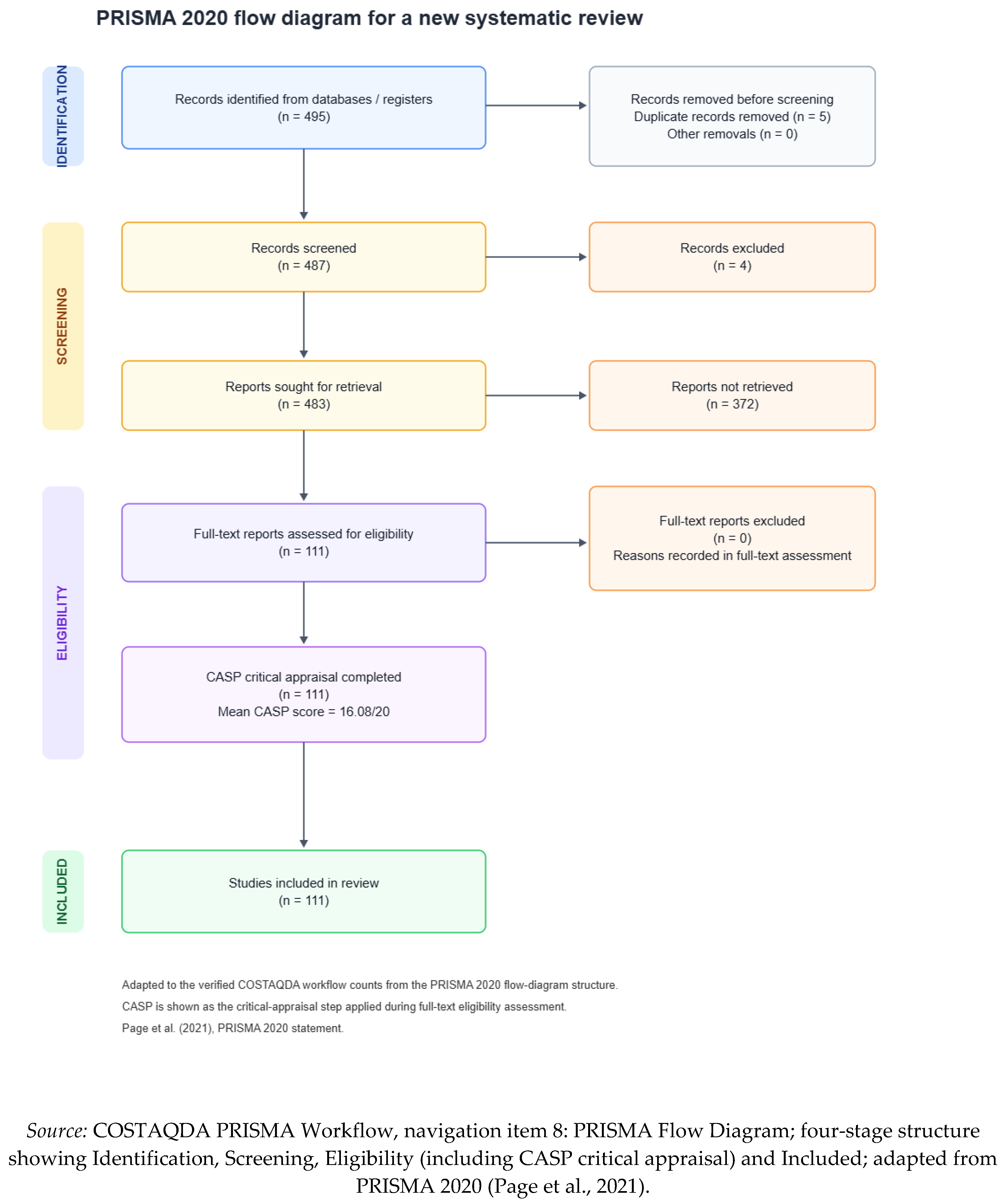
The actual PRISMA figure should display the verified workflow of 495 identified records, 5 duplicates, 487 screened records, 483 reports sought, 4 title/abstract exclusions, 111 full texts assessed, 0 full-text exclusions and 111 included records. Its interpretation is that the project has a persisted selection record, while the absence of a verified title/abstract decision rule limits reproducibility of that particular screening decision.
3.5. Critical Appraisal
The Critical Appraisal Skills Programme (CASP) was used in the PRISMA full-text workspace. CASP appraisals were completed for 111 of 111 currently included studies. The mean recorded CASP score was 16.08. Scores ranged across studies, including lower appraisals of 11–13 and higher appraisals of 18–19. These results were not converted into an unquestioned total-quality score. The supplied appraisal notes indicate that many assessments were conservative text-evidence appraisals because the configured appraisal service was unavailable; unsupported criteria were recorded as Can't tell and require researcher verification. Methodological appraisal therefore informed interpretation, particularly the need to avoid treating heterogeneous qualitative, case-study, review and quantitative evidence as equivalent.
Figure 2.
CASP Critical Appraisal Intelligence — PRISMA Workflow, Step 6: Full-Text Screening.
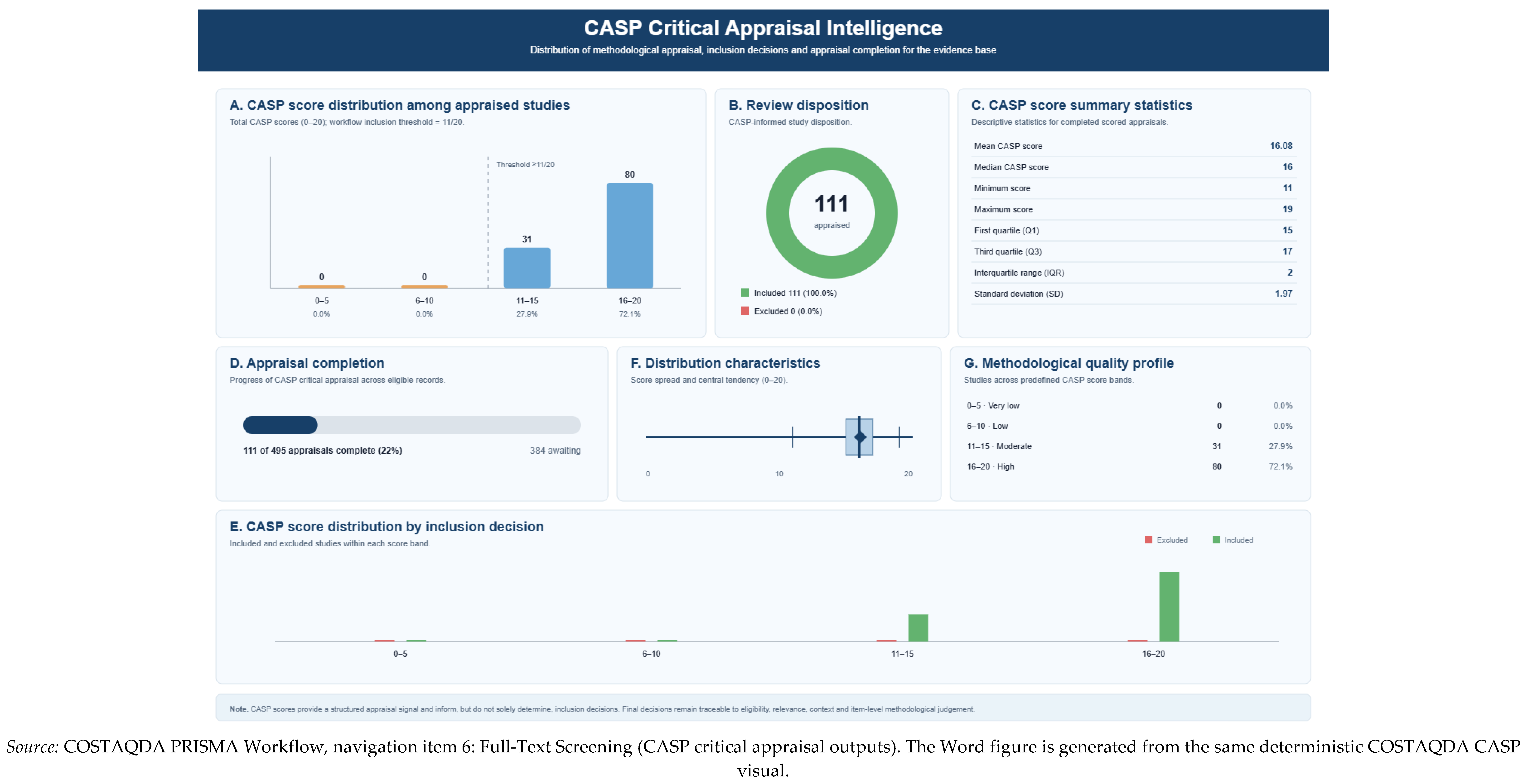
The actual CASP figure should display the 111 completed appraisals and their supplied score distribution. The pattern indicates broad completion of appraisal but not uniform methodological certainty. The appraisal decisions themselves repeatedly state that unsupported criteria require researcher verification; consequently, the figure should be interpreted as an appraisal audit rather than a definitive rank-ordering of study quality.
3.6. Data Extraction
A formal data-extraction procedure was not recorded in the supplied project evidence. Nevertheless, verified synthesis inputs comprised 842 extracted findings contributed by 98 studies, with finding-level and study-level identifiers retained for the thematic synthesis. The review therefore reports the verified synthesis dataset while noting that the wider extraction form, fields and extraction procedure were not supplied.
3.7. Data Synthesis and Analysis
Qualitative evidence synthesis was conducted on 842 extracted findings contributed by 98 studies. The COSTAQDA synthesis engine applied thematic synthesis, moving from traceable finding-level evidence to 10 initial codes, 4 categories, 0 descriptive themes and 5 analytical themes.
Theme development was constrained to the extracted finding-level evidence supplied by eligible studies. Each synthesised theme retained supporting study IDs and finding IDs, while contradictory evidence was preserved where identified. Titles, abstracts and bibliographic prominence were not treated as substitutes for extracted qualitative findings.
Recorded synthesis limitations included: The supplied evidence is geographically heterogeneous and does not directly report findings from SMEs operating in Soweto or South Africa; transfer to Soweto therefore requires local validation.; The evidence base mixes qualitative interviews, case studies, reviews and quantitative studies. The synthesis preserves reported relationships but cannot treat all evidence as equivalent in experiential depth or causal strength.; Direct evidence on Strategic Management Accounting adoption among SMEs is limited. Several findings concern digital transformation, digital accounting, Industry 4.0 or performance management more broadly.; Direct evidence on lender assessments or perceived creditworthiness is thin. The proposed link between digital SMA, reporting quality and funding access is mainly an inferred pathway from findings on financial statements, information asymmetry, financing constraints and financial-information accessibility.; Some supplied findings are incomplete excerpts, methodological descriptions or bibliographic material and were not used as substantive support for themes.; The evidence contains a tension between generally positive accounts of digital accounting and one finding reporting a negative association with financial performance. This indicates that implementation quality, skills, financial management practices and context may condition outcomes..
3.8. Bibliometric Intelligence and Confidence in the Evidence Base
Bibliometric intelligence provides a structural view of the evidence base that complements PRISMA selection, critical appraisal and qualitative synthesis. The following analyses examine citation relationships, scholarly influence, evidence connectivity and knowledge development within the included corpus. They provide contextual evidence about the intellectual structure and provenance of the literature and are not substitutes for methodological quality appraisal.
3.8.1. Local Citation Network
The Local Citation Network maps citation relationships within the included evidence base. It shows how studies are connected within the review corpus and supports examination of intellectual connectedness, centrality, bridging and isolation. These citation relationships describe the structure of the literature and do not, by themselves, establish methodological quality or validity.
Figure 3.
Local Citation Network — Bibliometric Intelligence, Step 12.
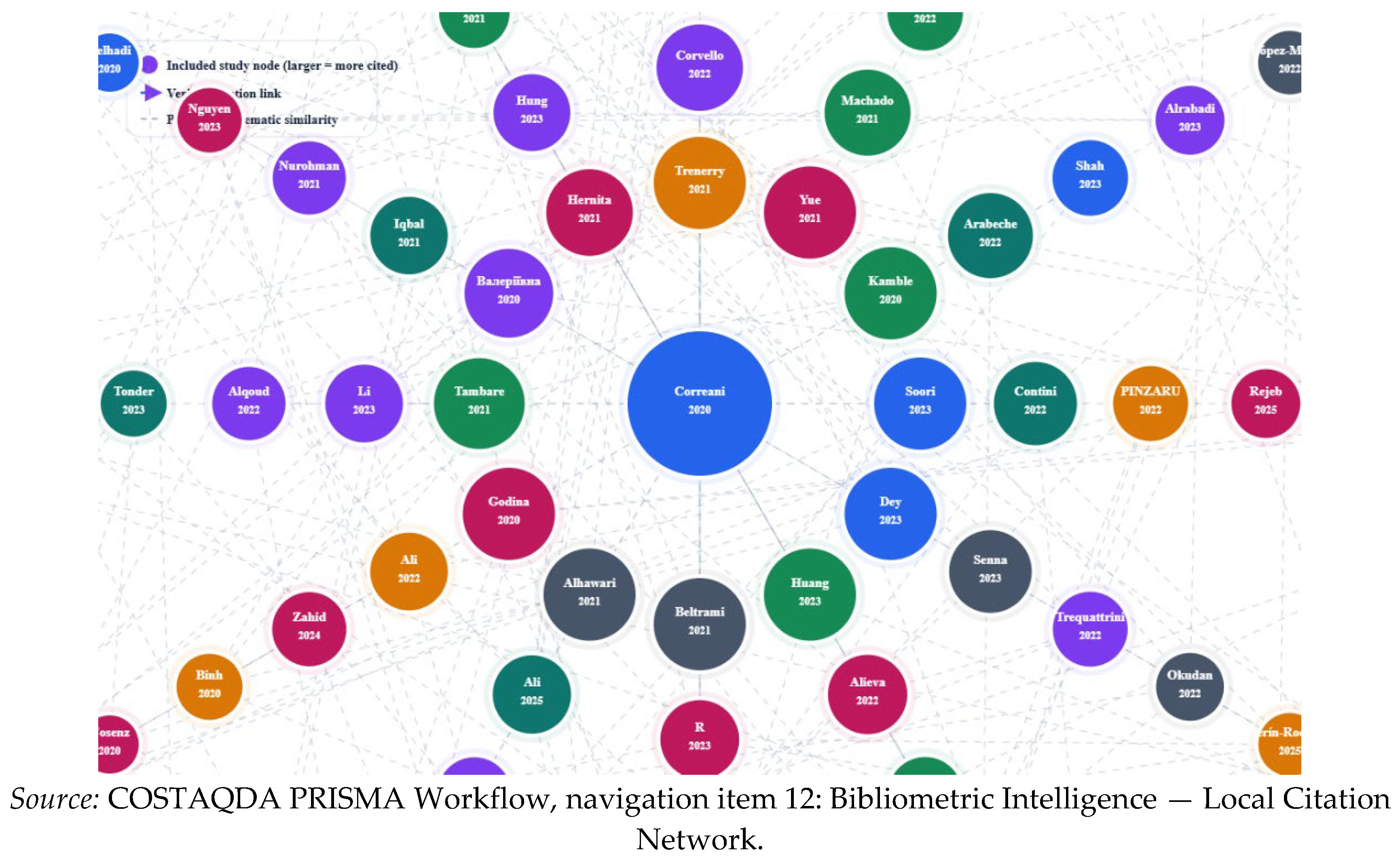
No verified Local Citation Network nodes, edges or metrics were supplied in the live bibliometric intelligence. Accordingly, no central, bridging, peripheral or isolated study pattern can be interpreted, and no conclusion about connectedness of the evidence base is made.
3.8.2. Influence Pyramid
The Influence Pyramid represents the distribution of scholarly influence within the included evidence base. It helps identify how bibliometric prominence is distributed across the reviewed studies. Influence is interpreted separately from methodological quality, which is assessed through critical appraisal.
Figure 4.
Influence Pyramid — Bibliometric Intelligence, Step 12.
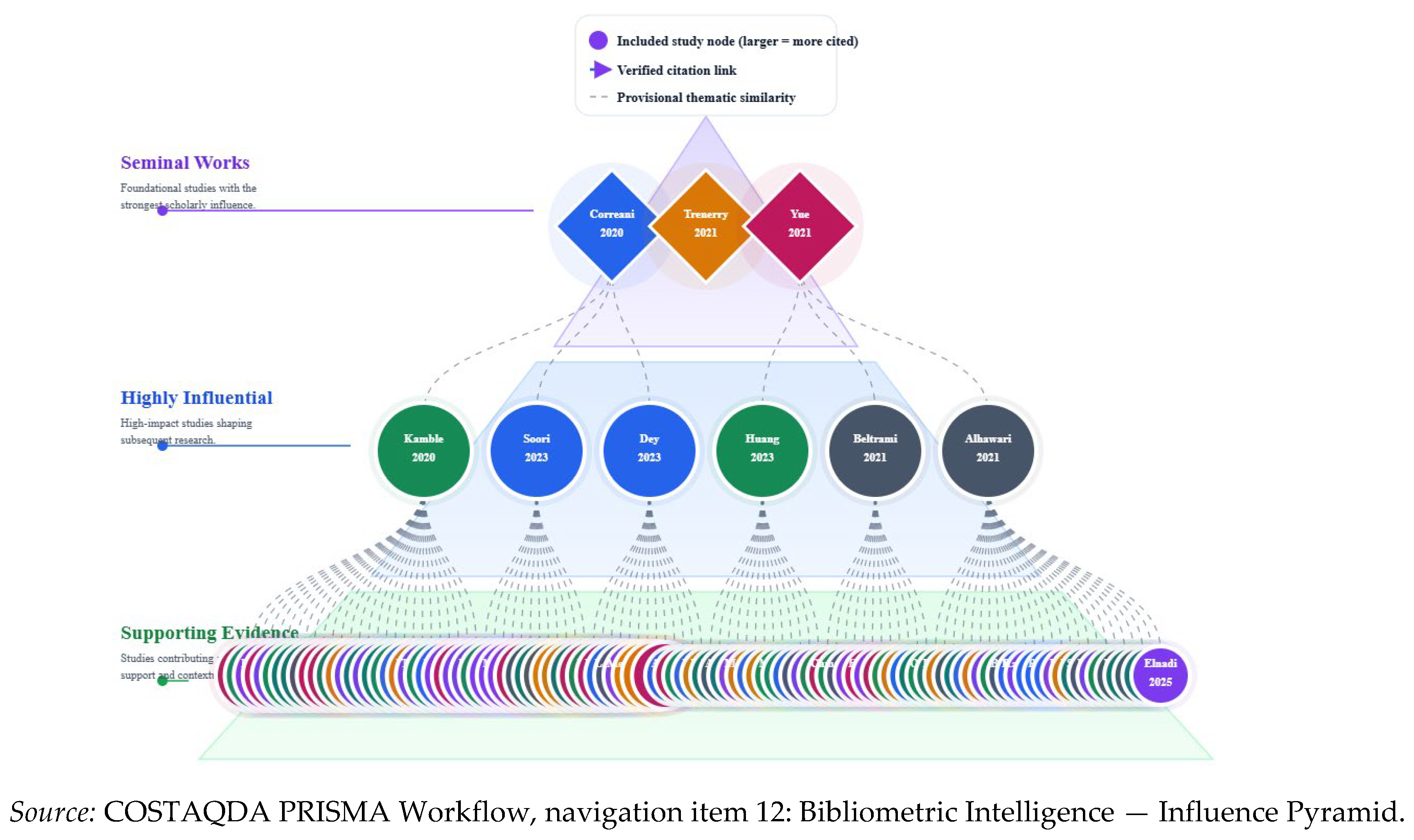
No verified Influence Pyramid nodes, influence values or metrics were supplied. Scholarly prominence therefore cannot be interpreted and is not treated as methodological quality or as a basis for confidence.
3.8.3. Evidence Strength
The Evidence Strength analysis examines the structure and strength of relationships within the evidence ecosystem assembled for the review. It complements, but does not replace, CASP methodological appraisal and must not be interpreted as a direct estimate of causal effect.
Figure 5.
Evidence Strength Network — Bibliometric Intelligence, Step 12.
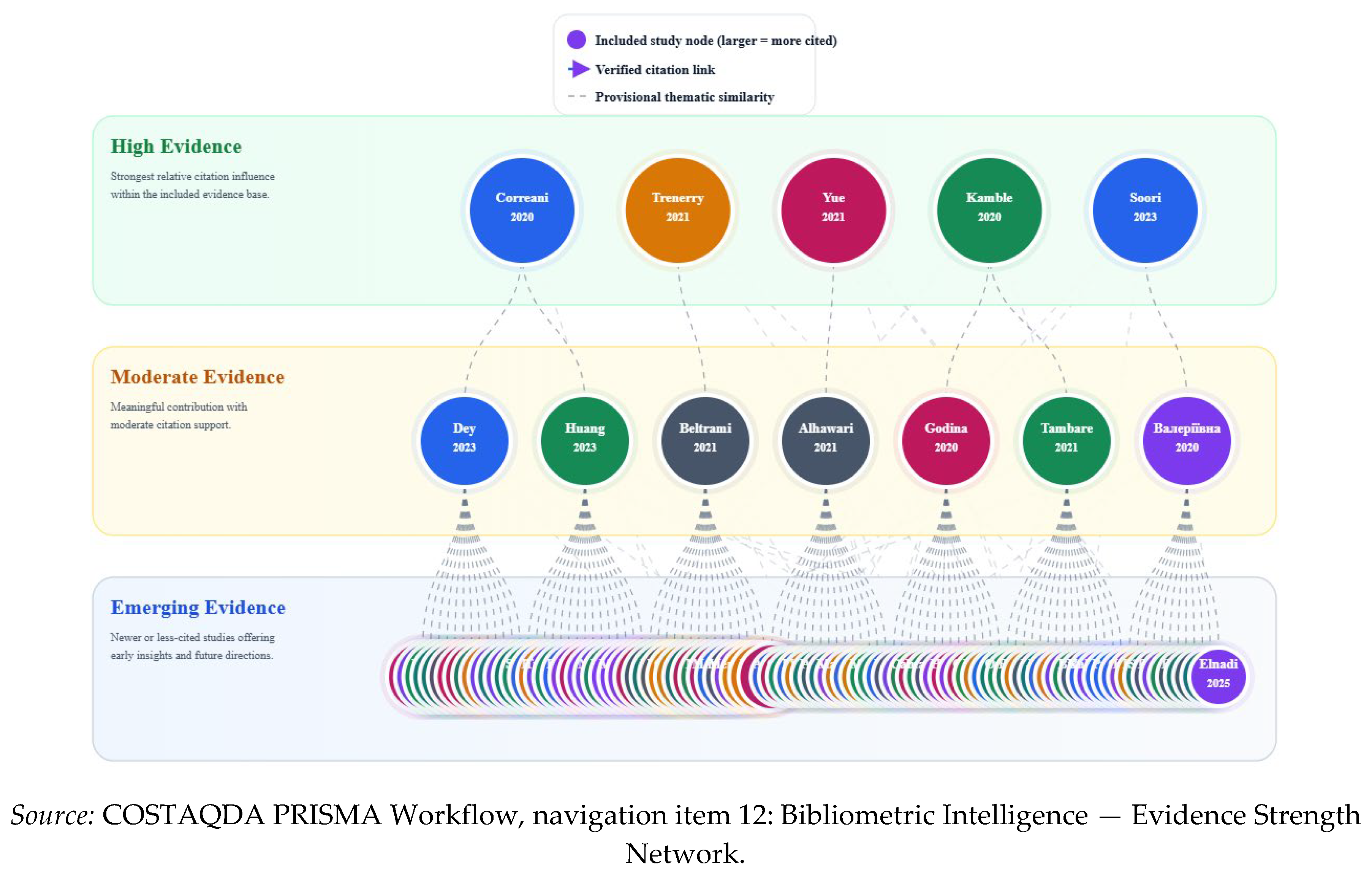
The workspace marks the Evidence Strength figure as available, but the live bibliometric intelligence supplies no evidence-strength metrics, relationships or interpretation. The figure should therefore be interpreted only as a display placeholder pending verified values. Evidence Strength must not replace CASP appraisal or be treated as a causal-effect estimate.
3.8.4. Knowledge Evolution
Knowledge Evolution examines the temporal and intellectual development of the included evidence base. It traces how research contributions develop over time and, where supported by the Step 12 data, how later studies extend, connect, challenge or consolidate earlier contributions.
Figure 6.
Knowledge Evolution — Bibliometric Intelligence, Step 12.
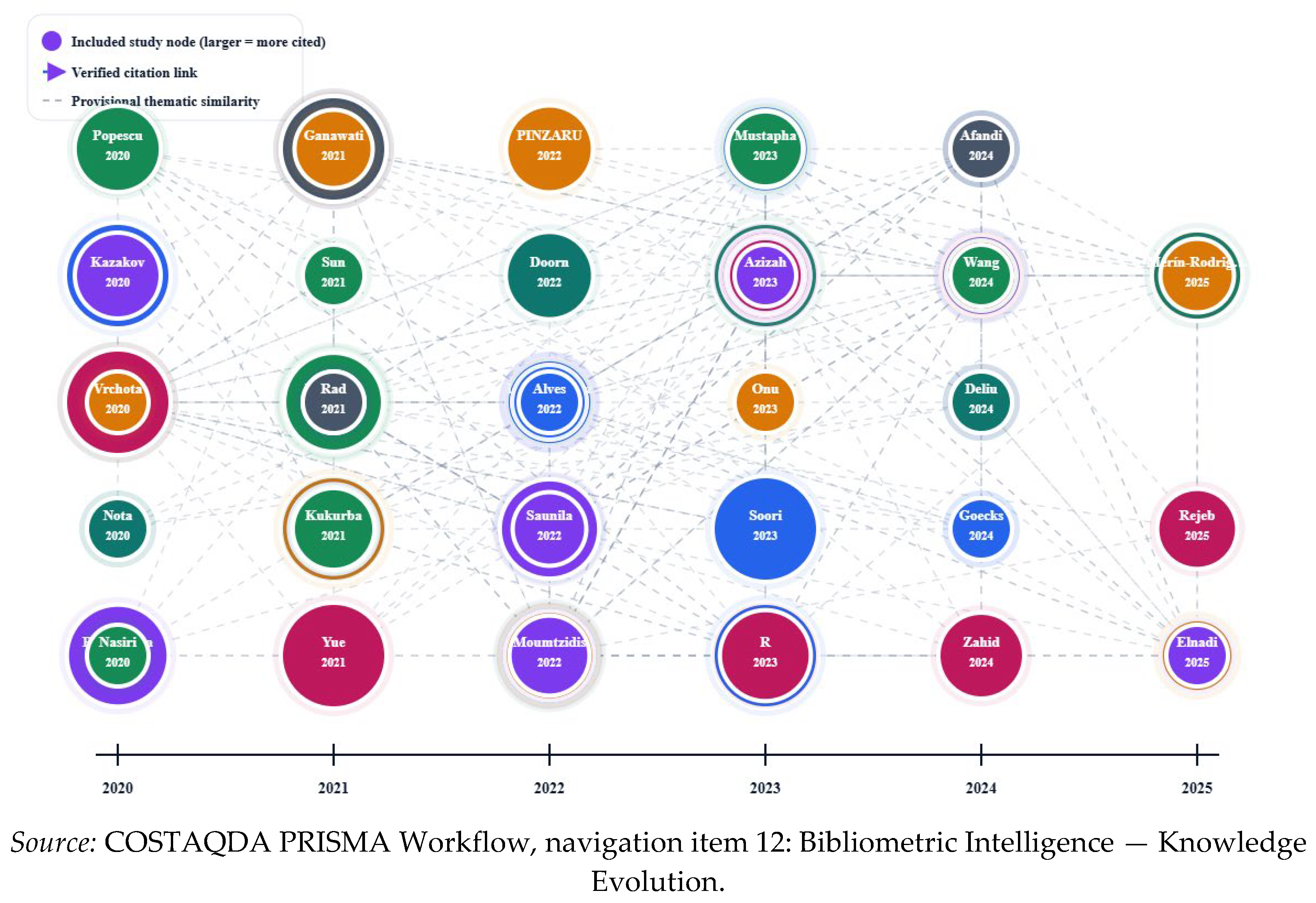
No verified Knowledge Evolution nodes, dates, trajectories or metrics were supplied in the live bibliometric intelligence. Chronological development cannot therefore be interpreted from Step 12 outputs. The qualitative evidence itself spans 2020–2025 and shows increasing attention to readiness, digital accounting, strategic alignment and funding pathways, but this is a literature-synthesis observation rather than a verified bibliometric evolution analysis.
3.8.5. Integrated Confidence in the Synthesised Evidence
Integrated confidence was assessed narratively rather than through a supplied formal confidence method, because the project field for confidence method was not recorded. Confidence is therefore based on transparent PRISMA selection, completed CASP appraisal, convergence and divergence in extracted findings, explicit contradictory evidence, and the limitations of geographic heterogeneity, mixed study designs, incomplete excerpts, limited direct SMA evidence and thin direct evidence on lender-perceived creditworthiness. The conclusions are strongest for barriers, readiness, data quality, reporting usefulness and staged implementation, and weaker for direct causal claims about Soweto funding access or creditworthiness.
4. Findings
4.1. Search and Selection Results
The verified selection record comprised 495 identified records, 5 duplicates, 487 screened records, 483 reports sought for retrieval, 4 title/abstract exclusions, 111 full texts assessed, 0 full-text exclusions and 111 included records. The qualitative synthesis used extracted findings from 98 studies rather than treating all 111 included records as equivalent contributors to every theme.
4.2. Characteristics of Included Studies
The evidence base was geographically heterogeneous and included studies from Europe, Asia, Africa and other settings, with only limited South African representation and no direct finding from SMEs operating in Soweto. Study designs included qualitative interviews, case studies, systematic or integrative reviews, cross-sectional surveys, longitudinal studies, quantitative modelling and mixed-method inquiries. The supplied evidence addressed digital transformation, digital accounting systems, performance measurement, Industry 4.0 readiness, SMA, financial inclusion, financing constraints and SME performance, although direct SMA adoption evidence was limited.
4.3. Methodological Strengths and Limitations of Included Studies
Strengths included a preserved Boolean search strategy, explicit inclusion and exclusion criteria, a persisted PRISMA workflow, completion of CASP appraisals for all 111 included studies and finding-level thematic traceability. Limitations included the unavailable title/abstract screening rule, unrecorded formal data-extraction procedure, conservative appraisal decisions requiring researcher verification, heterogeneous study designs, incomplete finding excerpts, limited direct SMA evidence, absence of direct Soweto findings and thin evidence on lender assessment or perceived creditworthiness.
4.4. Thematic Synthesis Matrix
Table 1 presents the thematic synthesis matrix linking the verified analytical themes only to studies with verified extracted evidence supporting at least one of the themes displayed in the matrix. Any study with no verified supporting contribution to any displayed theme is excluded, even if it was included elsewhere in the systematic review or qualitative evidence base. Rows represent analytical themes and columns represent theme-contributing studies. A check mark (✓) indicates that at least one verified extracted finding from that study was assigned to the theme; an em dash (—) indicates that the study contributed evidence to the synthesis overall but no supporting extracted finding from that study was assigned to that particular theme. The absence of a supporting assignment must not be interpreted as contradictory evidence. The totals report the number of evidence-contributing studies providing verified support to each theme. The matrix therefore functions as an audit trail between thematic interpretation and the underlying finding-level evidence rather than as a measure of methodological quality or effect size.
The most widely supported analytical theme was "SME adoption is limited by resource, capability and change-readiness constraints", with verified support from 6 of 19 studies. The least widely distributed theme was "Improved information may support funding access, but creditworthiness is only indirectly evidenced", with verified support from 5 of 19 studies. Differences in the number of supporting studies indicate the distribution of traceable thematic evidence across the included literature, not the relative importance or quality of a theme. Themes supported by fewer studies may still be analytically important when the underlying findings are conceptually rich, contextually distinctive or directly relevant to the review question. Conversely, wider study support indicates cross-study recurrence but does not by itself establish stronger methodological quality. The thematic patterns shown in Table 1 should therefore be interpreted alongside critical appraisal, contextual variation, contradictory findings where verified, and the detailed theme-led discussion that follows.
4.5. RO1: SME Adoption is Limited by Resource, Capability and Change-Readiness Constraints
Across the supplied evidence, the principal barriers were financial and human resource constraints, uncertain returns, limited awareness, insufficient technical capability, inadequate training and resistance to change. SMEs may be reluctant to invest when the business case is unclear or when implementation appears disproportionate to their size and capabilities (Kallmuenzer et al., 2024; Maheshwari et al., 2021; Annosi et al., 2021). The pattern addresses RO1 and supports a Soweto framework that begins with readiness and capability assessment rather than assuming that technology availability will produce adoption.
The evidence converged on the importance of skills and organisational preparedness, but its contexts varied substantially. Studies of manufacturing readiness, workplace transformation and accounting information systems emphasised management support, employee competence and awareness (Trenerry et al., 2021; Machado et al., 2021; Binh et al., 2020). One study also identified fear of job loss and concern about the loss of human communication, showing that adoption barriers may be behavioural and relational rather than merely financial (Kallmuenzer et al., 2024). CASP limitations and the mixture of reviews, interviews and surveys reduce certainty about the relative importance of each barrier.
4.6. RO1: Digital Transformation Requires Strategic Purpose and Sociotechnical Alignment
The evidence indicates that effective transformation begins by defining scope, purpose and strategic goals, then connecting those goals to data, systems, people and implementation activities (Correani et al., 2020). Readiness assessment can identify strengths, priorities and potential challenges before a transition roadmap is created (Rakić et al., 2021). Partnerships, trust, management support and feedback loops were also described as important enablers (Annosi et al., 2021; Kim et al., 2024). These findings address RO1 and RO3.
The pattern was not uniformly technological. A contradictory finding cautioned that digital communication may not replace face-to-face interaction and that some responsibilities require human creativity, intuition and judgement (Kallmuenzer et al., 2024). This does not establish that digitalisation is harmful; rather, it indicates contextual variation in how digital and human capabilities should be combined. CASP limitations and the reliance on several non-Soweto settings limit direct inference.
4.7. RO2: Data-Enabled SMA Can Improve the Quality and Usefulness of Financial Information
Digital accounting systems were associated with the collection, processing and storage of accounting information and with more timely, accurate and accessible reporting (Lutfi et al., 2022). Performance measurement systems and digital data infrastructures were linked to planning, costing, control, KPI monitoring, risk identification and continuous improvement (Tambare et al., 2021; Dossou et al., 2022; Nasiri et al., 2020). These findings address RO2 and support the inclusion of digital bookkeeping and reporting foundations within a broader SMA framework.
The evidence was not uniformly positive. Hamzah et al. (2024) reported a negative association between digital accounting and financial performance and suggested that improper or ineffective implementation may explain the result. This contradictory evidence means that the review cannot conclude that digital accounting automatically improves performance. Capability, data quality, financial management practices and implementation quality are conditions of benefit. The mixed methods and CASP limitations further weaken causal interpretation.
4.8. RO2: Improved Information May Support Funding Access, but Creditworthiness is Only Indirectly Evidenced
The supplied findings connect demanding financial statements and information asymmetry with limited capital access (Zayed et al., 2022). Other evidence associates digital transformation with reduced financing constraints and financial technology with easier access to financial services (Liu et al., 2022; Nurohman et al., 2021). The most defensible pathway is therefore indirect: digital SMA may improve record quality, transparency and the ability of an SME to demonstrate its financial condition, which may assist lender assessment.
The evidence does not directly measure lender-perceived creditworthiness among Soweto SMEs. Nor does it establish that improved reporting alone overcomes collateral requirements, affordability constraints or institutional lending practices. Hamzah et al. (2024) provides a cautionary counterpoint by finding a negative digital-accounting association with financial performance. Accordingly, RO2 is only partially answered and should not be presented as evidence of a direct creditworthiness effect.
4.9. RO3: A Practical Framework Should be Staged, Measurable and Locally Supportable
The integrated findings support a sequence of readiness assessment; definition of the SMA and funding-access purpose; selection of affordable and compatible accounting tools; data integration and governance; owner and employee training; staged implementation; monitoring through financial, operational and strategic KPIs; user feedback; and iterative refinement (Correani et al., 2020; Rakić et al., 2021; Bennett & Loose, 2024). Partnerships and external expertise should be incorporated because SMEs may lack the resources to implement a full system independently.
This theme addresses all three objectives. It responds to barriers through readiness and capability support, addresses reporting and funding pathways through measurable information outputs, and identifies framework elements through staged and user-centred implementation. The framework is transferable rather than directly validated for Soweto because the supplied studies were not conducted in the focal setting. Its implementation should therefore be tested locally with SMEs, accountants, lenders and support organisations.
5. Discussion
The review problem was how digital transformation might enhance SMA adoption and funding access among Soweto SMEs. The synthesis indicates that a framework should not begin with software selection. It should begin with readiness, resources, capabilities and a clear business purpose. This interpretation is consistent with evidence that SME digitalisation is constrained by limited financial and human resources, uncertain benefits and capability gaps (Kallmuenzer et al., 2024; Maheshwari et al., 2021). It also aligns with readiness-oriented evidence that transformation requires assessment of organisational conditions before a transition roadmap is designed (Machado et al., 2021; Rakić et al., 2021).
The first analytical theme shows that barriers are interconnected. Financial constraints may restrict investment, while limited skills and awareness restrict the ability to evaluate or use digital systems. Resistance and fear may further delay adoption. For Soweto, this means that a transferable framework should include affordable entry points, practical training, owner-manager engagement and support that explains near-term and longer-term value. The evidence does not establish which barrier is most influential in Soweto, so prioritisation requires local research.
The second analytical theme indicates that digital transformation must have strategic and sociotechnical alignment. Defining the scope of transformation connects strategic objectives to implementation components and prevents indiscriminate technology acquisition (Correani et al., 2020). Data governance, management support, partnerships and trust are similarly important (Annosi et al., 2021; Kim et al., 2024). The verified contradictory evidence concerning face-to-face communication and human judgement cautions against treating digital channels as universal substitutes. For SMEs, a blended model combining digital records and systems with appropriate human oversight is more consistent with the evidence.
The third analytical theme suggests that digital accounting can improve information timeliness, accessibility and usefulness for decision-making, including costing, cash-flow monitoring, planning and performance control (Lutfi et al., 2022). Performance measurement systems can mediate the relationship between digital capabilities and financial performance, although the evidence differs by capability type (Nasiri et al., 2020). These findings support linking digital accounting to SMA practices rather than treating accounting software as an end in itself. The negative finding reported by Hamzah et al. (2024) is important because it shows that ineffective implementation may generate no benefit or even an adverse association.
The fourth analytical theme requires the greatest caution. Better records may reduce information asymmetry and support more credible communication with funders, while digital transformation has been associated with reduced financing constraints in some evidence (Zayed et al., 2022; Liu et al., 2022). However, the supplied studies do not directly establish that lenders will perceive Soweto SMEs as more creditworthy because they adopt digital SMA. This is a transferable implication, not direct evidence. A Soweto framework should therefore measure lender-facing outcomes separately from internal reporting outcomes.
The fifth analytical theme provides the most concrete design implications. The framework should assess readiness, define purpose, select compatible tools, establish governance, train users, implement in phases, monitor KPIs, collect user feedback and iterate (Bennett & Loose, 2024; Dossou et al., 2022; Jones et al., 2023). Partnerships with accountants, SME support organisations, government agencies and financial institutions may be necessary because internal expertise is limited. The framework should be locally supportable, not merely technically sophisticated.
Taken together, the themes contribute a conditional model: readiness and capability enable strategic alignment; strategic alignment shapes the quality of implementation; implementation quality affects the usefulness of digital SMA information; information usefulness may support transparency and funding conversations; and staged support sustains adoption. The evidence supports this line of argument, but the absence of direct Soweto studies and the incomplete project evidence base mean that it remains a draft, transferable synthesis requiring local validation.
6. Conclusions
The review indicates that a digital transformation framework for SMA adoption among Soweto SMEs should be readiness-based, strategically aligned, sociotechnical, incremental, measurable and supported by local partnerships. It should connect affordable digital accounting and data governance with SMA practices, employee capability, performance measurement and transparent funding information. The evidence supports an indirect pathway from better information to possible funding access, but does not directly establish improved lender-perceived creditworthiness among Soweto SMEs. RO1 is answered through the identified resource, capability, resistance and readiness barriers; RO2 is answered cautiously through evidence on reporting usefulness and financing pathways; and RO3 is answered through the staged framework elements. Direct Soweto validation remains necessary, and the evidence base is incomplete.
7. Recommendations
Practice: SMEs should begin with a readiness and capability assessment, define a specific SMA and funding-information purpose, select affordable and compatible digital accounting tools, establish data-quality and governance routines, train owners and employees, and implement in manageable stages. Performance should be monitored through financial, operational and strategic KPIs, with user feedback used for refinement.
Practice: SME support organisations and accountants should provide practical training, implementation assistance and human support alongside digital tools. Digital communication should complement rather than automatically replace face-to-face engagement where judgement, trust or relationship-building is important.
Policy: Public SME-support programmes should prioritise affordable digital adoption, skills development, accounting information quality and trusted partnerships. Any funding-access intervention should involve lenders directly and should assess whether improved reporting changes actual lender decisions rather than assuming that digital adoption improves creditworthiness.
Future research: Researchers should conduct primary studies with Soweto SMEs, accountants, lenders and support organisations to validate the five analytical themes, measure digital SMA adoption, assess reporting quality and test the proposed funding-access pathway. Longitudinal and mixed-method designs should examine implementation quality, user capability, lender assessments and whether staged adoption produces sustained benefits.
Funding
No funding was provided for this article.
Conflicts of Interest
No conflicts of interest to declare.
AI-Assisted Technology and COSTAQDA Declaration
COSTAQDA was used as an AI-assisted evidence-synthesis and manuscript-development environment. AI-assisted functions supported the organisation, synthesis and presentation of verified project evidence and manuscript preparation within the documented COSTAQDA workflow. AI did not replace researcher responsibility for study selection, eligibility decisions, critical appraisal, verification of extracted evidence, interpretation of findings or final scholarly judgement. The human authors reviewed and approved the final manuscript and remain responsible for its accuracy, integrity, interpretations, citations and conclusions.
Appendix A. Article-Level CASP Scores
The article-level CASP scores are retained as an audit appendix. Every study shown below was critically appraised using CASP. DOI links are reproduced from the included-study record and are not inferred or invented.
| Study sequence | Study title | CASP Score | Study DOI link |
| Study 1 | Digital Transformation and Environmental Sustainability: A Review and Research Agenda | 17/20 | 10.3390/su13031530 |
| Study 2 | Implementing a Digital Strategy: Learning from the Experience of Three Digital Transformation Projects | 18/20 | 10.1177/0008125620934864 |
| Study 3 | A performance measurement system for industry 4.0 enabled smart manufacturing system in SMMEs- A review and empirical investigation | 13/20 | 10.1016/j.ijpe.2020.107853 |
| Study 4 | Preparing Workplaces for Digital Transformation: An Integrative Review and Framework of Multi-Level Factors | 16/20 | 10.3389/fpsyg.2021.620766 |
| Study 5 | The Digital Platform, Enterprise Digital Transformation, and Enterprise Performance of Cross-Border E-Commerce—From the Perspective of Digital Transformation and Data Elements | 16/20 | 10.3390/jtaer18020040 |
| Study 6 | Economic Business Sustainability and Strengthening Human Resource Capacity Based on Increasing the Productivity of Small and Medium Enterprises (SMEs) in Makassar City, Indonesia | 19/20 | 10.3390/su13063177 |
| Study 7 | Steering digitalization and management control maturity in small and medium enterprises (SMEs) | 13/20 | 10.1016/j.techfore.2024.123446 |
| Study 8 | Performance Measurement System and Quality Management in Data-Driven Industry 4.0: A Review | 17/20 | 10.3390/s22010224 |
| Study 9 | Factors Influencing the Financial Situation and Management of Small and Medium Enterprises | 18/20 | 10.3390/jrfm15120554 |
| Study 10 | Digital Transformation of Organizational Culture under Conditions of the Information Economy | 16/20 | 10.34021/ve.2020.03.01(1) |
| Study 11 | Keeping pace with the digital transformation — exploring the digital orientation of SMEs | 16/20 | 10.1007/s11187-024-00947-7 |
| Study 12 | Designing Value Chains for Industry 4.0 and a Circular Economy: A Review of the Literature | 15/20 | 10.3390/su14127084 |
| Study 13 | Internet of things for perishable inventory management systems: an application and managerial insights for micro, small and medium enterprises | 14/20 | 10.1007/s10479-021-04277-9 |
| Study 14 | New Product Development Process Design for Small and Medium Enterprises: A Systematic Literature Review from the Perspective of Open Innovation | 18/20 | 10.3390/joitmc7020153 |
| Study 15 | Development of a Sustainable Industry 4.0 Approach for Increasing the Performance of SMEs | 17/20 | 10.3390/pr10061092 |
| Study 16 | Industry 4.0 and sustainability: Towards conceptualization and theory | 13/20 | 10.1016/j.jclepro.2021.127733 |
| Study 17 | The impact of information and communication technology and internal market orientation blending on organisational performance in small and medium enterprises | 17/20 | 10.1108/ejmbe-04-2020-0068 |
| Study 18 | A Digital Twin Reference for Mass Personalization in Industry 4.0 | 13/20 | 10.1016/j.procir.2020.04.023 |
| Study 19 | Influence of Digital Accounting System Usage on SMEs Performance: The Moderating Effect of COVID-19 | 19/20 | 10.3390/su142215048 |
| Study 20 | Evaluating digital transformation in small and medium enterprises using the Alkire-Foster method | 17/20 | 10.1016/j.heliyon.2025.e41838 |
| Study 21 | The Influence of Digital Transformation and Supply Chain Integration on Overall Sustainable Supply Chain Performance: An Empirical Analysis from Manufacturing Companies in Morocco | 16/20 | 10.3390/en16021004 |
| Study 22 | How commitment and platform adoption drive the e-commerce performance of SMEs: A mixed-method inquiry into e-commerce affordances | 13/20 | 10.1016/j.ijinfomgt.2023.102649 |
| Study 23 | Fostering growth patterns of SMEs through business model innovation. A tailored dynamic business modelling approach | 13/20 | 10.1016/j.jbusres.2020.03.003 |
| Study 24 | Identification and Prioritization of Key Performance Indicators for the Construction Small and Medium Enterprises | 16/20 | 10.18400/tekderg.977849 |
| Study 25 | Adoption and performance outcome of digitalization in small and medium-sized enterprises | 19/20 | 10.1007/s11846-024-00744-2 |
| Study 26 | Impact of Green Servant Leadership in Pakistani Small and Medium Enterprises: Bridging Pro-Environmental Behaviour through Environmental Passion and Climate for Green Creativity | 18/20 | 10.3390/su152014747 |
| Study 27 | The impact of industry 4.0 on supply chain capability and supply chain resilience: A dynamic resource-based view | 12/20 | 10.1016/j.ijpe.2023.108913 |
| Study 28 | Impact of Accountant Resource on Quality of Accounting Information System: Evidence from Vietnamese Small and Medium Enterprises | 16/20 | 10.35944/jofrp.2020.9.1.001 |
| Study 29 | Impact of digital transformation on SME’s marketing performance: role of social media and market turbulence | 18/20 | 10.1007/s43621-025-01228-3 |
| Study 30 | The significance of employee behaviours and soft management practices to avoid digital waste during a digital transformation | 17/20 | 10.1108/ijlss-07-2021-0127 |
| Study 31 | Insights from Circular Economy Literature: A Review of Extant Definitions and Unravelling Paths to Future Research | 15/20 | 10.3390/su13020859 |
| Study 32 | Digital transformation for the sustainable development of firms: The role of green capability and green culture | 13/20 | 10.1002/sd.2756 |
| Study 33 | Industry 4.0: a systematic review of legacy manufacturing system digital retrofitting | 17/20 | 10.1051/mfreview/2022031 |
| Study 34 | A Precondition of Sustainability: Industry 4.0 Readiness | 17/20 | 10.3390/su13126641 |
| Study 35 | Digital-related capabilities and financial performance: the mediating effect of performance measurement systems | 16/20 | 10.1080/09537325.2020.1772966 |
| Study 36 | Digitalization within food supply chains to prevent food waste. Drivers, barriers and collaboration practices | 17/20 | 10.1016/j.indmarman.2021.01.005 |
| Study 37 | Opportunity or Threat? Exploring Middle Manager Roles in the Face of Digital Transformation | 12/20 | 10.1111/joms.12880 |
| Study 38 | Strategic management accounting in Bulgarian manufacturing SMEs | 13/20 | 10.30924/mjcmi.27.1.17 |
| Study 39 | Collaborative approaches in sustainable and resilient manufacturing | 16/20 | 10.1007/s10845-022-02060-6 |
| Study 40 | Challenges and Benefits of Sustainable Industry 4.0 for Operations and Supply Chain Management—A Framework Headed toward the 2030 Agenda | 18/20 | 10.3390/su14020830 |
| Study 41 | The Integration of Advanced Mechatronic Systems into Industry 4.0 for Smart Manufacturing | 17/20 | 10.3390/su16198504 |
| Study 42 | The Impact of Digital Technology, Automation, and Data Integration on Supply Chain Performance: Exploring the Moderating Role of Digital Transformation | 19/20 | 10.3390/logistics9010011 |
| Study 43 | Digital organisational readiness: experiences from manufacturing companies | 17/20 | 10.1108/jmtm-05-2019-0188 |
| Study 44 | Virtual manufacturing in Industry 4.0: A review | 16/20 | 10.1016/j.dsm.2023.10.006 |
| Study 45 | Entrepreneurial Orientation, Organizational Culture and Business Performance in SMEs: Evidence from Emerging Economy | 17/20 | 10.3390/su14095160 |
| Study 46 | The value relevance of digital marketing capabilities to firm performance | 17/20 | 10.1007/s11747-022-00858-7 |
| Study 47 | Is this time different? How Industry 4.0 affects firms’ labor productivity | 18/20 | 10.1007/s11187-023-00825-8 |
| Study 48 | Does Digital Transformation Promote Enterprise Development? | 16/20 | 10.4018/joeuc.307156 |
| Study 49 | Sustainability and strategic management accounting: evidence of green manufacturing in Thailand | 15/20 | 10.1080/23311975.2024.2302794 |
| Study 50 | The impact of Operations and IT-related Industry 4.0 key technologies on organizational resilience | 17/20 | 10.1080/09537287.2021.1874702 |
| Study 51 | Adopting Sustainability and Digital Transformation in Business in Romania: A Multifaceted Approach in the Context of the Just Transition | 16/20 | 10.24818/ea/2022/59/28 |
| Study 52 | Disentangling the dynamic digital capability, digital transformation, and organizational performance relationships in SMEs: a configurational analysis based on fsQCA | 14/20 | 10.1007/s10799-024-00437-y |
| Study 53 | Impact Assessment of Additive Manufacturing on Sustainable Business Models in Industry 4.0 Context | 16/20 | 10.3390/su12177066 |
| Study 54 | Development of a digital maturity model for Industry 4.0 based on the technology-organization-environment framework | 14/20 | 10.1016/j.cie.2023.109645 |
| Study 55 | Intangible assets management and digital transformation: evidence from intellectual property rights-intensive industries | 15/20 | 10.1108/medar-03-2021-1216 |
| Study 56 | Manufacturing and service supply chain resilience to the COVID-19 outbreak: Lessons learned from the automobile and airline industries | 18/20 | 10.1016/j.techfore.2020.120447 |
| Study 57 | The application of Industry 4.0 technologies in sustainable logistics: a systematic literature review (2012–2020) to explore future research opportunities | 16/20 | 10.1007/s11356-021-17693-y |
| Study 58 | Sustainability Outcomes of Green Processes in Relation to Industry 4.0 in Manufacturing: Systematic Review | 17/20 | 10.3390/su12155968 |
| Study 59 | How to Align Management Commitments to the Successful Implementation of Management Accounting Information Systems in Manager Decision Making | 12/20 | 10.52728/ijtc.v1i2.63 |
| Study 60 | Green Synergy: Interplay of corporate social responsibility, green intellectual capital, and green ambidextrous innovation for sustainable performance in the industry 4.0 era | 11/20 | 10.1371/journal.pone.0306349 |
| Study 61 | The significance of strategic management accounting on the performance of transport businesses in Nigeria | 17/20 | 10.9770/ird.2020.2.3(5) |
| Study 62 | Advancement of cloud-based accounting effectiveness, decision-making quality, and firm performance through digital transformation and digital leadership: Empirical evidence from Vietnam | 16/20 | 10.1016/j.heliyon.2023.e16929 |
| Study 63 | Industry 4.0 and Smart Data as Enablers of the Circular Economy in Manufacturing: Product Re-Engineering with Circular Eco-Design | 17/20 | 10.3390/su131810366 |
| Study 64 | Industry 4.0 and Smart Systems in Manufacturing: Guidelines for the Implementation of a Smart Statistical Process Control | 19/20 | 10.3390/asi7020024 |
| Study 65 | Shape Memory Alloy-Based Wearables: A Review, and Conceptual Frameworks on HCI and HRI in Industry 4.0 | 15/20 | 10.3390/s22186802 |
| Study 66 | The Role of Intellectual Capital, Organizational Learning and Digital Transformation on the Performance of SMEs in Denpasar, Bali-Indonesia | 17/20 | 10.51386/25815946/ijsms-v4i3p122 |
| Study 67 | How Does Digital Transformation Improve Supply Chain Performance: A Manufacturer’s Perspective | 17/20 | 10.3390/su16073046 |
| Study 68 | Factors influencing the digital transformation of sales organizations in Indonesia | 19/20 | 10.1016/j.heliyon.2024.e27017 |
| Study 69 | Sustainability and Industry 4.0: Definition of a Set of Key Performance Indicators for Manufacturing Companies | 16/20 | 10.3390/su141711004 |
| Study 70 | Link between Industry 4.0 and green supply chain management: Evidence from the automotive industry | 13/20 | 10.1016/j.cie.2022.108303 |
| Study 71 | The Role of Fintech and Financial Literacy on SMEs Sustainability | 16/20 | 10.4108/eai.27-8-2020.2303270 |
| Study 72 | The role of quality 4.0 in supporting digital transformation: Evidence from telecommunication industry | 18/20 | 10.5267/j.ijdns.2023.2.006 |
| Study 73 | Do industry 4.0 technologies improve Cantabrian manufacturing smes performance? The role played by industry competition | 13/20 | 10.1016/j.techsoc.2022.102019 |
| Study 74 | The interplay between industry 4.0 maturity of manufacturing processes and performance measurement and management in SMEs | 18/20 | 10.1108/ijppm-09-2021-0552 |
| Study 75 | Construction 4.0, Industry 4.0, and Building Information Modeling (BIM) for Sustainable Building Development within the Smart City | 18/20 | 10.3390/su141610028 |
| Study 76 | THE INFLUENCE OF GROWTH OF MICRO SMALL AND MEDIUM ENTERPRISES (UMKM) AND UNEMPLOYMENT ON GROWTH INDONESIAN ECONOMY | 16/20 | 10.54443/ijebas.v3i1.675 |
| Study 77 | Determinants of employee digital transformation readiness and job performance: A case of SMEs in Vietnam | 16/20 | 10.21511/ppm.21(4).2023.18 |
| Study 78 | Executives' role in digital transformation | 16/20 | 10.12821/ijispm100304 |
| Study 79 | Fin-Tech, Financial Inclusion, and Sustainability: a Quantitative Approach of Muslims SMEs | 16/20 | 10.30659/ijibe.6.1.54-67 |
| Study 80 | Artificial intelligence-driven supply chain resilience in Vietnamese manufacturing small- and medium-sized enterprises | 12/20 | 10.1080/00207543.2023.2179859 |
| Study 81 | The Role of Managerial Skills in the Sustainable Development of SMEs in Mehedinti County, Romania | 17/20 | 10.3390/su12031119 |
| Study 82 | User-Centered Development of an Online Dashboard Tool for Economic Sustainability for Small and Medium Enterprises | 17/20 | 10.3390/su16020557 |
| Study 83 | Does bigger still mean better? How digital transformation affects the market share–profitability relationship | 16/20 | 10.1016/j.ijresmar.2024.01.004 |
| Study 84 | Knowledge flows in industry 4.0 research: a longitudinal and dynamic analysis | 17/20 | 10.1007/s42488-025-00146-3 |
| Study 85 | Digital Transformation and Sustainable Supply Chain Performance for Sustainable Development: The Mediating Role of Supply Chain Capabilities | 19/20 | 10.1002/sd.70191 |
| Study 86 | Linking digital capability to small business performance: the mediating role of digital business transformation | 12/20 | 10.1080/23311975.2024.2342486 |
| Study 87 | Enterprise digital transformation, managerial myopia and cost stickiness | 15/20 | 10.1057/s41599-024-03926-1 |
| Study 88 | Influence Financial Technology, Financial Literacy, and Intellectual capital on financial inclusion in Micro, Small and Medium Enterprises (MSMEs) | 14/20 | 10.52728/ijtc.v3i4.572 |
| Study 89 | Co-Created Values in Crowdfunding for Sustainable Development of Enterprises | 17/20 | 10.3390/su13168767 |
| Study 90 | Soft and Hard Total Quality Management Practices Promote Industry 4.0 Readiness: A SEM-Neural Network Approach | 19/20 | 10.3390/su141911917 |
| Study 91 | The effect of digitally-driven business model innovation on business performance | 12/20 | 10.1080/08276331.2023.2239039 |
| Study 92 | Business Strategy and Small and Medium Enterprises (SMEs) Performance: The Moderating Role of the Business Environment | 16/20 | 10.59953/paperasia.v40i2b.97 |
| Study 93 | Industry 4.0, Disaster Risk Management and Infrastructure Resilience: A Systematic Review and Bibliometric Analysis | 18/20 | 10.3390/buildings11090411 |
| Study 94 | Thrive during a crisis: the role of digital technologies in fostering antifragility in small and medium-sized enterprises | 17/20 | 10.1007/s12652-022-03816-x |
| Study 95 | Digital Transformation Strategies Enabled by Internet of Things and Big Data Analytics: The Use-Case of Telecommunication Companies in Greece | 18/20 | 10.3390/info13040196 |
| Study 96 | The role of Industry 4.0 technologies in driving the financial importance of sustainability risk management | 18/20 | 10.24136/eq.2023.032 |
| Study 97 | An Empirical Study of the Relationship Between Digital Transformation, Corporate Social Responsibility and Financial Performance | 14/20 | 10.61093/bel.8(1).57-73.2024 |
| Study 98 | The potential of industry 4.0 for renewable energy and materials development – The case of multinational energy companies | 19/20 | 10.1016/j.heliyon.2023.e20547 |
| Study 99 | Energy Efficiency in Industry 4.0: The Case of Batch Production Processes | 16/20 | 10.3390/su12166631 |
| Study 100 | The rise of digital finance: Financial inclusion or debt trap? | 13/20 | 10.1016/j.frl.2021.102604 |
| Study 101 | DETERMINANTS OF FINANCIAL PERFORMANCE EVALUATION IN SMALL AND MEDIUM ENTERPRISES | 16/20 | 10.29303/akurasi.v7i2.612 |
| Study 102 | Model Design of Sociopreneurship: Halal Based-Development of Micro, Small and Medium Enterprises Through Zakat Institutions | 18/20 | 10.55188/ijif.v15i3.610 |
| Study 103 | The use of non-financial performance measures for managerial compensation: evidence from SMEs | 17/20 | 10.1007/s00187-022-00337-8 |
| Study 104 | Digital twin for smart manufacturing, A review | 16/20 | 10.1016/j.smse.2023.100017 |
| Study 105 | Sustainable performance management in the EU SME sector. A review and analysis of concepts and methods of strategic management accounting | 17/20 | 10.5604/01.3001.0054.0890 |
| Study 106 | The Impact of Industry 4.0 on Innovative Organisations, A Thematic Review using the PRISMA Statement 2020 | 15/20 | 10.3991/ijim.v17i09.39465 |
| Study 107 | Dynamic managerial capabilities for digital transformation in innovative SMEs: What are the effects on new product development performance? | 19/20 | 10.1016/j.jbusres.2025.115709 |
| Study 108 | The Role of Artificial Intelligence and Big Data Analytics in Shaping the Future of Professions in Industry 6.0: Perspectives from an Emerging Market | 18/20 | 10.3390/electronics13244983 |
| Study 109 | Digital transformation with digital twins - distinct mechanisms of enabling and controlling uses | 17/20 | 10.1080/09537325.2022.2090917 |
| Study 110 | Green Supply Chain Management Research Trends and Linkages to UN Sustainable Development Goals | 15/20 | 10.3390/su152215848 |
| Study 111 | Optimizing Marketing Strategies for Micro, Small, and Medium Enterprises (MSMEs) through Digital Marketing Training | 16/20 | 10.61978/civitas.v1i1.349 |
References
- Adeniran, A. O., & Obembe, O. E. (2020). The significance of strategic management accounting on the performance of transport businesses in Nigeria. Insights into Regional Development. [CrossRef]
- Annosi, M. C., Brunetta, F., Bimbo, F., & Kostoula, M. (2021). Digitalization within food supply chains to prevent food waste. Drivers, barriers and collaboration practices. Industrial Marketing Management. [CrossRef]
- Bennett, A. W., & Loose, S. M. (2024). User-Centered Development of an Online Dashboard Tool for Economic Sustainability for Small and Medium Enterprises. Sustainability. [CrossRef]
- Correani, A., Massis, A. D., Frattini, F. F., Petruzzelli, A. M., & Natalicchio, A. (2020). Implementing a Digital Strategy: Learning from the Experience of Three Digital Transformation Projects. California Management Review. [CrossRef]
- Dossou, P., Laouénan, G., & Didier, J. (2022). Development of a Sustainable Industry 4.0 Approach for Increasing the Performance of SMEs. Processes. [CrossRef]
- Grant, M. J., & Booth, A. (2009). A typology of reviews: An analysis of 14 review types and associated methodologies. Health Information and Libraries Journal, 26(2), 91–108.
- Hamzah, A., Rahmawati, T., Fitriani, C., & Febriansyah, Y. (2024). DETERMINANTS OF FINANCIAL PERFORMANCE EVALUATION IN SMALL AND MEDIUM ENTERPRISES. Akurasi Jurnal Studi Akuntansi dan Keuangan. [CrossRef]
- Jones, B., Rasha, A., Dyczkowska, J., & Dyczkowski, T. (2023). Sustainable performance management in the EU SME sector. A review and analysis of concepts and methods of strategic management accounting. Zeszyty Teoretyczne Rachunkowości. [CrossRef]
- Kallmuenzer, A., Mikhaylov, A. Y., Chelaru, M., & Czakon, W. (2024). Adoption and performance outcome of digitalization in small and medium-sized enterprises. Review of Managerial Science. [CrossRef]
- Kim, J., Rhee, J. H., & Park, C. H. (2024). How Does Digital Transformation Improve Supply Chain Performance: A Manufacturer’s Perspective. Sustainability. [CrossRef]
- Liu, C., Zhang, W. D., & Zhu, X. (2022). Does Digital Transformation Promote Enterprise Development? Journal of Organizational and End User Computing. [CrossRef]
- Lutfi, A., Alkelani, S. N., Al-Khasawneh, M. A., Alshira’h, A. F., Alshirah, M. H., Almaiah, M. A., Alrawad, M., Alsyouf, A., Saad, M., & Ibrahim, N. M. E. S. (2022). Influence of Digital Accounting System Usage on SMEs Performance: The Moderating Effect of COVID-19. Sustainability. [CrossRef]
- Machado, C. G., Winroth, M., Almström, P., Öberg, A. E., Kurdve, M., & Almashalah, S. Y. (2021). Digital organisational readiness: experiences from manufacturing companies. Journal of Manufacturing Technology Management. [CrossRef]
- Maheshwari, P., Kamble, S., Pundir, A. K., Belhadi, A., Ndubisi, N. O., & Tiwari, S. (2021). Internet of things for perishable inventory management systems: an application and managerial insights for micro, small and medium enterprises. Annals of Operations Research. [CrossRef]
- Nasiri, M., Ukko, J., Saunila, M., Rantala, T., & Rantanen, H. (2020). Digital-related capabilities and financial performance: the mediating effect of performance measurement systems. Technology Analysis and Strategic Management. [CrossRef]
- Nurohman, Y. A., Kusuma, M., & Narulitasari, D. (2021). Fin-Tech, Financial Inclusion, and Sustainability: a Quantitative Approach of Muslims SMEs. International Journal of Islamic Business Ethics. [CrossRef]
- Rakić, S., Pavlović, M., & Marjanović, U. (2021). A Precondition of Sustainability: Industry 4.0 Readiness. Sustainability. [CrossRef]
- Tambare, P., Meshram, C. Y., Lee, C., Ramteke, R. J., & Imoize, A. L. (2021). Performance Measurement System and Quality Management in Data-Driven Industry 4.0: A Review. Sensors. [CrossRef]
- Trenerry, B., Chng, S., Wang, Y., Suhaila, Z. S., Lim, S. S., Lu, H. Y., & Oh, P. H. (2021). Preparing Workplaces for Digital Transformation: An Integrative Review and Framework of Multi-Level Factors. Frontiers in Psychology. [CrossRef]
- Zayed, N. M., Mohamed, I. S., Islam, K. M. A., Перевoзoва, І. В., Nitsenko, V. S., & Morozova, O. (2022). Factors Influencing the Financial Situation and Management of Small and Medium Enterprises. Journal of Risk and Financial Management. [CrossRef]
- Zayed, N. M., Mohamed, I. S., Islam, K. M. A., Перевoзoва, І. В., Nitsenko, V. S., & Morozova, O. (2022). Factors Influencing the Financial Situation and Management of Small and Medium Enterprises. Journal of risk and financial management. [CrossRef]
- Liu, C., Zhang, W. D., & Zhu, X. (2022). Does Digital Transformation Promote Enterprise Development?. Journal of Organizational and End User Computing. [CrossRef]
- Mfolo, L., & Costa, K. (2024). Qualitative Evidence Synthesis Using COSTAQDA.
- Page, M. J., McKenzie, J. E., Bossuyt, P. M., Boutron, I., Hoffmann, T. C., Mulrow, C. D., et al. (2021). The PRISMA 2020 statement: an updated guideline for reporting systematic reviews. BMJ, 372, n71. [CrossRef]

Table 1.
Thematic Synthesis Matrix.
| THEMATIC SYNTHESIS |
Study One Correani (2020) |
Study Two Trenerry (2021) |
Study Three Tambare (2021) |
Study Four Zayed (2022) |
Study Five Maheshwari (2021) |
Study Six Dossou (2022) |
Study Seven Lutfi (2022) |
Study Eight Kallmuenzer (2024) |
Study Nine Rakić (2021) |
Study Ten Annosi (2021) |
Study Eleven Machado (2021) |
Study Twelve Liu (2022) |
Study Thirteen Hung (2023) |
Study Fourteen Kim (2024) |
Study Fifteen Contini (2022) |
Study Sixteen Nurohman (2021) |
Study Seventeen Bennett (2024) |
Study Eighteen Ali (2022) |
Study Nineteen Jones (2023) |
TOTALS |
|
Theme 1 SME adoption is limited by resource, capability and change-readiness constraints Barriers to digital SMA adoption |
— | ✓ | — | — | ✓ | — | — | ✓ | — | ✓ | ✓ | — | — | — | ✓ | — | — | — | — | 6 |
|
Theme 2 Digital transformation requires strategic purpose and sociotechnical alignment Strategic and sociotechnical enablers |
✓ | — | — | — | — | — | — | — | ✓ | ✓ | ✓ | — | — | ✓ | — | — | — | ✓ | — | 6 |
|
Theme 3 Data-enabled SMA can improve the quality and usefulness of financial information Digital SMA information infrastructure; Financial and performance consequences |
— | — | ✓ | — | — | ✓ | ✓ | — | — | — | — | — | ✓ | — | — | — | — | — | ✓ | 5 |
|
Theme 4 Improved information may support funding access, but creditworthiness is only indirectly evidenced Financial and performance consequences |
— | — | — | ✓ | — | — | ✓ | — | — | — | — | ✓ | — | — | — | ✓ | — | — | ✓ | 5 |
|
Theme 5 A practical framework should be staged, measurable and locally supportable Strategic and sociotechnical enablers; Digital SMA information infrastructure; Financial and performance consequences |
✓ | — | ✓ | — | — | ✓ | — | — | ✓ | — | — | — | — | — | — | — | ✓ | — | ✓ | 6 |
Only studies with verified extracted evidence supporting at least one displayed theme are included. ✓ = verified extracted evidence from the study supports the theme; — = the study supports at least one other displayed theme but no verified supporting finding from that study was assigned to this theme. An em dash does not indicate contradictory evidence.
Disclaimer/Publisher’s Note: The statements, opinions and data contained in all publications are solely those of the individual author(s) and contributor(s) and not of MDPI and/or the editor(s). MDPI and/or the editor(s) disclaim responsibility for any injury to people or property resulting from any ideas, methods, instructions or products referred to in the content. |
© 2026 by the authors. Licensee MDPI, Basel, Switzerland. This article is an open access article distributed under the terms and conditions of the Creative Commons Attribution (CC BY) license (http://creativecommons.org/licenses/by/4.0/).
Copyright: This open access article is published under a Creative Commons CC BY 4.0 license, which permit the free download, distribution, and reuse, provided that the author and preprint are cited in any reuse.