

Submitted:
21 September 2026
Posted:
05 October 2026
You are already at the latest version
Abstract
Although water recirculates through fish tanks, plant beds and filters in an aquaponic unit, each compartment supports a microbial community shaped by its local conditions. This distinction is especially important for major carps, including rohu (Labeo rohita), catla (Catla catla) and mrigal (Cirrhinus mrigala), because these major South Asian food fishes occupy contrasting feeding niches and provide a useful comparison of shared environmental exposure and host-associated selection. This focused narrative review examines major-carp gut microbiota, aquaponic water and biofilter communities, gut-water connectivity, and the strengths and limitations of 16S rRNA amplicon sequencing and shotgun metagenomics. Literature screening started with the reference collection assembled for the initial research synopsis. Titles, abstracts and available full texts were reviewed, targeted PubMed searches were used to check coverage, and bibliographic details were cross-checked against publisher, DOI and indexing records. Literature available up to 10 September 2026 was considered. Studies of aquaponic systems consistently show that water, biofilters, roots, biofilms and fish-associated habitats support distinct microbial assemblages despite continuous recirculation. Major-carp studies likewise report variation among host species, gut regions and culture conditions. Overlap between gut and environmental taxa should therefore be treated as evidence of ecological connectivity rather than direct proof of colonization or transmission. Common limitations include inconsistent sampling designs, insufficient tank replication, reliance on relative abundance, limited temporal sampling, low-biomass contamination in water samples and weak functional validation. Future studies would benefit from replicated carp culture, synchronized sampling of gut and aquaponic compartments, water-quality measurements, 16S profiling for community structure and selected shotgun metagenomics for functional resolution. Nitrogen cycling, carbohydrate metabolism, antimicrobial-resistance determinants, mobile genetic elements and source-selection relationships deserve particular attention. Future work should move beyond cataloguing taxa and determine how host identity, aquaponic habitat and microbial function interact over time in a controlled production system.
Keywords:
aquaponics
; major carps
; Labeo rohita
; Catla catla
; Cirrhinus mrigala
; gut microbiota
; water microbiota
; biofilter
; 16S rRNA
; shotgun metagenomics
; antimicrobial resistance
1. Introduction
Aquaculture has become a central part of the global aquatic-food supply, increasing interest in production systems that use water and nutrients efficiently (Boyd et al., 2022; Garlock et al., 2024). Aquaponics addresses this need by linking recirculating fish culture with soil-free plant production. Fish feed enters the system, only part is converted into fish biomass, and the remaining dissolved and particulate material becomes available for microbial transformation and plant nutrient recovery. For major-carp aquaponics, the microbial communities associated with tank water, filters, biofilms, roots and the fish gut are therefore central to both nutrient cycling and host-environment interactions (Yavuzcan Yildiz et al., 2017; Yamane et al., 2021; Anila and Daramola, 2025; Rudoy et al., 2025).
Microorganisms are particularly important because nitrogenous wastes must be transformed into forms that are less harmful to fish and more accessible to plants. Ammonia oxidation, nitrite oxidation, denitrification, organic-matter degradation and mineralization can occur in different parts of the aquaponic loop. Evidence from recirculating aquaculture systems is relevant here where it clarifies microbial processes that also operate in aquaponics, including the role of complete ammonia oxidizers such as comammox Nitrospira (Preena et al., 2021; Chai et al., 2025). In the present review, these RAS findings are used as supporting context rather than as a substitute for major-carp aquaponic evidence.
At the same time, the fish intestine forms its own selective habitat. Gut microorganisms are associated with digestion, nutrient metabolism, immune regulation and resistance to opportunistic colonizers, but their composition can change with diet, water quality, host species, gut region and rearing environment (Diwan et al., 2022, 2023; Johny et al., 2021; Maji et al., 2022). Rohu, catla and mrigal are particularly useful comparative hosts because they are major South Asian food fishes and occupy different feeding niches. Their shared exposure to the same water does not imply that they will develop the same intestinal microbiota (Sheikh et al., 2017; Pingle and Khandagle, 2023).
The importance of these species is both practical and scientific. As major food fishes in South Asian freshwater aquaculture, they are relevant to regional production, while their contrasting feeding niches provide a useful comparison of hosts exposed to the same culture water but to different dietary and microbial inputs. Catla is primarily a surface feeder, rohu a water-column feeder and mrigal a bottom feeder, allowing the three species to exploit different trophic resources within the same culture system (Mukherjee et al., 2020). This makes the three species particularly useful for testing how shared environmental exposure interacts with host-associated selection (Sheikh et al., 2017; Pingle and Khandagle, 2023).
The main issue considered here is how much gut-community structure reflects environmental exposure and how much is shaped by the host. This review brings together evidence from major-carp studies, aquaponic microbial ecology and sequencing methodology to examine that question. Gut and water communities are treated as connected but distinct habitats, with particular attention to microbial exposure, host selection and functional relationships across the system.
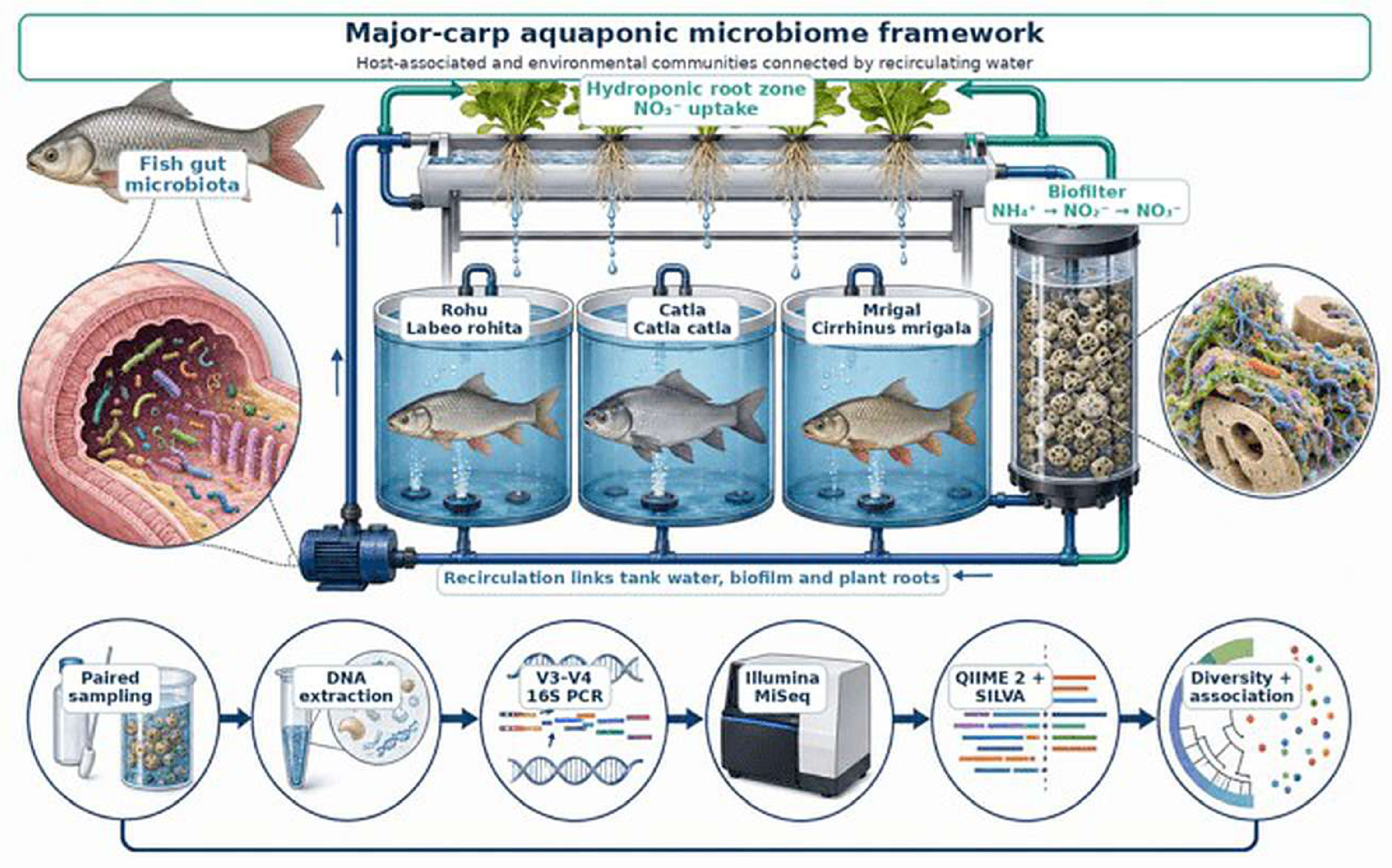
Figure 1.
Conceptual view of a major-carp aquaponic microbiome. Recirculation links gut, tank water, biofilter and root-zone habitats, while each compartment imposes its own ecological filters. Adapted conceptually from the evidence summarized by Schmautz et al. (2017), Ruiz et al. (2023), Preena et al. (2021) and Maji et al. (2022). Created with BioRender.com.
2. Scope and Review Approach
For this review, I used a focused narrative approach rather than a systematic-review or meta-analytic protocol. The starting set contained 41 references assembled for the initial research synopsis. I screened titles first, then reviewed available abstracts and full texts. The final synthesis prioritizes studies that directly inform major-carp gut microbiota, aquaponic water and biofilter communities, host-environment microbial connectivity, sequencing methodology, antimicrobial resistance and research design.
Targeted PubMed searches were used to check coverage and to identify indexed records for the principal themes. Search combinations included ‘aquaponics microbiome’, ‘fish gut microbiota’, ‘major carp 16S rRNA’, ‘water microbiota’, ‘biofilter community’, ‘shotgun metagenomics’, and the species names Labeo rohita, Catla catla and Cirrhinus mrigala. Bibliographic details were cross-checked against publisher pages, DOI records and PubMed or equivalent indexing records where available. Literature available up to 10 September 2026 was considered.
Because the review is narrative, it does not claim exhaustive database coverage and no formal risk-of-bias instrument was applied. The emphasis is instead on transparent source selection, critical comparison of what each study can and cannot establish, and strict separation between marker-gene evidence, functional metagenomic evidence and proposed future research.
3. Aquaponics as a Compartmentalized Microbial Ecosystem
3.1. Spatial Organization and Ecological Filtering
An aquaponic unit contains several linked but ecologically distinct microhabitats. These include the fish intestine, tank water, suspended solids, mechanical filters, nitrifying biofilters, hydroponic water, plant roots, wall biofilms and, in some designs, anaerobic mineralization zones. Oxygen availability, organic carbon, surface area, hydraulic retention time and nutrient supply vary among these locations. As a result, microorganisms that are abundant in one compartment may be rare or absent in another.
Several aquaponic studies have examined fish-associated and environmental samples separately and provide direct evidence of compartment-specific structure. Schmautz et al. (2017) reported that fish fecal communities differed from those associated with plant roots, biofilters and periphyton. Eck et al. (2019) found greater diversity in biofilter communities than in corresponding sump communities across aquaponic and aquaculture systems, while Bartelme et al. (2019) showed that engineered system components create distinct microbial microenvironments. Schmautz et al. (2021) further documented differences between aerobic and anaerobic compartments in both environmental conditions and microbial profiles. In a replicated system, Schmautz et al. (2022) identified nitrifying bacteria in hydroponic compartments and described spatial and temporal structure across the nitrogen cycle. Ruiz et al. (2023) later reported clear differentiation among fish intestine, water, biofilter, hydroponic and root-associated communities in a coupled system. More recent work supports the same general pattern: system design and habitat type can alter richness, diversity and community structure across gut, water, biofilm and filter habitats (Ruiz et al., 2026).
This spatial structure is important for interpreting sequencing data. A water sample cannot represent the entire aquaponic microbiome, and a biofilter sample does not necessarily reflect the microbial community to which fish are directly exposed. Results should therefore be interpreted at the level of the sampled compartment, while recognizing that each compartment remains connected through recirculating water.
3.2. Nitrogen Cycling, Organic Matter and Water Quality
Microbial nitrogen transformations are among the most operationally important processes in aquaponics. Ammonia released by fish and generated during organic-matter breakdown is oxidized to nitrite and then nitrate. Ammonia-oxidizing bacteria and archaea, nitrite-oxidizing organisms and comammox Nitrospira can all contribute to this process, depending on system conditions (Preena et al., 2021; Chai et al., 2025). Nitrate is generally less acutely toxic to fish than ammonia or nitrite and can be taken up by plants, linking microbial metabolism directly with crop nutrition.
Nitrification does not occur in isolation. Organic loading, dissolved oxygen, pH, temperature and substrate availability influence the balance between autotrophic nitrifiers and heterotrophic microorganisms. Uneaten feed and fecal solids also create surfaces and microsites where oxygen conditions and nutrient concentrations differ from the bulk water. These gradients help explain why microbial communities vary across water, biofilms and filtration media (Yavuzcan Yildiz et al., 2017; Yamane et al., 2021).
The same microbial loop can affect animal health and biosecurity. Aquaponic water may contain beneficial organisms, opportunistic pathogens and antimicrobial-resistance determinants. Reviews of pathogen transmission in aquaponics emphasize that recirculating water can connect fish and plant compartments, making filtration, hygiene and disinfection relevant to system-level risk management (Mori and Smith, 2019; Dinev et al., 2023). Changey et al. (2025) further showed that fish and the rhizosphere can influence both planktonic bacterial communities and the resistome within an aquaponic recirculation loop.

Table 1.
Functional interpretation of major aquaponic microbial compartments.
| Compartment | Main ecological features | Interpretive caution |
|---|---|---|
| Fish gut | Host-selected habitat influenced by diet, physiology, immune activity and environmental exposure. | Detection of environmental taxa in gut contents does not prove stable colonization. |
| Tank water | Dispersal medium containing planktonic cells, dissolved nutrients and microbial inputs from fish, feed and system surfaces. | Bulk water does not represent attached biofilms or mucosa-associated communities. |
| Biofilter | High-surface-area habitat supporting nitrification and other attached processes. | Community structure depends on media, oxygen, loading and system operation. |
| Root zone / hydroponic water | Plant-associated habitat influenced by nutrient uptake, root exudates and surface colonization. | Plant-associated communities may differ sharply from tank-water communities. |
| Biofilms / solids | Structured microhabitats with localized oxygen and carbon gradients. | Relative abundance in bulk samples can obscure microscale functional partitioning. |
4. Gut Microbiota of Major Carps
The gastrointestinal tract of fish is continually exposed to microorganisms from water and feed, but exposure is only the first step in community assembly. Digestive secretions, oxygen gradients, available nutrients, transit time, mucosal attachment sites and immune activity can favor some organisms while excluding others. For that reason, the intestinal microbiota is better understood as a host-filtered community than as a simple copy of the surrounding environment (Diwan et al., 2022, 2023; Johny et al., 2021).
Studies of major carps support this view. Foysal et al. (2020) reported clear differences across gastrointestinal regions and among rohu, catla and mrigal, while Mukherjee et al. (2020) found that gut region, fish species and source pond all contributed to community variation in a polyculture setting. Pingle and Khandagle (2023) also reported differences among wild and cultured carp gut communities, while Maji et al. (2022) showed that rohu maintained under different culture conditions displayed significant differences in gut microbial diversity and composition. Dissolved oxygen was associated with bacterial diversity in the rohu study, illustrating how host-associated communities can remain sensitive to environmental conditions without becoming identical to the water microbiome.
Species ecology is also relevant. Rohu, catla and mrigal differ in feeding position and dietary exposure, which can change the particles and microorganisms entering the digestive tract. Their intestinal morphology and physiology may add another layer of selection. This combination of shared environmental exposure and species-specific filtering makes the three carps a useful comparative system for studying host–environment microbiome relationships (Sheikh et al., 2017; Pingle and Khandagle, 2023).
Recent work outside aquaponics adds further support for habitat effects. Chamonara et al. (2025) found distinct rohu gut bacteriomes between fish collected from the Halda River and Kaptai Lake. Although this was not an aquaponic experiment, it strengthens the broader inference that environmental setting can be associated with major shifts in rohu gut community structure. The critical unresolved issue is whether such habitat effects remain detectable when fish species are compared under tightly controlled, shared or matched aquaponic conditions.
5. The Gut–Water Interface: Exposure, Selection and Microbial Exchange
Figure 2.
Working model of the gut-water interface. Water and feed provide microbial exposure, while intestinal conditions impose host selection. Fish in turn release cells and organic material back to the recirculating system. The diagram is conceptual and does not imply measured transfer rates. Supported by the source–selection patterns discussed in Ruiz et al. (2023), Maji et al. (2022) and Diwan et al. (2023). Created with BioRender.com.
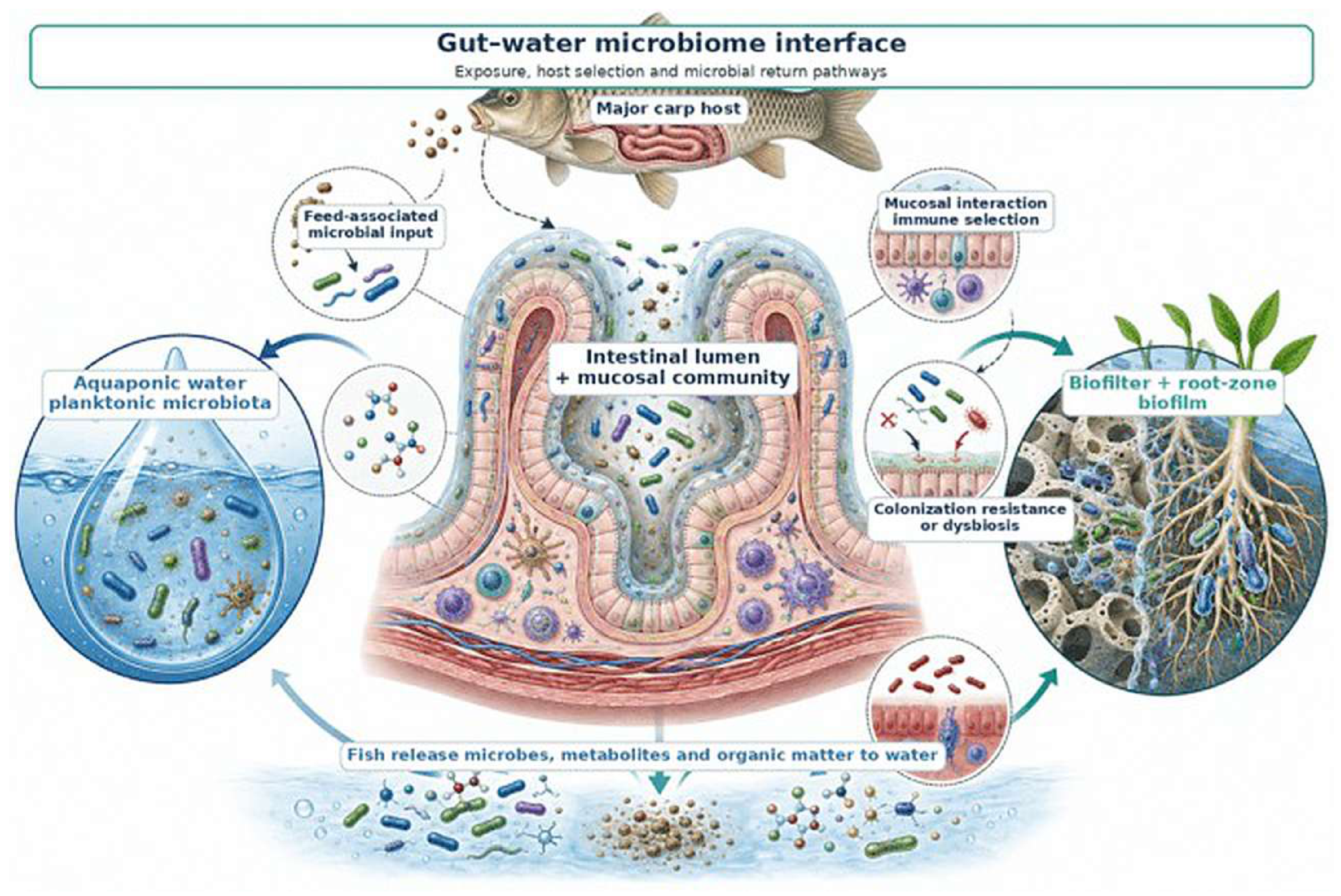
Although aquaponic water serves as an important microbial source pool, detection of a microorganism in the water does not imply permanent colonization of the fish gut. Fish continually ingest water and encounter microorganisms on epithelial surfaces, and feed is exposed to the same environment before ingestion. Consequently, some environmental organisms may be detected transiently in intestinal contents without establishing a stable host association.
The distinction between exposure and colonization is essential. Finding the same genus, species-level assignment or even amplicon sequence variant in water and gut samples demonstrates overlap, but not the direction of transfer. Stronger evidence for microbial exchange requires paired sampling, temporal information and, ideally, strain-level or genome-resolved analysis. Intestinal contents and mucosa should also be distinguished because luminal material includes recently ingested organisms whereas mucosa-associated communities are more closely tied to host tissue.
Evidence from coupled aquaponic systems suggests that fish-associated communities remain compositionally distinct even when they share the same recirculating water with environmental compartments (Ruiz et al., 2023; Ruiz et al., 2026). This supports a source–selection model in which the environment supplies microbial exposure while host physiology determines which organisms persist. For major carps, however, this model has not yet been tested with a replicated design that simultaneously samples rohu, catla, mrigal and matched aquaponic compartments.
Aquaponic systems provide a useful setting for addressing this gap because several environmental variables can be standardized or monitored more closely than in open ponds. Control of water flow, feed, stocking density, filtration and physicochemical conditions may help distinguish persistent host-associated patterns from short-term environmental variation.
6. Molecular Approaches for Gut and Water Microbiome Profiling
6.1. 16S rRNA Amplicon Sequencing
16S rRNA gene amplicon sequencing remains a practical approach for comparing bacterial communities across many samples. DNA is extracted from gut material, water filters, biofilms or other matrices, a hypervariable region is amplified, and sequence reads are processed into taxonomic features. Modern pipelines commonly use amplicon sequence variants rather than fixed-similarity operational taxonomic units because ASVs provide finer sequence resolution and improve reproducibility across datasets (Johny et al., 2021; Quast et al., 2013).
Community structure can then be summarized using complementary analyses. Alpha-diversity metrics describe within-sample richness or diversity, whereas beta-diversity measures compare community composition among samples. UniFrac incorporates phylogenetic relationships into between-community comparisons (Lozupone and Knight, 2005). Differential-abundance analysis requires additional care because microbiome counts are compositional; apparent changes in relative abundance can arise when another group changes in the opposite direction. Rarefaction is also not an appropriate general solution for differential-abundance testing because it discards valid count information (McMurdie and Holmes, 2014). Co-occurrence networks can be useful for generating ecological hypotheses, but network edges should not be treated as direct proof of biological interaction (Faust and Raes, 2012).
Amplicon sequencing is powerful for ecological comparisons, but its limits must be stated clearly. It usually provides genus-level or, in some cases, species-level assignments, and functional capacity is inferred rather than measured. A 16S profile cannot directly establish the presence of a metabolic pathway, an antimicrobial-resistance gene or a virulence determinant.
6.2. Shotgun Metagenomics and Genome-Resolved Analysis
Shotgun metagenomics sequences total community DNA rather than a single marker gene. This provides broader taxonomic coverage and direct access to microbial genes and metabolic pathways. In aquaculture, the approach can reveal functions related to nutrient metabolism, carbohydrate degradation, vitamin biosynthesis, antimicrobial resistance and mobile genetic elements (Martínez-Porchas and Vargas-Albores, 2017; Quince et al., 2017). Tyagi et al. (2019) provided a directly relevant example in rohu, showing that shotgun metagenomics can resolve taxonomic composition, metabolic pathways and antimicrobial-resistance genes in the gut microbiome. Yang et al. (2025) similarly illustrates how shotgun metagenomics can combine taxonomic and functional profiling in fish gut communities.
For a major-carp aquaponic study, the added value of shotgun sequencing would be strongest where the research question is explicitly functional. Nitrogen-cycling genes, complex-carbohydrate metabolism, vitamin synthesis, antimicrobial-resistance genes and potential virulence determinants could be examined directly rather than inferred from taxonomy. Assembly of metagenome-assembled genomes could also improve strain-level resolution and help test whether closely related organisms occur across gut and environmental compartments.
The trade-off is cost and complexity. Shotgun metagenomics is computationally more demanding, and fish gut samples may contain substantial host DNA. Low-biomass water samples are particularly vulnerable to reagent and laboratory contamination. Sampling strategy and controls therefore become part of the biological interpretation, not merely technical details (Thormar et al., 2024). A sensible design is to use 16S profiling broadly and apply shotgun metagenomics to a selected, well-controlled subset of samples.
Table 2.
Practical comparison of 16S rRNA amplicon sequencing and shotgun metagenomics.
| Feature | 16S rRNA amplicon sequencing | Shotgun metagenomics |
|---|---|---|
| Primary target | Selected bacterial/archaeal marker region | Total DNA in the sample |
| Main strength | Efficient community-level comparison across many samples | Higher taxonomic resolution plus direct gene and pathway information |
| Functional inference | Mostly indirect | Direct detection of functional genes and pathway potential |
| Viruses/fungi | Usually not characterized by standard bacterial 16S workflow | Can be detected when their DNA is represented and sequencing depth is adequate |
| AMR genes | Not directly resolved | Can be detected and profiled |
| Cost and computing | Lower | Higher |
| Best role in proposed study | Broad replicated ecological screening | Targeted functional and genome-resolved follow-up |
7. Antimicrobial Resistance, Pathogens and One-Health Relevance
Microbial profiling in aquaponics should extend beyond nitrifiers and dominant taxonomic groups. Recirculating systems can contain opportunistic pathogens and antimicrobial-resistance determinants alongside organisms that support nutrient cycling. Dinev et al. (2023) reviewed potentially hazardous microorganisms reported from aquaponic environments, while Mori and Smith (2019) emphasized the importance of water-mediated pathogen transmission and physical control measures in linked production systems.
Resistance is also an ecological rather than purely clinical feature. Changey et al. (2025) demonstrated that fish and rhizosphere compartments can shape the planktonic community and resistome of an aquaponic loop. This supports the inclusion of antimicrobial-resistance genes and mobile genetic elements in future functional studies. Shotgun metagenomics is particularly useful here because marker-gene sequencing cannot directly characterize the resistome (Martínez-Porchas and Vargas-Albores, 2017; Quince et al., 2017).
Care is still required when interpreting these data. Detecting a resistance gene does not establish that it is expressed, mobile or clinically relevant, just as detecting a taxon does not prove pathogenic activity. Functional claims should therefore be separated from sequence detection and, where possible, supported by culture, quantitative assays, metatranscriptomics or targeted biochemical measurements.
8. Methodological Constraints in the Current Evidence
| Constraint | Why it matters |
| Limited carp-specific aquaponic evidence | Major-carp microbiome studies are mostly derived from ponds, farms or natural waters, whereas aquaponic microbiome studies often involve other fish species. Direct extrapolation is therefore uncertain. |
| Methodological heterogeneity | Studies differ in gut region, luminal versus mucosal sampling, water volume, filtration, DNA extraction, primer region, sequencing platform, taxonomic database and bioinformatic pipeline. |
| Relative rather than absolute abundance | Amplicon data are compositional. A higher percentage of one taxon does not necessarily mean a higher absolute cell count. |
| Insufficient temporal sampling | Aquaponic microbial communities change as biofilters mature, fish grow, feed changes and plant roots develop. A single endpoint may capture a transient state. |
| Low-biomass contamination | Water samples can contain less microbial DNA than gut samples, increasing sensitivity to extraction-kit and laboratory contaminants. |
| Weak functional validation | Taxonomy does not establish metabolism, and shotgun genes show functional potential rather than confirmed activity. |
| Pseudoreplication | Individual fish from a single tank are not independent tank replicates. Host effects cannot be separated from tank effects without replicated units. |
| Ambiguous gut–water overlap | Shared taxa do not by themselves establish colonization, transmission direction or ecological function. |
Taken together, these limitations show that more advanced sequencing alone cannot correct a weak experimental design. Future studies should give equal attention to biological replication, synchronized environmental measurements, clearly defined sample types and analytical methods that match the biological question.
9. Research Priorities and a Comparative Framework for Major-Carp Aquaponics
The clearest research gap is the absence of a replicated experiment that compares rohu, catla and mrigal while sampling matched aquaponic compartments at the same time. Such a design would allow the effects of host identity and environmental exposure to be tested within a common operational context. Independent tanks are essential because several fish sampled from one tank do not provide true tank-level replication.
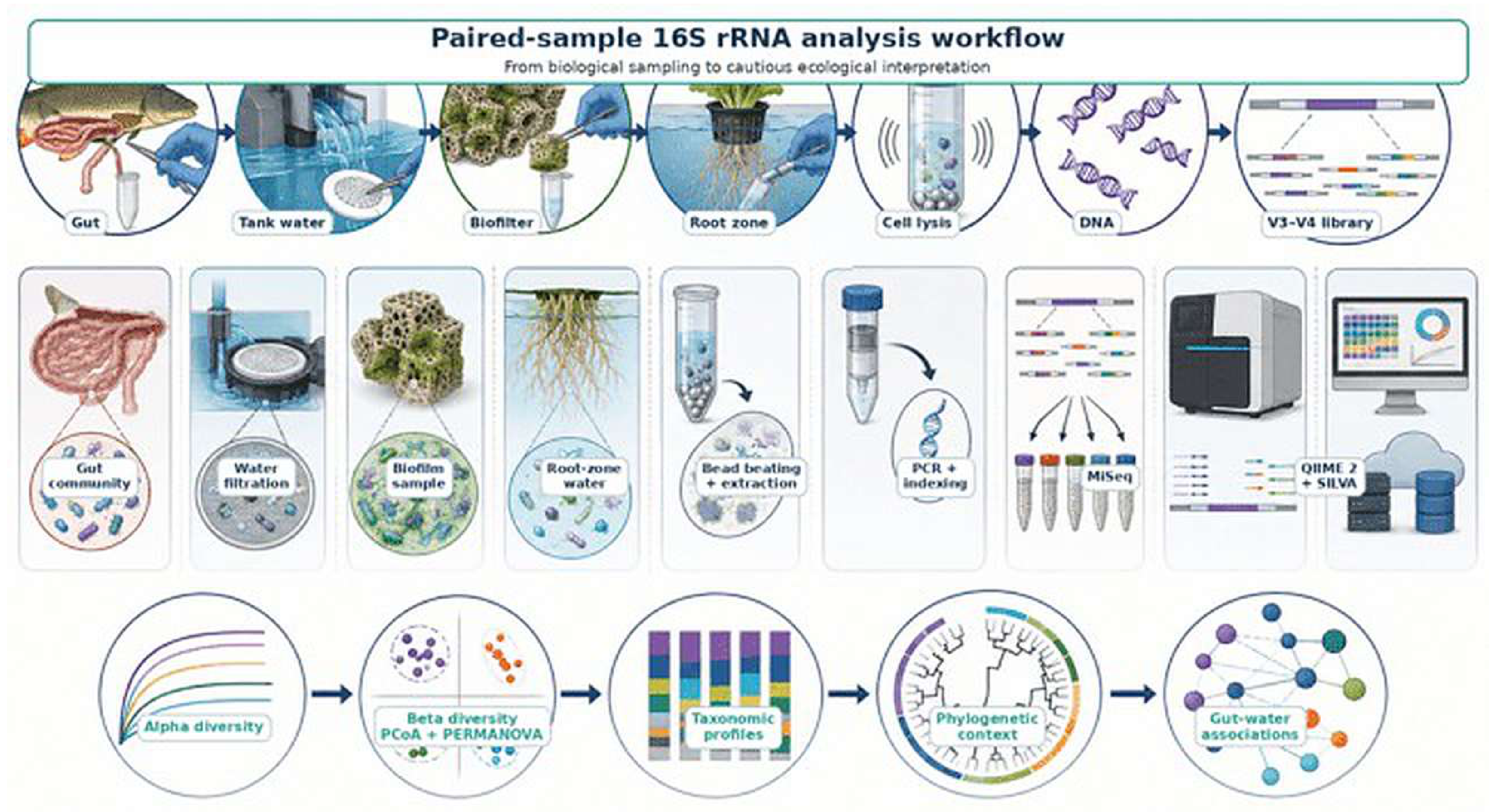
Figure 3.
Proposed paired-sample workflow. Gut and environmental matrices should be sampled in parallel, processed with contamination controls and analyzed with methods appropriate to compositional microbiome data. The workflow is consistent with the methodological considerations discussed by Johny et al. (2021), Quast et al. (2013), McMurdie and Holmes (2014) and Thormar et al. (2024). Created with BioRender.com.
A practical framework would include separate replicated units for each carp species, standardized feed and husbandry, synchronized gut and environmental sampling, and water-quality measurements collected at the same time as microbiome samples. Temperature, pH, dissolved oxygen, ammonia, nitrite, nitrate, phosphate, conductivity, organic carbon and suspended solids are particularly relevant because they can influence both microbial growth and fish physiology.
Sampling should distinguish intestinal contents from mucosa whenever the biological question requires it. Environmental sampling should separate tank water, biofilter material and hydroponic or root-zone compartments rather than collapsing them into a single ‘water microbiome’. Water volume and filter pore size should be reported, and low-biomass matrices should include field, filtration and extraction blanks.
For analysis, 16S rRNA sequencing can provide the replicated community-level comparison needed to test host and compartment effects. Shotgun metagenomics can then be applied to selected samples to examine genes involved in nitrogen cycling, organic-matter degradation, carbohydrate and amino-acid metabolism, vitamin synthesis, antimicrobial resistance and mobile genetic elements. This tiered approach balances ecological coverage with functional depth (Johny et al., 2021; Martínez-Porchas and Vargas-Albores, 2017; Thormar et al., 2024).
Table 3.
Proposed questions and interpretation rules for a future comparative study.
| Question | Testable expectation | Interpretation rule |
|---|---|---|
| Does host species structure the gut microbiota? | Gut beta diversity differs among rohu, catla and mrigal after accounting for tank-level replication. | A species effect cannot be separated from a tank effect without independent replicate units. |
| How strongly do gut and water communities overlap? | Some taxa or ASVs are shared, but gut communities remain distinct from bulk water. | Shared detection does not prove colonization or direction of transfer. |
| Which environmental compartment is most closely associated with gut variation? | Tank water, biofilter and root-zone communities show different statistical associations with gut profiles. | Association does not establish causality or function. |
| Do water-quality gradients covary with microbiome structure? | Environmental variation explains part of community-level variation. | Repeated measures and correlated environmental variables must be handled explicitly. |
| What functional traits are present? | Selected shotgun samples reveal genes related to nutrient cycling, metabolism, AMR and mobile elements. | Gene detection indicates potential, not confirmed expression or activity. |
10. Key Evidence Gaps
Several research priorities emerge repeatedly from the available literature. First, there is still no well-resolved study that simultaneously compares the gut microbiota of all three major carps with matched aquaponic environmental compartments. Second, the degree to which water microorganisms become transient passengers or persistent gut residents remains uncertain. Strain-level or genome-resolved methods are needed before shared genera can be interpreted as evidence of direct exchange.
Third, the stability of a core microbiome in aquaponically cultured major carps is unknown. Repeated sampling is required to distinguish persistent host-associated taxa from organisms introduced through water or feed. Fourth, functional work remains limited relative to taxonomic profiling. Nitrogen cycling, complex-carbohydrate degradation, vitamin metabolism, virulence potential, antimicrobial resistance and mobile elements deserve explicit attention in future shotgun analyses.
Fifth, microbiome composition needs to be connected more directly with measurable production outcomes. Growth, feed conversion, survival, digestive activity, immune indicators and disease occurrence can provide biological context for sequencing results, although these outcomes should not be overinterpreted without appropriate replication. Finally, the maturation of aquaponic systems itself deserves study. A newly established unit may support a different microbial network from a mature, biologically stabilized system, making longitudinal sampling more informative than a single endpoint.
11. Conclusions
Aquaponic microbiomes are connected by water flow but organized by habitat. Tank water, biofilters, roots, biofilms and the fish intestine each impose different ecological conditions, and the microbial communities occupying these locations should not be treated as a single pool. For major carps, available studies show that gut communities vary with host species and culture environment, while aquaponic studies show equally strong compartment-level structuring in the surrounding system.
Taken together, the available studies suggest that environmental exposure is followed by host- and habitat-specific selection. Water exposes fish to a broad range of microorganisms, but only a subset appears to persist in the gut. Fish, in turn, release microorganisms, metabolites and organic matter into the recirculating system. Establishing the direction and persistence of these exchanges will require paired sampling, temporal data and higher-resolution approaches rather than taxonomic overlap alone.
A future major-carp aquaponic study should prioritize replicated tanks, synchronized gut and environmental sampling, contemporaneous water-quality data, contamination controls and transparent analysis. Broad 16S profiling can establish community patterns, while selected shotgun metagenomics can resolve functional potential, antimicrobial-resistance genes and genome-level relationships. The field will move forward most effectively when it shifts from asking only which microorganisms are present to asking where they persist, what functions they can perform and how those patterns change across hosts, compartments and time.
Preparing this review has also helped me develop skills that are directly relevant to my planned PhD research at Bielefeld University. The PhD project addresses a different aquatic model, but it likewise depends on careful evaluation of environmental evidence, clear experimental replication, appropriate measurements and cautious interpretation of biological responses. Working through the methodological limitations and research gaps in this review has therefore provided useful preparation for designing and interpreting my planned work on chronic fluoxetine exposure in freshwater bivalves.
Author Contributions
Iqra Munawar conceptualized the review, assembled the source material, and is responsible for the scientific content and final approval of the manuscript.
Funding
This review received no external funding.
Data Availability Statements
No new experimental or sequencing data were generated or analyzed for this review.
Conflicts of Interest
The author declares no conflict of interest.
AI-Assisted Editing
An AI-assisted tool was used for language editing, formatting and preparation of conceptual illustrations. The author reviewed the manuscript and accepts responsibility for its accuracy, interpretation and originality.
Ethics Statement
No animals were used in this review. Any future experimental work described here would require prior approval from the relevant institutional ethics committee.
References
- Anila, M.; Daramola, O. Applications, technologies, and evaluation methods in smart aquaponics: A systematic literature review. Artif. Intell. Rev. 2025, 58, 25. [Google Scholar] [CrossRef]
- Bartelme, R. P.; Smith, M. C.; Sepulveda-Villet, O. J.; Newton, R. J. Component microenvironments and system biogeography structure microorganism distributions in recirculating aquaculture and aquaponic systems. mSphere 2019, 4(4), e00143-19. [Google Scholar] [CrossRef] [PubMed]
- Boyd, C. E.; McNevin, A. A.; Davis, R. P. The contribution of fisheries and aquaculture to the global protein supply. Food Secur. 2022, 14, 805–827. [Google Scholar] [CrossRef] [PubMed]
- Chai, Z.; Tian, Z.; Zheng, M.; Wang, B.; Li, Y.; Cui, J.; et al. The functional dominance and metabolic diversity of comammox Nitrospira in recirculating aquaculture systems. Water Res. 2025, 273, 122949. [Google Scholar] [CrossRef] [PubMed]
- Chamonara, K.; Uddin, M. S.; Masum, M. H. U. 16S rRNA metagenome analysis of gut bacteriome of Rohu (Labeo rohita) from Halda River and Kaptai Lake, Bangladesh. Microbiol. Resour. Announc. 2025, 14(10), e00590-25. [Google Scholar] [CrossRef] [PubMed]
- Changey, F.; Merlin, C.; Fourrier, C.; Fontaine, P.; Mathieu, L. Identifying the effects of fish and rhizosphere on the structure of the planktonic bacterial communities and resistome in an aquaponics recirculation loop. Environ. Microbiol. Rep. 2025, 17(4), e70128. [Google Scholar] [CrossRef]
- Dinev, T.; Velichkova, K.; Stoyanova, A.; Sirakov, I. Microbial pathogens in aquaponics potentially hazardous for human health. Microorganisms 2023, 11(12), 2824. [Google Scholar] [CrossRef] [PubMed]
- Diwan, A. D.; Harke, S. N.; Gopalkrishna; Panche, A. N. Aquaculture industry prospective from gut microbiome of fish and shellfish: An overview. J. Anim. Physiol. Anim. Nutr. 2022, 106(2), 441–469. [Google Scholar] [CrossRef] [PubMed]
- Diwan, A. D.; Harke, S. N.; Panche, A. N. Host-microbiome interaction in fish and shellfish: An overview. Fish. Shellfish Immunol. Rep. 2023, 4, 100091. [Google Scholar] [CrossRef] [PubMed]
- Eck, M.; Sare, A. R.; Massart, S.; Schmautz, Z.; Junge, R.; Smits, T. H. M.; Jijakli, M. H. Exploring bacterial communities in aquaponic systems. Water 2019, 11(2), 260. [Google Scholar] [CrossRef]
- Faust, K.; Raes, J. Microbial interactions: From networks to models. Nat. Rev. Microbiol. 2012, 10(8), 538–550. [Google Scholar] [CrossRef] [PubMed]
- Foysal, M. J.; et al. Next-generation sequencing reveals significant variations in bacterial compositions across the gastrointestinal tracts of the Indian major carps, rohu (Labeo rohita), catla (Catla catla) and mrigal (Cirrhinus mrigala). Lett. Appl. Microbiol. 2020, 70(3), 173–180. [Google Scholar] [CrossRef] [PubMed]
- Garlock, T. M.; Asche, F.; Anderson, J. L.; Eggert, H.; Anderson, T. M.; Che, B.; et al. Environmental, economic, and social sustainability in aquaculture: The aquaculture performance indicators. Nat. Commun. 2024, 15, 5274. [Google Scholar] [CrossRef] [PubMed]
- Johny, T. K.; Puthusseri, R. M.; Bhat, S. G. A primer on metagenomics and next-generation sequencing in fish gut microbiome research. Aquac. Res. 2021, 52(10), 4574–4600. [Google Scholar] [CrossRef]
- Lozupone, C.; Knight, R. UniFrac: A new phylogenetic method for comparing microbial communities. Appl. Environ. Microbiol. 2005, 71(12), 8228–8235. [Google Scholar] [CrossRef] [PubMed]
- Maji, U. J.; Mohanty, S.; Mahapatra, A. S.; Mondal, H. K.; Samanta, M.; Maiti, N. K. Exploring the gut microbiota composition of Indian major carp, rohu (Labeo rohita), under diverse culture conditions. Genomics 2022, 114(3), 110354. [Google Scholar] [CrossRef] [PubMed]
- Martínez-Porchas, M.; Vargas-Albores, F. Microbial metagenomics in aquaculture: A potential tool for a deeper insight into the activity. Rev. Aquac. 2017, 9(1), 42–56. [Google Scholar] [CrossRef]
- McMurdie, P. J.; Holmes, S. Waste not, want not: Why rarefying microbiome data is inadmissible. PLoS Comput. Biol. 2014, 10(4), e1003531. [Google Scholar] [CrossRef] [PubMed]
- Mori, J.; Smith, R. Transmission of waterborne fish and plant pathogens in aquaponics and their control with physical disinfection and filtration: A systematized review. Aquaculture 2019, 504, 380–395. [Google Scholar] [CrossRef]
- Mukherjee, A.; Rodiles, A.; Merrifield, D. L.; Chandra, G.; Ghosh, K. Exploring intestinal microbiome composition in three Indian major carps under polyculture system: A high-throughput sequencing based approach. Aquaculture 2020, 524, 735206. [Google Scholar] [CrossRef]
- Pingle, S. A.; Khandagle, A. J. A metagenomic analysis of gut microbiome phylogeny among four economically important carp species from wild and aquaculture farms. J. Appl. Biol. Biotechnol. 2023, 11, 105–111. [Google Scholar] [CrossRef]
- Preena, P. G.; Rejish Kumar, V. J.; Singh, I. S. B. Nitrification and denitrification in recirculating aquaculture systems: The processes and players. Rev. Aquac. 2021, 13(4), 2053–2075. [Google Scholar] [CrossRef]
- Quast, C.; Pruesse, E.; Yilmaz, P.; Gerken, J.; Schweer, T.; Yarza, P.; et al. The SILVA ribosomal RNA gene database project: Improved data processing and web-based tools. Nucleic Acids Res. 2013, 41(D1), D590–D596. [Google Scholar] [CrossRef] [PubMed]
- Quince, C.; Walker, A. W.; Simpson, J. T.; Loman, N. J.; Segata, N. Shotgun metagenomics, from sampling to analysis. Nat. Biotechnol. 2017, 35(9), 833–844. [Google Scholar] [CrossRef] [PubMed]
- Rudoy, D.; Olshevskaya, A.; Shevchenko, V.; Prazdnova, E.; Odabashyan, M.; Teplyakova, S. Prospects for the application of probiotics to increase the efficiency of integrated cultivation of aquatic animals and plants in aquaponic systems. Fishes 2025, 10(6), 251. [Google Scholar] [CrossRef]
- Ruiz, A.; Scicchitano, D.; Palladino, G.; Nanetti, E.; Candela, M.; Furones, D.; et al. Microbiome study of a coupled aquaponic system: Unveiling the independency of bacterial communities and their beneficial influences among different compartments. Sci. Rep. 2023, 13, 19704. [Google Scholar] [CrossRef] [PubMed]
- Ruiz, A.; Andree, K. B.; Furones, D.; Scicchitano, D.; Candela, M.; Carbó, R.; Gisbert, E. System design and habitat type drive microbial communities in recirculating aquaculture systems: Comparison of conventional fish-only and sustainable aquaponic systems. Front. Microbiol. 2026, 17, 1706522. [Google Scholar] [CrossRef] [PubMed]
- Schmautz, Z.; Graber, A.; Jaenicke, S.; Goesmann, A.; Junge, R.; Smits, T. H. M. Microbial diversity in different compartments of an aquaponics system. Arch. Microbiol. 2017, 199(4), 613–620. [Google Scholar] [CrossRef] [PubMed]
- Schmautz, Z.; Espinal, C. A.; Bohny, A. M.; Rezzonico, F.; Junge, R.; Frossard, E.; Smits, T. H. M. Environmental parameters and microbial community profiles as indication towards microbial activities and diversity in aquaponic system compartments. BMC Microbiol. 2021, 21, 12. [Google Scholar] [CrossRef] [PubMed]
- Schmautz, Z.; Walser, J.-C.; Espinal, C. A.; Gartmann, F.; Scott, B.; Pothier, J. F.; Frossard, E.; Junge, R.; Smits, T. H. M. Microbial diversity across compartments in an aquaponic system and its connection to the nitrogen cycle. Sci. Total Environ. 2022, 852, 158426. [Google Scholar] [CrossRef] [PubMed]
- Sheikh, M.; Laghari, M. Y.; Lashari, P. K.; Khooharo, A. R.; Narejo, N. T. Current status of three major carps (Labeo rohita, Cirrhinus mrigala and Catla catla) in the downstream Indus River, Sindh. Fish. Aquac. J. 2017, 8(3), 222. [Google Scholar]
- Thormar, E. A.; Hansen, S. B.; Jørgensen, L. V. G.; Limborg, M. T. Sampling fish gut microbiota - A genome-resolved metagenomic approach. Ecol. Evol. 2024, 14(9), e70302. [Google Scholar] [CrossRef] [PubMed]
- Tyagi, A.; Singh, B.; Billekallu Thammegowda, N. K.; Singh, N. K. Shotgun metagenomics offers novel insights into taxonomic compositions, metabolic pathways and antibiotic resistance genes in fish gut microbiome. Arch. Microbiol. 2019, 201(3), 295–303. [Google Scholar] [CrossRef] [PubMed]
- Yamane, K.; Kimura, Y.; Takahashi, K.; Maeda, I.; Iigo, M.; Ikeguchi, A.; Kim, H. J. The growth of leaf lettuce and bacterial communities in a closed aquaponics system with catfish. Horticulturae 2021, 7(8), 222. [Google Scholar] [CrossRef]
- Yang, J.; Qiang, Z.; Zhang, D.; Hao, H.; Wei, J.; Maira, H. S.; et al. Shotgun metagenomics analysis of gut microbiota of three indigenous fish species from the Kizil River, Xinjiang. Front. Microbiol. 2025, 16, 1617701. [Google Scholar] [CrossRef] [PubMed]
- Yavuzcan Yildiz, H.; Robaina, L.; Pirhonen, J.; Mente, E.; Domínguez, D.; Parisi, G. Fish welfare in aquaponic systems: Its relation to water quality with an emphasis on feed and faeces - A review. Water 2017, 9(1), 13. [Google Scholar] [CrossRef]
Disclaimer/Publisher’s Note: The statements, opinions and data contained in all publications are solely those of the individual author(s) and contributor(s) and not of MDPI and/or the editor(s). MDPI and/or the editor(s) disclaim responsibility for any injury to people or property resulting from any ideas, methods, instructions or products referred to in the content. |
© 2026 by the authors. Licensee MDPI, Basel, Switzerland. This article is an open access article distributed under the terms and conditions of the Creative Commons Attribution (CC BY) license (http://creativecommons.org/licenses/by/4.0/).
Copyright: This open access article is published under a Creative Commons CC BY 4.0 license, which permit the free download, distribution, and reuse, provided that the author and preprint are cited in any reuse.