
Submitted:
01 October 2026
Posted:
05 October 2026
You are already at the latest version
Abstract
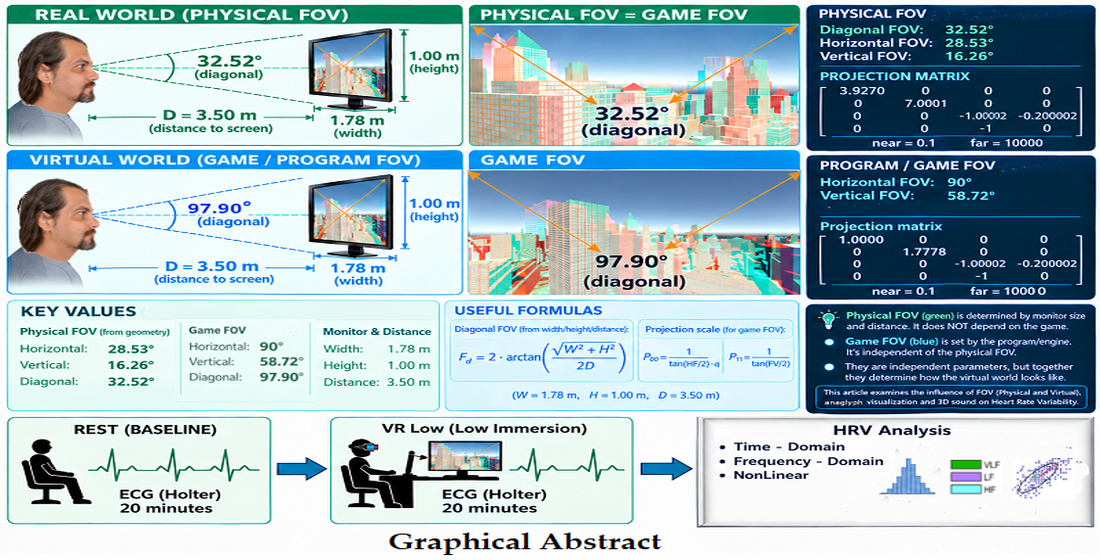
Field of view (FOV) and spatial audio are characteristics of virtual environments that can influence visual and auditory presentation and, consequently, physiological responses during interaction with virtual reality. This study aims to assess physiological responses during interaction with a low-immersion virtual environment by analysing heart rate variability (HRV). To this end, is developed a specialised 3D game using passive red-cyan anaglyph stereoscopy and a large display/projector (1.78 × 1.00 m) positioned 3.50 m from the participant. Thirty participants (17 men and 13 women) took part in the study, each undergoing a baseline resting phase and an experimental phase involving interaction with the virtual environment. Continuous electrocardiographic recording was performed using a Holter monitor during both phases, and consecutive RR intervals were extracted from the recorded signals for subsequent time-domain, frequency-domain, non-linear, and geometric HRV analysis. The experimental setup featured a physical diagonal field of view of 32.52°, a software-defined field of view of 97.90°, and enabled spatial audio. The results demonstrate statistically significant differences between the resting state and the experimental VR condition across a range of HRV metrics, including MeanRR, SDNN, SDANN, RMSSD, pNN50, LF, HF, LF/HF, SD1, SD2, HRVti, and TINN (p < 0.001). The observed changes in HRV parameters suggest that HRV can serve as an objective physiological indicator for characterising the physiological response to a low-immersion virtual environment. The data characterise the physiological response to the specific combination of visual and audio parameters under study, without allowing for the independent determination of the effects of physical FOV, software-defined FOV, anaglyph stereoscopy, and spatial audio. The study contributes by developing and experimentally characterising an accessible, low-immersion VR setup and by applying a multi-domain HRV analysis to assess the physiological response during interaction with it. This approach can serve as a foundation for future research on physiological reactions during interactions with virtual environments, as well as for developing and evaluating accessible VR systems for experimental, educational, and training applications.
Keywords:
field of view (FOV)
; virtual reality (VR)
; spatial sound
; heart rate variability (HRV)
Copyright: This open access article is published under a Creative Commons CC BY 4.0 license, which permit the free download, distribution, and reuse, provided that the author and preprint are cited in any reuse.