

Submitted:
30 September 2026
Posted:
02 October 2026
You are already at the latest version
Abstract
Curriculum transformation has become a strategic priority across African higher education, yet limited guidance exists on how transformation can be operationalised within mathematically rigorous undergraduate curricula. Although scholarship has advanced important perspectives on Africanisation, decolonisation, curriculum coherence, mathematics education and Open Distance e-Learning (ODeL), these have rarely been integrated into a coherent curriculum-design framework. This study addresses that gap through a qualitative documentary case study of the comprehensive redevelopment of MAT1512, a first-year undergraduate calculus module at the University of South Africa. Documentary evidence comprising curriculum blueprints, study-unit drafts, editorial records, assessment redesign documents, multimedia integration plans and quality-assurance records was analysed using abductive thematic analysis. The analysis focused on the relationships among curriculum decisions and how these collectively enabled curriculum transformation. The findings indicate that transformation was achieved through an integrated curriculum architecture that coordinated contextual and epistemic responsiveness, conceptual progression, mathematical rigour, constructive alignment, assessment for learning, embedded learner support, multiple representations, purposeful multimedia integration and student agency. These principles were synthesised into the Integrated Curriculum Transformation Framework for Undergraduate Mathematics (ICTF–UM), which conceptualises curriculum architecture as the mechanism through which curriculum transformation becomes operational in mathematically intensive ODeL environments. The ICTF–UM provides a theoretically grounded and empirically derived framework for curriculum redevelopment, offering curriculum developers a transferable model for integrating disciplinary integrity, contextual relevance and learner-centred design within undergraduate mathematics in African higher education and comparable ODeL contexts.
Keywords:
curriculum transformation
; curriculum architecture
; undergraduate mathematics
; calculus education
; Open Distance e-Learning
; African higher education
; documentary analysis
1. Introduction
Universities worldwide are under increasing pressure to redesign curricula that are simultaneously academically rigorous, socially responsive and educationally inclusive. Across Africa, and particularly in South Africa, curriculum transformation has evolved from policy aspiration into institutional practice as universities respond to widening participation, persistent inequalities in student success, and growing calls for decolonisation, Africanisation and epistemic justice (Department of Higher Education and Training, 2013; Heleta, 2016; Le Grange, 2016; Mbembe, 2016). These developments have prompted renewed scrutiny of both the knowledge represented within university curricula and the ways in which that knowledge is organised, taught and assessed. In mathematically intensive disciplines, this challenge is especially demanding because conceptual coherence, logical progression and disciplinary integrity must be preserved while simultaneously broadening epistemic access and supporting increasingly diverse student cohorts.
Although curriculum transformation has generated substantial scholarship, much of the literature has concentrated on why transformation is necessary rather than how it can be operationalised. Existing studies have examined decolonisation, contextualisation, constructive alignment, student-centred learning and Open Distance e-Learning (ODeL), yet these perspectives are frequently presented as parallel rather than integrated strands of curriculum scholarship. Consequently, curriculum developers receive strong normative guidance concerning the characteristics of transformed curricula but comparatively limited design guidance concerning how disciplinary, pedagogical, contextual and technological considerations may be synthesised into a coherent curriculum architecture. This implementation gap is particularly evident in undergraduate mathematics, where curriculum developers must preserve conceptual progression, disciplinary integrity and mathematical rigour while simultaneously broadening epistemic access through inclusive curriculum design.
This article argues that curriculum architecture provides the integrative curriculum-design mechanism through which curriculum transformation becomes operational. Rather than viewing contextualisation, learner support, assessment, representation, technology and multimedia as independent curriculum enhancements, the study conceptualises them as interdependent design elements whose educational value depends upon the relationships established among them. Transformation is therefore understood as a property of the curriculum as a whole rather than of individual innovations. The argument is developed through an in-depth qualitative documentary analysis of the redevelopment of MAT1512, a first-year undergraduate calculus module offered through the University of South Africa’s ODeL environment. The extensive documentary record generated throughout this redevelopment provides a unique opportunity to examine curriculum transformation as a sequence of interconnected educational design decisions rather than solely through policy analysis or post-implementation evaluation.
The study addresses the following research questions:
- How was curriculum transformation operationalised during the redevelopment of MAT1512?
- Which curriculum-design principles emerged from successive redevelopment decisions?
- How did these principles interact to produce a coherent undergraduate mathematics curriculum?
- How can these principles be synthesised into an Integrated Curriculum Transformation Framework for Undergraduate Mathematics (ICTF–UM)?
The study makes three principal contributions to mathematics education research. First, it develops the Integrated Curriculum Transformation Framework for Undergraduate Mathematics (ICTF–UM), a theoretically informed framework that explains how curriculum transformation can be operationalised through coherent curriculum architecture while maintaining mathematical rigour. Second, it demonstrates the value of qualitative documentary analysis for generating transferable curriculum-design knowledge from large-scale module redevelopment. Third, it provides an empirically grounded framework capable of informing the redesign of undergraduate mathematics curricula within African ODeL institutions and comparable higher-education contexts.
Figure 1 summarises the conceptual position adopted in this study. The framework proposed in this paper builds on curriculum-transformation scholarship but argues that transformation becomes educationally meaningful only when supported by an intentional curriculum architecture that integrates disciplinary knowledge, pedagogy, assessment, learner support and contextual responsiveness into a coherent curriculum system.
The remainder of the paper is organised as follows. Section 2 synthesises scholarship on curriculum transformation, mathematics education, curriculum design and ODeL to establish the theoretical foundations of the study. Section 3 describes the qualitative documentary case-study methodology and analytical procedures. Section 4 and Section 5 present the redevelopment context and empirical findings from which the ICTF–UM is developed. Section 6 discusses the theoretical and practical implications of the framework for undergraduate mathematics curriculum design within African higher education, before the paper concludes by considering its broader contribution to curriculum transformation research.
2. Literature Review
2.1. From Curriculum Reform to Curriculum Transformation
Curriculum scholarship has evolved from technical models of planning towards broader accounts of educational purpose, knowledge and participation. Early rational models, especially the objectives-based approach associated with Tyler (1949), provided a systematic sequence linking educational aims, learning experiences and evaluation. Although influential, such models were later criticised for treating curriculum primarily as a technical product rather than as a socially situated educational practice (Pinar, 2012; Schwab, 1973; Stenhouse, 1975). Contemporary curriculum scholarship therefore increasingly understands curriculum as a dynamic educational arrangement through which disciplinary knowledge, pedagogy, assessment and student formation are organised.
This shift is especially visible in higher education. Barnett and Coate (2005) argue that university curricula should enable students to develop forms of knowing, acting and being, while Biggs and Tang (2011) emphasise the importance of constructive alignment among learning outcomes, learning activities and assessment. These perspectives move curriculum thinking beyond content coverage and towards the deliberate organisation of students’ educational experiences. Curriculum transformation, on this account, involves redesigning the relationships among curriculum components rather than merely revising a syllabus.
Within South Africa, curriculum transformation has acquired particular urgency. Post-apartheid higher education policy initially emphasised access, equity and institutional restructuring, but more recent debates have foregrounded epistemic justice, decolonisation and curriculum responsiveness (Department of Higher Education and Training, 2013; Heleta, 2016; Le Grange, 2016; Mbembe, 2016). The #RhodesMustFall and #FeesMustFall movements intensified scrutiny of inherited curricula and challenged universities to reconsider the knowledge traditions, pedagogical practices and institutional assumptions embedded within higher education.
A central contribution of this literature is the recognition that transformation cannot be reduced to symbolic change. Le Grange (2016) cautions against treating decolonisation as the simple replacement of one knowledge tradition by another, while Luckett and Shay (2017) emphasise that epistemic access requires attention to the structuring of disciplinary knowledge. Accordingly, transformation therefore demands both critical responsiveness and curricular coherence. This tension is particularly important in mathematics, where conceptual progression and disciplinary integrity cannot be treated as secondary considerations.
Despite these advances, much curriculum-transformation scholarship remains stronger on justification than implementation. It explains why curricula should become more responsive, inclusive and epistemically open, but offers less guidance on how these commitments should be translated into the detailed architecture of a mathematically intensive curriculum. The operational challenge is therefore not a lack of principles, but a lack of integration.
2.2. Africanisation, Decolonisation and Epistemic Justice
Debates concerning Africanisation, decolonisation and epistemic justice have become central to curriculum transformation in South African higher education. Although these concepts overlap, they are not identical. Africanisation foregrounds the importance of African contexts, intellectual traditions and developmental priorities; decolonisation interrogates the historical and epistemological hierarchies embedded in curriculum; and epistemic justice concerns the conditions under which students and knowledge traditions are recognised as legitimate participants in educational practice (Fricker, 2007; Heleta, 2016; Le Grange, 2016; Mbembe, 2016; Msila & Gumbo, 2016).
Africanisation is frequently misunderstood as the substitution of imported examples with local ones. More substantive interpretations reject this reduction. Msila and Gumbo (2016) presents Africanisation as a project of intellectual and cultural responsiveness, while Horsthemke (2004) cautions against essentialist accounts that treat knowledge as fixed within cultural boundaries. These positions suggest that Africanisation is strongest when it creates meaningful dialogue between local realities and globally shared disciplinary practices.
Decolonisation extends the argument by asking how power shapes the selection and organisation of knowledge. Mbembe (2016) frames decolonisation as a rethinking of the university’s epistemic foundations, while Le Grange (2016) emphasises plurality, relationality and curriculum openness. In curriculum design, this implies more than adding African content: it requires reconsidering whose experiences are treated as intellectually significant, how examples are selected, and whether students are enabled to connect disciplinary knowledge with their social and material worlds.
The concept of epistemic justice provides a useful bridge between philosophical transformation and practical curriculum design. Fricker (2007) distinguishes testimonial injustice, in which a knower’s contribution is unfairly discounted, from hermeneutical injustice, in which people lack access to the interpretive resources required to make sense of experience. In mathematics education, epistemic justice may therefore be understood not only in terms of representation, but also in terms of students’ access to the concepts, representations and reasoning practices through which mathematical knowledge becomes intelligible.
This distinction matters because mathematics is often treated as culturally neutral. The logical validity of mathematical propositions may be universal, yet the curriculum through which students encounter those propositions is always designed within particular social and educational contexts. Examples, sequencing, language, representations and applications influence whether students recognise mathematics as meaningful and whether they can participate confidently in mathematical activity (Ernest, 1991; Skovsmose, 1994). Curriculum transformation in mathematics should therefore preserve disciplinary integrity while expanding the contextual and epistemic pathways through which students access mathematical ideas.
In the redevelopment of MAT1512, contextualisation was understood in this stronger sense. South African and broader African contexts were selected because they could motivate mathematical concepts, support interpretation or generate authentic modelling tasks. Their role was epistemic rather than decorative: context was expected to perform mathematical work. This approach positions contextual responsiveness as one component of curriculum architecture rather than as transformation in itself.
2.3. Curriculum Architecture as an Educational Design Construct
Curriculum architecture provides the conceptual bridge between transformation principles and curriculum practice. The term refers to the deliberate organisation of relationships among outcomes, content, pedagogy, representation, assessment, learner support and educational resources. Its emphasis is not simply on the quality of individual curriculum elements, but on whether those elements form a coherent educational system.
Constructive alignment is an important foundation for this view. Biggs and Tang (2011) argue that learning outcomes, teaching and learning activities, and assessment should mutually reinforce one another. Laurillard (2012) similarly conceptualises educational design as the orchestration of iterative interactions between learners, teachers, tasks and feedback. In both approaches, coherence is achieved through relationships rather than through isolated excellence.
Educational design research extends this principle by treating curriculum development as an iterative and knowledge-generating activity. McKenney and Reeves (2019) describe educational design research as a process in which practical interventions and theoretical understanding develop together. Although the present study does not claim a full design-based intervention cycle, it shares the premise that curriculum-development artefacts can reveal transferable design knowledge. The successive redevelopment of MAT1512 therefore constitutes more than a production history: it is an evidence base from which principles of curriculum architecture may be derived.
Curriculum coherence is particularly important in undergraduate mathematics. Concepts are ordered by prerequisite relationships, and later learning depends on earlier conceptual foundations. Contexts, explanations, activities and assessments cannot be rearranged independently without affecting the learning pathway. A visually attractive example that is poorly timed may confuse rather than support; a formative task that does not align with conceptual progression may assess performance without developing understanding. Curriculum architecture therefore requires both disciplinary insight and pedagogical coordination.
The ODeL context intensifies this requirement. In face-to-face environments, lecturers may repair weaknesses in curriculum materials through explanation and dialogue. In distance education, many of those pedagogical functions must be anticipated in the artefact itself (Anderson, 2008; Moore, 1993; Moore & Kearsley, 2012). The architecture of the study material must therefore embed teaching presence through sequencing, examples, prompts, navigation, formative activity and feedback.
Figure 2 summarises the conceptual development advanced in this study: curriculum thinking progresses from technical planning, through reform and transformation, towards curriculum architecture as the mechanism through which transformation becomes operational.
The distinctive claim of this article is that curriculum transformation in undergraduate mathematics becomes operational through curriculum architecture. Contextualisation, learner support, representation and assessment are not independently transformative. They become transformative when they are deliberately coordinated with mathematical progression and with one another.
2.4. Mathematics Education and Discipline-Specific Design
Curriculum architecture in mathematics must account for the distinctive epistemic structure of the discipline. Mathematical knowledge is cumulative, conceptually interconnected and dependent on the coordination of symbolic, graphical, numerical and verbal representations. Consequently, curriculum transformation cannot be separated from questions of conceptual progression, mathematical proficiency and disciplinary rigour.
Problem-solving research demonstrates that successful mathematical activity requires more than procedural execution. Schoenfeld (1992) shows that strategic knowledge, metacognition and beliefs about mathematics influence how learners engage with unfamiliar problems. Similarly, the framework of mathematical proficiency developed by Kilpatrick et al. (2001) integrates conceptual understanding, procedural fluency, strategic competence, adaptive reasoning and productive disposition. These perspectives suggest that curriculum design should provide opportunities for learners to interpret, justify and connect ideas rather than merely imitate algorithms.
Realistic Mathematics Education offers a related design principle. Freudenthal (1991) conceptualises mathematics as a human activity, while Gravemeijer (1994) develops guided reinvention as a means of supporting learners’ progression from context-bound reasoning towards formal mathematical structures. Context is therefore pedagogically valuable when it creates a need for mathematical abstraction. It is not inherently transformative merely because it is local or familiar.
Critical Mathematics Education broadens this perspective by emphasising the social uses of mathematics. Skovsmose (1994) argues that mathematical competence includes the capacity to interpret quantitative claims, examine assumptions and engage critically with mathematically mediated decisions. For curriculum transformation, this means that applications should invite interpretation and judgement rather than functioning only as vehicles for substitution into formulas.
Representation is another central issue. Duval (2006) argues that mathematical understanding depends on learners’ ability to coordinate different semiotic registers, while Arcavi (2003) emphasises the importance of visualisation in developing and communicating mathematical meaning. A curriculum that privileges symbolic notation without supporting translation among representations may preserve formal rigour while restricting conceptual access. Purposeful representational design therefore becomes an essential component of curriculum architecture.
Mathematical modelling further connects conceptual understanding with authentic application. Blum and Ferri (2009) describe modelling as a cyclic process involving simplification, mathematisation, calculation, interpretation and validation. Such tasks position students as mathematical decision-makers rather than passive users of procedures. Within MAT1512, this orientation informed the use of municipal planning, environmental processes, transport, agriculture and engineering contexts that required students to interpret mathematical results rather than merely compute them.
The literature therefore identifies several mathematics-specific curriculum-design requirements: coherent conceptual progression, integration of procedural and conceptual knowledge, coordination of multiple representations, authentic modelling and preservation of mathematical rigour. However, these principles are often studied at the level of individual lessons or interventions. Their integration across the architecture of a complete undergraduate module remains underdeveloped.
2.5. Open Distance e-Learning, Learner Support and Student Agency
Open Distance e-Learning changes the educational role of curriculum materials. In face-to-face teaching, lecturers may repair ambiguity, provide immediate feedback and adjust explanation during interaction. In ODeL, many of these functions must be anticipated within the design of the curriculum artefact itself. The study guide therefore becomes simultaneously a source of disciplinary knowledge, a pedagogical pathway and a form of teaching presence.
Moore (1993) conceptualises transactional distance through the interaction of dialogue, structure and learner autonomy. A highly structured course may reduce uncertainty but can also constrain independence when learners are not gradually invited to assume responsibility. Conversely, insufficient structure may increase confusion. Effective distance curriculum design therefore requires a deliberate balance between scaffolding and agency.
Self-directed learning research reinforces this principle. Garrison (1997) presents self-direction as involving self-management, self-monitoring and motivational control. Similarly, self-regulated learning requires learners to plan, monitor and evaluate their learning processes (Pintrich, 2004; Zimmerman, 2002). These capabilities should not be assumed simply because students study at a distance; they must be cultivated through explicit curriculum structures such as learning outcomes, formative tasks, reflective prompts, progress indicators and opportunities for self-assessment.
The Community of Inquiry framework offers a further lens. Garrison et al. (2000) conceptualise effective online learning through cognitive, social and teaching presence. Although MAT1512 is primarily a study-material case rather than an online-discussion intervention, the idea of teaching presence is directly relevant. Sequencing, explanatory commentary, worked examples, common-error warnings and “Looking Ahead” sections can embed instructional guidance within the curriculum itself.
Learning-design scholarship similarly treats educational materials as orchestrated learning environments. Laurillard (2012) emphasises iterative relationships among exposition, practice, feedback and reflection, while Conole (2013) highlights the role of explicit learning-design representations in coordinating tasks, resources and learner activity. For undergraduate mathematics, such coordination is especially important because conceptual difficulty accumulates quickly when transitions are weak or misconceptions remain unaddressed.
Open Educational Resources and multimedia extend the learning environment but do not automatically improve it. The UNESCO OER Recommendation emphasises access, adaptation and sharing (UNESCO, 2019), while research on multimedia learning cautions that additional media may increase cognitive load when not aligned with learning goals (Mayer, 2021). Curriculum architecture must therefore position multimedia and OER as purposeful extensions of the core learning pathway rather than as disconnected resource lists.
The MAT1512 redevelopment operationalised these principles through distributed learner support. Learning outcomes clarified expectations; worked examples modelled reasoning; reflection boxes promoted metacognition; summaries consolidated key ideas; and curated multimedia resources offered alternative explanations. Student agency was supported not by reducing structure, but by using structure to prepare learners for increasingly independent mathematical engagement.
2.6. Integrated Synthesis and Research Gap
The literature reviewed above identifies several necessary conditions for curriculum transformation, but no single tradition provides a sufficiently comprehensive model for undergraduate mathematics. Curriculum-transformation scholarship clarifies educational purpose and epistemic responsibility; Africanisation and decolonisation foreground contextual and epistemic responsiveness; mathematics education contributes conceptual progression, modelling, representation and rigour; and ODeL scholarship contributes learner support, self-regulation and resource integration. The unresolved problem is the organisation of these contributions into a coherent design.
This fragmentation is not merely theoretical. In curriculum-development practice, design decisions are interdependent. A contextual problem affects the representations and assessments that follow it; a new diagram may require changes to explanatory text; a multimedia resource may alter the sequence of learner activity; and additional scaffolding may influence opportunities for agency. Accordingly, transformation therefore depends on the quality of relationships among curriculum elements.
Table 1 summarises the literature traditions informing the study, their principal contributions, their limitations and the corresponding ICTF–UM design dimensions.
The framework treats these traditions as complementary and interdependent.
Figure 3 visualises the convergence of these literature streams into curriculum architecture.
The literature therefore supports the central proposition of this study: curriculum transformation in undergraduate mathematics is fundamentally a problem of curriculum architecture. The gap is not the absence of transformation principles, but the absence of a model explaining how those principles may be integrated into a coherent learning system. The documentary analysis of MAT1512 investigates this problem empirically by tracing how curriculum decisions were organised, revised and related across the redevelopment process.
3. Methodology
3.1. Research Design
This study employed a qualitative documentary case study to investigate how curriculum transformation was operationalised during the comprehensive redevelopment of MAT1512, a first-year undergraduate calculus module offered by the University of South Africa (UNISA). A documentary case-study design was selected because the redevelopment generated an extensive body of institutional documents that captured curriculum decision-making over an extended period. Rather than relying on retrospective accounts of curriculum development, the study examined documentary evidence produced during successive redevelopment cycles, thereby enabling curriculum transformation to be analysed as an evolving educational design process.
The case was bounded by the complete redevelopment of MAT1512, from the initial curriculum planning documents through successive study-unit revisions, editorial reviews, assessment redesign, multimedia integration and quality-assurance processes to the production of the final module manuscript. Treating the redevelopment as a single bounded case made it possible to investigate the relationships among curriculum decisions while preserving the institutional and disciplinary context in which they occurred.
A qualitative approach was considered appropriate because the study sought to understand the educational reasoning underpinning curriculum decisions rather than to measure predetermined variables or evaluate student performance quantitatively. The objective was to explain how curriculum transformation was enacted through curriculum design and how successive curriculum decisions collectively contributed to the development of an integrated curriculum framework.
3.2. Research Paradigm
The study was situated within an interpretivist research paradigm. Interpretivism assumes that educational practices are socially constructed and that meaning emerges through human interpretation of educational contexts and experiences. Within this perspective, curriculum redevelopment is understood as a complex process of educational decision-making shaped by disciplinary knowledge, institutional priorities, pedagogical beliefs and contextual considerations.
Consequently, the documentary evidence was analysed not merely as administrative records but as representations of educational thinking. Successive curriculum revisions, editorial comments and design decisions were interpreted as evidence of the evolving understanding of curriculum transformation within undergraduate mathematics. The interpretivist paradigm therefore provided an appropriate philosophical foundation for examining how curriculum architecture emerged through iterative curriculum redevelopment.
3.3. Case Context
The case investigated in this study was the redevelopment of MAT1512, a first-year undergraduate calculus module presented through the University of South Africa’s Open Distance e-Learning (ODeL) system. MAT1512 serves a large and diverse student population enrolled across multiple qualifications requiring foundational calculus. The redevelopment extended beyond routine revision of study materials and constituted a comprehensive curriculum redesign.
The redevelopment involved restructuring study units, refining conceptual sequencing, redesigning worked examples, incorporating authentic South African and African contexts, expanding visual representations, revising formative assessment, embedding learner-support features and integrating Open Educational Resources (OER). Throughout the redevelopment, extensive documentary evidence was generated, providing a detailed record of curriculum design decisions. This rich documentary corpus offered a unique opportunity to investigate curriculum transformation as an educational design process rather than solely as a policy initiative or post-implementation outcome.
3.4. Documentary Data Sources
The documentary corpus comprised curriculum blueprints, module planning documents, successive study-unit drafts, editorial records, assessment redesign documents, multimedia integration plans, quality-assurance reports and the final module manuscript. These documents collectively captured the evolution of curriculum thinking throughout the redevelopment process and documented the rationale underpinning major curriculum decisions.
Using multiple document types strengthened the analytical depth of the study because similar curriculum principles could be identified across independent documentary sources. Curriculum blueprints described intended curriculum structures, study-unit drafts illustrated their implementation, editorial records documented refinement decisions, while assessment and quality-assurance documents provided evidence of alignment and curriculum coherence. Together, these documents formed a comprehensive and auditable record of curriculum redevelopment.
3.5. Data Collection
Document collection was undertaken systematically throughout the redevelopment process. Documents were selected according to their relevance to curriculum design, conceptual organisation, learner support, assessment, multimedia integration and quality assurance. Duplicate documents and purely administrative records unrelated to curriculum redevelopment were excluded.

Table 2.
Documentary corpus analysed in the MAT1512 case study.
| Contribution to the analysis | Primary analytical focus | Document category |
| Evidence of intended curriculum architecture | Module structure, outcomes and conceptual sequence | Curriculum blueprints and planning documents |
| Evidence of iterative implementation and refinement | Explanations, examples, representations and activities | Successive study-unit drafts |
| Evidence of design reasoning and constant comparison | Rationale for revisions and quality concerns | Editorial and review records |
| Evidence of assessment-for-learning decisions | Alignment, cognitive demand and formative function | Assessment-redesign documents |
| Evidence of purposeful technology integration | Purpose, placement and relationship to core materials | Multimedia and OER plans |
| Evidence of curriculum coherence and final integration | Consistency, completeness and institutional standards | Quality-assurance records and final manuscript |
The resulting documentary corpus represented multiple redevelopment stages rather than a single curriculum snapshot. This longitudinal perspective enabled curriculum decisions to be examined across successive iterations, making it possible to identify recurring curriculum principles and trace their refinement throughout the redevelopment process.
3.6. Data Analysis
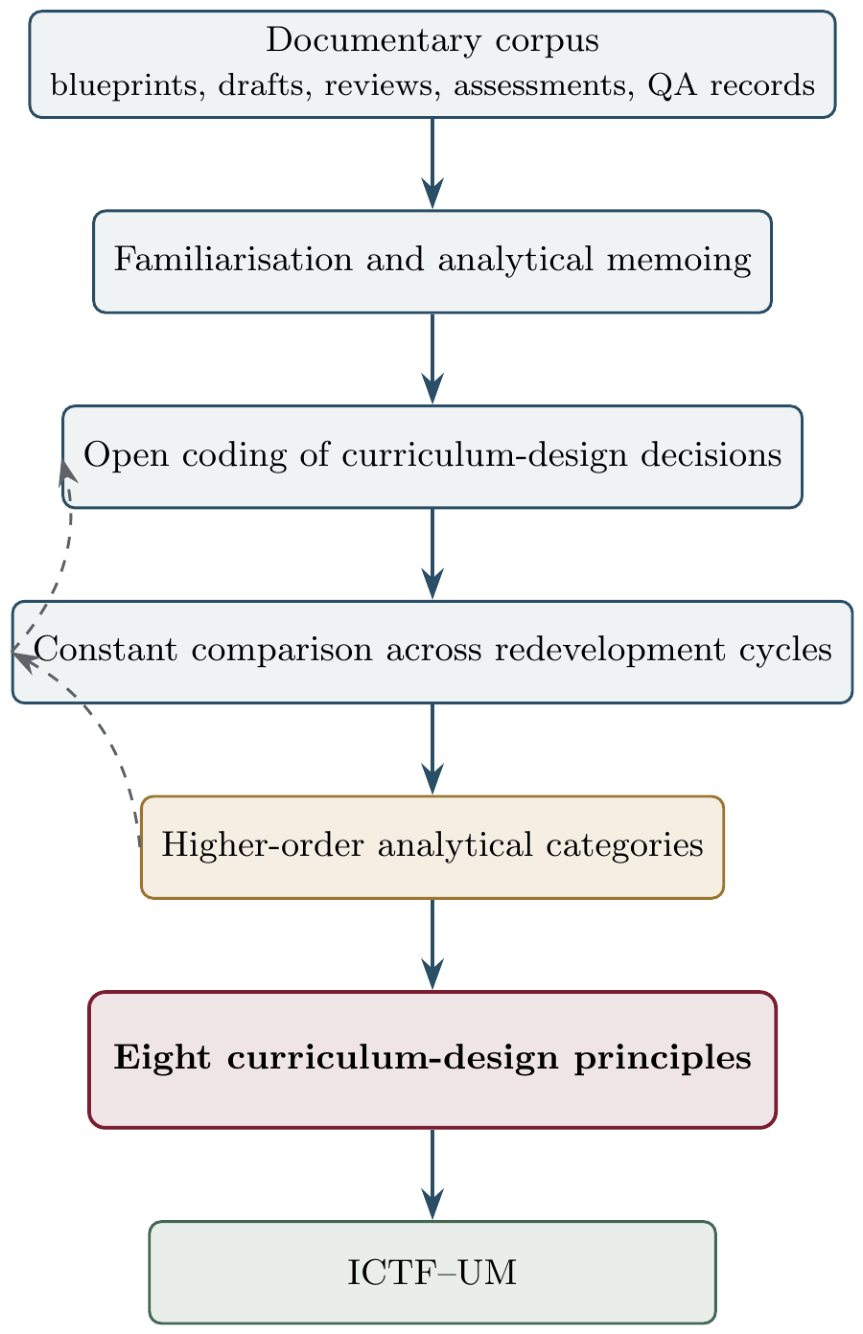
The documentary corpus was analysed using abductive thematic analysis. An abductive approach was adopted because it allowed iterative movement between empirical documentary evidence and existing curriculum theory. Rather than coding documents exclusively from predetermined theoretical categories or allowing themes to emerge entirely inductively, analysis combined theoretical sensitivity with close engagement with the documentary evidence.
The analytical process consisted of five stages.
First, all documents were read repeatedly to achieve familiarity with the redevelopment process and to identify significant curriculum decisions. Initial notes recorded recurring design features, editorial observations and emerging curriculum patterns.
Second, open coding was undertaken to identify discrete curriculum-design decisions relating to conceptual sequencing, contextualisation, mathematical representations, learner support, assessment, multimedia integration and curriculum organisation.
Third, constant comparison was used to examine similarities and differences across documents produced during different redevelopment stages. Related codes were progressively grouped into broader analytical categories representing recurring curriculum design principles.
Fourth, these analytical categories were synthesised into higher-order themes describing the principal dimensions of curriculum transformation observed throughout the redevelopment. Relationships among themes were examined to determine how individual curriculum decisions contributed to broader curriculum coherence.
Finally, the higher-order themes were integrated into the Integrated Curriculum Transformation Framework for Undergraduate Mathematics (ICTF–UM). Rather than representing isolated curriculum innovations, the framework conceptualises curriculum transformation as the coordinated interaction of multiple curriculum components within an integrated curriculum architecture.
Figure 4.
Abductive documentary-analysis pathway used to develop the ICTF–UM.
3.7. Trustworthiness
Trustworthiness was established using the criteria proposed by Lincoln and Guba.
Credibility was strengthened through prolonged engagement with the curriculum redevelopment process and triangulation across multiple documentary sources. Because documents originated from different redevelopment stages and served different educational purposes, convergence across sources increased confidence in the consistency of the emerging interpretations.
Dependability was supported through the maintenance of an explicit analytical audit trail documenting document selection, coding decisions, category development and framework construction. This transparent analytical process enhances the reproducibility of the study.
Confirmability was promoted through iterative comparison between documentary evidence and emerging interpretations, ensuring that analytical conclusions remained grounded in the documentary corpus rather than researcher assumptions. Successive refinement of themes also reduced the likelihood of premature interpretation.
Transferability was supported through rich description of the institutional context, curriculum redevelopment process and analytical procedures. Although the findings derive from a single case, the detailed account enables readers to judge the analytical applicability of the ICTF–UM to comparable undergraduate mathematics curricula within African higher education and similar Open Distance e-Learning environments.
3.8. Ethical Considerations
The study analysed institutional curriculum documents and did not involve human participants. Consequently, no personal or sensitive participant data were collected. Ethical principles relating to responsible scholarship nevertheless guided the research throughout.
Institutional documents were used solely for scholarly purposes, confidential editorial information was treated responsibly, and documentary evidence was represented accurately without selective reporting. The analysis focused on curriculum processes rather than individual contributors, thereby ensuring that the resulting framework reflected institutional curriculum development rather than personal perspectives. Throughout the study, careful attention was given to maintaining academic integrity, transparency and faithful representation of the documentary evidence.
4. Findings
This section presents the empirical findings emerging from the documentary analysis of the MAT1512 redevelopment. Rather than evaluating the effectiveness of the completed module in terms of student performance, the analysis focuses on the curriculum design process itself. The documentary corpus revealed how successive curriculum decisions evolved over multiple redevelopment cycles and how these decisions collectively produced an integrated undergraduate mathematics curriculum. The findings demonstrate that curriculum transformation was not achieved through isolated innovations but through the systematic coordination of multiple curriculum components. This coordinated design process ultimately informed the development of the Integrated Curriculum Transformation Framework for Undergraduate Mathematics (ICTF–UM).
Table 3.
Major curriculum interventions during the MAT1512 redevelopment.
| Architectural relationship | Educational purpose | Curriculum intervention |
| Required corresponding revision of examples and assessment | Strengthen conceptual progression | Restructuring study units |
| Linked context to outcomes, representations and formative tasks | Support interpretation and mathematical modelling | Authentic South African and African contexts |
| Connected exposition, practice and feedback | Make mathematical reasoning explicit | Expanded worked examples |
| Coordinated visual, symbolic and verbal explanations | Develop representational fluency | Enhanced graphical and numerical representations |
| Aligned tasks with outcomes and study-unit progression | Reinforce conceptual development | Formative-assessment redesign |
| Integrated guidance with the core mathematical pathway | Support independent ODeL learning | Embedded learner-support features |
| Positioned resources at specific conceptual points | Provide alternative explanations and extensions | Purposeful multimedia and OER integration |
| Connected local revisions to the module as a whole | Improve consistency and coherence | Iterative quality assurance |
4.1. The MAT1512 Redevelopment Context
The redevelopment of MAT1512 extended considerably beyond the routine revision of study materials. Instead, it constituted a comprehensive curriculum transformation project in which every aspect of the module was reconsidered in relation to the educational experience of first-year undergraduate students studying mathematics within an Open Distance e-Learning (ODeL) environment.
The redevelopment was motivated by several interrelated considerations. First, the existing curriculum required improved conceptual coherence to strengthen the progression of mathematical ideas throughout the module. Second, there was a need to improve learner accessibility through clearer explanations, richer visual representations and enhanced learner-support mechanisms. Third, the redevelopment sought to increase curriculum relevance by embedding authentic South African and broader African applications without compromising mathematical rigour. Finally, advances in educational technology created opportunities to integrate multimedia resources and Open Educational Resources (OER) more purposefully into the curriculum.
Rather than treating these objectives independently, the redevelopment adopted a systems perspective in which curriculum content, pedagogy, assessment, learner support and technology were viewed as mutually dependent components of a single curriculum architecture. Consequently, major curriculum decisions were evaluated not only in terms of their local effects but also according to their implications for the coherence of the curriculum as a whole.
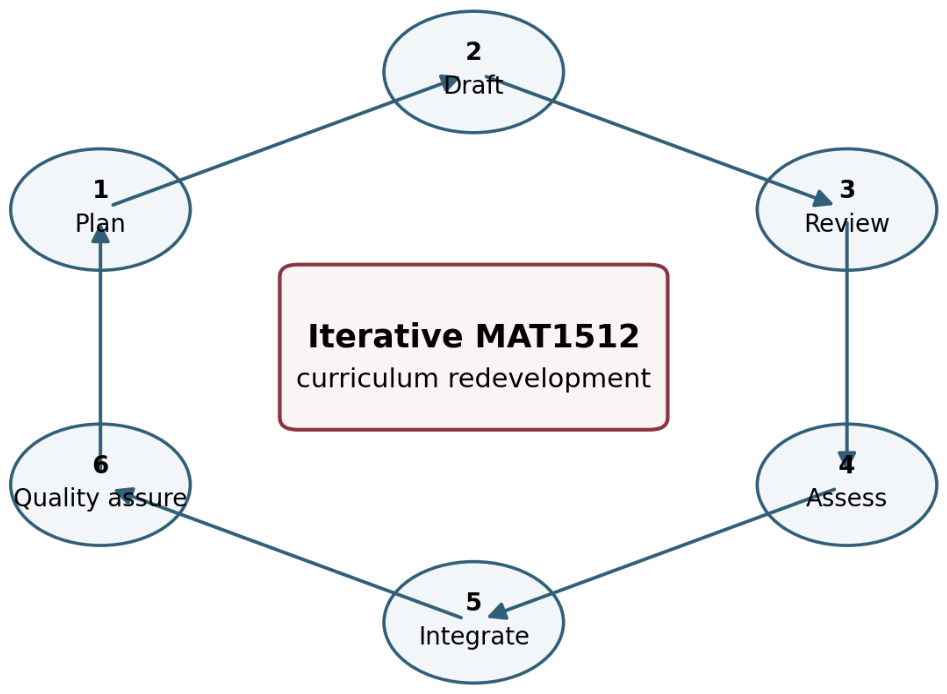
The redevelopment proceeded through multiple iterative design cycles comprising curriculum planning, study-unit drafting, editorial review, revision, assessment redesign, multimedia integration and quality assurance. Documentary evidence generated throughout these stages demonstrates that curriculum decisions became progressively more integrated over time. Early redevelopment documents primarily focused on improving individual curriculum components, whereas later documents increasingly emphasised relationships among conceptual progression, learner support, assessment, contextualisation and multimedia integration.
This progressive movement from component-level improvement towards systems-level curriculum design represents one of the most significant empirical observations emerging from the documentary analysis. Curriculum transformation therefore occurred not as a sequence of isolated revisions but as an evolving process of curriculum integration.
Figure 5.
Iterative MAT1512 curriculum-redevelopment cycle.
4.2. Emergent Curriculum Design Principles
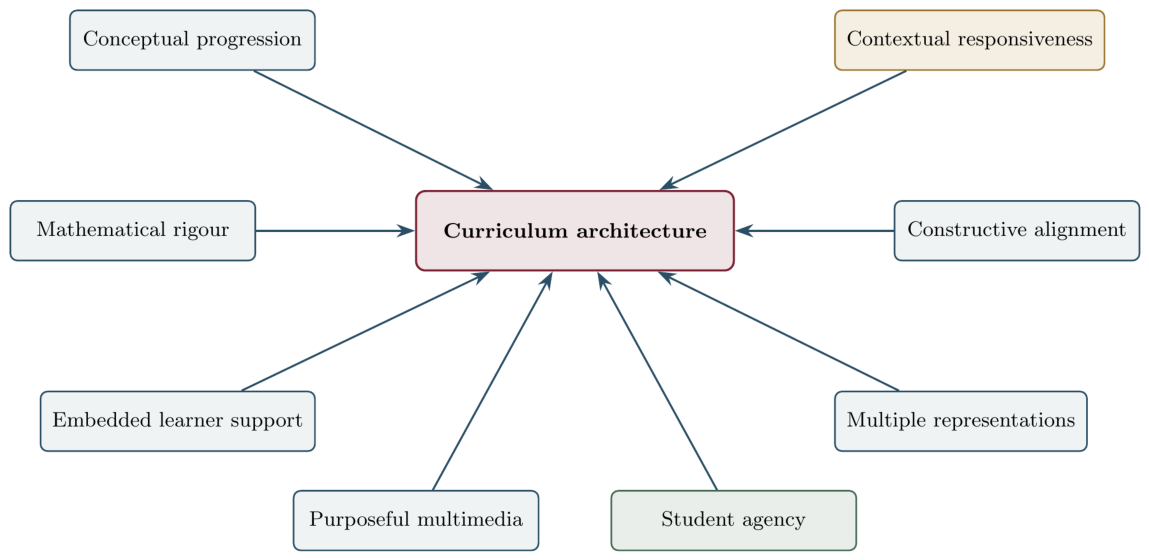
Across the documentary corpus, eight curriculum design principles consistently emerged as guiding considerations throughout the redevelopment process. Although each principle addressed a distinct aspect of curriculum design, the documents demonstrate that they were continually refined in relation to one another. Their educational significance therefore lies less in their individual characteristics than in the ways they interacted to produce a coherent curriculum.
4.2.1. Conceptual Progression
The redevelopment consistently prioritised the logical sequencing of mathematical concepts. Documentary evidence indicates that study units were repeatedly reorganised to ensure that new ideas emerged naturally from previously established concepts. Rather than introducing mathematical techniques in isolation, each study unit was designed to extend students’ conceptual understanding through carefully structured learning pathways. This emphasis on progression reduced unnecessary cognitive discontinuities and supported cumulative mathematical understanding.
4.2.2. Contextual Responsiveness
A second recurring principle concerned the purposeful integration of authentic South African and African contexts. Documentary evidence shows that contextual examples were selected not merely to increase local relevance but to illuminate underlying mathematical concepts. Financial mathematics, engineering applications, environmental modelling and everyday quantitative situations were therefore incorporated as vehicles through which abstract mathematical ideas became more accessible. Contextualisation functioned as a pedagogical strategy supporting conceptual understanding rather than as an independent curriculum objective.
4.2.3. Mathematical Rigour
Throughout the redevelopment, documentary records consistently emphasised that curriculum transformation should strengthen rather than dilute mathematical standards. Editorial decisions repeatedly preserved formal notation, mathematical precision and logical reasoning while simultaneously improving explanation, accessibility and learner guidance. The redevelopment therefore demonstrates that educational inclusivity and mathematical rigour are complementary rather than competing curriculum goals.
4.2.4. Learning Design
The redevelopment also reflected a systematic approach to learning design. Explanatory text, worked examples, graphical illustrations, practice activities and formative assessment were intentionally coordinated to support progressively deeper conceptual understanding. Rather than functioning as independent learning resources, these curriculum components were designed to reinforce one another throughout the module.
4.2.5. Assessment for Learning
Assessment was reconceptualised as an integral component of learning rather than solely a mechanism for evaluating performance. Documentary evidence demonstrates that formative assessment activities were aligned closely with learning outcomes and conceptual progression. Questions were designed to reinforce understanding, provide opportunities for reflection and prepare students for increasingly sophisticated mathematical reasoning.
4.2.6. Embedded Learner Support
Learner support was progressively embedded within the curriculum itself. Additional explanations, common-error alerts, revision activities, reflective questions and study guidance were incorporated directly into study materials rather than being provided separately. This approach recognised that students studying within ODeL environments frequently depend upon curriculum materials as their principal source of instructional support.
4.2.7. Multiple Representations
The redevelopment consistently expanded the use of multiple mathematical representations. Graphical, symbolic, numerical and verbal explanations were deliberately combined to support conceptual understanding and facilitate transitions between different forms of mathematical reasoning. Documentary evidence indicates that visual communication became increasingly important during successive redevelopment cycles.
4.2.8. Student Agency
Finally, the redevelopment increasingly encouraged students to become active participants in their own learning. Reflective activities, exploratory tasks and authentic problem-solving opportunities were incorporated throughout the module to promote independent mathematical thinking. Rather than presenting mathematics solely as a body of established procedures, the curriculum encouraged students to construct meaning through engagement with increasingly challenging mathematical ideas.
Collectively, these findings demonstrate that curriculum transformation within MAT1512 was characterised by the progressive integration of curriculum components rather than by isolated curriculum innovations. The documentary evidence consistently indicates that redevelopment decisions became increasingly interconnected as the project progressed. This observation suggested the existence of a higher-order organising mechanism capable of coordinating conceptual progression, assessment, learner support, contextualisation, representations and multimedia within a coherent curriculum system. The next section examines this organising mechanism and demonstrates how it led to the development of the Integrated Curriculum Transformation Framework for Undergraduate Mathematics (ICTF–UM).
4.3. Curriculum Architecture as the Integrating Mechanism
While the documentary analysis identified eight recurring curriculum design principles, a more significant finding emerged from examining the relationships among these principles. Across successive redevelopment cycles, curriculum decisions increasingly reflected systems thinking rather than isolated curriculum improvement. The analysis demonstrated that individual curriculum interventions rarely occurred independently. Instead, modifications to one curriculum component consistently required corresponding adjustments to other components in order to preserve curriculum coherence.
This pattern was particularly evident during the restructuring of study units. Documentary evidence showed that changes to conceptual sequencing were accompanied by revisions to worked examples, formative assessment activities, learner-support features and graphical representations. Likewise, the introduction of authentic South African and African applications frequently necessitated modifications to explanatory text, assessment tasks and multimedia resources. Rather than representing independent curriculum improvements, these interconnected decisions progressively strengthened the coherence of the curriculum as an integrated educational system.
The documentary corpus further demonstrated that curriculum architecture operated at multiple levels simultaneously. At the macro level, it informed the overall organisation of the module through the sequencing of study units and the progression of mathematical concepts. At the meso level, it guided the internal structure of individual study units by coordinating learning outcomes, explanatory text, worked examples, activities and assessment. At the micro level, it shaped the presentation of individual mathematical ideas through the deliberate integration of symbolic, graphical, numerical and contextual representations.
This multilevel perspective explains why apparently minor curriculum revisions frequently generated wider curriculum implications. Decisions concerning assessment influenced conceptual progression, learner support affected mathematical communication, while multimedia integration required reconsideration of instructional sequencing and student engagement. Curriculum architecture therefore emerged as the mechanism through which local curriculum decisions contributed to global curriculum coherence.
A further finding concerned the changing nature of curriculum decision-making throughout the redevelopment process. Early redevelopment documents primarily emphasised improvements to individual curriculum components. Subsequent documentary evidence increasingly reflected integrated curriculum thinking, with editorial comments and curriculum revisions explicitly recognising interactions among content organisation, pedagogy, assessment and learner support. This progression suggests that curriculum transformation itself evolved during the redevelopment, moving from incremental curriculum improvement towards deliberate curriculum integration.
These findings extend existing curriculum-transformation literature by demonstrating that meaningful curriculum transformation cannot be adequately explained through isolated curriculum principles alone. Contextual responsiveness, learner support, multiple representations and assessment each contributed to the redevelopment, yet their educational effectiveness depended upon their coordination within a coherent curriculum architecture. Accordingly, transformation therefore emerged as a systemic property of the curriculum rather than as the cumulative effect of independent innovations.
4.4. Summary of Findings
The documentary analysis demonstrates that the redevelopment of MAT1512 constituted considerably more than the revision of teaching materials. Rather, it represented a comprehensive curriculum transformation process characterised by iterative educational design, continual refinement and progressively stronger integration among curriculum components. Eight curriculum design principles consistently informed redevelopment decisions, but their principal educational value lay in the ways they interacted rather than in their independent implementation.
The most significant empirical finding is that curriculum architecture functioned as the organising mechanism through which conceptual progression, contextual responsiveness, mathematical rigour, assessment, learner support, multiple representations and student agency were coordinated into a coherent undergraduate mathematics curriculum. The analysis therefore suggests that curriculum transformation should be understood not as a collection of discrete interventions but as the deliberate orchestration of complementary curriculum components within an integrated educational design.
Table 4.
Emergent curriculum-design principles and documentary indicators.
| Educational implication | Representative documentary indicator | Emergent principle |
| Supports cumulative mathematical understanding | Repeated restructuring of topic and study-unit sequence | Conceptual progression |
| Connects abstraction with meaningful interpretation | Revision of applications to perform explicit mathematical work | Contextual responsiveness |
| Maintains disciplinary integrity while improving access | Editorial preservation of notation, precision and proof-oriented reasoning | Mathematical rigour |
| Strengthens curriculum coherence | Revisions connecting outcomes, activities and assessment | Constructive alignment |
| Provides practice, feedback and conceptual reinforcement | Formative tasks distributed throughout the learning pathway | Assessment for learning |
| Supports independent learning in ODeL | Guidance, common-error notes, summaries and reflection prompts | Embedded learner support |
| Develops representational fluency | Coordinated symbolic, graphical, numerical and verbal forms | Multiple representations |
| Develops independent mathematical reasoning | Exploratory, reflective and interpretive mathematical activity | Student agency |
Figure 6.
Eight interdependent curriculum-design principles identified in the documentary analysis.
This finding provides the empirical basis for the development of the Integrated Curriculum Transformation Framework for Undergraduate Mathematics (ICTF–UM). Rather than introducing an additional list of desirable curriculum characteristics, the framework explains how the relationships among curriculum components generate coherent curriculum transformation. The framework, presented in the following section, synthesises these empirical findings into a transferable model capable of informing undergraduate mathematics curriculum redevelopment within African Open Distance e-Learning environments and comparable higher education contexts.
5. The Integrated Curriculum Transformation Framework for Undergraduate Mathematics
The documentary analysis demonstrated that curriculum transformation within MAT1512 was achieved not through isolated curriculum innovations but through the deliberate coordination of multiple curriculum components. This finding led to the development of the Integrated Curriculum Transformation Framework for Undergraduate Mathematics (ICTF–UM). The framework represents the principal theoretical contribution of this study by explaining how curriculum transformation can be operationalised through curriculum architecture.
Rather than proposing another list of desirable curriculum characteristics, the ICTF–UM conceptualises curriculum transformation as an integrated educational design process in which curriculum decisions reinforce one another to produce coherent learning experiences. Curriculum architecture therefore functions as the organising mechanism through which disciplinary knowledge, pedagogy, assessment, learner support, contextual responsiveness and technology become educationally meaningful.
5.1. Conceptual Foundation of the ICTF–UM
The framework is founded on four complementary theoretical traditions synthesised in the literature review.
Curriculum studies provide the principles of curriculum coherence, constructive alignment and educational transformation. Mathematics education contributes discipline-specific understanding of conceptual progression, mathematical reasoning, modelling and representational fluency. Open Distance e-Learning scholarship contributes learner support, instructional design and learner agency, while African higher education scholarship provides the contextual foundations of Africanisation, decolonisation and epistemic justice.
The documentary analysis demonstrated that none of these perspectives alone adequately explains curriculum transformation in undergraduate mathematics. Their educational value emerges only when they are coordinated within a coherent curriculum architecture. Consequently, the ICTF–UM positions curriculum architecture as the central integrating construct connecting these complementary theoretical perspectives.
5.2. The Structure of the Framework
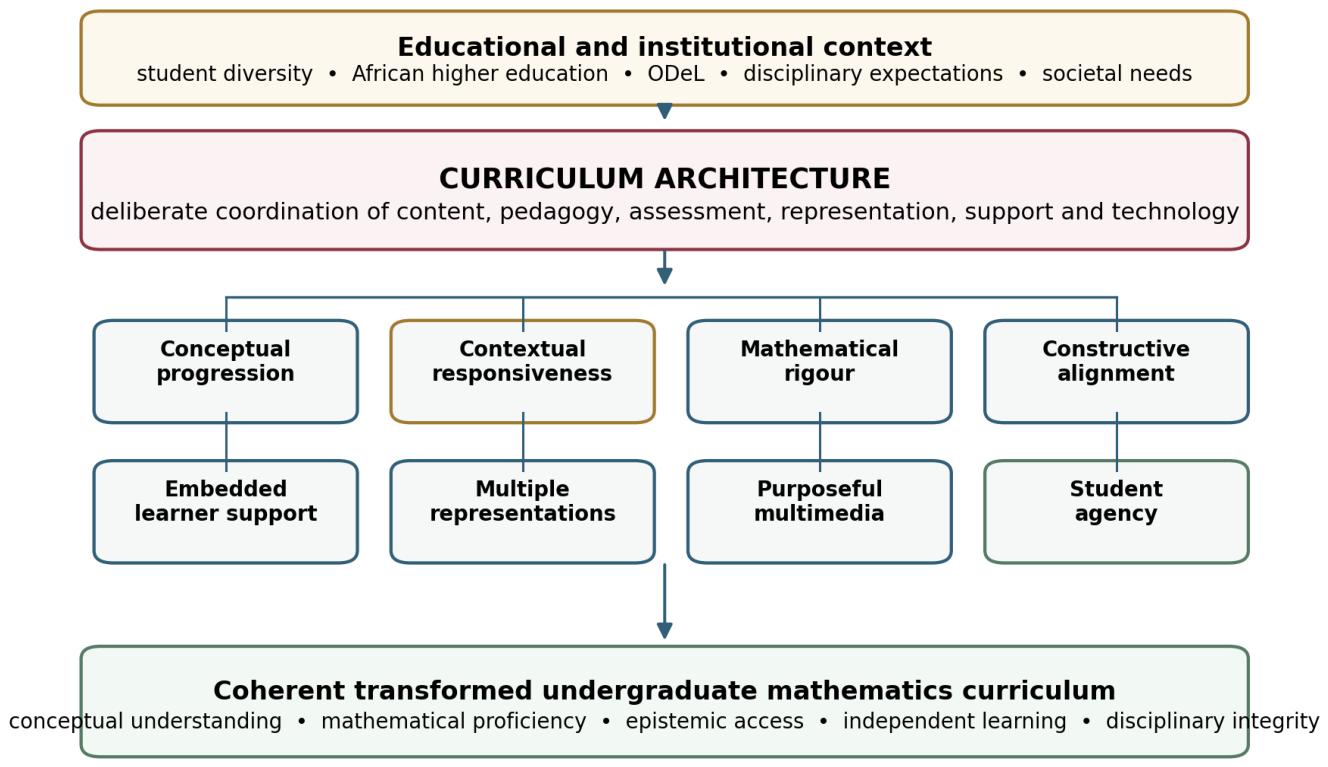
The ICTF–UM consists of three interrelated layers.
The first layer comprises the educational context within which curriculum redevelopment occurs. Institutional priorities, disciplinary expectations, student characteristics and societal needs collectively establish the environment in which curriculum decisions are made. Within African higher education this includes widening participation, graduate employability, epistemic justice and contextual relevance.
The second layer consists of curriculum architecture, which functions as the organising mechanism of the framework. Curriculum architecture coordinates relationships among curriculum content, conceptual progression, pedagogy, assessment, learner support, representations and educational technologies. Rather than operating independently, these curriculum components are designed as an integrated educational system.
The third layer represents educational outcomes. Through coherent curriculum architecture, transformed curricula support conceptual understanding, mathematical proficiency, learner agency, contextual responsiveness and disciplinary integrity. Curriculum transformation is therefore conceptualised as an emergent property of curriculum coherence rather than the consequence of isolated curriculum innovations.
5.3. Core Dimensions of the ICTF–UM
Eight mutually reinforcing dimensions constitute the operational components of the framework.
5.3.1. Conceptual Progression
Conceptual progression provides the structural backbone of undergraduate mathematics curricula. Mathematical ideas are organised so that increasingly sophisticated concepts emerge naturally from previously established knowledge. The documentary analysis demonstrated that conceptual progression influenced almost every curriculum decision undertaken during redevelopment.
5.3.2. Contextual Responsiveness
Contextual responsiveness connects abstract mathematics with authentic South African and African applications while preserving disciplinary rigour. Contexts function as pedagogical vehicles that promote conceptual understanding rather than replacing formal mathematical reasoning.
5.3.3. Mathematical Rigour
Transformation does not diminish mathematical standards. Instead, the framework maintains formal mathematical reasoning, precision and symbolic communication while improving conceptual accessibility and learner engagement.
5.3.4. Constructive Alignment
Learning outcomes, learning activities and assessment are deliberately aligned to ensure curriculum coherence. Assessment therefore reinforces conceptual development rather than merely measuring student achievement.
5.3.5. Embedded Learner Support
Learner support is incorporated directly into curriculum materials through explanations, worked examples, reflective questions, revision activities and guidance addressing common misconceptions. Within ODeL environments this embedded support becomes a central curriculum function.
5.3.6. Multiple Representations
Graphical, symbolic, numerical and verbal representations are deliberately coordinated to strengthen conceptual understanding and representational fluency. Students are supported in moving confidently between different forms of mathematical communication.
5.3.7. Purposeful Multimedia Integration
Technology and multimedia are incorporated because they enhance learning rather than because they increase technological sophistication. Videos, interactive resources and Open Educational Resources complement printed materials and extend opportunities for independent learning.
5.3.8. Student Agency
The framework progressively develops students as independent mathematical learners. Activities encourage exploration, reflection, justification and problem solving, supporting students in constructing mathematical understanding rather than reproducing procedures.
5.4. Relationships Among the Framework Dimensions
A defining characteristic of the ICTF–UM is that its dimensions operate as an integrated system rather than as independent curriculum features. Changes to one curriculum component frequently require corresponding adjustments elsewhere in the curriculum.
For example, introducing authentic contextual applications influences conceptual sequencing, assessment design and learner support. Similarly, strengthening representational fluency requires coordinated revisions to explanatory text, worked examples, graphical illustrations and formative assessment. Curriculum coherence therefore depends upon recognising these interdependencies throughout curriculum redevelopment.
The framework consequently shifts attention from individual curriculum innovations towards the relationships among curriculum components. Transformation becomes a systemic property of curriculum architecture rather than a collection of disconnected educational improvements.
Table 5.
Dimensions and design questions of the ICTF–UM.
| Key design question | Educational function | Framework dimension |
| Does each concept emerge from secure prerequisite understanding? | Organises cumulative mathematical development | Conceptual progression |
| Does the context perform a clear mathematical function? | Connects mathematics with authentic interpretation and modelling | Contextual responsiveness |
| Has accessibility been improved without diluting the mathematics? | Preserves precision, reasoning and disciplinary standards | Mathematical rigour |
| Do learning and assessment require the intended mathematical thinking? | Coordinates outcomes, activity and assessment | Constructive alignment |
| Can a distance learner progress without relying on unstated lecturer intervention? | Anticipates difficulty within the core material | Embedded learner support |
| Are transitions among representations made explicit? | Coordinates symbolic, graphical, numerical and verbal meaning | Multiple representations |
| Is the resource positioned where it solves a specific learning need? | Extends or clarifies the core learning pathway | Purposeful multimedia |
| Does support progressively transfer responsibility to the learner? | Develops reflection, strategy selection and independent reasoning | Student agency |
5.5. Contribution of the Framework
The ICTF–UM extends existing curriculum-transformation scholarship in three important respects. First, it conceptualises curriculum architecture as the mechanism through which curriculum transformation becomes operational. Second, it integrates insights from curriculum studies, mathematics education, ODeL and African higher education into a unified curriculum-design framework. Third, it provides curriculum developers with a transferable model capable of informing the redevelopment of undergraduate mathematics curricula beyond the MAT1512 case.
Rather than prescribing a fixed curriculum model, the ICTF–UM offers a flexible design framework through which institutions may adapt curriculum transformation to their own disciplinary, institutional and societal contexts while preserving conceptual coherence and mathematical rigour.
The following section discusses the theoretical implications of the framework, its contribution to curriculum scholarship and its potential application within undergraduate mathematics education more broadly.
Figure 7.
Integrated Curriculum Transformation Framework for Undergraduate Mathematics (ICTF–UM).
6. Discussion
The purpose of this study was to investigate how curriculum transformation was operationalised during the comprehensive redevelopment of MAT1512 and to develop an empirically grounded framework capable of informing undergraduate mathematics curriculum design. The documentary analysis demonstrated that curriculum transformation emerged through the systematic integration of curriculum components rather than through isolated curriculum innovations. This discussion interprets those findings in relation to existing scholarship and considers their implications for mathematics education, Open Distance e-Learning (ODeL) and curriculum redevelopment more broadly.
6.1. Curriculum Transformation as Curriculum Architecture
The principal contribution of this study is the proposition that curriculum transformation is fundamentally an architectural rather than an additive process. Much of the curriculum-transformation literature has focused on individual principles such as contextualisation, Africanisation, decolonisation, constructive alignment, learner-centred pedagogy or technology-enhanced learning. While these perspectives have significantly advanced curriculum scholarship, they frequently treat individual curriculum components independently. The findings of the present study suggest that meaningful transformation depends less on the inclusion of individual innovations than on the educational relationships established among them.
The MAT1512 redevelopment demonstrated that curriculum decisions concerning conceptual sequencing, assessment, learner support, representations and contextual applications continually influenced one another. Curriculum coherence therefore emerged from the deliberate coordination of these interconnected decisions rather than from their independent implementation. This observation extends existing curriculum-transformation scholarship by identifying curriculum architecture as the mechanism through which transformation becomes operational.
The findings also contribute to broader debates concerning educational change. Rather than conceptualising transformation as a once-off curriculum revision, the redevelopment illustrates transformation as an iterative process of educational design characterised by continual refinement, evaluation and integration. Curriculum architecture therefore provides a dynamic model capable of accommodating ongoing curriculum development while preserving coherence across successive redevelopment cycles.
6.2. Contribution to Mathematics Education
The findings reinforce several well-established principles within mathematics education while extending their application to programme-level curriculum design. Previous research has consistently emphasised conceptual understanding, mathematical reasoning, representational fluency and authentic problem solving as essential characteristics of effective mathematics learning. The documentary analysis confirms the importance of these principles but further demonstrates that their educational effectiveness depends upon their integration within coherent curriculum structures.
Conceptual progression emerged as the organising principle underpinning curriculum redevelopment. The redevelopment repeatedly prioritised logical sequencing, ensuring that increasingly sophisticated mathematical ideas developed naturally from previously established concepts. This finding supports existing mathematics education literature while illustrating how conceptual progression can inform curriculum organisation at module level rather than only individual lesson design.
Similarly, contextual responsiveness proved most effective when authentic applications functioned as vehicles for conceptual understanding rather than as isolated examples of local relevance. The redevelopment therefore illustrates that Africanisation and contextualisation need not compromise mathematical rigour. Instead, carefully selected contexts can strengthen abstraction by connecting formal mathematical ideas with meaningful quantitative situations encountered by students.
The increased use of multiple representations also reinforces the importance of representational fluency within undergraduate mathematics. Graphical, symbolic, numerical and verbal explanations were deliberately coordinated throughout the redevelopment, enabling students to construct increasingly sophisticated conceptual connections. These findings suggest that representation should be viewed not simply as an instructional strategy but as a structural feature of curriculum architecture.
6.3. Implications for Open Distance e-Learning
The study has important implications for curriculum design within Open Distance e-Learning environments. In ODeL institutions, curriculum materials assume many instructional functions traditionally performed through direct classroom interaction. Consequently, curriculum architecture becomes particularly significant because study materials themselves become the principal medium through which teaching presence is established.
The redevelopment demonstrates that learner support is most effective when embedded directly within curriculum materials. Rather than providing support through separate institutional services alone, explanatory guidance, worked examples, reflective prompts, revision activities and formative assessment were integrated throughout the module. This embedded approach reduced transactional distance by anticipating learning difficulties and supporting increasingly independent mathematical reasoning.
The findings further indicate that educational technologies contribute most effectively when integrated purposefully within curriculum architecture. Multimedia resources, Open Educational Resources and interactive learning materials enhanced learning because they complemented conceptual progression and assessment rather than functioning as supplementary technological additions. This reinforces the view that technology should be evaluated according to its educational contribution rather than its novelty.
6.4. Implications for Curriculum Developers
The ICTF–UM provides curriculum developers with a practical framework for managing complex curriculum redevelopment projects. Rather than redesigning individual curriculum components independently, the framework encourages curriculum teams to consider conceptual sequencing, contextual responsiveness, assessment, learner support, representation and technology as interdependent curriculum decisions.
An important implication concerns curriculum planning itself. Redevelopment should begin by establishing the conceptual architecture of the curriculum before individual study materials are developed. Once conceptual progression has been established, assessment, learner-support mechanisms, multimedia resources and contextual applications can be aligned systematically with broader curriculum intentions. This integrated approach reduces fragmentation and promotes curriculum coherence throughout the redevelopment process.
The framework also has potential application beyond undergraduate calculus. Although developed from the MAT1512 case, its emphasis on curriculum architecture, conceptual coherence and integrated educational design is relevant to a wide range of mathematically intensive undergraduate programmes. Institutions undertaking curriculum transformation may therefore adapt the framework while remaining responsive to their own disciplinary, institutional and societal contexts.
6.5. Limitations and Future Research
The study is subject to several limitations. First, the framework was developed from a single institutional case involving one undergraduate mathematics module. Although the documentary corpus was unusually rich and enabled detailed examination of curriculum redevelopment, additional studies across multiple institutions would strengthen the analytical transferability of the framework.
Figure 8.
ICTF–UM implementation and continuous curriculum-renewal cycle.
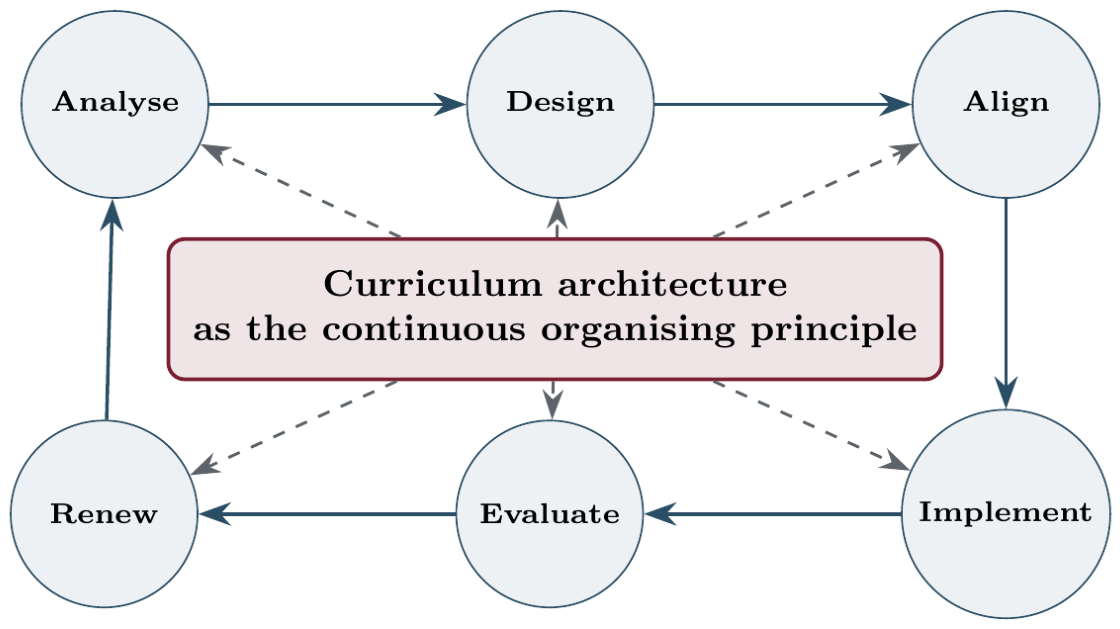
Second, the study focused on curriculum design rather than student outcomes. Consequently, the findings explain how curriculum transformation was operationalised but do not directly evaluate its influence on student achievement, retention or engagement. Future research should investigate relationships between implementation of the ICTF–UM and measurable educational outcomes.
Finally, curriculum transformation is inherently context dependent. Institutional priorities, disciplinary traditions and student characteristics vary across higher education systems. Further studies should therefore examine how the framework can be adapted to different disciplinary and national contexts while preserving its central architectural principles.
6.6. Summary
The discussion has demonstrated that the findings contribute to curriculum studies, mathematics education and Open Distance e-Learning by conceptualising curriculum architecture as the mechanism through which curriculum transformation becomes operational. The ICTF–UM extends existing scholarship by integrating curriculum coherence, mathematical rigour, contextual responsiveness, learner support and educational technology within a single curriculum-design framework. Although developed from the redevelopment of MAT1512, the framework provides broader theoretical and practical guidance for curriculum transformation within undergraduate mathematics and comparable higher education contexts. The final section concludes the paper by summarising the principal contributions of the study and considering its implications for future curriculum transformation research.
7. Conclusion
This study set out to investigate how curriculum transformation can be operationalised within undergraduate mathematics and to develop a theoretically informed, empirically grounded framework capable of guiding curriculum redevelopment in African Open Distance e-Learning (ODeL) contexts. Drawing on a qualitative documentary case study of the comprehensive redevelopment of MAT1512 at the University of South Africa, the study examined curriculum transformation as an educational design process rather than as a policy aspiration or post-implementation evaluation.
The documentary analysis demonstrated that meaningful curriculum transformation did not result from isolated curriculum innovations. Instead, transformation emerged through the deliberate integration of conceptual progression, contextual responsiveness, mathematical rigour, constructive alignment, assessment for learning, embedded learner support, multiple representations, purposeful multimedia integration and student agency. Although each of these curriculum dimensions contributed independently to the redevelopment process, their educational significance lay primarily in the coherent relationships established among them. This finding led to the development of the Integrated Curriculum Transformation Framework for Undergraduate Mathematics (ICTF–UM), in which curriculum architecture is conceptualised as the organising mechanism through which curriculum transformation becomes operational.
The study makes three principal contributions to mathematics education research. First, it advances curriculum theory by proposing curriculum architecture as an integrative construct that explains how diverse curriculum principles may be coordinated within mathematically intensive undergraduate programmes. Rather than presenting curriculum transformation as a collection of desirable educational characteristics, the framework demonstrates how these characteristics function collectively as an integrated curriculum system.
Second, the study contributes methodologically by illustrating the value of qualitative documentary analysis for investigating curriculum redevelopment. The extensive documentary corpus generated throughout the MAT1512 redevelopment enabled curriculum transformation to be examined as an evolving sequence of educational design decisions. This methodological approach provides an alternative to studies that rely primarily on policy analysis or student outcome data by demonstrating how curriculum knowledge can emerge directly from redevelopment practice.
Third, the study makes a practical contribution by providing curriculum developers with a transferable framework capable of informing future curriculum transformation initiatives. Although developed within undergraduate calculus, the ICTF–UM is sufficiently flexible to support curriculum redevelopment across other mathematically intensive disciplines where conceptual coherence, learner support and contextual responsiveness must be balanced with disciplinary rigour.
The findings also have broader implications for higher education. Contemporary curriculum transformation frequently emphasises decolonisation, Africanisation, graduate attributes and educational technologies. The present study suggests that these initiatives achieve their greatest educational value when they are integrated through coherent curriculum architecture rather than implemented as independent reforms. Curriculum transformation should therefore be understood as a systems-design challenge requiring sustained attention to the relationships among curriculum components throughout the redevelopment process.
Several limitations should nevertheless be acknowledged. The framework was developed from a single institutional case and therefore reflects the particular context of undergraduate mathematics within an African ODeL university. Although the analytical procedures and detailed case description support the transferability of the findings, additional studies across different institutions, mathematical disciplines and educational systems are required to examine the wider applicability of the framework. Furthermore, the present study focused on curriculum design rather than student outcomes. Future research should therefore investigate the relationship between implementation of the ICTF–UM and student engagement, conceptual understanding, progression and academic success.
Future investigations may also explore how curriculum architecture informs interdisciplinary curriculum redevelopment, the integration of emerging educational technologies, and the design of inclusive mathematics curricula responsive to increasingly diverse student populations. Comparative studies across institutions and national contexts would further strengthen understanding of how the framework may be adapted while preserving its central architectural principles.
In conclusion, this study argues that curriculum transformation is fundamentally an architectural process. Sustainable curriculum change is achieved not through the accumulation of isolated innovations but through the coherent organisation of curriculum knowledge, pedagogy, assessment, learner support and educational technology into an integrated educational system. The Integrated Curriculum Transformation Framework for Undergraduate Mathematics provides both a theoretical explanation and a practical model for achieving such integration. It is hoped that the framework will contribute to ongoing curriculum transformation initiatives within African higher education and stimulate further research into coherent curriculum design for undergraduate mathematics and related disciplines.
Declaration of Generative AI Use: Generative AI (OpenAI ChatGPT) was used to assist with language editing, manuscript organisation, LaTeX/Word formatting, and the preparation of tables and illustrative figures. It was not used to generate research data, conduct the documentary analysis, determine findings, or make the scholarly interpretations reported in this article. The authors reviewed and verified the final manuscript and accepts full responsibility for its accuracy and integrity.
Disclosure statement: The authors report no potential conflict of interest.
Funding
No external funding was received for this study.
Data availability statement
The documentary materials analysed in this study consist of institutional curriculum-development records. Access is subject to institutional permissions and confidentiality requirements.
Ethics statement: The study analysed institutional curriculum documents and did not involve human participants or personal data. Institutional requirements applicable to documentary research were observed.
References
- Anderson, T. (Ed.) The theory and practice of online learning The role of visual representations in the learning of mathematics. In Educational, 2nd ed.; AU Press, 2008. [Google Scholar]
- Stud. Math. 52(3), 215–241.
- Barnett, R.; Coate, K. Engaging the curriculum in higher education; Open University Press, 2005. [Google Scholar]
- Biggs, J.; Tang, C. Teaching for quality learning at university, 4th ed.; Open University Press, 2011. [Google Scholar]
- Blum, W.; Ferri, R. B. Mathematical modelling: Can it be taught and learnt? J. Math. Model. Appl. 2009, 1(1), 45–58. [Google Scholar]
- Conole, G. Designing for learning in an open world; Springer, 2013. [Google Scholar]
- Department of Higher Education and Training. White paper for post-school education and training; Government of South Africa: Pretoria, 2013. [Google Scholar]
- Duval, R. A cognitive analysis of problems of comprehension in a learning of mathematics. Educ. Stud. Math. 2006, 61(1–2), 103–131. [Google Scholar] [CrossRef]
- Ernest, P. The philosophy of mathematics education; Falmer Press, 1991. [Google Scholar]
- Freudenthal, H. Revisiting mathematics education: China lectures; Kluwer Academic Publishers, 1991. [Google Scholar]
- Fricker, M. Epistemic injustice: Power and the ethics of knowing; Oxford University Press, 2007. [Google Scholar]
- Garrison, D. R. Self-directed learning: Toward a comprehensive model. Adult Educ. Q. 1997, 48(1), 18–33. [Google Scholar] [CrossRef]
- Garrison, D. R.; Anderson, T.; Archer, W. Critical inquiry in a text-based environment: Computer conferencing in higher education. Internet High. Educ. 2000, 2(2–3), 87–105. [Google Scholar] [CrossRef]
- Gravemeijer, K. Developing realistic mathematics education; Freudenthal Institute, 1994. [Google Scholar]
- Heleta, S. Decolonisation of higher education: Dismantling epistemic violence and eurocentrism in south africa. Transform. High. Educ. 2016, 1(1), 1–8. [Google Scholar] [CrossRef]
- . [CrossRef]
- Horsthemke, K. Knowledge, education and the limits of africanisation. J. Philos. Educ. 2004, 38(4), 571–587. [Google Scholar] [CrossRef]
- Kilpatrick, J.; Swafford, J.; Findell, B. (Eds.) Adding it up: Helping children learn mathematics; National Academy Press, 2001. [Google Scholar]
- Laurillard, D. Teaching as a design science; Routledge, 2012. [Google Scholar]
- Le Grange, L. Decolonising the university curriculum. South Afr. J. High. Educ. 2016, 30(2), 1–12. [Google Scholar] [CrossRef]
- Luckett, K.; Shay, S. Reframing the curriculum: A transformative approach. Crit. Stud. Educ. 2017, 61(1), 50–65. [Google Scholar] [CrossRef]
- Mayer, R. E. Multimedia learning, 3rd ed.; Cambridge University Press, 2021. [Google Scholar]
- Mbembe, A. J. Decolonizing the university: New directions. Arts Humanit. High. Educ. 2016, 15(1), 29–45. [Google Scholar] [CrossRef]
- McKenney, S.; Reeves, T. C. Conducting educational design research, 2nd ed.; 2019. [Google Scholar]
- Routledge.
- Moore, M. G. Theory of transactional distance. In Theoretical Principles of Distance Education; 1993; pp. 22–38. [Google Scholar]
- Moore, M. G.; Kearsley, G. Distance education: A systems view of online learning. 2012. [Google Scholar] [CrossRef]
- Wadsworth, 3rd ed.
- Msila, V.; Gumbo, M. T. (Eds.) Africanising the curriculum: Indigenous perspectives and theories; SUN Press, 2016. [Google Scholar]
- Pinar, W. F. What is curriculum theory? 2nd ed.; Routledge, 2012. [Google Scholar]
- Pintrich, P. R. A conceptual framework for assessing motivation and self-regulated learning in college students. Educ. Psychol. Rev. 2004, 16(4), 385–407. [Google Scholar] [CrossRef]
- . [CrossRef]
- Schoenfeld, A. H. Learning to think mathematically: Problem solving, metacognition, and sense making in mathematics. In Handbook for Research on Mathematics Teaching and Learning; 1992; pp. 334–370. [Google Scholar]
- Schwab, J. J.; The practical 3: Translation into curriculum; Skovsmose, O. Towards a philosophy of critical mathematics education. In School Review; Kluwer Academic, 1973; Volume 81, 4, pp. 501–522. [Google Scholar]
- Publishers.
- Stenhouse, L.; An introduction to curriculum research and development. Heinemann; Tyler, R. W. Basic principles of curriculum and instruction. In Recommendation on open educational resources (oer); University of Chicago Press. UNESCO: Paris; UNESCO, 1975. [Google Scholar]
- Zimmerman, B. J. Becoming a self-regulated learner: An overview. Theory Into Pract. 2002, 41(2), 64–70. [Google Scholar] [CrossRef]
Figure 1.
Conceptual progression from curriculum reform to the ICTF–UM.
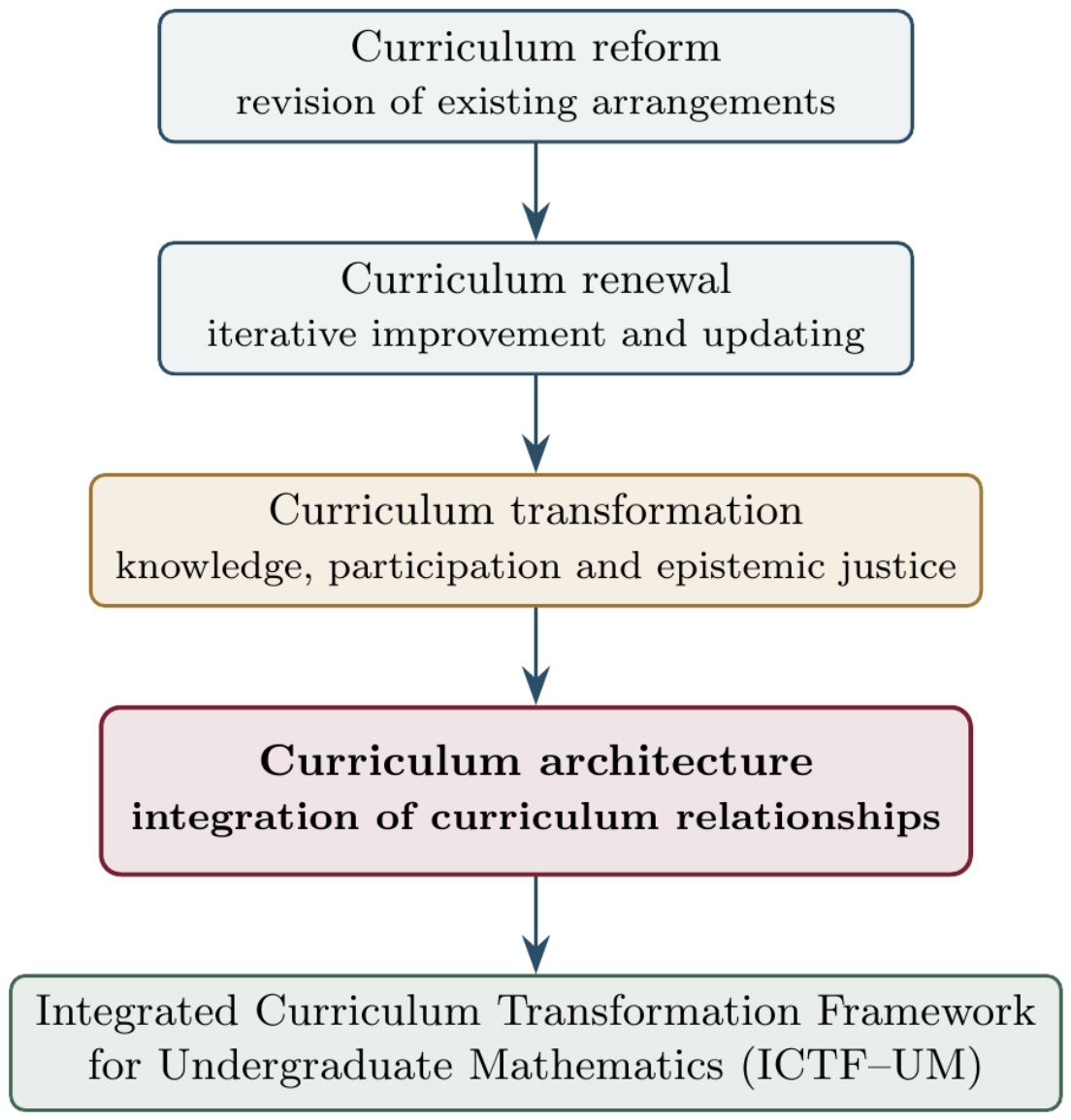
Figure 2.
From curriculum planning to curriculum architecture.
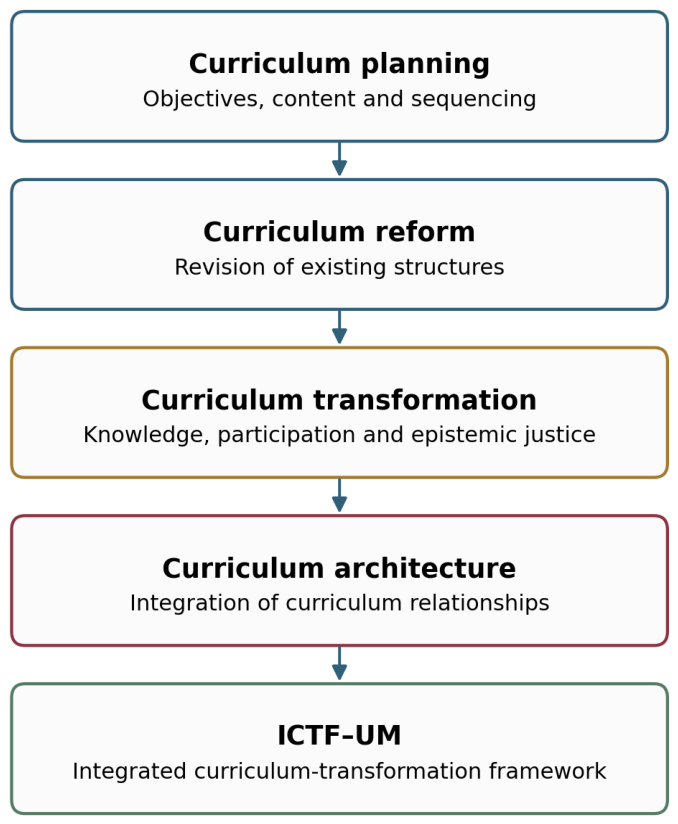
Figure 3.
Convergence of the theoretical traditions informing the ICTF–UM.
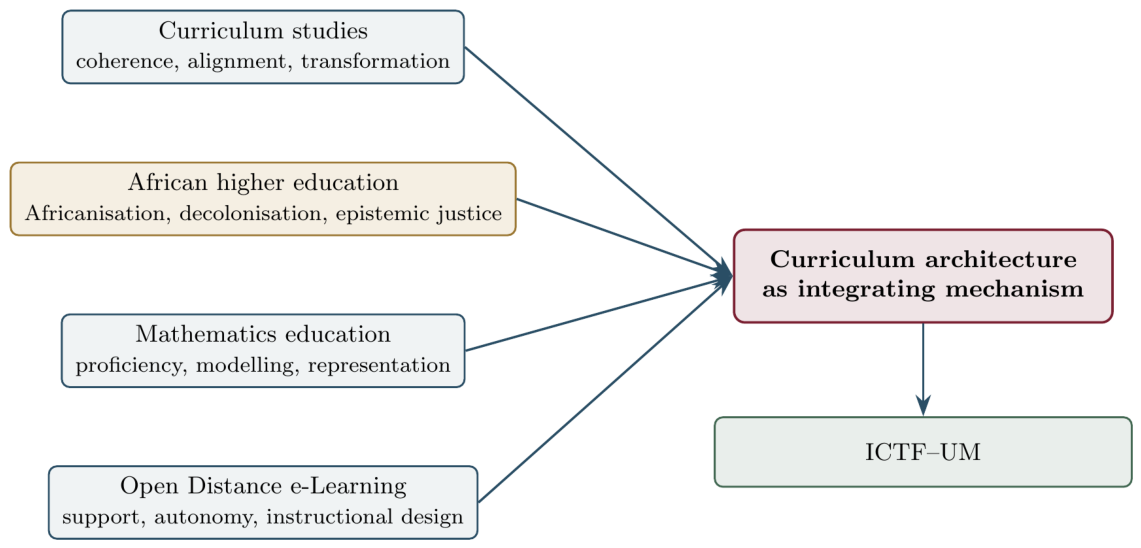
Table 1.
Theoretical foundations informing the ICTF–UM.
| ICTF–UM response | Limitation when used alone | Principal contribution | Literature tradition |
| Curriculum architecture as an integrating mechanism | Limited discipline-specific operational guidance | Transformation, coherence and constructive alignment | Curriculum studies |
| Integrated module-level mathematics design | Often focused on lessons or specific interventions | Conceptual progression, proficiency, modelling and representation | Mathematics education |
| Embedded learner-support architecture | Limited integration with disciplinary sequencing | Learner support, autonomy and instructional design | Open Distance e-Learning |
| Contextually and epistemically responsive architecture | Limited operational curriculum-design framework | Africanisation, decolonisation and epistemic justice | African higher education |
Disclaimer/Publisher’s Note: The statements, opinions and data contained in all publications are solely those of the individual author(s) and contributor(s) and not of MDPI and/or the editor(s). MDPI and/or the editor(s) disclaim responsibility for any injury to people or property resulting from any ideas, methods, instructions or products referred to in the content. |
© 2026 by the author. Licensee MDPI, Basel, Switzerland. This article is an open access article distributed under the terms and conditions of the Creative Commons Attribution (CC BY) license.
Copyright: This open access article is published under a Creative Commons CC BY 4.0 license, which permit the free download, distribution, and reuse, provided that the author and preprint are cited in any reuse.