
Submitted:
01 October 2026
Posted:
02 October 2026
You are already at the latest version
Abstract
Pocket parks can provide important recreational and environmental benefits in dense urban areas, but their effectiveness depends on whether residents can reach them safely and comfortably. This study examines pedestrian accessibility to Hayy Al Ain Park in Al Mabela, Muscat, Oman, focusing on three dimensions: street connectivity, physical infrastructural barriers, and microclimatic constraints. A bilingual questionnaire using a five-point Likert scale was administered to 43 respondents, and the relationships among the study constructs were assessed using SmartPLS with bootstrapping. Although 69.8% of respondents lived within a 5–10-minute walk of the park, 34.9% reported visiting it rarely and 25.6% never visited. Respondents also reported limited sidewalk continuity, indirect or inconvenient routes, inadequate shade, and heat exposure as important barriers to walking. The structural model explained 32.7% of the variance in pocket park accessibility. Microclimatic Constraints showed the strongest relationship with accessibility and were the only statistically significant predictor, whereas Street Connectivity and Physical Infrastructural Barriers were not statistically significant. The findings suggest that proximity alone is insufficient for evaluating pocket park accessibility and highlight the importance of integrating pedestrian infrastructure and climate-responsive street design with neighborhood green-space planning.
Keywords:
pocket parks
; pedestrian accessibility
; street connectivity
; pedestrian infrastructure
; thermal comfort
; urban green space
1. Introduction
Rapid urbanization is reshaping the spatial structure and everyday experience of cities worldwide. Continued urban population growth has intensified pressure on land and infrastructure while increasing the importance of healthy and livable urban environments [1]. Urban green spaces are increasingly important because they provide opportunities for recreation, social interaction, environmental improvement, and psychological restoration [2]. Rapid city growth is also associated with environmental pressures such as urban heat and reduced thermal comfort [3]. Dense urban living can contribute to higher levels of stress, making access to restorative environments increasingly significant [4]. Research linking green space and health further shows that contact with natural environments can support physical and psychological well-being through several pathways [5].
The importance of urban green space creates a parallel planning challenge: how to provide accessible greenery where land is scarce and development pressure is high. Public green spaces can support population health when they are available within residents’ everyday environments [6]. Yet urban densification often limits opportunities to create large parks, requiring smaller and more flexible forms of green infrastructure [7]. Pocket parks have therefore emerged as a practical strategy because they can occupy small parcels [8]. Their effectiveness, however, depends not only on internal design but also on their relationship with surrounding land uses and whether residents can reach them easily [9].
Green-space accessibility has traditionally been evaluated through distance, service areas, and walking time. Studies of urban green-space provision show that proximity is important in determining who benefits from access to parks [10]. GIS-based assessments have also demonstrated the value of examining pedestrian access through network measures rather than relying only on straight-line distance [11]. More recent work emphasizes that accessibility should account for the pedestrian network and route quality used to reach green spaces [12]. A park may therefore appear geographically close while remaining difficult to access because of barriers along the walking route [13].
The surrounding pedestrian environment is consequently central to whether proximity becomes practical accessibility. Sidewalk quality, continuity, and physical condition influence whether residents can walk safely to nearby destinations [14]. Built-environment characteristics such as street connectivity, route directness, pedestrian infrastructure, and traffic conditions also affect walking and cycling in residential neighborhoods [15]. Streetscape quality matters for green-space access because poorly designed routes may discourage walking even when the destination itself is attractive [16]. In hot climates, pedestrian access is further shaped by microclimatic conditions, as vegetation and shading can reduce heat exposure and improve outdoor comfort [17]. Severe heat can also alter park visitation patterns and create barriers for users [18].
These concerns are particularly relevant in cities shaped by car-oriented development. Research from Tehran shows that park use is related not only to park characteristics but also to accessibility conditions [19]. In Muscat, rapid urban expansion has occurred within a geographically constrained setting between the Gulf of Oman and the Al Hajar Mountains, contributing to a dispersed and automobile-oriented urban form [20]. In such conditions, the presence of a nearby park does not necessarily guarantee pedestrian access. Recent studies argue that route-environment quality must be included in green-space accessibility assessments because walking conditions directly influence whether people can reach green destinations [21]. Research on pocket parks in Kuala Lumpur similarly identifies usability and accessibility constraints as determinants of how small urban green spaces function [22]. Evidence from Nanjing also suggests that pocket-park use depends on the surrounding physical and spatial context rather than on park provision alone [23].
The relationship is especially important in hot-arid environments, where pedestrian movement may be restricted by both physical barriers and climatic discomfort. Pocket parks can support physical and psychological health, but these benefits depend on residents being able to use them regularly and comfortably [24]. Planning approaches that overlook pedestrian safety, route continuity, climatic conditions, and user experience risk producing green spaces that are spatially present but functionally isolated. Safe-city planning principles likewise emphasize that public spaces should be supported by environments that allow secure movement between private and public space [25].
This study examines how pedestrian infrastructural limitations affect access to localized pocket parks in Muscat, Oman, using Hayy Al Ain Park in Al Mabela as a case study. The analysis focuses on three dimensions: street connectivity, physical infrastructural barriers, and microclimatic constraints. Rather than treating geographic proximity as sufficient evidence of access, the study evaluates residents’ perceptions of the walking conditions connecting surrounding residential areas to the park. It seeks to explain why a pocket park may remain underused even when it lies within a short walking distance of nearby households. By examining the interaction between pedestrian infrastructure and climatic conditions, the study contributes to a more operational understanding of neighborhood green-space accessibility in hot-arid, automobile-oriented cities and provides a basis for planning pocket parks together with the pedestrian routes that support their everyday use. It further emphasizes the need to evaluate the entire pedestrian journey to the park, rather than considering the park as an isolated destination within the urban fabric.
2. Literature Review
2.1. Urban Green Spaces in Rapidly Growing Cities
The significance of urban green space has increased as cities face simultaneous challenges associated with population growth, environmental deterioration, and changing patterns of human health. The increasing burden of non-communicable diseases has encouraged greater attention to environmental conditions that can support healthier everyday lifestyles [26]. Urban living can also expose residents to persistent psychosocial pressures, making the quality of neighborhood environments increasingly relevant to physical and psychological well-being [27]. Epidemiological evidence indicates that characteristics of urban environments can influence anxiety, depression, and other dimensions of mental health, although these relationships are shaped by multiple social and environmental mechanisms [28].
One important consequence of contemporary urbanization is a reduction in routine interaction between residents and natural environments. Research on human–nature relationships suggests that reduced opportunities for engagement with nature may diminish some of the restorative and recreational functions historically available within everyday environments [29]. Direct encounters with nature have become comparatively uncommon for many urban populations, reinforcing the importance of accessible greenery within residential settings rather than relying only on distant natural landscapes [30]. Green spaces can therefore function as public-health resources by creating opportunities for outdoor recreation, social interaction, relaxation, and routine contact with natural environments [31].
The health value of greenery is not restricted to intensive exercise. Even relatively small amounts of vegetation and exposure to green environments can contribute to stress reduction and psychological recovery [32]. Experimental evidence also indicates that park environments can support attention and emotional recovery, demonstrating that the benefits of green space involve both physical and psychological processes [33]. At a population scale, exposure to greenness has been associated with health outcomes through pathways involving environmental quality, behavioral opportunities, and reduced exposure to harmful urban conditions [34]. A systematic review and meta-analysis across a broad range of studies similarly found associations between greenspace exposure and multiple health outcomes, supporting the treatment of greenery as a component of preventive urban-health planning [35].
Mental-health research provides additional justification for integrating green environments into residential planning. Long-term exposure to residential green and blue spaces has been associated with beneficial mental-health outcomes, although the strength of evidence varies according to population, exposure measure, and research design [36]. Reviews focused specifically on urban environments also identify several pathways through which green space may influence health, including physical activity, social interaction, stress reduction, and reductions in harmful environmental exposures [37]. More broadly, research on nature and health emphasizes that the benefits of natural environments arise through interconnected processes involving air quality, physical activity, social cohesion, and psychological restoration rather than through a single causal pathway [38].
Green infrastructure also contributes directly to the environmental performance of cities. Vegetation can capture airborne pollutants and influence pollutant dispersion, particularly where trees and other forms of greenery interact with the morphology of urban streets [39]. Green roofs and other vegetated surfaces can provide measurable cooling and humidification effects, demonstrating how relatively small interventions can influence urban microclimates [40]. The spatial arrangement of parks and vegetation can additionally affect the movement and concentration of traffic-derived air pollutants, meaning that environmental performance depends partly on how greenery is positioned in relation to surrounding roads and development [41].
Urban green spaces also have ecological functions that extend beyond human recreation. In highly urbanized areas, remaining green areas can serve as habitat or movement spaces for species affected by the replacement of natural or semi-natural land with built surfaces [42]. At the neighborhood scale, landscape configuration can influence surface temperatures, demonstrating an important relationship between vegetation, urban form, and local thermal conditions [43]. Green-space proximity has also been associated with neighborhood and park-based physical activity, although the relationship can vary according to characteristics such as age and gender [44]. Consequently, the value of urban parks is best understood as multidimensional: they provide environmental services, recreational opportunities, health benefits, and spaces for social activity simultaneously [45].
2.2. Pocket Parks as Small-Scale Urban Green Infrastructure
Although the benefits of urban greenery are widely recognized, providing conventional large parks can be difficult in developed and rapidly densifying urban areas. Research in compact urban environments indicates that even small parks can improve environmental conditions when they are carefully integrated into high-density urban fabrics [46]. Pocket parks respond to this constraint by providing relatively small but strategically located areas of vegetation and public activity that can be incorporated into otherwise intensively developed neighborhoods. Their design can be adapted to different district patterns, making them particularly useful where opportunities for acquiring large contiguous parcels are limited [47].
Leftover and underutilized urban parcels can also be transformed into small green spaces rather than remaining residual components of the built environment. Research into the design of leftover spaces demonstrates that enclosure, planting configuration, and spatial organization can substantially influence the suitability of such spaces for pocket-park development [48]. Despite their small size, pocket parks can contain restorative qualities when vegetation, seating, spatial enclosure, and other environmental components are appropriately configured [49].
The recreational function of these spaces is particularly important because residents use public parks for multiple activities rather than for one predetermined purpose. Observational research has identified spatial interactions among park users engaged in walking, resting, socializing, and other forms of recreation [50]. Pocket-park use may also vary according to demographic characteristics; evidence indicates that gender and age can influence patterns of visitation and the way small parks are experienced [51]. For children, perceived environmental characteristics within urban parks can similarly influence levels of physical activity, showing that park design affects not merely whether a space exists but how actively it is used [52].
Small green spaces can also provide opportunities for retreat from everyday urban demands. Nature-oriented settings have been identified as important environments for reconnecting people, particularly children, with outdoor experiences that may otherwise be limited within highly developed urban settings [53]. Parks further function as recreational environments in which management, visitor behavior, design, and environmental quality interact to determine the overall experience of users [54]. Importantly, however, simply constructing a park does not ensure that residents will use it. Patterns of park visitation vary substantially according to convenience, recreational preferences, user characteristics, and characteristics of the surrounding urban environment [55].
The distribution of green space also raises questions of urban equity. Unequal accessibility can mean that the environmental and health benefits associated with greenery are disproportionately available to particular populations or neighborhoods [56]. Green infrastructure therefore needs to be considered as a connected component of resilient urban landscapes rather than as a collection of isolated landscaped sites [57]. Accessibility standards that measure whether green areas can be reached within practical walking distances provide one means of identifying areas where residents may be underserved [58]. At the same time, expanding investment in landscaped environments reflects a broader shift in which urban green space is increasingly treated as an essential component of healthy urban development rather than a decorative addition [59].
Usability is equally important. Reviews of urban parks indicate that features such as accessibility, facilities, maintenance, safety, aesthetics, and opportunities for different activities influence both visitation and physical activity [60]. The attractiveness, size, and proximity of open spaces can also affect recreational walking, indicating that users respond to a combination of destination characteristics rather than to distance alone [61]. Small parks are therefore most effective when treated as networks of neighborhood destinations rather than isolated fragments; studies of groups of mini-parks show that relationships between individual spaces and surrounding neighborhood structure affect visitation patterns [62].
This emphasis on context is consistent with broader research on public-space production. Studies of informal urban environments demonstrate that public spaces acquire meaning through everyday activities, interaction, appropriation, and their relationship with surrounding streets and buildings rather than solely through formal designation [63]. Research examining everyday public-space production similarly shows that streets can operate simultaneously as spaces for mobility, social interaction, livelihood, recreation, and domestic extension, highlighting the close relationship between movement networks and public life [64]. Within Muscat specifically, research on residents' perceptions of contemporary urban development indicates that environmental experience, connectivity, social factors, and contextual compatibility contribute to how urban environments are evaluated [65].
Collectively, these findings suggest that the planning value of a pocket park cannot be assessed through its area or presence alone. A small park may be physically well designed but remain ineffective when its surrounding neighborhood fails to provide conditions that allow residents to reach, perceive, and incorporate the park into their everyday routines.
2.3. Pedestrian Infrastructure, Route Quality, and Microclimatic Accessibility
Accessibility to green space is fundamentally linked to the quality of the journey between the user's origin and the park. Streets themselves can function as forms of surrogate green space and everyday public environments, indicating that the experience of accessing a destination begins before the pedestrian reaches the formal park boundary [66]. Climatic comfort along this journey is particularly important during periods of high temperature because exposure to extreme heat can discourage outdoor activity even where recreational destinations are available [67].
Shade is therefore a critical component of pedestrian environments in warm climates. Canopy-based approaches demonstrate that the strategic placement of vegetation can reduce heat exposure within small urban spaces and improve the conditions experienced by users [68]. Different vegetation-cover configurations can similarly produce varying cooling and humidification effects, showing that the amount and arrangement of greenery matter for microclimatic performance [69]. Street-network configuration also has environmental consequences because road layout can alter residential exposure to traffic-generated pollutants and influence the environmental quality of walking routes [70]. Green infrastructure should consequently be planned as a connected network in which mobility, ecological performance, and access are integrated rather than addressed independently [71].
The relevance of these issues to Oman is supported by research specifically examining neighborhood environments in Muscat. The Physical Activity Neighborhood Environment Scale–Oman was developed and validated to examine perceptions of residential density, land-use mix, pedestrian infrastructure, safety, aesthetics, and street connectivity, demonstrating that neighborhood walkability in Oman is multidimensional and can be meaningfully evaluated through residents' perceptions [72]. This is particularly significant because residential neighborhoods in Oman have historically placed substantial emphasis on automobile movement, while facilities supporting everyday walking and cycling remain uneven.
Safety constitutes another fundamental layer of accessibility. Evidence from stated-choice analysis indicates that improvements in road safety, personal security, and walking quality can materially increase the attractiveness of sustainable modes, illustrating that pedestrians evaluate the conditions surrounding a journey as well as its travel time and monetary cost [73]. Urban morphology also affects mobility decisions because street configuration, land-use conditions, and accessibility interact with individual characteristics in shaping modal choices [74]. Street-level preference research further demonstrates that residents and other stakeholders evaluate pedestrian environments through trade-offs involving access, street design, public space, mobility, and urban livability [75].
The climate dimension cannot be separated from these mobility considerations. Recent geospatial evidence demonstrates that conversion from vegetated or agricultural surfaces to built-up land can intensify urban thermal conditions, reinforcing the importance of retaining and integrating greenery as cities expand [76]. Climate-responsive urbanism can also draw lessons from traditional settlement morphology, where relationships among building configuration, shading, local environmental conditions, and spatial organization demonstrate alternative approaches to reducing climatic exposure [77].
Pedestrian accessibility nevertheless includes a perceptual dimension in addition to measurable physical characteristics. Studies of public parks show that user perceptions can reveal barriers or preferences that conventional spatial assessments fail to capture [78]. Research across transportation, urban design, and public health similarly identifies density, street connectivity, land-use mix, and destination accessibility as recurring correlates of walking and cycling behavior [79]. A broader meta-analysis of the built environment and travel behavior also indicates that walking is related particularly to destination accessibility, land-use diversity, and street-network characteristics [80].
At the design scale, successful pedestrian networks require connectivity, integration with other modes, safe conditions, appropriate path quality, accessible destinations, and a supportive surrounding context [81]. Reviews of environmental influences on walking likewise identify sidewalks, trails, accessible destinations, aesthetics, and perceptions of traffic as attributes associated with walking behavior [82]. Assessment frameworks therefore increasingly distinguish several dimensions of the pedestrian environment—including function, safety, aesthetics, and destination access—rather than representing walkability through a single measure [83]. Psychological restoration is also affected by qualities of both built and natural environments, reinforcing the importance of considering residents' experienced environment rather than relying exclusively on objective spatial indicators [84]. Finally, the hierarchy-of-walking-needs perspective argues that the decision to walk depends on progressively higher-order requirements involving feasibility, accessibility, safety, comfort, and pleasurable experience [85].
The literature therefore reveals an important distinction between spatial proximity and operational accessibility. Existing studies provide strong evidence that green space, pocket parks, street design, safety, and thermal comfort individually matter for urban well-being, yet these dimensions are less frequently examined together at the immediate neighborhood scale. This limitation becomes especially important in hot-arid and automobile-oriented environments such as Muscat, where a park located only a few minutes from a residence may still be practically inaccessible if the connecting route contains discontinuous sidewalks, vehicular conflicts, physical obstructions, indirect street connections, intense solar exposure, or inadequate shade. The present study addresses this gap by examining street connectivity, physical infrastructural barriers, and microclimatic constraints simultaneously from the perspective of users accessing a localized pocket park.
3. Materials and Methods
3.1. Research Design
This study used a quantitative survey-based case-study approach to examine how pedestrian infrastructure conditions influence perceived accessibility to a neighborhood pocket park. The analysis focused on three dimensions of the pedestrian environment: Street Connectivity (SC), Physical Infrastructural Barriers (PIB), and Microclimatic Constraints (MCC). These dimensions were treated as exogenous latent constructs associated with Pocket Park Accessibility (PPA). A perception-based survey was selected because direct user assessments can capture barriers encountered during everyday movement that may not be adequately represented by conventional distance-based accessibility measures.
The questionnaire structure was adapted from the neighborhood accessibility framework developed by Ghamsary et al., particularly its treatment of route connectivity, physical layout, and pedestrian–vehicular interaction, and was modified to reflect the pedestrian and climatic conditions of Muscat [86]. The adaptation emphasized sidewalk provision and continuity, physical obstruction, traffic safety, pedestrian crossings, tree and structural shade, and exposure to high temperatures. Based on this conceptual structure, three hypotheses were examined:
- H1. Street Connectivity influences pocket park accessibility.
- H2. Physical Infrastructural Barriers influence pocket park accessibility.
- H3. Microclimatic Constraints influence pocket park accessibility.
The conceptual structure and relationships between the constructs are illustrated in Figure 1.
3.2. Study Area
The study was conducted at Hayy Al Ain Park in Al Mabela, Muscat, Oman. The park was selected because it represents a localized pocket park embedded within a predominantly residential urban fabric. According to the field assessment undertaken for this study, the park contains grassed areas, trees, seating, a children's playground, and internal pedestrian paths, while the surrounding streets provide substantially less-developed pedestrian infrastructure. This contrast between the relatively complete internal park environment and the weaker pedestrian conditions outside its boundary makes the site particularly suitable for examining whether the accessibility of a pocket park is determined by the park itself or by the quality of the routes leading to it.
Residential blocks surround the park on most sides. On its western side, the surrounding land uses include a fenced mosque compound and two-storey mixed-use buildings, beyond which the residential fabric continues. The resulting spatial configuration makes the surrounding street network particularly important for pedestrian access because residents must use these local streets to reach the park entrances. The compact residential setting also means that many households are located within a relatively short geographic distance of the park, allowing the study to distinguish between simple proximity and the actual experience of pedestrian access. In this context, a short walking distance does not necessarily indicate that the route is safe, continuous, or comfortable for users.
Field observations were undertaken in the surrounding neighborhood to document the conditions experienced along streets approaching the park. The observations identified locations where pedestrian facilities such as continuous sidewalks, pedestrian crossings, cycle facilities, shade, traffic-calming elements, and physical separation between pedestrians and vehicles were absent or limited. Photographs of representative access streets were also collected to provide visual documentation of these conditions, as presented in Figure 2. The field observations therefore complemented the perception-based survey by providing direct evidence of the physical street conditions encountered by residents when approaching the park.
3.3. Survey Instrument and Measurement
Data were collected using a bilingual survey to accommodate the predominantly Arabic-speaking local population while also allowing responses in English. The use of linguistically accessible questionnaire formats is important for reducing unnecessary comprehension barriers between the survey instrument and the population being examined [87].
The questionnaire consisted of two components. The first collected basic respondent characteristics, including age, residential proximity to Hayy Al Ain Park, and frequency of park visitation. Proximity was assessed by asking whether respondents lived within approximately a 5–10-minute walk of the park. Visitation frequency was included to provide an indication of how regularly respondents used the park.
The second component measured the three pedestrian-accessibility constructs through 10 manifest indicators. Street Connectivity contained two indicators (SC1–SC2), Physical Infrastructural Barriers contained five indicators (PIB1–PIB5), and Microclimatic Constraints contained three indicators (MCC1–MCC3), as shown in Table 1. Multi-item measurement is commonly used when broader concepts cannot be adequately represented through a single observed variable [88].
Responses were recorded using a five-point Likert scale, ranging from 1 = Strongly Disagree to 5 = Strongly Agree, with 3 representing a neutral response. Likert-type response formats provide an ordinal mechanism for measuring respondents' levels of agreement with statements relating to attitudes and perceived environmental conditions [89]. Careful formulation of questionnaire items is necessary because wording, response structure, and construct definition can directly influence the quality of survey-based measurements [90].
3.4. Data Collection and Respondent Profile
The questionnaire was administered digitally during on-site field visits in the area surrounding Hayy Al Ain Park. Customized QR codes and mobile-access links were used to enable respondents to complete the questionnaire electronically. Digital and mixed-mode survey approaches can facilitate direct participation while reducing the need for manual transcription of questionnaire responses [91].
The data collection produced 43 completed responses. Recruitment was intentionally concentrated on people associated with the surrounding neighborhood because the study sought to evaluate the experience of residents for whom Hayy Al Ain Park could reasonably function as a local green space. Of the final respondents, 69.8% reported living within a 5–10-minute walking distance of the park, while 30.2% reported living beyond this walking range.
The resulting sample was used as an exploratory case-study dataset rather than as a statistically representative sample of the wider population of Muscat. Survey research based on localized samples requires particular care when generalizing findings beyond the population and setting from which the respondents were recruited [92].
3.5. PLS-SEM and SmartPLS Analysis
The relationships defined in the conceptual model were analyzed using Partial Least Squares Structural Equation Modeling (PLS-SEM) in SmartPLS. PLS-SEM provides a variance-based approach for estimating relationships between latent constructs and is commonly applied when the research objective involves examining predictive relationships within a specified conceptual model [93].
The model included the three exogenous constructs—SC, PIB, and MCC—and Pocket Park Accessibility as the endogenous construct. The SmartPLS model simultaneously represented the relationships between the observed indicators and their associated latent constructs and the structural relationships between the constructs and pocket park accessibility. PLS-SEM separates these two components conceptually into the measurement model and structural model [94].
Following model estimation, a bootstrapping procedure was conducted in SmartPLS to evaluate the empirical support for the hypothesized relationships. Bootstrapping is a non-parametric resampling procedure commonly used in PLS-SEM to estimate the sampling distribution of path coefficients and derive significance statistics without imposing a normal-distribution assumption [95].
The analysis also obtained the coefficient of determination (R2) for Pocket Park Accessibility to indicate the proportion of variance explained collectively by Street Connectivity, Physical Infrastructural Barriers, and Microclimatic Constraints. The path-specific bootstrap results were then used to compare the relative relationships of the three constructs with PPA. Descriptive survey statistics were additionally examined to characterize respondents and summarize their perceptions of street connectivity, pedestrian infrastructure, shade, heat exposure, and park visitation.
4. Results
4.1. Respondent Characteristics and Descriptive Findings
A total of 43 respondents participated in the survey, as shown in Figure 3. Respondents aged 18–30 years constituted the largest group at 53.5%. Male respondents accounted for 53.5% of the sample and female respondents for 46.5%, indicating a relatively balanced gender distribution. A substantial majority, 69.8%, reported living within approximately a 5–10-minute walk of Hayy Al Ain Park, whereas 30.2% lived beyond this walking range. Despite this relatively high level of residential proximity, park visitation was limited. Approximately 34.9% reported visiting the park rarely, 25.6% reported never visiting it, and 23.3% visited more than once per week. These findings suggest that physical closeness to the park does not necessarily translate into frequent use, pointing to the possible influence of conditions along the routes used to reach the park.
The perception-based responses further indicated substantial dissatisfaction with the pedestrian environment surrounding the park. Approximately 55.8% of respondents strongly disagreed that the street configuration provided an easy and direct route to the park. Around 62.3% strongly disagreed that safe, continuous, and unobstructed sidewalks were available. In relation to thermal conditions, 55.8% disagreed that sufficient building- or vegetation-based shade was available along routes to the park, while 48.8% strongly agreed that high outdoor temperatures and direct solar exposure were major reasons for avoiding walking to the park. The strongest negative response was therefore associated with the availability and continuity of sidewalks, followed by concerns related to route directness and shade provision.
4.2. Measurement Model Assessment
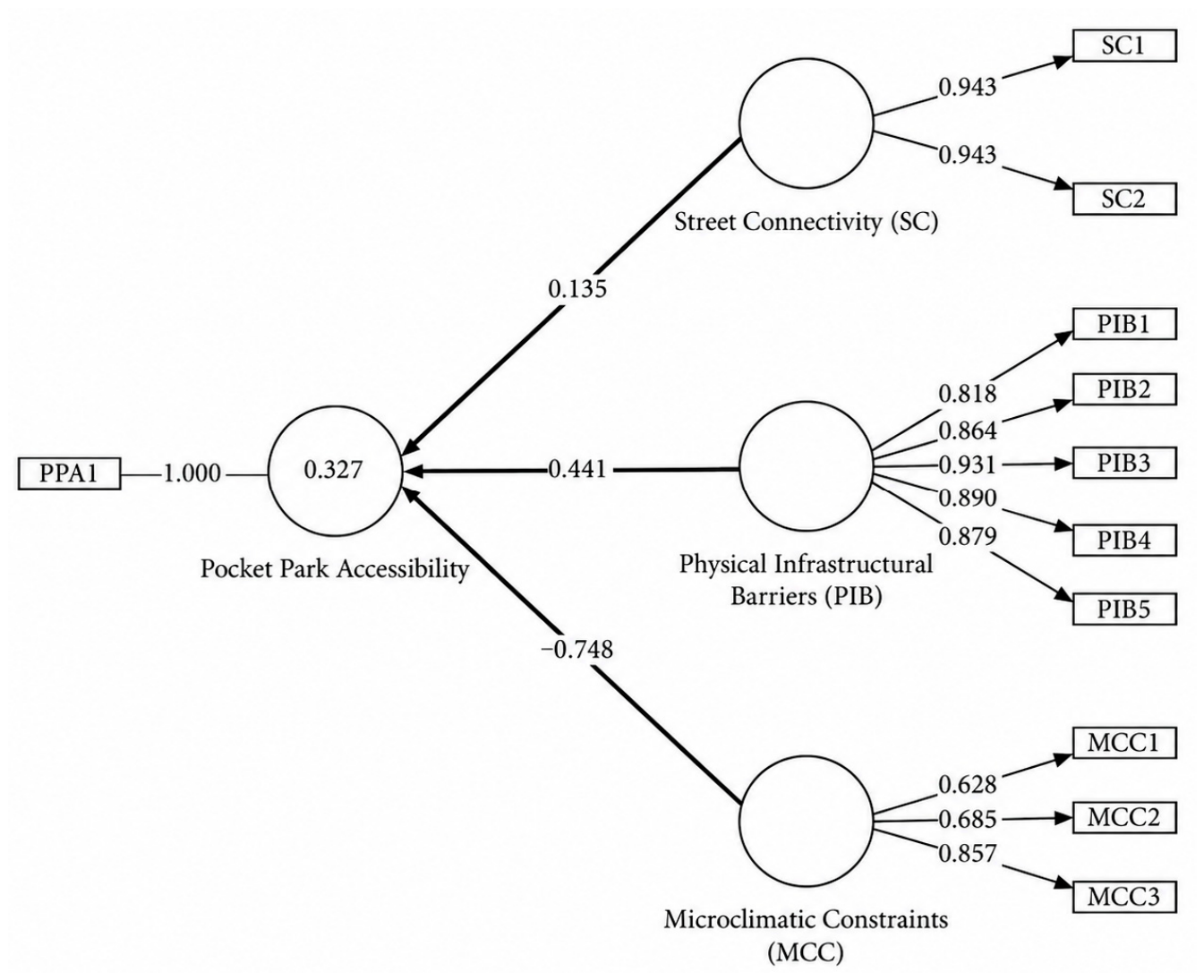
The measurement model was assessed using indicator loadings, average variance extracted (AVE), composite reliability (CR), and Cronbach’s alpha. As presented in Table 2, indicator loadings ranged from 0.628 to 0.943. Street Connectivity exhibited consistently high loadings for SC1 and SC2 (0.943 each), while the Physical Infrastructural Barriers indicators ranged from 0.818 to 0.931. For Microclimatic Constraints, the loadings ranged from 0.628 to 0.857. All three multi-item constructs achieved AVE values above 0.50, with values of 0.889 for SC, 0.770 for PIB, and 0.533 for MCC, indicating that more than half of the indicator variance was captured by their respective constructs. Composite reliability was also above 0.70 for all constructs, ranging from 0.770 to 0.943. Cronbach’s alpha was 0.876 for SC and 0.929 for PIB, whereas MCC produced a comparatively lower value of 0.646. The single-item PPA construct had a fixed loading, AVE, and CR of 1.000.
4.3. Discriminant Validity
Discriminant validity was assessed using the Fornell–Larcker criterion. As shown in Table 3, the square root of AVE for each construct exceeded the absolute value of its correlations with the remaining constructs. The diagonal values were 0.943 for Street Connectivity, 0.877 for Physical Infrastructural Barriers, 0.730 for Microclimatic Constraints, and 1.000 for Pocket Park Accessibility. These values exceeded the corresponding inter-construct correlations, providing support for discriminant validity. The strongest relationship was observed between Street Connectivity and Physical Infrastructural Barriers (r=−0.843), followed by the relationship between Physical Infrastructural Barriers and Microclimatic Constraints (r=0.658). The negative correlations between Street Connectivity and the two barrier-oriented constructs are consistent with their coding, whereby higher street-connectivity scores indicate more favorable pedestrian conditions, while higher PIB and MCC scores represent greater constraints.
4.4. Structural Model and Hypothesis Testing
The structural model assessed the relationships between Street Connectivity (SC), Physical Infrastructural Barriers (PIB), Microclimatic Constraints (MCC), and Pocket Park Accessibility (PPA). The model produced an R2 value of 0.327 for PPA, indicating that the three predictors collectively explained 32.7% of the variance in pocket park accessibility.
As shown in Table 4, Street Connectivity had a positive but statistically non-significant relationship with PPA (β = 0.135, t = 0.592, p = 0.554). Its 95% bootstrap confidence interval ranged from −0.304 to 0.563 and crossed zero, while the effect size was negligible (f2 = 0.007). Therefore, H1 was not supported. Physical Infrastructural Barriers also showed a positive but non-significant relationship with PPA (β = 0.441, t = 1.511, p = 0.131). The confidence interval ranged from −0.181 to 0.938 and included zero, while the corresponding effect size was small (f2 = 0.054). Accordingly, H2 was not supported.
In contrast, Microclimatic Constraints exhibited a strong negative and statistically significant relationship with PPA (β = -0.748, t = 3.280, p = 0.001). Its 95% bootstrap confidence interval ranged from −1.041 to −0.370 and did not include zero, providing support for H3. MCC also produced a large effect size (f2 = 0.433), substantially exceeding the effects associated with SC and PIB. This indicates that microclimatic conditions made the largest unique contribution to explaining variation in PPA within the structural model. The negative coefficient further shows that increasing heat-related and shade-related constraints corresponded with lower perceived accessibility to the park. The large f2 value also suggests that excluding MCC from the model would substantially reduce its explanatory power.
The structural-model results identify Microclimatic Constraints as the only statistically significant predictor of Pocket Park Accessibility in the present model. Greater microclimatic constraints were associated with lower accessibility, indicating that heat exposure and inadequate climatic protection along pedestrian routes may represent an important limitation on access to Hayy Al Ain Park. Although PIB produced a comparatively larger positive coefficient than SC, its relationship was not statistically significant and should therefore not be interpreted as evidence of an independent effect on PPA.
Figure 4.
The development of the SmartPLS calculation model.
5. Discussion
The findings of this study reinforce the distinction between geographic proximity and experienced accessibility to neighborhood green space. Although 69.8% of respondents reported living within a 5–10-minute walk of Hayy Al Ain Park, park visitation remained comparatively limited, with 34.9% visiting rarely and 25.6% never visiting. This apparent mismatch suggests that being located near a park does not necessarily mean that residents experience the park as readily accessible. Previous research similarly conceptualizes park accessibility as multidimensional, incorporating the quality of the journey, safety, transport conditions, and individual perceptions in addition to physical distance [96]. A recent systematic review further indicates that perceived accessibility can be more closely connected with park-use outcomes than objective proximity measures alone [97].
This interpretation is particularly relevant to the present case because respondents reported substantial dissatisfaction with the streets connecting surrounding residences to the park. Recent route-based accessibility research demonstrates that pedestrians evaluate environmental conditions throughout a journey and may perceive routes differently even when destinations have similar physical distances [98]. Previous comparisons between geographic and perceived park accessibility have likewise demonstrated that objective spatial access and residents' perceptions do not necessarily predict park use in the same way [99]. The findings from Hayy Al Ain Park therefore support a more route-sensitive interpretation of accessibility, while the relatively small and localized sample means that this interpretation should remain specific to the present case.
5.1. Physical Infrastructural Barriers and the Pedestrian Environment
Physical infrastructural conditions produced the most pronounced descriptive concern among respondents. Approximately 62.3% strongly disagreed that safe, continuous, and unobstructed sidewalks were available along routes to the park, while 55.8% strongly disagreed that the street configuration provided an easy and direct route. These findings are particularly important in Muscat, where automobile-oriented urban expansion has historically produced development patterns in which private vehicles dominate everyday mobility. Research examining Muscat's transition toward greater walkability similarly identifies urban sprawl and automobile dependence as substantial challenges to pedestrian-oriented development [100].
The local context is further supported by research conducted specifically within Muscat neighborhoods. De Siqueira and Al Balushi identified barriers to pedestrian activity associated with the built environment and emphasized the importance of redesigning existing neighborhoods to enable active movement and more usable public spaces [101]. The present findings complement this argument by showing that these pedestrian conditions may also affect access to a neighborhood destination as small and localized as a pocket park.
At the policy level, recent analysis of urban and transport planning in Oman has identified important gaps related specifically to walkability and destination access, despite broader policy commitments to healthier and more sustainable cities [102]. This provides an important planning context for the findings at Hayy Al Ain Park: creating a green destination without simultaneously ensuring continuous and safe pedestrian connections may limit the practical value of that investment.
Nevertheless, the structural-model findings require careful interpretation. Physical Infrastructural Barriers showed a positive path coefficient (β = 0.441), but the relationship with Pocket Park Accessibility was not statistically significant (t = 1.511, p = 0.131). The 95% bootstrap confidence interval ranged from −0.181 to 0.938 and therefore included zero, providing no statistical support for H2. The corresponding effect size was also small (f2 = 0.054), indicating that PIB made only a limited unique contribution to the explained variance in PPA after the other constructs were considered simultaneously. Therefore, the findings do not statistically confirm that physical infrastructural barriers independently determine Pocket Park Accessibility. This distinction is important because the descriptive survey results clearly identify sidewalks and pedestrian conditions as concerns, while the structural model does not establish PIB as an independent significant predictor. The final model explained 32.7% of the variance in Pocket Park Accessibility (R2 = 0.327). In comparison with PIB, Street Connectivity also had a non-significant effect (β = 0.135, p = 0.554, f2 = 0.007), whereas Microclimatic Constraints exhibited a strong and statistically significant negative effect (β = -0.748, p = 0.001, f2 = 0.433).
5.2. Microclimatic Constraints and Thermal Comfort
The second important dimension emerging from the descriptive findings concerns the microclimate of the walking route. Approximately 55.8% of respondents disagreed that adequate building- or vegetation-based shade was available, while 48.8% strongly agreed that high temperatures and direct solar exposure discouraged them from walking to the park. The original survey therefore indicates that thermal exposure forms part of residents' experience of park accessibility rather than simply being a characteristic of the regional climate. This descriptive pattern is strongly reinforced by the structural-model results, in which Microclimatic Constraints emerged as the only statistically significant predictor of Pocket Park Accessibility
This finding is consistent with research demonstrating that the spatial distribution of shade directly influences pedestrian thermal conditions and should be considered as part of sidewalk and streetscape planning [103]. Experimental research on pedestrian route choice further demonstrates that people actively modify walking behavior to reduce solar exposure, with shaded routes potentially being preferred even when they involve additional walking distance [104]. These findings help explain why a nominal walking distance of only 5–10 minutes may still represent a substantial barrier in environments where the route is highly exposed to direct sun.
Tree planting represents one potential response, although its effectiveness depends strongly on where shade is provided. Modeling of pedestrian heat exposure indicates that distributing trees along highly sun-exposed sidewalks can produce greater pedestrian cooling benefits than concentrating additional trees where substantial shade already exists [105]. This is particularly relevant to the routes surrounding Hayy Al Ain Park because improvements should focus not only on increasing the overall quantity of vegetation but on creating continuous shade along the actual pedestrian approach to the park. The large effect size associated with MCC (f2 = 0.433) further indicates that microclimatic conditions made a substantial unique contribution to the explanatory power of the model. When MCC was excluded, the explained variance in PPA decreased from R2 = 0.327 to approximately R2 = 0.035, highlighting the importance of this construct within the present case study.
Evidence from hot-desert environments also indicates that street geometry, horizontal shading, vegetation, and surface treatments can materially alter pedestrian thermal comfort [106]. Other forms of structural shading can similarly influence pedestrian-level thermal conditions, demonstrating that climate-responsive walking environments do not necessarily depend exclusively on mature tree canopy [107]. Field research in semi-arid outdoor public spaces further shows that thermal perception is influenced by both measured environmental conditions and behavioral adaptation, emphasizing the importance of combining physical design with users' subjective experience [108].
5.3. Pocket-Park Use and the Importance of the Surrounding Context
The results also raise a broader question about how pocket parks should be evaluated. Because these spaces are small and intended primarily to serve surrounding communities, their performance depends on more than the quality of facilities contained within the park boundary. Recent research on pocket-park visitation shows that proximity, visitor characteristics, satisfaction, facilities, and other park attributes interact in shaping visitation frequency [109]. This suggests that the success of a pocket park should be evaluated as part of a broader neighborhood system rather than as an isolated landscaped parcel.
Evidence from Nanjing similarly demonstrates that pocket-park usage reflects both internal park characteristics and the surrounding urban environment, with accessibility forming part of a wider combination of macro-, meso-, and micro-scale influences [110]. An evaluation of pocket parks in high-density urban areas has likewise emphasized the importance of assessing vitality from the user's perspective and adapting evaluation frameworks to local urban contexts [111]. These findings are relevant to Hayy Al Ain Park because the park itself contains grass, trees, seating, a playground, and internal pedestrian paths, whereas many of the perceived deficiencies occur on the streets that users must traverse before reaching it.
This distinction has practical significance. Improving the park internally may have limited influence on visitation if users continue to encounter discontinuous sidewalks, unsafe crossings, traffic conflicts, or prolonged solar exposure while approaching it. Research examining public-park attributes also shows that changes in park characteristics can influence visitation, but access and use emerge through combinations of destination and user conditions rather than one attribute alone [112]. The present findings therefore suggest that pocket-park planning and pedestrian-route planning should be treated as one connected design problem. In particular, the strong negative MCC–PPA relationship indicates that interventions outside the park boundary—such as continuous shade, heat-mitigating streetscape design, and protected pedestrian routes—may be as important as improvements made within the park itself. This shifts the planning emphasis from simply providing a pocket park to ensuring that the entire pedestrian journey to that park is safe, comfortable, and climatically responsive.
5.4. Planning Implications for Muscat
For For Muscat, the principal implication is that proximity-based green-space provision should be complemented by an assessment of route quality between residences and park entrances. This does not mean that conventional distance measures are irrelevant; rather, they provide only one dimension of accessibility. Comparative research across different urban contexts demonstrates that perceived access varies according to physical and contextual conditions even when green-space provision is present [113]. An integrated conception of accessibility similarly argues for moving beyond proximity alone when evaluating whether public parks are practically available to surrounding populations [114]. The present results add to this argument by showing that microclimatic constraints had the strongest and only statistically significant relationship with Pocket Park Accessibility, with a large effect size (f2 = 0.433). This suggests that, in the hot-arid context of Muscat, climatic comfort along the walking route should be treated as a core component of accessibility rather than as a secondary design consideration.
For Hayy Al Ain Park specifically, the descriptive findings point toward several priorities: continuous pedestrian paths linking surrounding residential streets to park entrances; removal or management of obstacles that interrupt pedestrian movement; safer and more legible crossings; traffic-calming measures where pedestrians interact with vehicles; and a connected shading strategy using tree canopy and, where appropriate, structural shade. Given the structural-model findings, particular priority should be placed on interventions that reduce direct solar exposure and improve thermal comfort along the routes approaching the park. Continuous shade provision, rather than isolated shaded points, would be especially important because users experience the entire journey between their homes and the park entrance. Such interventions would address the barriers respondents reported without assuming that any single intervention alone will necessarily increase visitation.
The user experience should also remain central to future improvements. Qualitative research on green-space barriers shows that residents' perceptions and preferences can reveal accessibility constraints that are difficult to identify through spatial provision measures alone [115]. Consequently, evaluating pocket parks through a combination of network accessibility, physical street audits, thermal measurements, and user perceptions would provide a more complete understanding of whether small urban green spaces are genuinely usable. For planning practice in Muscat, this means evaluating not only whether residents live within a prescribed walking distance of a park, but also whether that walking route is continuous, safe, shaded, and thermally tolerable.
5.5. Limitations and Future Research
The findings should be interpreted in light of several limitations. First, the study is based on 43 respondents from a single pocket park, which restricts the extent to which the results can be generalized to Al Mabela, Muscat, or other Gulf cities. Second, the study relies primarily on self-reported perceptions of street connectivity, physical barriers, and thermal conditions. Objective measurements of sidewalk continuity, crossing quality, route distance, pedestrian traffic, tree-canopy coverage, or thermal exposure were not included in the present analysis. Third, although Microclimatic Constraints showed a statistically significant relationship with Pocket Park Accessibility, the effects of Street Connectivity and Physical Infrastructural Barriers were not statistically significant at the 5% level. The findings should therefore be interpreted as evidence of association rather than causation. The three constructs explain 32.7% of the variance in PPA, indicating that a substantial proportion of variation remains associated with factors not represented in the current model. In addition, PPA was represented by a single indicator, which limits the ability to assess its internal measurement reliability in the same manner as the multi-item constructs. The MCC construct also produced a comparatively modest Cronbach’s alpha of 0.646, although its composite reliability (0.770) and AVE (0.533) remained above commonly applied thresholds.
Future research could address these limitations by examining multiple pocket parks across Muscat, increasing the sample size, incorporating residents from a broader range of age groups, and combining perception surveys with objective pedestrian-network and microclimatic measurements. Route-level GIS analysis, systematic sidewalk audits, shade mapping, pedestrian counts, and temperature or thermal-comfort measurements would be particularly useful. Future studies could also develop a multi-item measure of Pocket Park Accessibility to capture different dimensions of perceived access more comprehensively and strengthen measurement-model assessment. Repeating surveys at different times of the year could also help distinguish persistent infrastructural barriers from seasonal thermal constraints. Given the particularly strong effect observed for MCC seasonal data collection would also help determine whether the importance of microclimatic constraints remains stable across different temperature conditions. Such an expanded approach would enable stronger testing of whether the patterns identified around Hayy Al Ain Park are localized characteristics or part of a broader accessibility challenge affecting pocket parks within Muscat.
6. Conclusions
This study examined how pedestrian infrastructural conditions influence access to Hayy Al Ain Park, a localized pocket park in Al Mabela, Muscat. The findings demonstrate that physical proximity alone does not necessarily translate into practical accessibility or regular park use. Although 69.8% of respondents reported living within approximately a 5–10-minute walk of the park, 34.9% visited it rarely and 25.6% reported never visiting it. This mismatch suggests that the quality of the route between residences and the park is an important component of how accessibility is experienced.
The descriptive findings identified several barriers along these routes. Approximately 62.3% of respondents strongly disagreed that safe, continuous, and unobstructed sidewalks were available, while 55.8% strongly disagreed that the street configuration provided an easy and direct route to the park. Climatic exposure was also prominent: 55.8% reported inadequate shade along the walking routes, and 48.8% strongly agreed that high temperatures and direct solar exposure discouraged walking. These findings indicate that pedestrian access is shaped by an interaction between infrastructure, street configuration, and thermal comfort.
The structural model explained 32.7% of the variance in Pocket Park Accessibility. Among the three examined constructs, Microclimatic Constraints showed the strongest relationship with accessibility and was the only statistically significant predictor. Street Connectivity and Physical Infrastructural Barriers did not reach statistical significance at the 5% level. The results should therefore be interpreted as evidence of a significant association between microclimatic constraints and accessibility, while the effects of street connectivity and physical infrastructural barriers remain unsupported in the present model rather than as confirmation of causal relationships.
From a planning perspective, the study highlights the need to consider pocket parks and their surrounding pedestrian networks as a single interconnected system. Providing a park within walking distance is insufficient if residents must navigate discontinuous sidewalks, unsafe crossings, traffic conflicts, limited shade, or uncomfortable thermal conditions to reach it. Future pocket-park planning in Muscat should therefore integrate continuous pedestrian routes, safer crossings, traffic-calming measures, obstacle-free sidewalks, and climate-responsive shading strategies into the surrounding street environment.
Given the small sample of 43 respondents and the focus on one park, the findings should not be generalized to Muscat as a whole. Future studies should examine multiple pocket parks, larger and more diverse samples, and combine perception-based surveys with objective measures of sidewalk quality, route connectivity, shade, thermal exposure, and pedestrian movement. Such an approach would provide stronger evidence for developing accessible, climate-responsive, and pedestrian-oriented green-space networks in hot-arid cities.
Author Contributions
Conceptualization, J.A.J.; methodology, J.A.J.; software, J.A.J.; validation, J.A.J.; formal analysis, J.A.J.; investigation, J.A.J.; resources, J.A.J.; data curation, J.A.J.; writing—original draft preparation, J.A.J.; writing—review and editing, J.A.J.; visualization, J.A.J.; project administration, J.A.J. The author has read and agreed to the published version of the manuscript.
Funding
This research received no external funding.
Informed Consent Statement
Informed consent was obtained from all individual participants involved in the study.
Data Availability Statement
The data supporting the findings of this study are available from the corresponding author upon reasonable request.
Acknowledgments
During the preparation of this work, the authors used ChatGPT(5.5) in order to rephrase parts of the manuscript for improved clarity and language refinement. After using these tools/services, the authors reviewed and edited the content as needed and take full responsibility for the content of the published article.
Conflicts of Interest
The author declare no conflict of interest.
References
- United Nations. World Urbanization Prospects: The 2014 Revision, Highlights; Department of Economic and Social Affairs, Population Division, United Nations: New York, NY, USA, 2014. [Google Scholar]
- Fan, Y.; Luo, J.M. Development of a measurement scale for residents’ attitudes toward leisure activities in urban parks. J. Outdoor Recreat. Tour. 2021, 33, 100360. [Google Scholar] [CrossRef]
- Guo, F.; Wang, Z.; Dong, J.; Zhang, H.; Lu, X.; Lau, S.S.Y.; Miao, Y. Spatial differences in outdoor thermal comfort during the transition season in cold regions of China. Buildings 2022, 12, 720. [Google Scholar] [CrossRef]
- Lederbogen, F.; Kirsch, P.; Haddad, L.; Streit, F.; Tost, H.; Schuch, P.; Wüst, S.; Pruessner, J.C.; Rietschel, M.; Deuschle, M.; Meyer-Lindenberg, A. City living and urban upbringing affect neural social stress processing in humans. Nature 2011, 474, 498–501. [Google Scholar] [CrossRef]
- Markevych, I.; Schoierer, J.; Hartig, T.; Chudnovsky, A.; Hystad, P.; Dzhambov, A.M.; de Vries, S.; Triguero-Mas, M.; Brauer, M.; Nieuwenhuijsen, M.J.; Lupp, G.; Richardson, E.A.; Astell-Burt, T.; Dimitrova, D.; Feng, X.; Sadeh, M.; Standl, M.; Heinrich, J.; Fuertes, E. Exploring pathways linking greenspace to health: Theoretical and methodological guidance. Environ. Res. 2017, 158, 301–317. [Google Scholar] [CrossRef]
- Sugiyama, T.; Carver, A.; Koohsari, M.J.; Veitch, J. Advantages of public green spaces in enhancing population health. Landsc. Urban Plan. 2018, 178, 12–17. [Google Scholar] [CrossRef]
- Haaland, C.; van den Bosch, C.K. Challenges and strategies for urban green-space planning in cities undergoing densification: A review. Urban For. Urban Green. 2015, 14, 760–771. [Google Scholar] [CrossRef]
- Nordh, H.; Østby, K. Pocket parks for people—A study of park design and use. Urban For. Urban Green. 2013, 12, 12–17. [Google Scholar] [CrossRef]
- Peschardt, K.K.; Schipperijn, J.; Stigsdotter, U.K. Use of small public urban green spaces (SPUGS). Urban Urban Green 2012, 11, 235–244. [Google Scholar] [CrossRef]
- Barbosa, O.; Tratalos, J.A.; Armsworth, P.R.; Davies, R.G.; Fuller, R.A.; Johnson, P.; Gaston, K.J. Who benefits from access to green space? A case study from Sheffield, UK. Landsc. Urban Plan. 2007, 83, 187–195. [Google Scholar] [CrossRef]
- Morar, T.; Radoslav, R.; Spiridon, L.C.; Păcurar, L. Assessing pedestrian accessibility to green space using GIS. Transylv. Rev. Adm. Sci. 2014, 10, 116–139. [Google Scholar]
- Liu, D.; Huang, J.; Fang, D.; Lee, J.; Liu, Y.; Wang, S.; Kan, Z. Assessment of the 15-minute park accessibility accounting for fine-grained 3D pedestrian network and subjective quality perception among the public housing residents. Urban For. Urban Green. 2025, 114, 129165. [Google Scholar] [CrossRef]
- Quaresma, C.C.; Cruz, C.S.; Sanesi, G.; Oliveira, E.A.A.Q.; Conti, D.M.; Ferreira, M.L. Environmental injustice and pedestrian accessibility to urban parks: A comparative case study in São Paulo, Brazil. Urban For. Urban Green. 2026, 120, 129449. [Google Scholar] [CrossRef]
- Distefano, N.; Leonardi, S.; Liotta, N.G. Walking for sustainable cities: Factors affecting users’ willingness to walk. Sustainability 2023, 15, 5684. [Google Scholar] [CrossRef]
- Wang, Y.; Chau, C.K.; Ng, W.Y.; Leung, T.M. A review on the effects of physical built environment attributes on enhancing walking and cycling activity levels within residential neighborhoods. Cities 2016, 50, 1–15. [Google Scholar] [CrossRef]
- Stoia, N.L.; Niţă, M.R.; Popa, A.M.; Iojă, I.C. The green walk—An analysis for evaluating the accessibility of urban green spaces. Urban For. Urban Green. 2022, 75, 127685. [Google Scholar] [CrossRef]
- Dimoudi, A.; Nikolopoulou, M. Vegetation in the urban environment: Microclimatic analysis and benefits. Energy Build. 2003, 35, 69–76. [Google Scholar] [CrossRef]
- Liu, P.; Guo, Z.; Song, Y.; Fernandez, J. Vulnerable groups in severe heat: A study assessing the impacts of climate and pocket park visitations pre-post the pandemic. Urban Clim. 2025, 61, 102444. [Google Scholar] [CrossRef]
- Bahriny, F.; Bell, S. Patterns of urban park use and their relationship to factors of quality: A case study of Tehran, Iran. Sustainability 2020, 12, 1560. [Google Scholar] [CrossRef]
- Al Gharibi, H. Urban growth within a finite space: Case-study Muscat. In Arab Gulf Cities in Transition: Towards New Spatialities; Cummings, V., von Richthofen, A., Babar, Z., Eds.; Future Cities Laboratory Singapore/ETH Zurich: Singapore, 2019; pp. 16–39. [Google Scholar] [CrossRef]
- Zhao, J.; Willberg, E.; Korpilo, S.; Hämäläinen, J.; Lehvävirta, S. Rethinking the accessibility of urban green space through route environment quality. Urban For. Urban Green. 2026, 122, 129541. [Google Scholar] [CrossRef]
- Balai Kerishnan, P.; Maruthaveeran, S.; Maulan, S. Investigating the usability pattern and constraints of pocket parks in Kuala Lumpur, Malaysia. Urban For. Urban Green. 2020, 50, 126647. [Google Scholar] [CrossRef]
- Zhou, C.; Xie, M.; Zhao, J.; An, Y. What affects the use flexibility of pocket parks? Evidence from Nanjing, China. Land 2022, 11, 1419. [Google Scholar] [CrossRef]
- Huang, Y.; Lin, X.; Lin, S.; Chen, Z.; Fu, W.; Wang, M.; Dong, J. Pocket parks: A new approach to improving the psychological and physical health of recreationists. Forests 2023, 14, 1983. [Google Scholar] [CrossRef]
- Wekerle, G.; Whitzman, C. Safe Cities: Guidelines for Planning, Design and Management; Van Nostrand Reinhold: New York, NY, USA, 1995. [Google Scholar]
- Beaglehole, R.; Bonita, R.; Horton, R.; Ezzati, M.; Bhala, N.; Amuyunzu-Nyamongo, M.; Mwatsama, M.; Reddy, K.S. Measuring progress on NCDs: One goal and five targets. Lancet 2012, 380, 1283–1285. [Google Scholar] [CrossRef]
- Danielsson, M.; Heimerson, I.; Lundberg, U.; Perski, A.; Stefansson, C.-G.; Åkerstedt, T. Psychosocial stress and health problems: Health in Sweden: The National Public Health Report 2012, Chapter 6. Scand. J. Public Health 2012, 40, 121–134. [Google Scholar] [CrossRef]
- McKenzie, K.; Murray, A.; Booth, T. Do urban environments increase the risk of anxiety, depression and psychosis? An epidemiological study. J. Affect. Disord. 2013, 150, 1019–1024. [Google Scholar] [CrossRef]
- Cox, D.T.C.; Gaston, K.J. Human–nature interactions and the consequences and drivers of provisioning wildlife. Philos. Trans. R. Soc. B Biol. Sci. 2018, 373, 20170092. [Google Scholar] [CrossRef]
- Cox, D.T.C.; Hudson, H.L.; Shanahan, D.F.; Fuller, R.A.; Gaston, K.J. The rarity of direct experiences of nature in an urban population. Landsc. Urban Plan. 2017, 160, 79–84. [Google Scholar] [CrossRef]
- Maller, C.; Townsend, M.; St Leger, L.; Henderson-Wilson, C.; Pryor, A.; Prosser, L.; Moore, M. Healthy parks, healthy people: The health benefits of contact with nature in a park context. George Wright Forum 2009, 26, 51–83. [Google Scholar]
- Gu, J.; Liu, H.; Lu, H. Can even a small amount of greenery be helpful in reducing stress? A systematic review. Int. J. Environ. Res. Public Health 2022, 19, 9778. [Google Scholar] [CrossRef]
- Jin, Z.; Wang, J.; Liu, X. Attention and emotion recovery effects of urban parks during COVID-19—Psychological symptoms as moderators. Forests 2022, 13, 2001. [Google Scholar] [CrossRef]
- James, P.; Hart, J.E.; Banay, R.F.; Laden, F. Exposure to greenness and mortality in a nationwide prospective cohort study of women. Environ. Health Perspect. 2016, 124, 1344–1352. [Google Scholar] [CrossRef]
- Twohig-Bennett, C.; Jones, A. The health benefits of the great outdoors: A systematic review and meta-analysis of greenspace exposure and health outcomes. Environ. Res. 2018, 166, 628–637. [Google Scholar] [CrossRef]
- Gascon, M.; Triguero-Mas, M.; Martínez, D.; Dadvand, P.; Forns, J.; Plasència, A.; Nieuwenhuijsen, M.J. Mental health benefits of long-term exposure to residential green and blue spaces: A systematic review. Int. J. Environ. Res. Public Health 2015, 12, 4354–4379. [Google Scholar] [CrossRef]
- Kondo, M.C.; Fluehr, J.M.; McKeon, T.; Branas, C.C. Urban green space and its impact on human health. Int. J. Environ. Res. Public Health 2018, 15, 445. [Google Scholar] [CrossRef]
- Hartig, T.; Mitchell, R.; de Vries, S.; Frumkin, H. Nature and health. Annu. Rev. Public Health 2014, 35, 207–228. [Google Scholar] [CrossRef]
- Pugh, T.A.M.; MacKenzie, A.R.; Whyatt, J.D.; Hewitt, C.N. Effectiveness of green infrastructure for improvement of air quality in urban street canyons. Environ. Sci. Technol. 2012, 46, 7692–7699. [Google Scholar] [CrossRef]
- Dong, J.; Lin, M.; Zuo, J.; Lin, T.; Liu, J.; Sun, C.; Luo, J. Quantitative study on the cooling effect of green roofs in a high-density urban area—A case study of Xiamen, China. J. Clean. Prod. 2020, 255, 120152. [Google Scholar] [CrossRef]
- Xing, Y.; Brimblecombe, P. Dispersion of traffic derived air pollutants into urban parks. Sci. Total Environ. 2018, 622–623, 576–583. [Google Scholar] [CrossRef]
- Tzortzakaki, O.; Kati, V.; Panitsa, M.; Tzanatos, E.; Giokas, S. Butterfly diversity along the urbanization gradient in a densely-built Mediterranean city: Land cover is more decisive than resources in structuring communities. Landsc. Urban Plan. 2019, 183, 79–87. [Google Scholar] [CrossRef]
- Kim, J.-H.; Gu, D.; Sohn, W.; Kil, S.-H.; Kim, H.; Lee, D.-K. Neighborhood landscape spatial patterns and land surface temperature: An empirical study on single-family residential areas in Austin, Texas. Int. J. Environ. Res. Public Health 2016, 13, 880. [Google Scholar] [CrossRef]
- Kaczynski, A.T.; Potwarka, L.R.; Smale, B.J.A.; Havitz, M.E. Association of parkland proximity with neighborhood and park-based physical activity: Variations by gender and age. Leis. Sci. 2009, 31, 174–191. [Google Scholar] [CrossRef]
- Wong, K.K. Urban park visiting habits and leisure activities of residents in Hong Kong, China. Manag. Leis. 2009, 14, 125–140. [Google Scholar] [CrossRef]
- Lau, S.S.Y.; Lin, P.; Qin, H. A preliminary study on environmental performances of pocket parks in high-rise and high-density urban context in Hong Kong. Int. J. Low.-Carbon Technol. 2012, 7, 215–225. [Google Scholar] [CrossRef]
- Hou, J.; Wang, Y.; Zhou, D.; Gao, Z. Environmental effects from pocket park design according to district planning patterns—Cases from Xi’an, China. Atmosphere 2022, 13, 300. [Google Scholar] [CrossRef]
- Naghibi, M.; Faizi, M.; Ekhlassi, A. Design possibilities of leftover spaces as a pocket park in relation to planting enclosure. Urban For. Urban Green. 2021, 64, 127273. [Google Scholar] [CrossRef]
- Nordh, H.; Alalouch, C.; Hartig, T. Assessing restorative components of small urban parks using conjoint methodology. Urban For. Urban Green. 2011, 10, 95–103. [Google Scholar] [CrossRef]
- Santos, T.; Nogueira Mendes, R.; Vasco, A. Recreational activities in urban parks: Spatial interactions among users. J. Outdoor Recreat. Tour. 2016, 15, 1–9. [Google Scholar] [CrossRef]
- Li, Y.; Niu, S.; Mou, Y. Gender difference in the Chinese middle-aged and elderly of pocket park use: A case study of Zongbei Park. Front. Environ. Sci. 2022, 10, 978935. [Google Scholar] [CrossRef]
- Bao, Y.; Gao, M.; Luo, D.; Zhou, X. Urban parks—A catalyst for activities! The effect of the perceived characteristics of the urban park environment on children’s physical activity levels. Forests 2023, 14, 423. [Google Scholar] [CrossRef]
- Kimbell, A.R.; Schuhmann, A.; Brown, H. More kids in the woods: Reconnecting Americans with nature. J. For. 2009, 107, 373–377. [Google Scholar] [CrossRef]
- Manning, R.E.; Anderson, L.E.; Pettengill, P.R. Managing Outdoor Recreation: Case Studies in the National Parks, 2nd ed.; CABI: Wallingford, UK, 2017. [Google Scholar] [CrossRef]
- van Dongen, R.P.; Timmermans, H.J.P. Preference for different urban greenscape designs: A choice experiment using virtual environments. Urban For. Urban Green. 2019, 44, 126435. [Google Scholar] [CrossRef]
- Wu, J.; He, Q.; Chen, Y.; Lin, J.; Wang, S. Dismantling the fence for social justice? Evidence based on the inequity of urban green space accessibility in the central urban area of Beijing. Environ. Plan. B Urban Anal. City Sci. 2020, 47, 626–644. [Google Scholar] [CrossRef]
- Lafortezza, R.; Chen, J.; van den Bosch, C.K.; Randrup, T.B. Nature-based solutions for resilient landscapes and cities. Environ. Res. 2018, 165, 431–441. [Google Scholar] [CrossRef]
- Pafi, M.; Siragusa, A.; Ferri, S.; Halkia, M. Measuring the Accessibility of Urban Green Areas: A Comparison of the Green ESM with Other Datasets in Four European Cities; Publications Office of the European Union: Luxembourg, 2016. [Google Scholar] [CrossRef]
- Monteiro, R.; Ferreira, J.C.; Antunes, P. Green Infrastructure Planning Principles: An Integrated Literature Review. Land 2020, 9, 525. [Google Scholar] [CrossRef]
- McCormack, G.R.; Rock, M.; Toohey, A.M.; Hignell, D. Characteristics of urban parks associated with park use and physical activity: A review of qualitative research. Health Place 2010, 16, 712–726. [Google Scholar] [CrossRef]
- Sugiyama, T.; Francis, J.; Middleton, N.J.; Owen, N.; Giles-Corti, B. Associations between recreational walking and attractiveness, size, and proximity of neighborhood open spaces. Am. J. Public Health 2010, 100, 1752–1757. [Google Scholar] [CrossRef]
- Zhou, C.; An, Y.; Zhao, J.; Xue, Y.; Fu, L. How do mini-parks serve in groups? A visit analysis of mini-park groups in the neighbourhoods of Nanjing. Cities 2022, 129, 103804. [Google Scholar] [CrossRef]
- Arif, M.M.; Adeel, A.; Sheikh, N.B. Social relations and the making of urban space in informal settlements: Everyday appropriation and public space production. Sustainability 2026, 18, 5844. [Google Scholar] [CrossRef]
- Arif, M.M. Insights into the (Re)production of Public Spaces through Socio-Spatial Appropriation in Informal Settlements: Case Studies from Lahore, Pakistan. Ph.D. Thesis, KU Leuven, Faculty of Architecture, Ghent, Belgium, 2024. [Google Scholar]
- Al Sulaimani, G.; Arif, M.M.; Adeel, A.; Basheer, M.A.; Sheikh, N.B. Rethinking vertical cities: The influence of public perception on design, form, and socio-cultural integration. Societies 2025, 15, 250. [Google Scholar] [CrossRef]
- Fischer, L.K.; Gopal, D. Streetscapes as surrogate greenspaces during COVID-19? Front Sustain. Cities 2021, 3, 710920. [Google Scholar] [CrossRef]
- Panno, A.; Carrus, G.; Lafortezza, R.; Mariani, L.; Sanesi, G. Nature-based solutions to promote human resilience and wellbeing in cities during increasingly hot summers. Environ. Res. 2017, 159, 249–256. [Google Scholar] [CrossRef]
- Guo, F.; Guo, R.; Zhang, H.; Dong, J.; Zhao, J. A canopy shading-based approach to heat exposure risk mitigation in small squares. Urban Clim. 2023, 49, 101495. [Google Scholar] [CrossRef]
- Li, H.; Meng, H.; He, R.; Lei, Y.; Guo, Y.; Ernest, A.; Jombach, S.; Tian, G. Analysis of cooling and humidification effects of different coverage types in small green spaces in the context of urban homogenization: A case of HAU campus green spaces in summer in Zhengzhou, China. Atmosphere 2020, 11, 862. [Google Scholar] [CrossRef]
- Zheng, X.; Yang, J. Urban road network design for alleviating residential exposure to traffic pollutants: Super-block or mini-block? Sustain. Cities Soc. 2023, 89, 104327. [Google Scholar] [CrossRef]
- Hermoso, V.; Morán-Ordóñez, A.; Lanzas, M.; Brotons, L. Designing a network of green infrastructure for the EU. Landsc. Urban Plan. 2020, 196, 103732. [Google Scholar] [CrossRef]
- De Siqueira, G.; Mabry, R.; Al Siyabi, H.; Adeel, A.; Malaj, S.; Oyeyemi, A. Construct validity of the physical activity neighborhood environment scale-Oman. Front. Public Health 2023, 11, 1007075. [Google Scholar] [CrossRef]
- Adeel, A.; Arif, M.M.; Sheikh, N.B.; Ahsan, M.; Khan, M.S.U. Road safety as the binding constraint on sustainable mode choice: Discrete choice experiment estimated via conditional logit. In Proceedings of the 11th International Conference on Civil, Structural and Transportation Engineering (ICCSTE 2026), Barcelona, Spain, 2026; p. 185. [Google Scholar] [CrossRef]
- Arif, M.M.; Adeel, A.; Sheikh, N.B. Mode choice patterns and socio-spatial equity in contrasting transitional urban mobility systems. TeMA J. Land Use Mobil. Environ. 2025, 18, 271–292. [Google Scholar] [CrossRef]
- Adeel, A.; Arif, M.M.; Sheikh, N.B.; Ahsan, M.; Bashir, N. Designing livable transit-oriented development: A multi-stakeholder choice experiment on street-level trade-offs. Int. J. Civ. Infrastruct. 2025, 8, 138–154. [Google Scholar] [CrossRef]
- Ahsan, M.; Arif, M.M.; Adeel, A.; Sheikh, N.B. Transformation from green to brown: A geospatial analysis of urban expansion, urban heat environment, and agriculture land use conversion. Glob. Chall. Reg. Sci. 2026, 5, 100024. [Google Scholar] [CrossRef]
- Al Bulushi, F.; Adeel, A.; Al Ofi, I.; Agirbas, E.; Arif, M.M. Heritage values in vernacular settlement morphology: An integrated framework for climate-responsive conservation and urban regeneration. Land 2026, 15, 1356. [Google Scholar] [CrossRef]
- Basu, S.; Nagendra, H. Perceptions of park visitors on access to urban parks and benefits of green spaces. Urban For. Urban Green. 2021, 57, 126959. [Google Scholar] [CrossRef]
- Saelens, B.E.; Sallis, J.F.; Frank, L.D. Environmental correlates of walking and cycling: Findings from the transportation, urban design, and planning literatures. Ann. Behav. Med. 2003, 25, 80–91. [Google Scholar] [CrossRef]
- Ewing, R.; Cervero, R. Travel and the built environment: A meta-analysis. J. Am. Plan. Assoc. 2010, 76, 265–294. [Google Scholar] [CrossRef]
- Southworth, M. Designing the walkable city. J. Urban Plan. Dev. 2005, 131, 246–257. [Google Scholar] [CrossRef]
- Owen, N.; Humpel, N.; Leslie, E.; Bauman, A.; Sallis, J.F. Understanding environmental influences on walking: Review and research agenda. Am. J. Prev. Med. 2004, 27, 67–76. [Google Scholar] [CrossRef]
- Pikora, T.; Giles-Corti, B.; Bull, F.; Jamrozik, K.; Donovan, R. Developing a framework for assessment of the environmental determinants of walking and cycling. Soc. Sci. Med. 2003, 56, 1693–1703. [Google Scholar] [CrossRef]
- Beil, K.; Hanes, D. The influence of urban natural and built environments on physiological and psychological measures of stress—A pilot study. Int. J. Environ. Res. Public Health 2013, 10, 1250–1267. [Google Scholar] [CrossRef]
- Alfonzo, M.A. To walk or not to walk? The hierarchy of walking needs. Environ. Behav. 2005, 37, 808–836. [Google Scholar] [CrossRef]
- Ghamsary, E.S.; Karimimoshaver, M.; Akhavan, A.; Goruh, Z.A.; Aram, F.; Mosavi, A. Locating pocket parks: Assessing the effects of land use and accessibility on the public presence. Environ. Sustain. Indic. 2023, 18, 100253. [Google Scholar] [CrossRef]
- Brislin, R.W. Back-translation for cross-cultural research. J. Cross-Cult. Psychol. 1970, 1, 185–216. [Google Scholar] [CrossRef]
- DeVellis, R.F. Scale Development: Theory and Applications, 4th ed.; SAGE Publications: Thousand Oaks, CA, USA, 2017. [Google Scholar]
- Likert, R. A Technique for the Measurement of Attitudes. In Archives of Psychology No. 140; Columbia University: New York, NY, USA, 1932; pp. 1–55. [Google Scholar]
- Boateng, G.O.; Neilands, T.B.; Frongillo, E.A.; Melgar-Quiñonez, H.R.; Young, S.L. Best practices for developing and validating scales for health, social, and behavioral research: A primer. Front. Public Health 2018, 6, 149. [Google Scholar] [CrossRef]
- Dillman, D.A.; Smyth, J.D.; Christian, L.M. Internet, Phone, Mail, and Mixed-Mode Surveys: The Tailored Design Method, 4th ed.; Wiley: Hoboken, NJ, USA, 2014. [Google Scholar]
- Bethlehem, J. Selection bias in web surveys. Int. Stat. Rev. 2010, 78, 161–188. [Google Scholar] [CrossRef]
- Hair, J.F.; Hult, G.T.M.; Ringle, C.M.; Sarstedt, M. A Primer on Partial Least Squares Structural Equation Modeling (PLS-SEM), 3rd ed.; SAGE Publications: Thousand Oaks, CA, USA, 2022. [Google Scholar]
- Hair, J.F.; Risher, J.J.; Sarstedt, M.; Ringle, C.M. When to use and how to report the results of PLS-SEM. Eur. Bus. Rev. 2019, 31, 2–24. [Google Scholar] [CrossRef]
- Streukens, S.; Leroi-Werelds, S. Bootstrapping and PLS-SEM: A step-by-step guide to get more out of your bootstrap results. Eur. Manag. J. 2016, 34, 618–632. [Google Scholar] [CrossRef]
- Wang, D.; Brown, G.; Liu, Y. The physical and non-physical factors that influence perceived access to urban parks. Landsc. Urban Plan. 2015, 133, 53–66. [Google Scholar] [CrossRef]
- Gao, S.; Ismail, H.N.; Liu, W.; Tan, P.Y. A systematic literature review on factors and outcomes of park perceived accessibility. J. Plan. Lit. advance online publication. 2026. [Google Scholar] [CrossRef]
- Lee, D.; Kim, J.O.; Lee, J.H. Beyond distance: A computational framework for route-based urban park accessibility. Comput. Environ. Urban Syst. 2026, 126, 102417. [Google Scholar] [CrossRef]
- Wang, D.; Brown, G.; Liu, Y.; Mateo-Babiano, I. A comparison of perceived and geographic access to predict urban park use. Cities 2015, 42, 85–96. [Google Scholar] [CrossRef]
- Hegazy, S.M. Metamorphosing sprawl to walkable city: A study on the role of public transport—Muscat case study. HBRC J. 2024, 20, 571–588. [Google Scholar] [CrossRef]
- De Siqueira, G.; Al Balushi, A. Co-designing the pedestrian revolution in Muscat. City Territ. Archit. 2020, 7, 11. [Google Scholar] [CrossRef]
- Mabry, R.; Al Siyabi, A.; Al Siyabi, H.; Al Anquodi, Z.; De Siqueira, G.; Lowe, M. Urban design and transport planning for physical activity, health, and well-being: Do cities in Oman meet evidence-informed policy standards? J. Phys. Act. Health 2025, 22, 1370–1379. [Google Scholar] [CrossRef]
- Li, Y.; Huang, N.; He, J. Analytical evaluation of thermal comfort in the pedestrian environment using pedestrian shade space distribution. Urban Clim. 2023, 51, 101665. [Google Scholar] [CrossRef]
- Melnikov, V.R.; Christopoulos, G.I.; Krzhizhanovskaya, V.V.; Lees, M.H.; Sloot, P.M.A. Behavioural thermal regulation explains pedestrian path choices in hot urban environments. Sci. Rep. 2022, 12, 2441. [Google Scholar] [CrossRef]
- Lachapelle, J.A.; Krayenhoff, E.S.; Middel, A.; Coseo, P.J.; Warland, J. Maximizing the pedestrian radiative cooling benefit per street tree. Landsc. Urban Plan. 2023, 230, 104608. [Google Scholar] [CrossRef]
- Necira, H.; Matallah, M.E.; Bouzaher, S.; Mahar, W.A.; Ahriz, A. Effect of street asymmetry, albedo, and shading on pedestrian outdoor thermal comfort in hot desert climates. Sustainability 2024, 16, 1291. [Google Scholar] [CrossRef]
- Chen, L.; Mak, C.M.; Hang, J.; Dai, Y. Influence of elevated walkways on outdoor thermal comfort in hot-humid climates based on on-site measurement and CFD modeling. Sustain. Cities Soc. 2024, 100, 105048. [Google Scholar] [CrossRef]
- Ouis, A.; Benhassine, N.; Canan, F. Outdoor thermal perception in the semi-arid climate of Constantine, Algeria: A field survey during the post-COVID-19 period. Build. Environ. 2023, 245, 110920. [Google Scholar] [CrossRef]
- Geng, H.; Zhang, Y.; Chi, J.; He, K.; Feng, S.; Wang, B. What affect the satisfaction, preferences, and visitation of pocket parks? Evidence from Shanghai. J. Outdoor Recreat. Tour. 2024, 46, 100764. [Google Scholar] [CrossRef]
- Lu, X.; Yuan, H.; Huang, M.; Ke, R.; Wang, H. What makes a pocket park thrive? Efficiency of pocket park usage in main urban area of Nanjing, China. Land 2025, 14, 1758. [Google Scholar] [CrossRef]
- Ma, G.; Pellegrini, P.; Han, H. The vitality of pocket parks in high-density urban areas: An evaluation system from the users’ perspective in Southwest China. Urban For. Urban Green. 2025, 104, 128596. [Google Scholar] [CrossRef]
- Grilli, G.; Mohan, G.; Curtis, J. Public park attributes, park visits, and associated health status. Landsc. Urban Plan. 2020, 199, 103814. [Google Scholar] [CrossRef]
- Wang, D.; Brown, G.; Zhong, G.; Liu, Y.; Mateo-Babiano, I. Factors influencing perceived access to urban parks: A comparative study of Brisbane (Australia) and Zhongshan (China). Habitat Int. 2015, 50, 335–346. [Google Scholar] [CrossRef]
- Wang, D.; Brown, G.; Mateo-Babiano, I. Beyond proximity: An integrated model of accessibility for public parks. Asian J. Soc. Sci. Humanit. 2013, 2, 486–498. [Google Scholar]
- Ward, C.; Palmer, A.K.; Brockett, B.F.T.; Costanza, R.; Hatfield, J.; Kubiszewski, I.; Langford, P.; Pickett, K.; Willis, C. Perceptions, preferences and barriers: A qualitative study of greenspace and under-representation in Leeds, UK. People Nat. 2023, 5, 1284–1298. [Google Scholar] [CrossRef]
Figure 1.
Conceptual model of the factors influencing pocket park accessibility.
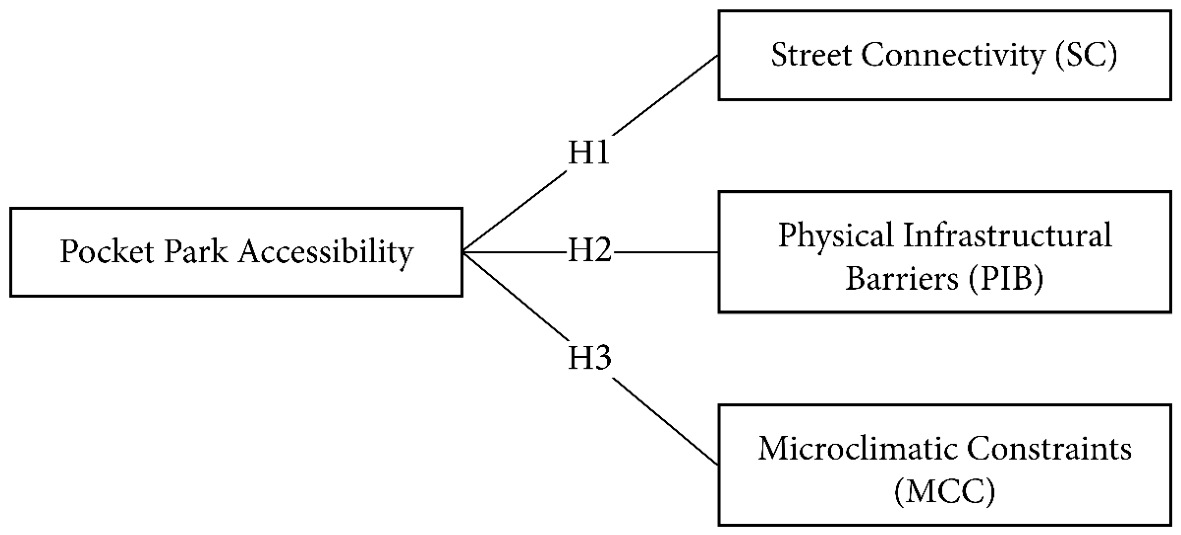
Figure 2.
Hayy Al Ain Park and examples of the surrounding streets used to access the park.
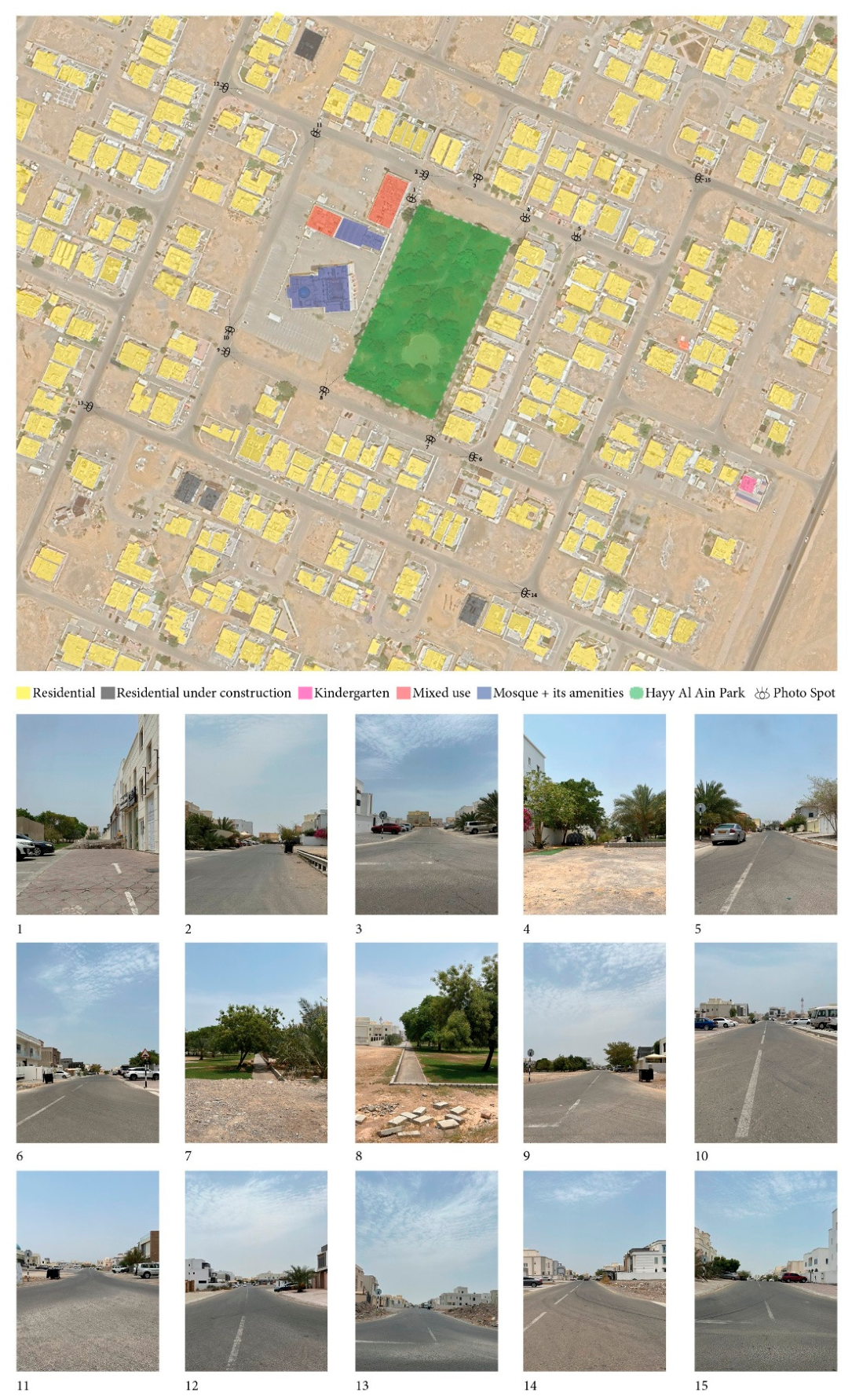
Figure 3.
Respondent characteristics, park-use patterns, residential proximity, and perceived pedestrian accessibility constraints associated with Hayy Al Ain Park.
Figure 3.
Respondent characteristics, park-use patterns, residential proximity, and perceived pedestrian accessibility constraints associated with Hayy Al Ain Park.
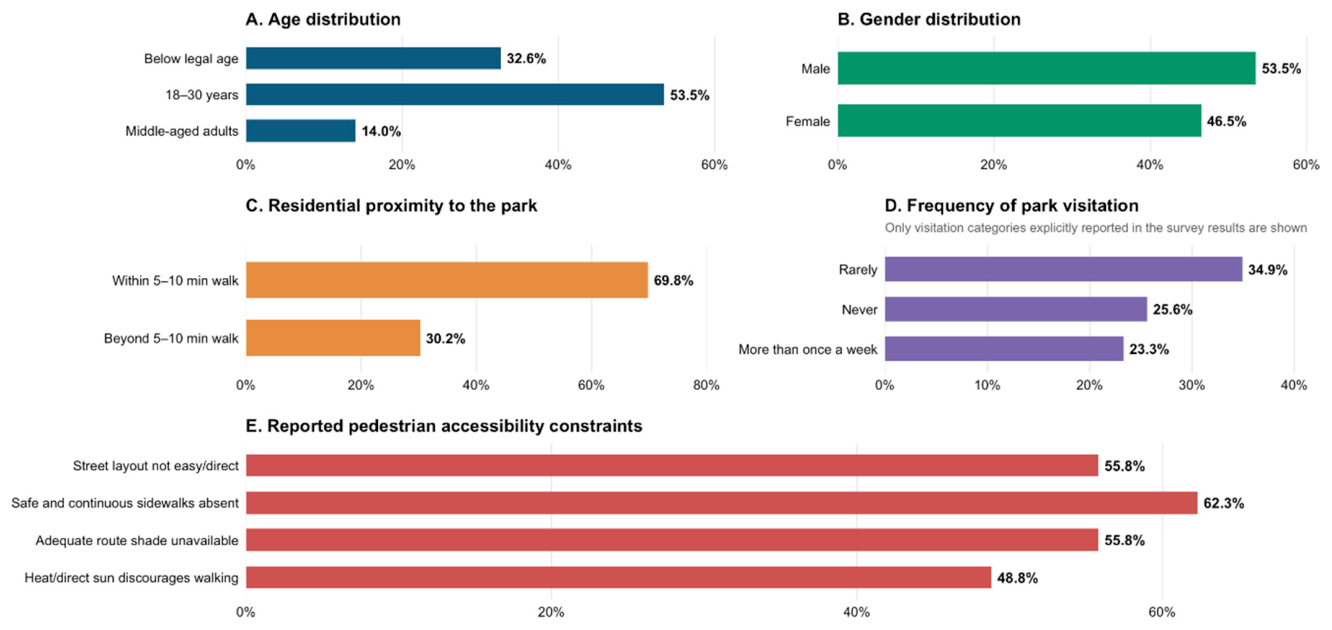

Table 1.
Measurement items used in the survey.
| Construct | Code | Survey item |
| Street Connectivity | SC1 | The street layout and routes leading directly to the park gates are straightforward, direct, and easy to navigate. |
| SC2 | The street network allows me to walk smoothly from my house to the park without an excessive number of confusing turns. | |
| Physical Infrastructural Barriers | PIB1 | There are sidewalks that lead to the park. |
| PIB2 | The sidewalks leading to the park are continuous, properly paved, and free of physical damage. | |
| PIB3 | Pedestrian paths to the park are clear of structural blockages such as parked cars, utility poles, or construction materials. | |
| PIB4 | I feel physically safe from high-speed vehicular traffic and moving cars when walking toward the park. | |
| PIB5 | Intersections and street crossings leading to the park are safe, clearly marked, and easy for pedestrians to negotiate. | |
| Microclimatic Constraints | MCC1 | The primary street corridors leading to the park possess adequate tree-canopy shade to protect pedestrians from the sun. |
| MCC2 | Surrounding buildings or boundary walls provide structural daytime shade along my walking route. | |
| MCC3 | High outdoor temperatures and direct sun exposure along the streets are a primary reason I avoid walking to the park. |
Table 2.
Factor Loadings, AVE, CR, and Cronbach's Alpha.
| Construct | Item | Loading | AVE | CR | Cronbach’s α |
| Street Connectivity (SC) | SC1 | 0.943 | 0.889 | 0.942 | 0.876 |
| SC2 | 0.943 | ||||
| Physical Infrastructural Barriers (PIB) | PIB1 | 0.818 | 0.770 | 0.943 | 0.929 |
| PIB2 | 0.864 | ||||
| PIB3 | 0.931 | ||||
| PIB4 | 0.890 | ||||
| PIB5 | 0.879 | ||||
| Microclimatic Constraints (MCC) | MCC1 | 0.628 | 0.533 | 0.770 | 0.646 |
| MCC2 | 0.685 | ||||
| MCC3 | 0.857 | ||||
| Pocket Park Accessibility (PPA) | PPA1 | 1.000 | 1.000 | 1.000 |
Table 3.
Fornell–Larcker Discriminant Validity Matrix.
| Construct | SC | PIB | MCC | PPA |
| SC | 0.943 | |||
| PIB | −0.843 | 0.877 | ||
| MCC | −0.439 | 0.658 | 0.730 | |
| PPA | 0.092 | −0.166 | −0.518 | 1.000 |
Table 4.
Structural Model Results and Hypothesis Testing.
| Path | β | Mean (M) | 2.5% CI | 97.5% CI |
t- value |
p- value |
f2 | Decision |
| SC → PPA | 0.135 | 0.083 | −0.304 | 0.563 | 0.592 | 0.554 | 0.007 | Not supported; negligible effect |
| PIB → PPA | 0.441 | 0.332 | −0.181 | 0.938 | 1.511 | 0.131 | 0.054 | Not supported; small effect |
| MCC → PPA | −0.748 | −0.698 | −1.041 | −0.370 | 3.280 | 0.001 | 0.433 | Supported; large effect |
Disclaimer/Publisher’s Note: The statements, opinions and data contained in all publications are solely those of the individual author(s) and contributor(s) and not of MDPI and/or the editor(s). MDPI and/or the editor(s) disclaim responsibility for any injury to people or property resulting from any ideas, methods, instructions or products referred to in the content. |
© 2026 by the author. Licensee MDPI, Basel, Switzerland. This article is an open access article distributed under the terms and conditions of the Creative Commons Attribution (CC BY) license.
Copyright: This open access article is published under a Creative Commons CC BY 4.0 license, which permit the free download, distribution, and reuse, provided that the author and preprint are cited in any reuse.