

Submitted:
30 September 2026
Posted:
02 October 2026
You are already at the latest version
Abstract
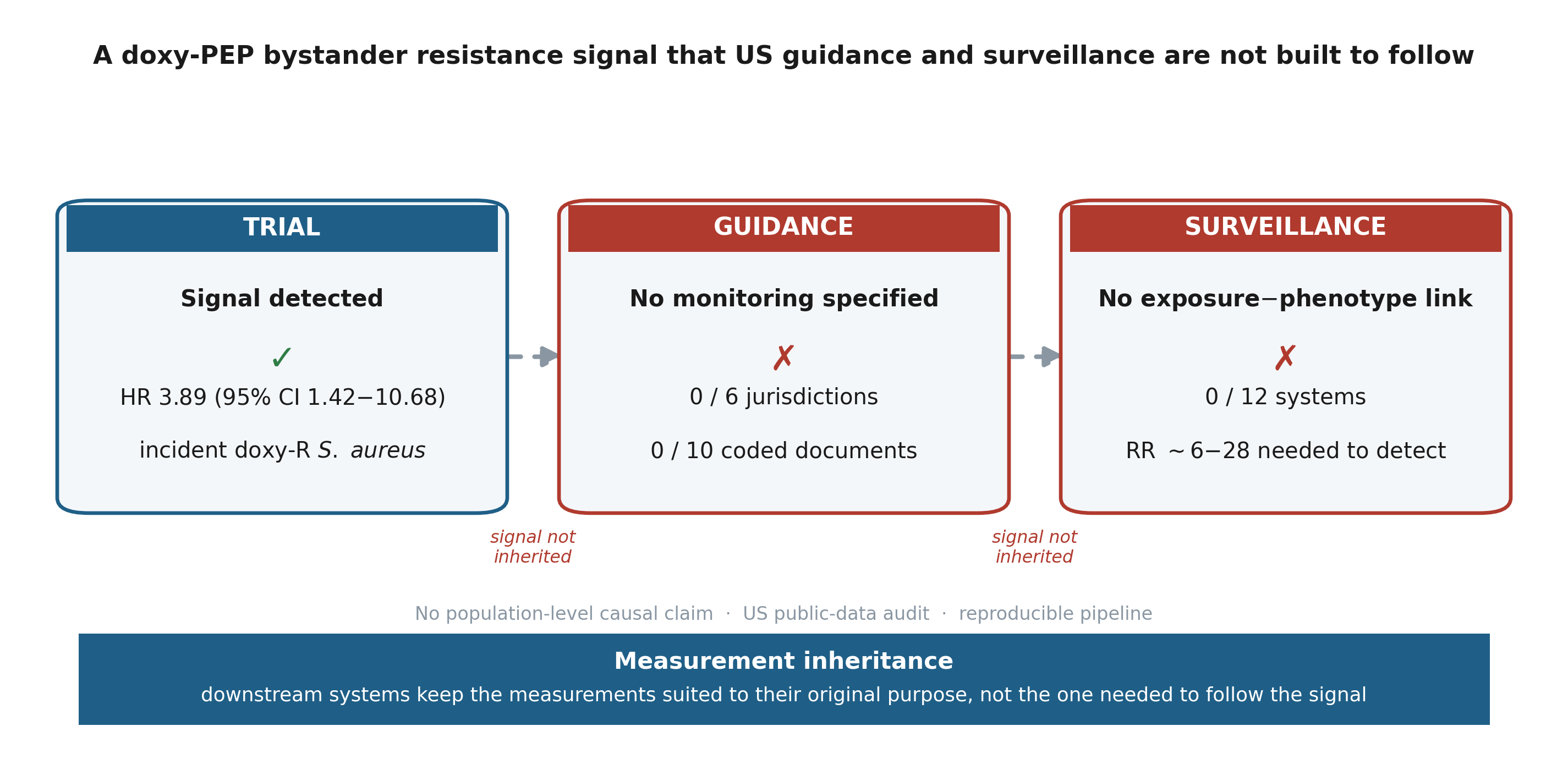
Background: Doxycycline post-exposure prophylaxis (doxy-PEP) prevents bacterial sexually transmitted infections and has scaled into guidance internationally. Doxycycline also selects tetracycline resistance beyond its target, and Staphylococcus aureus - a commensal and pathogen for which doxycycline is one of a limited number of oral options - is a clinically relevant bystander. Objectives: To determine whether the guidance and surveillance deployed around doxy-PEP could follow the bystander-resistance signal the pivotal trial's final analysis resolved, rather than to estimate a population effect. Methods: We conducted a reproducible public-data audit of clinical trials, governmental guidance and deployed US surveillance. Trials and surveillance were evaluated against externally specified relative-risk benchmarks; guidance was assessed for whether S. aureus monitoring was specified. Results: The final randomised DoxyPEP analysis reported a 3.89-fold higher hazard of incident doxycycline-resistant S. aureus under doxy-PEP (95% CI 1.42-10.68; 68 of 393 versus 5 of 163 incident events), with no effect on colonisation clearance. Yet 0 of 6 outbreak-matched governmental guidelines (0 of 10 coded) required S. aureus monitoring, and 0 of 12 established US surveillance systems linked doxy-PEP exposure to an S. aureus tetracycline phenotype at a common population denominator. Under realistic exposure-density and isolate-volume assumptions, population surveillance would require a within-exposed RR of approximately 6-28 to produce a detectable rate change. Conclusions: The final trial resolved a doxycycline-resistant S. aureus signal that current guidance and US surveillance are not configured to monitor. Following the signal requires sentinel surveillance linking doxy-PEP exposure to the S. aureus tetracycline phenotype at a common denominator. No population-level causal claim is made.
Keywords:
doxycycline post-exposure prophylaxis
; antimicrobial resistance
; S. aureus
; tetracycline resistance
; surveillance
; measurement inheritance
Copyright: This open access article is published under a Creative Commons CC BY 4.0 license, which permit the free download, distribution, and reuse, provided that the author and preprint are cited in any reuse.