

Submitted:
30 September 2026
Posted:
02 October 2026
You are already at the latest version
Abstract
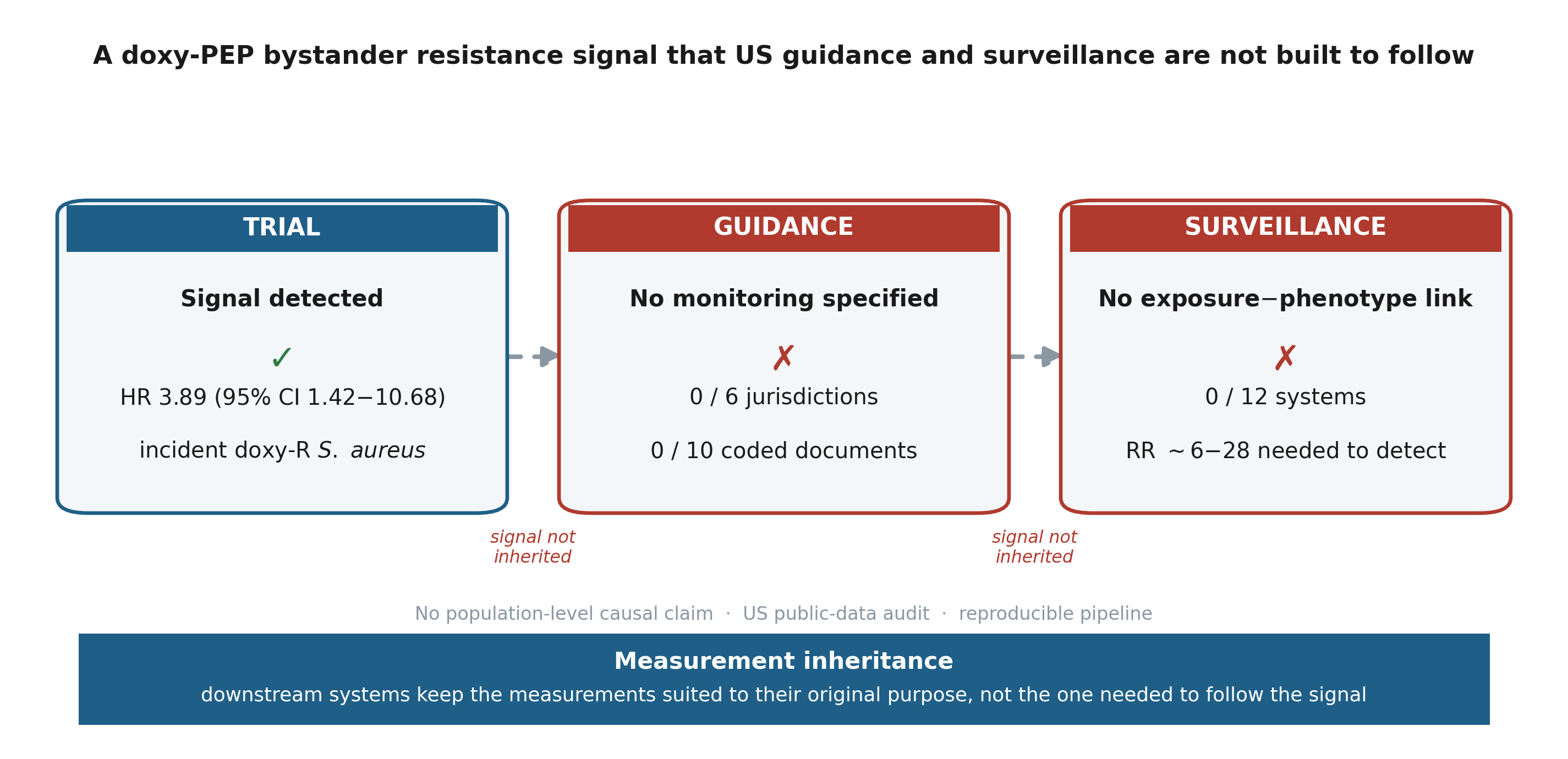
Background: Doxycycline post-exposure prophylaxis (doxy-PEP) prevents bacterial sexually transmitted infections and has scaled into guidance internationally. Doxycycline also selects tetracycline resistance beyond its target, and Staphylococcus aureus - a commensal and pathogen for which doxycycline is one of a limited number of oral options - is a clinically relevant bystander. Objectives: To determine whether the guidance and surveillance deployed around doxy-PEP could follow the bystander-resistance signal the pivotal trial's final analysis resolved, rather than to estimate a population effect. Methods: We conducted a reproducible public-data audit of clinical trials, governmental guidance and deployed US surveillance. Trials and surveillance were evaluated against externally specified relative-risk benchmarks; guidance was assessed for whether S. aureus monitoring was specified. Results: The final randomised DoxyPEP analysis reported a 3.89-fold higher hazard of incident doxycycline-resistant S. aureus under doxy-PEP (95% CI 1.42-10.68; 68 of 393 versus 5 of 163 incident events), with no effect on colonisation clearance. Yet 0 of 6 outbreak-matched governmental guidelines (0 of 10 coded) required S. aureus monitoring, and 0 of 12 established US surveillance systems linked doxy-PEP exposure to an S. aureus tetracycline phenotype at a common population denominator. Under realistic exposure-density and isolate-volume assumptions, population surveillance would require a within-exposed RR of approximately 6-28 to produce a detectable rate change. Conclusions: The final trial resolved a doxycycline-resistant S. aureus signal that current guidance and US surveillance are not configured to monitor. Following the signal requires sentinel surveillance linking doxy-PEP exposure to the S. aureus tetracycline phenotype at a common denominator. No population-level causal claim is made.
Keywords:
doxycycline post-exposure prophylaxis
; antimicrobial resistance
; S. aureus
; tetracycline resistance
; surveillance
; measurement inheritance
1. Introduction
Doxycycline post-exposure prophylaxis (doxy-PEP) substantially reduces bacterial sexually transmitted infections (STIs) and has moved quickly from trial result into guidance at every level, from the World Health Organization through national and municipal health departments.[1,2] Each doxycycline exposure also exerts selective pressure on organisms beyond the intended STI targets. Staphylococcus aureus is a clinically relevant bystander: it colonises the anatomical sites these trials swabbed and carries mobile tetracycline resistance determinants.[3] For two decades, community MRSA in these networks has been documented not as steady-state carriage but as clustered, outbreak-pattern transmission, with the USA300 lineage moving through sexual networks in San Francisco, Tokyo and Chicago.[4,5] The organism colonising these networks is the same one carried on skin community-wide, so resistance selected within the network could, if transmitted, extend beyond it. Tetracycline-resistant USA300 was in fact documented in an MSM-predominant community health population two decades ago, although by the doxycycline-sparing tet(K) mechanism, with those isolates remaining doxycycline-susceptible.[6] Doxycycline is one of a limited number of oral options for outpatient skin and soft-tissue infection, a choice often made empirically before any methicillin result returns,[7,8] so tetracycline susceptibility can matter clinically before methicillin status is known.
Clinicians who prescribe doxy-PEP have registered antimicrobial-resistance concerns directly, but those concerns have largely been framed around familiar targets. In a survey of Italian STI-clinic dermatologists, 91.7% named methicillin-resistant S. aureus (MRSA) selection as a worry, tied with gonococcal resistance as the highest-rated concern,[9] while a systematic review of 1840 healthcare professionals across four countries likewise placed antimicrobial resistance among the leading concerns about doxy-PEP.[10] That framing does not capture the full tetracycline-resistance question in S. aureus. In a military cohort of 168 personnel receiving doxycycline for malaria prophylaxis, overall tetracycline-class resistance in S. aureus did not differ by exposure, while tet(M) determinants were significantly more common among doxycycline-exposed personnel (), despite no corresponding difference in aggregate tetracycline-class resistance.[11]
The final DoxyPEP analysis provided a more direct test. Among participants free of doxycycline-resistant S. aureus at baseline, doxy-PEP carried a 3.89-fold higher hazard of incident doxycycline-resistant S. aureus (95% CI 1.42–10.68; 68/393 versus 5/163; ), while the hazard of clearing colonisation did not differ between arms (HR 1.01, 0.69–1.46).[12] The trial’s authors called for public-health surveillance of antimicrobial resistance in S. aureus and other commensals. One national programme has since begun to address that call: the UK Health Security Agency’s 2026 doxy-PEP monitoring plan for England proposes tetracycline-resistance surveillance in bystander pathogens, naming S. aureus.[13]
Whether existing guidance and surveillance can follow that trial-resolved signal remains unclear. We ask not whether doxy-PEP drives population-level resistance—a claim we do not make—but whether deployed guidance and surveillance can follow the signal at the population level where the clinical stake lies. The clinically decisive axis is tetracycline (doxycycline) susceptibility used in empirical oral therapy, not the methicillin axis around which staphylococcal surveillance is organised. We therefore audited three points in the evidence chain—trials, governmental guidance and deployed surveillance—within a common detectability framework.
2. Materials and Methods
2.1. Ethics
This study analysed publicly available guidance, surveillance documentation and aggregate published data; it did not involve individual-level human-participant data, and institutional review board approval was therefore not required.
2.2. Design
The study is a documentary and quasi-computational audit assembled in three streams, collected and analysed in sequence: clinical trials (Stream A), the governmental guidance built on them (Stream B) and the population surveillance meant to monitor them (Stream C). No individual-level or restricted data were used; every input is public. All source documents were read in full, coded with page, section or table locators, and SHA-256-pinned before analysis. Analytic decisions with multiple reasonable specifications were date-logged before results were known. The test-gated analysis pipeline is archived with a citable DOI and regenerates every figure and table from a single command.[14] Large language model use is disclosed in the Acknowledgements.
2.3. Detectability Framework
The three streams were evaluated within a common detectability framework: whether each could resolve a bystander-resistance signal and, where quantifiable, at what effect magnitude. For the trial and surveillance streams, detectability can be expressed quantitatively against an externally specified relative-risk benchmark; for guidance, the corresponding question is whether S. aureus measurement is specified at all. The empirical benchmark is Soge et al. [15] (tetracycline-resistant S. aureus colonisation, 18% versus 8% in doxy-PEP users with >3 doses/month versus non-users; RR ≈ 2.25); a cross-organism gonococcal RR ≈ 1.42 is retained as a prespecified, more conservative secondary benchmark.
Hazard ratio and risk ratio are different estimands, so the trial estimate is used only as a magnitude reference, not as a numerically equivalent effect measure.
2.4. Sources and Coding
The author identified, retrieved and screened all source documents for eligibility. Each eligible document was then coded from full text against a prespecified schema, and each coded item included a page, section or table locator. For the guidance corpus (Stream B), a first LLM pass coded all 10 documents against the schema. A second, blinded pass—run through a chat interface rather than the command-line agent, but within the same model family—separately re-coded a 5-document subsample (25 field-codings) for reliability. Disagreements were resolved by the author against the source. Per-field agreement is reported as raw concordance, which measures the reproducibility of the coding protocol rather than its accuracy; because the passes share a model family their errors are not independent, so a Cohen’s is given for context only (Limitations). The surveillance enumeration (Stream C) was coded by a single pass; its inclusion and exclusion list, with a stated reason per system, is given in the Supplementary data and reflects systems as deployed as of August 2026. All coding prompts and outputs are in the public repository.
2.5. Stream A—Trials
For each primary-trial S. aureus arm comparison (first-party published data only), we computed, from arm sizes and observed control rate, the exact (Fisher) power to detect the externally fixed benchmark effect and the minimum detectable RR at 80% power; fixing the effect externally makes this a design-based sensitivity analysis rather than observed power. The S. aureus assay is doxycycline throughout (E-test, MIC ≥ 16 mg/L). We tabulated how the resistance result was reported across trial venues and secondary syntheses (numerator, denominator basis, conditioning set and terminology). The final trial performed a participant-level time-to-event analysis itself; we cite that randomised result directly and did not re-estimate it. Cross-sectional carriage alone does not resolve the clustered transmission structure of S. aureus in these networks; the supporting dispersion, trend-test degradation and outbreak-shape analyses are MRSA-scoped (MRSA being a subset, not the analytic unit) and are reported in the Supplementary data.
2.6. Stream B—Guidance
The guidance sampling frame comprised US jurisdictions with documented community-associated MRSA/USA300 transmission in men who have sex with men, using the same clustering evidence as Stream A.[4,5] We included governmental public-health guidance only; clinic and provider-organisation documents were excluded with reasons. Each document was coded from full text, one record per document, with a locator for whether it requires, suggests or omits S. aureus monitoring and whether it names, counsels on or measures the organism. An independence check distinguished independently authored non-monitoring decisions from documents adapted from, or deferring to, another source.
2.7. Stream C—Surveillance
We examined a prespecified set of 12 established US surveillance and data systems (federal, state or metropolitan) plausibly capable of capturing, at the required level, either doxy-PEP/doxycycline exposure or S. aureus AMR phenotype, and coded each on three capabilities: exposure-side capture, phenotype-side capture (of the S. aureus tetracycline unit, not the MRSA subset) and the join, recording the geographic resolution of each side. A supporting analysis asked whether, even at a common denominator, the exposed subgroup is dense enough to move a population rate. The exposed population is indexed on the combined PrEP and people-living-with-HIV male count, the primary specification, because the trial enrolled both (AIDSVu 2024 state PrEP and prevalence). The dilution fraction is , where d is the share of users taking >3 doses/month (the subgroup carrying the benchmark effect) and the isolate-enrichment factor. Because f tracks exposure density rather than headcount it is population-independent, and the minimum detectable change in a proportion near baseline inverts to . Parameter choices were deliberately mixed: isolate volume was set high to favour detection, while the realistic under-sampling () and dose-threshold () factors bound against it. Both ranges and the resulting are reported; full grids and the metropolitan break-even are in the Supplementary data.
2.8. Scope
The corpus and the surveillance enumeration were restricted by design: Stream C is a prespecified set of US systems, and Stream B is US governmental guidance with the World Health Organization included only as the international apex reference. The resulting counts describe US architecture, not a global census.
3. Results
3.1. Stream A: Trial Measurement and Reporting of the S. aureus Endpoint
The final DoxyPEP analysis ran the participant-level test the interim had not—time to first detection of doxycycline-resistant S. aureus by arm, standard-of-care censored at crossover, by Cox proportional hazards—and returned HR 3.89 (95% CI 1.42–10.68; ), with colonisation clearance unchanged (HR 1.01).[12] The 2023 interim, by contrast, was presented as reassuring on a cross-sectional resistance fraction and was underpowered for any externally specified effect (0 of 4 comparisons powered; minimum detectable RR 3.8–5.1 against the benchmark 1.42–2.25). The hazard ratio is not comparable to that cross-sectional minimum; the difference therefore reflects a change in estimand rather than sample size alone.
Two features of the interim reporting remained relevant to downstream interpretation. First, a unit mismatch: the trial’s data table is headed “phenotypic resistance to the tetracycline antibiotic class” while its methods define the S. aureus assay as doxycycline, and the federal guideline then describes the doxycycline result as “tetracycline resistance in S. aureus”.[2] Because efflux and ribosomal-protection mechanisms differ in whether doxycycline still works (below), an endpoint scored as “the tetracycline class” does not answer the treatment-relevant question. Second, the signal was reported over differing, incompletely documented denominators and then propagated into secondary reporting under further contrasts (Table 1): the resistant numerator changes from 5 to 16 to 28 and the denominator basis shifts from colonised carriers to all-swabbed. The percentage therefore propagated more consistently than the denominator, contrast and terminology needed to interpret it. The individual-level data that could reconcile these first-party reports are not publicly available.[1]
Across trials the phenotype was measured on incompatible terms: DoxyPEP measured doxycycline resistance by E-test over two denominators; DuDHS measured it by disc diffusion in single-digit carriers; DOXYVAC measured only MRSA carriage—a methicillin, not a tetracycline, quantity, and one that itself rose within the doxy-PEP arm (1.8% to 9.9%) while being reported as a between-arms null.[16] A pooled estimate is not defensible. Even the intensively surveilled gonococcus was phenotyped in fewer than one diagnosis in five (resistance testing unavailable for 83%, 212/256).[17]
The estimand shift did not propagate downstream: no guidance document in the corpus cites the final time-to-event analysis or any hazard ratio, and the two documents revised after its online publication in March 2025—WHO (2026) and San Francisco (May 2026)—retained a cross-sectional or generic frame. This contrasts with the transmission of earlier cross-sectional values: CDC retained the 5%→13% figures and WHO cites Soge’s colonisation estimate.[15]
3.2. Stream B: S. aureus monitoring requirements in governmental guidance
Within the governmental guidance, efficacy and AMR harms were treated differently. The efficacy question received a graded, systematic evidence review, whereas the AMR-harm question—explicitly including resistant-pathogen development—received an ungraded review in the same document. Of the six documented-outbreak jurisdictions with governmental doxy-PEP guidance (San Francisco, Chicago, New York City, Boston/Massachusetts, Los Angeles County and San Diego), 0 require or suggest S. aureus monitoring. The pattern was not explained by document derivation: four jurisdictions were independently authored, one (Los Angeles County) was adapted from San Francisco and one (Massachusetts) from an external template. Three of the six name S. aureus specifically, two invoke only a generic “microbiome” risk and one is silent; even where named, none measure it. Across the full coded corpus (10 documents: CDC, WHO and eight US jurisdictions) the result is identical: none require S. aureus monitoring. Double-coding of a 5-of-10-document subsample (25 field-codings) gave 92% raw agreement (23/25); the one field with meaningful disagreement (bystander treatment; ) is reported unrounded. Providers are nonetheless required to counsel patients about resistance in commensal organisms despite no corresponding requirement to monitor S. aureus resistance.
3.3. Stream C: Surveillance Capability and Exposure–Phenotype Linkage
Following the signal requires one system to carry, at a common population denominator, both who is exposed to doxy-PEP and what tetracycline phenotype S. aureus carries. Across this prespecified set of twelve systems, none does (Figure 1). Two systems capture exposure at a population denominator (AIDSVu and CDC AtlasPlus, as a pre-exposure prophylaxis proxy, not doxy-PEP itself),[20] and zero capture S. aureus tetracycline resistance at a population denominator, so population-level linkage is not possible.
No assessed population-based system reports S. aureus tetracycline susceptibility. Wherever S. aureus is surveilled at a population denominator, the reported axis is methicillin: the population-based Active Bacterial Core surveillance/Emerging Infections Program (ABCs/EIP) reports invasive MRSA, and the National Healthcare Safety Network reports MRSA events. The only routine source of S. aureus tetracycline susceptibility, the facility cumulative antibiogram, is non-standardised and carries no population denominator; CLSI M39 mandates the MRSA/MSSA split and makes tetracycline a selectively suppressible supplemental agent. The National Antimicrobial Resistance Monitoring System excludes S. aureus altogether, and tetracycline-resistant S. aureus is not nationally notifiable in the United States. A system could be built—most directly by adding S. aureus tetracycline susceptibility to ABCs/EIP, which already holds the denominator—but none is deployed. The gap is therefore structural rather than a consequence of insufficient isolate volume.
Nor could an ordinary population system recover the missing side by collecting more isolates. Indexing the exposed population on the combined PrEP and people-living-with-HIV male count—the primary specification, because the trial enrolled both (Materials and methods)—the realistic-cell within-exposed effect required to move a population rate runs to RR ≈ 6–28 across the design-effect range (Figure 2); the more restrictive PrEP-only indexing gives RR ≈ 14–64, which overstates infeasibility. Both ranges exceed the prespecified benchmark range under realistic assumptions. Detection appears in a single grid cell in which all assumptions are simultaneously set to their most detection-favourable values ( 1.03, or 1.79 under single-comparison inference; parameters in the Supplementary data). Detectability is driven by quantities no deployed system reports directly—exposure density, isolate enrichment and dosing frequency. Against the more conservative cross-organism benchmark (RR 1.42), the best metropolitan cell needs about twice the combined male exposure density of the densest US geography (Washington, D.C.), and realistic cells far more. The only configuration that restores sensitivity is to sample S. aureus directly from doxy-PEP-exposed persons, converting surveillance into a sentinel cohort.
The three streams are summarised against the detectability framework in Table 2; a PubMed literature-coverage analysis of the bystander organism (361 papers, of which few name or measure it) is reported in the Supplementary data (S5).
4. Discussion
The final DoxyPEP analysis identified a significant increase in incident doxycycline-resistant S. aureus and called for surveillance of AMR in commensal organisms.[12] Our audit found that downstream systems are not configured to provide it: none of the assessed guidance requires S. aureus monitoring (0/6 outbreak-matched; 0/10 coded), and none of the 12 surveillance systems links doxy-PEP exposure to the relevant tetracycline phenotype at a common population denominator.
This mismatch is not explained by absence of a trial signal. The trial analysis evolved from a cross-sectional resistance fraction to a participant-level time-to-event estimand, whereas guidance and surveillance retained the earlier measurement structure.[21]
4.1. Tetracycline Resistance Mechanisms and the Phenotype Unit
Staphylococcal surveillance is standardised around methicillin, yet the treatment-relevant axis here is tetracycline susceptibility, used empirically before methicillin status is known, so the two axes are orthogonal. The molecular basis of tetracycline resistance is likewise heterogeneous: tet(K) efflux leaves doxycycline largely usable whereas tet(M) ribosomal protection can compromise it, and the trial resolved incident doxycycline resistance without resolving which.[3,8] Of 823 invasive USA300 isolates in national surveillance, 72 (9%) were tetracycline-resistant, yet 69 were doxycycline-susceptible tet(K) and only 3 doxycycline-resistant tet(M)[22]—a single breakpoint that combines mechanisms with different implications for doxycycline susceptibility. A surveillance variable can therefore remain valid for its original purpose while failing to distinguish the mechanism relevant to the new question. We do not forecast which mechanism is spreading.
4.2. Instrument Requirements for Population Monitoring
The core requirement is an exposure-linked sentinel cohort. It would sample S. aureus from doxy-PEP-exposed individuals, fixing the exposed fraction and the denominator, and would include the oropharyngeal and peri-anal sites, since nares-only screening under-detects colonisation by about 20% in this population.[23] It would report resistance per carrier and by mechanism (tet(M) versus tet(K)) rather than as a pooled tetracycline-class rate, and record dosing frequency rather than prescription status. Finally, it would carry S. aureus tetracycline susceptibility at a population denominator—most directly by adding it to the platform that already tracks invasive MRSA—joined to exposure on geography, with access to individual-level trial data. These components are technically feasible but are not deployed together at scale.
England’s national doxy-PEP monitoring plan is an instructive out-of-frame case. Outside our prespecified US corpus, it nonetheless proposes the phenotype half we find nowhere—tetracycline resistance in bystander pathogens including S. aureus—through routine laboratory AMR surveillance.[13] Yet its specimens come mainly from hospitalised patients; it records neither doxy-PEP use nor sexual orientation; and its exposure contrast is therefore a male-to-female resistance ratio in an 18–45 age band, an STI-surveillance conditioning set that may not capture S. aureus epidemiology. The same programme already runs exposure-linked sentinel surveillance that records recent doxy-PEP use, but only for gonorrhoea. The programme therefore shows that exposure-linked sentinel infrastructure is feasible, but it is currently applied to gonorrhoea rather than S. aureus.
These failures share a common structure. A guideline or surveillance system retains the sampling frame, cadence, coding, denominator and unit suited to the question for which it was designed. In doxy-PEP, the downstream bystander question therefore inherits a denominator affected by the intervention, a phenotype label that spans distinct resistance mechanisms and surveillance organised around methicillin. We term this pattern measurement inheritance. A downstream system retains measurement dimensions suited to the upstream question—unit, exposure, phenotype, denominator, cadence, linkage and measurement responsibility—even when the later question requires different dimensions. The required data may therefore exist separately while the downstream question remains unanswerable. The construct draws on familiar problems but concerns how they couple across stages of an evidence chain.[24,25] The gap is therefore not resolved by further analysis of the trial result; it is a property of the guidance and surveillance systems.
Potential resistance costs may accrue beyond the doxy-PEP recipient population, including patients treated empirically for skin and soft-tissue infection and higher-risk patients in whom oral anti-staphylococcal options are limited. Because current systems do not quantify this potential externality, it cannot be incorporated into a population-level benefit–harm assessment. The wider asymmetry—which we term distributive observability—is developed in the Supplementary data (S6).[26]
4.3. Limitations
We make no population-level causal claim and no transmission claim: whether the individual-level signal propagates into a population externality is precisely what no deployed system can determine. We did not re-estimate or dispute the trial’s randomised result. Colonisation is not infection, and the colonisation–infection link is itself unmeasured here. Much of the evidence for how S. aureus clusters and moves through these networks exists only for its MRSA subset, so where our clustering analysis relies on MRSA we mark it as such. Finally, the trial reaches only a roughly twelve-month horizon; persistence, dose–response and mechanism remain open. Our coding carries two asymmetries. The guidance corpus was double-coded on a 5-document subsample by two passes run through different interfaces—a command-line agent and a chat interface—but the same model family, so their errors are not independent; the 92% concordance measures the reproducibility of the coding protocol, not its accuracy. The surveillance enumeration was coded by a single pass. The measurement-inheritance interpretation would be falsified by deployment of guidance requiring S. aureus monitoring or a surveillance system linking doxy-PEP exposure to the relevant S. aureus tetracycline phenotype at a common population denominator; a proposed national programme does not yet meet this standard.[13]
4.4. Conclusions
The randomised trial identified a bystander-resistance signal that current guidance and surveillance are not configured to monitor. The gap is one of measurement architecture and is addressable through sentinel surveillance linking doxy-PEP exposure with the S. aureus tetracycline phenotype at a common denominator. Until such surveillance exists, the population-level question raised by the trial cannot be answered.
Supplementary Materials
The following supporting information can be downloaded at the website of this paper posted on Preprints.org.
Funding
This work received no specific grant from any funding agency in the public, commercial or not-for-profit sectors. It was conducted as an unfunded investigator-initiated study.
Data Availability Statement
All data are public (AIDSVu; published trials and guidelines) and all analysis code is openly available (https://github.com/Nyx-Dynamics/doxypep-bystander) and archived at Zenodo (doi:10.5281/zenodo.22747669),[27] regenerating every figure and table by a single command; every coded source is SHA-256-pinned. No restricted-access data were used.
Acknowledgments
A large language model was used for writing and analysis-engineering assistance beyond copyediting. The scientific argument, the reading of primary sources, the model specification and all conclusions are the author’s own; the author reviewed all generated content, independently verified every numerical value and quotation against primary sources and the regenerable analysis outputs, and takes full responsibility. No artificial-intelligence tool is credited as an author.
Conflicts of Interest
A. C. D. reports former employment at Gilead Sciences (2020–2024) with prior ownership of corporate stock, all divested by 2024; Gilead played no role in this work. A. C. D. is sole owner of Nyx Dynamics, LLC. No other conflicts to declare.
References
- Luetkemeyer, A.F.; Donnell, D.; Dombrowski, J.C.; et al. Postexposure doxycycline to prevent bacterial sexually transmitted infections. N Engl. J. Med. 2023, 388, 1296–1306. [Google Scholar] [CrossRef]
- Bachmann, L.H.; Barbee, L.A.; Chan, P.; Reno, H.; Workowski, K.A.; Hoover, K.; Mermin, J.; Mena, L.; et al. CDC clinical guidelines on the use of doxycycline postexposure prophylaxis for bacterial sexually transmitted infection prevention, United States, 2024. MMWR Recomm. Rep. 2024, 73, 1–8. [Google Scholar] [CrossRef]
- Grossman, T.H. Tetracycline antibiotics and resistance. Cold Spring Harb. Perspect. Med. 2016, 6, a025387. [Google Scholar] [CrossRef]
- Diep, B.A.; Chambers, H.F.; Graber, C.J.; Szumowski, J.D.; Miller, L.G.; Han, L.L.; Chen, J.H.; Lin, F.; Lin, J.; Phan, T.H.; et al. Emergence of multidrug-resistant, community-associated, methicillin-resistant Staphylococcus aureus clone USA300 in men who have sex with men. Ann. Intern Med. 2008, 148, 249–257. [Google Scholar] [CrossRef]
- de Jong, G.M.; van der Boor, S.C.; van Bokhoven, C.; et al. Methicillin-resistant Staphylococcus aureus (MRSA) in men having sex with men (MSM): a systematic review. BMC Infect. Dis. 2025, 25, 299. [Google Scholar] [CrossRef]
- Han, L.L.; McDougal, L.K.; Gorwitz, R.J.; Mayer, K.H.; Patel, J.B.; Sennott, J.M.; Fontana, J.L. High frequencies of clindamycin and tetracycline resistance in methicillin-resistant Staphylococcus aureus pulsed-field type USA300 isolates collected at a Boston ambulatory health center. J. Clin. Microbiol. 2007, 45, 1350–1352. [Google Scholar] [CrossRef]
- Stevens, D.L.; Bisno, A.L.; Chambers, H.F.; Dellinger, E.P.; Goldstein, E.J.C.; Gorbach, S.L.; Hirschmann, J.V.; Kaplan, S.L.; Montoya, J.G.; Wade, J.C. Practice guidelines for the diagnosis and management of skin and soft tissue infections: 2014 update by the Infectious Diseases Society of America. Clin. Infect. Dis. 2014, 59, e10–e52. [Google Scholar] [CrossRef]
- Liu, C.; Bayer, A.; Cosgrove, S.E.; Daum, R.S.; Fridkin, S.K.; Gorwitz, R.J.; Kaplan, S.L.; Karchmer, A.W.; Levine, D.P.; Murray, B.E.; et al. Clinical practice guidelines by the Infectious Diseases Society of America for the treatment of methicillin-resistant Staphylococcus aureus infections in adults and children. Clin. Infect. Dis. 2011, 52, e18–e55. [Google Scholar] [CrossRef]
- Donà, M.G.; Zaccarelli, M.; Giuliani, E.; et al. Doxycycline postexposure prophylaxis: a cross-sectional survey on knowledge, attitudes and prescribing practices among Italian dermatologists of sexually transmitted infection centers. Ital. J. Dermatol. Venereol. 2026, 161, 120–125. [Google Scholar] [CrossRef]
- Spence, M.; Fowler, C.; Absalom, S.; Roper, T.; Williams, D.; Richardson, D. Healthcare professionals’ beliefs and concerns about the use of doxycycline post-exposure prophylaxis (doxyPEP): a systematic review. Venereology 2026, 5, 9. [Google Scholar] [CrossRef]
- Mende, K.; Beckius, M.L.; Zera, W.C.; Yu, X.; Li, P.; Tribble, D.R.; Murray, C.K. Lack of doxycycline antimalarial prophylaxis impact on Staphylococcus aureus tetracycline resistance. Diagn. Microbiol. Infect. Dis. 2016, 86, 211–220. [Google Scholar] [CrossRef]
- Luetkemeyer, A.F.; Donnell, D.; Cohen, S.E.; et al. Doxycycline to prevent bacterial sexually transmitted infections in the USA: final results from the DoxyPEP multicentre, open-label, randomised controlled trial and open-label extension. Lancet Infect. Dis. 2025, 25, 873–883. [Google Scholar] [CrossRef]
- UK Health Security Agency. Monitoring and evaluation plan of doxycycline post-exposure prophylaxis (doxyPEP). https://www.gov.uk/government/publications/doxypep-monitoring-and-evaluation/monitoring-and-evaluation-plan-of-doxycycline-post-exposure-prophylaxis-doxypep, 2026. Guidance. applies to England, published 30 April 2026. [Google Scholar]
- Armond, A.C.V.; Cobey, K.D.; Moher, D. Research Integrity definitions and challenges. J. Clin. Epidemiol. 2024, 171, 111367. [Google Scholar] [CrossRef]
- Soge, O.O.; Thibault, C.S.; Cannon, C.A.; et al. Potential impact of doxycycline post-exposure prophylaxis on tetracycline resistance in Neisseria gonorrhoeae and colonization with tetracycline-resistant Staphylococcus aureus and Group A Streptococcus. Clin. Infect. Dis. 2025, 80, 1188–1196. [Google Scholar] [CrossRef]
- Vanbaelen, T.; Manoharan-Basil, S.S.; Kenyon, C. Studies of postexposure prophylaxis with doxycycline should consider population-level selection for antimicrobial resistance. Lancet Infect. Dis. 2024, 24, e606–e607. [Google Scholar] [CrossRef]
- Luetkemeyer, A.F.; Team, D.S. DoxyPEP and antimicrobial resistance in N. gonorrhoeae, commensal Neisseria and S. aureus. Conference on Retroviruses and Opportunistic Infections (CROI), 2023. [Google Scholar]
- Mayer, K.H.; Traeger, M.; Marcus, J.L. Doxycycline Postexposure Prophylaxis and Sexually Transmitted Infections. JAMA 2023, 330, 1381–1382. [Google Scholar] [CrossRef]
- Flores, J.; Davis, A.M.; Hazra, A. Doxycycline Postexposure Prophylaxis to Prevent Bacterial Sexually Transmitted Infection. JAMA 2025, 333, 248–249. [Google Scholar] [CrossRef]
- AIDSVu. State and county PrEP use and PrEP-to-Need Ratio. 2026. Available online: https://aidsvu.org.
- Renson, A.; Montoya, L.; Goin, D.E.; Díaz, I.; Ross, R.K. Pulling Back the Curtain: The Road from Statistical Estimand to Machine-Learning-Based Estimator for Epidemiologists (No Wizard Required). Am. J. Epidemiol. 2025, 194, 3566–3571. [Google Scholar] [CrossRef]
- McDougal, L.K.; Fosheim, G.E.; Nicholson, A.; Bulens, S.N.; Limbago, B.M.; Shearer, J.E.S.; Summers, A.O.; Patel, J.B. Emergence of resistance among USA300 methicillin-resistant Staphylococcus aureus isolates causing invasive disease in the United States. Antimicrob. Agents Chemother. 2010, 54, 3804–3811. [Google Scholar] [CrossRef]
- Kyaw, W.M.; Lee, L.K.; Siong, W.C.; Ping, A.C.L.; Ang, B.; Leo, Y.S. Prevalence of and risk factors for MRSA colonization in HIV-positive outpatients in Singapore. AIDS Res. Ther. 2012, 9, 33. [Google Scholar] [CrossRef]
- Tancredi, S.; Cullati, S.; Chiolero, A. Surveillance bias in the assessment of the size of COVID-19 epidemic waves: a case study. Public Health 2024, 234, 98–104. [Google Scholar] [CrossRef]
- Treem, J.W.; Barley, W.C.; Weber, M.S.; Barbour, J.B. Signaling and Meaning in Organizational Analytics: Coping with Goodhart’s Law in an Era of Digitization and Datafication. J. Comput.-Mediat. Commun. 2023, 28, zmad023. [Google Scholar] [CrossRef]
- Montoya, L.M.; Geng, E.H.; Valancius, M.; Kosorok, M.R.; Petersen, M.L. Effects Among the Affected. Stat. Med. 2025, 44, e70353. [Google Scholar] [CrossRef]
- Demidont, A.C. Guidance and surveillance capability for bystander Staphylococcus aureus tetracycline resistance under doxy-PEP: a three-stream evidence audit — research compendium, 2026. In Software and data compendium. [CrossRef]
Figure 1.
Surveillance architecture for doxy-PEP exposure and Staphylococcus aureus tetracycline resistance. Schematic summary of the 12 US surveillance and data systems assessed. Each quadrant represents the intersection of the measurement target (rows) and denominator structure (columns): (a) doxy-PEP exposure at a population denominator—captured, although only through PrEP-based proxies (AIDSVu and CDC AtlasPlus); (b) doxy-PEP exposure in facility-level data without a population denominator—not applicable to the population-level linkage question; (c) S. aureus tetracycline phenotype at a population denominator—absent, constituting the principal surveillance gap; and (d) S. aureus tetracycline phenotype in facility-level data—present in cumulative antibiograms but unusable for population linkage because no population denominator is retained. No assessed system links the exposure information represented by (a) with the population-level phenotype required in (c); consequently, 0 of 12 systems link doxy-PEP exposure to S. aureus tetracycline phenotype at a common population denominator.
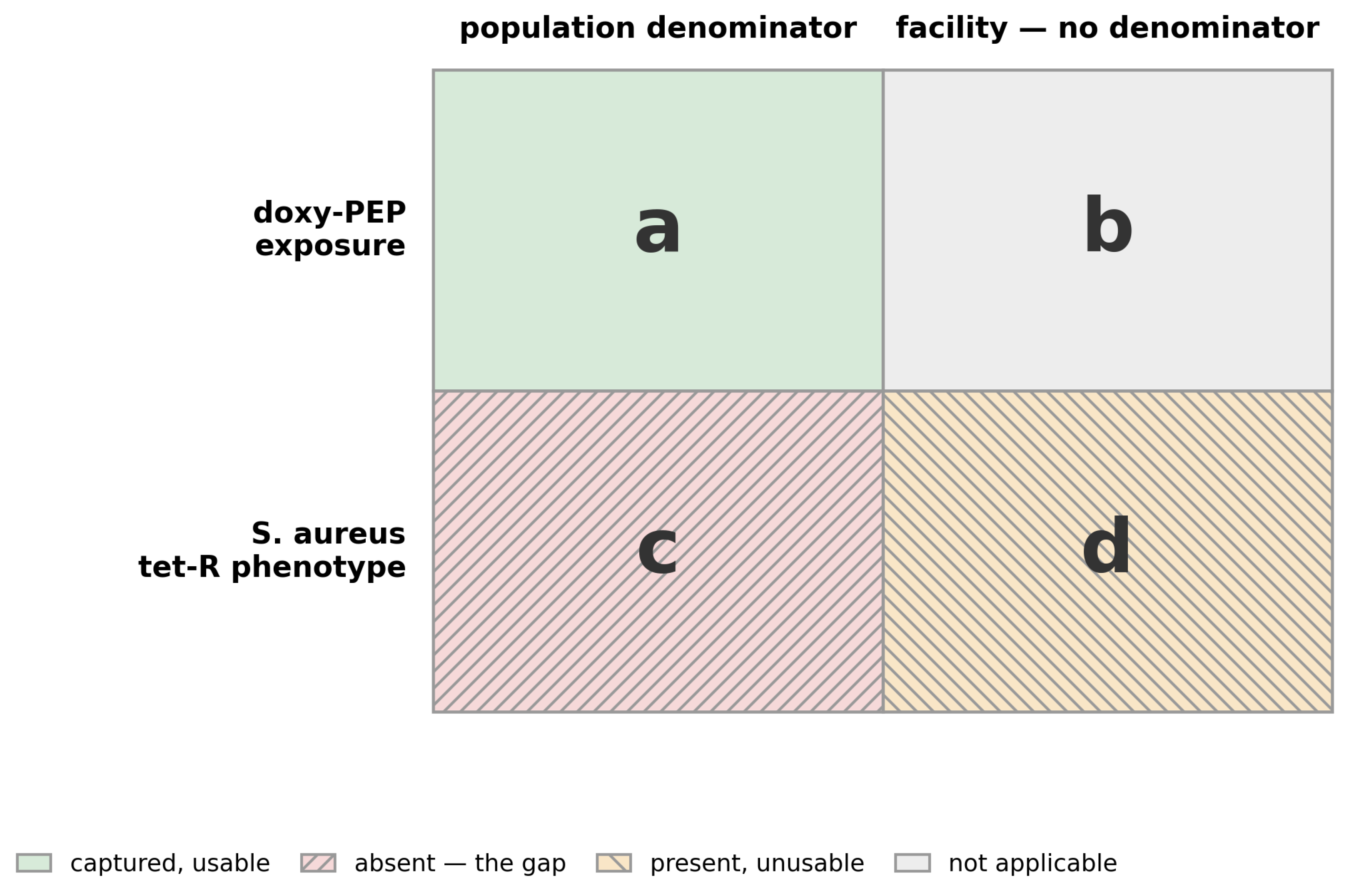
Figure 2.
Detectability of the doxy-PEP-associated S. aureus resistance signal across the three evidence streams. The shaded band shows the empirical benchmark range for within-exposed relative risk (RR 1.42–2.25). The final DoxyPEP trial reported a hazard ratio (HR) of 3.89 for incident doxycycline-resistant S. aureus. Guidance specifies no S. aureus monitoring threshold, whereas modelled population surveillance would require an RR of approximately 6–28 under the primary combined PrEP+PLWH exposure specification; the more restrictive PrEP-only specification requires approximately 14–64. The trial HR is shown only as an empirical magnitude reference and is not numerically interchangeable with the modelled RR thresholds because the estimands differ.
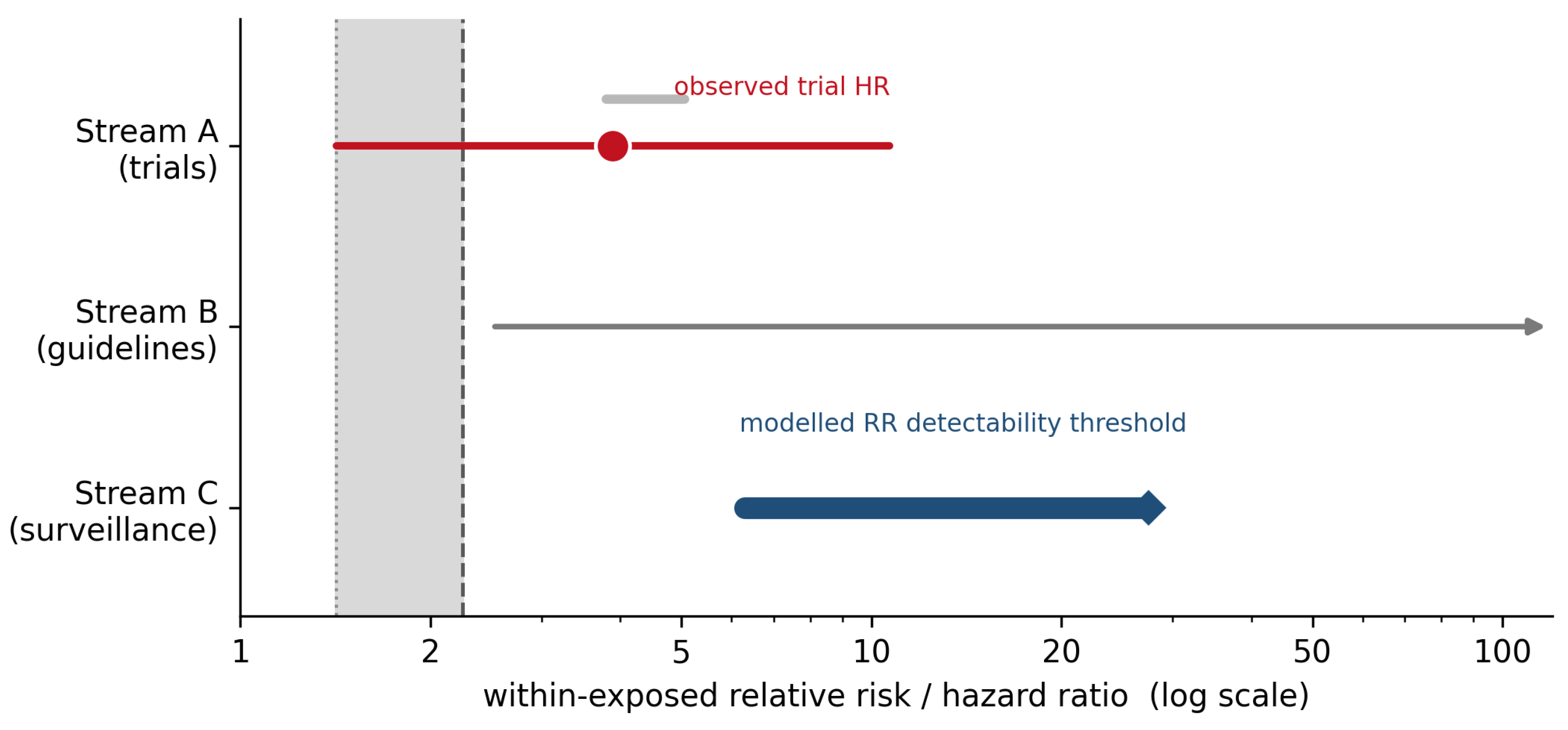

Table 1.
Changes in reporting of the DoxyPEP S. aureus resistance signal across publication and guidance venues. Numerators, denominators, conditioning sets, and contrasts differed across reports. The table is intended to show how the reported percentage was propagated while the underlying denominator and estimand changed; rows should not be interpreted as equivalent effect estimates.
| Venue | Reported result | Frame / conditioning set | What travels downstream |
|---|---|---|---|
| NEJM appendix[1] | 5/31 = 16% | Month-12 doxy-PEP arm; resistant among carriers | Numerator and carrier denominator explicit |
| CROI abstract[17] | 16/137 = 12% | Doxy-PEP arm; all-swabbed denominator | Different numerator/denominator basis |
| CDC guideline[2] | 28/222 = 13%; summarised 5%→13% | Doxy-PEP arm; guideline frame | Percentage retained, provenance less transparent |
| JAMA Insights[18] | 5% versus 4% | Doxy-PEP versus control; “infected with” | Between-arm percentage only; counts/timepoint dropped |
| JAMA Synopsis[19] | 5%→16% | Within arm, among S. aureus-isolated | Carrier-conditioned within-arm percentage (baseline to month 12) |
| Lancet ID final[12] | HR 3.89 (1.42–10.68); 68 of 393 vs 5 of 163 | Participant-level time-to-event; baseline-negative, as-randomised | Not cited by any coded guidance, including two revised after its March 2025 online publication |
Table 2.
Summary of the three-stream audit. is the modelled within-exposed relative risk required to produce a detectable population-level change under the primary surveillance specification.
Table 2.
Summary of the three-stream audit. is the modelled within-exposed relative risk required to produce a detectable population-level change under the primary surveillance specification.
| Stream | Question | Result |
|---|---|---|
| A. Trials | Was the bystander signal resolved? | Yes—HR 3.89 (1.42–10.68), incident doxy-R S. aureus |
| B. Guidance | Is S. aureus monitoring required? | No—0/6 outbreak-matched; 0/10 coded |
| C. Surveillance | Is exposure linked to phenotype? | No—0/12 systems; 6–28 to detect |
Disclaimer/Publisher’s Note: The statements, opinions and data contained in all publications are solely those of the individual author(s) and contributor(s) and not of MDPI and/or the editor(s). MDPI and/or the editor(s) disclaim responsibility for any injury to people or property resulting from any ideas, methods, instructions or products referred to in the content. |
© 2026 by the authors. Licensee MDPI, Basel, Switzerland. This article is an open access article distributed under the terms and conditions of the Creative Commons Attribution (CC BY) license (http://creativecommons.org/licenses/by/4.0/).
Copyright: This open access article is published under a Creative Commons CC BY 4.0 license, which permit the free download, distribution, and reuse, provided that the author and preprint are cited in any reuse.