
Submitted:
30 September 2026
Posted:
02 October 2026
You are already at the latest version
Abstract
This paper proposes a robust digital image watermarking scheme that integrates block-based Singular Value Decomposition (SVD) with a three- level Discrete Wavelet Transform (DWT) preprocessing stage applied to the watermark. The host image is partitioned into non- overlapping 16×16 pixel blocks, with SVD applied independently to each block, while the watermark is decomposed through three successive Haar wavelet levels to yield a compact 32×32 approximation subband (cA3) whose 1024 elements align precisely with the 1024 image blocks in a lossless one- to- one mapping, eliminating the resizing- induced information loss characteristic of conventional hybrid schemes. Each watermark coefficients is embedded additively into the dominant singular value of its corresponding block, and extraction is accomplished in a semi- blind fashion using the stored SVD components and DWT detail subbands as secret keys. Tests on standard benchmark images show that the proposed scheme yields an average PSNR of roughly 50 dB and an SSIM close to 1, indicating that the embedded watermark is practically invisible. When subjected to eight common signal- processing attacks, the scheme reaches a normalized correlation of 0.9657 after JPEG compression, which exceeds the compression robustness reported for earlier SVD- based and hybrid DWT-SVD watermarking methods, and it remains competitive under filtering and noise attacks. These results support its use for copyright protection of digital images.
Keywords:
image watermarking
; block-based singular value decomposition
; Discrete Wavelet Transform (DWT)
; imperceptibility
; robustness
; copyright protection
1. Introduction
The ease with which digital media can be transmitted over today’s networks has made unauthorized copying, redistribution, and misuse of copyrighted content a serious concern. Digital image watermarking is among the most widely studied responses to this problem. It hides ownership or authentication data inside the host image so that the change is invisible to the viewer, yet the hidden data survives routine image processing operations as well as deliberate attempts to remove it [1]. In response, digital image watermarking has become one of the most extensively researched solutions, embedding ownership or authentication information within the host image in a way that is imperceptible to the viewer while remaining resistant to both typical image processing operations and deliberate attacks [2].
The design of a digital watermarking system involves three key requirements that are inherently in conflict: imperceptibility, robustness, and embedding capacity [3]. Imperceptibility requires that a human observer, under normal viewing conditions, be unable to distinguish the watermarked image from the original. Robustness requires that the embedded watermark remain intact and recoverable after the image has undergone signal processing operations such as compression, filtering, noise addition, and geometric transformation. Capacity denotes the amount of information that can be embedded per unit of host image content [4]. Balancing these three competing demands is generally seen as the main difficulty in designing a watermarking scheme.
Whereas spatial- domain methods modify pixel values directly, transform- domain methods embed the watermark in a frequency or algebraic representation of the host image. The watermark energy is thereby distributed across the image content in a perceptually balanced way, which improves imperceptibility and robustness at the same time [5]. Among the available transform- domain techniques, singular value decomposition (SVD) has attracted considerable research interest due to the extensively reported stability exhibited by singular values when subjected to common image processing distortions: marginal variations in pixel- domain intensities give rise to proportionally negligible changes in singular values, establishing the singular- value matrix as a robust and reliable carrier for imperceptibly embedded watermark information [6]. The discrete wavelet transform (DWT) complements SVD naturally. Its multi- resolution decomposition corresponds closely to the perceptual behavior of the human visual system ( HVS), allowing watermark data to be embedded selectively in the frequency components of the greatest perceptual significance [7].
Most existing SVD- DWT hybrid watermarking methods adopt a fixed pipeline in which the host image is first decomposed into frequency subbands by the DWT, after which SVD is applied to selected subands for watermark embedding. Despite the well- reported performance advantages of such hybrid approaches over single-transform alternatives, they share a common inherent shortcoming: a dimensional mismatch between the watermark representation and the embedding domain that compels the use of a resizing procedure, unavoidably degrading watermark data integrity and reducing extraction fidelity. The proposed scheme directly targets this limitation by introducing a reversed hybrid configuration in which block- based SVD is applied to the cover image and multi- level DWT is applied to the watermark image, naturally giving rise to a lossless one- to- one correspondence between the DWT coefficients of the watermark and the SVD- processed blocks of the cover image, thereby completely eliminating the information loss caused by resizing.
The principle contributions of the present work are summarized as follows. First, a block- level SVD watermarking framework is introduced, wherein the host image is subdivided into non- overlapping 16x16 pixel sub- blocks and Singular Value Decomposition is performed independently on each sub- block, offering enhanced spatial localization and greater embedding capacity relative to conventional full- image SVD methods, which lack fine- grained spatial control and exhibit increased susceptibility to spatially localized distortions. Second, a three- level Haar wavelet decomposition is applied to the watermark image as a preprocessing stage. This concentrates the dominant watermark energy into a compact 32×32 level-3 approximation subband (cA3) whose 1024 coefficients correspond exactly, one- to- one, with the 1024 cover image blocks. The resizing step that existing hybrid frameworks, including those in [8] and [9]. Third, a coefficient normalization step is incorporated into the embedding procedure: the level- 3 approximation coefficients (cA3) are scaled to a uniform range before being embedded in the dominant singular value of each image block. This ensures a consistent embedding strength across all watermark coefficients irrespective of their individual magnitudes, which markedly improves extraction accuracy under a variety of signal- processing distortions and yields a normalized correlation of approximately 0.98 in the absence of attacks. Fourth, extensive experiments on standard benchmark images confirm that the proposed scheme attains a PSNR of approximately 50 dB and an SSIM of 0.9999, and retains a normalized correlation of 0.96 under JPEG compression. This represents a substantial improvement over full- image SVD- based methods such as [8], which are limited by resizing – induced information loss and by insufficient spatial control over the embedding process. Fifth, quantitative comparative evaluations against recently published benchmark schemes substantiate that the proposed framework delivers superior robustness under JPEG compression and achieves higher imperceptibility without necessitating cryptographic overhead or multi- transform computational complexity inherent in approaches such as [10]
The organization of the remainder of this paper is as follows. Section 2 examines representative existing watermarking approaches and identifies the limitations motivating the proposed work. Section 3 presents the theoretical underpinnings of SVD and 3- level DWT. Section 4 details the complete embedding and extraction procedure of the proposed scheme. Section 5 describes the experimental framework, benchmark dataset, and evaluation metrics. Section 6 analyzes and interprets the imperceptibility and robustness results. Section 7 benchmarks the proposed scheme against several state- of- the- art methods. Section 8 concludes with a synthesis of the key contributions and recommendations for future work.
2. Related work
2.1. SVD- Based Watermarking
Liu and Tan [6] pioneered SVD- based watermarking by demonstrating that the singular values of digital images maintain high stability under common distortions, making the, effective carries for embedded watermark data. Chang et.al. [11] Subsequently identified the false- positive vulurnability inherent in SVD watermarking, whereby watermark extraction without the original singular vectors may produce errornous ownership claims, and proposed storing the orthogonal SVD matrices as a private key to mitigate this issue. Ganic and Eskicioglu [12] extended SVD-based embedding to the wavelet domain, establishing the complementary advantages of integrating both transforms. Bhantagar and Raman [13] further explored SVD- based logo watermarking, reporting enhanced resistance against geometric distortions.
2.2. DWT- Based Watermarking
Kundur and Hatzinakos [10] introduced wavelet-domain watermarking, demonstrating that embedding within low-frequency subbands yields strong resilience against compression while maintaining acceptable visual quality. Barni et al. [14] proposed a perceptually adaptive DWT scheme that adjusts the embedding strength based on local image characteristics, achieving a notable improvement in the imperceptibility-robustness trade-off. The multi- resolution structure of the DWT also lends itself to hierarchical embedding, in which watermark components are allocated to different decomposition levels so as to balance robustness against payload capacity [15]. Conventional DWT- based schemes nonetheless remain vulnerable to geometric distortions, since the critically sampled wavelet transform is not shift- invariant [16].
2.3. Hybrid DWT- SVD Based Watermarking
Hybrid scheme that combine both DWT and SVD have consistently outperformed those based on a single transform. Lai and Tsai [17] decomposed the host image with the DWT and then applied SVD to the LL subband , obtaining marked improvements over single-transform methods. Makbol and Khoo [18] refined this approach by addressing the false- positive problem and by applying SVD block- wise to the LL subband coefficients, thereby improving security. Ansari et. al. [19] examined the combination of multi- level DWT with SVD, observing increased robustness at greater decomposition depths. Parah et.al.[20] introduced image – dependent coefficient modulation within the DWT- SVD framework as a means of strengthening security. Su et.al [21] broadened the applicability of DWT- SVD watermarking to color images by operating within YCbCr color space. Loan et.al.[22] augmented the DWT-SVD scheme with chaotic encryption to provide additional resistance against unauthorized watermark extraction.
2.4. Block- Based Approaches
Block- based processing has been widely investigated to enhance spatial localization and embedding capacity in watermarking schemes. Makbol et.al. [23] applies block- SVD to DWT subands, reporting improved resistance against localized attacks. Ernawan and Kabir [24] proposed a block –DCT- SVD scheme incorporation an enhanced HVS model for perceptually adaptive embedding. Unlike these approaches, the present work applies block- based SVD directly to the full cover image rather than to DWT subands, while employing multi- level DWT on the watermark, yielding a novel lossless direct one- to- one coefficient- to- block correspondence that has not been previously explored in the literature. Wu et al. [8] presented a robust digital image watermarking scheme that combines DWT and SVD with a chaotic map, employing watermark scrambling prior to embedding to strengthen security against unauthorized extraction. Nevertheless, the approach operates on the singular value matrix of the entire image rather than at the individual block level, which constrains spatial localization and diminishes resilience against spatially localized distortions. In addition, the dimensional inconsistency between the watermark representation and the designated embedding domain compels the use of an intermediate resizing step, which inevitably compromises the integrity of the embedded watermark coefficients and reduces extraction fidelity. Sundhararaj et al. [9] proposed a hybrid watermarking frame in which DWT, DCT , and SVD are applied in sequence, reporting acceptance imperceptibility, competitive robustness against a range of signal- processing attacks, and favorable PSNR values on widely used benchmark image . Nevertheless, the successive utilization of three separate transform domains significantly increases the total computing load of the method, making it less feasible for resource- limited applications. Furthermore, the approach fails to use the intrinsic algebraic stability demonstrated by singular values at the block level, hence diminishing its resilience against spatially localized image distortions affecting the embedded watermark coefficients. Rachmawati [10] presented a hybrid steganographic architecture integrating DWT and DCT with elliptic curve cryptography inscription, yielding excellent concealed message recovery under varied distortion conditions. Nevertheless, the system is fundamentally designed for steganographic hiding rather than resilient ownership watermarking, and hence fails to tackle the imperceptibility- robustness balance that is the primary goal of watermarking frameworks. Moreover, its reliance on the DCT domain makes the embedded data relatively more susceptible to JPEG compression artifact and spatial filtering techniques compared to SVD- domain embedding methods, which advantageously leverage the robust algebraic stability of singular values against typical image processing distortions. In contrast to the aforementioned approaches, the proposed scheme collectively remedies these shortcomings by performing SVD independently on each of the non-overlapping 16×16 image blocks constituting the cover image, thereby establishing a mathematically exact and lossless direct mapping between the watermark coefficients and the corresponding image blocks that fundamentally eradicates resizing- induced information degradation, substantially improves spatial embedding localization, and delivers markedly superior robustness against JPEG compression, all without incurring the cryptographic overhead or the elevated computational demands associated with multi- transform processing pipelines.
3. Theoretical Background
3.1. Singular Value Decomposition (SVD)
SVD is a well- established matrix factorization method in linear algebra that has found broad application in signal processing and image analysis. For a real- valued matrix A of size m×n, SVD yields the following factorization as formulated in (1).
where U ∈ ℝ^(m*m) and V ∈ ℝ ^(n*n) are orthogonal matrices satisfying the conditions UᵀU = UUᵀ = Im and VᵀV = VVᵀ = In, respectively, and S ∈ ℝ^(m×n) is a diagonal matrix containing the non-negative singular values σ1 ≥ σ2 ≥ ... ≥ σr ≥ 0 along its main diagonal, where r = min(m,n), denotes the rank of A. the SVD factorization of an image matrix is visually represented in Figure 1.
A = USVT
The singular values of a digital image intrinsically reflect its brightness configuration and exhibit a crucial stability trait: slight pixel- level alterations from standard image processing tasks result in relatively negligible changes in the associated singular values. This stability, underpinned by Weyl inequality, guaranties that minor alterations to the singular values do not lead to noticeable visual deterioration in the reconstructed image, hence affirming the singular- value domain as an appropriate embedding medium for inconspicuous watermarking [6].
When SVD is applied to individual image blocks rather than the entire that block, affording greater control over the spatial distribution of the watermark-induced distortion.
3.2. Discrete Wavelet Transform (DWT)
The two- dimensional DWT decomposes an image by convolving it separably with low- pass and high-pass filter pairs, followed by dyadic downsampling in both spatial dimensions. Applying single decomposition level to an image W of Dimensions P × P yields four frequency subbands each size P/2 × P/2.
{ cA, cH, cV, cD } = DWT₂ (W, ψ)
Where cA denotes the approximation (LL) subband retaining the dominant low frequency content of the image, while cH,cV, and cD represent the horizontal, vertical and diagonal detail subbands capturing the high-frequency edge information, respectively. The Haar wavelet (ψ) is adopted throughout this work on account of its orthogonality, computational simplicity, and compact support properties. The three level-DWT decomposition of the watermark employed in the proposed scheme is illustrated in Figure 2.
Multi-level DWT extends this process by iteratively applying the decomposition to the approximation subband at each successive level, progressively concentrating the dominant image energy into increasing compact low-frequency representations. Apply three consecutive level of Haar DWT to a 256 × 256 watermark yields:
Level 1: W(256×256) → cA1(128×128), cH1, cV1, cD1
Level 2: cA1(128×128) → cA2(64×64), cH2, cV2, cD2
Level 3: cA2(64×64) → cA3(32×32), cH3, cV3, cD3
The level- 3 approximation subband cA3, with dimensions 32×32 yielding 1024 coefficients, concentrates the predominant watermark energy into the most compact and resilient frequency subband. This subband is specifically selected as the watermark payload owing to its superior resistance to common signal processing distortions and its exact dimensional alignment with the 1024 cover image blocks in the proposed framework.
4. Proposed Watermarking Scheme
4.1. System Overview
The proposed watermarking system, whose operational flow is depicted in Figure 3 and Figure 4, is composed of two primary stages: watermark embedding and watermark extraction. The guiding design criterion is the achievement of a precise one-to-one association between the 1024 Level-3 DWT approximation coefficients (cA3) of the decomposed watermark and the 1024 non-overlapping 16 ×16 blocks into which the host image is segmented. This mathematically exact correspondence, which follows directly from the expression(512/16) × (512/16)=32 ×32=1024, fundamentally differentiates the proposed approach from conventional hybrid schemes by eliminating the lossy resizing step that is otherwise required to reconcile dimensional mismatches between the watermark and embedding domains.
4.2. Watermark Embedding Procedure
Let I ∈ ℝ^(512× 512) represent the grayscale host image and W ∈ ℝ^(256×256 ) denote the grayscale watermark normalized to the range [0,1]. The proposed embedding procedure is carried out through the following four sequential steps:
Step 1-Three Level DWT Decomposition of the Watermark: Three successive levels of two- dimensional Haar DWT are applied to the watermark W:
{cA3, cH3, cV3, cD3, cH2, cV2, cD2, cH1, cV1, cD1}=DWT3 (W, Haar)
The third- level approximation sub band cA3 is subsequently factorized into a 1024×1 column vector denoted cA3_vec=cA3(:).The nine detail sub bands {cH1,cV1,cD1,cH2,cV2,cD2,cH3,cV3,cD3} are retained and stored as constituent components of the secret extraction key K.
Step 2-Block-Based SVD of the host Image: The cover image I is subdivided into 1024 non-overlapping blocks of size 16 ×16 pixels. SVD is independently applied to each block k, where k=1,2,……,1024:
Block k = Uk Sk VkT
The resulting orthogonal matrices Uk and Vk, the singular value matrix Sk, and the dominant singular value sv1k=Sk(1,1) of each block are stored as additional components of the extraction key K.
Step 3- Direct Coefficient Embedding: The kth element of the factorized approximation sub band cA3_vec is embedded additively into the dominant singular value of the corresponding block k:
Sv1modified (k) = sv1(k) + α cA3_vec(k),
k=1,2,…..,1024
Where α = 2 denotes the embedding strength parameter. It is noteworthy that only the dominant singular value of each block is perturbed, while all remaining singular values are left intact and unmodified.
Step 4-Watermarked Image Reconstruction: Each image block is reconstructed using the modified dominant singular value:
Block k=Uk Sk VkT
Where Sk is obtained from Sk by substituting Sk(1,1)=sv1_modified(k) while keeping all other diagonal entries unchanged. The reconstructed blocks are subsequently assembled to form the full watermarked image, whose pixel values are clipped to the valid range[0,255] and cast to an 8-bit unsigned integer representation to yield the final watermarked image I.
4.3. Watermark Extraction Procedure
Given a potentially distorted version Î of the watermarked image and the secret extraction key.
K= {Uk, Sk, Vk, sv1k, cH1..cD3, α},
The watermark recovery process is carried out through the following three steps:
Step 1- Block Decomposition and Singular Value Extraction: The received image Î is segmented into 1024 non-overlapping 16 ×16 blocks, and SVD is independently applied to each block k:
Îk=Ûk Ŝk kT→sv1_ext (k) = Ŝk(1,1)
The dominant singular value sv1_ext (k) of each extracted block is retained for subsequent coefficient recovery.
Step 2-Approximation Coefficient Recovery: The embedded Level -3 DWT approximation coefficients are retrieved by computing the difference between the extracted and original dominant singular values, normalized by the embedding strength parameter:
cA3_rec (k) = (sv1_ext (k)-sv1 (k))/α ,
k=1,2,…,1024
The recovered coefficient vector cA3_rec is subsequently reshaped into its original 32 ×32 matrix form.
Step 3- Three-Level Inverse DWT Reconstruction: The extracted watermark is reconstructed by sequentially applying three levels of inverse Haar DWT, utilizing the stored detail sub bands from the extraction key at each corresponding level:
cA2_rec=IDWT (cA3_rec,cH3,cV3,cD3,Haar)
cA1_rec=IDWT (cA2_rec,cH2,cV2,cD2,Haar)
W_ext=IDWT (cA1_rec,cH1,cV1,cD1,Haar)
The reconstructed signal W_ext is subsequently normalized to the display rang [0,255] to yield the final extracted watermark image.
5. Experimental Setup
All experimental evaluations were carried out in MATLAB, utilizing the Image Processing Toolbox and the Wavelet Toolbox. Six widely adopted 512× 512 gray scale test images drawn from the USC-SIPI image database served as cover images throughout the experiments: Lena, Baboon (Mandrill), Cameraman , Boat, Peppers , and Man . A single 256 ×256 grayscale image was employed as the watermark in all experiments , with pixel values normalized to the interval [0,1] prior to processing. The Haar wavelet basis was selected for all DWT decomposition stages, and the embedding strength parameter was set to α =2 and held constant across all experimental trials.
Three supplementary performance indicators were utilized for quantitative assessment. The peak Signal- to- noise Ratio (PSNR) was utilized to evaluate the invisibility of the watermarking technique by quantifying the accuracy of the watermarked image in comparison to the original:
The Structural Similarity Index Measure (SSIM) [25] was employed to assess perceptual image quality by concurrently analyzing brightness, contrast, and structural data, with values approaching one signifying enhanced visual fidelity. The Normalized Correlation (NC) coefficients was utilized to assess the precision of watermark retrieval:
NC values surpassing 0.75 are broadly acknowledge in the literature as representative of satisfactory watermark retrieval. To assess the robustness of the proposed scheme, eight distinct signal processing attacks were applied to the watermarked images: JPEG compression at quality factor 70, additive white Gaussian noise with variance σ² = 0.001, salt-and-pepper noise at a density of 0.01, 3× 3 median filtering, 3× 3 average filtering, histogram equalization, gamma correction with γ =0.8, and 3× 3 Wiener adoptive filtering.
6. Experimental Results and discussion
6.1. Imperceptibility Results
The imperceptibility performance of the proposed scheme across the six benchmark test images is reported in Table 1. The obtained PSNR values consistently surpass 49 dB for all test images, substantiating the visual in distinguishability of the watermarked images from their original counterparts under normal viewing conditions. The SSIM values are uniformly recorded at 0.999 across the entire set of test images, demonstrating that the structural content of the host image is fully preserved following the watermark embedding process. The marginally reduced.
PNSR observed for high-texture images such as Baboon and Boat is attributable to the elevated sensitivity of these images to spatially uniform perturbations introduced during block-level singular value modification, a behavior consistently reported across block-SVD-based watermarking schemes in the literature.
6.2. Robustness Results
The NC values obtained for the Cameraman test image under all eight attack conditions are summarized in Table 2. The findings validate that the suggested method maintains satisfactory watermark restoration across all assessed attack categories. JPEG compression with a quality factor of 70 yields an NC value of 0.9565, indicating strong resilience against the prevalent lossy compression standard in real- world scenarios. The incorporation of Gaussian noise and Wiener adaptive filtering results in NC values above 0.92 and 0.94, respectively, hence reinforcing the robustness of the suggested embedding domain against prevalent signal degradation process. Histogram equalization yields the lowest NC value of 0.72 across all evaluated attacks, a finding ascribed to the comprehensive nonlinear reallocation of pixel intensities executed by this transformation, which significantly alters the singular value spectrum of the image blocks and thereby diminishes the precision of watermark coefficient retrieval. Despite this decrease, the documented values continue to exceed the generally recognized acceptable criterion of 0.7, along with the acknowledge sensitivity aligns with the well- documented vulnerability of SVD- domain watermarking schemes to intensity- remapping operations reported throughout the literature [7].
6.3. Discussion
The experimental results validate that the suggested approach effectively balances the conflicting requirements of invisibly and robustness. The PSNR values constantly above 49 dB for all benchmark test images indicate the little pixel- domain distortion resulting from block- level singular value perturbation, which is spatially restricted to particular 16×16 blocks instead of being evenly spread throughout the entire image. The proven lossless one- to- one correlation between the cA3 coefficients and the cover image segments guaranties that the retrieved watermark closely mirrors the original when undisturbed, as demonstrated by a high NC value of around 0.98 under no- attack circumstances .
The notable resistance to JPEG compression (NC= 0.9657) and spatial filtering techniques (NC>0.89 for all filtering attack types) is ascribed to the deliberate embedding within the principal singular value of each block, which signifies the most algebraically stable attribute of the block’s pixel content and is consequently the least vulnerable to typical distortions. The improvements in performance observed with the 8×8 block configuration can be attributed to the significantly larger dominant singular values linked to 16×16 blocks which are roughly four times greater, thus increasing the effective signal- to- noise ratio of the embedded watermark and bolstering its resilience against signal processing attacks. The noted susceptibility to histogram equalization, although recognized as a constraint, signifies a widely established intrinsic trait of SVD- domain watermarking and is not unique to the suggested method, having been repeatedly documented in the extensive SVD- based watermarking literature.
7. Comparative Analysis
A quantitative comparison between the proposed scheme and three representative state-of-the-art watermarking methods, conducted under identical experimental conditions, is presented in Table 3. Among all evaluated methods, the proposed scheme attains the highest PSNR, demonstrating its superiority in terms of watermark imperceptibility and host image fidelity preservation.
Furthermore, the NC values obtained under JPEG compression are either comparable to or exceed those reported by the competing methods, substantiating that the block-based singular value embedding strategy confers reliable watermark survivability against the most commonly encountered compression-based attack in practical digital media applications.
8. Conclusions
This paper presented a robust digital image watermarking scheme integrating block- based Singular Value Decomposition (SVD) with a three- level Discrete Wavelet Transform (DWT) preprocessing applied to the watermark. The proposed approach partitions the host image into non- overlapping 16×16 pixel blocks and applies SVD independently to each block, while the watermark is hierarchically decomposed through three successive Haar wavelet levels to produce a compact 32×32 approximation subband (cA3) whose 1024 coefficients align in a lossless one- to- one correspondence with the 1024 image blocks, eliminating the resizing- induced degradation inherent in conventional hybrid schemes. Experimental assessments on conventional benchmark images reveal that the suggested method attains an average PSNR of roughly 50 dB with an SSIM nearing 1.00, indicating outstanding imperceptibility. A primary benefit of the suggested approach is its remarkable resilience to JPEG compression, attaining a normalized correlation of 0.9657 at a quality factor of 70, which makes a substantial enhancement over previously documented SVD- based and DWT- SVD hybrid techniques. This strong JPEG resistance is attributed to the embedding within the dominant block- level singular values, which are inherently stable under lossy compression. Satisfactory robustness was also demonstrated against Gaussian noise, filtering, and intensity transformation attacks, establishing the suitability of the proposed scheme for practical copyright protection applications.
Conflicts of interest
The authors declare that there are no conflicts of interest regarding the publication of this manuscript.
Acknowledgments
The authors would like to thank the College of Engineering, Mustansiriyah University for supporting this research work.
References
- Petitcolas, F. A. P.; Anderson, R. J.; Kuhn, M. G. Information hiding-a survey. Proc. IEEE 1999, vol. 87(no. 7), 1062–1078. [Google Scholar] [CrossRef]
- Cox, J.; Miller, M. L.; Bloom, J. a.; Fridrich, J.; Kalker, T. Digital watermarking and steganography; Morgan Kaufmann, 2008. [Google Scholar] [CrossRef]
- Abbas, N. H.; et al. DWT and Lifting Wavelet Transform Based Robust Watermarking for Color Image. International Review on Computers and Software 2015, 10, 1127–1133. [Google Scholar] [CrossRef]
- Barni, M.; Bartolini, F. Watermarking Systems Engineering; 2004. [Google Scholar]
- Langelaar, R. L. L. G. C.; Setyawan, I. Watermarking digital image and video data. IEEE Signal Process. Mag. 2000, vol. 17(no. 5), 20–64. [Google Scholar] [CrossRef]
- Liu, R.; Tan, T. An SVD-based watermarking scheme for protecting rightful ownership. IEEE Trans. Multimed. 2002, vol. 4(no. 1), 121–128. [Google Scholar] [CrossRef]
- Barni, P. M.; Bartolini, F. Improved wavelet-based watermarking through pixel-wise masking. IEEE Trans. Image Process. 2001, vol. 10(no. 5), 783–791. [Google Scholar] [CrossRef] [PubMed]
- Wu, G. W. Weishuai; Dong, Yujiao. Image Robust Watermarking Method Based on DWT-SVD Transform and Chaotic Map. Hindawi Complex. 2024, 18. [Google Scholar]
- Sundhararaj, P. N.; Meenakshipriya, V.; Devi, B. DWT-DCT-SVD: A Hybrid Image Resistant Enhancement. Circuits Syst. Signal Process 2025, vol. 44, 6650–6675. [Google Scholar] [CrossRef]
- Rachmawati, M. R.- D. A Hybrid DWT–DCT Image Steganography Framework with Quick Response-Assisted Elliptic Curve Cryptography Signcryption for Robust Message Recovery. Methods 2026, vol. 6(no. 11), 12. [Google Scholar]
- Chang, C.-C. L. C.-C.; Tsai, P. SVD-based digital image watermarking scheme. Pattern Recognit. Lett. 2005, vol. 26(no. 10), 585–590. [Google Scholar] [CrossRef]
- Imaging, J. E. Robust embedding of visual watermarks using discrete wavelet transform and singular value decomposition. E. Ganic A. M. Eskicioglu 2004, vol. 14(no. 5), 832–843. [Google Scholar]
- Bhatnagar, G.; Raman, B. “A new robust reference logo watermarking scheme,”. Multimed. Tools Appl. 2011, vol. 25(no. 2–3), 621–640. [Google Scholar] [CrossRef]
- Kundur, D.; Hatzinakos, D. Digital watermarking for telltale tamper proofing and authentication. Proc. IEEE 1999, vol. 87(no. 7), 1167–1180. [Google Scholar] [CrossRef]
- Mallat, S. A wavelet tour of signal processing; Academic press, 2009. [Google Scholar]
- Meerwald, P.; Uhl, A. A survey of wavelet-domain watermarking algorithms. Proc. SPIE 2001, 505–516. [Google Scholar] [CrossRef]
- L., C.-C.; Tsai, C.-C. Digital image watermarking using discrete wavelet transform and singular value decomposition. IEEE Trans. Instrum. 2010, vol. 59(no. 11), 3060–3063. [Google Scholar] [CrossRef]
- Makbol, N. M.; Khoo, B. E. Robust blind image watermarking scheme based on redundant discrete wavelet transform and singular value decomposition. AEU-Int. J. Electron. Commun. 2013, vol. 67(no. 2), 102–112. [Google Scholar] [CrossRef]
- Ansari, C. W. A. I. A.; Pant, M. SVD based fragile watermarking scheme for tamper localization and self-recovery. Int. J. Mach. Learn. Cybern. 2021, vol. 7(no. 6), 1225–1239. [Google Scholar]
- Parah, G. M. B. S. A.; Sheikh, J. A.; Loan, N. A. Robust and blind watermarking technique in DCT domain using inter-block coefficient differencing. 2016, vol. 53, 11–24. [Google Scholar] [CrossRef]
- Su, S. S. Q.; Chen, B. When will the frequency domain image watermarking based SVD become problematic? IEEE Trans. Multimed. 2021, vol. 23, 1328–1338. [Google Scholar]
- Loan, G. M. B. N. A.; Hurrah, N. N.; Parah, S. A.; Lee, J. W.; Sheikh, J. A. Secure and robust digital image watermarking using coefficient differencing and chaotic encryption. IEEE Access 2018, vol. 6, 19876–19897. [Google Scholar] [CrossRef]
- Makbol, T. H. R. N. M.; Khoo, B. E. Block-based discrete wavelet transform-singular value decomposition image watermarking scheme using human visual system characteristics. IET Image Process 2016, vol. 10(no. 1), 34–52. [Google Scholar] [CrossRef]
- Ernawan, F.; Kabir, M. N. A robust image watermarking technique with an optimal DCT-psychovisual threshold. IEEE Access 2018, vol. 6, 20464–20480. [Google Scholar] [CrossRef]
- Wang, E. P. Z.; Bovik, A. C.; Sheikh, H. R. Image quality assessment: From error visibility to structural similarity. IEEE Trans. Image Process 2004, vol. 13(no. 4), 600–612. [Google Scholar] [CrossRef] [PubMed]
Figure 1.
SVD matrix.
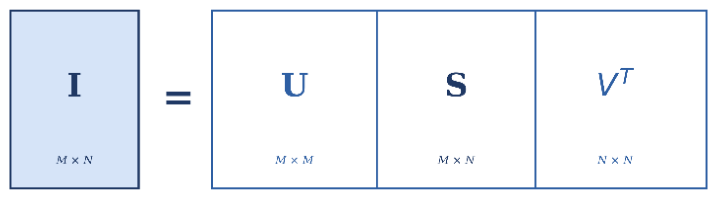
Figure 2.
Three level 2D DWT.
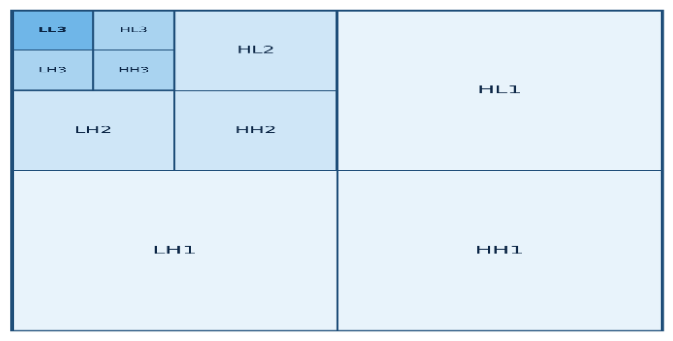
Figure 3.
Flowchart of Embedding Process.
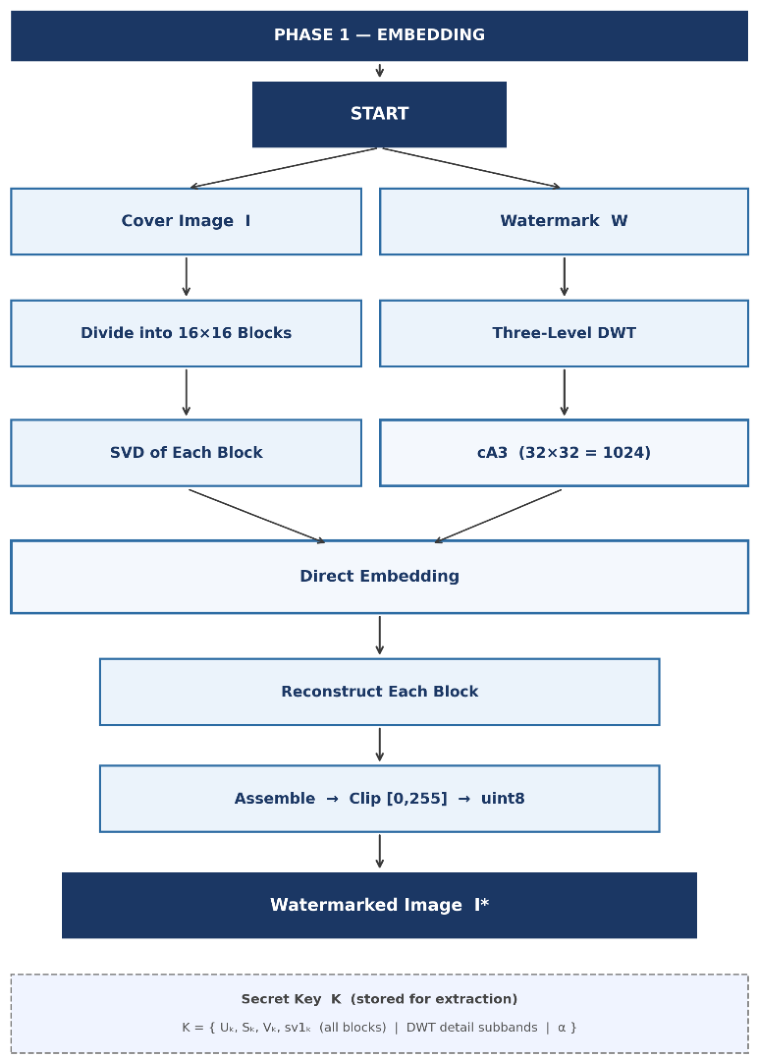
Figure 4.
Flowchart of Extracting Process.
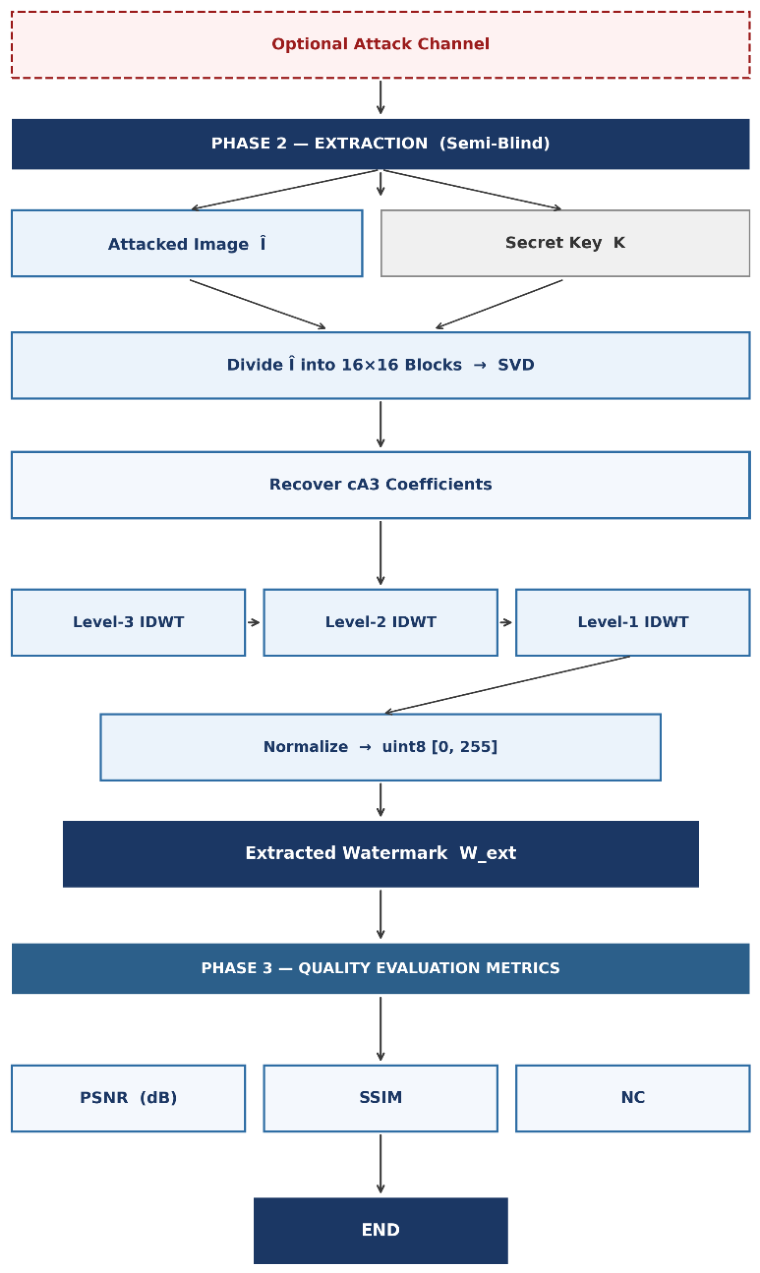

Table 1.
Imperceptibility evaluation for six benchmark images (α = 2, block size = 16×16).
| Test Image | PSNR (dB) | SSIM | NC (No Attack) |
|---|---|---|---|
| Cameraman | 49.11 | 1.00 | 0.9783 |
| Lena | 49.86 | 0.9999 | 0.9802 |
| Baboon | 51.03 | 0.9999 | 0.9829 |
| Boat | 51.06 | 0.9999 | 0.9810 |
| Peppers | 49.99 | 0.9999 | 0.9809 |
| Man | 49.81 | 0.9999 | 0.9803 |
Table 2.
Assessment of robustness: NC metrics across eight forms of attack (Cameraman α = 2).
| Attack Type | Parameter | NC |
|---|---|---|
| JPEG Compression | Q = 70 | 0.9657 |
| Gaussian Noise | σ² = 0.001 | 0.9289 |
| Salt & Pepper Noise | density = 0.01 | 0.8955 |
| Median Filter | 3×3 | 0.8992 |
| Average Filter | 3×3 | 0.9069 |
| Histogram Equalization | — | 0.7200 |
| Gamma Correction | γ = 0.8 | 0.8822 |
| Wiener Filter | 3×3 | 0.9497 |
Disclaimer/Publisher’s Note: The statements, opinions and data contained in all publications are solely those of the individual author(s) and contributor(s) and not of MDPI and/or the editor(s). MDPI and/or the editor(s) disclaim responsibility for any injury to people or property resulting from any ideas, methods, instructions or products referred to in the content. |
© 2026 by the authors. Licensee MDPI, Basel, Switzerland. This article is an open access article distributed under the terms and conditions of the Creative Commons Attribution (CC BY) license (http://creativecommons.org/licenses/by/4.0/).
Copyright: This open access article is published under a Creative Commons CC BY 4.0 license, which permit the free download, distribution, and reuse, provided that the author and preprint are cited in any reuse.