

Submitted:
30 September 2026
Posted:
02 October 2026
You are already at the latest version
Abstract
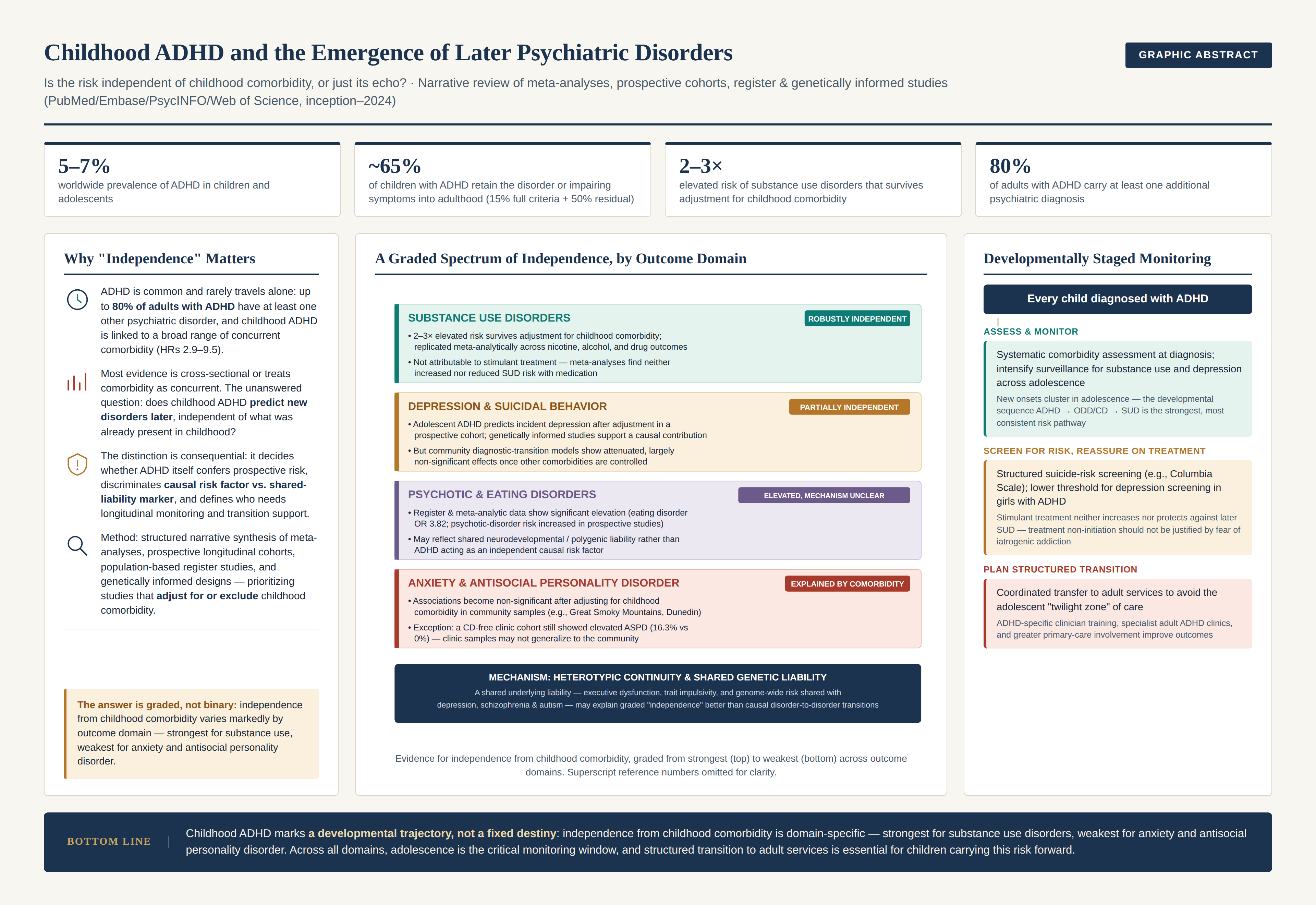
Objective: To determine whether childhood attention-deficit/hyperactivity disorder (ADHD) predicts the subsequent emergence of psychiatric disorders independent of disorders already present in childhood, and to translate the evidence into clinical recommendations. Method: Narrative review of meta-analyses, systematic reviews, prospective longitudinal cohorts, population-based register studies, and clinical practice guidelines identified through searches of PubMed/MEDLINE, Embase, PsycINFO, and Web of Science, prioritizing studies with substantial citation impact. Results: Childhood ADHD robustly and independently predicts later substance use disorders, with 2- to 3-fold elevations that survive adjustment for childhood comorbidity. Prospective and genetically informed studies support an association with incident depression and suicidal behavior, though adjusted community models attenuate these effects. Associations with anxiety and antisocial personality disorder are substantially explained by childhood comorbidity in community samples, while clinic cohorts show an elevated risk window for new onsets confined largely to adolescence. Register and meta-analytic data link ADHD to increased risk of psychotic and eating disorders, and genome-wide studies document extensive shared genetic liability across ADHD, depression, schizophrenia, and autism spectrum disorder. Conclusion: Childhood ADHD is associated with the subsequent emergence of psychiatric disorders, but independence from childhood comorbidity varies by outcome domain. Substance use disorders show the strongest evidence of independent emergence; internalizing outcomes are partially confounded by baseline comorbidity. Systematic monitoring for depression, suicidality, and substance use across adolescence, and structured transition to adult services, are warranted for children with ADHD.
Keywords:
ADHD
; comorbidity
; longitudinal
; heterotypic continuity
; substance use disorder
Introduction
Attention-deficit/hyperactivity disorder is one of the most common neurodevelopmental disorders of childhood, with a worldwide pooled prevalence of 5.29% [1] and an estimated adult prevalence of 2.5% [2]. Once considered a disorder that remitted by adulthood, ADHD is now recognized as persistent: roughly 65% of children with ADHD continue to experience the disorder or impairing symptoms into adulthood when partial remission is included [3], and prospective follow-up suggests that approximately 15% of cases continue to meet full diagnostic criteria in young adulthood, with an additional 50% retaining impairing symptoms [4].
Comorbidity is the rule rather than the exception. Up to 80% of adults with ADHD have at least one additional psychiatric disorder [5], and a population-based birth cohort study found childhood ADHD strongly associated with a broad range of comorbid psychiatric disorders during adolescence, including conduct/oppositional defiant disorder (hazard ratio [HR] = 9.54), mood disorders (HR = 3.67), anxiety disorders (HR = 2.94), eating disorders (HR = 5.68), personality disorders (HR = 5.80), and substance-related disorders (HR = 4.03) [6] (Table 1). Major practice guidelines, including the American Academy of Pediatrics clinical practice guideline [7] and the World Federation of ADHD International Consensus Statement [8], now mandate routine evaluation for co-occurring conditions.
Much of this evidence, however, is cross-sectional or treats comorbidity concurrently. The question addressed in this review is narrower and clinically consequential: does childhood ADHD predict the emergence of psychiatric disorders in adolescence and adulthood independent of psychiatric disorders already present during childhood? The distinction matters clinically, because it determines whether ADHD itself confers prospective risk that would be missed by treating only current comorbidity; theoretically, because it discriminates between ADHD as an independent risk factor and ADHD as a marker of broader shared liability; and for service planning, because it defines which young people require longitudinal monitoring and transition support. As one synthesis of community data concluded, with the exception of substance use, child and adolescent ADHD was not associated with markedly increased risk of other disorders early in adult life once comorbid adolescent disorders were controlled [9]. This review evaluates the totality of the evidence bearing on that conclusion and translates it into clinical practice recommendations.
Method
The author searched PubMed/MEDLINE, Embase, PsycINFO, and Web of Science from inception to 2024, combining terms for ADHD with terms for longitudinal outcomes (prospective, follow-up, cohort, register, emergence, comorbidity). Reference lists of included articles and relevant clinical guidelines were screened for additional studies, with priority given to works of substantial scholarly impact. Studies were included if they reported meta-analyses, systematic reviews, prospective longitudinal cohorts, population-based birth cohort or national register studies, or clinical practice guidelines examining ADHD in childhood or adolescence and subsequent psychiatric outcomes, and were published in English. Prospective designs establishing temporal ordering were treated as the gold standard, with particular attention to whether studies excluded children with baseline disorders, statistically adjusted for childhood comorbidity, or distinguished lifetime from interval (post-childhood) onsets. For each study, the design, sample, outcome domain, method of comorbidity adjustment, and effect estimates were extracted, and findings were organized thematically with a qualitative synthesis of the strength of evidence for independence in each domain. An AI-based language and literature-assistance tool (Claude, Anthropic) was used to help organize the literature synthesis, verify reference formatting, and prepare this manuscript for submission; all searches, data extractions, and interpretations were independently verified by the author against primary sources. Consistent with JDBP’s requirement that narrative reviews be accompanied by a completed PRISMA 2009 checklist, such a checklist is provided as supplementary material; items specific to systematic-review/meta-analysis methodology (protocol registration, a reproducible multi-database search strategy, dual-reviewer screening with a PRISMA flow diagram, formal risk-of-bias appraisal, and quantitative meta-analytic pooling) are marked not applicable to this narrative synthesis, with a brief rationale given for each.
Results
Persistence and Comorbidity Burden
Estimates of ADHD persistence vary widely depending on the definition used. In the Multimodal Treatment Study (MTA) of Children with ADHD, persistence ranged from 1.9% to 61.4% across combinations of diagnostic criteria and assessment method, with the clinically relevant DSM-5, combined-source definition yielding 49.9% [10] (Table 2). Persistence is closely tied to comorbidity: Danish register data spanning the 1981-2013 birth cohort (1,665,729 children; 32,308 with ADHD) showed significantly elevated, sex-differentiated risk of all 12 comorbid psychiatric disorders examined [11].
Substance Use Disorders
The association between childhood ADHD and later substance use disorders (SUD) is among the most robust findings in developmental psychopathology, and the clearest case of an independent, comorbidity-resistant association. A meta-analytic review of prospective longitudinal studies found that childhood ADHD prospectively predicted nicotine, alcohol, marijuana, and cocaine use disorders and roughly doubled the risk of SUD across substance classes [12]. A subsequent meta-analysis of 37 studies encompassing more than 762,000 participants confirmed that childhood ADHD confers increased risk of later substance-related disorders [13], and population-based birth cohort data corroborate elevated risk of adult substance dependence through adolescence into early adulthood [14]. Critically, the ADHD-SUD association survives adjustment for comorbid conduct problems [9], and the risk pathway is developmentally sequenced: adult substance disorders are preceded by behavioral disorders but not by childhood anxiety or depression [9].
Depression and Suicidal Behavior
A prospective cohort study found that adolescent ADHD predicted onset of major depressive disorder through early adulthood, remaining significant after controlling for psychosocial impairment and co-occurring psychiatric disorders [16], and genetic-epidemiological analyses are consistent with a causal contribution of ADHD liability to subsequent depression [17]. Yet in a 16-year follow-up of boys with ADHD, lifetime rates of mood disorders were elevated relative to controls, but interval (past-five-year) rates were not, apart from anxiety and smoking dependence [18] — suggesting comorbid disorders may emerge early and then remit.
Suicide risk shows a similarly prospective, if only partly independent, signal. In children diagnosed with ADHD at ages 4-6, ADHD conferred markedly greater odds of suicidal ideation and attempts through adolescence, controlling for sex and maternal depression, with 18.4% of children with ADHD versus 5.7% of comparisons making at least one suicide attempt [19]. A nationwide Taiwanese longitudinal study found ADHD to be an independent risk factor for suicide attempts, and an even stronger predictor of repeated attempts, independent of comorbidities [20]. A classic review estimated the annualized risk of completed suicide in individuals with ADHD at roughly three times that of the general population [21]. Much of the ADHD-suicide association appears mediated through, but not entirely reducible to, intervening depressive and externalizing pathology.
Prospectively, associations between childhood ADHD and later anxiety are more equivocal: while a 16-year follow-up found clear interval elevation in anxiety [18], diagnostic-transition analyses found that associations between behavioral disorders and later anxiety became non-significant after adjustment for other comorbidities in community samples [9]. Whether ADHD independently generates new anxiety disorders therefore depends heavily on how aggressively baseline comorbidity is controlled.
Psychotic and Eating Disorders
Register-based and cohort studies indicate that childhood ADHD is associated with increased risk of subsequent psychotic disorder; a meta-analysis of prospective studies concluded that childhood ADHD is associated with increased risk of a subsequent psychotic disorder, although the mechanism remains unclear and the absolute risk is low [22]. Meta-analytic evidence similarly indicates that the risk of any eating disorder in individuals with ADHD is significantly elevated (odds ratio [OR] = 3.82), with comparable elevations for anorexia nervosa (OR = 4.28), bulimia nervosa (OR = 5.71), and binge eating disorder (OR = 4.13) [23]. Bipolar disorder is also markedly overrepresented among individuals with ADHD, though much of this evidence remains cross-sectional, and longitudinal studies isolating incident bipolar disorder after childhood ADHD are limited [24].
Sex Differences
The burden of emergent psychiatric disorder differs by sex. Danish register data show ADHD associated with significantly increased risk across all 12 comorbid disorders examined, with sex-specific patterns in the strength of association [11], and community data suggest girls with ADHD may be at particular risk for internalizing outcomes, partly through negative peer status and conduct problems, while boys show higher rates of externalizing and substance outcomes.
Does Treatment Modify Emergence?
Evidence that treating childhood ADHD reduces later psychiatric emergence is limited and inconsistent. A meta-analytic review found that stimulant therapy in childhood was associated with reduced risk of subsequent drug and alcohol use disorders [27], yet in the MTA, randomized 14-month treatment groups did not differ on substance use through 8-year follow-up, and neither medication at follow-up nor cumulative stimulant exposure predicted substance outcomes [28]. Current data neither confirm that treating childhood ADHD prevents later psychiatric disorders nor attribute emergent comorbidity to treatment exposure.
Discussion
Synthesis: Is the Association Independent of Childhood Comorbidity?
Across outcome domains, the evidence supports a graded answer. Robustly independent: substance use disorders. The prospective association between childhood ADHD and later SUD survives adjustment for comorbidity in community samples [9], is replicated meta-analytically [12,13], and is not fully explained by treatment exposure [27,28]. Independent in some designs, attenuated in others: depression and suicidal behavior. Adolescent ADHD predicted incident depression after controlling for co-occurring disorders [16], and genetic analyses support a causal contribution [17]; yet community diagnostic-transition models found limited adjusted evidence for behavioral-to-emotional transitions [9]. Largely explained by baseline comorbidity in community samples: anxiety and ASPD. Associations with later anxiety and ASPD became non-significant after adjustment in community cohorts [9], though the exception is a conduct-disorder-free clinic cohort, in which ASPD still emerged in 16.3% of probands [15].
Timing also matters: across clinic-based studies, the period of increased risk for new-onset disorder appears largely confined to adolescence [15,18], so childhood ADHD is best conceptualized as a risk factor for early-emerging secondary disorders rather than for lifelong vulnerability to new onsets. Finally, the framing of “independence” is itself partly artificial: where ADHD and later disorders reflect heterotypic expressions of shared liability [25,26], controlling for childhood comorbidity removes variance attributable to ADHD itself, biasing estimates of independence downward. Both the community-sample nulls after adjustment and the genetically informed causal signals can be accommodated within a shared-liability, heterotypic-continuity framework.
Clinical Implications
The findings translate into practical, developmentally staged recommendations. First, comprehensive comorbidity assessment at diagnosis: consistent with AAP [7] and World Federation [8] guidance, every child diagnosed with ADHD should receive systematic assessment for mood, anxiety, disruptive behavior, eating, and substance-use symptoms. Second, developmentally staged monitoring across adolescence, when new onsets cluster [15,18], with particular attention to substance use given the robust, comorbidity-independent ADHD-SUD association [9,12]. Third, suicide-risk screening: because ADHD itself independently elevates suicide risk [19,20,21], clinicians should not assume suicidal ideation in a child with ADHD is solely attributable to comorbid depression or to medication. Fourth, balanced stimulant-safety counseling: the weight of evidence indicates stimulant treatment neither reliably increases nor protects against later substance use disorders [27,28], so treatment should not be withheld from fear of iatrogenic SUD, nor promised as preventive. Fifth, structured transition to adult services: because symptom persistence and new comorbidity converge at the child-to-adult transition, coordinated transition planning, ADHD-specific training for adult-service clinicians, and specialist adult ADHD clinics are recommended [29,30]. Sixth, sex-specific vigilance: given elevated risk of internalizing disorders, suicidal behavior, and eating pathology in girls with ADHD [11], clinicians should maintain a lower threshold for depression and suicide screening in females, while continuing behavioral and substance-use monitoring in boys.
Limitations
Several limitations qualify these conclusions. Clinic-referred cohorts over-represent severe, persistent ADHD and may inflate estimates of later morbidity. Definitions of persistence vary widely, complicating cross-study comparison. Adjustment strategies differ substantially — some studies control for childhood comorbidity, others for adolescent comorbidity, others exclude comorbid cases at baseline — and results are sensitive to these choices [9]. Register-based studies capture treated populations and may under-record comorbidity, and much of the bipolar- and eating-disorder evidence remains cross-sectional. Finally, few studies extend into mid-life, so the long-term trajectory of incident comorbidity beyond early adulthood remains incompletely characterized.
Conclusions
Childhood ADHD is associated with the subsequent emergence of psychiatric disorders, but the association is domain-specific and only partially independent of psychiatric disorders already present during childhood. The most robust, replicated, and comorbidity-independent associations are with substance use disorders [9,12,13] and, in several cohorts, suicidal behavior [19,20]. Associations with depression are supported by prospective and genetically informed evidence [16,17] yet attenuated in adjusted community models [9]. Associations with anxiety and ASPD are substantially explained by childhood comorbidity in community samples, while clinic samples suggest an elevated risk window confined largely to adolescence [15,18]. For clinicians, the practical implications hold regardless of how “independence” is parsed: children with ADHD, especially those with early comorbidity, persistent symptoms, or female sex, warrant systematic monitoring for emerging depression, suicidal behavior, eating pathology, and substance use across adolescence, followed by structured transition to adult services.
References
- Polanczyk, G.; de Lima, M.S.; Horta, B.L.; et al. The worldwide prevalence of ADHD: a systematic review and metaregression analysis. Am. J. Psychiatry 2007, 164(6), 942–948. [Google Scholar] [CrossRef]
- Simon, V.; Czobor, P.; Bálint, S.; et al. Prevalence and correlates of adult attention-deficit hyperactivity disorder: meta-analysis. Br. J. Psychiatry 2009, 194(3), 204–211. [Google Scholar] [CrossRef]
- Shaw, M.; Hodgkins, P.; Caci, H.; et al. A systematic review and analysis of long-term outcomes in attention deficit hyperactivity disorder: effects of treatment and non-treatment. BMC Med. 2012, 10(1), 99. [Google Scholar] [CrossRef]
- Agnew-Blais, J.; Polanczyk, G.V.; Danese, A.; et al. Evaluation of the persistence, remission, and emergence of attention-deficit/hyperactivity disorder in young adulthood. JAMA Psychiatry 2016, 73(7), 713–720. [Google Scholar] [CrossRef]
- Choi, W.-S.; Woo, Y.S.; Wang, S.-M.; et al. The prevalence of psychiatric comorbidities in adult ADHD compared with non-ADHD populations: a systematic literature review. PLoS ONE 2022, 17(11), e0277175. [Google Scholar] [CrossRef]
- Yoshimasu, K.; Barbaresi, W.J.; Colligan, R.C.; et al. Childhood ADHD is strongly associated with a broad range of psychiatric disorders during adolescence: a population-based birth cohort study. J. Child Psychol. Psychiatry 2012, 53(10), 1036–1043. [Google Scholar] [CrossRef]
- Wolraich, M.L.; Hagan, J.F.; Allan, C.; et al. Clinical practice guideline for the diagnosis, evaluation, and treatment of attention-deficit/hyperactivity disorder in children and adolescents. Pediatrics 2019, 144(4), e20192528. [Google Scholar] [CrossRef]
- Faraone, S.V.; Banaschewski, T.; Coghill, D.; et al. The World Federation of ADHD International Consensus Statement: 208 evidence-based conclusions about the disorder. Neurosci. Biobehav Rev. 2021, 128, 789–818. [Google Scholar] [CrossRef]
- Copeland, W.; Adair, C.E.; Smetanin, P.; et al. Diagnostic transitions from childhood to adolescence to early adulthood. J. Child Psychol. Psychiatry 2013, 54(7), 791–799. [Google Scholar] [CrossRef]
- Swanson, J.M.; Arnold, L.E.; Molina, B.S.G.; et al. Young adult outcomes in the follow-up of the multimodal treatment study of attention-deficit/hyperactivity disorder: symptom persistence, source discrepancy, and height suppression. J. Child Psychol. Psychiatry 2017, 58(6), 663–678. [Google Scholar] [CrossRef]
- Ottosen, C.; Larsen, J.T.; Faraone, S.V.; et al. Sex differences in comorbidity patterns of attention-deficit/hyperactivity disorder. J. Am. Acad. Child Adolesc. Psychiatry 2019, 58(4), 412–422. [Google Scholar] [CrossRef]
- Lee, S.S.; Humphreys, K.L.; Flory, K.; et al. Prospective association of childhood attention-deficit/hyperactivity disorder and substance use and abuse/dependence: a meta-analytic review. Clin. Psychol. Rev. 2011, 31(3), 328–341. [Google Scholar] [CrossRef]
- Groenman, A.P.; Janssen, T.W.P.; Oosterlaan, J. Childhood psychiatric disorders as risk factor for subsequent substance abuse: a meta-analysis. J. Am. Acad. Child Adolesc. Psychiatry 2017, 56(7), 556–569. [Google Scholar] [CrossRef]
- Molina, B.S.G.; Howard, A.L.; Swanson, J.M.; et al. Substance use through adolescence into early adulthood after childhood-diagnosed ADHD: findings from the MTA longitudinal study. J. Child Psychol. Psychiatry 2018, 59(6), 692–702. [Google Scholar] [CrossRef]
- Klein, R.G.; Mannuzza, S.; Ramos Olazagasti, M.A.; et al. Clinical and functional outcome of childhood attention-deficit/hyperactivity disorder 33 years later. Arch. Gen. Psychiatry 2012, 69(12), 1295–1303. [Google Scholar] [CrossRef]
- Meinzer, M.C.; Lewinsohn, P.M.; Pettit, J.W.; et al. Attention-deficit/hyperactivity disorder in adolescence predicts onset of major depressive disorder through early adulthood. Depress Anxiety 2013, 30(6), 546–553. [Google Scholar] [CrossRef]
- Riglin, L.; Leppert, B.; Dardani, C.; et al. ADHD and depression: investigating a causal explanation. Psychol. Med. 2020, 51(11), 1890–1897. [Google Scholar] [CrossRef]
- Hechtman, L.; Swanson, J.M.; Sibley, M.H.; et al. Functional adult outcomes 16 years after childhood diagnosis of attention-deficit/hyperactivity disorder: MTA results. J. Am. Acad. Child Adolesc. Psychiatry 2016, 55(11), 945–952. [Google Scholar] [CrossRef]
- Chronis-Tuscano, A.; Molina, B.S.G.; Pelham, W.E.; et al. Very early predictors of adolescent depression and suicide attempts in children with attention-deficit/hyperactivity disorder. Arch. Gen. Psychiatry 2010, 67(10), 1044–1051. [Google Scholar] [CrossRef]
- Huang, K.-L.; Wei, H.-T.; Hsu, J.-W.; et al. Risk of suicide attempts in adolescents and young adults with attention-deficit hyperactivity disorder: a nationwide longitudinal study. Br. J. Psychiatry 2018, 212(4), 234–238. [Google Scholar] [CrossRef]
- Nigg, J.T. Attention-deficit/hyperactivity disorder and adverse health outcomes. Clin. Psychol. Rev. 2012, 33(2), 215–228. [Google Scholar] [CrossRef]
- Nourredine, M.; Gering, A.; Fourneret, P.; et al. Association of attention-deficit/hyperactivity disorder in childhood and adolescence with the risk of subsequent psychotic disorder. JAMA Psychiatry 2021, 78(5), 519–529. [Google Scholar] [CrossRef]
- Nazar, B.P.; Bernardes, C.; Peachey, G.; et al. The risk of eating disorders comorbid with attention-deficit/hyperactivity disorder: a systematic review and meta-analysis. Int. J. Eat. Disord. 2016, 49(12), 1045–1057. [Google Scholar] [CrossRef]
- French, B.; Nalbant, G.; Wright, H.; et al. The impacts associated with having ADHD: an umbrella review. Front Psychiatry 2024, 15, 1343314. [Google Scholar] [CrossRef]
- Beauchaine, T.P.; McNulty, T. Comorbidities and continuities as ontogenic processes: toward a developmental spectrum model of externalizing psychopathology. Dev. Psychopathol. 2013, 25 4 Pt 2, 1505–1528. [Google Scholar] [CrossRef]
- Demontis, D.; Walters, G.B.; Athanasiadis, G.; et al. Genome-wide analyses of ADHD identify 27 risk loci, refine the genetic architecture and implicate several cognitive domains. Nat. Genet. 2023, 55(2), 198–208. [Google Scholar] [CrossRef]
- Wilens, T.E.; Faraone, S.V.; Biederman, J.; et al. Does stimulant therapy of attention-deficit/hyperactivity disorder beget later substance abuse? A meta-analytic review of the literature. Pediatrics 2003, 111(1), 179–185. [Google Scholar] [CrossRef]
- Molina, B.S.G.; Hinshaw, S.P.; Arnold, L.E.; et al. Adolescent substance use in the Multimodal Treatment Study of Attention-Deficit/Hyperactivity Disorder as a function of childhood ADHD, random assignment to childhood treatments, and subsequent medication. J. Am. Acad. Child Adolesc. Psychiatry 2013, 52(3), 250–263. [Google Scholar] [CrossRef]
- Young, S.; Murphy, C.M.; Coghill, D. Avoiding the ‘twilight zone’: recommendations for the transition of services from adolescence to adulthood for young people with ADHD. BMC Psychiatry 2011, 11(1), 174. [Google Scholar] [CrossRef]
- Kooij, J.J.S.; Bijlenga, D.; Salerno, L.; et al. Updated European Consensus Statement on diagnosis and treatment of adult ADHD. Eur. Psychiatry 2018, 56(1), 14–34. [Google Scholar] [CrossRef]

Table 1.
Risk of comorbid psychiatric disorders in children and adolescents with ADHD versus those without ADHD.
Table 1.
Risk of comorbid psychiatric disorders in children and adolescents with ADHD versus those without ADHD.
| Outcome domain | Hazard ratio |
| Conduct/oppositional defiant disorder | 9.54 |
| Mood disorders | 3.67 |
| Anxiety disorders | 2.94 |
| Eating disorders | 5.68 |
| Personality disorders | 5.80 |
| Substance-related disorders | 4.03 |
Note. Source: population-based birth cohort study (reference 6).
Table 2.
Persistence of ADHD across key prospective cohorts.
| Cohort/study | Follow-up | Persistence estimate |
| MTA young-adult follow-up (reference 10) | 6–8 years | 1.9–61.4% across definitions; 49.9% using the DSM-5, rating-scale, combined-source definition |
| Meta-analytic synthesis (reference 4) | — | ~15% met full criteria in young adulthood; a further ~50% retained residual impairing symptoms |
Disclaimer/Publisher’s Note: The statements, opinions and data contained in all publications are solely those of the individual author(s) and contributor(s) and not of MDPI and/or the editor(s). MDPI and/or the editor(s) disclaim responsibility for any injury to people or property resulting from any ideas, methods, instructions or products referred to in the content. |
© 2026 by the author. Licensee MDPI, Basel, Switzerland. This article is an open access article distributed under the terms and conditions of the Creative Commons Attribution (CC BY) license.
Copyright: This open access article is published under a Creative Commons CC BY 4.0 license, which permit the free download, distribution, and reuse, provided that the author and preprint are cited in any reuse.