

Submitted:
30 September 2026
Posted:
02 October 2026
You are already at the latest version
Abstract
Artificial intelligence (AI) has accelerated scientific prediction and design, but accurate predictions and promising structures alone do not explain how scientific systems behave. Using molecular science as our primary lens, we envision a progression from property prediction through structure generation toward a new paradigm coined Wave Intelligence. It integrates complementary modalities into a shared latent space and learns how those representations evolve under changing conditions. The term "Wave'" evokes the dynamic, evolving nature of scientific processes. This paper further outlines the research challenges and evaluation principles for developing Wave Intelligence and assessing its contribution to mechanistic understanding.
Keywords:
AI for science
; latent dynamics
; AI for chemistry
; computational chemistry
; AI for biology
; computational biology
; AI for material science
1. Introduction
Artificial intelligence (AI) has begun to reshape how scientific knowledge is generated across disciplines [1]. In life science and materials science, landmark systems have advanced protein structure prediction, materials discovery, autonomous synthesis, and experiment planning [2,3,4,5]. These developments motivate a broader question: how can AI’s growing predictive and generative capabilities contribute to scientific understanding [6]?
To examine this question, we focus on molecular science, because molecular interactions underpin drug discovery, biological function, and materials design. Property prediction has been a central application of AI in this field. Models learn relationships between molecular structures and their physical, chemical, or biological properties [7], supporting the ranking and selection of candidates for further evaluation. For example, deep-learning-guided antibiotic discovery illustrates the use of such predictions in virtual screening [8]; active learning extends this approach by iteratively selecting additional molecules for evaluation, helping allocate limited computational and experimental resources [9].
More recently, generative AI has expanded this role from evaluating candidate molecules to proposing new ones. Molecular generative models enable the exploration of chemical space toward desired properties [10,11,12], while methods such as RFdiffusion generate protein structures subject to specified structural or functional requirements [13]. This shift toward structure generation enables researchers to explore candidates beyond predefined libraries and approach molecular discovery as an inverse design problem, i.e.,, proposing structures intended to meet a scientific objective.
Predicting a property or generating a promising structure, however, does not by itself explain the processes underlying molecular behavior. Moving toward mechanistic understanding requires connecting observations to hypotheses about how systems evolve and respond to changes in conditions. As illustrated in Figure 1, we envision this as a further development of scientific AI that builds on prediction and generation.
Two challenges motivate this direction. First, scientific observations are complementary but incomplete. Three-dimensional molecular structures reveal spatial organization shaped by physical constraints, while text records human knowledge about conditions, interactions, and possible mechanisms in a coarse-grained manner. Combining these modalities requires representations that connect their shared information while preserving their distinct contributions. Second, matching existing observations does not establish how a system will respond to changed conditions. Thus, a candidate mechanism must yield predictions under changed conditions, and multiple mechanisms may remain plausible when the available evidence cannot distinguish them.
As illustrated in Figure 1(c), we envision Wave Intelligence as the next paradigm for AI for scientific discovery, in which shared multimodal representations and latent dynamics support the formulation and assessment of mechanistic hypotheses. The proposed shift is in the scientific objective: extending prediction and generation toward explanations of how systems evolve and respond to intervention. Mappings to observable quantities connect these hypotheses to predictions that can be assessed against data. Here, “Wave” evokes the evolution and interaction of scientific systems, including how changes propagate across their components.
This paper develops the conceptual framework of Wave Intelligence and situates it in relation to existing work on dynamical systems and multimodal learning. Using chemical reactions and metabolic pathways as illustrative applications, we examine how the framework could support mechanistic reasoning and computational planning. We then outline the learning challenges and evaluation principles needed to assess its contribution to mechanistic understanding.
2. Related Work and Positioning
2.1. Learning Dynamical Systems
Learning dynamical systems is an established research direction. Sparse equation discovery identifies compact governing equations from observed trajectories [14], while extensions jointly learn coordinates in which the dynamics admit a sparse description [15]. Neural ordinary differential equations parameterize continuous-time dynamics [16], and Koopman-based approaches seek observables whose evolution can be approximated by a linear operator [17].
Complementary approaches incorporate scientific structure or use learned dynamics to support decisions. Physics-informed neural networks incorporate specified differential equations into the training objective [18], while Hamiltonian neural networks parameterize dynamics through a learned Hamiltonian [19]. World models learn representations and transition models that support policy learning [20], and model-based reinforcement learning integrates learned models with planning and action selection [21]. Together, these approaches provide foundations for modeling evolution, incorporating prior knowledge, and predicting responses to candidate actions.
2.2. Shared Representations Across Modalities
One direction concerns whether different observations can be connected through a shared representation [12,22,23,24]. The Platonic Representation Hypothesis proposes that representations learned across models and modalities may converge toward a shared statistical model of reality [25]. This hypothesis motivates exploring shared representations of scientific systems whose properties are observed through different measurement processes.
2.3. Positioning Wave Intelligence
Existing work provides many of the ingredients needed to model scientific processes. Methods for learning dynamical systems describe how a state evolves, while multimodal representation learning connects complementary observations of that state. Wave Intelligence does not claim either ingredient as new. Its proposed shift is to organize them around a different scientific objective: formulating mechanistic hypotheses and testing whether their consequences remain consistent across observations and changed conditions.
This objective makes the two components mutually constraining. For example, textual descriptions of reaction conditions and three-dimensional structures of the participating molecules should jointly constrain a model of how the reaction evolves. A shared representation must retain information needed to predict how the system responds to a change in conditions; an evolution rule must account for observations made through different modalities. A candidate mechanism should therefore specify the interactions or transformations it proposes, the conditions under which they operate, and the observable outcomes they imply. Agreement with existing observations is a starting point. The more discriminating question is whether competing mechanisms make different predictions under a feasible perturbation.
As illustrated in Figure 1, Wave Intelligence proposes a paradigm shift in the central task of scientific AI: from “Can we predict a system’s properties or generate desired structures?” toward “Which proposed process explains its observations, and what evidence could distinguish it from alternatives?” Existing methods may meet some of these requirements, yet Wave Intelligence offers a paradigm for bringing those requirements together and an evaluation agenda for assessing when jointly learning multimodal representations and latent dynamics provides stronger mechanistic evidence than learning these components separately.
3. Conceptual Framework of Wave Intelligence
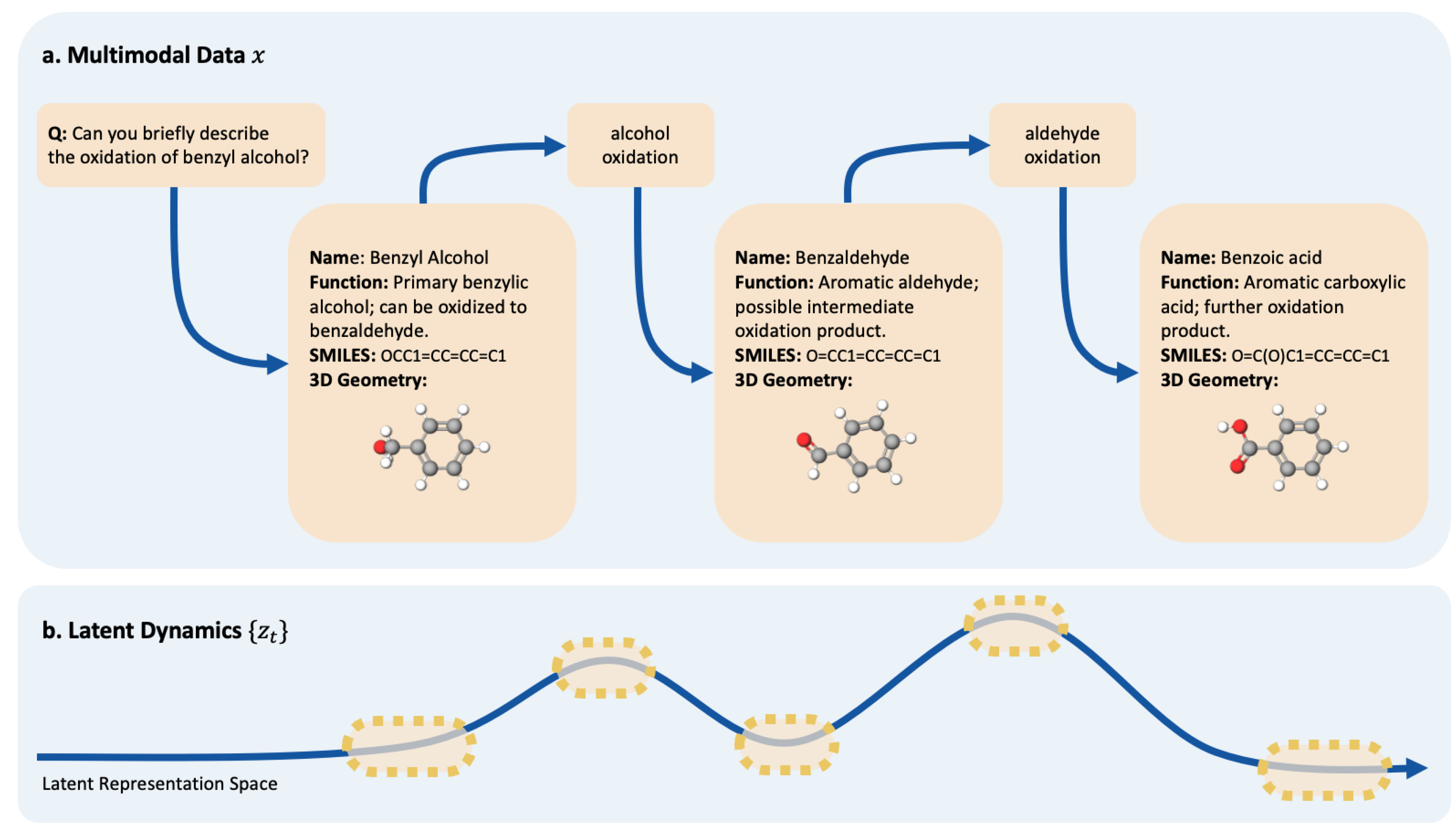
Wave Intelligence organizes scientific modeling around mechanistic hypotheses expressed through shared multimodal representations and latent dynamics. As illustrated in Figure 2, models integrate complementary observations and learn evolution rules under specified conditions and interventions, connecting the resulting dynamics to measurable predictions. It motivates the emphasis on evolving latent representations without requiring those dynamics to follow a physical wave equation. The framework comprises shared multimodal representations, latent evolution rules, and mappings to observable quantities.
3.1. Shared Multimodal Representations
Different modalities offer partial and complementary views of the same scientific process. In molecular science, text expresses accumulated knowledge in human language, including experimental conditions, proposed mechanisms, and relationships that may not be visible in a structure. Three-dimensional structures reveal spatial organization shaped by physical constraints, including geometric relationships that text may leave unspecified. Experimental measurements provide further evidence of how the system behaves under particular conditions. None of these views alone captures the underlying process. A shared representation should connect their evidence while preserving what each uniquely contributes; learning how that representation evolves can then test whether a proposed account explains changes in the system.
Let index the modalities available at time t, and let denote the corresponding observations of the scientific system. A model maps these observations to a shared latent representation:
where tokenizes and embeds observations from modality m, f integrates the resulting embeddings into a shared latent representation, and specifies relevant experimental and environmental conditions. Tokenization enables the model to process heterogeneous inputs from different modalities, while learned cross-modal alignment allows complementary observations to jointly constrain the latent scientific representation [22,26].
In practice, modalities may be missing, measurements may be noisy, and relevant factors may remain unobserved. The available observations may therefore be insufficient to determine a unique latent state. eq:waveencoding is schematic: implementations may represent this uncertainty through a distribution over latent states and infer them from observation histories rather than a single time point.
3.2. Latent Dynamics and Observable Predictions
The latent representation evolves according to
where summarizes specified interventions and operating conditions over the interval , including changes to the system configuration, and is the corresponding evolution rule. The dynamics may be modeled in discrete or continuous time.
Predictions become experimentally assessable through modality-specific decoders
where decodes the latent representation to quantities associated with modality m.
Together, the latent representations, evolution rules, and decoders provide a computational framework for expressing candidate mechanistic hypotheses. Scientific knowledge can constrain these components through applicable conservation laws, symmetries, boundary conditions, and measurement relationships. These constraints specify which representations and dynamics are scientifically admissible, while the decoders translate their consequences into measurable predictions.
Predictions across modalities are derived from the same evolving latent representation, allowing complementary observations to assess whether a candidate hypothesis consistently accounts for the available evidence. Discrepancies can motivate revision of the hypothesis or its assumptions. When multiple hypotheses remain consistent with the observations, the framework should preserve that uncertainty.
3.3. Illustrative Applications
Potential applications of Wave Intelligence include chemical reaction modeling, synthesis planning, metabolic pathway engineering, and materials processing. We illustrate these capabilities through chemical reactions and metabolic pathways.
3.3.0.1. Chemical reactions.
Chemical reaction modeling illustrates the overall pipeline shown in Figure 1. Property prediction estimates molecular properties such as reactivity (Figure 1(a)), while structure generation proposes molecules with desired properties (Figure 1(b)). Wave Intelligence builds on these capabilities to examine which reaction steps produce an observed outcome, what governs reaction rates, and how changes in concentrations or operating conditions affect the process. It could integrate molecular structures, spectroscopic observations, and textual descriptions of reaction conditions into a shared latent representation (Figure 1(c)). Evolution rules would encode candidate reaction steps and their kinetics, including the formation and consumption of proposed intermediates while enforcing stoichiometric mass balance. Decoders would translate the resulting latent dynamics into predicted concentration profiles. By perturbing initial concentrations or temperature schedules as model inputs, the framework could explore conditions associated with desired outcomes and identify where alternative mechanisms predict different observable responses. This connects multimodal representation learning with mechanistic hypothesis formation and computational planning.
3.3.0.2. Metabolic pathways.
In metabolic pathway modeling, Wave Intelligence could integrate metabolite measurements, enzyme abundance data, and textual annotations of biochemical reactions into a shared latent representation. Evolution rules would describe how metabolites are produced and consumed through interconnected reactions, with candidate hypotheses specifying enzyme-mediated transformations and regulatory interactions. The model could then predict how changes in nutrient availability or enzyme activity affect metabolite concentrations and pathway fluxes over time. For example, it could compare whether alternative regulatory hypotheses predict accumulation of an upstream metabolite or redistribution of flux through another pathway when a particular enzyme’s activity is reduced. These predictions would connect pathway-level behavior to candidate mechanisms and support computational exploration of metabolic modifications.
Across both applications, Wave Intelligence integrates multimodal evidence into a shared latent representation and expresses candidate mechanisms through latent dynamics. These dynamics predict how the system responds to specified changes, while decoders translate latent trajectories into measurable quantities. Multiple mechanisms may remain consistent with the available observations, and the framework should preserve these alternatives and compare their observable predictions under different conditions.
4. Research Agenda of Wave Intelligence
Having outlined the computational framework and its illustrative applications, we now consider how models developed within Wave Intelligence should be evaluated and what learning challenges remain.
4.1. From Predictive Accuracy to Mechanistic Evidence
Evaluating Wave Intelligence requires assessing both observable predictions and the evidence supporting their mechanistic interpretation. Accurate predictions alone do not uniquely identify a mechanism. Hidden variables, incomplete observations, measurement noise, and insufficient variation in observed conditions may allow several dynamical models to explain the same data. Moreover, invertible transformations of latent representations, accompanied by corresponding transformations of the evolution rules and decoders, can preserve observable predictions. Individual latent coordinates should therefore not automatically be assigned unique physical meanings.
Accordingly, we propose four dimensions for evaluating models developed within this paradigm:
- Predictive adequacy: whether the model accurately predicts held-out observations and their evolution over multiple time steps, including across modalities.
- Interventional adequacy: whether the model predicts responses to specified changes in inputs, initial configurations, or environmental conditions, as assessed against independent data.
- Scientific consistency: whether the model satisfies applicable scientific constraints and accounts consistently for observations across modalities.
- Evidence for mechanistic identification: whether the available evidence and identifiability assumptions support the proposed interpretation of latent variables, interactions, or evolution rules.
A key test is whether jointly learning representations and dynamics distinguishes candidate mechanisms under held-out conditions more effectively than learning them separately, given matched data and comparable model capacity.
4.2. Open Learning Challenges
Meeting these evaluation criteria raises three learning challenges for Wave Intelligence. The first is to align multimodal observations while preserving their complementary information. Modalities may capture different aspects of a system at different resolutions and times, and some observations may be missing or noisy. Shared representations must therefore connect corresponding information without erasing details available only through particular modalities.
The second is to learn latent dynamics that generalize beyond training conditions. A representation sufficient to reconstruct current observations across modalities may still lack information needed to predict how a system evolves under perturbed inputs or conditions. The challenge is to jointly learn cross-modal representations and evolution rules that support such predictions, while determining how scientific constraints should guide each component.
The third is to represent unresolved mechanistic uncertainty. Multiple candidate models may explain the available observations yet predict different responses under changed conditions. Preserving these alternatives requires distinguishing different mechanistic hypotheses from equivalent mathematical representations of the same model. The computational framework of Wave Intelligence should also separate uncertainty about the underlying dynamics from uncertainty due to measurement noise.
5. Conclusions
This paper envisions Wave Intelligence as the next paradigm for AI for scientific discovery, advancing from property prediction and structure generation toward mechanistic understanding. Its organizing objective is to formulate and assess mechanistic hypotheses; shared multimodal representations and latent dynamics provide the computational foundations. Complementary observations constrain representations of scientific systems, evolution rules express candidate mechanisms, and decoders translate their consequences into measurable predictions. Together, these components provide a computational framework for formulating mechanistic hypotheses and reasoning about how systems respond to changes in conditions.
Realizing this vision requires preserving complementary information across modalities, learning dynamics that generalize beyond training conditions, and representing uncertainty when several mechanisms remain plausible. We have outlined learning challenges and evaluation criteria to guide this development. Progress should be assessed by whether models explain complementary observations, predict responses under changed conditions, and clarify which mechanistic claims the evidence supports. Wave Intelligence thus offers a research agenda for connecting AI’s predictive and generative capabilities to explicit, testable explanations of scientific processes.
Acknowledgments
The author would like to thank Dr. Yuhao Li and Dr. Kanglei Liu for helpful discussions.
References
- Wang, H.; Fu, T.; Du, Y.; Gao, W.; Huang, K.; Liu, Z.; Chandak, P.; Liu, S.; Van Katwyk, P.; Deac, A.; et al. Scientific discovery in the age of artificial intelligence. Nature 2023, 620, 47–60. [Google Scholar] [CrossRef] [PubMed]
- Jumper, J.; Evans, R.; Pritzel, A.; Green, T.; Figurnov, M.; Ronneberger, O.; Tunyasuvunakool, K.; Bates, R.; Žídek, A.; Potapenko, A.; et al. Highly accurate protein structure prediction with AlphaFold. Nature 2021, 596, 583–589. [Google Scholar] [CrossRef] [PubMed]
- Merchant, A.; Batzner, S.; Schoenholz, S.S.; Aykol, M.; Cheon, G.; Cubuk, E.D. Scaling deep learning for materials discovery. Nature 2023, 624, 80–85. [Google Scholar] [CrossRef] [PubMed]
- Szymanski, N.J.; Rendy, B.; Fei, Y.; Kumar, R.E.; He, T.; Milsted, D.; McDermott, M.J.; Gallant, M.; Cubuk, E.D.; Merchant, A.; et al. An autonomous laboratory for the accelerated synthesis of inorganic materials. Nature 2023, 624, 86–91. [Google Scholar] [CrossRef] [PubMed]
- Boiko, D.A.; MacKnight, R.; Kline, B.; Gomes, G. Autonomous chemical research with large language models. Nature 2023, 624, 570–578. [Google Scholar] [CrossRef] [PubMed]
- Krenn, M.; Pollice, R.; Guo, S.Y.; Aldeghi, M.; Cervera-Lierta, A.; Friederich, P.; dos Passos Gomes, G.; Häse, F.; Jinich, A.; Nigam, A.; et al. On scientific understanding with artificial intelligence. Nat. Rev. Phys. 2022, 4, 761–769. [Google Scholar] [CrossRef] [PubMed]
- Wu, Z.; Ramsundar, B.; Feinberg, E.N.; Gomes, J.; Geniesse, C.; Pappu, A.S.; Leswing, K.; Pande, V. MoleculeNet: a benchmark for molecular machine learning. Chem. Sci. 2018, 9, 513–530. [Google Scholar] [CrossRef] [PubMed]
- Stokes, J.M.; Yang, K.; Swanson, K.; Jin, W.; Cubillos-Ruiz, A.; Donghia, N.M.; MacNair, C.R.; French, S.; Carfrae, L.A.; Bloom-Ackermann, Z.; et al. A deep learning approach to antibiotic discovery. Cell 2020, 180, 688–702. [Google Scholar] [CrossRef] [PubMed]
- Kangas, J.D.; Naik, A.W.; Murphy, R.F. Efficient discovery of responses of proteins to compounds using active learning. BMC Bioinform. 2014, 15, 143. [Google Scholar] [CrossRef] [PubMed]
- Gómez-Bombarelli, R.; Wei, J.N.; Duvenaud, D.; Hernández-Lobato, J.M.; Sánchez-Lengeling, B.; Sheberla, D.; Aguilera-Iparraguirre, J.; Hirzel, T.D.; Adams, R.P.; Aspuru-Guzik, A. Automatic chemical design using a data-driven continuous representation of molecules. ACS Cent. Sci. 2018, 4, 268. [Google Scholar] [CrossRef] [PubMed]
- Liu, S.; Wang, C.; Lu, J.; Nie, W.; Wang, H.; Li, Z.; Zhou, B.; Tang, J. Unsupervised discovery of steerable factors when graph deep generative models are entangled. Trans. Mach. Learn. Res. 2024. [Google Scholar] [CrossRef]
- Liu, S.; Li, Y.; Li, Z.; Gitter, A.; Zhu, Y.; Lu, J.; Xu, Z.; Nie, W.; Ramanathan, A.; Xiao*, C.; et al. A Text-guided Protein Design Framework. Nat. Mach. Intell. 2025, 7, 580–591. [Google Scholar] [CrossRef]
- Watson, J.L.; Juergens, D.; Bennett, N.R.; Trippe, B.L.; Yim, J.; Eisenach, H.E.; Ahern, W.; Borst, A.J.; Ragotte, R.J.; Milles, L.F.; et al. De novo design of protein structure and function with RFdiffusion. Nature 2023, 620, 1089–1100. [Google Scholar] [CrossRef] [PubMed]
- Brunton, S.L.; Proctor, J.L.; Kutz, J.N. Discovering governing equations from data by sparse identification of nonlinear dynamical systems. Proc. Natl. Acad. Sci. 2016, 113, 3932–3937. [Google Scholar] [CrossRef] [PubMed]
- Champion, K.; Lusch, B.; Kutz, J.N.; Brunton, S.L. Data-driven discovery of coordinates and governing equations. Proc. Natl. Acad. Sci. 2019, 116, 22445–22451. [Google Scholar] [CrossRef] [PubMed]
- Chen, R.T.Q.; Rubanova, Y.; Bettencourt, J.; Duvenaud, D. Neural ordinary differential equations. In Proceedings of the Advances in Neural Information Processing Systems, 2018; Vol. 31. [Google Scholar]
- Lusch, B.; Kutz, J.N.; Brunton, S.L. Deep learning for universal linear embeddings of nonlinear dynamics. Nat. Commun. 2018, 9, 4950. [Google Scholar] [CrossRef] [PubMed]
- Raissi, M.; Perdikaris, P.; Karniadakis, G.E. Physics-informed neural networks: A deep learning framework for solving forward and inverse problems involving nonlinear partial differential equations. J. Comput. Phys. 2019, 378, 686–707. [Google Scholar] [CrossRef]
- Greydanus, S.; Dzamba, M.; Yosinski, J. Hamiltonian neural networks. 2019, Vol. 32. [Google Scholar]
- Ha, D.; Schmidhuber, J. World models, 2018. [CrossRef]
- Sutton, R.S. Dyna, an integrated architecture for learning, planning, and reacting. ACM Sigart Bull. 1991, 2, 160–163. [Google Scholar] [CrossRef]
- Liu, S.; Nie, W.; Wang, C.; Lu, J.; Qiao, Z.; Liu, L.; Tang, J.; Xiao, C.; Anandkumar, A. Multi-modal molecule structure–text model for text-based retrieval and editing. Nat. Mach. Intell. 2023, 5, 1447–1457. [Google Scholar] [CrossRef]
- Ingraham, J.B.; Baranov, M.; Costello, Z.; Barber, K.W.; Wang, W.; Ismail, A.; Frappier, V.; Lord, D.M.; Ng-Thow-Hing, C.; Van Vlack, E.R.; et al. Illuminating protein space with a programmable generative model. Nature 2023, 623, 1070–1078. [Google Scholar] [CrossRef] [PubMed]
- Hayes, T.; Rao, R.; Akin, H.; Sofroniew, N.J.; Oktay, D.; Lin, Z.; Verkuil, R.; Tran, V.Q.; Deaton, J.; Wiggert, M.; et al. Simulating 500 million years of evolution with a language model. Science 2025, 387, 850–858. [Google Scholar] [CrossRef] [PubMed]
- Huh, M.; Cheung, B.; Wang, T.; Isola, P. Position: The Platonic Representation Hypothesis. In Proceedings of the Proceedings of the 41st International Conference on Machine Learning; PMLR; Salakhutdinov, R., Kolter, Z., Heller, K., Weller, A., Oliver, N., Scarlett, J., Berkenkamp, F., Eds.; 7 2024; Vol. 235, pp. 20617–20642. [Google Scholar]
- Li, H.; Du, W.; Li, Y.; Guo, H.; Liu, S. InertialAR: Autoregressive 3D Molecule Generation with Inertial Frames. In Proceedings of the Forty-third International Conference on Machine Learning, 2026. [Google Scholar]
Figure 1.
Three stages of AI for Scientific Discovery. (a) Property prediction learns conditional mappings. (b) Structure generation models a data distribution and supports molecule optimization. (c) Wave Intelligence learns latent dynamics in a shared multimodal representation space to support mechanistic understanding.
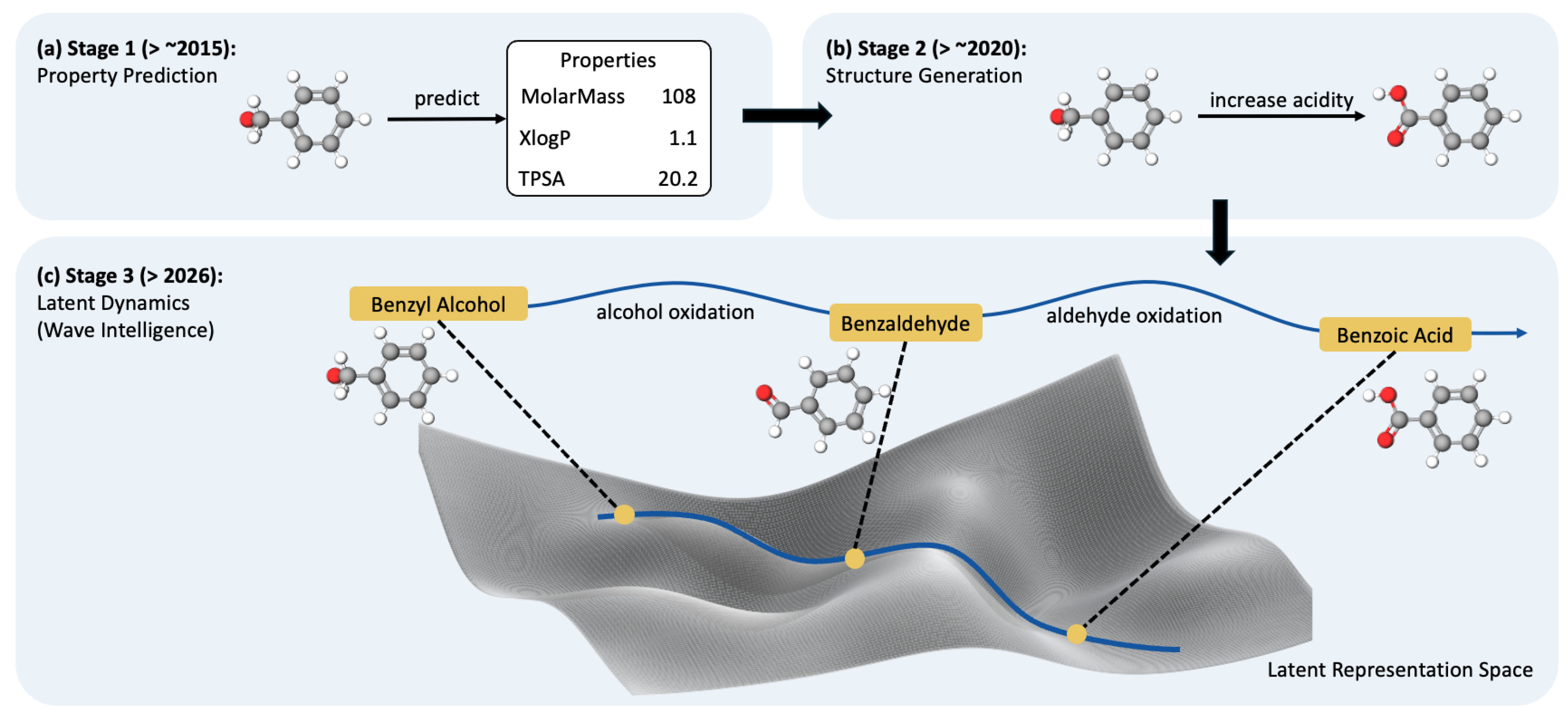
Figure 2.
Computational framework of Wave Intelligence. (a) illustrates the input data in a multimodal form. (b) These observations are mapped to a shared latent representation, whose latent dynamics model how the system evolves under specified conditions.
Figure 2.
Computational framework of Wave Intelligence. (a) illustrates the input data in a multimodal form. (b) These observations are mapped to a shared latent representation, whose latent dynamics model how the system evolves under specified conditions.
Disclaimer/Publisher’s Note: The statements, opinions and data contained in all publications are solely those of the individual author(s) and contributor(s) and not of MDPI and/or the editor(s). MDPI and/or the editor(s) disclaim responsibility for any injury to people or property resulting from any ideas, methods, instructions or products referred to in the content. |
© 2026 by the authors. Licensee MDPI, Basel, Switzerland. This article is an open access article distributed under the terms and conditions of the Creative Commons Attribution (CC BY) license (http://creativecommons.org/licenses/by/4.0/).
Copyright: This open access article is published under a Creative Commons CC BY 4.0 license, which permit the free download, distribution, and reuse, provided that the author and preprint are cited in any reuse.