

Submitted:
30 September 2026
Posted:
02 October 2026
You are already at the latest version
Abstract
Drug discovery has traditionally been driven by strategies aimed at identifying a single molecular target for a given disease, an approach inspired by Paul Ehrlich's "magic bullet" concept. While enormously productive, this reductionist paradigm has progressively given way to more comprehensive views, first through polypharmacology and multi-target drug design, then through network medicine. This article traces this conceptual evolution through a simple graph-based formalism, arguing that the natural endpoint of this trajectory is a fully systems-level paradigm, here termed System-Based Drug Discovery, in which the organism itself is modeled as a complex, multiscale, and multilayer network. Grounded in complexity science, this framework does not replace but integrates the traditional top-down and bottom-up discovery strategies within a unifying representation. The growing availability of biological data and computing power, together with recent advances in molecular generative models, is already turning this conceptual shift into practice, extending network-based reasoning from target identification and drug repositioning to the actual design of new molecular entities.
Keywords:
drug discovery
; network medicine
; complexity science
; disease module
; molecular generative models
Introduction
The search for remedies capable of relieving the suffering caused by disease, trauma, or more complex syndromes is an activity that has always accompanied the history of humankind. The enormous progress and the successes achieved in the therapeutic field especially over the course of the twentieth century are undoubtedly important, but they should not make us forget how many diseases still lack a cure. This highlights the full current relevance of drug discovery, a challenging undertaking, whose first key goal is the identification of new bioactive ingredients (usually small molecules, technically New Chemical Entities: NCEs) potentially capable of counteracting disease states. While the pharmacological approach is only one of the available ways of treating disease, and even taking into account the various new therapeutic modalities identified in recent years, it should be stressed that the ability to maintain an adequate flow of natural or synthetic NCEs entering the preclinical and clinical development pipeline represents a worldwide health necessity. Fortunately, considerable progress has been made in the design and synthesis of new chemical compounds, such that today's computational and synthetic chemistry technologies make it possible to obtain practically any molecule targeted at a given therapeutic goal. At this point, it may also be useful to broaden our view of the foundational horizon of drug research as a scientific discipline, attempting to place it within a conceptual framework that takes into account some current theoretical and experimental orientations in biology and beyond. Precisely, I am referring to the category of complexity, a salient feature of biological systems whose significance and scope are increasingly being explored also in medicine. Indeed, this same complexity-oriented view is already shaping new avenues of drug discovery, in the literature as well as in actual practice, which makes it worthwhile to reflect on how we arrived here and on what theoretical grounds this shift may rest. In this article, I will trace the evolution of the drug discovery paradigm, starting from a brief account of its development over the course of the twentieth century, and arriving at an updated definition consistent with certain current directions in scientific research.
From the “Magic Bullet” to Systems Biology
To simplify as much as possible the historical development of drug research, and to limit ourselves to the last century, we might say that the strategies for identifying new agents with therapeutic potential have essentially been two: a) the testing in vivo or in vitro of compounds without hypothesizing a mechanism of action a priori (a top-down approach), and b) the selection or production, based on a mechanistic hypothesis, of molecules to be tested in in vitro systems such as enzymes in solution, cell cultures, or isolated organs (a bottom-up approach). Following the top-down approach (often called "phenotypic drug discovery"), in the past, the discovery of new drugs was based mainly on clinical investigations or chance observations almost always followed by chemical modifications of prototypes (see, for example, the penicillins), whereas more recently so-called compound libraries have been widely exploited. These are more or less extensive collections of molecules systematically screened at high speed ("high throughput screening") until a promising compound is found. In the bottom-up strategy, by contrast, drug candidates are designed starting from hypotheses derived from knowledge of the disease to be treated, in particular of its pathogenesis at the molecular level. In this sense, it is at least from the 1960s onward that we speak of "rational drug design". This approach was strongly aided at first by advances in molecular and structural biology, and later by the application of statistical and/or molecular-modeling computational methods. In the early period, when the most important and frequent advances in biology consisted in the ability to identify and express in cell lines the genes associated with particular aspects of disease, the goal of the research was identified as the ability to specifically target the expression products of these genes with suitable molecules, so as to activate or inhibit a cellular response believed to play a crucial role in the progression or manifestations of the disease. This gave rise to the paradigm, inspired by Ehrlich's "magic bullet"1, referred to as "one disease – one target – one drug": to treat a disease it is necessary to hit a molecular target (generally a protein) with a compound that binds specifically to it. This way of conducting drug research became widespread and made it possible—and still does—to identify a great many NCEs with extremely high specificity for individual targets, although not many of these molecules, when studied in the clinical setting, turned out to be capable of acting in the expected specific way. In the late 1990s, however, just as this truly reductionist approach reached its peak of diffusion and acceptance, a somewhat different path emerged, less exclusive in identifying the target to be hit, and people began to look for "multi-target" compounds: molecules capable of binding to more than one target, with the aim of striking the biological processes associated with the disease not just at a single point but at several steps along the pathogenetic way. And so, from the 2000s onward, the paradigm became "one disease – multiple targets – one drug", supported by a great deal of experimental evidence contradicting the reductionist hypothesis of the single target.
Even from the broad outline sketched above, one can glimpse an evolution of the general drug discovery strategy toward increasing complexity. And for a schematic inspection, the two paradigms stated above can be depicted in a graph-based representation as follows:
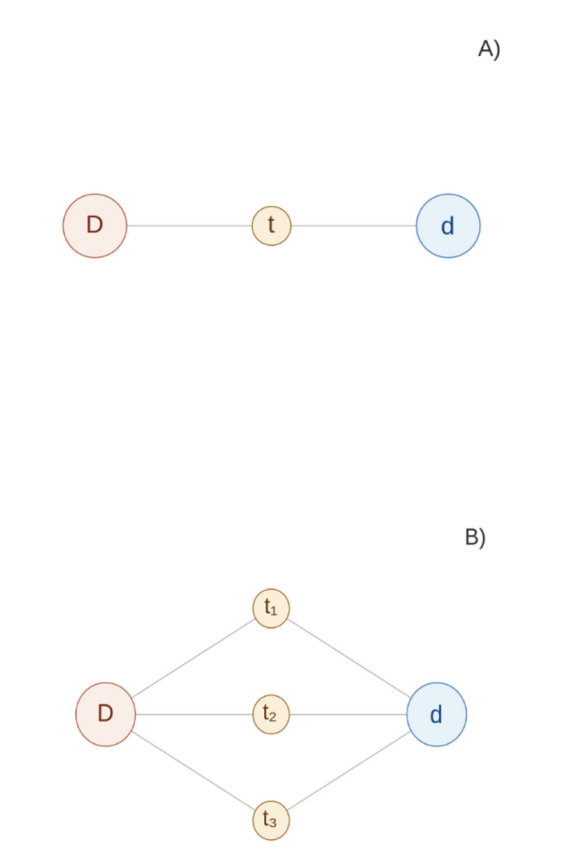
where D, t, and d stand for Disease, target, and drug, respectively. In the A) case, a single molecular element is hypothesized to link drug and disease, namely the target itself, be it an enzyme that is inhibited, a receptor that is activated or blocked, an ion channel that is opened or closed, and so on. In the B) case, the drug's action is assumed to be mediated by its interaction with more than one of the elements listed above, a representation that, even if only slightly, appears more realistic than the previous one. In practice, this shift from single-target pharmacology to “polypharmacology” has been supported by increasingly in-depth studies of drug mechanisms of action, which have made it possible to obtain a level of detail unimaginable just a few years earlier. Indeed, drugs designed and initially found to act through interaction with a single target later turned out to be multi-target molecules: a case in point is the well-known anticancer drug imatinib, a compound conceived and developed to selectively inhibit the BCR-ABL kinase enzyme responsible for uncontrolled cell proliferation in chronic myeloid leukemia, which was later found to be a poly-kinase inhibitor.
If we consider the two graphs shown above, we can say that B) seems to represent a drug–disease relationship more consistent with experimental knowledge than that represented by A), owing to the fact that B) takes into account several—ideally all—of the possible protein targets associated with the disease and capable of being hit by the drug. To take the reasoning a step further, we might recall a well-established finding of modern proteomic studies, namely that within a cell, proteins do not exist or act in isolation but interact with one another, possibly in various ways, the most frequent of which is direct contact. At the cellular level, then, proteins give rise to a network in which each protein is connected to one or more others, forming the so-called "protein–protein interactome" that can be represented as a graph in which individual proteins are the nodes and the connections between them are the edges. Using dedicated computational tools, it is possible to model and visualize this interactome, which, depending on the starting data and the construction criteria, can contain even more than 20k proteins and 1M connections. Remarkably, a recent observation made by some researchers is that the proteins involved in the pathogenesis and manifestations of a disease are almost always directly connected, or at least very close to one another within the interactome. This has led to the concept of the “disease module”, which is the sub-network of the interactome formed by the proteins associated with the disease together with their neighboring and connecting proteins, as tentatively shown by the scheme below:
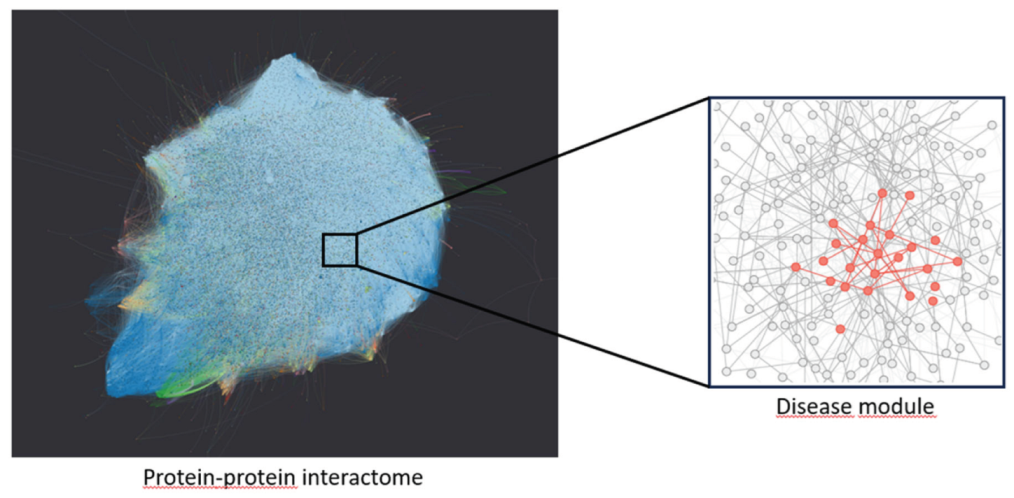
The disease module is a central concept in the innovative approach to medicine known as "network medicine"2 and can be used to continue the discussion of the paradigms introduced above with graphs A) and B), which, recall, represent the drug–disease relationship mediated by a single target (A) or several targets (B). We can now postulate that a drug does not act on the disease simply through a single or several target(s), but plausibly through some proteins of the disease module, and we can represent this version of the paradigm as follows:
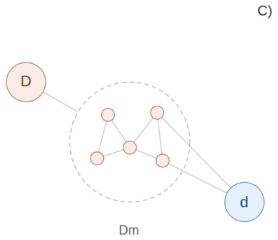
where Dm denotes the Disease module. This hypothesis, among other things, has given rise to numerous drug-repositioning studies, following the discovery that the modules of different diseases can partially overlap within the interactome; consequently, a drug originally developed to interact with some protein targets associated with a disease can be used to treat another condition that shares targets in common with the first one3.
Although paradigm C) may serve as a valid starting point for outlining the theoretical context of the search for new drugs, we note that it is based entirely on what we might consider a protein-level representation of a living system. It would be like saying that the protein–protein interactome stands for the whole individual (the patient) and the disease module for the part of the organism affected by the disease: the drug acts on the disease by hitting targets included in the disease module. But in this description, reductionism reappears. Indeed, the action of drugs on a living organism does not involve proteins alone. For example, proteins are the product of the expression of the genes that encode them, that is, "below" the protein level there is a genetic level with which a drug can directly interfere. On the other hand, proteins may take part in various biochemical pathways that enable the processes necessary for life and for cell replication, and drugs affect these pathways as well; here, then, is another level of description of the cellular system, "above" the protein level, at which we can study drug action. Continuing along this line of reasoning, we might further consider that cells interact with one another and may organize themselves into different types of aggregates depending on their characteristics (think of neuronal cells or, in a pathological setting, cancer cells) to give rise to tissues, and once again we are faced with another viewpoint on pharmacological action: drugs act on cells. And going further still, we come to the organs of our body, which carry out the various vital functions for the whole organism and with respect to which drug action can be considered ("drugs for the heart" or "drugs that act on the central nervous system"). What has been briefly introduced in these last lines does nothing more than apply to pharmacology the approach to describing living organisms known as "systems biology", which aims to study such organisms comprehensively (holistically4), thereby overcoming both the reductionism typical of traditional biology and the discretization of biological domains that leads to their being investigated separately. According to this way of viewing things, now increasingly accepted within the scientific community, the organization of living beings can be conceptualized as a sequence of intra- and inter-connected hierarchical levels, from molecules to cells and up to tissues and organs, up to individuals, possibly considered in their relationships with one another and with the environment: these levels, taken together and in their sequence, provide a global representation of the complexity of living systems. The scheme below gives an illustration of this concept:
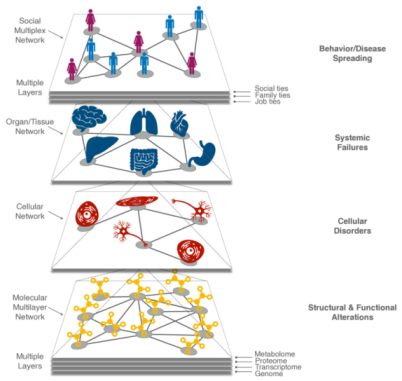
De Domenico, M. (2020, November 17). Multilayer Networks Illustrated. https://doi.org/10.17605/OSF.IO/GY53K
It should be noted that considering the complexity of living systems makes it possible to avoid a purely deterministic interpretation of biological phenomena, giving weight instead to the so-called "emergent properties" that arise from the horizontal and vertical interactions among the various entities making up the whole system. In this sense, diseases can be investigated not as simple consequences of single physiological aberrations (e.g., “a gene mutation causes the disease”), but as emergent properties, that is, as phenomena resulting from possible evolutions of a biological system along a path different from the one considered "physiological", yet equally compatible with the complexity of the system itself. For example, the mutation of a gene changes the network of relationships around it, and this, in connection with other organic and environmental factors, induces a different (“pathological”) configuration of the system5.
On the basis of the above, returning now to the development of the paradigms, we can broaden the range of pharmaceutical targets by considering the individual as a whole, across all levels of organization. It will therefore be a matter of rewriting graph C) in a form that takes the systems approach into account, as follows:
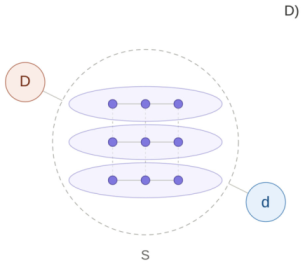
where S denotes the living organism (System) made up of the various entities that characterize its nature, interconnected according to the hierarchy of levels mentioned above. The paradigm can thus be redefined as "one disease – one system – one drug". This rewriting of the drug discovery paradigm (“System-Based Drug Discovery”) ultimately places this activity within the broader, more general context of systems biology, situating it in a multidisciplinary domain grounded in Complexity Science6, the current discipline that studies complex systems and their behavior.
Paradigm and Models
Having introduced this new way of considering the drug–disease relationship, it remains to be seen whether and how paradigm D) can be useful in assisting and guiding the identification of new molecular entities7 in drug research. In this regard, it should first be noted that the overall system described by the simple graph D) lends itself very well to being modeled in silico through the use of network science methods. Indeed, the real system denoted by S can be depicted as a network, in which the nodes represent the various biological entities that make it up (genes, proteins, cells, organs, etc.) and the connections make explicit the known relationships among them. To construct the network, one can use data collected in the numerous publicly accessible databases, which are in turn assembled on the basis of experimental studies in genomics, transcriptomics, proteomics, metabolomics, and microbiomics, as well as, moving across all levels, in molecular, cellular, and functional biology, anatomy, and physiology. Furthermore, to complete the overall network, one can also include the entities D and d of D), considering data concerning diseases (D), such as pathological manifestations and symptoms (phenotypes), definitions, and even environmental effects related to the onset and progression of diseases following exposure to external factors. Finally, the network can also comprise known drugs (d) and all information regarding their use, like their known targets, mechanisms of action, side effects and toxicities, as well as interactions with other drugs. With this data it is possible to build multiscale networks that provide an overall picture of the disease–organism–drug system, encompassing hundreds of thousands of nodes and millions of relationships among them. Various types of these network models exist, for example "multilayer networks" or "knowledge graphs", and network science provides us with the tools to extract from these representations information that cannot be detected through investigations based on less comprehensive and detailed models, such as those often obtained in vitro or even in vivo. To mention an example in this context, one challenge that has begun to be tackled is that of building "digital twins" of patients that are not merely an in silico replica of a person's pathophysiological characteristics, but that integrate the network models described above into a personalized predictive tool8. This should make it possible to develop a therapeutic intervention tailored to the patient, e.g., by identifying the specific targets to be hit by drugs and predicting the effects of those drugs on the entire organism.
It also follows from what has been said above that, in order to be useful for drug discovery, such network models must be analyzed, and simulations and predictions must be carried out on their basis. This field of activity is well known to people involved in drug design, since the use of simulative and predictive computational techniques has long been part of the skills required for this type of research. In particular, in the case of network models of complex systems, one can draw on applications from graph theory both to analyze their topology and dynamics and to predict the consequences of changes in the system's configuration, such as the silencing of a gene within a gene-regulatory network or the evolution over time of an intracellular metabolic network.
Recalling the question posed at the beginning of this section, that is, the applicability of the system-based paradigm in drug discovery, we may ask how the more or less complex and elaborate models can assist in the search for new molecular entities to be considered for therapeutic use. Undoubtedly, whatever type of model is used, it will provide a knowledge context on the basis of which the requirements that new therapeutic molecules must possess can be defined; then, virtual or real molecules possessing such required characteristics can be generated9 or extracted from the available databases. This way of operating can be applied to the search for small or large molecules (biomolecules), of natural or synthetic origin, and can be regarded as an extension of the classic approaches to the identification of new compounds, one that includes high-level modeling of the biological context, and possibly of preclinical and clinical issues, like pharmacokinetics, patentability, patient stratification, clinical outcome prediction, and so on. It is worth noting that all the drug discovery process so far described can be—and actually has been—partly or even completely automated through AI-informed platforms that carry out the whole sequence of activities, from target identification to simulated clinical trials of the proposed drug candidates10.
Needless to say, however, we must remember that the new molecular entities identified by computational models will then have to be produced, tested in the laboratory, and evaluated clinically before finally reaching, if all goes well, the patient.
Conclusions
I hope that what has been described above can convey an idea of the contemporary conceptual and theoretical landscape within which to situate the search for new drugs, understood as molecular entities acting on a complex system such as the human organism. Recalling the traditional approaches mentioned above, I would like to stress that the current perspective does not exclude or replace the design methodologies and techniques developed to date; rather, it includes and combines them within a more advanced paradigm. The two top-down and bottom-up strategies are no longer viewed as mutually exclusive, but are instead integrated into a scenario that considers the organism as a system in its entirety, while at the same time allowing for the specificity of interventions on targeted objectives. What makes the difference compared with the recent past is, first and foremost, network thinking, the conceptual shift that lets us virtualize and investigate the complex system represented by our organism as a web of relationships rather than a collection of isolated parts. This way of thinking finds its most concrete expression in network modeling: an extremely powerful and flexible tool, open to the continuous acquisition of new information and capable of revealing global system characteristics not evident in disaggregated data. Finally, from a conceptual standpoint, this paradigm rests on the recognition of the complex nature of living organisms and on the now well-established awareness that the functioning of these systems is based on the relationships established among their various components, at various levels. Today we have the tools needed to investigate this complexity, and the time has come to harness this knowledge to improve our ability to combat the diseases that still afflict humankind.
Notes and References
- The "magic bullet" (originally in German “Zauberkugel”) is one of the most famous metaphors developed to illustrate the mode of action of drugs. It says that a drug is able to bind a certain molecular/cellular target and only that one, and recalls the idea of "selective toxicity" that guided for decades the search for new therapeutic agents. The "magic bullet theory" was developed by Paul Ehrlich (1854-1915), a German scientist, Nobel laureate, who worked in the fields of chemistry, immunology and pharmacology. Among other achievements, he pioneered antimicrobial chemotherapy with the development of the first synthetic agent against syphilis (Salvarsan, arsphenamine). For an appreciation of his theory and of the influence it had on drug discovery, see K. Strebhardt & A. Ullrich, Paul Ehrlich's magic bullet concept: 100 years of progress, Nat. Rev. Cancer, 2008, 8, 473-480 (https://doi.org/10.1038/nrc2394).
- The term “network medicine” characterizes an innovative approach to medicine, a genuine “new paradigm for defining human diseases and therapies”, to use the words of Joseph Loscalzo, who, together with Albert L. Barabási, is one of the principal proponents of this new discipline (see: J. Loscalzo, A.-L. Barabási, E.K. Silverman, Network Medicine. Complex Systems in Human Disease and Therapeutics, Harvard University Press, Cambridge, Mass., 2017). The basic idea is to combine the systems biology approach with network science techniques in order to study, in a unifying way, the complex relationships among disease determinants, and to derive from this useful indications for explaining their pathogenesis and identifying possible therapies. This approach contrasts with the reductionist hypothesis that has dominated medicine since the seventeenth century and that has helped develop medical science and practice essentially by dissecting the complexity of disease into recognizable and verifiable elements, ultimately leading to an understanding of the underlying mechanisms. The Human Genome Project appears to have represented the high point of this trajectory, which led some to believe that knowledge of the genome and its possible variations would be sufficient to interpret an individual patient's pathology and to identify the corresponding personalized therapeutic treatment. However, the meager results in terms of an expanded therapeutic arsenal have helped call this vision into question, favoring a shift in perspective that recognizes in pathological manifestations the complex nature of the relationships between genetic and environmental determinants, and the resulting impossibility of forcing them into a rigid classification. Network medicine attempts to pursue this latter path, drawing on network science to represent and interpret the totality of diseases in a holistic (see Note 4) and integrated view.
- As an example, see E. Guney et al. in Nat. Commun., 2016, 7, 10331 (https://doi.org/10.1038/ncomms10331). In this pioneering work, the authors propose the distance between drug targets and disease-associated proteins (i.e., the disease module) as a suitable measure of the “proximity” between drug and disease, and by using this metric, they identify unprecedented drug-disease associations to be considered for drug repurposing.
- It should be stressed that the use of the term “holistic” (from the Greek ὅλοσ: whole, entire, total) in this context has nothing to do with the way the term is used in domains that are not rigorously scientific and that relate to practices vaguely inspired by oriental philosophies. On the contrary, the term refers here to a well-defined epistemological orientation suggested by the application to the life sciences of the Aristotelian idea that “the whole is more than the sum of its parts”, a notion that has been variously debated up to the present day. From the second half of the twentieth century onward, the holistic hypothesis, perhaps better described as unifying or systemic, gained considerable momentum, aided also by the theoretical support of L. von Bertalanffy's General Systems Theory (1950), and by the discovery of the role of communication and information in processes, initially proposed in the field of cybernetics by N. Wiener (1947).
- A telling illustration of an advanced way of describing a disease as a multi-level system has recently been offered by R. Solé et al. (Complex Diseases, Preprints.org, 2026, https://doi.org/10.20944/preprints202606.2155.v1, in particular Section 5, “Disease as Multiscale Systems.”) through a discussion of Alzheimer’s disease (AD). Inspired by the well known P. W. Anderson’s idea that “More is different” (Science, 1972, 177, 393-396, https://doi.org/10.1126/science.177.4047.393), they stress that in such complex disease, moving from one level to the next introduces new variables and new laws, so that higher-level properties cannot simply be deduced from a complete description of the lower-level components. Causality runs both upward and downward, since a molecular disturbance can reorganize cellular dynamics just as tissue- or organ-level states can, in turn, constrain and reshape molecular processes. Multiscale models formalize this idea by coupling a hierarchy of scale-specific descriptions, so that one can follow how a perturbation arising at one level propagates, amplifies, or is damped as it manifests at the others. In AD, the molecular scale is captured by reaction kinetics describing how amyloid-β monomers, dimers, and trimers evolve into plaques and fibrils. Analysis of this model shows that self-limiting pathology and irreversible plaque growth can coexist as alternative stable regimes, which helps explain why plaque burden alone is a poor predictor of clinical onset. At the tissue scale, the same aggregation process is described by a spatial model of local plaque density, whose growth parameters no longer follow from the molecular equations but instead absorb collective effects (like neuroinflammation, synaptic loss, glial reactivity) that only become meaningful at this coarser level. Moving up further, whole-brain activity is represented by a network of coupled non-linear oscillators, one per brain region, each governed by a bifurcation parameter that determines whether the region sustains rhythmic activity or collapses to a silent fixed point; neurodegeneration corresponds to a distributed shift of this parameter across the network, driving it toward a fragmented, incoherent dynamical regime. Finally, at the cognitive and behavioral scale, the integrity of the patient’s functional network can be captured by percolation theory: below a critical connectivity threshold the network fragments abruptly, and because hub-rich networks, while robust to random loss, are disproportionately vulnerable to the loss of their most connected nodes, this is precisely the failure mode that AD appears to exploit in its early stages. Taken together, this example shows disease not as a property of any single level, but as a behavior of the organism understood as a system in the sense discussed above: a hierarchy of coupled, scale-specific models whose collective dynamics, not any one of its parts, determines the transition from health to pathology.
- Complexity Science is the discipline that investigates complex systems. To define a complex system is not trivial, but we can cite some examples, such as cells, living organisms, populations, ecosystems. They obey the basic laws of physics and chemistry, but these laws are not sufficient to explain their difference from non-complex systems. In fact, one of the typical features of complex systems is that they give rise to the appearance of emergent phenomena: events or behaviors unpredictable on the basis of fundamental laws and knowledge of the system's components. To quote from the book of David C. Krakauer, The Complex World: An Introduction to the Foundations of Complexity Science, The Santa Fe Institute Press, Santa Fe, New Mexico (2024): "Complexity science is one of the most radical new scientific paradigms of the twentieth century. It includes paradoxes and challenges as puzzling as those in quantum mechanics and general relativity. Many of these puzzles are connected to the idea of emergence, including the origin of life from small molecule abiotic chemistry […]; how organisms coordinate into functional collectives; how “free will” (or the illusion thereof) might emerge from the biochemistry of brains; and how societies and their laws emerge from collectives of semi-autonomous agents."
- The terms “chemical entity” and “molecular entity” are interchangeable and, in official IUPAC terminology, denote "any atom, molecule, ion, ion pair, radical, radical ion, complex, conformer, etc. that is constitutionally or isotopically distinct, identifiable as a separately distinguishable entity". Here I want to stress that this definition makes no reference to the molecular weight of the entities in question, so that biological macromolecules (proteins, nucleic acids, etc.), sometimes improperly regarded as chemical species in their own right, fall fully within it as well.
- For a review on this topic, see M. De Domenico et al. in npj Digit. Med., 2025, 8, 37 (https://doi.org/10.1038/s41746-024-01402-3).
- A molecular generative model (MGM) is a neural network (NN) model trained to produce (to generate) new molecular structures rather than to classify or score existing ones. Having learned the statistical regularities and patterns of chemical space from a training set of known compounds, it samples from that learned distribution to propose novel molecules expected to share the desired properties. In the paper Evolution of Molecular Generation Models in Drug Discovery, J. Med. Chem. 2026, 69, 845-866 (https://doi.org/10.1021/acs.jmedchem.5c03310), H.-X. Xu et al. provide a systematic review of MGMs in drug discovery, organizing them into three categories based on the type of input information they exploit: ligand-based, structure-based, and pharmacophore-based molecular generation. The review traces the technical evolution within each category, from early linear molecular representations to 2D graphs and, more recently, 3D geometric representations, together with the underlying NN architectures, including recurrent networks, Transformers, variational autoencoders, generative adversarial networks, flow-based models, and diffusion models. For each architecture, the review illustrates the computational trade-offs and the application cases in which it led to experimentally validated new compounds. Significant challenges remain, chiefly the scarcity of high-quality structure-ligand data, the limited synthetic accessibility of proposed compounds, and the models’ difficulty in capturing binding-site dynamics rather than static geometry alone. Interestingly enough, the authors conclude that “moving beyond single-target generation, MGMs should further advance toward systemic drug design, explicitly modeling polypharmacology, network-level perturbations, and emergent properties of molecular ensembles”.
- Claims of drugs discovered through the use of AI are appearing at an accelerated pace, even though the debate is open on the prospective impact of such agentic models in the field. Opinions thereon range from enthusiasm to skepticism, as witnessed, for example, by the reports on the BioPharmaTrends platform (https://www.biopharmatrend.com/), particularly in the section "AI in Bio", on one hand, and articles like the recent one by A. Bender et al. in Nat. Rev. Drug Discov., 2026 (https://doi.org/10.1038/s41573-026-01496-2), on the other. In this author's opinion, technological (i.e., algorithmic and computational) issues should not be a problem anymore, while the main challenge, not easy to deal with, remains the data on which models need to be trained.
Disclaimer/Publisher’s Note: The statements, opinions and data contained in all publications are solely those of the individual author(s) and contributor(s) and not of MDPI and/or the editor(s). MDPI and/or the editor(s) disclaim responsibility for any injury to people or property resulting from any ideas, methods, instructions or products referred to in the content. |
© 2026 by the author. Licensee MDPI, Basel, Switzerland. This article is an open access article distributed under the terms and conditions of the Creative Commons Attribution (CC BY) license.
Copyright: This open access article is published under a Creative Commons CC BY 4.0 license, which permit the free download, distribution, and reuse, provided that the author and preprint are cited in any reuse.