

Submitted:
30 September 2026
Posted:
01 October 2026
You are already at the latest version
Abstract
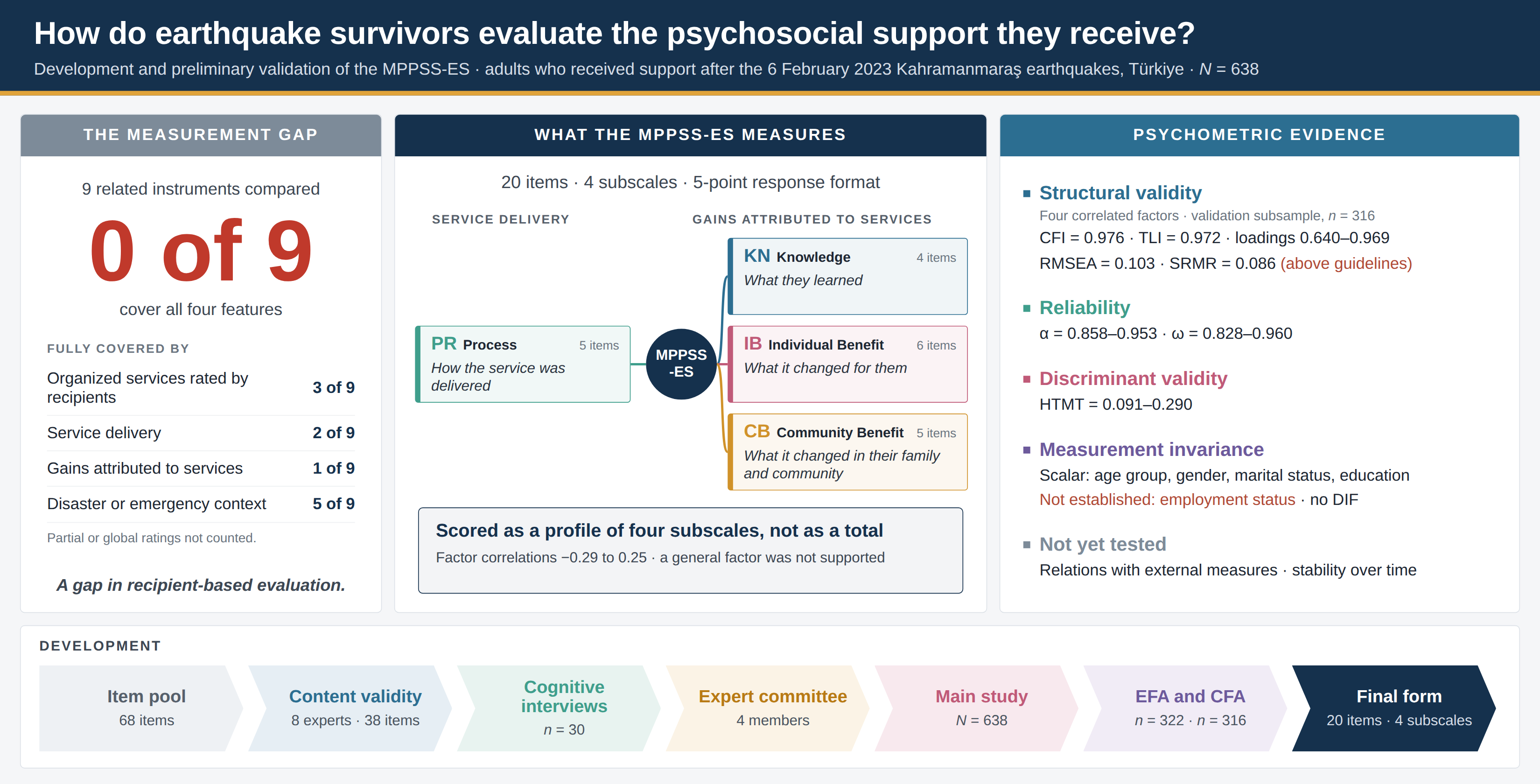
Background/Objectives: Psychosocial support was delivered on a large scale after the 6 February 2023 Kahramanmaraş earthquakes, but survivors have lacked a validated instrument for evaluating the organized services they received. This study developed the Multidimensional Perceived Psychosocial Support Scale for Earthquake Survivors (MPPSS-ES) and examined its psychometric properties. Methods: A 68-item pool covering four domains (Knowledge, Process, Individual Benefit, and Community Benefit) was reduced to 38 items through expert content validity ratings, cognitive interviews (n = 30), and expert committee review. The 38-item form was administered face to face to adults who had received psychosocial support in the affected region (N = 638). The sample was split into a calibration subsample (n = 322) for exploratory factor analysis and a validation subsample (n = 316) for confirmatory factor analysis; measurement invariance, differential item functioning, reliability, and discriminant validity were examined in the full sample. Results: Starting from the four-factor structure of the construct map, the exploratory analyses retained 20 items, each loading on its intended factor. In the validation subsample, the four-factor model showed a high comparative fit index (CFI = 0.976) and Tucker–Lewis index (TLI = 0.972) but a root mean square error of approximation (RMSEA) of 0.103, and standardized loadings ranged from 0.640 to 0.969. The factors were weakly correlated, Knowledge correlated negatively with the other three factors, and a general factor was not supported. Scalar invariance was supported across age group, gender, marital status, and education but was not established for employment status, and no item showed differential item functioning. Cronbach’s α ranged from 0.858 to 0.953 and McDonald’s ω from 0.828 to 0.960. Conclusions: The 20-item MPPSS-ES provides preliminary evidence for a four-subscale profile of survivors’ evaluations of organized psychosocial support. Relations with external measures and stability over time remain to be tested.
Keywords:
earthquake
; psychosocial support
; service evaluation
; scale development
; measurement invariance
; disaster mental health
; Türkiye
Copyright: This open access article is published under a Creative Commons CC BY 4.0 license, which permit the free download, distribution, and reuse, provided that the author and preprint are cited in any reuse.