
Submitted:
30 September 2026
Posted:
01 October 2026
You are already at the latest version
Abstract
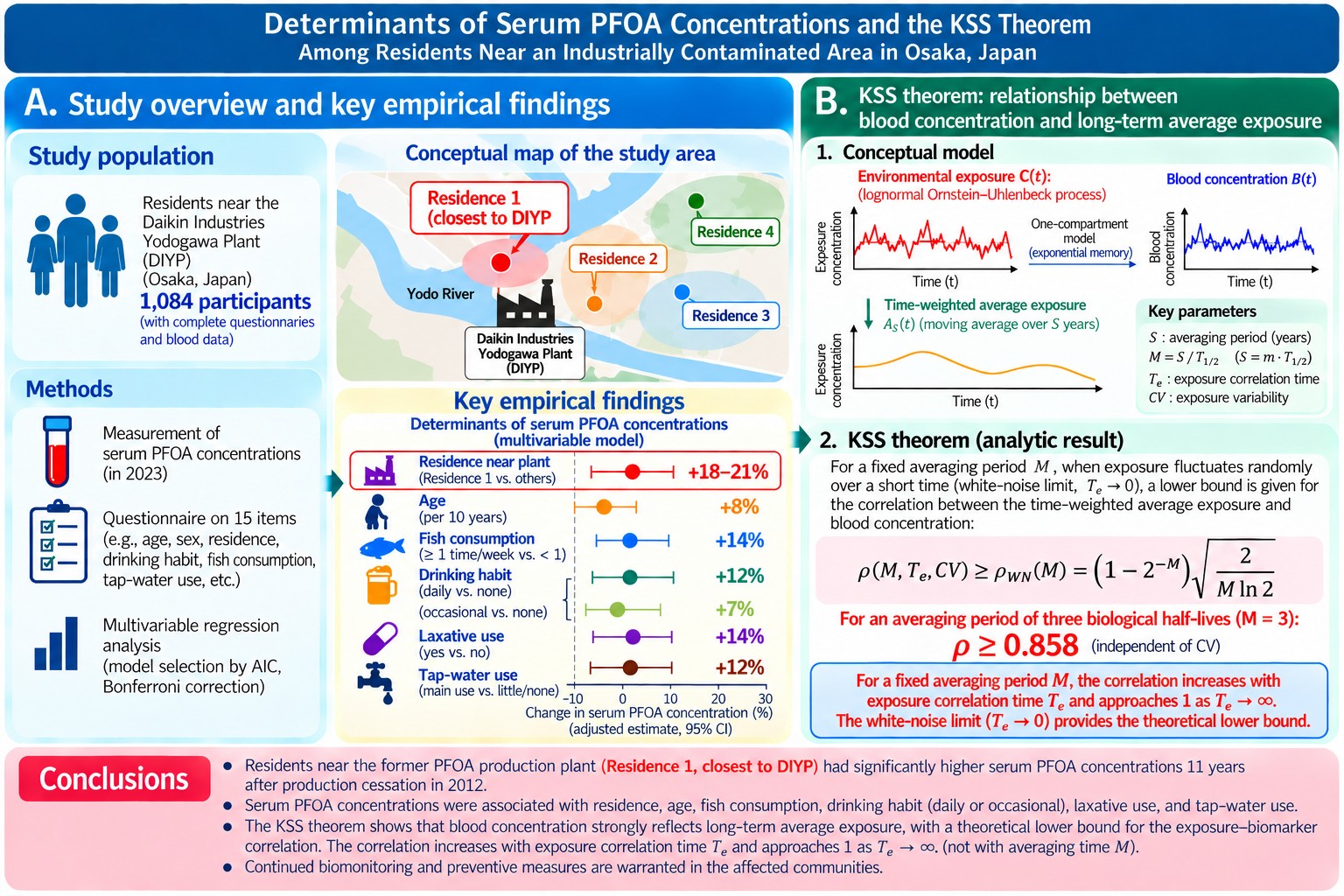
Background: In 2023, community-initiated biomonitoring was conducted among residents near the Daikin Industries Yodogawa Plant (DIYP), where PFOA contamination had previously been identified. Methods: Serum PFOA and questionnaire data were analyzed in 1,174 participants; 1,084 had complete data for 15 prespecified variables. Log10(PFOA) was modeled using multivariable regression, with model selection by AIC and Bonferroni correction. A sensitivity analysis excluded six consumers of self-grown agricultural products. We also theoretically examined the relationship between serum concentration and time-weighted average exposure using a one-compartment model with a lognormal Ornstein–Uhlenbeck exposure process. Results: Residence, age, fish consumption, drinking habit, laxative use, and tap-water use were significant determinants. Residents nearest DIYP had a geometric mean PFOA concentration of 5.95 ng/mL and adjusted concentrations 18%–21% higher than other areas. Predicted and observed stratum means were strongly correlated (r=0.927). Results remained significant in sensitivity analysis. The theoretical analysis showed that the white-noise limit provides a global lower bound for the serum–exposure correlation; for averaging over three biological half-lives, ρ≥0.858. Conclusions: Elevated PFOA near DIYP suggests that local exposure may have persisted after production ceased in 2012. Continued biomonitoring is warranted.
Keywords:
PFOA-producing plant
; PFOA biomonitoring
; Ornstein-Uhlenbeck process
; lower bound theorem
; time-weighted average
; residence area
; drinking habit
; laxatives
; fish consumption
; local vegetable consumption
Copyright: This open access article is published under a Creative Commons CC BY 4.0 license, which permit the free download, distribution, and reuse, provided that the author and preprint are cited in any reuse.