
Submitted:
30 September 2026
Posted:
01 October 2026
You are already at the latest version
Abstract
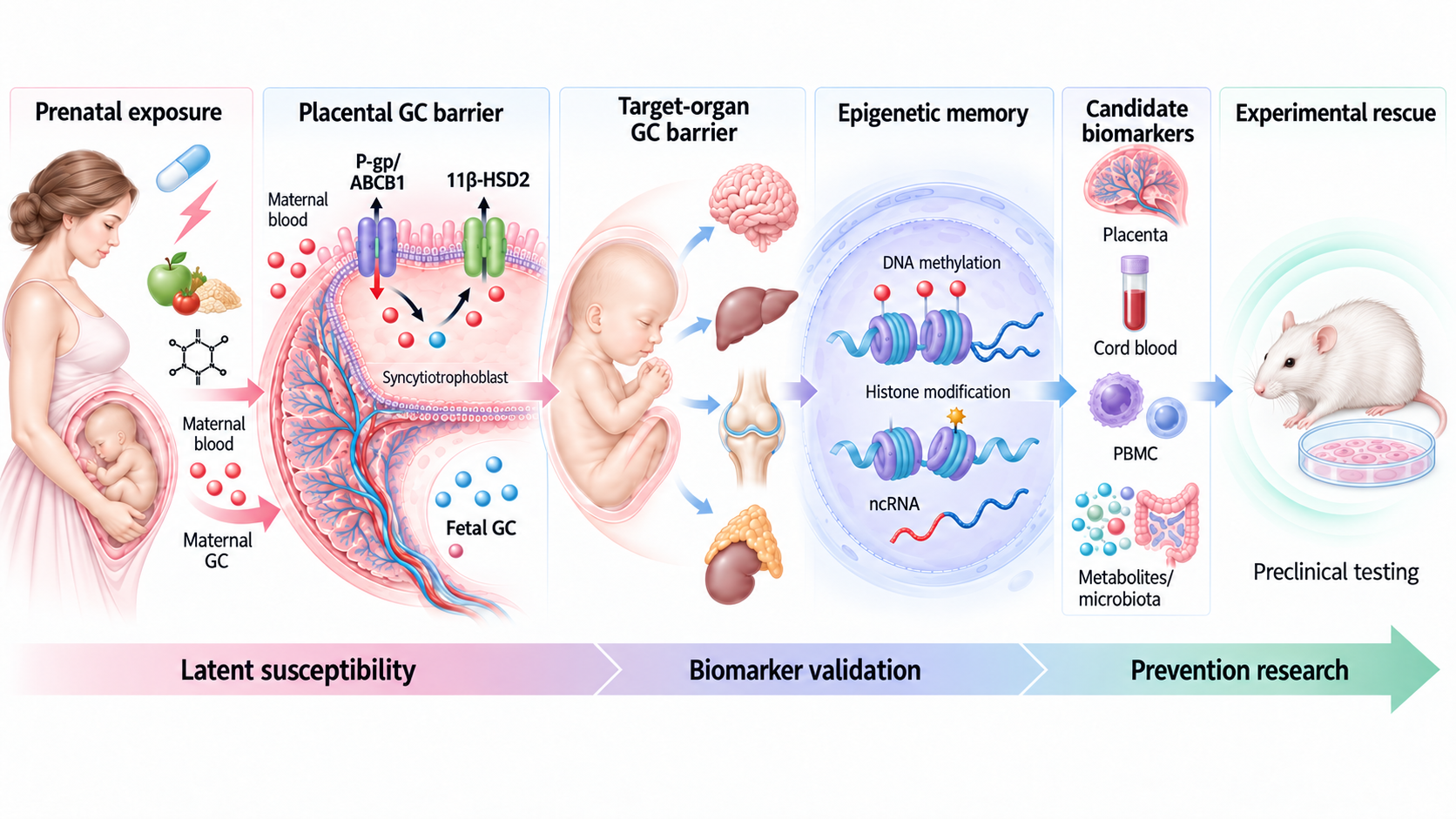
Prenatal exposures can establish latent disease susceptibility before clinical symptoms appear. This narrative review examines developmental targets that regulate fetal effective exposure, retain exposure-related molecular changes, indicate a pre-disease state, or permit experimental rescue. Evidence is compared across four representative modules: placental dysfunction and fetal growth restriction, metabolic dysfunction-associated steatotic liver disease, skeletal disease, and neurodevelopmental or affective disorders. The analysis links glucocorticoid barriers, epigenetic persistence, candidate biomarkers, and intervention windows without assuming that every disease follows the same sequence. Placental 11β-hydroxysteroid dehydrogenase type 2 and P-glycoprotein/ABCB1 provide upstream mechanistic candidates. Downstream chromatin, RNA, metabolic, and organ-specific pathways have different combinations of human association, animal mechanism, and rescue evidence. Neural examples illustrate this distinction: ATP-binding cassette transporter G1 (ABCG1) rescue remains cell-based in mammals, whereas coagulation factor XIII A chain (F13A1) has neonatal rat intervention evidence and a separate human cord-blood association. Neither establishes clinical prediction or treatment efficacy. Priorities are therefore assigned to human biomarker validation, preclinical causal testing, or maternal prevention research rather than combined into a clinical-readiness score. Progress depends on independent replication, tissue-relevant measurement, defined developmental windows, and long-term safety.
Keywords:
developmental origins of health and disease
; developmental targets
; glucocorticoid barrier
; 11β-HSD2
; P-gp/ABCB1
; epigenetic memory
; early-warning biomarkers
; early-life intervention
Copyright: This open access article is published under a Creative Commons CC BY 4.0 license, which permit the free download, distribution, and reuse, provided that the author and preprint are cited in any reuse.