
Submitted:
30 September 2026
Posted:
01 October 2026
You are already at the latest version
Abstract
Public health emergencies heighten the need for reliable evidence while increasing uncertainty, participant vulnerability, health-system strain, and political pressure. This critical narrative review examines how clinical trials can be accelerated while protecting participants’ dignity, rights, safety, and agency. Drawing on empirical literature, international ethical guidance, and Brazilian legal and regulatory sources, we analyse challenges involving scientific validity, consent, inclusion, adaptive designs, oversight, data governance, and equitable access. We propose the DIGNITY conceptual model: Dignity; Inclusive and locally responsive research; Governance, accountability, and transparency; Necessity and scientific validity; Informed and revisable consent; Timely, risk-proportionate oversight; and Yielding fair and accessible benefits. Brazil provides a regulatory case study through Law No. 14,874/2024, Decree No. 12,651/2025, single ethics review, national ethics governance, post-trial obligations, and risk-, complexity-, and reliance-based regulatory pathways. Regulatory agility requires preparedness, scientific prioritization, local responsiveness, and accountable coordination. DIGNITY is proposed as a normative framework for preparedness and ethical deliberation, requiring empirical evaluation. Procedural adaptations are ethically defensible when they preserve scientific validity, meaningful participant protection, independent oversight, and equitable access to benefits.
Keywords:
bioethics
; pandemics
; public health emergencies
; clinical trials
; research ethics
; informed consent
; human dignity
; regulatory science
; Brazil
; post‐trial access
1. Introduction
Public health emergencies compress time, magnify uncertainty, and place extraordinary pressure on health systems, regulators, researchers, sponsors, ethics committees, clinicians, and communities. They do not diminish the moral status of the people invited to participate in research. The 2024 revision of the World Medical Association Declaration of Helsinki makes this point explicit: even when new knowledge and interventions are urgently required during a public health emergency, its ethical principles remain applicable [1]. This is not a rhetorical addition. It is a direct response to the recurrent temptation to treat crisis as a moral exemption. The ethical imperative to conduct research during an outbreak is real. Care based solely on intuition, uncontrolled experimentation, political preference, or anecdotal evidence can produce avoidable harm. Some questions can be answered only while an emergency is unfolding, and failure to study them may condemn patients to interventions that are ineffective, unsafe, or inequitably distributed [2,3,4,5,6]. Yet the imperative to generate evidence does not authorize any study, any design, or any degree of participant burden. Research is ethically justified only when it has sufficient scientific and social value, a favorable and continuously reassessed relationship between risks and anticipated benefits, fair participant selection, meaningful consent or a narrowly justified alternative, independent review, and public accountability [1,2].
The coronavirus disease 2019 (COVID-19) pandemic demonstrated both the best and worst of emergency research. Large, pragmatic platform trials generated practice-changing answers at unprecedented speed. At the same time, the research landscape was crowded with small, overlapping, underpowered, poorly coordinated, and sometimes methodologically weak studies. An early analysis of 674 COVID-19 trials found extensive duplication, limited multinational coordination, and heavy concentration on a small number of interventions [7,8]. Research waste during a crisis is not merely inefficient. It exposes participants, consumes scarce clinical capacity, competes for eligible patients, delays conclusive answers, and amplifies misinformation.
This article advances a deliberately balanced position. Emergency research should not be slowed by duplicative bureaucracy, serial reviews, paper-based procedures, or regulatory requirements that add little protection. Conversely, speed must not become the dominant metric by which an ethics or regulatory system is judged. A decision may be rapid and rigorous, rapid and superficial, slow and rigorous, or slow and bureaucratic. The aim is therefore not to choose between agility and protection, but to design systems in which agility is produced by preparedness, coordination, scientific prioritization, and proportionate oversight rather than by erosion of rights.
Our central thesis is that public health emergencies may justify operational exceptionalism but not moral exceptionalism. Processes may be adapted; fundamental protections may not be discounted. To operationalize this position, we propose the DIGNITY conceptual model and apply it to Brazil, whose legal and regulatory architecture changed substantially between 2024 and 2026. Brazil is a particularly instructive case because it combines a universal public health system, marked regional inequalities, extensive experience with multicentre research, a continental territory, a recently restructured national ethics system, and new risk- and reliance-based pathways for clinical drug development.
Recent international proposals for trial-system reform reinforce the same distinction: the objective is not to replace rigorous ethical and regulatory assessment with speed, but to make rigorous review timely through standing networks, parallel processes, transparent requirements, and coordinated decision-making [9].
This critical narrative review examines ethical challenges in clinical trials conducted during public health emergencies. It draws on empirical literature, international ethical guidance, and Brazilian legal and regulatory sources to develop the proposed DIGNITY conceptual model.
2. Ethical Foundations of Pandemic Research
2.1. Human Dignity as a Non-Negotiable Moral Boundary
Human dignity is frequently invoked in research ethics but insufficiently operationalized. In this context, dignity should be understood as requiring at least six commitments: recognition of equal moral worth; prohibition of treating persons merely as instruments; respect for agency and the right to refuse; protection of bodily and psychological integrity; respect for privacy and identity; and fair consideration of how risks, burdens, knowledge, and benefits are distributed.
The prohibition against instrumentalization is particularly important during crises. Participants necessarily contribute to the production of generalizable knowledge, but they may never be reduced to biological opportunities created by an epidemic. The fact that a person is infected, critically ill, isolated from family, economically insecure, or without an established treatment does not weaken the duties owed to that person. On the contrary, dependency and constrained options heighten the obligation to ensure that recruitment, consent, and continued participation remain ethically defensible.
The language of collective necessity can obscure individual moral claims. Statements such as “the study must proceed because thousands may benefit” are incomplete unless accompanied by a defensible explanation of why this particular study is scientifically necessary, why its design can answer the question, why the selected population is appropriate, why risks are minimized, and why no less burdensome alternative exists. Aggregate benefit does not erase the person standing in front of the investigator.
The Declaration of Helsinki places the rights and interests of individual participants above the goals of generating knowledge and improving public health [1]. This does not imply an individualistic rejection of solidarity. It means that solidarity must be invited, not extracted. A person may freely accept risk for the benefit of others, but institutions may not manufacture that duty through fear, patriotic pressure, therapeutic misconception, or inequitable access to care.
This person-centred boundary is consistent with canonical accounts of ethical clinical research, which link ethical acceptability to social and scientific value, methodological validity, fair participant selection, a favourable risk–benefit profile, independent review, informed consent, and continuing respect for participants [10].
2.2. The Limits of Emergency Exceptionalism
Emergency exceptionalism is the belief—sometimes explicit, more often implicit—that extraordinary circumstances lower the threshold for ethically acceptable research. It can appear in multiple forms: approving weak studies because “something must be tried”; shortening consent because patients are desperate; accepting vague data-governance provisions because sharing is urgent; tolerating conflicts of interest because expertise is scarce; or assuming that post-trial access can be addressed after efficacy is established.
Against pandemic research exceptionalism, London and Kimmelman argued that crises do not make unreliable methods more informative and that rigorous research is essential precisely because decisions are urgent [11]. The most dangerous form of exceptionalism is not a formal suspension of ethics rules. It is the gradual normalization of lower expectations: less complete protocols, more permissive interpretation of equipoise, weaker justification of sample size, less scrutiny of consent, and public communication before independent evaluation.
The opposite error is ethical formalism: preserving every ordinary procedure even when it adds delay without adding protection. Requiring serial reviews of identical scientific questions, insisting on physical signatures when secure remote consent is feasible, or delaying urgent safety amendments until a routine meeting may protect the institution rather than the participant. Ethical governance must distinguish substantive safeguards from procedural habit.
The appropriate response is therefore structured flexibility. Every emergency adaptation should satisfy necessity, suitability, proportionality, least infringement, temporariness, transparency, revisability, and accountability. A measure should not be adopted merely because it is faster; it should be adopted because it achieves a legitimate emergency objective while preserving the highest feasible level of protection.
The principle is especially demanding when research deliberately increases exposure or departs from ordinary clinical pathways. WHO’s 2025 criteria for controlled human infection studies in public health emergencies illustrate this point: exceptional study designs may be ethically considered only under stringent scientific, risk, consent, governance, and public-value conditions, rather than because emergency status itself lowers the ethical threshold [12].
Recent analysis of outbreak vaccine trials, using Ebola-to-Nipah experience, reinforces that high-fatality, short-duration outbreaks do not remove the ethical need for informative controls, realistic accrual assumptions, community engagement, and credible post-trial access. Rather, epidemiologic volatility makes advance design choices and explicit trade-offs more important [13].
2.3. Scientific Validity as Participant Protection
A scientifically invalid study is ethically defective even when its intervention appears low risk. Participants assume burdens, disclose information, undergo procedures, and may alter treatment decisions on the understanding that their contribution can generate valuable knowledge. When a study is incapable of answering its question, that moral exchange is broken.
The early COVID-19 trial landscape illustrates the problem. Kouzy and colleagues identified 674 interventional trials by June 2020, of which only 35.8% of randomized studies were multicentre and 3.9% were multinational; chloroquine-related interventions accounted for nearly one quarter of randomized trials [8]. Glasziou and colleagues warned that poor questions, duplication, weak design, and incomplete reporting were producing research waste during the pandemic [7]. These failures were not caused by excessive rigor. They were caused by the absence of coordination, prioritization, and standing trial infrastructure.
Large platform trials demonstrated an alternative. The WHO Solidarity trial and the Randomised Evaluation of COVID-19 Therapy (RECOVERY) trial used simple, pragmatic designs and broad networks to generate conclusive evidence on mortality and major clinical outcomes [14,15]. Their importance lies not only in scale. They showed that methodological discipline can accelerate rather than impede emergency response. Simplicity should be achieved by focusing on critical questions and outcomes, not by tolerating ambiguity in the protocol.
Before approving an emergency trial, ethics committees and regulators should ask whether the question is already being answered, whether collaboration or platform enrolment is possible, whether the sample size is achievable under the projected epidemiology, whether the control group remains informative, whether outcomes are clinically meaningful, and whether the study has a credible dissemination and data-sharing plan. Funders also bear ethical responsibility: financing numerous competing underpowered trials can be as harmful as approving them.
The WHO 2024 guidance on best practices for clinical trials calls for sustained, functional trial ecosystems that can pivot during emergencies, minimize waste, and produce high-quality evidence [6]. Preparedness therefore means maintaining networks, master protocols, data systems, pharmacy and laboratory capacity, contracting templates, and community partnerships before an outbreak occurs.
The problem did not end with early trial proliferation. A 2024 meta-epidemiological cohort of 357 registered randomized COVID-19 trials of hydroxychloroquine, corticosteroids, or vitamin D found that only 107 (30%) had publicly available results by October 2022, illustrating how non-reporting can extend research waste beyond trial design and recruitment [16].
Scientific necessity also requires ethically defensible prioritization. WHO’s 2025 guidance on health-research priority setting emphasizes that allocating scarce research resources is inherently value-laden because it determines which populations and questions receive attention. Emergency prioritization should therefore be transparent, inclusive, evidence-informed, and contestable rather than driven by political visibility or sponsor prominence [17].
3. Consent, Vulnerability, and Participant Agency
3.1. Consent Under Structural Pressure and Temporary Incapacity
The ethical quality of consent cannot be inferred from the existence of a signed form. Valid consent requires adequate information, comprehension, decisional capacity, voluntariness, and an authentic opportunity to refuse without loss of entitled care. Emergencies threaten each of these conditions.
A patient may be febrile, hypoxic, delirious, sedated, frightened, isolated, or dependent on the same clinical team that is offering research participation. Family members may be unavailable because of infection-control measures. The intervention may be presented in a context in which no proven therapy exists. Even without explicit coercion, the structure of the situation can compress voluntariness. We call this consent under structural pressure: consent that is formally voluntary but materially constrained by dependency, fear, scarcity, institutional authority, or absence of realistic alternatives.
Therapeutic misconception is especially likely when the boundary between care and research is blurred. The phrase “experimental treatment” may be understood as personalized rescue rather than random allocation under uncertainty. Investigators should explicitly explain the study purpose, alternatives, randomization, placebo or control conditions, uncertain benefit, and the difference between clinical judgment and protocol assignment. When the treating clinician is also the investigator, additional safeguards—such as an independent consent professional, a concise comprehension check, or delayed confirmation—may be warranted.
Remote or electronic consent can be ethically appropriate when it reduces infection risk, permits family participation, and preserves documentation. It should not become a low-contact substitute for dialogue. The medium may change; the ethical functions of disclosure, deliberation, questions, voluntariness, and documentation remain.
Research without prior consent, often described as deferred consent, may be justified in narrowly defined emergency settings when the person lacks capacity, a representative cannot be reached in time, the intervention must be delivered within a short therapeutic window, the research cannot practicably be conducted otherwise, risks are proportionate, and prospective ethics approval has established the process. Empirical evidence suggests that stakeholder acceptability is greatest in low-risk, time-critical research with potential participant benefit [18]. Consent should then be sought from the participant or representative as soon as feasible, with transparent options regarding continued participation and the use of data already collected, subject to applicable law.
Deferred consent is not consent that investigators are free to postpone for convenience. It is a conditional exception to prior authorization and must include a plan for reconsent, management of death before consent, refusal after enrolment, notification of representatives, documentation of the incapacity and time constraints, and independent monitoring. The ethical burden of justification rests with the research team, not with the incapacitated participant.
The empirical literature supports neither blanket insistence on prospective consent nor permissive abandonment of consent. A 2026 rapid systematic review of 145 studies from 26 countries found that alternative approaches, including deferred and surrogate consent, were generally acceptable when prospective consent was not feasible, but acceptability varied with risk, invasiveness, prior experience, and opportunities to involve patients or relatives; pandemic studies particularly highlighted the need for pre-established pathways and early engagement with ethics committees [19].
3.2. Vulnerability: Protection Without Exclusion
Vulnerability should be treated as contextual and dynamic rather than as a permanent label attached to categories of people. A participant may be vulnerable because of illness severity, impaired capacity, poverty, institutional dependence, discrimination, language barriers, migration status, pregnancy, age, disability, incarceration, occupational hierarchy, or unequal access to care. These dimensions may overlap.
Two ethical errors must be avoided. The first is exploitation: selecting groups because they are accessible, dependent, less able to refuse, or located in settings with weaker oversight. The second is protective exclusion: omitting groups so consistently that evidence is unavailable for those most affected by the emergency. The 2024 Declaration of Helsinki requires consideration of both the harms of inclusion and the harms of exclusion [1].
Pregnant and breastfeeding persons, children, older adults, people with disabilities, Indigenous peoples, racialized populations, migrants, and patients with multiple comorbidities have historically been underrepresented in clinical trials. During a crisis, exclusion may appear administratively safe, but it transfers uncertainty to clinical practice. Products may later be used in these populations without adequate dosing, safety, or effectiveness data.
Inclusion is ethical only when scientifically justified and accompanied by tailored safeguards. Community engagement should begin before recruitment, not after controversy emerges. It should influence the research question, outcomes, consent materials, reimbursement, communication strategy, specimen and data governance, and post-trial plans. Engagement is not a public-relations exercise; it is a form of epistemic and procedural justice.
3.3. Health-Care Workers as Participants
Health-care workers may simultaneously be essential employees, potential participants, recruiters, investigators, and subordinates within the institution conducting the study. Their occupational exposure may make them scientifically relevant to vaccine, prophylaxis, or diagnostic research, but it may also create subtle pressure to participate.
Institutional messages that frame enrolment as professional duty, solidarity, or loyalty can become undue influence when employment relationships, evaluations, training opportunities, or team belonging are at stake. Recruitment should be separated from supervisory authority whenever possible, refusals should not be visible to line managers, and occupational health services should remain distinct from research decision-making.
4. Dynamic Trial Design and Oversight
4.1. Placebo, Equipoise, and a Moving Standard of Care
During a rapidly evolving emergency, the standard of care may change while a trial is recruiting. An initially acceptable placebo or usual-care comparator can become ethically problematic when reliable evidence establishes an effective intervention. Conversely, widespread off-label use or political endorsement does not automatically create an evidence-based standard of care.
Investigators, data and safety monitoring boards, ethics committees, and regulators need a prospective process for continuous evidence surveillance. The protocol should specify who will assess external evidence, what threshold will trigger reconsideration, how regional differences in standard care will be handled, how participants will be informed, and when the control arm must be modified or stopped.
Placebo remains ethically defensible when no proven intervention exists, when its use is scientifically necessary, and when it does not expose participants to additional risk of serious or irreversible harm that could be prevented by established care [1]. In an emergency, convenience is not sufficient justification. A rapidly changing evidence base demands more active oversight, not a more permissive comparator.
Equipoise should not be understood as ignorance. It requires honest professional uncertainty supported by a credible review of evolving evidence. Once uncertainty is materially altered, the ethical basis of randomization must be reassessed. Participants may require updated information and, when changes are material to their decision, renewed consent.
4.2. Adaptive Platform Trials
Adaptive platform trials can evaluate multiple interventions under a common infrastructure, add or discontinue arms, use shared controls, and answer successive questions without creating a new trial for each intervention. Their efficiency can reduce duplication and improve the probability that participant contributions generate useful knowledge.
However, statistical efficiency is not synonymous with ethical superiority. Platform trials can be difficult to explain, particularly when allocation probabilities, available arms, control groups, or stopping rules change over time. Their size and international reach can concentrate governance in a small coordinating group and weaken local influence over priorities, consent, and benefit sharing.
The WHO analysis of adaptive platform trials identified recurring issues involving consent, community engagement, inclusion, fairness of international partnerships, capacity development, knowledge transfer, and local and global accountability [20]. Ethical review must therefore address the platform as an evolving institution, not merely assess each arm as an isolated intervention.
A platform is ethically advantageous when it addresses prioritized questions, uses transparent adaptation rules, maintains independent statistical and safety oversight, communicates changes clearly, preserves appropriate local review, and shares infrastructure and authorship fairly. It is ethically problematic when complexity becomes opacity or when low-resource sites contribute participants without durable scientific capacity or decision-making power.
Recent empirical work makes the governance burden more concrete. Review of five infectious-disease platform trials found that platform-specific features generated distinctive regulatory and ethics questions even though most review comments were not unique to the platform architecture; effective review depended on sponsors clearly identifying adaptations and on authorities being prepared to evaluate them [21]. A 2026 scoping review of informed consent in adaptive platform trials found only four eligible empirical studies and identified persistent difficulty explaining changing randomization probabilities and potential benefit, underscoring the need for communication beyond the written form [22].
4.3. Expedited Ethics Review Without Ethical Dilution
Rapid ethics review is both possible and necessary. The WHO recommends that research ethics committees prepare procedures for time-sensitive review during public health emergencies [5]. Preparation may include pre-identified emergency rosters, virtual meetings, secure electronic submission, standardized document sets, access to external expertise, conflict-of-interest procedures, and coordination between committees and regulators.
An international study of ethics review during COVID-19 found extensive use of virtual meetings, ad hoc review mechanisms, and modified procedures, but also major gaps in pre-existing emergency policies, harmonization, coordination, and formal evaluation of the changes introduced [23]. These findings show that improvisation can sustain operations, but institutional learning is often lost when emergency measures are not assessed after the crisis.
Time to approval should never be the sole performance indicator. A defensible emergency-review system should measure time to administrative validation, time attributable to committee review, time awaiting investigator responses, quality and consistency of decisions, availability of relevant expertise, participant-facing improvements, safety outcomes, protocol deviations, inclusion, transparency, publication, and post-trial obligations.
Centralized or single ethics review can eliminate redundant assessment of the same protocol. Yet local context remains ethically material. The central review should ordinarily determine scientific validity, the overall risk–benefit relationship, core consent content, sponsor responsibilities, and general safety governance. Local assessment should address site capacity, local standard of care, recruitment relationships, language and culture, institutional conflicts, participant support, effects on local services, community concerns, and feasibility of post-trial commitments.
The governing principle should be: centralize what is common; preserve local authority over what is morally and contextually specific. Mutual recognition should not be confused with moral outsourcing.
More recent evidence supports a preparedness model rather than ad hoc acceleration. An international roadmap published in 2025 recommends joint or parallel regulatory and ethics review, single national ethics review where appropriate, transparent approval requirements, standardized consent processes, and standing trial networks [9]. A 2026 report describing two US multicentre COVID-19 randomized trials likewise showed that rapid activation required intensive coordination across multiple oversight bodies and repeated protocol changes, leading the authors to recommend emergency interagency standard operating procedures rather than informal workarounds [24]. An integrative review of emergency human-research protections published in 2026 similarly identified pre-approved protocols, enhanced training, and sustained resources for rapid-response review as core preparedness needs [25].
Delay itself can also become ethically consequential when fragmented review prevents an answerable question from being addressed while an epidemic window closes. The multinational COPCOV experience reported substantial cross-country approval delays and showed that nominally expedited pathways did not eliminate sequential processes and duplicated requirements [26]. At the institutional level, an independent 2025 evaluation of the WHO Ethics Review Committee identified timeliness, resources, coordination, monitoring, and role clarity as continuing determinants of effective oversight [27]. The relevant metric is therefore not speed in isolation, but whether systems remove low-value delay while preserving substantive review quality.
These proposals also converge with calls for continuously available clinical-trial networks and for an ecosystem view of research regulation in which ethics, scientific, contractual, data, and regulatory processes are coordinated across the research lifecycle rather than treated as isolated checkpoints [28,29].
4.4. Data Urgency, Privacy, and the Risk of a Permanent Emergency
Emergencies increase the value of rapid data access, linkage of health records, genomic surveillance, specimen sharing, digital recruitment, remote monitoring, and cross-border collaboration. They also increase the risk that extraordinary data practices become normalized without clear limits.
De-identification reduces but does not eliminate privacy risk, particularly when data are granular, genomic, longitudinal, or linkable across sources. Broad consent does not substitute for governance. Ethical data sharing requires a defined purpose, data minimization, role-based access, security, independent oversight, data-use agreements, transparent criteria for secondary use, community representation where appropriate, and a plan for destruction, return, or continued stewardship.
Emergency authorizations for unusual data uses should contain expiry clauses and review points. A crisis may justify temporary access that would not be proportionate in ordinary conditions; it does not justify a silent transition to permanent surveillance. The ethical question is not only whether data can help control an outbreak, but who controls the data, whose interests determine secondary use, which groups bear re-identification or stigmatization risks, and who benefits from the resulting knowledge or products.
These requirements are consistent with WHO guidance on the ethics of public-health surveillance, which emphasizes necessity, proportionality, privacy protection, community trust, transparency, and accountability when population-level data are collected or linked for public-health purposes [30].
In Brazil, these considerations operate alongside the General Personal Data Protection Law (Lei Geral de Proteção de Dados Pessoais—LGPD), which reinforces the need for lawful, purpose-limited, secure, and accountable processing of health and other sensitive personal data [31].
4.5. Politics, Commercial Interests, and the Manufacture of Hope
Clinical research during emergencies takes place under intense political, commercial, and media attention. Governments seek visible action, companies face financial incentives, institutions compete for prestige, journals accelerate publication, and the public understandably searches for hope. These pressures can distort scientific judgment without producing a conventional financial conflict of interest.
Preliminary findings may be announced before independent review; surrogate outcomes may be presented as clinical benefit; emergency authorization may be interpreted as proof of effectiveness; and public officials may promote interventions before equipoise has been resolved. Such communication can alter prescribing, recruitment, willingness to accept randomization, and trust in regulators.
Hope has moral value, but manufactured hope is a form of harm. It can expose patients to ineffective or unsafe interventions, undermine recruitment into rigorous trials, divert resources, and deepen distrust when claims are reversed. Emergency research requires a communication firewall: predefined rules for release of interim results, independent data-monitoring recommendations, disclosure of uncertainty, management of sponsor and investigator conflicts, and separation between scientific assessment and political announcement.
Compassionate or expanded access should also remain distinct from research. Access pathways pursue an individual therapeutic objective under uncertainty; clinical trials seek generalizable knowledge. Broad uncontrolled access may be justified in some circumstances, but it can worsen inequity, undermine recruitment, and generate misleading impressions of effectiveness. Its ethical use requires transparent eligibility, safety monitoring, fair allocation, and coordination with evidence-generating trials.
The distinction between research and emergency therapeutic use has been sharpened by WHO’s updated 2025 ethical framework for emergency use of unproven clinical interventions outside clinical trials. The guidance treats such use as exceptional, requires safeguards and systematic learning, and reiterates that rapid, rigorous, coordinated research remains ethically important during public health emergencies [32].
A 2025 analysis of a Peruvian COVID-19 vaccine episode provides a concrete illustration of the risks of political exceptionalism. A national commission identified multiple ethical and regulatory failures, including vaccination outside the approved trial, conflict-of-interest concerns, continuation of placebo control after an approved vaccine became available, and failure to release trial results, and concluded that the public-health emergency had enabled established safeguards to be circumvented under political pressure [33]. The case demonstrates why emergency visibility and therapeutic hope require stronger, rather than weaker, institutional independence and communication discipline.
5. Global Research Justice, Reciprocity, and Post-Trial Access
Public health emergencies are global, but authority over research agendas, funding, data, intellectual property, manufacturing, and publication remains highly unequal. Sites in low- and middle-income countries may recruit rapidly because disease burden is high, yet have limited influence over protocol design, statistical analysis, authorship, data access, or product allocation.
Emergency research extractivism occurs when risks and recruitment are local, while governance, ownership, and benefits are external. It is not prevented merely by obtaining local ethics approval. Ethical partnership requires early participation in priority setting, fair budget negotiation, local principal-investigator authority, access to data, capacity development, equitable authorship, technology transfer where relevant, and credible access to successful interventions.
The CIOMS guidelines emphasize collaborative partnership and sustainable capacity building, especially in settings with limited research infrastructure [2]. The ethical test is not whether a country receives a trial, but whether participation strengthens its ability to define and answer future health questions.
Post-trial access is where appeals to solidarity are tested. Asking communities to accept uncertainty for global benefit while leaving them unable to obtain the resulting product converts solidarity into extraction. Plans for access, affordability, supply, regulatory transition, and continuation for participants should be negotiated before recruitment and revisited as evidence evolves.
For the Region of the Americas, PAHO’s post-COVID ethics agenda similarly emphasizes preparedness, coordination, equitable partnerships, public trust, and institutional capacity as conditions for ethically credible emergency research [34].
Recent qualitative evidence also shows how difficult reciprocity can be to operationalize in lower-resource settings. In Ethiopia, stakeholders supported benefits for both participants and communities and emphasized multistakeholder planning for post-trial access, while expressing uncertainty about feasibility, costs, and the absence of sufficiently specific domestic rules [35]. This reinforces the need to negotiate credible responsibilities before recruitment rather than after efficacy is established.
These recurring tensions are synthesized in Table 1. The table distinguishes permissible procedural adaptations from the compensatory safeguards required to preserve scientific validity, participant protection, and distributive justice.
6. The DIGNITY Conceptual Model
The recurring weaknesses identified above are not solved by adding a generic instruction to “respect ethics” during emergencies. Decision-makers need an operational structure that links principles to questions, responsibilities, and safeguards. We therefore propose the DIGNITY conceptual model as a preparedness and review model for investigators, sponsors, research ethics committees, regulators, institutions, funders, and policy-makers.
The framework begins with dignity because the other components are not independent administrative goals. Inclusion, governance, validity, consent, timeliness, and access are the practical conditions through which persons and communities are recognized as ends rather than merely as sources of data or biological material.
The framework is shown in Figure 1. Its purpose is not to create a checklist that mechanically resolves ethical conflict, but to ensure that acceleration is evaluated against a coherent set of participant-level and system-level duties.
6.1. D—Dignity as the Non-Negotiable Foundation
Every adaptation should begin by identifying the person-level interests at stake: life, health, bodily integrity, agency, privacy, identity, family relationships, and fair treatment. No participant should bear a risk that is justified only by describing the population-level benefit.
A dignity assessment should ask whether the proposal treats participants as partners in knowledge generation, whether refusal remains realistic, whether burdens are minimized, and whether the study would remain defensible if its most vulnerable participant were publicly visible.
6.2. I—Inclusive and Locally Responsive Research
Research populations should reflect the epidemiology and intended use of the intervention unless exclusion is scientifically and ethically justified. Local investigators and communities should influence the question, design, consent, outcomes, and dissemination.
A local-context statement should accompany centralized review, documenting standards of care, language, recruitment relationships, institutional capacity, vulnerabilities, community concerns, and access conditions.
6.3. G—Governance, Accountability, and Transparency
Emergency governance should identify who sets priorities, who approves adaptations, who reviews external evidence, who communicates results, who controls data, and who bears responsibility for harm.
Protocols, registrations, decision rationales, amendments, summary results, and post-trial commitments should be publicly traceable to the maximum extent compatible with privacy and legitimate commercial confidentiality.
6.4. N—Necessity and Scientific Validity
A trial should proceed only if the question is socially important, not already adequately answered, and answerable with the proposed design and projected recruitment. Joining or extending a platform should be considered before creating a competing trial.
Scientific review and ethics review should be coordinated without collapsing their distinct responsibilities. Poor science cannot be repaired by a strong consent form.
For emergency systems, necessity should be demonstrated through explicit landscape review and priority setting. WHO’s 2025 ethics guidance on health-research priority setting provides a current normative basis for requiring transparent criteria, stakeholder participation, and fair allocation of scarce research capacity [17].
6.5. I—Informed and Revisable Consent
Consent should be treated as a continuing relationship. Participants should receive updated information when risks, standards of care, available arms, or post-trial plans materially change.
Emergency consent toolkits should include plain-language short forms, fuller reference information, remote and electronic options, interpreter pathways, representative consent, deferred-consent criteria, reconsent procedures, and comprehension checks.
6.6. T—Timely, Risk-Proportionate Oversight
Oversight intensity should be directed toward factors that are critical to participant protection and reliability of results. Low-value administrative repetition should be removed, while high-risk decisions receive concentrated expertise.
Emergency review should be faster because systems are prepared and coordinated, not because fewer ethical questions are asked.
The final consolidated ICH E6(R3) guideline, adopted on 16 June 2026, reinforces proportionality across contemporary trial designs while retaining the protection of participants and reliability of results as core GCP objectives. In emergency research, risk-proportionate quality management should therefore concentrate attention on factors critical to participant protection and interpretability rather than simply reduce oversight [36].
6.7. Y—Yielding Fair and Accessible Benefits
Ethical acceptability extends beyond data collection. Plans should address communication of results, continuation when clinically appropriate, product availability, affordability, supply, regulatory transition, and benefit sharing.
Reciprocity should be proportional to contributions and needs. Communities should not be asked to provide participants, specimens, or data under vague promises that depend entirely on future goodwill.
Table 2 translates the seven domains into operational questions, minimum evidentiary expectations, and potential decision consequences. These are proposed decision aids for preparedness and review; they are not validated scoring criteria.
7. Brazil as a Regulatory Case Study
Brazil provides a timely case for examining how ethical and regulatory reform can support emergency research while creating new implementation risks. Its Unified Health System (Sistema Único de Saúde—SUS) offers universal public coverage across a large and highly diverse territory. The country also has longstanding experience with institution-based research ethics committees and substantial participation in multinational clinical development.
Law No. 14,874 of 28 May 2024 established a statutory framework for research involving humans and created the National System for Research Ethics involving Human Beings (Sistema Nacional de Ética em Pesquisa com Seres Humanos—SINEP) [37]. Decree No. 12,651 of 7 October 2025 regulated the law, located SINEP within the Ministry of Health, and defined two components: INAEP and the research ethics committees (Comitês de Ética em Pesquisa—CEPs) that conduct protocol review [38,39]. During 2025–2026, Brazil entered an institutional transition in which INAEP began issuing rules and transitional guidance.
The legal framework explicitly links research conduct to dignity, safety, and participant well-being and requires consideration of human-rights treaties ratified by Brazil [38]. This is a strong normative foundation. The central challenge is to ensure that statutory efficiency does not become a narrow focus on deadlines or document flow.
7.1. Emergency Priority and Review Timelines
Law No. 14,874 establishes a general time limit of 30 business days for the CEP ethical opinion after acceptance of a complete submission and requires administrative acceptance or refusal of the dossier within 10 business days. For research considered strategic to SUS and relevant to a public health emergency, the law provides priority procedures and an ethical opinion within no more than 15 business days [37].
This statutory recognition of emergency priority is an important advance because it prevents urgent research from depending entirely on informal goodwill. Nevertheless, a deadline is not an emergency-review system. Brazil still needs permanently maintained operational procedures specifying activation criteria, priority-setting authority, reviewer rosters, access to specialized expertise, coordination with ANVISA and public-health authorities, management of competing protocols, and after-action evaluation.
The category “strategic to SUS and relevant to a public health emergency” should be applied through transparent criteria. Without such criteria, priority can be captured by political visibility, sponsor influence, institutional prestige, or the novelty of a technology rather than public-health value.
7.2. Single Ethics Review for Multicentre Research and Local Moral Knowledge
The law provides that research involving more than one Brazilian centre should be reviewed by a single CEP, preferably the committee linked to the coordinating centre, with notification to the CEPs of participating centres [37]. This model can markedly reduce duplicative review and inconsistent serial requirements.
Its ethical success depends on preserving local knowledge. A coordinating CEP cannot reliably infer every site’s staffing, referral pathways, language needs, community relationships, institutional pressures, local standard of care, or ability to meet post-trial commitments. A single scientific and ethical opinion should therefore be supplemented by a standardized local-context and feasibility attestation, with a clear route for the local CEP or institution to raise site-specific concerns without reopening the entire common protocol.
Centralization should eliminate duplication, not local accountability. The coordinating decision should remain visible to participating sites, and participants should receive the contacts of the local CEP and, when applicable, the coordinating or accredited CEP responsible for the ethical review.
INAEP’s provisional guidance clarifies that implementation of single review is progressive: one CEP opinion, preferably from the coordinating centre, may apply to all participating centres and notification should replace a second local CEP opinion. Importantly, single ethical review does not eliminate local institutional responsibilities for infrastructure, logistics, recruitment feasibility, participant protection, and local authorizations [40]. Accordingly, the local-context documentation proposed in this review is a compensatory governance safeguard, not a second local ethics review or an additional legal approval requirement.
7.3. SINEP, INAEP, CEPs, and Social Participation
Decree No. 12,651 defines SINEP as a national architecture intended to simplify processes, protect participant rights, promote ethical and efficient clinical trials, and strengthen governance. It assigns INAEP functions that include standard setting, accreditation, monitoring, support, supervision, and appeals, while CEPs remain independent institutional review bodies [38,39].
This structure creates an opportunity for national emergency preparedness: INAEP can establish standard operating procedures, training curricula, mutual-recognition rules, model consent pathways, national expert pools, minimum local-context requirements, and public performance indicators. It also creates concentration risk. The credibility of the system will depend on transparent appointments, conflict-of-interest management, public reasoning, meaningful representation of participants and communities, and institutional independence from immediate political and commercial pressures.
The planned national digital platform and public updating of registered research can improve traceability and coordination [38]. To serve emergency ethics, the platform should identify duplicate questions, active sites, recruitment status, amendments, safety signals, summary results, and post-trial commitments rather than function only as an electronic submission portal.
INAEP’s institutional architecture became more operationally defined in 2026: its Internal Rules were established by Resolution No. 1 of 2 April 2026, while accreditation and credentialing procedures for CEPs continued to be implemented through specific acts [41]. The Ministry of Health describes SINEP as comprising INAEP and the CEPs, with INAEP responsible for national standard setting, credentialing/accreditation, supervision, training support, and appeals, and CEPs retaining independent institutional protocol review responsibilities.
The transition remained institutionally dynamic in 2026. Resolution No. 4803 of 12 March 2026 created a CNS working group to formulate a new Intersectoral Commission on Research Ethics, and the CNS announced the institution of this commission as a mechanism for social participation and advisory work within the Council [42,43]. This development should not be conflated with protocol review under SINEP: the current statutory ethics-review architecture remains INAEP plus CEPs. Its relevance to emergency preparedness lies in preserving public reasoning and participant perspectives while maintaining explicit, non-duplicative interfaces with the statutory review system.
7.4. ANVISA Reform: Risk, Complexity, and Regulatory Reliance
For drug trials intended to support marketing authorization, ANVISA Resolution of the Collegiate Board No. 945/2024 (Resolução da Diretoria Colegiada—RDC 945/2024) and Normative Instruction No. 338/2024 (Instrução Normativa—IN 338/2024), subsequently amended, introduced updated procedures and optimized analysis based on risk, complexity, and regulatory reliance [44,45]. The framework entered into force in January 2025 and reflects a broader international movement toward proportionate oversight and use of assessments by trusted foreign authorities.
Reliance can reduce duplication and direct scarce regulatory expertise toward country-specific issues. It does not eliminate ANVISA’s responsibility to assess whether foreign conclusions are applicable to Brazil’s population, epidemiology, standard of care, health-system conditions, product supply, pharmacovigilance, and legal obligations. Regulatory reliance should be understood as informed use of another authority’s work, not automatic acceptance or transfer of sovereign accountability.
Ethics review and sanitary review should be coordinated in time but remain substantively independent. Parallel review is generally preferable to serial review. However, rapid communication is necessary when either pathway identifies a material change in risk, product quality, investigator information, comparator acceptability, consent content, or safety monitoring.
The current regulatory framework comprises RDC No. 945/2024 and IN No. 338/2024, with IN No. 345/2025 amending the optimized-review provisions. ANVISA’s fourth-edition questions-and-answers document, updated in August 2026, expressly confirms that regulatory submission and ethics submission may proceed in parallel and that the two decisions are independent; a registration-directed trial may begin only after both approvals have been obtained [44,45,46,47]. Reliance can reduce duplicative work, but it does not transfer ANVISA’s responsibility to assess applicability to Brazilian populations, epidemiology, standards of care, supply conditions, pharmacovigilance, and legal obligations.
Figure 2 presents this governance architecture schematically. It is intentionally conceptual rather than a statutory organizational chart: SINEP is the national system composed of INAEP and CEPs, while ANVISA performs sanitary/regulatory review within its legal remit. Ethical and regulatory review may proceed in parallel and remain substantively independent, with trial initiation contingent on all applicable approvals. The proposed local-context safeguard complements, rather than duplicates, the single-CEP review model.
7.5. Post-Trial Access and Reciprocity
Brazilian law gives post-trial access an unusually prominent legal position. A post-trial access plan must be presented before the start of the clinical trial, and subsequent Ministry of Health guidance has emphasized prior ethical review of the access program [37,40]. This creates an important counterweight to extractive emergency research.
Implementation remains complex. The relevant questions include which participants qualify, who determines clinical benefit, how long supply continues, what happens during regulatory review or procurement delays, how adverse effects are monitored, whether alternative products end the obligation, and how responsibilities are allocated among sponsor, investigator, institution, and SUS.
During a pandemic, individual continuation and population access should be distinguished but ethically connected. A sponsor may fulfil an individual continuation duty while the product remains unaffordable or unavailable to the affected community. The DIGNITY conceptual model therefore treats post-trial access as part of a wider reciprocity plan that includes affordability, supply, technology and knowledge transfer where appropriate, and communication of results.
Current INAEP transitional guidance further specifies that post-trial continuation is a legal duty rather than an optional expectation, that the access plan must be presented before trial initiation, and that the post-trial supply program requires prior ethical assessment by the competent CEP when continuation becomes indicated [40].
7.6. The Main Brazilian Regulatory Tensions
Brazil’s reforms create a potentially powerful model: legal recognition of dignity, a national ethics architecture, single review for multicentre research, emergency priority, defined timelines, post-trial duties, and risk- and reliance-based sanitary pathways. None of these elements is sufficient in isolation.
The decisive question is how the system behaves under stress. A future emergency will test whether national prioritization is independent and evidence-based; whether CEPs in different regions receive comparable support; whether central review listens to local concerns; whether timelines are achieved by preparedness rather than superficiality; whether ANVISA and INAEP communicate effectively; whether the digital platform supports real-time governance; and whether post-trial promises survive commercial and fiscal pressure.
Brazil should use the current transition period to institutionalize emergency readiness before the next crisis. The country does not need a separate, weaker ethics system for emergencies. It needs a pre-prepared, better connected, more transparent version of its ordinary system.
Table 3 reframes the principal regulatory mechanisms as paired opportunities and risks. The essential policy question is not whether Brazil can accelerate, but whether acceleration remains evidence-based, transparent, locally responsive, and accountable under emergency pressure.
8. From Ethical Principles to Emergency Preparedness
The normative analysis can be translated into a four-step decision sequence. A proposed emergency adaptation should first identify the legitimate emergency objective, then specify the rights or interests placed at risk, justify why the procedural change is necessary and proportionate, and define the compensatory safeguards required to preserve ethical acceptability.
The following measures would convert ethical aspiration into institutional capacity:
- Create and periodically rehearse national and institutional emergency research plans, including activation thresholds, reviewer rosters, external-expert access, virtual deliberation, conflict management, and backup systems.
- Maintain dormant or continuously active trial networks capable of pivoting to master protocols and prioritized questions without rebuilding contracts, data systems, pharmacies, laboratories, and governance from zero.
- Establish independent scientific prioritization before or alongside ethics review so that duplicate, infeasible, and low-value studies do not compete for participants and clinical capacity.
- Use coordinated or single ethics review for common protocol issues, combined with a mandatory local-context assessment and a protected route for site-specific objections.
- Develop an emergency consent toolbox containing plain-language layered information, remote and electronic consent, interpreter pathways, representative consent, research-without-prior-consent criteria, reconsent, and procedures after death or refusal.
- Require real-time external-evidence surveillance and predefined rules for changing comparators, stopping arms, updating information, and renewing consent.
- Focus quality management on factors critical to participant safety and reliability of results, consistent with ICH E6(R3), while removing low-value administrative repetition [36].
- Create public dashboards that track approved emergency research, active sites, recruitment, major amendments, summary safety information, results reporting, and post-trial commitments.
- Protect scientific and regulatory independence through transparent conflict declarations, recusal, independent data-monitoring structures, and rules governing public communication of preliminary findings.
- Negotiate reciprocity before recruitment: participant continuation, affordability, supply, local data access, fair authorship, capacity strengthening, and technology or knowledge transfer when relevant.
- Conduct mandatory after-action reviews following each emergency and publish which procedural changes improved quality, equity, and timeliness and which should be discontinued.
The preparedness agenda is constrained by several ethical red lines that should not be crossed even under severe time pressure:
- No scientifically invalid or unachievable trial should be justified by urgency.
- No waiver or deferral of prior consent should occur without necessity, prior authorization, and compensatory safeguards.
- No group should be recruited because dependency makes refusal easier to overcome, or excluded merely because inclusion requires additional effort.
- No emergency data or surveillance measure should continue indefinitely without renewed justification.
- No multinational partnership should externalize risks while centralizing data, authorship, intellectual property, and benefits.
- No political or commercial announcement should precede independent interpretation of evidence.
- No appeal to solidarity should be made without a credible plan for reciprocity.
9. Perspectives and Conclusions
Public health emergencies intensify the obligation to generate reliable evidence while preserving participants’ dignity, rights, safety, and agency. The central conclusion of this review is that regulatory agility requires preparedness, scientific prioritization, and accountable coordination. The COVID-19 experience illustrates how sustained trial networks and shared infrastructure can support rapid, informative studies, whereas fragmented recruitment and incomplete reporting undermine the value of participants’ contributions [6,9,14,15,16]. Research prioritization and timely dissemination are therefore ethical responsibilities throughout the research lifecycle [16,17].
The DIGNITY conceptual model provides a proposed normative structure for connecting participant protection with the institutional conditions under which research is designed, reviewed, conducted, and translated into accessible benefits. Its domains are interdependent: valid consent cannot compensate for a study incapable of answering its question, unjustified exclusion, deficient governance, or inequitable benefit sharing. Emergency adaptations, including alternative consent pathways and adaptive platform designs, require context-specific justification, prospectively approved safeguards, independent oversight, and reassessment as evidence and participants’ circumstances change [19,20,21,22]. DIGNITY should consequently be understood as an aid to ethical deliberation and preparedness, without assuming that checklist compliance alone establishes ethical acceptability.
The Brazilian case highlights opportunities to reduce avoidable delay through coordinated national governance, single ethics review, and proportionate regulatory assessment. Their ethical value depends on implementation. Review timelines must be evaluated alongside decision quality; single review must preserve local knowledge and institutional accountability; and regulatory reliance must retain independent assessment of applicability to Brazilian conditions. Digital systems should support transparent decisions, secure data governance, and traceable safety information and results. Post-trial commitments require defined responsibilities, feasible financing, and continuity arrangements, while individual participant continuation and broader population access require distinct but coordinated plans [37,38,39,40,44,45,46,47,48]. These considerations support evaluating regulatory reform through participant protection and equitable access alongside authorization speed.
These conclusions should be interpreted within the limits of a critical narrative review and normative analysis. The literature synthesis does not constitute exhaustive retrieval of relevant evidence, and DIGNITY has not undergone structured consensus development or prospective evaluation. The Brazilian analysis reflects the legal and institutional arrangements, subsequent developments may alter its operational implications. The capacity of the proposed model to improve emergency research governance therefore remains an empirical question.
Future research should examine DIGNITY across respiratory pandemics, emerging zoonoses, high-fatality outbreaks, vaccine and therapeutic platform trials, and settings with limited research capacity. Structured consultation with participants, communities, investigators, ethics committees, regulators, and sponsors, complemented by Delphi studies, could refine the domains and assess their contextual relevance. Simulation exercises, retrospective decision audits, and prospective implementation studies should evaluate review timeliness together with scientific adequacy, decision transparency, participant understanding, fair inclusion, safety oversight, results reporting, and fulfilment of post-trial commitments. Comparative evaluations should identify which procedural adaptations reduce avoidable delay while sustaining these protections, the resources required for implementation, and whether benefits are distributed equitably across institutions and populations.
The legitimacy of emergency clinical research ultimately rests on the joint achievement of reliable knowledge, meaningful participant protection, transparent governance, and fair access to resulting benefits. Urgency may require adapting how ethical obligations are fulfilled, but the justification for those adaptations depends on preserving the obligations themselves.
Author Contributions
Conceptualization, C.O.R. and N.C.A.; methodology, C.O.R and N.C.A.; investigation and source review, C.O.R. and N.C.A; Conceptual model development, C.O.R. and N.C.A; writing—original draft preparation, C.O.R. and N.C.A; writing—review and editing, C.O.R and N.C.A. All authors have read and agreed to the published version of the manuscript.
Funding
This research received no external funding.
Institutional Review Board Statement
Not applicable.
Informed Consent Statement
Not applicable.
Data Availability Statement
No new datasets were created or analysed. The literature and normative sources underlying this review are publicly available through the cited publications and official repositories.
Acknowledgments
The authors thank CAPES and CNPq, as well as the Graduate Program in Medical Sciences at the Faculty of Medicine of the University of São Paulo. C.O.R. holds a Junior Postdoctoral Fellowship from CNPq (151828/2024-5). During the preparation of this manuscript, the authors used ChatGPT (OpenAI) to assist with English language editing, revision and restructuring of manuscript sections. The figures were created in Biorender. The authors reviewed and edited all outputs and take full responsibility for the content of this publication.
Conflicts of Interest
C.O.R. is an alternate member of the National Instance for Research Ethics (INAEP) and serves as a technical consultant to the Brazilian Ministry of Health. N.C.A. is a civil servant at the Brazilian Health Regulatory Agency (ANVISA) and currently works at the Ministry of Health. These institutional roles are disclosed because of their relevance to the subject matter of this article. The views expressed in this article are solely those of the authors and do not represent the official positions of INAEP, ANVISA, the Brazilian Ministry of Health, or any other institutions with which the authors are affiliated.
Abbreviations
ANVISA — Brazilian Health Regulatory Agency (Agência Nacional de Vigilância Sanitária)
CEP — Research Ethics Committee (Comitê de Ética em Pesquisa)
CIOMS — Council for International Organizations of Medical Sciences
CNS — National Health Council (Conselho Nacional de Saúde)
GCP — Good Clinical Practice
ICH — International Council for Harmonisation of Technical Requirements for Pharmaceuticals for Human Use
INAEP — National Instance for Research Ethics (Instância Nacional de Ética em Pesquisa)
LGPD — General Personal Data Protection Law (Lei Geral de Proteção de Dados Pessoais)
PAHO — Pan American Health Organization
SINEP — National System for Research Ethics Involving Human Beings (Sistema Nacional de Ética em Pesquisa com Seres Humanos)
SUS — Unified Health System (Sistema Único de Saúde)
WHO — World Health Organization
WMA — World Medical Association
References
- World Medical Association. WMA Declaration of Helsinki—Ethical Principles for Medical Research Involving Human Participants. Adopted October 2024. Available online: https://www.wma.net/policies-post/wma-declaration-of-helsinki/ (accessed on 24 August 2026).
- Council for International Organizations of Medical Sciences. International Ethical Guidelines for Health-related Research Involving Humans, 4th ed.; CIOMS: Geneva, Switzerland, 2016. [Google Scholar] [CrossRef] [PubMed]
- World Health Organization. Guidance for Managing Ethical Issues in Infectious Disease Outbreaks; WHO: Geneva, Switzerland, 2016. [Google Scholar]
- World Health Organization. Ethical Standards for Research during Public Health Emergencies: Distilling Existing Guidance to Support COVID-19 R&D; WHO: Geneva, Switzerland, 2020. [Google Scholar]
- World Health Organization. Guidance for Research Ethics Committees for Rapid Review of Research during Public Health Emergencies; WHO: Geneva, Switzerland, 2020; ISBN 978-92-4-000621-8. [Google Scholar]
- World Health Organization. Guidance for Best Practices for Clinical Trials; WHO: Geneva, Switzerland, 2024; ISBN 978-92-4-009771-1. [Google Scholar]
- Glasziou, P.P.; Sanders, S.; Hoffmann, T. Waste in COVID-19 research. BMJ 2020, 369, m1847. [Google Scholar] [CrossRef] [PubMed]
- Kouzy, R.; Abi Jaoude, J.; Garcia Garcia, C.J.; El Alam, M.B.; Taniguchi, C.M.; Ludmir, E.B. Characteristics of the multiplicity of randomized clinical trials for coronavirus disease 2019 launched during the pandemic. JAMA Netw. Open 2020, 3, e2015100. [Google Scholar] [CrossRef] [PubMed]
- Cavaleri, M.; Alves de Sousa, C.M.; Hacker, A.; Higgs, E.S.; Lumpkin, M.M.; Maia, C.S.; Mathur, R.; Fimbo, A.M.; Reis, A.; Shin, K.S.; et al. A roadmap for fostering timely regulatory and ethics approvals of international clinical trials in support of global health research systems. Lancet Glob. Health 2025, 13, e769–e777. [Google Scholar] [CrossRef] [PubMed]
- Emanuel, E.J.; Wendler, D.; Grady, C. What makes clinical research ethical? JAMA 2000, 283, 2701–2711. [Google Scholar] [CrossRef] [PubMed]
- London, A.J.; Kimmelman, J. Against pandemic research exceptionalism. Science 2020, 368, 476–477. [Google Scholar] [CrossRef] [PubMed]
- World Health Organization. Key Criteria for the Ethical Acceptability of Controlled Human Infection Studies during Public Health Emergencies; WHO: Geneva, Switzerland, 2025; Available online: https://www.who.int/publications/i/item/9789240109063 (accessed on 24 August 2026)ISBN 978-92-4-010906-3.
- Jamrozik, E.; Abeler-Dörner, L.; Chaudhari, A.; Cheah, P.Y.; Hinch, R.; Jarman, R.; Johnson, T.; Parker, M.; Vegvari, C.; Wressnigg, N.; et al. Ethical challenges in outbreak trial design: From Ebola to Nipah. Vaccine 2026, 89, 128858. [Google Scholar] [CrossRef] [PubMed]
- WHO Solidarity Trial Consortium. Repurposed antiviral drugs for COVID-19—Interim WHO Solidarity Trial results. N. Engl. J. Med. 2021, 384, 497–511. [Google Scholar] [CrossRef] [PubMed]
- RECOVERY Collaborative Group. Dexamethasone in hospitalized patients with COVID-19. N. Engl. J. Med. 2021, 384, 693–704. [Google Scholar] [CrossRef] [PubMed]
- Fincham, L.; Hohlfeld, A.; Clarke, M.; Kredo, T.; McCaul, M. Exploring trial publication and research waste in COVID-19 randomised trials of hydroxychloroquine, corticosteroids, and vitamin D: A meta-epidemiological cohort study. BMC Med. Res. Methodol. 2024, 24, 19. [Google Scholar] [CrossRef] [PubMed]
- World Health Organization. WHO Guidance on the Ethics of Health Research Priority Setting; WHO: Geneva, Switzerland, 2025; Available online: https://www.who.int/publications/i/item/9789240110953 (accessed on 24 August 2026)ISBN 978-92-4-011095-3.
- Fitzpatrick, A.; Wood, F.; Shepherd, V. Trials using deferred consent in the emergency setting: A systematic review and narrative synthesis of stakeholders’ attitudes. Trials 2022, 23, 411. [Google Scholar] [CrossRef] [PubMed]
- Mahon, N.; Hays, L.M.C.; Coy, E.; Ainscough, K.; Burrell, A.; Gordon, A.C.; Rochwerg, B.; Wang, C.-M.; Harvey, D.; Parekh, D.; et al. Views on consent approaches used in emergency and critical care research: A rapid, systematic review. Trials 2026, 27, 308. [Google Scholar] [CrossRef] [PubMed]
- World Health Organization. Ethics and Adaptive Platform Trial Design in Public Health Emergencies: Meeting Report, 18–19 July 2022, Geneva, Switzerland; WHO: Geneva, Switzerland, 2023; ISBN 978-92-4-007967-0. [Google Scholar]
- de Jong, A.J.; van Hout, D.; Verberk, J.D.M.; Hensgens, M.P.M.; van der Velden, A.W.; van de Wijgert, J.H.H.M.; Bonten, M.J.M.; Derde, L.P.G. Considerations raised during the regulatory and ethics review of platform clinical trials in infectious diseases. Contemp. Clin. Trials Commun. 2026, 51, 101633. [Google Scholar] [CrossRef] [PubMed]
- Yada, N.; Samawi, L.; Adhikari, N.K.J.; Gibson, J.L.; Reid, R.J.; Fowler, R.A. Understanding how the informed consent process influences the decision to participate in an adaptive platform trial: A scoping review. PLoS ONE 2026, 21, e0344560. [Google Scholar] [CrossRef] [PubMed]
- Salamanca-Buentello, F.; Katz, R.; Silva, D.S.; Upshur, R.E.G.; Smith, M.J. Research ethics review during the COVID-19 pandemic: An international study. PLoS ONE 2024, 19, e0292512. [Google Scholar] [CrossRef] [PubMed]
- Gawad, A.; Mendoza, J.; Singleton, M.; Majkowski, R.; Hopkins, E.; Carll, J.; MacInnis, C.; Amirault, D.; Jackson, B.; McBee, N.; et al. Clinical trial coordination of multifaceted ethical and regulatory oversight entities during the COVID-19 public health emergency. Contemp. Clin. Trials 2026, 161, 108207. [Google Scholar] [CrossRef] [PubMed]
- Sauer, L.M.; Singleton, M.K.; Stolbach, A.; Links, J.M.; Resnick, B.; Rutkow, L. Human Research Protections during Emergencies: An Integrative Review. Ethics Hum. Res. 2026, 48, 17–26. [Google Scholar] [CrossRef] [PubMed]
- Winters, J.; Schilling, W.H.K. Approval delays in multi-country COVID-19 trials: The case of COPCOV and the risk of therapeutic inertia. Trials 2026, 27, 58. [Google Scholar] [CrossRef] [PubMed]
- World Health Organization. Evaluation of the WHO Ethics Review Committee WHO/DGO/EVL/2025.59; WHO: Geneva, Switzerland, 2025; Available online: https://www.who.int/publications/i/item/WHO-DGO-EVL-2025.59 (accessed on 24 August 2026)ISBN 978-92-4-011131-8.
- Yajima, R.; More, A.F.; Garvan, C.; Harper, C.; Grimes, K.V. A US clinical trial network is needed for the next pandemic. Nat. Med. 2022, 28, 1330–1331. [Google Scholar] [CrossRef] [PubMed]
- Frowde, R.L.; Dove, E.S.; Laurie, G.T. Reconciling fragmented sectors of health research regulation: Toward an ecosystem of processual regulation. Humanit. Soc. Sci. Commun. 2022, 9, 11. [Google Scholar] [CrossRef] [PubMed]
- World Health Organization. WHO Guidelines on Ethical Issues in Public Health Surveillance; WHO: Geneva, Switzerland, 2017. [Google Scholar]
- Brazil. Law No. 13,709, of 14 August 2018; General Personal Data Protection Law (Lei Geral de Proteção de Dados Pessoais—LGPD). Diário Oficial da União: Brasília, Brazil, 2018. Available online: https://www.planalto.gov.br/ccivil_03/_ato2015-2018/2018/lei/l13709.htm (accessed on 24 August 2026).
- World Health Organization. Emergency Use of Unproven Clinical Interventions outside Clinical Trials: Ethical Considerations; WHO: Geneva, Switzerland, 2022; Available online: https://www.who.int/publications/i/item/9789240041745 (accessed on 24 August 2026)ISBN 978-92-4-004174-5.
- Lanata, C.F.; Ochoa, T.J.; Bancalari, E.M.; Baylor, N.W.; Edwards, K.; Faden, R.R.; Madhi, S.A.; Nohynek, H.; Weijer, C. Testing an experimental vaccine during a public health emergency: Lessons from a Peruvian case. Vaccine 2025, 56, 127176. [Google Scholar] [CrossRef] [PubMed]
- Pan American Health Organization. Catalyzing Ethical Research in Emergencies: Ethics Guidance, Lessons Learned from the COVID-19 Pandemic, and Pending Agenda; PAHO: Washington, DC, USA, 2022. [Google Scholar]
- Tucho, G.T.T.; Wangamati, C.K.; Kumsa, D.M.; Bernabe, R.D.L.C. Perspectives of stakeholders on post-trial access arrangements in Ethiopia: A qualitative study. Glob. Bioeth. 2025, 36, 2497599. [Google Scholar] [CrossRef] [PubMed]
- International Council for Harmonisation of Technical Requirements for Pharmaceuticals for Human Use. ICH Harmonised Guideline: Guideline for Good Clinical Practice E6(R3), Final Consolidated Guideline. 16 June 2026. Available online: https://database.ich.org/sites/default/files/ICH%20E6%28R3%29_Step4_FinalConsolidatedGuideline_2026_0616_.pdf (accessed on 24 August 2026).
- Brazil. Law No. 14,874, of 28 May 2024; Provides for research involving human beings and establishes the National System for Research Ethics involving Human Beings. Diário Oficial da União: Brasília, Brazil, 2024. Available online: https://www.planalto.gov.br/ccivil_03/_ato2023-2026/2024/lei/l14874.htm (accessed on 24 August 2026).
- Brazil. Decree No. 12,651, of 7 October 2025. Regulates Law No. 14,874/2024 and the National System for Research Ethics involving Human Beings; Diário Oficial da União: Brasília, Brazil, 2025. Available online: https://www.planalto.gov.br/ccivil_03/_ato2023-2026/2025/decreto/d12651.htm (accessed on 24 August 2026).
- Ministry of Health of Brazil. Instância Nacional de Ética em Pesquisa—INAEP. Available online: https://www.gov.br/saude/pt-br/composicao/orgaos-colegiados/inaep (accessed on 24 August 2026).
- Ministry of Health of Brazil. Instância Nacional de Ética em Pesquisa. Orientações Provisórias: Perguntas e Respostas, Version 1.1. 19 February 2026. Available online: https://www.gov.br/saude/pt-br/composicao/orgaos-colegiados/inaep/publicacoes/perguntas-respostas-inaep (accessed on 24 August 2026).
- Ministry of Health of Brazil; Instância Nacional de Ética em Pesquisa. Resolução No. 1, of 2 April 2026. Establishes the Internal Rules of the National Instance for Research Ethics (INAEP). Available online: https://www.gov.br/saude/pt-br/composicao/orgaos-colegiados/inaep/legislacao (accessed on 24 August 2026).
- Conselho Nacional de Saúde. Resolução No. 803, of 12 March 2026. Provides for the working group to establish the Intersectoral Commission on Research Ethics (CONEP) of the National Health Council. Available online: https://www.gov.br/conselho-nacional-de-saude/pt-br/atos-normativos/resolucoes/2026/resolucao-no-803-de-12-de-marco-de-2026 (accessed on 24 August 2026).
- Conselho Nacional de Saúde. CNS institui nova Comissão Intersetorial de Ética em Pesquisa (Conep). 13 August 2026. Available online: https://www.gov.br/conselho-nacional-de-saude/pt-br/assuntos/noticias/agosto/cns-institui-nova-comissao-intersetorial-de-etica-em-pesquisa-conep (accessed on 24 August 2026).
- Agência Nacional de Vigilância Sanitária. Resolução da Diretoria Colegiada—RDC No. 945, of 29 November 2024. Establishes guidelines and procedures for clinical trials conducted in Brazil for subsequent marketing authorization of medicines. Brasília, Brazil, 2024. Available online: https://www.gov.br/anvisa/pt-br/assuntos/medicamentos/pesquisaclinica/regulamentacao (accessed on 24 August 2026).
- Agência Nacional de Vigilância Sanitária. Instrução Normativa—IN No. 338, of 29 November 2024, as amended. Establishes equivalent foreign regulatory authorities and criteria for optimized analysis by reliance and by risk and complexity. Brasília, Brazil. Available online: https://www.gov.br/anvisa/pt-br/assuntos/medicamentos/pesquisaclinica/regulamentacao (accessed on 24 August 2026).
- Agência Nacional de Vigilância Sanitária. Instrução Normativa—IN No. 345, of 20 February 2025. Amends Instrução Normativa No. 338/2024. Brasília, Brazil, 2025. Available online: https://www.gov.br/anvisa/pt-br/assuntos/medicamentos/pesquisaclinica/regulamentacao (accessed on 24 August 2026).
- Agência Nacional de Vigilância Sanitária. Pesquisa Clínica—Medicamentos: Documento de Perguntas e Respostas, RDC No. 945/2024 e IN No. 338/2024, 4th ed.; Anvisa: Brasília, Brazil, August 2026. Available online: https://www.gov.br/anvisa/pt-br/assuntos/noticias-anvisa/anvisa-atualiza-documento-de-perguntas-e-respostas-sobre-a-rdc-945-2024 (accessed on 24 August 2026).
- Park, Y.S.; Schroeder, D.; Kim, O.-J. Research Ethics Challenges in Pandemic Korea and Their Implications for the Revised 2024 Declaration of Helsinki. J. Korean Med. Sci. 2025, 40, e281. [Google Scholar] [CrossRef] [PubMed]
Figure 1.
The DIGNITY Conceptual Model. Seven interconnected domains translate human dignity into operational requirements for clinical trials conducted during public health emergencies: Dignity as the non-negotiable foundation; Inclusive and locally responsive research; Governance, accountability, and transparency; Necessity and scientific validity; Informed and revisable consent; Timely, risk-proportionate oversight; and Yielding fair and accessible benefits. Human dignity functions as the moral foundation linking participant-level protection to system-level preparedness and governance.
Figure 1.
The DIGNITY Conceptual Model. Seven interconnected domains translate human dignity into operational requirements for clinical trials conducted during public health emergencies: Dignity as the non-negotiable foundation; Inclusive and locally responsive research; Governance, accountability, and transparency; Necessity and scientific validity; Informed and revisable consent; Timely, risk-proportionate oversight; and Yielding fair and accessible benefits. Human dignity functions as the moral foundation linking participant-level protection to system-level preparedness and governance.
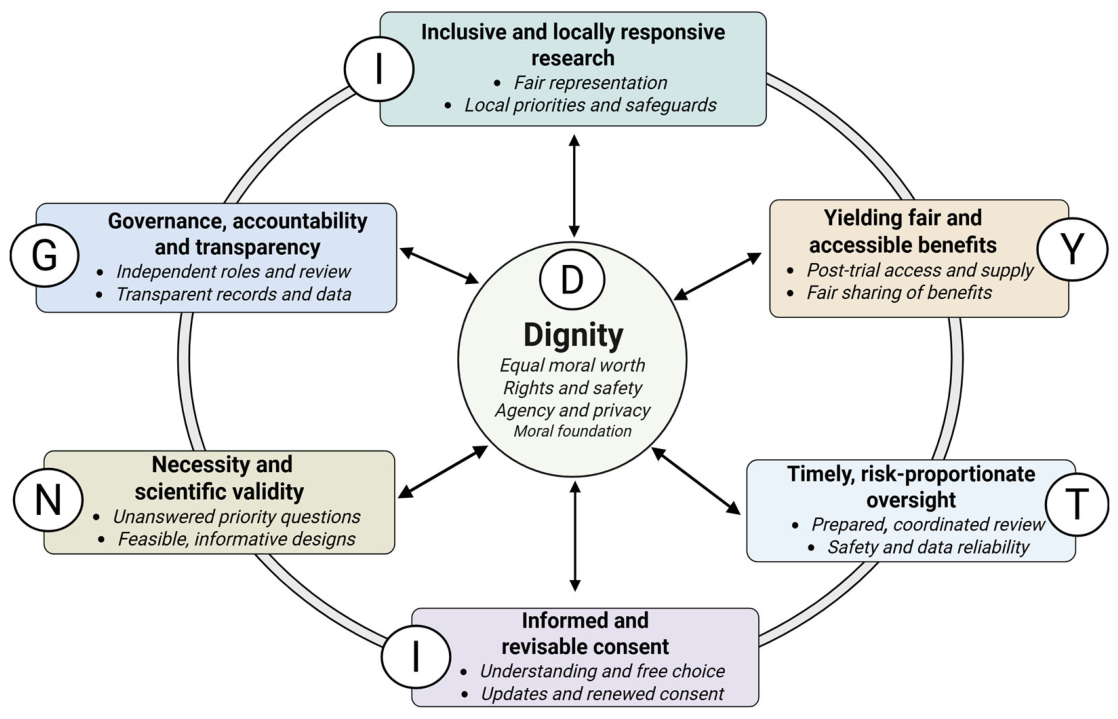
Figure 2.
Brazil’s emergency clinical research governance. Conceptual representation of ethics and regulatory governance during public health emergencies. Under current law, SINEP is composed of INAEP and the CEPs; INAEP performs national standard-setting, accreditation/credentialing, oversight, and appellate functions, whereas CEPs conduct independent protocol review. Multicentre research may receive a single CEP opinion; local institutional responsibilities nevertheless remain. ANVISA conducts sanitary/regulatory review under risk-, complexity-, and reliance-based pathways. The connectors denote functional coordination, not administrative hierarchy. The local-context safeguard shown is a normative proposal of this review and should not be interpreted as a second local CEP approval requirement.
Figure 2.
Brazil’s emergency clinical research governance. Conceptual representation of ethics and regulatory governance during public health emergencies. Under current law, SINEP is composed of INAEP and the CEPs; INAEP performs national standard-setting, accreditation/credentialing, oversight, and appellate functions, whereas CEPs conduct independent protocol review. Multicentre research may receive a single CEP opinion; local institutional responsibilities nevertheless remain. ANVISA conducts sanitary/regulatory review under risk-, complexity-, and reliance-based pathways. The connectors denote functional coordination, not administrative hierarchy. The local-context safeguard shown is a normative proposal of this review and should not be interpreted as a second local CEP approval requirement.
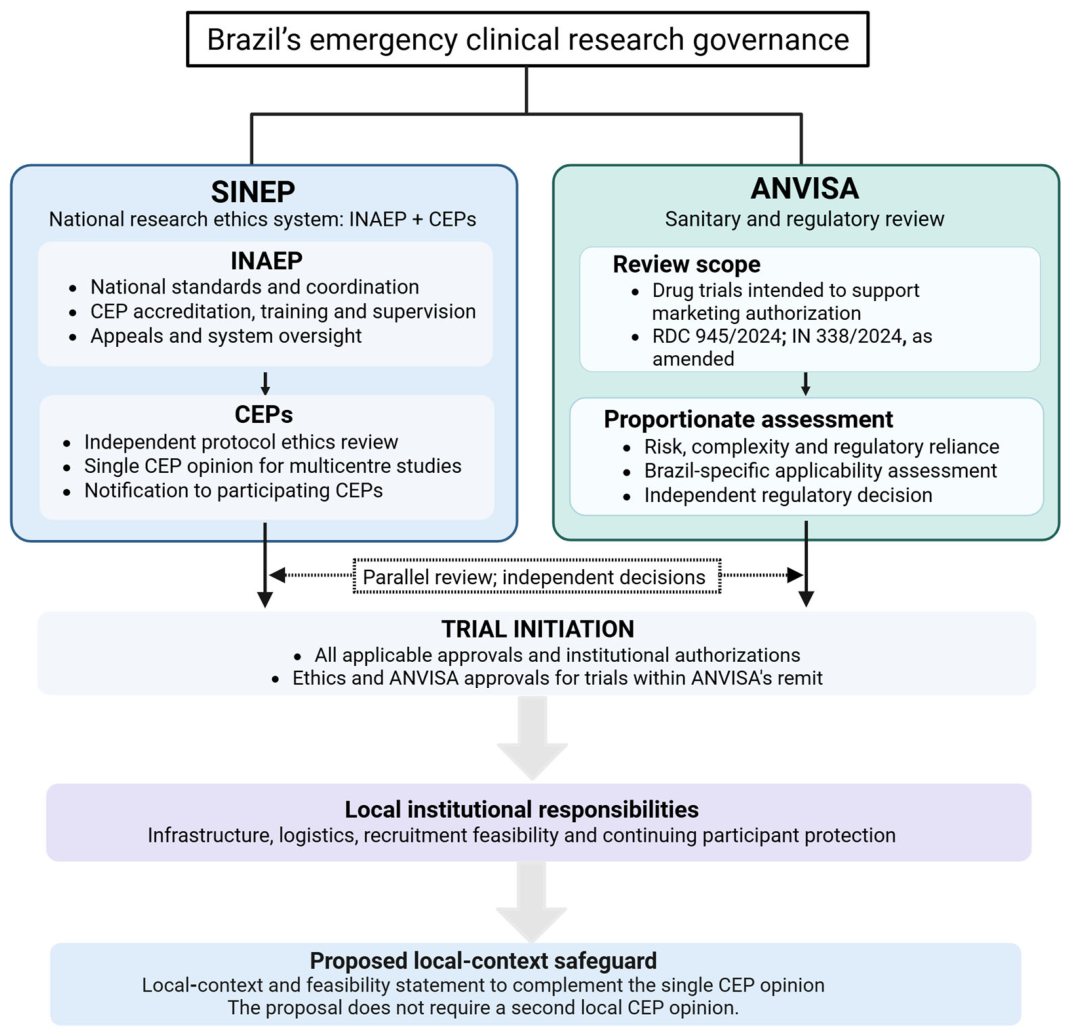

Table 1.
Ethical fault lines in emergency clinical trials.
| Tension | Primary ethical risk | Potential adaptation | Non-negotiable safeguards |
| Urgency vs. rigor | Inconclusive or misleading evidence | Parallel and accelerated review | Scientific priority, achievable sample size, meaningful outcomes, registration, independent monitoring |
| Consent vs. time-critical care | Enrolment without valid authorization | Remote, electronic, representative, or deferred processes | Necessity, prior approval, comprehension support, reconsent, refusal pathway, documentation |
| Centralization vs. local context | Loss of culturally and institutionally relevant protections | Single or coordinated ethics review | Mandatory local-context assessment, site capacity confirmation, local contacts and accountability |
| Data sharing vs. privacy | Re-identification, stigma, unauthorized secondary use | Accelerated controlled access and linkage | Purpose limitation, security, access governance, sunset clauses, public accountability |
| Placebo vs. evolving care | Withholding an established effective intervention | Adaptive control strategy | Continuous evidence surveillance, independent monitoring, predefined modification rules |
| Inclusion vs. protection | Exploitation or systematic exclusion | Tailored eligibility and safeguards | Scientific justification, fair selection, community engagement, subgroup monitoring |
| Speed vs. safety | Delayed recognition or communication of harm | Remote and risk-based monitoring | Critical-to-quality focus, real-time safety review, escalation pathways |
| Global collaboration vs. extraction | Local risks with external control and benefits | Multinational platforms and shared infrastructure | Local leadership, data access, fair authorship, capacity building, access and technology commitments |
| Authorization vs. evidence | Political or commercial pressure on scientific judgment | Emergency regulatory pathways | Independent assessment, transparent uncertainty, conflict management, communication firewall |
| Solidarity vs. reciprocity | Participants contribute but cannot access benefits | Pre-negotiated access arrangements | Feasible post-trial plans, affordability, supply, continuation, accountability |
Table 2.
Operational questions for the DIGNITY conceptual model.
| Domain | Core question | Minimum evidence | Decision consequence |
| Dignity | Could the study or adaptation instrumentalize participants? | Participant-level burden analysis and rights impact | Reject or redesign measures that treat vulnerability as permission |
| Inclusion | Are affected groups fairly represented and locally involved? | Epidemiologic justification, engagement record, local-context statement | Modify eligibility, recruitment, or safeguards |
| Governance | Who decides, who is accountable, and what is publicly traceable? | Decision map, conflict declarations, data and communication governance | Require independent roles and transparent records |
| Necessity | Is the question important, unanswered, and answerable? | Priority assessment, landscape review, feasible sample size and outcomes | Join a platform, consolidate, redesign, or do not approve |
| Informed consent | Can people understand, deliberate, and refuse under the circumstances? | Consent pathway, comprehension support, deferred-consent justification if applicable | Strengthen process or restrict enrolment |
| Timeliness | Does acceleration remove waste rather than protection? | Emergency standard operating procedure, expertise, timelines, risk-based plan | Parallelize, centralize, or intensify oversight as appropriate |
| Yielding benefits | Will participants and host communities fairly share benefits? | Access, affordability, continuation, dissemination, and capacity plan | Condition approval or partnership on credible commitments |
Table 3.
Brazil: regulatory opportunities, ethical risks, and preparedness priorities.
| Regulatory element | Opportunity | Ethical or implementation risk | Preparedness priority |
| 15-business-day emergency ethics timeline | Predictable prioritization of strategic SUS research | Deadline becomes a proxy for quality; ambiguous priority criteria | Transparent activation and prioritization rules; expert rosters; quality indicators |
| Single CEP review for multicentre studies | Less duplication and faster national activation | Loss of local contextual knowledge or confusion between ethics review and institutional feasibility | Structured local-context and feasibility documentation without duplicate CEP review; clear institutional escalation route |
| SINEP/INAEP national architecture | Standardization, training, accreditation, appeals, and national coordination | Concentration of authority; transition uncertainty; uneven regional capacity | Public reasoning, conflict safeguards, community representation, national emergency SOPs |
| National digital platform | Real-time mapping, transparency, duplicate detection, safety and result tracking | Portal used only for document submission; data fragmentation | Interoperability, recruitment dashboards, amendment and safety tracking, public summaries |
| ANVISA risk- and reliance-based review | Reduced duplication and focus on Brazil-specific risks | Uncritical importation of foreign conclusions | Documented applicability analysis and preserved sovereign accountability |
| Parallel ethical and sanitary review | Shorter total development time | Material information not shared across pathways | Formal rapid communication triggers and aligned critical-data sets |
| Post-trial access duties | Stronger reciprocity and participant protection | Operational ambiguity, supply gaps, unaffordability beyond participants | Pre-trial feasible plan, responsibility matrix, bridge supply, population-access strategy |
| Universal SUS setting | Potential for inclusive, pragmatic, nationally relevant research | Regional inequities and pressure on overburdened services | Distributed trial infrastructure, protected clinical capacity, fair site selection |
| CNS Intersectoral Commission on Research Ethics (2026) | Preservation of social participation and public reasoning within the CNS | Role ambiguity or duplicative expectations during institutional transition | Define transparent interfaces with SINEP/INAEP/CEPs; preserve non-duplicative mandates and participant representation |
Disclaimer/Publisher’s Note: The statements, opinions and data contained in all publications are solely those of the individual author(s) and contributor(s) and not of MDPI and/or the editor(s). MDPI and/or the editor(s) disclaim responsibility for any injury to people or property resulting from any ideas, methods, instructions or products referred to in the content. |
© 2026 by the authors. Licensee MDPI, Basel, Switzerland. This article is an open access article distributed under the terms and conditions of the Creative Commons Attribution (CC BY) license.
Copyright: This open access article is published under a Creative Commons CC BY 4.0 license, which permit the free download, distribution, and reuse, provided that the author and preprint are cited in any reuse.