

Submitted:
30 September 2026
Posted:
01 October 2026
You are already at the latest version
Abstract
ZnIn2S4 is a visible-light-responsive ternary sulfide used in photocatalytic hydrogen evolution, CO2 conversion, pollutant treatment, selective organic reactions and photoelectric sensing. Its layered structure and adaptable surface chemistry make it convenient for preparing nanosheets, porous assemblies, defect-containing surfaces and semiconductor junctions. These structural changes, however, influence different steps of a reaction, and the measured performance depends strongly on the donor, reactor, illumination and product analysis. This review examines ZnIn2S4 from the working structure to the measured reaction or sensing signal. The structural basis is followed by discussion of morphology, vacancies, composition, cocatalysts and heterojunctions. Representative applications are then considered with attention to product selectivity, carbon or oxygen balance, sulfide stability and analytical validation. Particular care is taken to distinguish sacrificial hydrogen evolution from overall water splitting, pollutant disappearance from mineralization, and a large photocurrent from a reliable sensor response. The aim is to summarize the available evidence while indicating which controls are still needed for meaningful comparison.
Keywords:
ZnIn2S4
; photocatalysis
; hydrogen evolution
; CO2 reduction
; sulfur vacancies
; photoe-lectrochemical sensing
1. Introduction
The transition toward low-carbon energy is taking place alongside a growing environmental burden [1,2,3]. Electricity, fuels and chemical products still depend heavily on energy-intensive processes, while the treatment of polluted water often requires additional chemicals and separation steps [4,5,6]. Solar energy can provide a cleaner source of driving force, but its practical value depends on whether light can be converted into useful chemical work with reasonable efficiency and selectivity [7,8,9]. This challenge is shared by several fields that are often discussed separately. Hydrogen production requires the storage of solar energy in a fuel. Carbon dioxide conversion seeks to use an abundant carbon source while avoiding uncontrolled products. Water treatment aims to destroy persistent molecules without transferring the problem to a secondary waste stream. At the same time, rapid monitoring of trace contaminants and biological markers requires photoactive materials that can generate stable and interpretable electrical signals. These tasks all depend on how photogenerated electrons and holes are created, separated and delivered to a surface or electrode. They also expose the limits of laboratory comparisons, because reaction media, product analysis and device configuration can change the apparent benefit of a material. The search for versatile visible-light absorbers therefore belongs to a wider effort to connect solar conversion, environmental remediation and chemical sensing [10,11].
Semiconductor photocatalysis links sunlight with reactions that would otherwise require chemical or electrical input [12]. The demands are different in each case. Hydrogen evolution needs electrons and accessible proton-reduction sites [13]. CO2 conversion adds the problem of binding and activating a stable molecule while controlling product selectivity [14]. Water treatment is governed by the interaction of the catalyst with the pollutant and with the surrounding matrix [15]. A photoelectrochemical sensor has a further requirement [16]. Its electrical response must be reproducible for a defined analyte. Visible-light absorption helps in all of these systems, but it does not decide the result by itself. ZnIn2S4 is attractive because it can be obtained as nanosheets or hierarchical assemblies and can be connected to other semiconductors without changing the whole synthesis route. Early studies of layered ZnIn2S4, together with later hydrogen-evolution reviews, established the importance of its morphology and interfaces [17,18]. More recent work on nanosheets and hollow structures has shifted attention toward local coordination, wetting and carrier transport [19,20]. The reported rate is therefore only the starting point. The more useful question is why the same modification helps one reaction and has little effect in another.
A ZnIn2S4 powder and a ZnIn2S4 electrode do not experiences the same experiment. In a slurry, the important variables include exposed surface, mixing and contact with dissolved reactants. The product still has to be quantified, and the source of the electrons or holes must be accounted for. Once the material is deposited on an electrode, adhesion, film resistance, applied potential and electrolyte become part of the result. A larger photocurrent may make a better transducer, but the assay also needs analyte recognition, calibration, interference tests and sample recovery. Photoelectric sensing is therefore treated here as a separate application rather than another activity number. Focused reviews have already discussed ZnIn2S4 hydrogen generation and irradiation conditions [21,22]. The present review takes a narrower route. It links each structural change to the process it is expected to influence and then considers how well the available measurements support that link. Representative studies are used in place of a catalogue of every composite so that reaction conditions and qualifications are not lost.
ZnIn2S4 does not have a single mechanism that applies to every reaction. Synthesis may change phase, thickness, defect population and surface residues together, and the surface can continue to evolve under illumination. The discussion therefore treats charge-transfer labels as working assignments and considers them in relation to the measurements reported for each system.In this review, ZnIn2S4 is abbreviated as ZIS when the composition is unambiguous. The discussion first outlines its crystal structure, morphology, electronic properties and surface chemistry, followed by the main strategies used to regulate these features. The applications are grouped into hydrogen evolution, CO2 reduction, environmental purification, selective organic transformations, H2O2 production and photoelectric sensing. Solid-state photodetectors are treated separately from PEC sensors because their performance is evaluated with different parameters. PEC, AQY and FTO denote photoelectrochemical, apparent quantum yield and fluorine-doped tin oxide, respectively. The terms type-II, Z-scheme and S-scheme are retained when used by the original authors, but these labels are not considered direct evidence of a charge-transfer pathway. Mechanistic assignments are therefore discussed together with the measurements supporting them and the stability of the material during operation. Studies of related semiconductors and functional materials have examined how vacancies, interfaces, composition and local coordination affect photo response. These reports provide context for the characterization principles discussed here, but they do not establish the same behavior in ZnIn2S4.
2. Structural and Electronic Basis of ZnIn2S4
Before discussing individual modification strategies, it is useful to relate the structure of ZnIn2S4 to the processes it supports. The crystal framework determines local coordination and available surfaces, while light absorption generates carriers that must reach reaction sites or be collected by an electrode. These links between structure, carrier behavior and photocatalytic or photoelectric output are summarized in Figure 1. The layered structure shown is representative; the phase and surface features of ZnIn2S4 depend on the synthesis conditions. The following section describes its crystal structures and synthesis-dependent surfaces [23,24,25,26,27].
2.1. Crystal Structure and Synthesis-Dependent Surfaces
The hexagonal layered form is commonly used in photocatalytic studies, although ZnIn2S4 also has other reported crystal structures. Phase labels should therefore come from diffraction and, where needed, local structural measurements of the actual sample [28]. A schematic crystal model cannot stand in for this verification. In layered materials, the arrangement of Zn, In and S across the sheet gives a different chemical environment to a basal plane and an edge [29,30]. The distinction matters because a large external surface area does not necessarily mean a large population of the sites that perform a given reaction [31,32]. The rhombohedral structure examined in a ZnIn2S4 phototransistor also illustrates why optoelectronic conclusions from one polymorph should not be transferred automatically to a typical hydrothermal nanosheet [33,34,35,36,37].
Hydrothermal and solvothermal routes often produce flower-like microspheres assembled from thin sheets [38,39]. The open assembly may expose edges and scatter light, although a dense core and overlapping sheets can hide part of the surface. Isolated nanosheets shorten the path from the bulk to the solution, but they may restack after drying and are not always easy to recover. A powder that disperses well in a stirred vial may therefore be a poor continuous coating. The useful morphology depends on the reaction medium and on the form in which the material will finally be used [40,41,42,43,44].
The synthesis route leaves chemical traces as well. Thiourea or thioacetamide, solvent choice and post-treatment can change sulfur content, surface oxide coverage and adsorbed residues. A small XPS shift may result from oxidation, charging or a change in coordination [45]. EDX is valuable for a compositional survey, but it cannot locate a dilute surface defect with confidence [46,47]. Claims about a particular facet, vacancy concentration or isolated site should therefore be supported by methods with the required spatial and chemical resolution. A comparison made from one precursor batch before and after a controlled treatment is especially useful because it reduces the number of variables that can explain a new rate [48,49,50,51].
Precursor chemistry can determine how a sample behaves after it is placed in water. Residual sulfur-containing ligands may alter wetting, and a weakly bound oxide layer can evolve during the first minutes of illumination. These changes are easily missed when characterization is limited to dried powders. For repeated use, the initial suspension, recovered solid and reaction solution should be considered together, especially when the rate changes between cycles.
2.2. Light Absorption, Carriers and Surface Reactions
Visible-light response is one reason ZnIn2S4 is used so often for hydrogen evolution. After a photon is absorbed, the carriers still have to survive recombination, reach a surface and complete the two half-reactions [52,53]. Band edges and optical gaps are frequently treated as fixed material constants, although phase, stoichiometry, surface chemistry and the measurement method can move the reported values. A Tauc plot estimates optical absorption. It does not directly give the redox potentials of a working interface. Flat-band data are useful only when the reference electrode, pH and conversion procedure are stated, and calculated vacuum-level positions should not be mixed silently with electrochemical measurements.
The surface can be as important as the band structure. Proton reduction requires a suitable adsorption site and a route for transferring charge to hydrogen intermediates [54,55]. CO2 reduction must activate a stable molecule while competing with hydrogen evolution. H2O2 production depends on a selective two-electron oxygen-reduction path and on avoiding peroxide decomposition. In water treatment, a strongly adsorbed pollutant can block the surface, while the active oxidant may come from dissolved oxygen rather than from direct hole transfer [56]. A defect that helps adsorption in one reaction can therefore trap carriers or accelerate an unwanted reaction in another.
A lower steady-state PL intensity, a smaller impedance arc or a larger photocurrent may support an argument for improved charge separation, but none of these signals has a single interpretation [57,58]. PL can fall when non-radiative traps increase, and impedance measured on an electrode does not directly give the turnover of a powder in suspension. Transient measurements, selective deposition, surface photovoltage and operando spectroscopy are more persuasive when they are measured under conditions close to those used for product formation. A mechanism is convincing only when the materials data and the chemical products point in the same direction.
2.3. Sulfide Stability and Working-State Evidence
The sulfur framework also creates a stability problem. If the intended oxidation reaction is slow, photogenerated holes may attack the sulfide. Sulfur loss, partial oxidation and dissolved Zn or In can then change the surface during a long run [59,60,61]. Reusing a recovered powder may not reveal the change, especially when every cycle starts with fresh solution. Continuous product monitoring and post-reaction composition are more informative than an unchanged final rate. The issue is especially serious in overall water splitting, where the sulfide must support water oxidation without a sacrificial hole scavenger [62]. The adjacent-site electronegativity study offers one example in which activity and stability were considered together [63].
Results from different ZnIn2S4 samples should first be read in light of the specimen that was tested. Suspended powders, supported films and isolated nanosheets expose different surfaces and receive different amounts of light. Their working interfaces are also unlike a dried powder prepared for XPS. Water, adsorbed reactants, a binder and the electrolyte double layer can change surface charge and access to sites. For this reason, a comparison between studies is meaningful only when the physical form, illuminated area and chemical surroundings are clear [64,65]. Optical and electrochemical measurements help interpret performance but cannot replace product analysis. Greater light absorption does not establish useful charge separation, while a larger photocurrent from a deposited film does not measure the quantum yield of a powder in suspension. Stability requires a similar distinction. Short reuse cycles show whether a catalyst can be handled repeatedly, whereas continuous operation can reveal slow drift and accumulation of dissolved or oxidized species [66,67]. If the surface reconstructs yet stays active, the reconstructed surface should enter the description of the working material.
The duration of a test matters because the chemistry may change during the test itself. A catalyst can retain its initial rate for several short cycles while slowly losing sulfur or releasing metal ions into the solution [68,69,70]. Conversely, a mild surface oxidation may lower the first rate but create a more stable working layer during later cycles. Time-resolved gas or liquid analysis, together with a final measurement of dissolved Zn, In and sulfur species, would help distinguish these situations. Such data are particularly valuable for overall water splitting and for sensor electrodes that are repeatedly switched between light and dark [30,71,72].
3. Structural Engineering Strategies
The following sections consider each modification in relation to the step it is intended to affect as shown in Figure 2. Thinner sheets may shorten the path to a surface, but can also restack or expose more edge sites. Vacancies can change adsorption and may become recombination centers after hydration or oxidation. Cocatalysts and junctions affect carrier collection only when their contact is close and remains stable during reaction. Because synthesis often changes several features together, the discussion considers material structure, reaction conditions and controls alongside the reported activity. For sensing electrodes, film integrity and receptor loading also affect the measured signal.
3.1. Thickness, Porosity and Hierarchical Assembly
Thin sheets expose more atoms to the solution and shorten the distance that carriers travel before reaching a surface. This is the main reason for using exfoliation and controlled sheet growth. Thickness, however, is not an isolated variable. Smaller sheets have a different edge-to-basal-plane ratio and may contain more defects or adsorbates [73,74,75,76]. They can also restack during drying. A meaningful comparison should therefore give the thickness distribution, exposed structure and reaction conditions rather than relying on the word ultrathin. Film continuity and electrical contact become equally important when the sheets are deposited on a substrate [77,78,79,80].
Porous assemblies offer a different balance. They allow light and reactants to reach internal sheets, while products can leave through the same network. Ding and co-workers compared hollow flowers made from defective ZnIn2S4 nanosheets with less favorable structures in hydrogen evolution [81]. Jia et al. later examined a porous, vacancy-containing preparation and reported a high donor-assisted H2 rate. These studies support the value of an open architecture, but porosity and vacancy density changed together in the latter case. A BET area measured on a dry powder is also not the same as the wet, illuminated area in a reactor. Pore accessibility, settling and gas bubbles may all change the effective surface during operation.
The morphology selected for a specific application should follow its mass-transfer needs [82,83,84]. In a hydrogen slurry, a loose flower can maintain dispersion while presenting many accessible sheets. For CO2 conversion, the adsorption of gas or dissolved bicarbonate and the local supply of proton donors’ matter. In pollutant removal, a porous material can concentrate an organic molecule before oxidation, making dark adsorption controls essential. In a PEC sensor, highly textured films can load more receptor but also increase nonspecific adsorption and background current. These distinctions argue against a single morphology ranking across all reported ZnIn2S4 applications [85,86,87,88,89].
3.2. Vacancies and Composition Control
Sulfur vacancies are often used to explain stronger absorption, altered charge distribution and enhanced reactant adsorption. They can change local coordination, but the experimental task is to show where the vacancies are and how many are present, then separate their effect from changes in morphology or oxidation state [90,91,92]. EPR, XPS and elemental analysis can support one another when appropriate controls are included. None of them, by itself, counts the vacancies on a working surface. Excessive defect density may instead create deep recombination centers. Activity should therefore be considered as a function of defect population rather than assumed to increase continuously. One study introduced Zn vacancies through sulfhydryl coordination and examined their influence on CO2 photoreduction [93]. Metal vacancies present a related but distinct case because they can change CO2 binding and local charge distribution. The assignment should remain consistent with the preparation chemistry and with the measurements made after reaction [94,95,96,97,98].
Changing composition or introducing heteroatoms may affect the adsorption site, the oxidation half-reaction and the durability of a sulfide simultaneously. Oxygen doping combined with surface sulfur vacancies has been studied for visible-light overall water splitting [99]. The claim is more demanding than a donor-assisted H2 rate because both water oxidation and hydrogen evolution need to be accounted for. Phosphorus filling of surface sites in few-layer ZnIn2S4 has also been investigated in sacrificial-agent-free hydrogen production [100]. These examples are best compared by what the added atom does locally, because doping and vacancy chemistry often occur together. A phosphorus atom occupying or interacting with a vacancy can alter the identity of the reactive site itself. Defect models need an operating-state qualification. A vacancy favorable in a DFT slab may be hydrated, oxygenated or occupied by a reaction intermediate in water. The lowest calculated adsorption energy for a chosen intermediate does not establish the full catalytic route. Isotopic labeling, in situ vibrational signals, controlled defect healing and measurements after extended illumination can help connect an idealized structural model to the real catalyst. These tests are especially important for CO2 and H2O2 reactions, in which the adsorbed intermediate and competing reduction path determine the product.
3.3. Cocatalysts and Interfacial Active Sites
A cocatalyst may lower a surface-reaction barrier or collect carriers before they recombine. Noble metals are convenient electron collectors in hydrogen studies, yet loading, particle size and deposition route also change the number of exposed sites [101,102]. Non-noble components can be attractive for practical reasons, although a high powder rate is not a cost analysis. The useful controls include bare ZnIn2S4, the isolated cocatalyst and a loading series tested with the same light and donor. Dai et al. photo-deposited Ni(OH)2 and nickel phosphide species on ZnIn2S4/ZnS [103]. The design assigns different interfacial functions to the two nickel-containing phases, but the final composition and distribution still need to be confirmed after deposition. A nominal precursor ratio cannot show which phase works during illumination. In a different route, an In-MOF precursor generated a ZnIn2S4 heterojunction for hydrogen formation without an added cocatalyst [104]. Its performance should be compared with the complete precursor-derived surface, under the solution and illumination used for the H2 test [105,106,107,108,109].
At the atomic scale, an isolated metal site may alter local adsorption and improve atom utilization. Its assignment requires microscopy and coordination analysis that exclude small clusters. The site should also be examined after reaction, since an atom bound to the pristine lattice may migrate, coordinate to oxidized sulfur or aggregate under illumination.
3.4. Heterojunctions and Mechanistic Evidence
Contact with a second semiconductor can change absorption, local fields, adsorption and carrier collection, but the result depends strongly on how the two phases meet [102,110,111]. Zhang et al. reported a sheet-on-sheet ZnIn2S4/g-C3N4 structure for H2 formation and related its performance to an intimate interface [112]. Later work introduced defects into both ZnIn2S4 and carbon nitride [113]. These systems cannot be reduced to one band diagram because their contact geometry and local chemistry are different. A physical mixture is a useful control for showing whether the interface itself matters. The label S-scheme requires further evidence. Type-II transfer, Z-scheme-like recombination and defect-mediated transfer can all produce a larger steady-state photocurrent. Work-function and light-dependent surface-potential measurements, spatially resolved deposition and selective radical tests can help separate these possibilities. When the surviving carriers are not located directly, the transfer path should remain a proposal rather than a settled fact [114,115,116,117,118].
Interfaces can also be designed for a particular chemical task. A MoO3-x@ZnIn2S4 core-shell structure was studied for photothermal-assisted CO2 conversion [119]. Here the thermal contribution and the charge-separation proposal both matters. A comparison without matching temperature would overstate the purely photocatalytic [120] advantage. Growth of ZnIn2S4 on amine-functionalized SiO2 addressed CO2 adsorption and nanosheet arrangement, showing that a support can contribute through reactant supply even if it does not form an electronically active junction. The appropriate comparison is therefore between complete reaction environments, with light flux, temperature, feed and support all specified. [121,122,123,124]
Synthesis rarely changes one feature alone. Vacancy formation can alter sheet thickness or wetting, while cocatalyst deposition can cover existing sites. Matched series that vary one parameter at a time are therefore more informative than a comparison of an optimized composite with pristine ZnIn2S4. A loading series can reveal the balance between interfacial contact and light shielding; defect studies can use controlled vacancy creation or healing to test whether activity follows the assigned site. Such controls are rarely perfect, but they help distinguish a cause from a structural change that accompanies synthesis.
For a heterojunction, work functions and surface potentials help establish the direction of charge redistribution, while transient measurements describe its timescale [125]. Their interpretation must be consistent with the product distribution. A proposed S-scheme should be presented as a working explanation when the evidence is indirect, especially if the partner semiconductor or the ZnIn2S4 surface changes during irradiation. Reporting the assumptions behind the model makes comparisons among junctions more useful than assigning every improved composite to the same pathway [126,127,128,129,130].
Reproducibility matters for both powders and electrodes. Independent batches can show whether a morphology or interface is controllable, while supported films should be assessed for loading, adhesion and electrical contact across replicate electrodes. A flower-like powder prepared in a small vial may have a size distribution that is difficult to retain when precursor concentration, mixing or heating history changes. Conversely, a film may appear uniform while its current varies from electrode to electrode. Reporting this spread identifies which preparation step limits transfer to repeatable reactions or sensing devices [131,132,133,134,135].
4. Photocatalytic Applications
Applications are grouped by measured output rather than by composite name. Donor-assisted H2 evolution is separated from overall water splitting because a sacrificial donor supplies the oxidation half-reaction. CO2 conversion is discussed with carbon-source controls and product balance in mind, while environmental purification is evaluated by distinguishing adsorption and parent-compound loss from mineralization. H2O2 production and selective organic reactions are considered through the products formed on both sides of the reaction where these were reported. Work on other semiconductor and catalyst systems has considered how morphology, porosity, heterojunctions and composition influence light-driven reactions. These examples are useful for framing materials design, although their activity values cannot be transferred directly to ZnIn2S4.
4.1. Hydrogen Evolution
Green hydrogen can be produced by renewable-powered water electrolysis or through solar-driven water splitting. Photocatalytic hydrogen production is of interest because semiconductor absorbers can use sunlight to drive chemical conversion directly, potentially avoiding separate photovoltaic and electrolyser units. Its practical performance, however, depends on light utilization, charge transfer, product separation and catalyst stability. Many studies use sacrificial donors to consume photogenerated holes; these demonstrate hydrogen evolution but do not establish overall water splitting or, on their own, a complete green-hydrogen process.
Hydrogen evolution is the most developed application of ZnIn2S4, but the terminology used for it still matters. Many studies use triethanolamine, lactic acid or sulfide/sulfite as a sacrificial donor, sometimes together with a deposited cocatalyst. The donor supplies the oxidation half-reaction, so the product is photocatalytic H2 evolution rather than overall water splitting. Rates can be compared only when the lamp spectrum and intensity, catalyst mass, reactor geometry, donor concentration and normalization are known. An AQY at a defined wavelength is helpful, although the calculation still depends on whether incident or absorbed photons are used. The morphology studies illustrates the point. Ding et al. used hollow flowers assembled from defective ZnIn2S4 sheets, while Jia et al. reported 61,506 ± 4746 μmol g-1 h-1 of H2 and an apparent quantum efficiency of 56.53% at 420 ± 15 nm for a porous, vacancy-containing material [81]. The second result was obtained with a donor and should be read together with its lamp, catalyst loading and solution. It is not an overall-splitting rate. Both reports suggest that open surface architecture can matter without changing the bulk band gap, but BET area or PL intensity alone does not tell how many sites receive light in a stirred suspension. Action spectra, transient measurements and comparable catalyst loadings are needed for a closer comparison. Sedimentation can further reduce the illuminated fraction of a powder during the experiment [136,137,138,139,140,141].
A junction adds another possibility. The sheet-on-sheet g-C3N4 example placed two light-responsive solids in extensive contact. Defect-containing ZnIn2S4-x/g-C3N4-x [113] added local electronic states to that interfacial picture. Both reports may show higher donor-assisted H2 output than their component controls, but the explanation need not be identical. An interfacial potential can change carrier direction while a defect may change the proton-binding surface. Loading experiments are particularly revealing. A thin partner layer can improve contact, whereas too much of it can shade ZnIn2S4 or block the surface. This often produces an optimum rather than a continuous increase with composite content. Cocatalysts address the surface step more directly. In Dai et al.’s Ni(OH)2/NixP-modified ZnIn2S4/ZnS system [103], two nickel-containing components were deliberately placed on a sulfide framework. To interpret such a result, one must know whether nickel phases collect electrons, assist water or donor oxidation, change wetting, or serve more than one function. The in-situ route itself can create a ZnS-rich interface and alter the underlying ZnIn2S4, making a bare ZnIn2S4 comparison only the first of several necessary controls. For the MOF-derived junction [104], the preparation route may supply an intimate interface without a separate cocatalyst deposition. Its value is best judged against the complete precursor-derived surface, not merely the presence or absence of a noble metal [142,143,144,145,146,147,148].
A much smaller set of studies tackles pure-water overall splitting. The oxygen-doped and vacancy-containing ZnIn2S4 reported in [99] and the green hollow gZIS (Figure 3) reported by Chong et al.[19] explicitly address this more difficult task. Xin et al. linked adjacent-site electronegativity differences to activity and stability in overall splitting [149]. Such claims demand H2 and O2 quantification, a plausible stoichiometric relationship, exclusion of sacrificial sulfur oxidation, and evidence that the solid remains chemically intact. Ideally, a gas balance is accompanied by isotope tests or dissolved-species analysis where source assignment is uncertain. A daytime stability run is meaningful, but it should be interpreted together with whether rates and gas ratios remain steady throughout the run. The distinction between H2 evolution and overall splitting also changes the outlook for scale-up. A high mass-normalized rate from a few milligrams of powder under a concentrated lamp does not specify production per illuminated area in an outdoor reactor. Sacrificial donors add material and separation costs. On the other hand, an overall-splitting material with lower initial rate may be more important scientifically if it suppresses photocorrosion and closes the oxidation balance. Reports should therefore provide both mass- and area-based outputs where possible, light input, gas verification and continuous operating duration. Those details let readers evaluate the chemistry without making a premature commercial claim [150,151,152,153,154].
Powder rates do not directly predict performance in a photoelectrode. A ZnIn2S4 slurry exposes both sides of a sheet to liquid, whereas immobilization creates a preferred contact with the substrate and electrolyte. Electrical connection may collect carriers before they react at the exposed surface, while a binder or protective layer can improve film integrity but limit proton or water access. Cocatalyst distributions optimized for suspended sheets may therefore need redesign for a supported device. Reports should give active mass and illuminated area, and state applied bias and collection method where relevant. Reactor geometry also affects the illuminated fraction of a slurry; a flow reactor adds residence time, pressure drop and product-removal effects. These variables can change the apparent rate even when catalyst loading is unchanged [155,156,157]. Related studies outside ZnIn2S4 have considered hydrogen evolution, water splitting and oxygen evolution across photocatalytic and electrocatalytic materials. The different reaction conditions and charge-balance requirements limit direct performance comparisons [158,159,160,161].
4.2. CO2 Photoreduction
The conversion of CO2 into useful chemicals and fuels is being investigated as part of broader efforts in carbon capture and utilization. Depending on the energy source and reaction system, this conversion can proceed through electrochemical, thermochemical, biological or light-driven routes, yielding products such as carbon monoxide, formate and hydrocarbons. Each route has distinct requirements for energy input, reaction conditions and product separation. Solar-driven conversion is of particular interest because it can couple light absorption with chemical transformation, although its practical performance remains dependent on efficient charge utilization and suitable reaction pathways. Within this area, semiconductor photocatalysts provide a means of using absorbed photons to drive CO2 reduction
CO2 photoreduction is difficult to assess because activation, proton delivery and product desorption are coupled to competing H2 evolution. At low conversion, trace carbon contamination can distort apparent product selectivity, and different studies report products that require different numbers of electrons. ZnIn2S4 has been examined both as an electron-rich component and as a surface whose metal sites or vacancies may bind intermediates. Product identity, carbon source and the contribution of the support therefore need to be considered together.
CO2 conversion is more demanding than proton reduction. The molecule is difficult to activate, several proton and electron pathways compete, and trace carbon contamination can produce misleading signals when conversion is low. ZnIn2S4 has been used both as an electron-rich component and as a surface whose metal sites or vacancies bind intermediates. The Zn-vacancy study based on sulfhydryl coordination emphasized local adsorption chemistry [93]. Nanosheets grown on amine-functionalized SiO2 emphasized the supply of CO2 near the sulfide [120]. These are different solutions to the same reaction problem. A reactive site has little value if CO2 does not reach it, while stronger adsorption does not guarantee selective reduction. Other reports introduced a photothermal MoO3-x@ZnIn2S4 composite [119], a 2D/2D sulfide and polymeric junction, or a hollow TAPB-COF@ZnIn2S4 structure [162]. In each case, the interface can change adsorption, water access, light penetration and temperature at the same time. The isolated components, a physical mixture and a dark experiment at the same temperature are therefore important controls [163,164,165,166,167,168].
In the study from Chen et al., hexagonal and cubic ZnIn2S4 nanosheets were successfully prepared via liquid ultrasonic exfoliation and lamellar hybrid-based synthetic strategies, respectively, as shown in Figure 4 [18]. The photocatalytic performance of these two ZnIn2S4 nanosheet phases was evaluated through CO2 photoreduction reactions for methyl formate production, with methanol acting as both the carbon dioxide absorbent and reducing agent. Photocatalytic tests confirmed that hexagonal ZnIn2S4 possesses better catalytic activity than cubic ZnIn2S4. In addition, both nanosheet samples exhibit remarkably higher reaction reactivity than hydrothermally synthesized ZnIn2S4 microspheres. Density functional theory calculations were further implemented to explore the inherent electronic structural characteristics of hexagonal and cubic ZnIn2S4 phases [169,170,171,172,173].
A CO2 product rate is most informative when reported with selectivity, absolute carbon conversion and competing H2 production. Isotope-labelled CO2 and carbon-containing blanks are particularly important at low conversion; for the Zn-vacancy system, these controls would help test whether the proposed local coordination change accounts for the observed product distribution [174,175,176,177].Product distributions may change during illumination as adsorption or the catalyst surface evolves. A shift from CO to CH4 after the first hour, for example, may reflect reconstruction rather than a fixed selectivity of the as-prepared solid. When water or a donor is present, the source of carbon and hydrogen should be established. Reporting electron-equivalent product yields alongside H2 would help compare studies in which products consume different numbers of electrons. For vacancy-containing catalysts, time-resolved products can also show whether the proposed adsorption site remains active or is modified during the reaction. These measurements are particularly relevant when a support changes local CO2 supply or when surface composition changes under illumination [178,179,180,181,182].
The support studies illustrate distinct ways to alter the environment around ZnIn2S4. Amine-functionalized silica provides potential CO2-binding groups while also controlling nanosheet arrangement. In a porous COF shell, adsorption capacity has to be considered together with permeability and product diffusion. Oxygen-deficient MoO3-x introduces a temperature-dependent contribution to the core-shell system, so its thermal and electronic effects should be separated. Their relative roles can be compared only when feed, light flux and temperature are matched. A support-only control and a physical mixture can help determine whether the benefit comes from local CO2 supply, an electronic junction or simply a change in dispersion [183,184,185,186,187]. Work on CO2 conversion and capture spans photocatalytic reduction, photothermal conversion and adsorption. These approaches address different stages of carbon utilization, so adsorption capacity should not be treated as evidence of photoreduction activity.
4.3. Environmental Purification
The discharge of industrial chemicals, pharmaceuticals, pesticides and other persistent pollutants has increased the demand for water-treatment methods that can operate under diverse environmental conditions. Conventional approaches, including adsorption, biological treatment and membrane separation, are useful in many settings, but they may transfer contaminants to another phase or require additional treatment when pollutants are poorly biodegradable. Advanced oxidation processes offer an alternative by converting contaminants into less harmful products, although their energy and chemical requirements vary with the treatment system.
Water purification requires evidence that contaminant concentration and hazard have both decreased. ZnIn2S4 composites have been tested against dyes, antibiotics and inorganic species, but removal can mean adsorption, loss of the parent signal, transformation or mineralization. For dyes, sensitization and adsorption can change the spectrum without extensive chemical destruction. Antibiotic studies are more informative when calibrated chromatography follows the parent compound and major products, with total organic carbon or toxicity measurements used where available. The composition of the water also matters because pH, dissolved oxygen and background organic matter can change adsorption and reactive-species chemistry [188,189,190,191,192].
ZnIn2S4 composites have been tested against dyes, antibiotics and inorganic contaminants, but removal can mean several different things, shown in Figure 5. It may be dark adsorption, disappearance of the parent molecule, transformation into smaller products or actual mineralization. A fading dye is weak evidence of chemical destruction because sensitization and adsorption can change its spectrum. Antibiotic studies are more informative when they report calibrated concentration data, products and, where possible, toxicity. Dark adsorption and light-only controls should come before a kinetic interpretation. A 2D/0D ZnIn2S4/ZnO structure and a hierarchical ZnIn2S4/C3N4 composite were both tested with tetracycline [193,194]. Their similar endpoint does not mean that their interfaces work in the same way. pH, initial concentration, lamp spectrum, catalyst loading and dissolved oxygen should be aligned before the rates are compared. A pseudo-first-order constant measured over one concentration interval is not an intrinsic surface constant. If one composite adsorbs more tetracycline before illumination, its higher apparent removal does not isolate the role of charge separation [195,196,197,198,199,200,201].
La-doped ZnIn2S4 was examined for oxygen activation and antibiotic degradation in water [202]. The proposed change to oxygen chemistry is a useful alternative to a discussion centered entirely on hole oxidation. If superoxide or another oxygen-derived species contributes, oxygen availability in the reactor and scavenger controls become important. Scavengers themselves can change adsorption, pH and interfacial kinetics, so the assignment is stronger when spin-trapping or another independent method supports it. A ZnIn2S4-decorated MIL-88B(Fe) system combined Cr(VI) reduction with tetracycline removal [203]. During simultaneous treatment, electrons used for metal reduction and holes used for organic oxidation may complement one another, but the final chromium species and transformed organics still need to be quantified. The two targets have different analytical endpoints. A lower Cr(VI) concentration does not establish recovery of harmless Cr(III), and a declining antibiotic peak may be replaced by products with different toxicity. The iron-containing framework can also contribute adsorption or secondary oxidative chemistry. Solution composition therefore matters when the contribution of ZnIn2S4 is discussed. This paired application is interesting because the reductive and oxidative sides can be followed separately. Real wastewater presents a more difficult test. Chloride, bicarbonate and dissolved natural organic matter may compete for oxidants or occupy surface sites, and suspended matter can shorten the optical path. A catalyst that works in distilled water at a chosen pH may behave differently in buffered, saline or colored water. Stability testing should include Zn and In release as well as repeated pollutant removal. Mineralization, intermediate toxicity, separation of the spent solid and performance at realistic concentrations deserve more weight than the near-complete disappearance of one parent peak [204,205,206,207,208,209].
The analytical endpoint can change the apparent ranking of water-treatment materials. A sample collected after tetracycline conversion may show substantial parent-compound loss while retaining aromatic fragments with biological activity. Chromatography can identify major transformation products, whereas total organic carbon provides a separate measure of mineralization; neither follows from the disappearance of the parent peak. In the ZnIn2S4-decorated MIL-88B(Fe) system, Cr(VI) reduction and tetracycline removal occur together, but the final chromium species and organic products should both be quantified. The iron-containing framework may contribute through adsorption or secondary oxidative chemistry. Matrix composition, catalyst recovery and Zn/In release also affect whether a result obtained in clean water is relevant to wastewater treatment [210,211,212,213,214]. Studies on environmental treatment and resource recovery have used photocatalytic, adsorptive and hybrid approaches. Their reported targets and endpoints differ, and pollutant removal or capture alone does not establish mineralization or selective conversion. [215,216,217,218,219,220] Related studies have addressed aqueous contaminants through adsorption, biomass-derived materials, photocatalytic degradation, and hybrid treatment. The targets include arsenic, nutrients, dyes, antibiotics, and oily wastes, but the reported endpoints differ. These examples provide environmental-treatment context; removal or adsorption should not be equated with mineralization or selective conversion. [221,222,223,224,225]
4.4. H2O2 Production and Selective Organic Transformations
Solar-driven chemical conversion can be directed toward products that serve as fuels, oxidants or chemical feedstocks. H2O2 is of interest because it is used in water treatment, chemical synthesis and disinfection, while its conventional production and transport can involve energy-intensive processes and concentrated solutions. Photocatalytic routes may allow H2O2 to be generated on site from water and oxygen, although product accumulation depends on controlling both its formation and subsequent decomposition. Light-driven organic transformations address a related but distinct objective: converting readily available substrates into specific products under comparatively mild conditions. In these reactions, selectivity is as important as conversion, since competing pathways can consume the substrate or oxidize the desired product. ZnIn2S4 has been examined in both areas, with material modification used to adjust charge-carrier behavior and surface reactivity for the target reaction (Figure 6).
H2O2 production and selective organic conversion use ZnIn2S4 differently from pollutant degradation. Here photogenerated charges are directed toward retaining a chosen product, and reactions on both sides can have value. Peroxide synthesis requires oxygen activation while avoiding H2O2 decomposition. In paired organic conversion, the oxidation product is collected rather than treated as a sacrificial by-product. The two topics are grouped because both require product selectivity and a clearer account of the complementary half-reaction, as shown in Figure 5 [226,227,228].
H2O2 provides a different target for oxygen reduction. A two-electron route can form peroxide, but the newly formed H2O2 may also be consumed by photogenerated charges or by the catalyst surface. The measured accumulation is therefore the difference between formation and loss. ZnIn2S4 nanosheets with tunable dual vacancies were studied for sacrificial-agent-free H2O2 production [229]. This is distinct from systems in which an alcohol supplies the oxidation half-reaction. The oxygen source, solution conditions and peroxide stability during illumination all affect the result. Oxygen-free controls and a time-dependent concentration profile are needed before the dual-vacancy composition can be linked to net formation. A surface that binds oxygen more strongly may also decompose peroxide more quickly. The optimum defect population should therefore be understood as a balance between the two processes, not as proof that more vacancies are always better. Radical trapping can suggest an oxygen-reduction route, but it does not establish two-electron selectivity or close the peroxide mass balance. Isotope tests, electron balances and independent decomposition experiments provide stronger support. Analytical methods should also be checked for interference from sulfide, residual thiourea or a colored catalyst suspension [230,231,232,233,234,235,236].
The two benzyl alcohol studies use related chemistry but arrive at it through different material designs. In one, separately introduced cocatalytic components modify the two redox sides of ZnIn2S4 nanoflowers [237,238]. In the other, an ultrathin nonporous host is intended to use both electrons and holes within one architecture. A fair comparison requires benzaldehyde selectivity at the same substrate conversion, rather than relying on the hydrogen rate alone. It also helps to know whether dissolved oxygen was excluded, since oxygen can consume electrons and alter alcohol oxidation. Both preparations coupled H2 evolution with benzaldehyde formation. The oxidation product is therefore part of the value of the reaction rather than a disposable donor product. Alcohol conversion, benzaldehyde selectivity and H2 yield should be reported together, along with the fate of the hydrogen and oxygen atoms. Further oxidation to benzoic acid or coupling byproducts may occur, so a high benzaldehyde signal at low conversion is only one part of the assessment [239,240,241,242,243,244].
Wu et al. examined C–H activation and coupling over zinc-indium sulfides and proposed a concerted proton-coupled electron-transfer route from experiments and calculations [245]. The study is useful because it addresses the oxidative elementary step instead of assigning every change to generic hole consumption. Cocatalyst-modified monolayer ZnIn2S4 has also been used to steer amine transformations [246]. In such reactions, rapid charge extraction does not guarantee selectivity if an intermediate remains on the surface or reacts again. Substrate conversion, desired product and side products should therefore be followed under the stated atmosphere and illumination. Both products in paired redox chemistry need to be reported. H2 generation with alcohol oxidation does not imply overall water splitting, but it can be a legitimate route to two useful products. Conversely, a selective organic product obtained with an externally supplied electron acceptor has an input that must be acknowledged. Benzyl alcohol is a simple model with benzaldehyde as a defined oxidation product, whereas an amine coupling reaction may involve two adsorbed reactants, sequential bond formation and several competing products. For the first case, the link between alcohol consumption, benzaldehyde and H2 can be followed directly. For the second, the principal carbon- and nitrogen-containing products and their selectivity at a stated conversion are more informative than substrate disappearance alone. The atmosphere and the identity of the complementary electron acceptor also matter. These details show whether a modified ZnIn2S4 surface improves a particular bond-forming step or merely accelerates loss of the starting compound [247,248,249,250,251]. Related literature on peroxide formation and selective chemical transformations covers photocatalytic and other catalytic systems. The studies are cited as application context, while their reaction pathways and performance remain specific to each material and protocol [252,253,254]. Studies on other photocatalysts have examined H2O2 formation from water and air, including donor–acceptor frameworks and heterojunction systems. They offer a useful comparison for product accumulation and charge-transfer analysis, although the reaction conditions and product accounting remain material-specific.
4.5. Photocatalytic Ammonia Synthesis
Ammonia is produced mainly through the Haber–Bosch process, which requires elevated temperature and pressure and is closely tied to centralized production and hydrogen supply. Photocatalytic nitrogen reduction has been investigated as a possible route to ammonia formation under light irradiation and relatively mild conditions (Figure 7). In this process, the catalyst must facilitate N2 adsorption and reduction while competing with proton reduction, which can lower the selectivity toward ammonia. Reported ammonia formation rates also require careful interpretation because trace nitrogen-containing impurities may contribute to the measured product.
Early ZnIn2S4-based studies mainly used semiconductor junctions to improve visible-light-driven nitrogen reduction. Zhang et al. combined one-dimensional In2O3 nanorods with two-dimensional ZnIn2S4 nanosheets [255]. The authors attributed the improved response to oxygen vacancies in In2O3 and the proposed step-scheme charge-transfer pathway. Under simulated sunlight, the optimized material containing 50 wt% In2O3 produced 18.1 ± 0.77 mg L-1 of ammonia after 2 h. This value is reported as a solution concentration rather than a catalyst-mass-normalized rate, so it should not be compared directly with rates from other reactor configurations. [256,257,258]
A different approach was reported by She et al., who coupled flower-like, spiky ZnIn2S4 with molecular cobalt phthalocyanine [259]. The composite generated ammonia at 156.59 μmol g-1 h-1 under visible-light irradiation without a sacrificial hole scavenger. The authors associated the result with improved light harvesting and charge separation after immobilizing the molecular catalyst on the semiconductor. This design shifts part of the catalytic function from the ZnIn2S4 surface to a molecular component, although the reported activity remains specific to the study’s illumination and reactor conditions [260,261].
More recently, Cheng et al. anchored sulfurized MXene quantum dots on ZnIn2S4 through Ti–S bonds [262]. In aqueous suspension under a 300 W xenon lamp, the composite reached an ammonia-production rate of 360.5 μmol g-1 h-1 without an added cocatalyst or sacrificial reagent. The study included dark and Ar controls and used 15N2 labeling to examine the nitrogen source. Spectroscopic measurements and calculations were used to relate the Ti–S-linked interface to carrier extraction and N2 adsorption. The result illustrates how an interface may influence both charge transport and the surface steps involved in nitrogen reduction, rather than acting only as a charge-separation junction [263,264].
These reports show several ways in which ZnIn2S4 has been incorporated into ammonia-producing photocatalysts, from oxide and sulfide junctions to molecular and quantum-dot components. Their reported rates should be read alongside the nitrogen source, illumination, reactor geometry, sacrificial reagents and analytical protocol, as shown in Figure 5. This is particularly important because the products are often measured at low concentrations, while the activity units and control procedures differ among studies. Further work would benefit from consistent isotope-based source verification and reporting that allows rates to be compared on a catalyst-mass and photon-input basis. The broader materials literature also includes studies on catalyst preparation, energy storage, porous frameworks and electrochemical conversion. They are cited here as examples of adjacent materials research, rather than as direct evidence for ZnIn2S4 photocatalysis or sensing. Nitrogen conversion has also been studied through photocatalytic nitrogen fixation and electrochemical nitrate or nitrogen reduction. Because the nitrogen source and reaction route differ, their yields require separate interpretation.
4.6. Comparing Reaction Performance
Rates across these applications cannot be placed on a single scale. For hydrogen evolution, donor identity, catalyst loading, photon flux and normalization affect the reported rate; area-based output becomes important for supported systems. CO2 studies require absolute product amounts, a carbon-source control and H2 competition, while pollutant removal should be separated from dark adsorption and mineralization. H2O2 accumulation is a net value that includes decomposition. Selective organic reactions require substrate conversion and product selectivity, preferably alongside the paired redox product. Sensing performance is governed by calibration, detection limit, matrix effects and reproducibility rather than a catalytic rate. Meaningful comparisons therefore report reaction-specific conditions, photon input, product distribution and stability instead of combining unlike data in one ranking.
5. ZnIn2S4 in Photoelectric Sensing
Photoelectric sensing combines optical excitation with electrical readout and includes photoelectrochemical (PEC) sensors and solid-state photodetectors, as shown in Figure 8. PEC platforms have been used in bioanalysis and clinical diagnostics for detecting biomarkers, nucleic acids and pathogens, as well as in environmental and food monitoring of metal ions, pesticides, antibiotics and other contaminants. Photodetectors are used to measure light intensity or wavelength in applications such as imaging and optical communication. Unlike conventional electrochemical methods, PEC sensors use illumination as an independently controlled excitation source. Modulating the light can help distinguish the photocurrent from the dark background, and some device designs operate at low or zero bias. Their electrical output can also be read by compact circuitry, which may simplify integration into portable systems compared with colorimetric or fluorescence assays that require optical signal detection [265,266,267,268,269,270].
In a PEC assay, the photoactive layer generates charge carriers under illumination, while the analyte changes their transfer through molecular recognition, a surface reaction, interfacial blocking or a mediator. The photocurrent may therefore increase or decrease, depending on the assay design. These features do not guarantee high selectivity or sensitivity: performance also depends on receptor specificity, electrolyte composition, matrix effects, electrode architecture and calibration. For ZnIn2S4-based sensors, the relevant question is how its light absorption, carrier transport and interface with the recognition layer contribute to the measured signal under the stated assay conditions [271,272,273,274,275]. Outside PEC sensing, optical methods used in food and environmental analysis include SERS, fluorescence, colorimetric assays, hyperspectral measurements, and smartphone-assisted readout. Their targets range from pesticide and toxin residues to metal ions, pathogens, and freshness-related signals. These studies illustrate how recognition and signal generation can be coupled in different ways; their analytical figures should not be compared directly with those of a ZnIn2S4 PEC electrode. [276,277,278,279,280,281,282]
5.1. From Photocatalyst to Sensing Electrode
ZnIn2S4 can serve as the photoactive layer in a PEC sensor (the left of Figure 6). Illumination produces an anodic or cathodic current, and analyte binding, surface reaction, blocking or a mediator changes that signal. A larger background current may improve signal-to-noise, but does not by itself lower the detection limit. Calibration slope, baseline variation, selectivity and electrode stability remain relevant, and the direction of the response should be tied to the proposed recognition or reaction step [283,284,285,286].
An early ZnIn2S4/CdS junction was used for indirect dopamine detection [287]. The junction supplied the photoresponse, while dopamine altered the measured current. In another study, PEDOT was combined with flower-like ZnIn2S4 microspheres to construct a carcinoembryonic-antigen immunosensor and related photoanodic and photocathodic assays [288]. The selected PEDOT/ZnIn2S4 film produced a much larger anodic photocurrent than the comparison film. That improvement strengthens the transducer, but it does not replace antibody controls or tests for nonspecific adsorption [289,290,291,292,293,294,295,296].
ZnIn2S4/Ag2CO3 was developed as a PEC biosensing platform for neuron-specific enolase [297]. The report gave a range from 50 fg mL-1 to 200 ng mL-1 and a detection limit of 4.86 fg mL-1 under its stated assay conditions. The proposed junction and associated Ag species increased the photocurrent compared with the individual components. Several effects may contribute to this result, including absorption, charge separation, electron mediation and immunorecognition. The proposed Z-scheme pathway cannot replace those separate controls. Calibration in a simple electrolyte should also be distinguished from validation in serum or another clinical matrix. A ZnIn2S4@ReS2/AgInS2 photoactive assembly was coupled to an aptamer for kanamycin detection [298]. A CdS-nanorod/ZnIn2S4-nanosheet 1D/2D junction was used in a tobramycin bioassay [299]. These cases illustrate how a heterointerface supplies charge collection while the recognition layer determines analyte specificity. The two functions should be tested independently. A larger photocurrent after junction formation says little about whether the aptamer or enzyme retains its function after immobilization. Selectivity experiments should include structurally related antibiotics and the real matrix in which an assay is intended to operate. A low instrumental detection limit in buffer is a starting point, not proof of field-ready antibiotic monitoring [300,301,302,303,304,305,306,307].
The two antibiotic cases should therefore be compared at the assay level. Their calibration limits include incubation, recognition chemistry and signal amplification, rather than the ZnIn2S4 interface alone. Time to result, selectivity against related antibiotics and recovery from the intended matrix would be more useful for comparison than the photocurrent alone. Inorganic-ion sensing follows a different route. ZnIn2S4 microspheres grown on WO3 nanosheets on FTO were used for PEC Cu2+ detection [308]. At 0 V versus SCE in pH 7 phosphate buffer containing 0.100 M L-ascorbic acid, Cu2+ lowered the anodic photocurrent through formation of CuxS at the surface. The reported logarithmic range was 5 nM to 100 μM, with a detection limit of 1.2 nM and recovery tests in river water. The ascorbic-acid medium is part of the assay and should be stated with the analytical figures. Competing ions, pH and complexation may alter the surface reaction, while fouling or sulfide corrosion must be excluded before the signal is assigned to Cu2+ [309,310,311,312,313].
Another self-powered design paired a ZnIn2S4@CdS photoanode with a Bi2WO6 photocathode for BACE1 detection [299]. An enzyme-cleavable probe enabled zero-bias operation, with a reported range of 1 fg mL-1 to 500 pg mL-1 and a detection limit of 0.30 fg mL-1. The numerical limit belongs to the complete two-electrode architecture, including peptide cleavage and probe deposition, rather than to ZnIn2S4 alone. Serum spike recoveries were reported, but reproducibility across independently prepared devices and performance in heterogeneous clinical samples remain important tests [314,315,316,317,318].
Because Cu2+ detection relies on surface conversion to CuxS, regeneration and recovery of the initial current determine whether the electrode is reusable or better treated as disposable. Differences in microsphere coverage, WO3 thickness or electrical contact with FTO may widen the spread in blank currents across electrodes. For river-water measurements, filtration, dilution and added ascorbic acid should be included in the assay protocol because each can change the concentration or speciation presented to the electrode. These details are part of analytical performance, not only experimental procedure [319,320,321,322].
Photoelectrochemical and electrochemical assays have also been developed for pesticides, antibiotics, toxins, and metal ions in food or water. Several use aptamers, immunorecognition, quantum-dot labels, microfluidic formats, or self-powered heterojunctions. Their performance depends on the complete assay and sample treatment, not solely on the photoactive material, so these reports are cited here as broader sensor-design context. [323,324,325,326,327,328]
5.2. Photodetectors and the Limits of Cross-Device Comparison
A photodetector responds to light itself and should not be compared directly with an analyte sensor (the right of Figure 6). Its relevant metrics include responsivity, detectivity, dark current, response time, wavelength and applied bias. Zhen et al. studied rhombohedral ZnIn2S4 nanosheets in a gated phototransistor and reported a dark current of 7 pA at 5 V, a specific detectivity of 1.8 × 10¹⁴ Jones, and sub-millisecond rise and decay times. These values describe a solid-state device, not a molecular detection limit in solution. They also depend on device area, noise estimate, wavelength, optical power and gate setting. ZnIn2S4 can generate a light-to-current response in both PEC electrodes and phototransistors, but the transport medium, junction, noise and meaning of the output are different. The two device classes can be discussed in one review only when their metrics remain separate [329,330,331,332,333].
For biomarker assays, the calibration range should be considered in relation to concentrations expected in the intended sample, not only the lowest detectable level. Antibody or aptamer immobilization can itself alter interfacial resistance, and later blocking or label-deposition steps may change the current before analyte binding is measured. In the self-powered BACE1 design, the enzyme-cleavable probe adds another step between target recognition and photocurrent. Measuring each layer or reaction stage separately helps locate the origin of the signal. A zero-bias response is useful, but does not remove the need to report illumination, incubation time and performance in a protein-containing matrix [334,335,336,337].
5.3. Analytical Validation and Durability
A PEC comparison should include the bare substrate, ZnIn2S4 layer and completed junction or receptor surface under the same illumination and potential. Reports should define the signal, baseline drift, regeneration protocol and detection-limit calculation. Measurement time is also relevant when comparing assays; a very low limit after lengthy incubation may not be practical for rapid screening. Signal-on and signal-off formats should be evaluated with appropriate blank and recognition controls [338,339,340,341].
Durability depends on the intended use. Repeated illumination may oxidize ZnIn2S4 or loosen a film, while storage can affect a bioreceptor. Useful measures include the number of full assay cycles, regeneration conditions, drift in blank current and calibration slope, and post-assay composition. Dissolved Zn and In measurements can complement microscopy or XPS after use. Storage experiments should state temperature and atmosphere. For disposable sensors, fabrication yield and batch-to-batch variation may matter more than regeneration [342,343,344].
Validation in a real sample requires more than spike recovery in a simple matrix. Serum proteins may foul the electrode, and natural-water ions or organic matter can compete for surface sites. Recovery tests should state sample preparation; agreement with an independent method on native samples provides stronger evidence. When clinical markers are discussed, their concentrations in the intended setting should be compared with the sensor’s validated working range. For multilayer assays, omission controls can identify whether recognition, label deposition or interfacial blocking produces the signal. Enzyme-based assays should also check whether illumination or applied bias affects receptor activity [345,346,347,348,349]. Optical and electrochemical sensing studies in other material systems illustrate the range of readout schemes used for chemical and biological targets. These reports provide general analytical context; their detection limits are not directly comparable with those of ZnIn2S4 devices [350,351,352,353]. Analytical studies further show the importance of matrix handling, sample pretreatment, and the choice of reference method. This is relevant when comparing sensor limits reported in buffer with measurements in food or environmental samples. The added examples include peroxide assays, microfluidic analyses, biosensor reviews, and combined detection–degradation platforms [354,355,356].
6. Conclusions and Outlook
ZnIn2S4 has been studied for donor-assisted hydrogen evolution, overall water splitting, CO2 conversion, pollutant treatment, selective synthesis and photoelectric devices. This range reflects the flexibility of its structure and surface chemistry, but also complicates comparison: synthesis can alter several material features at once, and reaction tests use different light sources, donors and normalization methods. The central question is which step changed, under what conditions, and whether the difference persists during operation.
Future studies should establish phase and defect identity in the material actually tested and follow relevant surface changes during operation. Controlled defect healing or creation, paired with product analysis, can strengthen causal assignments. For heterojunctions, measurements that distinguish competing charge-transfer pathways are more informative than a band diagram alone. Application-specific reporting remains necessary. Overall water splitting requires a verified gas balance and evidence against sulfide oxidation; CO2 reduction needs carbon-source controls and product balance; environmental and H2O2 studies should distinguish transformation from mineralization and peroxide formation from loss. In sensing, analytical validation must remain separate from photocatalytic activity, and photodetector metrics should not be compared with molecular detection limits.
The next step is to connect material-level measurements with repeatable reaction and device performance. For supported ZnIn2S4, film preparation, operating conditions and stability should accompany the initial photocurrent or catalytic rate. Powder activity with a sacrificial donor may not translate directly to an electrode used in a different electrolyte, while a sensing response depends on the receptor and sample-preparation steps as well as the semiconductor. Reporting these links will make the literature easier to compare without treating a high rate or low detection limit as a complete measure of performance.
Author Contributions
Conceptualization, G.T. Bai and Wenjie Zhang; supervision, G.T. Bai. All authors have read and agreed to the published version of the manuscript.
Funding
This research received no external funding.
Institutional Review Board Statement
Not applicable.
Informed Consent Statement
Not applicable.
Data Availability Statement
All the data cited in this paper are derived from published literature and no new experimental data were generated.
Conflicts of Interest
The authors declare no conflicts of interest.
References
- Yuan, Z.; Zhao, X.; Zhu, X.; Wang, K.; Lan, Y.-Q.; Jiang, Z. Solar-driven hydrogen peroxide production on designed g-C3N4: Strategies, mechanisms, and perspectives. Chin. Chem. Lett. 2026, 37, 112572. [Google Scholar] [CrossRef]
- Zhu, X.; Shi, S.; Jiang, Z. Photocatalytic nitrate reduction to ammonia: Mechanistic insights and catalyst design strategies toward sustainable nitrogen upcycling. Renew. Sust. Energy Rev. 2027, 243, 117384. [Google Scholar] [CrossRef]
- Shi, S.; Zong, H.; Yuan, Z.; Jiang, Z.; Qi, H.; Mo, Z.; Zhu, X. Insights into atomic level defect commanding coupling with n–π* excitation in carbon nitride for enhanced photocatalytic hydrogen production and CO2 reduction. Inorg. Chem. Front. 2025, 12, 2524–2536. [Google Scholar] [CrossRef]
- Zhu, X.; Zong, H.; Perez, C. J. V.; Miao, H.; Sun, W.; Yuan, Z.; Wang, S.; Zeng, G.; Xu, H.; Jiang, Z.; Ozin, G. A. Supercharged CO2 Photothermal Catalytic Methanation: High Conversion, Rate, and Selectivity. Angew. Chem. Int. Ed. Engl. 2023, 62, e202218694. [Google Scholar] [CrossRef] [PubMed]
- Zhu, X.; Zhou, E.; Tai, X.; Zong, H.; Yi, J.; Yuan, Z.; Zhao, X.; Huang, P.; Xu, H.; Jiang, Z. g-C3N4 S-Scheme Homojunction through Van der Waals Interface Regulation by Intrinsic Polymerization Tailoring for Enhanced Photocatalytic H2 Evolution and CO2 Reduction. Angew.Chem. Int. Ed. Engl. 2025, 63, e202425439. [Google Scholar] [CrossRef] [PubMed]
- Tan, M.; Yao, Z.; Zhu, C.; Ma, L.; Li, Y.; Cao, F.; Lei, Y.; Li, B.; Sun, X.; Chen, J.; Bai, Y. Remarkably boosting solar H2O2 production via directional charge migration and active site regulation on biomass-derived BC@Ni@ZnIn2S4. Chem. Eng. J. 2026, 545, 179788. [Google Scholar] [CrossRef]
- Li, X.; Jiang, Z.; Shi, S.; Yuan, Z.; Zhu, X. Constructing carbon nitride-based homojunction photocatalyst for enhanced hydrogen evolution and selective benzyl alcohol oxidation. J. Photoch. Photobio. A 2026, 471, 116709. [Google Scholar] [CrossRef]
- Miao, H.; Wu, J.; Luo, X.; Li, X.; Mo, Z.; Liu, J.; Jiang, Z.; Yi, J.; Zhu, X.; Xu, H. Mechanism Decoding of an S-Scheme ZnIn2S4/H2WO4 Heterojunction with Favorable Surface Electronic Potential for Enhanced and Anti-Corrosion Photocatalytic Hydrogen Evolution. Inorg. Chem. 2025, 64, 10290–10301. [Google Scholar] [CrossRef] [PubMed]
- Peng, H. P.; Yang, H. C.; Han, J. J.; Liu, X. Z.; Su, D.; Yang, T.; Liu, S. H.; Pao, C. W.; Hu, Z. W.; Zhang, Q. B.; Xu, Y.; Geng, H. B.; Huang, X. Q. Defective ZnIn2S4 Nanosheets for Visible-Light and Sacrificial-Agent-Free H2O2 Photosynthesis via O2/H2O Redox. J. Am. Chem. Soc. 2023, 145, 27757–27766. [Google Scholar] [CrossRef] [PubMed]
- Miao, H.; Shi, S.; Yuan, Z.; Liu, J.; Mo, Z.; Chen, H.; Xu, H.; Zhu, X. ZnIn2S4-based photocatalysts for biomass valorization coupled with hydrogen evolution: Interfacial charge dynamics and structural regulation. Int. J. Hydrogen Energy 2026, 231, 154953. [Google Scholar] [CrossRef]
- Su, H.; Lou, H.; Zhao, Z.; Zhou, L.; Pang, Y.; Xie, H.; Rao, C.; Yang, D.; Qiu, X. In-situ Mo doped ZnIn2S4 wrapped MoO3 S-scheme heterojunction via Mo-S bonds to enhance photocatalytic HER. Chem. Eng. J. 2022, 430, 132770. [Google Scholar] [CrossRef]
- Zhu, X.; Luo, X.; Lu, Y.; Miao, H.; Liu, J.; Mo, Z.; Shi, S.; Jiang, Z. Gradient Built-In Electric Field Engineering in Hierarchical Co0.85Se Quantum Dots-Modified Cadmium Sulfide Nanorods for Boosted Photocatalytic H2 Evolution. ChemSusChem 2026, 19, e71018. [Google Scholar] [CrossRef]
- Li, M.; Li, S.; Li, Y. B.; He, P.; Xiao, Y.; Chen, J. F.; Ren, T. Y. Decorating ZnS by ZnIn2S4 to fabricate hybrid photocatalyst ZnIn2S4/ZnS for high photocatalytic hydrogen generation performance. Mater. Lett. 2023, 334. [Google Scholar] [CrossRef]
- Zhao, C.; Zhou, A.; Li, H.; Yu, J.; Xing, N.; Zhang, J.; Chen, D.; Li, J. R. Reversed Electron Transfer in Cu-TiO2@ZnIn2S4 for Boosting Photocatalytic CO2 Reduction. Adv. Funct. Mater. 2025, 36, e19072. [Google Scholar] [CrossRef]
- Hao, M.; Deng, X.; Xu, L.; Li, Z. Noble metal Free MoS2/ZnIn2S4 nanocomposite for acceptorless photocatalytic semi-dehydrogenation of 1,2,3,4-tetrahydroisoquinoline to produce 3,4-dihydroisoquinoline. Appl. Catal. B Environ. 2019, 252, 18–23. [Google Scholar] [CrossRef]
- Qie, L.; Li, Y.; Li, W.; Ding, Y.; Li, C.; Sun, Y.; Wu, H. Photo-electrochemical sensor based on BiOI/ZnIn2S4 heterojunction for detecting hydrogen peroxide and dopamine. Microchim. Acta 2024, 191, 590. [Google Scholar] [CrossRef] [PubMed]
- Liu, Q.; Han, X.; Qian, A.; Pu, X.; Ye, L.; Liu, P.; Zhang, F.; Liu, J. Noble-metal-free dual CuNi single-atom embedded in ultrathin ZnIn2S4 for efficient photocatalytic H2 evolution. Mol. Catal. 2023, 550, 113620. [Google Scholar] [CrossRef]
- Chen, J.; Xin, F.; Yin, X.; Xiang, T.; Wang, Y. Synthesis of hexagonal and cubic ZnIn2S4 nanosheets for the photocatalytic reduction of CO2 with methanol. RSC Adv. 2015, 5, 3833–3839. [Google Scholar] [CrossRef]
- Chong, W.-K.; Ng, B.-J.; Lee, Y. J.; Tan, L.-L.; Putri, L. K.; Low, J.; Mohamed, A. R.; Chai, S.-P. Self-activated superhydrophilic green ZnIn2S4 realizing solar-driven overall water splitting: close-to-unity stability for a full daytime. Nat. Commun. 2023, 14. [Google Scholar] [CrossRef] [PubMed]
- Yang, W.; Liu, B.; Fang, T.; Jennifer, W.-A.; Christophe, L.; Li, Z.; Zhang, X.; Jiang, X. Layered crystalline ZnIn2S4 nanosheets: CVD synthesis and photo-electrochemical properties. Nanoscale 2016, 8, 18197–18203. [Google Scholar] [CrossRef] [PubMed]
- Yang, R.; Mei, L.; Fan, Y.; Zhang, Q.; Zhu, R.; Amal, R.; Yin, Z.; Zeng, Z. ZnIn2S4-Based Photocatalysts for Energy and Environmental Applications. 2021, 5, 2100887. [Google Scholar] [CrossRef]
- Zhang, G.; Wu, H.; Chen, D.; Li, N.; Xu, Q.; Li, H.; He, J.; Lu, J. A mini-review on ZnIn2S4-Based photocatalysts for energy and environmental application. Green Energy Environ. 2022, 7, 176–204. [Google Scholar] [CrossRef]
- Zhao, Z.; Wang, L.; Lin, X.; Xue, G.; Hu, H.; Ma, H.; Wang, Z.; Su, X.; Gao, Y. Effect of Tourmaline Addition on the Anti-Poisoning Performance of MnCeOx@TiO2 Catalyst for Low-Temperature Selective Catalytic Reduction of NOx. Molecules 2024, 29, 4079. [Google Scholar] [CrossRef] [PubMed]
- Wang, J.; Sun, H.; Zhao, W.; Pan, C.; Li, R.; Yao, Y.; Chang, C. Bimetallic chalcogenides enable highly efficientpolysulfide capture and conversion in lean-electrolyte Li–S batteries. J. Appl. Electrochem. 2024, 55, 877–887. [Google Scholar] [CrossRef]
- Wang, X.; Zheng, Y.; Yang, H. Effects of rovibrational excitation of LiH on the LiH depletion and H exchange channels for the reaction H (2S) + LiH (X1Σ+) on a new potential energy surface. Chem. Phys. Lett. 2020, 740, 137043. [Google Scholar] [CrossRef]
- Wang, B.; Yang, L.; Yuan, F.; Zhang, D.; Wang, H.; Wang, Q.; Sun, H.; Li, Z.; Sun, H.; Li, W. Chemical-etching strategy tailoring hollow carbon confined highly dispersed CoP nanoparticles for durable potassium storage. Electrochim. Acta 2023, 439, 141681. [Google Scholar] [CrossRef]
- Guo, X.; Wang, P.; Xu, Y.; Liu, L.; Li, H.; Wu, T. Enhancing electroreduction of NO3− to NH3 over Co3O4 nanowires via N-doping. New J. Chem. 2025, 49, 1128–1132. [Google Scholar] [CrossRef]
- Lv, S. R.; Zou, P.; Zhang, J. X.; Li, Z. G. Exogenous inorganic anions assisted the transformation and formation of cubic ZnIn2S4 with excellent photocatalytic properties. Colloids Surf. A-Physicochem. Eng. Asp. 2023, 675. [Google Scholar] [CrossRef]
- Fan, J.; Zhang, Y.; Zou, J.; Wang, H. Unveiling Cutting-Edge Advancements in ZnIn2S4-Based Heterojunctions for Photocatalysis. Carbon Neutraliz. 2026, 5, e70081. [Google Scholar] [CrossRef]
- Andreou, E. K.; Vamvasakis, I.; Douloumis, A.; Kopidakis, G.; Armatas, G. S. Size Dependent Photocatalytic Activity of Mesoporous ZnIn2S4 Nanocrystal Networks. ACS Catal. 2024, 14, 14251–14262. [Google Scholar] [CrossRef]
- Janani, R.; Melvin, A. A.; Singh, S. Facile one pot in situ synthesis of ZnS-ZnIn2S4 composite for improved photocatalytic applications. Mater. Sci. Semicond. Process. 2021, 122. [Google Scholar] [CrossRef]
- Feng, X. R.; Chen, H. J.; Yin, H. F.; Yuan, C. Y.; Lv, H. J.; Fei, Q.; Zhang, Y. J.; Zhao, Q. Y.; Zheng, M. M.; Zhang, Y. Z. Facile Synthesis of P-Doped ZnIn2S4 with Enhanced Visible-Light-Driven Photocatalytic Hydrogen Production. Molecules 2023, 28. [Google Scholar] [CrossRef] [PubMed]
- Ding, R.; Chen, S.; Chen, M.; Lu, J.; Zhang, X. Engineering ion-framed porous organic polymer for synergistic high-capacity adsorption and ultra-trace recovery of gold. J. Colloid Interface Sci. 2026, 701, 138702. [Google Scholar] [CrossRef] [PubMed]
- Chen, S.-M.; Chen, L.-K.; Tian, N.; Hu, S.-N.; Yang, S.-L.; Shen, J.-F.; Tang, J.-X.; Wu, D.-Y.; Chen, M.-S.; Zhou, Z.-Y.; Sun, S.-G. Double-Shell Confinement Strategy Enhancing Durability of PtFeTi Intermetallic Catalysts for the Oxygen Reduction Reaction. ACS Catal. 2024, 14, 16664–16672. [Google Scholar] [CrossRef]
- Liu, M.; Liu, L.; Zhang, Z.; Wan, M.; Guo, H.; Li, D. An Active Catalyst System Based on Pd (0) and a Phosphine-Based Bulky Ligand for the Synthesis of Thiophene-Containing Conjugated Polymers. Front. Chem. 2021, 9, 743091. [Google Scholar] [CrossRef] [PubMed]
- Liu, L.; Tai, X.; Zhou, X.; Xin, C.; Yan, Y. Anchorage of Au3+ into Modified Isoreticular Metal-Organic Framework-3 as a Heterogeneous Catalyst for the Synthesis of Propargylamines. Sci. Rep. 2017, 7, 12709. [Google Scholar] [CrossRef] [PubMed]
- Yuan, Z.; Jiang, Z. Applications of BiOX in the Photocatalytic Reactions. Molecules 2023, 28, 4400. [Google Scholar] [CrossRef] [PubMed]
- Sajid, M.; Yu, Y.; Tahir, K.; Liu, J.; Khan, A. U.; Haqmal, A. W.; Ali, J.; Rehman, N. Construction of a flower-shaped ZnIn2S4/g-C3N4 composite with dual function for highly efficient photocatalytic antibiotic decomposition and bacterial inhibition under visible light irradiation. Ceram. Int. 2026, 52, 7628–7641. [Google Scholar] [CrossRef]
- Li, S. Q.; Peng, S. Q.; Li, Y. X. Constructing an Open-Structured J-Type ZnIn2S4/In(OH)3 Heterojunction for Photocatalytical Hydrogen Generation. J. Phys. Chem. Lett. 2024, 15, 5215–5222. [Google Scholar] [CrossRef] [PubMed]
- Zhu, H. X.; Hu, M. D.; Guo, B. B.; Qu, X. L.; Lei, M. M.; Chen, R.; Chen, Z.; Shi, Z. D. Effect and molecular regulatory mechanism of monochromatic light colors on the egg-laying performance of Yangzhou geese. Anim. Reprod. Sci. 2019, 204, 131–139. [Google Scholar] [CrossRef] [PubMed]
- Wang, J.; Li, Y.; Liu, R.; Xu, X.-M.; Zeng, C.-S.; Shen, X.-B.; Gu, Y.-J. The Different Roles of Ni2+/Ni3+, Ni3+/Ni4+, and Mn3+/Mn4+ in Li-rich Layered Nanostructured LiNixMn1-xO2·Li2MnO3 with High Capacity. Int. J. Electrochem. Sci. 2021, 16, 210425. [Google Scholar] [CrossRef]
- Shen, L.; Lu, J.; Liu, H.; Meng, Q.; Li, X. Evaluation of Fused Aromatic-Substituted Diketopyrrolopyrrole Derivatives for Singlet Fission Sensitizers. J. Phys. Chem. A 2020, 124, 5331–5340. [Google Scholar] [CrossRef] [PubMed]
- Zhao, X.; Zhou, X.; Xing, W.; Yuan, Z.; Wang, K.; Zhang, Q.; Shan, Y.; Liu, J.; Ju, L.; Jiang, Z.; He, H. Cu3Pt1 alloys confined by penta-coordinate Al3+ on Al2O3 realize CO oxidation at room temperature. Mol. Catal. 2025, 570, 114664. [Google Scholar] [CrossRef]
- Sun, Z.; Liu, Y. Facile Fabrication of Flocculent Magnesium Silicate for the Adsorption of Oxytetracycline. ACS Omega 2020, 5, 19104–19110. [Google Scholar] [CrossRef] [PubMed]
- Li, X. L.; Fu, H. T.; Yang, X. H.; Xiong, S. X.; An, X. Z. Effect of active S of ZnIn2S4 on the photocatalytic H2 production by water splitting under visible light irradiation. Int. J. Hydrogen Energy 2024, 51, 395–405. [Google Scholar] [CrossRef]
- Liu, J. Y.; Chen, G.; Sun, J. X. Ag2S-Modified ZnIn2S4 Nanosheets for Photocatalytic H2 Generation. ACS Appl. Nano Mater. 2020, 3, 11017–11024. [Google Scholar] [CrossRef]
- Hojamberdiev, M.; Cai, Y. F.; Vequizo, J. J. M.; Khan, M. M.; Vargas, R.; Yubuta, K.; Yamakata, A.; Teshima, K.; Hasegawa, M. Binary flux-promoted formation of trigonal ZnIn2S4 layered crystals using ZnS-containing industrial waste and their photocatalytic performance for H2 production. Green Chem. 2018, 20, 3845–3856. [Google Scholar] [CrossRef]
- Cui, C. Exploring the Impact of Energy Independence through Innovative Technologies by Employing Machine Learning Analysis and Modeling for Control and Anti-Control. Iran. J. Chem. Chem. Eng. 2025, 44, 1021–9986. [Google Scholar]
- Yang, J.; Liu, S.; Geng, Q.; Tang, Y.; Liu, Y. Effect of Evaluation of Various Emission Control Policies on PM2.5 Reduction. ACS Omega 2024, 9, 330–340. [Google Scholar] [CrossRef] [PubMed]
- Zou, H.; Deng, X.; Zheng, L.; Guo, Q.; Nie, G. Facile synthesis of novel poly(1H-benzoindole)/WO3 nanocomposites with enhanced energy storage capability and its application in high-performance supercapacitor. J. Electroanal. Chem. 2022, 923, 116812. [Google Scholar] [CrossRef]
- Yuan, F.; Wang, J.; Ma, Q.; Sun, H.; Li, Z.; Zhang, D.; Wang, Q.; Wu, Y.; Li, W.; Wang, B. Edge-nitrogen synergize with micropores to realize fast and durable potassium storage for carbon anode. Carbon 2023, 213, 118291. [Google Scholar] [CrossRef]
- Yuan, X. X.; Li, P.; Wang, S. Y.; Liu, P. Y.; Zhao, J. W.; Wang, T.; Chang, K. Facile synthesis of ZnIn2S4@ZnS composites for efficient photocatalytic hydrogen precipitation. Catal. Sci. Technol. 2024, 14, 630–637. [Google Scholar] [CrossRef]
- Ren, X.; Tang, C. B.; Xu, B. R.; Tang, W.; Lin, B.; Yang, G. D. Facilitated charge transfer in ZnIn2S4@CuInP2S6 heterojunctions towards efficient photocatalytic H2 generation. Mater. Lett. 2023, 333. [Google Scholar] [CrossRef]
- Wei, W. C.; Tursun, M.; Yan, P.; Aihemaiti, A.; Abdukayum, A. An in situ grown ZnIn2S4 on Zn2SiO4:Ga3+ core-shell heterojunction for photocatalytic hydrogen production. J. Mater. Chem. A 2025, 13, 15916–15927. [Google Scholar] [CrossRef]
- Cai, Y.; Luo, F. X.; Guo, Y. J.; Guo, F.; Shi, W. L.; Yang, S. T. Near-Infrared Light Driven ZnIn2S4-Based Photocatalysts for Environmental and Energy Applications: Progress and Perspectives. MOLECULES 2023, 28. [Google Scholar] [CrossRef] [PubMed]
- Kumar, Y.; Kumar, R.; Raizada, P.; Khan, A. A. P.; Le, Q. V.; Singh, P.; Nguyen, V. H. Novel Z-Scheme ZnIn2S4-based photocatalysts for solar-driven environmental and energy applications: Progress and perspectives. J. Mater. Sci. Technol. 2021, 87, 234–257. [Google Scholar] [CrossRef]
- Tang, M.; Yin, W. A.; Zhang, F. R.; Liu, X.; Wang, L. L. The Potential Strategies of ZnIn2S4-Based Photocatalysts for the Enhanced Hydrogen Evolution Reaction. Front. Chem. 2022, 10. [Google Scholar] [CrossRef] [PubMed]
- Zhang, J. F.; Suo, C. C.; Hao, X. C.; Zhu, X. Y.; Zhuang, Y. H.; Hu, C. Y.; Li, W.; Luo, S.; Tian, B.; Ma, C. H.; Liu, S. X. Radical-mediated Cα-Cβ cleavage by ZnIn2S4-based heterojunction materials in photo-electro-catalysis. J. Catal. 2025, 448. [Google Scholar] [CrossRef]
- Chang, Y. C.; Chiao, Y. C.; Hsu, P. C. Rapid Microwave-Assisted Synthesis of ZnIn2S4 Nanosheets for Highly Efficient Photocatalytic Hydrogen Production. Nanomaterials 2023, 13. [Google Scholar] [CrossRef] [PubMed]
- Wu, Y. H.; Wang, Z. P.; Yan, Y. Q.; Wei, Y.; Wang, J.; Shen, Y. S.; Yang, K.; Weng, B.; Lu, K. Q. Rational Photodeposition of Cobalt Phosphate on Flower-like ZnIn2S4 for Efficient Photocatalytic Hydrogen Evolution. Molecules 2024, 29. [Google Scholar] [CrossRef] [PubMed]
- Zhang, T. X.; Wang, T.; Meng, F. L.; Yang, M. Q.; Kawi, S. J. Recent advances in ZnIn2S4-based materials towards photocatalytic purification, solar fuel production and organic transformations. J. Mater. Chem. C 2022, 10, 5400–5424. [Google Scholar] [CrossRef]
- Li, M. Z.; Wang, L. L.; Zhang, X. Y.; Yin, W. A.; Zhang, Y. B.; Li, J. W.; Yin, Z. Y.; Cai, Y. T.; Liu, S. J.; Zhao, Q. Recent status and future perspectives of ZnIn2S4 for energy conversion and environmental remediation. Chin. Chem. Lett. 2023, 34. [Google Scholar] [CrossRef]
- Wang, J.; Wei, Y.; Zhang, B. H.; Yang, K.; Huang, W. Y.; Lu, K. Q. Recent progress on ZnIn2S4-based composite photocatalysts for photocatalytic hydrogen production coupling organic synthesis. J. Mater. Chem. A 2025, 13, 39488–39509. [Google Scholar] [CrossRef]
- Cavdar, O.; Malankowska, A.; Amgar, D.; Mazierski, P.; Luczak, J.; Lisowski, W.; Zaleska-Medynska, A. Remarkable visible-light induced hydrogen generation with ZnIn2S4 microspheres/CuInS2 quantum dots photocatalytic system. Int. J. Hydrogen Energy 2021, 46, 486–498. [Google Scholar] [CrossRef]
- Yan, Y. J.; Chen, Z. Z.; Cheng, X. F.; Shi, W. L. Research Progress of ZnIn2S4-Based Catalysts for Photocatalytic Overall Water Splitting. Catalysts 2023, 13. [Google Scholar] [CrossRef]
- Song, Y. Y.; Zhang, J. Y.; Dong, X. H.; Li, H. D. A Review and Recent Developments in Full-Spectrum Photocatalysis using ZnIn2S4-Based Photocatalysts. Energy Technol. 2021, 9. [Google Scholar] [CrossRef]
- Wang, J.; Sun, S. J.; Zhou, R.; Li, Y. Z.; He, Z. T.; Ding, H.; Chen, D. M.; Ao, W. H. A review: Synthesis, modification and photocatalytic applications of ZnIn2S4. J. Mater. Sci. Technol. 2021, 78, 1–19. [Google Scholar] [CrossRef]
- Shamilov, R. R.; Muzipov, Z. M.; Galyametdinov, Y. G. A selective charge carrier scavenging strategy to enhance the efficiency of a ZnIn2S4 photocatalyst; CHEMICAL PAPERS; 2026. [Google Scholar] [CrossRef]
- Li, M.; Chen, L.; Xiao, Q. Q.; Yang, Y.; Chen, H. Y.; Qiu, X. Q. Self-doped zinc-mediated ZnIn2S4 microflowers towards optimized visible-light photocatalytic hydrogen production. J. Environ. Chem. Eng. 2024, 12. [Google Scholar] [CrossRef]
- Peng, Z. Y.; Feng, Z.; Cao, X. W.; Wang, Y.; Wang, S. Y.; Wang, L. L. Shining Light on ZnIn2S4 Photocatalysts: from Structural Tailoring to Energy Conversion Applications. Adv. Sustain. Syst. 2025, 9. [Google Scholar] [CrossRef]
- Shan, F. Y.; Zhang, R. Y.; Zhang, L.; Ma, H. Z. Solvent-mediated morphology engineering of hydrangea-like ZnIn2S4 for highly-enhanced visible-light photocatalytic degradation. Appl. Surf. Sci. 2026, 720. [Google Scholar] [CrossRef]
- Li Jia, W.; Li, W. J.; Yuan, H. Y.; Wu, X. F.; Liu, Y. W.; Dai, S.; Cheng, Q. L.; Liu, P. F.; Yang, H. G. Surface Cu+ modified ZnIn2S4 for promoted visible-light photocatalytic hydrogen evolution. J. Energy Chem. 2022, 74, 341–348. [Google Scholar] [CrossRef]
- Sun, X. S.; Luo, X.; Jin, S.; Zhang, X. D.; Wang, H.; Shao, W.; Wu, X. J.; Xie, Y. Surface modification of ZnIn2S4 layers to realize energy-transfer-mediated photocatalysis. Natl. Sci. Rev. 2022, 9. [Google Scholar] [CrossRef] [PubMed]
- Xia, Z. H.; Meng, F. F.; Li, X. L.; Yang, X. H.; Li, J. C.; Cao, L.; Xiong, S. X.; Fu, H. T. Surfactant induced active S atoms of ZnIn2S4 for enhanced photocatalytic H2 production. J. Photochem. Photobiol. A-Chem. 2027, 484. [Google Scholar] [CrossRef]
- Mangiri, R.; Reddy, N. P.; Bae, J. Transition-Metal-Doped ZnIn2S4 Photocatalysts for Enhanced Solar Hydrogen Production. ChemCatChem 2026, 18. [Google Scholar] [CrossRef]
- Li, S. L.; Tian, Y. H.; Zhang, G. X. Tuning the structure of ZnIn2S4 photocatalysts through one-pot synthesis: Impacts of temperature, solvent, and precursor concentration. Colloids Surf. A-Physicochem. Eng. Asp. 2025, 708. [Google Scholar] [CrossRef]
- Li, X.; Guo, S.; Liu, G.; Wang, Y.; Zhang, M.; Liu, Y.; Gu, Y. High sodium conductive polymer electrolyte-based nanoclusters in supercapacitor. J. Electroanal. Chem. 2024, 976, 118765–118765. [Google Scholar] [CrossRef]
- Yang, S.; Xing, K. Y.; Tao, Y. F.; Wang, J. Y.; Liu, K. H.; Zhang, M.; Xu, X. R.; Zhu, L.; Wei, W. Metagenomics-guided targeted isolation and mechanistic elucidation of haloalkaliphilic bisphenol A-degrading microorganisms. Bioresour. Technol. 2026, 459, 135172. [Google Scholar] [CrossRef] [PubMed]
- Wang, Y.; Geng, Q.; Yang, J.; Liu, Y.; Liu, C. Hybrid System of Flocculation-Photocatalysis for the Decolorization of Crystal Violet, Reactive Red X-3B, and Acid Orange II Dye. ACS Omega 2020, 5, 31137–31145. [Google Scholar] [CrossRef] [PubMed]
- Li, Y.; Jian, F. Molecular Structures of the Products of a Diphosphonate Ester Building Block with Lewis Bases. Molecules 2015, 20, 14435–14450. [Google Scholar] [CrossRef] [PubMed]
- Ding, S.; Medic, I.; Steinfeldt, N.; Dong, T.; Voelzer, T.; Haida, S.; Rabeah, J.; Hu, J.; Strunk, J. Ultrathin Defective Nanosheet Subunit ZnIn2S4 Hollow Nanoflowers for Efficient Photocatalytic Hydrogen Evolution. Small Struct. 2023, 4, 2300091. [Google Scholar] [CrossRef]
- Fan, J. P.; Zhang, Y. T.; Zou, J.; Wang, H. T. Unveiling Cutting-Edge Advancements in ZnIn2S4-Based Heterojunctions for Photocatalysis. Carbon Neutraliz. 2026, 5. [Google Scholar] [CrossRef]
- Zhang, X. R.; Ye, H. L.; Liang, Y. J.; Han, C.; Sun, Y. J. Zinc Indium Sulfide-Based Photocatalysts for Selective Organic Transformations. ChemCatChem 2024, 16. [Google Scholar] [CrossRef]
- Chen, G. J.; Yang, D.; Zhang, J.; Zhu, Q. C.; Ren, G. Y.; Tian, H.; Lei, J.; Zhuang, X. Z.; Huang, J. F.; Yin, L. X.; Kong, X. G. ZnIn2S4 was prepared by urea-thermal synthesis method for photocatalytic hydrogen evolution. Vacuum 2026, 246. [Google Scholar] [CrossRef]
- Yao, C.; Wang, M.; Cao, L. Hydrogenated Planar Aluminum Clusters: A Density Functional Theory Study. Molecules 2025, 30, 1389. [Google Scholar] [CrossRef] [PubMed]
- Yu, X.; Zhang, W.; Ma, L.; Tang, J.; Lu, W.; Li, J.; Zhang, J.; Xu, X. Interfacial engineering of a CoSe@NiFe heterostructure electrocatalyst for high-efficiency water and urea oxidation. Green Chem. 2025, 27, 731–742. [Google Scholar] [CrossRef]
- Tang, J.; Tian, N.; Xiao, C.; Zhou, Z. Morphological transformation of Pt nanocrystals by an electrochemical method in alkaline media and performance of ethanol electrooxidation. Inorg. Chem. Front. 2025, 12, 7548–7555. [Google Scholar] [CrossRef]
- shen, L.; Chang, Z.; Zhang, C.; Zhu, M.; Gao, X.; Liu, X.; Li, Y.; Lu, J.; Wu, Q.; Meng, Q. Molecular design of furanoacene-based singlet fission sensitizers combining diradical character and cross-substitution. Comput. Theor. Chem. 2024, 1242, 114982. [Google Scholar] [CrossRef]
- Ren, H.; Zhang, J.; Hu, T.; Li, Y.; Zhao, H.; Luo, E.; Xiao, H.; Zhao, M.; Tang, J.; Jia, J. An Fe3S4/Ni3S2 heterostructure realizing highly efficient electrocatalysis of ethylene glycol and alkaline electrolyte to produce high value-added chemicals and hydrogen. Green Chem. 2025, 27, 10711–10722. [Google Scholar] [CrossRef]
- Gao, B.; Lu, Y.; Gao, Z.; Yu, J.; Jiang, T.; Wang, Q.; Wu, M. Dual-defect engineering of Cu-dopant and S-vacancy in ZnIn2S4 nanosheets for photo-assisted zinc-air/sulfion hybrid batteries with a low charge voltage. Chem. Eng. J. 2026, 546, 179856. [Google Scholar] [CrossRef]
- Jing, Z.; Wang, Q.; Fan, C. M.; Yang, X. F.; Tang, P. Y.; Li, B. ZnIn2S4-based heterostructure photocatalysts for solar energy conversion: a comprehensive review. J. Mater. Chem. A 2025, 13, 18253–18282. [Google Scholar] [CrossRef]
- Ren, Y. J.; Foo, J. J.; Zeng, D. Q.; Ong, W. J. ZnIn2S4-Based Nanostructures in Artificial Photosynthesis: Insights into Photocatalytic Reduction toward Sustainable Energy Production. Small Struct. 2022, 3. [Google Scholar] [CrossRef]
- Nie, Y.; Bo, T.; Zhou, W.; Hu, H.; Huang, X.; Wang, H.; Tan, X.; Liu, L.; Ye, J.; Yu, T. Understanding the role of Zn vacancy induced by sulfhydryl coordination for photocatalytic CO2 reduction on ZnIn2S4. J. Mater. Chem. A 2023, 11, 1793–1800. [Google Scholar] [CrossRef]
- Li, J.; Han, K.; Sun, B.; Cao, L.; Zhang, S. First-principles study of O2 and H2O adsorption on the Mg3Sb2(10−11) surface. PCCP 2023, 25, 15490–15496. [Google Scholar] [CrossRef] [PubMed]
- Ma, H.; Xu, T.; Yuan, S.; Li, S.; Wang, J.; Zhang, Y.; Ren, H.; Lei, S. Interlayer interactions and electron transfer effects on sodium adsorption on 2D heterostructures surfaces. Chin. Chem. Lett. 2025, 36, 110219. [Google Scholar] [CrossRef]
- Yao, C. H.; Li, Y. D. Geometries and electronic structures of Pn − 1Al (n = 20–40) cages: A DFT study. Comput. Theor. Chem. 2022, 1217, 113922. [Google Scholar] [CrossRef]
- Li, Y.; Shen, X.-B.; Guo, S.-S.; Ao, D.-W.; Li, X.-P.; Sun, X.-F.; Li, W.-K.; Xu, X.-M.; Zeng, C.-S.; Liu, Z.-F.; Gu, Y.-J. Impacts of lithium content on structural and electrochemical properties of nanostructured high-voltage cathode material Li Ni0.5MnO4 (x = 0.96, 0.98, 1.0, 1.02, and 1.04). Int. J. Electrochem. Sci. 2022, 17, 22117. [Google Scholar] [CrossRef]
- Wang, K.; Liu, P.; Wang, M.; Wei, T.; Lu, J.; Zhao, X.; Jiang, Z.; Yuan, Z.; Liu, X.; He, J. Modulating d-d orbitals coupling in PtPdCu medium-entropy alloy aerogels to boost pH-general methanol electrooxidation performance. Chin. Chem. Lett. 2025, 36, 110532. [Google Scholar] [CrossRef]
- Jing, H.; Ren, J.; Yue, J.; Liu, S.; Liang, Q.; Wu, R.; Wang, Y.; Fang, Z.; Li, H.; Wei, S. ZnIn2S4 with oxygen atom doping and surface sulfur vacancies for overall water splitting under visible light irradiation. Catal. Sci. Technol. 2023, 13, 226–232. [Google Scholar] [CrossRef]
- Ng, B.-J.; Chong, W.-K.; Putri, L. K.; Kong, X. Y.; Low, J.; Lee, H. W.; Tan, L.-L.; Chang, W. S.; Chai, S.-P. Heteroatom P filling activates intrinsic S atomic sites of few-layered ZnIn2S4via modulation of H adsorption kinetics for sacrificial agent-free photocatalytic hydrogen evolution from pure water and seawater. J. Mater. Chem. A 2023, 11, 17079–17090. [Google Scholar] [CrossRef]
- Jiang, C. Y.; Ge, H. Y.; Lu, H. Y.; Peng, Z. Y.; Zhang, A. L.; Wang, L. L. ZnIn2S4-Based Photocatalysts for Diverse Solar-Driven Hydrogen Production Systems. Sol. RRL 2026, 10. [Google Scholar] [CrossRef]
- Wu, X. H.; Chen, G. Q.; Li, L. T.; Wang, J.; Wang, G. H. ZnIn2S4-based S-scheme heterojunction photocatalyst. J. Mater. Sci. Technol. 2023, 167, 184–204. [Google Scholar] [CrossRef]
- Dai, R.; Liu, X.; Shi, J.; Hu, L.; Lai, H.; Li, J. Photo-deposition of dual Ni(OH)2 and NixP cocatalysts on ZnIn2S4/ZnS for efficient photocatalytic hydrogen production. Commun. Chem. 2026, 9, 55. [Google Scholar] [CrossRef] [PubMed]
- Zang, S.; Cai, X.; Zang, Y.; Jing, F.; Lu, Y.; Tang, S.; Lin, F.; Mo, L. ZnIn2S4 Heterojunctions Constructed with In-MOF Precursor for Photocatalytic Hydrogen Evolution without Cocatalysts. Inorg. Chem. 2024, 63, 6546–6554. [Google Scholar] [CrossRef] [PubMed]
- Li, Y.; Zhou, X.; Gao, D.; Cheng, P.; Ma, J. G.; Song, D. Impact of Ligands on the Properties of Lanthanide Metal-Organic Frameworks. Z. Anorg. Allg. Chem. 2023, 649, e202200379. [Google Scholar] [CrossRef]
- Qi, J.; Li, Q.; Huang, M.; Ni, J.; Sui, Y.; Meng, Q.; Wei, F.; Zhu, L.; Wei, W. First-principles investigation of Boron-doped graphene/MoS2 heterostructure as a potential anode material for Mg-ion battery. Colloids Surf. A 2024, 683, 132998. [Google Scholar] [CrossRef]
- Wang, T.; Cao, S.; Sun, Y.; Liu, D.; Pan, S.; Ma, A.; Kuvarega, A. T.; Mamba, B. B.; Gui, J. Ionic liquid-assisted preparation of N, S-rich carbon dots as efficient corrosion inhibitors. J. Mol. Liq. 2022, 356, 118943. [Google Scholar] [CrossRef]
- Xia, Y. P.; Huang, Y. X.; Li, H. H.; Li, X. T.; Zheng, Z. P.; Zhou, F. Mechanochemical-assisted synthesis of a novel sandwich-structured coronene/trinuclear silver(I) pyrazolate donor-acceptor cocrystal: structure, spectroscopic, Hirshfeld surfaces and DFT studies. J. Mol. Struct. 2025, 1340, 142579. [Google Scholar] [CrossRef]
- Lin, H.; Zhang, S.; Zhao, D.; Wang, Y.; Liu, W.; Yang, F.; Liu, J.; Yan, D.; Wu, Z. Flexible polyphosphazene nanocomposite films: Enhancing stability and luminescence of CsPbBr3 perovskite nanocrystals. Chin. Chem. Lett. 2025, 36, 109795. [Google Scholar] [CrossRef]
- Wang, Y.; Sun, L.; Li, X.; Sun, X. Ultrasonic-assistant hydrothermal synthesis of ZnIn2S4/graphene-quantum-dots nanowires and the sono-effect improved catalytic activity. J. Water Process Eng. 2024, 65, 105807. [Google Scholar] [CrossRef]
- Li, C.; Che, H.; Yan, Y.; Liu, C.; Dong, H. Z-scheme AgVO3/ZnIn2S4 photocatalysts: “One Stone and Two Birds” strategy to solve photocorrosion and improve the photocatalytic activity and stability. Chem. Eng. J. 2020, 398, 125523. [Google Scholar] [CrossRef]
- Zhang, Z.; Liu, K.; Feng, Z.; Bao, Y.; Dong, B. Hierarchical Sheet-on-Sheet ZnIn2S4/g-C3N4 Heterostructure with Highly Efficient Photocatalytic H2 production Based on Photoinduced Interfacial Charge Transfer. Sci. Rep. 2016, 6, 19221. [Google Scholar] [CrossRef] [PubMed]
- Zhou, G.; Qi, Y.; Wu, Y.; Wang, H.; Yan, Z.; Wu, Y. Integrating dual-defects and the heterojunction in ZnIn2S4−x/g-C3N4−x composites induces breaking-symmetry for photocatalytic hydrogen production. J. Mater. Chem. A 2024, 12, 28414–28423. [Google Scholar] [CrossRef]
- Gao, X.; Yan, W. H.; Hu, B. Y.; Huang, Y. X.; Zheng, S. M. Porous Metal-Organic Frameworks for Light Hydrocarbon Separation. Molecules 2023, 28. [Google Scholar] [CrossRef] [PubMed]
- Zhang, L.; Zhang, Y.; Wang, R.; Kang, Z.; Liu, X.; Sun, D.; Meng, Q. Solvent modulated assembly of two Zn metal–organic frameworks: syntheses, luminescence, and gas adsorption properties. CrystEngComm 2015, 17, 6591–6597. [Google Scholar] [CrossRef]
- Ren, Y.; Sun, C.; Song, M.; Wang, L. Preparation of Porous Carbon-Manganese Dioxide Nanocomposite as a Supercapacitor Electrode. Int. J. Electrochem. Sci. 2016, 11, 10706–10714. [Google Scholar] [CrossRef]
- Li, D.; Wu, Q.; Liu, L.; Sun, X.; Guo, M.; Feng, Y. Preparation and Stability of Gemini Surfactant Modified Gold Nanofluids. Chem. J. Chin. Univ. 2017, 38, 1829. [Google Scholar]
- Wang, K.; He, S.; Zhang, B.; Cao, Z.; Zhou, T.; He, J.; Chu, G. Self-Supported 3D PtPdCu Nanowires Networks for Superior Glucose Electro-Oxidation Performance. Molecules 2023, 28, 5834. [Google Scholar] [CrossRef] [PubMed]
- Xiong, R.; Ke, X.; Jia, W.; Xiao, Y.; Cheng, B.; Lei, S. Photothermal-coupled solar photocatalytic CO2 reduction with high efficiency and selectivity on a MoO3−x@ZnIn2S4 core–shell S-scheme heterojunction. J. Mater. Chem. A 2023, 11, 2178–2190. [Google Scholar] [CrossRef]
- Shao, Y.; Dou, Z.; Liang, X.; Zhang, X.; Ji, M.; Pang, M.; Wang, M.; Wang, X. ZnIn2S4 nanosheet growth on amine-functionalized SiO2 for the photocatalytic reduction of CO2. Catal. Sci. Technol. 2022, 12, 606–612. [Google Scholar] [CrossRef]
- Xiao, M.; Zhang, X.; Liu, X.; Chen, Z.; Tai, X.; Wang, X. Recent Progress in Covalent Organic Framework-Based Membranes: Design, Synthesis, and Applications in the Fields of Energy and the Environment. ACS Macro Lett. 2025, 14, 1201–1220. [Google Scholar] [CrossRef] [PubMed]
- Guo, Q.; Sun, C.; Li, Y.; Li, K.; Tai, X. Recent Advances of Electrode Materials Applied in an Electrochromic Supercapacitor Device. Molecules 2025, 30, 182. [Google Scholar] [CrossRef] [PubMed]
- Ding, R.; Lu, J.; Zhang, X. Phthalocyanine and Amine Cofunctionalized Porous Organic Polymer for Selective Gold Recycling from Electronic Waste. ACS Sustain. Chem. Eng. 2025, 13, 12625–12633. [Google Scholar] [CrossRef]
- Ren, Y.; Han, S.; Liu, C.; Feng, Y.; Li, K.; Song, M. One-step Growth of Well Aligned K-doped ZnO Nanotapers Using a Facile Electrochemical Route: Photocatalyst Application. Int. J. Electrochem. Sci. 2019, 14, 6267–6275. [Google Scholar] [CrossRef]
- Lin, J. X.; Gao, Q. Z.; Zheng, X. L.; Zhai, J. D.; Yang, F.; Chen, X. J.; Wang, M. H.; Yang, M. M.; Li, J.; Shi, X. D.; Xiao, Y. H.; Tian, X. L.; Liu, Y. H. ZnIn2S4-based S-scheme heterojunction photocatalysts for efficient photocatalytic hydrogen evolution. Coord. Chem. Rev. 2026, 559. [Google Scholar] [CrossRef]
- Su, Q.; Zuo, C.; Liu, M.; Tai, X. A Review on Cu2O-Based Composites in Photocatalysis: Synthesis, Modification, and Applications. Molecules 2023, 28, 5576. [Google Scholar] [CrossRef] [PubMed]
- Tai, X.; Zhao, W. Synthesis, Structural Characterization, and Antitumor Activity of a Ca(II) Coordination Polymer Based on 1,6-Naphthalenedisulfonate and 4,4′-Bipyridyl. Materials 2013, 6, 3547–3555. [Google Scholar] [CrossRef] [PubMed]
- Su, Q.; Yu, L. Sub-10 nm PdNi@PtNi Core–Shell Nanoalloys for Efficient Ethanol Electro-Oxidation. Molecules 2024, 29, 4853. [Google Scholar] [CrossRef] [PubMed]
- Yang, J.; Wang, S.; Yan, Q.; Hu, H.; Xu, H.; Ma, H.; Su, X.; Gao, Y. Novel nitrogen-rich conjugated microporous polymers for efficient capture of iodine and methyl iodide. Polym. Chem. 2024, 15, 2652–2661. [Google Scholar] [CrossRef]
- Wang, K.; Wang, M.; Lei, Q.; Zhou, T.; Liu, X.; Cao, Z.; Jiang, Z.; He, J. Strain effect of PtCu alloy aerogel nanocatalysts on the oxygen reduction reaction enhancement. Mol. Catal. 2025, 580, 115121. [Google Scholar] [CrossRef]
- Jiang, J.; Ma, X.; Jiang, G. Solid State Synthesis of Spinel-Type Metal Oxide Mg1.5Fe0.5MnO4 and Study of Its Exchange Capability for Li+. Russ. J. Appl. Chem. 2018, 91, 1963–1967. [Google Scholar] [CrossRef]
- Li, T.; Xue, L.; Ma, L.; Wang, X.; Fan, X.; Cui, B.; Tang, L.; Yao, W.; Zhang, T.; Shen, L.; Liu, H. Theoretical design of phosphorus-doped perylene derivatives as efficient singlet fission chromophores. PCCP 2024, 26, 25848–25860. [Google Scholar] [CrossRef] [PubMed]
- Zeng, W.; Yue, D.; Wang, X.; Li, H.; Kong, X. Synthesis, structural, spectroscopic investigation, Hirshfeld surface analysis and DFT calculation of a new spiro compound including 4-nitroaniline moiety. J. Mol. Struct. 2025, 1322, 140371. [Google Scholar] [CrossRef]
- Liu, L.; Tai, X.; Zhou, X.; Liu, L. Synthesis, post-modification and catalytic properties of metal-organic framework NH2-MIL-53(Al). Chem. Res. Chin. Univ. 2017, 33, 231–238. [Google Scholar] [CrossRef]
- Zhao, X.; Zhou, X.; Xia, Y.; Xu, Z.; Song, M.; Wang, Z.; Guo, Q.; Jiang, Z. Realizing the high loading amount of active Cu on Al2O3 to boost its CO catalytic oxidation. J. Colloid Interface Sci. 2024, 673, 669–678. [Google Scholar] [CrossRef] [PubMed]
- Guo, H.; Liu, L.; Wu, Q.; Li, L.; Tai, X. Cu3N nanowire array as a high-efficiency and durable electrocatalyst for oxygen evolution reaction. Dalton Trans. 2019, 48, 5131–5134. [Google Scholar] [CrossRef] [PubMed]
- Yu, Z.; Wang, C.; Guo, S.; Yao, H.; Liang, Z.; Liu, R.; Shi, K.; Li, C.; Ma, S. Triangle nanowall arrays of ultrathin MoS2 nanosheets vertically grown on Co-Fe bimetallic disulfide as highly efficient electrocatalysts for hydrogen evolution reaction. Electrochim. Acta 2022, 403, 139683. [Google Scholar] [CrossRef]
- Qin, J.; Zhang, J.; Fan, G.; Wang, X.; Zhang, Y.; Wang, L.; Zhang, Y.; Guo, Q.; Zhou, J.; Zhang, W.; Ma, J. Cold Atmospheric Plasma Activates Selective Photothermal Therapy of Cancer. Molecules 2022, 27. [Google Scholar] [CrossRef] [PubMed]
- Li, J.; Zhang, S.; Han, K.; Sun, B.; Cao, L. Large improvement in thermoelectric performance of pressure-tuned Mg3Sb2. RSC Adv. 2021, 12, 1149–1156. [Google Scholar] [CrossRef] [PubMed]
- Cao, Z.; Zhang, W.; Zhou, T.; Yan, W.; Wang, K. Design and Optimization of Nanoporous Materials as Catalysts for Oxygen Evolution Reaction-A Review. Molecules 2024, 29, 4562. [Google Scholar] [CrossRef] [PubMed]
- Yang, Y.; Wang, H.; Qin, W.; Guo, Y.; Yao, H.; Li, J.; Shi, K.; Ma, S. MoS2/Au0/N-CNT derived from Au(III) extraction by polypyrrole/MoS4 as an electrocatalyst for hydrogen evolution reaction. J. Colloid Interface Sci. 2020, 561, 298–306. [Google Scholar] [CrossRef] [PubMed]
- Mou, M.; Wang, Y.; Yu, W.; Jiang, H.; Zhang, S.; Zhao, Y.; Ma, J.; Yan, L.; Kong, X.; Zhao, X. General design of self-supported Co-Ni/nitrogen-doped carbon nanotubes array for efficient oxygen evolution reaction. J. Colloid Interface Sci. 2025, 685, 988–997. [Google Scholar] [CrossRef] [PubMed]
- Cao, Z.; Shi, H.; Zhou, T.; Yan, W.; Song, J.; Feng, P.; Wang, K.; Jiang, Z. Prussian Blue Analogues and Their Derivatives for the Oxygen Evolution Reaction: A Review on Active Site Engineering Strategies. Inorganics 2025, 13, 354. [Google Scholar] [CrossRef]
- Cao, S.; Liu, Y.; Tai, X.; Shen, L.; Yang, H.; Li, F.; Sui, B.; Ma, P.; Zhu, L.; Gao, B.; Wang, A.; Azam, M. A dual-type I/II NIR photosensitizer for effective cancer photodynamic therapy with enhanced ROS generation. RSC Adv. 2025, 15, 28889–28896. [Google Scholar] [CrossRef] [PubMed]
- Zhou, T.; Cao, Z.; Tai, X.; Yu, L.; Ouyang, J.; Li, Y.; Lu, J. Hierarchical Co(OH)2 Dendrite Enriched with Oxygen Vacancies for Promoted Electrocatalytic Oxygen Evolution Reaction. Polymers 2022, 14, 1510. [Google Scholar] [CrossRef] [PubMed]
- Guo, Q.; Du, C.; Deng, X.; Cheng, Y.; Tai, X.; Nie, G. High performance polythiophene derivative with good electrochromic and energy storage properties electrochemical synthesized in boron trifluoride diethyl etherate. Dye. Pigment. 2023, 220, 111709. [Google Scholar] [CrossRef]
- Wu, Q.; Gao, Q.; Sun, L.; Guo, H.; Tai, X.; Li, D.; Liu, L.; Ling, C.; Sun, X. Facilitating active species by decorating CeO2 on Ni3S2 nanosheets for efficient water oxidation electrocatalysis. Chin. J. Catal. 2021, 42, 482–489. [Google Scholar] [CrossRef]
- Liu, C.; Ma, H.; Yuan, M.; Yu, Z.; Li, J.; Shi, K.; Liang, Z.; Yang, Y.; Zhu, T.; Sun, G.; Li, H.; Ma, S. (NiFe)S2 nanoparticles grown on graphene as an efficient electrocatalyst for oxygen evolution reaction. Electrochim. Acta 2018, 286, 195–204. [Google Scholar] [CrossRef]
- Xin, X.; Li, Y.; Zhang, Y.; Wang, Y.; Chi, X.; Wei, Y.; Diao, C.; Su, J.; Wang, R.; Guo, P.; Yu, J.; Zhang, J.; Sobrido, A. J.; Titirici, M.-M.; Li, X. Large electronegativity differences between adjacent atomic sites activate and stabilize ZnIn2S4 for efficient photocatalytic overall water splitting. Nat. Commun. 2024, 15, 337. [Google Scholar] [CrossRef] [PubMed]
- Cao, Z.; Zhou, T.; Ma, X.; Shen, Y.; Deng, Q.; Zhang, W.; Zhao, Y. Hydrogen Production from Urea Sewage on NiFe-Based Porous Electrocatalysts. ACS Sustain. Chem. Eng. 2020, 8, 11007−11015. [Google Scholar] [CrossRef]
- Wu, Q.; Li, J.; Wu, T.; Ji, L.; Zhang, R.; Jiang, P.; Chen, H.; Zhao, R.; Asiri, A. M.; Sun, X. One-Step Preparation of Cobalt-Nanoparticle-Embedded Carbon for Effective Water Oxidation Electrocatalysis. ChemElectroChem 2019, 6, 1996–1999. [Google Scholar] [CrossRef]
- Zhang, D.; Li, B.; Mao, X.; Fan, Z.; Yang, Z.; Wei, M.; Zhang, A.; Feng, J.; Bi, S. The mechanism of alkali promoting water splitting on g-C3N4. New J. Chem. 2022, 46, 17713–17719. [Google Scholar] [CrossRef]
- Lu, J.; Zeng, Y.; Ma, X.; Wang, H.; Gao, L.; Zhong, H.; Meng, Q. Cobalt Nanoparticles Embedded into N-Doped Carbon from Metal Organic Frameworks as Highly Active Electrocatalyst for Oxygen Evolution Reaction. Polymers 2019, 11, 828. [Google Scholar] [CrossRef] [PubMed]
- Qiu, X.; Wang, X.; Liu, X.; Yuan, S.; Han, K.; Yang, H. Theoretical Study of the Ternary Compound Monolayer CuP2Se for Photocatalytic Water Splitting with Efficient Optical Absorption. Chem.-EUR J. 2024, 30, e202400348. [Google Scholar] [CrossRef] [PubMed]
- Meng, Q.; Yang, J.; Ma, S.; Zhai, M.; Lu, J. A Porous Cobalt (II) Metal–Organic Framework with Highly Efficient Electrocatalytic Activity for the Oxygen Evolution Reaction. Polymers 2017, 9, 676. [Google Scholar] [CrossRef] [PubMed]
- Wang, X.; Duan, Y.; Zhao, X.; Yuan, Z.; Zhu, X. Insights into atomic level built-in electric field construction via localized graphitization in carbon nitride for enhanced photocatalytic overall water splitting. Mol. Catal. 2025, 573, 114854. [Google Scholar] [CrossRef]
- Cao, S.; Fan, J.; Sun, W.; Li, F.; Li, K.; Tai, X.; Peng, X. A novel Mn–Cu bimetallic complex for enhanced chemodynamic therapy with simultaneous glutathione depletion. Chem. Commun. 2019, 55, 12956–12959. [Google Scholar] [CrossRef] [PubMed]
- Wu, Q.; Gao, Q.; Wang, X.; Qi, Y.; Shen, L.; Tai, X.; Yang, F.; He, X.; Wang, Y.; Yao, Y.; Ren, Y.; Luo, Y.; Sun, S.; Zheng, D.; Liu, Q.; Alfaifi, S.; Sun, X.; Tang, B. Boosting electrocatalytic performance via electronic structure regulation for acidic oxygen evolution. iScience 2024, 27, 108738. [Google Scholar] [CrossRef] [PubMed]
- Zhang, C.; Tan, M.; Lu, X.; Li, W.; Yu, Y.; Wang, Q.; Zhang, W.; Qiu, X.; Yang, H. Photocatalytic water splitting for hydrogen production with high efficiency monolayer In2Te5: a theoretical study. Phys. Chem. Chem. Phy. 2023, 25, 24960–24967. [Google Scholar] [CrossRef] [PubMed]
- Xu, X.; Chen, S.; Chen, P.; Guo, K.; Yu, X.; Tang, J.; Lu, W.; Miao, X. Cation vacancy modulated Cu3P-CoP heterostructure electrocatalyst for boosting hydrogen evolution at high current densities and coupling Zn-H2O battery. J. Colloid Interface Sci. 2024, 674, 624–633. [Google Scholar] [CrossRef] [PubMed]
- Guo, Q.; Sun, C.; Li, Y.; Li, K.; Tai, X. Novel poly(9-hydroxyfluorene)/NiO flower-like microspheres with good energy storage performance for supercapacitor application. Polymer 2025, 335, 128833. [Google Scholar] [CrossRef]
- Fan, H.; Hu, M.; Duan, Y.; Zuo, L.; Yu, R.; Li, Z.; Liu, Q.; Li, B.; Wang, L. Hollow core–shell heterojunction TAPB-COF@ZnIn2S4 as highly efficient photocatalysts for carbon dioxide reduction. Chem. Sci. 2025, 16, 2316–2324. [Google Scholar] [CrossRef] [PubMed]
- Guan, Y.; Su, D.; Zhang, Y.; Zhang, B.; Liu, Y.; Liu, P.; Ban, L.; Qin, T.; Wang, K.; Chu, G.; Liu, X.; He, J. Ligand Effect of PdRu on Pt-Enriched Surface for Glucose Complete Electro-Oxidation to Carbon Dioxide and Abiotic Direct Glucose Fuel Cells. ChemSusChem 2025, 18, e202401108. [Google Scholar] [CrossRef] [PubMed]
- Wang, X.; Zeng, W.; Hu, P.; Liu, S.; Lin, Y.; He, Z.; Xin, C.; Kong, X.; Xu, J. Effect of Additives on CO2 Adsorption of Polyethylene Polyamine-Loaded MCM-41. Molecules 2024, 29, 1006. [Google Scholar] [CrossRef] [PubMed]
- Xin, C.; Jiao, X.; Yin, Y.; Zhan, H.; Li, H.; Li, L.; Zhao, N.; Xiao, F.; Wei, W. Enhanced CO2 Adsorption Capacity and Hydrothermal Stability of HKUST-1 via Introduction of Siliceous Mesocellular Foams (MCFs). Ind. Eng. Chem. Res. 2016, 55, 7950–7957. [Google Scholar] [CrossRef]
- Yuan, Z.; Sun, X.; Wang, H.; Zhao, X.; Jiang, Z. Applications of Ni-Based Catalysts in Photothermal CO2 Hydrogenation Reaction. Molecules 2024, 29. [Google Scholar] [CrossRef] [PubMed]
- Zhang, H.; Su, Q. Recent Advances of Indium-Based Sulfides in Photocatalytic CO2 Reduction. ACS Omega 2025, 10, 8793–8815. [Google Scholar] [CrossRef] [PubMed]
- Zhou, X.; Liu, L.; Kou, H.; Zheng, S.; Song, M.; Lu, J.; Tai, X. A Multifunctional 3D Supermolecular Co Coordination Polymer With Potential for CO2 Adsorption, Antibacterial Activity, and Selective Sensing of Fe3+/Cr3+ Ions and TNP. Front. Chem. 2021, 9, 678993. [Google Scholar] [CrossRef] [PubMed]
- Zuo, C.; Su, Q.; Jiang, Z. Advances in the Application of Bi-Based Compounds in Photocatalytic Reduction of CO2. Molecules 2023, 28, 3982. [Google Scholar] [CrossRef] [PubMed]
- Wang, X.; Zeng, W.; Liu, W.; Cao, X. C.; Hou, C. G.; Ding, Q.; Lü, Y. CO2 adsorption of lignite chars after one-step KOH activation. New J. Chem. 2020, 44, 13755–13763. [Google Scholar] [CrossRef]
- Yuan, Z.; Zhang, H.; Jiang, J.; Wang, H.; Zhao, X.; Wang, Z.; Jiang, Z.; He, H. Recent advances, modification strategies and perspectives of Bi2WO6 in photocatalytic CO2 reduction reaction. J. Environ. Sci. 2024, 42, 1413–1438. [Google Scholar] [CrossRef] [PubMed]
- Cui, L.; Xu, H.; Zhang, L.; Jin, X. Lignin-Based N-Carbon Dots Anchoring NiCO2S4/Graphene Hydrogel Exhibits Excellent Performance as Anodes for Hybrid Supercapacitor. Polymers 2024, 16, 2959. [Google Scholar] [CrossRef] [PubMed]
- Yuan, Z.; Zhu, X.; Gao, Q.; Jiang, Z. Light Control-Induced Oxygen Vacancy Generation and In Situ Surface Heterojunction Reconstruction for Boosting CO2 Reduction. Molecules 2023, 28, 4057. [Google Scholar] [CrossRef] [PubMed]
- Zuo, C.; Tang, X.; Wang, H.; Su, Q. A Review of the Effect of Defect Modulation on the Photocatalytic Reduction Performance of Carbon Dioxide. Molecules 2024, 29, 2308. [Google Scholar] [CrossRef] [PubMed]
- Wang, X.; Zeng, W.; Xin, C.; Kong, X.; Hu, X.; Guo, Q. The development of activated carbon from corncob for CO2 capture. RSC Adv. 2022, 12, 33069–33078. [Google Scholar] [CrossRef] [PubMed]
- Wang, X.; Zeng, W.; Guo, Q.; Geng, Q.; Yan, Y.; Hu, X. The further activation and functionalization of semicoke for CO2 capture from flue gases. RSC Adv. 2018, 8, 35521–35527. [Google Scholar] [CrossRef] [PubMed]
- Wang, X.; Zeng, W.; Kong, X.; Xin, C.; Dong, Y.; Hu, X.; Guo, Q. Development of Low-Cost Porous Carbons through Alkali Activation of Crop Waste for CO2 Capture. ACS Omega 2022, 7, 46992–47001. [Google Scholar] [CrossRef] [PubMed]
- Yuan, Z.; Zhu, X.; Gao, X.; An, C.; Wang, Z.; Zuo, C.; Dionysiou, D. D.; He, H.; Jiang, Z. Enhancing photocatalytic CO2 reduction with TiO2-based materials: Strategies, mechanisms, challenges, and perspectives. Environ. Sci. Ecotechnol. 2024, 20, 100368. [Google Scholar] [CrossRef] [PubMed]
- Chang, J.; Hou, C.; Wan, D.; Zhang, X.; Xu, B.; Tian, H.; Wang, X.; Guo, Q. Enhanced CO2 adsorption capacity of bi-amine co-tethered flue gas desulfurization gypsum with water of hydration. J. CO2 Util. 2020, 35, 115–125. [Google Scholar] [CrossRef]
- Gao, X.; Cao, L.; Chang, Y.; Yuan, Z.; Zhang, S.; Liu, S.; Zhang, M.; Fan, H.; Jiang, Z. Improving the CO2 Hydrogenation Activity of Photocatalysts via the Synergy between Surface Frustrated Lewis Pairs and the CuPt Alloy. ACS Sustain. Chem. Eng. 2023, 11, 5597–5607. [Google Scholar] [CrossRef]
- Wang, L.-H.; Tai, X.-S. Synthesis, Structural Characterization, Hirschfeld Surface Analysis and Photocatalytic CO2 Reduction Activity of a New Dinuclear Gd(III) Complex with 6-Phenylpyridine-2-Carboxylic Acid and 1,10-Phenanthroline Ligands. Molecules 2023, 28, 7595. [Google Scholar] [CrossRef] [PubMed]
- Zuo, C.; Su, Q.; Yan, X. Research Progress of Co-Catalysts in Photocatalytic CO2 Reduction: A Review of Developments, Opportunities, and Directions. Processes 2023, 11, 867. [Google Scholar] [CrossRef]
- Wang, X.; Kong, F.; Zeng, W.; Zhang, H.; Xin, C.; Kong, X. The Resource Utilization of Poplar Leaves for CO2 Adsorption. Molecules 2024, 29. [Google Scholar] [CrossRef] [PubMed]
- Xin, C.; Ren, Y.; Zhang, Z.; Liu, L.; Wang, X.; Yang, J. Enhancement of Hydrothermal Stability and CO2 Adsorption of Mg-MOF-74/MCF Composites. ACS Omega 2021, 6, 7739–7745. [Google Scholar] [CrossRef] [PubMed]
- Sun, M.; Fan, W.; Wang, X.; Gao, F.; Liu, X.; Han, Y.; Kang, Z.; Meng, Q.; Sun, D. Isoreticular expansion of UiO-66 via vinyl for efficient C2H2/CO2 separation. Sep. Purif. Technol. 2025, 361, 131342. [Google Scholar] [CrossRef]
- Zhao, X.; Chang, X.; Qin, C.; Wang, X.; Xu, M.; Fan, W.; Meng, Q.; Sun, D. Solvent Regulation in Layered Zn-MOFs for C2H2/CO2 and CO2/CH4 Separation. Molecules 2025, 30, 1171. [Google Scholar] [CrossRef] [PubMed]
- Wang, X.; Zeng, W.; Zhang, H.; Li, D.; Tian, H.; Hu, X.; Wu, Q.; Xin, C.; Cao, X.; Liu, W. The dynamic CO2 adsorption of polyethylene polyamine-loaded MCM-41 before and after methoxypolyethylene glycol codispersion. RSC Adv. 2019, 9, 27050–27059. [Google Scholar] [CrossRef] [PubMed]
- Sun, Z.; Liu, Y.; Srinivasakannan, C. Green Preparation and Environmental Application of Porous Carbon Microspheres. ChemistrySelect 2020, 5, 9308–9312. [Google Scholar] [CrossRef]
- He, Y.; Zheng, Y.; Liu, C.; Zhang, H.; Shen, J. Citric acid cross-linked β-cyclodextrins: A review of preparation and environmental/biomedical application. Carbohydr. Polym. 2024, 323, 121438. [Google Scholar] [CrossRef] [PubMed]
- Chen, X.; Dai, J.; Bai, M.; Cui, H.; Lin, L. Nanofibers Loaded with Nonthermal Nitrogen Plasma-Treated g-C3N4 for Efficient Visible Light-Driven Photodegradation of Omethoate. ACS Agric. Sci. Technol. 2023, 3, 543–551. [Google Scholar] [CrossRef]
- Jing, Z.; Ding, J.; Zhang, T.; Yang, D.; Qiu, F.; Chen, Q.; Xu, J. Flexible, versatility and superhydrophobic biomass carbon aerogels derived from corn bracts for efficient oil/water separation. Food Bioprod. Process. 2019, 115, 134–142. [Google Scholar] [CrossRef]
- Hu, X.; Wei, W.; Zhang, J.; Fan, S.; He, Y.; Bai, J.; Zhu, Y.; Zhao, Y.; Zhu, L.; Xiao, X. Nitrite self-degradation process in radish paocai under the synergistic regulation of prokaryotic microorganisms. Food Biosci. 2024, 57, 103612. [Google Scholar] [CrossRef]
- Wang, R.; Xie, X.; Xu, C.; Ji, R.; Shi, Z.; Cui, Q.; Wang, M. A Z-scheme 2D/0D ZnIn2S4/ZnO heterostructure for efficient photocatalytic degradation of tetracycline: energy band engineering and morphology modulation. Catal. Sci. Technol. 2023, 13, 426–436. [Google Scholar] [CrossRef]
- Wang, L.; Yang, T.; Peng, L.; Zhang, Q.; She, X.; Tang, H.; Liu, Q. Dual transfer channels of photo-carriers in 2D/2D/2D sandwich-like ZnIn2S4/g-C3N4/Ti3C2 MXene S-scheme/Schottky heterojunction for boosting photocatalytic H2 evolution. Chin. J. Catal. 2022, 43, 2720–2731. [Google Scholar] [CrossRef]
- Guo, X.; Yu, J.; Ma, L.; Yuan, J.; Guo, T.; Ma, Y.; Xiao, S.; Bai, J.; Zhou, B. Covalent organic polyrotaxanes based on β-cyclodextrin for iodine capture. RSC Adv. 2024, 14, 30077–30083. [Google Scholar] [CrossRef] [PubMed]
- Chen, S.; Ding, R.; Li, B.; Lu, J.; Zhang, X. A robust aerogel incorporated with phthalocyanine-based porous organic polymers for highly efficient gold extraction. Sep. Purif. Technol. 2025, 354, 129451. [Google Scholar] [CrossRef]
- Zhao, Z.; Li, C.; Zhao, T.; Wen, Z.; Hu, H.; Li, Y.; Wang, M.; Ma, H.; Gao, Y. Two-dimensional hydrazone-linked covalent organic frameworks for iodine capture. Colloids Surf. A Physicochem. Eng. Asp. 2025, 712, 136417. [Google Scholar] [CrossRef]
- Duan, J.; Cao, P.; Shu, T.; Zhou, B.; Xue, L.; Yang, L. Effects of Cellulosic Carbon Addition on Nitrogen Removal from Simulated Dry Land Drainage, and Its Environmental Effects. Agronomy 2023, 13, 3044. [Google Scholar] [CrossRef]
- Hao, J. H.; Dong, Y. Y.; Cheng, Y. N.; Wu, Y. X.; Liu, C.; Dong, Z. M.; Tai, X. S.; Zhang, Z. B.; Liu, Y. H.; Cao, X. H.; Wang, X. K. Insight into balancing adsorption and photocatalysis in ternary covalent organic frameworks with site-specific capture for maximized photocatalytic uranium extraction. Sci. China Chem. 2026. [Google Scholar] [CrossRef]
- Wu, Q.; Gao, Q.; Shan, B.; Wang, W.; Qi, Y.; Tai, X.; Wang, X.; Zheng, D.; Yan, H.; Ying, B.; Luo, Y.; Sun, S.; Liu, Q.; Hamdy, M.S.; Sun, X. Recent Advances in Self-Supported Transition-Metal-Based Electrocatalysts for Seawater Oxidation. Acta Phys. Chim. Sin. 2023, 39, 2303012. [Google Scholar] [CrossRef]
- Zhang, T.; Yuan, D.; Guo, Q.; Qiu, F.; Yang, D.; Ou, Z. Preparation of a renewable biomass carbon aerogel reinforced with sisal for oil spillage clean-up: Inspired by green leaves to green Tofu. Food Bioprod. Process. 2019, 114, 154–162. [Google Scholar] [CrossRef]
- Hu, Y.; Ma, X.; Fan, G.; Yang, L.; Li, F. Tailoring the d-band center enables La doped ZnIn2S4 to be active for boosting photocatalytic activation of oxygen and degradation of antibiotics in wastewater. Inorg. Chem. Front. 2024, 11, 4387–4400. [Google Scholar] [CrossRef]
- Huang, Q.; Hu, J.; Hu, Y.; Liu, J.; He, J.; Zhou, G.; Hu, N.; Yang, Z.; Zhang, Y.; Zhou, Y.; Zou, Z. Simultaneously enhanced photocatalytic cleanup of Cr(vi) and tetracycline via a ZnIn2S4 nanoflake-decorated 24-faceted concave MIL-88B(Fe) polyhedron S-scheme system. Environ. Sci. Nano 2022, 9, 4433–4444. [Google Scholar] [CrossRef]
- Yuan, J.; Zhu, Y.; Wang, J.; Liu, Z.; Zhang, T.; Li, P.; Qiu, F. Conversion of agricultural waste biomass resource into high-added-value composite and its potential for boosting synergistic removal of ammonia nitrogen in practical water. Food Bioprod. Process. 2025, 150, 240–251. [Google Scholar] [CrossRef]
- Wei, W.; Hu, X.; Yang, S.; Wang, K.; Zeng, C.; Hou, Z.; Cui, H.; Liu, S.; Zhu, L. Denitrifying halophilic archaea derived from salt dominate the degradation of nitrite in salted radish during pickling. Food Res. Int. 2022, 152, 110906. [Google Scholar] [CrossRef] [PubMed]
- Liu, H.; Li, P.; Qiu, F.; Zhang, T.; Xu, J. Controllable preparation of FeOOH/CuO@WBC composite based on water bamboo cellulose applied for enhanced arsenic removal. Food Bioprod. Process. 2020, 123, 177–187. [Google Scholar] [CrossRef]
- Guo, X.; Zhou, X.; Gu, Q.; Zhang, X.; Tang, Y. Cyclodextrin-threaded covalent organic polyrotaxanes with tunable solid-state emissive activity for efficient iodine capture. RSC Adv. 2025, 15, 42347–42353. [Google Scholar] [CrossRef] [PubMed]
- Shen, Y.; Sui, X.; Yu, X.-Y. Review: Recent advances of ToF-SIMS for environmental analysis and imaging. Anal. Chim. Acta 2025, 1374, 344412. [Google Scholar] [CrossRef] [PubMed]
- Xie, Y. H.; Tai, X. S.; Wang, S. H. Efficient uranium recovery from wastewater via flexocatalysis. Sci. China Chem. 2026. [Google Scholar] [CrossRef]
- Zuo, C.; Tai, X.; Jiang, Z.; Liu, M.; Jiang, J.; Su, Q.; Yan, X. S-Scheme 2D/2D Heterojunction of ZnTiO3 Nanosheets/Bi2WO6 Nanosheets with Enhanced Photoelectrocatalytic Activity for Phenol Wastewater under Visible Light. Molecules 2023, 28, 3495. [Google Scholar] [CrossRef] [PubMed]
- Li, C. W.; Dai, L. M. Biodegradation mechanism and removal routes of 17β-estradiol in aquaculture wastewater: A review. Aquac. Eng. 2026, 112, 102636. [Google Scholar] [CrossRef]
- Fan, X.; Peng, L.; Wang, X.; Han, S.; Yang, L.; Wang, H.; Hao, C. Efficient capture of lead ion and methylene blue by functionalized biomass carbon-based adsorbent for wastewater treatment. Ind. Crops Prod. 2022, 183, 114966. [Google Scholar] [CrossRef]
- Hao, M. J.; Liu, X. L.; Xie, Y. H.; Chen, H. Z.; Gu, H.; Luo, C. L.; Xiao, M. L.; Zhang, X. Y.; Li, J. Q.; Yang, X. Y.; Zhang, J. Y.; Yang, H.; Fan, F. Y.; Liang, J. C.; Wang, X. K. Framework materials for nuclear waste treatment. Chem. Soc. Rev. 2026, 55, 7165–7261. [Google Scholar] [CrossRef] [PubMed]
- Hu, B. W.; Tai, X. S.; Wang, X. K. Hierarchical transport channels break the mass-transfer bottleneck in seawater uranium adsorption. Sci. China Chem. 2026, 69, 2103–2104. [Google Scholar] [CrossRef]
- Yuan, J.; Zhu, Y.; Wang, J.; Gan, L.; He, M.; Zhang, T.; Li, P.; Qiu, F. Preparation and application of Mg–Al composite oxide/coconut shell carbon fiber for effective removal of phosphorus from domestic sewage. Food Bioprod. Process. 2021, 126, 293–304. [Google Scholar] [CrossRef]
- Ding, R.; Liu, J.; Meng, Q.; Wang, T.; Zhang, X. Dual-functional flexible cationic porphyrin-based covalent organic frameworks for selective adsorption and sensitive detection of Cr (VI). Sep. Purif. Technol. 2025, 359, 130544. [Google Scholar] [CrossRef]
- Xu, M.; Li, Y.; Wang, X.; Liu, H.; Liu, Q.; Zhang, Y.; Fan, W.; Meng, Q.; Sun, D. Imidazole-Functionalized Zn-MOFs for One-Step C2H4 Purification from C2H2/C2H4/C2H6 Ternary Mixture. Inorg. Chem. 2025, 64, 813–817. [Google Scholar] [CrossRef] [PubMed]
- Hu, X.; Gao, F.; Cheng, M.; Zhang, M.; Yang, B.; Wei, W.; Zhu, L.; Xiao, X. Genotype and phenotype-based elucidation of the dominant microbial community and metabolic characteristics responsible for nitrite hazards in fermented vegetable. LWT 2025, 226, 117962. [Google Scholar] [CrossRef]
- Tahira, M.; Batool, F.; Noreen, S.; Mustaqeem, M.; Munawar, K. S.; Kanwal, S.; Shahbaz, K.; Arshad, A.; Ali, H. M. Unlocking the potential of de-oiled seeds of Citrus sinensis loaded with metal nanoparticles for Congo red degradation and removal: a green water treatment strategy with bibliometric analysis. Front. Sustain. Food Syst. 2024, 8, 1430624. [Google Scholar] [CrossRef]
- Pan, X.; Kong, F.; Xing, M. Spatial separation of photo-generated carriers in g-C3N4/MnO2/Pt with enhanced H2 evolution and organic pollutant control. Res. Chem. Intermed. 2022, 48, 2837–2855. [Google Scholar] [CrossRef]
- Chen, Z. S.; Li, J. N.; Ma, Q.; Tai, X. S.; Lei, J. H.; Wang, X. K. Covalent-organic frameworks: An intelligent platform for photocatalytic uranium reduction and separation. Chin. Chem. Lett. 2026, 37, 112485. [Google Scholar] [CrossRef]
- Sun, Z. L.; Chen, Z. S.; Tai, X. S.; Wang, X. K. Uranium extraction from seawater: methods and challenges. Sci. China Chem. 2025, 68, 3923–3926. [Google Scholar] [CrossRef]
- Pan, X.; Ji, J.; Zhang, N.; Xing, M. Research progress of graphene-based nanomaterials for the environmental remediation. Chin. Chem. Lett. 2020, 31, 1462–1473. [Google Scholar] [CrossRef]
- Liu, X.; Xiao, M.; Yang, X.; Wang, L.; Gu, H.; Xie, Y.; Hao, M.; Waterhouse, G. I. N.; Tai, X.; Yang, H. Construction of nanospace-confined adsorption electrocatalyst for efficient uranium extraction from fluoride-containing wastewater. Sci. China Chem. 2025, 68, 6503–6512. [Google Scholar] [CrossRef]
- Zhang, T.; Zhao, B.; Chen, Q.; Peng, X.; Yang, D.; Qiu, F. Layered double hydroxide functionalized biomass carbon fiber for highly efficient and recyclable fluoride adsorption. Appl. Biol. Chem. 2019, 62, 12. [Google Scholar] [CrossRef]
- Guo, H.; Wang, S.; Chen, X.; Kou, J.; He, G.; Dong, Z.; Yan, Y. Engineering a covalent organic framework-based type-II heterojunction for enhanced photocatalytic H2O2 synthesis. Nat. Synth. 2025, 4, 1610–1620. [Google Scholar] [CrossRef]
- Li, K.; Liu, C.; Wang, K.; Ren, Y.; Li, F. Sodium borohydride-nickel chloride hexahydrate in EtOH/PEG-400 as an efficient and recyclable catalytic system for the reduction of alkenes. RSC Adv. 2018, 8, 7761–7764. [Google Scholar] [CrossRef] [PubMed]
- Liu, L.; Zhou, X.; Liu, L.; Jiang, S.; Li, Y.; Guo, L.; Yan, S.; Tai, X. Heterogeneous Bimetallic Cu–Ni Nanoparticle-Supported Catalysts in the Selective Oxidation of Benzyl Alcohol to Benzaldehyde. Catalysts 2019, 9, 538. [Google Scholar] [CrossRef]
- Zhang, C.; Xu, G.; Liang, Q.; Liang, L.; Fang, Z.; Wu, R.; Wei, S.; Wang, L.; Xu, X. ZnIn2S4 nanosheets with tunable dual vacancies for efficient sacrificial-agent-free H2O2 photosynthesis. Inorg. Chem. Front. 2024, 11, 8383–8391. [Google Scholar] [CrossRef]
- Wang, K.; Zhou, T.; He, J.; Cao, Z.; Jiang, Z. Regulating the atomic ratio of Pt/Ru to enhance CO anti-poisoning of Pt based electrocatalysts toward methanol oxidation reaction. Mol. Catal. 2024, 556, 113927. [Google Scholar] [CrossRef]
- Zhang, J.; Xu, X.; Guo, X.; Liu, N.; Ma, X.; Ren, H.; Xiao, H.; Zhao, M.; Lv, B.; Tang, J.; Hu, T.; Jia, J. PdMoW trimetallene facilitates the electrooxidation of ethanol in alkaline electrolyte with high efficiency and C2 selectivity. J. Colloid Interface Sci. 2026, 702, 138917. [Google Scholar] [CrossRef] [PubMed]
- Liu, L.; Tai, X.; Yu, G.; Guo, H.; Meng, Q. Gold and silver nanoparticles supported on metal-organic frameworks: a highly active catalyst for three-component coupling reaction. Chem. Res. Chin. Univ. 2016, 32, 443–450. [Google Scholar] [CrossRef]
- Liu, L.; Zhou, X.; Xin, C.; Zhang, B.; Zhang, G.; Li, S.; Liu, L.; Tai, X. Efficient oxidation of benzyl alcohol into benzaldehyde catalyzed by graphene oxide and reduced graphene oxide supported bimetallic Au-Sn catalysts. RSC Adv. 2023, 13, 23648–23658. [Google Scholar] [CrossRef] [PubMed]
- Yu, M. Y.; Liu, J. H.; Liu, F. W.; Zou, F.; Zhang, L.; Gao, Q. P.; Ren, X. Y.; Zhang, Q.; Liu, S. Z.; Dong, C. P.; Guo, T. T.; Ma, T. F.; Pei, W. Y. Polyoxometalate-Incorporated CuI-Resorcin [4]arene Metal-Organic Complexes as Heterogeneous Catalysts for Catalytic Oxidation of Mustard Gas Simulant. Eur. J. Inorg. Chem. 2023, 26, e202300221. [Google Scholar] [CrossRef]
- Liu, L.; Han, Z.; Lv, Y.; Xin, C.; Zhou, X.; Yu, L.; Tai, X. MIL-100(Fe) Supported Pt−Co Nanoparticles as Active and Selective Heterogeneous Catalysts for Hydrogenation of 1,3-Butadiene. ChemistryOpen 2022, 11, e202100288. [Google Scholar] [CrossRef] [PubMed]
- Hou, S.-F.; Zhang, A.; Xin, C.; Zhang, M. Molybdenum catalyzed homogeneous hydrogenation reaction: Recent innovations in catalysts design, modes of activation and reaction mechanisms. J. Catal. 2025, 443, 115984. [Google Scholar] [CrossRef]
- Wei, Y.; Wu, Y.; Wang, J.; Wu, Y.-H.; Weng, Z.; Huang, W.-Y.; Yang, K.; Zhang, J.-L.; Li, Q.; Lu, K.-Q.; Han, B. Rationally designed dual cocatalysts on ZnIn2S4 nanoflowers for photoredox coupling of benzyl alcohol oxidation with H2 evolution. J. Mater. Chem. A 2024, 12, 18986–18992. [Google Scholar] [CrossRef]
- Sheng Ling, G. Z.; Wan Kok, S. H.; Zhang, P.; Siang, T. J.; Haw, C. Y.; Tan, L.-L.; Chen, B.; Ong, W.-J. All-in-one ultrathin nanoporous ZnIn2S4 with ameliorated photoredox capability: harvesting electron–hole pairs in cooperative hydrogen and benzaldehyde production. J. Mater. Chem. A 2024, 12, 1453–1464. [Google Scholar] [CrossRef]
- Liu, L.; Tai, X.; Zhang, N.; Meng, Q.; Xin, C. Supported Au/MIL-53(Al): a reusable green solid catalyst for the three-component coupling reaction of aldehyde, alkyne, and amine. React. Kinet. Mech. Catal. 2016, 119, 335–348. [Google Scholar] [CrossRef]
- Yu, L.; Li, B.; Xue, R.; Wang, Q.; Tai, X.; Liu, L.; Zhang, Y.; Zhou, T.; Yang, X.; Lv, Y.; Gao, D. Interface engineering of PtCuMn nanoframes with abundant defects for efficient electrooxidation of liquid fuels. Fuel Process. Technol. 2022, 236, 107434. [Google Scholar] [CrossRef]
- Li, K.; Jing, R.; Ma, S.; Li, Y.; Tian, X.; Cao, S.; Zhao, X.; Wang, L. Light-controlled recovery and recycling of Pd nanoparticles with application in the semihydrogenation of phenylacetylene. Arab. J. Chem. 2025, 18, 1422024. [Google Scholar] [CrossRef]
- Liu, Y.; Liu, L.; Wang, L.; Zang, M.; Li, L.; Zhang, Y. MOF-Derived ZrO2-Supported Bimetallic Pd–Ni Catalyst for Selective Hydrogenation of 1,3-Butadiene. Molecules 2024, 29. [Google Scholar] [CrossRef] [PubMed]
- Liu, R.; Chen, Y.; Yu, H.; Položij, M.; Guo, Y.; Sum, T. C.; Heine, T.; Jiang, D. Linkage-engineered donor–acceptor covalent organic frameworks for optimal photosynthesis of hydrogen peroxide from water and air. Nat. Catal. 2024, 7, 195–206. [Google Scholar] [CrossRef]
- Zuo, C.; Su, Q. Research Progress on Propylene Preparation by Propane Dehydrogenation. Molecules 2023, 28, 3594. [Google Scholar] [CrossRef] [PubMed]
- Wu, X.; Fan, X.; Xie, S.; Scodeller, I.; Wen, X.; Vangestel, D.; Cheng, J.; Sels, B. Zinc-indium-sulfide favors efficient C − H bond activation by concerted proton-coupled electron transfer. Nat. Commun. 2024, 15, 4967. [Google Scholar] [CrossRef] [PubMed]
- Zheng, J.-H.; Qi, M.-Y.; Tang, Z.-R.; Xu, Y.-J. Manipulating selective amine transformation pathways via cocatalyst-modified monolayer ZnIn2S4 photocatalysts. J. Mater. Chem. A 2023, 11, 4013–4019. [Google Scholar] [CrossRef]
- Liu, L.; Zhou, X.; Yan, Y.; Zhou, J.; Zhang, W.; Tai, X. Bimetallic Gold-Silver Nanoparticles Supported on Zeolitic Imidazolate Framework-8 as Highly Active Heterogenous Catalysts for Selective Oxidation of Benzyl Alcohol into Benzaldehyde. Polymers 2018, 10, 1089. [Google Scholar] [CrossRef] [PubMed]
- Wang, Q.; Li, F.; Yang, H.; Wang, Y.; Ding, W.; Dai, F.; Wei, L.; Cao, S.; Song, W. Simultaneous self-supply of H2O2 and GSH-depleted intracellular oxidative stress for enhanced photodynamic/photothermal/chemodynamic therapy. Chem. Commun. 2022, 58, 8536–8539. [Google Scholar] [CrossRef] [PubMed]
- Chen, X.; Zhao, J.; Ren, B.; Xin, C.; He, L.; Li, Y. Silicification-Engineered Robust Copper Catalysts for Hydrogenation. J. Phys. Chem. C 2025, 129, 7248–7254. [Google Scholar] [CrossRef]
- Wang, K.; Cao, Z.; He, J. Strain Effect in PdCu Alloy Metallene for Enhanced Formic Acid Electrooxidation Reaction. Catalysts 2025, 15, 967. [Google Scholar] [CrossRef]
- Cui, Y.; Chen, Y.; Cao, Z.; Xu, L.; He, J.; Zhu, Z.; Lian, L.; Luo, X.; Yang, Z.; Chen, M. Oxidation of Toluene over the Pt-Embedded Mesoporous CeO2 Hollow Nanospheres with Advanced Catalytic Performances. Inorg. Chem. 2024, 63, 19972–19990. [Google Scholar] [CrossRef] [PubMed]
- Liu, L.; Zhou, X.; Guo, L.; Yan, S.; Li, Y.; Jiang, S.; Tai, X. Bimetallic Au–Pd alloy nanoparticles supported on MIL-101(Cr) as highly efficient catalysts for selective hydrogenation of 1,3-butadiene. RSC Adv. 2020, 10, 33417–33427. [Google Scholar] [CrossRef] [PubMed]
- Liu, L.; Zang, M.; Li, L.; Zhang, Y.; Wang, L.; Zhou, X.; Xin, C.; Tai, X. MIL-53(Al)-derived bimetallic Pd-Co catalysts for the selective hydrogenation of 1,3-butadiene at low temperature. Sci. Rep. 2025, 15, 448. [Google Scholar] [CrossRef] [PubMed]
- Zhang, X.; Chen, X.; Zhang, Z.; Yuan, T.; Yan, X.; Fang, M.; Wu, Y.; Xu, J. Why is acyl fluoride favored in NHC/photoredox catalysis? J. Catal. 2024, 439, 115776. [Google Scholar] [CrossRef]
- Zhang, J.; Pan, Z.-H.; Yang, Y.; Wang, P.-F.; Pei, C.-Y.; Chen, W.; Huang, G.-B. Boosting the catalytic activity of a step-scheme In2O3/ZnIn2S4 hybrid system for the photofixation of nitrogen. Chin. J. Catal. 2022, 43, 265–275. [Google Scholar] [CrossRef]
- Zuo, C.; Su, Q. Advances in Semiconductor-Based Nanocomposite Photo(electro)catalysts for Nitrogen Reduction to Ammonia. Molecules 2023, 28, 2666. [Google Scholar] [CrossRef] [PubMed]
- Su, Q.; Wang, P.; Zuo, C.; Jiang, J. Immobilization strategies, supporting materials, and performance advantages of photocatalysts in ammonia synthesis. Chin. J. Chem. Eng. 2026, 89, 157–186. [Google Scholar] [CrossRef]
- Meng, Y.; Huang, Z.; Chen, X.; Li, Y.; Yan, X.; Xu, J.; Wei, H. Curvature-Influenced Electrocatalytic NRR Reactivity by Heme-like FeN4-Site on Carbon Materials. Molecules 2025, 30, 1670. [Google Scholar] [CrossRef] [PubMed]
- She, P.; Wang, X.; Bao, T.; Rui, H.; Qi, Y.; Rao, H.; Sun, H.; Qin, J.-S. Photocatalytic nitrogen fixation over flower-like molecular cobalt phthalocyanine@ZnIn2S4 heterojunctions under visible-light irradiation. J. Mater. Sci. 2023, 58, 8731–8741. [Google Scholar] [CrossRef]
- Li, W.; Wang, P.; Wang, P.; Liu, H.; Wu, C.; Liu, Y.; Huang, J.; Fang, Z.; Guo, H.; Zhang, Y.; Li, F.; Wu, T.; Sun, X. Octahedral CoS2 electrocatalysts for efficient nitrate reduction to ammonia. Inorg. Chem. Front. 2024, 11, 7118–7125. [Google Scholar] [CrossRef]
- Zuo, C.; Su, Q.; Yu, L. Research Progress in Composite Materials for Photocatalytic Nitrogen Fixation. Molecules 2023, 28, 7277. [Google Scholar] [CrossRef] [PubMed]
- Cheng, X.; Guan, R.; Wu, Z.; Sun, Y.; Che, W.; Shang, Q. Establishing carrier transport channels based on Ti–S bonds and enhancing the photocatalytic performance of MXene quantum dots–ZnIn2S4 for ammonia synthesis. InfoMat 2024, 6, e12535. [Google Scholar] [CrossRef]
- Ma, H.; Yuan, S.; Li, S.; Wang, J.; Zhang, H.; Zhang, Y.; Yang, J.; Sun, J.; Xu, K.; Lei, S. Theoretical Screening of Efficient TM/GaN Single-Atom Catalysts for Electroreduction of Nitrate to Ammonia. J. Phys. Chem. C 2025, 129, 1953–1960. [Google Scholar] [CrossRef]
- Qin, F. Density Functional Theory Study of Nitrogen Reduction to Ammonia on Bilayer Borophene. Catalysts 2025, 15, 603. [Google Scholar] [CrossRef]
- Yang, Y.; Niu, X.; Duan, B.; Lu, J.; Zhang, X. Dual-modal biosensor for mercuric ion detection based on Cu2O@Cu2S/D-TA COF heterojunction with excellent catalase-like, electrochemical and photoelectrochemical properties. Biosens. Bioelectron. 2024, 262, 116568. [Google Scholar] [CrossRef] [PubMed]
- Zhang, Q.; Li, S.; Qiu, X.; Yang, C. L. Unraveling the Sensing Mechanism of an ESIPT-Based Ratiometric Fluorescent Probe for the Detection of Phosgene: A Theoretical Study. J. Fluoresc. 2025, 35, 11091–11101. [Google Scholar] [CrossRef] [PubMed]
- Guo, R.; Li, J.; Chen, L. H.; Yu, Z. H.; Yao, H. Q.; Shi, K. R.; Li, C. Q.; Ma, S. L. SDC/OS-LDH composite for highly sensitive fluorescence detection of Fe3+ at a much lower concentration. Dalton Trans. 2020, 49, 10413–10420. [Google Scholar] [CrossRef] [PubMed]
- Lu, J. T.; Zhang, H. W.; Li, S.; Guo, S. S.; Shen, L.; Zhou, T. T.; Zhong, H.; Wu, L.; Meng, Q. G.; Zhang, Y. X. Oxygen-Vacancy-Enhanced Peroxidase-like Activity of Reduced Co3O4 Nanocomposites for the Colorimetric Detection of H2O2 and Glucose. Inorg. Chem. 2020, 59, 3152–3159. [Google Scholar] [CrossRef] [PubMed]
- Song, M.; Wang, J.; Xie, Z.; Liu, L.; Zhao, W.; Zhou, W. Spectroscopic and temperature sensing properties of Sm3+ in self-activated CsLu(WO4)2 phosphors. J. Rare Earths 2024, 42, 2033–2042. [Google Scholar] [CrossRef]
- Zhou, X.; Guo, X.; Liu, L.; Zhai, H.; Meng, Q.; Shi, Z.; Tai, X. Two d10 luminescent metal–organic frameworks as dual functional luminescent sensors for (Fe3+,Cu2+) and 2,4,6-trinitrophenol (TNP) with high selectivity and sensitivity. RSC Adv. 2020, 10, 4817–4824. [Google Scholar] [CrossRef] [PubMed]
- Niu, X.; Li, M.; Liu, T.; Yang, Y.; Lu, J.; Zhang, X. Three-dimensional DNA Walker-mediated polarity switching biosensor based on the heterostructure of COFs and CuO nanocube for the sensitive photoelectrochemical detection of silver. Sens. Actuators B Chem. 2025, 426, 137019. [Google Scholar] [CrossRef]
- Cao, E.; Liu, X.; Sun, L.; Hao, W.; Sun, B. Optimized CdS-TiO2 nanocomposite for highly sensitive and selective detection of 2-Methoxyethanol vapor. Sens. Actuators B Chem. 2025, 426, 137101. [Google Scholar] [CrossRef]
- Liang, Z.; Su, F.; Guo, R.; Tang, Y.; Jin, S.; Yu, Z.; Li, J.; Ma, S. Photoluminescence Property of Layered Double Hydroxide Composite with Fluorescein and Detection Towards Fe3+. Chem. J. Chin. Univ. 2019, 40, 1352. [Google Scholar]
- Xin, X.; Wang, J.; Gong, C.; Xu, H.; Wang, R.; Ji, S.; Dong, H.; Meng, Q.; Zhang, L.; Dai, F.; Sun, D. Cyclodextrin-Based Metal-Organic Nanotube as Fluorescent Probe for Selective Turn-On Detection of Hydrogen Sulfide in Living Cells Based on H2S-Involved Coordination Mechanism. Sci. Rep. 2016, 6, 21951. [Google Scholar] [CrossRef] [PubMed]
- Xie, N.-B.; Wang, M.; Ji, T.-T.; Guo, X.; Gang, F.-Y.; Hao, Y.; Zeng, L.; Wang, Y.-F.; Feng, Y.-Q.; Yuan, B.-F. Simultaneous detection of 5-methylcytosine and 5-hydroxymethylcytosine at specific genomic loci by engineered deaminase-assisted sequencing. Chem. Sci. 2024, 15, 10073–10083. [Google Scholar] [CrossRef] [PubMed]
- Hu, X.; Shi, J.; Shi, Y.; Zou, X.; Tahir, H. E.; Holmes, M.; Zhang, W.; Huang, X.; Li, Z.; Xu, Y. A dual-mode sensor for colorimetric and fluorescent detection of nitrite in hams based on carbon dots-neutral red system. Meat Sci. 2019, 147, 127–134. [Google Scholar] [CrossRef] [PubMed]
- Li, Y.; Luo, S.; Sun, L.; Kong, D.; Sheng, J.; Wang, K.; Dong, C. A Green, Simple, and Rapid Detection for Amaranth in Candy Samples Based on the Fluorescence Quenching of Nitrogen-Doped Graphene Quantum Dots. Food Anal. Methods 2019, 12, 1658–1665. [Google Scholar] [CrossRef]
- Hu, X.; Shi, J.; Shi, Y.; Zou, X.; Arslan, M.; Zhang, W.; Huang, X.; Li, Z.; Xu, Y. Use of a smartphone for visual detection of melamine in milk based on Au@Carbon quantum dots nanocomposites. Food Chem. 2019, 272, 58–65. [Google Scholar] [CrossRef] [PubMed]
- Tahir, H. E.; Xiaobo, Z.; Xiaowei, H.; Jiyong, S.; Mariod, A. A. Discrimination of honeys using colorimetric sensor arrays, sensory analysis and gas chromatography techniques. Food Chem. 2016, 206, 37–43. [Google Scholar] [CrossRef] [PubMed]
- Ma, S.; Pan, L. G.; You, T.; Wang, K. g-C3N4/Fe3O4 Nanocomposites as Adsorbents Analyzed by UPLC-MS/MS for Highly Sensitive Simultaneous Determination of 27 Mycotoxins in Maize: Aiming at Increasing Purification Efficiency and Reducing Time. J. Agric. Food Chem. 2021, 69, 4874–4882. [Google Scholar] [CrossRef] [PubMed]
- Li, Y.; Li, Y.; Shi, J.; Li, Z.; Wang, X.; Hu, X.; Gong, Y.; Zou, X. A Novel Gas Sensor for Detecting Pork Freshness Based on PANI/AgNWs/Silk. Foods 2022, 11, 2372. [Google Scholar] [CrossRef] [PubMed]
- Peng, L.; He, H.; Ahmad, W.; Dong, C.; Zhu, A.; Wei, W.; Chen, Q.; Chen, X.; Wei, J.; Jiao, T.; Chen, Q. AuNP aggregation–triggered conformational changes in hairpin probes for dual-mode colorimetric and SERS detection of TTX. Food Chem. 2025, 493, 146085. [Google Scholar] [CrossRef] [PubMed]
- Zeng, K.; Chen, B.; Li, Y.; Meng, H.; Wu, Q.; Yang, J.; Liang, H. cth peroxidase-like activity for the highly-sensitive immunoassay of kanamycin in milk. Int. J. Food Sci. Technol. 2022, 57, 6028–6037. [Google Scholar] [CrossRef]
- Ma, s.; Wang, M.; You, T.; Wang, K. Using Magnetic Multiwalled Carbon Nanotubes as Modified QuEChERS Adsorbent for Simultaneous Determination of Multiple Mycotoxins in Grains by UPLC-MS/MS. J. Agric. Food. Chem. 2019, 67, 8035–8044. [Google Scholar] [CrossRef] [PubMed]
- Dai, Y.; Peng, W.; Ji, Y.; Wei, J.; Che, J.; Huang, Y.; Huang, W.; Yang, W.; Xu, W. A self-powered photoelectrochemical aptasensor using 3D-carbon nitride and carbon-based metal-organic frameworks for high-sensitivity detection of tetracycline in milk and water. J. Food Sci. 2024, 89, 8022–8035. [Google Scholar] [CrossRef] [PubMed]
- Han, E.; Gao, T.; Wang, T.; Bao, M.; Cai, J. Synergy of yttrium single atom doped carbon nitride and nickel/cobalt spinel ferrites in electrochemical sensing: A novel sensor for simultaneous detection of antioxidants. J. Food Compos. Anal. 2025, 143, 107597. [Google Scholar] [CrossRef]
- Wang, H.; Ye, H.; Zhang, B.; Zhao, F.; Zeng, B. Synthesis of ZnIn2S4/CdS Heterostructure Based on Electrostatic Interaction Mechanism for Indirect Photoelectrochemical Detection of Dopamine. J. Phys. Chem. C 2018, 122, 20329–20336. [Google Scholar] [CrossRef] [PubMed]
- Wang, C.; Zhang, B.; Cao, J.; Zeng, B.; Zhao, F. Organic–Inorganic Hybrid Flower-Shaped Microspheres Applied in Photoelectrochemical Sensing. ACS Appl. Mater. Interfaces 2022, 14, 23743–23755. [Google Scholar] [CrossRef]
- Lin, H.; Kang, W.; Kutsanedzie, F. Y. H. Chen, Q. J. F. A. M., A Novel Nanoscaled Chemo Dye–Based Sensor for the Identification of Volatile Organic Compounds During the Mildewing Process of Stored Wheat. Food Anal. Methods 2019, 12, 2895–2907. [Google Scholar]
- Sharma, A. S.; Ali, S.; Sabarinathan, D.; Murugavelu, M.; Li, H.; Chen, Q. Recent progress on graphene quantum dots-based fluorescence sensors for food safety and quality assessment applications. Compr. Rev. Food Sci. Food Saf. 2021, 20, 5765–5801. [Google Scholar] [CrossRef] [PubMed]
- Lin, H.; Jiang, H.; Adade, S. Y.-S. S.; Kang, W.; Xue, Z.; Zareef, M.; Chen, Q. Overview of advanced technologies for volatile organic compounds measurement in food quality and safety. Crit. Rev. Food Sci. Nutr. 2023, 63, 8226–8248. [Google Scholar] [CrossRef] [PubMed]
- Zhihua, L.; Xue, Z.; Xiaowei, H.; Xiaobo, Z.; Jiyong, S.; Yiwei, X.; Xuetao, H.; Yue, S.; Xiaodong, Z. Hypha-templated synthesis of carbon/ZnO microfiber for dopamine sensing in pork. Food Chem. 2021, 335, 127646. [Google Scholar] [CrossRef] [PubMed]
- Zhou, X.; Liu, L.; Wu, D.; Niu, Y.; Zheng, S.; Lu, J.; Feng, Y.; Tai, X.-S. A Luminescent Cd-MOF Used as a Chemosensor for High-Efficiency Sensing of Fe3+, Cr(IV), Trinitrophenol, and Colchicine. ACS Omega 2024, 9, 11339–11346. [Google Scholar] [CrossRef] [PubMed]
- Ran, W.; Geng, J.; Zhou, Z.; Zhang, S.; Li, X.; Shen, J.; Song, M.; Yan, T. High-performance optical thermometry based on fluorescence intensity ratio in a novel Bi9V2O18Cl:Yb3+/Er3+ up-conversion material. J. Mol. Struct. 2026, 1360, 145572. [Google Scholar] [CrossRef]
- Duan, B. Q.; Liu, T. T.; Tian, J.; Bai, M. X.; Sun, X. Y.; Lu, J. T.; Zhang, X. M. Ratiometric fluorescent sensors based on molecule@support hybrids for specific and sensitive detection of chromium(VI). Sensor. Actuat. B-CHEM. 2026, 458, 139773. [Google Scholar] [CrossRef]
- Li, J.; Su, F.-F.; Guo, R.; Liang, Z.-P.; Ma, S.-L. Photoluminescence and Detection of Hg(Ⅱ) Ions of Layered Yttrium Hydroxide Composite with Fluorescein. Chin. J. Inorg. Chem. 2018, 34, 1826–1832. [Google Scholar]
- Li, J.; Liu, S.; Dong, H.; Li, Y.; Liu, Q.; Wang, S.; Wang, P.; Li, Y.; Li, Y.; Wei, Q. A ZnIn2S4/Ag2CO3 Z-scheme heterostructure-based photoelectrochemical biosensor for neuron-specific enolase. Anal. Bioanal. Chem. 2023, 415, 5551–5562. [Google Scholar] [CrossRef] [PubMed]
- Liu, X.-P.; Tang, Y.-Y.; Chen, J.-S.; Mao, C.-J.; Jin, B.-K. A ZnIn2S4@ReS2/AgInS2-based photoelectrochemical aptasensor for the ultrasensitive detection of kanamycin. Chem. Commun. 2023, 59, 14847–14850. [Google Scholar] [CrossRef] [PubMed]
- Xu, A.; Zheng, H.; Kong, Z.; Wang, X.; Dong, H.; Lv, Y.; Xu, M.; Zhou, Y. A self-powered photoelectrochemical sensor with ultra-low background based on ZnIn2S4@CdS photoanode and Bi2WO6 photocathode for BACE1 detection. Biosens. Bioelectron. 2026, 313, 119128. [Google Scholar] [CrossRef]
- Zhang, L.; Zhou, J.; Qian, G.; Liu, S.; Obadi, M.; Xu, T.; Xu, B. Intelligent Discrimination of Grain Aging Using Volatile Organic Compound Fingerprints and Machine Learning: A Comprehensive Review. Foods 2026, 15, 216. [Google Scholar] [CrossRef] [PubMed]
- Hu, X.; Li, Y.; Xu, Y.; Gan, Z.; Zou, X.; Shi, J.; Huang, X.; Li, Z.; Li, Y. Green one-step synthesis of carbon quantum dots from orange peel for fluorescent detection of Escherichia coli in milk. Food Chem. 2021, 339, 127775. [Google Scholar] [CrossRef] [PubMed]
- Chao, Y.; Pang, J.; Bai, Y.; Wu, P.; Luo, J.; He, J.; Jin, Y.; Li, X.; Xiong, J.; Li, H.; Zhu, W. Graphene-like BN@SiO2 nanocomposites as efficient sorbents for solid-phase extraction of Rhodamine B and Rhodamine 6G from food samples. Food Chem. 2020, 320, 126666. [Google Scholar] [CrossRef] [PubMed]
- Zhou, J.-W.; Zou, X.-M.; Song, S.-H.; Chen, G.-H. Quantum Dots Applied to Methodology on Detection of Pesticide and Veterinary Drug Residues. J. Agric. Food. Chem. 2018, 66, 1307–1319. [Google Scholar] [CrossRef] [PubMed]
- Sun, J.; Zhou, X.; Mao, H. P.; Wu, X. H.; Zhang, X. D.; Gao, H. Y. Identification of pesticide residue level in lettuce based on hyperspectra and chlorophyll fluorescence spectra. Int. J. Agr. Biol. Eng. 2016, 9, 231–239. [Google Scholar] [CrossRef]
- Wang, S.; Liang, N.; Hu, X.; Li, W.; Guo, Z.; Zhang, X.; Huang, X.; Li, Z.; Zou, X.; Shi, J. Carbon dots and covalent organic frameworks based FRET immunosensor for sensitive detection of Escherichia coli O157:H7. Food Chem. 2024, 447, 138663. [Google Scholar] [CrossRef] [PubMed]
- Chen, W.; Sun, J.; Xiao, H.; Zhu, Z.; Xing, J.; Zhang, Y.; Shen, L.; Wang, Y. Near-infrared hemicyanine photosensitizer for targeted mitochondrial viscosity imaging and efficient photodynamic therapy. Spectrochim. Acta Part A Mol. Biomol. Spectrosc. 2025, 325, 125049. [Google Scholar] [CrossRef] [PubMed]
- Lingruo, L.; Shangying, L.; Dandan, H.; Qingguo, M.; Can, N.; Zhiqiang, W.; Xuelian, X. A Multifunctional Cyclodextrin-based Metal-organic Material for the Visual and Selective Detection of Ag+ and Adsorption of Congo Red. Curr. Anal. Chem. 2026, 22, 851–860. [Google Scholar] [CrossRef]
- Shen, Y.; Zeng, X.; Chen, M.; Du, Y.; Li, Y.; Peng, Y.; He, F.; Wu, S.; Qin, H. Photoelectrochemical detection of Cu2+ based on ZnIn2S4/WO3 Z-scheme heterojunction. Microchim. Acta 2024, 191, 726. [Google Scholar] [CrossRef] [PubMed]
- Wang, X.; Xu, Y.; Li, Y.; Li, Y.; Li, Z.; Zhang, W.; Zou, X.; Shi, J.; Huang, X.; Liu, C.; Li, W. Rapid detection of cadmium ions in meat by a multi-walled carbon nanotubes enhanced metal-organic framework modified electrochemical sensor. Food Chem. 2021, 357, 129762. [Google Scholar] [CrossRef] [PubMed]
- Qin, C.; Guo, W.; Liu, Y.; Liu, Z.; Qiu, J.; Peng, J. A Novel Electrochemical Sensor Based on Graphene Oxide Decorated with Silver Nanoparticles–Molecular Imprinted Polymers for Determination of Sunset Yellow in Soft Drinks. Food Anal. Methods 2017, 10, 2293–2301. [Google Scholar] [CrossRef]
- Mohammed, A. O.; Peng, W.; Shi, X.; Xu, Z.; Huang, W.; Yang, W.; Xu, W. Ultrasensitive photoelectrochemical aptasensor for sulfadiazine detection enhanced by taxifolin-boosted 3D porous g-C3N4. Biosens. Bioelectron. 2026, 304, 118600. [Google Scholar] [CrossRef] [PubMed]
- Liu, Z.; Wang, L.; Liu, P.; Zhao, K.; Ye, S.; Liang, G. Rapid, ultrasensitive and non-enzyme electrochemiluminescence detection of hydrogen peroxide in food based on the ssDNA/g-C3N4 nanosheets hybrid. Food Chem. 2021, 357, 129753. [Google Scholar] [CrossRef] [PubMed]
- Zeng, K.; Wei, W.; Jiang, L.; Zhu, F.; Du, D. J. Use of Carbon Nanotubes as a Solid Support To Establish Quantitative (Centrifugation) and Qualitative (Filtration) Immunoassays To Detect Gentamicin Contamination in Commercial Milk. 2016, 64, 7874–7881. [Google Scholar]
- Zhou, W.; Li, C.; Sun, C.; Yang, X. Simultaneously determination of trace Cd2+ and Pb2+ based on l-cysteine/graphene modified glassy carbon electrode. Food Chem. 2016, 192, 351–357. [Google Scholar] [CrossRef] [PubMed]
- Luo, L.; Liu, X.; Ma, S.; Li, L.; You, T. Quantification of zearalenone in mildewing cereal crops using an innovative photoelectrochemical aptamer sensing strategy based on ZnO-NGQDs composites. Food. Chem. 2020, 322, 126778. [Google Scholar] [CrossRef] [PubMed]
- Du, X.; Du, W.; Sun, J.; Jiang, D. Self-powered photoelectrochemical sensor for chlorpyrifos detection in fruit and vegetables based on metal–ligand charge transfer effect by Ti3C2 based Schottky junction. Food Chem. 2022, 385, 132731. [Google Scholar] [CrossRef] [PubMed]
- Lin, H.; Lin, J.; Song, B.; Chen, Q. Simulation and Non-Invasive Testing of Vinegar Storage Time by Olfaction Visualization System and Volatile Organic Compounds Analysis. Foods 2021, 10, 532. [Google Scholar] [CrossRef] [PubMed]
- Zhang, X.; Huang, C.; Jiang, Y.; Jiang, Y.; Shen, J.; Han, E. Structure-Switching Electrochemical Aptasensor for Single-Step and Specific Detection of Trace Mercury in Dairy Products. J. Agric. Food. Chem. 2018, 66, 10106–10112. [Google Scholar] [CrossRef] [PubMed]
- Yan, P.; Jin, Y.; Xu, L.; Mo, Z.; Qian, J.; Chen, F.; Yuan, J.; Xu, H.; Li, H. Enhanced photoelectrochemical aptasensing triggered by nitrogen deficiency and cyano group simultaneously engineered 2D carbon nitride for sensitively monitoring atrazine. Biosens. Bioelectron. 2022, 206, 114144. [Google Scholar] [CrossRef] [PubMed]
- Jiang, L.; Wei, W.; Liu, S.; Haruna, S. A.; Zareef, M.; Ahmad, W.; Hassan, M. M.; Li, H.; Chen, Q. A tailorable and recyclable TiO2 NFSF/Ti@Ag NPs SERS substrate fabricated by a facile method and its applications in prohibited fish drugs detection. J. Food Meas. Charact. 2022, 16, 2890–2898. [Google Scholar] [CrossRef]
- Zeng, K.; Zhang, X.; Wei, D.; Huang, Z.; Cheng, S.; Chen, J. Chemiluminescence imaging immunoassay for multiple aminoglycoside antibiotics in cow milk. Int. J. Food Sci. Tech. 2019, 55, 119–126. [Google Scholar] [CrossRef]
- You, F.; Wen, Z.; Yuan, R.; Qian, J.; Long, L.; Wang, K. Sensitive and stable detection of deoxynivalenol based on electrochemiluminescence aptasensor enhanced by 0D/2D homojunction effect in food analysis. Food. Chem. 2023, 403, 134397. [Google Scholar] [CrossRef] [PubMed]
- Meng, S.; Liu, D.; Li, Y.; Dong, N.; Chen, T.; You, T. Engineering the Signal Transduction between CdTe and CdSe Quantum Dots for in Situ Ratiometric Photoelectrochemical Immunoassay of Cry1Ab Protein. J. Agric. Food Chem. 2022, 70, 13583–13591. [Google Scholar] [CrossRef] [PubMed]
- Yang, W.; Gao, M.; Zhang, Y.; Dai, Y.; Peng, W.; Ji, S.; Ji, Y.; Huang, W.; Xu, W. Self-driven photoelectrochemical sensor based on Z-type perovskite heterojunction for profenofos detection in milk and cabbage. J. Food Compos. Anal. 2024, 136, 106738. [Google Scholar] [CrossRef]
- Wei, J.; Zhang, Y.; Peng, W.; Huang, W.; Cao, Y.; Yang, W.; Xu, W. Co-doped Bi2MoO6 lattice distortion strategy-based photoelectrochemical sensors for highly sensitive detection of profenofos residues in milk and cabbage. J. Food Compos. Anal. 2025, 144, 107675. [Google Scholar] [CrossRef]
- Han, E.; Gao, T.; Bao, M.; Cai, J. Tert-butylhydroquinone determination in food using electrochemical sensor based on polyaminobenzenesulfonic acid/gold nanoparticles-functionalized carbon black. J. Food Compos. Anal. 2025, 148, 108685. [Google Scholar] [CrossRef]
- Luo, L.; Ma, S.; Li, L.; Liu, X.; Zhang, J.; Li, X.; Liu, D.; You, T. Monitoring zearalenone in corn flour utilizing novel self-enhanced electrochemiluminescence aptasensor based on NGQDs-NH2-Ru@SiO2 luminophore. Food Chem. 2019, 292, 98–105. [Google Scholar] [CrossRef] [PubMed]
- Zeng, K.; Zhang, Y.; Meng, H.; Chen, B.; Wu, Q.; Yang, J.; Gu, X. Chemiluminescence microarray immunoassay for multiple aminoglycoside antibiotics based on carbon nanotube-assisted signal amplification. Anal. Bioanal. Chem. 2022, 414, 1819–1828. [Google Scholar] [CrossRef] [PubMed]
- Li, Z.; Zhou, X.; Shi, J.; Zou, X.; Huang, X.; Tahir, H. E. Preparation of conducting polyaniline/protoporphyrin composites and their application for sensing VOCs. Food Chem. 2019, 276, 291–297. [Google Scholar] [CrossRef] [PubMed]
- Liu, Y.; Ouyang, Q.; Li, H.; Chen, M.; Zhang, Z.-Z.; Chen, Q. A Turn-on Fluoresence Sensor for Hg2+ in Food Based on FRET Between Aptamers Functionalized Upconversion Nanoparticles and Gold Nanoparticles. J. Agric. Food. Chem. 2018, 66, 6188–6195. [Google Scholar] [CrossRef] [PubMed]
- Li, W.; Hu, X.; Li, Q.; Shi, Y.; Zhai, X.; Xu, Y.; Li, Z.; Huang, X.; Wang, X.; Shi, J.; Zou, X.; Kang, S. Copper nanoclusters @ nitrogen-doped carbon quantum dots-based ratiometric fluorescence probe for lead (II) ions detection in porphyra. Food Chem. 2020, 320, 126623. [Google Scholar] [CrossRef] [PubMed]
- Zhou, X.; Sun, J.; Tian, Y.; Lu, B.; Hang, Y.; Chen, Q. Hyperspectral technique combined with deep learning algorithm for detection of compound heavy metals in lettuce. Food Chem. 2020, 321, 126503. [Google Scholar] [CrossRef] [PubMed]
- Zhang, K.; Kwadzokpui, B. A.; Adade, S. Y.-S. S.; Lin, H.; Chen, Q. Quantitative and qualitative detection of target heavy metals using anti-interference colorimetric sensor Array combined with near-infrared spectroscopy. Food Chem. 2024, 459, 140305. [Google Scholar] [CrossRef] [PubMed]
- Aheto, J. H.; Huang, X.; Tian, X.; Zhang, X.; Zhang, W.; Yu, S. Activated carbon@silver nanoparticles conjugates as SERS substrate for capturing malathion analyte molecules for SERS detection. J. Food Saf. 2023, 43, e13072. [Google Scholar] [CrossRef]
- Li, Y.; Li, Y.; Zhang, D.; Tan, W.; Shi, J.; Li, Z.; Liu, H.; Yu, Y.; Yang, L.; Wang, X.; Gong, Y.; Zou, X. cased on functionalized graphene oxide and upconversion nanoparticles for sensitive and rapid detection of zearalenone. Lwt-Food. Sci. Technol. 2021, 147, 111541. [Google Scholar] [CrossRef]
- Ouyang, Q.; Wang, L.; Ahmad, W.; Rong, Y.; Li, H.; Hu, Y.; Chen, Q. A highly sensitive detection of carbendazim pesticide in food based on the upconversion-MnO2 luminescent resonance energy transfer biosensor. Food Chem. 2021, 349, 129157. [Google Scholar] [CrossRef] [PubMed]
- Liu, Z.; Wang, X.; Ren, X.; Li, W.; Sun, J.; Wang, X.; Huang, Y.; Guo, Y.; Zeng, H. Novel fluorescence immunoassay for the detection of zearalenone using HRP-mediated fluorescence quenching of gold-silver bimetallic nanoclusters. Food Chem. 2021, 355, 129633. [Google Scholar] [CrossRef] [PubMed]
- Niu, X.; Zheng, N.; Liao, M.; Zhu, Q.; Tian, H.; Lu, J.; Zhang, X. Cux+1O-mediated photo-nanozyme-integrated photoelectrochemical-colorimetric dual-readout biosensing for sensitive detection of MiRNA. Sens. Actuators B Chem. 2025, 444, 138383. [Google Scholar] [CrossRef]
- Zhang, M. Y.; Xin, C. L.; Hou, S. F.; Song, M. J. [2.2]Paracyclophane-Substituted Triarylboranes Featuring Temperature-Sensitive Dual Fluorescence and Circularly Polarized Luminescence. Org. Lett. 2025, 27, 9235–9240. [Google Scholar] [CrossRef] [PubMed]
- Cai, S.; Huang, Z.; Liu, C.; Liu, Q.; Cao, S.; Zeng, X. A NIR-emitting fluorescent probe based on se-substituted xanthene-cyanine for bioimaging endogenous H₂O₂ in autophagy and tumors. Spectrochim. Acta Part A Mol. Biomol. Spectrosc. 2026, 348, 127184. [Google Scholar] [CrossRef] [PubMed]
- Jiao, C.; Pang, J.; Shen, L.; Lu, W.; Zhang, P.; Liu, Y.; Li, J.; Jia, X.; Wang, Y. A “weak acid and weak base” type fluorescent probe for sensing pH: mechanism and application in living cells. RSC Adv. 2019, 9, 20982–20988. [Google Scholar] [CrossRef] [PubMed]
- Azam, K.; Akhtar, S.; Gong, Y. Y.; Routledge, M. N.; Ismail, A.; Oliveira, C. A. F.; Iqbal, S. Z.; Ali, H. Evaluation of the impact of activated carbon-based filtration system on the concentration of aflatoxins and selected heavy metals in roasted coffee. Food Control 2021, 121, 107583. [Google Scholar] [CrossRef]
- Bu, Q.; Yu, F.; Cai, J.; Bai, J.; Xu, J.; Wang, H.; Lin, H.; Long, H. Preparation of sugarcane bagasse-derived Co/Ni/N/MPC nanocomposites and its application in H2O2 detection. Ind. Crops Prod. 2024, 211, 118218. [Google Scholar] [CrossRef]
- Xu, Y.; Hassan, M. M.; Ali, S.; Li, H.; Ouyang, Q.; Chen, Q. Self-Cleaning-Mediated SERS Chip Coupled Chemometric Algorithms for Detection and Photocatalytic Degradation of Pesticides in Food. J. Agric. Food. Chem. 2021, 69, 1667–1674. [Google Scholar] [CrossRef] [PubMed]
- Cao, E.; Zhang, Y.; Sun, L.; Sun, B.; Hao, W.; Zhang, Y.; Nie, Z. WO3-LaFeO3 Nanocomposites for Highly Sensitive Detection of Acetone Vapor at Low Operating Temperatures. Chemosensors 2023, 11, 439. [Google Scholar] [CrossRef]
- Liu, M.; Wang, K.; Wang, H.; Lu, J.; Xu, S.; Zhao, L.; Wang, X.; Du, J. Simple and sensitive colorimetric sensors for the selective detection of Cu(ii). RSC Adv. 2021, 11, 11732–11738. [Google Scholar] [CrossRef] [PubMed]
- Li, J.; Xie, L.; Liang, Z.; Guo, R.; Liu, C.; Ma, S. Luminescence Property and Detection Capability Towards Hg2+ of LEuH Composites with MoS42- and OS- Anions. Chem. J. Chin. Univ. 2018, 39, 2154. [Google Scholar]
- Zhao, D.; An, Y.; Guo, T.; Xia, Y.; Yan, J. Manganese(II) coordination polymer based hypersensitive luminescence sensor for efficient detection of carcinoid biomarkers in urine samples. J. Mol. Struct. 2026, 1350, 143995. [Google Scholar] [CrossRef]
- Xia, Z.; Li, R.; Liu, F.; Zhou, W.; Zhao, W.; Meng, W.; Song, M.; Xue, J. Dual-luminescent Sc2(MoO4)3:Dy3+/Eu3+ phosphor system: energy transfer dynamics and high-sensitivity temperature sensing. RSC Adv. 2025, 15, 28994–29002. [Google Scholar] [CrossRef] [PubMed]
- Shi, Y.; Li, W.; Hu, X.; Zhang, X.; Huang, X.; Li, Z.; Zhai, X.; Shen, T.; Shi, J.; He, Y.; Zou, X. A novel sustainable biomass-based fluorescent probe for sensitive detection of salicylic acid in rice. Food Chem. 2024, 434, 137260. [Google Scholar] [CrossRef] [PubMed]
- Liang, N.; Hu, X.; Li, W.; Mwakosya, A. W.; Guo, Z.; Xu, Y.; Huang, X.; Li, Z.; Zhang, X.; Zou, X.; Shi, J. Fluorescence and colorimetric dual-mode sensor for visual detection of malathion in cabbage based on carbon quantum dots and gold nanoparticles. Food Chem. 2021, 343, 128494. [Google Scholar] [CrossRef] [PubMed]
- Zhu, A.; Jiao, T.; Ali, S.; Xu, Y.; Ouyang, Q.; Chen, Q. Dispersive micro solid phase extraction based ionic liquid functionalized ZnO nanoflowers couple with chromatographic methods for rapid determination of aflatoxins in wheat and peanut samples. Food Chem. 2022, 391, 133277. [Google Scholar] [CrossRef] [PubMed]
- Lin, H.; Yan, S.; Song, B.; Wang, Z.; Sun, L. Discrimination of aged rice using colorimetric sensor array combined with volatile organic compounds. J. Food Process Eng. 2019, 42, e13037. [Google Scholar] [CrossRef]
- Qu, L.; Zhang, X.; Chu, Y.; Zhang, Y.; Lin, Z.; Kong, F.; Ni, X.; Zhao, Y.; Lu, Q.; Zou, B. Research Progress on Nanotechnology-Driven Enzyme Biosensors for Electrochemical Detection of Biological Pollution and Food Contaminants. Foods 2025, 14, 1254. [Google Scholar] [CrossRef] [PubMed]
- Hassan, M. M.; Yi, X.; Zareef, M.; Li, H.; Chen, Q. Recent advancements of optical, electrochemical, and photoelectrochemical transducer-based microfluidic devices for pesticide and mycotoxins in food and water. Trends Food Sci. Tech. 2023, 142, 104230. [Google Scholar] [CrossRef]
- Zeng, W.; Pan, X.; Li, S.; Zhuang, Y.; Xu, H.; Pan, H.; Huang, S. MoS2 nanosheets vertically aligned on carbon cloth via electrodeposition for non-enzymatic H2O2 detection in food. Food Chem. 2026, 512, 148899. [Google Scholar] [CrossRef] [PubMed]
Figure 1.
Structural and photoresponse characteristics of ZnIn2S4. The schematic shows a representative layered structure, light-induced electron–hole generation, and the subsequent use of photogenerated carriers in surface reactions or photoelectric sensing. The structure is illustrative; ZnIn2S4 phase and surface features depend on the synthesis conditions.
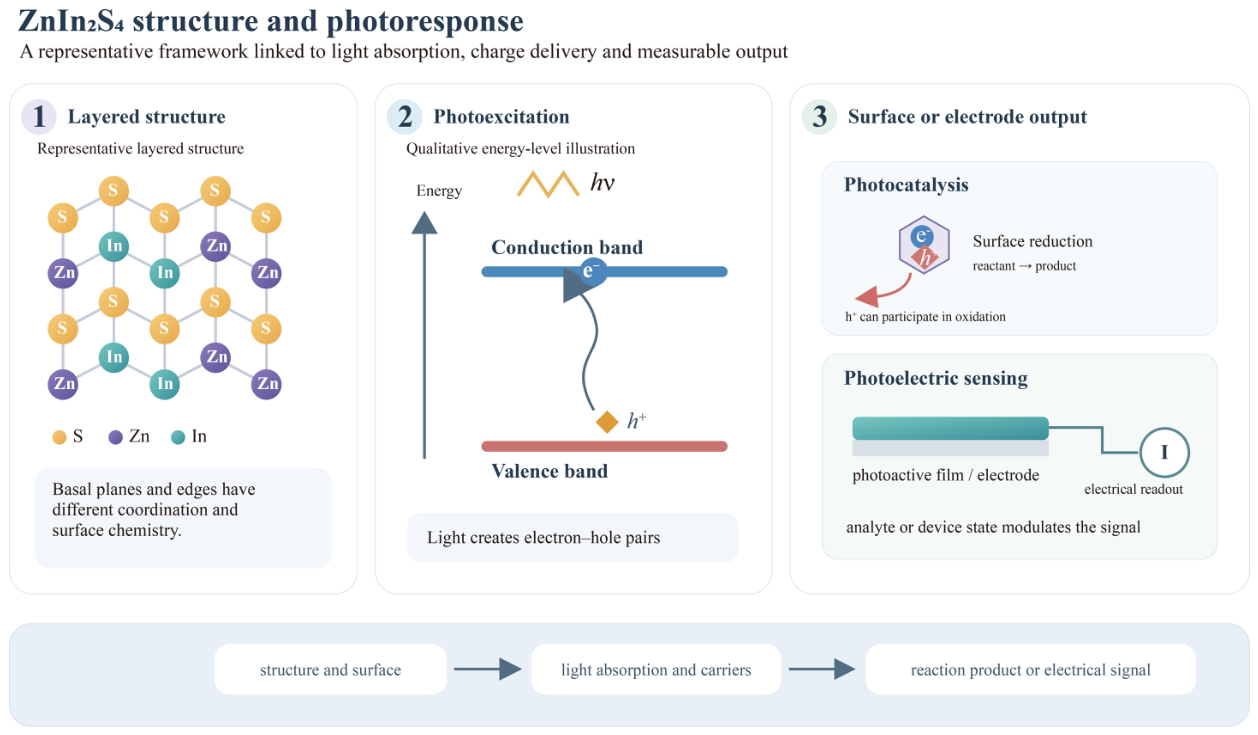
Figure 2.
Structural regulation strategies for ZnIn2S4 photocatalysts. Morphology and architecture, defects and composition, cocatalysts and active sites, and heterojunctions and interfaces can affect light absorption, charge transfer, and surface reactions. These effects may overlap, and their mechanistic assignments require experimental support.
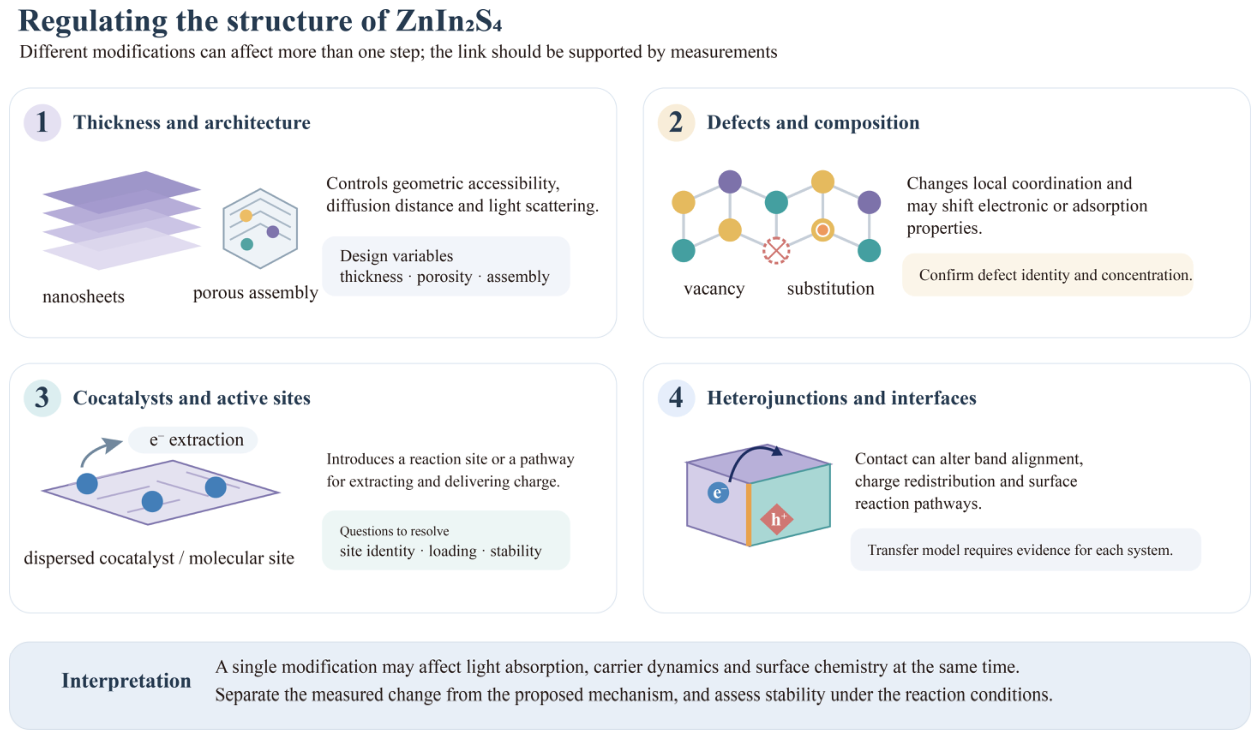
Figure 3.
(a) Structural schematic of the prepared gZIS composite; (b) Time-dependent overall water splitting performance of gZIS under solar irradiation; (c) Long-term cycling stability of the gZIS photocatalyst [19].
Figure 3.
(a) Structural schematic of the prepared gZIS composite; (b) Time-dependent overall water splitting performance of gZIS under solar irradiation; (c) Long-term cycling stability of the gZIS photocatalyst [19].
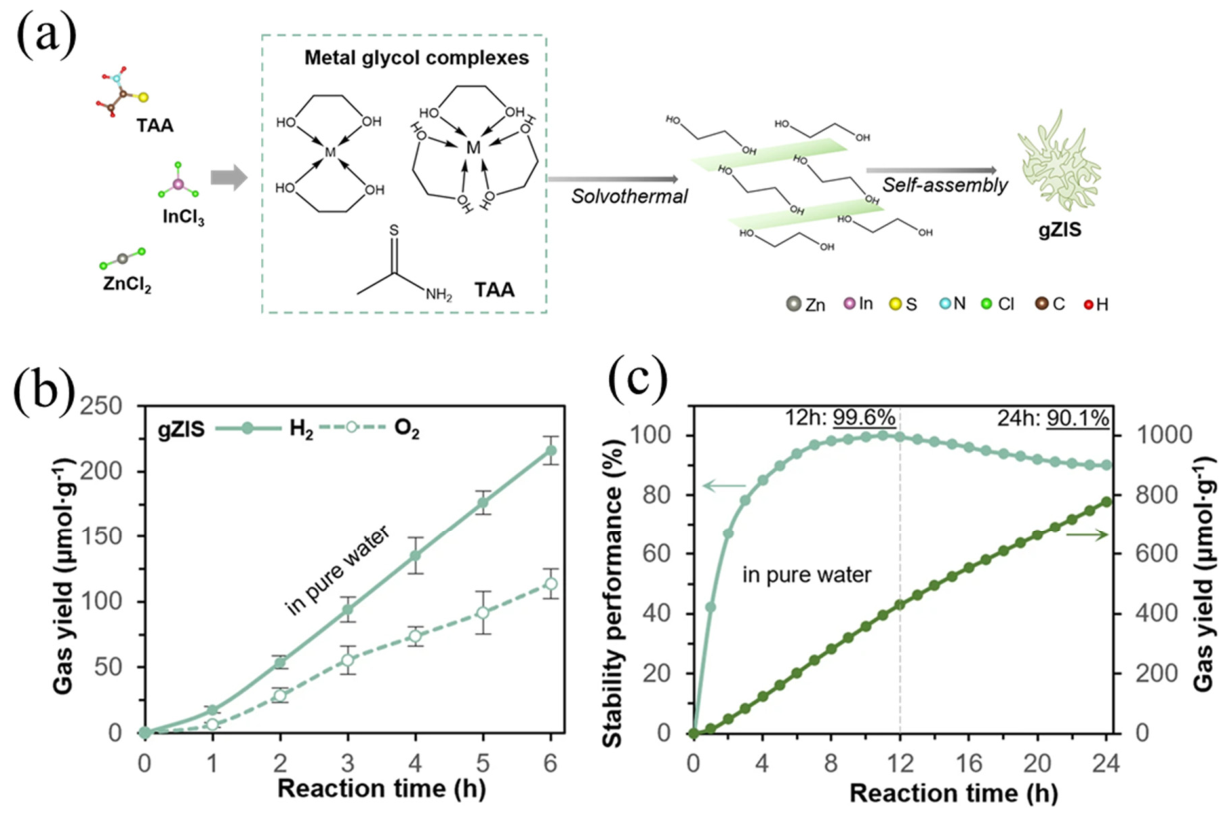
Figure 4.
Hexagonal and cubic ZnIn2S4 nanosheets were successfully synthesized and applied for photocatalytic CO2 reduction. Employing methanol as the reducing medium, the obtained ZnIn2S4 nanosheets exhibit excellent catalytic efficiency toward the photoreduction of CO2 into methyl formate [18].
Figure 4.
Hexagonal and cubic ZnIn2S4 nanosheets were successfully synthesized and applied for photocatalytic CO2 reduction. Employing methanol as the reducing medium, the obtained ZnIn2S4 nanosheets exhibit excellent catalytic efficiency toward the photoreduction of CO2 into methyl formate [18].
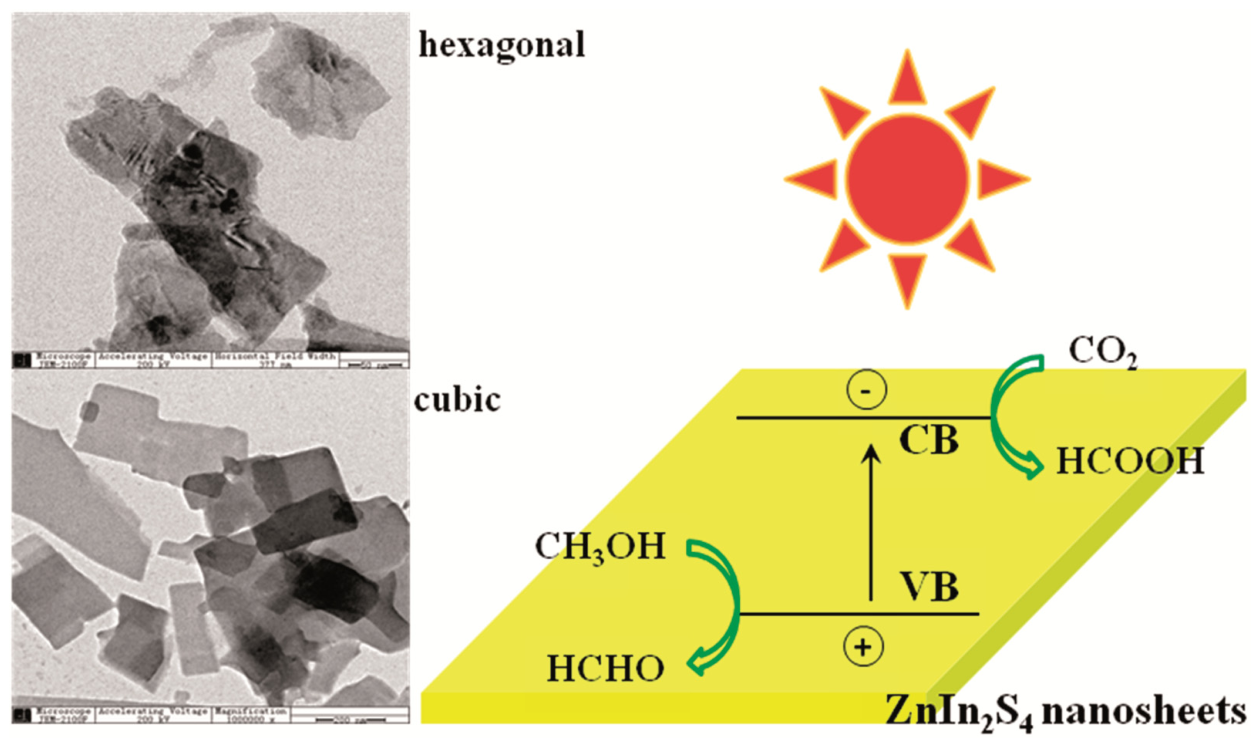
Figure 5.
Schematic illustration of ZnIn2S4-based photocatalytic environmental purification. Illumination generates charge carriers in the photoactive material, which may contribute to the transformation of organic or inorganic pollutants through surface reactions. The reaction pathway and products depend on the material and water matrix. Assessment should therefore consider pollutant conversion, transformation products, mineralization, possible metal leaching, and catalyst recovery.
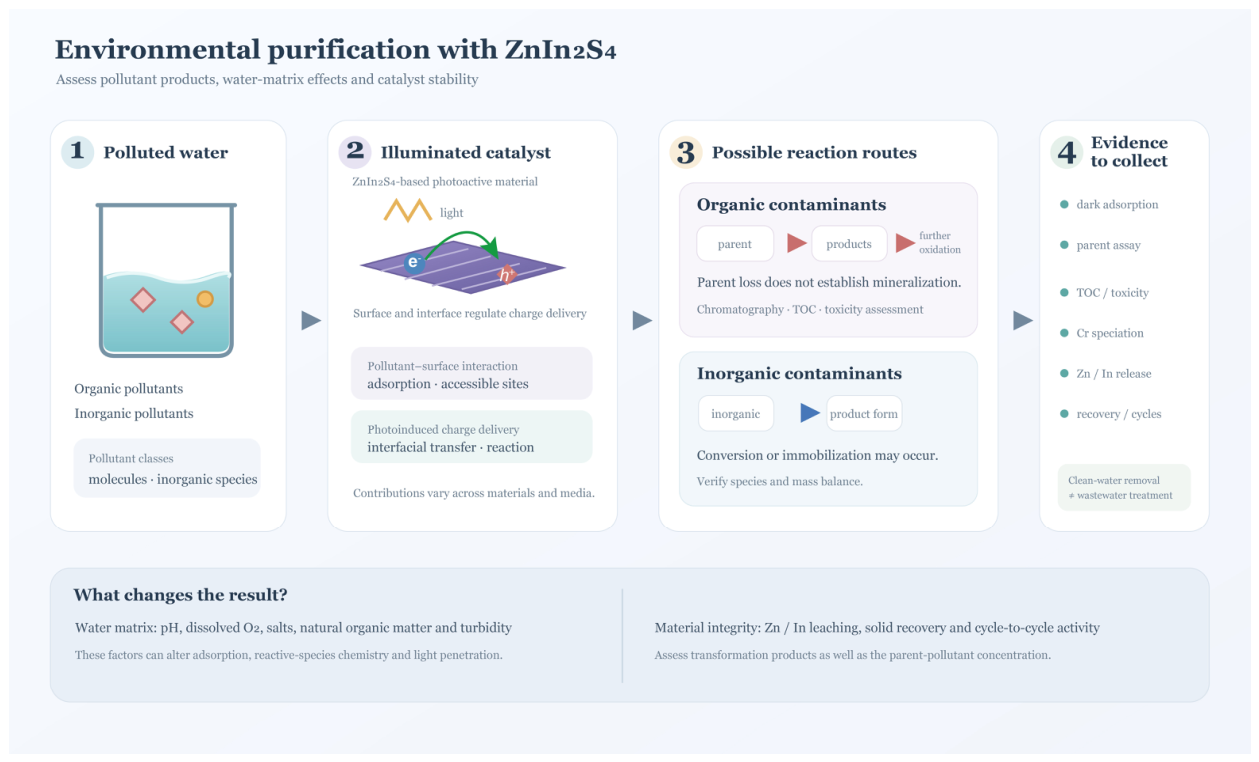
Figure 6.
Schematic illustration of H2O2 production and selective organic transformations over ZnIn2S4-based photocatalysts. Photogenerated electrons may drive the two-electron reduction of O2 to H2O2, whereas holes can promote the oxidation of organic substrates to target products. These pathways are shown separately; their selectivity depends on interfacial charge transfer, surface reactions, and reaction conditions. Evaluation should include product analysis, competing reactions, and catalyst stability.
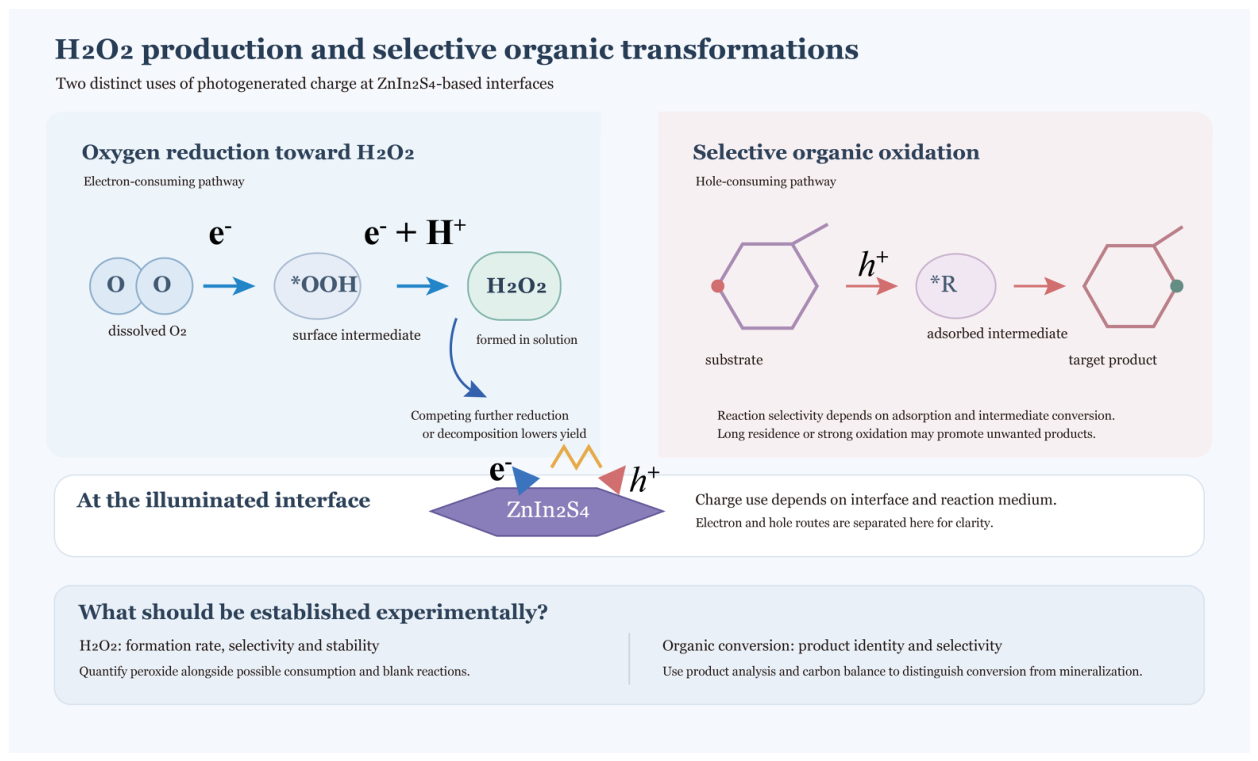
Figure 7.
Schematic illustration of photocatalytic ammonia synthesis over ZnIn2S4-based materials. Light absorption generates electron–hole pairs. Photogenerated electrons participate in the stepwise hydrogenation of adsorbed N2, leading to NH3 formation, while holes are consumed by an oxidation reaction. The associative pathway is shown schematically; the detailed sequence may vary with the catalyst and reaction conditions.
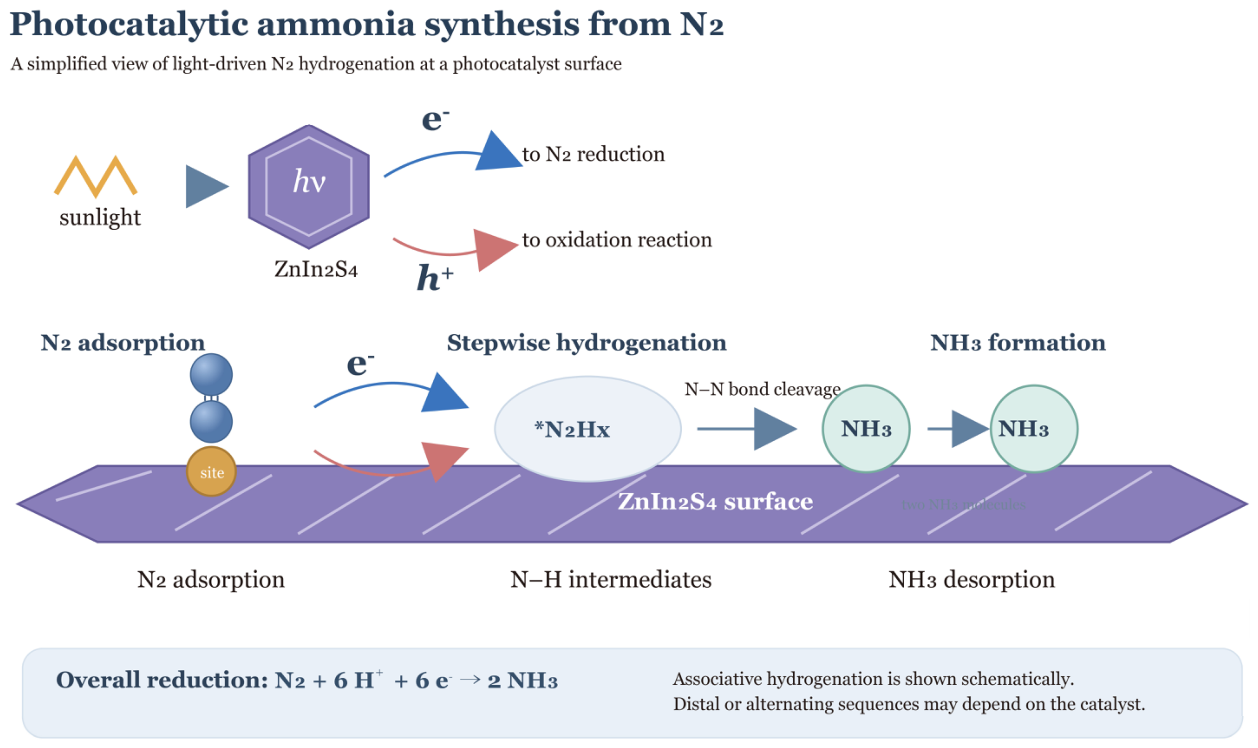
Figure 8.
Schematic illustration of ZnIn2S4-based photoelectric sensing. In PEC sensors, analyte recognition changes charge transfer at the ZnIn2S4 photoelectrode and modulates the photocurrent. In solid-state photodetectors, the ZnIn2S4 channel converts incident light into an electrical response.
Figure 8.
Schematic illustration of ZnIn2S4-based photoelectric sensing. In PEC sensors, analyte recognition changes charge transfer at the ZnIn2S4 photoelectrode and modulates the photocurrent. In solid-state photodetectors, the ZnIn2S4 channel converts incident light into an electrical response.
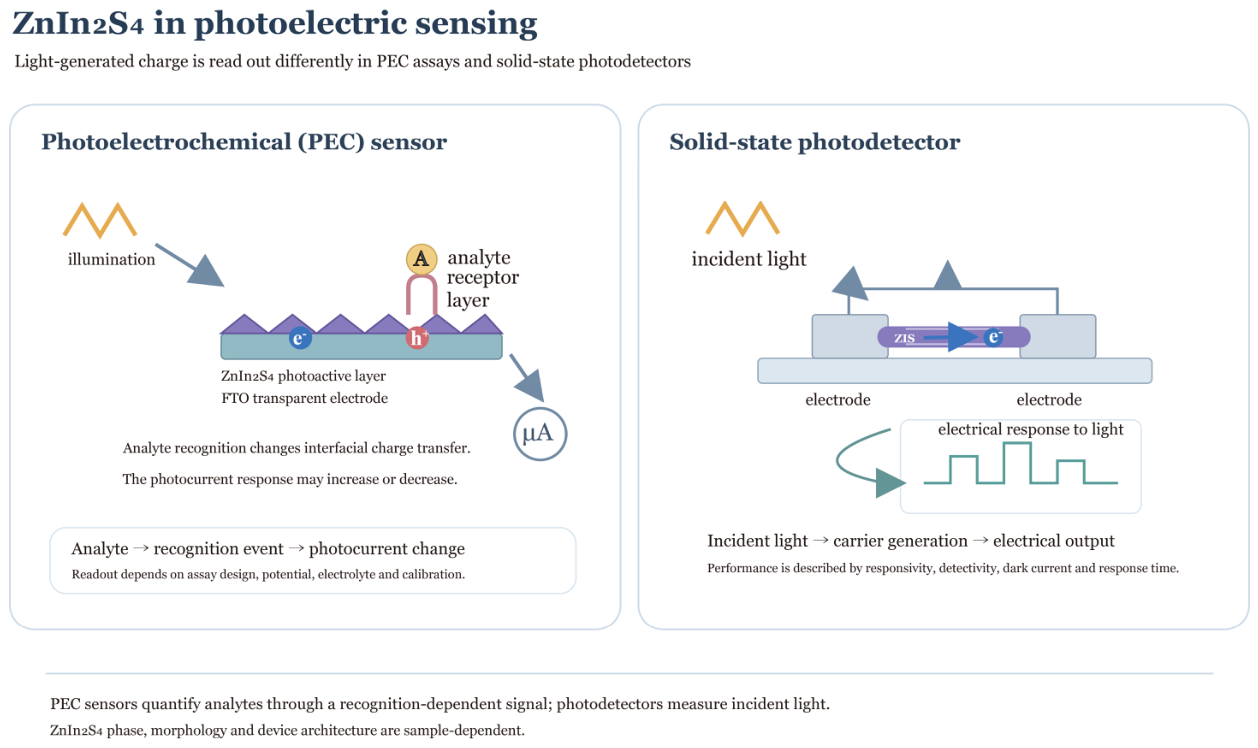
Disclaimer/Publisher’s Note: The statements, opinions and data contained in all publications are solely those of the individual author(s) and contributor(s) and not of MDPI and/or the editor(s). MDPI and/or the editor(s) disclaim responsibility for any injury to people or property resulting from any ideas, methods, instructions or products referred to in the content. |
© 2026 by the authors. Licensee MDPI, Basel, Switzerland. This article is an open access article distributed under the terms and conditions of the Creative Commons Attribution (CC BY) license (http://creativecommons.org/licenses/by/4.0/).
Copyright: This open access article is published under a Creative Commons CC BY 4.0 license, which permit the free download, distribution, and reuse, provided that the author and preprint are cited in any reuse.