

Submitted:
29 September 2026
Posted:
30 September 2026
You are already at the latest version
Abstract
Finance is inherently forward-looking, yet financial expectations are necessarily formed from historical and contemporaneous information. Quantitative and qualitative analyses provide the foundation for organizing this information, evaluating risk, and developing expectations about uncertain future outcomes. Financial models, however, remain conditional on assumptions, parameter stability, information availability, and the environments in which they are applied. This paper introduces the concept of data-based intuition as the capacity to form and apply context-sensitive financial judgments that emerge from accumulated analysis of quantitative and qualitative information. The framework does not position intuition as an alternative to analytical rigor; rather, analysis provides the foundation from which informed intuition develops, while intuition contributes to interpreting and applying analytical evidence within particular financial contexts. Data-based intuition is necessarily adaptive and fallible. New information, realized outcomes, and environmental change can reinforce, modify, or invalidate previously learned relationships, requiring both analysis and intuition to remain subject to revision. The framework consequently views financial decision-making as a recursive learning process in which data, analysis, experience, contextual interpretation, decisions, and outcomes continually interact. Artificial intelligence can substantially expand the analytical foundation of this process without eliminating uncertainty about the future applicability of observed relationships. The framework therefore has implications for financial expertise and education as increasingly sophisticated analytical capabilities place greater emphasis on interpretation, adaptation, recognition of limitations, and the development of informed financial judgment.
Keywords:
data-based intuition
; financial decision-making
; risk and uncertainty
; quantitative modeling
; adaptive rationality
1. Introduction
Financial decision-making is inherently forward-looking. Investment, financing, valuation, portfolio allocation, and risk-management decisions require commitments to be made before their outcomes are known (Fisher 1930; Markowitz 1952; Stulz 1996). Yet the information available for making these decisions is derived primarily from the past and present. Historical prices, financial statements, economic conditions, market behavior, and other quantitative and qualitative information provide the foundation for expectations about prospective outcomes. Finance therefore faces a fundamental problem: decisions about an uncertain future must be made using information generated under conditions that may not persist (Knight 1921; Lucas 1976).
Financial theory and practice address this problem extensively through quantitative analysis. Valuation models, portfolio optimization, asset-pricing models, forecasting methods, simulations, and risk measures impose structure on available information and provide disciplined approaches for evaluating alternatives (Black and Scholes 1973; Markowitz 1952; Sharpe 1964). These methods are indispensable to financial decision-making, but their conclusions remain conditional on the data, assumptions, parameter estimates, and relationships incorporated into the analysis. Numerical precision does not eliminate uncertainty about whether those relationships will continue to apply in the environment in which the decision ultimately produces its consequences (Box 1976; Lucas 1976; Pesaran and Timmermann 1995).
Financial decisions consequently require more than the production of analytical results. Decision-makers must assess the relevance of available information, interpret model outputs, consider information that may not be fully represented within a formal model, and determine whether relationships learned from prior observations remain applicable under current and prospective conditions. Experience can contribute to this process by developing an understanding of patterns, sensitivities, and relationships that becomes available when subsequent decisions are encountered (Ericsson and Kintsch 1995; Klein 1998; Simon 1987). At the same time, experience can reinforce inappropriate patterns, and intuition developed under one set of conditions can become unreliable when the environment changes (Hogarth 2001; Kahneman and Klein 2009).
This paper develops the concept of data-based intuition to describe the interaction between analytical evidence and informed financial judgment. Data-based intuition is defined as the capacity to form and apply context-sensitive financial judgments that emerge from the accumulated analysis of quantitative and qualitative information. The concept does not position intuition as an alternative to formal analysis. Rather, analysis provides the foundation from which informed intuition develops, while intuition contributes to the interpretation and application of analytical results within a particular decision environment. This formulation builds on research treating expert intuition as experience-based pattern recognition whose reliability depends on the structure of the environment and the quality of feedback (Hogarth 2001; Kahneman and Klein 2009; Klein 1998; Simon 1987). Intuition remains subject to analytical scrutiny, informational updating, and revision as circumstances change.
An important implication of this framework is that data-based intuition remains fallible. A judgment can be appropriately grounded in the information and analysis available ex ante and nevertheless produce an unfavorable outcome. Models can similarly fail because of estimation error, inappropriate assumptions, omitted information, or environmental change (DeMiguel et al. 2009; Michaud 1989). Sound financial decision-making therefore requires not only forming expectations but also recognizing their limitations and considering the consequences of being wrong. Where alternatives permit, decisions can be structured with a preference for favorable asymmetry between potential benefits and adverse consequences, while recognizing that neither the probabilities nor the resulting asymmetry can be known with certainty (Keynes 1936; Knight 1921).
The framework has increasing relevance as artificial intelligence (AI) expands the analytical capabilities available to financial decision-makers. AI can process larger quantities of quantitative and qualitative information, identify complex relationships, generate forecasts and scenarios, and reduce the cost of sophisticated analysis (Cao 2022; Gu et al. 2020). These capabilities can strengthen the informational foundation of financial decisions, but they do not eliminate the problem of applying relationships learned from observed information to an uncertain and changing future. Greater model complexity can also heighten challenges of interpretation and model risk (Aldasoro et al. 2025). As analytical production becomes increasingly accessible, interpretation, contextual evaluation, adaptation, and recognition of model limitations may become increasingly important components of financial expertise. The same development has implications for finance education, where analytical training can increasingly emphasize not only the production of model outputs but also their interpretation, limitations, and appropriate application.
The paper proceeds as follows. Section 2 examines the nature and purpose of finance, emphasizing its forward-looking character and the role of expectations under risk and uncertainty. Section 3 considers rational financial decision-making, quantitative and qualitative information, models, assumptions, and the limitations of mechanical optimization. Section 4 develops the concept of data-based intuition and its recursive relationship with data, analysis, experience, decisions, and outcomes. Section 5 examines the formation, updating, adaptation, and potential failure of financial intuition. Section 6 considers the interaction between models and intuition, the implications of artificial intelligence, and the application of the framework to contemporary financial decision-making. The final section concludes and considers broader implications for financial decision-making and education.
2. The Nature and Purpose of Finance
Finance has been defined through several complementary perspectives, including the allocation of resources across time, the valuation of uncertain cash flows, the management of risk, and the maximization of value. Underlying these perspectives is a common decision problem: available information must be used to evaluate alternatives whose consequences occur, at least partly, in the future. The nature of finance is therefore closely connected to how information is transformed into expectations and how those expectations inform decisions under risk and uncertainty. This section considers the principal conceptions of finance, its inherently forward-looking orientation, and the role of risk and uncertainty in the formation of financial expectations.
2.1. Competing Conceptions of Finance
Finance does not lend itself to a single definition. The discipline encompasses questions concerning resource allocation, valuation, risk, investment, financing, contracting, and the operation of financial markets. Although these perspectives differ in emphasis, they share a common concern: how individuals and organizations make choices across time when future outcomes are uncertain.
The intertemporal allocation of resources provides one of the discipline’s broadest foundations. Fisher’s analysis of consumption, investment, and interest established an early framework for choices involving present and future resources (Fisher 1930). Fama and Miller subsequently characterized finance as the allocation of resources by individuals and firms across time under conditions of certainty and uncertainty, with firms and capital markets facilitating that allocation (Fama and Miller 1972). Saving, investing, borrowing, lending, and consuming can all be understood within this framework as choices that exchange present resources for prospective future consequences.
Merton’s functional perspective extends this reasoning from individual choices to the financial system. Financial systems facilitate payments, pool funds, transfer resources across time and location, manage risk, provide price information, and address informational and incentive problems (Merton 1995). These functions connect the allocation of resources with the institutions and mechanisms through which financial claims are created, exchanged, and managed. Finance is thus concerned not only with choosing among alternatives, but also with the structures that make those choices possible.
Within corporate finance, value provides a more specific criterion for evaluating decisions. Investment, financing, and distribution policies affect expected cash flows, risk, the cost of capital, and ultimately firm value (Modigliani and Miller 1958). Jensen argues that value maximization supplies a coherent objective function for organizational decision-making while allowing stakeholder interests to be considered when they contribute to long-run value creation (Jensen 2001). The importance of this objective lies in its ability to provide a basis for choosing among competing alternatives. It does not, however, reveal the future cash flows, discount rates, risks, or other inputs needed to make that choice. Those quantities must still be estimated from the information available when the decision is made.
Asset pricing and investment theory approach the problem through the relationship between risk and expected return. Portfolio theory formalizes how expected return and risk can be evaluated jointly and how diversification can alter portfolio characteristics (Markowitz 1952). Asset-pricing models extend this reasoning by examining how exposure to risk should be reflected in expected returns (Lintner 1965; Mossin 1966; Sharpe 1964). Together, these theories frame financial choice as an evaluation of uncertain future payoffs relative to the risks undertaken to obtain them. The distinction between measurable risk and uncertainty that cannot be represented confidently by known probabilities further limits the precision of such evaluations (Knight 1921).
Information provides another unifying element. Market prices can aggregate the dispersed knowledge of participants and thereby perform both informational and allocative functions (Fama 1970; Hayek 1945). Because market participants possess different information and interpretations, trading, liquidity, and transaction prices are shaped by the process through which private and public information becomes incorporated into market values (Glosten and Milgrom 1985; Kyle 1985). Market structure consequently affects both the information available to decision-makers and the prices at which their decisions can be implemented.
The allocation of resources also occurs within contractual and governance arrangements. The separation of ownership and control can produce conflicts among managers, shareholders, creditors, and other claimholders. Ownership structures, compensation arrangements, debt contracts, and distribution policies can therefore serve as mechanisms for allocating decision rights, aligning incentives, and controlling agency costs (Jensen 1986; Jensen and Meckling 1976). This contracting perspective complements the informational view: financial arrangements determine not only how resources and risks are distributed, but also how participants are encouraged to use the information available to them.
Behavioral finance qualifies these frameworks by examining how actual decisions can depart systematically from the predictions of fully rational models. Framing, loss aversion, judgment, and cognitive biases can influence choices under uncertainty (Kahneman and Tversky 1979). Their effects may also persist in market prices when limits to arbitrage prevent sophisticated investors from fully correcting apparent mispricing (Shleifer and Vishny 1997). Behavioral finance therefore directs attention to the characteristics of the decision-maker without displacing the broader roles of information, incentives, risk, and institutional structure.
Risk management brings many of these elements together. Diversification, derivative securities, hedging, insurance, and corporate risk-management policies provide mechanisms for modifying exposure to uncertain outcomes (Black and Scholes 1973; Markowitz 1952; Stulz 1996; Stulz 2003). Their purpose is not necessarily to eliminate risk. Financial decisions frequently require determining which risks should be retained, transferred, diversified, or accepted in pursuit of expected returns and organizational objectives.
Taken together, these perspectives portray finance as a discipline in which information is used to allocate resources, value uncertain claims, structure incentives, and manage exposure to future outcomes. Their common element is neither a particular model nor a single institutional objective. It is the need to evaluate prospective consequences and make choices before the uncertainty surrounding those consequences has been resolved.
2.2. Finance as a Forward-Looking Discipline
The forward-looking character of finance follows from the timing of financial decisions. Resources are committed in the present in anticipation of outcomes that will be realized in the future. Investment and valuation depend on prospective cash flows and required returns; portfolio choice depends on expected returns, risks, and correlations; lending depends on anticipated repayment and default; and financial contracts establish claims to future payments. These decisions cannot be based solely on what has occurred, even though past and current information provide much of the evidence available when they are made.
This prospective orientation is embedded in foundational financial theory. Fisher’s intertemporal framework connects present choices with future consumption and investment opportunities (Fisher 1930). Portfolio theory requires expectations about the returns and risks of alternative portfolios (Markowitz 1952), while asset-pricing models relate current prices to expected returns and exposure to risk (Lintner 1965; Mossin 1966; Sharpe 1964). Financial markets reflect the same orientation: under the efficient-markets framework, new information affects prices when it changes assessments of future cash flows, discount rates, or risk (Fama 1970). Expectations thus connect available information with current financial prices and decisions.
Because the relevant outcomes have not yet occurred, financial analysis must form expectations from historical and contemporaneous evidence (Muth 1961). Forecasting is therefore implicit even when no formal forecasting model is used. Capital budgeting requires estimates of revenues, costs, investment needs, and terminal value; portfolio allocation requires expected returns and risks; credit analysis requires assessments of repayment capacity; and risk management requires evaluation of prospective exposures (Fisher 1930; Markowitz 1952; Stulz 1996; Stulz 2003). The methods vary across applications, but each applies currently available information to outcomes that remain unobserved.
This reliance on observed information places assumptions at the center of financial analysis. Historical relationships are informative only to the extent that the conditions producing them remain relevant. Changes in policy, regulation, technology, market structure, or behavior can alter those relationships, making parameter instability and structural change important limitations of historically estimated models (Lucas 1976; Pesaran and Timmermann 1995). Model outputs should consequently be interpreted as conditional assessments of the future rather than as observations of what the future will contain.
Financial decisions nevertheless cannot wait for uncertainty to be resolved. Available information must be interpreted, assumptions about its continued relevance must be made, and expectations must be formed before action is taken. Some uncertainty cannot be reduced to objectively known probabilities, distinguishing calculable risk from more fundamental uncertainty (Keynes 1936; Knight 1921). Decision-makers must therefore exercise judgment using information that is incomplete relative to the outcomes ultimately realized and under limitations of information and cognitive capacity (Knight 1921; Simon 1955). The central challenge is not merely to analyze the past and present, but to determine how much confidence their evidence deserves when applied to an uncertain future.
2.3. Risk, Uncertainty, and Expectation Formation
Risk and uncertainty differ in the extent to which prospective outcomes can be represented probabilistically. Under conditions of risk, possible outcomes and their probabilities can be described through probability distributions, allowing expected values and measures of dispersion to support comparison. Under more fundamental uncertainty, the relevant future states or their probabilities may themselves be unknown or difficult to estimate (Keynes 1936; Knight 1921). Financial decisions must nevertheless be made before either form of uncertainty is resolved.
Expectations provide the connection between available information and these prospective outcomes. They represent assessments of what may occur based on the information available when a decision is made, rather than direct observations of the future. The rational-expectations framework formalizes one approach by relating expectations to agents’ information and the underlying economic structure (Muth 1961). In practice, financial expectations may be formed from statistical models, market prices, economic analysis, professional judgment, or combinations of these sources.
Asset valuation illustrates this role directly. The current value of an asset reflects its expected future payoffs discounted for time and risk (Cochrane 2005). For equities, valuations therefore depend jointly on expectations of future cash flows and discount rates, and revisions to either component can change prices even when current cash flows remain unchanged. The present-value literature has examined whether movements in stock prices can be reconciled with subsequent dividends and other fundamentals (Campbell and Shiller 1988; Shiller 1981).
Distinguishing cash-flow expectations from discount-rate expectations is consequently important. A price change may reflect revised expectations about future cash flows, a change in the required return applied to those cash flows, or both. Evidence that valuation ratios predict subsequent returns supports time variation in expected returns and discount rates (Cochrane 2008; Fama and French 1988), while present-value research identifies discount-rate variation as an important source of movements in valuation ratios and asset prices (Campbell and Shiller 1988; Cochrane 2011). The same observed price movement can therefore arise from different assessments of the future, making interpretation as important as measurement.
Expectations may also differ among decision-makers who observe similar information. Differences in information sets, models, assumptions, objectives, experience, and interpretation can generate different assessments of the same prospective outcome. Financial markets provide a mechanism through which these heterogeneous expectations interact, with trading and prices reflecting differences in information and beliefs (Glosten and Milgrom 1985; Hayek 1945; Kyle 1985). Disagreement need not indicate irrationality; it may instead reflect uncertainty about the meaning of available evidence or its relevance to future conditions.
Expectation formation thus occupies a central position between financial information and financial choice. Analytical methods organize evidence and translate it into conditional assessments of prospective outcomes, but neither additional data nor greater model sophistication eliminates uncertainty about whether historically observed relationships will persist (Lucas 1976; Pesaran and Timmermann 1995). Risk may often be represented probabilistically, whereas more fundamental uncertainty limits the precision with which future states and their probabilities can be specified. The resulting challenge is not simply to generate an estimate, but to determine how much reliance that estimate deserves within a particular and potentially changing decision environment.
3. The Rational Approach to Financial Decision-Making
The forward-looking nature of finance requires a framework for converting available information and expectations into decisions. Financial theory has traditionally approached this problem through rational decision-making, in which alternatives are evaluated using relevant information, specified objectives, and analytical methods designed to identify preferred courses of action. The information underlying this process may be quantitative or qualitative, while the models used to organize it necessarily depend on assumptions about the relationships among financial variables and their relevance to future outcomes. This section examines rationality and optimization as foundations of financial decision-making, the roles of quantitative and qualitative information, the use of models and assumptions in forming expectations, and the limitations of treating analytically optimal solutions as mechanically applicable financial decisions.
3.1. Rationality and Optimization
Rational decision-making provides a structured connection among information, expectations, preferences, and choice. In its conventional form, a decision-maker identifies feasible alternatives, evaluates their possible consequences, and selects the alternative that best satisfies a specified objective subject to relevant constraints. Rational-choice theory formalizes this process through preferences, feasible alternatives, and consistency in choice (Arrow 1965; Savage 1954; von Neumann and Morgenstern 1944). Its principal contribution is not a guarantee of a favorable outcome, but a disciplined basis for comparing alternatives before their consequences are known.
Expected utility theory extends this structure to decisions involving uncertainty. Alternatives are evaluated according to their possible outcomes, associated probabilities, and the decision-maker’s preferences (von Neumann and Morgenstern 1944). Subjective expected utility permits beliefs about uncertain states to enter the decision process when probabilities are not objectively given (Savage 1954). Both approaches require prospective alternatives to be evaluated systematically, although their conclusions remain conditional on the beliefs, probabilities, and preferences used in the analysis.
Optimization translates this rational structure into an analytical decision process. Once an objective, decision variables, constraints, and relationships among those variables have been specified, mathematical or computational methods can identify the solution that best satisfies the stated problem. Markowitz’s mean–variance framework provides a foundational example by selecting portfolio weights according to expected return and risk (Markowitz 1952). Tobin extends portfolio choice to include risky and risk-free assets (Tobin 1958), while equilibrium asset-pricing models connect individual portfolio choices with expected returns in capital markets (Lintner 1965; Mossin 1966; Sharpe 1964). These developments illustrate how optimization can make complex financial decisions systematic, internally consistent, and transparent.
An optimal solution, however, is optimal only relative to the problem as specified. The objective must represent what the decision-maker seeks to accomplish, the constraints must describe the relevant feasible alternatives, and the model must capture the relationships material to the decision. In financial applications, many inputs—including expected returns, future cash flows, volatilities, correlations, discount rates, and default probabilities—are estimates rather than known quantities. The resulting solution therefore reflects a specified representation of the decision problem, not direct knowledge of its realized outcome.
This conditionality does not diminish the value of optimization. Formal analysis makes objectives and assumptions explicit, permits alternatives to be compared consistently, and reveals how preferred solutions respond to changes in inputs or constraints. It also allows complex interactions to be examined beyond what unaided judgment can reliably process. Its limitations arise when the internal precision of the solution is mistaken for equivalent precision about the environment in which the decision will be implemented.
Rational financial decision-making is therefore broader than mechanically selecting a mathematically optimal solution. Decision-makers operate with finite information, time, and cognitive capacity (Simon 1955). Rationality consequently involves both the disciplined use of analytical methods and an assessment of whether the problem has been represented adequately. A decision may reasonably depart from a model-generated optimum when relevant constraints, contextual information, or changing circumstances are not fully incorporated into the model. Such a departure need not reject rational analysis; it may instead reflect recognition of the conditions under which the analytical result applies.
3.2. Quantitative and Qualitative Information
The usefulness of rational analysis depends on the information supplied to it. Information can distinguish among alternatives, modify expectations, and reduce uncertainty, but its economic value ultimately derives from its capacity to improve decisions rather than from its quantity alone (Blackwell 1953). Financial analysis therefore requires both the identification of relevant information and an assessment of its reliability, timeliness, and applicability to the decision being considered.
Quantitative information occupies a prominent role because many financial characteristics can be represented numerically and examined systematically. Prices, returns, cash flows, interest rates, accounting measures, volatility, correlations, leverage, defaults, and macroeconomic variables can be incorporated into mathematical and statistical analyses. Quantification facilitates comparison, estimation, sensitivity analysis, and the explicit representation of relationships among financial variables. Historical observations of these quantities provide evidence about previously realized distributions and relationships, although their prospective relevance depends on the conditions under which they were generated.
Not all financially relevant information is readily represented by numerical measures. Management quality, competitive position, technological change, regulation, customer relationships, organizational capabilities, and market structure may affect future outcomes before their consequences are visible in historical data. Information asymmetry further implies that market participants can possess different information about the characteristics underlying a transaction (Akerlof 1970). Excluding qualitative evidence merely because it cannot be measured with comparable precision can therefore omit economically important features of the decision environment.
Financial reporting illustrates the interaction between these forms of information. Financial statements provide standardized quantitative measures of performance and financial position, while accompanying disclosures provide information about strategy, risks, accounting policies, contingencies, and other factors needed to interpret those measures. Corporate disclosure can consequently reduce information asymmetry between firms and outside investors (Healy and Palepu 2001). The meaning assigned to reported numbers often depends on contextual information concerning how they were produced and what they may imply for future performance.
The boundary between quantitative and qualitative information is also becoming less distinct. Textual disclosures, news, analyst commentary, and other narrative sources can be converted into measurable signals. Evidence that the linguistic content of financial news is associated with subsequent firm performance and market activity demonstrates that information need not originate numerically to have quantifiable financial consequences (Tetlock et al. 2008). Advances in computing and artificial intelligence further expand the range of information that can be incorporated into systematic financial analysis.
Information nevertheless remains costly and incomplete. Market participants devote resources to acquiring, processing, and interpreting information because informative analysis can possess economic value (Grossman and Stiglitz 1980). Additional information may improve an assessment without resolving uncertainty, and different sources may vary substantially in credibility and relevance. The decision problem therefore involves determining not only what information is available, but what weight it should receive.
Quantitative and qualitative information should consequently be treated as complementary inputs. Quantitative evidence provides measurement, comparability, and a basis for formal analysis, while qualitative evidence supplies context and may identify developments not yet reflected in historically estimated relationships. Neither form of information interprets itself. Their contribution depends on how effectively they are selected, evaluated, combined, and translated into expectations about prospective outcomes.
3.3. Models, Assumptions, and Expectations
Financial models provide structured representations of relationships that are relevant to financial decisions. By reducing complex economic and financial environments to a set of variables and relationships among them, models permit information to be organized, hypotheses to be evaluated, prospective outcomes to be estimated, and alternatives to be compared. Simplification is inherent in this process. A model does not attempt to reproduce every characteristic of the environment it represents; its usefulness depends instead on whether the features retained in the model are sufficiently relevant to the purpose for which it is being used (Box 1976; Friedman 1953).
The structure imposed by a model makes assumptions necessary. Assumptions may concern preferences, probability distributions, market behavior, information, relationships among variables, or the stability of parameters through time. Some assumptions provide analytical tractability, while others specify the conditions under which observed relationships are expected to continue. Financial models therefore produce results that are conditional on both their structural assumptions and the inputs supplied to them. The transparency of these assumptions is one of the strengths of formal modeling because it permits the conditions underlying a result to be identified and, where possible, tested or subjected to sensitivity analysis (Box 1976; Saltelli et al. 2008).
Expectations introduce an additional challenge because many of the inputs required by financial models concern quantities that have not yet been observed. Expected returns, future cash flows, default probabilities, volatilities, correlations, interest rates, and economic conditions must be estimated using information available when the analysis is performed. Historical data provide an important empirical foundation for these estimates, although the precision with which prospective financial quantities can be estimated varies considerably (Merton 1980; Pástor and Stambaugh 2000). The resulting parameters describe relationships observed under previous conditions. Their use in a forward-looking model consequently requires an implicit or explicit assumption about the extent to which those relationships remain informative about the future.
The distinction between estimation and realization is therefore fundamental to the interpretation of model output. An estimated expected return is not a realized return, a forecast cash flow is not a realized cash flow, and an estimated probability is not a statement that a particular outcome will occur. Models instead provide conditional assessments of prospective outcomes based on specified information and assumptions. Rational expectations provide one formal framework for relating available information to expectations (Muth 1961), but even internally consistent expectations remain conditional on the information and structure used to form them.
Model applicability becomes particularly important when the environment changes. Relationships estimated from historical observations may become less informative following changes in policy, regulation, technology, market structure, competition, or behavior. The Lucas critique demonstrates more generally that relationships observed under one policy environment need not remain invariant when the environment changes (Lucas 1976). Financial applications face a related problem whenever parameters estimated from historical observations are applied to circumstances that differ materially from those that generated the data. Model risk therefore arises not only from estimation error but also from uncertainty concerning whether the model itself provides an adequate representation of the environment in which it is being applied.
Uncertainty about the appropriate model creates a further layer of the decision problem. Several models may be consistent with portions of the available evidence while producing different implications for prospective outcomes. Greater computational sophistication does not by itself resolve uncertainty about model specification or about the stability of the relationships being modeled. Robust decision approaches explicitly recognize that decision-makers may have limited confidence in a particular probability model and examine decisions that remain defensible under alternative specifications (Hansen and Sargent 2001). The existence of model uncertainty therefore does not eliminate the value of formal analysis; it changes how its output should be interpreted.
Financial models are consequently most informative when their outputs are understood together with the assumptions, data, and environments from which they are derived. Models impose discipline on financial reasoning by making relationships explicit and allowing their implications to be examined systematically. At the same time, the numerical precision of an output should not be confused with certainty about the future. The decision-maker must assess whether the assumptions underlying the analysis remain reasonable, whether the information used to estimate the model remains relevant, and whether characteristics of the current decision environment are sufficiently represented by the model. Financial modeling therefore informs the decision process without eliminating the need to interpret the applicability of its results.
3.4. The Limits of Mechanical Optimization
Optimization is one of the principal strengths of quantitative financial analysis. Once objectives, constraints, inputs, and relationships among variables have been specified, optimization provides a systematic means of identifying the solution that best satisfies the stated decision problem. This analytical discipline is particularly valuable when financial decisions involve numerous alternatives or interactions that cannot be evaluated reliably through informal comparison alone. An optimized solution, however, is optimal with respect to the problem as represented in the model. Its applicability to the actual financial decision depends on the extent to which the model, inputs, assumptions, objectives, and constraints adequately represent the environment in which the decision is being made.
Portfolio optimization provides a useful illustration. Mean-variance optimization offers a rigorous framework for selecting portfolios based on expected returns, variances, and covariances (Markowitz 1952). The resulting portfolio weights, however, can be highly sensitive to estimation error in these inputs, particularly expected returns. Small changes in estimated parameters may generate substantial changes in optimized portfolio allocations, producing solutions that appear precise mathematically while remaining sensitive to the information used to construct them (Michaud 1989). The problem does not invalidate optimization; it demonstrates that the quality and stability of the optimum are conditional on the quality and stability of its inputs.
The distinction between in-sample optimization and out-of-sample performance further illustrates this limitation. A model can identify the solution that performs best according to estimated parameters without ensuring that the same solution will remain optimal when future outcomes differ from those estimates. Evidence from portfolio allocation demonstrates that theoretically sophisticated optimization strategies can face considerable difficulty consistently outperforming simple diversification rules out of sample when estimation error is taken into account (DeMiguel et al. 2009). Analytical sophistication therefore does not eliminate the consequences of uncertainty in the parameters on which the optimization depends.
Mechanical reliance on optimization can become particularly problematic when numerical precision is interpreted as equivalent to economic certainty. Computational methods can produce highly specific portfolio weights, valuations, hedge ratios, capital structures, or other recommended choices even when the underlying inputs are estimated imprecisely. In portfolio optimization, for example, relatively small changes in inputs can result in substantial changes in optimal allocations (Best and Grauer 1991). The precision of the solution reflects the mathematical procedure applied to the specified inputs; it does not necessarily reflect equivalent precision in knowledge about the future. Sensitivity analysis, scenario analysis, stress testing, and robustness analysis can reveal how conclusions change when assumptions or inputs vary (Hansen and Sargent 2001; Saltelli et al. 2008), but these methods themselves require decisions about which alternative assumptions and scenarios are relevant.
The decision environment may also contain information that is difficult to incorporate fully into the optimization problem. Changes in regulation, technology, competitive conditions, market liquidity, organizational objectives, or other contextual characteristics may affect the applicability of relationships estimated from historical observations. Structural changes can alter the relevance of historical relationships for prospective financial decisions and the resulting optimal choices (Pástor and Stambaugh 2001). Qualitative information may similarly indicate that conditions underlying a model are changing before sufficient quantitative observations exist to estimate the new relationships reliably. A mechanically implemented optimum can therefore remain internally consistent with its model while becoming less appropriate for the environment in which the decision must be implemented.
These limitations are consistent with the broader distinction between substantive and procedural conceptions of rationality. Decision-makers operate with finite information, computational capacity, and time, making complete representation and evaluation of every possible alternative difficult or impossible (Simon 1955). Under uncertainty, decision procedures that are less complex can sometimes perform effectively precisely because they do not attempt to estimate every feature of an uncertain environment (Gigerenzer and Brighton 2009). The appropriate degree of analytical complexity consequently depends in part on the decision problem, the quality of available information, and the stability of the environment to which the analysis is applied.
Recognizing the limits of mechanical optimization does not diminish the importance of quantitative analysis. Models and optimization provide discipline, consistency, transparency, and the capacity to process information beyond what unaided judgment can reliably accomplish. Their appropriate role is to inform financial decisions rather than to make the distinction between analysis and decision disappear. Model outputs provide evidence about what follows from specified information and assumptions; the decision-maker must still determine whether those assumptions remain reasonable, whether relevant information lies outside the model, and whether the resulting solution is appropriate for the circumstances in which it will be implemented.
The rational approach to financial decision-making therefore extends beyond mechanically accepting the output of an optimization procedure. Rationality requires disciplined use of available information and analytical methods, but it also requires recognition of uncertainty surrounding inputs, assumptions, model specification, and the decision environment. A financial decision may consequently depart from a model-generated optimum without necessarily representing a departure from rationality. Such a departure may instead reflect additional information, changing circumstances, or an assessment that the model does not fully represent the conditions relevant to the decision.
4. Data-Based Intuition: A Conceptual Framework
The preceding discussion establishes two features of financial decision-making. Financial decisions are inherently forward-looking and must therefore rely on expectations formed from information available before outcomes are known. At the same time, the analytical methods used to organize that information and evaluate alternatives produce results that are conditional on data, assumptions, model specifications, and the environments in which observed relationships were generated. Financial decision-making consequently involves both disciplined analysis and an assessment of how the resulting evidence applies to the circumstances in which a decision is being made.
This section develops the concept of data-based intuition as a framework for understanding this interaction. Data-based intuition does not substitute intuition for quantitative or qualitative analysis. It treats analysis as the foundation from which informed intuition develops, while recognizing that the application of analytical results requires interpretation within a particular decision environment. The framework distinguishes this conception of intuition from instinct, heuristics, and judgment, and develops a recursive view in which data, analysis, experience, contextual interpretation, decisions, and subsequent outcomes continually inform one another.
4.1. Defining Data-Based Intuition
Data-based intuition is defined here as the capacity to form and apply context-sensitive financial judgments that emerge from the accumulated analysis of quantitative and qualitative information. The term is intended to capture the interaction between analytical evidence and the interpretation required to apply that evidence to prospective financial decisions. It does not describe intuition as an alternative to analysis. Rather, the analytical process provides the informational foundation from which intuition develops, while intuition contributes to the assessment of how the implications of that analysis apply within a particular decision environment.
The term data-based is used broadly. Financial data include numerical observations such as prices, returns, cash flows, accounting measures, interest rates, volatility, and economic variables, but the relevant informational set may also contain qualitative evidence concerning management, competition, technology, regulation, market conditions, organizational capabilities, and other characteristics of the decision environment. As discussed previously, qualitative information can itself contain economically relevant signals and may sometimes be transformed into quantitative measures (Tetlock et al. 2008). Data-based intuition therefore does not require every relevant observation to originate in numerical form. It requires that intuition be informed by evidence rather than detached from it.
The use of the term intuition requires greater precision. Intuition is often associated with immediate judgments whose underlying reasoning is not fully articulated at the time the judgment is made. Research on expertise suggests that such judgments need not be arbitrary. Repeated exposure to decision environments can allow individuals to recognize patterns and associations without consciously reconstructing the entire analytical process underlying that recognition (Klein 1998; Simon 1987). Intuition has consequently been described as a form of nonconscious information processing in which judgments arise through associations developed through experience (Dane and Pratt 2007). Under this interpretation, intuition can represent accumulated learning rather than an absence of reasoning.
Data-based intuition places an additional condition on this conception. Experience alone does not necessarily produce reliable financial intuition. The experience from which intuition develops must contain relevant information, and the patterns learned from previous observations must remain sufficiently applicable to the environment in which the intuition is being used. An intuition formed from extensive experience in one market, institutional setting, regulatory regime, or economic environment may become less informative when the conditions underlying that experience change. The value of intuition is therefore conditional, just as the value of a formal model is conditional on the relevance of its assumptions, inputs, and structure.
This conditionality is particularly important in finance because the environment generating the data is not necessarily stationary. Relationships among returns, risks, cash flows, interest rates, investor behavior, and economic conditions can evolve through time. Data-based intuition therefore does not imply the mechanical extrapolation of patterns learned from historical experience. It includes the capacity to recognize when current circumstances resemble previously observed conditions and when differences in the present environment may make those historical relationships less applicable. In this sense, contextual interpretation is part of the intuition rather than an adjustment made independently of it.
The concept also places quantitative modeling within, rather than outside, the development of financial intuition. Statistical analysis, valuation models, optimization procedures, simulations, scenario analysis, and other analytical methods reveal relationships that may not be apparent from unaided observation. Repeated engagement with such analysis can contribute to an understanding of how financial variables interact, how results respond to changes in assumptions, and under what circumstances particular models perform well or poorly. Quantitative analysis therefore does more than generate a numerical answer to an immediate problem; it can contribute to the accumulated knowledge from which subsequent financial intuition is formed.
Data-based intuition should consequently be understood neither as purely analytical calculation nor as an unexplained feeling about a financial decision. It occupies the interaction between evidence, analysis, accumulated experience, and contextual interpretation. Data and analysis discipline intuition by providing an empirical and analytical foundation, while intuition allows the implications of that foundation to be interpreted in light of circumstances that may not be completely represented within a model. The resulting judgment remains subject to error, but it is distinguishable from unsupported intuition because it can be traced conceptually to an accumulated body of information, analysis, and experience.
4.2. From Data and Analysis to Intuition
Data-based intuition develops through repeated interaction with information, analytical methods, decisions, and outcomes. Financial analysis requires decision-makers to identify relevant information, examine relationships among variables, evaluate alternative explanations, form expectations, and assess the implications of those expectations for a decision. Repetition of this process creates more than a collection of individual analytical results. It can develop accumulated knowledge about patterns, relationships, sensitivities, and conditions that becomes available when subsequent decisions are encountered. Intuition can therefore emerge from analytical experience rather than independently of it.
Research on expertise provides a useful foundation for understanding this process. Experts do not necessarily evaluate every new problem by consciously reconstructing all of the individual observations and analytical steps encountered previously. Experience allows information to be organized into meaningful patterns that can be recognized when similar situations arise. Research on chess expertise, for example, demonstrates that superior performance is associated with the ability to recognize meaningful configurations developed through extensive domain-specific experience (Chase and Simon 1973). More generally, expertise can produce structured knowledge that allows relevant information to be accessed and applied efficiently when solving problems (Ericsson and Kintsch 1995). Although financial environments differ substantially from the domains in which much of the expertise literature developed, the underlying mechanism provides a useful explanation for how repeated analysis can contribute to increasingly informed recognition of financial patterns.
Financial analysis provides repeated opportunities for such learning. A decision-maker who repeatedly examines financial statements may develop an understanding of how particular combinations of margins, leverage, working capital, and cash flows relate to financial condition. Repeated valuation exercises can reveal which assumptions have the greatest effects on estimated value. Portfolio analysis can develop familiarity with the consequences of correlations, volatility, concentration, and changing expected returns. Forecasting can reveal which relationships appear persistent and which become unreliable when economic conditions change. The analytical process therefore contributes not only to the immediate decision but also to the knowledge available for interpreting subsequent decisions.
The development of reliable intuition nevertheless depends on the environment in which learning occurs. Experience can reinforce useful associations when observed outcomes provide informative feedback about prior assessments, but it can also reinforce misleading associations when feedback is noisy, delayed, incomplete, or incorrectly interpreted. Hogarth distinguishes between learning environments that foster valid intuitive knowledge and those in which experience may instead produce inappropriate confidence in learned patterns (Hogarth 2001). The amount of experience alone is therefore insufficient to determine the quality of intuition; the informational structure of that experience and the quality of feedback also matter.
This qualification is particularly relevant to finance. Financial outcomes frequently contain substantial noise, decisions may have consequences that emerge only after considerable time, and similar decisions can produce different realized outcomes because underlying conditions differ. A successful investment does not necessarily imply that the analysis leading to it was sound, just as an unfavorable realized outcome does not necessarily imply that the original decision was irrational. Learning from financial experience therefore requires distinguishing, as far as possible, between the quality of the decision process and the particular outcome subsequently realized. Without such differentiation, observed outcomes can generate misleading lessons and potentially weaken rather than improve subsequent intuition.
The reliability of intuitive expertise consequently depends on whether the environment contains sufficiently stable relationships to be learned and whether decision-makers receive adequate opportunities to learn those relationships. Kahneman and Klein identify these conditions as important determinants of when intuitive expertise can develop reliably (Kahneman and Klein 2009). This observation is especially important for financial decisions because the stability of the underlying environment can vary substantially. Some financial relationships may recur sufficiently often to support pattern recognition, while structural changes can make previously learned associations less relevant. Reliable financial intuition therefore requires both accumulated experience and continuing attention to whether the environment resembles the conditions under which that experience was acquired.
Quantitative and qualitative analysis can strengthen this learning process by making relationships more explicit. Models permit decision-makers to examine interactions that may be difficult to identify through unaided observation, while sensitivity analysis and alternative specifications reveal how conclusions respond to changes in assumptions and inputs. Qualitative analysis provides contextual information that can help explain why relationships appear, disappear, or change. Repeated engagement with these forms of analysis can gradually transform explicit analytical knowledge into a more integrated understanding of the decision environment. What initially requires deliberate calculation may eventually contribute to pattern recognition and informed expectations when related circumstances are encountered.
The movement from data to intuition is therefore neither instantaneous nor unidirectional. Data provide observations, analysis identifies and evaluates relationships within those observations, experience accumulates from repeated applications, and feedback from subsequent outcomes can modify the understanding developed through earlier analysis. Intuition emerges from this accumulated process as an ability to recognize and interpret patterns without necessarily reconstructing every analytical step each time a decision is made. New evidence can subsequently reinforce, modify, or invalidate those patterns. Data-based intuition is consequently an evolving form of financial knowledge whose usefulness depends on continued interaction between evidence, analysis, experience, and the environment in which decisions are made.
4.3. Distinguishing Intuition from Instinct, Heuristics, and Judgment
The concept of intuition overlaps with several forms of human decision-making, including instinct, heuristics, and judgment. These terms are sometimes used interchangeably, but distinguishing among them is useful for defining the role assigned to intuition in the present framework. Data-based intuition refers specifically to learned, context-sensitive recognition and interpretation that develops through engagement with information, analysis, experience, and feedback. Its informational foundation distinguishes it from responses that need not arise from accumulated domain-specific learning.
Table 1 summarizes the distinctions among data-based intuition and related forms of decision-making. Although these concepts can interact within a financial decision, they differ in their informational foundations, roles in the decision process, and responsiveness to subsequent evidence.
Instinct can be understood as a response that does not require the type of learned analytical experience emphasized here. Intuition, by contrast, can develop through accumulated exposure to patterns and relationships within a particular domain. Research on expertise supports the possibility that repeated experience can produce rapid recognition without requiring the decision-maker to consciously reconstruct the reasoning underlying each judgment (Kahneman and Klein 2009; Simon 1987). The distinction is therefore important for data-based intuition: an immediate response is not considered informative merely because it occurs quickly or without explicit deliberation. Its relevance depends on the informational and experiential foundation from which it emerges.
Heuristics occupy a different position. Heuristics are simplifying strategies or rules that allow decisions to be made without evaluating every available piece of information or calculating every possible outcome. Such strategies can be useful when information, time, or cognitive capacity is limited, but they can also produce systematic errors under particular conditions (Tversky and Kahneman 1974). Heuristics and intuition may interact because learned experience can influence which cues receive attention and which simplifying rules are employed. They are nevertheless conceptually distinct. A heuristic describes a decision rule or procedure, whereas data-based intuition describes an accumulated capacity to recognize and interpret financially relevant patterns within context.
Judgment is broader than either intuition or heuristics. Financial judgment involves forming an assessment or choosing among alternatives and may incorporate quantitative analysis, qualitative evidence, formal models, heuristics, intuition, or combinations of these inputs. Intuition can therefore contribute to judgment without being synonymous with it. Research on managerial decision-making similarly treats intuition as one mode through which information can enter strategic judgments rather than as a replacement for analytical reasoning (Dane and Pratt 2007; Khatri and Ng 2000). In the present framework, judgment is best understood as the resulting assessment, while data-based intuition is one source of information and interpretation contributing to that assessment.
The distinction between analytical and intuitive processes should also not be interpreted as requiring two completely independent forms of cognition. Dual-process theories commonly distinguish relatively rapid, automatic processing from slower and more deliberative reasoning, but the interaction between these processes is more complex than a strict dichotomy implies (Evans 2008). Deliberate financial analysis can contribute to the knowledge from which subsequent intuitive recognition develops, while an intuitive assessment can prompt further deliberate analysis when a model result appears inconsistent with accumulated experience or current conditions. Analytical and intuitive processes can therefore reinforce, challenge, and update one another.
Figure 1 presents data-based intuition as part of a recursive financial decision process. Information supports analysis and expectation formation, while contextual interpretation and accumulated intuition inform the decision. Subsequent outcomes generate feedback that can modify both the available information and the intuition applied to future decisions.
This interaction provides an important safeguard against treating intuition as inherently reliable. A decision-maker’s confidence in an intuitive assessment does not establish its validity. Intuition developed in environments with weak regularities or poor feedback can produce confidently held but unreliable judgments (Hogarth 2001; Kahneman and Klein 2009). Behavioral research similarly demonstrates that judgment under uncertainty is susceptible to systematic biases, including those arising from representativeness, availability, and anchoring (Tversky and Kahneman 1974). Data-based intuition must therefore remain open to evaluation against new evidence and formal analysis rather than being insulated from them.
Data-based intuition is consequently narrower than a general appeal to “gut feeling.” It is learned rather than merely spontaneous, evidence-based rather than unsupported, domain-specific rather than universally transferable, and subject to revision when new information or changing conditions weaken the relevance of previously learned relationships. Instinct may generate an immediate response, heuristics may simplify a decision process, and judgment represents the broader assessment through which a decision is ultimately formed. Data-based intuition describes the accumulated, analytically informed recognition that can contribute to that judgment when prior evidence and experience remain relevant to the circumstances of the decision.
4.4. A Recursive Framework of Financial Decision-Making
Data-based intuition can be represented as part of a recursive process through which financial information, analysis, experience, and decisions continually interact. A financial decision begins with information available about the relevant firm, asset, market, institution, or economic environment. Quantitative and qualitative analysis organizes this information, identifies relationships, and contributes to expectations concerning prospective outcomes. Models and optimization can further structure the problem by specifying relationships, objectives, constraints, and alternative courses of action. The resulting analysis provides an informational foundation for the decision but does not itself eliminate uncertainty about the future.
The interpretation of analytical results occurs within the environment in which the decision is being made. A decision-maker may consider whether relationships estimated from historical observations remain applicable, whether model assumptions adequately represent current circumstances, whether relevant qualitative information is captured by the analysis, and whether recent changes alter the significance of previously observed patterns. Accumulated experience with similar analyses and environments can contribute to this interpretation through pattern recognition and intuitive expertise (Kahneman and Klein 2009; Simon 1987). Data-based intuition consequently enters the decision process not as a substitute for analytical evidence but as part of the assessment of how that evidence applies to the circumstances confronting the decision-maker.
The interaction between analysis and intuition can operate in both directions. Analytical results can reinforce an intuitive assessment when model implications are consistent with patterns developed through prior analysis and experience. They can also challenge intuition by revealing relationships that are inconsistent with an initial assessment. Conversely, an analytically generated result that appears inconsistent with accumulated experience can prompt examination of assumptions, inputs, model specification, or changes in the decision environment. The appropriate response to such inconsistency is neither automatically to reject the model nor automatically to suppress the intuitive assessment, but to use the disagreement as information that may warrant further investigation. Analytical and intuitive processes can therefore function as complementary forms of scrutiny within the decision process.
A decision eventually requires action despite the remaining uncertainty. The decision may correspond closely to the solution generated by formal analysis, or it may incorporate adjustments reflecting information and contextual considerations that are not fully represented in the model. Such adjustments do not necessarily imply abandonment of rationality or optimization. As established previously, an optimized solution is conditional on the specification of the decision problem and the information incorporated within it. Rational financial decision-making can therefore include an assessment of whether the analytically preferred solution remains appropriate when considered together with additional evidence and the circumstances in which it will be implemented.
The process continues after the decision is made. Subsequent outcomes generate additional observations that can be compared with prior expectations and incorporated into future analysis. Forecast errors may reveal weaknesses in assumptions or models, while unexpected outcomes can identify relationships or contingencies that were previously underappreciated. Feedback can also reinforce patterns that continue to appear across repeated decisions. Learning from outcomes is therefore an important mechanism through which experience accumulates and intuitive expertise may develop, although the usefulness of such learning depends on the quality and interpretability of the feedback received (Hogarth 2001; Kahneman and Klein 2009).
The relationship between decisions and outcomes requires particular care because financial outcomes are affected by uncertainty. A favorable outcome does not establish that the preceding decision process was sound, and an unfavorable outcome does not necessarily demonstrate that it was deficient. Evaluating decisions solely by realized outcomes can confuse the quality of the decision with the particular state of the world that subsequently occurred. Learning requires comparison of outcomes with the information, expectations, assumptions, and alternatives that were available when the decision was made. This distinction allows feedback to inform subsequent intuition without treating realized outcomes as unambiguous evidence about the quality of prior decisions.
The framework is recursive because subsequent information does more than provide another observation for the same decision rule. New evidence can modify estimated relationships, alter model specifications, challenge assumptions, and change the accumulated patterns on which intuition relies. Changes in the decision environment can similarly reduce the relevance of earlier experience. Data-based intuition must therefore remain adaptive. Intuition that does not respond to contradictory evidence or changing circumstances becomes increasingly detached from the informational foundation that makes it data-based in the first place.
The resulting process can be summarized as a continuing interaction among data, analysis, expectations, contextual interpretation, decisions, outcomes, and learning. Historical and contemporaneous information provide the empirical foundation; analytical methods impose structure on that information; expectations translate available evidence into assessments of prospective outcomes; and data-based intuition contributes to the interpretation of those assessments within the current decision environment. Decisions produce outcomes that generate new information and experience, which subsequently modify analysis and intuition. Financial decision-making is therefore not a linear progression ending with an optimized solution, but a recursive learning process in which analytical knowledge and context-sensitive intuition evolve as information and circumstances change.
5. The Formation and Adaptation of Financial Intuition
If data-based intuition develops from accumulated engagement with information and analysis, its usefulness depends on how that knowledge is acquired, reinforced, and revised through time. Financial intuition is not a fixed attribute of the decision-maker. It can develop through experience and expertise, change as new information and feedback become available, and require adaptation when the environment underlying previously learned relationships changes. The same processes that allow intuition to become informative can also produce errors when experience is unrepresentative, feedback is misleading, or learned patterns no longer apply. This section examines the formation of financial intuition through experience and pattern recognition, its updating through learning and feedback, its adaptation to environmental change, and the conditions under which intuitive expertise can fail.
5.1. Experience, Expertise, and Pattern Recognition
Experience provides an important foundation for the development of data-based intuition, but experience and expertise are not equivalent. Repeated exposure to a domain creates opportunities to observe relationships, compare expectations with outcomes, and refine interpretations of relevant information. Expertise develops when this experience is accompanied by learning that improves the organization, recognition, and application of domain-specific knowledge. Research across several domains suggests that expert performance reflects not simply greater quantities of information, but differences in how that information is structured and used (Chi et al. 1982; Ericsson et al. 1993).
Pattern recognition is one mechanism through which accumulated expertise can affect decisions. Experts can develop representations that allow meaningful configurations of information to be recognized without independently evaluating every component of a problem. Evidence from chess demonstrates that experienced performers recognize structured configurations more effectively than novices when those configurations reflect meaningful relationships within the domain (Chase and Simon 1973). Such recognition is not equivalent to simple memorization. Accumulated experience allows individual observations to be interpreted as components of broader patterns whose significance has been learned through previous exposure.
Financial expertise can develop through a similar interaction between observation and analysis. Repeated examination of firms, securities, markets, and economic environments exposes decision-makers to combinations of information rather than isolated variables. An experienced analyst may interpret changes in leverage differently depending on cash-flow stability, industry conditions, interest rates, or the purpose for which additional financing is being obtained. A portfolio manager may interpret an increase in volatility differently depending on correlations, liquidity, valuation, and prevailing market conditions. Financial intuition can therefore reflect recognition of configurations of information whose relevance was developed through earlier analysis and experience rather than responses to individual indicators considered independently.
Evidence from financial analysts provides some support for the role of experience in financial expertise. Analyst forecasting performance has been shown to vary with experience, with firm-specific experience contributing to improvements in forecast accuracy (Mikhail et al. 1997). Such evidence does not imply that experience uniformly produces superior financial decisions, but it is consistent with the proposition that repeated engagement with a particular informational environment can improve the ability to interpret financially relevant information. Domain specificity is important: expertise developed through extensive familiarity with one firm, industry, market, or analytical problem need not transfer completely to another.
Analytical activity itself can contribute to the development of this expertise. Repeated valuation, forecasting, optimization, simulation, and financial statement analysis expose decision-makers to the sensitivity of conclusions to assumptions and inputs. An analyst who repeatedly constructs valuations, for example, can learn not only how to calculate an estimated value but also which assumptions typically drive that estimate, which inputs are comparatively stable, and which apparent changes in value are primarily consequences of model specification. Similarly, repeated portfolio optimization can reveal the sensitivity of optimal allocations to expected returns and covariance estimates (Best and Grauer 1991; Michaud 1989). These experiences can become part of the accumulated knowledge brought to subsequent analyses.
Expertise can consequently alter the way new financial information is interpreted. A novice and an experienced decision-maker may observe the same numerical result without assigning it the same significance because the experienced decision-maker can relate that observation to a larger set of previously encountered relationships and conditions. Research on expert cognition suggests that domain knowledge affects the representation of problems and the identification of information relevant to their solution (Chi et al. 1982). In financial settings, expertise may similarly allow observations to be interpreted relative to patterns developed from prior data, analysis, and outcomes.
The relationship between expertise and intuition nevertheless remains conditional. Experience can contribute to useful pattern recognition only when the patterns being learned contain sufficient regularity and when the experience provides meaningful opportunities to identify those regularities (Kahneman and Klein 2009). Repetition in an unstable or highly noisy environment can create familiarity without corresponding predictive knowledge. Expertise should therefore not be inferred simply from longevity or confidence. For data-based intuition, the relevant form of expertise is accumulated domain-specific understanding that remains connected to evidence and is capable of being revised when subsequent information challenges previously learned patterns.
Experience, expertise, and pattern recognition therefore form an important pathway through which explicit financial analysis can contribute to intuition. Repeated analytical engagement organizes individual observations into increasingly structured knowledge, while experience provides opportunities to recognize when similar configurations arise in subsequent decisions. Data-based intuition emerges partly from this accumulated capacity to interpret new information in relation to previously analyzed patterns. Its value depends not only on how much experience has been accumulated, but on the relevance, quality, and continued applicability of the knowledge produced by that experience.
5.2. Learning, Feedback, and Informational Updating
The development of financial intuition does not end when expertise has been acquired. Financial decision-makers continually encounter new information, observe outcomes from earlier decisions, and obtain evidence concerning relationships they previously believed to be relevant. This information can reinforce existing interpretations, weaken them, or reveal circumstances in which previously useful patterns no longer apply. The continued usefulness of data-based intuition therefore depends on learning and informational updating rather than simply on the accumulation of additional experience.
Bayesian reasoning provides a useful conceptual representation of this process. Existing beliefs provide a prior assessment that is revised as new evidence becomes available, with the resulting assessment reflecting both the prior belief and the information contained in the new evidence (Bayes 1763). Bayesian methods have consequently become important in financial applications in which uncertainty about parameters, models, and expected outcomes is incorporated explicitly into decision-making (Pástor and Stambaugh 2000). Data-based intuition need not involve formal Bayesian calculation, but its adaptation follows a related principle: accumulated understanding provides an initial basis for interpretation, while new information should alter that understanding when the evidence is sufficiently informative.
The amount of updating warranted by new information depends partly on its reliability and relevance. A single observation need not overturn a relationship supported by substantial prior evidence, particularly when financial outcomes contain considerable noise. Conversely, persistence in an established belief becomes difficult to justify when accumulating evidence consistently contradicts it. Learning therefore requires some assessment of the relative informational content of prior experience and new observations. In this respect, adaptive intuition involves neither mechanically abandoning prior knowledge when new information arrives nor preserving established beliefs regardless of contradictory evidence.
Feedback from earlier decisions represents an important source of new information. Forecasts can be compared with realized values, valuation assumptions with subsequent firm performance, and expectations about market or economic conditions with the environments that ultimately emerge. Differences between expected and realized outcomes can identify potential weaknesses in assumptions, information, or analytical methods. Forecast evaluation similarly emphasizes the informational value of forecast errors for assessing and potentially improving forecasting procedures (Diebold and Mariano 1995). Repeated evaluation of expectations against subsequent evidence can therefore contribute to the refinement of both formal analytical methods and the intuition developed from their use.
Financial feedback is nevertheless difficult to interpret because outcomes rarely identify the quality of the preceding decision unambiguously. Returns, firm performance, interest rates, and other financial outcomes are influenced by events that could not have been known with certainty when the decision was made. An investment based on weak reasoning can produce a favorable return, while a well-supported decision can produce an unfavorable outcome. Learning based solely on whether the outcome was favorable can therefore reinforce inappropriate relationships. Effective updating requires consideration of the decision process, the information available when the decision was made, and the sources of the difference between expectations and subsequent outcomes.
The interpretation of feedback can itself be affected by behavioral tendencies. Individuals may place disproportionate weight on evidence consistent with existing beliefs while discounting contradictory information, a tendency associated with confirmation bias (Nickerson 1998). They may also interpret the predictability of an outcome differently after learning that the outcome occurred. Hindsight bias can make realized events appear more foreseeable than they were from the information available ex ante (Fischhoff 1975). Both tendencies can interfere with learning because they alter the interpretation of the informational relationship between prior expectations and subsequent outcomes.
Analytical procedures can provide discipline to the updating process. Maintaining forecasts, documenting assumptions, conducting ex post evaluation, examining forecast errors, and comparing alternative models can create records against which subsequent outcomes can be evaluated. Such practices reduce dependence on retrospective recollection of what was expected and why. They can also help distinguish between errors arising from uncertain realizations and those associated with assumptions, estimation, model specification, or omitted information. Formal analysis therefore contributes not only to the initial decision but also to the quality of the feedback through which subsequent intuition is updated.
Learning in finance is consequently an iterative process. Existing knowledge influences the interpretation of new information, while new information can alter the knowledge applied to subsequent decisions. Feedback provides opportunities for refinement, but only when outcomes are evaluated relative to the information and expectations that preceded them. Data-based intuition remains connected to its analytical foundation through this continuing process of informational updating. Its value depends not on preserving previously learned patterns, but on allowing those patterns to be strengthened, qualified, or discarded as the available evidence changes.
5.3. Environmental Change and the Adaptation of Intuition
The usefulness of financial intuition depends not only on the quality of the experience from which it developed but also on the continued relevance of that experience. Data-based intuition necessarily draws on information generated in the past, whereas financial decisions concern outcomes that will occur in the future. Previously learned relationships can therefore become less informative when the economic, institutional, technological, or competitive environment changes. Adaptation requires recognizing when new circumstances represent additional observations within a familiar environment and when they indicate that the environment itself has changed.
This distinction is important because financial relationships need not remain stable through time. Changes in monetary policy, regulation, technology, market structure, competitive conditions, investor behavior, and financial institutions can alter relationships observed in historical data. Structural instability has long been recognized as a challenge for economic and financial inference (Lucas 1976; Pesaran and Timmermann 1995). Evidence of structural breaks in financial relationships similarly demonstrates that parameters estimated over one period may not provide an invariant description of subsequent periods (Pástor and Stambaugh 2001). The historical information from which both models and intuition develop must therefore be interpreted relative to the environment that generated it.
Changes in the environment create a common problem for formal analysis and intuition. A model estimated from historical observations can become less reliable when its underlying relationships change, but intuition developed through repeated exposure to those same relationships can become less reliable for the same reason. Experience is therefore not automatically an advantage under environmental change. The greater the confidence placed in a previously successful pattern, the more difficult it may become to recognize that the conditions supporting that pattern have weakened. Data-based intuition requires not only learning from experience but also an ability to reassess the relevance of what has been learned.
Financial history provides repeated examples of circumstances in which established relationships and prevailing assessments became less applicable as conditions changed. Periods of financial crisis, major changes in inflation or interest-rate regimes, technological disruption, regulatory reform, and changes in market liquidity can alter the significance of information that previously appeared reliable. Under such circumstances, mechanically extrapolating historical relationships can be problematic. The same concern applies to intuitive pattern recognition when the patterns being recognized were developed primarily under a different set of conditions.
Adaptation therefore requires attention to evidence concerning the current decision environment. New information should be evaluated not only for what it implies about an existing relationship but also for whether it suggests that the relationship itself has changed. Statistical procedures for identifying structural change provide one formal mechanism for examining this possibility (Andrews 1993; Bai and Perron 1998). Scenario analysis, stress testing, alternative model specifications, and sensitivity analysis can serve related purposes by examining how conclusions change when assumptions about the environment are altered. These analytical practices can help prevent both models and intuition from becoming anchored too strongly to a single historical regime.
Qualitative information can be particularly important when environmental change has not yet generated sufficient quantitative observations for reliable statistical identification. A regulatory change, technological innovation, change in management, geopolitical event, or emergence of a new competitor may alter expectations before its effects are visible in a sufficiently long numerical history. In such settings, restricting analysis to relationships that can already be estimated from historical observations may delay recognition of economically important change. Qualitative evidence can therefore contribute to adaptation by identifying changes in context that affect the interpretation of existing quantitative information.
The adaptation of intuition does not require discarding accumulated experience whenever circumstances change. Prior experience can remain valuable by helping decision-makers identify which relationships are likely to be robust, which assumptions are most vulnerable to changing conditions, and which signals deserve additional investigation. The relevant question is whether previously developed patterns continue to apply and, if not, how they should be modified. Experience becomes adaptive when it supports reassessment rather than merely reinforcing established expectations.
Data-based intuition must consequently remain provisional. Its informational foundation is historical, but its application is prospective and contextual. As the environment changes, previously useful patterns may require modification, new relationships may need to be learned, and some accumulated experience may become less relevant. Adaptation is therefore not separate from informed financial intuition; it is one of its defining characteristics. Intuition that remains unchanged despite material changes in the evidence or decision environment ceases to satisfy the informational discipline implied by the term data-based.
5.4. When Intuition Fails
Data-based intuition remains fallible. Its foundation in evidence, analysis, and experience can improve the informational basis of a financial judgment, but it cannot eliminate uncertainty or guarantee that the relationships inferred from prior observations will continue to apply. This limitation is fundamental rather than incidental to the concept. A financial intuition can be appropriately grounded in the information available when a decision is made and nevertheless prove incorrect. The quality of an intuitive judgment should therefore be evaluated primarily by the process through which it was formed and the information available ex ante, rather than solely by the outcome subsequently realized.
Intuition can fail for several reasons. The information from which it develops may be incomplete or unrepresentative, observed relationships may reflect noise rather than persistent economic structure, and feedback from previous decisions may have reinforced patterns that occurred by chance. Experience can also be interpreted selectively. Confirmation bias can encourage greater attention to information consistent with existing beliefs (Nickerson 1998), while hindsight bias can distort the lessons drawn from realized outcomes by making those outcomes appear more predictable after they occur (Fischhoff 1975). Overconfidence can further weaken the connection between the strength of the available evidence and the confidence assigned to a judgment (Barber and Odean 2001; Odean 1998). The accumulation of experience therefore does not ensure that the intuition derived from that experience is well calibrated.
Intuition can also fail even when the learning process that originally produced it was sound. A relationship that was persistent enough to support useful pattern recognition can weaken or disappear as the environment changes. Expertise developed under one market structure, monetary regime, regulatory environment, competitive setting, or technological environment may consequently become less informative under another. This possibility is particularly important in finance because structural instability can affect both formal models and the intuitive knowledge accumulated through their repeated application. Previously successful intuition can therefore become obsolete without having been irrational or poorly grounded when it originally developed.
The transfer of expertise across contexts creates a related risk. Intuition is generally domain-specific because the patterns recognized by experts develop through experience within particular environments (Kahneman and Klein 2009). Familiarity with one firm, industry, asset class, market, or historical period does not necessarily imply equivalent expertise in another. Superficial similarities can encourage the application of a familiar pattern to circumstances in which the underlying economic relationships differ. An experienced decision-maker may therefore be particularly vulnerable when confidence derived from genuine expertise in one setting is extended beyond the domain in which that expertise was acquired.
These limitations suggest that an important component of financial expertise is recognition of the boundaries of one’s own knowledge. Expertise should not be identified solely with the ability to recognize patterns or reach judgments efficiently. It also includes an increasing understanding of which judgments deserve confidence, which assumptions are particularly vulnerable, and which circumstances fall outside the range of prior experience. In this sense, the intuition required for sound financial decision-making includes intuition about the limitations of intuition itself. A familiar pattern can provide useful information while simultaneously warranting caution when the evidence supporting its continued relevance is weak.
This recognition is also important for the relationship between intuition and formal analysis. An intuitive judgment should not override an analytical result merely because the decision-maker feels strongly that the model is wrong. Similarly, numerical precision should not require acceptance of a model result when there are substantive reasons to question its assumptions or applicability. Disagreement between analysis and intuition can instead provide information about the decision problem. It may indicate a misspecified model, omitted information, an environmental change, an inappropriate intuitive analogy, or some combination of these factors. The appropriate response is further examination rather than automatic deference to either source of judgment.
The possibility of error also has implications for how financial decisions are structured. If neither models nor data-based intuition can establish the future with certainty, a decision should not depend unnecessarily on the assumption that a particular expectation will prove correct. Where feasible, decision-makers can seek opportunities in which the potential benefits from a favorable outcome are sufficiently large relative to the consequences of an unfavorable outcome. This does not imply that favorable asymmetry can be known with certainty. Estimates of probabilities, payoffs, and downside exposure are themselves subject to uncertainty. Rather, it implies a preference, when alternatives permit, for decisions whose potential upside appears meaningfully greater than the risks that must be accepted to obtain it.
This principle shifts attention from prediction alone to the consequences of prediction error. Assessing whether an outcome is likely is different from assessing what will happen if that assessment proves wrong. Both are relevant to a financial decision. A decision-maker with substantial confidence in an investment thesis may still limit the size of the position because the possibility of error remains. A firm may stage an investment rather than commit all resources immediately, preserve an option to expand or abandon a project as additional information becomes available, diversify exposures whose outcomes cannot be predicted independently with sufficient confidence, or hedge risks whose realization would impose unacceptable costs. Such practices do not necessarily reflect weak conviction. They can instead reflect recognition that even well-supported expectations remain uncertain.
The appropriate degree of exposure should consequently depend not only on the attractiveness of the expected outcome but also on confidence in the information and analysis supporting that expectation and on the consequences of being wrong. This principle is consistent with a broader financial emphasis on diversification, risk management, flexibility, and the preservation of alternatives. It also introduces an important distinction between confidence and commitment. Greater confidence may justify greater commitment, but uncertainty rarely disappears entirely, and the scale or reversibility of a decision can be adjusted accordingly. The objective is not to construct decisions that cannot fail, but, where possible, to avoid making uncertainty unnecessarily consequential.
Failure can also contribute to the subsequent development of intuition when it is examined appropriately. An unexpected outcome creates an opportunity to investigate whether the error arose from incomplete information, an inappropriate assumption, model specification, a behavioral bias, environmental change, or unavoidable uncertainty. The lesson should not automatically be that the original judgment was incorrect, because a reasonable decision can produce an unfavorable outcome. Nor should an unfavorable outcome be dismissed merely as bad luck. The value of failure lies in examining the relationship between the decision process and the outcome closely enough to determine whether the experience provides information that should modify future analysis or intuition.
The fallibility of data-based intuition is therefore not inconsistent with its usefulness. It is one of the conditions under which the framework operates. Financial decisions concern an uncertain future, and neither accumulated experience nor increasingly sophisticated analytical methods can remove that uncertainty. Mature financial intuition recognizes this limitation, remains responsive to contradictory evidence, and incorporates the possibility of error into the structure and scale of decisions. The capacity to recognize patterns is valuable, but so is the capacity to recognize when those patterns may not apply and to limit the consequences when a judgment proves incorrect. In this sense, awareness of fallibility is not merely a constraint on data-based intuition; it is itself an important component of sound financial intuition.
6. Data-Based Intuition in Contemporary Financial Decision-Making
The preceding sections suggest that neither formal analysis nor data-based intuition provides certainty about prospective financial outcomes. Their usefulness instead depends on the information available, the assumptions underlying the analysis, the experience informing intuition, and the environment in which the decision is made. Contemporary developments in artificial intelligence expand the ability to process information and conduct sophisticated analysis, but do not eliminate these underlying sources of uncertainty. This section considers how models, intuition, and emerging analytical capabilities can interact in financial decision-making.
6.1. The Interaction of Models and Intuition
Formal models and data-based intuition provide different but potentially complementary inputs into financial decisions. Models impose structure on information by specifying relationships, assumptions, objectives, and constraints, while data-based intuition incorporates accumulated analytical experience and interpretation of the current environment. Neither should automatically dominate the other. The relative weight placed on each depends on the quality of the underlying information, the suitability of the model, the relevance of prior experience, and the circumstances surrounding the decision.
Agreement between analytical results and informed intuition can provide useful corroboration, although it does not establish that the resulting assessment is correct. A model and an intuitive judgment may ultimately depend on overlapping historical information and therefore share common sources of error. Agreement should consequently increase confidence only to the extent that the underlying evidence and reasoning provide sufficiently independent support. The convergence of multiple approaches is most informative when similar conclusions emerge from different information, assumptions, or analytical perspectives rather than from repeated use of essentially the same underlying relationship.
Disagreement can be equally informative. When a model produces a result that appears inconsistent with accumulated experience, the discrepancy can prompt examination of the model’s assumptions, inputs, specification, and sensitivity to alternative conditions. The same process should subject intuition to scrutiny. The disagreement may indicate that the model omits relevant information, but it may instead reveal that intuition is relying on an outdated or inappropriate pattern. Model–intuition disagreement should therefore be treated as a signal for investigation rather than as a reason to automatically favor either source of judgment.
The appropriate interaction also depends on the nature of the decision environment. Greater reliance on formal analysis may be warranted when relationships are relatively stable, relevant information can be represented adequately, and model assumptions are reasonably consistent with prevailing conditions. Intuition may contribute more when the decision contains important contextual information that is difficult to formalize or when emerging changes have not yet produced sufficient observations for reliable estimation. Research on forecasting similarly suggests that combining information from different approaches can sometimes improve performance relative to relying on a single forecasting method (Bates and Granger 1969; Timmermann 2006). The principle is not that combining model output and intuition necessarily improves a decision, but that each can contain information absent from the other.
The interaction between models and intuition is therefore best viewed as conditional rather than hierarchical. Models can discipline intuition by requiring assumptions and implications to be made explicit, while intuition can encourage examination of whether the analytical structure adequately represents the current environment. Both remain subject to revision as new information becomes available. A sound financial decision process consequently does not ask whether models or intuition should prevail in general, but which information each contributes, where each is most vulnerable to error, and how much reliance each deserves in the particular decision being considered.
6.2. Artificial Intelligence and Financial Intuition
Artificial intelligence substantially expands the capacity to collect, process, and analyze financial information. Machine-learning methods can identify complex relationships in large datasets, while generative artificial intelligence can synthesize quantitative and qualitative information, generate alternative scenarios, and assist with increasingly sophisticated analytical tasks. These capabilities can improve the informational foundation available to financial decision-makers and reduce the cost and time required to perform many forms of analysis (Cao 2022; Gu et al. 2020).
Greater analytical capability, however, does not eliminate the forward-looking nature of financial decisions. Artificial intelligence, like other empirical methods, learns substantially from observed information and relationships and applies what has been learned to circumstances that may subsequently differ. Changes in economic regimes, market structure, regulation, technology, or behavior can therefore reduce the relevance of patterns identified from historical information. Greater model complexity may also make it more difficult to understand why particular predictions are generated, creating additional challenges for interpretation and model risk (Aldasoro et al. 2025). AI can expand the set of information and relationships considered in a decision without eliminating uncertainty about their future applicability.
Artificial intelligence can also contribute to the formation of data-based intuition rather than merely compete with it. By allowing decision-makers to examine more information, test alternative assumptions, generate scenarios, and compare competing explanations, AI can increase opportunities for analytical learning. Repeated interaction with these analyses may help decision-makers develop a richer understanding of financial relationships and identify circumstances in which conclusions are particularly sensitive to assumptions or changing conditions. At the same time, excessive reliance on AI-generated conclusions without understanding their informational basis could weaken rather than strengthen such learning.
The growing analytical capabilities of AI may consequently change where financial expertise provides the greatest value. As the production of calculations, forecasts, and analytical alternatives becomes increasingly automated, greater importance may attach to determining which questions should be asked, which information is relevant, whether identified relationships remain applicable, and how much confidence should be placed in the resulting analysis. Data-based intuition remains relevant to these tasks because the problem is not simply the production of analytical output but its interpretation within an uncertain and changing environment. AI therefore extends the analytical foundation from which financial intuition can develop while leaving intact the need to evaluate the applicability and limitations of that analysis.
6.3. Implications for Financial Decision-Making
The data-based intuition framework suggests that sound financial decision-making depends less on identifying a universally superior method than on assessing the relevance and limitations of the information available for a particular decision. Quantitative models, qualitative information, accumulated experience, intuitive assessments, and increasingly artificial intelligence can each contribute useful information. The appropriate reliance on each should remain conditional on the quality of that information, the assumptions underlying the analysis, and the extent to which the environment resembles the conditions from which prior relationships were learned.
Confidence in a financial assessment should therefore be distinguished from certainty about its outcome. Strong evidence, agreement across alternative analyses, and consistency with relevant experience may justify greater confidence, but prospective outcomes remain uncertain. Conversely, disagreement among models, evidence, and intuition need not make a decision impossible. Such disagreement can identify where uncertainty is concentrated and where additional analysis may have the greatest value. The decision process should therefore consider not only the preferred assessment but also the reasons that assessment might be incorrect.
The possibility of error also makes the structure of the decision important. Where alternatives permit, decision-makers can favor opportunities in which the potential benefit from being correct appears sufficiently large relative to the consequences of being wrong. This asymmetry cannot itself be known with certainty, since both probabilities and potential outcomes are estimated under uncertainty. Nevertheless, consideration of downside exposure, diversification, position size, reversibility, flexibility, and the ability to respond as additional information becomes available can reduce dependence on any single forecast being correct. Financial decisions can therefore be designed with their own fallibility in mind.
Adaptability remains essential after a decision has been made. New information should be used to reassess expectations, models, and intuitive judgments rather than merely to confirm the reasoning underlying the original decision. Outcomes provide opportunities for learning, but should be interpreted relative to the information available ex ante rather than judged solely by whether they were favorable or unfavorable. The objective is not to eliminate uncertainty, but to improve the process through which uncertainty is understood, decisions are made, and subsequent evidence is incorporated.
Data-based intuition consequently describes neither a rejection of formal analysis nor an elevation of human judgment above analytical methods. It describes a decision process in which evidence and analysis contribute to accumulated understanding, that understanding assists in interpreting new circumstances, and both remain subject to revision. Sound financial decision-making requires not only the ability to produce and interpret analytical results, but also to recognize their limitations, assess the consequences of being wrong, and adapt as information and circumstances change.
7. Conclusion
Financial decisions are necessarily made before their outcomes are known. Historical and contemporaneous information provide the evidence available to decision-makers, while quantitative and qualitative analyses organize that evidence and contribute to expectations about prospective outcomes (Muth 1961). Formal models and optimization provide essential discipline to this process, but their conclusions remain conditional on the information, assumptions, parameters, and environments on which they are based (Box 1976; Lucas 1976; Pesaran and Timmermann 1995). The forward-looking nature of finance therefore creates a persistent challenge: decisions must apply evidence derived largely from observed conditions to a future in which those conditions may not remain unchanged.
This paper develops the concept of data-based intuition as a framework for understanding how informed financial judgment can operate within this gap. Data-based intuition is not an alternative to quantitative analysis, nor does it provide a justification for unsupported subjective judgment. It develops through repeated engagement with quantitative and qualitative information, analytical models, decisions, realized outcomes, and the environments in which those outcomes occur. Analysis provides its informational foundation, while accumulated experience contributes to the recognition and interpretation of patterns when subsequent decisions are encountered. This conception is consistent with research describing expert intuition as experience-based pattern recognition rather than reasoning detached from evidence or analysis (Klein 1998; Simon 1987).
The usefulness of such intuition is necessarily conditional. Experience can produce expertise when the environment contains learnable relationships and provides meaningful feedback, but it can also reinforce inappropriate patterns, behavioral biases, and excessive confidence (Hogarth 2001; Kahneman and Klein 2009). Relationships that were once informative can become less relevant as economic, technological, regulatory, competitive, or market conditions change. Data-based intuition must therefore remain adaptive. New information and realized outcomes can reinforce prior understanding, but they must also be capable of modifying or overturning it. In this respect, the capacity to recognize the limitations of one’s accumulated knowledge is itself an important component of financial expertise.
The framework consequently does not establish a hierarchy between models and intuition. Formal analysis can discipline intuitive judgment by making assumptions, relationships, and implications explicit, while informed intuition can draw attention to contextual information, changing conditions, or potential limitations that may not be fully represented within a model. Agreement between the two can provide corroborating evidence, while disagreement can identify assumptions, information, or relationships requiring further examination. Evidence from forecasting research similarly suggests that combining information from different approaches can improve performance when those approaches contribute genuinely distinct information (Bates and Granger 1969; Timmermann 2006). Neither analytical precision nor intuitive confidence eliminates the possibility of error, making the consequences of being wrong, as well as the probability of being right, relevant to the structure and scale of financial decisions.
Artificial intelligence increases the relevance of this interaction rather than eliminating it. Machine-learning and AI methods can expand the amount of information processed and reduce the cost of producing forecasts, valuations, simulations, and alternative scenarios (Cao 2022; Gu et al. 2020). As these analytical capabilities become increasingly accessible, financial expertise may place greater emphasis on determining which questions are relevant, which relationships deserve confidence, and whether analytical conclusions remain appropriate for the environment in which they are applied. Model complexity and opacity can also create additional challenges for interpretation and model risk (Aldasoro et al. 2025). AI can therefore expand the analytical foundation from which data-based intuition develops while simultaneously increasing the importance of evaluating analytical output.
The framework also has implications for finance education. If financial expertise develops partly through repeated interaction with data, models, assumptions, decisions, and outcomes, financial education should extend beyond technical proficiency in applying analytical methods. Students need opportunities to interpret model outputs, examine their sensitivity to assumptions, evaluate competing quantitative and qualitative evidence, and reconsider decisions as information and circumstances change. Artificial intelligence may expand these opportunities by allowing students to conduct more analyses, explore alternative scenarios, and receive analytical feedback more rapidly. As calculation and model implementation become increasingly accessible, an important educational objective is to develop the capacity to understand what an analysis implies, recognize what it may omit, and determine how much reliance its conclusions deserve in a particular financial context.
The broader implication is that rational financial decision-making need not be understood as a choice between quantitative analysis and intuition. It can instead be viewed as a recursive learning process in which data inform analysis, analysis contributes to experience and intuition, intuition assists in interpreting new circumstances, decisions generate outcomes and additional information, and that information subsequently modifies both analysis and intuition. The objective is not to replace analytical rigor with judgment, but to develop judgment through analytical rigor while keeping that judgment responsive to new evidence and changing circumstances. In a discipline concerned with making decisions about an uncertain future, the capacity to learn from data may be essential, but so too is the capacity to recognize when what has been learned must change.
Author Contributions
This is a sole author manuscript. The author is responsible for conceptualization, writing (original draft preparation), review and editing.
Funding
This research received no external funding.
Institutional Review Board Statement
Not applicable.
Informed Consent Statement
Not applicable.
Data Availability Statement
This is a conceptual manuscript. No data was used.
Acknowledgments
During the preparation of this manuscript, the author used ChatGPT (OpenAI) for language assistance, citation verification, and  codicdited all outputs and takes full responsibility for the content of this publication.
codicdited all outputs and takes full responsibility for the content of this publication.Conflicts of Interest
The author declare no conflicts of interest.
Abbreviations
The following abbreviations are used in this manuscript:
| AI | Artificial Intelligence |
References
- Akerlof, George A. 1970. The market for “lemons”: Quality uncertainty and the market mechanism. The Quarterly Journal of Economics 84, 3: 488–500. [Google Scholar] [CrossRef]
- Aldasoro, Iñaki, Leonardo Gambacorta, Anton Korinek, Vatsala Shreeti, and Merlin Stein. 2025. Intelligent financial system: How ai is transforming finance. Journal of Financial Stability 81, 101472. [Google Scholar] [CrossRef]
- Andrews, Donald W. K. 1993. Tests for parameter instability and structural change with unknown change point. Econometrica 61, 4: 821–856. [Google Scholar] [CrossRef]
- Arrow, Kenneth J. 1965. Aspects of the Theory of Risk-Bearing. Helsinki: Yrjö Jahnssonin Säätiö. [Google Scholar]
- Bai, Jushan, and Pierre Perron. 1998. Estimating and testing linear models with multiple structural changes. Econometrica 66, 1: 47–78. [Google Scholar] [CrossRef]
- Barber, Brad M., and Terrance Odean. 2001. Boys will be boys: Gender, overconfidence, and common stock investment. The Quarterly Journal of Economics 116, 1: 261–292. [Google Scholar] [CrossRef]
- Bates, J. M., and C. W. J. Granger. 1969. The combination of forecasts. Operational Research Quarterly 20, 4: 451–468. [Google Scholar] [CrossRef]
- Bayes, Thomas. 1763. An essay towards solving a problem in the doctrine of chances. Philosophical Transactions of the Royal Society of London 53, 370–418. [Google Scholar] [CrossRef]
- Best, Michael J., and Robert R. Grauer. 1991. On the sensitivity of mean-variance-efficient portfolios to changes in asset means: Some analytical and computational results. The Review of Financial Studies 4, 2: 315–342. [Google Scholar] [CrossRef]
- Black, Fischer, and Myron Scholes. 1973. The pricing of options and corporate liabilities. Journal of Political Economy 81, 3: 637–654. [Google Scholar] [CrossRef] [PubMed]
- Blackwell, David. 1953. Equivalent comparisons of experiments. The Annals of Mathematical Statistics 24, 2: 265–272. [Google Scholar] [CrossRef]
- Box, George E. P. 1976. Science and statistics. Journal of the American Statistical Association 71, 356: 791–799. [Google Scholar] [CrossRef]
- Campbell, John Y., and Robert J. Shiller. 1988. The dividend-price ratio and expectations of future dividends and discount factors. The Review of Financial Studies 1, 3: 195–228. [Google Scholar] [CrossRef]
- Cao, Longbing. 2022. Ai in finance: Challenges, techniques, and opportunities. ACM Computing Surveys 55, 3: 1–38. [Google Scholar] [CrossRef]
- Chase, William G., and Herbert A. Simon. 1973. Perception in chess. Cognitive Psychology 4, 1: 55–81. [Google Scholar] [CrossRef]
- Chi, Michelene T. H., Robert Glaser, and Ernest Rees. 1982. Expertise in problem solving. In Advances in the Psychology of Human Intelligence. Edited by R. J. Sternberg. Hillsdale, NJ: Lawrence Erlbaum Associates, vol. 1, pp. 7–75. [Google Scholar]
- Cochrane, John H. 2005. Asset Pricing, Revised ed. Princeton, NJ: Princeton University Press. [Google Scholar]
- Cochrane, John H. 2008. The dog that did not bark: A defense of return predictability. The Review of Financial Studies 21, 4: 1533–1575. [Google Scholar] [CrossRef]
- Cochrane, John H. 2011. Discount rates. The Journal of Finance 66, 4: 1047–1108. [Google Scholar] [CrossRef]
- Dane, Erik, and Michael G. Pratt. 2007. Exploring intuition and its role in managerial decision making. Academy of Management Review 32, 1: 33–54. [Google Scholar] [CrossRef]
- DeMiguel, Victor, Lorenzo Garlappi, and Raman Uppal. 2009. Optimal versus naive diversification: How inefficient is the 1/n portfolio strategy? The Review of Financial Studies 22, 5: 1915–1953. [Google Scholar] [CrossRef]
- Diebold, Francis X., and Roberto S. Mariano. 1995. Comparing predictive accuracy. Journal of Business & Economic Statistics 13, 3: 253–263. [Google Scholar] [CrossRef]
- Ericsson, K. Anders, and Walter Kintsch. 1995. Long-term working memory. Psychological Review 102, 2: 211–245. [Google Scholar] [CrossRef] [PubMed]
- Ericsson, K. Anders, Ralf T. Krampe, and Clemens Tesch-Römer. 1993. The role of deliberate practice in the acquisition of expert performance. Psychological Review 100, 3: 363–406. [Google Scholar] [CrossRef]
- Evans, Jonathan St. B. T. 2008. Dual-processing accounts of reasoning, judgment, and social cognition. Annual Review of Psychology 59, 255–278. [Google Scholar] [CrossRef] [PubMed]
- Fama, Eugene F. 1970. Efficient capital markets: A review of theory and empirical work. The Journal of Finance 25, 2: 383–417. [Google Scholar] [CrossRef]
- Fama, Eugene F., and Kenneth R. French. 1988. Dividend yields and expected stock returns. Journal of Financial Economics 22, 1: 3–25. [Google Scholar] [CrossRef]
- Fama, Eugene F., and Merton H. Miller. 1972. The Theory of Finance. New York: Holt, Rinehart and Winston. [Google Scholar]
- Fischhoff, Baruch. 1975. Hindsight ≠ foresight: The effect of outcome knowledge on judgment under uncertainty. Journal of Experimental Psychology: Human Perception and Performance 1, 3: 288–299. [Google Scholar] [CrossRef]
- Fisher, Irving. 1930. The Theory of Interest: As Determined by Impatience to Spend Income and Opportunity to Invest It. New York: The Macmillan Company. [Google Scholar]
- Friedman, Milton. 1953. Essays in Positive Economics. Chicago, IL: University of Chicago Press. [Google Scholar]
- Gigerenzer, Gerd, and Henry Brighton. 2009. Homo heuristicus: Why biased minds make better inferences. Topics in Cognitive Science 1, 1: 107–143. [Google Scholar] [CrossRef] [PubMed]
- Glosten, Lawrence R., and Paul R. Milgrom. 1985. Bid, ask and transaction prices in a specialist market with heterogeneously informed traders. Journal of Financial Economics 14, 1: 71–100. [Google Scholar] [CrossRef]
- Grossman, Sanford J., and Joseph E. Stiglitz. 1980. On the impossibility of informationally efficient markets. The American Economic Review 70, 3: 393–408. [Google Scholar] [CrossRef]
- Gu, Shihao, Bryan Kelly, and Dacheng Xiu. 2020. Empirical asset pricing via machine learning. The Review of Financial Studies 33, 5: 2223–2273. [Google Scholar] [CrossRef]
- Hansen, Lars Peter, and Thomas J. Sargent. 2001. Robust control and model uncertainty. The American Economic Review 91, 2: 60–66. [Google Scholar] [CrossRef]
- Hayek, F. A. 1945. The use of knowledge in society. The American Economic Review 35, 4: 519–530. [Google Scholar]
- Healy, Paul M., and Krishna G. Palepu. 2001. Information asymmetry, corporate disclosure, and the capital markets: A review of the empirical disclosure literature. Journal of Accounting and Economics 31, 1–3: 405–440. [Google Scholar] [CrossRef]
- Hogarth, Robin M. 2001. Educating Intuition. Chicago, IL: University of Chicago Press. [Google Scholar]
- Jensen, Michael C. 1986. Agency costs of free cash flow, corporate finance, and takeovers. The American Economic Review 76, 2: 323–329. [Google Scholar] [CrossRef]
- Jensen, Michael C. 2001. Value maximization, stakeholder theory, and the corporate objective function. Journal of Applied Corporate Finance 14, 3: 8–21. [Google Scholar] [CrossRef]
- Jensen, Michael C., and William H. Meckling. 1976. Theory of the firm: Managerial behavior, agency costs and ownership structure. Journal of Financial Economics 3, 4: 305–360. [Google Scholar] [CrossRef]
- Kahneman, Daniel, and Gary Klein. 2009. Conditions for intuitive expertise: A failure to disagree. American Psychologist 64, 6: 515–526. [Google Scholar] [CrossRef] [PubMed]
- Kahneman, Daniel, and Amos Tversky. 1979. Prospect theory: An analysis of decision under risk. Econometrica 47, 2: 263–291. [Google Scholar] [CrossRef]
- Keynes, John Maynard. 1936. The General Theory of Employment, Interest and Money. London: Macmillan. [Google Scholar] [CrossRef]
- Khatri, Naresh, and H. Alvin Ng. 2000. The role of intuition in strategic decision making. Human Relations 53, 1: 57–86. [Google Scholar] [CrossRef]
- Klein, Gary. 1998. Sources of Power: How People Make Decisions. Cambridge, MA: The MIT Press. [Google Scholar] [CrossRef]
- Knight, Frank H. 1921. Risk, Uncertainty and Profit. Boston, MA: Houghton Mifflin Company. [Google Scholar]
- Kyle, Albert S. 1985. Continuous auctions and insider trading. Econometrica 53, 6: 1315–1335. [Google Scholar] [CrossRef]
- Lintner, John. 1965. The valuation of risk assets and the selection of risky investments in stock portfolios and capital budgets. The Review of Economics and Statistics 47, 1: 13–37. [Google Scholar] [CrossRef] [PubMed]
- Lucas, Robert E., Jr. 1976. Econometric policy evaluation: A critique. Carnegie-Rochester Conference Series on Public Policy 1, 19–46. [Google Scholar] [CrossRef]
- Markowitz, Harry. 1952. Portfolio selection. The Journal of Finance 7, 1: 77–91. [Google Scholar] [CrossRef]
- Merton, Robert C. 1980. On estimating the expected return on the market: An exploratory investigation. Journal of Financial Economics 8, 4: 323–361. [Google Scholar] [CrossRef]
- Merton, Robert C. 1995. A functional perspective of financial intermediation. Financial Management 24, 2: 23–41. [Google Scholar] [CrossRef]
- Michaud, Richard O. 1989. The markowitz optimization enigma: Is “optimized” optimal? Financial Analysts Journal 45, 1: 31–42. [Google Scholar] [CrossRef]
- Mikhail, Michael B., Beverly R. Walther, and Richard H. Willis. 1997. Do security analysts improve their performance with experience? Journal of Accounting Research 35 Supplement: 131–157. [Google Scholar] [CrossRef]
- Modigliani, Franco, and Merton H. Miller. 1958. The cost of capital, corporation finance and the theory of investment. The American Economic Review 48, 3: 261–297. [Google Scholar]
- Mossin, Jan. 1966. Equilibrium in a capital asset market. Econometrica 34, 4: 768–783. [Google Scholar] [CrossRef] [PubMed]
- Muth, John F. 1961. Rational expectations and the theory of price movements. Econometrica 29, 3: 315–335. [Google Scholar] [CrossRef]
- Nickerson, Raymond S. 1998. Confirmation bias: A ubiquitous phenomenon in many guises. Review of General Psychology 2, 2: 175–220. [Google Scholar] [CrossRef]
- Odean, Terrance. 1998. Volume, volatility, price, and profit when all traders are above average. The Journal of Finance 53, 6: 1887–1934. [Google Scholar] [CrossRef]
- Pástor, Luboš, and Robert F. Stambaugh. 2000. Comparing asset pricing models: An investment perspective. Journal of Financial Economics 56, 3: 335–381. [Google Scholar] [CrossRef]
- Pástor, Luboš, and Robert F. Stambaugh. 2001. The equity premium and structural breaks. The Journal of Finance 56, 4: 1207–1239. [Google Scholar] [CrossRef]
- Pesaran, M. Hashem, and Allan Timmermann. 1995. Predictability of stock returns: Robustness and economic significance. The Journal of Finance 50, 4: 1201–1228. [Google Scholar] [CrossRef]
- Saltelli, Andrea, Marco Ratto, Terry Andres, Francesca Campolongo, Jessica Cariboni, Debora Gatelli, Michaela Saisana, and Stefano Tarantola. 2008. Global Sensitivity Analysis: The Primer. Chichester, UK: John Wiley & Sons. [Google Scholar] [CrossRef]
- Savage, Leonard J. 1954. The Foundations of Statistics. New York: John Wiley & Sons. [Google Scholar]
- Sharpe, William F. 1964. Capital asset prices: A theory of market equilibrium under conditions of risk. The Journal of Finance 19, 3: 425–442. [Google Scholar] [CrossRef]
- Shiller, Robert J. 1981. Do stock prices move too much to be justified by subsequent changes in dividends? The American Economic Review 71, 3: 421–436. [Google Scholar]
- Shleifer, Andrei, and Robert W. Vishny. 1997. The limits of arbitrage. The Journal of Finance 52, 1: 35–55. [Google Scholar] [CrossRef]
- Simon, Herbert A. 1955. A behavioral model of rational choice. The Quarterly Journal of Economics 69, 1: 99–118. [Google Scholar] [CrossRef]
- Simon, Herbert A. 1987. Making management decisions: The role of intuition and emotion. Academy of Management Executive 1, 1: 57–64. [Google Scholar] [CrossRef]
- Stulz, René M. 1996. Rethinking risk management. Journal of Applied Corporate Finance 9, 3: 8–24. [Google Scholar] [CrossRef]
- Stulz, René M. 2003. Risk Management & Derivatives. Mason, OH: Thomson/South-Western. [Google Scholar]
- Tetlock, Paul C., Maytal Saar-Tsechansky, and Sofus Macskassy. 2008. More than words: Quantifying language to measure firms’ fundamentals. The Journal of Finance 63, 3: 1437–1467. [Google Scholar] [CrossRef]
- Timmermann, Allan. 2006. Forecast combinations. In Handbook of Economic Forecasting. Edited by G. Elliott, C. W. J. Granger and A. Timmermann. Amsterdam: Elsevier, Volume 1, pp. 135–196. [Google Scholar] [CrossRef]
- Tobin, James. 1958. Liquidity preference as behavior towards risk. The Review of Economic Studies 25, 2: 65–86. [Google Scholar] [CrossRef]
- Tversky, Amos, and Daniel Kahneman. 1974. Judgment under uncertainty: Heuristics and biases. Science 185, 4157: 1124–1131. [Google Scholar] [CrossRef] [PubMed]
- von Neumann, John, and Oskar Morgenstern. 1944. Theory of Games and Economic Behavior. Princeton, NJ: Princeton University Press. [Google Scholar] [CrossRef]
Figure 1.
A Recursive Framework of Financial Decision-Making.
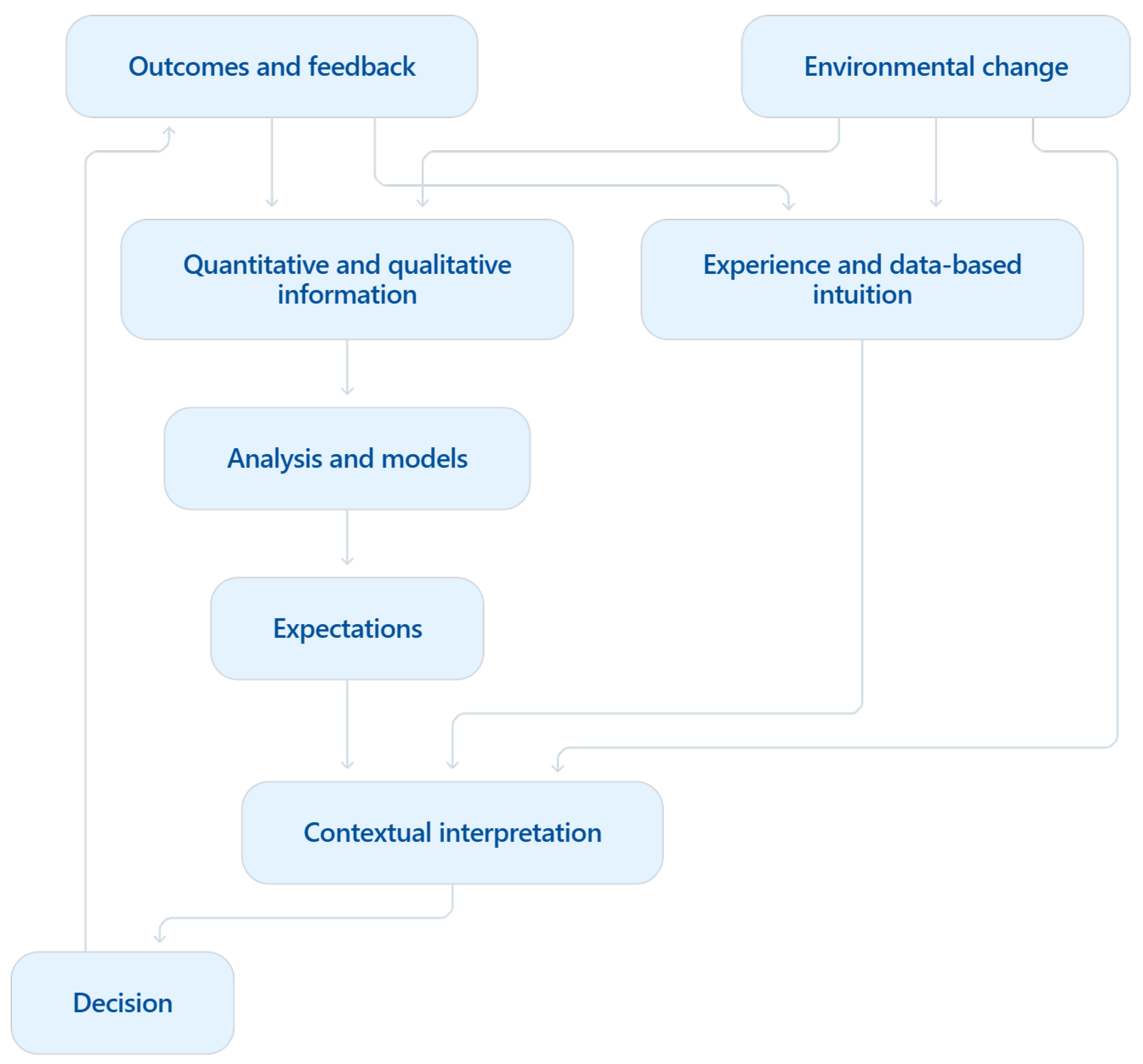

Table 1.
Distinguishing Data-Based Intuition from Related Concepts.
| Concept | Informational Foundation | Role in Decision-Making | Relationship with Learning and Revision |
|---|---|---|---|
| Instinct | Innate or spontaneous responses that need not arise from accumulated domain-specific learning. | Generates an immediate response without requiring deliberate analysis or a learned decision rule. | Does not necessarily depend on systematic evidence, analytical experience, or feedback. |
| Heuristic | Learned or adopted simplifying rules based on selected information or cues. | Reduces the information, calculation, or time required to reach a decision. | Can be modified through experience and feedback, but may also produce persistent biases or systematic errors. |
| Expert intuition | Domain-specific experience and learned recognition of meaningful patterns. | Produces rapid assessments without requiring the expert to reconstruct every underlying analytical step. | Improves when the environment contains learnable regularities and provides sufficiently informative feedback. |
| Judgment | Quantitative analysis, qualitative evidence, formal models, heuristics, intuition, preferences, and contextual considerations. | Produces the broader assessment through which alternatives are evaluated and a decision is ultimately formed. | Can be reconsidered as assumptions, evidence, expectations, or circumstances change. |
| Data-based intuition | Repeated engagement with quantitative and qualitative information, formal analysis, experience, and feedback. | Provides context-sensitive recognition and interpretation of how analytical evidence applies within a particular financial environment. | Remains subject to analytical scrutiny and is reinforced, qualified, or revised as new evidence, outcomes, and environmental changes are encountered. |
Disclaimer/Publisher’s Note: The statements, opinions and data contained in all publications are solely those of the individual author(s) and contributor(s) and not of MDPI and/or the editor(s). MDPI and/or the editor(s) disclaim responsibility for any injury to people or property resulting from any ideas, methods, instructions or products referred to in the content. |
© 2026 by the authors. Licensee MDPI, Basel, Switzerland. This article is an open access article distributed under the terms and conditions of the Creative Commons Attribution (CC BY) license (http://creativecommons.org/licenses/by/4.0/).
Copyright: This open access article is published under a Creative Commons CC BY 4.0 license, which permit the free download, distribution, and reuse, provided that the author and preprint are cited in any reuse.