

Submitted:
29 September 2026
Posted:
30 September 2026
You are already at the latest version
Abstract
Background & Objectives: Sickle Cell Disease (SCD) affects at least 300,000 babies globally, with 14% born in India. Disease-related stigma is a multidimensional social challenge that varies culturally and severely impacts the quality of life for both patients and caregivers. This study aimed to determine the magnitude of perceived stigma among individuals with Sickle Cell Disease and caregivers and also the factors associated with it. It also aimed to explore the lived experiences of patients and caregivers. Methodology: Community-based mixed methods study of convergent parallel design was conducted in the tribal district Betul of Madhya Pradesh, India. A total of 85 patients and 105 caregivers were sampled for quantitative strand. For qualitative strand, purposive sampling was used and data was saturated after IDI of five patients and five caregivers. Results: Mild stigma was reported by 68.2% of patients and 49.5% of caregivers, whereas severe and very severe stigma was more than twice as common among caregivers (26.7%) compared to patients (11.8%). For patients, high stigma was significantly associated with complication-related hospitalization (p=0.005). High stigma among caregivers was significantly associated with a nuclear family type (p<0.001), blood transfusions in the past year (p<0.001), complication-related hospitalizations (p=0.039), and recent pain crises (p=0.005). Seven themes were identified qualitatively. Conclusion: Overall burden of stigma was more among caregivers than patients. It was associated with frequency of hospitalisation, blood transfusion and pain crisis. Stigma operates as a multilayer, cyclical process driven by knowledge deficits, leading to outcomes ranging from financial insecurity to preventable mortality.
Keywords:
sickle cell disease
; perceived stigma
; mixed methods research
; tribal health
Introduction
Sickle Cell Disease (SCD) is one of the most common monogenic disorders globally, inherited through an autosomal recessive pattern [1]. Analysis from Global Burden of Disease Study 2021 reports that approximately 5,15,000 babies were born with SCD globally, a 13.7% increase since 2000. The highest burden lies in Sub-Saharan Africa, the Middle East, the Mediterranean, and the Indian sub-continent [2]. Each year at least 3,00,000 babies are born with this disorder globally and 14% of them are from India. The prevalence of SCD varies from as low as 1% to as high as 55% in various Indian population [3] showing heterogeneity in the distribution of the disease across country. The maximum prevalence is seen across central India, from Gujarat to Odisha [4]. The disease is widespread across the “Sickle Belt” of Central, Western, and Southern India, in states like Madhya Pradesh, Maharashtra, Odisha, Chhattisgarh, Gujarat, Andhra Pradesh and Telangana. In Madhya Pradesh alone, nearly 13,432 pregnancies are estimated to be at risk of having a child with SCD [5]. The Gonds and Bhils who constitute the largest tribal groups in central India (including MP) are significantly affected by SCD [6].
Stigma related to Sickle Cell Disease is a multidimensional social process that manifests differently across cultural contexts, significantly impacting the quality of life for both patients and caregivers. Study reveals approximately 27% of patients and 41% of caregivers reported experiencing “severe” or “very severe” stigma [7]. Adults are often labelled lazy and job opportunities are restricted leading to economic instability while children are discriminated against in school due to their physical condition and frequent absenteeism [8].
Against this backdrop, the present study aimed to determine the magnitude of perceived stigma among individuals with Sickle Cell Disease and caregivers in a tribal district of Central India and also the factors associated with it. The study also aimed to explore the lived experiences of patients and caregivers.
Materials & Methods
Study design, setting, and participants
This community-based mixed methods study was conducted from January 2026 to June 2026 in the tribal district Betul of Madhya Pradesh, India. The study design was convergent parallel (QUAN + qual); the quantitative strand was cross-sectional and the qualitative strand consisted of in-depth interviews. Adult individuals (>18 years) diagnosed with Sickle Cell Disease and primary caregivers of children (<18 years) were selected for both quantitative and qualitative part. Only the confirmed cases of Sickle Cell Disease (Solubility Test Positive + HPLC/Electrophoresis confirmation for HbSS) and primary caregiver living with the patient for lot less than a year were included. Cases of Sickle Cell Trait (HbAS) and those with other major comorbidities like HIV, active tuberculosis, etc were excluded.
Sample size determination
Cochran’s formula for determining sample size was applied independently for the estimation of sample size of patients and caregivers. Standard normal variate was taken as 1.96 (5% type-I error), estimated proportion of severe stigma among patients and caregivers was taken as 0.27 and 0.41 respectively as per a prior study [7] and the absolute error in precision was taken as 10% in the study. To allow for incomplete questionnaires and non-response, each estimate was inflated for an anticipated 10% non-response rate and rounded up, yielding final target samples of 85 patients and 105 caregivers (190 participants in total).
The qualitative study sample size was determined as per the theory of data saturation.
Sampling design
Concurrent mixed-methods sampling (probabilistic sampling for quantitative strand and purposive sampling for qualitative strand) was implemented.
Participants for the quantitative strands were selected by stratified random sampling, with the administrative block treated as the stratum. This was done as Betul’s blocks differ in tribal density and healthcare access. Moreover, National Sickle Cell Anaemia Elimination Mission also reports data at block level and maintains registries at the same which make it practical. Proportional allocation to block size was used as simple random sampling would have risked over- or under-representing high-tribal-density blocks by chance. Block-wise quotas were computed as ni = n × (Ni / N), where Ni is the number of registered patients in block I and N= 1,623 is the total frame at the time of sampling, and were rounded to whole numbers as can be seen in Table 1. Within each stratum participants were drawn by simple random selection using computer generated random numbers.
Participants for the qualitative part were selected by a combination of different purposive sampling techniques, such as convenient, theoretical, and maximum variation sampling.
Data collection technique and tools
After building rapport with the study participants, face to face interviews were conducted using a pre-tested schedule. Perceived stigma was estimated using ICMR-Sickle Cell Disease Stigma Scale for India among adult patients and caregiver of young patients (13). It has 16 and 17 items for patients and caregivers respectively; each item scored from 1 to 4 with the total maximum scores of 64 and 68. Study participants were initiated about the whole process and purpose of the study and included only after obtaining informed consent. The principles of public health research ethics were upheld during the study. (14)
Study variables with operational definition
Stigma perceived by adult patients and caregivers of young patient (measured through ISSSI scale) was the study’s dependent variable. For Chi-square (χ2) test, severity of stigma was categorised as “Low Stigma” (16-28 among patients and 17-29 among caregivers) and “High Stigma” (29-64 among patients and 30-68 among caregivers); and this was used as the dependent variable. The independent factors; age of patients/caregivers, family type, annual family income, hydroxyurea use, number of pain episodes and blood transfusion in the last year and hospitalisation due to complication in last year.
Statistical analysis and integration
Quantitative and qualitative data analyses were done simultaneously. Quantitative analyses were performed on Microsoft Excel and JAMOVI software version 2.7.38 (Jamovi Project, Sydney, Australia). Proportion of perceived stigma among study participants and associated factors were represented through appropriate descriptive statistics. Variables were dichotomized and coded into binary categories. Associations between categorical variables were assessed using Chi-square (χ2 test). Odds ratios with 95% confidence interval were calculated to estimate the strength of associations. A p-value <0.05 was considered statistically significant.
For the qualitative data, audio-recorded interviews were transcribed verbatim in Hindi and subsequently translated into English. The transcripts were reviewed multiple times and cross-checked with the recordings to ensure accuracy. Data were analysed using a hybrid approach of deductive and inductive thematic analysis manually. Deductively, the five core process stages of the Health Stigma and Discrimination Framework; drivers, facilitators, stigma marking, manifestation, and outcomes were used as an a priori coding structure. Inductively, coding remained open to content the a priori framework did not anticipate. Text segments describing phenomenon outside the framework were coded openly and grouped into their own categories and themes. Initial coding was performed independently by two researchers to enhance credibility, and discrepancies were resolved through discussion and consensus. Themes were reviewed and refined through expert discussions to ensure they accurately reflected participants lived experiences and the overall dataset.
Results
Quantitative findings
A total of 85 patients with Sickle Cell Disease and 105 caregivers were enrolled across all administrative blocks of Betul District, Madhya Pradesh. The median age of patients was 25 years (IQR 22-29); while the median age of caregivers was 36 years (IQR 32-40). Female participants predominated among patients (74.1%), whereas caregivers were nearly split equally (49.5% male, 50.5% female). Scheduled Tribe (ST) participants formed the largest group in both patients (43.5%) and caregivers (44.8%). A greater proportion of caregivers (15.2%) were illiterate than the patients (5.9%). Nearly half of the patients (48.2%) and caregivers (42.9%) belonged to Lower Middle socioeconomic class (Class III) by the updated BG Prasad Scale (2026).
Among the study participants, 80.5% takes Hydroxyurea. Only 4.2% and 7.4% of the participants had blood transfusion and hospitalisation due to complications respectively, for more than three times in the preceding year. Pain crises were more frequent where 27.9% reported three or more episodes.
Mild Stigma was perceived by more than half (68.2%) of the patients compared to nearly half half (49.5%) of the caregivers whereas the prevalence of severe and very severe stigma was more than twice among caregivers (26.7%) than among patients (11.8%). (Figure 1)
Median stigma score for patients was 25 (IQR 18-33) and for caregivers was 30 (IQR 22-43) (Figure 2). Among the stigma domains, Illness Burden was the highest scoring and Healthcare Interaction was the lowest in both populations. (Figure 3)
Among the patients, Chi-square (χ2) test indicated that only complication-related hospitalisation (OR 4.12, 95% CI 1.54-11.07, p=0.005), were significantly associated with high stigma. High stigma among caregivers was significantly associated with nuclear (vs. joint) family type (OR 5.26, 95% CI 2.28–12.14, p < .001), blood transfusion in the past year (OR 10.53, 95% CI 3.62–30.64, p < .001), complication-related hospitalisation (OR 2.54, 95% CI 1.05–6.17, p = .039), and pain crisis in the past year (OR 3.11, 95% CI 1.40–6.90, p = .005).(Table 5)

Table 2.
Association between participant characteristics and perceived stigma.
| Patients (N = 85) | Caregivers (N = 105) | |||||||
|---|---|---|---|---|---|---|---|---|
| Variable | High Stigma n (%) |
χ2 |
OR (95% CI) | p | High Stigma n (%) |
χ2 |
OR (95% CI) | p |
| Age group† | ||||||||
| Reference | 13 (34.2) | 1.00 | — | 29 (56.8) | 1.00 | — | ||
| Older | 14 (29.7) | 0.19 | 0.82 (0.33–2.04) | .663 | 24 (44.4) | 1.62 | 0.61 (0.28–1.31) | .203 |
| Sex | ||||||||
| Male (Reference) | 7 (31.8) | 1.00 | — | 29 (55.8) | 1.00 | — | ||
| Female | 20 (31.7) | 0.00004 | 1.00 (0.35–2.85) | .995 | 24 (45.3) | 1.15 | 0.66 (0.30–1.42) | .283 |
| Caste | ||||||||
| Other (Reference) | 13 (27.1) | 1.00 | — | 28 (48.3) | 1.00 | — | ||
| Scheduled Tribe | 14 (37.8) | 1.11 | 1.64 (0.65–4.11) | .293 | 25 (53.2) | 0.25 | 1.21 (0.56–2.63) | .617 |
| Family type | ||||||||
| Joint (Reference) | 12 (27.2) | 1.00 | — | 14 (29.1) | 1.00 | — | ||
| Nuclear | 15 (36.5) | 0.85 | 1.54 (0.61–3.86) | .358 | 39 (68.4) | 16.1 | 5.26 (2.28–12.14) | <.001* |
| Marital status | ||||||||
| Never married (Reference) | 9 (28.1) | 1.00 | — | — | — | — | — | |
| Married | 18 (33.9) | 0.31 | 1.31 (0.50–3.42) | .576 | — | — | — | — |
| Per capita income | ||||||||
| High (Reference) | 15 (31.2) | 1.00 | — | 25 (49.0) | 1.00 | — | ||
| Low | 12 (32.4) | 0.01 | 0.95 (0.38–2.38) | .908 | 28 (51.9) | 0.08 | 1.12 (0.52-2.41) | 0.772 |
| Hydroxyurea use | ||||||||
| No (Reference) | 4 (26.6) | 1.00 | — | 7 (31.8) | 1.00 | — | ||
| Yes | 23 (32.8) | 0.63 | 1.35 (0.39–4.69) | .641 | 46 (55.4) | 3.88 | 2.66 (0.98–7.21) | .054 |
| Blood transfusion, past year | ||||||||
| No (Reference) | 12 (25.5) | 1.00 | — | 25 (34.7) | 1.00 | — | ||
| Yes | 15 (39.4) | 1.88 | 1.90 (0.76–4.79) | .172 | 28 (84.8) | 22.7 | 10.53 (3.62–30.64) | <.001* |
| Complication-related hospitalisation, past year | ||||||||
| No (Reference) | 13 (22.0) | 1.00 | — | 33 (44) | 1.00 | — | ||
| Yes | 14 (53.8) | 8.43 | 4.12 (1.54–11.07) | .005* | 20 (66.7) | 4.4 | 2.54 (1.05–6.17) | .036* |
| Pain crisis, past year | ||||||||
| No (Reference) | 7 (20.0) | 1.00 | — | 18 (36.0) | 1.00 | — | ||
| Yes | 20 (40.0) | 3.80 | 2.67 (0.98–7.27) | .051 | 35 (63.6) | 8.0 | 3.11 (1.40–6.90) | .005* |
Note. CI = confidence interval. Outcome is high vs. low perceived stigma (binarised total ISSSI score).
Qualitative findings
Across participants, stigma operated as a multilayer, cyclical, intersecting process beginning with knowledge deficit acting as driver of stigma and producing outcome that ranged from financial insecurity to preventable mortality.
Theme 1: Community Ignorance of SCD Drives Stigma
A complete absence of bio-medical knowledge among their community functioned as the foundational cornerstone of stigma towards the patients and their caregivers. In the absence of scientific understanding, community filled the gap with supernatural and sometimes moral attribution that located blame on the patient or caregiver.
In my past life I had unpaid debt… my sister-in-law says my child is taking some kind of revenge on me. (35-year, female caregiver)
Villagers have no knowledge about the disease so they don’t know what it is. They tell to go to a shaman and get a ritual done. (24-year, male patient)
Theme 2: Policy and Absence of Structure as Facilitators of Stigma
Facilitators can either amplify or act as a protection towards stigma irrespective of individual attitudes. Structural gaps don’t cause stigma, but they determine how severe its consequences become.
Treatment in government facility takes too much time and the pain is unbearable so we go to a private clinic (26-year, female patient)
The complete absence of workplace protection doesn’t only permit discrimination but legitimise it.
When my employer found about it, he told me that I am not qualified for the job anymore and I need to give resignation (24-year, male patient)
In contrast health education by the healthcare provider acted as a positive facilitator disrupting the cycle at institutional level going on to illuminate an important intervention point in the whole process.
My doctor told me more about Sickle Cell, about Hydroxyurea and about the card. I started taking medicines regularly and my crisis reduced.
Theme 3: Stigma Marking Through Social, Gender, and Caste Identity
Five of my previous marriage arrangements were annulled when they found out about my disease so I hid my diseases from my wife until the day of marriage.
This kind of marking makes the patient socially undesirable for marriage. Men due to the assumption of them unable to fulfil their role as a provider for family, while women are reduced to their biology by branded as someone who would only produce infirm offsprings.
People say that it’s because of me that my child has Sickle Cell and I should also get my younger child checked (35-year, female caregiver)
To begin with, most patients who suffer from serious complications are from rural area and that too tribal, so they get less opportunities (29-year, male patient)
This shows intersection of tribal and geographical stigma with Sickle Cell Disease which multiplies the stigma. Stigma isn’t just about the disease; it’s also about how the disease interacts with who you are in society.
Theme 4: Manifestation of Stigma in Multiple Layers
The HSD framework postulates that stigma is primarily experienced as enacted (direct discrimination), internalised (self), or anticipated. These may exist independently but often a single individual bears the weight of all three at once.
I always live in fear that they might treat my child differently… if he makes a mistake in class. (35-year, female caregiver)
My in laws give me separate utensils when they serve me food and water and keep that plate aside and don’t eat or drink from it. I tell my mother that she should have killed me even before I was diagnosed (25-year, male patient)
This goes on to show that external discrimination and internal shame reinforce each other. The feeling of being ‘less’ than others is shared widely among all the participations.
Employers would think that I’m making an excuse when I have to take leave during pain crisis and they would not rehire me. (25-year, male patient)
Individuals living with sickle cell disease face discrimination across both social and professional sphere, locking them into a cycle of economic crisis.
Theme 5: Psychosocial and Economic Outcomes of Stigma
Due to sustained stigma exposures, patients and even their caregivers feel hopeless, lonely, socially withdrawn and anxious. A participant even breaks down during an interview as per the field notes of researcher.
Nobody has ever asked me all this that you’re asking, nobody is there to listen to me. (25-year, male patient)
One caregiver has even withdrawn from her social circles to prevent her already fragile mental health from breaking.
I already live in so much stress if I were to listen to others talking bad about my child, I might lose my mind. (35-year, female caregiver)
Across all participants financial devastation was the most consistent finding regardless of whether the participant was patient or caregiver. It was not due to a singular instance of out-of-pocket expenditure but as a cyclical and continuous outcome of stigma.
Every time when we dream or think about doing something, he gets sick and all the money is spent in his treatment. (30-year, male caregiver)
Theme 6: Disrupted Social and Family Functioning
It’s because of Sickle Cell Disease; I had to leave school in between. I couldn’t carry 4-5 books to school which was 4 kms from my village and we had to walk daily. I would fall sick due to this. (25-year male patient)
SCD Stigma and battling it takes precedence above everything for affected families. Be it normal family milestones like marriage, education, birth of a sibling or the interpersonal relations within the family.
I breastfed the younger one for only 9 months and happen to pay less attention to him. (35-year, female caregiver)
I am unable to work at field and help my family due to which my family has increased work burden (23-year, female patient)
Theme 7: Unmet Needs and Expectations from the Government
All the interviewed participants articulated a coherent set of expectations from the government. These were grounded in lived experiences. Adequate drug stock at nearest government facility, financial assistance, disability rights and scholarships for higher studies were the most frequent demands. One participant even advocated for the availability of counselling at the level of District Hospital.
Because of low stock of medicines, we often don’t get the required dose which leads to complications. (29-year, male patient)
I think there should be an awareness campaign and health camp for Sickle Cell patients to counsel the patients and their caregivers. (35-year, female caregiver)
Figure 3.
Word cloud of participant narratives, color-coded by the themes.
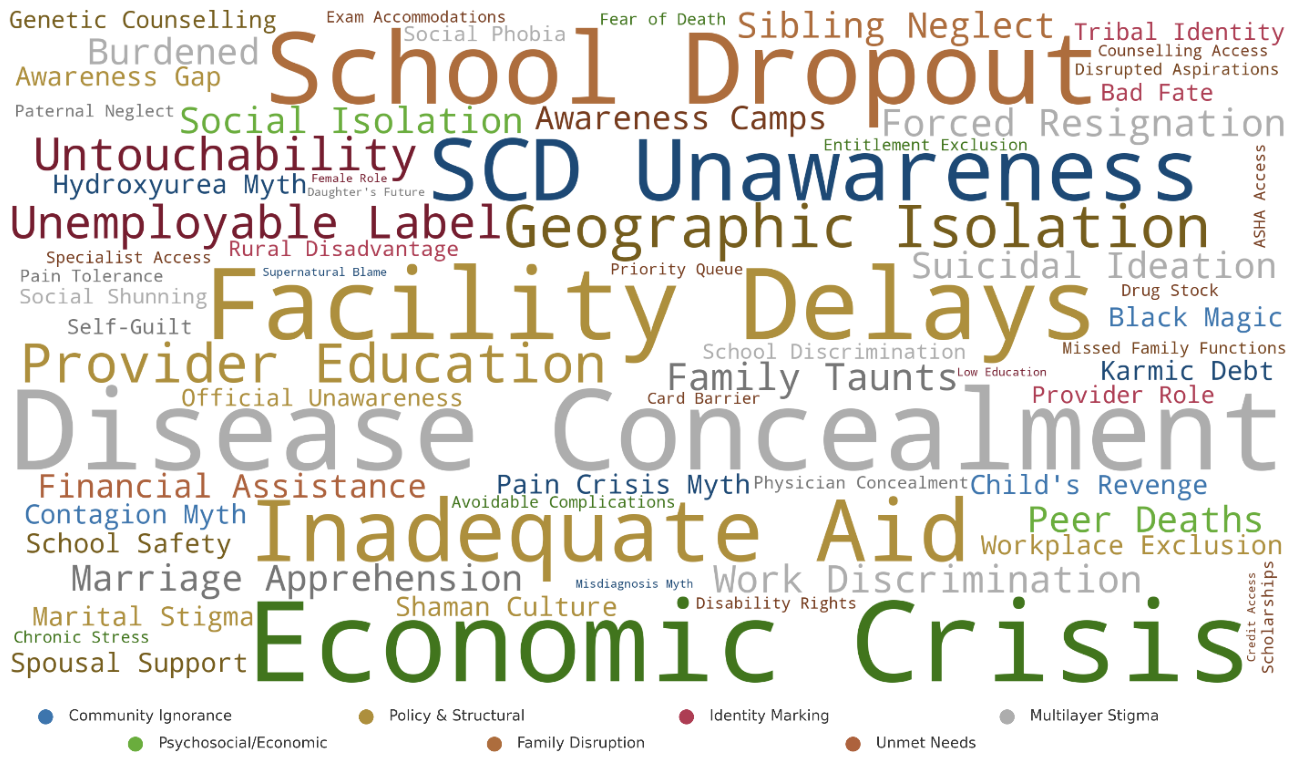
Quantitative and qualitative findings were integrated through construction of a joint display (Table 6)
Discussion
The present study, first of its kind, provides evidence from India on burden of stigma perceived by Sickle Cell Anemia patients and their caregivers by combining a validated quantitative instrument with qualitative in-depth accounts. Proportion of patients’ and caregivers’ perceived stigma in this tribal Betul District were considerably lower for both groups (11.8% and 26.7%, respectively) when compared to another multi-site study using the same instrument (27% and 41%, respectively) [11]. However just like the multi-site study, the present study shows the same direction of domain-level agreement which is higher stigma under illness burden, familial and reproductive stigma, and perceived blame and social judgement. This convergence at the domain level but divergence at magnitude level suggest that stigma across the country operates on the same architecture even where its magnitude does not.
One of the most analytically important discordance which can be seen in this study is the patients’ qualitative and quantitative stigma profiles. One of the hypotheses to explain this could that be of affiliate stigma [9], which refers to the extent of self-stigmatization among caregivers. It occurs when caregivers perceive and internalize negative social attitudes regarding their loved one’s condition, often experiencing shame and self-blame. Another explanation can be response shift [10], which theorizes that when patients are confronted with a chronic disease they accommodate to their illness by changing internal standards, values and conceptualization of quality of life. This may mean that patients living with SCD since birth or early childhood rate their own experience against a different baseline than a caregiver encountering the condition’s social consequences afresh.
In conclusion the study integrates independently collected quantitative and qualitative strands through a convergent parallel design engaging a tribal population that remains substantially under-represented in the SCD stigma literature relative to its disease burden. As India pursues elimination of SCD as a public health problem by 2047 [11], this study identifies specific, localized bottlenecks and accelerators. Within the Health Promotion pillar, the qualitative findings from the study points out that generic, translated Information, Education, and Communication (IEC) materials are unlikely to be adequate. Content developed with community input, addressing their beliefs and superstitions, rather than conveying bio medical facts alone, is more likely to be fulfil that knowledge deficit. Within Holistic Management, study suggest that reducing facility delays and Hydroxyurea dispensing through ASHA can improve drug adherence and hence reduce complication and hospitalization burden. The nuclear-household caregivers should be given priority enrollment in the existing Patient Support Groups. The Unique Disability Identification (UD-ID) conversion should be an explicit metric for entitlement delivery as patients’ accounts reflect on poor completion rates. The qualitative evidence shows that caregivers and patients disclosure trajectory shifts for the better after health education, not after diagnosis alone. This can be seen in one of the patient’s accounts who educated himself about the disease and now leads a peer-support group spreading awareness and helping other patients in navigating the disease.
The study has several limitations starting with the cross-sectional design which prevents establishing casual relationships. Self-reported stigma on a structured instrument is also susceptible to bias. Also, findings from a single tribal district should not be generalized to non tribal, urban or other state SCD population without further study.
Institutional Review Board Statement
This study was approved by Institutional Ethics Committee, All India Institute of Hygiene and Public Health, Kolkata on 2026-02-19 (approval number: IEC/2026(1)/201).
References
- Rees, D.C.; Williams, T.N.; Gladwin, M.T. Sickle-cell disease. The Lancet;PubMed 2010, 376(9757), 2018–31. [Google Scholar] [CrossRef] [PubMed]
- Wastnedge, E.; Waters, D.; Patel, S.; Morrison, K.; Goh, M.Y.; Adeloye, D.; et al. The global burden of sickle cell disease in children under five years of age: a systematic review and meta-analysis. In J Glob Health; PubMed Central; Volume 8, 2, p. 021103. [CrossRef] [PubMed] [PubMed Central]
- Colah, R.B.; Mukherjee, M.B.; Martin, S.; Ghosh, K. Sickle cell disease in tribal populations in India. In Indian J Med Res.; PubMed Central, May 2015; Volume 141, 5, pp. 509–15. [Google Scholar] [CrossRef] [PubMed] [PubMed Central]
- Hockham, C.; Bhatt, S.; Colah, R.; Mukherjee, M.B.; Penman, B.S.; Gupta, S.; et al. The spatial epidemiology of sickle-cell anaemia in India. Sci. Rep. 2018, 8(1), 17685. [Google Scholar] [CrossRef]
- Gupta, R.B. Sickle cell disease load in Madhya Pradesh. RMRCT Update. Newslett Reg. Med. Res. Cent. Tribals Jabalpur 2006, 3, 1–6. [Google Scholar]
- Babu, B.V.; Sridevi, P.; Surti, S.; Ranjit, M.; Bhat, D.; Sarmah, J.; et al. Inadequate community knowledge about sickle cell disease among the Indian tribal population: a formative assessment in a multicentric intervention study. Trans. R Soc. Trop. Med. Hyg.;PubMed 2021, 115(12), 1434–44. [Google Scholar] [CrossRef] [PubMed]
- Bv, B.; Y, S.; P, S.; Sb, S.; M, B.; D, B.; et al. Sickle Cell Disease-Related Stigma: Quantitative Assessment From India. Pediatr. Blood Cancer 2025. [Google Scholar] [CrossRef] [PubMed]
- Bhat, D.; Babu, B.V.; Surti, S.B.; Ranjit, M.; Sarmah, J.; Sridevi, P.; et al. Stigma of sickle cell disease among Indian tribal population: A multi-centric qualitative study. J. Natl. Med. Assoc.;PubMed 2023, 115(6), 556–65. [Google Scholar] [CrossRef] [PubMed]
- Mak, W.W.S.; Cheung, R.Y.M. Affiliate Stigma Among Caregivers of People with Intellectual Disability or Mental Illness. J. Appl. Res. Intellect. Disabil. 2008, 21(6), 532–45. [Google Scholar] [CrossRef]
- Sprangers, M.A.; Schwartz, C.E. Integrating response shift into health-related quality of life research: a theoretical model. Soc. Sci. Med.;PubMed 1999, 48(11), 1507–15. [Google Scholar] [CrossRef] [PubMed]
- National Sickle Cell Anaemia Elimination Mission [Internet]. 13 Jul 2026. Available online: https://sickle.nhm.gov.in/home/about.
Figure 1.
Distribution of perceived stigma severity among patients (n = 85) and caregivers (n = 105), as percentages within each group.
Figure 1.
Distribution of perceived stigma severity among patients (n = 85) and caregivers (n = 105), as percentages within each group.
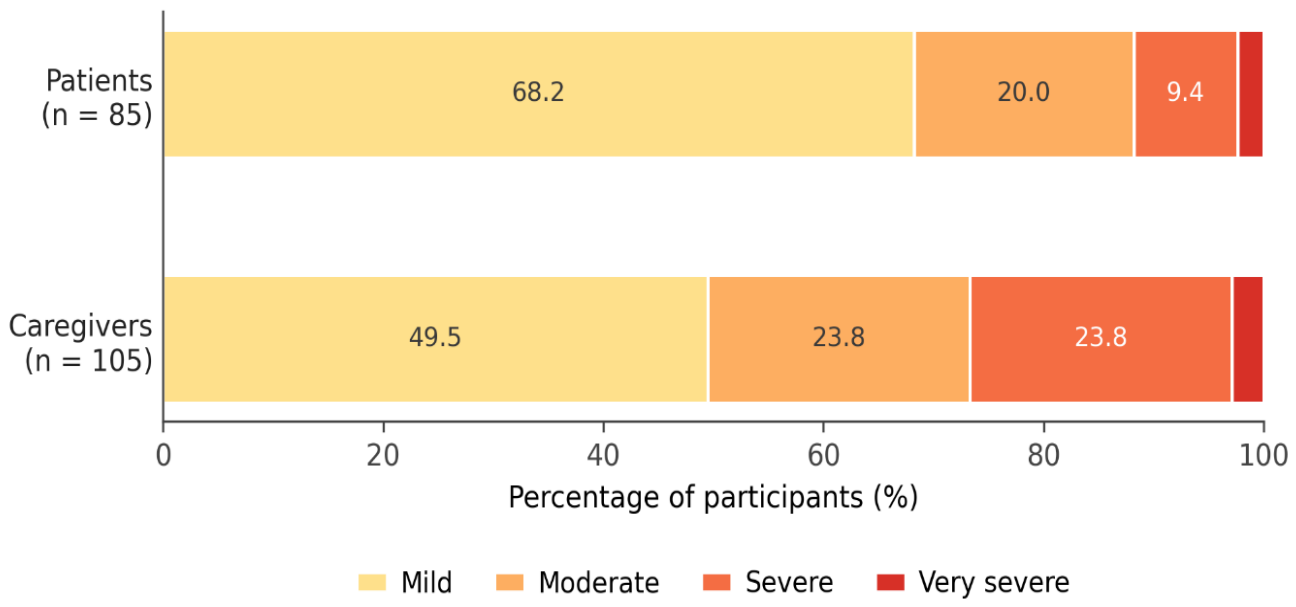
Figure 2.
Distribution of total ISSSI stigma scores among patients and caregivers.
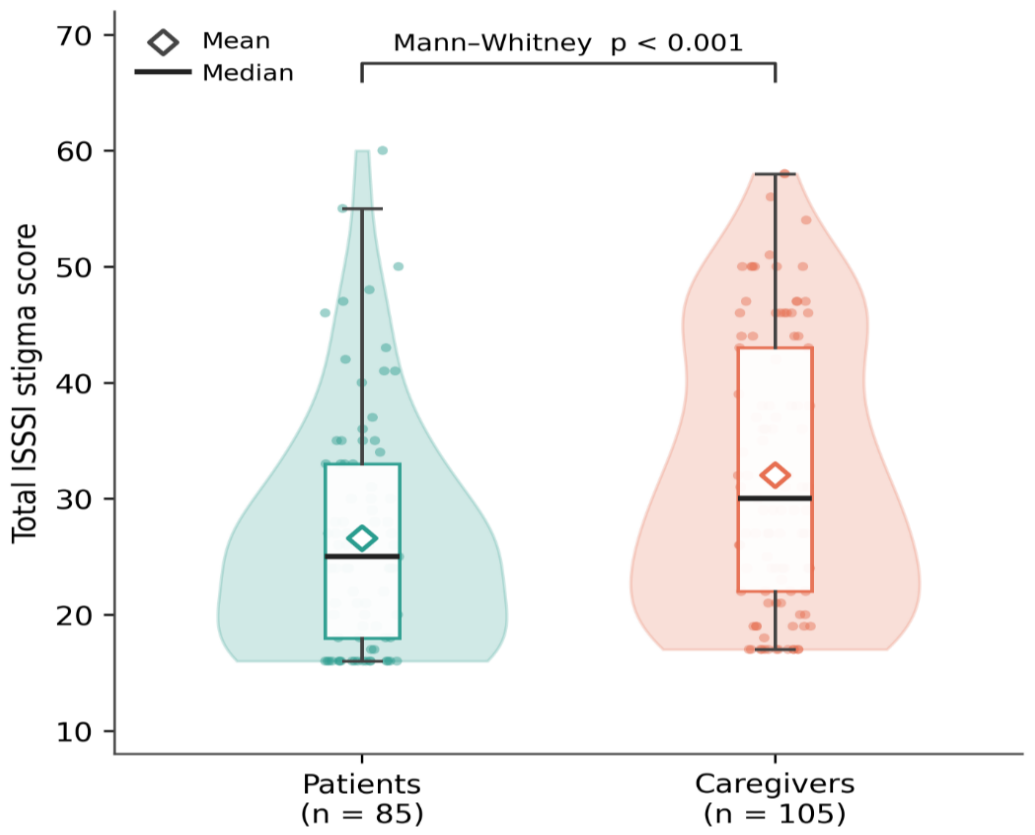
Figure 3.
Domain-wise mean item scores of perceived stigma on the ISSSI response scale (1–4) among (A) patients and (B) caregivers, normalised by the number of items per domain.
Figure 3.
Domain-wise mean item scores of perceived stigma on the ISSSI response scale (1–4) among (A) patients and (B) caregivers, normalised by the number of items per domain.
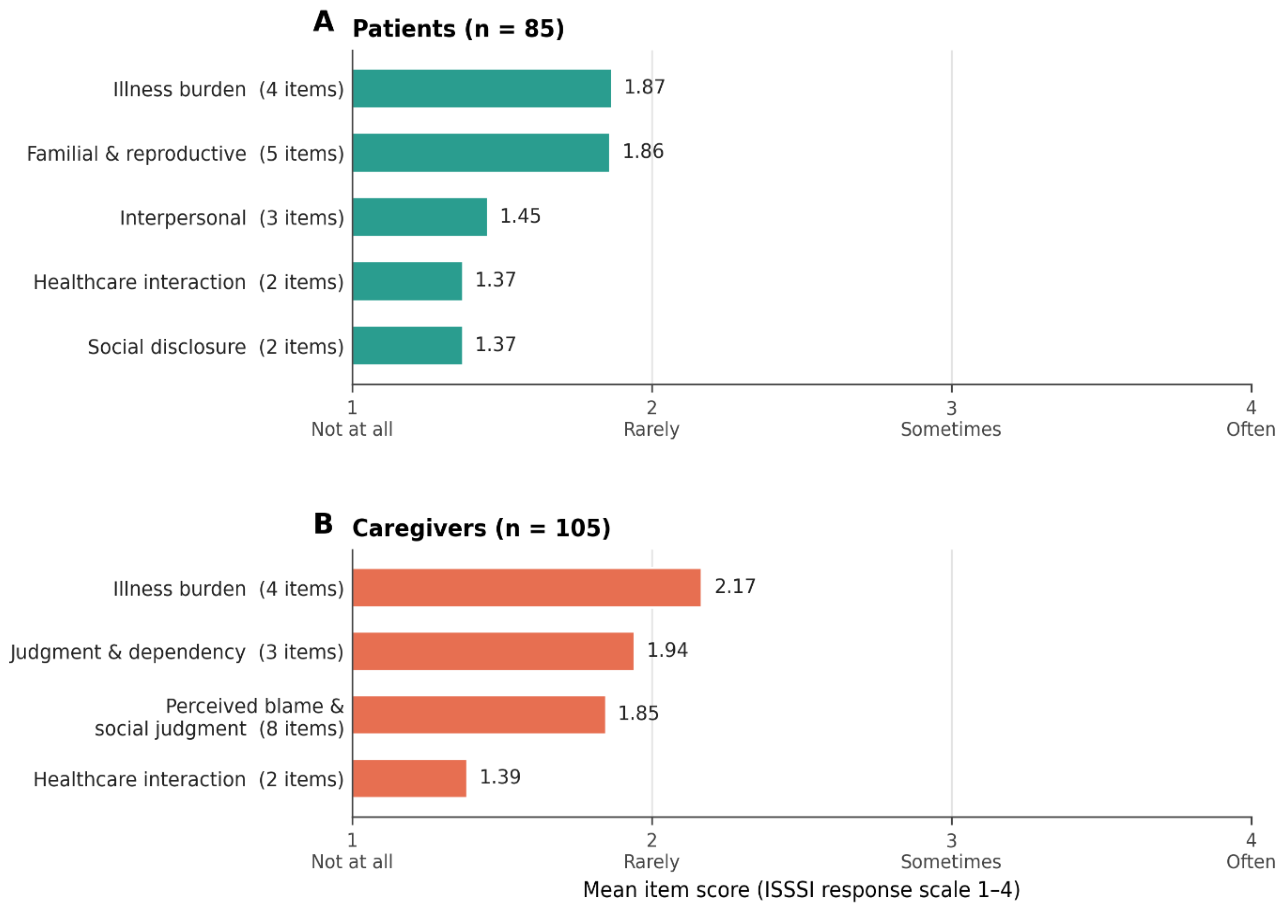
Table 1.
Block-wise distribution of the patient and caregiver samples by stratified random sampling with proportional allocation.
Table 1.
Block-wise distribution of the patient and caregiver samples by stratified random sampling with proportional allocation.
| Block | Registered patients (Ni) | Proportion of frame (%) | Patients sampled (n) | Caregivers sampled (n) |
|---|---|---|---|---|
| Amla | 76 | 4.7 | 4 | 5 |
| Athner | 66 | 4.1 | 3 | 4 |
| Betul | 468 | 28.8 | 25 | 30 |
| Bhainsdehi | 323 | 19.9 | 17 | 21 |
| Bhimpur | 223 | 13.7 | 12 | 14 |
| Chicholi | 149 | 9.2 | 8 | 10 |
| Ghoradongri | 123 | 7.6 | 6 | 8 |
| Multai | 54 | 3.3 | 3 | 4 |
| Prabhatpattan | 74 | 4.6 | 4 | 5 |
| Shahpur | 67 | 4.1 | 4 | 4 |
| Total | 1,623 | 100.0 | 85 | 105 |
Table 6.
Joint Display of Quantitative and Qualitative Findings Organized by HSD Framework Constructs.
Table 6.
Joint Display of Quantitative and Qualitative Findings Organized by HSD Framework Constructs.
| Domain (HSD Construct / Emergent Theme) | Quantitative Findings | Qualitative Findings | Meta-Inference (Integrated Explanation) |
|---|---|---|---|
| Moral/Supernatural Attribution - community driver → internalized caregiver blame (Drivers→Manifestation; Theme 1) | ISSSI-Cg: Perceived Blame & Social Judgment domain (14.78 ± 5.48, third-highest of four caregiver domains). | “They tell to go to a shaman and get a ritual done.” (24M, patient). “In my past life I had unpaid debt… my sister-in-law says my child is taking some kind of revenge on me.” (35F, caregiver) | The driver stage of stigma production can’t be captured by ISSSI. This driver to outcome transition is observable only through integration of the two strands. |
| Structural/Institutional Absence as Facilitator (Facilitators; Theme 2) | No direct ISSSI domain. Healthcare Interaction, as an adjacent proxy: the lowest-scoring domain in both populations | “When my employer found about it… I need to give resignation.” (29M, patient). “Treatment in government facility takes too much time… so we go to a private clinic.” (30M, caregiver) | The significance of this construct is corroborated by the sheer qualitative coding volume rather than by a significant association, absence of which reflects a gap in instrument coverage. |
| Intersectional & Marital Stigma Marking (Marking; Theme 3) | Familial & Reproductive stigma (Pt) was the second-highest of five patient domains. Nearly half of both samples are Scheduled Tribe | “Five of my previous marriage arrangements were annulled…” (25M, patient). “…that too tribal, so to begin with they get less opportunities.” (29M, patient) | Data across both streams converges for marital/reproductive dimension. The caste-tribal identity shows discordance which suggests limited power or an unrepresentative account rather than a mismatched outcome measure. |
| Multi-Layered Manifestation & the Illness-Burden–Severity Link (Manifestations; Theme 4) | Highest-scoring domain in both populations, and the only domain significant against clinical severity in both patients and caregivers. | Most densely coded theme in the dataset. “My in-laws give me separate utensils… I tell my mother she should have killed me even before I was diagnosed.” (25M, patient) | One of the strongest points of convergence in study. Domain score and qualitative coding volume are concordant across both populations. |
| Psychosocial & Economic Outcomes (Individual Outcomes; Theme 5) | Total stigma significantly higher among caregivers than patients. Severe or very severe stigma was more than twice as prevalent among caregivers as among patients. | “Nobody has ever asked me all this… nobody is there to listen to me.” (25M, patient, sobbing per field notes). “Every time… he gets sick and all the money is spent in his treatment.” (30M, caregiver) | This construct constitutes the study’s discordance where patients produced most severe distress narratives yet scored lower than caregivers in overall total Stigma scores. |
| Disrupted Family & Social Functioning — nuclear-family risk amplifier (Family/Social Outcomes; Theme 6) | Nuclear family structure was associated with the perceived stigma of caregivers. | “I breastfed the younger one for only 9 months and happen to pay less attention to him.” (35F, caregiver) | Both strands for this construct converges. Although not confirmed by a participant account, it is possible that this might be due to diffusion of caregiving burden across members of a joint household |
Disclaimer/Publisher’s Note: The statements, opinions and data contained in all publications are solely those of the individual author(s) and contributor(s) and not of MDPI and/or the editor(s). MDPI and/or the editor(s) disclaim responsibility for any injury to people or property resulting from any ideas, methods, instructions or products referred to in the content. |
© 2026 by the authors. Licensee MDPI, Basel, Switzerland. This article is an open access article distributed under the terms and conditions of the Creative Commons Attribution (CC BY) license (http://creativecommons.org/licenses/by/4.0/).
Copyright: This open access article is published under a Creative Commons CC BY 4.0 license, which permit the free download, distribution, and reuse, provided that the author and preprint are cited in any reuse.