

Submitted:
29 September 2026
Posted:
30 September 2026
You are already at the latest version
Abstract
Industrial Internet of Things (IIoT) technologies enable interconnected sensing, computation, and actuation across distributed industrial systems, but translating equipment health information into autonomous physical maintenance actions remains challenging. This work proposes and experimentally validates an IIoT-enabled Cyber-Physical Production System architecture that integrates Remaining Useful Life estimation, Digital Twin-based prescriptive logic, distributed control, and on-demand Additive Manufacturing to close the loop between failure prediction and maintenance execution. The architecture distributes sensing, prognostics, decision-making, and manufacturing functions across heterogeneous edge nodes using IEC 61499-compliant function blocks, DINASORE, and MQTT-based communication. A nine-node physical testbed comprising degrading robotic systems and a 3D printer was developed to evaluate individual components and the complete information-to-action workflow. Experimental results demonstrate reliable distributed data acquisition and control, online degradation assessment, and autonomous triggering of replacement-part production. During closed-loop validation, degradation of a previously unseen component caused its predicted health state to cross the prescribed threshold and automatically initiated fabrication, with a mean orchestration latency of approximately 225ms and no human intervention in the decision path. The results demonstrate how IIoT connectivity, distributed intelligence, and cyber-physical actuation can support autonomous maintenance workflows linking equipment health monitoring directly to physical manufacturing resources.
Keywords:
industrial internet of things
; cyber-physical production systems
; autonomous maintenance
; digital twin
; edge computing
; distributed control
; IEC 61499
; additive manufacturing
; remaining useful life
1. Introduction
The Industrial Internet of Things (IIoT) [1] has progressively extended industrial systems from isolated automation assets towards interconnected Cyber-Physical Production Systems (CPPSs) [2], in which sensing, communication, computation, and physical processes are increasingly integrated. However, connectivity and data availability alone do not make an industrial system autonomous. While IIoT architectures can continuously acquire equipment data and support distributed analytics, a persistent challenge is translating the resulting information into timely and coordinated physical action. This information-to-action gap is particularly evident in industrial maintenance, where detecting or predicting equipment degradation does not ensure that the corresponding maintenance action can be autonomously decided and physically executed.
Predictive Maintenance (PdM) illustrates this limitation. By continuously monitoring asset condition and estimating indicators such as Remaining Useful Life (RUL), IIoT-enabled PdM can anticipate failures before they occur [3,4]. Nevertheless, an accurate RUL estimate remains primarily diagnostic or prognostic information: it neither determines which corrective action should follow nor guarantees that the physical resources required to execute that action are available [5,6]. Consequently, even an accurately predicted failure may still result in downtime when a required replacement component is unavailable, obsolete, or subject to long procurement lead times.
Prescriptive Maintenance (PsM) and Digital Twin (DT) technologies provide a mechanism for progressing from prediction towards decision-making. A DT can continuously represent the state of a physical asset using IIoT data, incorporate predictive models, and evaluate maintenance conditions to recommend or autonomously trigger corrective actions [5,7]. Yet, closing the loop requires more than generating a maintenance decision: the decision must propagate through the cyber-physical infrastructure to a resource capable of executing the corresponding physical action. In this context, Additive Manufacturing (AdM) provides an interesting execution mechanism by allowing replacement components to be produced from digital models on demand, potentially reducing dependence on physical spare-part inventories and conventional supply chains [6,8,9,10].
Realizing such an information-to-action workflow introduces an additional architectural requirement. Sensing, prognostics, decision-making, machine control, and manufacturing resources may be physically distributed across an industrial environment and should therefore not depend on a single centralized execution point. Distributed, event-driven control architectures provide a means of coordinating these heterogeneous cyber-physical resources while supporting modularity and reconfiguration [2,11]. The IEC 61499 standard is particularly relevant in this context because its distributed Function Block (FB) model supports event-driven execution across networked industrial devices [12]. Combined with lightweight IIoT communication protocols and edge-hosted analytics, this provides the technological basis for distributing the complete maintenance workflow from sensing to physical execution.
Despite these complementary developments, existing research largely addresses the individual stages of this workflow separately. PdM studies predominantly focus on condition assessment and prediction [5,13]; DT- and PsM-based approaches extend these capabilities towards maintenance decision-making [2,7]; AdM research investigates digital spare parts and on-demand fabrication [6,8,14]; and distributed IEC 61499 architectures primarily address flexible industrial control [11,12]. As summarized in Table 1, comparatively little work investigates how these capabilities can operate as a single distributed IIoT-enabled system. In particular, there remains limited experimental evidence of architectures in which live equipment data are processed at the edge, converted into a maintenance decision, and propagated autonomously to a physical manufacturing resource without centralized coordination or human intervention in the decision path.
This work addresses this gap by proposing and experimentally validating an IIoT-enabled CPPS architecture that closes the information-to-action loop for autonomous maintenance. The architecture distributes sensing, RUL estimation, DT-based prescriptive logic, and physical manufacturing capabilities across heterogeneous edge nodes. IEC 61499-compliant FBs provide the event-driven execution model, DINASORE [15] enables Python-based predictive functions to execute within the distributed control environment, Message Queuing Telemetry Transport (MQTT) supports operational communication between nodes, and an AdM resource is exposed as a cyber-physical service that can be triggered directly by the maintenance logic.
The contribution of this work is primarily architectural and experimental rather than the proposal of a new prognostic or prescriptive algorithm. Specifically, the paper: (i) defines an IIoT-enabled architecture connecting distributed sensing, edge-based prediction, prescriptive decision-making, and physical AdM execution within a common information-to-action workflow; (ii) demonstrates how ML-based RUL estimation and maintenance logic can be integrated into an IEC 61499-compliant distributed control environment [16]; and (iii) physically validates the complete architecture on a nine-node testbed, including autonomous progression from live equipment degradation to replacement-part fabrication triggering without human intervention in the decision path.
The experimental results demonstrate reliable distributed communication and control, successful online degradation assessment, and autonomous propagation of maintenance decisions to the AdM resource. In the complete closed-loop experiments, a newly generated degradation trajectory autonomously crossed the prescribed maintenance threshold and initiated the corresponding print job, with approximately 225 of cyber-physical orchestration latency. These results demonstrate the feasibility of extending IIoT infrastructures beyond monitoring and prediction towards distributed systems in which industrial information can directly initiate coordinated physical action.
2. Materials and Methods
The proposed system was designed to experimentally evaluate whether an IIoT-enabled, distributed architecture can autonomously transform equipment health information into a physical maintenance action. The methodology therefore covers three interconnected elements: the system architecture and its distributed implementation, the predictive and prescriptive maintenance pipeline that converts sensor data into maintenance decisions, and the physical testbed used to validate the complete information-to-action workflow. Rather than optimizing any individual predictive, communication, or control component, the implementation was designed to evaluate their integration within a reproducible end-to-end CPPS.
2.1. IIoT-Enabled Autonomous Maintenance Architecture
The proposed architecture extends the conventional IIoT monitoring and analytics pipeline into a closed information-to-action workflow for autonomous maintenance. As illustrated in Figure 1, the physical layer comprises production equipment, sensing devices, and AdM resources, while the cyber layer distributes data acquisition, equipment-health estimation, prescriptive decision-making, and resource orchestration across networked edge nodes.
Each monitored physical asset is associated with a DT that receives its sensor stream and executes a trained RUL prediction model. The resulting equipment-health estimate is evaluated by PsM logic according to a maintenance condition: replacement-part production must be initiated sufficiently early to complete before the predicted failure. When this condition is satisfied, the DT generates a production request that is propagated through the IIoT infrastructure to an available AdM resource. The maintenance workflow therefore comprises four successive stages: physical sensing, edge-based health estimation, prescriptive decision-making, and cyber-physical execution.
The architecture is inherently distributed. Multiple physical assets and their corresponding DT instances can operate independently while accessing a shared pool of AdM resources, avoiding dependence on a single centralized maintenance decision point [11,12]. This distribution also separates the maintenance functions according to their computational and physical roles: sensor acquisition can execute close to the monitored equipment, predictive models can execute on dedicated edge nodes, and manufacturing commands can be consumed directly by the corresponding physical resource.
The PsM policy used in this study was deliberately restricted to a threshold-based decision rule. Its purpose is not to introduce a new prescriptive optimization method, but to provide a deterministic decision boundary through which the integration between prediction and physical execution can be experimentally evaluated. More sophisticated policies considering production schedules, maintenance costs, resource availability, or competing actions can be incorporated without modifying the underlying distributed architecture.
2.2. Distributed Edge and Control Implementation
The architecture was implemented using the IEC 61499 distributed control model, which represents application functionality as interconnected, event-driven FBs that can be deployed across networked devices. This model was selected because the maintenance workflow is inherently event-driven: sensor observations produce updated health estimates, threshold conditions generate maintenance events, and these events trigger actions on physically distributed resources. In contrast to concentrating these functions in a central controller, IEC 61499 allows sensing, prediction, decision-making, and actuation functions to be mapped to the edge nodes associated with their respective physical resources.
DINASORE [17] was used as the IEC 61499-compliant Run-Time Environment (RTE). Its Python-based FB implementation was particularly relevant because the maintenance pipeline requires direct integration with the PyTorch-based RUL models and associated signal-processing libraries [18]. Established RTEs such as 4diac FORTE [19] predominantly execute compiled C/C++ FB algorithms [16], whereas DINASORE [17] allows data-processing and ML functionality to be integrated directly into the distributed FB environment and automatically exposes FB state through Open Platform Communications Unified Architecture (OPC UA) [20]. Hard real-time execution was not required because the distributed functions considered in this work perform condition monitoring, health estimation, and maintenance orchestration rather than safety-critical control.
Operational communication between distributed nodes uses MQTT [21]. Its lightweight publish–subscribe model allows sensor streams, health information, and maintenance-triggering events to be exchanged without direct dependencies between producers and consumers. MQTT was selected based on its suitability for resource-constrained IIoT devices and previously reported latency and bandwidth advantages over HTTP in Raspberry-Pi-based IEC 61499 deployments [22]. OPC UA, automatically provided by DINASORE, was used separately for supervisory access to the state of individual FBs. MQTT therefore constitutes the operational communication layer, whereas OPC UA provides supervisory visibility into the distributed execution environment.
Four custom FBs implement the principal information-to-action functions: IMU_STREAM acquires and publishes vibration data; ONLINE_RUL interfaces the online inference process with the IEC 61499 application; RUL_THRESHOLD evaluates the prescriptive maintenance condition; and PRINT_START converts the resulting maintenance event into a command to the AdM resource. Existing MQTT FBs from the DINASORE repository [23] provide communication between these functions when deployed on different nodes. Consequently, the logical workflow remains independent of the physical placement of the corresponding FBs.
2.3. Predictive and Prescriptive Maintenance Pipeline
Equipment degradation was monitored through vibration because loosening and wear of the Polylactic Acid (PLA)-printed robotic-arm grippers produced measurable changes in their mechanical response. Each of the three monitored arms was equipped with a different vibration sensor: an ADXL345 [24], a piezoelectric sensor, or an MPU9250 [25] (Table 2). Life-cycle data were collected using an accelerated degradation protocol in which equivalent mechanical faults and looseness were deliberately introduced at logged timestamps. Approximately of operation was recorded, covering four degradation stages: normal operation, early degradation, heavy degradation, and complete failure.
The ADXL345 and MPU9250 were sampled at 3200 and 4000 , respectively, using dedicated C-based acquisition utilities running on Raspberry Pi nodes. The analog piezoelectric sensor was sampled through a Raspberry Pi Pico W [26] and transmitted serially to its associated edge node, providing an effective sampling rate of approximately 2800 . For consistent model development, the three datasets were resampled to 2800 and processed using a 1 high-pass Butterworth filter.
Following the RUL-development methodology of Berghout and Benbouzid [27], the signals were segmented into 1 windows and represented through time- and frequency-domain features. Time-domain features comprised root mean square, variance, peak value, crest factor, skewness, and kurtosis, while spectral energy was computed over four frequency bands using the Fast Fourier Transform (FFT) [28]. Stationary windows with variance below 1e-6 were discarded, after which the features were standardized and reduced through Principal Component Analysis (PCA) [29], retaining 95 of the variance.
Because independently measured failure labels were unavailable, a Health Index (HI) was constructed from the degradation trajectories. Four Health States (HSs) were obtained using a four-component Gaussian Mixture Model [30] after temporal smoothing and outlier removal. The resulting states were chronologically mapped and constrained to monotonic degradation. The transition from the initial healthy state to the first degraded state defined the First Predicted Transition (FPT), from which a normalized exponential HI trajectory was derived using (1).
Three independent prediction models were trained, one for each asset and sensing modality. This per-asset strategy was selected instead of sensor fusion because it allows each DT to execute its health-estimation process independently, without requiring synchronization with other monitored assets. Each model combines a one-dimensional convolutional layer for local feature extraction with a bidirectional Long Short-Term Memory (LSTM) network for learning the temporal degradation trajectory [6]. Hyperparameters, including sequence length, convolutional configuration, LSTM size and depth, dropout, learning rate, and weight decay, were independently optimized using 30 Optuna trials [31]. Samples were grouped into 60-window sequences and divided at the block level into 80 training and 20 held-out test data.
For online operation, incoming vibration streams were accumulated into 1 buffers and resampled to the model input frequency. The same filtering, feature extraction, scaling, and PCA transformations fitted during model development were then applied to each incoming window. Processed observations populated a rolling sequence buffer and were passed to the corresponding model once the required sequence length was reached. A rolling median and Exponential Moving Average (EMA) [32] were applied to the resulting HI estimates to reduce the influence of transient mechanical shocks generated during normal pick-and-place operation.
Online inference was interfaced with the distributed IEC 61499 application through the ONLINE_RUL FB. The inference process executes asynchronously from the RTE to prevent signal processing and ML computation from blocking event execution. The resulting health estimate is periodically exposed to the RUL_THRESHOLD FB, which implements the PsM decision rule. Once the configured maintenance threshold is crossed, the FB generates a single maintenance event that is published through MQTT to the AdM resource.
2.4. Additive Manufacturing as a Cyber-Physical Resource
The AdM system was integrated as an independently addressable cyber-physical resource rather than as a locally operated peripheral. A Raspberry Pi associated with the 3D printer runs OctoPi [33], including the OctoPrint [34] management server, together with a DINASORE instance. The PRINT_START FB subscribes to the corresponding MQTT maintenance topic and, upon receiving a valid production event, invokes the OctoPrint Representational State Transfer (REST) API to initiate the preconfigured replacement-part print job.
This implementation decouples the maintenance decision from the physical location and native interface of the manufacturing resource. From the perspective of the distributed CPPS, the printer is exposed as an event-triggered service that can receive production requests from any authorized DT instance. Consequently, multiple monitored assets can share the same AdM capability without requiring direct device-level integration between each asset and the printer.
The autonomous scope evaluated in this work extends from equipment sensing to confirmed initiation of the replacement-part print job. Retrieval, inspection, and installation of the fabricated component remain manual operations and are outside the experimental validation. Accordingly, the AdM integration is evaluated as the physical execution endpoint of the proposed information-to-action architecture rather than as a complete autonomous repair process.
2.5. Experimental Testbed and Validation Protocol
The architecture was deployed on a laboratory-scale CPPS comprising three EEZYbotARM Mk2 robotic arms [35] and an Ender-3 S1 Pro 3D printer [36]. The robotic arms form a pseudo-production line in which a workpiece is transferred sequentially between stations, while the printer represents the shared physical maintenance resource. The complete implementation comprises nine Raspberry Pi edge nodes and one Raspberry Pi Pico W [26] peripheral connected through a common Ethernet network. Table 2 summarizes the principal hardware and software components.

Table 2.
Core hardware and software components of the experimental testbed.
| Component | Role | Qty. |
|---|---|---|
| EEZYbotARM Mk2 [35] | Production-line robotic arm | 3 |
| Ender-3 S1 Pro | AdM resource | 1 |
| Raspberry Pi 3 Model B V1.2 | Distributed edge nodes | 9 |
| Raspberry Pi Pico W | Piezoelectric sensor interface | 1 |
| ADXL345 [24] | Vibration sensing (Arm #1) | 1 |
| Piezoelectric sensor [37] | Vibration sensing (Arm #2) | 1 |
| MPU9250 [25] | Vibration sensing (Arm #3) | 1 |
| DINASORE [17] | IEC 61499 RTE | — |
| OctoPi/OctoPrint [33,34] | AdM resource management | — |
| PyTorch; Optuna [31] | RUL model development and inference | — |
Each robotic arm is controlled by a dedicated Raspberry Pi running DINASORE, with arm-to-arm coordination performed through MQTT. Arms #1 and #3 use separate sensing and predictive-maintenance nodes, resulting in three edge nodes per arm: control, sensor acquisition, and RUL inference. For Arm #2, the Pico W is directly attached to the predictive-maintenance node through its serial interface, eliminating the need for a separate sensing Raspberry Pi. The ninth Raspberry Pi hosts the AdM interface. This deployment preserves functional separation between physical control, sensing, predictive processing, and manufacturing while allowing all components to participate in the same distributed IEC 61499 application.
Figure 2 displays the physical testbed, while Figure 3 maps the logical information-to-action architecture onto the physical testbed, including the location of the principal FBs and the MQTT communication paths. The same logical maintenance workflow is instantiated independently for each monitored arm, while the AdM node is shared between the three DT instances.
The system was evaluated at four complementary levels. First, distributed control and sensor communication were assessed during 1 of continuous pseudo-production-line operation by measuring successful hand-off cycles, communication latency, jitter, packet loss, and interruptions in the sensing streams. Second, the three RUL models were evaluated on their held-out test data using Root Mean Squared Error (RMSE), Mean Absolute Error (MAE), and the PHM-2012 scoring metric [38,39]. Third, the maintenance-triggering path was isolated from model behaviour by forcing threshold-crossing events in 30 trials (10 per arm) and measuring successful event generation, delivery, print initiation, and threshold-to-print latency. Finally, the complete information-to-action workflow was evaluated in three end-to-end accelerated-degradation trials using Arm #2. In these experiments, no threshold was manually forced: the live sensor stream was processed by the online RUL pipeline until the configured maintenance condition was autonomously reached, after which the resulting event was propagated to the AdM node and print initiation was confirmed.
This staged protocol separates the reliability of the underlying IIoT communication infrastructure, the predictive capability of the RUL models, the reliability of cyber-physical action triggering, and the behaviour of the integrated closed loop. The final experiment therefore evaluates the central architectural objective of this work: autonomous progression from live physical degradation data to initiation of a corresponding physical manufacturing action without human intervention in the decision path.
3. Results
The proposed architecture was evaluated progressively from its distributed IIoT infrastructure to the complete information-to-action workflow. Four levels of validation were considered: (i) distributed control and sensor-data acquisition, (ii) online equipment-health estimation, (iii) autonomous propagation of maintenance decisions to the AdM resource, and (iv) end-to-end operation from live degradation data to physical print initiation. This staged evaluation separates the performance of the underlying communication and predictive components from the experimental validation of the integrated autonomous maintenance loop.
3.1. Distributed IIoT Operation and Data Acquisition
During 1 of continuous pseudo-production-line operation, the distributed control system completed 84 hand-off cycles. All expected coordination messages were received in the correct sequence, resulting in a 100 successful cycle rate during the observation period. The mean coordination latency was (), with a maximum observed delay of 114 . The mean cycle duration was , with a maximum cycle jitter of .
Sensor acquisition was evaluated during the same continuous run. The MQTT-based ADXL345 and MPU9250 streams exhibited no packet loss, while their longest observed inter-message gaps were and , respectively. The piezoelectric sensing path, which uses the Raspberry Pi Pico W serial interface rather than MQTT for sensor-to-edge communication, exhibited a maximum observed gap of . Across the three sensing paths, no interruption longer than 910 was observed. Table 3 summarizes the communication and acquisition measurements.
3.2. Equipment-Health Estimation
The three asset-specific models were evaluated on their respective held-out test sets against the constructed HI trajectories described in Section 2.3. The ADXL345-based model achieved the lowest prediction errors, with an RMSE of 0.0334 and an MAE of 0.0225, whereas the MPU9250-based model produced the largest errors, with an RMSE of 0.0838 and an MAE of 0.0420. The piezoelectric model achieved the highest PHM-2012 score (0.9950), while all three models obtained scores above 0.98 (Table 4).
Figure 4, Figure 5 and Figure 6 compare the predicted and reference HI trajectories over the chronologically ordered test blocks. Despite differences in prediction error between sensing modalities, the three models reproduce the overall degradation progression represented by their respective HI targets. Of particular relevance to the subsequent prescriptive stage, the estimated trajectories provide a continuously updated health indicator that can be evaluated against the configured maintenance threshold.
3.3. Autonomous Maintenance-Action Triggering
The reliability and latency of the information-to-action path were first evaluated independently of the health-estimation model by externally inducing the threshold condition. A total of 90 trials were performed, with 30 trials initiated from each monitored arm. In every trial, the threshold event was correctly generated, received by the AdM node, and converted into a confirmed print-start command, corresponding to a 100 success rate across all three stages of the triggering chain (Table 5).
Across the 90 trials, the mean time between threshold crossing and confirmed print-job initiation was (). Mean response times were 350 , 339 , and 388 for Arms 1–3, respectively. These measurements characterize the cyber-physical orchestration path from the prescriptive decision boundary to activation of the manufacturing resource; they do not include the subsequent physical fabrication time.
3.4. End-to-End Information-to-Action Validation
The complete autonomous maintenance workflow was subsequently evaluated without externally forcing the prescriptive threshold. Three end-to-end trials were performed, one on each arm, using newly acquired accelerated-degradation trajectories. In each trial, live vibration data were continuously processed by the online health-estimation pipeline until the estimated HI autonomously reached the configured maintenance threshold. The resulting event was then propagated through the distributed CPPS to the AdM node, where print-job initiation was confirmed without human intervention in the decision or triggering path.
The degradation process reached the configured threshold after 16 08 to 17 15 across the three trials (Table 6). Once the threshold was reached, the corresponding print job was initiated after 224 , 231 , and 219 , respectively, corresponding to a mean end-to-end orchestration response of approximately 225 .
Unlike the isolated triggering experiments of Section 3.3, these trials include the complete chain from live physical sensing and online health estimation to prescriptive decision-making, distributed event propagation, and physical resource activation. All three trials completed this information-to-action sequence without manual intervention in the decision path.
4. Discussion
The principal finding of this study is that an IIoT infrastructure can be extended beyond distributed sensing and condition monitoring to autonomously connect equipment-health information with a physical manufacturing resource. The end-to-end experiments demonstrate the complete progression from live vibration sensing and edge-based health estimation to prescriptive threshold evaluation, distributed event propagation, and confirmed initiation of replacement-part fabrication without human intervention in the decision path. The significance of the results therefore lies primarily in the operation of these components as a single information-to-action workflow, rather than in the novelty of any individual predictive, communication, or control method.
4.1. From IIoT Monitoring to Autonomous Physical Action
A central challenge identified in Section 1 is that industrial connectivity and predictive intelligence do not, by themselves, close the loop between information and physical action. PdM can identify degradation and anticipate maintenance requirements, while DT and PsM approaches can transform equipment-health information into maintenance decisions. However, these capabilities remain incomplete from an autonomous-systems perspective if the resulting decision is not propagated to a physical resource capable of acting upon it.
The end-to-end experiments provide the strongest evidence that the proposed architecture addresses this integration gap. Unlike the isolated triggering experiments, in which the maintenance threshold was externally induced, the complete trials operated from newly acquired degradation data and allowed the online health-estimation pipeline to determine when the configured maintenance condition was reached. In all three trials, this condition autonomously generated the corresponding maintenance event and initiated the AdM job. The experiment therefore validates not merely communication between independent components, but their operation as a closed cyber-physical workflow from live equipment data to physical resource activation.
This result extends the role of the AdM system beyond that of an independently operated manufacturing device. Within the proposed architecture, the printer is exposed as a shared cyber-physical resource that can consume maintenance requests generated by distributed DT instances. This provides a practical implementation of the digital-spare-part concept discussed in previous AdM maintenance studies [6,8], while introducing an explicit autonomous link between equipment degradation, maintenance decision-making, and manufacturing-resource activation.
The demonstrated loop nevertheless terminates at confirmed print-job initiation. The experiments do not establish that the fabricated component satisfies dimensional or mechanical requirements, that it can be successfully installed, or that production can subsequently resume. Accordingly, the demonstrated contribution should be interpreted as autonomous maintenance-resource orchestration rather than a fully autonomous repair process.
4.2. Distributed Intelligence and Communication
The distributed implementation demonstrates that sensing, predictive processing, prescriptive decision-making, and manufacturing-resource activation can be assigned to separate edge nodes while remaining part of a common event-driven application. During continuous operation, all 84 production hand-off cycles were completed successfully, and the sensing paths remained operational without interruptions exceeding 910 . These results support the feasibility of using the implemented IEC 61499/MQTT infrastructure for the temporal requirements of the investigated maintenance workflow.
The architecture also combines two forms of distribution. Horizontal communication coordinates peer production resources, whereas the maintenance workflow propagates information from physical sensing through predictive and prescriptive functions towards the AdM resource. Both interaction patterns were supported by the same MQTT-based communication substrate. This is consistent with the modularity sought in distributed IEC 61499 automation [2,12] and avoids introducing a separate communication infrastructure specifically for maintenance orchestration.
DINASORE was particularly relevant to this integration because its Python-based FB implementation allowed ML-based health estimation to coexist with event-driven IEC 61499 execution. Previous evaluations have demonstrated favourable communication characteristics for MQTT on resource-constrained IEC 61499 platforms [22]; the present implementation extends this concept by incorporating Python-based predictive processing into the distributed workflow. The resulting architecture consequently places computation close to the corresponding physical assets while retaining interoperability with the event-driven control layer.
These results should not, however, be interpreted as evidence of hard real-time behaviour or industrial-scale network performance. DINASORE does not provide the deterministic execution guarantees associated with hard-real-time control environments, and the experiments were conducted on a nine-node laboratory network under controlled traffic conditions. The measured communication performance is therefore sufficient for the maintenance-orchestration timescale investigated here, but scalability, network congestion, fault tolerance, cybersecurity, and deterministic behaviour under industrial operating conditions remain to be evaluated.
4.3. Predictive and Prescriptive Maintenance within the Closed Loop
The three asset-specific models reproduced the overall degradation progression represented by their respective constructed HI trajectories, although their prediction errors differed across sensing modalities. The ADXL345-based model achieved the lowest RMSE and MAE, whereas the piezoelectric model achieved the highest PHM-2012 score. These differences cannot be attributed exclusively to sensor performance because each sensing modality was evaluated on a different physical arm and only one degradation life cycle was available per asset. Consequently, the experiments do not establish the superiority of any individual sensing technology.
More importantly for the proposed architecture, aggregate prediction accuracy is not the only relevant property of a health-estimation model embedded within a prescriptive loop. The estimated trajectory ultimately determines when the maintenance decision boundary is reached. Prediction errors close to this boundary can therefore affect whether an action is triggered sufficiently early, even when aggregate RMSE or MAE remains low. This distinguishes health estimation used for autonomous decision-making from prediction evaluated only as an offline regression task and motivates future evaluation using decision-oriented metrics such as threshold-crossing error and available maintenance lead time.
The reported predictive performance must also be interpreted in light of the constructed HI used as the regression target. Because independently measured failure labels were unavailable, the reference degradation trajectories were derived from the observed sensor data through clustering, temporal constraints, and an analytically defined degradation function. The reported errors therefore quantify agreement with this constructed representation rather than independently validated physical RUL. The results establish that the models can reproduce the adopted degradation representation sufficiently to drive the subsequent experimental decision logic, but they do not establish equivalent RUL accuracy for naturally occurring industrial degradation.
The prescriptive layer should similarly be interpreted according to its intended experimental role. The implemented policy evaluates a single configured maintenance threshold rather than optimizing among alternative actions, costs, production constraints, or resource schedules. The contribution is therefore not a new PsM optimization algorithm, but the integration and autonomous execution of prescriptive logic within a distributed DT/IIoT workflow. More expressive PsM approaches [5,13] could replace this threshold rule without altering the fundamental information-to-action architecture.
The isolated triggering experiments further show that this decision can be reliably converted into physical resource activation. All 90 induced threshold events resulted in confirmed print-job initiation. The measured response characterizes only the digital and cyber-physical orchestration interval between the maintenance decision and activation of the AdM resource; it excludes the subsequent fabrication and installation stages and should therefore not be interpreted as total replacement lead time.
4.4. Limitations and Future Research
The findings establish technical feasibility at prototype scale, but several limitations constrain their generalization. First, the predictive evaluation is based on accelerated degradation and a single life cycle for each monitored asset. The HI targets are constructed rather than independently measured, and the three sensing modalities were deployed on different physical arms. Multiple independent run-to-failure experiments, additional failure modes, and independently established degradation or failure labels are therefore required to assess predictive robustness and generalization.
Second, the prescriptive and execution layers intentionally represent a constrained maintenance scenario. A single threshold determines the maintenance action, one replacement-part type is considered, and one AdM resource is shared by the monitored assets. Industrial deployment would require richer decision-making capable of considering maintenance urgency, production schedules, resource availability, manufacturing time, costs, and potentially competing requests from multiple assets.
Third, the distributed architecture was evaluated on a nine-node laboratory testbed connected through a controlled network. No comparison with an equivalent centralized implementation was performed, and the experiments did not evaluate large-scale communication, node or network failures, concurrent maintenance requests, cybersecurity, or hard-real-time requirements. The results therefore demonstrate operability of the distributed architecture under the evaluated conditions rather than superiority over centralized alternatives or scalability to industrial deployments.
Finally, physical validation ended at confirmed initiation of replacement-part fabrication. Part quality, dimensional accuracy, mechanical suitability, installation, restoration of production, and total maintenance lead time were outside the experimental scope. Similarly, potential benefits frequently associated with on-demand AdM, including reduced spare-part inventory, material consumption, energy use, downtime, and environmental impact, were not directly measured in this study and should not be inferred from the present results.
Future work should consequently extend validation in two complementary directions. At the system level, experiments should consider larger and heterogeneous IIoT deployments, concurrent maintenance requests, alternative communication and control configurations, failure recovery, cybersecurity mechanisms, and quantitative comparison with centralized and PdM-only baselines. At the maintenance level, evaluation should incorporate multiple degradation cycles and failure modes, decision-oriented prognostic metrics, richer prescriptive policies, AdM resource scheduling, and validation of the complete physical cycle from degradation detection through fabrication and installation to recovery of production. These extensions would allow the architectural feasibility demonstrated here to be translated into quantitative evidence of scalability, maintenance effectiveness, and industrial value.
5. Conclusions
This study proposed and experimentally validated an IIoT-enabled CPPS architecture that extends equipment monitoring and predictive intelligence into a closed information-to-action workflow for autonomous maintenance. The architecture distributes sensing, equipment-health estimation, DT-based prescriptive logic, IEC 61499 control, and AdM resource activation across heterogeneous edge nodes, enabling live degradation information to autonomously initiate a corresponding physical manufacturing action.
Experimental validation demonstrated the architecture progressively from its underlying distributed infrastructure to complete closed-loop operation. The communication and sensing infrastructure supported continuous distributed operation, the asset-specific models reproduced the adopted degradation trajectories, and all 90 isolated maintenance-triggering trials successfully propagated the prescriptive event to confirmed print-job initiation. Most importantly, the end-to-end experiments demonstrated autonomous progression from live degradation sensing and online health estimation to threshold-based decision-making and AdM activation without human intervention in the decision path. These results establish the technical feasibility of closing the information-to-action gap through distributed IIoT intelligence and cyber-physical resource orchestration.
The findings should be interpreted as a proof of feasibility at laboratory scale rather than evidence of industrial effectiveness. Validation was limited to a nine-node testbed, accelerated degradation, a single replacement-part type and AdM resource, and deliberately simple prescriptive logic. Moreover, the physical validation ended at confirmed print-job initiation; fabrication quality, part installation, recovery of production, total maintenance lead time, and economic or sustainability benefits were not evaluated.
Future work should therefore extend the architecture to multiple degradation cycles, failure modes, components, and heterogeneous industrial resources; evaluate richer prescriptive and resource-scheduling strategies; and investigate scalability, fault tolerance, cybersecurity, and comparative performance against centralized and non-prescriptive alternatives. Extending validation through fabrication, installation, and restoration of production would ultimately determine whether the demonstrated information-to-action architecture can translate its technical feasibility into measurable maintenance and industrial benefits.
Author Contributions
Conceptualization, P.M. and R.P.; methodology, P.M. and R.P.; software, P.M.; validation, P.M. and R.P.; formal analysis, P.M.; investigation, P.M.; resources, R.P.; data curation, P.M.; writing—original draft preparation, P.M.; writing—review and editing, P.M. and R.P.; visualization, P.M.; supervision, R.P.; project administration, R.P.; funding acquisition, R.P. All authors have read and agreed to the published version of the manuscript.
Funding
This research received no external funding.
Institutional Review Board Statement
Not applicable.
Informed Consent Statement
Not applicable
Data Availability Statement
The data supporting the findings of this study are available from the corresponding author upon reasonable request.
DURC Statement
Current research is limited to the field of Industrial Internet of Things and Cyber-Physical Production Systems, with applications in autonomous industrial maintenance and distributed manufacturing. The research is intended to support the development of more autonomous, responsive, and efficient maintenance systems and does not pose a threat to public health or national security. The authors acknowledge the potential dual-use implications associated with distributed cyber-physical control and autonomous manufacturing technologies and confirm that the research was conducted in accordance with applicable ethical, legal, and regulatory requirements. The authors advocate for responsible deployment, appropriate cybersecurity measures, regulatory compliance, and transparent reporting to mitigate potential misuse and foster beneficial industrial applications.
Acknowledgments
The authors acknowledge the support provided by the Foundation for Science and Technology (FCT/MCTES) within the scope of the Associated Laboratory ARISE (LA/P/0112/2020), the R&D Unit SYSTEC through Base (UIDB/00147/2020) and Programmatic (UIDP/00147/2020) funds. Also, the authors used OpenAI ChatGPT to support language refinement, structural organization, and iterative drafting of selected manuscript sections. The AI system was used as an assistive tool for text editing, content refinement, and conceptual organization under full human supervision. All technical content, literature analysis, interpretations, and final manuscript revisions were reviewed and validated by the authors.
Conflicts of Interest
The authors declare no conflicts of interest.
Abbreviations
The following abbreviations are used in this manuscript:
| 3D | Three-Dimensional |
| AdM | Additive Manufacturing |
| AM | Autonomous Maintenance |
| API | Application Programming Interface |
| CAD | Computer-Aided Design |
| CPPS | Cyber-Physical Production System |
| CPS | Cyber-Physical System |
| DT | Digital Twin |
| EMA | Exponential Moving Average |
| FB | Function Block |
| FPT | First Predicted Transition |
| HI | Health Index |
| HS | Health State |
| HTTP | Hypertext Transfer Protocol |
| IEC | International Electrotechnical Commission |
| IIoT | Industrial Internet of Things |
| IoT | Internet of Things |
| LSTM | Long Short-Term Memory |
| ML | Machine Learning |
| MQTT | Message Queuing Telemetry Transport |
| OPC UA | Open Platform Communications Unified Architecture |
| PCA | Principal Component Analysis |
| PdM | Predictive Maintenance |
| PLA | Polylactic Acid |
| PsM | Prescriptive Maintenance |
| REST | Representational State Transfer |
| RTE | Runtime Environment |
| RUL | Remaining Useful Life |
| SPI | Serial Peripheral Interface |
References
- Afrin, S.; Rafa, S.J.; Kabir, M.; Farah, T.; Alam, M.S.B.; Lameesa, A.; Ahmed, S.F.; Gandomi, A.H. Industrial Internet of Things: Implementations, challenges, and potential solutions across various industries. Computers in Industry 2025, 170. [CrossRef]
- Barrero-Arciniegas, H.A.; Bataleblu, A.A.; Rauch, E.; Matt, D.T. Sustainable and resilient cyber-physical production systems: A systematic literature review. Journal of Computational Design and Engineering 2026, 13, 215–249. [CrossRef]
- Benhanifia, A.; Cheikh, Z.B.; Oliveira, P.M.; Valente, A.; Lima, J. Systematic review of predictive maintenance practices in the manufacturing sector. Intelligent Systems with Applications 2025, 26, 200501. [CrossRef]
- Khan, M.; Khan, M.A.; Moser, B.; Rafique, W.; Xiaolong, X.; Wanchun, D. AI-Driven Predictive Maintenance in Industrial IoTs: A Comprehensive Survey. IEEE Internet of Things Journal 2026, 13, 20275–20298. [CrossRef]
- Orošnjak, M.; Saretzky, F.; Kedziora, S. Prescriptive Maintenance: A Systematic Literature Review and Exploratory Meta-Synthesis. Applied Sciences (Switzerland) 2025, 15. [CrossRef]
- Azeta, J.; Omeche, T.T.; Daniyan, I.; Abiola, J.O.; Daniyan, L.; Phuluwa, H.S.; Muvunzi, R. Artificial intelligence and robotics in predictive maintenance: a comprehensive review. Frontiers in Mechanical Engineering 2026, 11. [CrossRef]
- Khan, S.; Farnsworth, M.; McWilliam, R.; Erkoyuncu, J. On the requirements of digital twin-driven autonomous maintenance. Annual Reviews in Control 2020, 50, 13–28. [CrossRef]
- Bouyahrouzi, E.M.; Benmimoun, R.; El Kihel, Y.; Bajjou, M.S. Integrating industry 4.0 technologies and maintenance 4.0 for sustainable manufacturing: a systematic literature review. International Journal of Advanced Manufacturing Technology 2025, 140, 35–61. [CrossRef]
- Wankhede, V.A.; Agrawal, R. Unveiling the nexus of Industry 4.0 and Lean Six Sigma for sustainable development: insights from bibliometric and structural topic modeling analysis. International Journal of Lean Six Sigma 2025, 16, 1337–1365. [CrossRef]
- Ahmmed, M.S.; Isanaka, S.P.; Liou, F. Promoting Synergies to Improve Manufacturing Efficiency in Industrial Material Processing: A Systematic Review of Industry 4.0 and AI. Machines 2024, 12. [CrossRef]
- Prenzel, L.; Steinhorst, S. Decentralized Autonomous Architecture for Resilient Cyber-Physical Production Systems. In Proceedings of the 2021 Design, Automation & Test in Europe Conference & Exhibition (DATE), feb 2021, pp. 1300–1303. ISSN: 1558-1101, . [CrossRef]
- Leitão, P.; Queiroz, J.; Sakurada, L. Collective Intelligence in Self-Organized Industrial Cyber-Physical Systems. Electronics 2022, 11, 3213. [CrossRef]
- Mallioris, P.; Aivazidou, E.; Bechtsis, D. Predictive maintenance in Industry 4.0: A systematic multi-sector mapping. CIRP Journal of Manufacturing Science and Technology 2024, 50, 80–103. [CrossRef]
- Molęda, M.; Małysiak-Mrozek, B.; Ding, W.; Sunderam, V.; Mrozek, D. From Corrective to Predictive Maintenance—A Review of Maintenance Approaches for the Power Industry. Sensors 2023, 23. [CrossRef]
- Pereira, E.; Reis, J.; Gonçalves, G. DINASORE: A dynamic intelligent reconfiguration tool for cyber-physical production systems. CEUR Workshop Proceedings 2020, 2739, 63 – 71.
- Prenzel, L.; Zoitl, A.; Provost, J. IEC 61499 Runtime Environments: A State of the Art Comparison. Lecture Notes in Computer Science (including subseries Lecture Notes in Artificial Intelligence and Lecture Notes in Bioinformatics) 2020, 12014 LNCS, 453 – 460. Cited by: 16; Conference name: 17th International Conference on Computer Aided Systems Theory, EUROCAST 2019; Conference date: 17 February 2019 through 22 February 2019; Conference code: 239119; All Open Access, Green Open Access, . [CrossRef]
- Pereira, E.; Reis, J.; Gonçalves, G. DINASORE: A Dynamic Intelligent Reconfiguration Tool for Cyber-Physical Production Systems. In Proceedings of the Eclipse Conference on Security, Artificial Intelligence, and Modeling for the Next Generation Internet of Things (Eclipse SAM IoT), 2020, pp. 63–71.
- Ferreira, C.; Gonçalves, G. Remaining Useful Life prediction and challenges: A literature review on the use of Machine Learning Methods. Journal of Manufacturing Systems 2022, 63, 550–562. [CrossRef]
- Eclipse Foundation. 4diac FORTE. https://eclipse.dev/4diac/4diac_forte/, 2026. Accessed: 2026-07-22.
- OPC Foundation. OPC Unified Architecture (OPC UA). https://opcfoundation.org/, 2026. Accessed: 2026-07-22.
- Banks, A.; Briggs, E.; Borgendale, K.; Gupta, R. MQTT Version 5.0, 2019.
- da Rocha, H.; Abrishambaf, R.; Pereira, J.; Santo, A.E. Integrating the IEEE 1451 and IEC 61499 Standards with the Industrial Internet Reference Architecture. Sensors 2022, 22. Cited by: 34; All Open Access, Gold Open Access, Green Open Access, . [CrossRef]
- DIGI2-FEUP. DINASORE Function Blocks, 2026.
- Analog Devices. Data Sheet ADXL345. https://www.analog.com/media/en/technical-documentation/data-sheets/adxl345.pdf, 2022. Revision G.
- InvenSense. PS-MPU-9250A-01: MPU-9250 Product Specification. https://product.tdk.com/system/files/dam/doc/product/sensor/mortion-inertial/imu/data_sheet/ps-mpu-9250a-01-v1.1.pdf, 2016. Revision 1.1.
- Pi, R. Pico microcontroller boards, 2026.
- Berghout, T.; Benbouzid, M. A Systematic Guide for Predicting Remaining Useful Life with Machine Learning. Electronics 2022, 11, 1125. [CrossRef]
- Garcia, J.; Rios-Colque, L.; Peña, A.; Rojas, L. Condition Monitoring and Predictive Maintenance in Industrial Equipment: An NLP-Assisted Review of Signal Processing, Hybrid Models, and Implementation Challenges. Applied Sciences (Switzerland) 2025, 15. [CrossRef]
- Morales Matamoros, O.; Takeo Nava, J.G.; Moreno Escobar, J.J.; Ceballos Chávez, B.A. Artificial Intelligence for Quality Defects in the Automotive Industry: A Systemic Review. Sensors 2025, 25. [CrossRef]
- Yu, D.; Deng, L., Gaussian Mixture Models. In Automatic Speech Recognition: A Deep Learning Approach; Springer London: London, 2015; pp. 13–21. [CrossRef]
- Akiba, T.; Sano, S.; Yanase, T.; Ohta, T.; Koyama, M. Optuna: A Next-Generation Hyperparameter Optimization Framework. In Proceedings of the Proceedings of the 25th ACM SIGKDD International Conference on Knowledge Discovery & Data Mining, New York, NY, USA, 2019; KDD ’19, pp. 2623–2631. [CrossRef]
- Grebenkov, D.S.; Serror, J. Following a trend with an exponential moving average: Analytical results for a Gaussian model. Physica A: Statistical Mechanics and its Applications 2014, 394, 288–303. [CrossRef]
- OctoPrint Community. OctoPi: Raspberry Pi Image with OctoPrint Preinstalled, 2024.
- Häußge, G. OctoPrint, 2024.
- daGHIZmo. EEZYbotARM Mk2 – 3D Printed Robot, 2016.
- Creality. Ender-3 S1 Pro, 2026.
- DFRobot. Analog Piezo Disk Vibration Sensor (SKU:DFR0052). https://mm.digikey.com/Volume0/opasdata/d220001/medias/docus/2096/DFR0052_Web.pdf, 2017.
- Pan, Y.; Kang, S.; Kong, L.; Wu, J.; Yang, Y.; Zuo, H. Remaining useful life prediction methods of equipment components based on deep learning for sustainable manufacturing: A literature review. Artificial Intelligence for Engineering Design, Analysis and Manufacturing: AIEDAM 2025, 39. [CrossRef]
- Lefrouni, K.; Taibi, S. Artificial Intelligence Techniques for Industrial Predictive Maintenance: A Systematic Review of Recent Advances. Journal Europeen des Systemes Automatises 2025, 58, 653–668. [CrossRef]
Figure 1.
Proposed IIoT-enabled architecture for autonomous maintenance, showing the distributed information-to-action workflow from physical sensing and edge-based health estimation to prescriptive decision-making and on-demand manufacturing. Multiple asset-specific DT instances can independently access shared AdM resources.
Figure 1.
Proposed IIoT-enabled architecture for autonomous maintenance, showing the distributed information-to-action workflow from physical sensing and edge-based health estimation to prescriptive decision-making and on-demand manufacturing. Multiple asset-specific DT instances can independently access shared AdM resources.
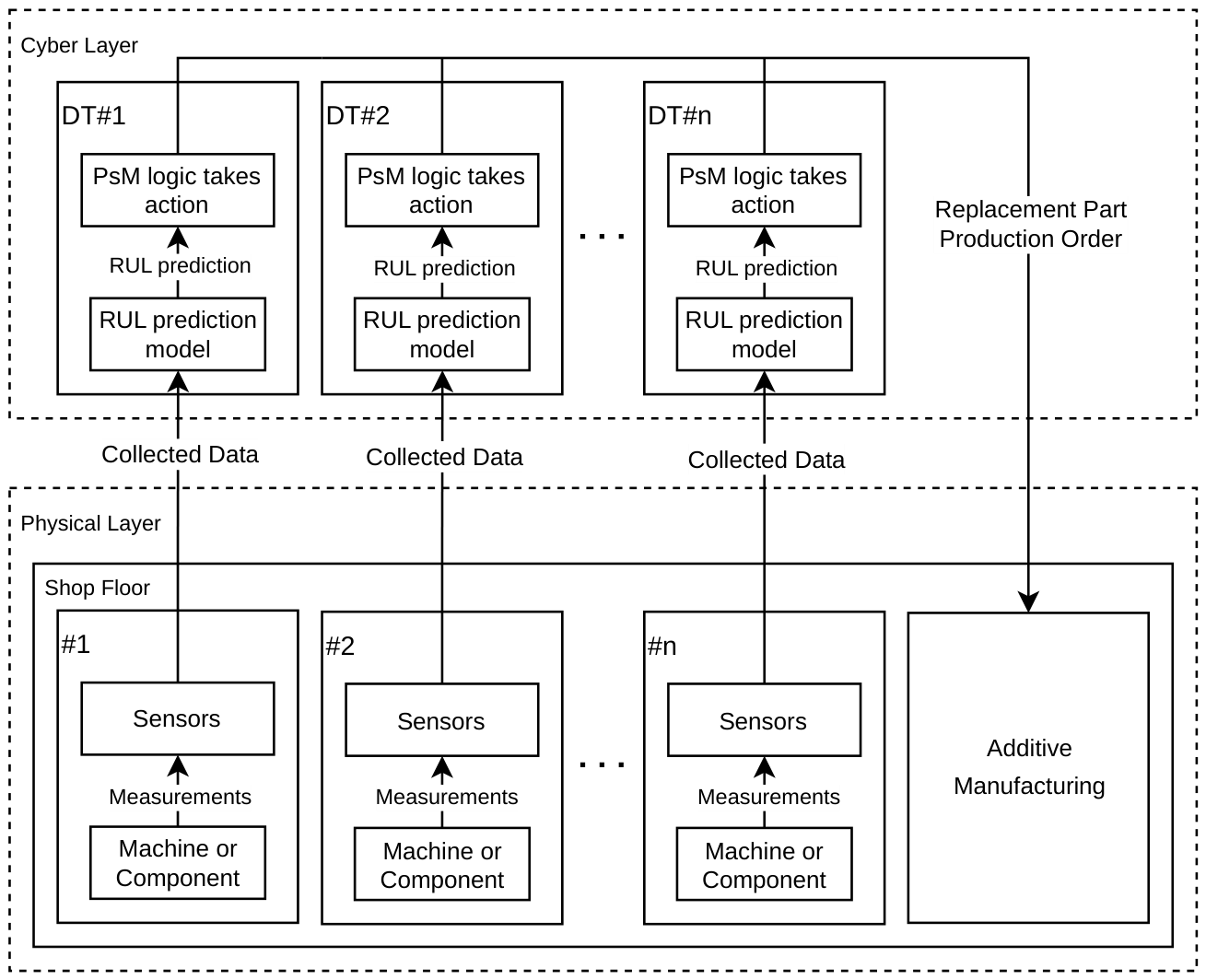
Figure 2.
Photographs of the experimental testbed: (a) the three EEZYbotARM Mk2 arms featuring distinct vibration sensors (ADXL345, piezoelectric sensor, and MPU9250 attached to Arms #1–#3, respectively); (b) the Ender-3 S1 Pro 3D printer and the Raspberry Pi that hosts the OctoPrint and DINASORE instances.
Figure 2.
Photographs of the experimental testbed: (a) the three EEZYbotARM Mk2 arms featuring distinct vibration sensors (ADXL345, piezoelectric sensor, and MPU9250 attached to Arms #1–#3, respectively); (b) the Ender-3 S1 Pro 3D printer and the Raspberry Pi that hosts the OctoPrint and DINASORE instances.
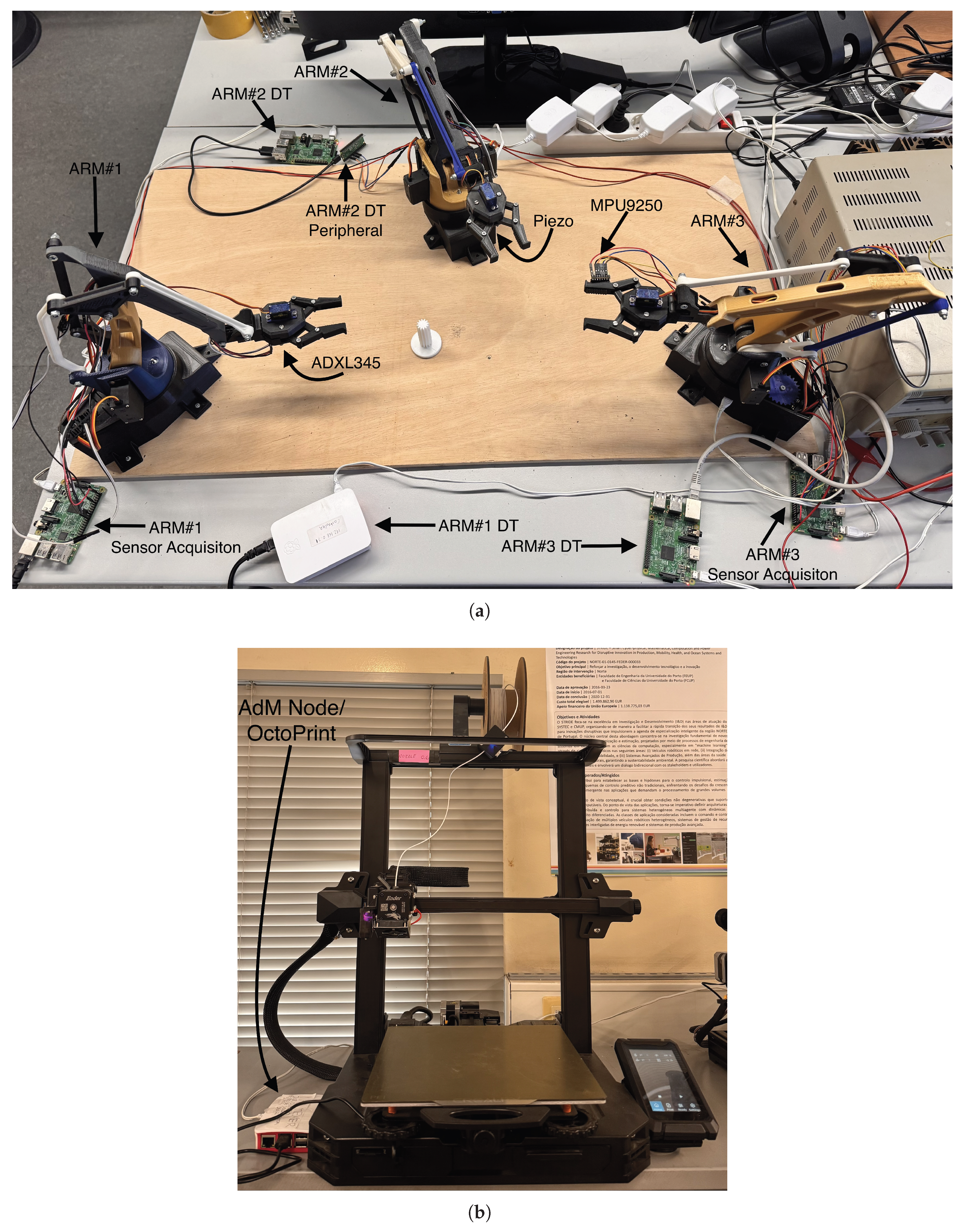
Figure 3.
Proposed architecture adapted to the testbed.
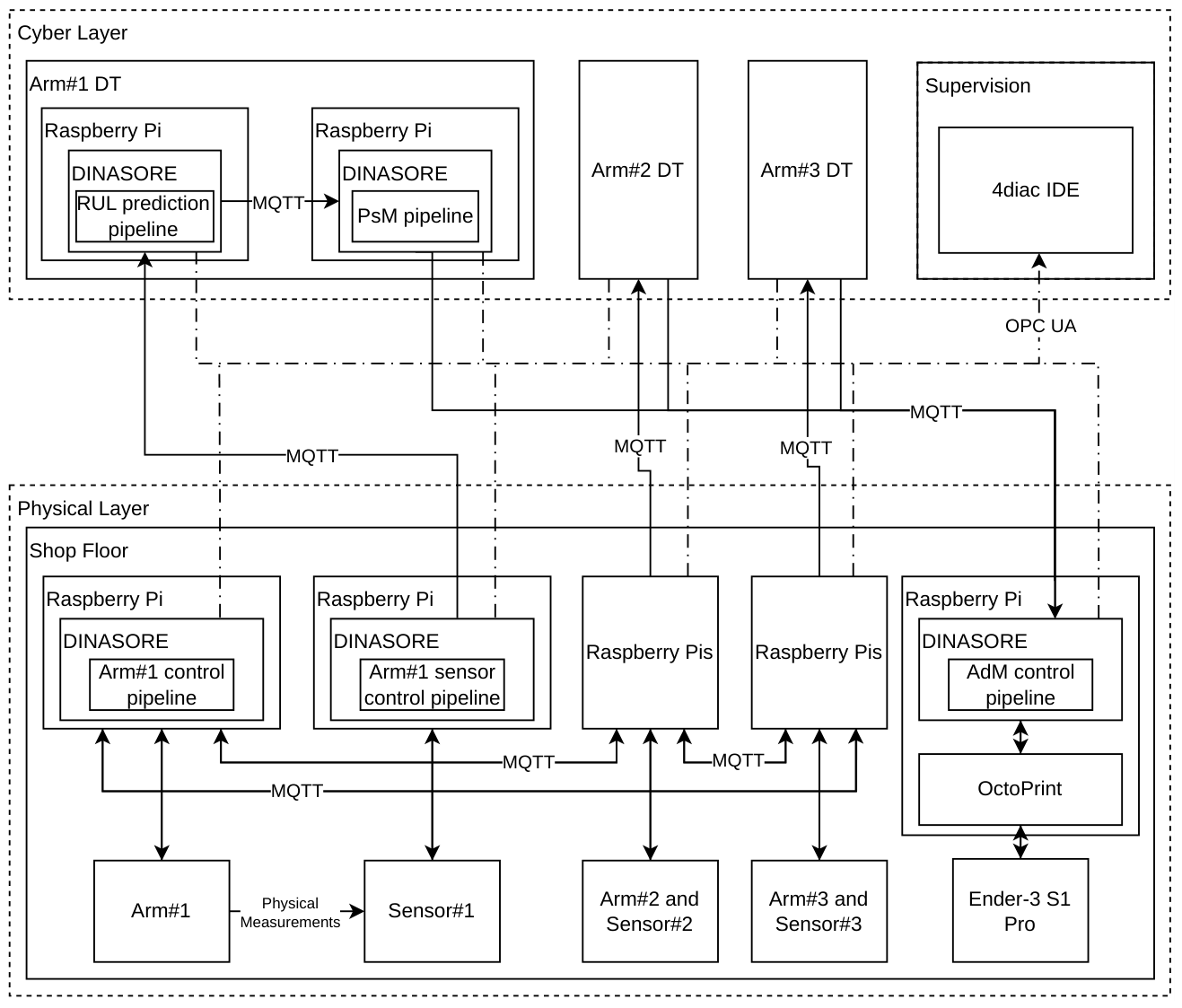
Figure 4.
Predicted versus ground-truth HI trajectories on the held-out test set for the ADXL per-arm RUL model.
Figure 4.
Predicted versus ground-truth HI trajectories on the held-out test set for the ADXL per-arm RUL model.
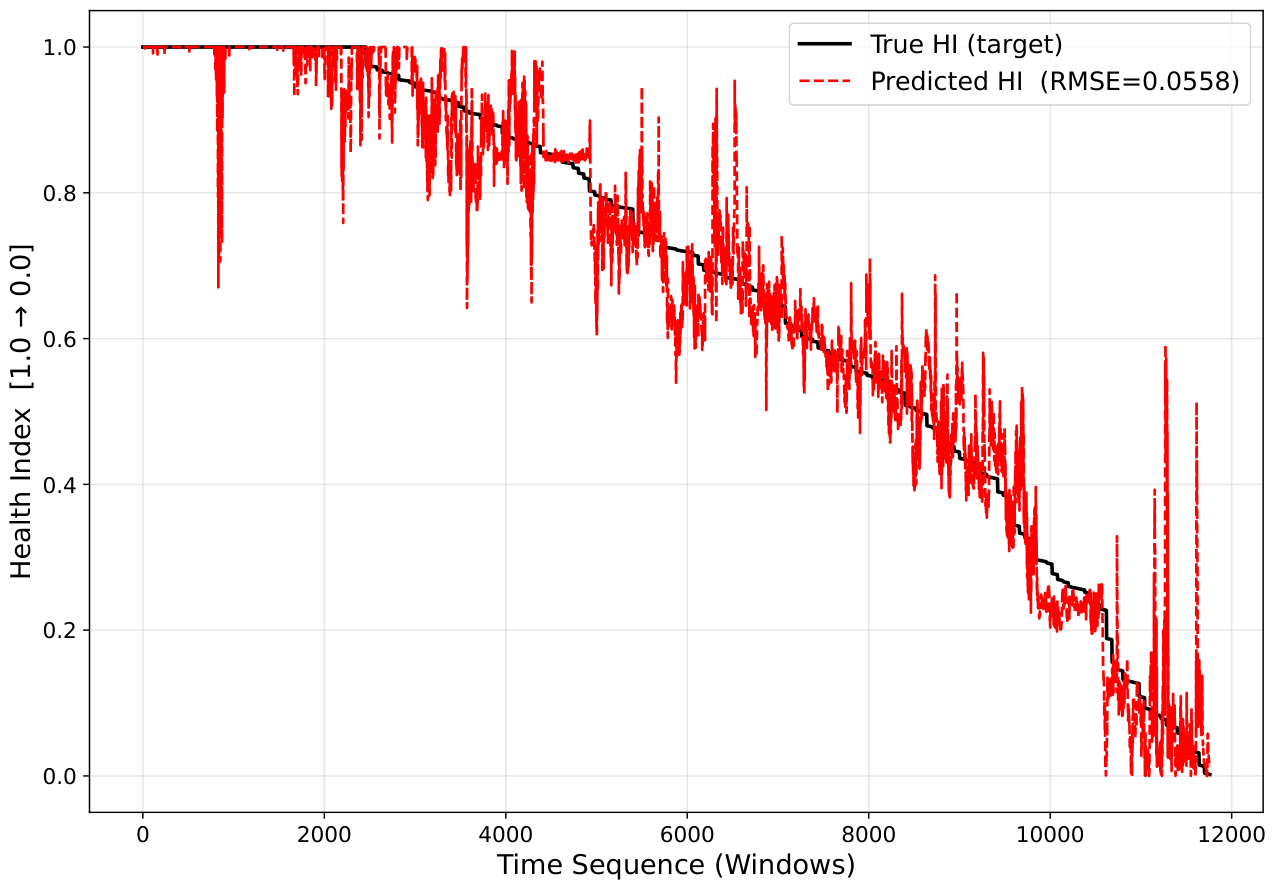
Figure 5.
Predicted versus ground-truth HI trajectories on the held-out test set for the PIEZO per-arm RUL model.
Figure 5.
Predicted versus ground-truth HI trajectories on the held-out test set for the PIEZO per-arm RUL model.
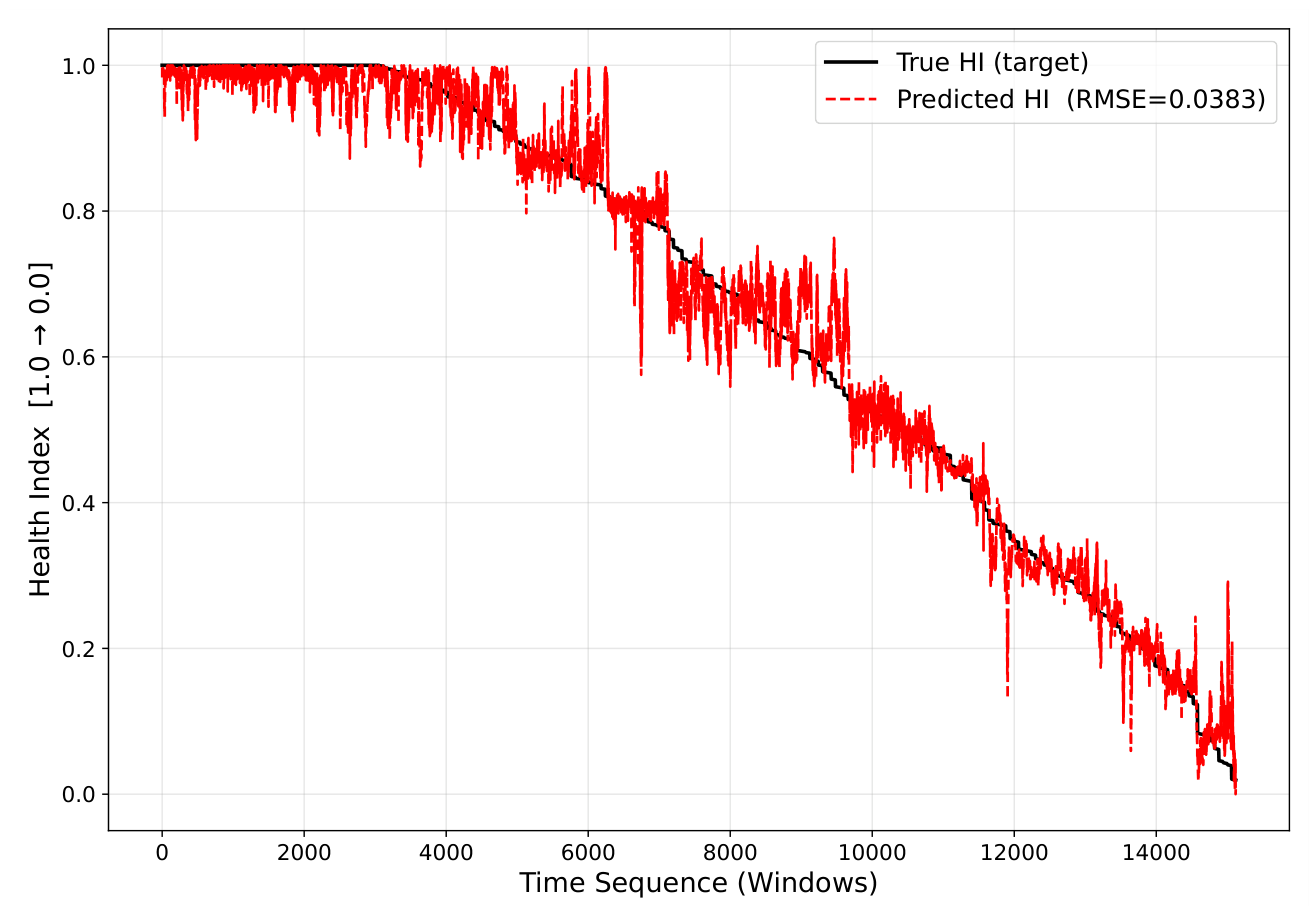
Figure 6.
Predicted versus ground-truth HI trajectories on the held-out test set for the MPU per-arm RUL model.
Figure 6.
Predicted versus ground-truth HI trajectories on the held-out test set for the MPU per-arm RUL model.
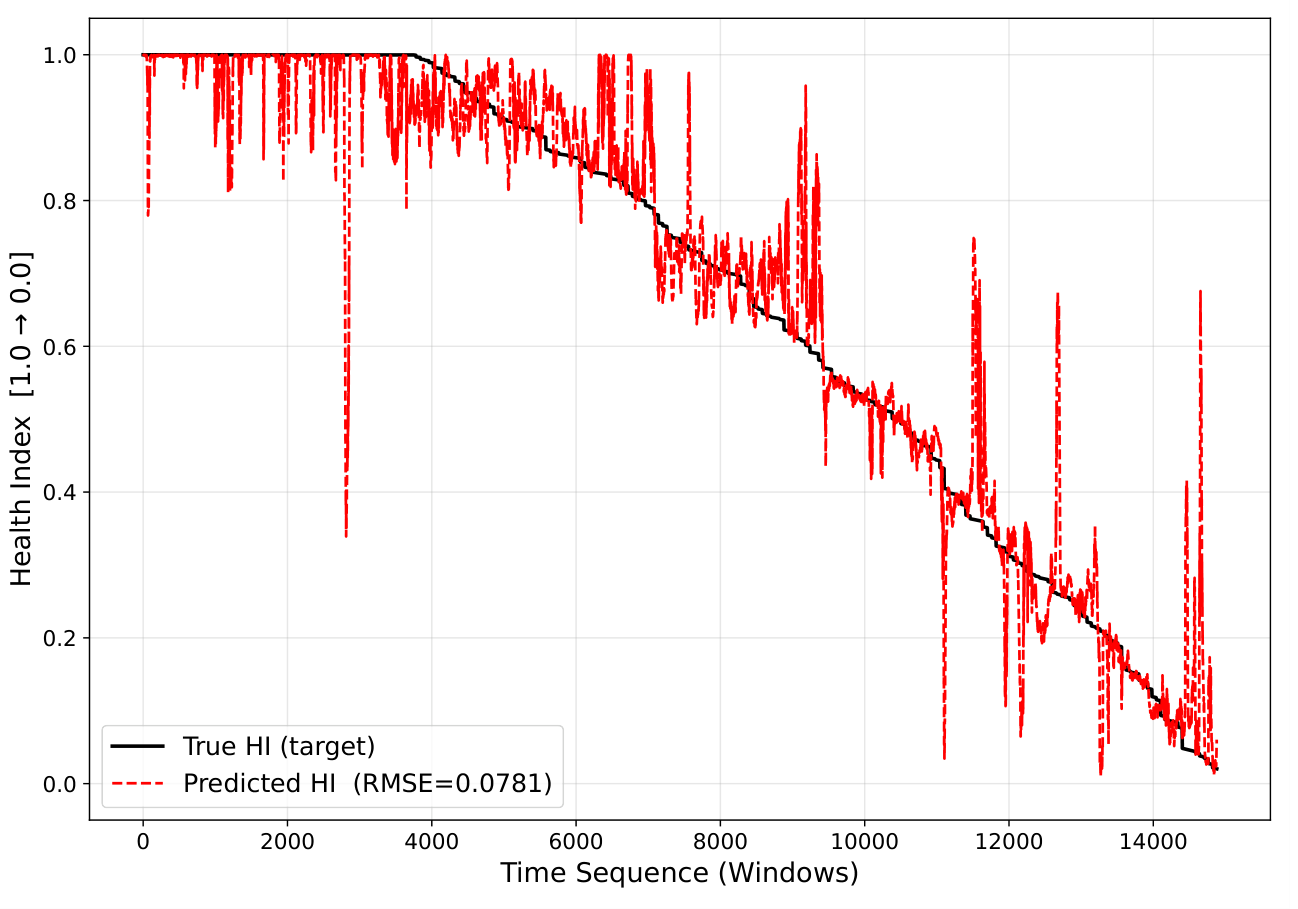
Table 1.
Positioning of representative related work across the capabilities required for an IIoT-enabled autonomous maintenance loop.
Table 1.
Positioning of representative related work across the capabilities required for an IIoT-enabled autonomous maintenance loop.
| Reference(s) | PdM/RUL | DT/PsM | CPPS | AdM |
|---|---|---|---|---|
| Khan et al. [7] | Partial | Yes | No | No |
| Barrero-Arciniegas et al. [2] | Partial | Yes | No | No |
| Orošnjak et al. [5] | Yes | Yes | No | No |
| Mallioris et al. [13] | Yes | Yes | No | No |
| Azeta et al. [6] | Partial | No | No | Yes |
| Bouyahrouzi et al. [8] | Partial | No | No | Yes |
| Molęda et al. [14] | Partial | No | No | Yes |
| Prenzel and Steinhorst [11] | No | No | Yes | No |
| Leitão et al. [12] | No | No | Yes | No |
| This work | Yes | Yes | Yes | Yes |
Note: “Partial” indicates that a capability is discussed as motivation or context without being directly implemented or empirically validated.
Table 3.
Distributed control and sensor-data acquisition results.
| Metric | Arm 1 | Arm 2 | Arm 3 | Overall |
|---|---|---|---|---|
| Control hand-off cycles | – | – | – | 84 |
| Successful control cycles | – | – | – | 100 |
| Mean cycle duration (s) | – | – | – | 43.65 ± 0.02 |
| Max cycle jitter (s) | – | – | – | 0.14 |
| Mean coordination latency (ms) | – | – | – | 12.4 ± 3.8 |
| Max coordination delay (ms) | – | – | – | 114 |
| Mean MQTT jitter (ms) | ± 1.7 | ± 2.23 | ± 4.57 | – |
| Max MQTT jitter (ms) | – | |||
| Sensor link | MQTT | Serial | MQTT | – |
| Mean sensor jitter (ms) | 3.96 | n/a | 13.41 | – |
| Packet loss (%) | n/a | – | ||
| Samples lost (%) | – | |||
| Longest observed gap (s) | 0.246 | 0.695 | 0.910 | – |
Table 4.
Health-estimation performance against the constructed HI trajectories on the held-out test sets.
Table 4.
Health-estimation performance against the constructed HI trajectories on the held-out test sets.
| Arm | Sensor | RMSE | MAE | PHM-2012 |
|---|---|---|---|---|
| 1 | ADXL345 | 0.0334 | 0.0225 | 0.9894 |
| 2 | Piezoelectric | 0.0456 | 0.0281 | 0.9950 |
| 3 | MPU9250 | 0.0838 | 0.0420 | 0.9833 |
Table 5.
Autonomous replacement-part triggering results.
| Arm | Trials | Event fired | Event received | Print started | Mean latency (ms) | (ms) |
|---|---|---|---|---|---|---|
| 1 | 30 | 30/30 | 30/30 | 30/30 | 350 | 98 |
| 2 | 30 | 30/30 | 30/30 | 30/30 | 339 | 83 |
| 3 | 30 | 30/30 | 30/30 | 30/30 | 388 | 109 |
Table 6.
End-to-end system validation results.
| Trial | Time to threshold crossing | Response time | Manual intervention |
|---|---|---|---|
| 1 | 1642 | 224 | No |
| 2 | 1715 | 231 | No |
| 3 | 1608 | 219 | No |
Disclaimer/Publisher’s Note: The statements, opinions and data contained in all publications are solely those of the individual author(s) and contributor(s) and not of MDPI and/or the editor(s). MDPI and/or the editor(s) disclaim responsibility for any injury to people or property resulting from any ideas, methods, instructions or products referred to in the content. |
© 2026 by the authors. Licensee MDPI, Basel, Switzerland. This article is an open access article distributed under the terms and conditions of the Creative Commons Attribution (CC BY) license (http://creativecommons.org/licenses/by/4.0/).
Copyright: This open access article is published under a Creative Commons CC BY 4.0 license, which permit the free download, distribution, and reuse, provided that the author and preprint are cited in any reuse.