

Submitted:
29 September 2026
Posted:
30 September 2026
You are already at the latest version
Abstract
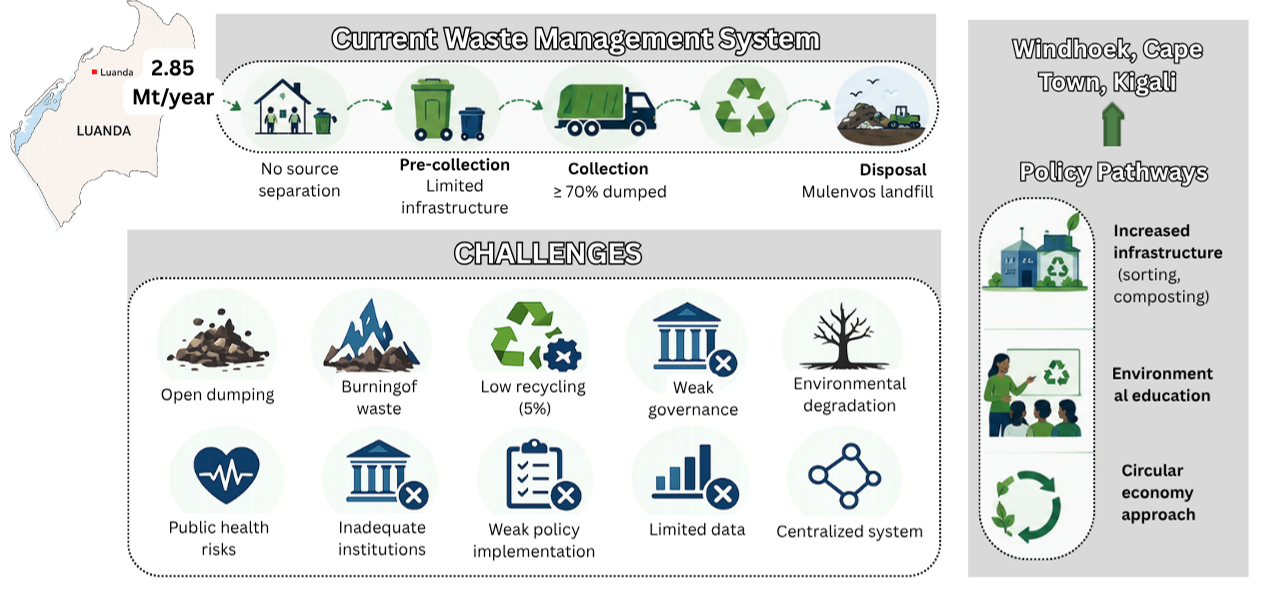
Municipal solid waste management (MSWM) remains a major environmental and public health challenge in rapidly urbanising cities in sub-Saharan Africa. This study provides a comprehensive analysis of MSWM in Luanda, Angola, focusing on institutional, regulatory, and operational dimensions across the waste management chain. The analysis is based on secondary data from official, technical, and academic sources covering waste generation and composition, pre-collection, collection and transport, recycling, final disposal, and governance. Luanda is also compared with Windhoek (Namibia), Cape Town (South Africa), and Kigali (Rwanda), which have more structured MSWM systems. The results indicate that Luanda generates approximately 2.85 million tonnes of municipal solid waste annually, while collection services reach around 70% of the population. Major deficiencies in pre-collection, infrastructure, and service coverage contribute to widespread uncontrolled dumping, burning, and burial of waste. Recycling remains limited and is largely driven by informal waste pickers. Key challenges include institutional fragmentation, insufficient infrastructure, weak policy implementation, and low public awareness. The study identifies opportunities for urban reorganisation, investment in treatment infrastructure, waste picker inclusion, environmental education, and institutional decentralisation.
Keywords:
municipal solid waste management
; environmental policy
; urban governance
; sub-Saharan Africa
; waste pickers
1. Introduction
The increase in municipal solid waste (MSW) generation represents a major environmental and policy challenge globally, despite progress in waste management and public policy in recent decades [1,2,3]. In 2022, the world population exceeded 8 billion [4], generating an estimated 2.01 billion tonnes of MSW annually [2,5,6,7].
Sub-Saharan Africa, home to more than 1.2 billion people [4,8,9], faces acute structural and governance challenges in MSW management (MSWM). In 2016, the region generated over 174 million tonnes of MSW, with an average rate of 0.46 kg/inhabitant/day [6,10]. Waste composition is characterised by a predominance of organic waste (57%), followed by plastics (13%), paper and cardboard (9%), glass (4%), metals (4%) and unsorted waste (13%), [11].
Despite some advances, many cities in developing economies—particularly in Africa—continue disposing of waste in streets, watercourses, drainage systems, and unregulated landfills, with open burning and burial remaining common [5,12]. High poverty levels compel individuals, including children, to engage in informal waste collection for subsistence. This activity has been partially formalised in some contexts through cooperatives, non-governmental organisations (NGO) and local integration policies within MSWM systems [13]. However, inadequate MSWM continues to generate serious environmental degradation and public health risks, including diseases such as cholera and malaria [12,14,15].
Despite the growing body of research on MSWM in developing countries, limited attention has been paid to integrated analyses linking operational performance with institutional, regulatory, and policy frameworks [5,6], constraining understanding of governance impacts.
Against this backdrop, Luanda—Angola’s capital and largest urban centre—represents a critical case. Persistent deficiencies in MSWM have compromised environmental quality and public health. MSW generation is linked to rapid urban growth [16,17], the expansion of informal settlements lacking sanitation, and migration [17].
Luanda generates approximately 6.3 million tonnes of waste annually, of which 45% (2.85 million tonnes) corresponds to MSW [18], with a per capita rate of 0.75–0.78 kg/inhabitant/day [17,18]. MSWM performance remains limited. A shortage of containers in pre-collection leads to widespread dumping, burning and burying [19,20,21]. Although collection services reach around 70% of the population, significant areas remain unserved, and landfilling is the predominant disposal method.
Despite environmental policies aligned with the Sustainable Development Goals (SDGs), Angola has achieved limited progress in MSWM [18], particularly in Luanda, where governance limitations, infrastructure deficits and weak policy implementation constrain integrated system development [17].
This study provides a comprehensive, policy-oriented assessment of MSWM in Luanda by analysing regulatory, institutional and operational practices across the waste management chain. It also situates Luanda within the sub-Saharan context through comparison with Windhoek, Cape Town, and Kigali. By integrating operational and governance dimensions, the research contributes to understanding MSWM challenges and provides policy-relevant insights for more sustainable and inclusive systems.
2. Materials and Methods
This article is based on a descriptive approach aimed at synthesising and contextualising the available information on MSWM in the city of Luanda. The study draws on the analysis of secondary data, including regulations and public policies on waste management and environmental protection, relevant scientific literature, technical reports, publications by non-governmental organisations and newspaper articles (used to complement the limited information available from official sources).
Information on the regulatory and institutional framework, as well as on waste generation, pre-collection, collection and transport, and final disposal systems, was obtained from various sources considered reliable at both national and international levels. These include documents and reports produced by the National Waste Agency (ANR), the United Nations Development Programme (UNDP), the Catholic University of Angola (UCAN), the Luanda Public Cleaning and Sanitation Company (ELISAL), the Japan International Cooperation Agency (JICA), and the Agência Angola Press (ANGOP), as the official media outlet of the Angolan State. These sources were selected based on their credibility, relevance, and contribution to a comprehensive understanding of the MSWM system in Luanda.
The gathered data was subjected to a thorough analysis, enabling the identification of systemic challenges and opportunities for improvement. The methodological approach acknowledges the constraints associated with data availability and the institutional fragmentation that characterise many urban contexts in sub-Saharan Africa. These limitations were addressed by cross-checking information from multiple sources and by situating the analysis of Luanda within comparable urban contexts in the region.
More specifically, the methodological approach follows a sequential and critically oriented analytical structure. First, the study examines waste generation and composition in Luanda, together with current MSWM practices across the different stages of the system, with the aim of critically assessing the existing situation and identifying key shortcomings and gaps that require attention. Subsequently, the analysis focuses on the institutions and organisations responsible for MSWM, as well as on public policies related to waste management and environmental protection. The study then reviews MSWM experiences implemented in other sub-Saharan African cities, which serve as a comparative reference. Finally, based on this integrated and critical analysis, a set of improvement opportunities for municipal solid waste management in Angola are identified, with potential applicability to other cities facing similar urban and institutional conditions. Figure 1 presents a schematic representation of the methodology adopted in this study.
3. Results
3.1. Generation, Classification and Composition of MSW
The generation stage represents the starting point of the MSWM system. In Angola, its characterisation is constrained by the scarcity of specific studies and the limited availability of official data, especially at the local level, leading to discrepancies among sources.
According to earlier estimates, in 2014 Angola generated approximately 3.5 million tonnes of waste per year, of which around 1.3 million tonnes corresponded to Luanda, with a generation rate of 0.75–0.80 kg per inhabitant per day [22]. More recent data from the National Waste Agency indicate an increase to approximately 25 million tonnes annually nationwide, 25% generated in Luanda (around 6.3 million tonnes). Of this total, 45% corresponds to municipal solid waste (about 2.9 million tonnes), while the remainder includes hospital (8%), industrial (15%), construction and demolition (12%), and unsorted waste (20%) [18].
Discrepancies are also evident in daily generation estimates. While ANGOP reports 6,000 tonnes per day [23,24], JICA estimates 9,133 tonnes [25]. However, per capita values converge between 0.75 and 0.78 kg per inhabitant per day [17,18], highlighting the need to strengthen data collection and monitoring for more reliable planning.
The composition of MSW is closely linked to economic development and consumption patterns. Low- and middle-income countries, including sub-Saharan Africa, tend to show higher organic fractions [5,6,26]. In Luanda, organic waste accounts for approximately 25%, followed by paper and cardboard (16%), plastics (15%), glass (6%), metals (7%), and unsorted waste (31) [27]. This composition has implications for management options, particularly for organic recovery and the limitations posed by low source separation.
3.2. Current MSWM System in Luanda
Comprehensive MSWM constitutes a fundamental component of environmental protection and public health, as inadequate waste handling remains a key vector for the transmission of infectious diseases, particularly in urban contexts with insufficient infrastructure [28]. In many developing countries, waste management systems face constraints related to limited financial resources, low public awareness, and deficiencies in governance and institutional capacity [15].
In general terms, waste management encompasses a set of operations covering the entire life cycle of waste, from generation to final disposal, prioritising prevention, reuse, recycling, and recovery over disposal. These operations include pre-collection, collection and transport, treatment, and final disposal, and require coordinated involvement from public and private stakeholders.
However, in Luanda, these stages lack an integrated approach, as waste is predominantly managed in a non-segregated state and disposed of directly in landfills or open dumpsites.
3.2.1. Pre-Collection
The waste storage and containerisation system in Luanda is highly deficient. Current regulations do not explicitly define the types of containers or bags to be used, resulting in heterogeneous and largely informal practices. Consequently, waste is generally deposited in a mixed and undifferentiated manner at both household level and communal collection points [17,29], typically in containers placed on pavements or other designated areas. In several neighbourhoods, containers are insufficient or absent, and pre-collection services are not regularly provided [20,29,30]. These limitations are worsened by the lack of regular cleaning and sanitisation, increasing health risks for the surrounding population.
Two main types of containers are used in the city: 1.1 m³ rear-loading containers, mainly in central areas, and 5 m³ containers, primarily in peripheral and semi-rural areas [31].
Inadequate pre-collection practices are not limited to urban areas. According to the 2016 Social Report on Angola by the Catholic University of Angola [22], nationally 59% of waste is disposed of in uncontrolled dumps, 31% in containers, 6% is buried, and 4% burned in urban areas. In rural areas, the situation is more critical, with 87% of waste deposited in uncontrolled dumps, 8% buried, 4% burned, and only 1% disposed of in containers. More recent data confirm that six out of ten people in urban areas and nine out of ten in rural areas dispose of waste in open spaces [20], a practice particularly widespread in Luanda due to high population density and its role as the country’s main commercial and industrial centre.
Overall, waste separation at source is not systematically carried out in the city [17,29], significantly limiting opportunities for recycling and recovery. Regarding collection, although [32] reports daily services, other sources indicate that frequency remains insufficient relative to waste volumes, contributing to accumulation in public spaces [16,20,33].
3.2.2. Collection and Transport
The collection and transport of municipal solid waste (MSW) constitute one of the main operational challenges of the municipal solid waste management (MSWM) system in Luanda. This situation is exacerbated by the presence of informal settlements characterised by narrow, unpaved streets with limited accessibility for large collection vehicles (Figure 2). These settlements are also marked by severe deficits in basic infrastructure, including sanitation, housing, education, public health services, drinking water supply, and electricity, representing major urban challenges in the country’s capital [17,34,35].
Collection and transport services cover approximately 70% of the population [25], meaning that a substantial share lacks regular access. Waste is collected in a mixed form, without separation at source, limiting recycling and material recovery [17,29,33]. The predominant vehicles are rear-loading compactor trucks with a capacity of around 21 m³. The public company ELISAL operates 162 vehicles of this type [31,36]. In peripheral and hard-to-reach areas, alternative methods are used, including motor scooters provided to cooperatives involved in MSW collection [37].
Once collected, MSW is transported to the Mulenvos landfill, the only formal final disposal facility serving both Luanda and the country [16,17,33,39]. Services operate under a shared model involving ELISAL and six private operators, as shown in Table 1 [40]. While this arrangement aims to expand coverage, it also creates challenges related to coordination, continuity, and overall efficiency.
3.2.3. MSW Recycling in Luanda
Recycling levels in sub-Saharan Africa remain generally very low, with average rates between 4% and 5%, reflecting structural limitations in MSWM systems across the region [6,42,43]. In the city of Luanda, recycling activities are still incipient and highly fragmented.
According to various institutional sources, several recycling companies operate in the city, most of them small-scale; however, there is no accurate or consolidated information confirming whether all are legally authorised [29,33,44,45]. Consequently, recycling rate estimates vary considerably depending on the source, with [25] estimating approximately 5%, in contrast to organisations such as [20].
A central component of recycling in Luanda is the informal collection of recyclable materials by waste pickers, locally known as “catadores”. This group includes young people, older adults, and sometimes children, operating individually or in small groups under precarious conditions, without formal recognition or adequate protection (Figure 3). Catadores collect materials from bins, containers, and landfill sites, which are then sold to recycling companies for subsistence [27,45,46,47,48].
The activities of the “catadores” are further constrained by social stigmatisation and the absence of comprehensive policies for regulation and social inclusion. Although some organisations have promoted training and capacity-building programmes for waste pickers linked to existing recycling cooperatives [49,50,51,52], these initiatives remain insufficient to consolidate a formalised recycling system. As a result, recycling activities remain predominantly informal, making it difficult to estimate actual recycled volumes and limiting effective integration into the formal MSWM system [51].
3.2.4. Final Disposal of MSW in Luanda
Most of the waste generated in the city of Luanda is disposed of directly at the Mulenvos landfill without prior treatment [16,17,20,33,39]. Access to the Mulenvos landfill is particularly challenging, especially during the rainy season, affecting the continuity and efficiency of disposal operations [53,54]. The landfill was designed with an estimated operational lifespan extending until 2030 and a projected daily capacity of approximately 2,500 tonnes [48]. Nevertheless, it currently receives more than 200,000 tonnes per month, significantly exceeding its intended capacity [17]. Estimates of disposed waste are based on vehicle entry records, providing only an indirect approximation of actual generation levels [17].
The current condition of the Mulenvos landfill poses serious risks to public health and the environment due to excessive MSW accumulation and limited operational controls [16,39]. Accumulated waste and stagnant water promote the proliferation of disease vectors such as mosquitoes and rodents, responsible for transmitting endemic diseases. Among these, malaria remains a leading cause of morbidity and mortality in Angola [55,56]. In addition, deficiencies in sanitation and MSWM have contributed to recurrent cholera outbreaks, including those in 2011, 2016–2017, and the current outbreak, which has resulted in a high number of cases and fatalities in Luanda [35,39,48,57,58,59].
Basic sanitation and MSWM deficiencies remain key determinants in the spread of infectious diseases in Angola. The link between inadequate environmental conditions and health risks is reflected in the disease burden associated with these factors. In this context, inadequate waste management represents not only an environmental concern but also a structural public health challenge. The main associated diseases include malaria (74%), malnutrition (8%), acute respiratory infections in children under five years of age (7%), typhoid fever (5%), and conventional tuberculosis (3%). Additionally, acute respiratory diseases in individuals over five years (1%), HIV/AIDS (1%), and cases related to tuberculosis and HIV/AIDS testing (1%) are reported. These figures highlight the impact of environmental deficiencies on national morbidity patterns [22].
3.3. Public Policies and Institutional Framework for MSWM
From a legal and policy perspective, environmental protection in Angola is primarily grounded in the Constitution of the Republic of Angola (CRA). In particular, Article 21(m) establishes that promoting harmonious and sustainable development, while ensuring environmental and natural resource protection, is a fundamental duty of the State. Furthermore, Article 39 recognises the right of every person to live in a healthy and unpolluted environment, while also imposing on citizens the duty to preserve it and on the State the obligation to adopt measures to protect biodiversity and national ecosystems [60].
On this constitutional basis, a broad set of laws, regulations, decrees, and public policies related to municipal solid waste management (MSWM) and environmental protection has been developed. These instruments constitute the regulatory framework guiding planning, implementation, and oversight of waste management actions at national and subnational levels. At the national level, MSWM policy in Angola is defined by public entities including the Ministry of the Environment (MINAMB), the National Waste Agency (ANR), the Environmental Development Agency (ADA), and provincial governments. MINAMB formulates national environmental and MSWM policies, while ANR is responsible for approving, supervising, and monitoring waste management plans, as well as certifying and inspecting waste and wastewater operators. Table 2 summarises the main legal instruments currently in force in Angola [18].
In parallel, the United Nations Development Programme (UNDP) in Angola is implementing a community-based project aimed at raising awareness of waste management issues and reducing single-use plastics, promoting behavioural change and citizen participation within MSWM [61].
Despite these efforts, the effectiveness of public policies remains limited by the lack of up-to-date, reliable, and systematised official data at both national and local levels [10,29,33]. This gap hinders the formulation of realistic strategies and constrains evaluation of policy impacts.
Regarding institutional roles, provincial governments act as intermediaries between national guidelines and local implementation, adapting strategic plans to municipal contexts and coordinating their execution [18]. In Luanda, MSWM falls under the responsibility of the Provincial Government of Luanda (GPL), which operates primarily through the public company ELISAL [36,62,63].
As a public company, ELISAL manages municipal solid waste (MSW) in several municipalities, including operation of the Mulenvos landfill. However, activities are shared with the private sector; currently, seven companies operate in Luanda, one public (ELISAL) and six private [40,55,64]. While this mixed arrangement aims to improve service provision, it also introduces challenges related to coordination, supervision, and operational consistency.
The ADA complements this framework through initiatives focused on environmental awareness and education, including campaigns promoting appropriate waste management practices [18]. Their effectiveness, however, depends on alignment with operational services and available institutional capacity at the local level.
3.4. MSWM Experiences in Sub-Saharan African Cities
In the global context, numerous cities have developed research initiatives, technological solutions, and public–private policy frameworks aimed at promoting integrated waste management systems, within the broader transition from linear models to circular economy approaches [65]. These strategies emphasise waste prevention, resource efficiency, recycling, and recovery, while fostering collaboration among public authorities, private operators, and communities [6,66,67]. Recent studies highlight that successful implementation of circular waste management depends not only on technology, but also on coherent regulatory frameworks, stable governance, and inclusive public–private partnerships [68]. Although many advances have been consolidated in developed countries, relevant experiences have also emerged in sub-Saharan Africa, despite significant socio-economic, institutional, and urban constraints.
This section presents a comparative analysis of waste management in Luanda and other sub-Saharan African cities with different levels of institutionalisation, service coverage, and performance. This perspective allows Luanda’s situation to be situated within the regional context and to draw lessons from cities facing diverse structural conditions.
The selected cities—Windhoek (Namibia), Cape Town (South Africa), and Kigali (Rwanda)—exhibit distinct trajectories in planning, governance, service coverage, and infrastructure. These cases allow identification of similarities and contrasts with Luanda, as well as factors explaining differences in operational efficiency, financial sustainability, and circular economy practices.
The analysis is organised on a case-by-case basis, addressing key MSWM components in each city, including institutional frameworks, infrastructure, collection and transport, service coverage, and recycling practices. Rather than establishing a hierarchy, this comparison aims to improve understanding of the structural challenges and opportunities for improving MSWM in Luanda.
3.4.1. City of Windhoek, Namibia
The city of Windhoek, the capital of Namibia—a country that shares a land border with Angola—has a more structured MSWM system than the city of Luanda. Waste management responsibilities lie with the Department of Municipal Waste (DGRM), which operates under the Windhoek Department of Infrastructure, Water and Waste Management (DIAGRW) and is responsible for the comprehensive provision of waste management services, with the participation of the private sector. At the national level, environmental protection falls under the mandate of the Ministry of Environment and Tourism [69,70].
From an infrastructure perspective, Windhoek has developed a diversified network of waste management facilities, including recycling and incineration plants, seven satellite landfills, a hazardous waste landfill, two transfer stations, and a treatment centre [70,71]. In addition, the city has extensive coverage of waste containerisation systems, comprising approximately 52,000 240-litre containers, 376 wheelie bins, bags for peripheral and semi-rural areas, and 822 public litter bins distributed across the urban area [70].
With an estimated population of approximately 461,000 inhabitants [72], Windhoek generates around 7,000 tonnes of municipal solid waste per month, equivalent to about 233 tonnes per day. Collection and transport services are provided on a regular weekly basis using rear-loading compactor trucks with a capacity of approximately 22 m³, complemented by smaller vehicles with capacities of around 10 m³ [70,73].
Service coverage reaches close to 100% in formal areas of the city, while in informal settlements it is estimated at around 30%. This highlights the persistence of internal inequalities, although at a markedly lower level than those observed in Luanda. The system for charging collection fees operates effectively and contributes to the financial sustainability of the MSWM system. Moreover, waste separation is implemented in certain contexts, such as markets, commercial establishments, industrial areas, and some households, facilitating recycling activities.
Despite the availability of infrastructure and source separation mechanisms, recycling rates in Windhoek remain relatively low, ranging between 2% and 5% [70,73]. These values are consistent with regional averages for sub-Saharan Africa [6,42,43], indicating that while Windhoek’s MSWM system is more organised and has broader coverage than that of Luanda, recycling continues to represent a structural challenge shared across the region.
3.4.2. Cape Town, South Africa
Cape Town, South Africa, has one of the most advanced MSWM systems on the African continent. Responsibility for waste management lies with the City of Cape Town, which coordinates all stages of the system, from pre-collection and collection and transport to transfer, treatment, and final disposal. Service provision is supported by the participation of private sector operators under municipal oversight [69].
With a population exceeding 4.7 million inhabitants [69,74], the city generates more than 1.7 million tonnes of waste per year. The MSWM system is underpinned by a robust regulatory and planning framework, centred on the National Environmental Management: Waste Act No. 59 of 2008, complemented by integrated waste management plans at national, provincial, and municipal levels. These instruments promote waste prevention, source separation, recycling, and the diversion of waste towards circular economy-oriented models [75,76].
The system incorporates differentiated economic instruments, with specific collection fees applied to the domestic, commercial, and industrial sectors, while households classified as indigent receive the service free of charge. In urban areas, households are provided with 240-litre containers equipped with radio-frequency identification (RFID) systems, which facilitate operational monitoring and service control [69].
From an infrastructure perspective, Cape Town has an extensive network of transfer and material recovery facilities, nine organic waste treatment plants—including composting and biogas facilities—and three authorised landfills [75,76]. South Africa also has a well-established plastics recycling industry, with only around 2% of plastic waste managed outside the country. In Cape Town, waste separation rates for recycling range between 22% and 23%, significantly higher than regional averages [69,75].
The system is further reinforced by a comprehensive environmental communication and education programme focused on sustainable development, targeting residents, businesses, and visitors through schools, communities, and public spaces [69]. In addition, several specific initiatives have been implemented to promote waste diversion, including Think Twice (voluntary source separation), Drop Off (voluntary delivery of recyclables), domestic and community composting programmes, and Buy Back Centres, which incentivise recycling by allowing waste to be exchanged for food vouchers [77].
3.4.3. City of Kigali, Rwanda
Waste management in the city of Kigali, the capital of Rwanda, is characterised by a highly regulated model with strong institutional oversight. The Regulatory Authority for Utilities (RURA), in coordination with other state agencies, is responsible for guiding MSWM policies, while the City of Kigali and its districts manage contracts with private companies responsible for waste collection and transport, as well as landfill operations [78,79,80,81].
Daily waste generation in Kigali is estimated to range between 400 and 800 tonnes, equivalent to approximately 292,000 tonnes of municipal solid waste per year, with per capita generation rates between 0.57 and 0.60 kg per day. The organic fraction represents the largest share of the waste stream, reflecting prevailing consumption patterns and household practices [78,80,82].
Collection and transport services are organised through a zoned system covering urban, peripheral, and rural or hard-to-reach areas. These services are provided exclusively by private operators under district-level coordination and supervision by RURA and other national agencies. Service coverage reaches approximately 88.7% of the population [82,83]. Regarding final destination, 52.3% of waste is disposed of in landfills, 35.5% is composted, and 7.24% is incinerated without energy recovery [82].
Waste collection follows a mixed schedule, with weekly collection from households and daily collection from public spaces, and lower service frequencies observed in rural areas compared to urban zones. Waste is disposed of at the Nduba landfill, currently the only landfill in the country [80,82]. Rwanda also operates an electronic waste treatment facility; however, overall recycling rates remain relatively low [78].
A distinctive feature of the Kigali model is the mandatory community-based urban clean-up programme known as Umuganda, which takes place once a month and promotes direct citizen participation in maintaining urban cleanliness and environmental stewardship [80].
The experiences of Windhoek, Cape Town, and Kigali highlight the presence of stronger legal, institutional, and operational frameworks for integrated MSWM compared to the city of Luanda. These cities are frequently recognised among the cleanest urban environments on the African continent, reflecting greater policy continuity, clearer institutional responsibilities, and the application of more effective economic and regulatory instruments.
Nevertheless, despite these advances, common challenges persist across these systems, particularly with regard to limited efficiency in source separation and recycling and composting rates that remain relatively low. In addition, countries such as Rwanda and South Africa have adopted partial or total bans on single-use plastics, reflecting an increasing commitment to waste reduction strategies and the transition towards circular economy models [79,80,81,82,84].
Table 3 provides a comparative summary of the main components of the MSWM systems in Luanda, Windhoek, Cape Town, and Kigali, offering an integrated overview of similarities and differences across these urban contexts.
3.5. Main Challenges in MSWM
Previous studies indicate that MSWM in developing countries faces persistent structural and governance constraints, including infrastructure deficiencies, limited financial resources, inadequate service coverage, operational inefficiencies, reliance on obsolete technologies and equipment, inadequate final disposal practices, and the limited implementation of strategies aimed at waste reduction and material recovery [5,6].
In line with the above, the review of scientific literature and institutional documentation conducted in this study indicates that the MSWM system in the city of Luanda is affected by a set of interrelated structural, institutional, social, economic, and environmental challenges that constrain its operation and undermine its long-term sustainability. These challenges do not act independently but interact and reinforce one another, hindering the consolidation of an integrated management model aligned with the principles of the waste hierarchy and the circular economy, as well as weakening policy effectiveness.
The main challenges identified within the MSWM system in the city of Luanda are outlined below.
a) Uncontrolled urbanisation and occupation of unsuitable areas
One of the main challenges identified is the rapid and largely unplanned urban growth of the city of Luanda. The expansion of informal settlements has taken place mostly in the absence of adequate land-use planning and effective supervision by local authorities, reflecting broader governance limitations. As a result, many dwellings are located in environmentally fragile or otherwise unsuitable areas, which significantly hinders the provision of basic urban services, including MSWM.
These areas are characterised by severe deficits in sanitation infrastructure, road networks, and accessibility for collection vehicles, directly affecting service coverage and operational efficiency [17,34]. Consequently, waste accumulation in public spaces increases, exacerbating risks to public health and environmental quality.
b) Deficiencies in the pre-collection and collection and transport system
The pre-collection stage remains one of the weakest components of the MSWM system in Luanda. The insufficient number of containers, their uneven spatial distribution, and the absence of services in certain neighbourhoods contribute to the accumulation of waste in open spaces, favouring the proliferation of contamination sources.
In addition, limitations in the operational capacity of collection and transport services result in incomplete population coverage, estimated at around 70%, with the most significant service gaps observed in peripheral, rural, and hard-to-reach areas. In these contexts, poor road conditions—particularly during the rainy season—further constrain service frequency and regularity, undermining overall effectiveness and reflecting broader infrastructure and planning deficiencies.
c) Lack of infrastructure for comprehensive waste management
Another critical challenge is the lack of adequate infrastructure for waste treatment and recovery. The absence of sorting, recycling, composting, and material recovery facilities prevents progress towards a comprehensive and integrated waste management model, maintaining a near-total dependence on final disposal in landfills.
This structural limitation not only increases pressure on the Mulenvos landfill but also restricts opportunities for material recovery and the generation of environmental, social, and economic benefits associated with waste valorisation, limiting the transition towards circular economy approaches.
d) Increase in waste pickers and social vulnerability
Rising unemployment and poverty levels have contributed to an increase in the number of individuals and households relying on informal waste collection activities as a means of subsistence, reflecting broader socio-economic and policy gaps. This situation highlights the absence of inclusive public policies aimed at formalising, regulating, and providing social protection for this group.
Waste pickers operate under precarious conditions, without institutional recognition or access to basic occupational safety measures, exposing them to significant health and social risks. At the same time, although their activities contribute to material recovery, they remain largely disconnected from the formal MSWM system, limiting system efficiency.
e) Lack of environmental education and awareness campaigns
The review indicates that environmental education and public awareness campaigns related to waste management are insufficient and fail to effectively reach large segments of the population. In many neighbourhoods, particularly within informal settlements, information on appropriate waste management practices is either limited or entirely absent.
This shortcoming restricts citizen participation, hinders the adoption of responsible behaviours, and limits the feasibility of implementing measures such as source separation, waste reduction, and recycling initiatives, which are essential for effective policy implementation.
f) Deficits in public policy implementation and low regulatory compliance
Despite the existence of a relatively comprehensive legal and regulatory framework for MSWM, its implementation remains weak. Insufficient control, enforcement, and sanctioning mechanisms contribute to widespread non-compliance with existing laws and decrees, undermining system governance.
These institutional weaknesses translate into limited coordination across different levels of government and inconsistent application of public policies, reducing the overall effectiveness of the strategies designed and limiting their impact on system performance.
g) Administrative centralisation and resource management
Finally, administrative centralisation in decision-making processes, combined with limited transparency in the allocation and management of public resources, represents an additional challenge for MSWM. The concentration of authority hinders the adaptation of policies to local conditions and reduces the capacity of municipalities to respond effectively to operational problems.
The lack of decentralisation and clearly defined accountability mechanisms negatively affects resource efficiency, weakens local governance capacities, and compromises the long-term sustainability of waste management interventions.
3.6. Opportunities for Improvement in MSWM
According to [5], comprehensive MSWM is based on three interdependent components: (i) the technological or technical component; (ii) the sustainability component, which integrates social, political, institutional, financial, economic, and environmental dimensions; and (iii) the stakeholder component.
Building on the document review conducted, several opportunities for improvement have been identified which, if implemented progressively and in a context-adapted manner, could significantly strengthen the MSWM system in the city of Luanda and support its transition towards a more sustainable, inclusive, and policy-coherent model.
a) Urban reorganisation and provision of basic infrastructure
The evidence analysed indicates that strengthening the MSWM system in Luanda is closely linked to broader urban planning and governance processes. Local administrations need to assume a more active role in land-use regulation and urban supervision, promoting targeted development models that facilitate the gradual structural reorganisation of neighbourhoods.
This process should ensure progressive access to basic infrastructure and services, including sanitation systems, drinking water networks, electricity, healthcare, education, and formal waste collection and transport services. Urban reorganisation would help to limit the expansion of settlements in environmentally vulnerable areas, thereby reducing the operational and institutional constraints currently affecting waste management.
b) Strengthening the pre-collection and collection and transport system
This work confirms that one of the main weaknesses of the MSWM system lies in the operational stages of pre-collection and collection and transport. Addressing this challenge requires a comprehensive revision and optimisation of the existing model, supported by improved planning and service regulation, and adapted to actual waste generation volumes and to the socio-economic and territorial characteristics of the city.
A more efficient system should consider the condition of the road network, including narrow and unpaved streets in peripheral, rural, and hard-to-reach areas, through the use of vehicles adapted to these contexts. Increasing the number of containers, improving their spatial distribution, and enhancing service frequency are also critical to prevent the formation of uncontrolled dumping sites.
Promoting waste separation at source represents a key opportunity, as it facilitates the recovery of recyclable materials and reduces pressure on landfills, thereby extending their operational lifespan. Experiences from cities such as Kigali, where a zoned collection system has been implemented, provide relevant reference points for policy design and implementation in the context of Luanda.
c) Requalification of final disposal and treatment systems
Final disposal remains one of the most critical structural challenges of the MSWM system. Comparative evidence highlights the need to invest in waste treatment infrastructure, including sorting and separation facilities, composting, biomethanisation, and incineration with energy recovery, drawing on experiences developed in cities such as Windhoek and Cape Town.
The requalification of the Mulenvos landfill, in line with plans previously defined by national authorities, is a priority to reduce the environmental and public health risks associated with its current level of saturation. In parallel, the promotion of domestic and community composting initiatives would enable the recovery of the organic fraction of waste, reducing the volume directed to final disposal and supporting circular economy approaches.
d) Socio-economic inclusion of waste pickers
The document review underscores the importance of designing and implementing public policies aimed at the socio-economic inclusion of waste pickers through their gradual integration into the formal MSWM system. The establishment of legally recognised cooperatives and organisations would facilitate access to protective equipment, training programmes, and safer working conditions.
Experiences in other cities in sub-Saharan Africa and in developing countries more broadly indicate that such approaches contribute to reducing informal activity in landfills and open dumps, while promoting greater social equity and improving the efficiency and traceability of material recovery processes.
e) Environmental education for sustainable development
Environmental education constitutes a fundamental pillar for the consolidation of integrated MSWM. The review highlights the need to strengthen awareness-raising programmes by incorporating waste-related content into curricula at all educational levels, as well as through community-based campaigns supported by traditional and digital media.
Cooperation among public authorities, private operators, and community organisations is essential to fostering an environmentally informed citizenry. Populations with greater awareness of the environmental and health impacts of waste are better positioned to adopt responsible practices, participate in waste management systems, and support policy implementation.
f) Strengthening and updating public policies
Although Angola has an established regulatory framework for waste management, the review suggests that it requires further development, enforcement, and updating in line with the SDGs. Priority measures include the regulation of single-use plastics, the effective implementation of extended producer responsibility schemes, stricter control of waste imports, and the reinforcement of the “polluter pays” principle.
These policies should be adapted to the socio-economic realities of Luanda and aligned with the waste management hierarchy, prioritising reduction, reuse, recycling, and recovery over final disposal, while ensuring coordination among institutions and the active involvement of all relevant stakeholders.
g) Administrative decentralisation and institutional strengthening
Finally, administrative decentralisation emerges as a key condition for improving the efficiency, responsiveness, and transparency of the MSWM system. Strengthening the operational capacities of local administrations would allow for greater participation of public and private actors, fostering competition, accountability, and improved service quality.
Moreover, enhanced institutional stability, clearer allocation of responsibilities, and reduced political interference in technical and administrative decision-making would contribute to the consolidation of more efficient, continuous, and results-oriented waste management practices.
3.7. Limitations of the Study
This study is subject to several limitations that constrained, to some extent, the depth and granularity of the analysis. One of the main challenges was the limited availability of systematised and up-to-date data, not only regarding waste generation, but across all stages of the MSWM system. This constraint restricted the possibility of conducting a more detailed quantitative and comparative characterisation of the current situation.
In addition, access to official information from relevant institutions was subject to certain restrictions, which required complementing the analysis with secondary sources, including technical reports, institutional documents, press articles, and grey literature. This situation reflects a broader structural weakness in data recording, monitoring, and transparency mechanisms related to waste management governance at both local and national levels.
Despite these limitations, the information collected was sufficient to meet the objectives of the study. The analysis provides a coherent, descriptive, and contextualised overview of the current state of MSWM in Luanda, as well as a robust identification of its main challenges and policy-relevant opportunities for improvement.
4. Conclusions
The analysis conducted in this study demonstrates that municipal solid waste management (MSWM) in the city of Luanda is affected by a set of interrelated structural, technical, institutional, and social challenges that significantly constrain its effectiveness and long-term sustainability. These challenges are evident throughout all stages of the MSWM system, where inadequate infrastructure, limited service coverage, and the persistence of inappropriate waste management practices continue to undermine system performance and policy effectiveness.
The Mulenvos landfill remains the primary destination for largely untreated waste, generating significant environmental and public health risks, while limited source separation, low recycling rates, and insufficient environmental education further exacerbate waste accumulation in public spaces. Together, these factors highlight that MSWM in Luanda is not only an environmental issue, but also a structural public health and governance challenge closely linked to rapid urban growth, informality, and institutional constraints.
At the same time, the comparative analysis with other sub-Saharan African cities—specifically Windhoek, Cape Town, and Kigali—shows that alternative pathways towards more effective and integrated MSWM systems are both feasible and contextually relevant within the region. Although these cities face their own limitations, their experiences underline the importance of coherent policy frameworks, stable governance arrangements, adequate infrastructure provision, economic instruments, and sustained citizen engagement in improving service coverage, operational efficiency, and environmental outcomes.
Drawing on these experiences, the study identifies a set of context-adapted opportunities for improving MSWM in Luanda, including urban reorganisation and infrastructure provision, strengthening of pre-collection and collection systems, investment in treatment and recovery facilities, socio-economic inclusion of waste pickers, reinforcement of environmental education, and greater administrative decentralisation. The progressive implementation of these measures, supported by stronger policy coordination and enforcement, and aligned with the waste management hierarchy, the Sustainable Development Goals, and circular economy principles, could significantly enhance the resilience, inclusiveness, and sustainability of the system.
Overall, the consolidation of a sustainable MSWM model in Luanda requires coordinated and sustained action among public authorities, private operators, and civil society, supported by effective governance and policy implementation. By adapting successful elements from other sub-Saharan African cities to local socio-economic and institutional conditions, Luanda has the potential to move towards a more integrated, inclusive, and health-oriented waste management system, with direct benefits for environmental quality, urban liveability, and public health, as well as for long-term policy effectiveness.
Author Contributions
Conceptualization, N.D., J.M.d.A.A. and J.P.R.; methodology, J.M.d.A.A. and J.P.R.; validation, J.M.d.A.A. and J.P.R.; formal analysis, N.D., J.M.d.A.A. and J.P.R.; investigation, N.D., J.M.d.A.A. and J.P.R.; resources, N.D., J.M.d.A.A. and J.P.R.; data curation, N.D.; writing—original draft preparation, N.D. and J.M.d.A.A.; writing—review and editing, J.P.R.; visualization, N.D.; supervision, J.M.d.A.A. and J.P.R. All authors have read and agreed to the published version of the manuscript.
Funding sources
This research did not receive any specific grant from funding agencies in the public, commercial, or not-for-profit sectors.
Funding
This research received no external funding.
Institutional Review Board Statement
Not applicable.
Informed Consent Statement
Informed consent was obtained from all subjects involved in the study.
Conflicts of Interest
The authors declare no conflicts of interest.
References
- Maalouf, A.; Mavropoulos, A. Re-assessing global municipal solid waste generation. Waste Manag. Res. 2022, 41(4), 936–947. [Google Scholar] [CrossRef] [PubMed]
- Moreno, S.H. Análisis y Mejora del Sistema Integral de Gestión de Residuos Sólidos Urbanos en la Ciudad de Castelló de la Plana Respondiendo a Demandas de Sostenibilidad y Circularidad. Doctoral Thesis, Universitat Politècnica de València, Valencia, Spain, 2023. [Google Scholar]
- Raza-Carrillo, D.; Acosta, J. Planificación ambiental y el reciclaje de desechos sólidos urbanos. Econ. Soc. Territ. 2022, 22(69), 519–544. [Google Scholar] [CrossRef]
- World Bank. África: Panorama general. 2023. Available online: https://www.bancomundial.org/es/region/afr/overview (accessed on 16 April 2026).
- Derdera, S.E.; Ogato, G.E.; Elmo, S.; Shale, G. Towards integrated and sustainable municipal solid waste management system in Shashemane City Administration, Ethiopia. Heliyon 2023, 9(11), e21865. [Google Scholar] [CrossRef] [PubMed]
- Kaza, S.; Yao, L.; Bhada-Tata, P.; Van Woerden, F. What a Waste 2.0: A Global Snapshot of Solid Waste Management to 2050; World Bank: Washington, DC, USA, 2018. [Google Scholar] [CrossRef]
- United Nations Environment Programme (UNEP). Perspect. Mund. De La Gest. De Residuos 2024 2024. [CrossRef] [PubMed]
- Fundación Anesvad. Cinco problemas de salud pública en África. 2023. Available online: https://www.anesvad.org/estapasando/cinco-problemas-de-salud-publica-en-africa/ (accessed on 15 April 2026).
- World Bank. Población, total—Sub-Saharan Africa. 2022. Available online: https://datos.bancomundial.org/indicator/SP.POP.TOTL?locations=ZG (accessed on 16 February 2025).
- Japan International Cooperation Agency (JICA). 2022a. Common Challenges in SWM in Africa Learned from Survey by JICA. Available online: https://unhabitat.org/sites/default/files/2022/08/Session%282%29-1b_EN.pdf (accessed on 15 April 2026).
- United Nations Environment Programme. Africa Waste Management Outlook; United Nations Environment Programme: Nairobi, Kenya, 2018a; Available online: https://www.unep.org/ietc/resources/publication/africa-waste-management-outlook (accessed on 15 April 2026).
- Vinti, G.; Bauza, V.; Clasen, T.; Tudor, T.; Zurbrugg, C.; Vaccari, M. Health risks of solid waste management practices in rural Ghana: A semi-quantitative approach toward a solid waste safety plan. Environ. Res. 2023, 216, 114728. [Google Scholar] [CrossRef] [PubMed]
- De Andrade, R.M.; Ferreira, J.A. A Gestão de Resíduos Sólidos Urbanos no Brasil frente às questões da globalização. Rev. Eletrônica Prodema 2011, 6(1). Available online: http://www.revistarede.ufc.br/rede/article/view/118 (accessed on 16 April 2026).
- Kang, Y.O.; Yabar, H.; Mizunoya, T.; Higano, Y. Environmental and economic performances of municipal solid waste management strategies based on LCA method: A case study of Kinshasa. Heliyon 2023, 9(3), e14372. [Google Scholar] [CrossRef] [PubMed]
- UN-Habitat. Día Mundial del Hábitat 2018: Gestión de residuos sólidos municipales. 2018. Available online: https://onu-habitat.org/index.php/dia-mundial-del-habitat-2018 (accessed on 15 April 2026).
- EcoAngola. 2026a. Aterros sanitários em Angola: O que diz a teoria e o que mostra a realidade. Available online: https://ecoangola.com/aterros-sanitarios-em-angola/ (accessed on 19 April 2026).
- United Nations Development Programme (UNDP). 2020a. Este lixo não é meu! Available online: https://www.undp.org/pt/angola/blog/este-lixo-nao-e-meu (accessed on 15 April 2026).
- Agencia Nacional de Residuos (ANR). 2023a. O estado atual da gestão de resíduos em Angola. Available online: https://anr.gov.ao/ (accessed on 16 April 2026).
- Deutsche Welle (DW). Problema do lixo em Luanda já afeta abastecimento de água. 2021a. Available online: https://www.dw.com/pt-002/lixo-em-luanda-problema-sem-fim-%C3%A0-vista-j%C3%A1-afeta-abastecimento-de-%C3%A1gua/a-57511298 (accessed on 16 April 2026).
- EcoAngola. A calamidade do lixo nos grandes centros urbanos em Angola. 2026b. Available online: https://ecoangola.com/a-calamidade-do-lixo-centros-urbanos-em-angola/ (accessed on 15 April 2026).
- Jornal de Angola. Queima de lixo. 2016. Available online: https://www.jornaldeangola.ao/ao/noticias/detalhes.php?id=359338 (accessed on 4 March 2024).
- Universidade Católica de Angola (UCAN). 2016. Relatório Social de Angola 2016. Available online: https://www.cmi.no/publications/file/6532-monografia-de-municipio-de-kalandula.pdf (accessed on 15 April 2026).
- Agência Angola Press (ANGOP). Lixo invade periferia de Luanda. 2021a. Available online: https://www.angop.ao/noticias/sociedade/lixo-invade-periferia-de-luanda/ (accessed on 16 April 2026).
- Agência Angola Press. Luanda produz 6,3 milhões de toneladas de lixo por ano. 2021b. Available online: https://angop.ao/noticias/politica/luanda-produz-6-3-milhoes-toneladas-de-lixo-por-ano (accessed on 16 April 2026).
- Japan International Cooperation Agency. 2022b. Estudo de Coleta de Dados sobre Gestão de Resíduo Sólido Municipal em Cidades Africanas. Available online: https://openjicareport.jica.go.jp/PDF/1000048191.PDF (accessed on 15 April 2026).
- Martínez, N.M.J. La gestión integral de residuos sólidos urbanos en México: Entre la intención y la realidad. Let. Verdes Rev. Latinoam. Estud. Socioambientales 2015, 17, 29–56. [Google Scholar] [CrossRef]
- Agência Angola Press. Luanda produz cerca de seis mil toneladas de resíduos sólidos. 2022. Available online: https://www.angop.ao/noticias/sociedade/luanda-produz-cerca-de-seis-mil-toneladas-de-residuos-solidos/ (accessed on 16 April 2026).
- UN-Habitat. Recolectar y eliminar residuos de manera eficiente. 2025. Available online: https://onu-habitat.org/index.php/recolectar-y-eliminar-residuos-de-manera-eficiente (accessed on 15 April 2026).
- United Nations Development Programme. Espaço para experimentação. 2020b. Available online: https://www.undp.org/pt/angola/blog/espaco-para-experimentacao (accessed on 15 April 2026).
- Ambiente Magazine. Amontoados de lixo em Luanda ameaçam saúde e incomodam moradores. 2021. Available online: https://www.ambientemagazine.com/amontoados-de-lixo-em-luanda-ameacam-saude-e-incomodam-moradores/ (accessed on 18 April 2026).
- Empresa de Limpeza e Saneamento de Luanda (ELISAL). Frota e Equipamento. 2026a. Available online: https://www.elisal.ao/frotas/ (accessed on 15 April 2026).
- Empresa de Limpeza e Saneamento de Luanda. 2026b. Plano Estratégico para a Gestão de Resíduos Urbanos (PESGRU). Available online: https://www.elisal.ao/wp-content/uploads/2023/09/Decreto-Presidencial-no-196_12-Plano-estrategico-PESGRU.pdf (accessed on 21 April 2026).
- United Nations Development Programme. Para além da superfície. 2020c. Available online: https://www.undp.org/pt/angola/blog/para-alem-da-superficie (accessed on 15 April 2026).
- Braz, O. Urbanização de Luanda, expansão dos musseques e realojamento dos seus habitantes no novo milénio. 2021. Available online: https://repositorio.grupoautonoma.pt/server/api/core/bitstreams/a3b60229-3253-4144-b901-8da63a6db6a1/content (accessed on 16 April 2026).
- United Nations (UN). Angola enfrenta “desigualdades significativas e condições de vida desafiadoras”. 2024. Available online: https://news.un.org/pt/story/2024/07/1834791 (accessed on 15 April 2026).
- Empresa de Limpeza e Saneamento de Luanda. 2022. Relatório e Contas 2021. Available online: https://www.ucm.minfin.gov.ao/cs/groups/public/documents/document/aw4z/mjkw/~edisp/minfin3290141.pdf (accessed on 15 April 2026).
- Centro de Imprensa Aníbal de Melo (CIAM). Empresa de limpeza de Luanda reforçada com equipamentos técnicos. 2022. Available online: https://www.ciam.gov.ao/ao/noticia/1486 (accessed on 16 April 2026).
- Jamba, S.R.J. Juventude e Vulnerabilidades Sociais em Luanda-Angola. Master’s Thesis, Universidade Federal do Rio Grande do Norte, Natal, Brazil, 2024. Available online: https://repositorio.ufrn.br/server/api/core/bitstreams/971c0f2e-1aec-4df7-a4a5-1dcbab5e5d31/content (accessed on 16 April 2026).
- EcoAngola. Angola possui aterros sanitários ou lixeiras? 2026c. Available online: https://ecoangola.com/angola-possui-aterros-ou-lixeiras/ (accessed on 15 April 2026).
- Autoridade Reguladora da Concorrência (ARC). 2023. Recomendação sobre o Modelo de Contratação de Empresa para Gestão de Resíduos Sólidos Urbanos em Angola. Available online: https://www.ucm.minfin.gov.ao/cs/groups/public/documents/document/aw40/ntm5/~edisp/minfin4539622.pdf (accessed on 16 April 2026).
- Jornal de Angola. Aprovado modelo de recolha de lixo. 2018. Available online: https://www.jornaldeangola.ao/ao/noticias/detalhes.php?id=419551 (accessed on 29 March 2024).
- Deutsche Welle. ¿Qué hacer con la pandemia de residuos en África? 2022. Available online: https://www.dw.com/es/qu%C3%A9-hacer-con-la-pandemia-de-residuos-originada-por-el-coronavirus-en-%C3%A1frica/a-60790458 (accessed on 16 April 2026).
- Longfor, N.R.; Aduba, J., Jr.; Istrate, I.R.; Qian, X. Mitigating greenhouse gas emissions from municipal solid waste in Sub-Saharan Africa via sustainable waste management: An economic benefit assessment. Resour. Conserv. Recycl. Adv. 2023, 20, 200192. [Google Scholar] [CrossRef]
- Centro de Imprensa Aníbal de Melo. Toneladas de resíduos sólidos podem gerar por ano 412 milhões de euro. 2024. Available online: https://ciam.gov.ao/ao/noticia/3145 (accessed on 16 April 2026).
- EcoAngola. O Problema da Gestão de Resíduos Sólidos Urbanos em Angola. 2026d. Available online: https://ecoangola.com/o-problema-da-gestao-de-residuos-solidos-urbanos-em-angola/ (accessed on 15 April 2026).
- EcoAngola. Catadores de Materiais Recicláveis em Angola. 2026e. Available online: https://ecoangola.com/catadores-de-materiais-reciclaveis-em-angola/ (accessed on 15 April 2026).
- EcoAngola. Desafios Quotidianos de um Catador em Angola: Estigmatização Social e Exclusão Urbana. 2026f. Available online: https://ecoangola.com/desafios-quotidianos-de-um-catador-em-angola/ (accessed on 15 April 2026).
- Tomás, V.M. A tutela jurídico-ambiental dos aterros sanitários em Angola: “Estudo de Caso Aterro Sanitário dos Mulenvos”. 2018. Available online: https://www.webartigos.com/artigos/a-tutela-juridico-ambiental-dos-aterros-sanitarios-em-angola-estudo-de-caso-aterro-sanitario-dos-mulenvos/168810 (accessed on 15 April 2026).
- Acção para o Desenvolvimento Rural e Ambiente (ADRA). ADRA Promove Formação aos Catadores de Resíduos Sólidos. Available online: https://www.adra-angola.org/artigos/adra-promove-formacao-aos-catadores-de-residuos-solidos (accessed on 16 April 2026).
- Agencia Nacional de Residuos. Catadores recebem formação em matéria de gestão de resíduos sólidos. 2023b. Available online: https://anr.gov.ao/noticia.php?id=78 (accessed on 16 April 2026).
- UNICEF. É possível fazer arte com o lixo. 2023. Available online: https://www.unicef.org/angola/historias/%C3%A9-poss%C3%ADvel-fazer-arte-com-o-lixo (accessed on 15 April 2026).
- UNICEF. Cooperativas de Catadores em Angola Capacitadas em Educação Ambiental, Reciclagem e Economia. 2024. Available online: https://www.unicef.org/angola/historias/cooperativas-de-catadores-em-angola-capacitadas-em-educa%C3%A7%C3%A3o-ambiental-reciclagem-e (accessed on 15 April 2026).
- Jornal de Angola. Elisal repõe contentores de lixo em Luanda. 2021a. Available online: https://www.jornaldeangola.ao/ao/noticias/elisal-repoe-contentores-de-lixo-em-luanda/ (accessed on 29 March 2024).
- Jornal de Angola. Difícil acesso ao aterro sanitário impede transporte do lixo. 2021b. Available online: https://www.jornaldeangola.ao/ao/noticias/dificil-acesso-ao-aterro-sanitario-impede-transporte-do-lixo/ (accessed on 11 January 2024).
- Deutsche Welle. Luanda: Lixo e chuva colocam saúde pública em risco. 2021b. Available online: https://www.dw.com/pt-002/luanda-lixo-e-chuva-colocam-sa%C3%BAde-p%C3%BAblica-em-risco/a-59678556 (accessed on 16 April 2026).
- Deutsche Welle. Malária: O que retirar da experiência cabo-verdiana? 2024a. Available online: https://www.dw.com/pt-002/combate-%C3%A0-mal%C3%A1ria-nos-palop-o-que-retirar-da-experi%C3%AAncia-de-cabo-verde/a-68081788 (accessed on 16 April 2026).
- Direcção Nacional de Saúde Pública. 2025. Boletim Informativo da Cólera. Available online: https://www.afro.who.int/sites/default/files/2025-01/BOLETIM%20CO%CC%81LERA%2023.pdf (accessed on 16 April 2026).
- Deutsche Welle. Cólera em Angola: “É expetável o aumento de casos”. 2025. Available online: https://www.dw.com/pt-002/c%C3%B3lera-em-angola-%C3%A9-expet%C3%A1vel-o-aumento-de-casos/a-71681029 (accessed on 16 April 2026).
- United Nations. OMS e parceiros juntam-se a Angola para responder surto de cólera no país. 2025. Available online: https://news.un.org/pt/story/2025/05/1848311 (accessed on 15 April 2026).
- Governo de Angola. 2023. Constituição da República de Angola. Available online: https://governo.gov.ao/documentos/constitui%C3%A7%C3%A3o (accessed on 18 April 2026).
- United Nations Development Programme (UNDP). Pelo Ambiente, o PNUD Angola avança sem plásticos. 2026. Available online: https://www.undp.org/pt/angola/pelo-ambiente-o-pnud-angola-avanca-sem-plasticos (accessed on 15 April 2026).
- Empresa de Limpeza e Saneamento de Luanda. 2020. Relatório de Gestão 2020. Available online: https://www.ucm.minfin.gov.ao/cs/groups/public/documents/document/aw4x/ndkx/~edisp/minfin1491872.pdf (accessed on 15 April 2026).
- Empresa de Limpeza e Saneamento de Luanda. 2023. Relatório de Gestão e Contas 2023. Available online: https://www.ucm.minfin.gov.ao/cs/groups/public/documents/document/aw40/nda4/~edisp/minfin4408585.pdf (accessed on 15 April 2026).
- Deutsche Welle. Empresas de limpeza começam a recolher lixo em Luanda. 2021c. Available online: https://www.dw.com/pt-002/empresas-de-limpeza-come%C3%A7am-a-recolher-lixo-em-luanda/a-57050218 (accessed on 16 April 2026).
- López-Portillo, M.P.; Martínez-Jiménez, G.; Ropero-Moriones, E.; Saavedra-Serrano, M.C. Waste treatments in the European Union: A comparative analysis across its member states. Heliyon 2021, 7, e08645. [Google Scholar] [CrossRef] [PubMed]
- Achillas, C.; Vlachokostas, C. Integrated waste management in the circular economy era: Insights from research and practice. Energies 2025, 18, 728. [Google Scholar] [CrossRef]
- Makan, A.; Salama, Y.; Mamouni, F.Z.; Makan, M. Towards zero-waste cities: An integrated and circular approach to sustainable solid waste management. Sustainability 2025, 17(17), 7884. [Google Scholar] [CrossRef]
- Sesay, R.E.V.; Fang, P. Circular economy in municipal solid waste management: Innovations and challenges for urban sustainability. J. Environ. Prot. 2025, 16(2), 35–65. [Google Scholar] [CrossRef]
- City of Cape Town. 2024. 4th Generation Integrated Waste Management Plan: Waste Sector 2022/23–2026/27. Available online: https://resource.capetown.gov.za/documentcentre/Documents/City%20strategies,%20plans%20and%20frameworks/IntegratedWasteManagementPlanIWMP_WasteSectorPlan_2022-27.pdf (accessed on 16 April 2026).
- United Nations Statistics Division (UNSD). 2019. Solid Waste Management: City of Windhoek. Available online: https://unstats.un.org/unsd/envstats/meetings/2019-Namibia/documents/Session%205.3.1%20CityWindhoek%20Solid%20Waste%20Management.pdf (accessed on 15 April 2026).
- Hasheela, R. Municipal Waste Management in Namibia: The Windhoek Case Study. Doctoral Thesis, Universidad de Azteca, Chalco, Mexico, 2009. Available online: http://the-eis.com/elibrary/search/2772 (accessed on 15 April 2026).
- Embajada de España en Namibia. 2024. República de Namibia. Available online: https://www.exteriores.gob.es/documents/fichaspais/namibia_ficha%20pais.pdf (accessed on 15 April 2026).
- African Clean Cities Platform. Windhoek. 2024. Available online: https://www.africancleancities.org/sites/default/files/2022/07/windhoek_en.pdf (accessed on 16 February 2025).
- City of Cape Town. 2023. Census 2022: Cape Town Trends and Changes. Available online: https://resource.capetown.gov.za/documentcentre/Documents/City%20research%20reports%20and%20review/Census_2022_Trends_and_Changes.pdf (accessed on 16 April 2026).
- GreenCape. 2020. Waste 2020 Market Intelligence Report. Available online: https://greencape.co.za/wp-content/uploads/2022/10/WASTE_MIR_20200331-3.pdf (accessed on 15 April 2026).
- GreenCape. 2022. Waste 2022 Market Intelligence Report. Available online: https://greencape.co.za/wp-content/uploads/2022/10/WASTE_MIR_7_4_22_FINAL-3.pdf (accessed on 15 April 2026).
- Braga, A.F.; Ribeiro, H. Coleta seletiva na Cidade do Cabo: Que lições podemos tirar? Rev. Tecnol. Soc. 2021, 17(48), 163–184. [Google Scholar] [CrossRef]
- Manirumva, E. 2021. Policy Brief: Evaluation of Waste Management Framework in Kigali City: Health and Social Economic Effect. Available online: https://www.academia.edu/ (accessed on 15 April 2026).
- Rwanda Utilities Regulatory Authority (RURA). 2020. Regulation Governing Solid Waste Collection and Transportation Services. Available online: https://www.rura.rw/fileadmin/Documents/Water/RegulationsGuidelines/Draft_Regulations_for_Solid_waste_collection_and_transportation_services_for_consultation.pdf (accessed on 18 June 2025).
- Squire, J.N.T.; Nkurunziza, J. Urban Waste Management in Post-Genocide Rwanda: An Empirical Survey of the City of Kigali. J. Asian Afr. Stud. 2022, 57(4), 760–772. [Google Scholar] [CrossRef]
- Xie, J.; Martin, J. 2022. Plastic Waste Management in Rwanda: An Ex-post Policy Analysis. Available online: https://openknowledge.worldbank.org/server/api/core/bitstreams/1269d406-9e96-559a-8e6a-2fecada5dd5c/content (accessed on 15 February 2025).
- Iraguha, F.; Handono, A.; Setyono, P. Assessment of current solid waste management practices, community perceptions, and contributions in the City of Kigali, Rwanda. IOP Conf. Ser. Earth Environ. Sci. 2022, 1016, 012056. [Google Scholar] [CrossRef]
- Dzikus, A. 2024. Improving Waste Collection. Available online: https://www.africancleancities.org/sites/default/files/2024-04/Kigali-Rwanda-fs.pdf (accessed on 16 April 2026).
- United Nations Environment Programme. África, en el camino a erradicar los plásticos desechables. 2018b. Available online: https://www.unep.org/es/noticias-y-reportajes/reportajes/africa-en-el-camino-erradicar-los-plasticos-desechables (accessed on 15 April 2026).
Figure 1.
Methodological framework of the study.
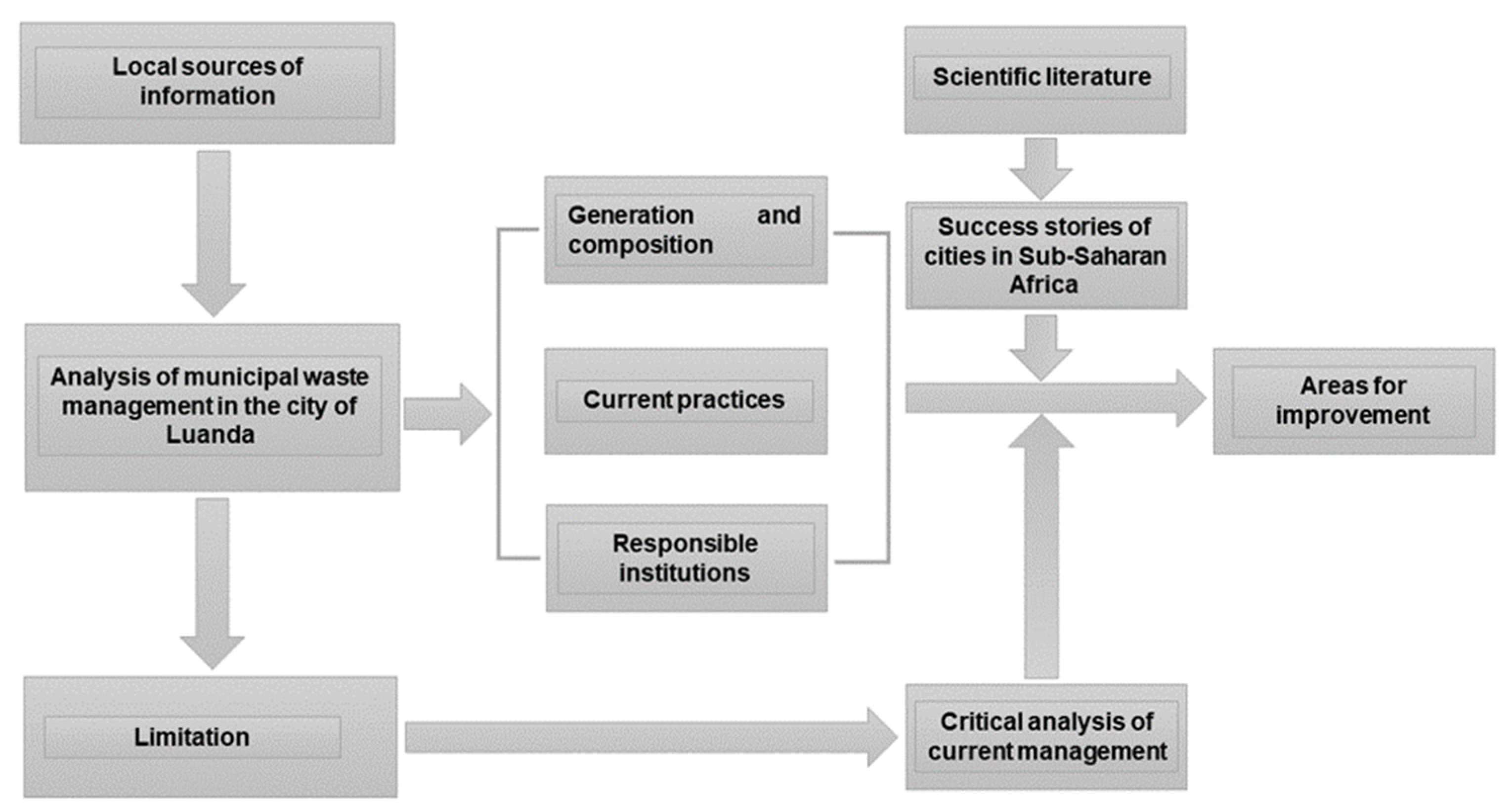
Figure 2.
Urban settlement in Luanda [38].
Figure 2.
Urban settlement in Luanda [38].
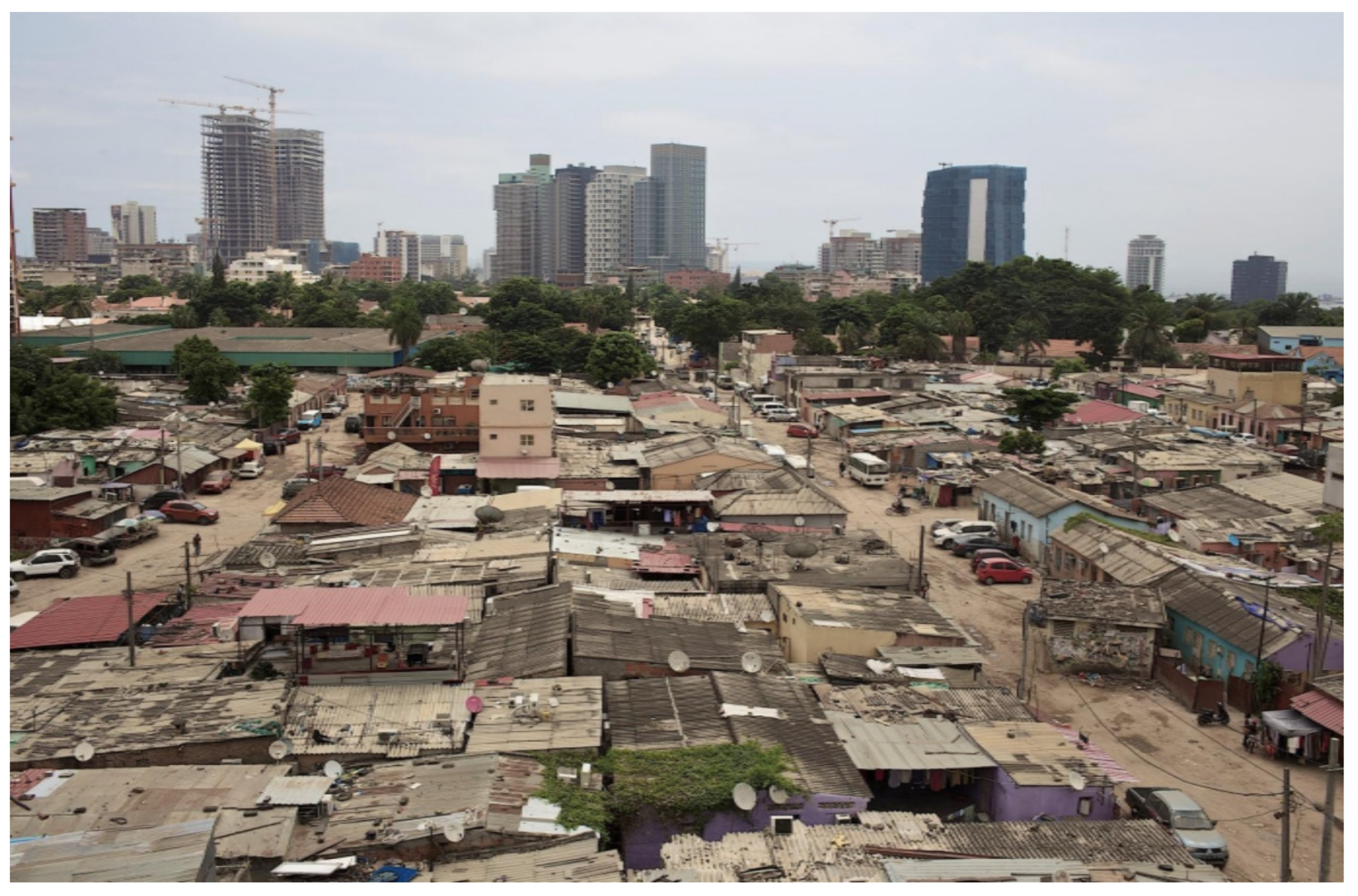
Figure 3.
Waste pickers (catadores) at the Mulenvos landfill [46].
Figure 3.
Waste pickers (catadores) at the Mulenvos landfill [46].
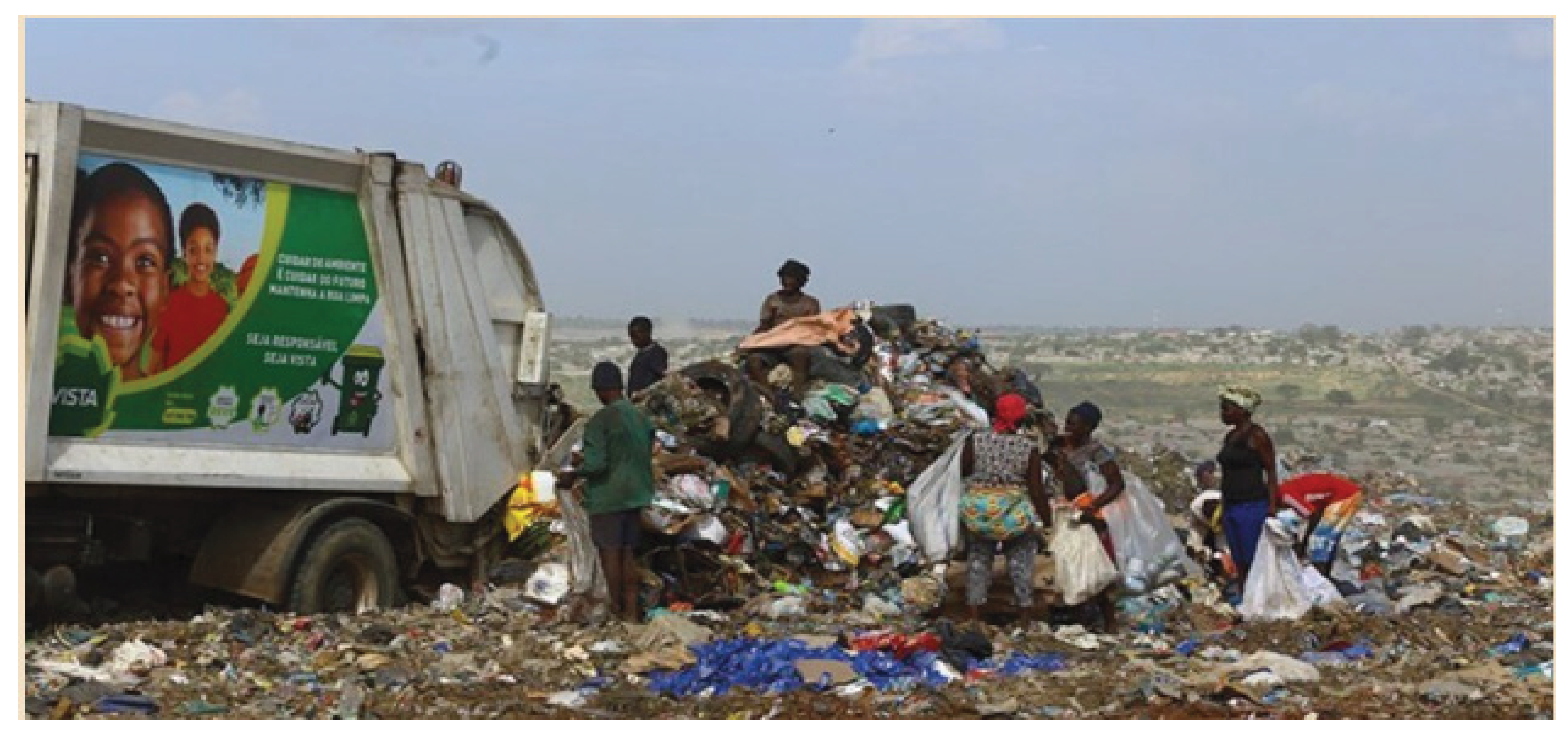

Table 1.
MSW collection companies in the city of Luanda [40].
Table 1.
MSW collection companies in the city of Luanda [40].
| MSW management companies | Municipalities of operation | Type of entity |
|---|---|---|
| ELISAL (Empresa de Limpeza e Saneamento de Luanda) | Luanda y Cazenga | Public |
| Er-Sol | Icolo y Bengo | Private |
| Sambiente | Quiçama y Viana | Private |
| Multilimpeza | Cacuaco | Private |
| Jump Business | Belas | Private |
| Chay | Kilamba Kiaxi | Private |
| Consórcio Dassala/Envirobac | Talatona | Private |
Table 2.
Main legal provisions on waste management in Angola. Source: own elaboration.
| Legislation | Main objective |
|---|---|
| Law 5/98 of 19 June | Establishes the first basic environmental law in Angola |
| Presidential Decree No. 11/11 of 7 January | Creation of the National Institute for Environmental Management |
| Order No. 199/12 of 29 February | Establishment of the register of waste, water and wastewater management companies. |
| Presidential Decree No. 196/12, of 30 August | Approval of the Strategic Plan for Waste Management: PESGRU. |
| Presidential Decree No. 190/12 of 24 August | Comprehensive regulation of waste management (generation, pre-collection, disposal, collection and transport and treatment |
| Executive Decree No. 234/13 of 18 July | Guidelines for provincial waste management plans |
| Executive Decree, 17/13 | Regulation of construction and demolition waste management |
| Presidential Decree No. 160/14, of 18 June | Regulation of hospital and healthcare waste management |
| Presidential Decree No. 181/14 of 28 July | Creation of the National Waste Management Agency (ANR) |
| Presidential Decree No. 24/15 of 29 January | Legalisation of waste management and water treatment companies |
| Presidential Decree No. 107/16, of 20 May | Establishment of the legal regime for cleaning fees. |
| Presidential Decree No. 106/16, of 20 May | Approval of the Luanda Provincial Urban Cleaning Plan |
| Presidential Decree No. 265/18, of 15 November | Regulation of waste transfer for reuse, recycling and recovery |
| Presidential Decree No. 203/19, of 25 June | Legal regime applicable to landfills |
Table 3.
Comparative waste management between Luanda, Windhoek, Cape Town and Kigali. Source: (own elaboration,2026).
Table 3.
Comparative waste management between Luanda, Windhoek, Cape Town and Kigali. Source: (own elaboration,2026).
| Management aspects | Luanda | Windhoek | Cape Town | Kigali |
|---|---|---|---|---|
| Population (inhabitants) | 9,079,811 | 461,000 | 4,772,846 | 1,200,000 |
| Responsible institutions | MINAMB, ANR, ADA, GPL, ELISAL | DIAGRW and DGRM | Provincial government, national government and the City Council City | RURA and other state institutions |
| MSW Generation | 6,000 to 9,133 t/day 0.75 to 0.78 kg/inhabitant/day |
233 t/day 0.51 kg/inhabitant/day |
1.7 million t/year 0.98 kg/inhabitant/day | 400 to 800 t/day, 0.57 to 60 kg/inhabitant/day |
| Collection/transport | Service coverage: 70% The service is shared with the private sector. Collection is daily. No collection fee. |
Service coverage: 100% Service shared with the private sector. Collection is once a week. There is a collection fee. |
Shared service with private collection. Collection is once a week. There is a collection fee. Free service for disadvantaged families. |
Service coverage: 88.72%. The service is entirely private and zoned Community cleaning service in the city once a month. Collection is once a week from households and once a day from public spaces. |
Disclaimer/Publisher’s Note: The statements, opinions and data contained in all publications are solely those of the individual author(s) and contributor(s) and not of MDPI and/or the editor(s). MDPI and/or the editor(s) disclaim responsibility for any injury to people or property resulting from any ideas, methods, instructions or products referred to in the content. |
© 2026 by the authors. Licensee MDPI, Basel, Switzerland. This article is an open access article distributed under the terms and conditions of the Creative Commons Attribution (CC BY) license (http://creativecommons.org/licenses/by/4.0/).
Copyright: This open access article is published under a Creative Commons CC BY 4.0 license, which permit the free download, distribution, and reuse, provided that the author and preprint are cited in any reuse.