
Submitted:
29 September 2026
Posted:
30 September 2026
You are already at the latest version
Abstract
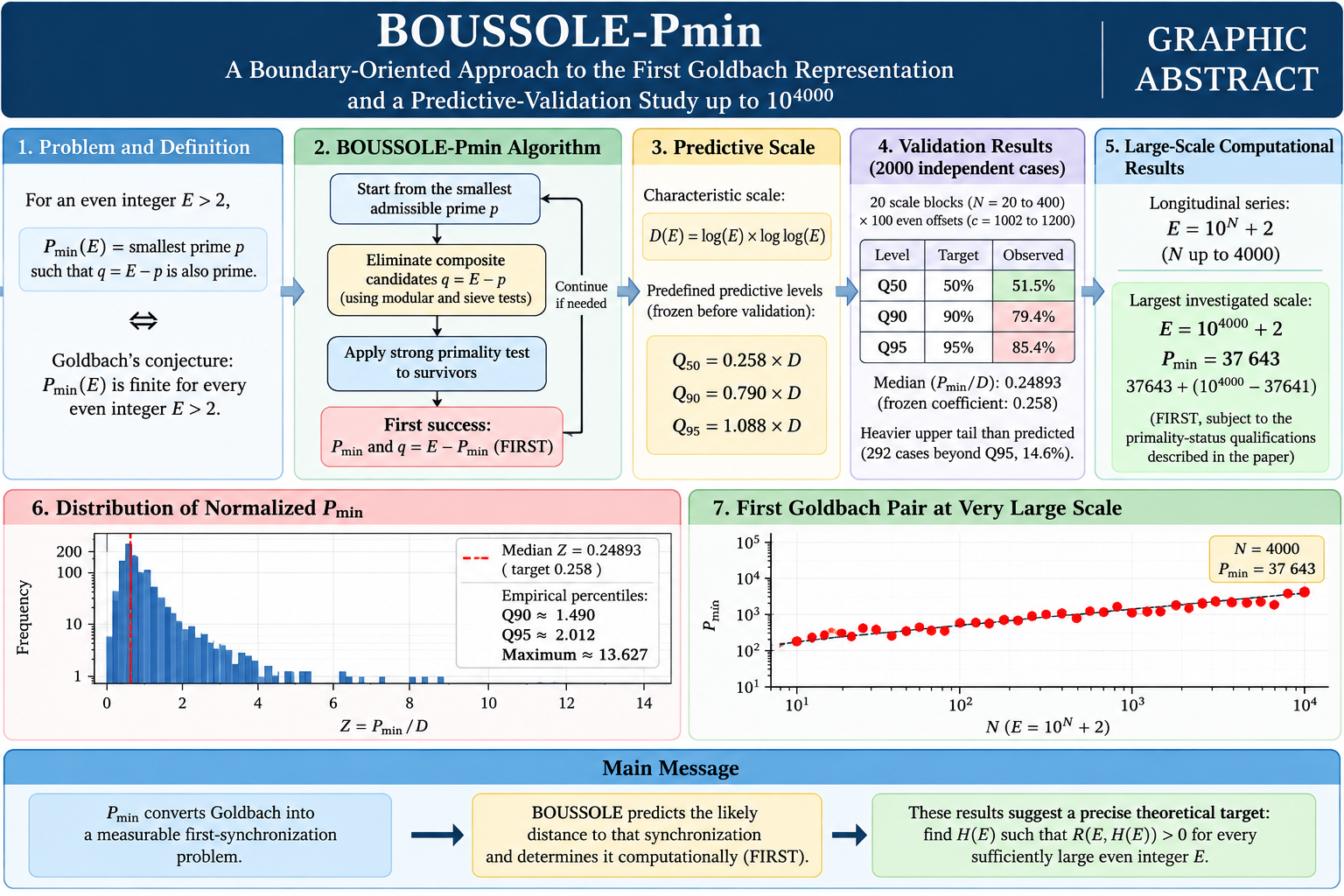
The binary Goldbach conjecture states that every even integer greater than 2 is a sum of two primes. This paper studies the smallest prime component of such a representation. For an even integer E, Pmin(E) is defined as the smallest prime p for which E - p is also prime. BOUSSOLE-Pmin combines an ordered FIRST search with an empirical prediction of the likely boundary distance. A longitudinal reference series of 100 selected integers of the form 10^N + 2 was studied up to N = 4000. A separate frozen prediction was then tested on 2000 new integers of the form 10^N + c, using 20 values of N from 20 to 400 and 100 even offsets at each level. The predictive scale was D(E) = log(E) log log(E), with frozen levels 0.258D, 0.790D and 1.088D. Observed coverages were 51.5%, 79.4% and 85.4%. The independent median Pmin/D was 0.24893, close to the frozen median coefficient 0.258, while the upper tail was substantially heavier than predicted. The method therefore uses prediction as a search compass, not as a stopping rule. Finally, Pmin gives a direct reformulation of Goldbach: a future proof can target uniform positivity of the number of prime pairs with the smaller prime restricted to a controlled boundary window.
Keywords:
Goldbach conjecture
; minimal Goldbach partition
; Pmin
; prime pairs
; computational number theory
; predictive search
; sieve
; BOUSSOLE
1. Introduction
The binary Goldbach conjecture states that every even integer greater than 2 can be expressed as the sum of two prime numbers. It remains open despite strong analytic results and extensive computation [1,2,3,4].
Large-scale computation provides an important benchmark. Oliveira e Silva, Herzog and Pardi verified the conjecture for every even integer up to 4 x 10^18 and also studied counts and first occurrences of minimal Goldbach partitions [1]. Such finite verification is extremely strong evidence, but no finite bound proves the statement for all even integers.
The classical heuristic framework of Hardy and Littlewood predicts an abundance of Goldbach representations after local arithmetic corrections [2]. On the rigorous side, Chen proved that every sufficiently large even integer is the sum of a prime and a number having at most two prime factors [3]. Work on exceptional sets, including Montgomery and Vaughan [4], shows how close analytic methods can come when a small exceptional population is allowed. The full binary problem requires eliminating every exception.
The present study asks a deliberately simple boundary question: how far must one move through the small primes before the first prime p is found for which E—p is also prime? This leads to Pmin(E), the smallest prime component of a Goldbach partition. Minimal Goldbach partitions have been studied computationally before [1]; the contribution here is to treat Pmin as a longitudinal and predictive variable, validate a frozen search scale on new cases, and formulate an adaptive FIRST algorithm.
Two datasets are kept separate. The first is a long-range reference series E = 10^N + 2, with 100 selected scales extending to N = 4000. The second is an independent predictive-validation cohort of 2000 new integers E = 10^N + c, with N = 20, 40, ..., 400 and c = 1002, 1004, ..., 1200. The predictive coefficients were frozen before this second search and were not recalibrated during validation.
The purpose of this paper is computational and methodological. It defines Pmin and the FIRST rule, reports the long-range observations, tests a simple predictive normalization, gives the final BOUSSOLE-Pmin algorithm, and identifies a precise analytical target for future proof attempts. No experimental observation in this paper is presented as a proof of Goldbach’s conjecture.
2. Definition of Pmin and the BOUSSOLE FIRST Method
2.1. Definition and the FIRST Rule
Let E be an even integer greater than 2. Define Pmin(E) as the smallest prime p for which q = E—p is also prime. When Pmin exists, E = Pmin(E) + q is a Goldbach representation. The word smallest is essential: a successful pair is not a Pmin result unless every smaller prime candidate has already been eliminated. This is the FIRST rule. The concept is closely related to the minimal Goldbach partitions studied in [1].
Pmin(E) = the smallest prime p such that E—p is prime.
For a fixed E, primes are examined in increasing order. Cheap modular and small-prime divisibility tests eliminate composite complements first. Strong probable-prime or primality testing is applied only to survivors. Sieving accelerates the search but never changes the increasing order when an exact FIRST claim is required.
2.2. Fifty Longitudinal Examples
The first experiment uses E = 10^N + 2. The following 50 Pmin values illustrate the longitudinal behavior from N = 10 to N = 500. They are presented in compact groups to avoid a large table.
For N = 10, 20, 30, 40, 50, the observed Pmin values are respectively 59, 13, 13, 19, 59.
For N = 60, 70, 80, 90, 100, the observed Pmin values are respectively 163, 449, 13, 281, 1289.
For N = 110, 120, 130, 140, 150, the observed Pmin values are respectively 71, 709, 43, 5, 593.
For N = 160, 170, 180, 190, 200, the observed Pmin values are respectively 523, 631, 3221, 1451, 191.
For N = 210, 220, 230, 240, 250, the observed Pmin values are respectively 173, 743, 1723, 2039, 2531.
For N = 260, 270, 280, 290, 300, the observed Pmin values are respectively 5651, 863, 541, 4583, 71.
For N = 310, 320, 330, 340, 350, the observed Pmin values are respectively 173, 181, 853, 599, 2099.
For N = 360, 370, 380, 390, 400, the observed Pmin values are respectively 10891, 2011, 149, 71, 809.
For N = 410, 420, 430, 440, 450, the observed Pmin values are respectively 61, 1201, 5653, 2593, 191.
For N = 460, 470, 480, 490, 500, the observed Pmin values are respectively 2551, 701, 2029, 3631, 1039.
These observations show immediately that Pmin is not monotone in E. For example, Pmin(10^290 + 2) = 4583, while Pmin(10^300 + 2) = 71. Likewise, Pmin(10^360 + 2) = 10891, followed by Pmin(10^380 + 2) = 149.
Five explicit examples are: E = 10^10 + 2, Pmin = 59, q = 10^10—57; E = 10^100 + 2, Pmin = 1289, q = 10^100—1287; E = 10^180 + 2, Pmin = 3221, q = 10^180—3219; E = 10^300 + 2, Pmin = 71, q = 10^300—69; and E = 10^360 + 2, Pmin = 10891, q = 10^360—10889.
2.3. Successive Even Integers and q-Anchors
A complementary local experiment keeps the magnitude essentially fixed and changes E by only 2. In the validation block near 10^20, the first eleven offsets give the following sequence:
10^20 + 1002 -> Pmin 41; +1004 -> 11; +1006 -> 13; +1008 -> 47; +1010 -> 17; +1012 -> 19; +1014 -> 53; +1016 -> 23; +1018 -> 277; +1020 -> 59; +1022 -> 29.
Several neighboring integers share the same complementary prime. For example, 10^20 + 1004 with p = 11 and 10^20 + 1006 with p = 13 both give q = 10^20 + 993. Such a shared complement is called a q-anchor in BOUSSOLE. It can accelerate neighboring searches, but it does not establish Pmin unless all smaller prime candidates are eliminated independently.
2.4. Boundary Interpretation and Primality Status
Pmin is the first Goldbach synchronization encountered from the small-prime boundary. A long run of failed prime candidates is called a FIRST desert. The search log distinguishes a Goldbach hit from an audited Pmin result, and it also distinguishes probable-prime status from independently confirmed or certified primality. Probable-prime testing is a computational filter, not a formal certificate; classical pseudoprime and Lucas-test literature provides the background for such tests [5].
3. Predictive Scale and Independent Validation Protocol
3.1. Predictive Scale
The prime number theorem makes logarithmic scales natural in questions about local prime density [6]. Hardy-Littlewood heuristics further indicate that Goldbach representations are influenced by both prime density and local arithmetic factors [2]. The present study does not derive its predictive scale from those theorems; it tests an empirical normalization suggested by the reference series.
D(E) = log(E) x log log(E), with natural logarithms.
Z(E) = Pmin(E) / D(E).
Before the independent validation began, three coefficients were frozen: 0.258, 0.790 and 1.088. They define Q50 = 0.258D, Q90 = 0.790D and Q95 = 1.088D. The labels express intended predictive coverage, not mathematical bounds.
3.2. Frozen Validation Design
The independent cohort contains 2000 new even integers E = 10^N + c. The 20 scale blocks use N = 20, 40, 60, ..., 400. Within each block, the 100 offsets are c = 1002, 1004, ..., 1200. Thus the experiment contains 20 distinct scale blocks with 100 neighboring even integers per block. Statistical independence between blocks or within blocks is not assumed.
For every case, D, Q50, Q90 and Q95 were calculated before comparison with Pmin. No coefficient was changed, no failed case was removed and no observation was used to recalibrate the model during validation. The rule was: predict first, search second, compare last.
Three indicators were recorded: I50 = 1 if Pmin <= Q50, I90 = 1 if Pmin <= Q90, and I95 = 1 if Pmin <= Q95. Their cohort means are the observed coverages.
3.3. Prediction Examples
For an integer near 10^20, D is approximately 176.37; Q50 = 45.50, Q90 = 139.33, and Q95 = 191.89; Pmin = 41 lies inside Q50, while Pmin = 277 lies beyond Q95.
For an integer near 10^100, D is approximately 1252.42; Q50 = 323.13, Q90 = 989.41, and Q95 = 1362.64; the predicted windows remain tiny compared with E.
For an integer near 10^200, D is approximately 2824.05; Q50 = 728.61, Q90 = 2231.00, and Q95 = 3072.57; the same frozen coefficients are used without recalibration.
For an integer near 10^400, D is approximately 6286.52; Q50 = 1621.92, Q90 = 4966.35, and Q95 = 6839.73; prediction remains a search landmark, not a stopping rule.
The validation range from approximately 10^20 to 10^400 is the domain in which these frozen coefficients were tested on the 2000-case cohort. The separate longitudinal series extends much farther, to 10^4000 + 2. Beyond the validated predictive domain, use of the same coefficients is an extrapolation.
4. Results
4.1. Global Validation
The complete cohort contains 2000 distinct (N, c) cases, exactly 100 at each of the 20 scale blocks, with no duplicate case. All individual computational FIRST observations were retained in Supplementary Data S1. For the 2000-case cohort, the q values were accepted under the stated software primality/probable-prime criterion; they are not presented as 2000 independently certified primality proofs.
The observed coverage rates were 51.5% for Q50, 79.4% for Q90 and 85.4% for Q95. Q50 was therefore close to its nominal 50% target. Q90 and Q95 were under-calibrated in the upper tail. In total, 292 of 2000 observations, or 14.6%, exceeded the frozen Q95 level.
Across the 2000 cases, mean Pmin was 1553.895, median Pmin was 607, the minimum was 3 and the maximum was 29917. The largest absolute Pmin occurred for E = 10^360 + 1198, with Pmin = 29917 and q = 10^360—28719. Its prime rank was 3239 and Z was approximately 5.371.
For the normalized variable Z = Pmin/D, the mean was 0.54417 and the median was 0.24893. The empirical 90th, 95th and 99th percentiles were approximately 1.48979, 2.01189 and 4.40848. The maximum Z was 13.62671, observed for E = 10^80 + 1054 with Pmin = 13093 and q = 10^80—12039.
The frozen median coefficient 0.258 is close to the independent median 0.24893. In contrast, the frozen upper coefficients 0.790 and 1.088 are much smaller than the observed 90th and 95th percentiles. The central scale is therefore more successful than the initial tail calibration.
4.2. Variation Across Scale Blocks
N = 20: 52% / 86% / 90%, max Pmin 419; N = 40: 57% / 93% / 95%, max Pmin 1123; N = 60: 42% / 58% / 83%, max Pmin 1327; N = 80: 44% / 62% / 70%, max Pmin 13093.
N = 100: 39% / 59% / 59%, max Pmin 6653; N = 120: 63% / 91% / 95%, max Pmin 4241; N = 140: 54% / 90% / 92%, max Pmin 6197; N = 160: 31% / 71% / 83%, max Pmin 6451.
N = 180: 81% / 88% / 88%, max Pmin 7489; N = 200: 59% / 81% / 81%, max Pmin 9311; N = 220: 87% / 96% / 97%, max Pmin 9433; N = 240: 0% / 57% / 75%, max Pmin 9857.
N = 260: 43% / 56% / 71%, max Pmin 23887; N = 280: 57% / 91% / 91%, max Pmin 14633; N = 300: 81% / 89% / 91%, max Pmin 24841; N = 320: 74% / 86% / 91%, max Pmin 9833.
N = 340: 14% / 80% / 80%, max Pmin 24113; N = 360: 66% / 86% / 88%, max Pmin 29917; N = 380: 46% / 80% / 92%, max Pmin 10733; N = 400: 40% / 88% / 96%, max Pmin 12227.
The block-to-block variation is substantial. For example, Q50 coverage was 87% at N = 220, 0% at N = 240 and 43% at N = 260. This demonstrates that magnitude alone does not determine FIRST distance; local arithmetic structure strongly affects Pmin. The blocks are therefore treated as distinct local sequences rather than as 2000 independent random draws.
4.3. Long-Range Series to 10^4000 + 2
N = 800: Pmin = 30763; N = 900: Pmin = 3469; N = 1000: Pmin = 6569; N = 1100: Pmin = 7211; N = 1200: Pmin = 4129; N = 1300: Pmin = 18041; N = 1400: Pmin = 18251.
N = 1500: Pmin = 1283; N = 1600: Pmin = 6491; N = 1700: Pmin = 2281; N = 1800: Pmin = 89; N = 1900: Pmin = 28879; N = 2000: Pmin = 25951; N = 2250: Pmin = 9539.
N = 2500: Pmin = 9941; N = 2750: Pmin = 3719; N = 3000: Pmin = 26693; N = 3250: Pmin = 25639; N = 3500: Pmin = 29333; N = 3750: Pmin = 16139; N = 4000: Pmin = 37643.
The N = 2250 and N = 2500 values retain a FIRST-minimality audit qualification and are not used as the strongest independently certified minimality claims. At N = 4000, the observed pair is p = 37643 and q = 10^4000—37641; the complementary q was externally reported as prime in the project record, while the Pmin interpretation also depends on completeness of the preceding FIRST audit.
The long-range series and the 2000-case validation answer different questions. The former studies change of scale over thousands of decimal digits; the latter tests a frozen predictive model on many new nearby offsets. Neither dataset is an exhaustive sample of all even integers.
5. The Final BOUSSOLE-Pmin Algorithm
The final method has three layers: exact ordered FIRST search, predictive landmarks, and adaptive continuation. The governing rule is simple: prediction tells us where to search; FIRST determines the answer. This layered design continues the adaptive multilevel framework developed in the author’s earlier algorithmic work [7], while making Pmin the explicit FIRST objective.
5.1. Reproducible Procedure
- Input an even integer E > 2 and record basic arithmetic information and small-prime residues.
- Compute D = log(E) log log(E), then Q50 = 0.258D, Q90 = 0.790D and Q95 = 1.088D.
- Generate prime candidates p in strictly increasing order. For primes greater than 3, use the usual admissible residues modulo 6 and additional small-prime congruences.
- For each p, compute q = E—p. Reject q immediately when a small prime divisor is forced or found. This cheap destructive layer reduces expensive tests.
- Apply a strong probable-prime or primality test only to surviving q values. Probable-prime status must be labelled as such [5].
- If q succeeds and every smaller prime p has been eliminated, record p as the FIRST value and hence Pmin under the stated primality criterion.
- If no hit occurs by Q50, continue to Q90; if none occurs by Q90, continue to Q95.
- If Q95 fails, do not stop. Extend the ordered frontier adaptively, for example to 2Q95, 4Q95 and beyond, while preserving complete FIRST order.
- For unusually long searches, record a FIRST-desert diagnosis: candidate count, destructive small factors, sieve depth and possible q-anchor structure.
- Before final recording, verify p + q = E and record separately the primality status of p and q, the prime rank of Pmin, D, Z and the predictive region in which FIRST occurred.
5.2. Exact Mode, Predictive Mode and Limits
Exact FIRST mode asks what Pmin is. Predictive mode asks how far the search is likely to travel. A failed predictive window is not an algorithmic failure. If computation stops because of time, memory or primality-testing cost, the result is reported as incomplete rather than as evidence that Pmin does not exist.
The method has no intrinsic decimal-length limit in its definition. Its present upper range is computational. Conversely, the absence of an input-size limit does not prove that the empirical prediction is valid at arbitrary scale. The validated predictive domain and the theoretical domain must remain distinct.
6. Discussion and a Possible Route Toward Goldbach’s Conjecture
6.1. Interpretation and Relation to Previous Work
The computations establish properties of the investigated families, not a proof of Goldbach. This distinction parallels all finite verification: even the exhaustive confirmation up to 4 x 10^18 remains finite [1]. BOUSSOLE has a different purpose: it studies where the first representation occurs in selected integers that may contain thousands of digits.
Minimal Goldbach partitions are not new [1]. The present contribution is the longitudinal Pmin viewpoint, the normalized variable Z, a frozen out-of-sample validation, the explicit separation between prediction and FIRST, and the adaptive search architecture.
Hardy-Littlewood heuristics provide the classical probabilistic setting for Goldbach representations [2], but the specific scale D = log(E) log log(E) is empirical here and is not claimed as a consequence of their conjecture. Chen reaches prime plus prime-or-semiprime for all sufficiently large even integers [3]; the remaining passage to simultaneous primality reflects the parity obstruction that a computational sieve does not remove. Exceptional-set results such as Montgomery-Vaughan [4] emphasize the remaining need for uniformity: Goldbach permits no exceptional even integer.
6.2. Goldbach Reformulated Through Pmin
For an even integer E > 2, Pmin(E) exists if and only if E has a Goldbach representation. Therefore the binary Goldbach conjecture is equivalent to the statement that Pmin(E) is finite for every even E > 2. This is a reformulation, not a proof.
For a positive boundary H, define R(E,H) as the number of primes p <= H for which E—p is also prime. Then Pmin(E) <= H if and only if R(E,H) > 0. This gives a direct analytical target: find an explicit H(E) for which R(E,H(E)) is uniformly positive for every sufficiently large even E.
The first theoretical target need not be the empirical scale log(E) log log(E). A realistic proof program may begin with a much larger H(E), seek uniform positivity there, and then reduce the window. Possible stages include a power-sized boundary, a smaller power, a sub-polynomial boundary and eventually a polylogarithmic boundary. The empirical scale is a computational reference, not a theorem.
6.3. The Remaining Obstruction
The core difficulty is simultaneous primality. For every failed prime p, the complement E—p has a prime divisor. Small destructive factors can be organized through congruences and sieve methods; complements with no small divisor require control of larger factors. A hypothetical complete FIRST desert would have to cover every prime candidate by these destructive mechanisms. Proving that such complete avoidance is impossible, uniformly in E, is the unresolved step.
The heavy tail in the validation is relevant here. It shows that average density alone does not describe every local block. A proof must control unusually unfavorable residue structures as well as typical cases. The proposed proof target is therefore uniform positivity of R(E,H), not a fitted probabilistic statement.
If one could rigorously establish R(E,H(E)) > 0 for every sufficiently large even E, with an explicit range and with the remaining finite cases covered computationally, the binary Goldbach conjecture would follow. This result is not proved in the present paper.
7. Conclusions
BOUSSOLE-Pmin studies the first Goldbach representation from the small-prime boundary. The reference series contains 100 selected scales of E = 10^N + 2 and reaches N = 4000. The independent validation contains 2000 new integers and preserves every individual Pmin value.
The frozen central prediction performed well: Q50 achieved 51.5% coverage and the independent median Z = 0.24893 was close to the frozen coefficient 0.258. The upper tail was much heavier than predicted: Q90 and Q95 achieved 79.4% and 85.4%, and 292 cases exceeded Q95. The correct conclusion is therefore that log(E) log log(E) is a useful empirical characteristic scale in the studied families, not a proved universal bound.
The final algorithm uses the predictive levels as landmarks but preserves an ordered FIRST search and continues adaptively after prediction failure. Practical limits arise from computation and certification, not from the definition of Pmin. Predictive extrapolation beyond the tested domain remains empirical.
The theoretical value of Pmin is its simplicity. Goldbach is equivalent to finiteness of Pmin for every even E > 2. The associated counting function R(E,H) turns the future proof problem into a precise question: find a controlled boundary H(E) for which R(E,H(E)) is uniformly positive. BOUSSOLE measures the first synchronization; a proof must replace the experimental word often by the uniform word always.
Supplementary Materials
The following supporting information can be downloaded at the website of this paper posted on Preprints.org, Supplementary Data S1: BOUSSOLE_Pmin_validation_2000_MASTER.csv, containing the 2000 individual validation cases and the fields N, c, Pmin, compact q, D, Z, prime rank, Q50, Q90, Q95, I50, I90 and I95. Supplementary Data S2: BOUSSOLE_Pmin_validation_summary.csv, containing the 20 block summaries.
Author Contributions
Conceptualization, methodology, investigation, validation, formal analysis, data curation, interpretation, writing—original draft, writing—review and editing: B.B. The author has read and approved the manuscript and accepts responsibility for its content.:.
Funding
This research received no external funding.
Institutional Review Board Statement
Not applicable.
Informed Consent Statement
Not applicable.
Data Availability Statement
The complete 2000-case validation dataset and the 20-block summary are supplied with this preprint as Supplementary Data S1 and S2. They contain the individual observations used to calculate the reported validation percentages and normalized Pmin statistics. The long-range BOUSSOLE values reported in the main text are part of the author’s computational research record; cases carrying an explicit FIRST-audit qualification are identified as such.
Acknowledgments
During the preparation of this manuscript, the author used OpenAI ChatGPT (GPT-5.6 Sol) for language editing, manuscript organization, computational scripting and presentation of results. The author reviewed and edited the output and takes full responsibility for the content of this publication. The author also acknowledges the developers and maintainers of the computational number-theory software and public prime-number databases used for selected independent checks.
Conflicts of Interest
The author declares no conflict of interest.
References
- Oliveira e Silva, T.; Herzog, S.; Pardi, S. Empirical Verification of the Even Goldbach Conjecture and Computation of Prime Gaps up to 4 x 10^18. Mathematics of Computation 2014, 83, 2033-2060. [CrossRef]
- Hardy, G.H.; Littlewood, J.E. Some Problems of Partitio Numerorum; III: On the Expression of a Number as a Sum of Primes. Acta Mathematica 1923, 44, 1-70. [CrossRef]
- Chen, J.R. On the Representation of a Larger Even Integer as the Sum of a Prime and the Product of at Most Two Primes. Scientia Sinica 1973, 16, 157-176. [CrossRef]
- Montgomery, H.L.; Vaughan, R.C. The Exceptional Set of Goldbach’s Problem. Acta Arithmetica 1975, 27, 353-370. [CrossRef]
- Pomerance, C.; Selfridge, J.L.; Wagstaff, S.S., Jr. The Pseudoprimes to 25 x 10^9. Mathematics of Computation 1980, 35, 1003-1026. [CrossRef]
- Hadamard, J. Sur la distribution des zeros de la fonction zeta(s) et ses consequences arithmetiques. Bulletin de la Societe Mathematique de France 1896, 24, 199-220.
- Bahbouhi, B. Bahbouhi.b.goldbach.2026: An Adaptive Multilevel Algorithm for Constructing Goldbach Prime Pairs in Very Large Even Integers. Preprints 2026, 202609.1348.v1. [CrossRef]
Disclaimer/Publisher’s Note: The statements, opinions and data contained in all publications are solely those of the individual author(s) and contributor(s) and not of MDPI and/or the editor(s). MDPI and/or the editor(s) disclaim responsibility for any injury to people or property resulting from any ideas, methods, instructions or products referred to in the content. |
© 2026 by the authors. Licensee MDPI, Basel, Switzerland. This article is an open access article distributed under the terms and conditions of the Creative Commons Attribution (CC BY) license (http://creativecommons.org/licenses/by/4.0/).
Copyright: This open access article is published under a Creative Commons CC BY 4.0 license, which permit the free download, distribution, and reuse, provided that the author and preprint are cited in any reuse.