

Submitted:
28 September 2026
Posted:
30 September 2026
You are already at the latest version
Abstract
The rapidly expanding availability of palaeogenomic data provides new opportunities for archaeological chronology, yet genetic evidence is rarely incorporated independently within Bayesian chronological models. Here, we develop an approach for modelling cultural and genetic transitions separately, allowing their temporal relationship to be evaluated explicitly. We apply this framework to the Mesolithic-Neolithic transition in Denmark using 494 radiocarbon dates from 130 archaeological sites integrated with archaeological, isotopic and palaeogenomic evidence. Consistent with previous research, the preferred model places the rapid establishment of Neolithic cultural practices across Denmark around 4000 BC. The model further indicates that Mesolithic lifeways persisted for several generations, while European farmer ancestry appears 223-515 years after the introduction of Neolithic cultural practices in western Denmark and 324-474 years after in eastern Denmark (68.3% probability). Dietary patterns also differ significantly by genetic ancestry after accounting for chronology, while strontium isotope variation suggests possible differences in landscape use between hunter-gatherer and farming communities. The introduction of Neolithic practices, persistence of Mesolithic lifeways and population turnover therefore represent overlapping rather than synchronous processes. More broadly, the study demonstrates how palaeogenomic evidence can provide independent chronological information within Bayesian models, offering a transferable approach for disentangling cultural and population change by modelling these processes separately and evaluating their temporal relationship.
Keywords:
Mesolithic-Neolithic transition
; neolithization
; Bayesian chronological modelling
; palaeogenomics
; genetic ancestry
; Ertebølle Culture
; Funnel Beaker Culture
1. Introduction
Modern archaeology interprets the past through multiple sources and draws on a broad range of disciplines. The archaeological material record remains at its heart, but methods from the natural sciences have advanced the “biomolecular humanities” and greatly expanded our understanding of past lifeways and societies (Oras, et al., 2025). The rapidly increasing palaeogenomic coverage and mapping of genetic ancestry groups have reinvigorated earlier discussions of population migrations based on distributions of archaeological evidence. At the same time, critics caution against simplified migration narratives (Furholt, 2019, Hofmann, 2015) and call for closer integration of archaeological and palaeogenomic evidence to understand the complex relationship between cultural and demographic change (Bánffy and Whittle, 2024, Eisenmann, et al., 2018). Recent studies have begun addressing this challenge by integrating archaeological and palaeogenomic evidence within demographic models (LaPolice, et al., 2025).
Palaeogenomics is still a relatively recent addition to the archaeological toolbox, and its full potential has not yet been realised. Most studies have focused on population mobility across time and space (e.g., Racimo, et al., 2020), and more recently on kinship practices and social organisation of past societies through the identification of genetic kinship (identity-by-descent) (e.g., Ringbauer, et al., 2024). Although largely overlooked, palaeogenomic evidence also has considerable potential to improve archaeological chronologies by incorporating genetic ancestry groups and genetic kinships as prior information within Bayesian chronological models. This raises the possibility of evaluating cultural and population change independently, rather than assuming that the two processes were necessarily synchronous.
1.1. The Mesolithic-Neolithic Transition
The Mesolithic-Neolithic transition occurred relatively late in Denmark around 4000-3950 BC, and its rich and well-preserved archaeological record has received immense attention over the past c. 175 years. The transition is defined economically by a shift in subsistence strategy from fishing, hunting and gathering to pastoralism and agriculture, and culturally by the arrival of the Funnel Beaker Culture, which replaced the Late Mesolithic Ertebølle Culture (Fischer and Kristiansen, 2002, Sørensen, 2014, Sørensen, 2020).
The elements conventionally associated with the Neolithic appear to have emerged at different times. Growing evidence suggests that cereals and domesticated animals were introduced in multiple steps, with cattle and sheep/goat appearing earlier than pigs and cereals (Gron and Sørensen, 2018, Sjögren, 2025). Dietary studies likewise indicate a marked shift from predominantly aquatic Mesolithic diets towards more terrestrial Neolithic diets (Fischer, et al., 2007, Richards, et al., 2003), although aquatic foods continued to be exploited (Lucquin, et al., 2023, McLaughlin, et al., 2025, Milner, et al., 2004, Robson, et al., 2021). Together, these findings question the interpretation of the Mesolithic-Neolithic transition as a single synchronous event around 4000 BC.
1.2. Migration, CULTURAL Transmission and Population Replacement
The relative importance of migration and cultural transmission in the spread of the Neolithic remains one of the central debates in European prehistory. Traditional archaeological models have interpreted the introduction of agriculture in Denmark either as the result of incoming farming populations, the adoption of Neolithic practices by indigenous hunter-gatherers, or combinations of the two (Fischer, 2002, Gron and Sørensen, 2018, Klassen, 2004, Larsson, 2007, Shennan, 2018, Sørensen, 2020, Sørensen and Karg, 2014). Increasingly, however, the transition is viewed as a multi-stranded process involving prolonged cultural, economic and demographic interactions between the last hunter-gatherer communities and the first farmers (Gron and Sørensen, 2018), while culturally distinct communities may have coexisted within the same or neighbouring landscapes (Jensen and Sørensen, 2023, Koivisto, et al., 2025).
Recent palaeogenomic research has transformed this discussion by demonstrating a rapid population turnover at the onset of the Danish Neolithic, associated with the arrival of Early European farmers (EF) carrying a mixture of Anatolian-derived farmer ancestry and non-local Western Hunter-Gatherer (WHG) ancestry. Gene flow from local Danish hunter-gatherers into farming populations was initially limited, but increased later in the Neolithic (Allentoft, et al., 2024). Genetic ancestry, however, need not coincide with cultural practices or identities. Archaeological and palaeogenomic evidence therefore provide complementary rather than interchangeable perspectives on the Mesolithic-Neolithic transition, highlighting the need for chronological frameworks capable of evaluating cultural and population change independently.
1.3. Chronological Frameworks
Influential studies by Fischer et al. (2007) and Sørensen & Karg (2014) present large radiocarbon (14C) datasets supporting a Mesolithic-Neolithic transformation around 4000/3950 BC in Southern Scandinavia. Establishing the temporal relationship between the different cultural and population processes involved in this transition, however, requires more than identifying a single chronological boundary.
Evaluating the timing of these processes is not straightforward. Visual inspection of calibrated 14C dates can exaggerate date ranges and fails to account for multimodal probability distributions or the non-independence of related dates (Bayliss, 2015). Bayesian statistics instead provides a framework for integrating 14C evidence with prior information to estimate the timing of events that cannot be dated directly and to evaluate competing archaeological scenarios (Bayliss, 2007, Buck, et al., 1996). The choice of prior information is critical to the resulting chronological models. Bayesian chronological studies increasingly integrate multiple forms of archaeological evidence as priors (e.g., Griffiths, et al., 2022, Rose and Meadows, 2024). Palaeogenomic data raise the possibility that genetic ancestry groups, and in some cases genetic kinships, may likewise provide chronological information. Such applications remain few, but Allentoft et al. (2024) use genetic ancestry data to estimate a rapid Mesolithic-Neolithic transition across Denmark beginning around 3900 BC. Their model assigns individuals with WHG and EF ancestry to successive phases separated by a trapezoidal transition, thereby preventing possible temporal overlap between the two ancestry groups from being investigated. Whether cultural and genetic transitions were synchronous and the extent to which palaeogenomic evidence can provide independent chronological information therefore remain to be tested formally.
This study investigates the Late Mesolithic-Early Neolithic transition in Denmark by modelling cultural and genetic transitions separately within a Bayesian framework, formally testing their synchronicity while evaluating the chronological potential of palaeogenomic evidence.
2. Material and Methods
2.1. Data Selection
A dataset focused on the Late Mesolithic-Early Neolithic in present-day Denmark is compiled through an extensive literature review. The dataset integrates archaeological, chronological, isotopic, and palaeogenomic information, including site context and cultural association, 14C ages, dietary (δ13C, δ15N) and strontium (Sr87/Sr86) isotope measurements, genetic ancestry, and sample material (palaeobotanical, zooarchaeological and human skeletal remains). Sites and find contexts are included if they contain at least one 14C date associated with either a cultural attribution or a genetic ancestry assignment, allowing wetland deposits lacking archaeological context to be included where genetic ancestry information is available. 14C dates on marine and freshwater organisms, food crusts, fatty residues and peat are excluded because of their potentially large reservoir offsets.
The final dataset comprises 494 14C dates from 130 archaeological sites (western Denmark = 56, eastern Denmark = 74, Figure 1a-b). Of these, 143 14C dates are from human remains, of which 108 also have dietary stable isotope measurements determined by IRMS. Strontium isotope ratios (87Sr/86Sr) are available for 52 individuals and genetic ancestry information for 67 individuals (WHG = 31, EF = 34, Baltic hunter-gatherer (BHG) = 2). Analytical methods vary according to data type and laboratory, and methodological details are provided in the original publications (Appendix A).
Data coverage is particularly good in eastern and central Denmark but comparatively sparse in western and southern Jutland (Figure 1a), reflecting taphonomic biases that favour collagen preservation in eastern Denmark. Previous isotopic and palaeogenomic studies have therefore also focussed on eastern Denmark (Allentoft, et al., 2024, Fischer, et al., 2007), and the available isotopic and palaeogenomic evidence consequently remains geographically uneven.
2.2. Dietary Reconstruction and Reservoir Offsets
Consumption of aquatic foods (marine and freshwater) causes 14C age offsets because aquatic organisms are depleted in 14C relative to atmospheric CO2 (Heaton, et al., 2020). Humans, dogs and pigs may consume a mixture of terrestrial and aquatic foods, resulting in mixed carbon signals that require 14C age correction (Stuiver, et al., 1986). The proportions of marine and freshwater protein in individual diets are reconstructed using the FRUITS Bayesian multi-proxy mixing model, which estimates the contribution of selected food groups to the consumer’s diet based on IRMS measurements of dietary stable isotope values (δ13C, δ15N) (Fernandes, et al., 2014). Full details of the approach and estimated dietary reservoir offsets are provided in Appendix A and B.1.
FRUITS dietary estimates are additionally used to examine dietary variation by genetic ancestry and modelled date. Associations between marine dietary contribution, modelled median date and genetic ancestry are evaluated using multiple linear regression, restricted to individuals with WHG and EF ancestry because of the small BHG sample. The independent contribution of each predictor is evaluated by single-term deletion using F-tests. Freshwater contribution is assessed descriptively because of the comparatively large uncertainties associated with the FRUITS estimates.
2.3. Bayesian Chronological Modelling
Bayesian chronological models are constructed in OxCal v4.4 (Bronk Ramsey, 2009a) using the Northern Hemisphere atmospheric calibration curve IntCal20 (Reimer, et al., 2020). The exact OxCal CQL code is provided in Appendix E.
Sites are modelled individually and incorporate prior information on cultural association, stratigraphy and sample material (Appendix S4). No explicit kinship constraints are applied because those genetically related individuals in the dataset are interpreted as broadly contemporaneous and therefore do not provide additional chronological information. 14C ages with dietary reservoir offsets are modelled using the Delta_R function in OxCal (Bronk Ramsey, 2009a) with minimum and maximum offsets estimated using the relevant regional marine and freshwater reservoir ages (Appendix B.1). 14C ages with suspected dietary reservoir offsets, but lacking stable isotope measurements, are modelled as terminus post quem or marked as outliers. A default charcoal outlier model is added to all samples of charcoal, charred wood and wood with potentially substantial intrinsic ages (Bronk Ramsey, 2009b), and obvious residual or intrusive samples are marked as outliers. Relevant posterior boundary estimates from individual site models are cross-referenced to a cultural transition model estimating the timing of the Mesolithic-Neolithic transformation and to an ancestry transition model estimating the end of the WHG ancestry phase and the beginning of the EF ancestry phase (Figure 2). Estimated end boundaries of Ertebølle sites contribute to the Mesolithic phase of the cultural transition model, whereas estimated start boundaries of Funnel Beaker sites contribute to the Neolithic phase. Likewise, individuals with WHG or EF ancestry are cross-referenced to their respective ancestry phases and, where archaeological context permits, also to the cultural transition model. Individuals lacking contextual information are therefore constrained solely by their genetic ancestry. The ancestry transition model is otherwise modelled independently of the cultural transition model, allowing the temporal relationship between cultural transformation and genetic change to be evaluated explicitly.
A small number of sites spanning the Late Mesolithic-Early Neolithic transition are not incorporated in the chronological modelling because they lack a clearly defined transition event. They are nevertheless retained in the dataset because they provide relevant evidence for the transition period. These sites are summarized in Appendix C.3.
2.4. Strontium Isotope Methods.
Measured 87Sr/86Sr values and genetic data are compiled from Allentoft et al. (2024), Sjögren & Fischer (2023), Fischer et al. (2007), Maring & Riede (2019) and Price et al. (2007) and are re-interpreted here with reference to published Danish and northern German baseline ranges. To summarize variation within the dataset, observations are grouped using the Jenks Natural Breaks optimization method (Jenks, 1967, Jenks and Caspall, 1971). Associations between genetic ancestry and strontium class are evaluated using the Fisher–Freeman–Halton exact test.
3. Results
3.1. Modelled Chronologies
Model A estimates a single Mesolithic-Neolithic cultural transition and ancestry transition across Denmark, assuming that the transitions occurred contemporaneously across the region. The Mesolithic and Neolithic are modelled as overlapping bounded phases, allowing the Neolithic to start before the Mesolithic ends. The model is not accepted (Amodel = 44.9), suggesting regional differences in the timing of the cultural transition.
Model B estimates the Mesolithic-Neolithic cultural transition and ancestry transition separately for western and eastern Denmark. In Model B1, the respective transitions are modelled using trapezoidal boundary parameters, assuming sequential phases (Lee and Bronk Ramsey, 2012); the model otherwise follows Model A. Both regional models are accepted, and principal posterior estimates are summarised in Table 1 and Figure 3. Model B1 estimates short cultural transitions in both regions, while the temporal relationship between WHG and EF ancestry differs. In western Denmark, the WHG phase ends before the EF phase begins, whereas in eastern Denmark, the WHG phase ends after the beginning of the EF phase. In eastern Denmark, the posterior distribution for the start of EF ancestry is multimodal, although relatively well constrained compared with the estimated end of WHG ancestry.
Model B2 allows Mesolithic and Neolithic cultural activity to overlap in western and eastern Denmark but otherwise follows Models A and B1. Both regional models are accepted, and principal posterior estimates are summarised in Table 2 and Figure 4 (Appendices C.1 and D). Model B2 estimates limited overlap between the Mesolithic and Neolithic phases while producing WHG-EF temporal relationships broadly comparable to Model B1. The posterior distribution for the start of EF ancestry in eastern Denmark likewise remains multimodal.
Although Model A produces posterior estimates broadly similar to Models B1 and B2, its poor agreement index indicates that a single synchronous cultural transition across Denmark is inconsistent with the 14C evidence. The regional models perform substantially better and reveal contrasting relationships between WHG and EF ancestry: in western Denmark, WHG ancestry disappears before EF ancestry appears, whereas in eastern Denmark WHG ancestry persists after the appearance of EF ancestry.
Model B2 is preferred because allowing the Mesolithic and Neolithic phases to overlap provides greater modelling flexibility and is consistent with archaeological evidence for contemporaneous Mesolithic and Neolithic cultural activity and late individuals with WHG ancestry (Gron and Sørensen, 2018, Jensen and Sørensen, 2023). Although the individual posterior boundary estimates permit uncertainty in the temporal relationship between the two phases, paired marginal posterior probability distributions show that Mesolithic activity continues after the introduction of the Neolithic in both regions (Appendix C.2). The estimated start of Neolithic activity may be earlier in western than eastern Denmark, but extensive overlap between the posterior distributions provides no clear evidence for a regional difference.
3.2. Chronological Sensitivity Testing
The robustness of the preferred Model B2 is assessed through a series of alternative modelling scenarios. Models A and B1 already provide sensitivity tests of the key modelling assumptions by evaluating, respectively, a single cultural transition across Denmark and separate regional Mesolithic-Neolithic transitions that may extend over time but do not permit overlap between the two phases. To further assess the contribution of ancestry-based constraints, Model C retains the structure of Model B2 but excludes all ancestry information. Model C produces posterior probability distributions closely comparable to those of the preferred Model B2, indicating that removing the ancestry-based constraints does not substantially alter the estimated cultural chronology. Genetic ancestry therefore provides little additional chronological resolution in this dataset, which is already well constrained by radiocarbon and archaeological evidence.
3.3. Dietary Variation by Genetic Ancestry and Modelled Date
Dietary and genetic ancestry information is available for 63 individuals. FRUITS estimates a mean contribution of 28.7% (range 5.2-66.1%) from marine fish and mammals and 22.8% (range 6.4-47.8%) from freshwater fish (Appendix A). Dietary composition shows clear variation through time and between genetic ancestry groups (Figure 5). WHG individuals dating to the Mesolithic show higher marine contributions, whereas EF and BHG individuals dating to the Neolithic show lower marine and higher freshwater contributions. Some overlap between ancestry groups is nevertheless apparent, particularly around and after the Mesolithic-Neolithic transition. A multiple linear regression model including modelled median date and genetic ancestry (WHG and EF) as predictors of marine dietary contribution indicates that ancestry is significantly associated with marine contribution after accounting for date (F = 29.86, p < 0.001), whereas date is not significantly associated with marine contribution after accounting for ancestry (F = 3.36, p = 0.072). This suggests that the observed differences in marine dietary contribution are more strongly associated with genetic ancestry than with chronology alone. The small number of BHG individuals prevents their inclusion in the statistical comparison. Freshwater contribution is not subjected to statistical testing because the comparatively large uncertainties associated with the FRUITS estimates limit meaningful comparison between groups.
3.4. Strontium Isotope Variation
Stable strontium isotope ratios (Sr87/Sr86) are available for 52 individuals, of whom 25 also have genetic ancestry information. Figure 6a shows the distribution of measured Sr87/Sr86 values by genetic ancestry and osteological sex.
Several regional baseline ranges have been proposed for modern-day Denmark and northern Germany, generally identifying a biologically available 87Sr/86Sr range of 0.7081-0.7117 (e.g., Frei, 2012, Frei, et al., 2026, Schaefer-Di Maida, et al., 2026). Most individuals fall within this range and are therefore considered likely local. The only individuals potentially falling outside this range are the Vittrup bog body (87Sr/86Sr = 0.71343) and Henriksholm-Bøgebakken Grave 12 (87Sr/86Sr = 0.714463). Further details on strontium isotope analyses are available in Appendix B.2.
To summarize the distribution of measured 87Sr/86Sr values, observations are grouped using the Jenks Natural Breaks optimization method (Jenks, 1967, Jenks and Caspall, 1971). WHG individuals are concentrated in the lower classes (14/22; 63.3%), whereas EF individuals are more broadly distributed across the lower and intermediate classes (Figure 6b). The distribution differs significantly between ancestry groups (Fisher–Freeman–Halton exact test, two-sided p = 0.016), although the small sample sizes for individuals with unknown or BHG ancestry limit conclusions about their distributions.
4. Discussion
4.1. The Mesolithic-Neolithic Transition in Denmark
The Mesolithic-Neolithic transition varied considerably in pace and timing across Europe (Bocquet-Appel, et al., 2012, Shennan, 2018). Reconstructing this process across present-day Denmark is challenging because of regional differences in archaeological visibility and preservation. Nevertheless, the present dataset supports a broadly contemporaneous onset of Neolithic cultural activity across Denmark around 4100-3950 BC, consistent with previous research (Fischer and Kristiansen, 2002, Sørensen, 2014, Sørensen, 2020). The chronology places this onset earlier than in southern Norway (around 3900 BC), broadly contemporaneous with southern Sweden (around 4000 BC), and later than along the Baltic coast of northern Germany (around 4100 BC) (Andersson, et al., 2016, Hartz, et al., 2007, Nielsen, 2021, Solheim, 2021, Sørensen, 2014). Mesolithic lifeways, however, persisted until around 3950-3750 BC. This period of cultural overlap is substantially shorter than suggested by recent demographic modelling based on summed radiocarbon probability distributions, which inferred prolonged hunter-gatherer persistence in Denmark (Cortell-Nicolau, et al., 2025). The difference likely reflects the contrasting modelling approaches: Cortell-Nicolau et al. use radiocarbon-date frequencies as proxies for population dynamics, whereas the present study estimates the chronological boundaries of archaeologically defined cultural activity. The estimated persistence of Mesolithic lifeways is also consistent with recent evidence for sustained, and in some areas intensified, coastal resource exploitation during and beyond the transition (McLaughlin, et al., 2025). Together, these results suggest that the Danish transition was characterised by the rapid establishment of Neolithic cultural practices alongside a more gradual abandonment of Mesolithic lifeways.
4.2. Late Surviving Hunter-Gatherers
The palaeogenomic evidence indicates that local Danish hunter-gatherers made only a limited contribution to the earliest Neolithic gene pool, with gene flow between late surviving hunter-gatherers and farming communities increasing later in the Neolithic (Allentoft, et al., 2024). A similar pattern has been observed in Central Europe, where genetic exchange increased gradually over successive generations during the Neolithic expansion (Tsoupas, et al., 2025, Vondrovský, 2026). Nevertheless, this does not exclude the coexistence of Mesolithic and Neolithic communities or the adoption of cultural identities different from those suggested by genetic ancestry.
The most prominent example of the latter is the Dragsholm man, a young man around 20 years at death with WHG ancestry, who was buried with characteristic grave goods from the Funnel Beaker Culture (Price, et al., 2007). In total, three individuals with WHG ancestry are currently known from the Neolithic period, together with two individuals dating to the Mesolithic-Neolithic transition, all from eastern Denmark. Dietary information is available for four of these individuals, providing further insight into their lifeways (Figure 7). Despite their WHG ancestry, the Dragsholm man, Ravnsbjerggård II and Elkenøre have relatively low marine dietary contributions, resembling the general pattern among EF individuals. Rødhals, in contrast, retains a substantially higher marine contribution, more characteristic of earlier WHG individuals (cf. Figure 5). The two individuals with BHG ancestry likewise show contrasting dietary patterns: Vittrup has a low marine contribution comparable to the general EF pattern, whereas Svinninge Vejle has a substantially higher marine contribution. Together, these observations show that genetic ancestry, dietary practice and cultural affiliation did not necessarily coincide, as also observed by Hofmann (2015, 460): “Genetic information acts as a cumulative and long-term archive of population history, but provides no answers regarding an individual’s experienced sense of belonging”. Some late-surviving individuals with hunter-gatherer ancestry therefore appear to have adopted dietary practices more typical of Neolithic farming communities, whereas others retained dietary patterns more characteristic of earlier hunter-gatherers.
Individuals carrying EF ancestry substantially outnumber those with WHG ancestry in the current dataset, although preservation and sampling biases prevent their relative frequencies from being interpreted directly as population proportions. Agent-based modelling demonstrates that even modest differences in fertility between Mesolithic and Neolithic populations could rapidly reduce Mesolithic ancestry (McLaughlin, et al., 2025). The persistence of a few late-surviving WHG individuals is therefore compatible with a rapid demographic transformation.
4.3. Migrating Farmers
The chronology established here raises the question of how Neolithic practices were introduced into Denmark. Late Mesolithic communities of Southern Scandinavia maintained contacts with Neolithic societies on the continent, as demonstrated by imported artefacts including shoe-last axes, jadeite and flat copper axes (Klassen, 2000, Klassen, 2002, Klassen, 2004). Early cereals and domesticated animals may likewise reflect such interactions, possibly representing scouting expeditions or small-scale pioneer settlements before 4000 BC, followed by larger-scale migration and the establishment of a fully Neolithic economy (Gron and Sørensen, 2018, Sjögren, 2025, Sørensen, 2020).
Neither the palaeogenomic nor the strontium isotope evidence allows the pioneer phase of Neolithic migration into Denmark to be identified directly. As none of the individuals carrying EF ancestry can be identified as first-generation migrants, they provide only a terminus ante quem for the introduction of this ancestry group. This limitation is partly accommodated by the Bayesian chronological model, which assumes that the earliest occurrences of a phenomenon are unlikely to be sampled and dated, although whether this adequately accounts for the absence of the earliest generations remains uncertain. The isotope data suggest differences between ancestry groups, with WHG individuals concentrated in the lower strontium classes and EF individuals more broadly distributed across the lower and intermediate classes. However, small sample sizes and similar strontium baseline values across large parts of Western Europe limit interpretation of these differences. More broadly, taphonomic and sampling biases may limit the archaeological and palaeogenomic visibility of the earliest farming populations. Consequently, the current palaeogenomic and strontium record primarily reflects established farming communities rather than the pioneer phase of Neolithic migration.
4.4. Modelling Cultural and Genetic Change
The earliest appearance of the Funnel Beaker Culture in Denmark has been interpreted as marking the arrival of Early European farming populations (Allentoft, et al., 2024). By modelling the cultural and genetic transitions independently, however, the present study provides a formal chronological test of this interpretation. Posterior difference estimates indicate that EF ancestry appeared 223-515 years after the introduction of Neolithic cultural practices in western Denmark and 324-474 years after their introduction in eastern Denmark (68.3% probability). Mesolithic practices continued for 118-330 years after the introduction of the Neolithic in western Denmark and 70-269 years after its introduction in eastern Denmark (68.3% probability). Considered together, the continued Mesolithic cultural activity and the presence of late-surviving individuals with hunter-gatherer ancestry are consistent with small hunter-gatherer groups persisting alongside farming communities for several generations after the introduction of the Neolithic. These results demonstrate that cultural change and population turnover unfolded on different timescales, with the introduction of Neolithic cultural practices, the persistence of Mesolithic lifeways, and the expansion of populations carrying EF ancestry representing overlapping rather than synchronous processes.
The observed temporal offsets may have resulted from several processes. Neolithic practices may initially have spread through cultural interactions, although the practical knowledge required for agriculture and the rapid rate of Neolithic expansion have been argued to favour substantial demic diffusion (Fort, et al., 2018, Sørensen, 2020). Alternatively, the earliest communities carrying EF ancestry may have remained demographically small and genetically underrepresented in the current dataset because of preservation and sampling biases despite producing an archaeologically visible cultural record. These mechanisms are not mutually exclusive, and the apparent temporal offset need not reflect a simple delay in the arrival of EF ancestry.
The resulting pattern is consistent with a period of cultural duality or ‘inner peripheries’ (Jensen and Sørensen, 2023, Vondrovský, 2026), in which hunter-gatherers and incoming farmers maintained distinct ways of life within the same or neighbouring landscapes. Similar patterns are documented in Central Europe (Gehlen, 2017, Stäuble, et al., 2021). Modelling of archaeological and palaeogenomic evidence from the European Neolithic expansion suggests that such cultural distinctions may have been maintained through limited cultural transmission between farmer and hunter-gatherer populations and predominantly within-group mating (LaPolice, et al., 2025). In Denmark, continued use of kitchen middens and sustained exploitation of marine resources provide further evidence for the persistence of distinct hunter-gatherer lifeways during the transition (McLaughlin, et al., 2025). The dietary evidence likewise indicates differences between ancestry groups, with WHG ancestry significantly associated with higher marine dietary contributions after accounting for chronology. The late WHG individuals discussed above, however, demonstrate that this relationship was not absolute. The strontium data may likewise be consistent with differentiated landscape use between ancestry groups, although the observed differences cannot currently be translated directly into geographical origins. For example, at Syltholm Fjord, fishing practices continued from the Mesolithic into the Neolithic and beyond (Fig. C.3.2) (Koivisto, et al., 2025). Hunter-gatherer activities may have remained focused on coastal environments while farming communities established settlements further inland on suitable agricultural soils (Gron and Sørensen, 2018, Sørensen, 2016), a pattern potentially consistent with the strontium evidence. As illustrated by the Dragsholm man, however, genetic ancestry and cultural affiliation were not necessarily coupled.
Taken together, the archaeological, chronological, isotopic and palaeogenomic evidence supports a three-stage model of the Danish Mesolithic-Neolithic transition, broadly comparable to that proposed by Gron & Sørensen (2018). An interaction phase before 4000 BC involved contacts between hunter-gatherers and farming communities, reflected in imported artefacts, early domesticates and possibly small-scale pioneer settlements. Around 4000 BC, the Funnel Beaker Culture and Neolithic cultural practices were rapidly established across Denmark, followed by a more gradual demographic transformation during which Mesolithic lifeways persisted, EF ancestry became widespread and local WHG ancestry disappeared. These stages represent overlapping rather than discrete processes, demonstrating that the Mesolithic-Neolithic transition cannot be understood as a single synchronous event.
4.5. The Chronological Potential of Palaeogenomic Evidence
Palaeogenomic evidence has become increasingly available since around 2015 as advances in next-generation sequencing made large-scale ancient DNA studies feasible, but its inherent chronological potential has yet to be widely exploited. This study demonstrates that palaeogenomic data can be treated as a source of chronological evidence, rather than solely as evidence for ancestry, migration, or kinship. Just as archaeological typologies have long been incorporated as prior information within Bayesian chronological models, genetic ancestry groups can likewise provide prior information. Genetic kinships can also constrain the temporal separation between related individuals (e.g., Meadows, et al., 2020), providing an additional source of chronological evidence.
Sensitivity testing shows that removing the ancestry-based constraints has little influence on the posterior estimates in the present study. This likely reflects the well-documented 14C and archaeological dataset available for the Danish Mesolithic-Neolithic transition, which already provides strong chronological constraints. In less well-constrained chronological contexts, or where genetic data provide independent chronological structure not captured by archaeological priors, the contribution of palaeogenomic evidence may be considerably greater. As palaeogenomic datasets continue to expand, recognising their chronological value could potentially improve archaeological chronologies across a wide range of contexts.
5. Conclusion
The archaeological record is a finite resource with the ethical implication that we must always aim to maximize the knowledge gained before carrying out destructive sampling (Källén, et al., 2024). The present study demonstrates how legacy data can be reanalysed using modern analytical approaches to generate new archaeological insights. By modelling cultural and genetic transitions independently within a Bayesian framework, this approach allows their temporal relationship to be evaluated explicitly and quantitatively. Taken together, the chronological, palaeogenomic and isotopic evidence show that the Danish Mesolithic-Neolithic transition was not a single synchronous event but a series of overlapping cultural and demographic processes. The rapid establishment of Neolithic cultural practices around 4000 BC was accompanied by persistent Mesolithic lifeways, while substantial population turnover unfolded over the following centuries as European farmer ancestry became widespread.
Beyond the Danish case, this study illustrates how palaeogenomic evidence can be incorporated as an independent source of chronological information within Bayesian models. Genetic ancestry contributed only limited additional chronological resolution in the Danish dataset, likely because the chronology is already well constrained by archaeological and 14C evidence. The contribution of palaeogenomic evidence may be greater in contexts where existing chronological constraints are weaker. More broadly, modelling cultural and genetic evidence independently provides a framework for testing the temporal relationship between cultural and population change in other prehistoric transitions.
Supplementary Materials
The following supporting information can be downloaded at the website of this paper posted on Preprints.org.
Funding
This project is part of the ERC Synergy project COREX: From Correlations to Explanations: towards a new European prehistory, funded by the European Research Council under the European Union’s Horizon 2020 research and innovation program (Grant Agreement No. 951385).
Acknowledgments
We are grateful to the entire COREX team for their continued support, collaboration and insightful discussions throughout this project. We are likewise grateful to Stephen Shennan for comments on an earlier draft. This study is indebted to the generations of archaeologists who, over the past 175 years, have excavated, documented and curated the archaeological record of the Danish Mesolithic-Neolithic. Their work continues to provide the foundation for new archaeological research.
References
- Allentoft, M.E., Sikora, M., Fischer, A., Sjögren, K.-G., Ingason, A., Macleod, R., Rosengren, A., Schulz Paulsson, B., Jørkov, M.L.S., Novosolov, M., Stenderup, J., Price, T.D., Fischer Mortensen, M., Nielsen, A.B., Ulfeldt Hede, M., Sørensen, L., Nielsen, P.O., Rasmussen, P., Jensen, T.Z.T., Refoyo-Martínez, A., Irving-Pease, E.K., Barrie, W., Pearson, A., Sousa da Mota, B., Demeter, F., Henriksen, R.A., Vimala, T., McColl, H., Vaughn, A., Vinner, L., Renaud, G., Stern, A., Johannsen, N.N., Ramsøe, A.D., Schork, A.J., Ruter, A., Gotfredsen, A.B., Henning Nielsen, B., Brinch Petersen, E., Kannegaard, E., Hansen, J., Buck Pedersen, K., Pedersen, L., Klassen, L., Meldgaard, M., Johansen, M., Uldum, O.C., Lotz, P., Lysdahl, P., Bangsgaard, P., Petersen, P.V., Maring, R., Iversen, R., Wåhlin, S., Anker Sørensen, S., Andersen, S.H., Jørgensen, T., Lynnerup, N., Lawson, D.J., Rasmussen, S., Korneliussen, T.S., Kjær, K.H., Durbin, R., Nielsen, R., Delaneau, O., Werge, T., Kristiansen, K., Willerslev, E., 2024. 100 ancient genomes show repeated population turnovers in Neolithic Denmark. Nature 625(7994), 329-337. [CrossRef]
- Andersson, M., Artursson, M., Brink, K., 2016. Early Neolithic Landscape and Society in Southwest Scania – New Results and Perspectives. Journal of Neolithic Archaeology 18, 23-114. [CrossRef]
- Bánffy, E., Whittle, A., 2024. The uncertain frontier: Risks, reversals and interactions in the initial establishment of Neolithic settlement. Documenta Praehistorica 51, 220-237. [CrossRef]
- Bayliss, A., 2007. Bayesian Buildings: An Introduction for the Numerically Challenged. Vernacular Architecture 38, 76-87.
- Bayliss, A., 2015. Quality in Bayesian chronological models in archaeology. World Archaeology 47(4), 677-700. [CrossRef]
- Bocquet-Appel, J.-P., Naji, S., Vander Linden, M., Kozlowski, J., 2012. Understanding the rates of expansion of the farming system in Europe. Journal of Archaeological Science 39(2), 531-546. [CrossRef]
- Bronk Ramsey, C., 2009a. Bayesian Analysis of Radiocarbon Dates. Radiocarbon 51(1), 337-360. [CrossRef]
- Bronk Ramsey, C., 2009b. Dealing with Outliers and Offsets in Radiocarbon Dating. Radiocarbon 51(3), 1023-1045. [CrossRef]
- Buck, C.E., Cavanagh, W.G., Litton, C.D., 1996. Bayesian approach to interpreting archaeological data. Wiley, Chichester.
- Cortell-Nicolau, A., Rivas, J., Crema, E.R., Shennan, S., García-Puchol, O., Kolář, J., Staniuk, R., Timpson, A., 2025. Demographic interactions between the last hunter-gatherers and the first farmers. Proceedings of the National Academy of Sciences 122(14), e2416221122. [CrossRef]
- Eisenmann, S., Bánffy, E., van Dommelen, P., Hofmann, K.P., Maran, J., Lazaridis, I., Mittnik, A., McCormick, M., Krause, J., Reich, D., Stockhammer, P.W., 2018. Reconciling material cultures in archaeology with genetic data: The nomenclature of clusters emerging from archaeogenomic analysis. Scientific Reports 8(1), 13003. [CrossRef]
- Fernandes, R., Millard, A.R., Brabec, M., Nadeau, M.-J., Grootes, P., 2014. Food Reconstruction Using Isotopic Transferred Signals (FRUITS): A Bayesian Model for Diet Reconstruction. PLOS ONE 9(2), e87436. [CrossRef]
- Fischer, A., 2002. Food for Festing? An evaluation of explanations of the Neolithisation of Denmark and southern Sweden. In: Fischer, A., Kristiansen, K. (Eds.), The Neolithisation of Denmark: 150 Years of Debate, Sheffield, 343-393.
- Fischer, A., Kristiansen, K., 2002. The Neolithisation of Denmark: 150 Years of Debate. Sheffield.
- Fischer, A., Olsen, J., Richards, M., Heinemeier, J., Sveinbjörnsdóttir, Á.E., Bennike, P., 2007. Coast–inland mobility and diet in the Danish Mesolithic and Neolithic: evidence from stable isotope values of humans and dogs. Journal of Archaeological Science 34(12), 2125-2150. [CrossRef]
- Fort, J., Mercè Pareta, M., Sørensen, L., 2018. Estimating the relative importance of demic and cultural diffusion in the spread of the Neolithic in Scandinavia. Journal of The Royal Society Interface 15(148), 20180597. [CrossRef]
- Frei, K.M., 2012. Exploring the potential of the strontium isotope tracing system in Denmark. Danish Journal of Archaeology 1, 113-122. [CrossRef]
- Frei, K.M., Beck, M.R., Pantmann, P., Møller, N.A., Søvsø, M., Frei, R., 2026. Bronze Age non-elite mobility in Denmark examined through a new human-based bioavailable strontium isotope range. PLOS ONE 21(2), e0341434. [CrossRef]
- Furholt, M., 2019. De-contaminating the aDNA – archaeology dialogue on mobility and migration: discussing the culture-historical legacy. Current Swedish Archaeology 27(1), 53-68. [CrossRef]
- Gehlen, B., 2017. Foragers and farmers during the Neolithic transition in western central Europe: searching for evidence of mobility and intercultural networks. In: Scharl, S., Gehlen, B. (Eds.), Mobility in prehistoric sedentary societies. Papers of the CRC 806 workshop in Cologne 26-27 June 2015. Leidorf, rahden/Westf., 39-73.
- Griffiths, S., Johnston, R., May, R., McOmish, D., Marshall, P., Last, J., Bayliss, A., 2022. Dividing the Land: Time and Land Division in the English North Midlands and Yorkshire. European Journal of Archaeology 25(2), 216-237. [CrossRef]
- Gron, K.J., Sørensen, L., 2018. Cultural and economic negotiation: a new perspective on the Neolithic Transition of Southern Scandinavia. Antiquity 92(364), 958-974. [CrossRef]
- Hartz, S., Lübke, H., Terberger, T., 2007. From fish and seal to sheep and cattle: new research into the process of neolithisation in northern Germany. In: Whittle, A., Cummings, V. (Eds.), Going Over: The Mesolithic-Neolithic Transition in North-West Europe. British Academy, 567-594.
- Heaton, T.J., Köhler, P., Butzin, M., Bard, E., Reimer, R.W., Austin, W.E.N., Bronk Ramsey, C., Grootes, P.M., Hughen, K.A., Kromer, B., Reimer, P.J., Adkins, J., Burke, A., Cook, M.S., Olsen, J., Skinner, L.C., 2020. Marine20 - The Marine Radiocarbon Age Calibration Curve (0–55,000 cal BP). Radiocarbon 62(4), 779-820. [CrossRef]
- Hofmann, D., 2015. What Have Genetics Ever Done for Us? The Implications of aDNA Data for Interpreting Identity in Early Neolithic Central Europe. European Journal of Archaeology 18(3), 454-476. [CrossRef]
- Jenks, G.F., 1967. The Data Model Concept in Statistical Mapping. International Yearbook of Cartography 7, 186-190.
- Jenks, G.F., Caspall, F.C., 1971. Error on choroplethic maps: Definition, measurement, reduction. Annals of the Association of American Geographers 61(2), 217-244.
- Jensen, T.Z.T., Sørensen, L.V., 2023. Duality in the Early Neolithic on Lolland-Falster and in south Scandinavia. In: Groß, D., Rothstein, M. (Eds.), Changing Identity in a Changing World - Current Studies on the Stone Age around 4000 BCE. Sidestone Press, Leiden, 89-107.
- Källén, A., Mulcare, C., Nyblom, A., Strand, D., 2024. Petrous Fever. Current Anthropology 65(6), 990-1009. [CrossRef]
- Klassen, L., 2000. Frühes Kupfer im Norden: Untersuchungen zu Chronologie, Herkunft und Bedeutung der Kupferfunde der Nordgruppe der Trichterbecherkultur. Moesgård Museum & Jysk Arkæeologisk Selskab, Højbjerg.
- Klassen, L., 2002. The Ertebølle Culture and Neolithic continental Erurope. In: Fischer, A., Kristiansen, K. (Eds.), The Neolithisation of Denmark: 150 Years of Debate, Sheffield, 305-317.
- Klassen, L., 2004. Jade und Kupfer: Untersuchungen zum Neolithisierungsprozess im westlichen Ostseeraum unter besonderer Berücksichtigung der Kulturentwicklung Europas 5500-2500 BC. Jysk Arkæologisk Selskab, Højbjerg.
- Koivisto, S., Robson, H.K., Philippsen, B., Stafseth, T., Brinch, M., Schmölcke, U., Astrup, P.M., Casati, C., Henriksen, M.B., Uldum, O., Lundbye, M., Maring, R., Kanstrup, M., Måge, B.T., Groß, D., 2025. Fishing with Stationary Wooden Structures in Stone Age Denmark: New Evidence from Syltholm Fjord, Southern Lolland. Proceedings of the Prehistoric Society, 1-30. [CrossRef]
- LaPolice, T.M., Williams, M.P., Huber, C.D., 2025. Modeling the European Neolithic expansion suggests predominant within-group mating and limited cultural transmission. Nature Communications 16(1), 7905. [CrossRef]
- Larsson, L., 2007. Mistrust traditions, consider innovations? The Mesolithic-Neolithic transition in southern Scandinavia. In: Whittle, A., Cummings, V. (Eds.), Going Over: The Mesolithic-Neolithic Transition in North-West Europe. British Academy, London, 595-616.
- Lee, S., Bronk Ramsey, C., 2012. Development and Application of the Trapezoidal Model for Archaeological Chronologies. Radiocarbon 54(1), 107-122. [CrossRef]
- Lucquin, A., Robson, H.K., Oras, E., Lundy, J., Moretti, G., González Carretero, L., Dekker, J., Demirci, Ö., Dolbunova, E., McLaughlin, T.R., Piezonka, H., Talbot, H.M., Adamczak, K., Czekaj-Zastawny, A., Groß, D., Gumiński, W., Hartz, S., Kabaciński, J., Koivisto, S., Linge, T.E., Meyer, A.-K., Mökkönen, T., Philippsen, B., Piličiauskas, G., Visocka, V., Kriiska, A., Raemaekers, D., Meadows, J., Heron, C., Craig, O.E., 2023. The impact of farming on prehistoric culinary practices throughout Northern Europe. Proceedings of the National Academy of Sciences 120(43), e2310138120. [CrossRef]
- Maring, R., Riede, F., 2019. Possible Wild Boar Management during the Ertebølle Period. A Carbon and Nitrogen Isotope Analysis of Mesolithic Wild Boar from Fannerup F, Denmark. Environmental Archaeology 24(1), 15-27. [CrossRef]
- McLaughlin, T.R., Robson, H.K., Maring, R., Boethius, A., Guiry, E., Groß, D., Koivisto, S., Philippsen, B., Milner, N., Bailey, G., Craig, O.E., 2025. Marine exploitation and the arrival of farming: resolving the paradox of the Mesolithic-Neolithic transition in Denmark. Quaternary Science Reviews 363, 109447. [CrossRef]
- Meadows, J., Rinne, C., Immel, A., Fuchs, K., Krause-Kyora, B., Drummer, C., 2020. High-precision Bayesian chronological modeling on a calibration plateau: The Niedertiefenbach gallery grave. Radiocarbon 62(5), 1261-1284. [CrossRef]
- Milner, N., Craig, O.E., Bailey, G.N., Pedersen, K., Andersen, S.H., 2004. Something fishy in the Neolithic? A re-evaluation of stable isotope analysis of Mesolithic and Neolithic coastal populations. Antiquity 78(299), 9-22. [CrossRef]
- Nielsen, S.V., 2021. Early farming in Southeastern Norway: New evidence and interpretations. Journal of Neolithic Archaeology 23, 83-113. [CrossRef]
- Oras, E., de Groot, J., Björkstén, U., 2025. The “biomolecular humanities”? New challenges and perspectives. iScience 28(2), 111679. [CrossRef]
- Price, T.D., Ambrose, S.H., Bennike, P., Heinemeier, J., Noe-Nygaard, N., Petersen, E.B., Petersen, P.V., Richards, M.P., 2007. New information on the Stone Age graves at Dragsholm, Denmark. Acta Archaeologica 78(2), 193-219. [CrossRef]
- Racimo, F., Woodbridge, J., Fyfe, R.M., Sikoraa, M., Sjögren, K.-G., Kristiansen, K., Linden, M.V., 2020. The spatiotemporal spread of human migrations during the European Holocene. Proceedings of the National Academy of Sciences 117(16), 8989-9000. [CrossRef]
- Reimer, P.J., Austin, W.E.N., Bard, E., Bayliss, A., Blackwell, P.G., Bronk Ramsey, C., Butzin, M., Cheng, H., Edwards, R.L., Friedrich, M., Grootes, P.M., Guilderson, T.P., Hajdas, I., Heaton, T.J., Hogg, A.G., Hughen, K.A., Kromer, B., Manning, S.W., Muscheler, R., Palmer, J.G., Pearson, C., van der Plicht, J., Reimer, R.W., Richards, D.A., Scott, E.M., Southon, J.R., Turney, C.S.M., Wacker, L., Adolphi, F., Büntgen, U., Capano, M., Fahrni, S.M., Fogtmann-Schulz, A., Friedrich, R., Köhler, P., Kudsk, S., Miyake, F., Olsen, J., Reinig, F., Sakamoto, M., Sookdeo, A., Talamo, S., 2020. The IntCal20 Northern Hemisphere Radiocarbon Age Calibration Curve (0-55 cal kBP). Radiocarbon 62(4), 725-757. [CrossRef]
- Richards, M.P., Schulting, R.J., Hedges, R.E.M., 2003. Sharp shift in diet at onset of Neolithic. Nature 425(6956), 366-366. [CrossRef]
- Ringbauer, H., Huang, Y., Akbari, A., Mallick, S., Olalde, I., Patterson, N., Reich, D., 2024. Accurate detection of identity-by-descent segments in human ancient DNA. Nature Genetics 56(1), 143-151. [CrossRef]
- Robson, H.K., Saul, H., Steele, V.J., Meadows, J., Otto Nielsen, P., Fischer, A., Heron, C.P., Craig, O.E., 2021. Organic residue analysis of Early Neolithic ‘bog pots’ from Denmark demonstrates the processing of wild and domestic foodstuffs. Journal of Archaeological Science: Reports 36, 102829. [CrossRef]
- Rose, H.A., Meadows, J., 2024. Dividing time - An absolute chronological study of material culture from Early Iron Age urnfields in Denmark. PLOS ONE 19(5), e0300649. [CrossRef]
- Schaefer-Di Maida, S., Knipper, C., Kneisel, J., 2026. Custom is lord of all − The Bronze Age spread of the cremation custom in Northern Bronze Age by using strontium isotopes. Journal of Archaeological Science: Reports 71, 105664. [CrossRef]
- Shennan, S., 2018. The First Farmers of Europe: An Evolutionary Perspective. Cambridge University Press, Cambridge.
- Sjögren, K.-G., 2025. Neolitisation in Sweden, based on directly dated cereals. In: Hofmann, D., Cummings, V., Bjørnevad-Ahlqvist, M., Iversen, R. (Eds.), The Early Neolithic of Northern Europe: New approaches to migration, movement and social connection, 205-232.
- Sjögren, K.-G., Fischer, A., 2023. The Chronology of Danish Dolmens. Results from 14C Dates on Human Bones. Journal of Neolithic Archaeology 25, 1-33. [CrossRef]
- Solheim, S., 2021. Timing the emergence and development of arable farming in southeastern Norway by using summed probability distribution of radiocarbon dates and a Bayesian age model. Radiocarbon 63(5), 1503-1524. [CrossRef]
- Sørensen, L., 2014. From hunter to farmer in Northern Europe: Migration and adaptation during the Neolithic and Bronze Age. Wiley, Oxford.
- Sørensen, L., 2016. New theoretical discourses in the discussion of the Neolithisation process in South Scandinavia during the late 5th and early 4th millennium BC – an identification of learning processes, communities of practise and migrations. Documenta Praehistorica 43, 209-234. [CrossRef]
- Sørensen, L., 2020. Biased data or hard facts? Interpretations of the earliest evidence of agrarian activity in southern Scandinavia from 6000 to 4000 cal BC in a theoretical discourse on random down-the-line exchanges and structured migrations. In: Gron, K.J., Sørensen, L., Rowley-Conwy, P. (Eds.), Farmers at the Frontier: a Pan-European Perspective on Neolithisation. Oxbow, Oxford, 289-316.
- Sørensen, L., Karg, S., 2014. The expansion of agrarian societies towards the north – new evidence for agriculture during the Mesolithic/Neolithic transition in Southern Scandinavia. Journal of Archaeological Science 51, 98-114. [CrossRef]
- Stäuble, H., Liebermann, C., Orschiedt, J., Schier, W., 2021. Einleitung: Mesolithikum oder Neolithikum? Auf den Spuren später Wildbeuter. In: Schier, W., Orschiedt, J., Stäuble, H., Liebermann, C. (Eds.), Mesolithikum oder Neolithikum? Auf den Spuren später Wildbeuter. Topoi, Berlin, 9-25.
- Stuiver, M., Pearson, G.W., Braziunas, T., 1986. Radiocarbon Age Calibration of Marine Samples Back to 9000 Cal Yr BP. Radiocarbon 28(2B), 980-1021. [CrossRef]
- Tsoupas, A., Reyna-Blanco, C.S., Quilodrán, C.S., Blöcher, J., Brami, M., Wegmann, D., Burger, J., Currat, M., 2025. Local increases in admixture with hunter-gatherers followed the initial expansion of Neolithic farmers across continental Europe. Science Advances 11(34), eadq9976. [CrossRef]
- Vondrovský, V., 2026. Not just a Single Story: Conceptualising the Diversity of Neolithic Lifeways in Central Europe. Proceedings of the Prehistoric Society, 1-15. [CrossRef]
Figure 1.
Study dataset, a) location of archaeological sites, b) kernel density plot of all 14C ages.
Figure 1.
Study dataset, a) location of archaeological sites, b) kernel density plot of all 14C ages.
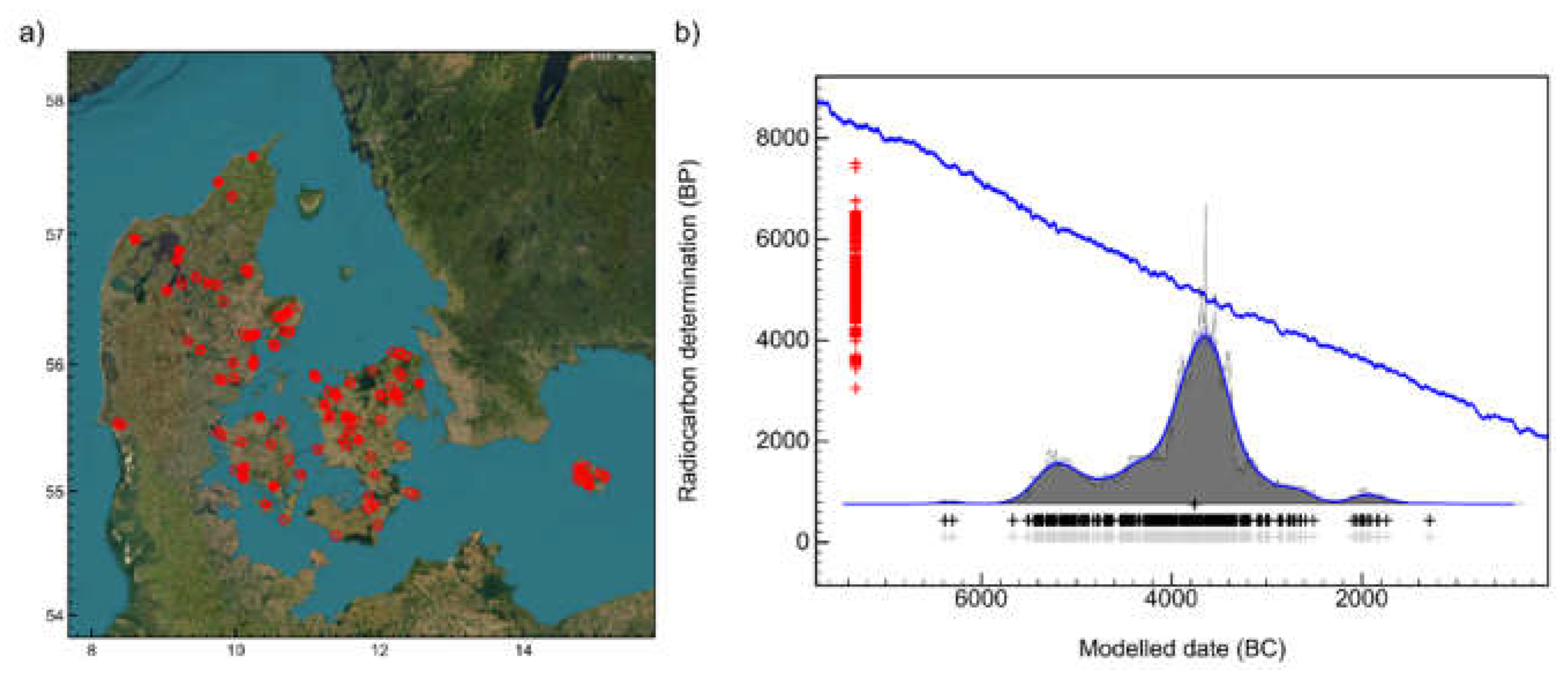
Figure 2.
Schematic illustration of chronological models. Yellow parameters are cross-referenced between the individual site models and the cultural transition model, and blue parameters between the individual site models and the ancestry transition model.
Figure 2.
Schematic illustration of chronological models. Yellow parameters are cross-referenced between the individual site models and the cultural transition model, and blue parameters between the individual site models and the ancestry transition model.
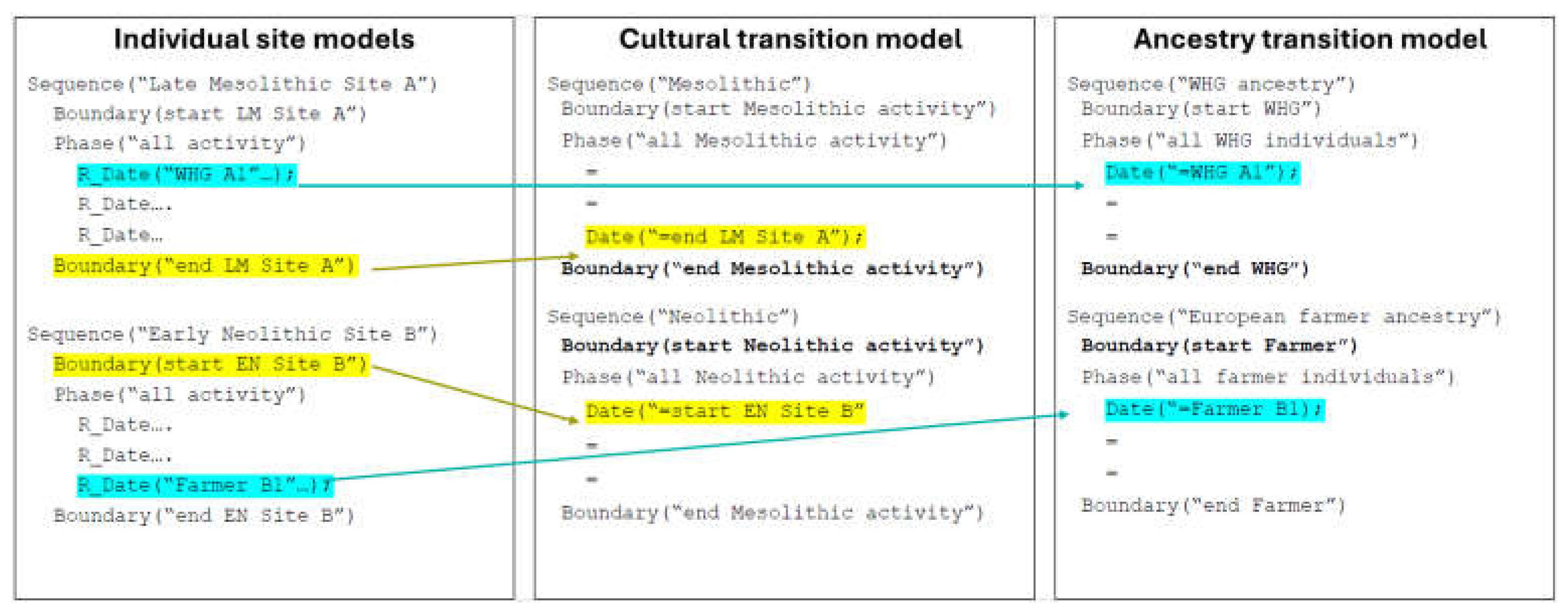
Figure 3.
Plots of the principal chronological parameters from Model B1, a) western Denmark, and b) eastern Denmark. Boundary estimates in red, summarized distributions in black.
Figure 3.
Plots of the principal chronological parameters from Model B1, a) western Denmark, and b) eastern Denmark. Boundary estimates in red, summarized distributions in black.
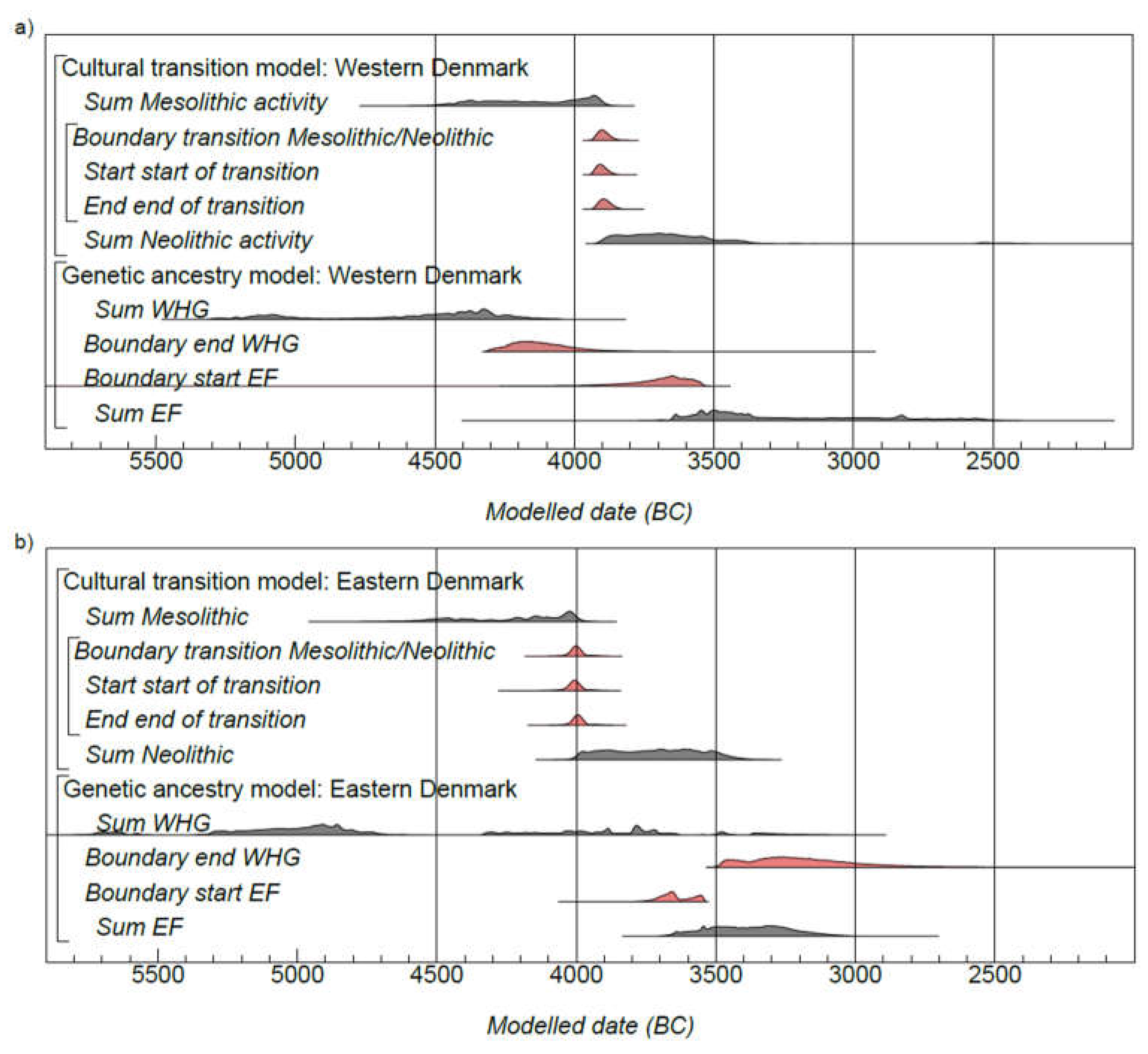
Figure 4.
Plots of the principal chronological parameters from Model B2, a) western Denmark, and b) eastern Denmark. Boundary estimates in red, summarized distributions in black.
Figure 4.
Plots of the principal chronological parameters from Model B2, a) western Denmark, and b) eastern Denmark. Boundary estimates in red, summarized distributions in black.
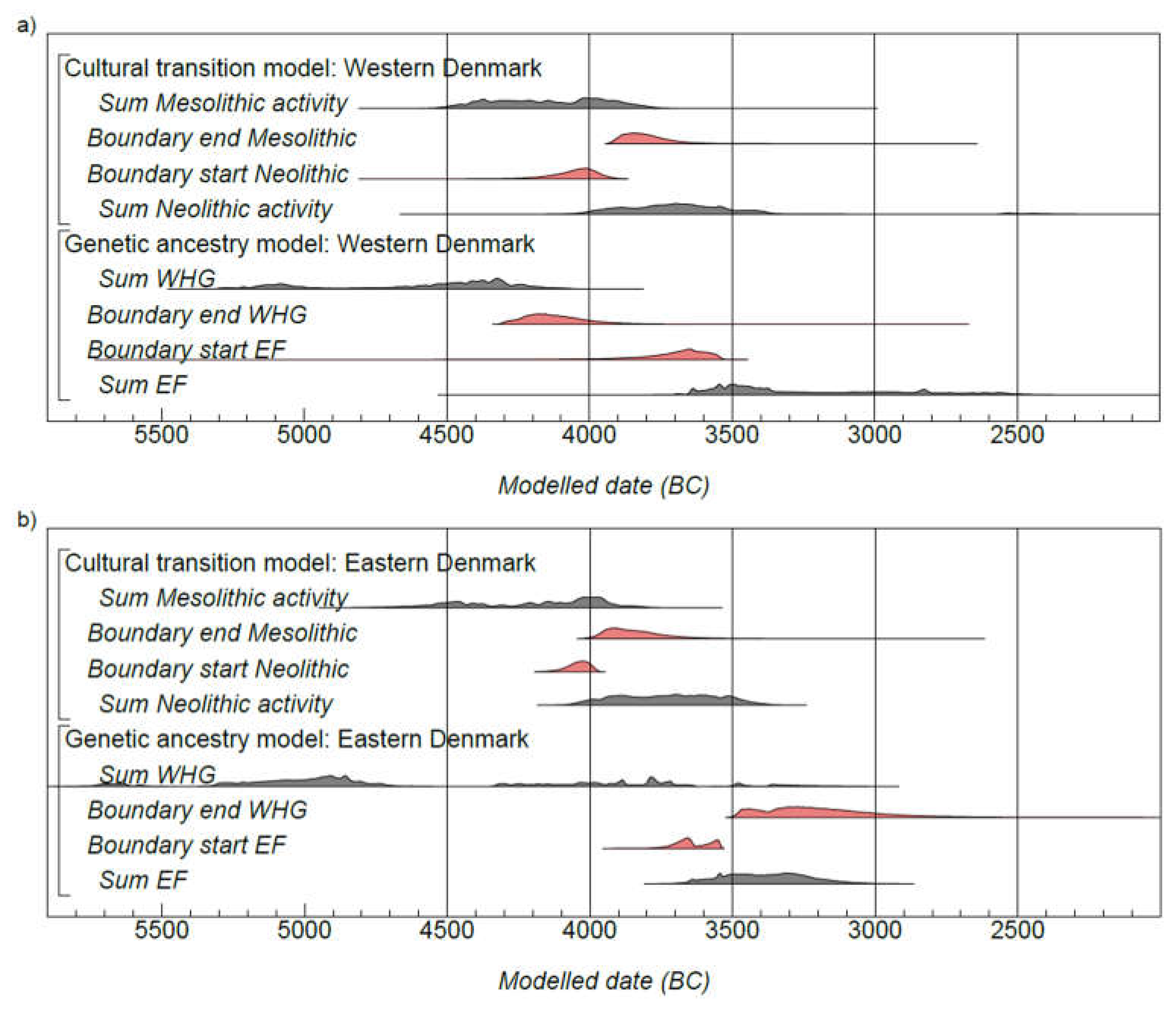
Figure 5.
Dietary variation by modelled date and genetic ancestry groups: a) contribution from marine fish and mammals; b) contribution from freshwater fish. Horizontal error bars represent 68.3% posterior probability ranges for modelled dates; vertical error bars represent standard deviations of FRUITS estimates.
Figure 5.
Dietary variation by modelled date and genetic ancestry groups: a) contribution from marine fish and mammals; b) contribution from freshwater fish. Horizontal error bars represent 68.3% posterior probability ranges for modelled dates; vertical error bars represent standard deviations of FRUITS estimates.
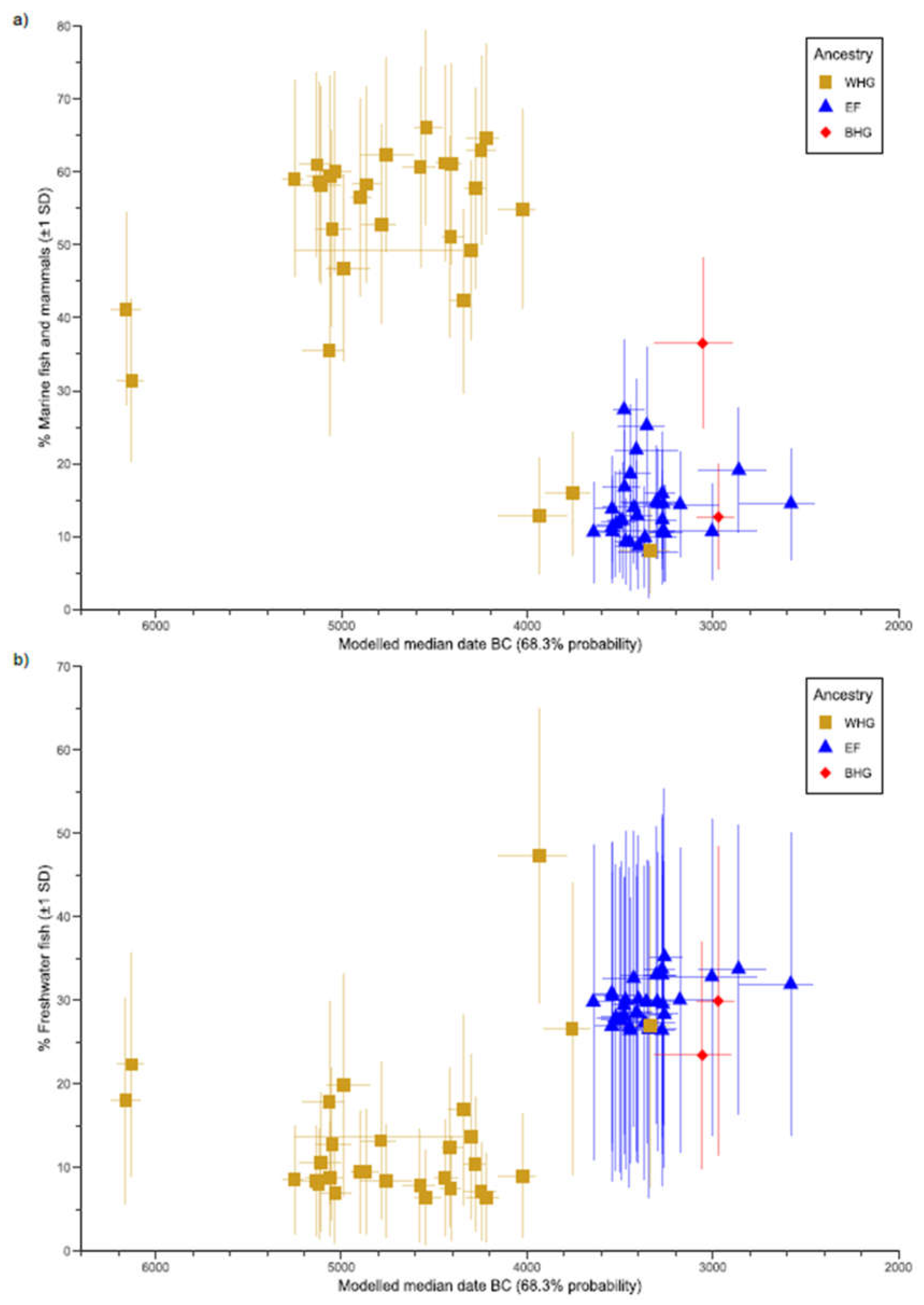
Figure 6.
Strontium isotope variation, a) 87Sr/86Sr values by ancestry group and osteological sex. Squares = males; circles = females; triangles = unknown sex. EF = European farmer; WHG = Western Hunter-Gatherer; BHG = Baltic Hunter-Gatherer; b) distribution of 87Sr/86Sr values among ancestry groups classified using the Jenks Natural Breaks optimization method.
Figure 6.
Strontium isotope variation, a) 87Sr/86Sr values by ancestry group and osteological sex. Squares = males; circles = females; triangles = unknown sex. EF = European farmer; WHG = Western Hunter-Gatherer; BHG = Baltic Hunter-Gatherer; b) distribution of 87Sr/86Sr values among ancestry groups classified using the Jenks Natural Breaks optimization method.
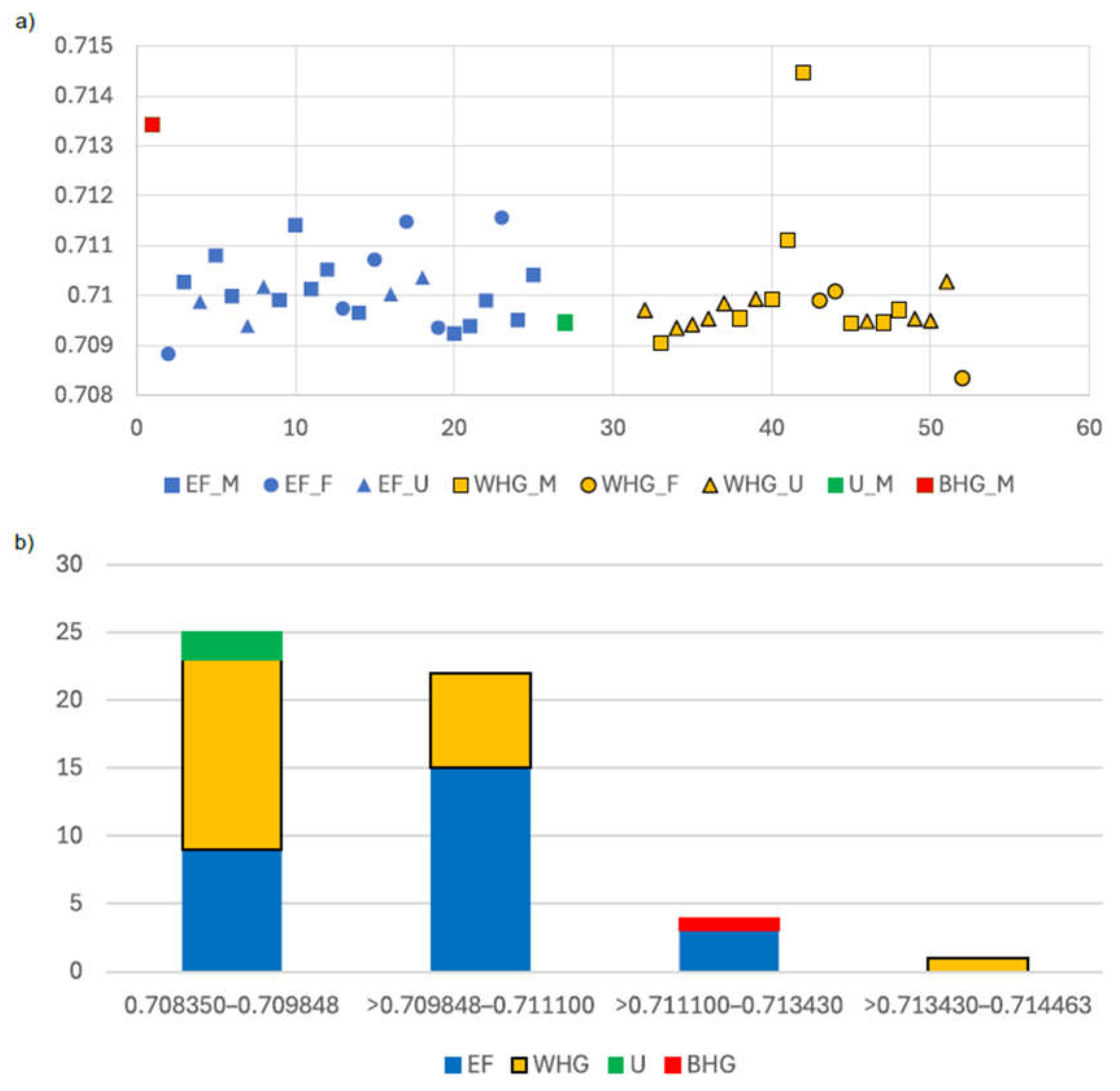
Figure 7.
Marine dietary contribution among late individuals with WHG and BHG ancestry by modelled date. Horizontal error bars represent 68.3% posterior probability ranges for modelled dates; vertical error bars represent standard deviations of FRUITS estimates.
Figure 7.
Marine dietary contribution among late individuals with WHG and BHG ancestry by modelled date. Horizontal error bars represent 68.3% posterior probability ranges for modelled dates; vertical error bars represent standard deviations of FRUITS estimates.
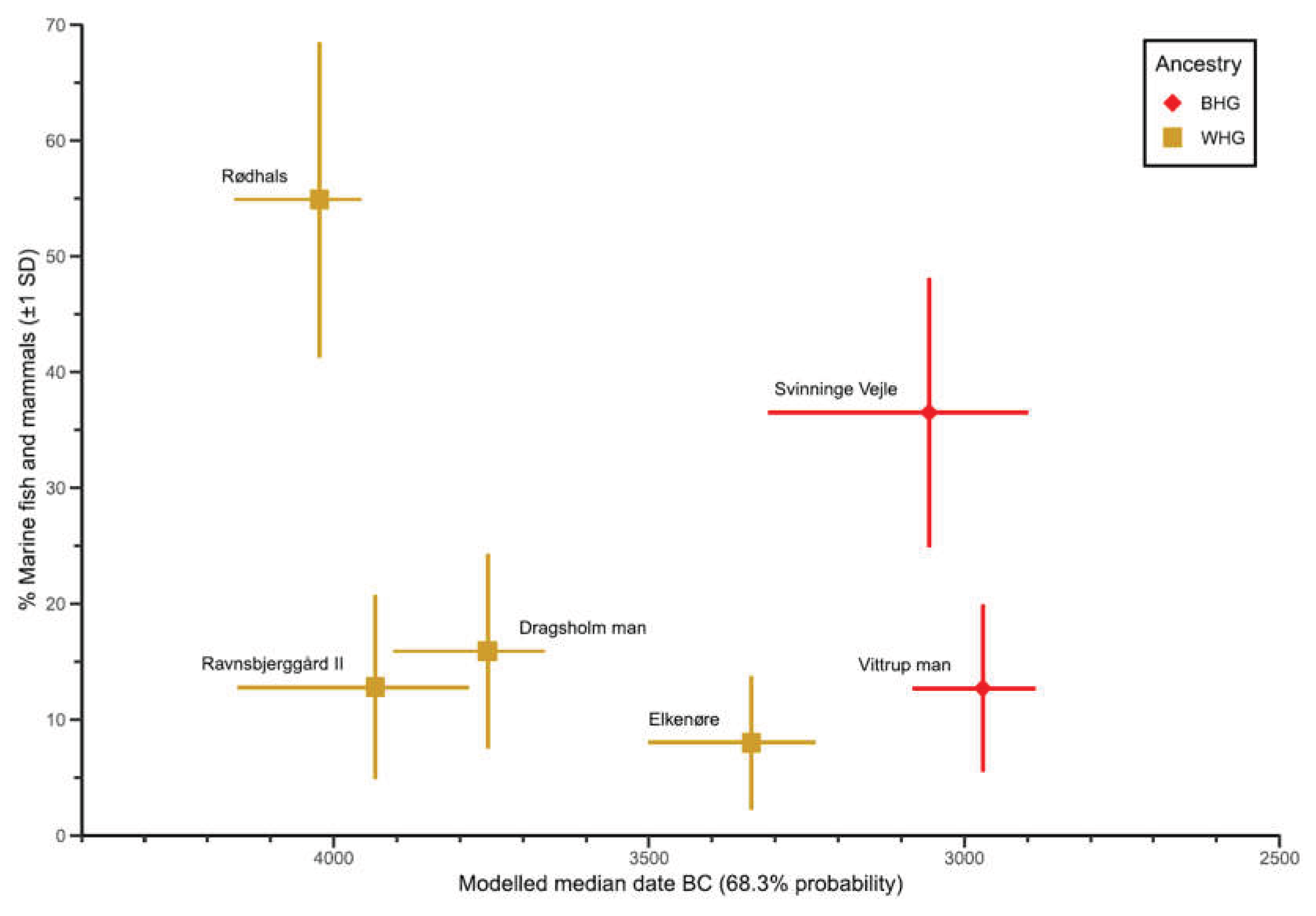

Table 1.
Posterior density estimates of principal chronological parameters from Model B1.
| Model B1 western Denmark (Amodel = 67.2) |
Model B1 eastern Denmark (Amodel = 73.2) |
|||
| 68.3% | 95.4% | 68.3% | 95.4% | |
| Charcoal O_M | 1-70yr | - | 3-79yr | - |
| Start cultural transition | 3927-3887 cal BC | 3940-3861cal BC | 4031-3984 cal BC | 4075-3931 cal BC |
| Transition duration | 0-16yr | - | 0-18yr | - |
| End WHG ancestry | 4244-4040 cal BC | 4310-3875 cal BC | 3473-3081 cal BC | 3497-2780 cal BC |
| Start EF ancestry | 3752-3558 cal BC | 4014-3530 cal BC | 3708-3546 cal BC | 3742-3540 cal BC |
Table 2.
Posterior density estimates of principal chronological parameters from Model B2.
| Model B2 western Denmark (Amodel = 62.1) |
Model B2 eastern Denmark (Amodel = 87.1) |
|||
| 68.3% | 95.4% | 68.3% | 95.4% | |
| Charcoal O_M | 1-30yr | - | 0-66yr | - |
| End Mesolithic | 3896-3756 cal BC | 3929-3623 cal BC | 3961-3785 cal BC | 4008-3609 cal BC |
| Start Neolithic | 4115-3969 cal BC | 4259-3915 cal BC | 4061-3991 cal BC | 4116-3970 cal BC |
| End WHG ancestry | 4236-4035 cal BC | 4304-3872 cal BC | 3472-3076 cal BC | 3496-2766 cal BC |
| Start EH ancestry | 3760-3558 cal BC | 4035-3534 cal BC | 3703-3546 cal BC | 3740-3539 cal BC |
Disclaimer/Publisher’s Note: The statements, opinions and data contained in all publications are solely those of the individual author(s) and contributor(s) and not of MDPI and/or the editor(s). MDPI and/or the editor(s) disclaim responsibility for any injury to people or property resulting from any ideas, methods, instructions or products referred to in the content. |
© 2026 by the authors. Licensee MDPI, Basel, Switzerland. This article is an open access article distributed under the terms and conditions of the Creative Commons Attribution (CC BY) license (http://creativecommons.org/licenses/by/4.0/).
Copyright: This open access article is published under a Creative Commons CC BY 4.0 license, which permit the free download, distribution, and reuse, provided that the author and preprint are cited in any reuse.