

Submitted:
26 September 2026
Posted:
30 September 2026
You are already at the latest version
Abstract
We introduce a bitopological version of the theory of gerbes. A bitopological space is a set equipped with two topologies, and the simultaneous use of two topologies provides a natural framework for studying geometric structures in which two notions of locality are present. We define a bitopological gerbe as a gerbe over a bitopological space together with compatible gerbe structures for the two associated sites. We introduce bitopological coverings, bitopological banded gerbes, morphisms, equivalences, and bitopological Dixmier– Douady classes. We prove basic comparison results between the two gerbe structures and show that, under a compatibility condition, the classification of abelian bitopological gerbes is governed by a suitable third cohomology group associated with the pair of topologies. Several examples are given, including the diagonal case, product bitopological spaces, and bitopological manifolds. We also discuss the relation with bundle gerbes and Lie groupoids. The purpose of the paper is to provide a starting point for a systematic theory of higher geometric structures on bitopological spaces.
Keywords:
bitopological space
; gerbe
; bundle gerbe
; sheaf of groupoids
; Dixmier–Douady class
; ˇCech cohomology
; differentiable stack
; Lie groupoid
; higher geometry
MSC: 54E55; 18F20; 55N30; 58H05; 53C08
1. Introduction
Gerbes are higher geometric objects which may be regarded, in one formulation, as stacks in groupoids satisfying suitable local non-emptiness and local connectedness conditions. The general cohomological theory of gerbes goes back to the work of Giraud, while the differential-geometric theory of abelian gerbes was developed extensively by Brylinski [3]. Bundle gerbes provide a more geometric realization of these objects and were introduced by Murray [9].
In the differential-geometric setting, gerbes have particularly important relationships with degree-three cohomology. In the abelian -banded case, the corresponding characteristic class is the Dixmier–Douady class. The bundle-gerbe formulation gives a geometric realization of this class in [9]. More recently, differential cohomology and connections on gerbes have provided a useful framework for describing their curvature and characteristic data.
At the same time, bitopological spaces have been studied since the foundational work of Kelly [8]. A bitopological space is a set X endowed with two topologies .
The two topologies need not coincide, and the interaction between them leads to a rich theory of separation, continuity, convergence, and compactness. See also [4] for a systematic treatment of bitopological spaces.
The purpose of this paper is to combine these two theories.
The central idea is that a space carrying two topologies may support two related notions of local geometric data. Instead of forcing one of the topologies to be ignored, we associate a gerbe to each topology and impose a compatibility condition between them. This leads to the following basic object:
where is a gerbe over , is a gerbe over , and is a specified equivalence between the two gerbe structures on a common refinement.
This construction is inspired by the relationship between gerbes, Lie groupoids, and differentiable stacks developed by Behrend and Xu [1,2]. In particular, Behrend and Xu established the relationship between -gerbes and groupoid -central extensions and developed Chern–Weil theory for such objects [2].
The notion introduced here should be regarded as a framework for developing a theory of gerbes adapted to spaces with two topologies. In particular, the term “bitopological gerbe” is used here as a definition introduced in this paper.
The paper is organized as follows. Section 2 recalls basic notions from bitopological spaces. Section 3 reviews gerbes and their cohomological description. Section 4 introduces bitopological gerbes. Section 5 studies morphisms and equivalences. Section 6 introduces bitopological Dixmier–Douady classes. Section 7 gives examples. Section 8 discusses bundle gerbes and Lie groupoids. Finally, Section 9 contains several directions for further development.
2. Bitopological Spaces
We begin with the basic notions.
Definition 2.1.
A bitopological space is a triple , where is a set and are two topologies on .
The terminology goes back to Kelly [8].
Definition 2.2.
Let be a bitopological space. A subset is called bitopen if it is open in both and . The collection is called the common topology.
Notice that is again a topology on X .
Definition 2.3.
A map is called bitopologically continuous if and are continuous.
Remark 2.4.
The two topologies can encode different local structures. For example, one topology may describe a finer geometric structure, while the second topology may describe a weaker or coarser structure. This is one of the motivations for introducing bitopological geometry.
Proposition 2.5.
If is bitopologically continuous, then is continuous.
Proof.
Let . Since f is continuous with respect to both pairs of topologies, .
Hence . Therefore f is continuous for the common topologies. □
3. Gerbes and Bundle Gerbes
We recall the basic concept of a gerbe.
Let be a site. A gerbe over is, informally, a stack in groupoids satisfying local non-emptiness and local connectedness. More precisely, every object of the site has a covering on which the gerbe has an object, and any two objects are locally isomorphic. This viewpoint is part of the general theory of gerbes developed by Giraud and was developed in the differential-geometric context by Brylinski [3].
Definition 3.1.
Let be a site. A gerbe over is a stack in groupoids such that:
- (i)
- for every object U of , there is a covering such that is nonempty;
- (ii)
- for every U and every two objects , there exists a covering such that .
If the automorphism sheaf of every object is identified with an abelian sheaf A , one obtains an A -banded gerbe. The abelian case is particularly important because equivalence classes of A -gerbes are described by degree-two cohomological data.
For a smooth manifold M , the case leads to the familiar degree-three Dixmier–Douady class. Bundle gerbes provide a concrete realization of this theory [9].
Definition 3.2.
Let M be a smooth manifold. A bundle gerbe over M consists of a surjective submersion , a principal -bundle , where , and an associative multiplication isomorphism
over .
This is the standard geometric formulation introduced by Murray [9]. The associated Dixmier–Douady class lies in .
The relation between gerbes and differentiable stacks was developed in detail by Behrend and Xu [2]. They showed, in particular, how -gerbes over differentiable stacks can be described through central extensions of Lie groupoids.
4. Bitopological Sites
Definition 4.1.
Let be a bitopological space. We associate to X two sites
whose objects are open subsets of and , respectively, with coverings given by open coverings. .
Remark 4.2.
It should be noted that the common site is important because it provides a domain on which the two gerbe structures can be compared.
Definition 4.3.
A common refinement of the two topologies is a site equipped with continuous morphisms of sites
In many geometric examples, provides such a common refinement.
5. Bitopological Gerbes
We now introduce the main definition.
Definition 5.1.
Let be a bitopological space. A bitopological gerbe on X is a triple , where:
- (i)
- is a gerbe on ;
- (ii)
- is a gerbe on ;
- (iii)
- Φ is an equivalence between the restrictions of and to a common refinement .
Thus a bitopological gerbe contains two local descriptions of the same higher geometric object.
We write .
Remark 5.2.
The equivalence Φ is essential. Without Φ, the pair would simply consist of two unrelated gerbes. The compatibility datum makes the object genuinely bitopological.
Definition 5.3.
as gerbes.
Definition 5.4.
A bitopological gerbe is called weakly compatible if
is an equivalence but the two restrictions are not necessarily equal.
The weakly compatible case is the natural categorical formulation.
6. Banded Bitopological Gerbes
In this section we introduce the notion of banded bitopological gerbes. The purpose of the band is to specify the sheaf of abelian groups that acts as the automorphism sheaf of the objects of a gerbe. In the bitopological setting, the two topologies may carry different bands, and the compatibility equivalence between the two component gerbes must preserve these bands on the common refinement. Let
be a bitopological space. Let
denote the corresponding sites associated with the two topologies. We assume that there is a common refinement
together with restriction functors
Let and be sheaves of abelian groups on and , respectively. We write
for their restrictions to the common refinement. Assume that on there is a specified isomorphism of sheaves of abelian groups
The map is the datum that identifies the two bands on the common refinement. It is important to distinguish this identification from an equality of the two sheaves: in general, and may be defined on different sites and need not be equal before restriction to . Recall that a gerbe on a site is said to be A-banded if its band is identified with the sheaf A . In particular, for every object U of and every object , there is an identification
which is compatible with restriction and with conjugation by morphisms in the gerbe. Since A is abelian, the resulting automorphism sheaves are canonically identified with the band. Let
be a bitopological gerbe on X , where is a gerbe on , is a gerbe on , and
is the compatibility equivalence on the common refinement. The equivalence is said to be band-compatible if, after identifying the two bands by , the induced map on automorphism sheaves agrees with . More explicitly, let U be an object of and let x be an object of . The equivalence sends x to an object
The functor induces a morphism
Using the band identifications
and
the above morphism must coincide with
Definition 6.1.
Let
be a bitopological space, and let
be a bitopological gerbe on X. Let and be sheaves of abelian groups on and , respectively, together with an isomorphism
We say that is an -banded bitopological gerbe if the following conditions hold:
- 1.
- is an -banded gerbe on ;
- 2.
- is an -banded gerbe on ;
- 3.
- the compatibility equivalenceis compatible with the identification of bands
Thus, an -banded bitopological gerbe consists of two gerbes whose bands may be different on the two sides, together with an equivalence on the common refinement that identifies the two gerbes in a way that preserves their band structure. The compatibility of the bands can be expressed by the commutative diagram
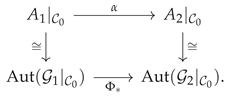 Here denotes the map on automorphism sheaves induced by the equivalence . The diagram expresses the fact that the identification of the bands is not merely an abstract isomorphism of sheaves, but is the same identification that is induced by the compatibility equivalence of the two gerbes.
Remark 6.2.
If
and the identification
is the identity, then an -banded bitopological gerbe is simply a bitopological gerbe whose two component gerbes have the same band A and whose compatibility equivalence preserves this common band.
The banded condition is particularly useful when one wants to associate cohomological invariants to bitopological gerbes. For an A -banded gerbe, its equivalence class is naturally related to degree-two or degree-three cohomological data, depending on the cohomological formalism being used. In the classical case of abelian -banded gerbes, the associated Dixmier–Douady class lies in
The bitopological setting produces two such classes, one associated with each topology, subject to the compatibility imposed on the common refinement. In particular, if
where denotes the sheaf of -valued functions in the appropriate site, the preceding construction gives the basic bitopological analogue of an -banded gerbe.
Definition 6.3.
An -bitopological gerbe on
is an
for which the identification of the two bands on the common refinement is the canonical identification
Equivalently, an -bitopological gerbe is a triple
such that and are -banded gerbes for the two respective topologies and the equivalence
preserves the -band. The -case is the principal example considered in this paper. It is sufficiently general to retain the essential interaction between the two topologies while allowing the use of the classical Dixmier–Douady theory. In particular, the two component gerbes determine classes
and
and the compatibility equivalence on the common refinement imposes a compatibility relation between their restrictions. Consequently, the natural bitopological Dixmier–Douady datum may be viewed as a compatible pair
belonging to an appropriate fiber product
Thus, the notion of a banded bitopological gerbe provides the categorical framework needed to formulate cohomological invariants that simultaneously record the gerbe structures associated with the two topologies and their compatibility on the common refinement.
7. Bitopological Čech Description
Definition 7.1.
Let be a -open covering and let be a -open covering. Suppose that the two coverings have a common refinement . For an abelian band A, a gerbe can locally be described by a Čech 2-cocycle. Thus the first gerbe determines a cocycle , while the second determines . After restriction to the common refinement, compatibility means that the corresponding cocycles are cohomologous.
Here denotes the Čech differential.
Proposition 7.2.
Equivalent choices of local trivializations determine cohomologous compatible bitopological Čech cocycles.
Proof.
Observe that is preserved under changes of trivialization. □
8. Bitopological Dixmier–Douady Classes
For an ordinary -gerbe, the Dixmier–Douady class is a degree three integral cohomology class. This is one of the fundamental features of gerbes and bundle gerbes [3,9].
Definition 8.1.
For a bitopological gerbe, there are naturally two classes:
and
The compatibility isomorphism Φ gives a comparison between their restrictions to the common refinement.
is called the bitopological Dixmier–Douady class of .
Theorem 8.2.
Proof.
The equivalence
identifies the two restricted gerbes. Equivalent abelian gerbes determine the same cohomology class. Therefore their degree-three classes on the common refinement coincide. □
Remark 8.3.
The theorem shows that the two components of a bitopological Dixmier–Douady class are not independent. Their difference vanishes after passing to the common refinement.
9. The Diagonal Case
The first consistency test for the theory is the case in which the two topologies coincide.
Proposition 9.1.
Suppose that . Then every strictly compatible bitopological gerbe is equivalent to an ordinary gerbe on .
Proof.
Let us consider and . A strictly compatible bitopological gerbe satisfies . Hence the data reduce to a single gerbe on . □
Thus the theory introduced here extends ordinary gerbe theory.
10. Example: A Product Bitopological Space
Let M and N be smooth manifolds and set .
Let be the topology generated by open sets of the form
and let be the topology generated by sets
Let be an -gerbe on M and an -gerbe on N . Their pullbacks define gerbes on X :
If these are equipped with an equivalence on a common refinement, we obtain a bitopological gerbe.
The corresponding Dixmier–Douady classes are
This example illustrates that the two topologies can retain different geometric information.
11. Bitopological Bundle Gerbes
We next give a geometric version.
Let , where M is a smooth manifold equipped with two compatible topologies.
Let
be surjective submersions.
Suppose that and are principal -bundles with bundle-gerbe multiplication maps
and
Definition 11.1.
A bitopological bundle gerbe consists of the data
where Φ is a stable equivalence between the two bundle-gerbe structures on a common refinement.
This definition extends the bundle-gerbe construction of Murray [9] by retaining two compatible geometric realizations.
Proposition 11.2.
Every bitopological bundle gerbe determines a bitopological -gerbe.
Proof.
Each bundle gerbe determines an -banded gerbe. The stable equivalence on the common refinement induces an equivalence between the corresponding gerbes. Hence the data satisfy the definition of a bitopological -gerbe. □
12. Bitopological Gerbes and Lie Groupoids
Lie groupoids provide an important geometric language for gerbes. In the differentiable setting, Behrend and Xu established a close relationship between -gerbes over differentiable stacks and -central extensions of Lie groupoids [1,2].
Let be a Lie groupoid. A central extension is a diagram
compatible with the groupoid multiplication.
For a bitopological setting, suppose that and each carry two compatible topologies:
The source and target maps are required to be continuous for both topological structures:
Definition 12.1.
A bitopological Lie groupoid is a Lie groupoid whose object and arrow spaces are equipped with two topologies such that all structure maps are continuous with respect to the corresponding topologies.
Definition 12.2.
A bitopological central extension of a bitopological Lie groupoid G by is an extension
which is central and compatible with both topological structures.
Proposition 12.3.
Under the usual differentiability and stackification hypotheses, a compatible bitopological -central extension determines a bitopological -gerbe.
Proof.
For each topology, the central extension determines an -gerbe by the groupoid construction of Behrend and Xu [1,2]. Compatibility of the extension with the two topologies produces an equivalence of the two resulting gerbes on the common refinement. Hence the resulting object is a bitopological -gerbe. □
13. Connections and Curvature
Suppose that a bitopological bundle gerbe is equipped with connections and curvings . For each component we obtain a closed three-form
Definition 13.1.
A connective structure on a bitopological gerbe is a pair such that the equivalence Φ preserves the connective structures on the common refinement.
Proposition 13.2.
on the common refinement.
Proof.
The compatibility of the connective structures implies that the two gerbes with connection become isomorphic after restriction to the common refinement. Therefore their three-curvatures represent the same de Rham cohomology class there. □
14. Morphisms of Bitopological Gerbes
Let and be bitopological gerbes over X .
Definition 14.1.
A morphism of bitopological gerbes consists of morphisms
such that on the common refinement
Thus we have the commutative diagram up to natural isomorphism
Definition 14.2.
A morphism of bitopological gerbes is an equivalence if both and are equivalences of gerbes.
15. Functoriality
Functoriality is an essential property of the theory of bitopological gerbes. It expresses the fact that a bitopologically continuous map between bitopological spaces induces a pullback operation on bitopological gerbes. The construction is obtained by applying the ordinary pullback operation to each of the two gerbes and then pulling back the compatibility equivalence to the common refinement.
Proposition 15.1.
Let
be bitopological spaces. A map
is called bitopologically continuous if
is continuous for each . Thus, f determines two continuous maps between the corresponding topological spaces:
Suppose that
is an -bitopological gerbe on Y. Here is an -gerbe on the site associated with , while
is the compatibility equivalence over a common refinement of the two topologies.
The continuous maps and induce pullback gerbes
on and , respectively. For simplicity, we denote these two pullbacks by
The compatibility equivalence Φ also pulls back to the common refinement of the two topologies on X. If denotes the chosen common refinement of and , then the continuity of f induces the corresponding map on the refined sites and hence an equivalence
on X, up to canonical equivalence.
Moreover, the construction is compatible with equivalences of bitopological gerbes and therefore defines a functor
Proof.
The proof follows from the ordinary functoriality of pullback for gerbes on each of the two topological sites.
Since f is bitopologically continuous, the maps
are continuous. Consequently, the ordinary pullback construction for gerbes gives
as an -gerbe on . We write these gerbes simply as
It remains to verify that these two pullback gerbes satisfy the bitopological compatibility condition.
On the common refinement, the original bitopological gerbe is equipped with an equivalence
Pullback of gerbes is functorial with respect to morphisms and equivalences. Hence induces an equivalence
Because is an equivalence, its pullback is again an equivalence. Thus the triple
satisfies precisely the defining compatibility condition for a bitopological gerbe on X .
The construction is independent, up to canonical equivalence, of the chosen representatives of the gerbes and of the corresponding compatibility data. Indeed, if
are equivalent gerbes and the equivalences are compatible with , then their pullbacks satisfy
and the induced equivalences commute with the pulled-back compatibility morphisms up to the canonical natural isomorphisms associated with pullback.
Therefore is well-defined up to canonical equivalence. □
15.1. Functoriality of the Dixmier–Douady Class
The compatibility of the original gerbe implies that the two classes agree after restriction to the common refinement. Since pullback commutes with the restriction maps, the same compatibility relation holds for the pulled-back classes. Thus
again belongs to the appropriate fiber product of cohomology groups.
15.2. Identity Maps
The construction satisfies the expected identity property. Let
be the identity map. Then
and
Consequently,
Thus pullback along the identity map is naturally equivalent to the identity functor:
15.3. Composition of Pullbacks
Functoriality also holds for compositions. Let
be bitopologically continuous maps, and let be an -bitopological gerbe on Z . Then there are canonical equivalences
The same compatibility holds for the comparison morphism:
Therefore,
This equality is understood as a canonical equivalence rather than a strict equality of representatives.
15.4. Functoriality Theorem
The preceding observations can be summarized as follows.
Theorem 15.2.
The assignment
together with pullback along bitopologically continuous maps defines a contravariant functor from the category of bitopological spaces and bitopologically continuous maps to the category of gerbe categories.
Remark 15.3.
The contravariance is important. A map induces a pullback from gerbes on Y to gerbes on X. Thus the direction of the map is reversed at the level of gerbe categories:
This is exactly analogous to the usual contravariant behavior of cohomology and of ordinary gerbes.
15.5. The Diagonal Case
The functoriality of bitopological gerbes should reduce to the classical functoriality of ordinary -gerbes when the two topologies coincide. This diagonal case provides an important consistency check for the bitopological theory. Suppose that
on X , and
on Y . Thus,
are diagonal bitopological spaces. In this situation, a bitopologically continuous map
is simply an ordinary continuous map
Let be an -gerbe on . The corresponding diagonal bitopological gerbe is defined by
The two components of are therefore identical, and the compatibility equivalence on the common refinement is simply the identity equivalence
Pulling back the diagonal gerbe along f gives
Since pullback preserves identity morphisms, we have
Consequently,
Thus, the pullback of a diagonal bitopological gerbe is again diagonal.
Proposition 15.4.
Let
be a bitopologically continuous map between diagonal bitopological spaces. Let
be the diagonal bitopological gerbe associated with an -gerbe on . Then
Moreover, the bitopological Dixmier–Douady class satisfies
Under the canonical identification
the above pair corresponds to
Hence the functoriality of diagonal bitopological gerbes agrees with the ordinary functoriality of -gerbes.
Proof.
Since
and
the common refinements on X and Y may be identified with and , respectively. The compatibility equivalence of the diagonal gerbe is
Pullback along f gives
Therefore,
The ordinary Dixmier–Douady class is natural with respect to pullback. Thus,
where
is the usual cohomological pullback. Since both components of are equal to , we obtain
Using the naturality relation above, this becomes
In the diagonal situation, the two maps to the cohomology of the common refinement are the identity maps. Hence the fiber product reduces canonically to the diagonal:
Explicitly, the identification is given by
Consequently,
Therefore, the bitopological Dixmier–Douady class in the diagonal case is precisely the ordinary Dixmier–Douady class of the pulled-back gerbe. This proves the proposition. □
The diagonal case shows that the bitopological construction is a genuine extension of the classical theory of -gerbes. When the two topologies coincide, no additional cohomological information is introduced by the bitopological structure. The two components of the bitopological Dixmier–Douady class are forced to agree, and the resulting class is exactly the ordinary class in . The additional structure becomes relevant only when the two topologies on the underlying space are genuinely different.
16. Trivial Bitopological Gerbes
We now consider the simplest class of bitopological gerbes, namely those whose two component gerbes are trivial.
Definition 16.1.
Let
be a bitopological gerbe on
We say that is trivial if each component gerbe is equivalent to the trivial -gerbe and if the compatibility equivalence
is compatible with the chosen trivializations on the common refinement .
The following proposition gives an immediate cohomological consequence of this definition.
Proposition 16.2.
Let
be a trivial bitopological gerbe. Then
Consequently, the bitopological Dixmier–Douady class vanishes:
Proof.
By definition, each component is equivalent to the trivial -gerbe. The Dixmier–Douady class is invariant under equivalence of gerbes, while the trivial -gerbe has vanishing Dixmier–Douady class. Hence
and
Therefore,
This proves the proposition. □
Under the usual hypotheses for the classification of -gerbes by degree-three integral cohomology, the converse can also be considered. Namely, if
then each component gerbe is cohomologically trivial. However, for a complete trivialization of the bitopological gerbe, one must also take the compatibility equivalence on the common refinement into account. Thus, vanishing of the two component Dixmier–Douady classes is the cohomological part of the triviality condition, while the compatibility data determine whether these individual trivializations assemble into a trivialization of the entire bitopological gerbe.
17. A Classification Principle
Suppose that the two sites and the common refinement are such that abelian gerbes are classified by degree-three cohomology.
Let denote the fiber product
Theorem 17.1
(Bitopological classification principle). Assume that:
- (i)
- abelian -gerbes on each of the two sites are classified by degree-three integral cohomology;
- (ii)
- the common refinement admits the corresponding restriction maps;
- (iii)
- equivalences of gerbes on the common refinement satisfy effective descent.
Then equivalence classes of -bitopological gerbes are naturally classified by .
Proof.
An -bitopological gerbe determines a pair
The compatibility equivalence implies . Thus the pair belongs to .
Conversely, let .
By the assumed classification results, choose gerbes and representing a and b . Equality of their restrictions in the common cohomology group gives an equivalence between their restrictions to the common refinement. The descent hypothesis allows this equivalence to be incorporated into the gerbe data, producing a bitopological gerbe.
Changing representatives within the same cohomology classes changes the resulting gerbes only by equivalence. Hence the classification is by the fiber product above. □
Remark 17.2.
The theorem should be interpreted as a structural classification principle. In concrete categories, additional hypotheses are needed to identify the precise cohomology theory and to verify descent.
18. Example: The Diagonal Bitopological Gerbe
Consider the special case in which the two topologies coincide, namely .
In this situation, the two underlying topological structures are identical, and hence the common refinement is simply . The corresponding restriction maps are therefore identity maps.
Consequently, the two cohomological descriptions are identified with the same group .
The fiber product appearing in the classification of bitopological gerbes consequently becomes
Thus, in the diagonal case, the compatibility condition between the two gerbe classes is automatic once they are identified on the common space.
Corollary 18.1.
If , then the theory of -bitopological gerbes reduces to the usual theory of -gerbes on .
This example shows that the proposed bitopological framework contains ordinary gerbe theory as a special case. In particular, it provides an extension of the classical theory rather than a replacement for it.
19. Relation with Differentiable Stacks
Differentiable stacks provide a natural framework in which groupoids, gerbes, and differential geometry can be treated simultaneously. Behrend and Xu developed this framework and established the relation between differentiable stacks and Lie groupoids [2].
The common refinement plays the role of a comparison stack
This suggests that bitopological gerbes can be regarded as gerbes on a diagram of sites or stacks rather than on a single site (see, [7]).
20. Further Examples
Example 20.1
(Comparable topologies). Suppose . Then every -open set is -open. The identity map
is continuous.
In this case a gerbe on the finer topology can sometimes be restricted to the coarser structure, provided the corresponding descent data are compatible. This gives a natural source of bitopological gerbes.
Example 20.2
(Discrete–usual pair). Let X be a smooth manifold and let
where is the discrete topology and is the manifold topology.
A gerbe for the discrete topology records purely local set-theoretic data, while the second gerbe records smooth geometric data. A compatibility equivalence then measures the extent to which these two descriptions define the same higher geometric object.
Example 20.3
(A bitopological manifold). Let M be a smooth manifold with two topologies both compatible with its smooth structure. A bundle gerbe equipped with connective structures for both topologies provides an example of a bitopological differential gerbe.
Its curvature data are represented by , with after passage to the common refinement.
21. Possible Applications
The bitopological gerbe framework may be useful in situations in which two notions of locality coexist. One topology may describe the strong topology of a function space while the other describes a weaker topology. A gerbe carrying both structures could encode higher geometric data compatible with both levels of regularity. Gerbes naturally appear in gauge theory, quantization, and string theory. The appearance of degree-three characteristic classes and three-form fluxes makes the bitopological extension potentially relevant to settings in which two geometric structures are used simultaneously. The relationship between gerbes, connections, curvings and prequantization has been studied extensively in the differentiable setting [2]. Since gerbes on differentiable stacks can be described by central extensions of Lie groupoids [1,2], bitopological gerbes suggest the study of central extensions of bitopological Lie groupoids (see, [5,6]).
22. Conclusions
We have introduced a framework for bitopological gerbes by combining the theory of bitopological spaces with the geometric and cohomological theory of gerbes. The basic object is a triple , where and are gerbes associated with the two topologies on the underlying space, while is an equivalence relating their restrictions to a common refinement.
This framework naturally leads to a description in terms of compatible descent data. In particular, if and denote the corresponding cohomological data, their restrictions to the common refinement are required to agree. At the level of third cohomology, this compatibility can be expressed through the fiber product
Thus, the cohomological classification of bitopological gerbes is naturally related to pairs of gerbe classes whose restrictions coincide on the common refinement.
The diagonal case recovers ordinary gerbe theory. The framework also admits a geometric formulation using bundle gerbes and a groupoid formulation using compatible central extensions.
Several questions remain open. Among them are the construction of a fully intrinsic bicategorical definition, the development of bitopological Deligne cohomology, the classification of bitopological bundle gerbes with connective structures, and the study of bitopological gerbes over bitopological Lie groupoids.
These directions suggest that bitopological gerbes can serve as a natural higher-geometric extension of bitopological topology.
References
- K. Behrend and P. Xu, S 1-bundles and gerbes over differentiable stacks , C. R. Math. Acad. Sci. Paris 336 (2003), no. 2, 163–168. [CrossRef]
- K. Behrend and P. Xu, Differentiable stacks and gerbes , J. Symplectic Geom. 9 (2011), no. 3, 285–341. [CrossRef]
- J.-L. Brylinski, Loop Spaces, Characteristic Classes and Geometric Quantization , Progress in Mathematics, Vol. 107, Birkhäuser, Boston, 1993.
- B. P. Dvalishvili, Bitopological Spaces: Theory, Relations with Generalized Algebraic Structures, and Applications , North-Holland Mathematics Studies, Vol. 199, Elsevier, 2005.
- S. Jafari Bitopological Groupoids: Properties and Examples , submitted.
- S. Jafari Bitopological Lie Groupoids: Properties and Examples , submitted.
- S. Jafari Bitopological gerbes on differentiable stacks , submitted.
- J. C. Kelly, Bitopological spaces , Proc. London Math. Soc. (3) 13 (1963), 71–89. [CrossRef]
- M. K. Murray, Bundle gerbes , J. London Math. Soc. (2) 54 (1996), no. 2, 403–416.
- M. K. Murray and D. Stevenson, Bundle gerbes: stable isomorphism and local theory , J. London Math. Soc. (2) 62 (2000), 925–937.
- A. Weinstein and P. Xu, Extensions of symplectic groupoids and quantization , J. Reine Angew. Math. 417 (1991), 159–189.
Disclaimer/Publisher’s Note: The statements, opinions and data contained in all publications are solely those of the individual author(s) and contributor(s) and not of MDPI and/or the editor(s). MDPI and/or the editor(s) disclaim responsibility for any injury to people or property resulting from any ideas, methods, instructions or products referred to in the content. |
© 2026 by the authors. Licensee MDPI, Basel, Switzerland. This article is an open access article distributed under the terms and conditions of the Creative Commons Attribution (CC BY) license (http://creativecommons.org/licenses/by/4.0/).
Copyright: This open access article is published under a Creative Commons CC BY 4.0 license, which permit the free download, distribution, and reuse, provided that the author and preprint are cited in any reuse.