

Submitted:
29 September 2026
Posted:
30 September 2026
You are already at the latest version
Abstract
Tourism is a strategic sector in India's development agenda, and scholarship on its management has expanded quickly since the pandemic. This paper reviews 52 publications from 2022 to 2026 and organizes them into five themes: (1) smart tourism, artificial intelligence (AI) and digitalization; (2) sustainability and overtourism; (3) governance, policy and law; (4) niche and special-interest tourism (adventure, medical, spiritual); and (5) economic performance and hospitality management. The review finds a marked rise in technology-oriented and Viksit Bharat 2047-linked work since 2025, alongside a persistent reliance on conceptual, descriptive and single-region designs. Three gaps stand out: little empirical validation of AI and smart-tourism frameworks, weak integration between sustainability goals and governance mechanisms, and limited attention to workforce readiness and community outcomes. A research agenda is proposed.
Keywords:
India
; tourism management
; smart tourism
; sustainable tourism
; tourism governance
; Viksit Bharat 2047
; systematic review
1. Introduction
India combines a large domestic market with extraordinary cultural, natural and medical-service assets, and tourism is repeatedly positioned as an engine of economic growth, employment and regional development (Kaleeshwari & Sajjan, 2024; Rohan, 2023). The country's diverse heritage sites, religious destinations, natural landscapes and rapidly developing hospitality infrastructure provide a broad foundation for both domestic and international tourism. Post-pandemic analyses describe a phase of recovery and structural change in the tourism economy (Kiran et al., 2026), while national aspirations for 2047 have pushed policy and academic attention toward technology, sustainability, innovation and international competitiveness (Shethiya, 2025; Thombare & Advitot, 2026). Recent studies also indicate increasing attention to digital transformation, including artificial intelligence, social media, virtual reality and smart tourism applications, as tools for destination marketing and visitor engagement.
At the same time, the expansion of Indian tourism creates challenges that extend beyond visitor numbers and economic growth. Issues related to environmental sustainability, rural and regional accessibility, infrastructure, destination carrying capacity, digital inclusion and changing tourist expectations have become increasingly important. Recent research, for example, identifies connectivity, healthcare accessibility and transport limitations as important barriers to rural tourism participation among younger generations in India. Studies of environmentally conscious tourism similarly emphasize the growing importance of sustainable accommodation practices and consumer decision-making. These developments suggest that contemporary tourism management in India is increasingly concerned with balancing economic expansion with technological transformation, social inclusion and environmental responsibility.
Existing work, however, is scattered across management, technology, law, sustainability and destination studies, and is published in journals, edited books, conference proceedings, preprints and repositories of very uneven rigor. This diversity makes it difficult to identify the major directions of recent scholarship and to determine which methodological approaches and evidence bases are most commonly employed. A structured thematic review can therefore help clarify how the field has developed during the recent post-pandemic period and where important research gaps remain.
Accordingly, this review consolidates the 2022–2026 literature on tourism management in India and asks three questions:
RQ1. Which themes dominate recent scholarship?
RQ2. What methods and evidence bases do these studies use?
RQ3. What gaps should future research address?
2. Method
The corpus comprises 52 publications dated 2022–2026 supplied as the review sample. Each entry was screened by title, outlet and publication type, and subsequently coded inductively into a primary thematic category based on the main subject indicated by the publication. The coding process was intended to identify broad patterns across the literature rather than to evaluate the statistical quality or substantive validity of individual studies.
Publication types include journal articles, book chapters, conference proceedings and repository items, as well as preprints. This broad inclusion strategy allows the review to capture emerging research that may not yet have appeared in established journals, particularly in rapidly developing areas such as artificial intelligence, smart tourism and digital transformation. At the same time, the heterogeneous publication formats require caution when interpreting the overall evidence base.
Limitation: coding relied primarily on bibliographic information and the scope indicated by titles and abstracts rather than systematic full-text appraisal. Consequently, the synthesis is thematic and indicative rather than a formal systematic review with detailed risk-of-bias assessment. It is not a quantitative meta-analysis or a quality-weighted evidence synthesis. The number of publications within a theme should therefore not be interpreted as evidence that the theme has stronger empirical support than other areas. Several sources are also non-peer-reviewed (e.g., Zenodo, Preprints.org, Figshare) and should be read with caution, particularly when their findings are used to support broader conclusions about Indian tourism.
3. Overview of the Corpus
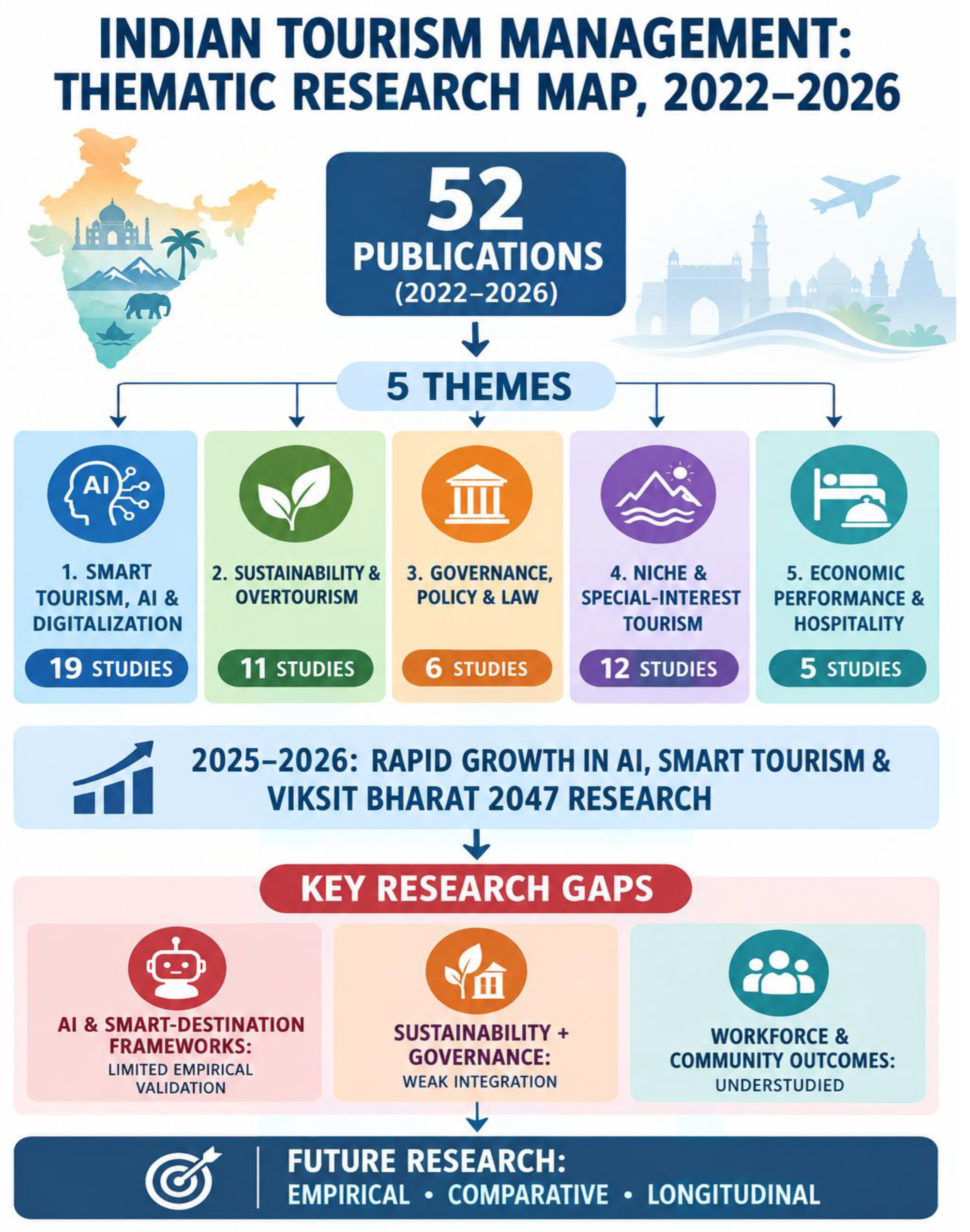
Table 1 summarizes the thematic distribution of the 52 publications included in the review. The corpus demonstrates a noticeable increase in publication activity during 2025–2026, when roughly half of the sample appeared. This recent concentration is partly associated with growing academic interest in artificial intelligence, smart destinations, digital transformation and the Viksit Bharat 2047 development agenda. The pattern suggests that recent tourism-management scholarship in India is increasingly responding to technological and policy changes rather than focusing exclusively on conventional destination-management issues.
Figure 1.
Thematic Research Map of Indian Tourism Management Literature, 2022–2026.
The thematic distribution also indicates that Indian tourism research has become increasingly interdisciplinary. Studies connect tourism with information technology, sustainability, marketing, hospitality management, public policy and regional development. For example, research on virtual reality examines its potential as a destination-marketing and visitor-engagement tool, while more recent work considers AI and social media in destination promotion, travel planning and crisis management. At the same time, sustainability-oriented studies continue to address environmental practices and tourists' decision-making, indicating that technological innovation and sustainability are emerging as interconnected rather than entirely separate research areas.
4. Thematic Synthesis
4.1. Smart tourism, AI and digitalization
This is the fastest-growing stream in the reviewed literature. Early work examines traveller decision-making and technology-driven behavioral intention, using structural models to explain technology adoption and acceptance (Paliwal et al., 2022; Rajput et al., 2022). These studies provide an important foundation for understanding how tourists respond to digital technologies at the individual level. Later studies turn to destination-level architectures: AI as the “brain” of smart destinations (Bilal, 2026), AI in tourism and hospitality aligned with Viksit Bharat 2047 (Baral et al., 2026; Bobade/Shelke, 2026), and data analytics for smart management (Vijaya et al., 2024; Suchithra, 2026). This shift indicates a movement from examining individual technology adoption toward considering how digital technologies can be incorporated into broader destination-management systems.
Reviews of digitalization trace its evolution and consumer–organization relationships (Lepcha & Bhattacharjee, 2026; Siddiqui & Ahmad, 2026; Kumar et al., 2026). Governance dimensions of intelligent destinations are considered by Kumar et al. (2025), while digital marketing and post-pandemic digital recovery are covered by Patro and Katta (2023) and Dubey and Thakur (2023). Taken together, these studies suggest that digitalization is increasingly viewed not simply as a marketing instrument but as an organizational and governance mechanism capable of influencing destination planning, visitor experience and service delivery. Workforce readiness, however, an essential enabler of successful digital transformation, receives comparatively little attention (Thakur & Sharma, 2025). This creates a potential research gap concerning employee skills, organizational adaptation and the capacity of tourism businesses to implement AI-based systems effectively.
4.2. Sustainability and overtourism
Sustainability is treated as both a policy objective and a management challenge. Studies analyze national strategies and initiatives (Mahida & Mahida, 2025; Pathak, 2025), critical success factors (Duggal & Bhasin, 2025), destination development (Choudhary et al., 2025) and the integration of sustainability across the sector (Misra & Keerthiraj, 2025; Dhama & Anil, 2024). Empirical work tests determinants of sustainable practices (Naik & Chanda, 2025), whereas Rijwani (2025) warns of overtourism in fragile destinations. Integrated PESTEL-based reviews link good governance to sustainability (Agrawal & Raheja, 2025).
The literature therefore presents sustainability as a multidimensional issue involving environmental protection, economic viability, institutional capacity and destination management. There is also an emerging connection between sustainability and smart tourism, as digital technologies may help monitor visitor flows, improve resource allocation and support more informed destination management. Recent research similarly discusses smart tourism as a possible mechanism for addressing overtourism while maintaining environmental, economic and social objectives. Nevertheless, the reviewed Indian literature contains relatively limited longitudinal or comparative evidence demonstrating whether proposed sustainability strategies produce measurable improvements over time.
4.3. Governance, policy and law
Governance studies examine whether tourism development is planned or accidental, as in Goa (Gore et al., 2025), and map the legal and regulatory framework (Tah & Goswami, 2026a, 2026b). Stakeholder perspectives on managing constructed environments in Northeast India provide rare grounded evidence (Zimik & Kang, 2026). Broader overviews situate Indian tourism policy in its institutional context (Diekmann, 2022; Thombare & Advitot, 2026).
This body of research highlights the importance of coordination between national, state and local institutions, particularly because tourism development often involves multiple stakeholders and overlapping regulatory responsibilities. It also suggests that infrastructure development alone may not guarantee sustainable tourism outcomes when planning, regulation and stakeholder participation are weak. Compared with the rapidly expanding literature on AI and digitalization, however, fewer studies empirically examine how tourism policies are implemented in practice or how different stakeholder groups perceive and respond to regulatory changes. This represents an area where future research could connect policy analysis with field-based evidence and destination-level case studies.
4.4. Niche and special-interest tourism
Adventure tourism is assessed through visitor profiles (Chandel, 2022), multi-criteria destination prioritization (Dhillon, 2024), national strategy (Khandre, 2024), and critical or economic reviews (Ghuge, 2024; Mangoch, 2023; Patel, 2025). Medical tourism studies address cost competitiveness (DeMicco & Guzman, 2022), current scenarios (Amiri, 2025) and growth and patient experience (Kumar et al., 2026). Spiritual and religious tourism is examined through cultural context and technology (Kaur, 2024; Muruganantham & Patro, 2025; Vijayabanu et al., 2023).
These studies demonstrate the considerable diversity of India's tourism market and indicate that tourism management cannot be understood solely through conventional leisure tourism. Adventure, medical and spiritual tourism involve different consumer motivations, service requirements, infrastructure needs and destination-management challenges. At the same time, much of the literature remains concentrated on individual tourism segments or specific destinations, making cross-segment comparisons relatively limited. Future research could therefore examine how digitalization, sustainability and service quality operate across different forms of special-interest tourism rather than treating each segment as an isolated market.
4.5. Economic performance and hospitality management
Macro-level work documents the sector's contribution and post-pandemic recovery (Kaleeshwari & Sajjan, 2024; Kiran et al., 2026; Rohan, 2023), while hospitality-focused papers review industry trends and management practice (Kumar & Hussain, 2024; Majeed, 2023; Prasanth, 2024). These studies provide the economic and organizational context within which the other themes can be understood, particularly by linking tourism growth with employment, business performance and the recovery of hospitality activities following the pandemic.
The hospitality literature also indicates that tourism growth depends not only on visitor demand but on the capacity of hotels, restaurants and related service providers to respond to changing consumer expectations. In this respect, hospitality management intersects with the emerging themes of digitalization, sustainability and workforce development. However, compared with studies of technology adoption and destination development, relatively fewer publications in the reviewed corpus provide detailed firm-level or longitudinal evidence on productivity, employee outcomes and financial performance. Further empirical research could therefore strengthen the connection between macro-level tourism growth and the operational performance of individual tourism and hospitality organizations.
5. Cross-Cutting Observations

Table 2.
Methodological profile and implications.
| Dimension | Observation | Implication |
|---|---|---|
| Design | Conceptual and review papers predominate | Theory is ahead of evidence |
| Data | Few large-sample surveys; scattered case studies | Limited generalizability |
| Scale | National overviews or single states (Goa, Himachal Pradesh, Northeast) | Regional comparison is missing |
| Outlets | Mix of peer-reviewed journals, book chapters, repositories and preprints | Uneven quality control |
| Alignment | Strong link to Viksit Bharat 2047 and national policy | Risk of aspiration outpacing implementation |
6. Research Gaps and Agenda
Table 3.
Gaps and future directions.
| Gap | Suggested direction |
|---|---|
| AI and smart-destination frameworks lack validation | Pilot implementations, longitudinal and experimental studies, and measurable smart-destination indicators |
| Sustainability and governance studied separately | Integrated models linking regulation, carrying capacity and stakeholder outcomes |
| Limited attention to workforce and community | Studies of skills, digital readiness and local benefit distribution |
| Niche segments studied in isolation | Comparative studies across adventure, medical and spiritual tourism, including quality and safety |
| Weak data infrastructure | Open, standardized destination data and cross-state comparisons |
| Ethical and privacy issues of AI in tourism | Governance frameworks for data use, algorithmic fairness and transparency |
7. Conclusion
Recent research on Indian tourism management is expanding in scope, moving from post-pandemic recovery and economic description toward AI-enabled, sustainable and policy-aligned visions of the sector. The literature reviewed in this study shows increasing attention to smart tourism, digitalization, sustainability, governance, special-interest tourism and hospitality management. In particular, the rapid emergence of AI-related research indicates that technology is becoming an increasingly important component of discussions about destination management, tourist decision-making and service delivery. At the same time, sustainability research continues to emphasize the need to balance tourism growth with environmental protection and responsible destination development. Recent empirical studies, for example, have examined tourists' environmental awareness and attitudes as well as their responses to green hotel practices in India.
However, the field remains characterized by a substantial proportion of conceptual, descriptive and review-based work, while empirical evidence on the long-term effects of emerging tourism strategies remains comparatively limited. The ambitions associated with smart destinations, AI adoption and sustainable tourism by 2047 therefore require further validation through systematic empirical research. Future studies could strengthen the field by employing larger and more diverse samples, longitudinal designs, comparative destination studies and firm-level data. Greater integration of quantitative and qualitative approaches would also help explain not only whether particular tourism policies or technologies are associated with desirable outcomes, but also how and under what conditions those outcomes occur.
Another important direction concerns the relationship between technology, governance and sustainability. These dimensions are often discussed separately, yet the development of smart tourism destinations requires coordination among government institutions, tourism businesses, technology providers, visitors and local communities. Similarly, sustainable tourism cannot be assessed only through visitor numbers or environmental indicators; employment conditions, community participation, cultural preservation and the distribution of tourism-related benefits also deserve attention. Evidence from Indian destinations illustrates the relevance of resident perspectives and destination-specific conditions in evaluating sustainable tourism development.
Greater attention to people is therefore particularly important. Workers need appropriate digital skills and organizational support to implement emerging technologies, while host communities need meaningful opportunities to participate in tourism planning and benefit from tourism development. Addressing these dimensions could help connect the technological and economic ambitions of Indian tourism with broader social and environmental objectives.
Overall, the thematic map presented in this review provides a foundation for future research by identifying the major directions of recent scholarship and the areas where evidence remains comparatively limited. The next stage of research should move beyond describing emerging trends toward testing their actual effects across destinations, organizations, workers, tourists and local communities. Such work would contribute to a more evidence-based understanding of how India's tourism sector can combine technological innovation, economic development, effective governance and long-term sustainability.
References
- Agrawal, S. S.; Raheja, S. Does good governance encourage sustainable tourism? A systematic review of PESTEL analysis towards Indian tourism; Emerald Publishing, 2025; pp. 209–222. [Google Scholar] [CrossRef]
- Amiri, M. Medical tourism in India: Current scenario. Figshare. 2025. Available online: https://figshare.com/articles/journal_contribution/Medical_tourism_in_India_current_scenario/29847590.
- Baral, A.; Rahman, F.; Ariyaputhiri, S. Role of artificial intelligence in reshaping Indian tourism and hospitality: Toward the Vision of Viksit Bharat 2047. 2026. [Google Scholar] [CrossRef]
- Bilal, S. AI as the brain of smart tourism destinations: A theoretical framework for India’s next-generation tourism ecosystem. Int. J. Manag. Organ. Res. 2026, 5(5), 65–71. [Google Scholar] [CrossRef]
- Bobade/Shelke, A. (2026). Smart tourism ecosystems: Leveraging artificial intelligence and digital infrastructure for Viksit Bharat 2047. Zenodo (CERN European Organization for Nuclear Research). [CrossRef]
- Chandel, J. K. Understanding adventure tourists’ profile: A case study from Himachal Pradesh (India). Turizam. 2022. Available online: https://scindeks.ceon.rs/Article.aspx?artid=1450-66612201036C.
- Choudhary, A.; Devnath, A.; Gopalkrisna, M. Advancing sustainable tourism destination development in India; Taylor & Francis, 2025; pp. 309–329. [Google Scholar] [CrossRef]
- DeMicco, F. J.; Guzman, J. Medical tourism/travel in India: A cost comparison of procedures with the United States; Apple Academic Press eBooks, 2022; Available online: https://www.taylorfrancis.com/books/9781003277392/chapters/10.1201/9781003277392-13.
- Dhama, N., & Anil, K. (2024). Sustainable tourism: A new paradigm shift in India’s travel and tourism industry. Dialnet (Universidad de La Rioja). Available online: https://dialnet.unirioja.es/descarga/articulo/9948468.pdf.
- Dhillon, P. S. Adventure destination prioritization in India: AHP and TOPSIS approach. Rev. De Tur.-Stud. Și Cercet. În Tur. 2024, 38. [Google Scholar] [CrossRef]
- Diekmann, A. Indian tourism; Emerald Publishing, 2022; Available online: https://www.emerald.com/insight/publication/doi/10.1108/9781802629378.
- Dubey, N.; Thakur, M. Restoring Indian tourism with digital innovations in new normal: Tourism business perspective. 2023. Available online: https://stm.bookpi.org/RACMT/article/view/12030.
- Duggal, M.; Bhasin, H. J. A study of critical success factors sustainable tourism in India. J. Inform. Educ. Res. 2025, 5(2). [Google Scholar] [CrossRef]
- Ghuge, S. P. (2024). Tourism an Incredible India with adventure tourism: A critical review. Zenodo (CERN European Organization for Nuclear Research). [CrossRef]
- Gore, S.; Borde, N.; Desai, P. H. Tourism by design or default? Aligning practice with tourism governance in Goa. J. Policy Res. Tour. Leis. Events 2025, 1–16. [Google Scholar] [CrossRef]
- Kaleeshwari, S.; Sajjan, S. Tourism performance and economic development in India. Int. J. Multidiscip. Res. 2024, 6(3). [Google Scholar] [CrossRef]
- Kaur, A. (2024). Spiritual tourism: An Indian context. Zenodo (CERN European Organization for Nuclear Research). [CrossRef]
- Khandre, Y. Exploring the uncharted: A forward-looking assessment of India’s adventure tourism national strategy. GBS Impact Journal of Multi Disciplinary Research. 2024. Available online: https://www.journalpressindia.com/gbs-impact-journal-of-multi-disciplinary-research/doi/10.58419/gbs.v10i1.1012408.
- Kiran, K. P.; Govind, S. R.; Biranolli, A. Recovery, resilience, and structural transformation in India’s tourism economy: A trend analysis of the post-pandemic period. J. Asia Entrep. Sustain. 2026, 22(5s), 521–530. [Google Scholar] [CrossRef]
- Kumar, B. S.; Hussain, S. Trends in Indian hospitality and tourism industry. 2024. [Google Scholar] [CrossRef]
- Kumar, J.; Adhupiya, A.; Madhavaraman, M. Medical tourism in India: Growth trajectory, patient experience, and policy-driven opportunities. Int. J. Drug Deliv. Technol. 2026, 16(45s). [Google Scholar] [CrossRef]
- Kumar, N. R.; Pavithra, R.; Yuvaraj; Kumar, T. M. The role of smart tourism in India for optimizing visitor experiences through technology. JIMS8I - International Journal of Information Communication and Computing Technology 2023. Available online: http://www.indianjournals.com/ijor.aspx?target=ijor:jims8i&volume=11&issue=2&article=005.
- Kumar, P.; Boro, S.; Dkhar; Kupar, W.; Makri, W.; Mukhim, K.; Goswami, A.; Sohkhlet, D. Digital transformation and consumer-organization relationships in India’s tourism ecosystem. 2026. Available online: https://services.igi-global.com/resolvedoi/resolve.aspx?doi=10.4018/979-8-2600-0497-5.ch005.
- Kumar, P.; Dubey, S.; Sahu, A. K. A review on smart and intelligent techniques for digital tourism. International Journal of Scientific Research in Computer Science Engineering and Information Technology 2022. Available online: https://ijsrcseit.com/CSEIT228651.
- Kumar, R. N.; Janani, M.; Pavithra, R.; William, A. J. The role of TIAS in shaping smart tourism: Governance perspectives on choosing intelligent destinations. Bus. Anal. J. 2025, 46(1), 53–69. [Google Scholar] [CrossRef]
- Lepcha, C. C.; Bhattacharjee, D. Digitalization of tourism and its evolution in the Indian context. Rev. Rev. Index J. Multidiscip. 2026, 6(2), 12–18. [Google Scholar] [CrossRef]
- Mahida, R. G.; Mahida, D. H. M. Driving economic growth through sustainable tourism: An analysis of India’s national strategies and initiatives. Vidhyayana 2025, 10(6). [Google Scholar] [CrossRef]
- Majeed, A. Management of hospitality industry: The Indian perspective. Int. J. Res. Appl. Sci. Eng. Technol. 2023, 11(3), 517–521. [Google Scholar] [CrossRef]
- Mangoch, D. J. S. Analysis of developing adventure tourism in India. 2023. Available online: https://www.eelet.org.uk/index.php/journal/article/view/257.
- Misra, A., & Keerthiraj. (2025). Integrating sustainability in India’s tourism sector. IGI Global eBooks, 359–386. [CrossRef]
- Muruganantham, G.; Patro, U. S. Role of technology for sustainable growth of religious tourism. 2025. Available online: https://www.emerald.com/books/book/17012/chapter/94007405/Role-of-Technology-for-Sustainable-Growth-of.
- Naik, S.; Chanda, R. S. Examining the impact of factors on sustainable tourism practices: An empirical study in the Indian context. Cogent Soc. Sci. 2025, 11(1). [Google Scholar] [CrossRef]
- Paliwal, M.; Chatradhi, N.; Singh, A.; Dikkatwar, R. Smart tourism: Antecedents to Indian traveller’s decision. European Journal of Innovation Management 2022. Available online: https://www.emerald.com/insight/content/doi/10.1108/EJIM-06-2022-0293/full/html.
- Patel, D. C. A study on adventure tourism as an engine for India’s sustainable economic growth. Zenodo (CERN European Organization for Nuclear Research). 2025. [Google Scholar] [CrossRef]
- Pathak, A. K. From numbers to nature: India’s 2022 tourism policy and the shift toward sustainable pathway. Preprints.org. 2025. [Google Scholar] [CrossRef]
- Patro, C. S., & Katta, R. M. R. (2023). Digital marketing in tourism services in India. Advances in Finance, Accounting, and Economics Book Series. Available online: https://services.igi-global.com/resolvedoi/resolve.aspx?doi=10.4018/978-1-6684-8613-9.ch007.
- Prasanth, S. New technologies in the tourism and hospitality service sector. International Journal For Multidisciplinary Research 2024. Available online: https://www.ijfmr.com/research-paper.php?id=12513.
- Rajput, S.; Jain, E.; Mehra, A.; Thakur, K.; Gupta, O.; Singh, P. K. Technology-driven tourism: A PLS-SEM model of its antecedents in tourist behavior intention. 2022. Available online: https://ieeexplore.ieee.org/document/10119265/.
- Rijwani, D. M. P. Taming the tourist tide: Managing overtourism in India’s fragile destinations. Eur. Econ. Lett. (EEL) 2025. [Google Scholar] [CrossRef]
- Rohan, K. Tourism sector in India. Int. J. Multidiscip. Res. 2023, 5(5). [Google Scholar] [CrossRef]
- Shethiya, Y. C. Vision 2047: Strategic roadmap for making India a global sustainable tourism leader. In Zenodo; CERN European Organization for Nuclear Research, 2025. [Google Scholar] [CrossRef]
- Siddique, N., & Khanduri, S. (2026). Smart and sustainable tourism in India. [CrossRef]
- Siddiqui, A.; Ahmad, M. S. K. Digitalization and smart tourism in India: A comprehensive research analysis. 2026. [Google Scholar] [CrossRef]
- Suchithra, L. Smart tourism destinations: Integrating AI, digital technologies, and data analytics for sustainable tourism development. Shanlax International Journal of Management 2026. Available online: https://shanlaxjournals.in/journals/index.php/management/article/view/10416.
- Tah, A., & Goswami, S. (2026a). Indian tourism and law: Policies, regulation and governance. Zenodo (CERN European Organization for Nuclear Research). [CrossRef]
- Tah, A.; Goswami, S. Sustainable tourism in India: Legal framework, challenges and future direction. Adv. Int. J. Res. 2026b, 7(1). [Google Scholar] [CrossRef]
- Thakur, N., & Sharma, C. (2025). Employee readiness and challenges in adopting smart technology in hospitality and tourism industry. IGI Global eBooks. Available online: https://services.igi-global.com/resolvedoi/resolve.aspx?doi=10.4018/979-8-3373-2145-5.ch009.
- Thombare, P. Y., & Advitot, S. C. (2026). Tourism development in India: Problems and prospects in the context of Viksit Bharat 2047. Zenodo (CERN European Organization for Nuclear Research). [CrossRef]
- Venkat-Kishore, S. The ‘smart’ recalibration of Indian tourism; Emerald Publishing, 2022; Available online: https://www.emerald.com/insight/content/doi/10.1108/978-1-80262-9378-20221012/full/html.
- Vijaya, J., Sharma, H., Bhiwapurkar, A. M., Srivastava, D., Jaswani, N., & Jangir, V. (2024). Leveraging data analytics and AI for smart tourism management. Advances in Hospitality, Tourism and the Services Industry (AHTSI) Book Series. Available online: https://services.igi-global.com/resolvedoi/resolve.aspx?doi=10.4018/979-8-3693-3715-8.ch015.
- Vijayabanu, C., Rajakarthikeyan, G., & Kavipriya, J. (2023). Divine destinations. Advances in Hospitality, Tourism and the Services Industry (AHTSI) Book Series. Available online: https://services.igi-global.com/resolvedoi/resolve.aspx?doi=10.4018/979-8-3693-1414-2.ch005.
- Zimik, A. S. S.; Kang, S.-W. Emergence of constructed environment for selected tourist destinations management in Northeast India: Insights from stakeholders. J. Tour. Manag. Res. 2026, 13(1), 100–131. [Google Scholar] [CrossRef]
Table 1.
Thematic classification of the reviewed literature.
| Theme | Approx. no. of studies | Representative studies | Dominant approach |
|---|---|---|---|
| Smart tourism, AI and digitalization | 19 | Bilal (2026); Baral et al. (2026); Paliwal et al. (2022); Rajput et al. (2022); Vijaya et al. (2024) | Conceptual frameworks; a few PLS-SEM or survey studies |
| Sustainability and overtourism | 11 | Naik & Chanda (2025); Rijwani (2025); Duggal & Bhasin (2025); Misra & Keerthiraj (2025) | Reviews, policy analysis, some empirical models |
| Governance, policy and law | 6 | Gore et al. (2025); Tah & Goswami (2026a); Zimik & Kang (2026); Diekmann (2022) | Policy and legal analysis; stakeholder interviews |
| Niche tourism (adventure, medical, spiritual) | 12 | Dhillon (2024); Khandre (2024); Kumar et al. (2026); DeMicco & Guzman (2022); Kaur (2024) | Case studies, MCDM (AHP/TOPSIS), cost comparison |
| Economic performance and hospitality | 5 | Kiran et al. (2026); Kaleeshwari & Sajjan (2024); Majeed (2023); Kumar & Hussain (2024) | Trend and descriptive analysis |
Note: some studies span several themes; counts reflect primary coding.
Disclaimer/Publisher’s Note: The statements, opinions and data contained in all publications are solely those of the individual author(s) and contributor(s) and not of MDPI and/or the editor(s). MDPI and/or the editor(s) disclaim responsibility for any injury to people or property resulting from any ideas, methods, instructions or products referred to in the content. |
© 2026 by the authors. Licensee MDPI, Basel, Switzerland. This article is an open access article distributed under the terms and conditions of the Creative Commons Attribution (CC BY) license (http://creativecommons.org/licenses/by/4.0/).
Copyright: This open access article is published under a Creative Commons CC BY 4.0 license, which permit the free download, distribution, and reuse, provided that the author and preprint are cited in any reuse.