
Submitted:
27 September 2026
Posted:
29 September 2026
You are already at the latest version
Abstract
Background/Objectives: Posterior shoulder stretching is widely prescribed for gleno-humeral internal rotation deficit (GIRD) and posterior shoulder tightness (PST), but durability of benefit and adherence to home programmes are poorly reported. This review evaluated the outcomes and adherence of home-based posterior shoulder stretching programmes in active populations, with pre-specified emphasis on outcomes measured beyond the immediate post-intervention period. Methods: Nine electronic sources, including ClinicalTrials.gov, were searched. Eligible studies were controlled interventions of primarily home-based posterior shoulder stretching in adolescents or adults with GIRD and/or PST. Screening and extraction were performed in duplicate. Risk of bias was assessed using RoB 2 and certainty using GRADE. Continuous outcomes were pooled using random-effects models with mean differences or standardised mean differences. Results: Of 1,228 records, 70 full texts were assessed and nine studies (361 randomised participants) were included. Compared with no stretching or usual activity, stretching increased internal rotation by 13.91° (95% CI 2.61–25.22; two studies, 99 participants; I² = 94%; very low certainty) and horizontal adduction (standardised mean difference 1.20, 95% CI 0.77–1.63; two studies, 99 participants; I² = 0%; low certainty). Sleeper and cross-body stretches did not differ (−0.16°, 95% CI −9.83–9.50; two studies, 53 participants). Five studies reported adherence using five different formats. Conclusions: Low- to very-low-certainty evidence suggests that home-based posterior shoulder stretching may improve shoulder mobility over three to eight weeks, without demonstrated superiority of one technique. No included study provided a post-intervention comparison capable of determining whether stretching-related mobility gains were retained; therefore, durability remains uncertain.
Keywords:
glenohumeral internal rotation deficit
; posterior shoulder tightness
; sleeper stretch
; cross-body stretch
; home exercise programme
; overhead athlete
; range of motion
; adherence
; systematic review
; meta-analysis
1. Introduction
Repetitive overhead activity alters the passive rotational arc of the glenohumeral joint. External rotation increases on the dominant side while internal rotation decreases, and when the loss of internal rotation exceeds the gain in external rotation the resulting side-to-side difference is termed glenohumeral internal rotation deficit (GIRD) [1,2]. A related construct, posterior shoulder tightness (PST), is quantified as the side-to-side difference in horizontal adduction and is attributed to tightness of the posterior capsule and posterior rotator cuff [3,4].
A dominant-arm internal rotation deficit of 15° or more has been associated with an increased risk of rotator cuff and labral pathology in overhead athletes [2,5]. Posterior shoulder stretching most commonly the sleeper stretch and the cross-body stretch, and their scapular-stabilised modifications is therefore embedded in both prevention and rehabilitation programmes [6,7].
Two features of that literature limit its usefulness to clinicians. First, almost all trials measure outcomes at the end of the intervention and stop there, so whether any mobility gain persists once the programme is discontinued is largely unknown. Second, these programmes are prescribed to be performed independently, yet adherence is rarely quantified in a way that permits comparison across studies. A programme that works only while it is being supervised, or only while the participant continues to perform it, has a different clinical meaning from one whose effect is retained.
This review was registered to address those two gaps directly Its objective was to evaluate the effects of primarily home-based posterior shoulder stretching programmes, delivered with or without minimal supervision, in active populations with GIRD and/or PST. The outcomes examined were internal rotation range of motion, horizontal adduction range of motion, posterior shoulder tightness and GIRD, pain, shoulder function or disability, adherence, adverse events, and any outcome measured after the intervention period had ended. The last of these carried the review's pre-specified emphasis and is the outcome on which the registered question turns.
2. Materials and Methods
2.1. Protocol and Registration
This systematic review was conducted and reported in accordance with PRISMA 2020 [8] and was prospectively registered with PROSPERO on 13 May 2026 (CRD420261386156). A full protocol was prepared and uploaded as part of the PROSPERO registration. The completed PRISMA 2020 checklist is provided as Supplementary File S1. Deviations from the prospectively registered methods are described in Section 2.10.
2.2. Eligibility Criteria
Eligible participants were adolescents and adults with GIRD and/or PST identified clinically or by explicit study criteria, drawn from athletic, occupational, military or other active populations. Participants could be symptomatic or asymptomatic. Studies confined to postoperative arthroplasty or fracture populations, shoulder dislocation, adhesive capsulitis without identifiable GIRD or PST, full-thickness rotator cuff tear, neurological disorders or systemic rheumatological conditions were excluded.
Eligible interventions were home-based posterior shoulder stretching programmes, including self-administered sleeper and cross-body stretches and their modifications, delivered with or without minimal supervision provided the programme was primarily home-based. Therapist-assisted interventions without a home component, manual therapy or mobilisation used alone, multimodal programmes in which the effect of stretching could not be isolated, and single-session laboratory stretching without a home programme were excluded.
Eligible comparators were no treatment, usual care, wait-list, sham, an alternative home-based posterior shoulder stretching programme, a supervised or clinic-based stretching programme, or another conservative comparator against which the stretching component could be meaningfully compared.
Eligible designs were randomised controlled trials, quasi-randomised trials, non-randomised controlled intervention studies, prospective comparative studies and controlled home-based intervention studies. Case reports and series, cross-sectional studies, purely observational studies without an intervention comparison, reviews, editorials, conference abstracts without full data, and cadaveric, biomechanical or laboratory studies without relevant clinical outcomes were excluded. Only studies published in English were eligible; no date restriction was applied and only published studies were sought.
2.3. Information Sources and Search Strategy
PubMed/MEDLINE, the Cochrane Central Register of Controlled Trials, Web of Science Core Collection (Science Citation Index Expanded and Social Sciences Citation Index), CINAHL, Embase, Scopus, Google Scholar, PEDro and ClinicalTrials.gov were searched. Google Scholar screening was limited to the first 300 records ranked by relevance. Reference lists of included studies were screened. Full search strategies for every source are provided as Supplementary File S2.
2.4. Selection Process
Records were screened independently and in duplicate by the two review authors against the eligibility criteria, first at title and abstract and then at full text. All disagreements were resolved by discussion between the two reviewers; no third adjudicator was used. Six of 16 full-text decisions differed between reviewers before discussion. Agreement was 93.75% when decisions were collapsed to include versus not-include, with Cohen's κ = 0.875, which is almost perfect agreement on the Landis and Koch scale [9]. Agreement on the 46 data-extraction queries was 100%.
One included study [10] was authored by both review authors. No independent non-author assessor was available; both authors screened, extracted and appraised that study. The potential for bias in its appraisal is acknowledged and declared in the Conflicts of Interest statement. The study contributes to no pooled estimate in this review, so any such bias is confined to its narrative description and to its risk-of-bias judgement, and cannot propagate into a summary effect.
2.5. Data Collection Process and Data Items
Data were extracted in duplicate onto a piloted form. Extracted items comprised study identification and registration, design, setting, country, funding and conflicts, participant characteristics and the diagnostic threshold applied, full intervention and comparator detail following the TIDieR items, numbers randomised and analysed per arm with reasons and timing of any loss, and, for every review outcome at every timepoint, arm-level n, mean and dispersion exactly as printed.
Review outcomes were internal rotation range of motion, horizontal adduction range of motion or posterior shoulder tightness, GIRD, pain, shoulder function or disability, adherence, and adverse events. Every outcome received a row for every study even when not reported, so absence is visible. Where a value was derived rather than reported, the derivation is shown. Where the text and a table disagreed, the table was extracted and the disagreement logged; textual derived values were not used. The master data extraction sheet and per-study extraction forms are provided as Supplementary Files S4.
2.6. Risk of Bias Assessment
Risk of bias in randomised studies was assessed with the Cochrane RoB 2 tool [11], separately for each outcome the study contributed. Domain 5 judgements were made after retrieving the trial registry record where one existed. Four included studies have no registration of any kind; for those, Domain 5 was judged with no pre-specified analysis plan available, and this is recorded explicitly rather than left blank. Assessments were made in duplicate with disagreements resolved by discussion.
2.7. Effect Measures and Synthesis Methods
Continuous outcomes were synthesised using random-effects models with the restricted maximum likelihood estimator for between-study variance and Wald-type confidence intervals. Effect measures follow the registered plan, which specified the mean difference or the standardised mean difference according to measurement consistency across studies. Internal rotation range of motion was pooled as a mean difference in degrees. Horizontal adduction range of motion was pooled as a standardised mean difference (Hedges g) because the two contributing studies measure it from different reference positions and with different endpoint definitions, producing absolute values that differ approximately twofold. This is the exercise of a choice the protocol expressly provided for rather than a departure from it, and the raw mean difference is reported alongside as a sensitivity analysis (Figure S1).
Endpoint values were used throughout rather than change scores, because the primary reports provide endpoint standard deviations but not standard deviations of change, and the correlation needed to derive them is not recoverable from the published data. This is the conventional handling in that situation, and its consequence that any baseline imbalance is carried into the pooled estimate is stated in the Limitations.
Statistical heterogeneity was quantified with the I² statistic and the chi-square test. A prediction interval was not calculable with two or three studies per comparison, and this is stated rather than omitted. Analyses were performed in Review Manager (RevMan Web (version 10.1.0)) and independently reproduced.
2.8. Reporting Bias Assessment
Funnel plots and statistical tests for funnel-plot asymmetry were not performed because every pooled comparison contained fewer than 10 studies, the threshold below which such tests have insufficient power to distinguish chance from real asymmetry. Risk of bias due to missing results was instead assessed at study level through RoB 2 Domain 5, supported by comparison of registered against reported outcomes for the five studies with a retrievable registry record.
2.9. Certainty Assessment
Certainty of evidence was rated using the Grading of Recommendations Assessment, Development and Evaluation (GRADE) approach [19] for each review outcome, considering risk of bias, inconsistency, indirectness, imprecision and publication bias. Ratings were made in duplicate, and the resulting certainty assessments are presented in the Results.
2.10. Deviations from the Registered Protocol
Seven deviations are declared. Each is stated below (Table 1), with the reason it arose and its consequence for the review's conclusions.
3. Results
3.1. Study Selection
The search returned 1,228 records, of which 520 were duplicates. Of 708 records screened, 611 were excluded at title and abstract and 97 reports were sought for retrieval. Twenty-seven could not be obtained, and 70 full texts were assessed for eligibility. Sixty-one were excluded, leaving nine included studies. Five of the nine contributed to a pooled estimate and four to narrative synthesis only. The flow of records is shown in Figure 1 and the excluded studies with reasons are listed in Supplementary File S3.
Four of the 27 unretrieved records are duplicate registry or conference records of studies whose full report was obtained, and two further pairs are duplicate registry records of one another, so the 27 records correspond to approximately 21 distinct unretrieved studies. This distinction is drawn here because the record count alone overstates the amount of missing evidence.
3.2. Characteristics of Included Studies
The nine included studies randomised 361 participants and were published between 2007 and 2026. Interventions lasted three to eight weeks. Populations comprised university and collegiate overhead athletes, recreational overhead athletes, adolescent and youth baseball players, and college students with unilateral posterior shoulder tightness. Diagnostic thresholds ranged from a 10° to a 20° side-to-side internal rotation difference. Study characteristics are given in Table 2.
3.3. Risk of Bias
No study was at low risk of bias across all domains for any outcome. Participants could not be blinded to a stretch they perform themselves, so Domain 2 was rated at some concerns or higher throughout, and every self-reported outcome carried a high risk in Domain 4. Objectively measured range of motion with a blinded assessor was the most reliable class of outcome in this evidence base. Domain 5 could be resolved against a registry record for five studies; four have no registration of any kind. Risk-of-bias judgements are summarised in Table 3.
3.4. Posterior Shoulder Stretching Versus No Stretching or Usual Activity
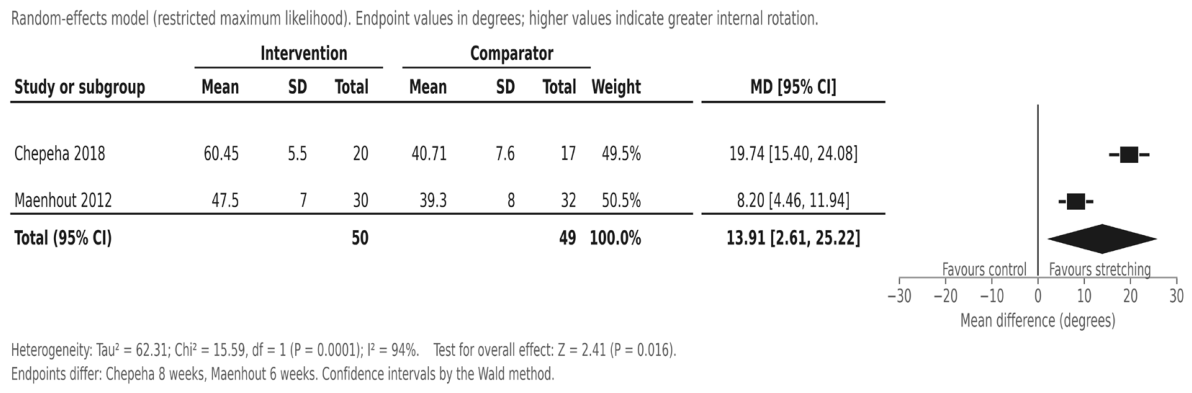
Two studies with 99 participants compared stretching against no stretching or usual activity. Internal rotation range of motion improved by a pooled mean difference of 13.91° (95% CI 2.61 to 25.22; Z = 2.41, P = 0.016), with substantial heterogeneity (τ² = 62.31; χ² = 15.59, df = 1, P = 0.0001; I² = 94%). The two individual estimates were 19.74° (Chepeha, 8 weeks) and 8.20° (Maenhout, 6 weeks). Given only two studies, the I² statistic is unstable and the range of the individual estimates is at least as informative as the pooled value.
Figure 2.
Internal rotation range of motion: posterior shoulder stretching versus no stretching or usual activity.
Figure 2.
Internal rotation range of motion: posterior shoulder stretching versus no stretching or usual activity.
Horizontal adduction range of motion, pooled as a standardised mean difference, gave 1.20 (95% CI 0.77 to 1.63; Z = 5.47, P < 0.001) with no detectable heterogeneity (τ² = 0.00; χ² = 0.35, df = 1, P = 0.56; I² = 0%) (Figure 3).
The same data pooled as a raw mean difference give 6.64° (95% CI 0.28 to 13.01) with I² = 88% (Figure S1). The marked reduction in heterogeneity after standardisation is consistent with differing measurement conventions contributing substantially to the raw-scale heterogeneity.
3.5. Sleeper Stretch Versus Cross-Body Stretch
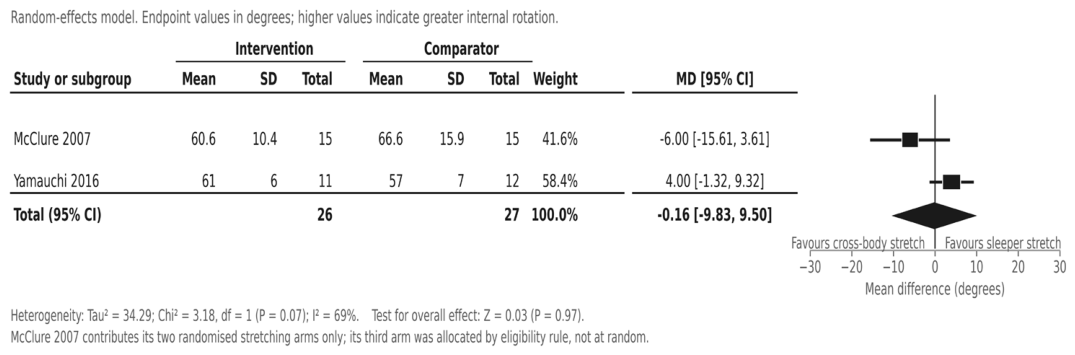
Two studies with 53 participants compared the two techniques head to head. The pooled mean difference in internal rotation range of motion was −0.16° (95% CI −9.83 to 9.50; Z = 0.03, P = 0.97; I² = 69%), with the two studies pointing in opposite directions: −6.00° favouring cross-body in McClure and +4.00° favouring sleeper in Yamauchi. The available evidence did not demonstrate a difference between the techniques; however, the small evidence base and imprecision preclude conclusions of equivalence.
Figure 4.
Internal rotation range of motion: sleeper stretch versus cross-body stretch.
de Araújo et al. [17] compared the same two techniques but reported GIRD rather than internal rotation range of motion, and could not be pooled with the above. At four weeks GIRD was 14.42° (SD 8.63) after sleeper stretching and 11.35° (SD 7.13) after cross-body stretching, a difference of 3.07° (95% CI −2.16 to 8.30) that excludes neither direction.
3.6. Pain
Pain was a registered main outcome. Four studies measured it, on three different instruments, and no two were poolable. The available between-group data are given in Table 4.
3.7. Shoulder Function and Disability
Function was also a registered main outcome and was measured by one study only. Chepeha et al. [12] reported self-rated shoulder function on a 0–100 visual analogue scale at eight weeks: 8.05 (SD 10.4) in the stretching group against 26.59 (SD 21.4) in controls, a difference of 18.54 points favouring stretching (P = 0.002). No other included study administered a functional or disability instrument. This is the largest single gap in the evidence base relative to what the protocol set out to examine.
3.8. Adherence
Adherence was a registered main outcome. Five of nine studies reported it, in five mutually incomparable formats, and four reported nothing at all (Table 5). No quantitative synthesis was possible.
3.9. Adverse Events
Five studies reported adverse events, all as absent or minor. McClure et al. [14] recorded that 3 of 15 participants in the sleeper arm and 1 of 15 in the cross-body arm found the stretch itself painful. Kawakami et al. [18] states twice that no adverse events or discomfort were reported and twice in its own Discussion that some participants reported mild discomfort during sleeper stretching; both statements are reported here because the harms claim cannot be taken at face value. No serious adverse event was reported by any study.
3.10. Outcomes Beyond the End of the Intervention
This was the review's registered primary emphasis, and it is the finding that most constrains what can be concluded. No included study provided a post-intervention comparison that could determine whether the effect of posterior shoulder stretching itself was retained after the prescribed intervention period. Manske et al. [15] included an assessment four weeks after the four-week programme; however, its randomised contrast evaluated the addition of clinic-delivered mobilisation to stretching rather than stretching versus a non-stretching comparator. In that study internal rotation gain from baseline to eight weeks was 11.8° in the stretching-only arm and 11.1° in the stretching-plus-mobilisation arm, a net retention that slightly favours stretching alone and that runs opposite to the direction claimed in that paper's own abstract. The tabulated values are reported here.
3.11. Certainty of Evidence
Publication bias could not be assessed statistically because every comparison contained fewer than 10 studies; it was addressed at study level through RoB 2 Domain 5. GRADE certainty was not downgraded for publication bias in any row (Table 6).
4. Discussion
Low- to very-low-certainty evidence suggests that home-based posterior shoulder stretching may improve shoulder mobility in active populations with GIRD or posterior shoulder tightness over programmes lasting three to eight weeks. Against no stretching or usual activity, internal rotation range of motion increased by a pooled 13.91°, while horizontal adduction showed a standardised mean difference of 1.20. Available evidence did not demonstrate a difference between sleeper and cross-body stretching; however, the small evidence base and imprecision preclude conclusions of equivalence. Beyond these short-term mobility outcomes, the evidence remains limited.
The review was registered to address a narrower and clinically consequential question: whether mobility gains are retained after the prescribed intervention period and whether participants adhere to home programmes. The available evidence does not answer either question adequately. No included study provided a post-intervention comparison that could determine whether the effect of posterior shoulder stretching itself was retained after the prescribed intervention period. Manske et al. [15] included an assessment four weeks after the four-week programme; however, its randomised contrast evaluated the addition of clinic-delivered mobilisation to stretching rather than stretching versus a non-stretching comparator. Five of nine studies reported adherence, using five different and mutually incomparable formats. Consequently, the durability of mobility gains attributable to posterior shoulder stretching and the extent to which prescribed home programmes are followed remain uncertain.
4.1. The Heterogeneity in Horizontal Adduction Was Not Clinical
Pooled as a raw mean difference, horizontal adduction showed I² = 88%, a value that would ordinarily prompt consideration of clinical or methodological sources of heterogeneity. Standardising the effect markedly reduced the observed heterogeneity. Chepeha measured horizontal adduction from the acromion with the scapula manually stabilised and reported values around 20°, whereas Maenhout used a different reference position and endpoint definition and reported values around 42°. These differing measurement conventions are consistent with measurement methods contributing substantially to the raw-scale heterogeneity.
4.2. Comparison with Existing Reviews
Previous systematic reviews have reported short-term improvements in shoulder range of motion following posterior shoulder stretching, although the certainty and consistency of evidence vary across stretching techniques [20,21]. Those reviews did not restrict to home-based delivery and did not set out to examine retention or adherence. The present review's contribution is therefore less a new effect estimate than a demonstration of where the evidence stops: applying a home-based criterion strictly reduces a large literature to nine studies, none of which follows participants beyond the end of the programme.
4.3. Strengths and Limitations
The review applied its registered eligibility criteria strictly and documents every departure. Screening and extraction were duplicated with almost perfect agreement (κ = 0.875). Every extracted value carries a source location, arithmetic inconsistencies within the primary reports were checked and logged rather than propagated, and registry records were retrieved to resolve Domain 5 where they exist.
Against that, the pooled estimates rest on two studies each, so I² is unstable and no prediction interval could be calculated. Endpoint values were used rather than change scores, which carries any baseline imbalance into the estimate; Chepeha's arms differ by 3.8° at baseline. Only English-language reports were eligible. Four of the nine included studies are unregistered, so selective reporting cannot be excluded for them. One included study was authored by both review authors and, with no independent assessor available, was appraised by its own authors; it contributes to no pooled estimate.
The most substantive limitation is not of method but of the underlying literature. No included study measured any review outcome after its intervention had ended. The closest is Manske et al. [15], which assessed participants four weeks after a four-week programme, but its randomised contrast is the addition of clinic-delivered mobilisation rather than stretching itself. The review's registered primary emphasis therefore has no evidence base to summarise, and nothing in these nine studies establishes whether mobility gained during a home programme is retained once that programme stops. Pain was measured by four studies on three instruments and function by one, so neither supports a pooled estimate. This is a limitation of the field rather than of the search: the eligibility criteria to 70 full texts.
4.4. Implications
For practice, a home-based posterior shoulder stretch may improve internal rotation and horizontal adduction over three to eight weeks, and the choice between sleeper and cross-body technique can be made on patient comfort rather than on evidence of differential effect. Whether to continue the stretch indefinitely is a question the evidence does not address.
For research, the single most useful contribution would be a trial that continues measuring after the programme stops. A four-week stretching trial with a twelve-week post-intervention assessment and a pre-specified adherence measure would add more to this field than another comparison of two stretch positions. Reporting horizontal adduction with an explicit statement of reference position and endpoint definition would also allow future reviews to pool on the raw scale.
5. Conclusions
Low- to very-low-certainty evidence suggests that home-based posterior shoulder stretching may improve internal rotation and horizontal adduction range of motion in active populations with glenohumeral internal rotation deficit or posterior shoulder tightness over three to eight weeks. Available evidence did not demonstrate superiority of one stretching technique over another. No included study provided a post-intervention comparison capable of determining whether mobility gains attributable to posterior shoulder stretching were retained after the prescribed intervention period, and adherence reporting was too inconsistent to synthesise. Consequently, the durability of benefit and real-world adherence to these programmes remain uncertain.
Supplementary Materials
The following supporting information can be downloaded at the website of this paper posted on Preprints.org: File S1, completed PRISMA 2020 checklist; File S2, full search strategies for all sources; File S3, excluded studies with reasons; File S4, master data extraction sheet; Figure S1, horizontal adduction pooled as a raw mean difference; Figure S2, sensitivity analysis of internal rotation range of motion.
Author Contributions
Conceptualization, O.G. and H.J.; methodology, O.G. and H.J.; validation, O.G. and H.J.; formal analysis, O.G. and H.J.; investigation, O.G. and H.J.; data curation, O.G. and H.J.; writing—original draft preparation, O.G.; writing—review and editing, O.G., M.J., N.S.D. and H.J.; visualization, O.G.; supervision, H.J.; project administration, O.G. All authors have read and agreed to the published version of the manuscript.
Funding
This research received no external funding.
Institutional Review Board Statement
Not applicable.
Informed Consent Statement
Not applicable.
Data Availability Statement
No new data were created or analyzed in this study.
Acknowledgments
During the preparation of this work the authors used generative artificial intelligence tools to assist with drafting and language editing of the manuscript.
Conflicts of Interest
The authors declare no conflict of interest.
References
- Burkhart, S.S.; Morgan, C.D.; Kibler, W.B. The disabled throwing shoulder: Spectrum of pathology part I: Pathoanatomy and biomechanics. Arthroscopy 2003, 19, 404–420. [Google Scholar] [CrossRef]
- Wilk, K.E.; Macrina, L.C.; Fleisig, G.S.; Porterfield, R.; Simpson, C.D.; Harker, P.; Paparesta, N.; Andrews, J.R. Correlation of glenohumeral internal rotation deficit and total rotational motion to shoulder injuries in professional baseball pitchers. Am. J. Sports Med. 2011, 39, 329–335. [Google Scholar] [CrossRef]
- Myers, J.B.; Laudner, K.G.; Pasquale, M.R.; Bradley, J.P.; Lephart, S.M. Glenohumeral range of motion deficits and posterior shoulder tightness in throwers with pathologic internal impingement. Am. J. Sports Med. 2006, 34, 385–391. [Google Scholar] [CrossRef]
- Laudner, K.G.; Stanek, J.M.; Meister, K. Assessing posterior shoulder contracture: The reliability and validity of measuring glenohumeral joint horizontal adduction. J. Athl. Train. 2006, 41, 375–380. [Google Scholar]
- Shanley, E.; Rauh, M.J.; Michener, L.A.; Ellenbecker, T.S.; Garrison, J.C.; Thigpen, C.A. Shoulder range of motion measures as risk factors for shoulder and elbow injuries in high school softball and baseball players. Am. J. Sports Med. 2011, 39, 1997–2006. [Google Scholar] [CrossRef]
- Maenhout, A.; Van Eessel, V.; Van Dyck, L.; Vanraes, A.; Cools, A. Quantifying acromiohumeral distance in overhead athletes with glenohumeral internal rotation loss and the influence of a stretching program. Am. J. Sports Med. 2012, 40, 2105–2112. [Google Scholar] [CrossRef]
- Cools, A.M.; Johansson, F.R.; Cagnie, B.; Gosselink, R.; Witvrouw, E.E. Stretching the posterior shoulder structures in subjects with internal rotation deficit: Comparison of two stretching techniques. Shoulder Elb. 2012, 4, 56–63. [Google Scholar] [CrossRef]
- Page, M.J.; McKenzie, J.E.; Bossuyt, P.M.; Boutron, I.; Hoffmann, T.C.; Mulrow, C.D.; Shamseer, L.; Tetzlaff, J.M.; Akl, E.A.; Brennan, S.E.; et al. The PRISMA 2020 statement: An updated guideline for reporting systematic reviews. BMJ 2021, 372, n71. [Google Scholar] [CrossRef]
- Landis, J.R.; Koch, G.G. The measurement of observer agreement for categorical data. Biometrics 1977, 33, 159–174. [Google Scholar] [CrossRef]
- Gharisia, O.; Lohman, E.; Daher, N.; Eldridge, A.; Shallan, A.; Jaber, H. Effect of a novel stretching technique on shoulder range of motion in overhead athletes with glenohumeral internal rotation deficits: A randomized controlled trial. BMC Musculoskelet. Disord. 2021, 22, 402. [Google Scholar] [CrossRef]
- Sterne, J.A.C.; Savović, J.; Page, M.J.; Elbers, R.G.; Blencowe, N.S.; Boutron, I.; Cates, C.J.; Cheng, H.-Y.; Corbett, M.S.; Eldridge, S.M.; et al. RoB 2: A Revised Cochrane Risk-of-Bias Tool for Randomized Trials. Cochrane. 2019.
- Chepeha, J.C.; Magee, D.J.; Bouliane, M.; Sheps, D.; Beaupre, L. Effectiveness of a posterior shoulder stretching program on university-level overhead athletes: Randomized controlled trial. Clin. J. Sport Med. 2018, 28, 146–152. [Google Scholar] [CrossRef]
- Yu, I.-Y.; Kang, M.-H.; Oh, J.-S. The effects of posterior shoulder stretch on rotator cuff strength ratio in adolescent baseball players with scapular dyskinesis: A randomized controlled trial. Isokinet. Exerc. Sci. 2017, 25, 1–9. [Google Scholar] [CrossRef]
- McClure, P.; Balaicuis, J.; Heiland, D.; Broersma, M.E.; Thorndike, C.K.; Wood, A. A randomized controlled comparison of stretching procedures for posterior shoulder tightness. J. Orthop. Sports Phys. Ther. 2007, 37, 108–114. [Google Scholar] [CrossRef]
- Manske, R.C.; Meschke, M.; Porter, A.; Smith, B.; Reiman, M. A randomized controlled single-blinded comparison of stretching versus stretching and joint mobilization for posterior shoulder tightness measured by internal rotation motion loss. Sports Health 2010, 2, 94–100. [Google Scholar] [CrossRef]
- Yamauchi, T.; Hasegawa, S.; Nakamura, M.; Nishishita, S.; Yanase, K.; Fujita, K.; Umehara, J.; Ji, X.; Ibuki, S.; Ichihashi, N. Effects of two stretching methods on shoulder range of motion and muscle stiffness in baseball players with posterior shoulder tightness: A randomized controlled trial. J. Shoulder Elb. Surg. 2016, 25, 1395–1403. [Google Scholar] [CrossRef]
- de Araújo, J.N.; Oliveira, A.B.A.; de Araújo, D.L.F.; dos Santos, G.A.; da Silva, M.R.; Kamonseki, D.H.; de Oliveira, V.M.A. The effects of sleeper stretch vs. crossbody stretch in overhead athletes with shoulder pain and glenohumeral internal rotation deficit: A randomized controlled trial. J. Shoulder Elb. Surg. 2026, 35, 1832–1840. [Google Scholar] [CrossRef]
- Kawakami, J.; Karasuyama, M.; Tomohiko, N.; Takaki, I.; Ryota, E.; Mika, K.; Miki, M.; Leo, S.; Shota, N.; Kota, F. Cross-Body Versus Combined Sleeper Stretch for Posterior Shoulder Tightness: A Randomized Controlled Trial. Cureus 2025, 17, e92975. [Google Scholar] [CrossRef]
- Balshem, H.; Helfand, M.; Schünemann, H.J.; Oxman, A.D.; Kunz, R.; Brozek, J.; Vist, G.E.; Falck-Ytter, Y.; Meerpohl, J.; Norris, S.; Guyatt, G.H. GRADE guidelines: 3. Rating the quality of evidence. J. Clin. Epidemiol. 2011, 64, 401–406. [Google Scholar] [CrossRef]
- Mine, K.; Nakayama, T.; Milanese, S.; Grimmer, K. Effectiveness of stretching on posterior shoulder tightness and glenohumeral internal-rotation deficit: A systematic review of randomized controlled trials. J. Sport Rehabil. 2017, 26, 294–305. [Google Scholar] [CrossRef]
- Ceballos-Laita, L.; Robles-Pérez, R.; Carrasco-Uribarren, A.; Cabanillas-Barea, S.; Pérez-Guillén, S.; Greidane, E.; Jiménez-del-Barrio, S. Is stretching effective for reducing glenohumeral internal rotation deficit? A systematic review and meta-analysis. Appl. Sci. 2024, 14, 7166. [Google Scholar] [CrossRef]
Figure 1.
PRISMA 2020 flow diagram.
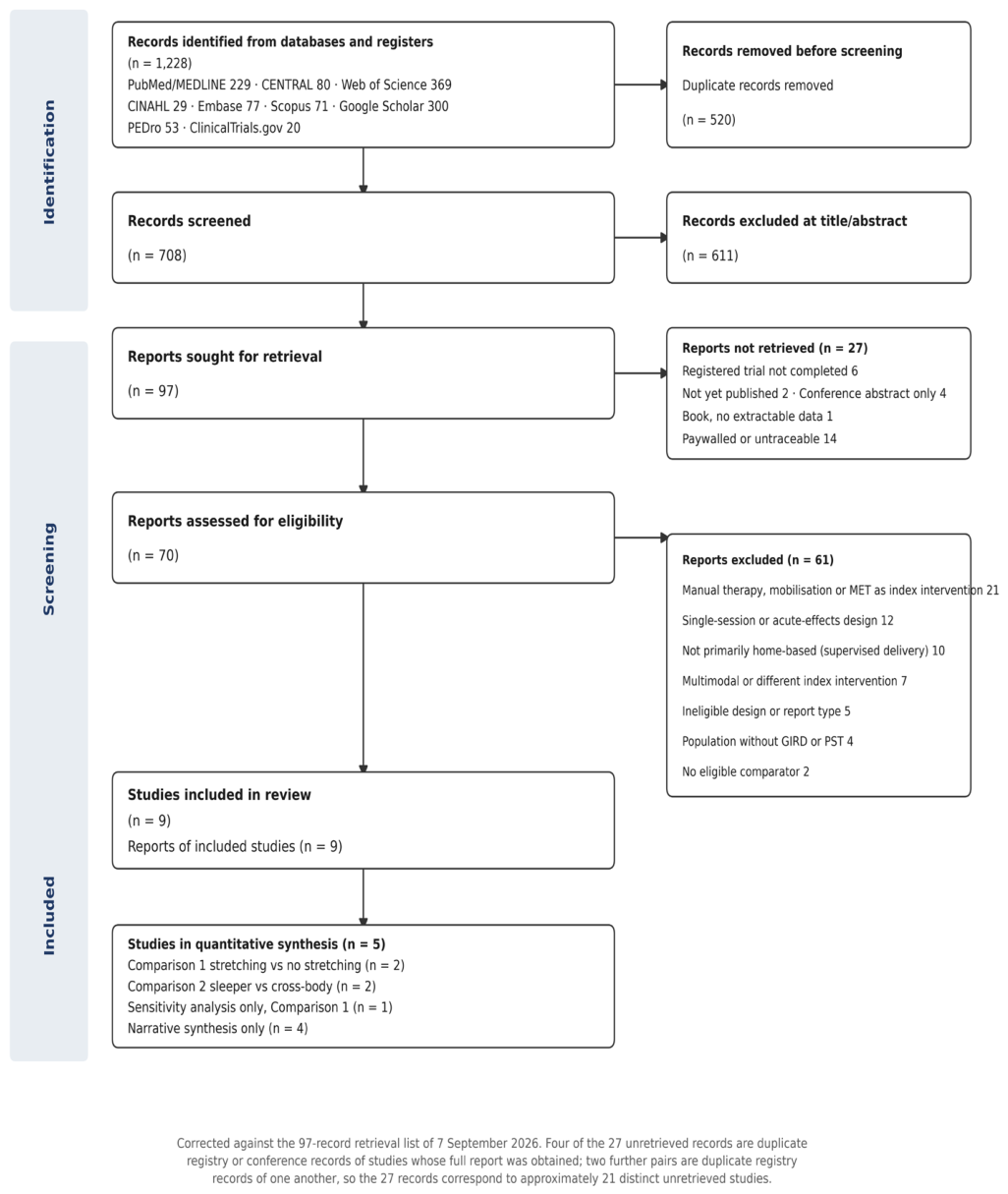
Figure 3.
Horizontal adduction range of motion, standardised mean difference.
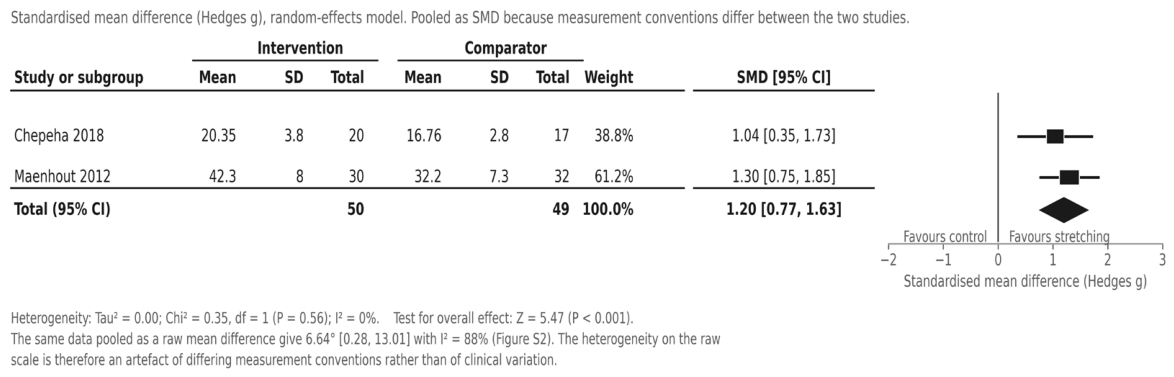

Table 1.
Please add.
| S.NO | Registered position | What was done | Reason and consequence |
|---|---|---|---|
| 1 | Interventions must be primarily home-based | Yu et al. [13] was included although the report never states where the daily stretch was performed | The stretch is unambiguously self-applied and was prescribed daily, while the supervised co-intervention ran only three times weekly, so it cannot have been clinic-delivered on the remaining four days. The study contributes to a sensitivity analysis only, never to a primary estimate, so the inclusion cannot alter a headline result (Figure S2). |
| 2 | Studies enter whole | Only the two randomised arms of McClure et al. [14] were used | Its third arm was allocated by the eligibility rule rather than at random and by construction had no baseline deficit to reverse. Using the randomised comparison alone is the more conservative choice and avoids importing a non-randomised contrast into a pooled estimate. |
| 3 | Four comparisons were registered | A fourth comparison (home stretch plus clinic mobilisation versus home stretch alone) was added for Manske et al. [15] | The home stretch is identical in both arms of that trial, so its randomised contrast estimates added mobilisation rather than stretching. Reporting it under its own heading prevents it being mistaken for evidence about stretching, which pooling it would have done. |
| 4 | Comparison of active techniques not specified in the analysis plan | Gharisia et al. [10] and Kawakami et al. [18] are reported under a comparison of alternative active techniques | Both compare one active stretch against another and fit no registered comparison. They are described narratively and pooled with nothing, so the addition affects presentation only. |
| 5 | Mean difference or standardised mean difference according to measurement consistency | Horizontal adduction pooled as a standardised mean difference | Measurement conventions differ approximately twofold between the two studies. This is the exercise of a registered option rather than a departure; the raw mean difference is given as a sensitivity analysis. |
| 6 | Effect measure not specified as endpoint or change | Endpoint values used throughout | Standard deviations of change are not recoverable from the primary reports. This is conventional practice in that situation and its consequence is stated in the Limitations. |
| 7 | Registered title begins 'Long-Term Outcomes and Adherence' | The word 'Long-Term' has been removed from the title | No included study provided a post-intervention comparison capable of determining whether mobility gains attributable to posterior shoulder stretching were retained after the prescribed intervention period. A title promising long-term outcomes would therefore misdescribe the available evidence |
Two registered items were not delivered and are declared as such. Subgroup analyses by population type, symptomatic status, stretch type and follow-up duration were pre-specified but were not feasible with two to three studies per comparison.
Table 2.
Characteristics of the nine included studies.
| Study | Design; country | Participants; threshold | Intervention | Comparator | Duration | Outcomes reported |
|---|---|---|---|---|---|---|
| Chepeha 2018 [12] | Parallel RCT; Canada | 37 university volleyball, swimming and tennis athletes; IR deficit ≥15° | Sleeper stretch, once daily, 5 × 2 min | Usual training, no posterior stretch | 8 weeks | IR ROM, horizontal adduction, GIRD, PST, pain, function |
| Maenhout 2012 [6] | RCT; Belgium | 62 recreational overhead athletes; GIRD ≥15° | Sleeper stretch, daily, 3 × 30 s | Usual activity, no stretch | 6 weeks | IR ROM, horizontal adduction, ER ROM, acromiohumeral distance |
| Yu 2017 [13] | RCT; South Korea | 24 adolescent baseball players with scapular dyskinesis; GIRD >15° | Sleeper stretch daily plus scapular stabilisation 3×/week | Scapular stabilisation alone | 6 weeks | IR ROM, GIRD, ER ROM, rotator cuff strength, pain |
| McClure 2007 [14] | RCT; USA | 54 college students; IR asymmetry ≥10° | Sleeper stretch, daily, 5 × 30 s | Cross-body stretch, same dose (third non-randomised arm not used) | 4 weeks | IR ROM, horizontal adduction, adherence, adverse events |
| Yamauchi 2016 [16] | RCT; Japan | 24 college baseball players; GIRD >10° | Modified cross-body stretch, daily, 3 × 30 s | Modified sleeper stretch, same dose | 4 weeks | IR, ER, total rotation, horizontal adduction, muscle stiffness |
| de Araújo 2026 [17] | Assessor-blinded RCT; Brazil | 38 overhead athletes; GIRD ≥20° and NPRS ≥2 | Sleeper stretch, 3×/week | Cross-body stretch, same schedule | 4 weeks | GIRD, pain, adherence, adverse events |
| Gharisia 2021 [10] | Assessor-blinded RCT; USA | 42 overhead athletes; IR deficit ≥10° | Novel clam-shell bridging stretch, 3×/week, 3 × 30 s | Modified sleeper stretch, same dose | 4 weeks | IR ROM, pain, adherence, adverse events |
| Kawakami 2025 [18] | Single-blind RCT; Japan | 25 youth baseball players aged 10–15 with PST | Cross-body plus sleeper stretch, daily, 3 × 30 s each | Cross-body stretch alone | 3 weeks | IR, ER, total rotation, horizontal adduction, adverse events |
| Manske 2010 [15] | RCT; USA | 39 participants; IR difference ≥10° | Home cross-body stretch plus clinic joint mobilisation | Home cross-body stretch alone | 4 weeks plus 4-week retention | IR, ER, total rotation, adherence |
ER, external rotation; GIRD, glenohumeral internal rotation deficit; IR, internal rotation; NPRS, Numeric Pain Rating Scale; PST, posterior shoulder tightness; RCT, randomised controlled trial; ROM, range of motion.
Table 3.
RoB 2 judgements per study and outcome. D1, randomisation process; D2, deviations from intended interventions; D3, missing outcome data; D4, measurement of the outcome; D5, selection of the reported result.
Table 3.
RoB 2 judgements per study and outcome. D1, randomisation process; D2, deviations from intended interventions; D3, missing outcome data; D4, measurement of the outcome; D5, selection of the reported result.
| Study | Outcome | D1 | D2 | D3 | D4 | D5 | Overall |
|---|---|---|---|---|---|---|---|
| Chepeha 2018 [12] | IR and horizontal adduction ROM | Some concerns | Some concerns | Low | Low | Some concerns | Some concerns |
| Chepeha 2018 | Pain and function | Some concerns | Some concerns | Low | High | Some concerns | High |
| Maenhout 2012 [6] | ROM outcomes | Some concerns | Some concerns | Low | Some concerns | Some concerns | Some concerns |
| Yu 2017 [13] | IR ROM and GIRD | Some concerns | High | Low | High | High | High |
| McClure 2007 [14] | IR and horizontal adduction ROM | Some concerns | Some concerns | Low | Low | High | High |
| Yamauchi 2016 [16] | ROM outcomes | Low | Some concerns | Some concerns | Some concerns | High | High |
| de Araújo 2026 [17] | GIRD | Low | Some concerns | Some concerns | Low | High | High |
| de Araújo 2026 [17] | Pain | Low | Some concerns | Some concerns | High | High | High |
| Gharisia 2021 [10] | IR ROM | Low | Some concerns | Some concerns | Low | Some concerns | Some concerns |
| Gharisia 2021 [10] | Pain | Low | Some concerns | Some concerns | High | Some concerns | High |
| Kawakami 2025 [18] | ROM outcomes | Low | Some concerns | Some concerns | Low | High | High |
| Manske 2010 [15] | IR ROM | Some concerns | Some concerns | Low | Low | High | High |
Two Domain 5 judgements warrant specific mention. In de Araújo et al. [17] the registered co-primary outcome, glenohumeral rotation range of motion, was measured but has no post-intervention value anywhere in the report. In Yu et al. [13] the examiners who delivered the intervention also measured every outcome, unblinded, and the trial is unregistered.
Table 4.
Pain outcomes.
| Study | Instrument | Intervention, mean (SD) | Comparator, mean (SD) | Between- group difference (95% CI) |
Interpretation |
|---|---|---|---|---|---|
| Chepeha 2018 [12] | VAS 0–100, 8 weeks | 8.9 (16.1), n = 20 | 17.76 (22.1), n = 17 | −8.86 (−21.6 to 3.9), P = 0.14 | No significant difference. The manuscript should not describe a pain benefit here. |
| de Araújo 2026 [17] | NPRS 0–10, 4 weeks | 2.83 (2.07), n = 18 | 2.69 (1.81), n = 17 | 0.14 (−1.15 to 1.43) | No difference between sleeper and cross-body stretching. |
| Yu 2017 [13] | VAS 0–10, 6 weeks | 2.08 (1.31), n = 12 | 3.58 (1.92), n = 12 | −1.50 (−2.82 to −0.18) | Favours the arm receiving the stretch; both arms improved. |
| Gharisia 2021 [10] | NPRS 0–10, 4 weeks | 0.71 (0.49), n = 7 | 2.00 (1.40), n = 7 | −1.29 (−2.39 to −0.19) | Symptomatic subgroup only. Baseline pain was 4.43 versus 2.57, an imbalance of 1.86 points on a 10-point scale in the outcome that produced the study's only significant result. |
NPRS, Numeric Pain Rating Scale; VAS, visual analogue scale. Lower values indicate less pain in every instrument.
Table 5.
Adherence reporting across the nine included studies.
| Study | What was reported | How it was measured |
|---|---|---|
| McClure 2007 [14] | 81.0% (SD 16.0) and 88.9% (SD 10.0) by arm | Daily log sheet returned by the participant |
| Manske 2010 [15] | Mean session counts with ranges | Daily log sheet |
| Gharisia 2021 [10] | 100% in both arms | Log sheet with weekly reminders. Incompatible with the two participants recorded as withdrawing from one arm after week 1. |
| Kawakami 2025 [18] | 100%, all participants | Guardian-supervised exercise log |
| de Araújo 2026 [17] | 7 of 35 (20.0%) did not complete the programme | Recorded by the research therapist |
| Chepeha 2018 [12] | Not reported numerically | Monitored and encouraged by the team athletic trainer |
| Maenhout 2012 [6] | Not reported | Explicitly not monitored |
| Yamauchi 2016 [16] | 'More than 70% of days' | Verbal confirmation only; no denominator, no per-arm breakdown |
| Yu 2017 [13] | Not reported | No log, diary or attendance record described for a 42-session daily protocol |
Table 6.
Summary of Findings.
| Outcome | Studies (participants) | Effect estimate | Certainty | Reasons for downgrading |
|---|---|---|---|---|
| IR ROM, stretching vs no stretching | 2 (99) | MD 13.91° higher (2.61 to 25.22) | Very low | Risk of bias, serious inconsistency (I² = 94%), imprecision |
| Horizontal adduction, stretching vs no stretching | 2 (99) | SMD 1.20 (0.77 to 1.63) | Low | Risk of bias, imprecision. Not downgraded for inconsistency (I² = 0%) |
| IR ROM, sleeper vs cross-body | 2 (53) | MD 0.16° lower (9.83 lower to 9.50 higher) | Low | Risk of bias, serious imprecision |
| GIRD, sleeper vs cross-body | 1 (35) | MD 3.07° higher (2.16 lower to 8.30 higher) | Very low | Risk of bias, single study, imprecision |
| Pain | 4 (110) | Not pooled | Very low | Risk of bias, inconsistent instruments, indirectness, imprecision |
| Function | 1 (37) | MD 18.54 points lower on VAS 0–100 | Very low | Risk of bias, single study, indirectness, imprecision |
| Adherence | 5 (216) | Not pooled; five incomparable formats | Very low | Inconsistent and incomplete reporting |
| Adverse events | 5 (183) | Sparse; none serious | Very low | Not systematically ascertained; one study internally contradictory |
| Retention beyond end of intervention | 0 (0) | No data | — | No eligible comparison determined retention of mobility gains attributable to posterior shoulder stretching after the prescribed intervention period. |
Disclaimer/Publisher’s Note: The statements, opinions and data contained in all publications are solely those of the individual author(s) and contributor(s) and not of MDPI and/or the editor(s). MDPI and/or the editor(s) disclaim responsibility for any injury to people or property resulting from any ideas, methods, instructions or products referred to in the content. |
© 2026 by the authors. Licensee MDPI, Basel, Switzerland. This article is an open access article distributed under the terms and conditions of the Creative Commons Attribution (CC BY) license (http://creativecommons.org/licenses/by/4.0/).
Copyright: This open access article is published under a Creative Commons CC BY 4.0 license, which permit the free download, distribution, and reuse, provided that the author and preprint are cited in any reuse.