

Submitted:
28 September 2026
Posted:
29 September 2026
You are already at the latest version
Abstract
Saudi Arabia’s Vision 2030 positions media as both an instrument and an object of national transformation. This systematic literature review synthesizes peer-reviewed evidence published between January 2016 and September 2026 to establish how, and under what conditions, media contribute to social change. In accordance with PRISMA 2020, a search of Open Alex conducted on September 28, 2026, was complemented by scoping searches; 86 studies in journals indexed in Scopus or the Directory of Open Access Journals were appraised on design features adapted from the Mixed Methods Appraisal Tool and synthesized thematically across three mechanisms: ownership and investment, digital audience engagement, and regulation. Three convergent patterns emerge. State-led investment and cultural policy have expanded capacity and youth-oriented production across television, film, streaming, gaming, and entertainment, a pattern termed here managed diversification. Platforms have become arenas in which reform, particularly women’s empowerment and flagship national projects, is debated, endorsed, and normalized, with influencers as prominent intermediaries. Regulatory modernization has formalized a fast-growing creator economy, and women’s professional inclusion has advanced, while studies report reliance on official sources and link legal uncertainty and perceived monitoring to anticipatory self-restraint. The review refines the concept of conditional transformation: the communicative visibility of reform has expanded substantially at home and abroad, whereas editorial autonomy has expanded more gradually, and the evidence points to regulatory predictability as a condition for its further expansion. The review maps gaps in political-economy, longitudinal, and reception research and derives recommendations aligned with Vision 2030’s commitment to effective, transparent, and accountable government.
Keywords:
systematic literature review
; Vision 2030
; Saudi Arabia
; media and social change
; media ownership
; digital audience engagement
; media regulation
; conditional transformation
1. Introduction
Saudi Arabia’s Vision 2030, launched in April 2016, set out a program of economic diversification, social opening, and administrative reform organized around three pillars: a vibrant society, a thriving economy, and an ambitious nation (Alshuwaikhat & Mohammed, 2017; Council of Economic and Development Affairs [CEDA], 2016; Moshashai et al., 2020). Media occupy a distinctive position within this program. They are at once an instrument of reform, through which new policies, opportunities, and social norms are communicated to a young and highly connected population, and an object of reform, in that culture, entertainment, and the screen industries were designated as sectors for investment and growth (CEDA, 2016; Sakr, 2026). This dual position has made Saudi media newly central to debates about modernization, public engagement, and the social consequences of state-led transformation.
This review proceeds from the premise that media under Vision 2030 are best understood not as a neutral conduit of change but as an institutional space in which reform narratives are expanded, managed, and negotiated. Historically, the Saudi media system developed in close alignment with the state, a pattern that Rugh (2004) classified as a “loyalist” press and that Muyidi (2025) traces to a “security imperative” in which technological adoption was balanced against regulatory oversight and the preservation of Islamic cultural identity. Saudi capital also built one of the most influential media industries in the Arab world, moving from national broadcasting to pan-Arab satellite leadership (Kraidy, 2021). Since 2016, digital platforms have widened participation and accelerated the circulation of reform-oriented content, particularly among younger audiences and women (Alsulaiman, 2022; Thorsen & Sreedharan, 2019). Expanded circulation, however, does not in itself establish pluralism. Where ownership concentration, regulatory ambiguity, or self-restraint persists, expanded visibility may coexist with limited editorial autonomy. The analytical question is therefore not whether media matter but under what conditions they shape social change in a setting where liberalization and managed communication proceed together.
Three mechanisms through which media may influence social change have each been transformed since 2016: ownership, audience engagement, and regulation. Ownership has been reconfigured through state investment in major broadcasters, the public listing of media groups, and large-scale investment in domestic content (MBC Group, 2024; Sakr, 2026). Audience engagement has migrated decisively to mobile and social platforms (Alsulaiman, 2022; Ben Amor & Mzoughi, 2023). Regulation has been modernized through new institutions and licensing regimes, including the reorganization of the General Commission for Audiovisual Media into the General Authority for Media Regulation and the introduction of a license for individuals who advertise on social platforms (General Authority for Media Regulation [GAMR], n.d.; Saudi Gazette, 2022; Saudipedia, n.d.). Whether these changes amount to a transformation of the media system, or to a more sophisticated form of managed communication, is a question that a growing but dispersed body of research has begun to address.
That body of research has expanded rapidly since 2016, but it remains fragmented across communication studies, political science, linguistics, cultural studies, and information science. Studies typically examine a single outlet, platform, genre, or reform episode, and they rarely speak to one another across disciplinary boundaries. Existing overviews of Saudi media are predominantly historical or narrative in design (Kraidy, 2021; Muyidi, 2025) and do not apply systematic search, appraisal, and synthesis procedures to the post-2016 literature. Neither the scoping searches nor the database search conducted for this review identified a systematic review that integrates ownership, audience engagement, and regulation. This fragmentation carries interpretive risks in both directions. Evaluations that treat investment and visibility as proxies for pluralism may overstate the degree of transformation, whereas accounts that attend only to control may understate the real expansion of participation and representation that the evidence documents. A systematic review is suited to adjudicating between these readings, because it establishes what is known, where findings converge or conflict, and where evidence remains thin (Petticrew & Roberts, 2006; Xiao & Watson, 2019).
The overarching review question therefore asks what the peer-reviewed literature published since the launch of Vision 2030 reveals about how media contribute to social change in Saudi Arabia. Four review questions (RQs) guide the synthesis: (RQ1) What does the literature report about how changes in media ownership, investment, and industry structure have shaped media content and diversity? (RQ2) What patterns of audience consumption and digital engagement do the literature document, and how are they linked to perceptions of societal transformation? (RQ3) How does literature characterize the effects of the regulatory framework on media practice, independence, and freedom of expression? (RQ4) Across these mechanisms, under what conditions does the literature suggest that media contribute to social change, and where do its patterns, contradictions, and gaps lie?
The review makes three contributions. First, it maps convergent patterns, contradictions, and gaps across ownership, audiences, and regulation in a synthesis of 86 peer-reviewed studies on media and social change in Saudi Arabia under Vision 2030, conducted and reported in accordance with PRISMA 2020 and accompanied by record-level documentation of every screening decision. Second, it refines the notion of conditional transformation, tested here against the synthesized evidence, to describe a media system in which communicative reach expands faster than editorial autonomy, and it distinguishes this configuration from both liberalization and stasis. Third, it derives recommendations that are grounded in the reviewed evidence and aligned with Vision 2030’s own commitment to an effective, transparent, and accountable government (CEDA, 2016), treating regulatory predictability as a key condition for converting the Kingdom’s substantial investment in media into durable public trust.
The review is interpretive rather than statistical; given the heterogeneity of designs in the field, it synthesizes findings thematically rather than estimating pooled effects. The paper proceeds as follows. Section 2 sets out the theoretical and contextual background and the analytical framework. Section 3 describes the review methodology. Section 4 reports the characteristics of the evidence base and the thematic synthesis. Section 5 discusses the findings in relation to theory and the review’s limitations, Section 6 concludes, and Section 7 sets out recommendations for policy, practice, and research.
2. Theoretical and Contextual Background
This section establishes the conceptual and contextual foundations of the review. It first sets out the theoretical orientation, drawing on comparative media systems research, theories of state–media relations, and audience and communication theory to develop the concept of conditional transformation (Section 2.1). It then outlines the Saudi context along the three mechanisms examined in the review: media ownership and control (Section 2.2), shifts in audience media consumption (Section 2.3), and the regulatory framework (Section 2.4). The section concludes by identifying the research gap and presenting the analytical framework that guided data extraction and synthesis (Section 2.5).
2.1. Theoretical Orientation: Media Systems, State–Media Relations, and Conditional Change
Comparative media research provides the starting point. Hallin and Mancini’s (2004) framework identifies the role of the state, political parallelism, journalistic professionalization, and market structure as the dimensions along which media systems differ. When the framework was extended beyond the Western democracies from which it was derived, contributors found that its three models fit poorly elsewhere but that its analytical dimensions, particularly the role of the state, remained productive (Hallin & Mancini, 2011). Rugh’s (2004) typology of Arab media distinguished mobilization, loyalist, diverse, and transitional systems and placed the Saudi press in the loyalist category, characterized by privately owned outlets that operate in close alignment with state policy. Stier’s (2015) cross-national analysis confirmed that regime type strongly predicts media freedom while documenting substantial variation among non-democratic systems, including comparatively freer media in monarchies than in several other autocratic subtypes, an observation that directs attention to the mechanisms through which influence is exercised rather than to regime labels alone.
Three further concepts clarify those mechanisms. The first is media capture, the condition in which formerly independent media fall under the sway of governments, owners, or corporate patrons, typically through ownership concentration, financial dependence, and regulation used as leverage (Schiffrin, 2021). The second is Heydemann’s (2007) account of “authoritarian upgrading,” in which states in the Arab region managed rather than suppressed new communication technologies, selectively liberalizing some domains while retaining control over others; MacKinnon’s (2011) related notion of “networked authoritarianism” describes systems that permit considerable online discussion while shaping its boundaries. The third concerns participatory alignment. Regional scholarship distinguishes accounts that emphasize state-directed deception and surveillance (Jones, 2022) from accounts in which much pro-government discourse is produced by decentralized supporters rather than by coordinated campaigns, a debate whose Saudi-specific evidence is synthesized in Section 4.4. Together, these perspectives describe an environment in which state influence can operate through ownership, regulation, and participation rather than through prohibition alone.
Three additional bodies of theory are needed to understand audiences, content, and their interaction. Uses and gratifications research explains platform choice by the needs that audiences seek to satisfy, including information, social interaction, identity, and entertainment (Katz et al., 1973), and its extension to interactive media adds gratifications such as immediacy, interactivity, and user control (Sundar & Limperos, 2013). Agenda-setting and framing theory explain how reform narratives acquire salience and meaning: media influence what publics think about (McCombs & Shaw, 1972) and how issues are defined, attributed, and evaluated (Entman, 1993). Chadwick’s (2017) account of the hybrid media system adds that older and newer media logics now interact continuously, so that state institutions, broadcasters, private outlets, influencers, and ordinary users co-produce public discourse.
Drawing these strands together, the review adopts the concept of conditional transformation as a sensitizing framework. A media system undergoes conditional transformation when the visibility, reach, and participatory intensity of public communication expand substantially while editorial autonomy, understood as the capacity of media organizations and individuals to set agendas and frame issues without anticipatory self-restraint, expands more gradually or unevenly. The outcome is neither liberalization nor stasis. It is a configuration in which media contribute to social change by amplifying and normalizing reform narratives, while their capacity to initiate agendas independently remains contingent on regulatory and ownership conditions. In this review, the concept serves as an a priori framework whose adequacy is tested, and refined, against the synthesized evidence rather than assumed.
2.2. Media Ownership and Control in Saudi Arabia
The Saudi media system developed under close state guidance. Muyidi (2025) traces its evolution from an independent press in the 1920s through the establishment of the Saudi Press Agency and state broadcasting to the satellite and digital eras, arguing that each phase balanced technological adoption against regulatory oversight and the preservation of Islamic cultural identity. Kraidy (2021) shows how geopolitics, religion, and economics combined to build a regional media powerhouse: MBC was launched from London in 1991 by relatives and business associates of the ruling family, inaugurating the Arab satellite era, and transnational Saudi media such as MBC, Rotana, and ART were typically based outside the Kingdom.
Vision 2030 changed the economic logic of the sector. The Vision set a target of raising household spending on cultural and entertainment activities inside the Kingdom from 2.9% to 6% (CEDA, 2016), and the state’s role expanded from gatekeeper to investor and anchor client. The General Entertainment Authority, established in 2016, has organized successive editions of Riyadh Season since 2019 (Saudi Press Agency, 2026); the 35-year ban on commercial cinema was lifted in 2018, and the Saudi Film Commission was established in February 2020 (B. F. Alharbi, 2026). MBC Group’s shares began trading on the Main Market of the Saudi Exchange on January 8, 2024, after an offering of 10% of the company’s share capital that raised SAR 831 million (MBC Group, 2024). Figure1 summarizes the principal institutional milestones of this period.
Figure 1.
Principal Institutional Milestones in the Saudi Media and Entertainment Sectors, 2012–2024. Note. Compiled by the author from Al-Razgan et al. (2021), B. F. Alharbi (2026), CEDA (2016), GAMR (n.d.), MBC Group (2024), Saudi Gazette (2022), Saudi Press Agency (2026), and Saudipedia (n.d.). GCAM = General Commission for Audiovisual Media; GAMR = General Authority for Media Regulation.
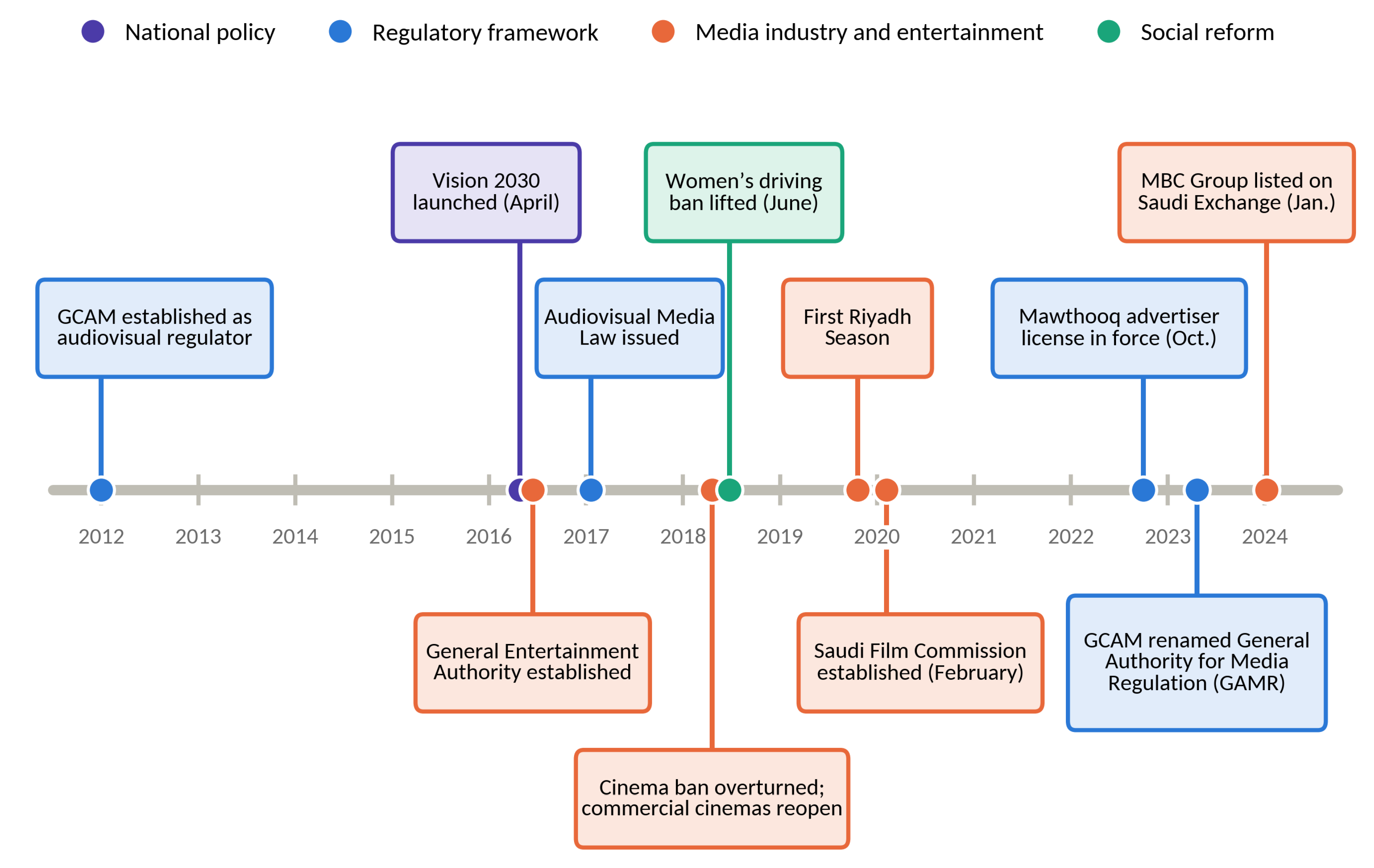
These milestones describe the institutional scaffolding of reform rather than its effects. The evidence on how the restructuring of ownership and investment has shaped content, diversity, and professional practice is synthesized in Section 4.2.
2.3. Shifts in Audience Media Consumption
Audience research on Saudi Arabia documents a rapid migration to digital media, a trajectory already visible before Vision 2030. Early studies established the social significance of platforms. Chaudhry (2014) showed that hashtags on Twitter, the platform renamed X in 2023, created awareness of, and a forum of support for, the campaign on women’s driving, while cautioning that offline change had initially been limited; Al-Saggaf and Simmons (2015) explored how social media were used during two natural disasters; and Guta and Karolak (2015) demonstrated that blogging and social media enabled young Saudi women to negotiate identity and express views that were difficult to voice in traditional forums. By October 2019, Saudi Arabia had more than 10 million Twitter users, roughly one-third of the population (Kraidy, 2021).
These studies establish the baseline against which post-2016 research should be read: platforms were already spaces of information, identity work, and mobilization, but their relationship to institutional change was uncertain. Uses and gratifications theory and the hybrid media perspective (Chadwick, 2017; Sundar & Limperos, 2013) provide the lenses through which the more recent evidence, synthesized in Section 4.3, is interpreted.
2.4. Regulatory Framework and Media Independence
The regulatory architecture governing Saudi media combines constitutional principles, long-standing statutes, and new institutions. Article 39 of the 1992 Basic Law of Governance prohibits media content that may lead to sedition or division and does not include an explicit guarantee of press freedom (Zaid, 2018), and the Anti-Cyber Crime Law, finalized in the mid-2000s, extended legal limits to online expression (Kraidy, 2021). The General Commission for Audiovisual Media was established in 2012 as a legal entity with financial and administrative independence, governed by a board chaired by the minister responsible for media and charged with licensing and monitoring broadcast and media content (GAMR, n.d.). In 2023 it was renamed the General Authority for Media Regulation, with responsibility for audiovisual and written media, digital content and social media platforms, and advertising by individuals, companies, and institutions under the Audiovisual Media Law of 2017 and its 2018 executive regulations (Saudipedia, n.d.). In October 2022, the Mawthooq license came into force, requiring individuals who advertise through personal social media accounts to hold a three-year license at a fee of SAR 15,000 (Saudi Gazette, 2022).
These institutions perform developmental as well as supervisory functions. In the film sector, the audiovisual regulator combined support for industry development with content censorship, and Alamri (2023) concludes that its overall impact has been positive, although some of its policies have slowed the development of Saudi filmmaking. More generally, licensing regimes can create legal certainty for new entrants, protect consumers from undisclosed advertising, and professionalize a rapidly growing creator economy; the consolidation of regulatory authority in a single body can reduce jurisdictional overlap; and the formal regulation of influencers responds to public concern about the quality and credibility of commercial content. The analytical question addressed in Section 4.4 is therefore not whether regulation exists but whether, according to the evidence, it is predictable, transparent, and proportionate enough to allow media organizations to plan and professionals to report without anticipatory self-restraint.
2.5. Research Gap and Analytical Framework
Three observations motivate the present review. First, the pre-2016 literature emphasized the emancipatory potential of digital platforms, whereas studies published since 2016 describe a more complex configuration in which participation, nationalism, branding, professionalization, and control coexist; this shift has not been systematically assessed. Second, research on ownership, audiences, and regulation has developed largely in isolation across disciplines, so that few studies examine how the three mechanisms interact. Third, the field lacks an appraisal of the quality and distribution of its evidence: it is unclear which conclusions rest on robust designs and which rest on small purposive samples, single platforms, or single episodes. Table 1 sets out the theoretical lenses that informed the review and specify how each was used in coding and interpretation.
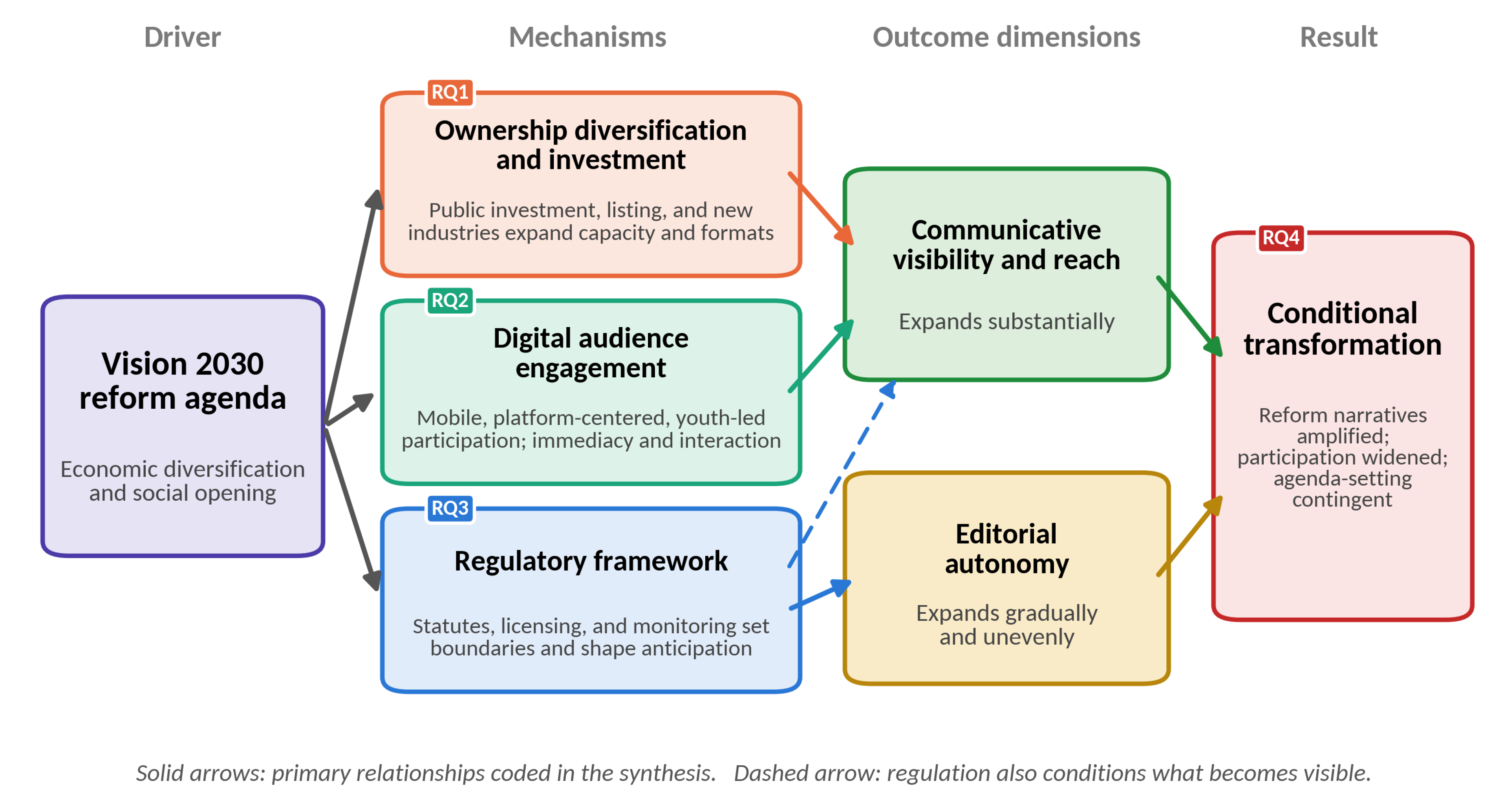
Figure2 presents the a priori analytical framework that organized data extraction and synthesis. Vision 2030 acts on the media system through three mechanisms, each mapped to a review question. Ownership diversification and investment expand capacity, formats, and reach (RQ1). Digital audience engagement expands participation, immediacy, and exposure to varied perspectives (RQ2). The regulatory framework sets the boundaries within which the first two mechanisms operate and shape the anticipatory behavior of professionals and users (RQ3). The outcome for social change depends on the balance between two dimensions: communicative visibility, which the first two mechanisms expand, and editorial autonomy, which the third conditions (RQ4). The framework anticipates that when visibility expands faster than autonomy, the result is conditional transformation; whether the evidence supports that expectation is examined in Section 4.5.
Figure 2.
A Priori Analytical Framework Guiding the Review. Note. RQ = review question. Developed by the author from Chadwick (2017), Heydemann (2007), MacKinnon (2011), Schiffrin (2021), and Sundar and Limperos (2013).
Figure 2.
A Priori Analytical Framework Guiding the Review. Note. RQ = review question. Developed by the author from Chadwick (2017), Heydemann (2007), MacKinnon (2011), Schiffrin (2021), and Sundar and Limperos (2013).
3. Review Methodology
This section describes how the review was designed and conducted. It first outlines the review design, the reporting standards followed, and the four review questions (Section 3.1), and then specifies the eligibility criteria (Section 3.2). It next describes the information sources, search strategy, and study selection process (Section 3.3), followed by the procedures for data extraction, methodological appraisal, and thematic synthesis (Section 3.4). The section concludes by addressing research integrity and the use of artificial intelligence tools (Section 3.5) and the author’s reflexive position (Section 3.6).
3.1. Review Design, Transparency, and Review Questions
The study is a systematic literature review designed and reported in accordance with the PRISMA 2020 statement (Page et al., 2021) and, for the search, the PRISMA-S extension (Rethlefsen et al., 2021), and it follows established guidance for systematic reviews in the social sciences (Petticrew & Roberts, 2006; Xiao & Watson, 2019). The review was not prospectively registered. To offset the absence of a registered protocol and to allow every decision to be audited, the article is accompanied by the complete search strategy, including the query submitted to the database and the exploratory strings that were tested but not adopted (Supplementary File S1); a record-level screening log that reports the screening decision for each of the 1,158 database records and for every study identified by the scoping searches, together with the reason for each exclusion at the full-record stage (Supplementary File S2); and the data extraction and appraisal matrix for the included studies (Supplementary File S3).
Because the relevant literature combines qualitative, quantitative, computational, and documentary designs, the review question was structured with the SPIDER tool (Cooke et al., 2012), which accommodates heterogeneous evidence more readily than intervention-oriented formats. The sample comprised Saudi media organizations, professionals, content, audiences, and regulatory institutions; the phenomenon of interest was media ownership and investment, audience engagement, and regulation as mechanisms of social change under Vision 2030; the design could be any empirical or systematic analytical design; the evaluation encompassed reported practices, perceptions, representations, and effects; and the research type could be qualitative, quantitative, or mixed. Table 2 links each review question to the corresponding component of the analytical framework, its synthesis focus, and the principal data extraction fields.
The four review questions retain the architecture of the analytical framework so that each mechanism is examined in its own right before the evidence is integrated. RQ1 through RQ3 corresponds to the three mechanisms, and RQ4 addresses the outcome dimensions and the conditions under which media contribute to social change.
3.2. Eligibility Criteria
Table 3 sets out the inclusion and exclusion criteria. The time frame begins on January 1, 2016, the start of the year in which Vision 2030 was launched, and ends on September 28, 2026, the date of the database search. Studies published within this window whose data collected before the launch were retained and flagged as baseline evidence, because they allow comparison between pre-reform and reform-era configurations; they were not treated as evidence of reform effects. Multi-country studies were eligible when Saudi Arabia was among the settings examined and the study reported data drawn from it; findings pooled across countries were interpreted as regional evidence and weighted accordingly.
Three criteria warrant explanation. First, eligibility was restricted to peer-reviewed articles in journals that were indexed in Scopus in the year of publication or had been admitted to the Directory of Open Access Journals before the article appeared. Scopus coverage was verified against the coverage years reported by SCImago (n.d.), whose journal indicators are derived from Scopus data, and admission to the directory was verified against the date on which each journal was added (Directory of Open Access Journals [DOAJ], n.d.). For articles published in 2026, for which SCImago coverage data were not yet complete, journals covered through 2025 without a discontinuation notice were treated as indexed. The criterion establishes a transparent and verifiable quality floor while admitting open-access regional journals that satisfy the directory’s inclusion requirements; its cost, the exclusion of otherwise relevant studies published in journals that met neither condition, is quantified in Section 4.1 and considered in Section 5.6. Second, studies whose primary object was foreign-policy or inter-state communication, or in which media were incidental to another outcome such as tourism intentions or clinical behavior, were excluded unless they reported findings on the domestic media system, audiences’ media use, or the representation of reform; for the same reason, studies of sport, tourism, and nation branding were eligible only when they analyzed media content, coverage, or platform discourse. Third, a study was included only when its bibliographic record could be resolved against Crossref or the publisher, a safeguard against the propagation of incomplete or erroneous metadata.
3.3. Information Sources, Search Strategy, and Study Selection
Studies were identified through two complementary branches: a structured search of a bibliographic database and preliminary scoping searches. The database branch used Open Alex, an open index of scholarly works, for three reasons. First, because its data are freely available, any reader can rerun the search without licensing barriers, which strengthens reproducibility (Culbert et al., 2025). Second, in comparison of 16.8 million recent publications indexed in Open Alex, the Web of Science, and Scopus, Open Alex showed reference coverage comparable to that of the other two databases, although some metadata, including abstracts, were less complete (Culbert et al., 2025). Third, its linguistic coverage is considerably more balanced than that of the Web of Science, a property that matters for literature produced partly in Arabic, even though its language metadata are not always accurate (Céspedes et al., 2025).
The database search was executed on September 28, 2026, through the Open Alex application programming interface with the title-and-abstract search filter, restricted to publication dates from January 1, 2016, to September 28, 2026, and to the work types “article” and “review.” The Boolean string combined three elements: the Saudi setting, an explicit reference to Vision 2030, and media and platform terms. Anchoring the string on Vision 2030 was a deliberate choice in favor of precision. In exploration tests, a broader three-block string that admitted general terms for reform, transformation, regulation, and related concepts returned 4,125 records, and a two-block string combining the setting with media terms returned 21,283 records. Both volumes exceeded what a single-reviewer workflow could screen with consistent attention, whereas the anchored string returned to 1,158 records. The anchor carries a known cost in sensitivity. Of the 68 scoping-branch studies judged eligible, the 64 that have digital object identifiers served as a benchmark set: the anchored string retrieved 16 of them, compared with 35 for the broader string. For this reason, the two branches were treated as complementary sources of equal standing and were subjected to the same eligibility criteria. Table 4 reports the search strings, fields, limits, and yields.
The scoping searches, conducted in September 2026 before the database search, combined Saudi Arabia and Vision 2030 with media, journalism, social media, film, television, influencer, and regulation terms in web search engines and on publisher platforms, and they identified 72 potentially eligible studies. Duplicates were removed first within the database branch, by comparing Unicode-normalized titles, and then across branches, by comparing digital object identifiers and titles.
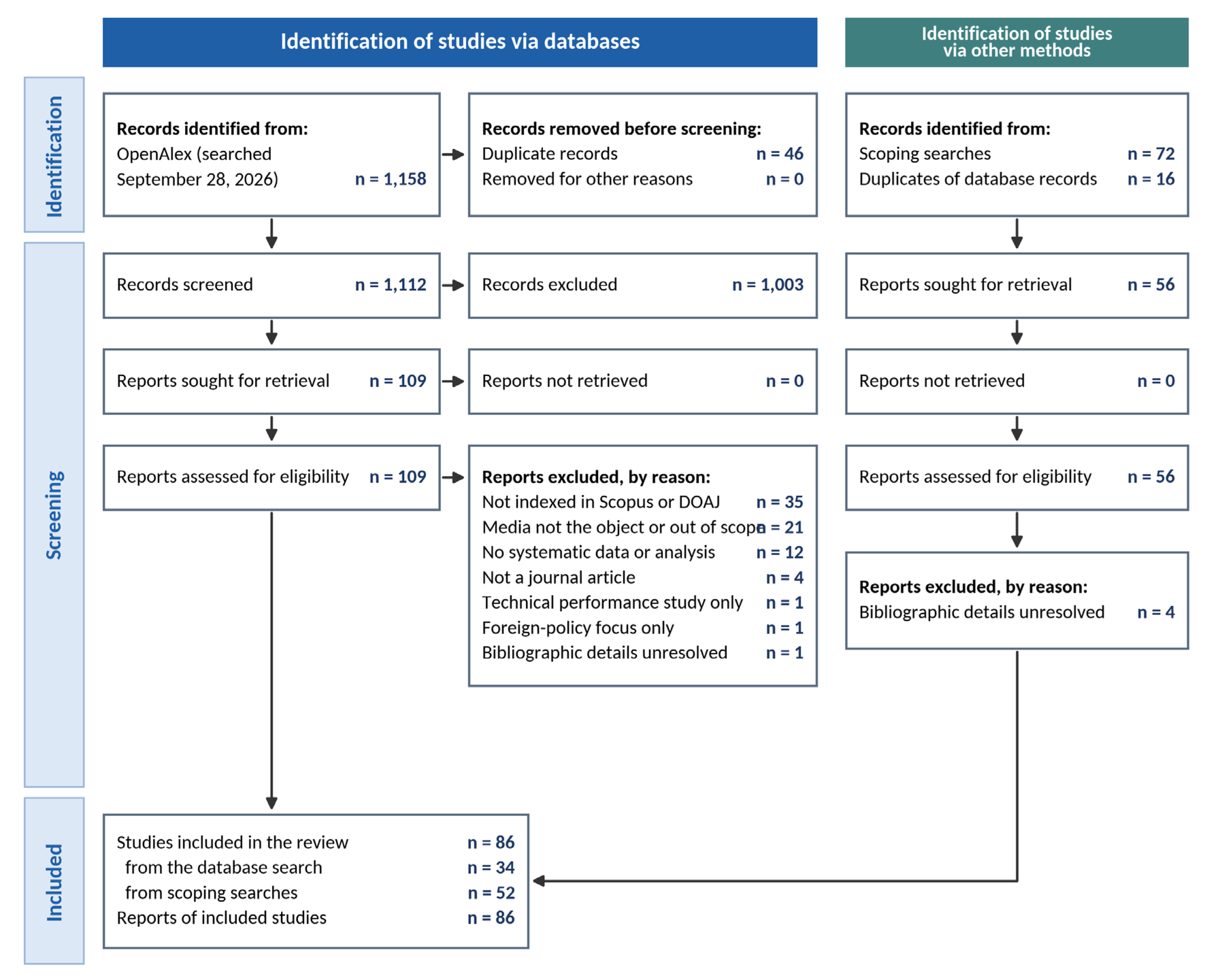
Screening proceeded in two stages. Titles and abstracts were first screened against the eligibility criteria, and the full records of potentially eligible studies, comprising the bibliographic record, the abstract, and, where needed and accessible, the full text, were then assessed, with the reason for every exclusion recorded. The indexing of each candidate’s journal was verified at the second stage. Screening decisions at both stages were made by an AI-based research assistant (Claude, Anthropic) that applied the criteria in Table 3; they were not duplicated by an independent human reviewer, and every decision is reported in Supplementary File S2 so that it can be audited and, where warranted, reversed. The selection process is summarized in the PRISMA 2020 flow diagram in Figure3.
Figure 3.
PRISMA 2020 Flow Diagram of Study Identification, Screening, and Inclusion. Note. Adapted from the PRISMA 2020 flow diagram template for new systematic reviews that include searches of databases and other sources (Page et al., 2021). The database branch reports the OpenAlex search executed on September 28, 2026; the other-methods branch reports the preliminary scoping searches. Studies retrieved by both branches (n = 16) are counted once, in the database branch. The reason for every exclusion at the full-record stage is recorded in Supplementary File S2. DOAJ = Directory of Open Access Journals.
3.4. Data Extraction, Appraisal, and Synthesis
A standardized extraction form captured bibliographic details, setting, design, sample or corpus, data period, platforms or media examined, the mechanism or mechanisms addressed, principal findings, and reported enabling and constraining conditions (Table 2). Data were extracted from the full text where accessible and otherwise from the abstract and publisher metadata, and the resulting matrix is provided in Supplementary File S3.
Methodological appraisal was adapted to the heterogeneity of the corpus. Each qualitative, quantitative, or mixed-methods study was assigned to the category of the Mixed Methods Appraisal Tool (MMAT), version 2018, that corresponds to its design, namely qualitative, quantitative descriptive, quantitative non-randomized, or mixed methods (Hong et al., 2018); historical, legal, and documentary analyses were instead assigned to the JBI approach to text and opinion (McArthur et al., 2015). The content, discourse, corpus, and computational analyses that dominate the field are not directly addressed by either instrument, and full texts were not uniformly accessible. The appraisal therefore concentrated on four design features that condition the weight a finding can bear and that could be established consistently across the corpus. These features were whether the size of the sample, corpus, or case base was reported; whether the data period was specified; whether surveys reported random or stratified sampling; and whether the data were Saudi-specific and collected after the launch of the Vision, collected before it, or pooled across countries. Following the MMAT response format, the first three features were coded “yes,” “no,” or “can’t tell” (or “not applicable” where no units were sampled or no survey was used), with any feature that could not be established from the sources consulted coded “can’t tell” rather than “no”; the fourth feature classified each study’s data as reform-era Saudi, baseline, or regional. Consistent with MMAT guidance, no overall score was computed, and no study was excluded on appraisal grounds; appraisal instead informed the weight given to findings in the synthesis.
Findings were integrated through thematic synthesis (Thomas & Harden, 2008), which proceeds in three stages: line-by-line coding of the findings of included studies, organization of codes into descriptive themes, and development of analytical themes that go beyond the content of the primary studies to address the review questions. Coding combined deductive codes derived from the analytical framework (Figure2) with inductive codes arising from the studies themselves. Three further procedures addressed the review’s analytical aims. Contradictions were examined by comparing findings on the same phenomenon across designs, platforms, samples, time periods, and disciplinary vantage points, so that apparent disagreements could be traced to substantive or methodological sources. Research gaps were identified by mapping the evidence against the review questions and the framework and by recording the mechanisms, populations, platforms, and designs for which evidence was sparse or absent. Finally, sensitivity checks re-examined each analytical theme, first after setting aside the baseline and regional studies, whose evidence is temporally or geographically indirect, and then after setting aside the one study published in a journal that was subsequently discontinued from Scopus.
3.5. Research Integrity and Use of Artificial Intelligence Tools
The review analyzed published literature and involved no human participants; ethical approval was therefore not required. Bibliographic metadata for every cited source were checked against Crossref or publisher records, and the included studies were screened for retraction, correction, and expression-of-concern notices in Open Alex and Crossref; no retracted study was identified, and where a correction had been issued, the corrected version was used. Findings are reported as published by their authors, and the review’s interpretive judgments are distinguished from the reported evidence. One record by the author of this review was retrieved by the database search and was excluded at the full-record stage because its journal met neither indexing condition; the author did not write or co-write any of the included studies. In line with Springer Nature’s policy on large language models, the use of an AI-based research assistant (Claude, Anthropic) is documented here: the tool executed the database search through the Open Alex interface, made the screening decisions reported in Supplementary File S2, extracted and appraised the data reported in Supplementary File S3, verified bibliographic metadata against Crossref and publisher records, and assisted in drafting and editing the manuscript. The tool does not meet the criteria for authorship, and responsibility for the content of the review rests with the author.
3.6. Reflexivity
The author is a Saudi communication scholar. This position provided linguistic access to Arabic-language sources and contextual knowledge of institutions and policies, but it also carried the risk that familiarity would shape interpretation. To mitigate this risk, disconfirming evidence was sought and reported explicitly, contradictions were traced to their substantive or methodological sources, and interpretations were checked against the full range of designs in the corpus. The principal methodological limitations, which concern the database and the sensitivity of the search, the source criterion, language, the depth of appraisal, the screening process, and the heterogeneity of designs, are discussed in Section 5.6.
4. Results
This section first reports the selection process and the characteristics of the evidence base (Section 4.1) and then presents the thematic synthesis. Three analytical themes correspond to the mechanisms of the framework: managed diversification in ownership (Section 4.2), expanded participation in audience engagement (Section 4.3), and bounded discourse in regulation (Section 4.4). A cross-cutting theme, conditional transformation, integrates the evidence on visibility and autonomy (Section 4.5). Section 4.2 through 4.4 each close by identifying convergent patterns, contradictions, and gaps, and these elements are summarized for all four themes at the end of Section 4.1.
4.1. Study Selection and Characteristics of the Evidence Base
The database search returned 1,158 records. After the removal of 46 duplicates, 1,112 records were screened on title and abstract, of which 1,003 were excluded, and the full records of the remaining 109 were assessed for eligibility. Seventy-five were excluded at this stage: 35 because the journal met neither indexing condition; 21 because media were not the object of study or the study fell outside the phenomenon of interest; 12 because they reported no systematic data or analysis; four because they were not journal articles; and one each because it was a technical performance study, addressed foreign-policy communication only, or could not be verified bibliographically. Thirty-four studies were included from the database branch, 16 of which had also been identified by the scoping searches. Of the 72 studies identified by the scoping searches, the 16 already retrieved by the database search were set aside, the remaining 56 were assessed, and four were excluded because their bibliographic details could not be resolved, leaving 52. In total, 86 studies were included, 34 from the database branch and 52 from the scoping searches (Figure3). The source criterion accounted for the largest share of exclusions at the full-record stage (35 of the 75 database records excluded at that stage), and the records it excluded were published predominantly in regional journals, including several Arabic-language titles, which indicates that a considerable body of regional scholarship lies outside the quality floor adopted here. Table 5 summarizes the settings, designs, mechanisms, and principal findings of the included studies.
The evidence base is recent and expanding. Eighty-one of the 86 studies (94%) were published between 2021 and 2026, and 38 (44%) appeared in 2025 or 2026 alone, which indicates that the scholarly assessment of the media dimension of Vision 2030 is still consolidating. Designs are diverse but unevenly distributed. Content, discourse, and corpus analyses form the largest group (33 studies), followed by surveys (16); mixed or multi-method designs (14); computational analyses of platform data (10); documentary, legal, or historical analyses (10); interview studies (2); and a single intervention study. By primary theme, audience engagement (27 studies) and the representation of reform (26) outweigh regulation and professional practice (18) and ownership and industry (15); when every mechanism that a study address is counted, visibility and representation appear in 47 studies and ownership in 23. X, formerly Twitter, supplied the data for 15 of the 23 studies that analyzed platform-generated content, more than all other platforms combined; English-language Saudi newspapers are prominent in representation research; and survey samples are drawn predominantly from university students, professional groups, and single cities or institutions. Seventy-two studies report Saudi data from the reform era, 10 report data pooled across several countries, and four rely wholly or mainly on data collected before the launch of Vision 2030.
The design-feature appraisal qualifies the confidence that particular findings can bear (Supplementary File S3). Of the 77 studies that sampled units of analysis, 62 reported the size of their sample, corpus, or case base, and 44 of the 86 studies specified the period to which their data refer. Of the 24 studies with a survey component, four reported random or stratified sampling (Alkhashil et al., 2026; Alsulaiman, 2022; BinJwair & Bingimlas, 2024; Martin et al., 2016), but only Martin et al. (2016) drew a national probability sample, and its data predate the Vision; one study relied on snowball recruitment (Alardawi, 2026), and 19 did not report the sampling basis in the sources consulted. Other recurring features that constrain confidence are small purposive corpora in discourse and visual analyses; keyword- or hashtag-based sampling in computational studies, which can overrepresent mobilized or polarized voices; and a reliance on English-language newspapers in representation research. Thirty-one studies met every applicable criterion: they reported the size of the sample or corpus, specified the data period, reported random or stratified sampling where a survey was used, and analyzed Saudi data from the reform era. The sensitivity check did not alter the direction of any analytical theme. Setting aside the 14 baseline and regional studies did, however, thin two strands of evidence: the documentation of public criticism of influencers, which rests chiefly on a Gulf-wide hashtag (AlJuwaiser & ALMutarie, 2025), and the evidence on anticipatory self-restraint, which rests substantially on regional and documentary studies (AlAshry, 2023; James & Zweiri, 2026; Zaid, 2018). Setting aside the study published in a journal later discontinued from Scopus (Snoussi et al., 2024) left the finding of predominantly promotional news coverage supported by discourse evidence (Alzilaei, 2025).
Table 6 summarizes the four analytical themes, their sub-themes, the convergent patterns that define them, the contradictions and tensions within the evidence, and the principal evidence gaps. The subsections that follow present each theme in turn.
4.2. Evolving Media Ownership Structures: Managed Diversification
Investment, institution-building, and new industries. The literature documents a substantial expansion of industrial capacity since 2016, led by the state as investor, owner, and anchor client. Sakr (2026) reports that the state acquired a 60% stake in MBC and that some USD 64 billion was envisaged over 10 years from 2018 to build a major television and film industry. Sakr also shows how production shifted toward local content capable of meeting pent-up demand among the under-30 majority, within a state emphasis on Saudi identity and national unity. Foley (2025), drawing on interviews with film professionals and institutional stakeholders conducted in 2023 and 2024, documents rapid institution-building, early achievements, and international partnerships in the film sector, including links with Japan’s animation industry, and identifies the conditions that will shape its next stage. Khalil and Zayani (2022) analyze MBC’s streaming platform Shahid as a regional venture that simultaneously inhabits national borders and transnational “third spaces” in which cultural politics are negotiated. Cultural policy has extended the same developmental logic to newer industries. Combining an analysis of government policies and documents with interviews with Saudi gamers, Al-Khamees et al. (2023) show that the status of gaming rose after 2016 under an aspirational cultural policy, and Altalidi et al. (2025), tracing the Saudi subtitling field from the 1950s, identify 2016 as a distinctive turning point at which the sociocultural developments promoted by Vision 2030 restructured audiovisual production and consumption. Modernization also extends to news: born-digital newspapers adhere more closely to digital design standards and offer richer media than former print titles, and young readers prefer their layouts (Alkhomees & Bahfen, 2025). Madani (2022) shows how the MDL Beast festival was promoted through frames of “opening up to the world,” “positive change,” and “national pride,” projecting an image of the Kingdom beyond conservative stereotypes. In historical perspective, Muyidi (2025) interprets these developments as the latest phase of a system in which media serve national cohesion and in which women’s participation in the profession is rising.
Content: social themes within negotiated boundaries. Studies of the content produced by the new industries converge on a finding of expanded thematic range within negotiated boundaries. Killick’s (2025) analysis of the film Naga shows how social liberalization intersects with job-market expansion and a “moderate” nationalism, and how filmmakers negotiate shifting boundaries of permissibility through symbolism and genre-mixing. B. F. Alharbi’s (2026) multimodal analysis of four film posters released in 2023 and 2024 finds a shift from a single, unified representation of national identity toward differentiated representations shaped by social roles, geography, and transformation, with women’s visibility expressed through individualized agency. Albuhayri and Elyas (2026) show that Mandoob renders economic, social, and cultural change through class divisions, gender dynamics, and the contrast between traditional and modern values, and AlShurafa et al. (2022) find that the animated series Masameer uses culture-specific signs and humor that may stimulate social change. Advertising follows a similar trajectory: car advertisements produced after the lifting of the driving ban celebrate women’s achievements while balancing global empowerment discourse with local tradition (Olwi & Albawardi, 2025). Reception evidence is thinner. Viewers of Masameer responded mostly positively and on topic, but many did not engage critically with the issues that the series raised (El Alaoui & Pilotti, 2022).
Promotional coverage and the alignment of content with official priorities. The evidence on news content points to a narrower margin. In a survey of 170 newspaper practitioners, Snoussi et al. (2024) found that coverage of Vision 2030 was predominantly general (65.3%) rather than analytical (21.2%) and that practitioners regarded the press as promoting rather than evaluating Vision. Discourse evidence points in the same direction: an analysis of the websites of four major Saudi news outlets between 2019 and 2022 found that coverage of cultural change relied heavily on persuasive strategies, with praise accounting for 31.85% of solidarity strategies and affirmation for 43.70% of hinting strategies (Alzilaei, 2025). In entertainment, the alignment of content with official priorities also extends to global platforms: Khalil and Zayani (2021) show that Netflix’s removal of a critical comedy episode from its Saudi service at the government’s request reflected a “symbiotic relationship” in which targeted content requests were met by the platform’s “controlled compliance.” Read through Schiffrin’s (2021) framework of media capture, these studies suggest that diversification has added new actors, formats, and genres without necessarily altering the incentives that align news content with official priorities.
Patterns, contradictions, and gaps. The convergent pattern is managed diversification: investment and cultural policy have expanded capacity, genres, and youth-oriented content, and cultural production now engages social themes more openly than before 2016. The principal contradiction lies between industry and production studies, which document creative latitude and institutional achievement (Al-Khamees et al., 2023; Foley, 2025; Killick, 2025; Sakr, 2026), and news-focused studies, which document promotional coverage (Alzilaei, 2025; Snoussi et al., 2024), together with a case of platform compliance (Khalil & Zayani, 2021). The two are reconcilable if the margin of latitude differs by genre, with fiction, animation, gaming, and entertainment enjoying wider latitude than news and current affairs, although the removal of a critical comedy episode suggests that political satire is an exception (Khalil & Zayani, 2021); the literature implies this proposition but has not tested it. A second tension concerns the cultural terms of expansion: new industries such as gaming have developed amid continuing negotiation between religious traditions and the expansion of the sector and between the expectations of users and those of the state (Al-Khamees et al., 2023), which suggests that the boundaries of permissible content are being renegotiated rather than simply widened. The gaps are considerable. No included study systematically examines ownership concentration, cross-ownership, financing, or the advertising market after 2016; streaming commissioning is examined only through single cases; and newsroom-level autonomy has not been measured with established instruments.
4.3. Digital Media and Audience Engagement: Expanded Participation
Platform-centered consumption and its gratifications. The audience literature documents a decisive shift toward mobile, platform-centered consumption. In a random sample of 840 young adults at a public university in Riyadh, Alsulaiman (2022) found heavy smartphone-based reliance on Twitter and WhatsApp for news. Ben Amor and Mzoughi (2023) identified four gratifications that young Saudis seek from Snapchat, namely information seeking, self-expression, entertainment, and interaction, confirming the relevance of the uses and gratifications framework (Katz et al., 1973; Sundar & Limperos, 2013). Saudi online newspapers command wide use and trust: in a survey of 400 students at three universities in Riyadh, most respondents used, trusted, and relied on Saudi online newspapers, Sabq above all, and Vision 2030 and the fight against corruption and terrorism were among the topics they followed most closely (Eldagher, 2022). Postgraduate students perceived social networking sites as having a moderate and mainly positive effect on their social trust, civic participation, and political engagement (Alghamdi & Plunkett, 2021). Trust in content creators rests on verifiable signals: female history students in Riyadh preferred visual platforms and trusted independent creators who cited sources, displayed credentials, and communicated transparently (Alkhashil et al., 2026). The effects of exposure are beginning to be measured. Among 410 young adults recruited through snowball sampling, greater exposure to films about artificial intelligence was associated, weakly, with viewing the technology as a threat (Cramér’s V = 0.14), whereas younger and more educated respondents attributed greater social value to it (Alardawi, 2026).
Platforms as arenas of reform dialogue. A substantial body of computational and discourse research shows that platforms have become arenas in which reform is debated, endorsed, and normalized, particularly with respect to women’s rights. Before the Vision, Twitter already gave Saudis, and women in particular, a distinctive space to voice views on the driving ban (Altoaimy, 2018). During the 2016 #EndMaleGuardianship campaign, Twitter functioned as a shared space with public-sphere characteristics, enabling dialogue across the gender segregation of offline public discourse and a counter public that helped legitimize the campaign (Thorsen & Sreedharan, 2019). In the week after the September 2017 decree permitting women to drive, 60% of the users represented in a sample of 14,777 tweets supported the government’s decision, whereas 40% opposed it or were neutral (Al-Razgan et al., 2021). Network analysis of about 2 million #SaudiWomenCanDrive tweets identified rights advocates, the political leadership, and government agencies among the most influential accounts, with supportive and opposing hashtags coexisting (Jastania et al., 2022), and stance analysis of tweets from 2016 and 2017 found opinion on women’s driving and male guardianship closely divided in the labeled sample (Azmi & Al-Ghadir, 2024). Beyond gender relations in the narrow sense, social media has helped shift attitudes toward women’s football from resistance to endorsement through storytelling and visible role models (Angerer & Schuhn, 2026). The same visibility nonetheless attracts hostility: interviews with 33 Saudi female athletes and sports fans identified gender-based derogatory comments, misogyny, and appearance-related discrimination as common forms of online hate directed at women in sport, and a classifier trained on 7,487 annotated Arabic tweets from X detected such speech with 85% accuracy (Alhayan et al., 2024). Entertainment and development initiatives are debated in the same arenas. About three in five annotated tweets on Riyadh Season expressed positive sentiment (Alsahafi et al., 2026), and social media discussion of the New Murabba project divided along generational and religious lines, with young professionals endorsing it as a necessary reform for economic diversification and older, religiously conservative users voicing cultural and religious concerns (Hidayat & Soekarba, 2024).
Influencers as intermediaries. Influencers have become central intermediaries between reform agendas and public. M. Alharbi (2025) found that X users in Saudi Arabia, Qatar, and Bahrain who follow influencers perceived their countries’ national visions as achievable, sustainable, and inclusive, with Saudi respondents holding the most positive perceptions. Combining a survey of 400 participants with an analysis of posts by a leading Saudi public figure about Riyadh Season, MDL Beast, and Formula 1, Salim and Salamah (2025) show that influencers act as cultural ambassadors and mediators of state-led nation branding and contribute to the Kingdom’s soft power. Influencer publics are nonetheless evaluative rather than passive. A Gulf hashtag criticizing influencers, analyzed in a 2024 dataset of about 20,000 posts and 53,200 users, resonated most strongly in Saudi Arabia and spanned social, religious-ethical, cultural, and national domains of criticism (AlJuwaiser & ALMutarie, 2025). Influence also runs downstream: family-oriented channels shape children’s values and behavior, including the imitation of prank content (Qutub & Muhammad, 2022).
Limits within expanded participation: trust, misinformation, and digital citizenship. The same literature identifies limits. Young Saudis trust traditional media more than social media, even though highly engaged users regard social news as trustworthy (Alsulaiman, 2022), and in a survey of 5,472 residents during the COVID-19 pandemic, the Ministry of Health was the most trusted source of information (91.7%), far ahead of social media (1.1%; Almuzaini et al., 2021). Social platforms were the principal channels of rumor during the early pandemic, with WhatsApp (46%) and Twitter (41%) the most frequently reported sources (Alasmari et al., 2021). Families perceive considerable risk: in a survey of 1,524 family members in Hail, respondents rated TikTok, Twitter, Snapchat, YouTube, and Instagram the riskiest platforms, and two-thirds of the identified threats were rated high in severity and likelihood (Moubarak & Afthanorhan, 2024). The evidence also suggests that some of these limits can be addressed: a brief educational video significantly improved participants’ ability to identify misleading WhatsApp messages (Alsaad & AlDossary, 2024). Evidence on digital citizenship is mixed: university students reported a high level of digital citizenship practice (BinJwair & Bingimlas, 2024), whereas a broader sample of social media users showed moderate awareness of its dimensions and identified the improper use of technology as the principal obstacle to its development (Al Rashidi & Alalfy, 2023). Finally, online discourse on some reform-related policies remains contested: comments on news videos about residency policy show the colloquial register carrying exclusionary nationalist claims (Al-Bohnayyah, 2026).
Patterns, contradictions, and gaps. The convergent pattern is expanded participation: engagement is mobile, platform-centered, and youth-driven, with prominent participation by women, and platforms have become the principal arenas in which reform narratives and entertainment initiatives are debated and normalized. Four contradictions stand out. The first is a reliance–trust paradox, in which audiences depend on social platforms for news but place greater trust in traditional and official sources (Almuzaini et al., 2021; Alsulaiman, 2022); the finding that young readers trust Saudi online newspapers (Eldagher, 2022) suggests that trust attaches to institutional news sources rather than to channels as such. The second concerns the balance of opinion on reform: majority support in the week after the driving decree (Al-Razgan et al., 2021) contrasts with closely divided stances in a labeled sample from 2016 and 2017 (Azmi & Al-Ghadir, 2024) and with generationally differentiated responses to a flagship urban project (Hidayat & Soekarba, 2024). These differences are at least partly methodological, reflecting sampling windows, hashtag-based selection, and classification choices, and they caution against treating any single platform snapshot as a measure of public opinion. The third concerns women’s participation, whose growing visibility in sport and public life (Angerer & Schuhn, 2026) coexists with gendered online abuse (Alhayan et al., 2024). The fourth concerns influencers, who appear both as effective ambassadors of national branding (M. Alharbi, 2025; Salim & Salamah, 2025) and as targets of sustained public criticism (AlJuwaiser & ALMutarie, 2025). The principal gaps are the scarcity of probability-based national samples, the dominance of X over platforms such as TikTok and Snapchat, the near absence of longitudinal or experimental designs linking media use to attitude change, and limited attention to older, rural, and non-Saudi resident audiences.
4.4. Regulatory Challenges and Media Freedom: Bounded Discourse
Institutional modernization and the formalization of the creator economy. The regulatory literature documents a process of institutional modernization that has formalized a previously unregulated creator economy. Industry experts regard the licensing, disclosure, and content standards administered by the General Authority for Media Regulation as trust-building instruments that shape how influencers are selected and how promotions are disclosed, although consumer trust in influencer promotion remains cautious and depends on consistency, transparency, and expertise (Alharthi et al., 2026). A doctrinal analysis finds that no single statute governs social media marketing and that overlapping schemes in copyright, trademark, content regulation, competition, and e-commerce law create civil and criminal liability risks for entrepreneurs (Sarabdeen, 2025), which indicates that consolidation remains incomplete. Licensing has also opened the broadcasting field to new audiences: the recent licensing of foreign-language stations in Saudi Arabia under Vision 2030 has extended to the Kingdom a form of diaspora media that, across the Gulf, contributes to cultural continuity, socialization, and a sense of belonging among expatriate communities (James & Zweiri, 2026). Regulation also rests on a measure of public support. In a 2014 probability survey, the desire to preserve culture predicted support for the censorship of entertainment media among Saudi respondents (Martin et al., 2016), and more recent evidence of family concern about platform risks (Moubarak & Afthanorhan, 2024) suggests that protective regulation continues to resonate with segments of the public.
Professional inclusion and the practice of journalism. A second strand documents the professional inclusion of women, which the reform period has accelerated. Government and supervisor support are associated with higher job satisfaction among Saudi women journalists, whereas perceived gender discrimination is associated with job stress (Muyidi et al., 2023); in mixed-gender newsrooms, higher-quality contact with male coworkers is associated with lower intergroup anxiety and intention to quit (Zhang et al., 2023); and women journalists, formerly absent, asked 13.8% of the questions at ministerial press conferences held between 2020 and 2023, although their participation remains below their share of the workforce (Alfahad, 2024). Studies of journalistic practice, by contrast, report heavy reliance on official sources. In science coverage published in three national dailies in 2021, 95% of stories relied on a single source, official sources predominated, and journalists described themselves as disseminators rather than watchdogs (Alhuntushi & Lugo-Ocando, 2024). Regional studies that include Saudi newspapers attribute similar patterns in statistical reporting chiefly to training and skills gaps and to contested professional autonomy (Alhuntushi & Lugo-Ocando, 2022) and describe business journalism that “ticks the boxes” of professionalism without deepening analysis (Alaqil & Lugo-Ocando, 2023). Adherence to responsible-reporting guidance on suicide is low, prompting calls for national standards for media coverage (AlSheddi, 2025), and a six-country study of pandemic coverage that included a Saudi outlet identified distortions such as the overestimation of official responses, which journalists attributed to institutional, governmental, and societal pressures (Shehata & Adel, 2024).
Predictability, monitoring, and anticipatory self-restraint. A third strand, composed mainly of legal, documentary, and regional perception studies, associates legal uncertainty and perceived monitoring with anticipatory self-restraint. In the creator economy, the overlapping legal schemes noted above (Sarabdeen, 2025) are a source of legal uncertainty that consolidated rules would reduce. Focus groups with journalists from seven Arab countries, including Saudi Arabia, indicate that perceived digital surveillance shapes professional behavior and the adoption of secure communication tools (AlAshry, 2023), and diaspora media in the Gulf, including the foreign-language stations recently licensed in Saudi Arabia, operate with limited freedom owing to censorship and self-control measures (James & Zweiri, 2026). Zaid’s (2018) comparison of 11 Arab broadcast regulators concludes that the new regulators function more as instruments of “authoritarian upgrading” than as vehicles of liberalization, noting that the Saudi regulator’s board was chaired by the minister and composed predominantly of government representatives. The evidence on enforcement is mixed in its implications: an analysis of more than 300 million tweets posted between 2010 and 2017 found that imprisonment deterred those detained from further online criticism but did not deter criticism among their followers, whose attention to the detained and their causes increased (Pan & Siegel, 2020). As the sensitivity check indicates, this strand rests substantially on regional and documentary evidence, and Saudi-specific fieldwork on self-restraint remains scarce.
Participatory alignment and contested accounts of coordination. A fourth strand concerns the participatory enforcement of discursive boundaries. Drawing on about 100 interviews with nationalist journalists, intellectuals, and influencers conducted in 2021 and 2022, Schmidt-Feuerheerd (2026) shows that open platforms allow pro-government users to perform public opinion and to police views that diverge from official positions, a practice he terms collaborative authoritarianism, while also enabling these users occasionally to press the state to respond to their demands. Accounts of how such alignment is produced diverge. Analyzing regime-aligned Saudi hashtags and 279 regional hashtags, Abrahams and Leber (2021) find little evidence of top-down manipulation and few bots, attributing most pro-government content to decentralized supporters and influential “cyber knights.” By contrast, Al-Rawi (2021), analyzing an archive of accounts that Twitter released and attributed to state-linked operations, documents a coordinated campaign to discredit a prominent journalist after his disappearance in 2018. The two findings concern different phenomena, everyday discourse on prominent hashtags and a specific crisis episode, and rest on different data sources, which suggests that organic and coordinated dynamics coexist and vary by issue and moment. Table 7 consolidates the regulatory and policy mechanisms documented in the reviewed literature, distinguishing the developmental functions reported for each from its reported constraining effects and identifying the evidence on which each rest.
Patterns, contradictions, and gaps. The convergent pattern is one of bounded discourse within a modernizing institutional framework. Three contradictions structure the evidence. The first concerns the sources of constraint on journalism: capacity-oriented studies attribute weak sourcing and shallow analysis mainly to training and skills, alongside contested professional autonomy (Alaqil & Lugo-Ocando, 2023; Alhuntushi & Lugo-Ocando, 2022), whereas legal and regional studies emphasize legal uncertainty, regulatory design, and perceived monitoring (AlAshry, 2023; Sarabdeen, 2025; Zaid, 2018). The explanations are complementary rather than mutually exclusive, and their relative weight is an empirical question that the literature has not resolved. The second concerns the function of regulation itself, which appears as a trust-building, professionalizing, and enabling instrument in studies of the creator economy, newsroom inclusion, and newly licensed services (Alharthi et al., 2026; James & Zweiri, 2026; Muyidi et al., 2023) and as a constraint in legal and documentary analyses. The third concerns how online alignment is produced: largely organically in analyses of prominent hashtags (Abrahams & Leber, 2021) and through coordination in a specific crisis episode (Al-Rawi, 2021). The gaps are pronounced. No included study evaluates the implementation of the Audiovisual Media Law or the effects of the Mawthooq license on creators, analyzes the decisions or procedures of the General Authority for Media Regulation, or surveys Saudi journalists’ role perceptions with established comparative instruments, and much of the evidence on self-restraint derives from regional or documentary data rather than from Saudi-specific fieldwork.
4.5. Cross-Cutting Theme: Conditional Transformation
Across the three mechanisms, the clearest pattern is neither liberalization nor stasis but conditional transformation. The concept is supported by two bodies of evidence: studies documenting a substantial expansion in the communicative visibility of reform, at home and abroad, and the evidence synthesized above on the more gradual expansion of editorial autonomy.
Communicative visibility: the amplification of reform narratives. Counting every mechanism that a study addresses (47 of 86 studies), the most densely studied domain in the corpus is the representation of reform, above all women’s empowerment, and its findings are strikingly consistent. A baseline study found that newspaper and magazine articles published in March 2016 already portrayed women as active and independent, although some writers noted remaining equality gaps (Elyas et al., 2021). After the launch, a corpus of 1,578 items in Arab News and Saudi Gazette presented Vision 2030 as a matter of public interest and strongly endorsed women’s empowerment (Afzal & Omar, 2021); computational analysis of 43 local newspapers in 2021 and 2022 found supportive contexts for women’s empowerment far outnumbering impeding ones, by 74 to 17 (Almaghlouth & Almujaiwel, 2023); and a critical discourse analysis of 320 articles published between 2015 and 2023 traced a shift from conservative to progressive portrayals and a growing visibility of women’s professional roles (Al-Qahtani, 2025). Visual studies concur. News images from 2023 depart from portrayals of women as passive and show them in military, policing, technology, and business roles (AlQahtani & Alghamdi, 2025), and state-aligned tourism and sport media present women as public actors, entrepreneurs, athletes, and cultural ambassadors (Alsharif, 2026). A comparison of 10,000 tweets posted in 2015 and 2022 shows discourse on women shifting from restriction and guardianship toward empowerment, achievement, and national identity (A. Alharbi & Albawardi, 2025). The same visibility extends to other reform domains. Official and news discourse on the Saudi Green Initiative constructs a contextualized national identity for international audiences (Almaghlouth, 2022), and climate coverage in Arab News between November 2022 and November 2023 framed the issue as change, crisis, fight, and collective responsibility while foregrounding the Saudi Green Initiative among national responses (Jabeen, 2024). The transformation of AlUla involves a deliberate re-engineering of heritage narratives for global audiences (Basyar et al., 2026), promotional materials for The Line rework tropes of nature, space, and time to convey the official narrative of transformation (Alaily-Mattar & Jones, 2025), and football and mega-events project the image of a progressive, youth-oriented entertainment hub (Agerschou-Madsen, 2025).
The literature also records the limits of this visibility. Reproductive rights and caregiving remain underrepresented in press coverage of women’s rights (Al-Qahtani, 2025); caricaturists use irony to depict remaining struggles over rights and discrimination (Al-Ghamdi et al., 2022); women’s visibility in promotional media is greater in urban and globally oriented settings than in rural ones, and symbolic inclusion has advanced faster than structural empowerment (Alsharif, 2026); promotional materials for The Line convey little sense of what the project actually is as architecture (Alaily-Mattar & Jones, 2025); and an interpretive analysis reads nation-branding imagery as coexisting with retained political control (Agerschou-Madsen, 2025).
International visibility and contested images. International visibility has risen markedly. In the News on the Web corpus spanning 20 English-speaking countries, mentions of Vision 2030 rose from 43 in 2016 to 308 in 2024 and were organized around modernization, social reform, national identity, and international alliances (Almohawes, 2026). An analysis of 30 Arab and international television news programs aired between 2023 and 2025 found that coverage of Saudi economic developments centered on diversification, innovation, global partnerships, and sustainability, with Arab outlets strongly positive and international channels more analytical within broadly supportive frames (Shaher & Radwan, 2026). English-language sentiment on X around Saudi-hosted sporting and tourism events between December 2023 and December 2024 was strongly positive during event periods (A. Alharbi, 2026), and British tabloid coverage of sports events hosted in the Kingdom became less negative between 2017 and 2021 as neutral and positive coverage grew (Almahraj, 2023). CNN and BBC coverage in 2023 combined positive frames of regional mediation, social welfare, events, and economic strength with negative frames concerning human rights (Tahat et al., 2025). Sport has become a prominent vehicle of this visibility: analyses of sports tourism and of investment in mixed martial arts describe these initiatives as instruments of cultural diplomacy and nation branding aligned with national development plans (Jeong, 2026; Rai & Longkumer, 2026), and Jeong (2026) argues that their effectiveness depends on whether investment is seen to produce structural change or is read as image management. Visibility is also expanding in non-Western markets: on the Chinese platform Douyin, an influencer’s family-life framing of the Kingdom generated strong resonance, although Chinese audiences’ perceptions remained largely disconnected from its social transformation (Liu & Zhu, 2025).
International images nonetheless remain contested and differentiated by the vantage point of the outlet. Coverage of women’s military enlistment ranged across advocating, biased, and neutral patterns, with Saudi and Arab outlets framing enlistment as empowerment (Ghobain et al., 2024) and Western outlets leaning toward negative frames of rights and inequality (Ghobain et al., 2026). Asharq Al-Awsat framed NEOM as technological progress and economic benefit, whereas ALQST, a human rights organization, foregrounded human rights concerns and environmental harms (Ilmi & Zawawi, 2024). Internationally circulated stock images of women driving were generic and decontextualized, simplifying the social change they purported to depict (Albawardi & Jones, 2023).
Editorial autonomy: bounded and uneven. Set against this expansion of visibility, the evidence on autonomy synthesized in Section 4.2 through 4.4 points to a more gradual trajectory. News coverage of the Vision has been more promotional than analytical (Alzilaei, 2025; Snoussi et al., 2024), sourcing relies heavily on official voices (Alhuntushi & Lugo-Ocando, 2024), and legal and regional analyses associate legal uncertainty and perceived monitoring with anticipatory self-restraint (AlAshry, 2023; James & Zweiri, 2026; Sarabdeen, 2025). Autonomy is not static, however: creative industries negotiate wider margins (Al-Khamees et al., 2023; Killick, 2025; Sakr, 2026), women’s professional presence has grown (Alfahad, 2024), and online publics contest as well as endorse (Al-Bohnayyah, 2026; AlJuwaiser & ALMutarie, 2025; Hidayat & Soekarba, 2024).
The visibility–autonomy configuration. Figure4 locates this configuration on the two dimensions of the analytical framework. Before 2016, according to the background literature (Section 2), Saudi media combined comparatively limited visibility of reform themes with limited autonomy, although baseline studies show that some reform themes were already visible (Altoaimy, 2018; Elyas et al., 2021). The synthesized evidence places the reform-era media system in a position of high visibility and conditional autonomy, and the reform pathway that the review proposes, the target configuration in Figure4, runs toward the upper-right quadrant, in which expanded reach is matched by predictable and transparent rules that reduce anticipatory self-restraint.
Figure 4.
The Conditional Transformation Model: Communicative Visibility and Editorial Autonomy in Saudi Media. Note. Developed by the author from the thematic synthesis (Section 4.2, Section 4.3, Section 4.4 and Section 4.5). Positions are analytical and illustrative rather than measured.
Figure 4.
The Conditional Transformation Model: Communicative Visibility and Editorial Autonomy in Saudi Media. Note. Developed by the author from the thematic synthesis (Section 4.2, Section 4.3, Section 4.4 and Section 4.5). Positions are analytical and illustrative rather than measured.
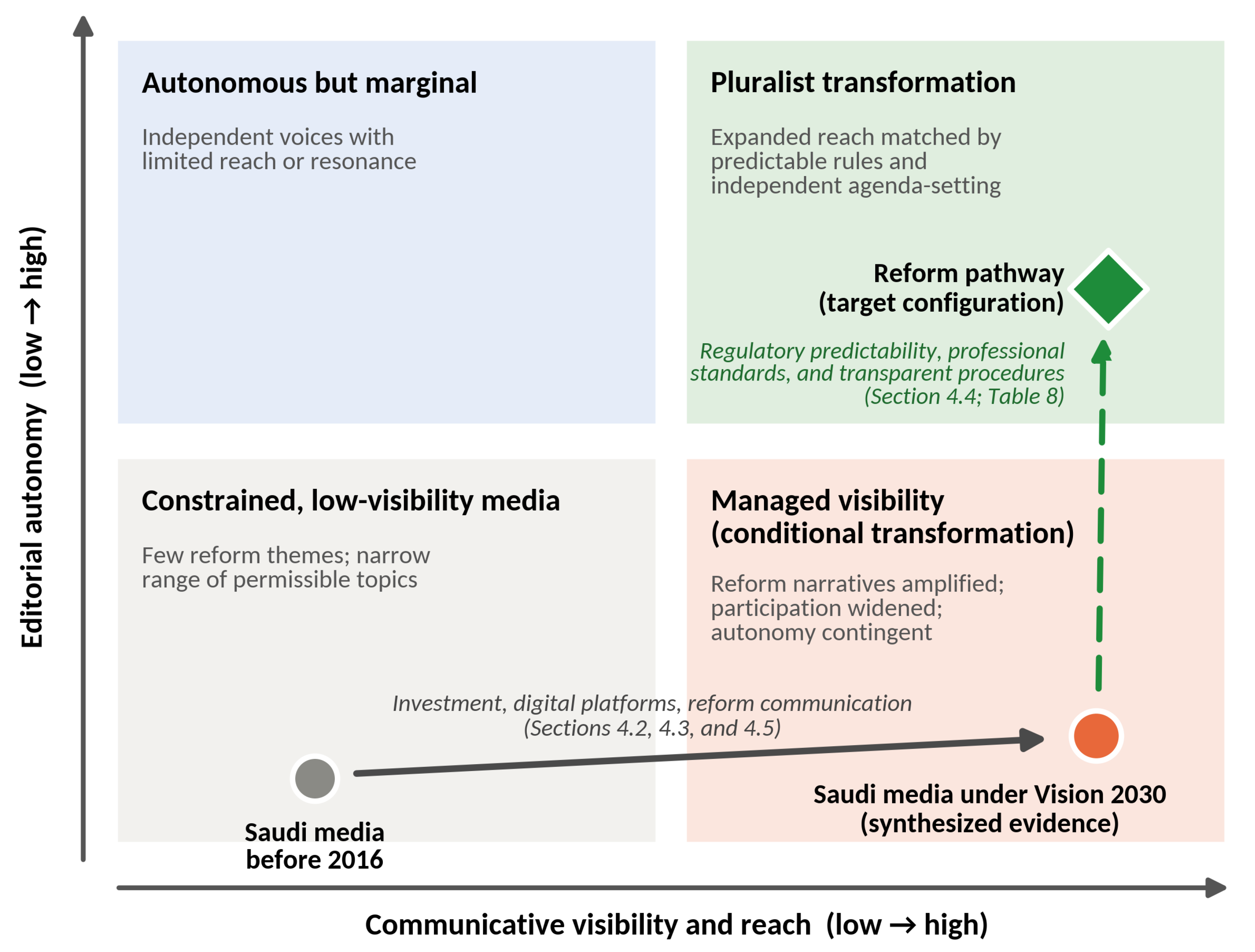
The model clarifies what media currently contribute to social change in Saudi Arabia and what they do not. According to the reviewed evidence, they contribute by normalizing reform, widening the range of visible roles and lifestyles, connecting young audiences to civic topics, projecting the Kingdom’s transformation to international audiences, and providing government and society with a shared arena of communication. The evidence does not yet show a fully independent capacity across the media system to set agendas, scrutinize institutions, or sustain contested debate. Whether this independent agenda-setting capacity develops is likely to depend substantially on regulatory conditions, alongside professional capacity and ownership incentives, which is why the Discussion and Recommendations treat regulatory predictability as a pivotal, though not yet directly tested, condition.
5. Discussion
This section interprets the findings of the review in light of the theoretical framework set out in Section 2. It first considers each mechanism in turn: ownership reform (Section 5.1), digital engagement (Section 5.2), and regulation (Section 5.3). It then examines the contribution of the concept of conditional transformation to theory (Section 5.4) and offers a constructive reading of the Saudi case that weighs its achievements against the conditions for its next stage (Section 5.5). The section concludes by setting out the limitations of the review (Section 5.6).
5.1. Ownership Reform: Expanded Capacity, Evolving Autonomy
The review supports a measured interpretation of ownership reform. Literature documents diversification, investment, and new industries, but it does not document a decisive shift in the balance of editorial control within the news media. Ownership reform has altered the composition of the media field more than the distribution of editorial autonomy within it. This conclusion is consistent with Kraidy’s (2021) account of a media sector that expanded from national broadcasting to transnational reach under ownership closely linked to the ruling establishment, and with Schiffrin’s (2021) argument that capture operates through incentives as much as through ownership titles; it also echoes Mellor’s (2024) regional finding that the digital sphere has maintained the offline hierarchies of political, economic, and cultural power in Arab journalism. The distinction matters analytically: a media system can grow in scale, quality, and reach while its editorial center of gravity changes more slowly, and evaluations that use investment as a proxy for pluralism will overstate the degree of transformation.
The growth of the sector is, however, substantive rather than cosmetic. Investment and cultural policy have created professional opportunities and generated content that reaches Saudi audiences on their own terms, including youth-oriented television (Sakr, 2026), regional streaming (Khalil & Zayani, 2022), a domestic cinema that explores social themes (Albuhayri & Elyas, 2026; Killick, 2025), a film sector of growing institutional depth (Foley, 2025), and emerging gaming and audiovisual translation industries (Al-Khamees et al., 2023; Altalidi et al., 2025). The gap that the review identifies is between capacity and autonomy, not between rhetoric and reality. Its most plausible locus is genre: the evidence suggests that entertainment, gaming, and fiction enjoy wider latitude than news, a proposition that future research should test directly.
5.2. Digital Engagement: Participation as a Conditional Public Sphere
The audience literature documents a decisive shift toward mobile, platform-centered consumption, especially among younger users, and platform choice follows the gratifications predicted by uses and gratifications theory (Ben Amor & Mzoughi, 2023; see also Katz et al., 1973; Sundar & Limperos, 2013). Platforms have functioned as arenas of reform dialogue with public-sphere characteristics (Thorsen & Sreedharan, 2019); a comparison of tweets from 2015 and 2022 records a shift in discourse on women toward empowerment and achievement (A. Alharbi & Albawardi, 2025); majority support followed the driving decree (Al-Razgan et al., 2021); and about three in five annotated tweets on Riyadh Season were positive (Alsahafi et al., 2026). Trust, moreover, follows institutions across channels: Saudi online newspapers retain the trust of young readers (Eldagher, 2022), just as official sources commanded the highest trust during the pandemic (Almuzaini et al., 2021).
This participation should not, however, be equated with an unrestricted public sphere. Three qualifications emerge from the synthesis. First, engagement is structured by intermediaries, particularly influencers whose content generally reinforces national reform agendas (M. Alharbi, 2025; Salim & Salamah, 2025) but who are themselves subject to public scrutiny (AlJuwaiser & ALMutarie, 2025). Second, the same environment carries risks of misinformation, polarization, and gendered abuse (Al-Bohnayyah, 2026; Alasmari et al., 2021; Alhayan et al., 2024), which help to explain the reliance–trust paradox identified in Section 4.3 and underline the protective function that regulation and media literacy can perform. Third, digital participation operates within the same regulatory boundaries as traditional media, so that self-restraint can migrate from newsrooms to individual accounts (AlAshry, 2023; Schmidt-Feuerheerd, 2026). The result is what Chadwick (2017) would describe as a hybrid system in which older logics of alignment and newer logics of participation interpenetrate. The review adds that the direction of this hybridity is not fixed: the platforms that host participatory alignment also host contestation, evaluation, and the gradual normalization of new social roles.
5.3. Regulation: Predictability as the Lever of the Next Stage
Across the regulatory literature, legal uncertainty and perceived monitoring are the conditions that the reviewed studies link to anticipatory self-restraint (AlAshry, 2023; James & Zweiri, 2026; Sarabdeen, 2025; Zaid, 2018). The review reads this as a problem of predictability rather than of regulation as such. Because the association rests predominantly on legal, documentary, and regional evidence (Section 4.1), it is best treated as a well-grounded proposition that awaits Saudi-specific testing rather than as an established effect. It nonetheless refines Stier’s (2015) macro-level result that regime type predicts media freedom: within a given regime type, the predictability of regulation may be the variable that directly shapes professional behavior. It is also consistent with capacity-oriented evidence, because professionals who lack clear standards and specialized training are more likely to default to official sources (Alhuntushi & Lugo-Ocando, 2022, 2024).
The regulatory story is not one-directional. The consolidation of regulatory functions in the General Authority for Media Regulation, the modernization of the audiovisual legal framework, and the licensing of individual advertisers represent substantial institutional capacity building (GAMR, n.d.; Saudi Gazette, 2022; Saudipedia, n.d.), and the reviewed studies associate these instruments with trust-building in the creator economy (Alharthi et al., 2026) and with newly licensed services for expatriate communities (James & Zweiri, 2026); in the newsroom, government support is associated with job satisfaction among women journalists (Muyidi et al., 2023). The constructive implication is that Saudi Arabia already possesses the institutional means to move from uncertainty to predictability, a move that Vision 2030 itself anticipates in its commitment to wide-ranging transparency and accountability reforms (CEDA, 2016). The evidence indicates that what is needed is not the creation of regulations where none exists but the specification of clear standards, transparent procedures, and proportionate remedies that allow professionals to plan and report with confidence.
5.4. Conditional Transformation as a Contribution to Theory
The concept of conditional transformation offers a middle-range account of media change in state-led reform contexts. It differs from liberalization, which implies the parallel expansion of visibility and autonomy; from stasis, which denies change altogether; and from accounts that foreground control (e.g., Jones, 2022) at the expense of the real expansion of participation and representation that the reviewed evidence documents. It complements Heydemann’s (2007) concept of authoritarian upgrading, MacKinnon’s (2011) networked authoritarianism, and Schmidt-Feuerheerd’s (2026) collaborative authoritarianism by shifting the analytical lens from state strategy to observable configurations of visibility and autonomy, and it specifies a mechanism, regulatory predictability, through which the configuration could change.
Because the concept has been tested against, and refined through, a systematic synthesis rather than a single case, it can be stated as testable propositions. First, where regulatory standards and procedures become more predictable and transparent, the share of analytical rather than promotional coverage should increase. Second, trust in digital news and content creators should rise with the transparency of sourcing, credentials, and commercial disclosure, as the evidence on creator trust already suggests (Alharthi et al., 2026; Alkhashil et al., 2026). Third, gains in the representation of reform should translate into durable attitudinal change most strongly where they are accompanied by lived institutional change, as in the case of women’s driving and employment (Al-Razgan et al., 2021; Macias-Alonso et al., 2023); the same logic applies abroad, where the effectiveness of sport-based nation branding is argued to depend on whether investment is seen to produce structural change (Jeong, 2026). The concept also has comparative reach. Patterns of state influence and regulatory design are observable across Arab media systems (Zaid, 2018), and Gulf states display similar dynamics around national visions, influencers, diaspora media, and sport-based soft power (M. Alharbi, 2025; James & Zweiri, 2026; Rai & Longkumer, 2026); comparative studies would help to establish the conditions under which conditional transformation moves toward pluralism.
5.5. A Constructive Reading of the Saudi Case
Read constructively, the reviewed evidence records considerable achievements. Saudi Arabia has built a media and entertainment industry of regional significance, begun to meet substantial pent-up demand for domestic content, and developed new creative industries in film, streaming, animation, gaming, and audiovisual translation (Al-Khamees et al., 2023; Altalidi et al., 2025; Foley, 2025; Sakr, 2026). Its media have amplified reform narratives that the wider literature links to measurable social outcomes, including new connections between women’s mobility and employment after the lifting of the driving ban (Macias-Alonso et al., 2023), positive shifts in social attitudes and behavioral intentions following legal reform (Alhejaili, 2025), gains in subjective well-being, particularly among women (Burger & Arampatzi, 2025), and widespread youth support for the Vision, alongside concerns about the pace of change (Thompson, 2021). Women’s presence in journalism has grown (Alfahad, 2024; Zhang et al., 2023), official risk communication earned high public trust during the pandemic (Almuzaini et al., 2021), and climate coverage in the national English-language press has framed action on climate change as a collective responsibility (Jabeen, 2024). Internationally, the visibility of the Vision has risen sharply (Almohawes, 2026), television coverage of the Kingdom’s economic development has been broadly supportive in both Arab and international outlets (Shaher & Radwan, 2026), sentiment around Saudi-hosted events has been strongly positive (A. Alharbi, 2026), and influencer content has begun to reach audiences in China (Liu & Zhu, 2025). These achievements indicate that media have helped to normalize and sustain reform narratives; establishing their causal contribution to the pace of reform is a task for future research.
The evidence also identifies the next stage. Audience trust is conditioned by transparency and perceived credibility, professionals’ analytical depth by regulatory predictability and training, and the range of perspectives in news coverage by incentives that, read through the capture framework, favor caution (Section 4.2). Converting the Kingdom’s investment in media into durable public trust, and thereby into deeper social influence, requires that autonomy expand alongside visibility. This is an attainable objective for a system that has already demonstrated the institutional capacity to reorganize its regulatory framework, build new industries, and commit publicly to transparent and accountable government (CEDA, 2016).
5.6. Limitations of the Review
The review has limitations that frame the interpretation of its conclusions. First, the database branch relied on a single open index. Although Open Alex’s reference coverage is comparable to that of the Web of Science and Scopus for the publications they share, some of its metadata, including abstracts and language fields, are less complete or less accurate (Céspedes et al., 2025; Culbert et al., 2025), and records without abstracts had to be screened on their titles and publisher metadata. Second, the Vision 2030 anchor favored precision over sensitivity: the search retrieved 16 of the 64 benchmark studies, that is, the eligible scoping-branch studies with digital object identifiers, so that studies addressing the media system without naming the Vision in their titles or abstracts depended on the scoping branch, which was not itself systematic. Third, the source criterion excluded 35 records at the full-record stage, predominantly from regional journals and including Arabic-language titles; the synthesis may therefore underrepresent Arabic-language scholarship and locally oriented research agendas. Independently of this criterion, English-language outlets such as Arab News and Saudi Gazette are overrepresented among the media texts that the primary studies analyzed. Fourth, screening decisions and data extraction were made by an AI-based research assistant and were not duplicated by independent human reviewers, and the appraisal was confined to design features that could be established from abstracts and accessible full texts, so that “can’t tell” codes reflect reporting and access as much as design. The screening log and the extraction and appraisal matrix (Supplementary Files S2 and S3) allow every decision to be verified. Fifth, publication bias cannot be excluded, and the rapid growth of the field means that relevant studies may have appeared after the search. Sixth, the heterogeneity of designs precluded quantitative pooling, and thematic synthesis necessarily involves interpretive judgment, whose subjectivity was mitigated, but not eliminated, by the search for disconfirming evidence and by the sensitivity checks. Finally, the corpus relies heavily on data from X, convenience samples, and small purposive corpora. Because the review synthesizes practices, perceptions, and representations as reported in primary studies, it cannot establish the causal effects of media on social change, and the evidence on self-restraint describes perceived rather than measured enforcement. These limitations define an agenda that the recommendations for research address directly.
6. Conclusion
This review asked what the peer-reviewed literature published since the launch of Vision 2030 reveals about how media contribute to social change in Saudi Arabia and under what conditions that contribution can deepen. Synthesizing 86 studies published between 2016 and 2026, it finds that media have become more visible, participatory, and strategically important and that their editorial autonomy has expanded more gradually. Ownership reform and cultural policy have diversified the composition of the media field and expanded its capacity, most visibly in television, film, streaming, gaming, and entertainment, whereas news coverage has remained more promotional than analytical. Digital platforms have transformed how audiences, especially young people and women, encounter and discuss reform, and they have given voice to perspectives that traditional channels seldom carried, although participation remains bounded by the expectations that shape newsrooms and is complicated by misinformation, polarization, and gendered abuse. Regulatory modernization has formalized the creator economy and opened broadcasting to new audiences, and women’s professional inclusion has advanced, while legal uncertainty and perceived monitoring emerge as the conditions linked to anticipatory self-restraint, a finding that rests largely on legal, documentary, and regional evidence.
The concept of conditional transformation captures this configuration. Media in Saudi Arabia are best understood as an enabling but conditioned force within Vision 2030: they amplify reform narratives, widen participation, project the Kingdom’s transformation to international audiences, and contribute to shifts in social discourse, yet their transformative capacity is limited where autonomy does not expand alongside visibility. By synthesizing a dispersed and multidisciplinary literature, the review indicates that an enlarged communication space does not by itself produce pluralism, proposes the conditions under which it could, and maps the gaps that future research must close.
The conclusion is constructive. Saudi Arabia has assembled the components of a modern media system: investment, talent, engaged audiences, infrastructure, and regulatory institutions. The remaining task is to align these components so that independence grows with reach. Predictable and transparent regulation, sustained investment in professional standards, and responsiveness to audiences’ trust in credible, transparently sourced content would allow the Kingdom’s media to move from managed visibility toward sustained public debate and would strengthen the credibility of the reform program that media have helped to make visible.
7. Recommendations
The recommendations below derive directly from the synthesized evidence and from the gaps it reveals. Table 8 links each recommendation to the evidence that grounds it, the actors responsible for implementation, an indicator of progress, and the related Vision 2030 commitment.
7.1. Recommendations for Policy and Practice
Publish clear content standards, decision criteria, and appeal procedures. Because the reviewed studies link legal uncertainty and perceived monitoring to anticipatory self-restraint (Section 4.4), regulators should publish clear content standards, decision criteria, and appeal procedures and should communicate the reasoning behind enforcement decisions. Greater predictability would be expected to reduce anticipatory self-restraint among professionals and creators and to strengthen the legitimacy of regulation, in keeping with the Vision’s commitment to transparent and accountable government.
Adopt consultative, evidence-based regulatory processes. The consolidation of regulatory functions in the General Authority for Media Regulation provides an institutional foundation. Building on it, the Authority should base licensing and content decisions on transparent criteria and published reasoning, informed by structured consultation with media organizations, professional associations, creators, and academic experts, so that oversight is perceived as impartial and proportionate.
Consolidate the legal framework for digital content and influencer commerce. The finding that overlapping legal schemes govern social media marketing (Sarabdeen, 2025) indicates the value of a consolidated code, or at least integrated guidance, covering disclosure, intellectual property, consumer protection, and content standards for creators and platforms.
Invest in analytical coverage and source diversity. Evidence of promotional coverage, persuasive news discourse, and single-source reporting (Section 4.2 and Section 4.4) suggests that media organizations should invest in analytical and explanatory journalism on the implementation of reform, broaden the range of expert and citizen sources, and treat diversity of perspective as a component of audience value rather than as a risk.
Strengthen professional development and reporting standards. Given the evidence that training and skills gaps shape sourcing and statistical reporting (Alhuntushi & Lugo-Ocando, 2022, 2024) and that adherence to responsible-reporting guidance is low (AlSheddi, 2025), universities, media organizations, and the regulator should develop continuing professional education and national reporting guidelines in specialized domains, while sustaining the support that has advanced women’s participation in the profession.
Expand media and information literacy. Given the reliance–trust paradox, the circulation of misinformation, and uneven awareness of digital citizenship (Section 4.3), together with evidence that a brief intervention improved the detection of misleading messages (Alsaad & AlDossary, 2024), educational institutions, media organizations, and platforms should scale media and information literacy programs, with particular attention to messaging applications and to families.
Protect women’s expanding participation in digital public life. The evidence that women athletes and fans encounter gendered online abuse (Alhayan et al., 2024), even as social media help to normalize women’s participation in sport (Angerer & Schuhn, 2026), indicates the value of coordinated action by the regulator, platforms, and sports and cultural bodies to detect and respond to such abuse, drawing on the automated detection tools that Saudi researchers have begun to develop.
Institutionalize audience research and dialogue. Regular national surveys of audience preferences and trust, together with structured forums for creators and professionals, would allow regulation and editorial strategy to respond to changing practices and would build the trust on which engagement depends.
7.2. Recommendations for Future Research
Political economy of ownership and financing. Research should examine ownership concentration, cross-ownership, financing, and the advertising market after 2016, including the commissioning practices of streaming platforms, which the review found largely unexamined.
Longitudinal and comparative designs. Panel studies of audiences and repeated content analyses of news would determine whether the configuration identified here moves toward the upper-right quadrant of Figure4, and comparative studies of Gulf Cooperation Council states pursuing national visions would identify the contextual conditions under which conditional transformation deepens (M. Alharbi, 2025; Zaid, 2018).
Probability-based and multi-platform audience research. National probability samples, older and rural audiences, non-Saudi residents, and platforms other than X, notably TikTok and Snapchat, are underrepresented; research that links exposure to attitudinal and behavioral outcomes through experimental or panel designs is especially needed, building on the few studies that have begun to measure exposure effects (Alardawi, 2026).
Journalistic practice and regulation. Saudi-specific surveys of journalists’ role perceptions using established comparative instruments, newsroom ethnographies, and evaluations of the Audiovisual Media Law, the Mawthooq license, and regulatory decision-making would replace inference from regional or documentary data with direct evidence, particularly on the extent and sources of self-restraint.
Reception of reform representation. The dense literature on the representation of women and reform should be complemented by reception studies that examine how audiences, including those in non-Western markets, interpret these representations and whether representational change translates into attitudinal change. Such studies would extend the discourse literature (Al-Qahtani, 2025; AlQahtani & Alghamdi, 2025) and help to explain why perceptions of the Kingdom abroad can remain largely disconnected from its transformation (Liu & Zhu, 2025).
Arabic-language evidence synthesis. Future reviews should incorporate regional and Arabic-language databases and journals (regional journals accounted for most of the records that the source criterion excluded here) and should complement anchored searches with broader strings screened in duplicate, to test whether the patterns identified in internationally indexed scholarship hold across the wider Saudi research ecosystem.
Emerging platforms and formats. Research on podcasts, short video, streaming, gaming, and content generated with artificial intelligence should assess whether new formats expand the range of sustained public discourse or reproduce existing boundaries, following analyses of new Saudi cinema, animation, and gaming (Al-Khamees et al., 2023; AlShurafa et al., 2022; Killick, 2025).
Together, these recommendations address the gaps identified in the synthesis and provide a program for understanding and strengthening the role of media in social change under Vision 2030.
Author Bio
- Dr. Safran Safar Almakaty is a Professor at Imam Mohammad ibn Saud Islamic University (IMSIU) in Riyadh, specializing in communication, media studies, and higher education in Saudi Arabia and the Middle East.
- He holds an MA from Michigan State University (www.msu.edu) and a PhD from the University of Kentucky (www.uky.edu). His research examines how technology, global trends, and sociopolitical forces reshape regional media, public discourse, and information exchange.
- He also advises government, corporate, and nonprofit organizations on communication strategy, international relations, media literacy, digital transformation, and higher education reform.
- His work spans hybrid conferences, public diplomacy, and strategic conferences supporting Saudi Vision 2030. He has published in peer-reviewed journals, contributed to international forums, and collaborated on cross-cultural research.
- As an educator, he mentors emerging scholars and promotes international engagement, effective public diplomacy, and modernized knowledge institutions across the Middle East.
Ethics Declaration
Not applicable. The study reviewed published literature and involved no human participants.
Declaration of generative AI and AI-assisted technologies in manuscript preparation
The author used (Paperpal) for language editing and (Perplexity) to verify the accuracy of citations and references. The author reviewed and edited all content and assumed full responsibility for the published article.
Consent to Publish
Not applicable.
Consent to Participate
Not applicable.
Funding
This work was supported and funded by the Deanship of Scientific Research at Imam Mohammad ibn Saud Islamic University (IMSIU) (grant number IMSIU-DDRSP2602).
Conflicts of Interest
The authors declare no conflicts of interest.
References
- Abrahams, A.; Leber, A. Electronic armies or cyber knights? The sources of pro-authoritarian discourse on Middle East Twitter. Int. J. Commun. 15 2021, 1173–1199. Available online: https://ijoc.org/index.php/ijoc/article/view/14800.
- Afzal, N.; Omar, A. The Saudi Vision 2030: Reproduction of women’s empowerment in the Saudi press: A corpus-based critical discourse analysis. Regist. J. 2021, 14(1), 121–138. [Google Scholar] [CrossRef]
- Agerschou-Madsen, F. Football fever in Saudi Arabia: Nation branding and framing images of transformation. Middle East J. Cult. Commun. 2025, 18(1), 1–33. [Google Scholar] [CrossRef]
- Alaily-Mattar, N.; Jones, P. Representing spatial futures in the age of social media: Unpacking the case of The Line. Archnet-IJAR Int. J. Archit. Res. 2025, 19(2), 434–449. [Google Scholar] [CrossRef]
- Alamri, M. Film regulation and censorship practices in Saudi Arabia: A case study of GCAM. Asian J. Media Commun. 2023, 7(1), 1–15. [Google Scholar] [CrossRef]
- Alaqil, F.; Lugo-Ocando, J. Using statistics in business and financial news in the Arabian Gulf: Between normative journalistic professional aspirations and “real” practice. Journal. Pract. 2023, 17(4), 775–798. [Google Scholar] [CrossRef]
- Alardawi, M. Exposure to AI-themed films and perceptions of artificial intelligence: A survey of Saudi young adults in Saudi Arabia. In Online Media and Global Communication; Advance online publication; 2026. [Google Scholar] [CrossRef]
- AlAshry, M. S. Arab authorities use digital surveillance to control press freedom: Journalists’ perceptions. Digit. Policy Regul. Gov. 2023, 25(3), 250–266. [Google Scholar] [CrossRef]
- Alasmari, A.; Addawood, A.; Nouh, M.; Rayes, W.; Al-Wabil, A. A retrospective analysis of the COVID-19 infodemic in Saudi Arabia. Future Internet 2021, 13(10), 254. [Google Scholar] [CrossRef]
- Albawardi, A.; Jones, R. H. Saudi women driving: Images, stereotyping and digital media. Vis. Commun. 2023, 22(1), 96–127. [Google Scholar] [CrossRef]
- Al-Bohnayyah, M. Register choice and symbolic authority in Saudi YouTube news comments. Front. Commun. 11 2026, 1869597. [Google Scholar] [CrossRef]
- Albuhayri, O.; Elyas, T. Visualizing ideology: A visual grammar analysis of sociocultural and gender representations in the Saudi film Mandoob (Night Courier). In British Journal of Middle Eastern Studies; Advance online publication; 2026. [Google Scholar] [CrossRef]
- Alfahad, A. The presence of women in Saudi press conferences. Humanit. Soc. Sci. Commun. 11 2024, 1720. [Google Scholar] [CrossRef]
- Alghamdi, A. A.; Plunkett, M. The perceived impact of social networking sites and apps on the social capital of Saudi postgraduate students: A case study. Future Internet 2021, 13(1), 20. [Google Scholar] [CrossRef]
- Al-Ghamdi, N. A.; Alqahtani, A.; Alshahrani, L.; Elyas, T. A semiotic analysis of images of Saudi women’s rights in caricatures in light of Saudi women’s empowerment. Semiotica 2022, 2022(249), 217–247. [Google Scholar] [CrossRef]
- Alharbi, A. BERT-based temporal sentiment analysis of Saudi tourism events. J. Comput. Sci. 2026, 22(9), 2802–2813. [Google Scholar] [CrossRef]
- Alharbi, A.; Albawardi, A. The social representation of “women” on X platform before and after the launch of Saudi Vision 2030. Appl. Corpus Linguist. 2025, 5(3), 100140. [Google Scholar] [CrossRef]
- Alharbi, B. F. Representing national identity: A multimodal analysis of Saudi film posters. Humanit. Soc. Sci. Commun. 13 2026, 755. [Google Scholar] [CrossRef]
- Alharbi, M. Setting a favorable agenda or stimulating skepticism? A survey on the perception and attitudes towards GCC national visions based on influencers’ Twitter posts. Online Media Glob. Commun. 2025, 4(4), 772–797. [Google Scholar] [CrossRef]
- Alharthi, B.; Farsi, M.; Helmy, A. Social media influencer marketing and e-commerce in Saudi Arabia: A social media analysis from consumer and industry perspectives. Front. Commun. 11 2026, 1723356. [Google Scholar] [CrossRef]
- Alhayan, F.; Almobarak, M.; Shalabi, H.; Alshubaili, L.; Albatati, R.; Alqahtani, W.; Alhaidari, N. Detection of cyberhate speech towards female sport in the Arabic Xsphere. PeerJ Comput. Sci. 10 2024, e2138. [Google Scholar] [CrossRef] [PubMed]
- Alhejaili, M. O. From law to social change: Examining the behavioural effects of legal reforms in Saudi Arabia. Humanit. Soc. Sci. Commun. 12 2025, 1953. [Google Scholar] [CrossRef]
- Alhuntushi, A.; Lugo-Ocando, J. Articulating statistics in science news in Arab newspapers: The cases of Egypt, Kuwait and Saudi Arabia. Journal. Pract. 2022, 16(4), 702–718. [Google Scholar] [CrossRef]
- Alhuntushi, A.; Lugo-Ocando, J. Science journalism in the Kingdom of Saudi Arabia: News sources engagement and [lack of] science accountability. J. Sci. Commun. 2024, 23(5), Article A04. [Google Scholar] [CrossRef]
- AlJuwaiser, G.; ALMutarie, A. #Celebrities_of_worthlessness: The dynamics of cancel culture and GCC influencers on X platform. Online Media Glob. Commun. 2025, 4(4), 711–743. [Google Scholar] [CrossRef]
- Al-Khamees, O. A.; Yecies, B.; Moore, C. Cultural policy aspirations and the turn in Saudi Arabia’s video game industry. Int. J. Cult. Policy 2023, 29(7), 862–875. [Google Scholar] [CrossRef]
- Alkhashil, M. A.; Yehia, E. F.; Al-Rashed, S. A. A. Digital history as participatory communication: Platforms, trust, and youth engagement in Saudi Arabia. Cogent Arts Humanit. 2026, 13(1), 2610057. [Google Scholar] [CrossRef]
- Alkhomees, E.; Bahfen, N. Disparities in design for a youth audience: “Digital native” versus “digital migrant” newspapers in Saudi Arabia. Soc. Sci. 2025, 14(6), 353. [Google Scholar] [CrossRef]
- Almaghlouth, S. Environmental sustainability in the online media discourses of Saudi Arabia: A corpus-based study of keyness, intertextuality, and interdiscursivity. PLoS ONE 2022, 17(11), e0277253. [Google Scholar] [CrossRef] [PubMed]
- Almaghlouth, S.; Almujaiwel, S. Computational techniques for analyzing women’s social change in Saudi newspapers. Soc. Sci. 2023, 12(3), 114. [Google Scholar] [CrossRef]
- Almahraj, Y. A. British press coverage of international sports events hosted by Saudi Arabia: Content analysis study in light of country concept model. Humanit. Soc. Sci. Commun. 10 2023, 742. [Google Scholar] [CrossRef]
- Almohawes, M. A corpus-based critical discourse analysis of news on the web representing Saudi Vision 2030. Front. Commun. 11 2026, 1801652. [Google Scholar] [CrossRef]
- Almuzaini, Y.; Mushi, A.; Aburas, A.; Yassin, Y.; Alamri, F.; Alahmari, A.; Yezli, S.; Khan, A. A.; Jokhdar, H. A. Risk communication effectiveness during COVID-19 pandemic among general population in Saudi Arabia. Risk Manag. Healthc. Policy 14 2021, 779–790. [Google Scholar] [CrossRef] [PubMed]
- Al-Qahtani, A. Navigating modernity and tradition: A CDA of Saudi news articles on women’s rights. SAGE Open 2025, 15(3). [Google Scholar] [CrossRef]
- AlQahtani, S. M.; Alghamdi, A. K. H. Unveiling progress: A visual exploration of Saudi women in the workforce. Humanit. Soc. Sci. Commun. 12 2025, 1401. [Google Scholar] [CrossRef]
- Al Rashidi, M. E.; Alalfy, H. R. Digital citizenship and social media impact on Saudi family cohesion: A Vision 2030 perspective. Int. J. Adv. Appl. Sci. 2023, 10(9), 18–28. [Google Scholar] [CrossRef]
- Al-Rawi, A. Disinformation under a networked authoritarian state: Saudi trolls’ credibility attacks against Jamal Khashoggi. Open Inf. Sci. 2021, 5(1), 140–162. [Google Scholar] [CrossRef]
- Al-Razgan, M.; Alrowily, A.; Al-Matham, R. N.; Alghamdi, K. M.; Shaabi, M.; Alssum, L. Using diffusion of innovation theory and sentiment analysis to analyze attitudes toward driving adoption by Saudi women. Technol. Soc. 65 2021, 101558. [Google Scholar] [CrossRef]
- Alsaad, E.; AlDossary, S. A. Educational video intervention to improve health misinformation identification on WhatsApp among Saudi Arabian population: Pre-post intervention study. JMIR Form. Res. 8 2024, e50211. [Google Scholar] [CrossRef] [PubMed]
- Al-Saggaf, Y.; Simmons, P. Social media in Saudi Arabia: Exploring its use during two natural disasters. Technol. Forecast. Soc. Change 95 2015, 3–15. [Google Scholar] [CrossRef]
- Alsahafi, S.; Alshutayri, A.; Alahdal, S. Sentiment analysis of tweets during the Riyadh Season using deep learning. Eng. Technol. Appl. Sci. Res. 2026, 16(1), 32327–32335. [Google Scholar] [CrossRef]
- Alsharif, S. Cultural representation, soft power, and tourism futures in Vision 2030: Saudi Arabia’s path toward the 2034 FIFA World Cup. Front. Sociol. 11 2026, 1761036. [Google Scholar] [CrossRef] [PubMed]
- AlSheddi, M. Between guidelines and headlines – Analysis of newspapers reporting of suicide in Saudi Arabia. Crisis 2025, 46(5), 293–298. [Google Scholar] [CrossRef] [PubMed]
- AlShurafa, N.; Alssadi, W.; Elyas, T.; AlRawi, M. Investigating the cultural signs and ideological representations in Masameer Saudi cartoon: A discursive and semiotic analysis. Br. J. Middle East. Stud. 2022, 49(5), 1052–1076. [Google Scholar] [CrossRef]
- Alshuwaikhat, H. M.; Mohammed, I. Sustainability matters in national development visions—Evidence from Saudi Arabia’s Vision for 2030. Sustainability 2017, 9(3), 408. [Google Scholar] [CrossRef]
- Alsulaiman, S. A. Understanding Saudi millennials news consumption in a digital world. Online J. Commun. Media Technol. 2022, 12(3), e202220. [Google Scholar] [CrossRef]
- Altalidi, B.; Alqarni, A.; Sahari, Y. Mapping subtitling in KSA in relation to Saudi Vision 2030: A sociological and historical analysis. J. Arbitrer 2025, 12(2), 174–191. [Google Scholar] [CrossRef]
- Altoaimy, L. Driving change on Twitter: A corpus-assisted discourse analysis of the Twitter debates on the Saudi ban on women driving. Soc. Sci. 2018, 7(5), 81. [Google Scholar] [CrossRef]
- Alzilaei, M. J. Strategies of the Saudi press discourse towards cultural change in the light of the Kingdom’s Vision 2030: An analytical study in the framework of the pilgrims’ methods (persuasive–solidarity–hinting–guiding). J. Umm Al-Qura Univ. Soc. Sci. 2025, 17(1), 1–23. [Google Scholar] [CrossRef]
- Angerer, K.; Schuhn, L. The role(s) of social media for women’s football stakeholders in Saudi Arabia. In Soccer & Society; Advance online publication; 2026. [Google Scholar] [CrossRef]
- Azmi, A. M.; Al-Ghadir, A. I. Using Twitter as a digital insight into public stance on societal behavioral dynamics. J. King Saud Univ. – Comput. Inf. Sci. 2024, 36(5), 102078. [Google Scholar] [CrossRef]
- Basyar, M. H.; Mashad, D.; Ghafur, M. F.; Wahyudhi, N.; Margiansyah, D. From forbidden site to global attraction: AlUla’s narrative re-engineering. Ann. Tour. Res. Empir. Insights 2026, 7(2), 100232. [Google Scholar] [CrossRef]
- Ben Amor, N. E. H.; Mzoughi, M. N. Do millennials’ motives for using Snapchat influence the effectiveness of Snap Ads? SAGE Open 2023, 13(3). [Google Scholar] [CrossRef]
- BinJwair, A.; Bingimlas, K. Students’ practice of digital citizenship values at Prince Sattam Bin Abdulaziz University. SAGE Open 2024, 14(2). [Google Scholar] [CrossRef]
- Burger, M. J.; Arampatzi, E. Vision 2030 and subjective well-being in Saudi Arabia. Sustainability 2025, 17(15), 6856. [Google Scholar] [CrossRef]
- Céspedes, L.; Kozlowski, D.; Pradier, C.; Sainte-Marie, M. H.; Shokida, N. S.; Benz, P.; Poitras, C.; Ninkov, A. B.; Ebrahimy, S.; Ayeni, P.; Filali, S.; Li, B.; Larivière, V. Evaluating the linguistic coverage of OpenAlex: An assessment of metadata accuracy and completeness. J. Assoc. Inf. Sci. Technol. 2025, 76(6), 884–895. [Google Scholar] [CrossRef]
- Chadwick, A. The hybrid media system: Politics and power, 2nd ed.; Oxford University Press, 2017. [Google Scholar] [CrossRef]
- Chaudhry, I. #Hashtags for change: Can Twitter promote social progress in Saudi Arabia. Int. J. Commun. 8 2014, 943–961. Available online: https://ijoc.org/index.php/ijoc/article/view/2362.
- Cooke, A.; Smith, D.; Booth, A. Beyond PICO: The SPIDER tool for qualitative evidence synthesis. Qual. Health Res. 2012, 22(10), 1435–1443. [Google Scholar] [CrossRef] [PubMed]
- Council of Economic and Development Affairs. Saudi Vision 2030. Kingdom of Saudi Arabia. 2016. Available online: https://www.vision2030.gov.sa/media/rc0b5oy1/saudi_vision203.pdf.
- Culbert, J. H.; Hobert, A.; Jahn, N.; Haupka, N.; Schmidt, M.; Donner, P.; Mayr, P. Reference coverage analysis of OpenAlex compared to Web of Science and Scopus. Scientometrics 2025, 130(4), 2475–2492. [Google Scholar] [CrossRef]
- Directory of Open Access Journals DOAJ: Directory of Open Access Journals. n.d. Available online: https://doaj.org.
- El Alaoui, K.; Pilotti, M. A. E. The shifting grounds of humour: The case of Masameer in Saudi Arabia. J. Arab Muslim Media Res. 2022, 15(1), 107–124. [Google Scholar] [CrossRef]
- Eldagher, M. دور الصحافة الإلكترونية في تشكيل معارف واتجاهات الشباب الجامعي نحو عمليات تنظيم الدولة "داعش" في المملكة العربية السعودية: دراسة ميدانية [The role of online journalism in shaping knowledge and attitudes of university youth towards Daesh’s operations in Saudi Arabia: A field study]. Arab Media Soc. 2022, 32. [Google Scholar] [CrossRef]
- Elyas, T.; Al-Zhrani, K. A.; Mujaddadi, A.; Almohammadi, A. The representation(s) of Saudi women pre-driving era in local newspapers and magazines: A critical discourse analysis. Br. J. Middle East. Stud. 2021, 48(5), 1033–1052. [Google Scholar] [CrossRef]
- Entman, R. M. Framing: Toward clarification of a fractured paradigm. J. Commun. 1993, 43(4), 51–58. [Google Scholar] [CrossRef]
- Foley, S. To see the Kingdom through a new lens: Vision 2030 and the Saudi film industry. Middle East J. Cult. Commun. 2025, 17(4), 316–336. [Google Scholar] [CrossRef]
- General Authority for Media Regulation. About GAMR . n.d. Available online: https://gmedia.gov.sa/en/overview.
- Ghobain, E.; Al-Nofaie, H.; Alhazmi, F.; Bosli, R.; Shamakhi, M. A triangulated digital approach to news sentiment analysis: Insights from media coverage of Saudi women enlistment in military forces. Journal. Media 2026, 7(1), 50. [Google Scholar] [CrossRef]
- Ghobain, E.; Al-Nofaie, H.; Saad, A. Press portrayals of Saudi women’s empowerment in the context of military enlistment. Humanit. Soc. Sci. Commun. 11 2024, 218. [Google Scholar] [CrossRef]
- Guta, H.; Karolak, M. Veiling and blogging: Social media as sites of identity negotiation and expression among Saudi women. J. Int. Women’s Stud. 2015, 16(2), 115–127. Available online: https://vc.bridgew.edu/jiws/vol16/iss2/7.
- Hallin, D. C.; Mancini, P. Comparing media systems: Three models of media and politics; Cambridge University Press, 2004. [Google Scholar] [CrossRef]
- Hallin, D. C.; Mancini, P. (Eds.) Comparing media systems beyond the Western world; Cambridge University Press, 2011. [Google Scholar] [CrossRef]
- Heydemann, S. Upgrading authoritarianism in the Arab world (Analysis Paper No. 13); Saban Center for Middle East Policy at the Brookings Institution, 2007; Available online: https://www.brookings.edu/articles/upgrading-authoritarianism-in-the-arab-world/.
- Hidayat, N. A.; Soekarba, S. R. Public perception of socio-economic transformation in Saudi Arabia: The case of the New Murabba project. J. CMES 2024, 17(2), 125–138. [Google Scholar] [CrossRef]
- Hong, Q. N.; Fàbregues, S.; Bartlett, G.; Boardman, F.; Cargo, M.; Dagenais, P.; Gagnon, M.-P.; Griffiths, F.; Nicolau, B.; O’Cathain, A.; Rousseau, M.-C.; Vedel, I.; Pluye, P. The Mixed Methods Appraisal Tool (MMAT) version 2018 for information professionals and researchers. Educ. Inf. 2018, 34(4), 285–291. [Google Scholar] [CrossRef]
- Ilmi, D.; Zawawi, M. Media framing of technological advancement and human rights to Saudi Arabia’s NEOM project. Leksema J. Bhs. Dan Sastra 2024, 9(2), 107–122. [Google Scholar] [CrossRef]
- Jabeen, I. The portrayal of environmental concerns: An ecolinguistic analysis of media discourse. World J. Engl. Lang. 2024, 14(5), 13–24. [Google Scholar] [CrossRef]
- James, T. B.; Zweiri, M. Broadcasting belonging: Local media and expatriate communities in the Gulf. J. Arab Muslim Media Res. 2026, 19(1), 135–156. [Google Scholar] [CrossRef]
- Jastania, Z.; Abbasi, R. A.; Aslam, M. A.; Khanzada, T. J. S.; Ghori, K. M. Analyzing public discussions about #SaudiWomenCanDrive using network science. IEEE Access 10 2022, 4739–4749. [Google Scholar] [CrossRef]
- Jeong, J. Saudi Arabia’s soft power play through sports tourism and “sportswashing.”. Int. J. Sport Policy Politics Advance online publication. 2026. [Google Scholar] [CrossRef]
- Jones, M. O. Digital authoritarianism in the Middle East: Deception, disinformation and social media; Hurst, 2022. [Google Scholar]
- Katz, E.; Blumler, J. G.; Gurevitch, M. Uses and gratifications research. Public Opin. Q. 1973, 37(4), 509–523. [Google Scholar] [CrossRef]
- Khalil, J. F.; Zayani, M. De-territorialized digital capitalism and the predicament of the nation-state: Netflix in Arabia. Media Cult. Soc. 2021, 43(2), 201–218. [Google Scholar] [CrossRef]
- Khalil, J. F.; Zayani, M. Digitality and debordered spaces in the era of streaming: A Global South perspective. Telev. New Media 2022, 23(2), 167–183. [Google Scholar] [CrossRef]
- Killick, A. The politics of representation in new Saudi Arabian cinema. Middle East J. Cult. Commun. 2025, 17(4), 359–373. [Google Scholar] [CrossRef]
- Kraidy, M. M. Saudi Arabia: From national media to global player. In Arab media systems; Richter, C., Kozman, C., Eds.; Open Book Publishers, 2021; pp. 91–108. [Google Scholar] [CrossRef]
- Liu, Q.; Zhu, Y. Social media influencers on Douyin and Saudi Arabia’s national image building in China: “Roujie” as an example. Online Media Glob. Commun. 2025, 4(4), 600–628. [Google Scholar] [CrossRef]
- Macias-Alonso, I.; Kim, H.; González, A. L. Self-driven women: Gendered mobility, employment, and the lift of the driving ban in Saudi Arabia. Gend. Place Cult. 2023, 30(11), 1574–1593. [Google Scholar] [CrossRef]
- MacKinnon, R. China’s “networked authoritarianism.”. J. Democr. 2011, 22(2), 32–46. [Google Scholar] [CrossRef]
- Madani, R. The new image of Saudi cultural shift; MDL Beast music festival; Saudi Vision 2030. Cogent Arts Humanit. 2022, 9(1), 2105511. [Google Scholar] [CrossRef]
- Martin, J. D.; Martins, R. J.; Wood, R. Desire for cultural preservation as a predictor of support for entertainment media censorship in Saudi Arabia, Qatar, and the United Arab Emirates. Int. J. Commun. 10 2016, 3400–3422. Available online: https://ijoc.org/index.php/ijoc/article/view/5315.
- MBC Group. First day of trading . [Press release. 8 January 2024. Available online: https://www.mbc.net/news/34.
- McArthur, A.; Klugárová, J.; Yan, H.; Florescu, S. Innovations in the systematic review of text and opinion. Int. J. Evid.-Based Healthc. 2015, 13(3), 188–195. [Google Scholar] [CrossRef] [PubMed]
- McCombs, M. E.; Shaw, D. L. The agenda-setting function of mass media. Public Opin. Q. 1972, 36(2), 176–187. [Google Scholar] [CrossRef]
- Mellor, N. The digital divide in the journalism sector. Converg. Int. J. Res. Into New Media Technol. 2024, 30(3), 1120–1133. [Google Scholar] [CrossRef]
- Moshashai, D.; Leber, A. M.; Savage, J. D. Saudi Arabia plans for its economic future: Vision 2030, the National Transformation Plan and Saudi fiscal reform. Br. J. Middle East. Stud. 2020, 47(3), 381–401. [Google Scholar] [CrossRef]
- Moubarak, H. F. A.; Afthanorhan, A. Risk assessments of virtual interactions on Saudi families. Humanit. Soc. Sci. Commun. 11 2024, 281. [Google Scholar] [CrossRef]
- Muyidi, A. A historical approach of media development in Saudi Arabia under the cultural and religious influences. Humanit. Soc. Sci. Commun. 12 2025, 1746. [Google Scholar] [CrossRef]
- Muyidi, A.; Zhang, Y. B.; Gist-Mackey, A. The influence of gender discrimination, supervisor support, and government support on Saudi female journalists’ job stress and satisfaction. Manag. Commun. Q. 2023, 37(2), 207–224. [Google Scholar] [CrossRef]
- Olwi, A.; Albawardi, A. Women’s representation in Saudi car advertisements: A multimodal critical discourse analysis. J. Arab. Stud. 2025, 15(1), 130–158. [Google Scholar] [CrossRef]
- Page, M. J.; McKenzie, J. E.; Bossuyt, P. M.; Boutron, I.; Hoffmann, T. C.; Mulrow, C. D.; Shamseer, L.; Tetzlaff, J. M.; Akl, E. A.; Brennan, S. E.; Chou, R.; Glanville, J.; Grimshaw, J. M.; Hróbjartsson, A.; Lalu, M. M.; Li, T.; Loder, E. W.; Mayo-Wilson, E.; McDonald, S.; …; Moher, D. The PRISMA 2020 statement: An updated guideline for reporting systematic reviews. BMJ 372 2021, n71. [Google Scholar] [CrossRef] [PubMed]
- Pan, J.; Siegel, A. A. How Saudi crackdowns fail to silence online dissent. Am. Political Sci. Rev. 2020, 114(1), 109–125. [Google Scholar] [CrossRef]
- Petticrew, M.; Roberts, H. Systematic reviews in the social sciences: A practical guide; Blackwell Publishing, 2006. [Google Scholar] [CrossRef]
- Qutub, A. A.; Muhammad, A. A. The effect of children’s exposure to the YouTube platform Moshaya Family Channel on socialization of the Saudi child regarding life satisfaction. Online Media Glob. Commun. 2022, 1(2), 437–463. [Google Scholar] [CrossRef]
- Rai, P.; Longkumer, I. Grappling for influence: The role of mixed martial arts as soft power strategy on Gulf nationalism. In Studies in Ethnicity and Nationalism; Advance online publication; 2026. [Google Scholar] [CrossRef]
- Rethlefsen, M. L.; Kirtley, S.; Waffenschmidt, S.; Ayala, A. P.; Moher, D.; Page, M. J.; Koffel, J. B.; PRISMA-S Group. PRISMA-S: An extension to the PRISMA statement for reporting literature searches in systematic reviews. Syst. Rev. 10 2021, 39. [Google Scholar] [CrossRef] [PubMed]
- Rugh, W. A. Arab mass media: Newspapers, radio, and television in Arab politics; Praeger, 2004. [Google Scholar]
- Sakr, N. Edgy in the “right” way: Meeting pent-up demand for youth-oriented local content on Saudi TV. Crit. Stud. Telev. Int. J. Telev. Stud. 2026, 21(1), 96–113. [Google Scholar] [CrossRef]
- Salim, D. F.; Salamah, M. W. Social media influencers and their role in enhancing Saudi Arabia’s national brand image in global media. Online Media Glob. Commun. 2025, 4(4), 647–675. [Google Scholar] [CrossRef]
- Sarabdeen, J. Saudi Arabian legal framework on the use of social media in entrepreneurial marketing. Soc. Sci. Humanit. Open 12 2025, 102242. [Google Scholar] [CrossRef]
- Saudi Gazette. Mawthooq license of advertisers comes into force. 1 October 2022. Available online: https://www.saudigazette.com.sa/article/625590.
- Saudipedia. The General Authority of Media Regulation . n.d. Available online: https://saudipedia.com/en/the-general-authority-of-media-regulation.
- Saudi Press Agency. General Entertainment Authority marks a decade of transformation in entertainment sector . 7 May 2026. Available online: https://www.spa.gov.sa/en/N2579853.
- Schiffrin, A. (Ed.) Media capture: How money, digital platforms, and governments control the news; Columbia University Press, 2021. [Google Scholar]
- Schmidt-Feuerheerd, B. Collaborative authoritarianism and its unintended consequences. Democratization 2026, 33(1), 19–39. [Google Scholar] [CrossRef]
- SCImago. SJR: SCImago Journal & Country Rank . n.d. Available online: https://www.scimagojr.com.
- Shaher, M. A.; Radwan, A. F. Reporting Saudi economic developments in Middle East TV news media. Stud. Media Commun. 2026, 14(3), 258–268. [Google Scholar] [CrossRef]
- Shehata, M.; Adel, N. News distortion in times of crises: Covid-19 case in the Arab media. Int. J. Commun. 18 2024, 5222–5246. Available online: https://ijoc.org/index.php/ijoc/article/view/21924.
- Snoussi, T.; Al-Mutairi, M. B. S.; AlLughaysim, A. N.; Abduljabbar, O. J. Factors influencing the perception of communication practitioners in Saudi journalism regarding the elements and components of Saudi Vision 2030: A survey study. Pak. J. Life Soc. Sci. 2024, 22(2), 8405–8430. [Google Scholar] [CrossRef]
- Stier, S. Democracy, autocracy and the news: The impact of regime type on media freedom. Democratization 2015, 22(7), 1273–1295. [Google Scholar] [CrossRef]
- Sundar, S. S.; Limperos, A. M. Uses and grats 2.0: New gratifications for new media. J. Broadcast. Electron. Media 2013, 57(4), 504–525. [Google Scholar] [CrossRef]
- Tahat, K. M.; Mansoori, A. S.; Tahat, D. N. Saudi Arabia’s image in the international press: News framing by CNN and the BBC. Dirasat Hum. Soc. Sci. 2025, 52(3), 7198. [Google Scholar] [CrossRef]
- Thomas, J.; Harden, A. Methods for the thematic synthesis of qualitative research in systematic reviews. BMC Med. Res. Methodol. 8 2008, 45. [Google Scholar] [CrossRef] [PubMed]
- Thompson, M. C. The impact of Vision 2030 on Saudi youth mindsets. Asian Aff. 2021, 52(4), 805–825. [Google Scholar] [CrossRef]
- Thorsen, E.; Sreedharan, C. #EndMaleGuardianship: Women’s rights, social media and the Arab public sphere. New Media Soc. 2019, 21(5), 1121–1140. [Google Scholar] [CrossRef]
- Xiao, Y.; Watson, M. Guidance on conducting a systematic literature review. J. Plan. Educ. Res. 2019, 39(1), 93–112. [Google Scholar] [CrossRef]
- Zaid, B. A normative study of broadcast regulators in the Arab world. Int. J. Commun. 12 2018, 4401–4420. Available online: https://ijoc.org/index.php/ijoc/article/view/7001.
- Zhang, Y. B.; Muyidi, A. A.; Gist-Mackey, A. N. Women journalists’ contact quality with male coworkers, affective attitudes toward men and intention to quit: Intergroup anxiety in Saudi Arabia. Commun. Stud. 2023, 74(3), 217–233. [Google Scholar] [CrossRef]

Table 1.
Theoretical Lenses Informing the Review and Their Analytical Use.
| Lens | Core concepts | Key sources | Analytical use in the review |
|---|---|---|---|
| Comparative media systems | Role of the state; political parallelism; professionalization; the loyalist press | Hallin & Mancini (2004, 2011); Rugh (2004); Stier (2015) | Situates Saudi media as a state-guided system and directs coding toward mechanisms rather than regime labels (all RQs) |
| Media capture | Ownership incentives; financial dependence; regulation as leverage | Schiffrin (2021); Mellor (2024) | Codes the alignment of content with ownership and patronage and the resulting diversity outcomes (RQ1) |
| Authoritarian upgrading and networked control | Selective liberalization; managed technology; participatory alignment | Heydemann (2007); MacKinnon (2011); Jones (2022) | Codes regulatory, monitoring, and participatory mechanisms (RQ3) |
| Uses and gratifications | Information, interaction, identity, and entertainment; immediacy; interactivity | Katz et al. (1973); Sundar & Limperos (2013) | Codes platform choice, motives, and trust (RQ2) |
| Agenda setting and framing | Salience; problem definition; causal attribution; evaluation | McCombs & Shaw (1972); Entman (1993) | Codes the representation of reform and the international image (RQ4) |
| Hybrid media system | Interpenetration of older and newer media logics | Chadwick (2017) | Integrates mechanisms and interprets the co-production of discourse by state actors, media, influencers, and users (RQ4) |
Note. RQ = review question. Compiled by the author from the sources cited.
Table 2.
Review Questions, Framework Components, Synthesis Focus, and Principal Extraction Fields.
| Review question | Framework component | Synthesis focus | Principal extraction fields |
|---|---|---|---|
| RQ1. What does the literature report about how changes in media ownership, investment, and industry structure have shaped media content and diversity? | Ownership diversification and investment | State investment; industry formation; content and genre; promotional versus analytical coverage | Ownership and financing; outlet, industry, or genre studied; content characteristics; reported diversity outcomes |
| RQ2. What patterns of audience consumption and digital engagement does the literature document, and how are they linked to perceptions of societal transformation? | Digital audience engagement | Platform use and gratifications; reform dialogue; influencers; trust; misinformation | Platforms; sample and sampling; motives; trust measures; attitudes toward reform |
| RQ3. How does the literature characterize the effects of the regulatory framework on media practice, independence, and freedom of expression? | Regulatory framework | Institutional modernization; professional practice; ambiguity and self-restraint; participatory enforcement | Legal and regulatory instruments; professional practices; reported enabling and constraining conditions |
| RQ4. Across these mechanisms, under what conditions does the literature suggest that media contribute to social change, and where do its patterns, contradictions, and gaps lie? | Outcome dimensions: visibility and autonomy | Representation of reform; international image; the visibility–autonomy relationship | Representations and frames; outcome claims; conditions identified; methodological limits |
Note. RQ = review question. Developed by the author for this review.
Table 3.
Eligibility Criteria.
| Criterion | Inclusion | Exclusion |
|---|---|---|
| Setting and population | Saudi media organizations, professionals, content, audiences, or regulatory institutions; multi-country studies reporting data from Saudi Arabia | Studies without Saudi data; studies of Saudi-financed assets abroad that examine only non-Saudi audiences |
| Phenomenon of interest | Ownership, investment, or industry structure; audience consumption and engagement; regulation and professional practice; representation of reform in domestic or international media. Studies of sport, tourism, or nation branding were eligible only when they analyzed media content, coverage, or platform discourse | Media incidental to the study; foreign-policy or inter-state communication without findings on the domestic media system or reform; consumer-marketing, tourism-intention, or clinical outcomes; official health-campaign message analyses without media-system findings |
| Design | Empirical designs (qualitative, quantitative, mixed, computational, content, discourse, or corpus analysis) or systematic historical, legal, or documentary analysis | Opinion pieces, editorials, and conceptual essays without systematic data; technical system-performance studies without substantive findings |
| Publication type | Peer-reviewed journal articles, including advance online publications | Books, book chapters, theses, conference papers, preprints, reports, and repository records |
| Time frame | Published from January 1, 2016, to September 28, 2026, the date of the database search; studies with data collected before the launch of Vision 2030 (April 2016) retained as baseline evidence | Published before January 1, 2016 |
| Language | English or Arabic | Other languages |
| Source | Journal indexed in Scopus in the year of publication, according to SCImago coverage data, or listed in DOAJ before the date of publication (applied to records from both identification branches) | Journal meeting neither condition |
| Verifiability | Bibliographic record (authors, title, journal, publication status, and DOI or stable URL) resolvable against Crossref or the publisher | Bibliographic details that could not be resolved |
Note. DOAJ = Directory of Open Access Journals. Developed by the author in accordance with PRISMA 2020 (Page et al., 2021). Indexing was verified against SCImago (n.d.) and DOAJ (n.d.) records.
Table 4.
Search Strategy: Sources, Fields, Search Strings, and Limits.
| Source | Field | Search string | Limits, date, and yield |
|---|---|---|---|
| OpenAlex (application programming interface) | Title and abstract | Saudi AND ("Vision 2030" OR "Saudi Vision") AND (media OR journalism OR journalist OR journalists OR journalistic OR news OR newspaper OR newspapers OR press OR broadcasting OR television OR film OR films OR cinema OR "social media" OR Twitter OR Snapchat OR Instagram OR TikTok OR YouTube OR influencer OR influencers OR "content creators" OR streaming) | Publication dates January 1, 2016, to September 28, 2026; work types: article, review; searched September 28, 2026; 1,158 records |
| Scoping searches | Web search engines and publisher platforms | Free-text combinations of Saudi Arabia and Vision 2030 with media, journalism, social media, film, television, influencer, and regulation terms | September 2026; 72 records; same eligibility criteria |
Note. The Open Alex search used the title and abstract search filter. The complete query URL, the exploratory strings that were tested but not adopted, and the record-level results are reported in Supplementary Files S1 and S2. Records retrieved by both sources were counted once, in the database branch.
Table 5.
Characteristics and Principal Findings of the Included Studies.
| Study | Design, setting, and data | Mech. | Principal finding |
|---|---|---|---|
| A. Ownership, industry, and production | |||
| Al-Khamees et al. (2023) | Policy and document analysis with interviews. Saudi video game industry; government policies and documents; interviews with Saudi gamers | O, R | Gaming’s status rose after 2016 under aspirational cultural policy; tensions persist between religious traditions and the expansion of gaming and between gamers’ and the state’s expectations. |
| Albuhayri & Elyas (2026) | Visual grammar analysis. Feature film Mandoob, released in 2023; six scenes | O, V | Film renders economic, social, and cultural change through class divisions, gender dynamics, and the contrast of traditional and modern values. |
| B. F. Alharbi (2026) | Multimodal (visual grammar) analysis. Posters of four Saudi films (2023–2024) | O, V | National identity shifts from a single, unified image to differentiated representations; women’s agency individualized; heritage as continuity amid change. |
| Alkhomees & Bahfen (2025) | Visual content analysis and interviews. Born-digital vs. former print newspapers; 10 front pages; 18 Gen Z readers | O, E | Born-digital outlets align more closely with digital design standards and richer media; Gen Z readers preferred the born-digital layout. |
| AlShurafa et al. (2022) | Semiotic and critical discourse analysis. Animated YouTube series Masameer; 11 settings | O, V | Culture-specific signs carry values, power relations, and stereotypes; humor operates as entertainment and as a vehicle that may stimulate social change. |
| Altalidi et al. (2025) | Qualitative socio-historical field analysis (Bourdieu). Saudi subtitling field since the 1950s; archival sources, observation, reports, and audiovisual content | O | Sociocultural developments promoted by Vision 2030 restructured the subtitling field, making 2016 a distinctive turning point in audiovisual production and consumption. |
| Foley (2025) | Qualitative interviews with film professionals and stakeholders. Saudi film sector (incl. Film AlUla) and Japanese animation partners; Oct 2023–May 2024 | O | Documents rapid institution-building, early achievements, and international partnerships (including Japanese animation), and the conditions shaping the sector’s next stage. |
| Khalil & Zayani (2021) | Qualitative case study (media reports, industry data). Netflix’s Saudi service; removal of a critical comedy episode in 2019 | O, R | State and global platform form a “symbiotic relationship”: targeted content requests met by the platform’s “controlled compliance.” |
| Khalil & Zayani (2022) | Conceptual case study. Shahid (MBC Group) streaming platform | O | Regional streaming services inhabit national borders and transnational “third spaces” at once, becoming sites where regional cultural politics are negotiated. |
| Killick (2025) | Textual film analysis. Feature film Naga (new Saudi cinema) | O, V | Social liberalization intersects with job-market expansion and “moderate” nationalism; filmmakers negotiate shifting boundaries of permissibility through symbolism and genre-mixing. |
| Madani (2022) | Organizer interviews and framing analysis. MDL Beast festival, Riyadh (Dec 2019); 100 Instagram posts; 3 organizers | O, V | Festival promoted through “opening up to the world,” “positive change,” and “national pride” frames to project a new national image. |
| Muyidi (2025) | Historical-interpretive analysis of secondary sources. Saudi media, 1920s–present | O, R | Development shaped by a “security imperative” balancing technological adoption, regulatory oversight, and Islamic cultural identity; media serve national cohesion; women’s participation rising. |
| Olwi & Albawardi (2025) | Multimodal critical discourse analysis. Six Saudi car advertisements on YouTube (2020–2021) | O, V | Advertisers celebrate women’s achievements to market cars, balancing global empowerment discourse with local tradition. |
| Sakr (2026) | Qualitative policy and production analysis. Saudi television since 2016; gray literature, press archives, trade publications | O, V | State took a 60% stake in MBC; some USD 64 billion envisaged over 10 years from 2018 for TV and film; youth-oriented local content framed by state emphasis on Saudi identity and national unity. |
| Snoussi et al. (2024) | Survey. Saudi newspaper practitioners (n = 170) | O, R | Coverage of Vision 2030 mostly general (65.3%) rather than analytical (21.2%); practitioners viewed the press as promoting rather than evaluating the Vision. |
| B. Audience consumption and engagement | |||
| Al Rashidi & Alalfy (2023) | Descriptive survey. Social media users in Saudi Arabia | E | Respondents showed moderate awareness of digital literacy, ethics, access, and participation; improper use of technology was the main obstacle to digital citizenship. |
| Al-Bohnayyah (2026) | Qualitative content analysis. Comments on 88 YouTube news videos on residency policy (2024–2025); 360 coded | E, V | Colloquial Arabic dominated (78.9%); register choice tracked argument type, with colloquial comments carrying exclusionary nationalist claims. |
| Al-Razgan et al. (2021) | Sentiment analysis (diffusion of innovation). 14,777 Arabic tweets in the week after the September 2017 driving decree | E, V | 60% of users supported the government’s approval of women’s driving; 40% opposed or were neutral. |
| Alardawi (2026) | Survey (chi-square and logistic regression). Saudi young adults aged 18–35 (n = 410; snowball sample recruited on social media) | E | Greater exposure to AI-themed films was associated with viewing AI as a threat (Cramér’s V = 0.14); younger and more educated respondents attributed more social value to AI. |
| Alasmari et al. (2021) | Mixed methods. 3.8 million Arabic tweets (Dec 2019–Apr 2020); community survey (n = 88) | E | Social platforms were the main rumor channels; WhatsApp (46%) and Twitter (41%) were the most reported sources of rumors. |
| Alghamdi & Plunkett (2021) | Mixed-methods case study. Postgraduate students, Umm Al-Qura University (n = 606) | E | Social networking sites perceived as having a moderate, mainly positive impact on social trust, civic participation, and political engagement. |
| M. Alharbi (2025) ‡ | Survey. X users following influencers in Saudi Arabia, Qatar, and Bahrain | E, V | Followers viewed national visions as achievable, sustainable, and inclusive; Saudi respondents held the most positive perceptions. |
| Alhayan et al. (2024) | Interviews and machine-learning classification. Interviews with 33 Saudi female athletes and fans; 7,487 annotated Arabic tweets | E, V | Interviews identified gender-based derogatory comments, misogyny, and appearance-related discrimination as common forms of online hate toward women in sport; a classifier detected such speech with 85% accuracy. |
| AlJuwaiser & ALMutarie (2025) ‡ | Network analysis and thematic analysis. X hashtag criticizing GCC influencers; 53.2k users and 20k posts in 2024 | E | Critical campaign resonated most strongly in Saudi Arabia, spanning social, religious-ethical, cultural, and national domains of criticism. |
| Alkhashil et al. (2026) | Survey. Female university students in Riyadh (n = 238) | E | Visual platforms preferred; trust in independent creators rested on source citation, visible credentials, and transparency. |
| Almuzaini et al. (2021) | Cross-sectional survey. General population (n = 5,472), COVID-19 | E, R | The Ministry of Health was the most trusted source (91.7%), far ahead of social media (1.1%); risk communication judged effective. |
| Alsaad & AlDossary (2024) | Single-group pre–post intervention. WhatsApp users (n = 483 completers) | E | A short educational video significantly improved identification of misleading WhatsApp messages. |
| Alsahafi et al. (2026) | Deep-learning sentiment analysis. Tweets on the 2020 and 2021 Riyadh Seasons (81,175 annotated; 33,300 in the balanced set) | E, V | About three in five annotated tweets on Riyadh Season were positive; an attention-based model with AraBERT embeddings reached 83.37% accuracy. |
| Alsulaiman (2022) | Online survey (uses and gratifications). Young adults at a public university in Riyadh (n = 840) | E | Heavy smartphone-based reliance on Twitter and WhatsApp for news; traditional media trusted more, though highly engaged users view social news as trustworthy. |
| Altoaimy (2018) † | Corpus-assisted discourse analysis. 5,876 Arabic tweets on women’s driving (Oct–Dec 2015) | E, V | Twitter gave Saudis, especially women, a distinctive space to voice views on the driving ban and to circulate arguments for change. |
| Angerer & Schuhn (2026) | Mixed methods. Stakeholders in Saudi women’s football (2020 onward) | E, V | Social media served outreach and shifted attitudes from resistance to endorsement of women’s football through storytelling and role models. |
| Azmi & Al-Ghadir (2024) | Stance detection (machine learning). Dialectal Arabic tweets on five divisive issues (2016–2017); 4,037 labeled | E, V | About two-thirds of tweets took explicit positions; stances on women’s driving and guardianship were closely divided in the labeled sample. |
| Ben Amor & Mzoughi (2023) | Survey (EFA, CFA, SEM). Saudi Snapchat users aged 18–35 (n = 265) | E | Four gratifications sought: information seeking, self-expression, entertainment, and interaction; information and entertainment drive responses to platform content. |
| BinJwair & Bingimlas (2024) | Descriptive survey. University students (n = 540) | E | High self-reported practice of digital citizenship values (M = 4.01 of 5); female students scored higher on all dimensions. |
| El Alaoui & Pilotti (2022) | Thematic analysis. Viewer comments on Masameer videos | E | Responses were mostly on-topic and positive, but many viewers did not engage critically with the issues raised. |
| Eldagher (2022) | Survey. Students at three universities in Riyadh (n = 400) | E | Most respondents used, trusted, and relied on Saudi online newspapers, Sabq most of all; Vision 2030 and the fight against corruption and terrorism were the most followed topics. |
| Hidayat & Soekarba (2024) | Social media content analysis. Social media content on the New Murabba project | E, V | Young professionals supported the project as necessary reform for diversification, whereas older and religiously conservative users voiced cultural and religious concerns. |
| Jastania et al. (2022) | Network analysis. #SaudiWomenCanDrive; about 2 million tweets from 630,000 users | E, V | Influential accounts included rights advocates, the political leadership, and government agencies; supportive and opposing hashtags coexisted. |
| Moubarak & Afthanorhan (2024) | Descriptive survey. Family members in Hail (n = 1,524; Dec 2022–Jan 2023) | E, R | TikTok, Twitter, Snapchat, YouTube, and Instagram rated the riskiest platforms; 66.7% of identified threats rated high in severity and likelihood. |
| Qutub & Muhammad (2022) | Online survey and channel monitoring. Mothers of children aged 5–13 (n = 338); family YouTube channel | E | Children learned platform practices and imitated prank content; the channel shaped values and behavior. |
| Salim & Salamah (2025) | Mixed methods. Survey (n = 400) and 20 posts by a leading Saudi public figure (Riyadh Season, MDL Beast, F1) | E, V | Influencers act as cultural ambassadors and mediators of state-led nation branding and contribute to national soft power. |
| Thorsen & Sreedharan (2019) | Quantitative and qualitative analysis of tweets. #EndMaleGuardianship; 2.7 million tweets over seven months in 2016 | E, V | Twitter functioned as a shared space with public-sphere characteristics, enabling cross-gender dialogue and a counterpublic that helped legitimize the campaign. |
| C. Regulation and professional practice | |||
| Abrahams & Leber (2021) ‡ | Computational analysis of Twitter accounts. Three Saudi hashtags from 2018 and 279 MENA hashtags from 2019–2020 | R, E | Little evidence of top-down manipulation on regime-aligned Saudi hashtags; bots were few; pro-government content stemmed largely from decentralized supporters. |
| Al-Rawi (2021) | Computational and visual analysis. Platform-released archive of accounts attributed to state-linked operations (78.3 million tweets) | R, E | Documents a coordinated campaign, beginning within hours of a journalist’s 2018 disappearance, to discredit him and his associates. |
| Alaqil & Lugo-Ocando (2023) ‡ | Content analysis and interviews. Business and financial news in Saudi Arabia and the UAE | R | Statistics generally valid but used to “tick the boxes” of professionalism rather than deepen analysis, reflecting context and training. |
| AlAshry (2023) ‡ | Focus groups and survey. Focus groups with 14 journalists from seven Arab countries incl. Saudi Arabia; survey of 199 Egyptian journalists | R | Perceived digital surveillance shaped journalists’ behavior and use of secure tools; regulation can function as “soft” censorship. |
| Alfahad (2024) | Conversation analysis. 13 ministerial press conferences (2020–2023) | R, V | Women journalists, previously absent, asked 13.8% of questions; participation remains below their workforce share. |
| Alharthi et al. (2026) | Two online surveys. Consumers (n = 38) and industry experts (n = 8) | R, E | Consumer trust in influencer promotion was cautious; experts viewed GAMR licensing, disclosure, and content standards as trust-building instruments. |
| Alhuntushi & Lugo-Ocando (2022) ‡ | Content analysis, Delphi, and interviews. 932 science articles in Egypt, Kuwait, and Saudi Arabia; Delphi panel; 18 interviews | R | Heavy reliance on official statistics (55.9%); deficits traced chiefly to training and skills gaps and contested professional autonomy. |
| Alhuntushi & Lugo-Ocando (2024) | Content analysis and interviews. 174 science stories in three dailies in 2021; 12 journalists | R | 95% of stories were single-sourced and official sources dominated; journalists saw themselves as disseminators rather than watchdogs. |
| AlSheddi (2025) | Content analysis against WHO guidance. 471 newspaper reports on suicide (2010–2024) | R | Low adherence to responsible-reporting guidance (e.g., warning signs in 3.2% of reports); calls for national media coverage standards. |
| James & Zweiri (2026) ‡ | Historical and policy analysis. Expatriate radio in the UAE, Qatar, and Saudi Arabia | R, O | Licensing of foreign-language stations under Vision 2030 enabled diaspora media that operate within censorship and self-restraint yet sustain cultural continuity and belonging. |
| Martin et al. (2016) † | Survey (country-level regressions). Face-to-face probability survey (Saudi n = 1,009; 2014) | R, E | Desire for cultural preservation predicted support for entertainment media censorship among Saudi respondents. |
| Muyidi et al. (2023) | Survey (regression). Saudi female journalists | R | Supervisor and government support were associated with higher job satisfaction; perceived gender discrimination with higher job stress. |
| Pan & Siegel (2020) † | Automated text analysis and crowd-coding. More than 300 million tweets and search data (2010–2017) | R, E | Imprisonment deterred those detained from further online criticism but did not suppress it among their followers. |
| Sarabdeen (2025) | Systematic review and doctrinal legal analysis. Saudi law on social media marketing | R | No single statute governs the field; overlapping schemes create civil and criminal liability risks for creators and firms. |
| Schmidt-Feuerheerd (2026) | Qualitative interviews. About 100 interviews with nationalist journalists, intellectuals, and influencers (Nov 2021–May 2022) | R, E | Open platforms let pro-government users perform public opinion and police divergent views (“collaborative authoritarianism”), occasionally pressing the state to respond. |
| Shehata & Adel (2024) ‡ | Textual analysis and survey. Six Arab outlets’ Facebook pages incl. a Saudi outlet (141 posts); 116 journalists | R, V | Five types of crisis-news distortion, including overestimating official responses, attributed to institutional, governmental, and societal pressures. |
| Zaid (2018) ‡ | Normative document analysis and interviews. Broadcast regulators in 11 Arab states incl. Saudi Arabia | R | New regulators lack independence and serve “authoritarian upgrading”; the Saudi board was ministerially chaired with a government majority. |
| Zhang et al. (2023) | Survey (intergroup contact theory). Female journalists in mixed-gender newsrooms (n = 198) | R | Higher-quality contact with male coworkers reduced intergroup anxiety, improving attitudes and lowering intention to quit. |
| D. Visibility and representation of reform | |||
| Afzal & Omar (2021) | Corpus-based critical discourse analysis. 1,578 items in Arab News and Saudi Gazette (post-2016) | V | Both newspapers presented Vision 2030 as a matter of public interest and strongly endorsed women’s empowerment. |
| Agerschou-Madsen (2025) | Interpretive framing analysis. Nation-branding visuals around football and the 2034 World Cup bid | V, O | Football projects a progressive, youth-oriented entertainment hub; the author reads a tension between opened public space and retained political control. |
| Al-Ghamdi et al. (2022) | Social-semiotic multimodal analysis. 20 caricatures on women’s rights | V | Caricaturists use irony to depict remaining struggles over rights and discrimination within the empowerment agenda. |
| Al-Qahtani (2025) | Critical discourse analysis. 320 articles in Arab News and Saudi Gazette (2015–2023) | V | Shift from conservative to progressive portrayals of women; reproductive rights and caregiving remained underrepresented. |
| Alaily-Mattar & Jones (2025) | Qualitative content analysis. Promotional materials for The Line disseminated on digital platforms | V, O | Materials foregrounded tropes reworking nature, space, and time that propagate the official story of transformation, while conveying little about the project’s architecture. |
| Albawardi & Jones (2023) | Visual social-actor analysis. Stock and search-engine images of Saudi women driving in 2018 | V, O | Internationally circulated images were generic and decontextualized, simplifying gender relations and social change. |
| A. Alharbi & Albawardi (2025) | Corpus linguistics and critical discourse analysis. 10,000 tweets by men and women, 2015 vs. 2022 | V, E | Discourse on women shifted from restriction and guardianship to empowerment, achievement, and national identity, with pockets of negativity. |
| A. Alharbi (2026) | Transformer-based (BERT) sentiment analysis. 10,000 English-language tweets on Saudi-hosted sporting and tourism events (December 2023–December 2024) | V, E | International sentiment was strongly positive during event periods and varied across the pre-event, event, and post-event stages. |
| Almaghlouth & Almujaiwel (2023) | Computational corpus analysis. 43 local newspapers (2021 and 2022 samples; about 2.7 million tokens) | V | Supportive contexts for women’s empowerment far outnumbered impeding ones (74 vs. 17); some negativity in religion and society sections. |
| Almaghlouth (2022) | Corpus-based discourse analysis. Saudi Green Initiative news and official tweets (87,237 words; Nov–Dec 2021) | V | Discourse builds a contextualized national identity for international audiences, dominated by “action” framing with officials as key actors. |
| Almahraj (2023) | Content analysis (country concept model). The Sun and Daily Mail coverage of Saudi-hosted sports events (2017–2021) | V | Negative coverage declined while neutral and positive coverage increased; foreign coverage remains beyond state control. |
| Almohawes (2026) | Corpus-based critical discourse analysis. News on the Web corpus, 20 English-speaking countries (2016–2025); 1,628 instances | V | Mentions of Vision 2030 rose sharply (43 in 2016 to 308 in 2024) around modernization, social reform, national identity, and alliances. |
| AlQahtani & Alghamdi (2025) | Visual framing analysis. 30 news images (Apr–Sep 2023) | V | Images depart from portrayals of women as passive, showing them in military, policing, technology, and business roles aligned with Vision 2030. |
| Alsharif (2026) | Critical discourse analysis. 25 state-aligned tourism and sport media items (2022–2025) | V, O | Women presented as public actors, entrepreneurs, and ambassadors, blending heritage with modernity; visibility greater in urban and global settings than rural ones. |
| Alzilaei (2025) | Content analysis of argumentative strategies. Websites of four major Saudi news outlets (2019–2022) | V | Coverage of cultural change relied heavily on persuasive strategies; praise formed 31.85% of solidarity strategies and affirmation 43.70% of hinting strategies. |
| Basyar et al. (2026) | Critical discourse analysis. AlUla: state documents, 69 media pieces (2017–2025), religious texts | V, O | AlUla’s transformation involves deliberate narrative re-engineering of heritage and national belonging for global audiences. |
| Elyas et al. (2021) † | Critical discourse analysis. 17 newspaper and magazine articles (March 2016) | V | Women portrayed as active and independent with achievements praised; some writers noted remaining equality gaps. |
| Ghobain et al. (2024) | Corpus-assisted critical discourse analysis. 29 articles on women’s military enlistment (2018–2023) | V | Coverage ranged across advocating, biased, and neutral patterns, with Saudi and Arab outlets framing enlistment as empowerment. |
| Ghobain et al. (2026) | Lexicon-based sentiment and thematic analysis. 22 international articles on women’s enlistment (2018–2023) | V | Western outlets leaned negative on rights and inequality; Saudi and Arab outlets stressed empowerment and modernization; non-Western coverage was mixed. |
| Ilmi & Zawawi (2024) | Framing analysis. Asharq Al-Awsat and ALQST coverage of NEOM | V | Asharq Al-Awsat framed NEOM as technological progress and economic benefit, whereas ALQST foregrounded human rights and environmental harms. |
| Jabeen (2024) | Corpus-based ecolinguistic analysis. 129 Arab News articles on climate (November 2022–November 2023; 119,129 tokens) | V | Climate was framed as change, crisis, fight, and collective responsibility, with the Saudi Green Initiative foregrounded among national responses. |
| Jeong (2026) | Qualitative documentary analysis with interview. Policy documents, media discourse, and an interview at the Ministry of Investment | V, O | Sports tourism serves cultural diplomacy and nation branding; its effectiveness depends on whether investment yields structural change or is read as image management. |
| Liu & Zhu (2025) | Content and framing analysis with survey. Saudi-related Douyin influencer content; survey of Chinese viewers | V, E | Family-life framing by a leading influencer generated strong resonance, yet Chinese perceptions of Saudi Arabia remained largely disconnected from its social transformation. |
| Rai & Longkumer (2026) ‡ | Qualitative case studies. Qatar, the UAE, and Saudi Arabia; media coverage and government statements | V, O | Investment in mixed martial arts projects resilience, modernity, and authenticity and is aligned with national development plans such as Vision 2030. |
| Shaher & Radwan (2026) | Thematic content analysis. 30 Arab and international television news programs (2023–2025) | V | Coverage centered on diversification, innovation, partnerships, and sustainability; Arab outlets were strongly positive, and international channels more analytical within supportive frames. |
| Tahat et al. (2025) | Qualitative content analysis (framing). 207 CNN and BBC stories (Jan–Jun 2023) | V | Positive frames of regional mediation, social welfare, events, and economic strength coexisted with negative human rights frames. |
Note. Studies are grouped by primary themes and listed alphabetically within groups. Mech. = mechanism(s) addressed: O = ownership, industry, and production; E = audience engagement; R = regulation and professional practice; V = visibility and representation of reform. † = data collected before the launch of Vision 2030 (baseline evidence). ‡ = multi-country study including Saudi data (regional evidence). n = sample size. Compiled by the author from the included studies; design-feature appraisal codes for each study are reported in Supplementary File S3.
Table 6.
Analytical Themes: Convergent Patterns, Contradictions, and Evidence Gaps.
| Theme (section) | Sub-themes | Convergent patterns | Contradictions and tensions | Evidence gaps |
|---|---|---|---|---|
| Managed diversification (ownership; 4.2) | Investment and institution-building across television, film, streaming, gaming, and subtitling; content within negotiated boundaries; promotional coverage and alignment | State-led investment and cultural policy expanded capacity, genres, and youth-oriented content; cultural production engages social themes more openly than before 2016 | Creative latitude and achievement in industry studies versus promotional coverage and persuasive news discourse; religious traditions versus new cultural industries; latitude may differ by genre | Ownership concentration, financing, and advertising markets; streaming commissioning; measured newsroom autonomy |
| Expanded participation (engagement; 4.3) | Platform-centered consumption; platforms as arenas of reform dialogue; influencers as intermediaries; trust, misinformation, harassment, and digital citizenship | Mobile, youth-driven engagement with prominent participation by women; platforms normalize reform narratives and entertainment initiatives; influencers mediate national branding | Reliance on social platforms versus greater trust in official and institutional news sources; majority support versus divided or generationally differentiated opinion; women’s visibility versus gendered online abuse; influencers as ambassadors versus targets of criticism | Probability samples; platforms beyond X; longitudinal and experimental designs; older, rural, and non-Saudi resident audiences |
| Bounded discourse (regulation; 4.4) | Institutional modernization and licensing; professional inclusion and practice; predictability, monitoring, and self-restraint; participatory alignment | Modernized institutions, newly licensed services, and professional inclusion coexist with dependence on official sources and anticipatory self-restraint | Capacity versus legal explanations of constraint; regulation as trust-building versus restrictive; organic versus coordinated online alignment | Evaluations of the Audiovisual Media Law, the Mawthooq license, and regulatory decisions; Saudi-specific journalist surveys and fieldwork on self-restraint; newsroom ethnography |
| Conditional transformation (cross-cutting; 4.5) | Visibility of reform at home; international visibility and contested images; bounded autonomy | Consistent amplification of reform narratives, especially women’s empowerment, sustainability, and flagship projects; rising and increasingly favorable international visibility | Empowerment narratives versus underrepresented issues and symbolic-over-structural inclusion; promotional imagery versus limited project information; favorable versus rights-centered international frames | Reception studies; Arabic-language press; links between representation and attitudinal change; audiences in non-Western markets |
Note. Compiled by the author from thematic synthesis. The studies supporting each cell are cited in the corresponding section.
Table 7.
Regulatory and Policy Mechanisms Documented in the Reviewed Literature.
| Mechanism | Instruments and practices | Reported developmental function | Reported constraining effect | Principal evidence (predominant design) |
|---|---|---|---|---|
| Constitutional and statutory provisions | Basic Law of Governance (Article 39); audiovisual, cybercrime, and commercial legislation | Anchors the media’s role in national unity and social cohesion | Broadly framed and overlapping provisions leave wide interpretive discretion | Zaid (2018); Sarabdeen (2025) (legal and documentary) |
| Regulatory institutions and licensing | GCAM/GAMR licensing; Mawthooq advertiser license; licensing of foreign-language broadcasting | Legal certainty, disclosure, and professionalization; trust-building in the creator economy; services for expatriate communities | Governance dominated by government representatives; licensed diaspora media operate with limited freedom | Zaid (2018); Alharthi et al. (2026); James & Zweiri (2026) (documentary; small surveys) |
| Predictability of application | Overlapping legal regimes; perceived surveillance | — | Legal uncertainty for entrepreneurs; perceived monitoring; anticipatory self-restraint | Sarabdeen (2025); AlAshry (2023); James & Zweiri (2026) (legal and documentary; regional focus groups) |
| Cultural and industrial policy | Film, gaming, entertainment, and localization policy under Vision 2030 | Industry formation; new genres and professions; international partnerships | Tensions between religious traditions and new cultural industries | Al-Khamees et al. (2023); Foley (2025); Altalidi et al. (2025) (policy and document analysis; interviews) |
| Content protection and monitoring | Content standards; monitoring of online expression; detentions | Protection of cultural values and families, supported by segments of the public | Deterrence of individual critics without aggregate suppression of criticism | Martin et al. (2016); Moubarak & Afthanorhan (2024); Pan & Siegel (2020) (surveys; computational) |
| Participatory enforcement | Nationalist users policing discourse; organic pro-government mobilization | Performs public consensus; can press the state to respond | Narrows tolerance for divergent views | Schmidt-Feuerheerd (2026); Abrahams & Leber (2021); Al-Bohnayyah (2026) (interviews; computational; content analysis) |
| Platform compliance | State requests to global platforms | Aligns global services with national law | Targeted removal of critical content | Khalil & Zayani (2021) (case study) |
| Professional support and standards | Government support for women journalists; mixed-gender newsrooms; reporting guidance | Job satisfaction; women’s participation; calls for national reporting standards | Dependence on official sources; disseminator role | Muyidi et al. (2023); Zhang et al. (2023); Alfahad (2024); Alhuntushi & Lugo-Ocando (2024); AlSheddi (2025) (surveys; content analysis) |
Note. A dash indicates that no developmental function was reported in the reviewed studies. GCAM = General Commission for Audiovisual Media; GAMR = General Authority for Media Regulation. Compiled by the author from the included studies.
Table 8.
Recommendations Grounded in the Review.
| Recommendation | Grounding evidence (section) | Responsible actors | Indicator of progress | Related Vision 2030 commitment |
|---|---|---|---|---|
| Publish clear content standards, decision criteria, and appeal procedures | Legal uncertainty and perceived monitoring linked to self-restraint (4.4) | GAMR; Ministry of Media | Published standards; reasoned decisions; appeal outcomes | Transparent and accountable government |
| Adopt consultative, evidence-based regulatory processes | Licensing viewed as trust-building when transparent (4.4) | GAMR; professional associations; industry; universities | Consultation cycles; regulatory impact assessments | Effective and enabling government |
| Consolidate the legal framework for digital content and influencer commerce | Overlapping legal schemes (4.4) | Legislators; GAMR; commerce and consumer-protection authorities | Consolidated code or integrated guidance | Thriving economy; enabling government |
| Invest in analytical coverage and source diversity | Promotional coverage; single-source reporting (4.2, 4.4) | Media owners; editors; investors | Share of analytical coverage; source diversity | Vibrant society |
| Strengthen professional development and reporting standards | Training gaps; low guideline adherence; women’s inclusion (4.4) | Universities; media organizations; GAMR | Training uptake; guideline compliance audits | High-performing government; vibrant society |
| Expand media and information literacy | Reliance–trust paradox; misinformation; effective interventions (4.3) | Education authorities; universities; platforms; media | Program reach; measured gains in misinformation detection | Vibrant society |
| Protect women’s expanding participation in digital public life | Gendered online abuse directed at women in sport (4.3) | GAMR; platforms; sports and cultural bodies | Reporting and response times; prevalence of detected abusive content | Vibrant society; women’s participation |
| Institutionalize audience research and dialogue | Trust differentials; polarized online opinion (4.3) | GAMR; media organizations; research centers | Regular national audience and trust surveys; creator forums | Effective government |
| Build longitudinal and comparative research infrastructure | Evidence gaps across all themes (4.2–4.5) | Universities; funding bodies; GAMR (data access) | Panel datasets; GCC comparisons; open data | Ambitious nation |
Note. Vision 2030 commitments paraphrase CEDA (2016). GAMR = General Authority for Media Regulation; GCC = Gulf Cooperation Council. Compiled by the author from the synthesis.
Disclaimer/Publisher’s Note: The statements, opinions and data contained in all publications are solely those of the individual author(s) and contributor(s) and not of MDPI and/or the editor(s). MDPI and/or the editor(s) disclaim responsibility for any injury to people or property resulting from any ideas, methods, instructions or products referred to in the content. |
© 2026 by the authors. Licensee MDPI, Basel, Switzerland. This article is an open access article distributed under the terms and conditions of the Creative Commons Attribution (CC BY) license (http://creativecommons.org/licenses/by/4.0/).
Copyright: This open access article is published under a Creative Commons CC BY 4.0 license, which permit the free download, distribution, and reuse, provided that the author and preprint are cited in any reuse.