
Submitted:
28 September 2026
Posted:
29 September 2026
You are already at the latest version
Abstract
Long-term rehabilitation after acquired brain injury (ABI) must support participation, autonomy, and quality of life alongside impairment reduction. This article introduces the Model of Goal-Oriented Neuroplastic Rehabilitation (MGONR), a practice-derived and theory-informed framework. MGONR proposes that personally meaningful goals, when operationalised and supported by positive commitment, may organise repeated goal-directed behaviour and create favourable conditions for experience-dependent learning and functional adaptation. The framework is informed by three empirical components. A five-year analysis (2019–2023) included 62 participants with ABI and examined 253 general life goals and 1,122 specific rehabilitation goals. A 2023–2024 assessment examined the association between self-evaluated goal achievement and QOLIBRI scores in 47 participants. A supplementary analysis of routine QOLIBRI assessments (2022–2025) examined annual patterns and within-person change. Mean self-evaluated goal achievement increased across the five years. Self-evaluated goal achievement showed a positive, non-significant trend towards higher perceived quality of life (F(1, 42) = 3.81, p = 0.058, partial η² = 0.083). Among 25 participants assessed in both 2022 and 2025, reconstructed QOLIBRI Total and QOLIBRI-OS scores increased significantly, with medium within-person effect sizes. These findings provide initial clinical and behavioural grounding for MGONR but do not demonstrate neuroplastic change or validate all pathways of the model.
Keywords:
acquired brain injury
; long-term rehabilitation
; goal setting
; goal-directed behaviour
; neuroplasticity
; positive commitment
; participation
; quality of life
; QOLIBRI
; MGONR
1. Introduction
Acquired brain injury (ABI), including traumatic brain injury, stroke, anoxic brain injury, and other non-progressive cerebral conditions, is a major cause of long-term disability worldwide. Traumatic brain injury affects millions of people each year, while stroke remains a leading contributor to death and disability across the lifespan (Dewan et al., 2019; GBD 2019 Stroke Collaborators, 2021). Many people continue to experience difficulties in cognition, executive functioning, emotional regulation, behaviour, communication, and social participation for years or decades after injury (Cicerone et al., 2019; Masel & DeWitt, 2010). These consequences can limit independence, quality of life, and community reintegration after acute and post-acute rehabilitation.
Recovery after brain injury is increasingly understood as a dynamic and long-term process supported by experience-dependent neuroplasticity. The adult brain retains the capacity for structural and functional reorganisation when it is repeatedly engaged in meaningful, task-specific, and behaviourally relevant activity (Kleim & Jones, 2008; Nudo, 2011). These principles provide a biological rationale for continued rehabilitation in the chronic phase.
Rehabilitation science has also placed greater emphasis on person-centred care, participation, and goal-oriented practice. Collaborative goal setting can identify personal priorities, support shared decision-making, coordinate multidisciplinary interventions, and provide a basis for evaluating individual progress (Holliday et al., 2007; Turner-Stokes, 2009; Wade, 2009). Within MGONR, personally meaningful and collaboratively developed goals are proposed to foster positive commitment. This practice-derived construct (Section 3.4) may help sustain goal-directed behaviour over time. This person-centred perspective is consistent with the International Classification of Functioning, Disability and Health (ICF), which includes activity, participation, and environmental factors alongside body functions and structures (World Health Organization, 2001).
A conceptual gap remains between these fields. Neuroscience identifies repetition, task specificity, salience, intensity, feedback, and active engagement as conditions relevant to experience-dependent neuroplasticity (Kleim & Jones, 2008). Psychological theories explain how goals and motivation influence attention, effort, persistence, and self-regulation (Deci & Ryan, 2000; Locke & Latham, 2002). Rehabilitation research describes how goals are formulated, prioritised, and evaluated (Holliday et al., 2007; Turner-Stokes, 2009; Wade, 2009). Less attention has been given to the process through which personally meaningful goals translate into sustained everyday behaviour over months or years of rehabilitation.
Goal-directed behaviour provides a link between these domains. The influence of personally meaningful goals on neuroplastic change is indirect. Goals may organise patterns of purposeful behaviour that repeatedly engage executive control, attention, motivation, motor learning, emotional regulation, and adaptive problem-solving. They can therefore act as organisers of the experiences through which learning, functional adaptation, and participation may occur.
The Model of Goal-Oriented Neuroplastic Rehabilitation (MGONR) is a practice-derived and theory-informed conceptual framework for long-term rehabilitation after ABI. It integrates experience-dependent neuroplasticity, Goal-Setting Theory, Self-Determination Theory, person-centred rehabilitation, multidisciplinary practice, and the ICF in a cyclical process. Personal goals are operationalised into specific rehabilitation actions and sustained through repeated goal-directed behaviour. MGONR is a process model and does not introduce a new neurobiological mechanism. Neuroplasticity provides the theoretical biological foundation for the model's emphasis on repeated, meaningful, feedback-informed, and behaviourally relevant activity. The present study did not include direct neurobiological measures.
This process-based view also aligns with movement–cognition approaches. Meaningful activity after ABI commonly combines motor, sensory, cognitive, motivational, and social demands (Cicerone et al., 2019; World Health Organization, 2001). Adapted physical and sports-based programmes at Center Naprej provide one practical example of such activity (Vešligaj Damiš et al., 2024). MGONR therefore treats long-term rehabilitation as an integrated brain–body–cognition process.
The empirical grounding of MGONR draws on three components from long-term community-based rehabilitation at Center Naprej. These include a five-year analysis of goal setting, operationalisation, and repeated self-evaluation; a cross-sectional analysis of the association between self-evaluated goal achievement and perceived quality of life measured with QOLIBRI; and a supplementary analysis of routine QOLIBRI assessments over time. The findings provide clinical and behavioural context for the model and its proposition that personally meaningful and operationalised goals may organise sustained goal-directed behaviour. They are not interpreted as direct evidence of neuroplastic change or as validation of all pathways proposed in MGONR.
2. Theoretical Foundations
2.1. Experience-Dependent Neuroplasticity
Experience-dependent neuroplasticity provides a biological basis for learning and functional recovery after acquired brain injury (ABI). The adult brain can modify its structural and functional organisation in response to learning, environmental demands, and behaviourally relevant experience (Cramer et al., 2011; Kleim & Jones, 2008; Nudo, 2011). After injury, such reorganisation may contribute to recovery and compensation. The effects of such reorganisation can be adaptive or maladaptive, depending on the experience and the neural systems engaged.
The characteristics of behavioural experience are therefore central. Repetition, intensity, timing, task specificity, salience, and transfer of learning influence experience-dependent plasticity (Kleim & Jones, 2008). Nudo (2011) reviewed evidence that post-injury training can alter functional cortical organisation, while also noting the limitations of transferring findings from animal models directly to human rehabilitation. These principles provide a biological rationale for structured and continued rehabilitation beyond spontaneous early recovery. Adaptive neuroplasticity depends on appropriately organised experience, including its quality, frequency, intensity, and personal relevance (Cramer et al., 2011; Kleim & Jones, 2008).
For MGONR, these findings provide the biological rationale for repeated and meaningful goal-directed activity. They do not explain how a person sustains such activity over time. That question requires attention to goals, motivation, self-regulation, and environmental support.
2.2. Goal Setting in Neurorehabilitation
Goal setting is a central component of rehabilitation practice. It provides a shared structure for identifying priorities, planning interventions, coordinating multidisciplinary work, monitoring progress, and evaluating individual outcomes (Holliday et al., 2007; Turner-Stokes, 2009; Wade, 2009). Explicit goals can connect longer-term life priorities with shorter-term rehabilitation actions and support communication among the person with ABI, family members, and professionals.
Goal-Setting Theory proposes that specific and appropriately challenging goals can direct attention, mobilise effort, support persistence, and encourage strategy use (Locke & Latham, 2002). Its application in neurorehabilitation must account for neurological impairments, cognitive capacity, emotional state, communication abilities, social context, and insight. Difficulties with executive functioning, self-awareness, initiation, memory, emotional regulation, or fatigue may affect a person's ability to formulate, remember, pursue, and evaluate goals.
Person-centred goal setting is therefore a collaborative and iterative process. Personal priorities are clarified, feasible outcomes negotiated, and broader life goals operationalised into achievable rehabilitation steps. Goals are documented and reviewed as the person's functioning and circumstances change. This approach is consistent with the ICF because it connects body functions and structures with activity, participation, and environmental factors (World Health Organization, 2001).
Evidence for the effects of goal-setting interventions remains limited and heterogeneous. Active participation in goal setting may improve engagement, while evidence concerning participation and other rehabilitation outcomes is less conclusive (Knutti et al., 2022; Levack et al., 2015). Goal Attainment Scaling can support the evaluation of individualised achievement when standardised measures do not capture personally meaningful change, although its application requires careful goal formulation and scoring (Turner-Stokes, 2009).
Within MGONR, goal setting initiates the rehabilitation process. A goal acquires clinical relevance through personal endorsement, operationalisation, support, and repeated goal-directed behaviour. This distinction separates the written goal from the behavioural processes considered in the next section.
2.3. Goal-Directed Behaviour
In this article, goal-directed behaviour is used in a clinical sense to describe organised and adaptive action towards an explicitly represented outcome. It includes maintaining the goal, planning and initiating relevant actions, sustaining effort, monitoring progress, responding to feedback, inhibiting competing responses, adjusting strategies, and evaluating outcomes. These processes depend on the interaction of executive control, attention, motivation, learning, emotional regulation, and environmental support.
From a cognitive neuroscience perspective, goal-directed behaviour involves prefrontal and cortico-subcortical systems associated with cognitive control, action selection, motivation, and reward-based learning. Miller and Cohen (2001) proposed that actively maintained goal representations in the prefrontal cortex guide information processing and behaviour. Conflict-monitoring processes can signal the need for increased cognitive control (Botvinick et al., 2001). Reward-related cortico-basal ganglia circuits and dopaminergic prediction-error signals contribute to reward processing and feedback-based learning (Haber & Knutson, 2010; Schultz, 1998). These findings offer a theoretical account of neural functions relevant to goal pursuit. They do not provide direct neurobiological evidence for MGONR.
Goal-directed behaviour may be disrupted after acquired brain injury by difficulties in executive functioning, initiation, planning, self-awareness, emotional regulation, attention, fatigue management, or behavioural inhibition. A rehabilitation goal may be personally meaningful and appropriately formulated yet still have little effect on everyday functioning when the person lacks sufficient cognitive, emotional, motivational, or environmental support. Progress in long-term rehabilitation often depends on small, repeated, supported, and contextually meaningful actions.
Goal-directed behaviour is closely linked to self-regulation. Self-regulation involves comparing current performance with a desired state, selecting strategies, monitoring progress, responding to feedback, and adapting behaviour when obstacles arise (Karoly, 1993). Executive functioning similarly includes goal formulation, planning, and the effective performance of goal-directed plans (Lezak, 1982). These capacities influence whether a goal becomes an active organiser of behaviour or remains a statement in a rehabilitation plan.
Within MGONR, goal-directed behaviour is the central behavioural process through which personally meaningful goals acquire clinical relevance. Operationalised goals are translated into repeated, structured, feedback-informed, and personally relevant actions. These may involve motor practice, cognitive training, communication strategies, emotional regulation, self-care, social participation, or community activities. Their emphasis, intensity, frequency, and amount of repetition are tailored to the person's goals, needs, abilities, and priorities. Goal-directed behaviour therefore provides the key bridge between goal setting, rehabilitation practice, and the repeated experience that may support adaptive neuroplasticity.
2.4. Self-Determination Theory
Self-Determination Theory (SDT) explains how the quality and persistence of motivation are shaped by the satisfaction of three basic psychological needs: autonomy, competence, and relatedness (Deci & Ryan, 2000; Ryan & Deci, 2000, 2017). Autonomy refers to experiencing one's actions as personally endorsed. Competence is the experience of being able to act effectively. Relatedness involves feeling connected to, respected by, and supported by others. Social environments that support these needs are more likely to foster autonomous and sustainable motivation.
These conditions are highly relevant to long-term rehabilitation after acquired brain injury. Rehabilitation may require prolonged effort, repeated practice, tolerance of slow or fluctuating progress, and adjustment to changes in functioning and life circumstances. Goals connected with the person's values, identity, relationships, roles, and desired participation can support autonomy. Realistic goals, achievable steps, appropriate feedback, and recognisable progress can support competence. Respectful therapeutic relationships, emotional safety, encouragement, family involvement, and coordinated multidisciplinary care can support relatedness.
SDT is consistent with person-centred and goal-oriented rehabilitation. In health-related contexts, autonomy support, psychological need satisfaction, and autonomous motivation have been associated with more favourable behavioural and health outcomes (Ng et al., 2012). These conditions may be especially relevant after ABI because difficulties with executive functioning, initiation, self-awareness, emotional regulation, fatigue, or communication can reduce a person's capacity to sustain engagement without support.
Within MGONR, SDT informs the psychological basis of positive commitment. Positive commitment is a practice-derived construct proposed in MGONR. It is defined as a personally endorsed, emotionally acceptable, realistically attainable, supported, and action-oriented commitment to a meaningful and operationalised rehabilitation goal. Simple compliance with a rehabilitation plan does not meet this definition. Positive commitment is more likely to develop when the person considers the goal personally relevant, experiences progress as possible, and feels supported within therapeutic and social relationships. Personally meaningful goals may support autonomy, operationalised steps may support competence, and therapeutic and social support may strengthen relatedness.
More autonomous and personally endorsed motivation may help a person engage in meaningful activity, return to practice, respond to feedback, tolerate setbacks, and remain involved despite slow or variable progress. Positive commitment connects these motivational conditions with repeated goal-directed behaviour. In MGONR, this is the pathway through which motivation may contribute to the sustained experience required for learning, functional adaptation, and participation.
2.5. Multidisciplinary Rehabilitation
Acquired brain injury (ABI) may affect multiple interacting areas of functioning, including movement, cognition, communication, emotional regulation, behaviour, fatigue, self-awareness, relationships, independence, and participation. Because these consequences shape everyday functioning together, long-term rehabilitation requires coordinated input from different professional disciplines.
Multidisciplinary rehabilitation combines expertise from several fields. Interdisciplinary collaboration describes how the team works through shared assessment, joint planning, coordinated implementation, and regular communication around common goals. This coordination is especially relevant after ABI, when a personally meaningful goal, such as greater independence at home or return to community activities, may depend on physical, cognitive, emotional, communicative, environmental, and social factors.
The ICF provides a suitable framework for this work. It conceptualises functioning as an interaction among a health condition, body functions and structures, activities, participation, and contextual factors (World Health Organization, 2001). Rehabilitation outcomes therefore extend beyond change at the impairment level. Functional gains acquire practical relevance when they are transferred to everyday activity, autonomy, participation, and community life.
Evidence supports organised multidisciplinary rehabilitation after ABI (Turner-Stokes, 2008). The cognitive rehabilitation literature also supports structured and individually tailored interventions that include strategy training, feedback, and functional relevance (Cicerone et al., 2019). Goal-oriented planning helps the team connect discipline-specific interventions with shared life goals and monitor individual progress (Turner-Stokes, 2009; Wade, 2009). In long-term rehabilitation, these processes require regular evaluation and adaptation as the person's abilities, priorities, and circumstances change.
Slovenian professional foundations define long-term rehabilitation after ABI as an integrated and continuous social and health care process based on interdisciplinary collaboration. They emphasise individualised planning, coordinated teamwork, the contribution of health and social care professionals, and the active role of the person with ABI in defining goals and participating in rehabilitation (Vešligaj Damiš, 2020). These principles form part of the professional foundation from which MGONR was developed.
At Center Naprej, MGONR translates this foundation into a coordinated clinical process. A broad, personally meaningful life goal is clarified and operationalised into specific actions across relevant areas. For example, a goal of greater independence may include physiotherapy, occupational therapy, cognitive rehabilitation, psychological support, communication strategies, environmental adaptation, social work, collaboration with family members, and practice in the community. The team aligns these actions, adjusts task demands, provides feedback, monitors progress, addresses barriers, and supports transfer into everyday life.
This coordinated work is central to the neuroplasticity-informed logic of MGONR. It extends meaningful, task-specific, and feedback-informed activity across therapeutic sessions and everyday contexts. In this way, the team may help sustain goal-directed behaviour and positive commitment over time, creating favourable conditions for experience-dependent learning and functional adaptation.
2.6. The Conceptual Gap Addressed by MGONR
The theoretical foundations reviewed above provide distinct but complementary explanations for different aspects of rehabilitation after acquired brain injury (ABI). Experience-dependent neuroplasticity explains why repeated, task-specific, salient, and behaviourally relevant activity may support adaptive learning and functional reorganisation (Kleim & Jones, 2008; Nudo, 2011). Self-Determination Theory explains how autonomy, competence, and relatedness may support more autonomous and sustained motivation (Deci & Ryan, 2000; Ryan & Deci, 2017). Rehabilitation frameworks such as the ICF emphasise functioning, participation, and contextual factors (World Health Organization, 2001), while collaborative and person-centred goal-setting approaches emphasise the person's priorities, active involvement, shared decision-making, and meaningful individual outcomes (Holliday et al., 2007; Turner-Stokes, 2009; Wade, 2009). Multidisciplinary rehabilitation literature further highlights the importance of coordinated intervention across interacting domains of functioning following ABI (Turner-Stokes, 2008).
However, these perspectives are often applied in parallel rather than integrated into a single process model of long-term rehabilitation. Neuroscience identifies conditions under which neuroplastic adaptation may occur, but does not fully explain how individuals with ABI sustain repeated engagement in meaningful activity over months and years. The goal-setting literature demonstrates the clinical importance of collaborative goals, but often focuses on their formulation, prioritisation, and evaluation rather than on the behavioural processes through which goals are repeatedly enacted in everyday rehabilitation practice (Holliday et al., 2007; Turner-Stokes, 2009; Wade, 2009). Motivation theory explains why people may become more engaged when goals are personally endorsed and supported, but does not by itself describe how this motivation is translated into structured, repeated, and feedback-informed rehabilitation behaviour.
This gap is particularly relevant in chronic and long-term rehabilitation after ABI. Many individuals continue to live with complex combinations of cognitive, emotional, behavioural, physical, communicative, and social consequences long after the acute and post-acute phases. In such contexts, rehabilitation progress often requires more than isolated therapeutic gains. It also depends on the person's capacity, together with professional and environmental support, to remain engaged in repeated, meaningful, and adaptive activity over time. A written rehabilitation goal is therefore not sufficient on its own. The central clinical question is how personally meaningful goals are transformed into sustained goal-directed behaviour.
MGONR addresses this conceptual gap by linking personally meaningful goal setting, goal operationalisation, positive commitment, repeated goal-directed behaviour, multidisciplinary support, evaluation, and reflection within a single process framework. Goals are not understood as direct causes of neuroplastic change. They are conceptualised as behavioural organisers that help structure the experiences through which learning and adaptation may occur.
Positive commitment is central to this integration. It is shaped by the perceived relevance of the goal, the person's sense of autonomy and competence, supportive relationships, and the feasibility of the operationalised rehabilitation steps. Positive commitment therefore links motivational conditions with the repeated actions required for sustained rehabilitation engagement.
MGONR thus offers a framework for understanding how long-term rehabilitation may remain clinically meaningful beyond the early recovery phase. The model does not claim to demonstrate neuroplastic change directly. It proposes that personally meaningful and operationalised goals, when supported by positive commitment and repeated goal-directed behaviour, create favourable clinical and behavioural conditions for experience-dependent learning and functional adaptation after ABI.
3. The Model of Goal-Oriented Neuroplastic Rehabilitation (MGONR)
3.1. Why a New Model?
Section 2.6 identified the absence of a coherent process model explaining how personally meaningful goals are translated into sustained rehabilitation behaviour over time. MGONR was developed to address this gap.
The model emerged from long-term rehabilitation practice at Center Naprej and was gradually developed within a structured, person-centred, goal-oriented, multidisciplinary, and neuroplasticity-informed approach for people living with the long-term consequences of ABI. Clinical practice, together with longitudinal goal-setting data, informed the proposition that personally meaningful and operationalised goals may function as organisers of behaviour, engagement, learning, and functional adaptation, extending beyond their conventional role as planning instruments (Vešligaj Damiš & Furek, 2025).
MGONR does not introduce a new neurobiological mechanism or replace established rehabilitation approaches. Its contribution lies in integrating existing neurobiological, psychological, behavioural, and rehabilitation principles into a coherent process model that explains how personal meaning may be translated into sustained action and, through repeated experience, into meaningful functional adaptation over time.
3.2. The Conceptual Foundation of MGONR
The Model of Goal-Oriented Neuroplastic Rehabilitation (MGONR) is a practice-derived and theory-informed framework for long-term rehabilitation after acquired brain injury (ABI). It describes how personally meaningful goals, when translated into structured and repeated goal-directed behaviour, may support experience-dependent learning, functional adaptation, participation, and quality of life over time. The model is grounded in the understanding that rehabilitation outcomes in the chronic phase are shaped by the type and intensity of therapeutic intervention and by the quality, personal relevance, and repetition of the person's active engagement (Cramer et al., 2011; Kleim & Jones, 2008; Nudo, 2011).
MGONR is not a single therapeutic technique, assessment instrument, or standardised intervention protocol. It connects goal setting, person-centred rehabilitation, the ICF, Self-Determination Theory, and neuroplasticity-informed rehabilitation within a process in which personal meaning, motivation, behaviour, learning, function, participation, evaluation, and reflection are dynamically interrelated (Deci & Ryan, 2000; Kleim & Jones, 2008; Ryan & Deci, 2017; Wade, 2009; World Health Organization, 2001).
A central proposition of MGONR is that personally meaningful goals can function as behavioural organisers. When a goal is connected to the person's life, identity, values, and desired participation, it may strengthen personal endorsement, motivational relevance, and sustained engagement (Deci & Ryan, 2000; Locke & Latham, 2002; Ryan & Deci, 2017). Personal meaning alone, however, is not sufficient. To become clinically useful, a goal must be operationalised into concrete, achievable, observable, and evaluable actions that can be repeatedly practised in therapeutic and everyday contexts (Dekker et al., 2020; Wade, 2009).
This transition from meaning to action is central to MGONR.
The neurobiological foundation of MGONR lies in the principle of experience-dependent neuroplasticity. Adaptive neural reorganisation is influenced by the characteristics of behavioural experience (Cramer et al., 2011; Kleim & Jones, 2008; Nudo, 2011). MGONR applies these principles to long-term community-based rehabilitation by proposing that goal-directed behaviour may provide a meaningful and ecologically relevant context for repeated learning. Personally meaningful goals are therefore understood as behavioural entry points into the rehabilitation process: they help shape the experiences through which learning and functional adaptation may occur. Whether these processes extend to neuroplastic change itself was not tested in the present study.
The psychological foundation of MGONR is informed by theories of motivation, goal setting, and self-regulation (Deci & Ryan, 2000; Karoly, 1993; Locke & Latham, 2002; Ryan & Deci, 2017). MGONR integrates these perspectives by conceptualising the person as an active participant whose values, choices, effort, behaviour, and reflection contribute to the rehabilitation process.
The clinical foundation of MGONR is multidisciplinary, ecological, and participation-oriented, because the long-term consequences of ABI are rarely confined to a single functional domain (Cicerone et al., 2019; World Health Organization, 2001). The model therefore places the person's goal-directed behaviour within a coordinated multidisciplinary context in which therapeutic activities, daily routines, family and social support, environmental adaptations, and community participation are aligned around personally meaningful goals (Turner-Stokes, 2009; Wade, 2009).
At its core, MGONR conceptualises rehabilitation as a cyclical process (Figure 1). Personal meaning is translated into operationalised goals; operationalised goals support positive commitment and goal-directed behaviour; repeated and feedback-informed activity supports experience-dependent learning; learning may contribute to adaptive neuroplastic processes and functional adaptation; functional adaptation supports participation and quality of life; and evaluation and reflection enable the person and the multidisciplinary team to revise existing goals or formulate new ones. MGONR therefore understands long-term rehabilitation as an ongoing process of adaptation and development over time, without a fixed endpoint. From a movement–cognition perspective, the model conceptualises rehabilitation as an integrated brain–body–cognition process in which meaningful goal-directed activity provides the experiential basis for learning, functional adaptation, and participation (Figure 2).
3.3. The Seven Core Principles of MGONR
The Model of Goal-Oriented Neuroplastic Rehabilitation is organised around seven interrelated core principles. Together, they describe the conceptual logic of MGONR and explain how personally meaningful goals may be translated into structured behaviour, repeated experience, experience-dependent learning, and functional adaptation.
The seven principles should be distinguished from the thirteen-step cyclical process presented in Section 3.5. The principles describe the conceptual logic of the model, whereas the thirteen steps illustrate how this logic may be operationalised in long-term rehabilitation practice.
3.3.1. Personal Meaning
The first principle of MGONR is personal meaning. Rehabilitation begins with the person's life context, values, identity, needs, relationships, roles, aspirations, and desired participation in everyday life. After acquired brain injury, individuals may experience functional limitations alongside disruptions to autonomy, self-image, relationships, social roles, future expectations, and continuity of identity (Gracey et al., 2008; Masel & DeWitt, 2010). Rehabilitation goals must therefore be more than clinically relevant; they should also be connected to what the person experiences as important and meaningful.
Within MGONR, personal meaning provides the motivational entry point into rehabilitation. A goal that reflects the person's own values and life priorities may strengthen personal endorsement, attention, emotional investment, persistence, and active participation (Dekker et al., 2020; Locke & Latham, 2002; Ryan & Deci, 2017). Personal meaning thereby helps transform rehabilitation from an externally prescribed programme into a process that is experienced as relevant to the person's own life.
3.3.2. Goal Operationalisation
The second principle is goal operationalisation. Personal meaning alone is not sufficient to guide rehabilitation unless it is translated into concrete, achievable, observable, and evaluable actions. MGONR therefore distinguishes between general life goals and specific rehabilitation goals. General goals reflect personal values, identity, and longer-term life directions, whereas specific goals translate these directions into actionable steps within therapeutic, functional, and everyday contexts.
Goal operationalisation is the process through which an aspiration becomes clinically usable. The operational detail of this process is described in Section 3.5. The hierarchical connection between meaningful general goals and specific rehabilitation goals helps preserve the relationship between individual therapeutic activities and the person's broader life priorities (Dekker et al., 2020; Wade, 2009).
Operationalised goals therefore create a bridge between subjective personal meaning and structured rehabilitation activity.
3.3.3. Positive Commitment
The third principle is positive commitment, defined and developed in Section 3.4. It helps bridge goal formulation and sustained goal-directed behaviour and is theoretically informed by Goal-Setting Theory and Self-Determination Theory (Deci & Ryan, 2000; Locke & Latham, 2002; Ryan & Deci, 2017).
This principle is particularly relevant after ABI because difficulties with initiation, executive functioning, emotional regulation, self-awareness, fatigue, or motivation may interfere with independent goal pursuit (Cicerone et al., 2019). Positive commitment must therefore be supported through collaborative planning, appropriate goal difficulty, feedback, recognition of progress, relational support, and adjustment of demands.
3.3.4. Goal-Directed Behaviour
The fourth principle is goal-directed behaviour. Goals represent desired outcomes, but within MGONR they may also function as organisers of behaviour. Once a goal has personal meaning, has been operationalised into specific actions, and is supported by positive commitment, it may guide attention, effort, decision-making, initiation, practice, self-monitoring, and behavioural adjustment.
Goal-directed behaviour involves maintaining a representation of the desired outcome, selecting and initiating appropriate actions, sustaining effort, monitoring progress, responding to feedback, and modifying strategies when obstacles arise (Karoly, 1993; Miller & Cohen, 2001). It is therefore more than participation in an individual therapeutic activity. It represents an organised pattern of purposeful actions connected to a personally meaningful direction.
Goal-directed behaviour is central to MGONR because rehabilitation requires active engagement. Through goal-directed behaviour, therapeutic activities can become connected to real-life purposes, increasing the likelihood that learning and adaptation will extend beyond the therapeutic setting into everyday life.
3.3.5. Experience-Dependent Learning and Adaptive Neuroplasticity
The fifth principle is experience-dependent learning and adaptive neuroplasticity. MGONR is grounded in the understanding that behaviour and neural organisation may continue to adapt in response to active, meaningful, repeated, task-specific, sufficiently challenging, and feedback-informed experience, even beyond the acute and post-acute phases after brain injury (Cramer et al., 2011; Kleim & Jones, 2008; Nudo, 2011).
Within MGONR, goal-directed behaviour provides the behavioural context in which experience-dependent learning may occur. Personally meaningful and repeatedly practised activities may engage motor, cognitive, emotional, motivational, communicative, and social processes in an integrated manner. Learning may involve improvement or restoration of function, development of compensatory strategies, establishment of new routines, increased self-awareness, improved self-regulation, or more effective participation in everyday life.
The model does not claim that every observed functional improvement constitutes direct evidence of neuroplastic change. Nor does it assume that goals themselves produce neuroplasticity. It proposes that structured and repeated goal-directed rehabilitation may create favourable behavioural conditions for experience-dependent learning and adaptive neuroplastic processes.
3.3.6. Multidisciplinary Integration, Function, and Participation
The sixth principle is multidisciplinary integration directed toward function and participation. The long-term consequences of acquired brain injury are rarely confined to one functional domain. Cognitive, emotional, behavioural, physical, communicative, social, and environmental factors interact continuously and influence everyday functioning (Cicerone et al., 2019; World Health Organization, 2001). Rehabilitation should therefore not be organised as a collection of disconnected professional interventions.
MGONR places the person's meaningful goals at the centre of multidisciplinary coordination. At Center Naprej, general life goals are formulated across the ten life domains of the Wheel of Life and operationalised into specific rehabilitation goals within six rehabilitation fields: life skills training, psychology, physiotherapy, occupational therapy, healthcare, and work under special conditions (adapted work activities). Shared goals can coordinate professional activities, reduce fragmentation, and support practice across different situations and environments (Turner-Stokes, 2009; Wade, 2009).
Within this principle, function is not treated as an isolated clinical outcome. Functional adaptation becomes personally and clinically meaningful when it supports activity, autonomy, social roles, relationships, community involvement, and participation in everyday life. MGONR therefore understands functional adaptation and participation as closely connected outcomes of coordinated goal-directed rehabilitation.
3.3.7. Evaluation, Reflection, and Ongoing Adaptive Development
The seventh principle is evaluation, reflection, and ongoing adaptive development. Long-term rehabilitation is a dynamic and cyclical process that requires regular review. Goals must be evaluated, progress recognised, barriers identified, and strategies adjusted in response to changes in the person's functioning, health, circumstances, priorities, and life context.
Beyond its administrative function, evaluation is a therapeutic and self-regulatory process. Through evaluation and reflection, the person and the multidisciplinary team consider what has changed, what remains difficult, whether current goals are still meaningful and realistic, and which adaptations or new goals may be required. Regular monitoring can help identify ineffective strategies and support timely modification of rehabilitation activities (Wade, 2009).
Ongoing adaptive development does not imply unlimited recovery, continuous improvement, or restoration of the person's pre-injury state. It refers to the continuing possibility of meaningful development over time (Gracey et al., 2008; Masel & DeWitt, 2010).
MGONR therefore conceptualises evaluation and reflection as processes that connect one rehabilitation cycle with the next. Personal meaning, goals, positive commitment, behaviour, learning, functional adaptation, participation, quality of life, and renewed goal development remain dynamically linked as the person's abilities, needs, roles, and circumstances change.
3.4. Positive Commitment
Positive commitment is a central and distinctive construct within the Model of Goal-Oriented Neuroplastic Rehabilitation (MGONR). It is defined as a personally endorsed, emotionally acceptable, realistically attainable, supported, and action-oriented commitment to a meaningful and operationalised rehabilitation goal. It represents the point at which a goal becomes psychologically active for the person and begins to support sustained goal-directed behaviour.
Positive commitment is related to the established construct of goal commitment, which refers to a person's attachment to and determination to attain a particular goal (Locke et al., 1988). Within MGONR, however, the concept is adapted to the specific demands of long-term rehabilitation after acquired brain injury. Beyond determination to pursue a goal, it includes personal endorsement, perceived attainability, emotional acceptability, appropriate support, and readiness to translate the goal into repeated action.
Positive commitment should therefore be distinguished from compliance or passive agreement with a rehabilitation plan. A person may formally agree with a professionally proposed goal without experiencing it as personally meaningful or worth sustained effort.
Likewise, fatigue, executive dysfunction, impaired initiation or self-awareness, emotional difficulties, previous experiences of failure, communication difficulties, or environmental barriers may interfere with the translation of an endorsed goal into sustained behaviour (Cicerone et al., 2019).
The construct is theoretically informed by Self-Determination Theory, Goal-Setting Theory, and self-regulation theory (Deci & Ryan, 2000; Karoly, 1993; Locke & Latham, 2002; Ryan & Deci, 2017). Autonomy supports the sense that the goal belongs to the person; competence supports the belief that meaningful progress is possible; and relatedness provides encouragement and continuity of support. Specific and meaningful goals may further guide attention, effort, persistence, feedback processing, and behavioural adjustment.
After ABI, positive commitment cannot be understood solely as an internal psychological state. It is conceptualised as a relational and dynamic process shaped by interaction among the person, the goal, the multidisciplinary team, important support persons, and the rehabilitation environment. Commitment may strengthen, weaken, or fluctuate in response to progress, fatigue, emotional distress, health changes, environmental barriers, or changing life priorities. It therefore requires continuing support through collaborative review, feedback, recognition of meaningful progress, adjustment of goal difficulty, reflection, and adaptation of rehabilitation strategies.
The term positive commitment had previously been used as a clinical principle in the professional foundations for national guidelines and service standards for long-term ABI rehabilitation, edited by the first author, but it was not formally defined as a distinct construct (Vešligaj Damiš, 2020). The present article provides a systematic definition of the construct and positions it within a process model of rehabilitation. Within MGONR, positive commitment functions as a motivational and self-regulatory bridge between personally meaningful and operationalised goals and sustained goal-directed behaviour.
This bridge is also relevant to the neuroplasticity-informed logic of MGONR. Experience-dependent learning requires active, repeated, meaningful, task-specific, and feedback-informed engagement (Kleim & Jones, 2008; Nudo, 2011). Positive commitment does not directly cause or demonstrate neuroplastic change. It may increase the likelihood that these behavioural conditions are sustained over time. In this way, it may support the repeated experiences through which learning and functional adaptation can gradually occur.
At this stage, positive commitment is proposed as a practice-derived and theory-informed conceptual construct and has not yet been independently validated as a clinical measure. It was not assessed as a separate variable in the present study, and the current findings should therefore not be interpreted as direct empirical validation of the construct. Future research should operationalise positive commitment, examine its reliable assessment, and investigate its relationship with goal-directed behaviour, rehabilitation engagement, goal achievement, participation, and quality of life.
3.5. The Thirteen-Step Process of MGONR
MGONR conceptualises long-term rehabilitation after acquired brain injury as a cyclical and adaptive process in which personal meaning is translated into operationalised goals, positive commitment, goal-directed behaviour, repeated experience, learning, functional adaptation, participation, quality of life, and renewed goal development. Goals and rehabilitation strategies are regularly reviewed and adapted to changes in the person’s abilities, circumstances, priorities, and life context.
The process comprises thirteen interrelated steps (Figure 1).
Step 1: Personal Values, Needs, and Identity
The process begins with the person’s values, needs, roles, identity, relationships, aspirations, and broader life context. Rehabilitation is anchored in what matters to the person and in the life they wish to maintain, regain, or develop. These elements provide the personal foundation from which meaningful rehabilitation priorities can emerge (Dekker et al., 2020).
Step 2: Personal Meaning
Personal meaning develops through reflection on the person’s life situation and priorities. The person is supported in identifying areas of satisfaction, difficulty, unmet need, importance, and desired change. At Center Naprej, this process is supported by the Wheel of Life, a structured self-assessment instrument covering ten life domains. The Wheel of Life is not a mandatory component of MGONR, but it is highly recommended because it facilitates comprehensive reflection and supports the formulation of personally meaningful general life goals (Vešligaj Damiš & Furek, 2025).
Step 3: Goal Operationalisation
Personally meaningful priorities are translated into goals through a hierarchical process. General life goals express broader values, priorities, and desired life directions across the ten life domains. These broader goals are operationalised into specific rehabilitation goals within six defined rehabilitation fields: life skills training, psychology, physiotherapy, occupational therapy, healthcare, and work under special conditions (adapted work activities). Specific goals translate broader life priorities into concrete, achievable, observable, and evaluable actions that can be practised, supported, monitored, and adapted. Maintaining an explicit connection between general and specific goals helps preserve the personal meaning of rehabilitation activity (Dekker et al., 2020; Wade, 2009).
Step 4: Positive Commitment
Once a goal is personally meaningful and operationalised, positive commitment supports the transition from intention to sustained action. Positive commitment is defined as a personally endorsed, emotionally acceptable, realistically attainable, supported, and action-oriented commitment to a meaningful and operationalised rehabilitation goal. It provides the motivational and self-regulatory bridge between goal formulation and goal-directed behaviour, as described in Section 3.4.
Step 5: Goal-Directed Behaviour
Positive commitment supports engagement in goal-directed behaviour: organised and purposeful actions directed towards the person’s goals. These actions may involve motor, cognitive, communicative, emotional, self-care, social, creative, vocational, or community-based activity. The multidisciplinary team coordinates its contributions around the person’s broader goals, with each professional discipline contributing from its own perspective. Goal-directed behaviour thereby connects rehabilitation activities with personally meaningful real-life purposes.
Step 6: Repeated Experience
Goal-directed behaviour becomes a source of repeated rehabilitation experience. Activities are practised over time and supported through appropriate intensity, repetition, feedback, encouragement, task adjustment, and variation across therapeutic and everyday contexts. The amount and form of practice are individually adapted according to the person’s goals, abilities, needs, and progress. Repeated and feedback-informed experience provides the behavioural conditions required for learning (Kleim & Jones, 2008; Nudo, 2011).
Step 7: Experience-Dependent Learning
Through repeated goal-directed experience, the person may develop new or adapted patterns of functioning. Learning may involve restoration or improvement of function, compensatory strategies, new routines, greater self-awareness, improved self-regulation, communication strategies, or more effective ways of participating in everyday life. Learning is therefore understood broadly and may involve motor, cognitive, emotional, behavioural, communicative, and social processes.
Step 8: Adaptive Neuroplasticity
Experience-dependent learning is supported by the capacity of the nervous system to adapt in response to meaningful, active, repeated, task-specific, and feedback-informed experience (Cramer et al., 2011; Kleim & Jones, 2008; Nudo, 2011). Within MGONR, adaptive neuroplasticity represents the theoretical biological foundation of this process. The model does not assume that every functional change represents direct evidence of neuroplastic change, and neuroplasticity was not directly measured in the present study.
Step 9: Functional Adaptation
Learning and repeated practice may be expressed clinically through changes in function. These may include changes in movement, cognition, communication, emotional regulation, self-awareness, independence in daily activities, or the effective use of compensatory strategies. Within MGONR, functional change is especially relevant when it improves the person’s capacity to act effectively in meaningful everyday situations.
Step 10: Participation
Functional adaptation may enable greater participation in personally valued life situations. Participation can involve family and social roles, relationships, community involvement, learning, work or productive activity, leisure, self-advocacy, decision-making, and everyday routines. In accordance with the ICF, MGONR therefore links functional outcomes with activity and participation in real-life contexts (World Health Organization, 2001).
Step 11: Quality of Life
Changes in functioning and participation may contribute to perceived quality of life. Within MGONR, quality of life reflects the person’s subjective experience of their life situation and therefore cannot be inferred from functional improvement alone. It represents an important outcome of rehabilitation and can also provide information about whether current goals and rehabilitation priorities remain personally meaningful.
Step 12: Evaluation and Reflection
Progress is regularly evaluated by the person and the multidisciplinary team. Evaluation includes reviewing goal achievement, recognising progress, identifying barriers, examining whether goals remain meaningful and realistic, and determining whether rehabilitation strategies require adjustment. Reflection adds consideration of what has changed, what remains difficult, what has become important, and how the person understands their current situation. Evaluation and reflection are clinical and self-regulatory processes that support awareness, adaptation, and future goal development.
Step 13: Renewed Personal Meaning and Goal Development
Evaluation and reflection return the rehabilitation process to the person’s current values, needs, priorities, identity, and life context. Existing goals may remain relevant, require adaptation, or be replaced by new personally meaningful goals. Renewed personal meaning therefore initiates the next rehabilitation cycle. In this way, MGONR conceptualises long-term rehabilitation as an ongoing process of goal development, action, learning, adaptation, participation, and reflection rather than as a pathway with a fixed endpoint.
Through this thirteen-step process, MGONR connects personal meaning with structured, goal-directed, and neuroplasticity-informed rehabilitation behaviour. The model places the person’s values and goals at the centre of rehabilitation while recognising the importance of operationalisation, positive commitment, multidisciplinary support, repetition, feedback, learning, evaluation, and continued adaptation over time.
3.6. Relationship to Existing Rehabilitation Frameworks and Approaches
MGONR is not intended to replace established rehabilitation frameworks, theoretical models, or clinical methods. It integrates their central contributions within a process-oriented framework for long-term rehabilitation after acquired brain injury. Its contribution lies in explaining how personally meaningful goals may be translated into positive commitment, sustained goal-directed behaviour, repeated rehabilitation experience, experience-dependent learning, and functional adaptation over time.
MGONR is closely aligned with the ICF (World Health Organization, 2001). Like the ICF, it extends rehabilitation outcomes beyond impairment reduction and emphasises functioning in everyday contexts, participation in valued life situations, and the influence of personal and environmental conditions. Whereas the ICF primarily provides a framework for describing and organising functioning and disability, MGONR focuses on the process through which personally meaningful goals may organise rehabilitation behaviour and contribute to functional adaptation and participation.
The model is also consistent with person-centred rehabilitation, which emphasises values, preferences, identity, autonomy, life context, and active involvement in decision-making (Wade, 2009). MGONR operationalises these principles by beginning with personal meaning and life priorities and describing how they are translated into specific rehabilitation goals, positive commitment, and sustained action.
MGONR further builds on established goal-setting approaches. Collaborative goal setting supports priority identification, shared decision-making, interdisciplinary coordination, and evaluation of individual progress (Holliday et al., 2007; Turner-Stokes, 2009; Wade, 2009). Structured methods such as Goal Attainment Scaling provide valuable approaches to evaluating individualised goal achievement (Turner-Stokes, 2009). MGONR complements these approaches by focusing on what happens after a goal has been formulated: whether it is translated into repeated, supported, and feedback-informed goal-directed behaviour.
The model is compatible with evidence-based cognitive and neuropsychological rehabilitation, including structured practice, strategy training, compensatory approaches, feedback, contextual relevance, and transfer into everyday functioning (Cicerone et al., 2019). It places these interventions within a broader process organised around personally meaningful life goals and participation.
MGONR also integrates motivational and neuroplasticity-informed perspectives. Self-Determination Theory identifies autonomy, competence, and relatedness as important conditions for sustained and personally endorsed motivation (Deci & Ryan, 2000; Ryan & Deci, 2017); within MGONR, these conditions contribute to positive commitment. Experience-dependent neuroplasticity provides the biological rationale for repeated, task-specific, salient, active, and feedback-informed activity (Kleim & Jones, 2008; Nudo, 2011). MGONR does not propose a new neurobiological mechanism or assume that goals themselves produce neuroplastic change. It proposes that meaningful and operationalised goals may help organise the repeated behaviour through which favourable conditions for experience-dependent learning and adaptive neuroplastic processes are created.
The distinctive contribution of MGONR is therefore integrative and process-based. It connects person-centred values and goals, motivational processes, goal-directed behaviour, multidisciplinary rehabilitation, experience-dependent learning, functional adaptation, participation, and evaluation within a single cyclical framework. This integration is particularly relevant to long-term community-based rehabilitation, where rehabilitation may involve functional improvement as well as compensation, self-regulation, adaptation to changing circumstances, identity reconstruction, meaningful life roles, and quality of life (Gracey et al., 2008; Masel & DeWitt, 2010).
3.7. Testable Propositions of MGONR
The conceptual structure of MGONR gives rise to several propositions that can be examined prospectively. First, more explicit alignment between personally meaningful general life goals and specific rehabilitation goals is expected to be associated with more sustained goal-directed behaviour. Second, stronger positive commitment is expected to be associated with more sustained goal-directed behaviour following goal operationalisation. Third, repeated, meaningful, task-specific, and feedback-informed goal-directed activity is expected to be associated with greater functional adaptation and participation over time. Fourth, regular evaluation, reflection, and goal adaptation are expected to be associated with the continued personal relevance of rehabilitation as life circumstances change. These propositions specify theoretically expected relationships between key elements of the model and require prospective empirical testing; they should not be interpreted as causal pathways established by the current study.
4. Materials and Methods
4.1. Study Design, Setting, and Relationship to Previous Work
This study used a practice-derived, theory-informed observational design based on three complementary empirical components embedded within routine long-term community-based neurorehabilitation at Center Naprej, Slovenia. It drew on routinely collected rehabilitation data to examine longitudinal goal-setting processes, the relationship between perceived goal achievement and quality of life, and broader patterns of quality of life over time. The study was not designed as a controlled intervention trial.
Center Naprej is a specialist rehabilitation centre for adults with acquired brain injury (ABI) who are living at home and no longer receive inpatient medical rehabilitation. The long-term rehabilitation programme is delivered in two units, Maribor and Murska Sobota. The rehabilitation context, multidisciplinary team, and clinical instruments are described in Section 4.3.
The first empirical component was a five-year longitudinal analysis of personal goal setting, goal operationalisation, and repeated self-evaluated goal achievement from 2019 to 2023. It examined the distribution, stability, development, and evaluation of general life goals and specific rehabilitation goals within the Center Naprej two-level goal structure.
The second component examined the association between self-evaluated rehabilitation goal achievement and perceived quality of life during 2023–2024. Quality of life was assessed using the Quality of Life after Brain Injury instrument (QOLIBRI), while perceived goal achievement was assessed using the Center Naprej Self-Evaluation of Rehabilitation Goal Achievement. This was a cross-sectional analysis and not a repeated-measures analysis of change over time.
The third component was a supplementary analysis of routine QOLIBRI assessments collected between 2022 and 2025. Annual results were summarised descriptively, and paired within-person comparisons were conducted for participants assessed at both the beginning and end of the observation period. Because the annual samples were overlapping but not identical and the dataset was not fully balanced across years and rehabilitation units, this component was not designed to establish causal change over time.
The five-year goal-setting dataset and selected findings on personal goal setting and quality of life were previously reported by Vešligaj Damiš and Furek (2025). The present article extends this earlier work by integrating these findings within the conceptual development of MGONR and by including additional analyses of routine QOLIBRI data. The previously reported findings are therefore not presented as a wholly new independent dataset. The supplementary 2022–2025 QOLIBRI analysis reported here has not been published previously.
4.2. Participants
The present study draws on three overlapping analytical samples from the same long-term rehabilitation programme at Center Naprej. All participants were adults with acquired brain injury involved in routine community-based long-term neurorehabilitation at the Maribor or Murska Sobota unit. Because individuals could contribute data to more than one empirical component, the sample sizes reported below should not be summed. The samples overlap but are not identical.
In the first empirical component, 62 individuals with ABI were included in the five-year goal analysis conducted between 2019 and 2023. The sample included 15 women and 47 men, aged 27–82 years, with a mean age of 54.87 years. Forty-one participants were from the Maribor unit and 21 from the Murska Sobota unit. Inclusion required participation in the Center Naprej long-term rehabilitation programme and at least one recorded general or specific rehabilitation goal within the Individual Rehabilitation Plan (IRP). Participants contributed goal-setting and goal-evaluation data according to the availability of routine rehabilitation documentation.
In the second empirical component, 47 participants were included in the analysis of the relationship between self-evaluated rehabilitation goal achievement and perceived quality of life during the 2023–2024 assessment period. This sample included 12 women and 35 men, with a mean age of 55 years. Inclusion required both an available self-evaluation of rehabilitation goal achievement and a valid QOLIBRI assessment.
The third empirical component comprised routine QOLIBRI assessments collected between 2022 and 2025. Following data validation, the cleaned dataset included 161 valid assessments from 62 individuals. After repeated within-year assessments were averaged, these corresponded to 158 participant-year observations. The averaging procedure and annual distribution are described in Section 4.6.
Common inclusion criteria across the three components were a confirmed diagnosis of acquired brain injury, age 18 years or older, participation in the Center Naprej long-term rehabilitation programme, and availability of relevant pseudonymised routine rehabilitation data for the respective analysis. Eligibility for each component was determined by the availability and validity of the specific data required.
For the purposes of this study, the chronic phase was defined by the person's return to living at home in the community and cessation of inpatient medical rehabilitation, together with persistent long-term consequences of injury, rather than by a fixed interval since injury. Participants entered the programme from different points in the care pathway, and time since injury was not systematically recorded in the routine documentation.
Cognitive, communicative, emotional, behavioural, and functional difficulties were not in themselves exclusion criteria. Goal formulation and evaluation were adapted to the person's capacities and supported by rehabilitation professionals when required. For the QOLIBRI components, administration could be adapted to support understanding and communication; however, only assessments reflecting the participant's own responses and active participation were retained as valid self-report data.
4.3. Rehabilitation Context and Neuroplasticity-Informed Operationalisation of MGONR
The rehabilitation context of the present study was the long-term community-based neurorehabilitation programme at Center Naprej, Slovenia. The programme is intended for adults with acquired brain injury who live at home and no longer receive inpatient medical rehabilitation but continue to experience long-term cognitive, physical, emotional, behavioural, communicative, or social consequences of injury. Rehabilitation is delivered within a structured, multidisciplinary, person-centred, and participation-oriented environment aimed at supporting functional adaptation, autonomy, meaningful participation, and quality of life.
The clinical process is organised through the Individual Rehabilitation Plan (IRP; Slovene: Individualni načrt rehabilitacije, INR), which functions as a working rehabilitation framework for assessment, collaborative goal formulation, planning and implementation of rehabilitation activities, evaluation of progress, identification of barriers, and revision of goals and strategies over time.
Before general life goals are formulated, the person is supported in systematically reflecting on relevant areas of life and identifying personal priorities. At Center Naprej, this process is commonly supported by the Wheel of Life, a structured self-assessment tool covering ten life domains (Section 4.4.2).
Goals are organised through a two-level structure. General life goals express broader values, priorities, desired life direction, and participation aims, whereas specific rehabilitation goals translate these directions into concrete, observable, achievable, and evaluable actions. Goal formulation and operationalisation are undertaken collaboratively by the person and the multidisciplinary team, so that specific rehabilitation goals function as coordinated steps toward broader personally meaningful aims rather than as isolated discipline-specific targets.
Within the Center Naprej goal system, both general and specific goals can be classified across ten life domains. Specific rehabilitation goals are operationalised within six defined rehabilitation fields: life skills training, psychology, physiotherapy, occupational therapy, healthcare, and work under special conditions.
Depending on individual needs, rehabilitation may include physiotherapy, occupational therapy, psychological and neuropsychological support, speech and language therapy, nursing care, social work, cognitive rehabilitation, work under special conditions, family collaboration, environmental adaptation, and community-based participation.
The programme is described as neuroplasticity-informed because rehabilitation activities are organised in ways consistent with established principles of experience-dependent learning. Specific goals are translated into meaningful, active, repeated, task-specific, contextually relevant, and feedback-informed activities (Kleim & Jones, 2008; Nudo, 2011). Repetition occurs both within structured rehabilitation activities and across everyday routines, social situations, community activities, and other real-life contexts, supporting practice, adaptation, and transfer into everyday functioning.
This does not imply that neuroplastic change was directly measured or that individual rehabilitation activities produced specific neural effects. The programme sought to create behavioural and environmental conditions considered favourable for experience-dependent learning and functional adaptation. Neuroplasticity therefore represents the theoretical biological foundation of the rehabilitation approach, not a directly assessed outcome of the present study.
Evaluation and revision are embedded throughout the process. Progress toward active goals is reviewed through the person’s self-evaluation, professional observation, multidisciplinary discussion, and available clinical or quality-of-life measures. Goals may be maintained, adapted, replaced, or discontinued as circumstances, functioning, priorities, and perceived relevance change, creating an ongoing cycle of goal formulation, action, feedback, evaluation, reflection, and renewed goal development.
The clinical practices described above were part of routine rehabilitation during the periods in which the empirical data were collected. MGONR was subsequently formulated as a practice-derived and theory-informed conceptual framework integrating these established processes. Participants were therefore not enrolled in a prospectively standardised intervention explicitly labelled MGONR, and the present study should not be interpreted as a controlled evaluation of an MGONR treatment protocol.
Routine rehabilitation documentation provided the empirical basis for the analyses presented in this article. IRP records, the Wheel of Life process, the two-level goal structure and ten-domain goal classification, repeated self-evaluations of goal achievement, and QOLIBRI assessments enabled different aspects of the long-term rehabilitation process to be examined across the three empirical components.
4.4. Instruments and Clinical Measures
4.4.1. Individual Rehabilitation Plan
The Individual Rehabilitation Plan (IRP; Slovene: Individualni načrt rehabilitacije, INR) is the central planning, implementation, evaluation, and documentation framework of the Center Naprej rehabilitation programme. It provides a structured process for assessment, collaborative goal formulation, planning and implementation of rehabilitation activities, repeated evaluation of goal achievement, and revision of rehabilitation priorities.
The IRP is organised as a cyclical process informed by the Plan–Do–Check–Act logic. It positions the person with acquired brain injury as an active participant in rehabilitation planning and supports shared decision-making between the person, the multidisciplinary team, and, where appropriate, relatives or other key support persons.
In the present study, the IRP provided the primary source of longitudinal clinical data on goal formulation, operationalisation, implementation, repeated evaluation, continuation, and adaptation. IRP data were used in the first empirical component to analyse general life goals and specific rehabilitation goals over the five-year period from 2019 to 2023.
4.4.2. Wheel of Life
The Wheel of Life used at Center Naprej is an internally adapted version of an existing structured self-assessment and reflection format. Its life domains and instructions for use were adapted to the needs of long-term rehabilitation after ABI. It supports systematic reflection before goal formulation and covers ten life domains: knowledge/work, finances, family, partnership, health, friendship, leisure, independence, self-image, and emotions.
Participants rate their current satisfaction with each domain on a scale from 1 to 10, with lower scores indicating lower satisfaction and higher scores indicating greater satisfaction. The ratings facilitate discussion of life areas experienced as important, unsatisfactory, challenging, or in need of change and support the identification of personal priorities.
In the first empirical component, the Wheel of Life supported the formulation and classification of general life goals across the ten domains. It was used as a clinical goal-elicitation and reflection tool rather than as a standardised psychometric outcome measure and was not used as an outcome measure in the second or third empirical components.
4.4.3. Self-Evaluation of Rehabilitation Goal Achievement
The Self-Evaluation of Rehabilitation Goal Achievement is an internal Center Naprej clinical measure used to assess the person's perceived progress toward active rehabilitation goals. Participants rate their current level of achievement for each active goal on a scale from 1 to 10, where 1 indicates being very far from the goal and 10 indicates that the goal has been fully achieved.
Ratings are completed as part of the routine IRP evaluation process. Professionals may clarify instructions, support communication, and help the person recall the goal and relevant rehabilitation activities. A rating is retained as self-evaluation data only when it represents the participant's own judgement of progress.
In the first empirical component, repeated self-evaluations were used to examine longitudinal patterns of perceived goal achievement between 2019 and 2023. In the second component, mean self-evaluated achievement of general life goals was used as the goal-related clinical indicator in the analysis of its relationship with perceived quality of life.
The measure is an individualised self-rating scale rather than a standardised instrument. Each person evaluates progress toward their own collaboratively formulated goals; consequently, the content differs between participants and there is no fixed set of items common to the sample. Its results should therefore be interpreted as person-centred clinical indicators of perceived progress toward individually meaningful goals rather than as directly comparable standardised scores. Further psychometric evaluation, including test–retest reliability and responsiveness, remains a task for future research.
4.4.4. Quality of Life after Brain Injury
The Quality of Life after Brain Injury instrument (QOLIBRI), originally developed for people with traumatic brain injury, was used to assess perceived health-related quality of life. The original QOLIBRI comprises 37 items across six scales: cognition, self, daily life and autonomy, social relationships, emotions, and physical problems. The first four scales assess satisfaction, whereas the final two assess the extent to which the person is bothered by emotional and physical difficulties. A six-item QOLIBRI Overall Scale (QOLIBRI-OS) was administered as a separate global measure (von Steinbüchel et al., 2010; von Steinbüchel et al., 2012).
A Slovenian-language version of the QOLIBRI and QOLIBRI-OS was translated internally by two members of the Center Naprej team for routine rehabilitation use. The translation preserved the structure and response format of the original instruments but has not undergone formal linguistic or independent psychometric validation in a Slovenian population. Scale scores were transformed to a 0–100 metric, with higher values indicating better perceived quality of life.
Two different summary approaches were used in the empirical analyses. In the second empirical component, the routinely documented Center Naprej QOLIBRI summary score was used, calculated as the unweighted mean of the six QOLIBRI scale scores and the QOLIBRI-OS. This routine clinical summary score should not be interpreted as the standard 37-item QOLIBRI Total score.
In the third empirical component, the 37-item QOLIBRI Total score was reconstructed from the six scale scores using item-count weighting: 7 items for cognition, 7 for self, 7 for daily life and autonomy, 6 for social relationships, 5 for emotions, and 5 for physical problems. The QOLIBRI-OS was analysed separately and was not included in this reconstructed Total score.
The QOLIBRI results should therefore be interpreted as clinical self-report data obtained using an internally translated Slovenian-language version of the instruments.
4.5. Goal Classification and Data Sources
Goals recorded within the Individual Rehabilitation Plan (IRP) were analysed using the Center Naprej goal classification system, previously described by Vešligaj Damiš and Furek (2025). The system combines a two-level goal structure, consisting of general life goals and specific rehabilitation goals, with a ten-domain content classification linked to the adapted Wheel of Life. Both general and specific goals can be classified according to the life domain they address.
General life goals were defined as broad, value-based goals reflecting the person's priorities, identity, longer-term life direction, and desired participation. They were classified across ten life domains: knowledge/work, finances, family, partnership, health, friendship, leisure, independence, self-image, and emotions. Specific rehabilitation goals were defined as concrete and operationalised goals that translated these broader directions into observable rehabilitation activities, functional tasks, or participation-related behaviours.
Specific rehabilitation goals were formulated and operationalised within six defined rehabilitation fields: life skills training, psychology, physiotherapy, occupational therapy, healthcare, and work under special conditions. They were also classified according to the ten-domain content classification, allowing their rehabilitation focus to remain linked to the person's broader life priorities. The six rehabilitation fields therefore describe the areas in which specific goals were operationalised, whereas the ten life domains describe the broader life content addressed by both general and specific goals.
For the first empirical component, all available general life goals and specific rehabilitation goals recorded between 2019 and 2023 were extracted from pseudonymised routine rehabilitation documentation. In total, 253 general life goals and 1,122 specific rehabilitation goals were analysed. For each specific rehabilitation goal, it was also recorded whether it had been formulated in relation to a corresponding general life goal. A goal followed across several years was counted once, whereas repeated evaluations of the same goal were counted separately. This distinction allowed both the number of individual goals and their longitudinal evaluation to be examined.
Goal-achievement data for the first empirical component were derived from repeated self-evaluations of active rehabilitation goals recorded within the IRP process. These data were used to examine perceived progress and longitudinal patterns of goal continuation, adaptation, replacement, and achievement.
For the second empirical component, the data comprised self-evaluated rehabilitation goal-achievement scores and quality-of-life data from the 2023–2024 assessment period. Only participants with valid data for both measures were included. This component examined the cross-sectional relationship between perceived goal achievement and perceived quality of life and did not involve a new classification of goals.
For the third empirical component, routine quality-of-life assessments collected between 2022 and 2025 were extracted from pseudonymised clinical records. Participants could contribute data in one or more years, and annual samples were overlapping but not identical. Records were reviewed for completeness and validity, and assessments that did not represent the participant's own responses and active participation were excluded. Because the available data were not fully balanced across years or rehabilitation units, this component was used to provide supplementary temporal context rather than evidence of causal change.
4.6. Data Analysis
Data analysis was organised according to the three empirical components of the study.
In the first empirical component, goal-setting and goal-evaluation data collected between 2019 and 2023 were analysed descriptively and longitudinally. Descriptive analyses included the number and distribution of general life goals and specific rehabilitation goals, their classification across the ten life domains, the distribution of specific rehabilitation goals across the six rehabilitation fields, the proportion of specific rehabilitation goals formulated in relation to a general life goal, and the number of repeated goal evaluations.
Longitudinal goal-evaluation data were used to describe patterns of goal continuation, adaptation, and perceived achievement. Changes in self-evaluated goal achievement across the five-year period were examined using descriptive trend analysis. General life goals were categorised according to their evaluation patterns as improving, declining, stable, variable, or evaluated only once. These analyses were used to characterise the long-term structure and dynamics of goal pursuit within routine rehabilitation practice. Findings from this component are presented selectively as empirical grounding for the development of MGONR.
In the second empirical component, the association between self-evaluated rehabilitation goal achievement and perceived quality of life was examined in 47 participants with available data from the 2023–2024 assessment period. The mean self-evaluated achievement of general life goals was used as the goal-related clinical indicator, and the Center Naprej QOLIBRI summary score described in Section 4.4.4 served as the quality-of-life indicator.
A linear regression model was fitted with the Center Naprej QOLIBRI summary score as the dependent variable and mean self-evaluated achievement of general life goals as the predictor of interest, with adjustment for gender, age, and the number of general life goals. For the predictor of interest, the unstandardised regression coefficient (B), its standard error (SE), the 95% confidence interval (CI) for B, and the standardised regression coefficient (β) were reported.
Effect size was reported using partial eta squared (partial η²). Statistical significance was set at p < 0.05, and findings approaching but not reaching this threshold were interpreted as statistical trends and discussed cautiously.
No repeated-measures QOLIBRI analysis was conducted within the second empirical component. QOLIBRI was used as a cross-sectional quality-of-life measure in relation to self-evaluated goal achievement during the selected assessment period.
In the third empirical component, the QOLIBRI dataset collected between 2022 and 2025 was checked for completeness, valid score ranges, repeated participant codes, and repeated assessments within the same calendar year. The cleaned dataset contained 161 valid assessments from 62 unique participants. When more than one valid assessment was available for the same participant within the same calendar year, the within-year mean was calculated to prevent unequal weighting in annual descriptive summaries. This procedure yielded 158 participant-year observations: 42 in 2022, 30 in 2023, 44 in 2024, and 42 in 2025.
The 37-item QOLIBRI Total score was reconstructed from the six scale scores using item-count weighting, as described in Section 4.4.4. The six-item QOLIBRI Overall Scale (QOLIBRI-OS) was analysed separately and was not included in the reconstructed QOLIBRI Total score.
Descriptive statistics included frequencies, means, standard deviations, medians, interquartile ranges, observed ranges, and 95% confidence intervals. Annual summaries were calculated separately for the reconstructed QOLIBRI Total score and the QOLIBRI-OS. Because the annual samples were overlapping but not identical, and only the Maribor unit was represented in 2023, annual differences were interpreted descriptively and were not used to infer causal change over time.
A paired comparison was conducted for the 25 participants with valid assessments in both 2022 and 2025. Normality of within-person differences was examined using the Shapiro–Wilk test. Where the distribution of differences did not depart significantly from normality, paired-samples t-tests were used. Wilcoxon signed-rank tests were additionally conducted as sensitivity analyses. Mean within-person changes, 95% confidence intervals, and Cohen's dz effect sizes were calculated. All statistical tests were two-tailed, and statistical significance was set at p < 0.05.
Because no direct neurobiological measures were collected, neuroplasticity was not analysed as a biological outcome variable. Interpretation therefore focused on functional, behavioural, motivational, participation-related, and quality-of-life indicators theoretically consistent with experience-dependent learning and adaptive neuroplastic processes in the chronic phase after acquired brain injury.
4.7. Ethical Considerations
The study was conducted in accordance with the ethical principles of the Declaration of Helsinki and with applicable institutional and data protection requirements concerning confidentiality and the use of clinical and rehabilitation information for research purposes.
The research plan was reviewed and approved by the Professional Council of Center Naprej at its meeting of 12 February 2024 (Decisions 1–3), with no protocol code assigned at that time. The approval covered the analysis of goal data collected between 2019 and 2023. The supplementary QOLIBRI analyses covering 2022–2025, together with the present manuscript, were approved by the same body on 8 September 2026 (reference no. 1/2026).
The study involved the analysis of routinely collected clinical and rehabilitation data generated within the long-term rehabilitation programme. No invasive procedures, experimental treatments, or additional clinical interventions were introduced for the purposes of the study.
All participants, or their legal representatives where applicable, provided written informed consent permitting pseudonymised clinical and rehabilitation data to be used for research, educational, and professional development purposes. Goal setting, goal evaluation, and quality-of-life assessment formed part of routine person-centred rehabilitation practice.
Before analysis, personal identifiers were removed and replaced with coded participant identifiers. Data were handled according to principles of confidentiality, data minimisation, restricted access, and secure processing. No information that could reasonably enable identification of individual participants is reported in this manuscript.
Particular attention was given to the ethical inclusion of individuals with cognitive, communicative, emotional, behavioural, or functional difficulties following acquired brain injury. Instructions and communication were adapted to individual abilities, and professional support was provided when required, including clarification of instructions, communication support, or assistance in recalling the relevant goal or rehabilitation context.
For self-report measures, including self-evaluation of goal achievement and QOLIBRI assessments, data were retained only when responses represented the participant’s own judgement. Professional or family support was not used to replace the participant’s response, and assessments that did not reflect the participant’s own active involvement were excluded from the relevant analyses.
The ethical foundation of the study was respect for dignity, autonomy, supported participation, privacy, and the right of persons with acquired brain injury to contribute to rehabilitation planning and evaluation in accordance with their abilities, needs, values, and life circumstances.
4.8. Use of Generative Artificial Intelligence
Generative artificial intelligence tools were used in a supporting role during the preparation of this manuscript. OpenAI ChatGPT (GPT-5 family, accessed in 2026) was used for English-language editing and to support supplementary statistical calculations in the QOLIBRI analysis reported in Section 4.6. Anthropic Claude (Opus and Sonnet model families, accessed in 2026) was used for visual formatting and figure preparation, as well as for language and structural editing. Generative AI tools were not used to design the study, collect clinical data, develop the conceptual model, or generate the interpretations or conclusions. All AI-assisted outputs were critically reviewed and edited by the authors, and all reported statistical results were verified against the original pseudonymised datasets.
5. Results
5.1. Overview of Empirical Evidence
The results are presented according to the three complementary empirical components of the study.
The first component presents the five-year longitudinal analysis of goal setting, goal operationalisation, and repeated self-evaluated goal achievement between 2019 and 2023. Findings include the distribution of goals across life domains and rehabilitation fields, repeated goal evaluation, and longitudinal patterns of perceived goal achievement.
The second component presents the cross-sectional analysis of the association between self-evaluated rehabilitation goal achievement and perceived quality of life during the 2023–2024 assessment period.
The third component presents the supplementary analysis of routine QOLIBRI assessments collected between 2022 and 2025, including annual descriptive patterns and within-person comparisons between 2022 and 2025.
The three components are analytically distinct but complementary and provide empirical information on long-term goal processes, perceived goal achievement, and quality of life in persons participating in long-term rehabilitation after acquired brain injury.
5.2. Longitudinal Goal-Setting Findings, 2019–2023
In the first empirical component, 1,375 goals were analysed over the five-year period from 2019 to 2023. Of these, 253 were classified as general life goals and 1,122 as specific rehabilitation goals. General life goals represented broader, value-based life directions, whereas specific rehabilitation goals translated these broader directions into concrete rehabilitation activities, functional tasks, and participation-related behaviours.
The component included 62 participants with acquired brain injury: 47 men and 15 women, aged 27–82 years, with a mean age of 54.87 years. Forty-one participants were from the Maribor unit and 21 from the Murska Sobota unit.
General life goals were most frequently classified within the knowledge/work and health domains. Knowledge/work accounted for 36% of general life goals and health for 28%. The remaining goals were distributed across emotions (8%), independence (6%), leisure (5%), partnership (4%), friendship (4%), self-image (3%), finances (3%), and family (3%).
Specific rehabilitation goals were similarly concentrated in health and knowledge/work. Health accounted for 46% of specific rehabilitation goals and knowledge/work for 35%, followed by independence (6%), emotions (4%), self-image (2%), leisure (2%), partnership (2%), friendship (1%), family (1%), and finances (1%). Goals were represented across all ten life domains.
The distribution of general life goals and specific rehabilitation goals across the ten life domains is presented in Figure 3.
Percentages represent the proportion of goals classified within each domain. General life goals reflect broader personal priorities, whereas specific rehabilitation goals represent concrete rehabilitation activities and functional or participation-related behaviours.
Specific rehabilitation goals were also distributed across the six rehabilitation fields. Life skills training included the largest number of goals (n = 269), followed by physiotherapy (n = 185), occupational therapy (n = 185), healthcare (n = 176), work under special conditions (n = 158), and psychology (n = 149).
Of the 1,122 specific rehabilitation goals, 730 (65.1%) were formulated in relation to a corresponding general life goal, whereas 392 (34.9%) were not linked to a general life goal.
Repeated evaluation generated substantially more observations than the number of individual goals. The 253 general life goals were evaluated on 838 occasions, while the 1,122 specific rehabilitation goals were evaluated on 3,440 occasions. Goals are routinely reviewed and evaluated approximately once per year as part of the Individual Rehabilitation Plan process.
Of the 253 general life goals, 84 (33.2%) had five recorded evaluations during the five-year observation period. This reflects the longer-term nature of general life goals, which may remain relevant across several years and continue to provide direction for rehabilitation. In contrast, specific rehabilitation goals are more concrete and dynamic. Once achieved, they may be completed, modified, or replaced by a new specific goal representing the next step toward a broader general life goal. Accordingly, fewer repeated evaluations of an individual specific goal may reflect progression and adaptation within the rehabilitation process rather than discontinuity.
Descriptive longitudinal results showed an increase in mean self-evaluated goal achievement. The mean self-evaluated achievement rating for general life goals increased from 5.49 in 2019 to 6.66 in 2023. The mean self-evaluated achievement rating for specific rehabilitation goals increased from 5.18 to 6.75 over the same period (Figure 4).
Trend analysis of the 253 general life goals showed that 122 goals (48.2%) had an increasing pattern of self-evaluated achievement. A further 44 goals (17.4%) remained stable, 25 (9.9%) showed a declining pattern, and 28 (11.1%) showed a variable pattern. Thirty-four goals (13.4%) were evaluated only once and therefore could not be classified longitudinally.
5.3. Goal Achievement and Quality of Life, 2023–2024
The second empirical component examined the association between self-evaluated rehabilitation goal achievement and perceived quality of life during the 2023–2024 assessment period in 47 participants with valid data for both measures (12 women and 35 men; mean age 55 years).
In the linear regression model adjusted for gender, age, and the number of general life goals, higher mean self-evaluated achievement of general life goals showed a positive trend towards higher QOLIBRI summary scores (B = 3.30, SE = 1.69, 95% CI [−0.11, 6.70], β = 0.30). The association approached, but did not reach, the conventional threshold for statistical significance, F(1, 42) = 3.81, p = 0.058, partial η² = 0.083. The effect size was of medium magnitude.
The finding was therefore interpreted as an exploratory statistical trend rather than a statistically significant association. Because the analysis was cross-sectional, no conclusions can be drawn regarding the direction or causality of the relationship between perceived goal achievement and quality of life.
5.4. Supplementary QOLIBRI Findings, 2022–2025
The third empirical component comprised routine QOLIBRI assessments collected between 2022 and 2025. Following data validation, the cleaned dataset included 161 valid assessments from 62 participants. Three participants had more than one valid assessment within the same calendar year. For annual analyses, repeated within-year assessments were averaged to prevent unequal weighting, resulting in 158 participant-year observations: 42 in 2022, 30 in 2023, 44 in 2024, and 42 in 2025.
The annual mean reconstructed 37-item QOLIBRI Total score was 66.81 (SD = 16.03) in 2022, 65.24 (SD = 16.50) in 2023, 71.02 (SD = 14.72) in 2024, and 71.88 (SD = 11.68) in 2025. The corresponding mean QOLIBRI-OS scores were 64.48 (SD = 18.55), 62.67 (SD = 19.16), 70.55 (SD = 18.23), and 69.71 (SD = 15.60), respectively (Table 1).
These annual values provide descriptive temporal context only. The annual samples overlapped but were not identical, and the number and composition of participants differed across years. In addition, only participants from the Maribor unit were represented in the 2023 dataset. The annual results were therefore not treated as a balanced longitudinal series, and no causal interpretation was made of differences between annual means.
A paired analysis was conducted for the 25 participants with valid assessments in both 2022 and 2025. The mean reconstructed QOLIBRI Total score increased from 67.78 (SD = 12.99) in 2022 to 75.51 (SD = 11.88) in 2025. The mean within-person increase was 7.73 points (95% CI [2.79, 12.66]), t(24) = 3.23, p = 0.004, Cohen’s dz = 0.65. The Wilcoxon signed-rank sensitivity analysis yielded a consistent result (p = 0.006). Seventeen participants had higher QOLIBRI Total scores in 2025, whereas eight had lower scores.
A corresponding increase was observed for the QOLIBRI-OS. The mean score increased from 63.83 (SD = 19.46) in 2022 to 72.08 (SD = 17.60) in 2025. The mean within-person increase was 8.25 points (95% CI [2.49, 14.01]), t(24) = 2.96, p = 0.007, Cohen’s dz = 0.59. The Wilcoxon signed-rank sensitivity analysis also yielded a consistent result (p = 0.004). Nineteen participants had higher QOLIBRI-OS scores in 2025, two remained unchanged, and four had lower scores.
The paired mean scores are presented in Figure 5.
Bars represent mean scores for the 25 participants with valid assessments at both time points.
The paired analyses showed statistically significant within-person increases of medium magnitude in both the reconstructed QOLIBRI Total score and the QOLIBRI-OS between 2022 and 2025. However, these findings should not be interpreted as evidence that the rehabilitation programme caused the observed changes. The analysis was based on routinely collected clinical data, included no control group, and was limited to participants with valid assessments at both time points. The findings therefore provide longitudinal clinical information on perceived quality of life rather than evidence of a treatment effect.
5.5. Summary of Empirical Findings Relevant to MGONR
Taken together, the three empirical components provide complementary clinical and behavioural findings from long-term rehabilitation practice after acquired brain injury.
The five-year goal analysis demonstrated that general life goals and specific rehabilitation goals could be formulated, repeatedly evaluated, and followed over time, with increasing mean self-evaluated goal achievement across the observation period. The 2023–2024 cross-sectional analysis showed a positive, non-significant trend in the association between self-evaluated achievement of general life goals and perceived quality of life. The supplementary QOLIBRI analyses provided additional longitudinal information, with statistically significant within-person increases in both the reconstructed 37-item QOLIBRI Total score and the separate 6-item QOLIBRI Overall Scale (QOLIBRI-OS).
These findings provide complementary empirical context for the MGONR framework but do not constitute direct biological evidence of neuroplastic change, evidence of a causal treatment effect, or independent empirical validation of the complete model.
6. Discussion
The present article introduces the Model of Goal-Oriented Neuroplastic Rehabilitation (MGONR) as a practice-derived and theory-informed framework for long-term rehabilitation after acquired brain injury. MGONR proposes a process through which personally meaningful and operationalised goals may support positive commitment, sustained goal-directed behaviour, repeated rehabilitation experience, experience-dependent learning, and functional adaptation. The three empirical components provide complementary clinical and behavioural context for this process-based interpretation. The following sections discuss the principal findings, their theoretical and clinical implications, limitations, and directions for future research.
6.1. Principal Findings
The present study provides three complementary empirical findings and one broader conceptual contribution.
First, the five-year goal analysis indicates that goal-oriented rehabilitation processes can be sustained over several years in people living with the chronic consequences of acquired brain injury. General life goals provided longer-term direction and were repeatedly evaluated, whereas specific rehabilitation goals represented more concrete and dynamic steps that could be adapted or replaced as rehabilitation progressed. Mean self-evaluated goal achievement increased across the observation period, and almost half of the general life goals showed an increasing evaluation pattern. These findings extend the previously reported taxonomic analysis by demonstrating the longitudinal continuity of goal-oriented rehabilitation practice (Vešligaj Damiš & Furek, 2025). They do not establish a causal treatment effect, but they indicate that meaningful goals can remain relevant to rehabilitation practice well beyond the early phases of recovery.
The distribution of goals also provides clinically relevant information. Knowledge/work and health predominated, whereas fewer goals were recorded in areas such as emotions, self-image, partnership, and friendship. These proportions should not be interpreted as indicating that difficulties in these areas were uncommon. After acquired brain injury, self-awareness, emotional regulation, and the recognition or expression of psychosocial difficulties may themselves be affected. The recorded goal pattern may therefore reflect what was most accessible or actionable for the person at a particular time, as well as what was personally important. This interpretation was not directly tested and should remain tentative.
A related finding concerns the hierarchy between goal levels. Of the 1,122 specific rehabilitation goals, 730 (65.1%) were explicitly linked to a corresponding general life goal, whereas 392 (34.9%) were not. This identifies an important difference between the conceptual structure of MGONR and routine documentation practice. If specific goals are intended to operationalise broader personal priorities, the relationship between the two levels should be made explicit wherever possible. This finding therefore points to an area for further clinical refinement and more consistent implementation rather than to a limitation of the hierarchical principle itself.
Second, the 2023–2024 analysis showed a positive, non-significant trend in the association between self-evaluated achievement of general life goals and perceived quality of life, with a medium-sized effect estimate. Because the association did not reach conventional statistical significance and the analysis was cross-sectional, its direction and causality cannot be determined. Nevertheless, the finding suggests that perceived progress toward personally meaningful goals and perceived quality of life may be clinically related.
Third, the supplementary QOLIBRI analysis adds longitudinal context. In the subgroup assessed in both 2022 and 2025, both the reconstructed QOLIBRI Total and the separate QOLIBRI-OS showed statistically significant within-person increases of medium magnitude. These changes cannot be attributed specifically to rehabilitation because the study lacked a control group and relied on routine clinical data. They nevertheless show that perceived quality-of-life scores increased within this paired subgroup over the observation period.
The broader conceptual contribution is the integration of these observations within MGONR. The model proposes that personally meaningful and operationalised goals may organise sustained goal-directed behaviour and thereby create favourable conditions for experience-dependent learning, functional adaptation, participation, and quality of life. The present findings provide clinical and behavioural context for this proposition, but they do not independently validate the complete MGONR process: positive commitment was not measured separately, and neuroplastic change was not directly assessed.
6.2. Goal-Directed Behaviour as a Central Process in Long-Term Adaptation
A central implication of the present findings is that goal-directed behaviour may represent an important behavioural process in long-term adaptation after acquired brain injury. Goal formulation alone is unlikely to produce meaningful change unless the goal is translated into purposeful action. Personally meaningful goals provide direction, whereas goal-directed behaviour comprises the organised actions through which the person initiates, practises, monitors, and adjusts behaviour in relation to a desired outcome (Karoly, 1993; Locke & Latham, 2002; Miller & Cohen, 2001).
The five-year findings indicate that this process can remain relevant in the chronic phase. General life goals provided longer-term direction, while specific rehabilitation goals translated these broader priorities into more concrete and adaptable actions. Their repeated evaluation indicates continuity in goal-oriented rehabilitation well beyond acute and post-acute care. These findings do not establish a causal treatment effect, but they support the clinical relevance of sustained goal-oriented rehabilitation processes over time.
After acquired brain injury, however, the transition from intention to action may be disrupted by impairments in executive functioning, initiation, attention, memory, emotional regulation, self-awareness, communication, or fatigue management (Cicerone et al., 2019). Goal-directed behaviour should therefore not be understood solely as an individual capacity or responsibility. It is often a supported process involving the person, the multidisciplinary team, relevant support persons, and the rehabilitation environment.
Long-term adaptation also extends beyond restoration of impaired functions. It may include compensation, new routines, improved self-regulation, environmental adaptation, reconstruction of identity, and participation in valued life roles (Gracey et al., 2008; World Health Organization, 2001). From this perspective, progress toward meaningful goals may involve both functional improvement and learning how to live more effectively with persistent consequences of injury.
Within MGONR, goal-directed behaviour is therefore conceptualised as a central behavioural process linking personally meaningful goals with subsequent rehabilitation processes and outcomes. By organising repeated, active, task-relevant, personally meaningful, and feedback-informed experience, it may create favourable conditions for experience-dependent learning and functional adaptation. These processes are consistent with neuroplasticity-informed rehabilitation principles, but the present study does not establish goal-directed behaviour as a direct cause or measure of neuroplastic change.
6.3. The Clinical Role of Positive Commitment
One of the distinctive conceptual contributions of MGONR is the construct of positive commitment. As defined in Section 3.4, it describes a personally endorsed, emotionally acceptable, realistically attainable, supported, and action-oriented commitment to a meaningful and operationalised rehabilitation goal. Its particular relevance lies in helping explain the transition from goal formulation to sustained goal-directed behaviour.
The longitudinal findings are compatible with this proposed role. Many goals remained active and were repeatedly evaluated over several years, demonstrating continuity in longer-term rehabilitation directions. However, repeated goal evaluation cannot be considered a direct measure of positive commitment, and the construct was not assessed independently in the present study. The findings therefore provide clinical context for the construct rather than empirical validation of it.
Positive commitment may be particularly relevant after acquired brain injury because goal pursuit can be affected by difficulties in initiation, executive functioning, emotional regulation, self-awareness, communication, and fatigue. In this context, commitment cannot be reduced to motivation or personal will. It is supported through the interaction between the person, the meaningfulness and attainability of the goal, therapeutic relationships, feedback, recognition of progress, family or social support, and the rehabilitation environment (Deci & Ryan, 2000; Ryan & Deci, 2017).
Within MGONR, positive commitment therefore has a specific clinical role: it helps maintain the connection between an operationalised goal and repeated action, particularly when progress is slow, fluctuating, or requires substantial support. By supporting sustained engagement, it may increase the likelihood that meaningful and feedback-informed rehabilitation activities are repeated over time. This is consistent with the conditions required for experience-dependent learning, but does not constitute evidence of neuroplastic change.
Further research is needed to operationalise positive commitment as a measurable construct and to examine its relationship with goal-directed behaviour, rehabilitation engagement, goal achievement, participation, and quality of life.
6.4. Neuroplasticity-Informed Interpretation
The present findings can be interpreted within a neuroplasticity-informed framework, although neuroplastic change was not directly measured. MGONR does not propose that goals themselves produce neural change. Personally meaningful and operationalised goals may instead organise repeated, active, task-relevant, salient, and feedback-informed behaviour that is consistent with established principles of experience-dependent learning and adaptive neuroplasticity (Cramer et al., 2011; Kleim & Jones, 2008; Nudo, 2011).
The distinction between a goal and the experience generated through goal pursuit is central. A written or verbally expressed goal does not alter neural structure or function. Its potential rehabilitation relevance lies in whether it is translated into repeated meaningful action. In long-term rehabilitation, such experience may involve motor practice, cognitive or communication strategies, emotional and behavioural self-regulation, environmental adaptation, participation, feedback, and transfer of learning across therapeutic and everyday contexts.
From this perspective, MGONR conceptualises rehabilitation as an integrated brain–body–cognition process. Meaningful activity rarely engages a single system in isolation: movement may simultaneously require attention, planning, sensory processing, motivation, emotional regulation, communication, and social interaction. Similarly, a cognitive or communication strategy becomes functionally relevant when it is practised and transferred into personally meaningful everyday situations.
The longitudinal goal findings are compatible with this interpretation because goals remained active and were repeatedly evaluated over several years. The QOLIBRI findings provide additional information about perceived quality of life, but QOLIBRI scores are self-reported outcomes and should not be interpreted as biomarkers, proxy measures, or indirect measures of neural change. Neuroplasticity itself is also not synonymous with recovery; adaptation may be beneficial, compensatory, neutral, or maladaptive depending on the experiences that are repeatedly reinforced.
The neuroplasticity-informed interpretation of MGONR must therefore remain clearly delimited. The present study did not assess neural activation, connectivity, structural change, cortical organisation, or neurophysiological functioning. MGONR should consequently be understood as a theoretically grounded clinical process model that seeks to create behavioural and environmental conditions favourable for experience-dependent learning and functional adaptation, rather than as a neurobiologically validated intervention.
6.5. Clinical Implications for Long-Term ABI Rehabilitation
The findings and the MGONR framework have several implications for long-term rehabilitation after acquired brain injury. First, the findings support the view that rehabilitation in the chronic phase should not be understood solely as maintenance, care, or prevention of deterioration. The longitudinal findings indicate that meaningful goals can remain relevant to rehabilitation and be repeatedly evaluated over several years. Although the present study does not establish a causal treatment effect, it supports the provision of continued opportunities for learning, adaptation, participation, and goal development beyond the acute and post-acute phases.
Goal setting is best approached from the person’s life context, values, identity, roles, relationships, and desired participation rather than solely from professionally identified impairments. Structured reflection across life domains, supported where appropriate by tools such as the Wheel of Life, may help identify priorities before goals are formulated. Importantly, less frequently expressed domains such as emotions, self-image, and relationships should not automatically be interpreted as less relevant; systematic reflection may help ensure that important areas are not overlooked.
The distinction between general life goals and specific rehabilitation goals is clinically important. General goals preserve longer-term personal direction, whereas specific goals translate this direction into concrete and evaluable rehabilitation actions. The finding that some specific goals were not explicitly linked to a general life goal highlights the need to make this relationship clearer wherever possible. Shared personally meaningful goals can also coordinate multidisciplinary contributions and reduce the risk of rehabilitation becoming fragmented into isolated professional tasks.
Repeated goal evaluation can be understood as a therapeutic and self-regulatory process rather than merely a documentation requirement. Regular review enables the person and the multidisciplinary team to recognise progress, identify barriers, revise goals and strategies, and determine whether current goals remain meaningful and realistic. Clinicians should likewise avoid assuming that formal agreement with a goal ensures sustained engagement. Positive commitment may require continued support through achievable goals, feedback, recognition of progress, relational support, and adaptation to cognitive, emotional, social, and environmental needs.
Quality of life should remain an important component of long-term evaluation alongside goal achievement and functional outcomes. Repeated QOLIBRI assessment can provide clinically useful information about the person’s subjective experience, but changes should be interpreted in context and not automatically equated with functional improvement or deterioration, or with a treatment effect. More broadly, MGONR emphasises flexible, person-centred, multidisciplinary, community-based rehabilitation that can respond to changing abilities, health, life circumstances, priorities, and participation needs over time.
6.6. Limitations
The present study has several limitations. First, it was conducted within a single specialist long-term rehabilitation centre in Slovenia and relied on routinely collected clinical data. This supports ecological relevance but limits experimental control and transferability to other organisational, healthcare, and cultural contexts. The observational design included no randomisation, control group, or comparison intervention; consequently, changes in goal achievement and quality of life cannot be attributed causally to the rehabilitation programme or to MGONR.
The three empirical components used overlapping but non-identical samples and addressed different questions. They should therefore be interpreted as complementary analyses rather than as one unified longitudinal dataset. The 2023–2024 goal-achievement analysis involved only 47 participants and was cross-sectional, so the observed positive, non-significant trend in the association with quality of life requires replication in larger longitudinal samples. The supplementary 2022–2025 QOLIBRI dataset was also unbalanced across years and units, and the paired analysis included only 25 participants with assessments at both time points, introducing potential selection bias.
Goal achievement was assessed using an individualised self-evaluation measure. Ratings may be influenced by cognitive impairment, self-awareness, memory, emotional state, communication difficulties, expectations, and assessment support. Impaired self-awareness after traumatic brain injury may persist during community reintegration and is related to emotional and psychosocial functioning, which can affect the interpretation of self-reported progress (Fleming et al., 2006; Geytenbeek et al., 2017; Port et al., 2002). At the same time, the participant’s own perception of progress is clinically important in person-centred rehabilitation and should be interpreted alongside professional observations and other clinical information rather than as an objective measure of functional change.
The Slovenian-language QOLIBRI and QOLIBRI-OS were internally translated but have not undergone formal linguistic or independent psychometric validation in a Slovenian population. The participant population was also clinically heterogeneous in age, injury characteristics, functional and cognitive abilities, rehabilitation needs, and environmental support. Time since injury was not systematically available in the routine documentation. These factors limit subgroup interpretation and identification of which individuals may benefit most from particular elements of the model.
Two limitations are particularly important for interpretation of MGONR itself. Positive commitment was not assessed as a separate variable, so its proposed role within the model cannot be empirically confirmed from the present data. Neuroplasticity was likewise not measured directly; no neuroimaging, neurophysiological, or other biological measures were collected. The term neuroplasticity-informed therefore refers to the theoretical organisation of rehabilitation around established principles of meaningful activity, repetition, task specificity, feedback, active engagement, and transfer of learning, not to demonstrated neural change.
Finally, MGONR was formulated retrospectively as an integrative conceptual framework derived from established clinical practices and longitudinal observations. Participants were not prospectively enrolled in a standardised intervention explicitly labelled MGONR, and the complete thirteen-step process was not independently tested. The current findings therefore provide preliminary clinical and behavioural grounding rather than validation of the complete model. Part of the five-year goal dataset has been reported previously, whereas the supplementary 2022–2025 QOLIBRI analysis represents an additional empirical contribution of the present manuscript.
6.7. Future Directions
Future research should prospectively evaluate MGONR in clinical practice by defining in advance how its key processes and outcomes will be followed over time. Particular attention should be given to the linkage between general life goals and specific rehabilitation goals, their longitudinal evaluation and adaptation, and the role of positive commitment in sustaining goal-directed behaviour. Subsequent studies may examine the transferability and clinical applicability of the model in other rehabilitation settings.
A major priority is the further development of positive commitment as a measurable construct. Future studies should distinguish it from related concepts such as motivation, goal commitment, engagement, adherence, and self-efficacy, and examine its relationship with goal-directed behaviour, rehabilitation engagement, goal achievement, participation, and quality of life.
Future analyses should also focus more closely on individual trajectories rather than group averages alone. Combining self-evaluated goal achievement and QOLIBRI outcomes with professional, functional, and participation-related measures would provide a more comprehensive evaluation of rehabilitation outcomes. Formal linguistic and psychometric validation of the Slovenian QOLIBRI and QOLIBRI-OS would further strengthen their clinical and research use.
At a later stage, the neuroplasticity-informed assumptions of MGONR could be examined more directly using neurophysiological, neuroimaging, or digital behavioural measures where feasible and in collaboration with appropriate research or clinical partners. Such studies could investigate the repeated, meaningful, task-specific, and feedback-informed experiences generated through goal pursuit (Kleim & Jones, 2008; Nudo, 2011). Such measures would provide an additional level of model testing rather than a prerequisite for its clinical and behavioural evaluation.
In parallel, practical implementation materials should be developed, including guidance for linking general life goals with specific rehabilitation goals, structured goal-review procedures, and approaches for supporting positive commitment and goal-directed behaviour. These materials should remain flexible and responsive to individual abilities, communication needs, life circumstances, and rehabilitation settings. Further development of MGONR should proceed progressively and, where possible, through collaboration among rehabilitation services, researchers, and people with lived experience of acquired brain injury.
7. Conclusions
The Model of Goal-Oriented Neuroplastic Rehabilitation (MGONR) provides a practice-derived and theory-informed framework for long-term rehabilitation after acquired brain injury. Its distinctive contribution is the integration of personal meaning, goal operationalisation, positive commitment, sustained goal-directed behaviour, experience-dependent learning, functional adaptation, participation, and quality of life within a cyclical rehabilitation process.
The empirical findings indicate that meaningful rehabilitation goals can remain relevant and be repeatedly evaluated over several years in the chronic phase after acquired brain injury. Self-evaluated goal achievement showed a positive, non-significant trend in the association with perceived quality of life, while the supplementary longitudinal QOLIBRI findings showed statistically significant within-person increases in the subgroup assessed in both 2022 and 2025. These findings support the clinical relevance of long-term goal-oriented rehabilitation but do not establish a causal treatment effect or provide direct evidence of neuroplastic change.
MGONR therefore proposes that personally meaningful and operationalised goals may function as behavioural organisers that help sustain purposeful rehabilitation activity over time. By linking the person’s values and life priorities with repeated, supported, and feedback-informed action, the model offers a framework for supporting rehabilitation that remains active, adaptive, and personally meaningful beyond the early recovery phase after acquired brain injury.
Author Contributions
Conceptualization, J.V.D.; methodology, J.V.D. and T.F.; investigation, J.V.D. and T.F.; data curation, J.V.D. and T.F.; formal analysis, J.V.D. and T.F.; writing—original draft preparation, J.V.D.; writing—review and editing, J.V.D., T.F. and L.P.; visualization, J.V.D.; supervision, J.V.D.; project administration, J.V.D. All authors have read and agreed to the published version of the manuscript.
Funding
This research received no external funding.
Institutional Review Board Statement
The study was conducted in accordance with the Declaration of Helsinki. The research plan and the use of pseudonymised routine clinical and rehabilitation data were reviewed and approved by the Professional Council (Strokovni svet) of Center Naprej, Maribor, Slovenia, the institution’s standing multidisciplinary review body, at its meeting of 12 February 2024 (Decisions 1–3). No protocol code was assigned at that time. The scope of the approval was extended to the supplementary QOLIBRI analyses covering 2022–2025 and to the present manuscript by a supplementary decision of the same body on 8 September 2026 (reference no. 1/2026).
Informed Consent Statement
Written informed consent was obtained from all participants or, where applicable, their legal representatives for the use of pseudonymised clinical and rehabilitation data for research purposes.
Data Availability Statement
Individual-level data are not publicly available because of the sensitive clinical nature of the data and participant confidentiality and data protection requirements. Aggregated and anonymised findings are reported in the manuscript. Requests for additional aggregated information may be directed to the corresponding author, subject to institutional and data protection requirements.
Acknowledgments
The authors gratefully acknowledge the participants of the long-term rehabilitation programme at Center Naprej and their families for their trust and collaboration. We also thank the multidisciplinary teams at the Maribor and Murska Sobota units for their contribution to long-term person-centred rehabilitation and clinical documentation. During the preparation of this manuscript, the authors used OpenAI ChatGPT (GPT-5 family, accessed in 2026) for English-language editing and support with supplementary statistical calculations, and Anthropic Claude (Opus and Sonnet model families, accessed in 2026) for visual formatting and figure preparation, as well as for language and structural editing. The authors have reviewed and edited all AI-assisted outputs and take full responsibility for the content of this publication.
Conflicts of Interest
J.V.D. is the Director of Center Naprej, where the study was conducted. This institutional role is disclosed for transparency. The authors declare no other conflicts of interest.
References
- Botvinick, M. M., Braver, T. S., Barch, D. M., Carter, C. S., & Cohen, J. D. (2001). Conflict monitoring and cognitive control. Psychological Review, 108(3), 624–652. [CrossRef]
- Cicerone, K. D., Goldin, Y., Ganci, K., Rosenbaum, A., Wethe, J. V., Langenbahn, D. M., Malec, J. F.,.
- Bergquist, T. F., Kingsley, K., Nagele, D., Trexler, L., Fraas, M., Bogdanova, Y., & Harley, J. P. (2019).
- Evidence-based cognitive rehabilitation: Systematic review of the literature from 2009 through 2014.
- Archives of Physical Medicine and Rehabilitation, 100(8), 1515–1533. [CrossRef]
- Cramer, S. C., Sur, M., Dobkin, B. H., O’Brien, C., Sanger, T. D., Trojanowski, J. Q., Rumsey, J. M., Hicks,.
- R., Cameron, J., Chen, D., Chen, W. G., Cohen, L. G., deCharms, C., Duffy, C. J., Eden, G. F., Fetz, E. E., Filart, R., Freund, M., Grant, S. J., … Vinogradov, S. (2011). Harnessing neuroplasticity for clinical applications. Brain, 134(6), 1591–1609. [CrossRef]
- Deci, E. L., & Ryan, R. M. (2000). The “what” and “why” of goal pursuits: Human needs and the self-determination of behavior. Psychological Inquiry, 11(4), 227–268. [CrossRef]
- Dekker, J., de Groot, V., ter Steeg, A. M., Vloothuis, J., Holla, J., Collette, E., Satink, T., Post, L., Doodeman, S., & Littooij, E. (2020). Setting meaningful goals in rehabilitation: Rationale and practical tool. Clinical Rehabilitation, 34(1), 3–12. [CrossRef]
- Dewan, M. C., Rattani, A., Gupta, S., Baticulon, R. E., Hung, Y.-C., Punchak, M., Agrawal, A., Adeleye, A. O., Shrime, M. G., Rubiano, A. M., Rosenfeld, J. V., & Park, K. B. (2019). Estimating the global incidence of traumatic brain injury. Journal of Neurosurgery, 130(4), 1080–1097. [CrossRef]
- Fleming, J. M., Winnington, H. T., McGillivray, A. J., Tatarevic, B. A., & Ownsworth, T. L. (2006). The development of self-awareness and relationship to emotional functioning during early community reintegration after traumatic brain injury. Brain Impairment, 7(2), 83–94. [CrossRef]
- GBD 2019 Stroke Collaborators. (2021). Global, regional, and national burden of stroke and its risk factors, 1990–2019: A systematic analysis for the Global Burden of Disease Study 2019. The Lancet Neurology, 20(10), 795–820. [CrossRef]
- Geytenbeek, M., Fleming, J., Doig, E., & Ownsworth, T. (2017). The occurrence of early impaired self-awareness after traumatic brain injury and its relationship with emotional distress and psychosocial functioning. Brain Injury, 31(13–14), 1791–1798. [CrossRef]
- Gracey, F., Palmer, S., Rous, B., Psaila, K., Shaw, K., O’Dell, J., Cope, J., & Mohamed, S. (2008).
- “Feeling part of things”: Personal construction of self after brain injury. Neuropsychological Rehabilitation, 18(5–6), 627–650. [CrossRef]
- Haber, S. N., & Knutson, B. (2010). The reward circuit: Linking primate anatomy and human imaging.
- Neuropsychopharmacology, 35(1), 4–26. [CrossRef]
- Holliday, R. C., Ballinger, C., & Playford, E. D. (2007). Goal setting in neurological rehabilitation:.
- Patients’ perspectives. Disability and Rehabilitation, 29(5), 389–394. [CrossRef]
- Karoly, P. (1993). Mechanisms of self-regulation: A systems view. Annual Review of Psychology, 44, 23–52. [CrossRef]
- Kleim, J. A., & Jones, T. A. (2008). Principles of experience-dependent neural plasticity: Implications for rehabilitation after brain damage. Journal of Speech, Language, and Hearing Research, 51(1), S225–S239. [CrossRef]
- Knutti, K., Björklund Carlstedt, A., Clasen, R., & Green, D. (2022). Impacts of goal setting on engagement and rehabilitation outcomes following acquired brain injury: A systematic review of reviews. Disability and Rehabilitation, 44(12), 2581–2590. [CrossRef]
- Levack, W. M. M., Weatherall, M., Hay-Smith, E. J. C., Dean, S. G., McPherson, K., & Siegert, R. J. (2015). Goal setting and strategies to enhance goal pursuit for adults with acquired disability participating in rehabilitation. Cochrane Database of Systematic Reviews, 2015(7), Article CD009727. [CrossRef]
- Lezak, M. D. (1982). The problem of assessing executive functions. International Journal of Psychology, 17(1–4), 281–297. [CrossRef]
- Locke, E. A., & Latham, G. P. (2002). Building a practically useful theory of goal setting and task motivation: A 35-year odyssey. American Psychologist, 57(9), 705–717. [CrossRef]
- Locke, E. A., Latham, G. P., & Erez, M. (1988). The determinants of goal commitment. Academy of Management Review, 13(1), 23–39. [CrossRef]
- Masel, B. E., & DeWitt, D. S. (2010). Traumatic brain injury: A disease process, not an event. Journal of Neurotrauma, 27(8), 1529–1540. [CrossRef]
- Miller, E. K., & Cohen, J. D. (2001). An integrative theory of prefrontal cortex function. Annual Review of Neuroscience, 24, 167–202. [CrossRef]
- Ng, J. Y. Y., Ntoumanis, N., Thøgersen-Ntoumani, C., Deci, E. L., Ryan, R. M., Duda, J. L., & Williams, G.
- C. (2012). Self-determination theory applied to health contexts: A meta-analysis. Perspectives on Psychological Science, 7(4), 325–340. [CrossRef]
- Nudo, R. J. (2011). Neural bases of recovery after brain injury. Journal of Communication Disorders, 44(5), 515–520. [CrossRef]
- Port, A., Willmott, C., & Charlton, J. (2002). Self-awareness following traumatic brain injury and implications for rehabilitation. Brain Injury, 16(4), 277–289. [CrossRef]
- Ryan, R. M., & Deci, E. L. (2000). Self-determination theory and the facilitation of intrinsic motivation, social development, and well-being. American Psychologist, 55(1), 68–78. [CrossRef]
- Ryan, R. M., & Deci, E. L. (2017). Self-determination theory: Basic psychological needs in motivation, development, and wellness. Guilford Press.
- Schultz, W. (1998). Predictive reward signal of dopamine neurons. Journal of Neurophysiology, 80(1), 1–27. [CrossRef]
- Turner-Stokes, L. (2008). Evidence for the effectiveness of multi-disciplinary rehabilitation following acquired brain injury: A synthesis of two systematic approaches. Journal of Rehabilitation Medicine, 40(9), 691–701. [CrossRef]
- Turner-Stokes, L. (2009). Goal attainment scaling (GAS) in rehabilitation: A practical guide. Clinical Rehabilitation, 23(4), 362–370. [CrossRef]
- Vešligaj Damiš, J. (Ed.). (2020). Pridobljene možganske poškodbe: Dolgotrajna rehabilitacija oseb s pridobljeno možgansko poškodbo v doživljenjskem obdobju: Strokovne podlage za nacionalne smernice in standarde storitev [Acquired brain injuries: Long-term rehabilitation of persons with acquired brain injury across the lifespan: Professional foundations for national guidelines and service standards]. Center Naprej; Center Korak.
- Vešligaj Damiš, J., & Furek, T. (2025). Empowering individuals through personal goal setting in long-term brain injury rehabilitation: A taxonomic analysis and its impact on quality of life. Science Set Journal of Medical and Clinical Case Studies, 4(6), 1–12. [CrossRef]
- Vešligaj Damiš, J., Mesarić, L., Vošinek, T., Jug, P., & Polenek, L. (2024, September 13–15). Brain changes: Adapted physical training and sports as a medium in the long-term rehabilitation of persons with acquired brain injury and their effects [Poster presentation]. Movement: Brain, Body, Cognition – 6th International Conference on Movement and Cognition, Charles University, Prague, Czech Republic.
- von Steinbüchel, N., Wilson, L., Gibbons, H., Hawthorne, G., Höfer, S., Schmidt, S., Bullinger, M., Maas, A., Neugebauer, E., Powell, J., von Wild, K., Zitnay, G., Bakx, W., Christensen, A.-L., Koskinen, S., Sarajuuri, J., Formisano, R., Sasse, N., Truelle, J.-L., & QOLIBRI Task Force. (2010). Quality of Life after Brain Injury (QOLIBRI): Scale development and metric properties. Journal of Neurotrauma, .
- 27(7), 1167–1185. [CrossRef]
- von Steinbüchel, N., Wilson, L., Gibbons, H., Muehlan, H., Schmidt, H., Schmidt, S., Sasse, N., Koskinen, S., Sarajuuri, J., Höfer, S., Bullinger, M., Maas, A., Neugebauer, E., Powell, J., von Wild, K., Zitnay, G., Bakx, W., Christensen, A.-L., Formisano, R., … Truelle, J.-L. (2012). QOLIBRI Overall Scale: A brief index of health-related quality of life after traumatic brain injury. Journal of Neurology, Neurosurgery & Psychiatry, 83(11), 1041–1047. [CrossRef]
- Wade, D. T. (2009). Goal setting in rehabilitation: An overview of what, why and how. Clinical Rehabilitation, 23(4), 291–295. [CrossRef]
- World Health Organization. (2001). International classification of functioning, disability and health: ICF.
Figure 1.
The thirteen-step cyclical process of the Model of Goal-Oriented Neuroplastic Rehabilitation (MGONR). Personal values, needs, and identity are translated through personal meaning and goal operationalisation into positive commitment, goal-directed behaviour, repeated experience, experience-dependent learning, adaptive neuroplasticity, functional adaptation, participation, and quality of life. Evaluation and reflection lead to renewed personal meaning and goal development, which initiates the next cycle.
Figure 1.
The thirteen-step cyclical process of the Model of Goal-Oriented Neuroplastic Rehabilitation (MGONR). Personal values, needs, and identity are translated through personal meaning and goal operationalisation into positive commitment, goal-directed behaviour, repeated experience, experience-dependent learning, adaptive neuroplasticity, functional adaptation, participation, and quality of life. Evaluation and reflection lead to renewed personal meaning and goal development, which initiates the next cycle.
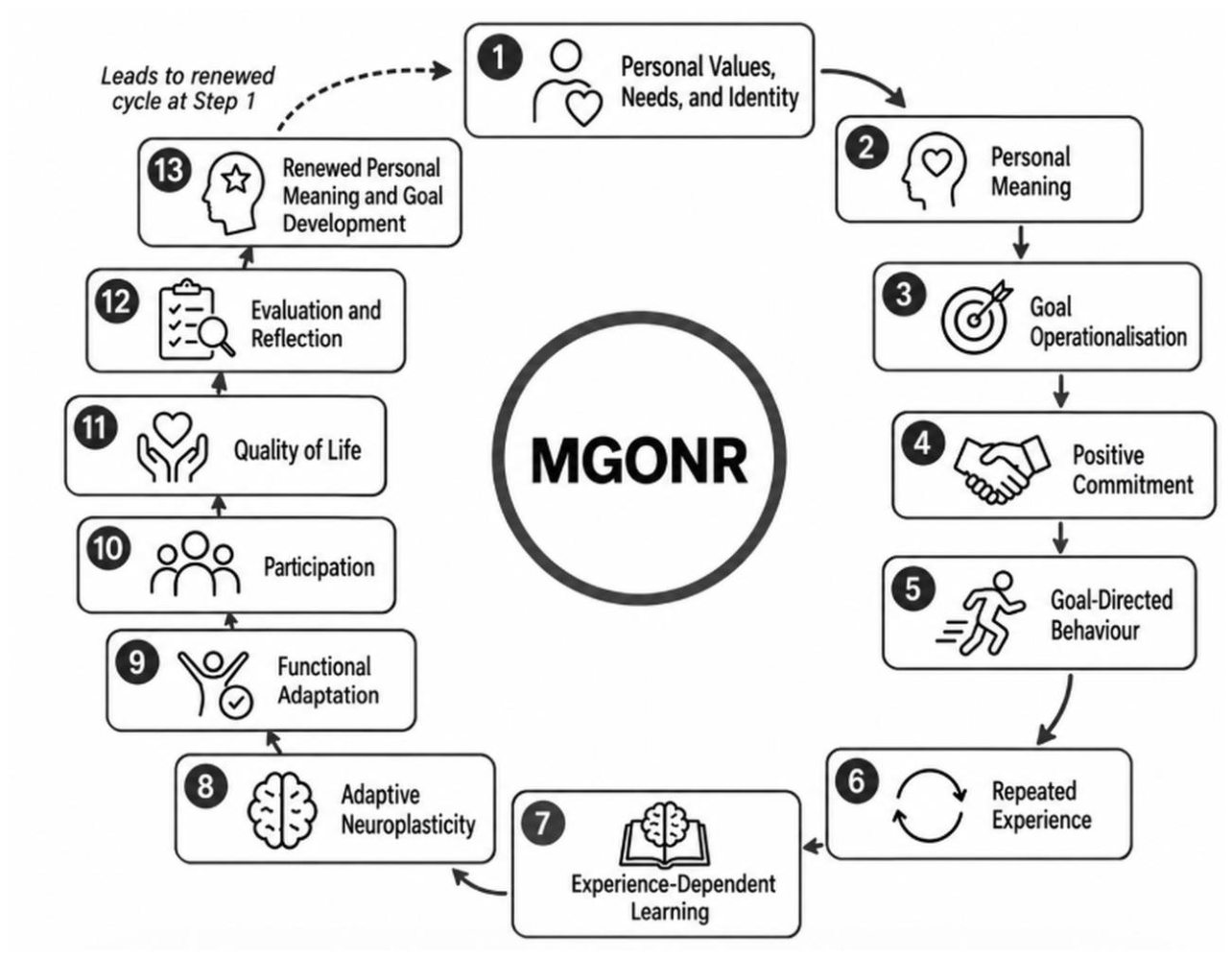
Figure 2.
The three-level architecture of the Model of Goal-Oriented Neuroplastic Rehabilitation (MGONR): the core goal cycle and its parallel psychological–behavioural and neurobiological levels. Neurobiological processes are shown as theoretically proposed correlates and were not measured in the present study.
Figure 2.
The three-level architecture of the Model of Goal-Oriented Neuroplastic Rehabilitation (MGONR): the core goal cycle and its parallel psychological–behavioural and neurobiological levels. Neurobiological processes are shown as theoretically proposed correlates and were not measured in the present study.
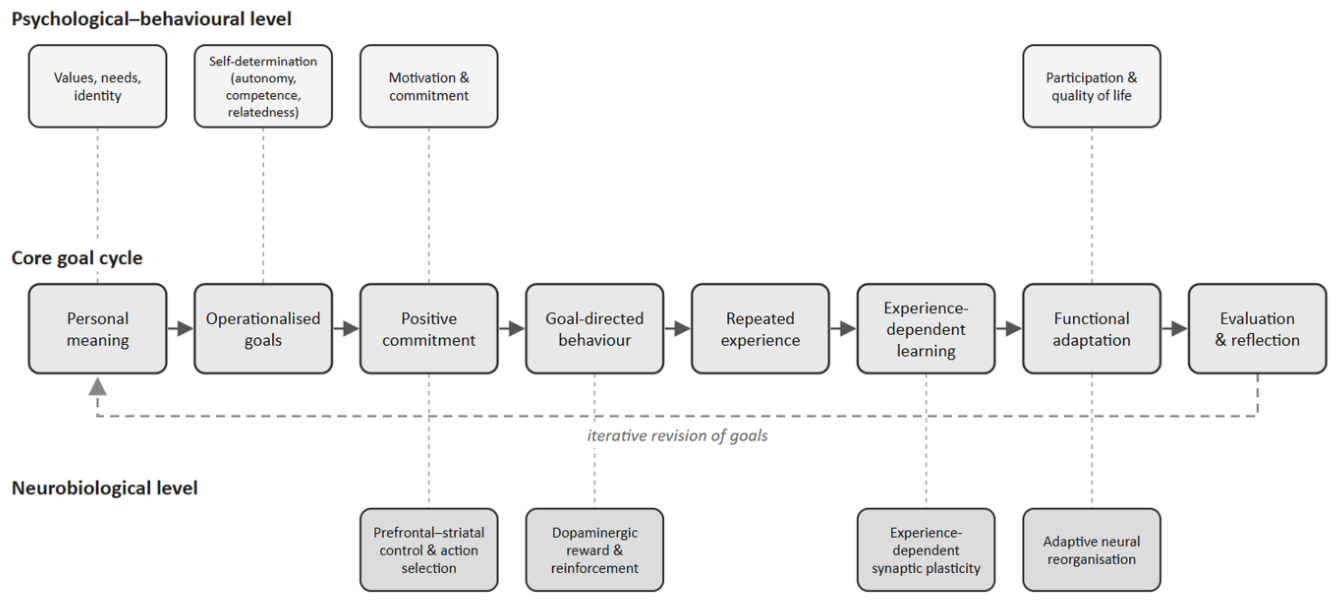
Figure 3.
Distribution of general life goals and specific rehabilitation goals across the ten life domains.
Figure 3.
Distribution of general life goals and specific rehabilitation goals across the ten life domains.
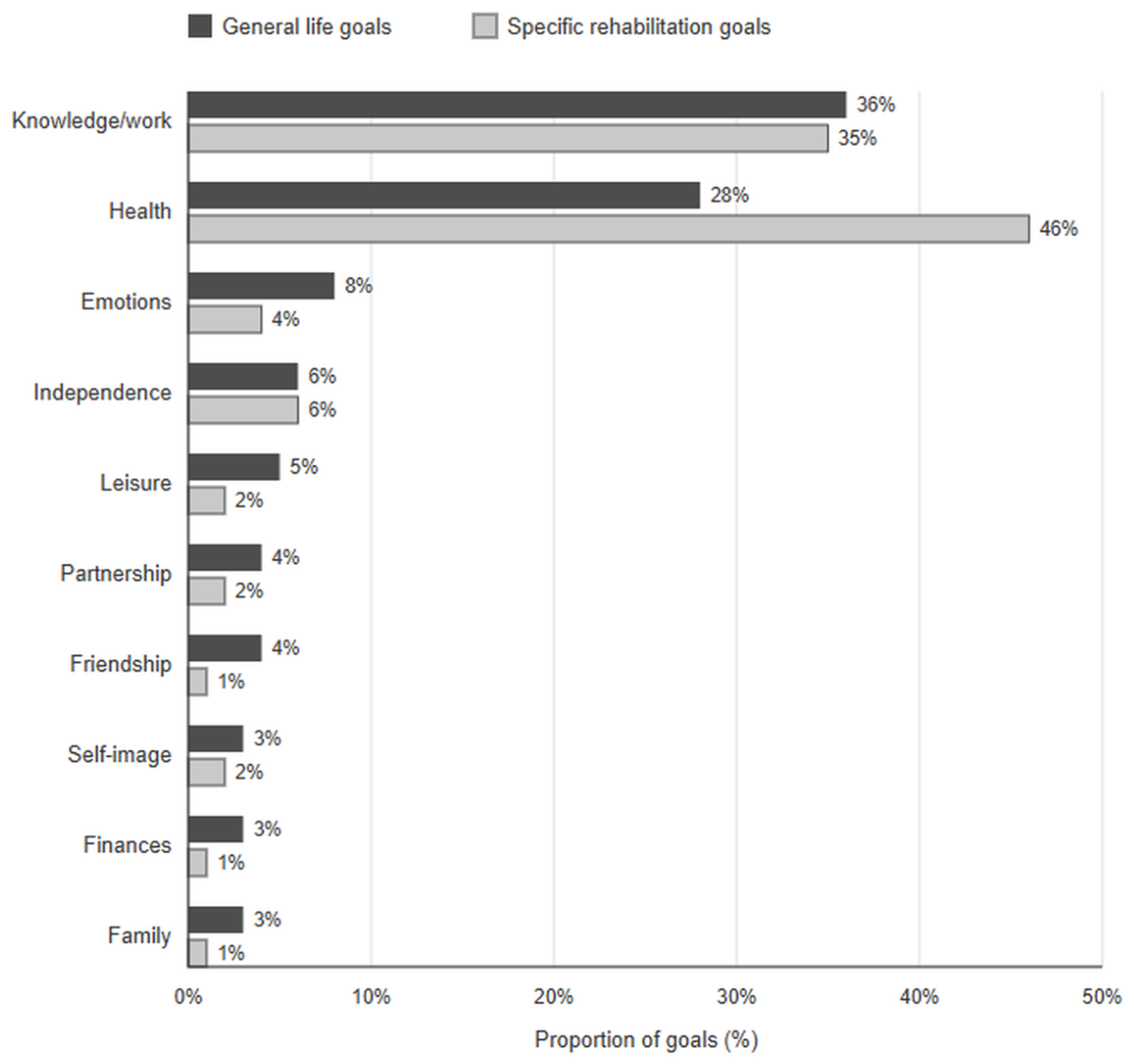
Figure 4.
Five-year trend in mean self-evaluated achievement of general life goals and specific rehabilitation goals (2019–2023), rated on a 1–10 scale.
Figure 4.
Five-year trend in mean self-evaluated achievement of general life goals and specific rehabilitation goals (2019–2023), rated on a 1–10 scale.
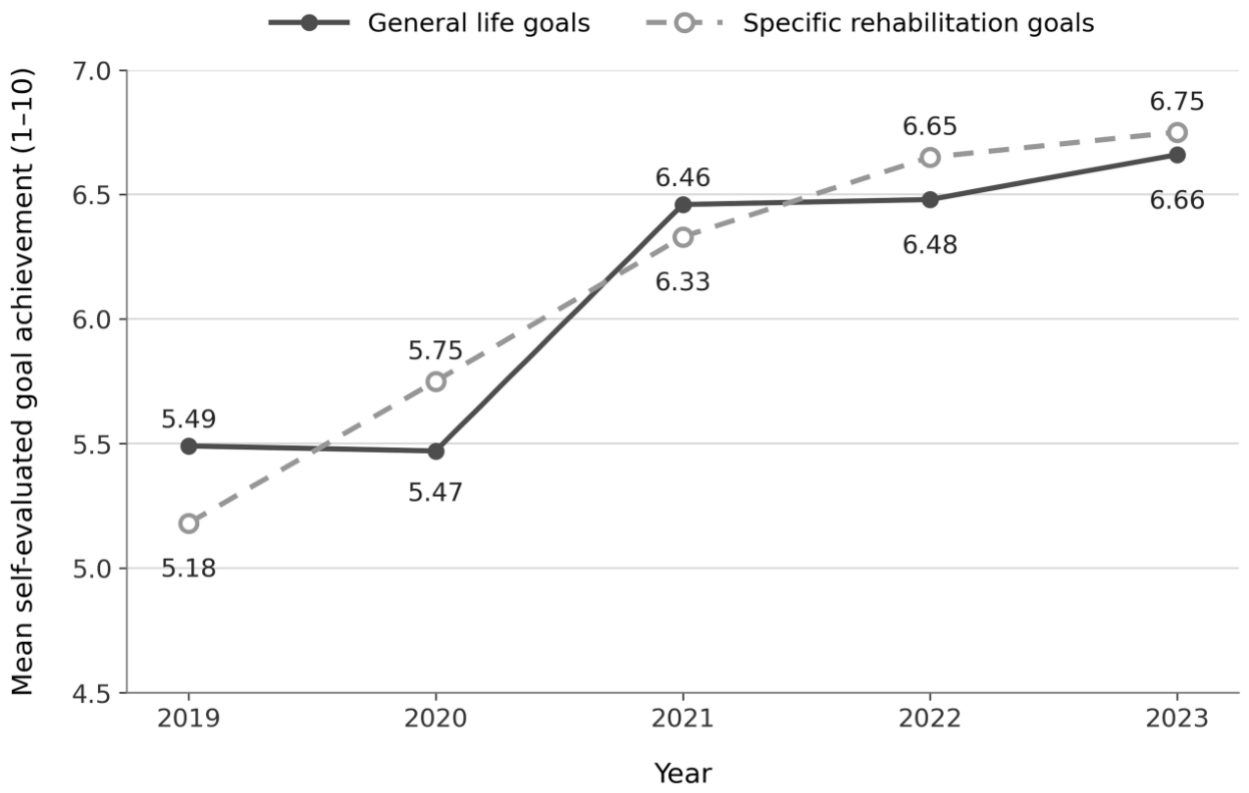
Figure 5.
Paired reconstructed QOLIBRI Total and QOLIBRI-OS scores in 2022 and 2025.
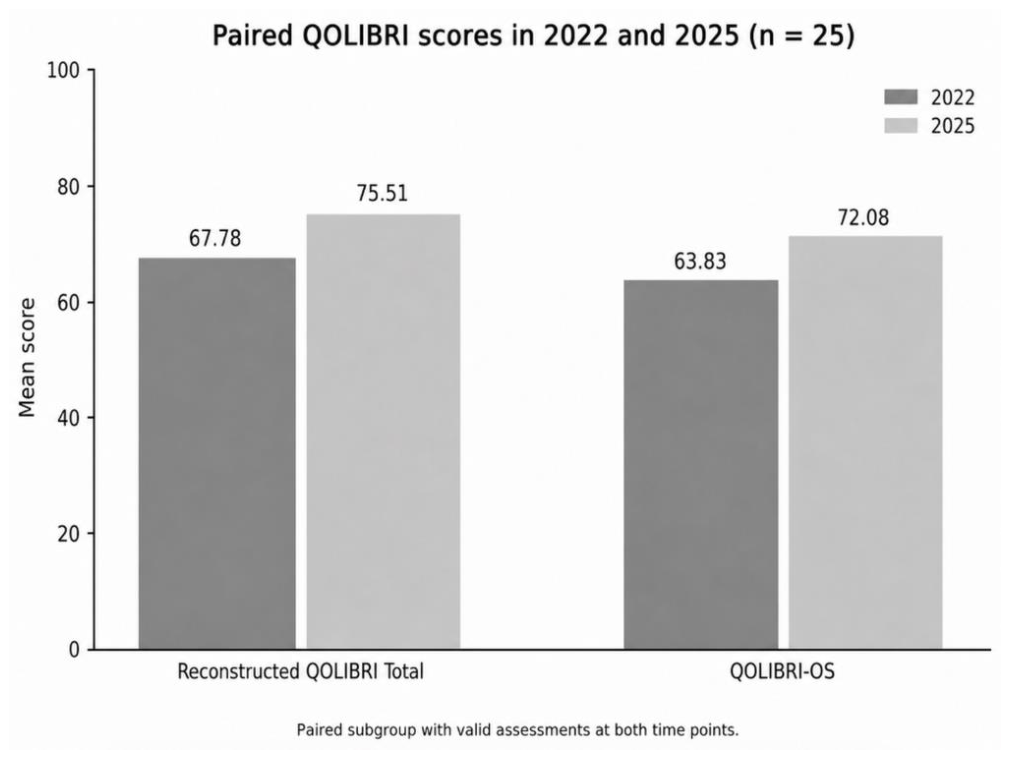

Table 1.
Annual reconstructed QOLIBRI Total and QOLIBRI-OS scores, 2022–2025.
| Year | Participant-year observations, n | QOLIBRI Total, mean ± SD | QOLIBRI-OS, mean ± SD |
| 2022 | 42 | 66.81 ± 16.03 | 64.48 ± 18.55 |
| 2023 | 30 | 65.24 ± 16.50 | 62.67 ± 19.16 |
| 2024 | 44 | 71.02 ± 14.72 | 70.55 ± 18.23 |
| 2025 | 42 | 71.88 ± 11.68 | 69.71 ± 15.60 |
Disclaimer/Publisher’s Note: The statements, opinions and data contained in all publications are solely those of the individual author(s) and contributor(s) and not of MDPI and/or the editor(s). MDPI and/or the editor(s) disclaim responsibility for any injury to people or property resulting from any ideas, methods, instructions or products referred to in the content. |
© 2026 by the authors. Licensee MDPI, Basel, Switzerland. This article is an open access article distributed under the terms and conditions of the Creative Commons Attribution (CC BY) license (http://creativecommons.org/licenses/by/4.0/).
Copyright: This open access article is published under a Creative Commons CC BY 4.0 license, which permit the free download, distribution, and reuse, provided that the author and preprint are cited in any reuse.