
Submitted:
27 September 2026
Posted:
29 September 2026
You are already at the latest version
Abstract
Kidney complications are common after hematopoietic stem cell transplantation (HSCT) and contribute substantially to short- and long-term morbidity and mortality. Acute kidney injury (AKI) affects a large proportion of recipients, particularly after allogeneic transplantation, and reflects the combined effects of baseline patient vulnerability, conditioning intensity, calcineurin inhibitor exposure, infection, hemodynamic disturbances, and transplant-specific complications. This review summarizes the epidemiology, risk factors, and major causes of kidney injury after HSCT, with emphasis on a time-based diagnostic approach. Important etiologies include sepsis, marrow infusion syndrome, sinusoidal obstruction syndrome, graft-versus-host disease–associated kidney injury, transplant-associated thrombotic microangiopathy, and glomerular disease. We also discuss emerging therapeutic approaches, including complement-directed therapy for transplant-associated thrombotic microangiopathy and defibrotide for sinusoidal obstruction syndrome. Beyond the acute transplant period, AKI is increasingly recognized as a major determinant of subsequent chronic kidney disease, cardiovascular risk, and impaired long-term survival. Structured surveillance of kidney function, blood pressure, and proteinuria, together with early recognition of transplant-specific syndromes and closer nephrology follow-up in high-risk patients, is therefore essential. Multidisciplinary collaboration between transplant hematology and nephrology is central to improving kidney and overall outcomes across the HSCT continuum.
Keywords:
hematopoietic stem cell transplantation
; acute kidney injury
; renal injury after transplantation
; transplant-associated thrombotic microangiopathy
; sinusoidal obstruction syndrome
; chronic kidney disease
1. Introduction
Worldwide, more than 90,000 hematopoietic stem cell transplantation (HSCT) procedures are performed annually, and approximately 1.5 million transplants were completed between 1957 and 2019. Although the use of allogeneic HSCT has increased more rapidly recently, autologous transplantation remains the predominant procedure. The most common indications for allogeneic HSCT are lymphoproliferative disease and leukemia, whereas multiple myeloma is the predominant indication for autologous HSCT[1,2].
Advances in transplantation strategies and supportive care have substantially improved overall outcomes after HSCT. In contrast, the burden of kidney disease has changed little over the past two decades. Acute kidney injury (AKI) and chronic kidney disease remain among the most common non-relapse complications after transplantation and are associated with significantly increased short- and long-term mortality, particularly in patients with severe AKI[3,4]. Renal dysfunction after HSCT may be multifactorial, reflecting the potential effects of nephrotoxic medications, infectious complications, engraftment syndrome, hepatic sinusoidal obstruction syndrome, thrombotic microangiopathy and graft-versus-host disease (GVHD). The risk of AKI is further influenced by both patient- and transplant-related factors, including underlying disease, age, comorbidity burden, performance status, transplant type, conditioning intensity, stem cell source, degree of HLA mismatch, and the immunosuppressive regimens used for GVHD prophylaxis[5,6].
The clinical importance of AKI following HSCT is underscored by its high incidence and profound impact on survival. In a meta-analysis of 36 cohort studies published between 1995 and 2019, encompassing 5,144 patients, Kanduri et al reported a pooled AKI incidence of 55.1% (95% confidence interval (CI) 46.6–63.3%) within the first 100 days after transplantation, with stage 3 AKI occurring in 8.3% of patients. AKI was associated with markedly increased mortality, with pooled odds ratios of 3.05 (95% CI 2.07–4.49) for 3-month mortality and 2.23 (95% CI 1.06–4.73) for 3-year mortality[3]. More recent studies have reported comparable AKI incidences ranging from approximately 33% to 64%, with most episodes occurring early after transplantation (median onset day 12-13) and cumulative incidences generally assessed within the first 100 days[7]–[10]. Irrespective of transplant type, patients requiring kidney replacement therapy experience particularly poor outcomes, with reported mortality rates exceeding 80%[11,12].
In pediatric HSCT recipients, AKI is generally less common, with reported incidences ranging from 21% to 28%, likely reflecting greater renal functional reserve. Nevertheless, severe AKI requiring kidney replacement therapy remains associated with poor outcomes, with mortality rates of 52-65% and one-year survival of only 27.4%[13].
Reported AKI incidence varies considerably across studies, in part because of differences in diagnostic criteria. The subsequent development of the RIFLE, AKIN, and ultimately the KDIGO criteria has provided a standardized framework for AKI diagnosis and severity classification, with KDIGO now representing the preferred definition in contemporary HSCT studies[3]. Because the KDIGO definition incorporates a lower creatinine threshold than earlier classification systems, differences in diagnostic criteria likely contribute to the heterogeneity in reported AKI incidence, together with variations in patient populations, transplant characteristics, and study design[14].
2. Epidemiology and Risk Factors for AKI after HSCT
2.1. Incidence According to Transplant Type
Transplant type is one of the strongest determinants of AKI risk after HSCT. The lower incidence observed after autologous transplantation is largely attributable to the absence of GVHD as well as the lack of exposure to calcineurin inhibitors (CNIs) and methotrexate used for GVHD prophylaxis[11]. Earlier studies demonstrated a substantially higher incidence of AKI following allogeneic transplantation than after autologous transplantation. In a landmark study by Ando et al., AKI occurred in 48% and 66% of patients receiving non-myeloablative (NMA) and myeloablative conditioning (MAC), respectively, compared with only 19% of autologous transplant recipients. This disparity was mirrored by mortality, which ranged from 50% to 54% after allogeneic transplantation compared with approximately 20% following autologous transplantation[15].
Similar differences have been reported in more recent cohorts. Munch et al. observed a 100-day AKI incidence of 20.7% among patients with multiple myeloma undergoing autologous HSCT and 35.2% among patients with Hodgkin lymphoma, whereas patients with leukemia receiving allogeneic transplantation experienced an AKI incidence of 81.8%[16]. These findings emphasize that transplant modality and the underlying disease are major determinants of post-transplant renal risk (see Table 1).
2.2. Conditioning Intensity and Regimen-Related Risks
Conditioning chemotherapy administered before donor stem cell infusion represents another major determinant of AKI risk. Conditioning regimens are broadly classified as myeloablative (MAC), reduced-intensity conditioning (RIC), or non-myeloablative (NMA). In addition to inducing sufficient immunosuppression to permit donor stem cell engraftment, MAC regimens eradicate malignant cells and may augment antitumor immunity by promoting T-cell responses[5]. By contrast, RIC and NMA regimens rely more heavily on graft-versus-tumor effects and are therefore preferentially used in older patients or those with substantial comorbidity who may not tolerate intensive conditioning. Regardless of conditioning intensity, allogeneic HSCT recipients require post-transplant immunosuppression to prevent GVHD, whereas autologous recipients do not[11].
Conditioning intensity therefore represents a balance between treatment efficacy and toxicity. Most studies have demonstrated that MAC is associated with a higher incidence of severe AKI and an approximately fourfold greater requirement for kidney replacement therapy than RIC and NMA regimens, despite the latter groups generally including older patients with greater baseline comorbidity[7,17]. However, this relationship is not entirely consistent across studies. Abramson et al. reported a higher incidence of AKI among patients receiving RIC than MAC. This finding was attributed, at least in part, to differences in transplant protocols, including the use of T-cell depleted grafts and CNI-free GVHD prophylaxis in the MAC cohort, as well as confounding by indication, i.e. selection of patients with greater comorbidity for RIC and NMA approaches[9].
Supporting this concept, Adhikari et al. analyzed 13,187 transplant recipients and demonstrated that conditioning intensity influences the balance between relapse and major organ failure. Although MAC is associated with greater treatment-related organ toxicity, the incidence of dialysis-requiring renal failure may be lower in selected populations because of differences in patient selection, GVHD prophylaxis, and post-transplant complications. Conversely, RIC and NMA regimens were associated with higher risks of relapse and treatment failure[18].
The conditioning regimen itself may also influence renal outcomes. Among patients undergoing RIC allogeneic HSCT, fludarabine-melphalan conditioning was associated with a significantly higher incidence of AKI than fludarabine-busulfan and fludarabine-cyclophosphamide plus total body irradiation (TBI) (HR: 1.35, 95% CI: 1.01–1.81; p=0.05)[7]. For patients with eGFR 15-60 ml/min and <15 ml/min including dialysis a dose reduction of orally administered melphalan by 25% and 50%, respectively is recommended [19]. The role of TBI remains controversial; however, several studies have reported an increased risk of severe AKI, with hazard ratios approaching 1.8.
2.3. Calcineurin Inhibitor Exposure and Modifiable Treatment Factors
Beyond conditioning-related toxicity, exposure to CNIs is one of the most consistently identified modifiable risk factors for AKI after allogeneic HSCT. Several studies have demonstrated that supratherapeutic CNI concentrations are independently associated with increased risk of AKI, highlighting the importance of careful drug monitoring and dose adjustment[7]–[9]. In addition, the combination of methotrexate with a CNI as GVHD prophylaxis has been associated with a 2.1-fold higher incidence of severe AKI[20].
2.4. Baseline Patient Characteristics and Risk Prediction
Patient-related factors substantially influence susceptibility to AKI after HSCT and contribute to both early renal complication and subsequent CKD[21]. Baseline renal function is an independent predictor of overall survival, non-renal mortality, and the subsequent need for kidney replacement therapy following allogeneic HSCT[7,20,22,23]. Increasing age is another well-established risk factor. In one cohort of 422 allogeneic transplant recipients, age >55 years was associated with a 2.4-fold higher risk of severe AKI[20]. Similarly, Yanigisawa et al reported that age ≥60 years independently predicted fatal renal complications (HR 1.465; 95% CI: 1.241–1.730; p < 0.001)[21].
The influence of sex has been less consistent. Most studies identify male sex as risk factor for renal complications[21,23], whereas Sun et al. identified elderly female sex as an independent risk factor of severe AKI among patients with acute leukemia[24]. Higher baseline serum albumin concentrations (>3.4-3.5 g/dl), likely reflecting better nutritional status, lower inflammation, and preserved oncotic pressure, have consistently been associated with lower risk of AKI after HSCT[7]–[9].
Pretransplant comorbidity is an important determinant of post-transplant outcomes and is routinely incorporated into risk prediction models. The Hematopoietic Cell Transplantation-Comorbidity index (HCT-CI) was specifically developed to improve risk stratification in transplant recipients and demonstrates greater sensitivity than the Charlson Comorbidity Index (CCI), identifying comorbidity in 62% versus 12% of patients while providing superior discrimination for survival outcomes. Within the HCT-CI, renal dysfunction is classified as mild (SCr of 1.2-2 mg/dl) or severe (Scr >2 mg/dl, dialysis or kidney transplant recipient (KTR), with severe renal impairment contributing two of the maximum twelve points[6].
A HCT-CI score of ≥4 was independently associated with an increased risk of AKI after HSCT (HR, 1.43; 95% CI, 1.14 to 1.79; P = .002)[7]. Although the HCT-CI was originally developed to predict overall and non-relapse mortality rather than kidney-specific complications, several studies support its value for identifying patients at increased renal risks[25]. In a nationwide Japanese cohort of 36,596 HSCT recipients, including approximately 16% pediatric patients, Yanigasawa et al. reported a five-year cumulative incidence of fatal renal complications of approximately 2.2%, with most events occurring relatively early after transplantation. Moderate or severe renal comorbidity according to the HCT-CI, together with increasing age and advanced disease status, independently predicted fatal renal complications[21].
Several HSCT-specific prediction models for early AKI have subsequently been developed. Rodrigues et al. proposed an adult risk score incorporating four readily available variables: HCT-CI, pre-existing CKD, underlying disease (lymphoma or leukemia versus multiple myeloma) and the platelet-to-lymphocyte ratio as a marker of systemic inflammation[4]. Gan et al. developed a nomogram including donor source, HLA compatibility, ABO matching, tacrolimus exposure, acute GVHD, infection, and triazole antifungal therapy, achieving a concordance index of 0.842 (0.809 after internal validation)[26]. Although these models are promising, most remain limited by retrospective single-center study designs and lack of external validation before widespread clinical implementation. In pediatric HSCT recipients, Chen et al. developed a dynamic online nomogram using data from two centers that incorporated medical exposure, HLA compatibility, hepatic veno-occlusive disease, GVHD, cytomegalovirus activation, TMA, C-reactive protein and ferritin. The model demonstrated excellent discrimination, with concordance-indexes of 0.96 and 0.91 in the training and validations cohorts, respectively[27].
3. Etiologies of AKI after HSCT
The causes of AKI following HSCT are diverse and vary throughout the transplant course. As the patients clinical condition and transplant-related complications evolve over time, the differential diagnosis changes accordingly. Therefore, a time-based approach provides a practical framework for understanding the major etiologies of AKI after HSCT. Figure 1 summarizes the main causes of renal dysfunction following stem cell transplantation along with the timelines.
3.1. Sepsis
Stem cell transplant recipients are immunocompromised and may develop infections that lead to sepsis complicated by AKI [28,29]. Sepsis-induced AKI is driven by systemic vasodilation with reduced renal perfusion, inflammatory cytokine-mediated tubular injury, and endothelial dysfunction leading to intrarenal microvascular thrombosis.[30] Furthermore, antimicrobial medication used in the management of sepsis can be nephrotoxic, like aminoglycosides and vancomycin and warrant consideration of therapeutic level monitoring [31].
3.2. Marrow Infusion Syndrome
The stem cell preservation process requires exposure to cryoprotective agents, which can induce red blood cell (RBC) lysis. During stem cell infusion, the release of lysed RBCs may lead to marrow infusion syndrome, an early complication that typically occurs within 24–48 hours after transplantation. Clinical manifestations include fever, nausea and vomiting, and hemoglobin pigment nephropathy.[11] AKI develops through multiple mechanisms, including renal vasoconstriction, direct tubular cytotoxicity from free hemoglobin, and intratubular hemoglobin cast formation [11].
3.3. Hepatic Sinusoidal Obstruction Syndrome
Hepatic sinusoidal obstruction syndrome (formerly known as veno-occlusive disease) after stem cell transplantation is an important cause of AKI, typically developing within the first 30 days after HSCT, particularly following allogeneic transplantation. It results from toxic injury to hepatic sinusoidal endothelial cells caused by conditioning chemotherapy and/or radiation, leading to endothelial activation, loss of barrier integrity, and detachment. Sloughed endothelial cells, inflammatory cell infiltration, and local thrombosis obstruct the hepatic sinusoids and terminal venules, resulting in sinusoidal congestion, portal hypertension, and centrilobular hepatic necrosis.
Risk factors for SOS can be broadly categorized into patient-related factors, including extremes of age, advanced-stage malignancy, and the underlying disease, as well as baseline hepatic dysfunction, reflected by elevated transaminases, ferritin, or bilirubin levels.[32] Cytoreductive regimens including high dose of total body irradiation, busulfan and cyclophosphamide are presumed triggers[33].
SOS/VOD appears to be a variant of hepatorenal syndrome typically manifesting within 21 days of transplant, but late onset can occur[11]. It is characterized by edema, jaundice, hepatomegaly, and diuretic resistant ascites. Spontaneous recovery is rare, with mortality rates approaching 80%, especially in severe SOS with multiorgan failure [34].
Updated diagnostic criteria by the European Society for Blood and Marrow Transplantation in 2023, aiming for early detection and severity grading (Table 2)[33,35].
The mainstay of SOS/VOD treatment has been symptom management and supportive care although these measures are still important, the emergence of defibrotide as an approved therapy for SOS in the United States has had a positive impact on patient survival. Defibrotide is an endothelial-protective agent with anti-inflammatory, antithrombotic, and profibrinolytic properties[36]. It is administered at 25 mg/kg/day in four divided doses, does not require dose adjustment in patients with renal impairment or those receiving dialysis, and early initiation after diagnosis has been associated with improved day-100 survival[37]. Although earlier pediatric and retrospective studies suggested a potential role for prophylaxis in high-risk patients, the phase III HARMONY trial did not demonstrate improvement in SOS/VOD free survival at day 30 after HSCT with defibrotide prophylaxis compared with best supportive care (67% vs 73%, respectively)[38].
3.4. GVHD-Associated Kidney Disease
Allogeneic hematopoietic cell or bone marrow transplantation (BMT) may cause graft-versus-host-disease (GVHD). However, involvement of the kidney in GVHD is not well-understood and there are no established histopathologic criteria for renal GVHD (r-GVHD). Experimental and clinical studies support the kidney as a target of GVHD. Immune-mediated endothelial injury, T-cell infiltration, tubulitis, peritubular capillaritis, glomerulitis, and proinflammatory cytokine activation have been suggested to contribute to renal damage[39]. Overall, renal GVHD is considered rare compared with GVHD involving other organs, with reported estimates of approximately 1% among allogeneic HSCT recipients[40]. Various patterns of glomerular injury have been described as potential forms of renal GVHD, including thrombotic microangiopathy, membranous nephropathy, minimal change disease, focal segmental glomerulosclerosis and various other forms of glomerulonephritis [41]. In a large retrospective cohort from Hong Kong, Yap et al. involving 2204 patients who underwent HSCT (1999–2021), 31 patients (1.4%) developed de novo glomerular diseases after a mean duration of 2.8 ± 2.7 years after HSCT. Approximately 48.4% experienced (non-renal) pre-existing or concomitant graft-versus-host-disease at renal presentation[42].
3.5. Transplant-Associated Thrombotic Microangiopathy
Transplant associated TMA is a serious complication of hematopoietic stem cell transplant. It is associated with substantial morbidity and mortality. Endothelial injury is the central pathogenic event, triggering complement activation, microvascular thrombosis, microangiopathic hemolytic anemia, thrombocytopenia, and progressive multiorgan dysfunction, with the kidneys, lungs, gastrointestinal tract, and central nervous system being particularly affected. Renal involvement is often an early manifestation and may present with new or worsening hypertension, proteinuria, and acute kidney injury, frequently preceding the development of overt hematologic abnormalities[43]. Therefore, a high index of suspicion is essential, and TA-TMA should be considered even before the complete laboratory features become apparent.
Incidence is variable and ranges between 0.5% to 64%. This is partly because of the difficulty in detection of the condition and variations between centers in diagnostic criteria applied[44]. It is more frequent after allogeneic transplantion but can be also developed following autologous transplantion. Risk factors include unrelated or HLA mismatched donors, older recipient age, female sex, CNI exposure, myeloablative conditioning, viral infections, and graft-versus-host disease, all of which contribute to endothelial injury and complement activation[45,46]. The various published diagnostic criteria are outlined in Table 3.
Management of TA-TMA includes both supportive and targeted therapy. Supportive management includes blood pressure control, correction of volume and electrolyte abnormalities, avoidance of additional nephrotoxic exposure and early identification and treatment of viral infections. Modification or discontinuation of CNIs should be individualized, as reducing immunosuppression may increase the risk of GVHD. Plasma exchange was historically used in the management of TA-TMA, however clinical responses have been inconsistent, and accumulating evidence suggests that the risks and procedural burden may outweigh the potential benefits[44]. With the introduction of targeted complement inhibition, outcomes in high-risk TA-TMA have improved markedly. In a prospective multicenter study, eculizumab was associated with survival rates of 71% at 6 months and 62% at 1 year after HSCT, compared with 18% and 16.7%, respectively, in historical controls who did not receive complement-directed therapy[47]. These findings have subsequently been supported by adult and pediatric studies reporting favorable response rates and improved overall survival[48,49,50] . More recently, narsoplimab, a monoclonal antibody targeting mannan-binding lectin-associated serine protease-2 (MASP-2), became the first FDA-approved therapy specifically for TA-TMA. It is approved for use in adults and pediatric patients aged ≥2 years. In the pivotal single-arm study, a TA-TMA response was achieved in 61% of patients, with additional expanded-access data demonstrating responses in 67% of pediatric patients and 69% of adults[51,52].
Historically, a late-onset renal syndrome termed chronic BMT nephropathy was described after HSCT [53]–[56]. This entity typically manifests 6–12 months after transplantation and is characterized by hypertension, anemia disproportionate to the degree of renal impairment, and azotemia, often accompanied by proteinuria and microangiopathic changes on kidney biopsy resembling radiation nephritis[54,55,57]. Total body irradiation (TBI) is the dominant risk factor. Reduction and hyperfractionation of the total dose, partial renal shielding and careful use of other nephrotoxic agents have been associated with a lower incidence in several cohorts[58,59].
3.6. Glomerular Disease After HSCT
Glomerular disease is an uncommon but clinically important complication following hematopoietic stem cell transplantation (HSCT). In the retrospective cohort of 2,204 HSCT recipients from Yap et al. the histopathologic spectrum included thrombotic microangiopathy (38.7%), membranous nephropathy (25.8%), mesangial proliferative glomerulonephritis (12.9%), minimal change disease (9.7%), focal segmental glomerulosclerosis (9.7%), and membranoproliferative glomerulonephritis (3.2%)[42]. Among patients who developed nephrotic syndrome after allogeneic hematopoietic stem cell transplantation, membranous nephropathy is the most common histopathological lesion, accounting for approximately two-thirds of reported cases[60]. It typically presents late after transplantion, with a median onset of 20 months. It is frequently associated with chronic GVHD or tapering of immunosuppression. The optimal treatment strategy for this rare manifestation remains undefined;[61] however, successful use of rituximab and calcineurin inhibitors has been reported in case reports and series[62]. More recently, protocadherin FAT1 has emerged as a potential target antigen in membranous nephropathy after HSCT[63]. The reported response to rituximab in FAT1-positive cases suggests that identifying the underlying antigen may help guide treatment and further supports an immune-mediated mechanism[64].
4. Long-Term Kidney Outcomes After HSCT
With advancements in conditioning regimens, supportive care, and management of GVHD, long-term survivorship after HSCT has improved significantly. The long-term consequences of AKI have emerged as a major determinant of late morbidity, cardiovascular risk, and mortality. Renal outcomes are no longer a temporary concern confined to the acute post-transplant hospitalization but a core component of survivorship care, warranting dedicated, longitudinal attention from the onco-nephrologist working alongside transplant hematologists.
4.1. Transition to Chronic Kidney Disease
Acute kidney injury (AKI) following stem cell transplantation is not a self-limited event confined to the peri-transplant period. It is increasingly recognized as the inflection point from which a substantial proportion of HSCT recipients start developing progressive nephron loss. The pathophysiological link between AKI and CKD in HSCT recipients mirrors, and in some respects exceeds, that seen in the general critically ill population. Incomplete tubular repair, peritubular capillary rarefaction, maladaptive fibrosis, pericyte-to-myofibroblast transition, and persistent low-grade inflammation following an AKI episode create a substrate for irreversible nephron loss even when serum creatinine appears to normalize[65]–[67]. Post-HSCT AKI is common, with incidence estimates ranging widely—from under 10% to over 70%—depending on the AKI definition applied (KDIGO, RIFLE, or pRIFLE), transplant type, and conditioning intensity, and is independently associated with subsequent CKD, prolonged hospitalization, and reduced long-term survival [10,65,68,69]. Myeloablative conditioning, TBI-containing regimens, unrelated or mismatched donor grafts, severe acute GVHD, and repeated nephrotoxic drug exposures (calcineurin inhibitors, aminoglycosides, amphotericin, intravenous contrast, foscarnet) are consistently identified as amplifiers of both AKI severity and its likelihood of failing to resolve[65,68,70].
In pediatric cohorts, AKI within the first 100 days is a consistent predictor of CKD detected on later surveillance, particularly when cystatin C–based estimating equations are used[71,72]. Long-term renal prognosis after AKI is determined more by the extent and timing of renal recovery during the first 90 days than by peak AKI severity alone. Patients with persistent impairment of kidney function at 90 days have a substantially higher risk of CKD progression, supporting serial monitoring of renal recovery rather than reliance on peak serum creatinine values alone[73,74]. The cumulative incidence of CKD varies from 7% to 48%, and it may develop between 6 months and 10 years post-HSCT, with ∼4% of cases progressing to end-stage renal disease [6]. Its pathogenesis is multifactorial and includes antecedent AKI, transplant-associated thrombotic microangiopathy, calcineurin-inhibitor nephrotoxicity, chronic GVHD-associated glomerular disease including membranous nephropathy and minimal change disease and radiation-related renal injury. Importantly, AKI itself is an established risk factor for subsequent CKD, suggesting that early renal insults are the most important contributor to the later development of persistent kidney dysfunction[6]. The presence of subsequent CKD may limit therapeutic options for both chronic GVHD management and subsequent disease relapse, and as such, has been associated with worse GVHD-free/relapse-free survival [75].
4.2. Surveillance and Long-Term Nephrology Follow-Up
Given the latency and insidious onset of post-HSCT renal disease, regular and structured long-term surveillance is the most essential strategy. This should ideally begin before conditioning with a baseline assessment of renal function, blood pressure, and urinalysis to serve as a reference point for subsequent monitoring. Consensus survivorship guidelines recommend serial monitoring of serum creatinine, estimated GFR, blood pressure, and urine protein/albumin at defined intervals—typically day 100, 6 months, and 12 months post-transplant, and then at least annually thereafter for the lifetime of the survivor[76]. Closer surveillance is recommended in patients with a prior AKI episode, chronic GVHD, ongoing calcineurin inhibitor exposure, TBI-based conditioning, or diabetes and hypertension as comorbid risk amplifiers.
Surveillance in the first 100 days should specifically screen for TA-TMA using a combination of lactate dehydrogenase, haptoglobin, peripheral smear for schistocytes, blood pressure trends, and proteinuria, applying harmonized diagnostic criteria, since early recognition materially alters outcomes with complement-directed therapies such as eculizumab or narsoplimab[77]–[80]. Long-term follow-up should also proactively address the downstream metabolic consequences of CKD—hypertension, anemia, mineral and bone disease, and metabolic acidosis—and should trigger formal nephrology referral for a sustained eGFR decline (particularly a decline exceeding 25% from baseline), refractory hypertension, or persistent significant proteinuria. Patients who progress to end-stage kidney disease face markedly elevated mortality, exceeding 80% at three years among those requiring chronic dialysis.
Underscoring the importance of early nephroprotective strategies, individualized, risk-adapted conditioning and immunosuppressive regimens in patients identified as high risk, and consideration of kidney transplantation in appropriate long-term HSCT survivors, an approach that has yielded favorable outcomes in adult recipients though pediatric experience remains more limited.
5. Conclusion
Acute kidney injury and chronic kidney disease are frequent complications after HSCT, arise from multiple and often overlapping etiologies, and are associated with adverse short- and long-term outcomes. Early recognition of kidney injury and transplant-specific complications, together with appropriate long-term surveillance, is essential to reduce progressive kidney dysfunction. Multidisciplinary collaboration between BMT physicians and nephrologists is critical to improving kidney and overall outcomes in this patient population.
References
- Niederwieser, D.; Baldomero, H.; Bazuaye, N.; Bupp, C.; Chaudhri, N.; Corbacioglu, S.; et al. One and a half million hematopoietic stem cell transplants: continuous and differential improvement in worldwide access with the use of non-identical family donors. Haematologica 2022, 107, 1045–1053. [Google Scholar] [CrossRef] [PubMed]
- Snowden, J.A.; Sánchez-Ortega, I.; Corbacioglu, S.; Basak, G.W.; Chabannon, C.; de la Camara, R.; et al. Indications for haematopoietic cell transplantation for haematological diseases, solid tumours and immune disorders: current practice in Europe, 2022. Bone Marrow Transplant. 2022, 57, 1217–1239. [Google Scholar] [CrossRef] [PubMed]
- Kanduri, S.R.; Cheungpasitporn, W.; Thongprayoon, C.; Bathini, T.; Kovvuru, K.; Garla, V.; et al. Incidence and mortality of acute kidney injury in patients undergoing hematopoietic stem cell transplantation: a systematic review and meta-analysis. QJM Mon. J. Assoc. Physicians 2020, 113, 621–632. [Google Scholar] [CrossRef] [PubMed]
- Rodrigues, N.; Fragão-Marques, M.; Costa, C.; Branco, C.; Marques, F.; Vasconcelos, P.; et al. Predictive Risk Score for Acute Kidney Injury in Hematopoietic Stem Cell Transplant. Cancers 2023, 15, 3720. [Google Scholar] [CrossRef] [PubMed]
- Copelan, E.A. Hematopoietic Stem-Cell Transplantation. N. Engl. J. Med. 2006, 354, 1813–1826. [Google Scholar] [CrossRef] [PubMed]
- Hingorani, S. Renal Complications of Hematopoietic-Cell Transplantation. Ingelfinger JR, ed. New England Journal of Medicine 2016, 374, 2256–2267. [Google Scholar]
- Vergara-Cadavid, J.; Johnson, P.C.; Kim, H.T.; Yi, A.; Sise, M.E.; Leaf, D.E.; et al. Clinical Features of Acute Kidney Injury in the Early Post-Transplantation Period Following Reduced-Intensity Conditioning Allogeneic Hematopoietic Stem Cell Transplantation. Transplant. Cell. Ther. 2023, 29, 455.e1–455.e9. [Google Scholar] [CrossRef] [PubMed]
- da Costa-Junior, L.C.; Tavares R de, CB da S; Izu, M.; Maradei, S.C.; Moreira, M.C.R.; Nogueira, M.C.; et al. Early Acute Kidney Injury in Allogeneic Hematopoietic Cell Transplantation: Incidence, Severity, and Associated Factors in a 634-Recipient Cohort. Eur. J. Haematol. 2026. [Google Scholar] [CrossRef] [PubMed]
- Abramson, M.H.; Gutgarts, V.; Zheng, J.; Maloy, M.A.; Ruiz, J.D.; Scordo, M.; et al. Acute Kidney Injury in the Modern Era of Allogeneic Hematopoietic Stem Cell Transplantation. Clin. J. Am. Soc. Nephrol. CJASN 2021, 16, 1318–1327. [Google Scholar] [CrossRef] [PubMed]
- Madsen, K.; Pelletier, K.; Côté, G.; Kitchlu, A.; Chen, S.; Mattsson, J.; et al. Acute kidney injury within 100 days post allogeneic hematopoietic cell transplantation is associated with increased risk of post-transplant complications and poor transplant outcomes. Bone Marrow Transplant. 2022, 57, 1411–1420. [Google Scholar] [CrossRef] [PubMed]
- Renaghan, A.D.; Jaimes, E.A.; Malyszko, J.; Perazella, M.A.; Sprangers, B.; Rosner, M.H. Acute Kidney Injury and CKD Associated with Hematopoietic Stem Cell Transplantation. Clin. J. Am. Soc. Nephrol. CJASN 2020, 15, 289–297. [Google Scholar] [CrossRef] [PubMed]
- Lopes, J.A.; Gonçalves, S.; Jorge, S.; Raimundo, M.; Resende, L.; Lourenço, F.; et al. Contemporary analysis of the influence of acute kidney injury after reduced intensity conditioning haematopoietic cell transplantation on long-term survival. Bone Marrow Transplant. 2008, 42, 619–626. [Google Scholar] [CrossRef] [PubMed]
- Di Nardo, M.; Ghafoor, S.; Szmit, Z.; Elbahlawan, L.; Rowan, C.M.; Agulnik, A.; et al. International expert consensus statement on PICU admission and early critical care management for paediatric patients following haematopoietic cell transplant and immune effector cell therapy. Lancet. Child Adolesc. Health 2025, 9, 426–438. [Google Scholar] [CrossRef] [PubMed]
- Yaqub, S.; Hashmi, S.; Kazmi, M.K.; Aziz Ali, A.; Dawood, T.; Sharif, H. A Comparison of AKIN, KDIGO, and RIFLE Definitions to Diagnose Acute Kidney Injury and Predict the Outcomes after Cardiac Surgery in a South Asian Cohort. Cardiorenal Med. 2022, 12, 29–38. [Google Scholar] [CrossRef] [PubMed]
- Ando, M.; Mori, J.; Ohashi, K.; Akiyama, H.; Morito, T.; Tsuchiya, K.; et al. A comparative assessment of the RIFLE, AKIN and conventional criteria for acute kidney injury after hematopoietic SCT. Bone Marrow Transplant. 2010, 45, 1427–1434. [Google Scholar] [CrossRef] [PubMed]
- Munch, P.V.; Nørgaard, M.; Jensen, S.K.; Birn, H.; Schmidt, H.; Christiansen, C.F. Risk of and Mortality After Acute Kidney Injury Following Cancer Treatment: A Cohort Study. Cancer Med. 2025, 14, e70646. [Google Scholar] [CrossRef] [PubMed]
- Parikh, C.R.; Schrier, R.W.; Storer, B.; Diaconescu, R.; Sorror, M.L.; Maris, M.B.; et al. Comparison of ARF after myeloablative and nonmyeloablative hematopoietic cell transplantation. Am. J. Kidney Dis. Off. J. Natl. Kidney Found. 2005, 45, 502–509. [Google Scholar] [CrossRef] [PubMed]
- Adhikari, A.; Mahadevia, H.; Bansal, V.; Saha, S.; Cossor, F. Competing risks of relapse and major organ failure after allogeneic hematopoietic cell transplantation. J. Clin. Oncol. 2026, 44. [Google Scholar] [CrossRef]
- Dimopoulos, M.A.; Merlini, G.; Bridoux, F.; Leung, N.; Mikhael, J.; Harrison, S.J.; et al. Management of multiple myeloma-related renal impairment: recommendations from the International Myeloma Working Group. Lancet. Oncol. 2023, 24, e293–e311. [Google Scholar] [CrossRef] [PubMed]
- Gutiérrez-García, G.; Villarreal, J.; Garrote, M.; Rovira, M.; Blasco, M.; Suárez-Lledó, M.; et al. Impact of severe acute kidney injury and chronic kidney disease on allogeneic hematopoietic cell transplant recipients: a retrospective single center analysis. Bone Marrow Transplant. 2020, 55, 1264–1271. [Google Scholar] [CrossRef] [PubMed]
- Yanagisawa, R.; Koyama, H.; Yakushijin, K.; Uchida, N.; Jinguji, A.; Takeda, W.; et al. Analysis of risk factors for fatal renal complications after allogeneic hematopoietic cell transplantation. Bone Marrow Transplant. 2024, 59, 325–333. [Google Scholar] [CrossRef] [PubMed]
- Farhadfar, N.; Dias, A.; Wang, T.; Fretham, C.; Chhabra, S.; Murthy, H.S.; et al. Impact of Pretransplantation Renal Dysfunction on Outcomes after Allogeneic Hematopoietic Cell Transplantation. Transplant. Cell. Ther. 2021, 27, 410–422. [Google Scholar] [CrossRef] [PubMed]
- Ferraz, F.T.P.; Marra, A.R.; Hamerschlak, N.; de Souza Durão Junior, M. The use of low doses of methotrexate during peri-cell infusion period may be a risk factor for acute kidney injury in patients subjected to hematopoietic stem cell transplantation. Ann. Hematol. 2020, 99, 627–633. [Google Scholar] [CrossRef] [PubMed]
- Sun, W.; Lu, S.; Wu, Y.; Xu, Z.; Ma, R.; Mo, X.; et al. Incidence, Risk Factors, and Prognosis of Acute Kidney Injury in Elderly Patients With Acute Leukemia Undergoing Haploidentical Hematopoietic Stem Cell Transplantation. Clin. Transplant. 2025, 39, e70257. [Google Scholar] [CrossRef] [PubMed]
- Veeraputhiran, M.; Yang, L.; Sundaram, V.; Arai, S.; Lowsky, R.; Miklos, D.; et al. Validation of the Hematopoietic Cell Transplantation-Specific Comorbidity Index in Nonmyeloablative Allogeneic Stem Cell Transplantation. Biology of Blood and Marrow Transplantation: Journal of the American Society for Blood and Marrow Transplantation 2017, 23, 1744–1748. [Google Scholar] [CrossRef] [PubMed]
- Gan, Z.; Chen, L.; Wu, M.; Liu, L.; Shi, L.; Li, Q.; et al. Predicting the risk of acute kidney injury after hematopoietic stem cell transplantation: development of a new predictive nomogram. Sci. Rep. 2022, 12, 15316. [Google Scholar] [CrossRef] [PubMed]
- Chen, Z.; Jia, W.; Guo, C.; Wu, Y.; Liu, J.; Song, C. A Two-Center Study of a Prognostic Model Related to Acute Kidney Injury After Allogeneic Hematopoietic Stem Cell Transplantation in Children: Development of a New Predictive Dynamic Nomogram. Pediatr. Blood Cancer 2025, 72, e31482. [Google Scholar] [CrossRef] [PubMed]
- Merouani, A.; Shpall, E.J.; Jones, R.B.; Archer, P.G.; Schrier, R.W. Renal function in high dose chemotherapy and autologous hematopoietic cell support treatment for breast cancer. Kidney Int. 1996, 50, 1026–1031. [Google Scholar] [CrossRef] [PubMed]
- Caliskan, Y.; Besisik, S.K.; Sargin, D.; Ecder, T. Early renal injury after myeloablative allogeneic and autologous hematopoietic cell transplantation. Bone Marrow Transplant. 2006, 38, 141–147. [Google Scholar] [CrossRef] [PubMed]
- Schrier, R.W.; Wang, W. Acute renal failure and sepsis. N. Engl. J. Med. 2004, 351, 159–169. [Google Scholar] [CrossRef] [PubMed]
- Kogon, A.; Hingorani, S. Acute kidney injury in hematopoietic cell transplantation. Semin. Nephrol. 2010, 30, 615–626. [Google Scholar] [CrossRef] [PubMed]
- Dalle, J.-H.; Giralt, S.A. Hepatic Veno-Occlusive Disease after Hematopoietic Stem Cell Transplantation: Risk Factors and Stratification, Prophylaxis, and Treatment. Biology of Blood and Marrow Transplantation: Journal of the American Society for Blood and Marrow Transplantation 2016, 22, 400–409. [Google Scholar] [CrossRef] [PubMed]
- McDonald, G.B.; Hinds, M.S.; Fisher, L.D.; Schoch, H.G.; Wolford, J.L.; Banaji, M.; et al. Veno-occlusive disease of the liver and multiorgan failure after bone marrow transplantation: a cohort study of 355 patients. Ann. Intern. Med. 1993, 118, 255–267. [Google Scholar] [CrossRef] [PubMed]
- Coppell, J.A.; Richardson, P.G.; Soiffer, R.; Martin, P.L.; Kernan, N.A.; Chen, A.; et al. Hepatic veno-occlusive disease following stem cell transplantation: incidence, clinical course, and outcome. Biology of Blood and Marrow Transplantation: Journal of the American Society for Blood and Marrow Transplantation 2010, 16, 157–168. [Google Scholar] [CrossRef] [PubMed]
- Mohty, M.; Malard, F.; Alaskar, A.S.; Aljurf, M.; Arat, M.; Bader, P.; et al. Diagnosis and severity criteria for sinusoidal obstruction syndrome/veno-occlusive disease in adult patients: a refined classification from the European society for blood and marrow transplantation (EBMT). Bone Marrow Transplant. 2023, 58, 749–754. [Google Scholar] [CrossRef] [PubMed]
- Richardson, P.G.; Soiffer, R.J.; Antin, J.H.; Uno, H.; Jin, Z.; Kurtzberg, J.; et al. Defibrotide for the treatment of severe hepatic veno-occlusive disease and multiorgan failure after stem cell transplantation: a multicenter, randomized, dose-finding trial. Biology of Blood and Marrow Transplantation: Journal of the American Society for Blood and Marrow Transplantation 2010, 16, 1005–1017. [Google Scholar] [CrossRef] [PubMed]
- Tocchetti, P.; Tudone, E.; Marier, J.-F.; Marbury, T.C.; Zomorodi, K.; Eller, M. Pharmacokinetic profile of defibrotide in patients with renal impairment. Drug Des. Dev. Ther. 2016, 10, 2631–2641. [Google Scholar] [CrossRef] [PubMed]
- Grupp, S.A.; Corbacioglu, S.; Kang, H.J.; Teshima, T.; Khaw, S.L.; Locatelli, F.; et al. Defibrotide plus best standard of care compared with best standard of care alone for the prevention of sinusoidal obstruction syndrome (HARMONY): a randomised, multicentre, phase 3 trial. Lancet. Haematol. 2023, 10, e333–e345. [Google Scholar] [CrossRef] [PubMed]
- Mii, A.; Shimizu, A.; Kaneko, T.; Fujita, E.; Fukui, M.; Fujino, T.; et al. Renal thrombotic microangiopathy associated with chronic graft-versus-host disease after allogeneic hematopoietic stem cell transplantation. Pathol. Int. 2011, 61, 518–527. [Google Scholar] [CrossRef] [PubMed]
- Fraile, P.; Vazquez, L.; Caballero, D.; Garcia-Cosmes, P.; López, L.; San Miguel, J.; et al. Chronic graft-versus-host disease of the kidney in patients with allogenic hematopoietic stem cell transplant. Eur. J. Haematol. 2013, 91, 129–134. [Google Scholar] [CrossRef] [PubMed]
- Caza, T.N.; Jhaveri, K.D. Glomerular diseases post-hematopoietic stem cell transplantation: pathologic spectrum and plausible mechanisms. Clin. Kidney J. 2023, 16, 896–900. [Google Scholar] [CrossRef] [PubMed]
- Yap, D.Y.H.; Lie, D.; Lau, T.; Tang, A.; Chan, G.; Chan, T.S.Y.; et al. Clinico-pathological correlations and outcomes of de novo glomerular diseases in patients after haematopoietic stem cell transplantation. Clin. Kidney J. 2023, 16, 976–984. [Google Scholar] [CrossRef] [PubMed]
- Wanchoo, R.; Bayer, R.L.; Bassil, C.; Jhaveri, K.D. Emerging Concepts in Hematopoietic Stem Cell Transplantation-Associated Renal Thrombotic Microangiopathy and Prospects for New Treatments. Am. J. Kidney Dis. Off. J. Natl. Kidney Found. 2018, 72, 857–865. [Google Scholar] [CrossRef] [PubMed]
- Khosla, J.; Yeh, A.C.; Spitzer, T.R.; Dey, B.R. Hematopoietic stem cell transplant-associated thrombotic microangiopathy: current paradigm and novel therapies. Bone Marrow Transplant. 2018, 53, 129–137. [Google Scholar] [CrossRef] [PubMed]
- Labrador, J.; López-Corral, L.; López-Godino, O.; Vázquez, L.; Cabrero-Calvo, M.; Pérez-López, R.; et al. Risk factors for thrombotic microangiopathy in allogeneic hematopoietic stem cell recipients receiving GVHD prophylaxis with tacrolimus plus MTX or sirolimus. Bone Marrow Transplant. 2014, 49, 684–690. [Google Scholar] [CrossRef] [PubMed]
- Ye, Y.; Zheng, W.; Wang, J.; Hu, Y.; Luo, Y.; Tan, Y.; et al. Risk and prognostic factors of transplantation-associated thrombotic microangiopathy in allogeneic haematopoietic stem cell transplantation: a nested case control study. Hematol. Oncol. 2017, 35, 821–827. [Google Scholar] [CrossRef] [PubMed]
- Jodele, S.; Dandoy, C.E.; Aguayo-Hiraldo, P.; Lane, A.; Teusink-Cross, A.; Sabulski, A.; et al. A prospective multi-institutional study of eculizumab to treat high-risk stem cell transplantation-associated TMA. Blood 2024, 143, 1112–1123. [Google Scholar] [CrossRef] [PubMed]
- Benítez Carabante, M.I.; Bueno, D.; Alonso García, L.; López Torija, I.; Marsal, J.; Fernandez Navarro, J.M.; et al. Use of Eculizumab in Pediatric Patients with High-Risk Transplantation-Associated Thrombotic Microangiopathy: Outcomes and Risk Factors Associated with Response and Survival. A Retrospective Study on Behalf of the Spanish Group for Hematopoietic Transplantation and Cellular Therapy (GETH-TC). Transplant. Cell. Ther. 2024, 30, 601.e1–601.e13. [Google Scholar] [CrossRef] [PubMed]
- Alhomoud, M.; Heller, G.; Cho, C.; Fein, J.A.; Dahi, P.B.; Shah, G.L.; et al. Outcomes of Terminal Complement Blockade in Adults with High-Risk Transplant-Associated Thrombotic Microangiopathy: A Comparative Analysis. Transplant. Cell. Ther. 2026, 32, 503.e1–503.e9. [Google Scholar] [CrossRef] [PubMed]
- Schoettler, M.L.; Dvorak, C.C.; Bueno-Sánchez, D.; Krauss, A.; Chaudhury, S.; Bachman, E.; et al. Ravulizumab Plus Best Supportive Care in Pediatric Patients with Hematopoietic Stem Cell Transplantation-Associated Thrombotic Microangiopathy: 52-Week Results from a phase 3 Trial. Transplant. Cell. Ther. 2026, 32, S69–S70. [Google Scholar] [CrossRef]
- Schoettler, M.L.; Pusarla, S.K.; Nangia, N.; Perales, M.-A.; Duarte, R.F.; Grauer, A.; et al. Narsoplimab Results in Excellent Survival in Adults and Children With Hematopoietic Cell Transplant Associated Thrombotic Microangiopathy (TA-TMA). Am. J. Hematol. 2025, 100, 2040–2051. [Google Scholar] [CrossRef] [PubMed]
- Chumnumsiriwath, P.; Vittayawacharin, P.; Ramos-Perez, J.; Jeyakumar, D.; Lee, B.J.; Doh, J.; et al. Narsoplimab for refractory transplantation-associated thrombotic microangiopathy (TA-TMA) in adult patients receiving allogeneic hematopoietic stem cell transplantation (AHSCT). Bone Marrow Transplant. 2025, 60, 1065–1069. [Google Scholar] [CrossRef] [PubMed]
- Zager, R.A.; O’Quigley, J.; Zager, B.K.; Alpers, C.E.; Shulman, H.M.; Gamelin, L.M.; et al. Acute renal failure following bone marrow transplantation: a retrospective study of 272 patients. Am. J. Kidney Dis. Off. J. Natl. Kidney Found. 1989, 13, 210–216. [Google Scholar] [CrossRef] [PubMed]
- Cohen, E.P.; Lawton, C.A.; Moulder, J.E. Bone marrow transplant nephropathy: radiation nephritis revisited. Nephron 1995, 70, 217–222. [Google Scholar] [CrossRef] [PubMed]
- Cohen, E.P.; Lawton, C.A.; Moulder, J.E.; Becker, C.G.; Ash, R.C. Clinical course of late-onset bone marrow transplant nephropathy. Nephron 1993, 64, 626–635. [Google Scholar] [CrossRef] [PubMed]
- Lawton, C.A.; Cohen, E.P.; Barber-Derus, S.W.; Murray, K.J.; Ash, R.C.; Casper, J.T.; et al. Late renal dysfunction in adult survivors of bone marrow transplantation. Cancer 1991, 67, 2795–2800. [Google Scholar] [CrossRef] [PubMed]
- Miralbell, R.; Sancho, G.; Bieri, S.; Carrió, I.; Helg, C.; Brunet, S.; et al. Renal insufficiency in patients with hematologic malignancies undergoing total body irradiation and bone marrow transplantation: a prospective assessment. Int. J. Radiat. Oncol. Biol. Phys. 2004, 58, 809–816. [Google Scholar] [CrossRef] [PubMed]
- Lawton, C.A.; Barber-Derus, S.W.; Murray, K.J.; Cohen, E.P.; Ash, R.C.; Moulder, J.E. Influence of renal shielding on the incidence of late renal dysfunction associated with T-lymphocyte deplete bone marrow transplantation in adult patients. Int. J. Radiat. Oncol. Biol. Phys. 1992, 23, 681–686. [Google Scholar] [CrossRef] [PubMed]
- Lawton, C.A.; Fish, B.L.; Moulder, J.E. Effect of nephrotoxic drugs on the development of radiation nephropathy after bone marrow transplantation. Int. J. Radiat. Oncol. Biol. Phys. 1994, 28, 883–889. [Google Scholar] [CrossRef] [PubMed]
- Beyar-Katz, O.; Davila, E.K.; Zuckerman, T.; Fineman, R.; Haddad, N.; Okasha, D.; et al. Adult Nephrotic Syndrome after Hematopoietic Stem Cell Transplantation: Renal Pathology is the Best Predictor of Response to Therapy. Biology of Blood and Marrow Transplantation: Journal of the American Society for Blood and Marrow Transplantation 2016, 22, 975–981. [Google Scholar] [CrossRef] [PubMed]
- Ai, S.; Wen, Y.; Fan, X.; Hua, T.; Ye, W.; Li, X.; et al. Case report: Nephrotic syndrome and portal hypertensive ascites after allogeneic hematopoietic stem cell transplantation: a rare manifestation of chronic graft-versus-host disease. Front. Immunol. 2024, 15, 1464616. [Google Scholar] [CrossRef] [PubMed]
- Desai, N.; Law, A.D.; Bourlon, C.; John, R.; Kitchlu, A.; Chan, C.; et al. Renal Involvement in Chronic Graft-Versus-Host Disease. Eur. J. Haematol. 2025, 115, 547–554. [Google Scholar] [CrossRef] [PubMed]
- Sethi, S.; Madden, B.; Casal Moura, M.; Nasr, S.H.; Klomjit, N.; Gross, L.; et al. Hematopoietic Stem Cell Transplant-Membranous Nephropathy Is Associated with Protocadherin FAT1. J. Am. Soc. Nephrol. JASN 2022, 33, 1033–1044. [Google Scholar] [CrossRef] [PubMed]
- Nackenhorst, M.C.; Milovanovic, D.; Schmidt, A.; Mongera, N.; Köller, M.; Passler, W.; et al. Protocadherin FAT1-associated membranous nephropathy after hematopoietic stem cell transplantation-a cohort study with clinico-pathological correlations. Clin. Kidney J. 2026, 19, sfag005. [Google Scholar] [CrossRef] [PubMed]
- Kemmner, S.; Verbeek, M.; Heemann, U. Renal dysfunction following bone marrow transplantation. J. Nephrol. 2017, 30, 201–209. [Google Scholar] [CrossRef] [PubMed]
- Parikh, C.R.; McSweeney, P.A.; Korular, D.; Ecder, T.; Merouani, A.; Taylor, J.; et al. Renal dysfunction in allogeneic hematopoietic cell transplantation. Kidney Int. 2002, 62, 566–573. [Google Scholar] [CrossRef] [PubMed]
- Basile, D.P.; Anderson, M.D.; Sutton, T.A. Pathophysiology of acute kidney injury. Compr. Physiol. 2012, 2, 1303–1353. [Google Scholar] [CrossRef]
- Singh, N.; McNeely, J.; Parikh, S.; Bhinder, A.; Rovin, B.H.; Shidham, G. Kidney complications of hematopoietic stem cell transplantation. Am. J. Kidney Dis. Off. J. Natl. Kidney Found. 2013, 61, 809–821. [Google Scholar] [CrossRef] [PubMed]
- Kist-van Holthe, J.E.; Goedvolk, C.A.; Brand, R.; van Weel, M.H.; Bredius, R.G.M.; van Oostayen, J.A.; et al. Prospective study of renal insufficiency after bone marrow transplantation. Pediatr. Nephrol. Berl. Ger. 2002, 17, 1032–1037. [Google Scholar] [CrossRef] [PubMed]
- Hazar, V.; Gungor, O.; Guven, A.G.; Aydin, F.; Akbas, H.; Gungor, F.; et al. Renal function after hematopoietic stem cell transplantation in children. Pediatr. Blood Cancer 2009, 53, 197–202. [Google Scholar] [CrossRef] [PubMed]
- Hirano, D.; Kakegawa, D.; Miwa, S.; Umeda, C.; Takemasa, Y.; Tokunaga, A.; et al. Independent risk factors and long-term outcomes for acute kidney injury in pediatric patients undergoing hematopoietic stem cell transplantation: a retrospective cohort study. BMC Nephrol. 2020, 21, 373. [Google Scholar] [CrossRef] [PubMed]
- Gadashova, A.; Tunçay, S.C.; Özek, G.; Hakverdi, G.; Kansoy, S.; Kabasakal, C.; et al. Long-term kidney outcomes in children after allogeneic hematopoietic stem cell transplantation assessed with estimated glomerular filtration rate equations, creatinine levels, and cystatin C levels. J. Bras. De Nefrol. 2023, 45, 60–66. [Google Scholar] [CrossRef] [PubMed]
- Heung, M.; Steffick, D.E.; Zivin, K.; Gillespie, B.W.; Banerjee, T.; Hsu, C.-Y.; et al. Acute Kidney Injury Recovery Pattern and Subsequent Risk of CKD: An Analysis of Veterans Health Administration Data. Am. J. Kidney Dis. Off. J. Natl. Kidney Found. 2016, 67, 742–752. [Google Scholar] [CrossRef] [PubMed]
- Pannu, N.; James, M.; Hemmelgarn, B.; Klarenbach, S.; Alberta Kidney Disease Network. Association between AKI, recovery of renal function, and long-term outcomes after hospital discharge. Clin. J. Am. Soc. Nephrol. CJASN 2013, 8, 194–202. [Google Scholar] [CrossRef] [PubMed]
- Pelletier, K.; Côté, G.; Madsen, K.; Chen, S.; Kim, S.J.; Chan, C.T.; et al. Chronic kidney disease, survival and graft-versus-host-disease-free/relapse-free survival in recipients of allogeneic hematopoietic stem cell transplant. Clin. Kidney J. 2022, 15, 1583–1592. [Google Scholar] [CrossRef] [PubMed]
- Rotz, S.J.; Bhatt, N.S.; Hamilton, B.K.; Duncan, C.; Aljurf, M.; Atsuta, Y.; et al. International Recommendations for Screening and Preventative Practices for Long-Term Survivors of Transplantation and Cellular Therapy: A 2023 Update. Transplant. Cell. Ther. 2024, 30, 349–385. [Google Scholar] [CrossRef] [PubMed]
- Mengel, M.; Mihatsch, M.; Halloran, P.F. Histological characteristics of calcineurin inhibitor toxicity--there is no such thing as specificity! American Journal of Transplantation: Official Journal of the American Society of Transplantation and the American Society of Transplant Surgeons 2011, 11, 2549–2550. [Google Scholar] [CrossRef] [PubMed]
- Jodele, S.; Davies, S.M.; Lane, A.; Khoury, J.; Dandoy, C.; Goebel, J.; et al. Diagnostic and risk criteria for HSCT-associated thrombotic microangiopathy: a study in children and young adults. Blood 2014, 124, 645–653. [Google Scholar] [CrossRef] [PubMed]
- Jodele, S.; Dandoy, C.E.; Lane, A.; Laskin, B.L.; Teusink-Cross, A.; Myers, K.C.; et al. Complement blockade for TA-TMA: lessons learned from a large pediatric cohort treated with eculizumab. Blood 2020, 135, 1049–1057. [Google Scholar] [CrossRef] [PubMed]
- Khaled, S.K.; Claes, K.; Goh, Y.T.; Kwong, Y.L.; Leung, N.; Mendrek, W.; et al. Narsoplimab, a Mannan-Binding Lectin-Associated Serine Protease-2 Inhibitor, for the Treatment of Adult Hematopoietic Stem-Cell Transplantation-Associated Thrombotic Microangiopathy. J. Clin. Oncol. Off. J. Am. Soc. Clin. Oncol. 2022, 40, 2447–2457. [Google Scholar] [CrossRef] [PubMed]
- Ho, V.T.; Cutler, C.; Carter, S.; Martin, P.; Adams, R.; Horowitz, M.; et al. Blood and marrow transplant clinical trials network toxicity committee consensus summary: thrombotic microangiopathy after hematopoietic stem cell transplantation. Biology of Blood and Marrow Transplantation: Journal of the American Society for Blood and Marrow Transplantation 2005, 11, 571–575. [Google Scholar] [CrossRef] [PubMed]
- Cho, B.-S.; Yahng, S.-A.; Lee, S.-E.; Eom, K.-S.; Kim, Y.-J.; Kim, H.-J.; et al. Validation of recently proposed consensus criteria for thrombotic microangiopathy after allogeneic hematopoietic stem-cell transplantation. Transplantation 2010, 90, 918–926. [Google Scholar] [CrossRef] [PubMed]
- Jodele, S.; Dandoy, C.E.; Myers, K.C.; El-Bietar, J.; Nelson, A.; Wallace, G.; et al. New approaches in the diagnosis, pathophysiology, and treatment of pediatric hematopoietic stem cell transplantation-associated thrombotic microangiopathy. Transfusion and Apheresis Science: Official Journal of the World Apheresis Association: Official Journal of the European Society for Haemapheresis 2016, 54, 181–190. [Google Scholar] [CrossRef] [PubMed]
Figure 1.
Diagnostic framework and temporal pattern of kidney complications after hematopoietic stem cell transplantation. Claude (Anthropic) was used to assist with graphical design and figure layout. All scientific content was reviewed and verified by the authors.
Figure 1.
Diagnostic framework and temporal pattern of kidney complications after hematopoietic stem cell transplantation. Claude (Anthropic) was used to assist with graphical design and figure layout. All scientific content was reviewed and verified by the authors.
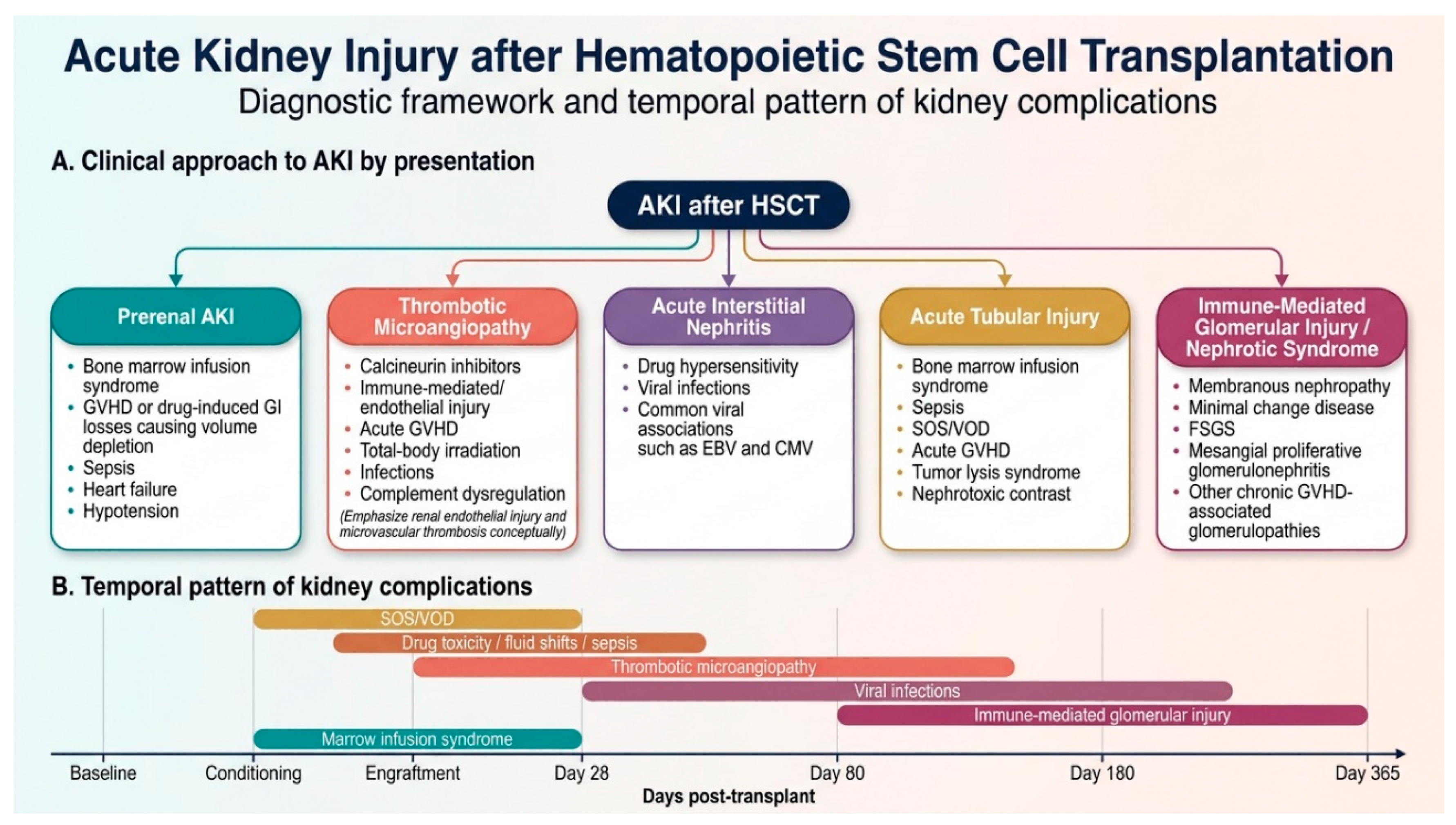

Table 1.
Transplant- and Patient-related Risk factors for AKI after HSCT.
| Transplant-related risk factors | |
| Before HSCT | Allogeneic transplantation |
| Myeloablative conditioning regimen | |
| fludarabine -melphalan containing conditioning | |
| Total body irradiation. | |
| ABO incompatibility/HLA mismatch | |
| After HSCT | Calcineurin-inhibitor based GVHD prophylaxis |
| GVHD | |
| Patient-related risk factors | |
| Before HSCT | Age |
| Baseline CKD | |
| Underlying disease | |
| Comorbidity (HCT-CI) | |
| Low serum albumin | |
| After HSCT | Infectious complications, CMV reactivation |
Table 2.
Diagnostic criteria and severity grading of sinusoidal obstruction syndrome/veno-occlusive disease (SOS/VOD) according to the revised EBMT criteria:.
Table 2.
Diagnostic criteria and severity grading of sinusoidal obstruction syndrome/veno-occlusive disease (SOS/VOD) according to the revised EBMT criteria:.
| Component | Criteria |
| Time of onset | Classical SOS/VOD: ≤21 days after HSCT. Late-onset SOS/VOD: >21 days after HSCT. |
| Diagnosis | Probable: ≥2 of the following: bilirubin ≥2 mg/dL, painful hepatomegaly, weight gain >5%, ascites, or ultrasound/elastography suggestive of SOS/VOD. |
| Clinical: Bilirubin ≥2 mg/dL plus ≥2 of the following: painful hepatomegaly, weight gain >5%, or ascites. | |
|
Proven: Histologic confirmation or hepatic venous pressure gradient (HVPG) ≥10 mmHg. |
|
| Severity grading | Mild: Bilirubin 2.0–3.0 mg/dL; liver function <3× upper limit of normal (ULN); weight gain ≤2%; normal renal function; slow progression (6–7 days). |
| Moderate: Bilirubin 3.1–5.0 mg/dL; liver function 3–5× ULN; weight gain 2.1–5%; renal function <2× baseline; progression over 4–5 days. | |
| Severe: Bilirubin >5.0 mg/dL; liver function >5× ULN; weight gain >5%; renal function ≥2× baseline; rapid progression. |
Table 3.
Comparison of commonly used diagnostic criteria for transplant-associated thrombotic microangiopathy (TA-TMA).
Table 3.
Comparison of commonly used diagnostic criteria for transplant-associated thrombotic microangiopathy (TA-TMA).
| Diagnostic Feature | International Working Group (IWG) Criteria (LeukemiaNet) | Blood and Marrow Transplant Clinical Trials Network (BMT CTN) Criteria[81] | Cho et al. Probable TA-TMA Criteria[82] | Jodele et al. Criteria[83] |
| LDH | Increased | Increased | Increased | Increased |
| Schistocytes | >4% | >2/HPF | >2/HPF | Microangiopathy (schistocytes or tissue biopsy) |
| Thrombocytopenia | Present | Not required | Present | Present |
| Hemoglobin | Decreased or increased RBC transfusion requirement | Not required | Decreased | Decreased or increased RBC transfusion requirement |
| Direct Coombs test | Not required | Negative | Negative | Not required |
| Haptoglobin | Decreased | Not required | Decreased | Not required |
| Coagulation profile | Normal | Normal | Normal | Not required |
| Renal involvement | Not required | Not required | Not required | Proteinuria >30 mg/dL and/or hypertension |
| Terminal complement activation | Not required | Not required | Not required | Elevated soluble C5b-9 |
Disclaimer/Publisher’s Note: The statements, opinions and data contained in all publications are solely those of the individual author(s) and contributor(s) and not of MDPI and/or the editor(s). MDPI and/or the editor(s) disclaim responsibility for any injury to people or property resulting from any ideas, methods, instructions or products referred to in the content. |
© 2026 by the authors. Licensee MDPI, Basel, Switzerland. This article is an open access article distributed under the terms and conditions of the Creative Commons Attribution (CC BY) license (http://creativecommons.org/licenses/by/4.0/).
Copyright: This open access article is published under a Creative Commons CC BY 4.0 license, which permit the free download, distribution, and reuse, provided that the author and preprint are cited in any reuse.